
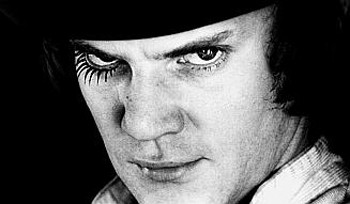
Malcolm McDowell/Tiburon Film Festival

Every Mother’s Son: Malcolm McDowell captured some grand horror in ‘A Clockwork Orange.’

Droog Day Afternoon

Alex is great, but what about Mick?

By

The camera rolls up to a male figure in a white boiler suit and bother-boots, capped with a derby. The derby is just his way of scorning the good behavior of that most well-behaved of all hats. A dandy with a welfare-state future, he holds his glowing white pint of milk, evidently supplied from the same electric dairy that Cary Grant used to scare his wife in Hitchcock’s Suspicion. Ignoring the drink, the lens heads for its target, a glowering eye whose twin is fringed below with obscene little false eyelashes.

“Hi, hi, hi.” The actor Malcolm McDowell, turning up at the Tiburon Film Festival March 11-12, will always be in thrall to his best-known character, Alexander de Large, Alex the droog. As critic David Thomson put it, in Alex we see both Ariel and Caliban–an apt description for a creature invented by a Shakespearean novelist like Anthony Burgess. To the 1971 film version of A Clockwork Orange, McDowell brought the Ariel, and director Stanley Kubrick brought the Caliban. Since that memorable image, McDowell has been a reliable character actor who knows that no matter what movie he’s in, at least five minutes of it will be good. Most recently he stopped the show in the film In Good Company, doing a fine job of flaunt-the-accent-and-collect-the-money.

Admiring McDowell’s nasty insouciance onscreen for decades, I’ve never had such a drastic range of feelings about a movie as I have about A Clockwork Orange. I loved it foolishly then, and I can’t bear it now.

When I was a young nihilist, A Clockwork Orange struck me as an antirevenge movie. It mocked that tradition of “what the movie advertisements refer to as ‘a roaring rampage of revenge,'” as the Bride says in Kill Bill 2. Revenge neither toughened Alex nor incited him to greater crimes. What didn’t kill him just made him want to die.

Still, A Clockwork Orange may be essentially a young person’s film, made particularly for audiences that never needed to fear having their home invaded. Character actor Patrick Magee’s fatuous writer, who gets “the old surprise visit,” only garners as much sympathy as Elmer Fudd would when facing his usual witty, slangy tormentor. It’s not just the droogs’ flamboyant behavior that appeals to the young trouble-fan–their rumbling, stomping and raping; it’s also their love of drugs like vellocet, synthmesc or drencrom (the last probably slang for the late Hunter S. Thompson’s beloved Adrenochrome). Alex the adolescent, haunting his record stores, drunk on sensation, is the one we feel for. He is the only one who isn’t an ape, a victim or a zombie–the missing link between Richard III and Johnny Rotten.

It’s a joke that Alex’s name is Alexander de Large, a tribute to the ultimate megalomaniac (lately cut down to size in Oliver Stone’s miserable epic). Every man’s hand is against little Alex.

This pretty thugs vs. ugly oafs motif is one Oliver Stone tried to get in his similarly divisive Natural Born Killers, a film that also prompted a censorship case in England. (Both A Clockwork Orange and Natural Born Killers were accused of spurring monkey-see-monkey-do killings.) If Stone’s film ended as a lesser cult film it’s likely because of the old movie problem of not enough chemistry; Woody Harrelson and Juliette Lewis didn’t have a shred of McDowell’s lethal charisma.

As it turned out, England in the 1970s was going to be more short sharp shock than “Ing Soc,” as George Orwell called English socialism in 1984. The droogs’ language is a catchy mix of Cockney street slang and Russian, probably implying the Kremlin’s secret involvement in all this hooliganism. But as we know, our present isn’t the summer of communism; rather, it’s the winter of capitalism. That’s why I still prefer McDowell’s starring role in an epic Candide story that’s as worthy of a second look as A Clockwork Orange.

Why isn’t O Lucky Man! on DVD yet?

Lindsay Anderson’s 1973 O Lucky Man! is a Brechtian musical horror story about England. Again McDowell plays the affable lad going through the mill. The difference is that while Alex jumps, McDowell’s Mick Travis is pushed. Anderson, a noted film critic turned director, had previously led McDowell through If . . . a variation on Jean Vigo’s famed surreal film Zero for Conduct, in which a violent rebellion breaks out against his stodgy and vicious boarding school.

O Lucky Man! is more relaxed. It’s a shrewd and uproarious cabaret movie, animated by a rollicking pub-rock score by pianist Alan Price of the Animals. It begins in the past, a silent, sepia-toned piece of fake Eisenstein homage. McDowell (made l American peon) has his hands amputated for trying to steal a single coffee bean. By the time the story begins in earnest, capitalism has got a little more polite. Still, Mick, an eager-beaver traveling salesman for a coffee firm, has to fight off at least 400 blows.

The proudly left-wing movie is certainly not to everyone’s taste. And calling it a mess can be fair. Yet O Lucky Man! anticipates the mise en scène of The Simpsons. The nice-guy mark of a hero goes down Homer’s road, taking a dozen jobs, facing Frankensteinian doctors, the savageness of the military, time in jail and the excesses of international capitalism at every new bad turn. What keeps McDowell’s kind Mick from being crushed are strange touches of grace from the middle-aged–usually motherly types. The sweetest scene features Mary MacLeod, replaying Rosasharon’s act of charity in the actual ending of The Grapes of Wrath, which Anderson’s beloved John Ford never got to stage in his classic film version.

Like A Clockwork Orange, O Lucky Man! was a movie I saw repeatedly at Los Angeles revival houses like the Fox Venice or the Nu-Art. Once I was fortunate enough to catch it at the Motion Picture Academy’s theater on Wilshire Boulevard. Anderson was there to show the full version, with a sequence cut in America. In this episode, Mick is a social worker failing to talk a poor woman out of gassing herself. Beginning as Alex, McDowell is now at one with Clockwork‘s horrific civil servant Mr. Deltoid, a foolish exponent of a system powerless to help but quite good at hurting.

It was the mid-’70s, times were almost as bad as they are now, and O Lucky Man! went over like free beer. There was, however, a dissenting voice during the Q&A session, which came from a proper English lady in the audience.

“Mr. Anderson,” she said huffily, “Is this your view of England?”

“Madame,” Anderson replied, “to use a British expression–yes, with bells on.”

“Well, I think you should put some sort of warning at the beginning of the film that this is your own view . . .” she began to retort before being quite drowned out.

McDowell’s film had the last word.

Malcolm McDowell appears Friday-Saturday, March 11-12, to be honored at the Tiburon International Film Festival. Friday, McDowell’s newest work, ‘Evilenko,’ is screened at 7pm; director David Grieco and co-star Marton Csokas will also be in attendance. Saturday at 8:30pm, ‘A Clockwork Orange’ is screened. All events at the Tiburon Playhouse Theater, 40 Main St., Tiburon. $8-$10. 415.789.8854.

Select Fest

Themes of all stripes emerge at the TIFF

While there are numerous intentional themes embedded in the programming for the fourth annual Tiburon International Film Festival–including a tribute to Cuba, presentations devoted to peace in the Middle East, sports flicks, political films, animated shorts, a focus on Marin filmmakers and those films that dwell largely on music–there are several presumaby unintentional themes as well.

The oddest of the lot is the ongoing plight of young people saddled with unwanted real estate. In Retreat, for example, four unloving trust-fund babies must decide what to do with their lavishly appointed Maine summer home, riddled as it is with memories of an especially unpleasant governness.

Similarly, in Finding Home, an award-winning new movie co-starring Genevieve Bujold, Louise Fletcher and newcomer Lisa Brenner, a young woman can only create her future by first unlocking her past, all of which is bundled up within the shingled facade of a gorgeous East Coast summer home reeking of stinky memories and demanding a broker.

In Ocean Front Property, a broken-hearted man seeks the solace of four walls and a private dock, clinging piteously to his lease when his ex-fiancée, her new man and a sexy neighbor break the silence. Egads.

Regardless of how sexy the neighbor, one will assume that she’s at least legally employed, unlike a handful of other film-fest fatales who toil at the oldest profession. “What happens when a disenfrancised kid from the suburbs takes a road trip with a prostitute from the city?” pant the filmmakers of Anathema. Something assuredly lurid.

Meanwhile, Zooey purports to tell the true story of an exceptionally attractive (albeit bruised) prostitute and her loser of a husband. And finally, the documentary Hidden Truths focuses on the miserable existence of Nicaraguan prostitutes, women who toil in an illegal milieu that is nonetheless tolerated by a government that will neither help nor condemn them, a film that should shame the makers of purient what-if prostitute films everywhere.

With some 260 films screening over one short week, the TIFF truly aims to have something for everyone, even if realty and harlotry don’t arouse. In addition to honoring Malcolm McDowell, the fest hails the art of the stuntman on Saturday morning, March 12, at 10:45am. Several unsung heroes of action films will screen clips of their most courageous and outrageous stunts as well as discuss how exactly to flip two cars against each other in a wall of flame and bricks. Or something like that.

Later that day, filmmaker Orson Welles receives laudatory examination at 7:30pm with a screening of F for Fake to be followed by a presentation by Welles scholar Joseph McBride and former Welles cameraman Gary Graver.

Wrapping up the special programming, director Sam Peckinpah is honored on Sunday, March 13, at 3pm with a showing of Sam Peckinpah’s West: Legacy of a Hollywood Renegade.

For complete and dizzying details on the TIFF, visit www.tiburonfilmfestival.com or call 415.381.4123.

–Gretchen Giles

From the March 9-15, 2005 issue of the North Bay Bohemian.
© Metro Publishing Inc.

‘Cursed’

0

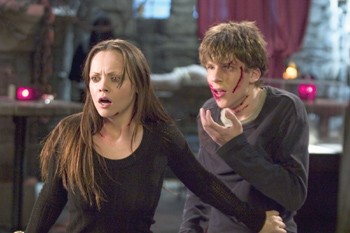
I’d Like to Meet His Tailor: As werewolf movies go, ‘Cursed’ isn’t quite awash enough in the red stuff.

Blood and Guts

Hematology memoirist Bill Hayes gets ‘Cursed’

By David Templeton

“I SEE blood! So much blood!”

With those words, effectively exclaimed by a freaky carnival palm reader in the opening moments of Cursed, director Wes Craven’s unexpectedly hip new take on the ever-popular werewolf story, it is clear that I picked the right movie to see with Bill Hayes, author of the entertaining science memoir Five Quarts: A Personal and Natural History of Blood (Ballantine; $23.95 cloth). Hayes apparently agrees. As an onscreen gypsy rambles on about blood and death and big scary beasts and how it might be good to avoid the full moon at all costs, Hayes turns with a wicked grin and whispers, “Perfect opening. This is going to be good!”

Cursed isn’t good, exactly, but it’s certainly not bad. Starring Christina Ricci as a reluctant L.A. werewolf attempting to juggle a love life, a Hollywood career and a newfound thirst for human flesh and blood, the tongue-in-cheek horror-comedy is actually kind of a kick. The only problem is that, when all is said and done, it’s not that bloody. Sure, we see drops of blood here and there as people are dispatched by an ever-expanding assortment of careerist lycanthropes. But it says something about Cursed that the big money shot, the one that gets the biggest eeew! from the audience, is of a woman with a bloody nose.

“For a movie that opens with the line ‘I see blood! So much blood!’ it didn’t really deliver on its promise,” Hayes remarks after the film, adding, “I was a little disappointed.”

Bill Hayes is not a blood fetishist, nor does he appear to be a serial killer. But he does know a lot about blood, as he demonstrates in the remarkable and very readable Five Quarts (how much blood the average human body contains). Hayes’ interest in blood stems in part from his lifelong fascination with the unseen mechanics of the human body, and also because his comic-book-loving partner, Steven, whom he talks about in the book, has been HIV-positive for several years.

Hayes writes that since the appearance of AIDS in the early 1980s, our relationship to blood has become more complicated, with blood proving to be both good and potentially dangerous, an unsettling view the ancient gladiators evidently did not share, back when they were guzzling the blood of their vanquished foes.

Hayes likes to share facts like that gladiator thing. He can also tell you that the act of draining every drop of blood from a person is called exsanguination, and knows exactly how long it takes for a single blood cell to complete a full circuit of the circulatory system in the average body at rest (about 30 seconds). Unfortunately, as he was writing the book, Hayes has accumulated so much hematological know-how that he no longer sees bloody movies in the same way.

“When that palm reader was looking at the woman’s hand,” he admits, “I found myself thinking, ‘Now, at any given time, about a quarter of the body’s blood supply is circulating through the skin, so if the average human body has about five quarts of blood circulating through it all the time, then there must be about one and a quarter quarts of blood pumping through that actress’s palm at this very moment.’ That’s the kind of thing that occurs to me all the time now.”

If you think that’s unfortunate, consider this: “I can no longer pick up a five-quart container of ice cream,” Hayes confesses, “without thinking, ‘Five quarts. If I were exsanguinated for any reason, you could fit all my blood in this plastic tub.”

Eeew!

Asked why people have such strong reactions to movies like Psycho and Carrie–which Hayes ranks along with Blade as three of the best blood-themed movies of all time–he replies, “People have probably always had a visceral reaction to the sight of blood, even when it’s very obviously fake blood. In the theater, even before Shakespeare, blood has always been an effective shock device.”

Cursed is an example of that, demonstrating that you can shock an audience as easily with a few drops of blood as you can with whole buckets of it. It all goes back to our basic human responses–that alternate fascination and revulsion which so many of us feel at the sight of blood.

“I think horror movies and vampire movies and werewolf movies–including the one we just saw–tap into that love-hate relationship we all have with blood,” Hayes muses. “In Cursed, as in the real world, blood represents life, to humans and werewolves. I have no problem with that.”

With a laugh, he adds, “I just wish there’d been more of it.”

From the March 9-15, 2005 issue of the North Bay Bohemian.

© Metro Publishing Inc.

Briefs

0

Briefs

Water War Is On

On Feb. 24, local open-space and water-resource advocates the OWL Foundation officially filed a complaint against the city of Rohnert Park in Sonoma County Superior Court, alleging among other things that the water supply assessment recently approved by the Rohnert Park City Council fails to comply with SB 610. “This new law requires local agencies to assess local water supplies, during both dry and wet water years, before approving any significant new development projects,” notes OWL litigator Ed Casey, a veteran of Southern California’s water wars.

GMO Battle Heats Up

The special election for Sonoma County’s GE-Free ordinance is months away, but the rhetoric is already flowing hot and nasty. “We believe that the CAO had insufficient time to fully assess the impacts of the proposed GMO initiative on the legal, agricultural and public health aspects of the ordinance,” says Sonoma County Farm Bureau executive director Lex McCorvey, citing the County Administrator’s Office report on the measure’s potential economic impacts released March 1. “This initiative will cost Sonoma County taxpayers millions of dollars and at the same time be devastating to family farming operations throughout Sonoma County.” Au contraire, says GE-Free campaign coordinator Daniel Solnit, who, like his counterpart, disavows the CAO report, but for different reasons. “They totally ignored the huge potential losses to farmers and county government if we don’t pass this initiative,” Solnit says.

Nurses With Balls

How to stop Republican rollback of popular, hard-fought progressive policies and initiatives? The California Nurses Association’s March 5 court victory forcing Gov. Arnold Schwarzenegger to reinstate legally mandated patient-staffing ratios in hospitals offers a clue: dog your opponent to the ends of the earth. Since boasting several months ago that he kicks nurse butt, the governor has been hounded by the CNA at almost every turn. Twice, he’s been forced to enter high-profile events through the back door or risk a public scene. When Backdoor Arnold went back East begging for campaign funds last month, the CNA ran a full-page ad against him in the New York Times. According to the latest Field Poll, the governor’s pumped-up popularity is beginning to shrivel. There’s a lesson here, liberals.

From the March 9-15, 2005 issue of the North Bay Bohemian.

© Metro Publishing Inc.

Hipper Than Hip

0

Absolutely Horrendous: The ‘Absolutely Fabulous’ Britcom characters, represented here by actress Joanna Lumley (in tattered legwarmers), epitomize what is wrong with chasing cool for cool’s sake.

Hipper Than Hip

When will we be cool enough to stop posing and embrace the real thing?

By Jon Spayde

It’s time to let hip die. It has served its purpose, energized some nightclubs, inspired some good books and made some nasty people rich. Now it can die, because it is really beginning to stand in the way of something more interesting.

Hip. The slick little monosyllable is, after all, more than half a century old, having pretty much replaced “hep” in the popular press just after the Second World War. Hep and the world of hepness and the hepcat were the spirited creations of black jazz players in the 1930s.

You don’t need to agree with The Dictionary of American Slang‘s fanciful derivation of “hepcat” from hipicat–“person in the know” in the West African language Wolof–to recognize that the clued-in, snazzily stylish hepcat ethos was pure African American creativity: a zoot-suited, hi-de-hi-de-hi-de-ho horse laugh at the racist stereotype of the “Negro” as a shuffling, mumbling, fresh-out-of-the-cotton-patch naif. Here was an image of blacks as dazzling urbanites: brilliant, stylish and “hep to the jive”–so knowing in the ways of the world, that is, that no one, ever, could get the jump on them.

Then in the bebop era, “hep” became “hip,” and this little word began a long career in the (white) mass media. From a good-natured symbol of subcultural solidarity, it slowly morphed into something altogether less cheerful and nourishing. This change is the dispiriting path from the radiantly sleek and life-affirming Harlem bandleader Cab Calloway in his white suit to a SoMa art dealer in his all-white room, sizing you up and finding you pathetic.

This change has been partly a matter of scale. Hipness has become a heavier and heavier burden with the passage of the decades. What the hepcats had to master to be hep was a manageable number of gestures, attitudes and musical fashions, mostly native to their uptown New York or Southside Chicago milieu. What the beatnik circa 1958 had to master to be hip was an expanded list, including, but not limited to, bebop, existentialism, Paul Klee, Glenn Gould, William Blake and Buddhism.

But what the early-21st-century would-be hip guy or gal has to master (or pretend to master) just to stay in the game keeps growing exponentially. Modern avant-garde art from Delacroix to Caio Fonseca. Pop culture from Louis Jordan to Deadwood. Film from the Lumiere brothers to the Coen brothers. You have to be intimately familiar with King Sunny Adé records and know what techouse is. You have to be no stranger to kink: Bob Flanagan, Jim Thompson, Ed Gein. You have to have at least a nodding acquaintance with Walter Benjamin, Jacques Derrida, Roland Barthes.

And that’s only the core curriculum, so to speak. If you decide to major in hipness, then you’re expected to go absolutely all the way. The hip film jock, for instance, should not only have favorite early ’70s Hong Kong sex comedies and German Alpine films, but also be prepared to argue the merits of raw Belgian video stock and underground Japanese anime. It just never ends, and I think that the sheer magnitude of it makes people cold and grumpy.

Compassion is called for. After all, the hip–the folks who absolutely have to keep up–are among the much-touted information glut’s frontline troops and main victims.


Hip is such an enormous proposition in our culture now that it has fragmented into dozens of different directions. What I’ve described here is mainly (but not exclusively) white, middle- to upper-middle-class, college-educated, culture-centered hip. Inner-city black hip–defined by kids as young as 14 years old–has different rules, which dictate youth culture in general and exert steady pressure on other forms of hip.

And I’m certain that there are versions of hip, hipper, hippest for most of our major subcultures, from Trekkies (it’s hipper to call them Trekkers) to truckers.

It’s mostly the arty, white-urban hip that I want to say goodbye to.

What’s wrong with Fassbinder movie revivals, raw-food restaurants and the Gotan Project? Not a thing. More of them, please.

What’s wrong is that snooty art-dealer tone, that fossilized critique of America à la 1960 that lurks in the bonding rituals of hip. And oh, the air of unanimity as those rituals go forward! We all hate wall-to-wall carpeting. We won’t sing folk songs around a campfire, except ironically. Religion sucks (although “spirituality” doesn’t). Hip, whose guiding idea is ostensibly to liberate us from our conformist childhoods, is now the very model of conformism. No wonder global capitalism adores it and needs its characteristic combination of total predictability and restless worship of change, its total ability to “deliver a demographic.”

But what lies beyond hip? Its essential truth, I submit, as well as its cancellation. I want hip to put itself out of existence by being faithful to its own principles. One of those principles is that it is very good to encounter and interact with the “Other.” That’s the point of going to Turkish restaurants and listening to African music, isn’t it?

People who are hip believe, explicitly or implicitly, that the world would be a better place if the unhip, snoring in front of their TiVos, would wake up, go out into the beautiful and complicated world, and interact with people different from themselves.

They, the hip, believe that they do this all the time.

I wonder. I wonder whether hip people are willing to jar themselves out of their own certainties as totally as they think others should be jarred. Going to see Ronald K. Brown or to hear Saul Williams may provide rich food for thought, but you may be sure it will be provided well within the comfortable ritual realm of hipness, on a respected urban stage. Let’s see how our hipsters do on a visit to an African Methodist Episcopal church in Oakland. Let them stay for the sermon–not just the cool gospel music–and consider seriously what the assembled African Americans have come to hear and mull over.

I want to see hip people confronting a hated Other like fundamentalist Christianity. Let them learn the difference between fundamentalist and evangelical. Let them read articulate evangelical scholars and leftist evangelicals. Let them, for once, sympathetically and compassionately look for the human truths that lie behind the appeal of such faiths.

I’d like them to poke around in labor history and blue-collar gay and lesbian history and regional history so they can see that the fires of unorthodox thought and spiritual rebellion sometimes burn in very unlikely looking places–in ugly little houses with wall-to-wall carpeting, for example.

What would come of this dramatic about-face I’m urging on the hip?

Maybe not the downfall of hip itself, but only a new image in the hipster’s brain of a more complex, rich, pregnant world than he or she has ever seen before.

Maybe a permanent habit of suspending holier-than-thou judgment.

Maybe a revived sense of the magical trickster logic living inside everything.

Maybe some hope for the future.

Now that’s hip.

From the March 9-15, 2005 issue of the North Bay Bohemian.

© Metro Publishing Inc.

The Byrne Report

The Byrne Report

Blind Trust

THE NORTH BAY has never been a political stronghold for Gov. Arnold Schwarzenegger, and it is even less so now in the wake of his immoderate State of the State speech in January, in which he proposed to explode government programs that benefit women, children, the elderly and the disabled. Statewide, the tide of public opinion is slowly starting to turn against the movie star whose trademark veneer of political moderation and reform has worn thin, revealing nothing less than Gray Davis on steroids.

Once again, public policy is for sale.

Davis, however, had no real personal wealth. Schwarzenegger is so rich, he’s confronted by a personal conflict of interest just about every time he opens his mouth. The key to understanding the truth of that statement is the structure of the governor’s phony blind trust.

To shield wealthy government officials from being paralyzed by possible conflicts of interest, the state’s three-decade old Political Reform Act allows them to place assets in a blind trust managed by a “disinterested party.” The theory is that, after a time, the official will no longer know what he owns. The trustee is supposed to have little or no contact with the official. He is empowered to liquidate the original portfolio and to buy new assets, which are unknown to the official.

When he set up his blind trust in 2003, Schwarzenegger designated as trustee his close friend and financial adviser Paul D. Wachter. “We’ve been friends for 25 years and been in business together for less than 15 years,” Wachter told me about his relationship with Schwarzenegger. “I am his main person in the whole business, financial, legal area–and, obviously, a close confidant. As the blind trustee, I manage all his money.”

It doesn’t take a doctorate in ethics to see that Wachter is exactly the wrong person to serve as the disinterested trustee. “‘Disinterested party’ excludes family and business associates,” says Tracy Westen, CEO of the nonpartisan Center for Governmental Studies in Los Angeles. “The word ‘blind’ means that the trust is not being run by someone with whom you interact on an intimate or a daily basis. If the beneficiary of a blind trust were to get some sense of how the trust is being invested through a casual remark, or a deliberate remark, that might affect a governmental decision. If a longtime business partner is handling the trust, I would certainly question whether it was truly blind.”

Last March Schwarzenegger appointed his friend, Wachter, to a state jobs commission. In May 2004, Schwarzenegger took his personal financial adviser, Wachter, on a trip to Israel, Jordan and Iraq to look for business opportunities. In July Schwarzenegger appointed his blind trustee, Wachter, to the Board of Regents of the University of California, which controls billions in state money.

Furthermore, Wachter is anything but disinterested in the link between the governor’s political and financial success. He is in charge of building Schwarzenegger’s international business brand and securing lucrative television commercials for the superstar in Asia. Wachter’s Main Street Advisors Inc. has long managed much of the Schwarzenegger fortune. The economic disclosure statement that Wachter filed when he became a Regent shows that he and Schwarzenegger are linked by millions of dollars’ worth of partnership investments.

A comparison of the disclosure statements indicates that at the time Schwarzenegger’s blind trust was created, he and Wachter were jointly invested in 10 partnerships: Acacia Partners (invests in publicly traded stocks); SEG Partners (public stocks); Alson Signature Fund (stocks); Tar Heel I Investors / Tar Heel II Investors (invested in the Platform Inc., a software company); Angel Investors II (venture capital); Apollo Investment Fund IV (leveraged buyouts); MSA Real Estate Investors (holds an interest in a Goldman Sachs real estate partnership); Venice Venture (venture capital); and Pinpoint Investors (owns stock in Cell Guide Ltd., which develops cell phone technology).

Wachter has every financial incentive to influence policy on taxation and government regulation of any number of industries, including, say cell phones, in ways to benefit himself and his client.

“We are not trying to create a blind trust which says the governor and I never met,” Wachter says. “Or that I sold all his assets and he does not know anything in his portfolio. Instead, as of the date of his inauguration, he has no involvement with anything in the portfolio.

“You don’t have to liquidate everything,” Wachter says. “The key point of a blind trust is that the governor is supposed to be kept away from real and apparent conflicts of interest. You do not want people even to feel like there might be a conflict of interest.”

See how you feel about our leader’s built-in conflicts by visiting Schwarzenegger.com and experiencing the synergy between his movie-star, muscle-man and political brands. Or his donor list of billionaires with whom he shares investments. It would be amusing, it if wasn’t a confirmation that we are trapped inside a plutocracy.

From the March 2-8, 2005 issue of the North Bay Bohemian.

© Metro Publishing Inc.

Male Shortage

Male Call

Where have all the good men gone?

By David Templeton

Blanca Florido has been working the phones lately, and working them hard. Using every trick, charm and persuasive skill at her disposal, Florido has been single-minded in her quest to nail down a few good men, and whenever possible, to have those men recommend a couple of others. Unfortunately, she¹s had only intermittent luck.

It all started when Florido agreed to direct an upcoming May production of Carousel for the San Anselmo Town Players. The popular Rodgers and Hammerstein musical has, over the years, become a staple of community theater around the country, renowned for its serious tone, haunting music and—being that it takes place among a motley crew of carnies and circus performers—for its colorful cast and setting. Unfortunately, there are a large number of male roles in the show, and an apparent dearth of male actors in the North Bay. Florido has been struggling to find enough men to even out a conspicuous gender imbalance in her large troupe of players: at the moment, she’s cast 47 females— but only seven males, and those seven weren’t all that easy to get.

Says a bemused Florido, “I’ve had to promise all sorts of things—negotiating rehearsal times and everything, agreeing to let some of them start rehearsing in mid-March, after their schedules have freed up—just to get enough male bodies to fill the men’s roles. But I still have a number of small male roles left to fill, so I’m not sure what we’re going to do.”

What Florido is describing is a problem that has been facing the community theater and small-theater world of the North Bay for some time now. It’s become a common theme: whenever a show calls for a cast of youngish representatives of the manly persuasion, the casting folks have a terrible time luring in enough guys to pull off the show. The situation is bad enough when a company seeks to stage a Shakespeare or David Mamet play, but the problem grows especially acute when it’s a musical, since young, triple-threat men (those who can act, sing and dance) are nearly impossible to find. As a result, those few qualified guys seem to have the pick of parts they might not always be suited for, resulting in middle-aged dudes and unseasoned youths straining believability as they take on the parts of dashing twenty- or thirty-something leading men.

“I think it’s pretty universal around here that when men go out for parts in community theater, they have very little competition,” Florido states. “It’s not that tough for men to get good parts, while for women, there’s a lot of fierce competition.”

Argo Thompson, executive director of the new Sixth Street Playhouse in Santa Rosa, currently staging the female-centric musical Mame, agrees. “This problem,” he says, “is one of the reasons why we are seeing more all-female productions of everything from Hamlet to True West. I’ve personally been thinking of doing an all-female version of Glengarry Glen Ross.” The shortage of quality males has also affected local play selection as well. “When the Players are choosing musicals,” he says, “it is much more likely that we would choose Sweet Charity than South Pacific.”

“It isn’t necessarily difficult to find men so much as it’s difficult to find younger men,” adds Holly Vinson, artistic director for Santa Rosa Players. She cites the recent auditions for Santa Rosa Players’ upcoming production of Guys and Dolls, which attracted plenty of men ranging ages 40 to 65. “When you’re doing a musical that calls for a guy in his 20s who can sing and act and move,” she says, “it’s almost impossible to find him in this town. That’s been true for quite a while.”

“My personal take on the subject,” says Gene Abravaya, who recently directed Pacific Alliance Stage Company’s all-female version of The Odd Couple at Spreckels Performing Arts Center, “is that the arts have always attracted only a small percentage of our population, of any gender.” Additionally, Abravaya believes that the younger generation does not share the same fondness for live theater as do older generations. “Ask a sampling of young people today if they would rather be performing in a Broadway show or a rock concert at Madison Square Garden,” he says, “and they will choose the latter practically every time. So our rapidly depleting ranks are not being filled the way they once were.”

The problem may also be related to the success of North Bay community theater as a breeding ground for young talented actors who, once they reach the right age, tend to head off to San Francisco, Los Angeles and New York to try their luck in professional theater—that is, theater that includes a hefty paycheck.

“In local community theater,” says Florido, “we’re relying on people’s volunteer participation, and we’re lucky to get as many good people as we do.” That said, she is confident that she will eventually find enough capable men to fill the remaining roles in Carousel.

“If you can sing and dance, even a little, it’s not too late!” she laughs. “Come join us! We need you!”

All singing and dancing males are invited to call Blanca Florido at 415.454.7602.

From the March 2-8, 2005 issue of the North Bay Bohemian.

© Metro Publishing Inc.

John Adams

0

Modern Master: Composer John Adams’ recent Grammy win reveals a rare acuity of the music industry.

‘Souls’ Ascending

John Adams gets Grammy nod for 9-11 elegy

By Greg Cahill

The celebrity hounds sniffing for stories in the mainstream media cast their eyes in the direction of Kanye West on Feb. 13, wondering if the rapper–who had garnered a whopping 10 Grammy Award nominations–would sweep the star-studded ceremony. His smash hit “Jesus Walks” picked up Best Rap Song honors. All in all, West, who showed no sign of humility during his arrogant acceptance speech for that award, had to settle for just three Grammys that night. Star Jones must have been soooo disappointed.

But the media mostly ignored the fact that reclusive composer John Adams, who splits his time between his Berkeley home and a secluded Sonoma County ranch polishing the upcoming opera Doctor Atomic (chronicling the endeavors of atomic bomb creator J. Robert Oppenheimer and slated for its world premiere on Oct. 1 at the San Francisco Opera), also picked up three Grammys, all for the same remarkable piece–a work that surely will stand the test of time long after the fickle pop-music audience is asking Kanye who?

Adams’ 2002 composition On the Transmigration of Souls, recorded last year on the Nonesuch label, won for Best Classical Album, Best Classical Contemporary Composition and Best Orchestral Album.

No small feat.

The stunning recording, a monumental 25-minute work that honors the victims of the Sept. 11, 2001, World Trade Center attacks, captures the dark side of the American experience and finds Adams traveling far beyond the somber minimalism and fanciful miniatures that brought him to the public’s attention in the 1980s.Like the event itself, it stops you in your tracks, forcing you to gaze into the abyss and ponder the eternal.

This extraordinary piece, commissioned by the New York Philharmonic and the Lincoln Center’s Great Performers program, was recorded during premiere anniversary concerts held between Sept. 19-24, 2002. It is a complex multilayered affair that Adams has called “a memory space.”

The work’s single movement features narrators intoning the names of the lost along with excerpts from their last fleeting phone messages, taped street sounds that bolster the sense of menace and a pair of spectral choruses reading snippets of the desperate messages left on handmade posters by family members searching for their loved ones.

It is chilling and heartbreaking and difficult to listen to without being cast back into that pit of grief that is Ground Zero. And that is its brilliance.

Adams–whose 1991 opera The Death of Klinghoffer was cancelled by several companies in the weeks after the attacks because it was deemed too provocative–has created an aural time capsule, a crucible for the horror that spilled from that rip in the American psyche known collectively as simply 9-11. It is not cathartic.

Rather, Adams–who has said he wanted the piece to be contemplative, like a Gothic cathedral–has stepped into the role of a modern-day Virgil, guiding us through a day in hell. There is no neat resolution. In the last seconds, the horror evoked simply dissipates into a vague sense of disbelief set against the soft whoosh of taped traffic noise and the ethereal sound of papers blowing in the wind. The listener is left to contemplate that sad day again.

On the Transmigration of Souls is a work everyone should hear at least once, though many might choose not to reawaken those memories. Yet, for future generations, this work is a haunting, visceral monument that should go a long way toward helping to communicate the emotional impact of a dark moment in American history.

From the March 2-8, 2005 issue of the North Bay Bohemian.

© Metro Publishing Inc.

Sculpture Sonoma

0

Art-chitecture: Bruce Johnson’s ‘Poetry House’ travels down Meyer Grade in two pieces for its first public showing.

Byck’s Miracle

Sculpture Sonoma, 2005–coming to a venue near you

By Gretchen Giles

Dr. Walter Byck is a miracle worker. Certainly, the retired physician helped to save many lives during his long career. Certainly, the wines that he and his wife, Marijke, produce at their Paradise Ridge winery are remarkable. But such merely human feats pale compared to Byck’s most recent swoop of prestidigitation: he has somehow–mirrors? smoke?–convinced every major arts organization in Sonoma County to work amicably together toward the same goal. And they said that humankind would never walk on the moon!

Byck’s effort is not unlike the terrors and trials of space travel. Using only his enthusiasm and overworked cell phone, the sweet result of Byck’s efforts is titled Sculpture Sonoma, 2005, and involves almost every sculptor in Sonoma County concurrently showing work at 12 disparate exhibition spaces in the late, hot, wane of this coming summer.

Venues include the Byck’s own Sculpture Grove–celebrating its 10th anniversary of presenting challenging, cutting-edge art in a magnificent five-acre outdoor setting–as well as the Museum of Contemporary Art, the Sonoma County Museum, the Sonoma Valley Museum of Art, the Charles M. Schulz Museum, the Cultural Arts Council of Sonoma County’s gallery, the Sebastopol Center for the Arts, both of the SRJC campus galleries, Sonoma State’s prestigious University Art Gallery, the city of Santa Rosa’s Finley Center and even the city of Cloverdale, which has been greatly involved of late in presenting public sculpture.

The concept evolved with the Byck’s Sculpture Grove approaching its decade mark. “The idea was to honor local sculptors and to create a cooperative venture,” Byck explains by, yes, his cell phone. The doctor asked his artist friends to compile lists of those colleagues and peers whose work they most admired in order to create a pool of talent.

Karen D’Or, executive director of the Cultural Arts Council, has helped to shape the resulting pool of talent, and the event and her gallery will act as an anchor to help unite the disparate venues into a comprehensible whole for visitors. Byck’s miracle helps the arts council move closer to its chosen goal of coordinating often competing venues for the greater good of all.

And good it is. World-renowned artist Mark di Suvero–who splits his time like a tourist’s T-shirt between New York, Paris and Petaluma–will be placing works in Paradise Ridge’s wine cellars, as his outdoor pieces are simply too massive to be erected for just one year. Cazadero artist Bruce Johnson is bringing what Byck terms his “most ambitious venture,” The Poetry House, to settle in among the oaks; Byck has been busy for weeks grading a pad for its placement. Light sculptor Charles Churchill will exhibit his jazz-infused electrical miracles at the Finley Center.

Cloverdale artist Carol Setterlund will enjoy a tremendously well-earned one-woman show at the Sonoma County Museum, while large-scale civic sculptor Robert Ellison will show works at both Paradise Ridge and the MOCA. Sea Ranch-based bronze sculptor Robert Holmes, who keeps a foundry in Sebastopol, has agreed to participate. Woodworker and HGTV host David Marks is creating a gilded redwood piece for Paradise Ridge that Byck claims to be “absolutely astonishing.”

Perhaps most astonishing of all is that there is funding. The Community Foundation of Sonoma County, a grant-making nonprofit dedicated to supporting the arts and human services, itself just received a large endowment from the James Irvine Foundation, a name familiar to those who watch and listen to public media. In a truly shocking state of affairs, monies from the Irvine grant are available to promote Sculpture Sonoma, 2005, as well as to produce a slick, four-color catalogue and maps to delineate the countywide placements of art.

Byck, who proposed to his wife outside of a sculpture garden in Holland almost half a century ago, is near giddy about seeing a life’s dream take on physical scale outside of his own property. “I am a physician. I like math and physics. And then I met Bruce Johnson. Now,” he chuckles with unabashed glee, “I know more sculptors in Sonoma County than anyone.”

And for that we thank you, Dr. Byck.

From the March 2-8, 2005 issue of the North Bay Bohemian.

© Metro Publishing Inc.

Chun Yu

Never Forget: Author Chun Yu recalls the horrors of the Cultural Revolution.

Daughter of the Revolution

Chun Yu’s ‘Little Green’ offers a window of innocence on a dark chapter of modern China

By Sara Bir

Chun Yu is slight, with long black hair and dark eyes that sparkle. At first glance, her girlish looks would prompt any bouncer worth his salt to check her ID. But were one to read Chun’s book Little Green, the first few passages would reveal that there’s no need:

“I was born in a small city near the East Sea, / When the Great Cultural Revolution began. / My name is Xiao Quing, Little Green, / My country Zhong Guo, the Middle Kingdom. / When I was ten years old, / Our leader died and the revolution ended. / And this is how I remember it.”

To meet Chun, who is warm and personable and apt to explode into an infectious giggle, you would never detect that she was born at the exact moment the Chinese Cultural Revolution began, on May 4, 1966. The decade that followed is now referred to by both the Chinese public and government as the Ten Years Great Calamity. Logic and tradition were turned upside down as students betrayed teachers, families splintered and millions died. In her book Little Green: Growing Up during the Chinese Cultural Revolution (Simon & Schuster; $15.95), first-time author Chun tells us of the Revolution as she saw it: from the perspective of a child.

“I think Little Green is a pretty innocent book,” says Chun, settling down over tea in her San Rafael home. “I was a child, I was protected by my family. But we had tough lives.”

Little Green, written in the form of a prose poem, reveals the everyday wonder and hardships of growing up during a tumultuous period that much of the world is barely aware of outside the context of history books. Chun’s narrative gently unwinds to paint memories of a family’s quiet struggles, unshakable love and hard-won stability. She was only two when the government sent her father away for re-education in the countryside; the rest of the family stayed behind, leaving Chun’s mother to raise her and her brother while working full-time as a teacher. They lived with 11 other families in a long one-story building. In the evenings, many of the children were alone while the adults went to mandatory political classes:

“Often the electricity went out, / an oil lamp was all we had– / the light glowing only in a sphere– / beyond that, it was pure darkness.Somewhere in the darkness, I thought, / Mama must be under another sphere of light / with Chairman Mao’s Red Book in her hand. / Baba was too far away; / we couldn’t imagine what his life was like / and whether he had a sphere of light too.”

Almost everyone has tiny incidents of early life etched perfectly in memory–the texture of bright orange shag carpet, the sting of a scraped knee, the muggy panting of the family dog–but few of us can string them together to form a compelling, moving whole. Little Green, which is slender but rich with detail, benefits as much from Chun’s vivid recollection of the small and commonplace as it does from its dynamic historical backdrop. The situation may not have been universal, but a child’s reaction to the world around her is. This is what Chun captures.

“There are certain things that made such an impression on me, I’ve never forgotten them,” Chun explains. “Those things, I remember every detail of it. I was very young. Most children live in the moment.

“All of the parents had to go to study after dinner, and so all of the grandparents showed up to take care of the kids, because the other choice was to be locked up at home. It’s a life that people here would picture as perfect–‘Oh, this fuzzy, warm love we had every day’–but love has different qualities. And some love is not that fuzzy, because in that environment we could not afford it to be. But you can see–it’s solid, it was very real. I think that’s the best gift my parents gave me, this confidence in them that if something happened, I know they would give everything they could.”

The story behind Little Green is nearly as remarkable as the story it tells. After getting her master’s degree at Peking University, Chun came to the United States in 1991 to earn her Ph.D. in chemistry at Rutgers. She was awarded a post-doctoral fellowship by a joint Harvard-MIT program soon after. “It was very difficult for me here at the beginning,” she says. “I went to different ESL classes, but I never felt really confident, because there were a lot of foreigners and only one English teacher.”

Chun eventually pursued an English study of her own devising, by reading the New York Times religiously and looking up all of the words she didn’t know. “I believed that by reading the newspaper, every section of it–politics, fashion–I’d learn the culture,” she smiles. “Every word came upon me. Eventually, I wrote a letter to my sister: ‘I have made up my mind. From now on, I will learn this language. I will love it, and one day I will write with a glow.'”

Chun wrote short poems in Chinese and English, and read in the Boston area often. “But I always wanted to tell my own story, and I always wanted to write a book,” she says. So she signed up for a Harvard Extension writing class, and that’s where the first version of Little Green was created. From the very first sentence, she wrote in English.

“I met many students when I came here, and some of them knew something about China, but most of them, it’s just not something that they are very learned about. But I have made many friends here, and they want to know. You can’t hand them a history book, ‘Learn the history and then come back and talk to me,'” she says. “So I often told them my childhood story, and they got so much out of it. At the time, my country was so isolated from the United States–they were our enemies. So my childhood story had nothing in common with life here on the surface. This desire of communication, trying to help them understand my life, it’s always there.”

Over the next several years, Chun continued to expand and refine her manuscript. “After my full-time job, I’d come home and have dinner. Then I’d try to stay awake. At one moment, you’re finally awake, in the quiet of night. I waited for these moments to come to me. I really never forced anything. This pool of stories in my head that I cared about, each story finds its moment to tell itself. Actually, I wrote the beginning and the ending on the same day. And the story in the middle just showed itself from moment to moment.”

Even though she had been sharing her manuscript with friends and her writers’ group, Chun wasn’t actively seeking publication. “I was really inexperienced. I had no idea about agents, I had no idea about the publishing business. At the time, it seemed too early to think about getting an agent.” But on a tip from a friend, Chun e-mailed her manuscript to an employee at Simon & Schuster. Taken with Chun’s work, he called it to the attention of editor Paula Wiseman.

“In a few days,” Chun says, “she sent me this long e-mail, and she said some very nice things about the book. I had no idea who Simon & Schuster was then. I was just so lucky. I truly met people who read the book and came back with unbelievable encouragement.”

Just as Little Green found a publisher, Chun accepted an offer to work as a principal scientist at Medtronic, a medical device company whose vascular division is in Santa Rosa. Chun recently took a leave of absence from Medtronic to focus on her writing and complete two more manuscripts that will pick up where Little Green left off, forming a trilogy. As Chun grows, so does the voice of the narration; the last book will eventually come to the time of the Tiananmen Square demonstrations, which Chun participated in.

“Many, many Chinese people lived as I did,” she says. “I feel this kind of life is poetry. You don’t need to have huge drama–what happened is already enough. I just want people to know exactly how life was; I didn’t need to make up anything.”

Chun Yu appears on Thursday, March 10, at 7pm at Copperfield’s Books’ Montgomery Village store (2316 Montgomery Drive, Santa Rosa, 707.578.8938); Tuesday, March 15, at 7pm at Book Passage (51 Tamal Vista Blvd., Corte Madera, 415.927.0960); and on Sunday, March 20, at 11am at Barnes & Noble (700 Fourth St., Santa Rosa, 707.576.7494). All events are free.

From the March 2-8, 2005 issue of the North Bay Bohemian.

© Metro Publishing Inc.

Briefs

0

Briefs

Race Report Card

Last week, Oakland-based public-policy institute the Applied Research Center (ARC) released a report card on state government based on how public officials voted last year on 10 bills identified by ARC as having “the most direct positive impact on communities of color in the state.” The bills ranged from efforts to improve access to higher education for minorities to defining what constitutes a hate crime. The good news is that the North Bay’s 2004 legislative contingent, assemblymembers Patti Berg, Pat Wiggins and Joe Nation, and senators John Burton and Wesley Chesbro, were all awarded A’s. In fact, overall, the Legislature’s majority party averaged an A in the grading. The bad news is that Republicans, including Gov. Arnold Schwarzenegger, averaged an F, dragging the state down to a C. Shouldn’t they be grounded for that or something?

Low-Wage Lament

The North Bay’s state politicians may have scored high when it comes to racial equality, but the area’s economy continues to get lousy marks from New Economy, Working Solutions, the nonprofit research organization chaired by Santa Rosa Junior College professor Marty Bennett. The organization releases “The Limits of Prosperity,” its most recent report on the economies of Mendocino, Napa, Sonoma and Marin counties, at a special forum on March 5, from 9am to 11:30am, at SRJC. “The burden of poverty has been shouldered disproportionately by minorities in the North Bay,” the study finds, noting that “Latinos and Native Americans are nearly three times as likely as whites to be poor; blacks are twice as likely; and Asians are one-third more likely to be poor.” For more info on the forum, contact 707.545.7349, ext. 221.

Don Wan

On Feb. 25, Donald Huberty, the 76-year-old former Sonoma County resident whose legal battle with Charles Schwab Inc. was recently detailed in these pages ( Feb. 9), was ordered by Sonoma County Superior Court Judge Allan D. Hardcastle to enter arbitration with the discount securities broker. Hardcastle told Huberty he must enter arbitration with the National Association of Security Dealers no later than June 24 or the case will be dismissed. Huberty, who lives in Costa Rica, hopes to appeal the decision.

From the March 2-8, 2005 issue of the North Bay Bohemian.

© Metro Publishing Inc.

Malcolm McDowell/Tiburon Film Festival

Every Mother's Son: Malcolm McDowell captured some grand horror in 'A Clockwork Orange.'Droog Day AfternoonAlex is great, but what about Mick?By The camera rolls up to a male figure in a white boiler suit and bother-boots, capped with a derby. The derby is just his way of scorning the good behavior of that most well-behaved of all hats. A...

‘Cursed’

I'd Like to Meet His Tailor: As werewolf movies go, 'Cursed' isn't quite awash enough in the red stuff.Blood and GutsHematology memoirist Bill Hayes gets 'Cursed'By David Templeton"I SEE blood! So much blood!"With those words, effectively exclaimed by a freaky carnival palm reader in the opening moments of Cursed, director Wes Craven's unexpectedly hip new take on the ever-popular...

Briefs

BriefsWater War Is OnOn Feb. 24, local open-space and water-resource advocates the OWL Foundation officially filed a complaint against the city of Rohnert Park in Sonoma County Superior Court, alleging among other things that the water supply assessment recently approved by the Rohnert Park City Council fails to comply with SB 610. "This new law requires local agencies to...

Hipper Than Hip

Absolutely Horrendous: The 'Absolutely Fabulous' Britcom characters, represented here by actress Joanna Lumley (in tattered legwarmers), epitomize what is wrong with chasing cool for cool's sake.Hipper Than HipWhen will we be cool enough to stop posing and embrace the real thing?By Jon Spayde It's time to let hip die. It has served its purpose, energized some nightclubs, inspired some...

The Byrne Report

The Byrne ReportBlind Trust THE NORTH BAY has never been a political stronghold for Gov. Arnold Schwarzenegger, and it is even less so now in the wake of his immoderate State of the State speech in January, in which he proposed to explode government programs that benefit women, children, the elderly and the disabled. Statewide, the tide of public...

Male Shortage

Male CallWhere have all the good men gone?By David TempletonBlanca Florido has been working the phones lately, and working them hard. Using every trick, charm and persuasive skill at her disposal, Florido has been single-minded in her quest to nail down a few good men, and whenever possible, to have those men recommend a couple of others. Unfortunately, she¹s...

John Adams

Modern Master: Composer John Adams' recent Grammy win reveals a rare acuity of the music industry.'Souls' AscendingJohn Adams gets Grammy nod for 9-11 elegyBy Greg CahillThe celebrity hounds sniffing for stories in the mainstream media cast their eyes in the direction of Kanye West on Feb. 13, wondering if the rapper--who had garnered a whopping 10 Grammy Award nominations--would...

Sculpture Sonoma

Art-chitecture: Bruce Johnson's 'Poetry House' travels down Meyer Grade in two pieces for its first public showing.Byck's MiracleSculpture Sonoma, 2005--coming to a venue near youBy Gretchen GilesDr. Walter Byck is a miracle worker. Certainly, the retired physician helped to save many lives during his long career. Certainly, the wines that he and his wife, Marijke, produce at their Paradise...

Chun Yu

Never Forget: Author Chun Yu recalls the horrors of the Cultural Revolution.Daughter of the RevolutionChun Yu's 'Little Green' offers a window of innocence on a dark chapter of modern ChinaBy Sara BirChun Yu is slight, with long black hair and dark eyes that sparkle. At first glance, her girlish looks would prompt any bouncer worth his salt to check...

Briefs

BriefsRace Report CardLast week, Oakland-based public-policy institute the Applied Research Center (ARC) released a report card on state government based on how public officials voted last year on 10 bills identified by ARC as having "the most direct positive impact on communities of color in the state." The bills ranged from efforts to improve access to higher education for...
11,084FansLike
4,446FollowersFollow
6,928FollowersFollow