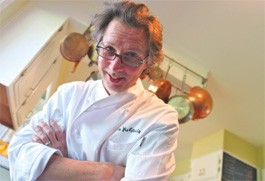
Whamola!

0

music & nightlife |

By Matt Pamatmat

There is footage on the Primus DVD Animals Should Not Try to Act Like People where, during the band’s classic “My Name Is Mud,” multiple Les Claypools assault the stage with bass guitars, imitators mimicking the Primus frontman’s gangly knee-stomp. It’s a good analogy for Claypool, whose post-Primus years have seen him in various and seemingly unending configurations: musician, novelist, mockumentarian.

Like Pink Floyd’s crazy diamond, Claypool remains a many-faceted renaissance man, mutating and evolving over the years but always keeping some trademark thread that runs through all he does, that permeates whatever media he works in. As I found out by getting the chance to talk with him on the phone, he is not the stereotypical rock star; he’s articulate, even eloquent, down-to-earth and self-deprecating, a seriously talented individual but one who doesn’t take himself, or anything, too seriously.

From the early days of Primus, originally called Primate, when Claypool would slink across the stage giving his trademark hand-shaking wave to the audience, to his various collaborations with an eclectic cast of musicians, he has remained a wellspring of creativity and a raconteur of the seedier, weirder side of existence. This Dec. 31, he brings his traditionally unpredictable annual New Year’s Eve bash to the North Bay.

Since the early ’90s, Claypool and his family have called the North Bay home. As he sings in the Primus song “Coddingtown”: “Moved on up to Sono-Co to clear my head of smog.” North Bay references figure prominently in Claypool’s songs, from Del Davis’ Christmas Tree farm on Highway 116 to D’s Diner in Sebastopol. The video for the Primus song “Jerry Was a Racecar Driver” was filmed at Petaluma’s battleworn Phoenix Theater.

Unlike musicians who unsuccessfully break free of a popular band to pursue solo interests, Claypool’s talents have only diversified over time. An iconoclastic artist always with a new trick up his sleeve, Claypool has used his down time from Primus to swap ideas and record with musicians as diverse as the Police’s Stewart Copeland, Funkadelic and later Talking Heads keyboardist Bernie Worrell, KFC-container-wearing guitarist Buckethead, Phish’s Trey Anastasio and others. These collaborations have also resulted in some interesting band names, as the Worrell, Buckethead and (second Primus drummer) Brain project was dubbed Colonel Claypool’s Bucket of Bernie Brains. By occasionally engaging in other pursuits, the bassist has helped keep Primus relevant while allowing time for members to explore new dimensions, as with original drummer Tim Alexander’s latest band, Fata Morgana.

Of late, Claypool directed and starred in a mockumentary about the jam-band scene, Electric Apricot: Quest for Festeroo (partially filmed in Marin County), as well as sitting down to write the novel South of the Pumphouse and releasing the album Of Whales and Woe. Claypool cites Bukowski, David Sedaris, Terence McKenna and Groucho Marx, among others, as literary influences. The novel, Claypool’s first, is in its fifth printing.

“I had someone throw a copy of Pumphouse at the taxicab I was leaving in,” Claypool said on the phone from home, where he is recuperating after a recent combined book and Primus tour. “I wasn’t able to sign their copy and had to get going, and they were pretty pissed,” he chuckles.

Not long after Animals Should Not hit the stores, Claypool released a DVD showcasing his solo and post-Primus collaborations, 5 Gallons of Diesel, the title of which comes from a line in the brutal, postapocalyptic, oh-shit-we-ran-out-of-oil sci-fi film Road Warrior. “The movie theater where I grew up would show it late at night,” he explains. “If there wasn’t anything else to do, we’d go see Road Warrior.”

Then there is Claypool’s traditional New Year’s Eve shows. Decked out in creative raiment, he holds an almost messianic sway over his flock, his bass an instrument of truth as he leads his so-called fancy band. Claypool has been known in past New Years’ to celebrate with a bellyful of magic mushrooms. Part of the tradition is a “best hat” contest, making New Year’s shows with Claypool a surreal distant cousin of Sunday at a Baptist church.

Claypool’s band features members who helped him–circa the Fearless Flying Frog Brigade era–perform Pink Floyd’s bitter concept album Animals live in its entirety. This year, Claypool’s 16th time hosting, should be especially festive, with the recent political thumping of the neo-cons sure to make the outspoken, left-leaning Claypool smile. A Willy Wonka of a newer, less innocent age, Claypool nonetheless gives us reason to hope–or at least to bounce up and down.

Les Claypool’s New Year’s Eve Hatter’s Ball is slated for Sunday, Dec. 31, from 7pm. With DJ Malarkey, the New Orleans Social Club–featuring George Porter Jr., Leo Nocentelli, Ivan Neville, Henry Butler and Raymond Weber–members of the Meters and the Neville Brothers–and funny funksters the Coup. Santa Rosa Fairgrounds Grace Pavilion, 1375 Bennett Valley Road, Santa Rosa. $50-$100; all ages. Vehicle camping available. 707.861.2035.


FIND A MUSIC REVIEW

First Bite

0

The Slow Food movement is sweeping the nation, and I’m planning accordingly. I’m buying as much stock in olive oil as I can.

Slow Food chefs are nuts for the stuff. They treat it like fine wine, identifying the fruits’ appellation and vintage, crafting meticulous tasting notes, and pairing it with food based on each oil’s flavor, fragrance and even color.

If there’s any chance to use a little olive oil in a recipe, a Slow Food chef will. And if it’s possible to use a whole lot of olive oil, don’t put it past a Slow pro to open the floodgates.

Case in point: the Slow Food temple Bovolo, set within the Plaza Farms gourmet grocery/epicurean gift shop in Healdsburg (bovolo is Italian for “snail,” and the snail is the Slow Food logo). All the food at this charming restaurant is artisan, made from scratch using Northern California-sourced ingredients. Bovolo’s people appreciate good olive oil, particularly that produced by Healdsburg’s own DaVero, made from trees imported from Tuscany. (DaVero, in fact, shares retail space in Plaza Farms.)

Now, I adore great olive oil, and as luck would have it, my mom and I visited Bovolo in November, just in time for DaVero’s “Olio Nuovo” fresh press of the year. We enjoyed a terrific lunch, leaving with olive oil coating our tongues and seeping out of our pores for days after.

Oil shimmered on the plate when I picked up my first piece of coo-coo frites, a half-dozen decadent hot pockets of pillowy Parmesan-dusted dough stuffed with explosively rich, buttery-wet mozzarella and house-cured, black pig salumi ($6.50). Oil glistened in a light green puddle atop a cup of rustic Tuscan pork stew ($4.50), thinning it into more of a porridge of kale, carrot, Parmesan and farro.

Oil perfumed the Bovolo burger, the plump ground sausage patty slicked with mustard aioli and served alongside delightfully cinnamon-y apple and onion marmelata ($9.50). Whole olives frolicked in their own happy greasiness alongside the burger and another sandwich of nicely salty proscuitto di Parma layered with nutty Bellwether Farms fontina and tangy fig jam ($8.50).

By this time, I was delighted; mom (who could last a year on just a half pat of butter) was pretty queasy. But, I promised her, every dish at Bovolo isn’t so hog-wild with oil.

We returned later for a beautiful thin-crust pizza, the 12-inch funghi ($16.50) layered with fat, sweaty wild mushrooms and tart, salty Laura Chenel goat cheese (we passed on the optional spritz of white truffle oil, $2).

A sausage sandwich ($8.50) featured undoubtedly the best link I’ve ever had in my life, the crisp skin popping and sending juices running down my chin. On top of the crunchy muffinlike roll sat fresh peppery arugula sprinkled with lots of Parmesan, pepperoncini and caramelized onion; the trick was to get the whole thing in my mouth in one bite to experience all the flavors at once.

It was a lovely, light and lively meal. We passed on the dessert special of the day, however: olive oil pound cake.

Bovolo, 106 Matheson St., Healdsburg. Breakfast, lunch and dinner served daily. 707.431.2962.


View All

Quick-and-dirty dashes through North Bay restaurants. These aren’t your standard “bring five friends and order everything on the menu” dining reviews.

News Briefs

December 13-19, 2006

Mitchell resurfaces

An online blog is the latest forum for Pulitzer Prize-winning journalist David Mitchell, former owner of the Point Reyes Light newspaper. Last fall Mitchell sold the Light to Robert Plotkin for $500,000, but the two had a falling out. Mitchell is under a three-year injunction to stay away from Plotkin and the Light offices, and recently a judge ordered him to stop writing on a volunteer basis for the Bodega Bay Navigator, an online-only publication. Now Mitchell has launched SparselySageAndTimely.com. The blog presents Mitchell’s musings on birds, lizards, raccoons, snakes and Plotkin. “This is my one opportunity to publicly make a point-by-point rebuttal to all the things the new owner of the Light has said about me in public,” Mitchell explains.

Honored but humble

California Department of Forestry (CDF) battalion chief Tina G. Anderson of Napa County says she was just doing her job when she helped rescue a helicopter crew in July 2004, actions that recently earned her the Governor’s Medal of Valor. In 2004, a Butte County fire was believed to be under control when a CDF helicopter crashed in a steep, brushy area. While Battalion Chief Joseph W. Waterman led some 50 firefighters in creating a landing zone for a helicopter rescue, Anderson and heavy fire equipment operator Fredrick Westrip worked to extricate a member of the helicopter crew who was trapped inside the downed craft. A spot fire broke out approximately a thousand feet downhill from the crash site and began racing in their direction. “The sequence of events went from really bad to worse,” Anderson recalls. The injured crew was airlifted out and the firefighters retreated. “About the time we made it to the safety line, the fire hit the crash site, so we didn’t have a lot of time left,” Anderson says. Everyone survived. Waterman and Westrip each also received a Medal of Valor from the governor. Anderson says she doesn’t feel like a hero. “There are a lot of people out there who do amazing things, who don’t get recognition.”

Funding nurses

The state recently handed out $1.5 million in a competitive grant process, and Sonoma State University picked up $114,319 for its program offering master’s degree-level nurse-practitioner training for rural and underserved areas of Northern California. The students can either be on SSU’s Rohnert Park campus or participate online through a “distance learning” program in collaboration with the California State Universities at Chico and Stanislaus, explains SSU nursing department chairwoman Liz Close.


Two by Two

0

December 13-19, 2006

Best-of-the-year lists are often about connecting big cultural dots. What did this year’s discs by Beck and E-40 tell us about micropersonal technology? Did the latest by the Killers and DJ Shadow shed any light on religious extremism? This topical thinking led me nowhere in 2006, but I did find that new releases made sense in pairs.

For example, I found two openly political singles both inspiring for their divergent displays of humanism. The Dixie Chicks’ “Not Ready to Make Nice” is a bitter, trenchant reply to the shit they’ve taken for being anti-Bush; it’s dead serious blues-rock with its own stay-the-course truth. Conversely, Soul Asylum’s “Lately” is the best bring-the-boys-home fantasy of 2006, thanks to its light-hearted bubblegum swing.

Here are some pairings that connect a few of the year’s best albums.

Drive-By Truckers, A Blessing and a Curse; Ghostface Killah, Fishscale

This pair shares the great attribute of plain-spoken, thoughtful storytelling. Drive-By Truckers offer gutsy, emotive roots-rock, emerging from the shadow of Lynyrd Skynyrd comparisons not with triple guitar fire but rather with a triple singer-songwriter punch. Ghostface Killah is the last member of rap collective Wu-Tang Clan to remain vital, yet he sounds vulnerable on this character-filled, soul-based narrative about dealing cocaine. Both discs tell cautionary tales about moving on; while DBT ask what’s next on the Stones-like “Aftermath USA,” Ghostface samples the Stylistics for a sad goodbye on “Big Girl.”

Boris, Pink; Bobby Bare Jr., The Longest Meow

If you enjoy an off-the-cuff, warts-and-all aesthetic, this pair packs a huge payoff. Boris are a Japanese noise-punk power trio that smoke ambient feedback and belch industrial spazz, sometimes in terse riff-metal blasts and sometimes in scattered transformations like the 17-minute drone “Just Abandoned Myself.” Bobby Bare Jr.’s dad was a modest ’70s pop-country star, but Junior’s ahead of the sons-of-country-outlaws curve that includes Shooter Jennings and Hank III. His disc isn’t even country (he’s backed by jam band heroes My Morning Jacket) but rather the kind of ragged, melodic alt-rock meltdown we used to get from the Replacements.

Tom Russell, Love & Fear; Todd Snider, The Devil You Know

In this tandem of world-weary songwriters, Russell is wiser than Snider, but Snider is funnier than Russell. Or is it the other way around? Aren’t Russell’s endless romantic images of church and the heart more amusing than empathetic? Isn’t Snider so much deeper than his smart-ass clowning character? The photos of ex-girlfriends that Russell converses with on “The Pugilist at 59” talk with a humor that Snider has no use for when he squarely confronts his boss on “Looking for a Job.”

Pearl Jam, Pearl Jam; Outkast, Idlewild

Veterans figured big in 2006, but this pair reached the summit via different paths. Pearl Jam returned from alt-icon mediocrity with a direct, biting and basic hard rock sound. Outkast’s movie soundtrack, a diverse but complete stew of a hundred years of American pop, continued stretching the hip-hop duo’s creativity. Both offered plenty of drama; the characters in Idlewild no doubt understand Eddie Vedder’s plea, “Having tasted a life wasted / I am never going back again.”

Alejandro Escovedo, The Boxing Mirror; the Raconteurs, Broken Boy Soldiers

Here are two discs about transformation. Roots-rock veteran Escovedo recently recovered from life-threatening hepatitis C, and The Boxing Mirror pulses with stark, sweet, subtle ballads about staring death in the eye. White Stripes’ Jack White rethinks himself as simply one of two frontmen in the Raconteurs, a hooky neo-classic rock band that also rebirths pop songsmith Brendan Benson.

Mastodon, Blood Mountain; TV on the Radio, Return to Cookie Mountain

Yeah, I just combined these two for laughs. But is this pair the uncharted future of rock? Mastodon’s hypertechnical prog-thrash hybrid is the new nu metal, and TV on the Radio’s weird indie dance rock may be the new neo-new wave.

Whether that’s meaningful or empty ear candy, these connections are a cultural mountain I look forward to climbing again next year.


Power Shopping

0

December 13-19, 2006

Made in the North Bay:

I have a confession: I just bought my new Nikon at RitzCamera.com. What’s the big deal? Simply that buying online from a national chain goes against everything I believe.

I avoid Wal-Mart like the scourge that it is and shun mega-malls. Instead, I buy my books at Copperfield’s Books in Sebastopol or at Book Passage in Corte Madera. (Copperfield’s has other outlets in Santa Rosa, Petaluma, Napa and Calistoga.) I wanted to buy my camera at an independent store, but none had the camera-and-lens combo I sought. So I purchased it from a faceless online vendor and ended up saving about $100 because I didn’t have to pay sales tax. This savings didn’t make me feel any better, but I’m sure it induces lots of people to buy online, making it even harder for local merchants to survive.

For me, buying locally isn’t a vague altruistic notion about doing the right thing. It’s damn personal, even selfish. I want independent stores to endure. Locally owned merchants are the true pillars of the community. And when they’re driven out of business by predatory chain stores, we all lose.

A battle is being waged right now in Corte Madera, where a mammoth Barnes & Noble opened last month down the street from Book Passage. That independent bookstore, owned by Elaine and Bill Petrocelli, has a 30-year history of bringing top authors to Marin County, sponsoring events like last year’s benefit with Amy Tan for Hurricane Katrina victims, and raising some $60,000 a year for the local hospice chapter through the sale of donated used books.

Beyond all that, what Book Passage gives back is this: The bookstore has become a place where people gather. Book groups meet there, annual conferences bring aspiring and legendary writers together (and add to the coffers of nearby hotels, restaurants and bars), and book lovers converse in the store’s cafe.

On a sun-splashed August day, there are few places I’d rather be than on Book Passage’s piazza, chatting over a chai tea and gazing at the perfect pinnacle of Mt. Tam. In so many ways, Book Passage and other independent stores have become the piazzas of America. We sorely lack what’s found in most every European and Latin America town: the central plaza, the zocalo, the village green. Vibrant bookstores with cafes help to fill this void.

A four-day travel-writing seminar at Book Passage in 1992 fueled my desire to become a travel writer. A decade later, I garnered a contract for my first literary book, A Sense of Place, from a publishing house called Travelers’ Tales, whose executive editor I met at that seminar.

Whether buying books, bicycles, crafts, hardware or produce, there are so many reasons to support local shops. Much more of your dollar stays in the community (as opposed to getting siphoned off to some distant corporate headquarters), and local merchants often support nearby producers, cutting down on the environmental costs of shipping. Independent stores don’t create the sprawl of malls. Since 1990, the amount of retail space per American has doubled, from 19 square feet to 38 square feet, according to Stacy Mitchell, author of Big-Box Swindle. Great Britain has just seven square feet per person.

“I believe we are as political as where we put our money,” says Candra Rainey, owner of Milk & Honey, a gift and jewelry store in Sebastopol. “We can take back our power with our everyday choices. It is political to buy from a local, small business.~It is political to buy from a woman-owned store. It is political to support local artists.”

Many of us are glad to send $40 to NPR or $50 to Greenpeace. Yet we sometimes drive to clusters of soulless boxes or succumb to the ease of buying online without realizing what’s being lost. In the last 15 years, about half the independent bookstores in the U.S. have shut down. Similar trends have hit pharmacies, stationery shops and other local businesses. With the holidays approaching, let’s support local stores and keep our community centers alive. We’ll all be better for it in the long run.

So what will I do with the $100 I saved on my camera? I’m using it to renew my membership in Left Coast Writers, a monthly salon at Book Passage where writers meet with top authors and editors, the kind of gathering that will never happen down the street at Barnes & Noble.

Info on Stacy Mitchell’s book, ‘Big-Box Swindle,’ is at www.bigboxswindle.com. For Mitchell’s report about the costs of megastores, go to www.bohemian.com and download the pdf. For an alliance of local Petaluma businesses, see www.ibuypetaluma.org.


Morsels

0

December 13-19, 2006

Perhaps the oddest stocking stuffer for the North Bay foodie on your holiday list is Cookies for Rookies, a little hand-drawn map that outlines the top cookie-purchasing and -baking spots in Sonoma County. Created by the tireless cookie passion of compadres Maayan Simon and André Morand, Cookies for Rookies: A Guide to Sonoma County’s Cookie Scene is surprising in a number of ways. First, and most obviously of course, is the notion of there being a “cookie scene” at all. Graciously allowing that as a granted, we next widen in prudish wonder at the intensely sexual nature of said cookie scene, in which there are evidently cookies to “satisfy every desire,” as Simon and Morand report of the Artisan Bakers in Sonoma. “Are you getting hot?” they ask, “Because we sure are.” Man, pass those cookies! A benefit for Free Mind Media, Cookies for Rookies is an intensely personal, sweet little guide that fits snugly into a wallet, perfect for taking out into the scene when going cookie-hopping. To learn how to support independent media while satisfying every desire, go to www.myspace.com/cookiesforrookies.

Also on the do-gooding-while-eating trail, we direct your attention to the Marin French Cheese Factory, long known for its award-winning Rouge et Noir soft cheeses. The oldest hand-made artisanal cheese producer in the U.S., Marin French Cheese Co. may now also be one of the most altruistic. Owner Jim Boyce was inspired to begin a donation program to the Marine Mammal Center on the Marin Headlands ater reading 2004 news reports about Chippy, the sea lion discovered some 60 miles from the ocean with a bullet cruelly lodged in his head. Nursed back to health at the MMC, Chippy presumably swims free today, but other sea mammals need attention. To help out the good folks at Marine Mammal, Boyce pledges that an entire dollar–and we’re not being facetious, that’s a large percentage on an $8 product–of the price of each of his cheeses sold through area retail outlets will be donated to benefit the center. This holiday season, make it red and black for Chippy and the pups. www.marinfrenchceheese.com.

Quick dining snapshots by Bohemian staffers.

Winery news and reviews.

Food-related comings and goings, openings and closings, and other essays for those who love the kitchen and what it produces.

Recipes for food that you can actually make.

Odds and Sods

0

December 13-19, 2006

Made in the North Bay:

‘Pottery Barn doesn’t fit the bill for us,” laughs Dione Carston, creative director and buyer for Martin Showroom in St. Helena. “If someone has an interesting personality and is looking for more eccentricity, they come here. This is the place to come for people who don’t want someone else to say, ‘Oh, I have that too.'”

Opened in 2004 by interior designer Erin Martin to accommodate such oversized collectibles that can only be comfortably fitted into oversized homes, Martin Showroom changes its stock almost weekly and features work by such area artists as Gordon Huether. On a more mortal level, Carston is excited right now about the sun jars ($61) by artist Tobias Wong that, she explains, “look like old mason jars but are solar-powered.” Sit them on the windowsill all day, and they’ll provide a warm glow for up to eight hours at night.

Martin also carries sculpture by West Marin genius Evan Shively, a former chef (Oliveto, Postrio, Manka’s), who has established an environmentally smart wood mill on Tomales Bay that Carston explains is almost a religious sanctuary. All the wood Shively uses is reclaimed. A beautiful heavenward sculpture by him illuminates a corner of the Martin Showroom on a semipermanent basis.

“Whatever we want is what comes in,” Carston laughs. “That way, we’re happy if it doesn’t sell.” 1350 Main St., St. Helena. 707.967.8787.–G.G.

There’s a certain kind of Santa who likes to help plump up the Christmas stocking with little soaps and unguents. This year, Santa can add toothpaste to the list. But there’s a minty twist to this hygienic tale: This particular brand of toothpaste not only whitens and cleans, protects against plaque and scrubs up the gums–it also works as an effective appetite suppressant. Please meet Crave-Breakerâ„¢, a product admittedly produced in Australia but whose North Bay cred comes from Great White Trading Co., the Santa Rosa company that imports it exclusively into the United States.

Made from a homeopathic formula that reportedly reduces food desires, Crave-Breaker has also quelled the nicotine and alcohol jones, according to anecdotal reports. Brush your teeth and get thin! Brush your teeth and stay sober! Brush your teeth and be smoke-free! Now that’s some happy holiday. Currently only available at Amazon.com and Raley’s, a West Coast food chain that includes Nob Hill and Bel Air markets in its umbrella, Crave-Breaker can be found at the stores in Napa (Nob Hill Foods, 611 Trancas St.; Raley’s, 217 Soscol Ave.), Rohnert Park (Raley’s, 100 Raley’s Town Center), Santa Rosa (Raley’s, 1407 Fulton Road) and Windsor (Raley’s, 8852 Lakewood Drive).–G.G.

It’s not the thought that counts, it’s the experience of a gift that matters. At least that’s the message from Excitations, a Virginia-based company offering a variety of “experiential gift packages” throughout the North Bay.

Wrap up a chance to bike and paddle through the Napa and Dry Creek valleys ($185), a personal tasting with the winemaker at Signorello Vineyards in Napa ($335 for four people) or a family sleepover at Safari West in Santa Rosa ($535).

“Physical objects are soon forgotten, but the memory of receiving a unique experience can last a lifetime,” says Excitations CEO Ian Landy.

The company has set up partnerships with local businesses to offer a range of possibilities. Prices range from $50 to $8,000. And if you’re not sure exactly what experience would thrill a particular recipient, you can buy a “circle” certificate for $75-$500 which lets the person choose among a list of possibilities in your price range. www.excitations.com.–P.L.H.

This is not a sex joke: What gives at least 12 times a year? A calendar, you silly, and silly is the serious order of the day with the work of Sonoma County sculptor Patrick Amiot. Famously adorning Florence Avenue in Sebastopol with his whimsical found-object works depicting surfers and Amazonian women and fire fighters and planes, Amiot has also helped to establish a Folk Art for Schools program. Selling for $10 each, glossy four-color calendars that feature Amiot’s giddy sculptures are available throughout the North Bay. Now in its fourth year, the project has raised over $100,000 for area school programs since its inception. Help the kids and get something at least 12 times next year. That’s not a sex joke, either. www.folkartforschools.com.–G.G.

Next time filling the pantry means a trip to Whole Foods, keep an eye out for your wardrobe, too. Besides organic food, the grocery’s West Coast branches also stock Indigenous, a line of organic clothing, made from natural and organic fibers like alpaca, silk, bamboo, Tencel and cotton. The Santa Rosa-based wholesale company works with some 275 knitting and weaving cooperatives, who construct the handmade garments, which range from about $70 to $140. Indigenous pays workers–primarily in Ecuador, Peru and India–20 percent to 300 percent more than what they would make on their own. Trying to ensure that workers have a say in their own economic gain, the 12-year-old company has recently blossomed. Last month, Indigenous delivered its first batch of sweaters to Eileen Fischer.

“We’re hardcore into our values,” says Indigenous co-founder Scott Leonard. “It’s like the band theory. We were local for a while; all of a sudden, we’ve gotten a hit.” It’s the hit felt round the world. Leonard estimates that since inception, his company has been able to pay well over $5 million to garment workers, or “artisans,” as he calls them. www.indigenousdesigns.com.–B.A.

The Evans Galleries traffic in the type of dark masculine glass and ceramics shot through with gold that happen to look very good when placed under a peck of persimmons. In silvered decanters that look appropriate to Cleopatra’s boudoir. In amber-tinged vessels that should never be sullied with more than a single stem. Specializing in glass, both hand-blown and hand-painted, as well as raku pottery, this five-person design studio has a very distinctive look to its work. Based in Healdsburg, the group has an outlet near home and one in Calistoga.

The bowls, platters, glasses, decanters and other useful objects that Evans produces have a sense of history to them, almost as though they were unearthed from some uniquely clean and modern section of ancient Pompeii. Prices range between $75 and $200; this is the type of craft that looks very good indeed with a credit card headed toward it. Healdsburg, 332 Healdsburg Ave., 707.473.0963. Calistoga, 1421 Lincoln Ave., 707.942.0453.–G.G.

Buy a grape, help a vineyard worker? In a sense, that’s just what Back Room Wines in Napa hopes that holiday shoppers will consider doing.

Back Room has teamed up with Discovery Editions, a company that has developed proprietary technology allowing them to exactly recreate–short of time travel–works of art. They can even nail the luminosity. This particular company occupies itself specifically with art created during the Age of Discovery, when plants and animals were lovingly annotated by artists who were as much scientists as painters.

In partnering with Back Room, Discovery Editions has provided a limited set of artworks devoted to the noble grape and produced by various artists between 1570 and 1803. Twenty percent of all purchases will be donated directly to the Napa Valley Community House for Farmworker’s Fund, which not only helps with housing but provides advocacy on many levels. Those who like to sit while they shop can visit www.discoveryeditions.com/brw and grant 10 percent of sales to the farmworkers’ fund. Prints retail at about $500. 974 Franklin St., Napa. 707.226.1378.–G.G.


Lit Wit

0

December 13-19, 2006

Made in the North Bay:

If, as they say, a picture is worth a thousand words, what’s it worth when the picture is that of two guys known around the world for the words they don’t use? The math gets tricky when solving fractions of words. That said, an eloquently simple photograph graces the back flap of Sonoma writer-actor Reed Martin and his cohort Austin Tichenor’s new book, Reduced Shakespeare: The Attention-Impaired Reader’s Guide to the World’s Best Playwright [Abridged] (Hyperion; $17.95).

There is Tichenor, professorially adorned in a blue sweater, arms crossed and wearing an expression of dedicated seriousness. Standing just behind him, dressed in a somber suit, is Martin wearing a similarly serious expression largely obscured by the plume of inflated pink bubblegum ballooning from his face. It’s as eloquent an image as the Shakespare-in-a-Groucho-mustache logo used by Martin and Tichenor’s Reduced Shakespeare Company, the lit-wit troupe who have taken the theatrical axe to such hallowed institutions as Shakespeare’s canon, the Bible, American and world history, the great books of literature and Hollywood’s favorite flicks.

Reduced Shakespeare Company shows have toured the world, and the Shakespeare show was turned into a BBC radio mini-series that is still rebroadcast now and then almost 15 years later. While the scripts of those stage shows, or most of them, have been published, Reduced Shakespeare, the book, represents the first time the Reduced Duo have shared the stuff that didn’t make it into those projects–and a whole lot more.

Crammed with offbeat illustrations, charts, diagrams, lists and quizzes, the book is made-to-order as a gift for anyone who loves Shakespeare, hates Shakespeare, likes the Reduced Shakespeare Co. or just enjoys irreverent fun-poking aimed at lofty subjects. It represents an impressive step toward the mainstream for Martin and Tichenor, who’ve been weaseling their way into the consciousness of literate humors through regular appearances on NPR’s All Things Considered, where they’ve offered reduced and semiflatulent versions of everything from A Christmas Carol to King Lear. Now that Monty-Python-in-a-library sense of humor is translated into what works simultaneously as a humorous book about Shakespeare and his plays and an entertaining spoof of books about Shakespeare and his plays.

As the authors write in the book’s preface, “Somebody, somewhere needs to boil down all the pertinent information [about Shakespeare], into one brilliantly concise, intellectually cogent and entertainingly readable volume.

“Until somebody does that,” they add, “we’ve written this.”

Much of the book is inspired nonsense, as with the Bard’s “previously undiscovered” to-do list, which tells us that Shakespeare was planning to write a tribute to Queen Elizabeth tentatively titled The Regina Monologues, and includes a reminder to “Take out garbage (including Timon of Athens).”

Succinctly and clearly explaining the difference between a folio and a quarto by offering a visual image of folded paper, the two also offer a funny but genuinely useful guide to distinguishing the comedies from the tragedies from the histories. Simply use what they term the “Couples, Corpses and Crowns” rule: in Shakespeare’s comedies, “everyone gets married;” in the tragedies, “everybody dies;” and in the histories, “somebody’s named King.”

For many, the hot creamy center of the book will be the explorations of the plays, each of which includes a bare-bones plot description with a one-sentence encapsulation that places the plot in a modern context and then suggests a moral for the story. For example, in writing about Macbeth, Martin and Tichenor give us the following:

“Plot: Macbeth, encouraged by three witches and his power-hungry wife, wants to be King of Scotland. He kills Duncan and becomes King himself. Lady Macbeth goes mad and dies. Macbeth is then killed by Macduff.

“One Sentence Plot Encapsulation: Lady Macbeth encourages her husband to be more aggressive in pursuing career options.

“Moral: What goes around comes around.”

Sure to be a permanent resident on the shelves of Shakespeare festival bookstores all over the country, this very funny, smart and delightfully dumb book even includes reviews of every movie made from a Shakespeare play, a stunt that leads to one of its best academic groaners, describing Anthony Hopkins’ performance in the bloody film Titus as “silence of the Iambs.”

If you know anyone who’d understand that joke, then this book is definitely for them.


Museums and gallery notes.

Reviews of new book releases.

Reviews and previews of new plays, operas and symphony performances.

Reviews and previews of new dance performances and events.

Stiff Competition

Call it the battle of the bronzed.

Ninety-nine bronze and marble statues that currently call Washington, D.C., home may gain a new neighbor soon and, metaphorically speaking, say goodbye to a long-standing member of the club. The statue of minister-orator Thomas Starr King is about to be booted from the National Statuary Hall to make room for a brand-new effigy of–wait for it–former president Ronald Reagan. The change will be made some time in 2007, unless a growing movement to demand a public discussion of the issue grants the Rev. King a reprieve.

While there are those who will take a “who cares?” approach to the matter, a growing number of historians are encouraging the public to ponder the fragile significance of those historical figures we choose to represent our state. For some, the stampede to honor Reagan in any and every way possible (he already has an airport, some highways and a great big ship named after him) is taking place at the expense of all Californians, who should be allowed to have some say in the matter.

“A lot of people are upset because we feel that history is being trivialized with this statue decision having been made so casually, without any kind of public input,” says Senator Debra Bowen, D-Marina del Rey, who was just elected to the post of secretary of state. Bowen has asked Gov. Schwarzenegger to request that further action be halted until some sort of public conversation can take place.

“Starr King has been representing California since 1931,” says Bowen. “He was almost single-handedly responsible for keeping California from seceding during the Civil War. California–and arguably the rest of the country, too–would be a very different place if we had seceded from the Union. He also raised unprecedented amounts of money for wounded soldiers, and his writings about Yosemite had a lot do with it eventually becoming a National Park. Why shouldn’t there be more discussion before this man is shown the door? It should be our choice as citizens, which historical figure best represents us.”

As Bowen points out, there was barely any discussion in the state Legislature when that initial door-showing decision was made.

The motion was brought up in the waning seconds of the Legislature’s summer session, late in the evening of Aug. 31. With no warning and nothing in paper filed in advance, the measure was presented by state Sen. Dennis Hollingsworth, R-Murrieta, who proposed that the statue of King be removed from the Statuary Hall and replaced with one of Reagan. Only a few senators in attendance had any idea who Thomas Starr King was, though some of the legislators were familiar with the National Statuary Hall–some had even been there.

But almost no one knew the details: that the gallery was established in 1864 to honor important historical figures from every state in the Union; that it contains two sculptures from each state, for a current total of 100 statues; that, ever since 1931, California’s two rigid representatives have been the Rev. Thomas Starr King and Father Junipero Serra; that recent changes now allow any state to request that one or both of its statues be altered or replaced.

With no time to think about it and no information beyond the fact that they’d heard of Reagan and didn’t know much about the other guy, the state Senate discussed it for less than 30 minutes before voting to approve the measure, with the only “no” vote cast by Sen. Bowen.

“The process was the antithesis of democracy,” Bowen says, “and it is disrespectful to not let us have a discussion about it. [Sen. Hollingsworth’s move] is not a procedural mechanism usually used to make these kinds of discussions.”

A close look at the current residents of the Statuary Hall shows a motley mish-mash of the famous and the forgotten; the figures each state chooses say a lot about that state and how it wants to be viewed. For example, the state of Utah has, as its unmoving representatives, Mormon founder Brigham Young (no surprise there) and the inventor of the television, Philo T. Farnsworth (whose statue was created by James R. Avati, the son of the famous late illustrator James Avati, who lived in Petaluma for the last part of his life). Many of the others are fairly obscure. Quick! Anyone know anything about Maine’s Hannibal Hamlin?

Though Bowen was the only dissenting vote, she is far from alone in her desire to put the brakes on the statue swap, and to call attention to the forgotten man who seems to be losing the instant recognition seal-of-approval.

“This decision is a travesty. The story of Starr King is a glorious story, and it’s such a pity that his reputation has faded so much,” says historian Glenna Matthews of UC Berkeley. Matthews is writing a biography of Starr King, and was, in her words, “floored” when she heard of the state’s decision to bounce King from his place of honor. “This decision should never have been made so casually,” she says. “By rushing this through without the proper period of time to look at it, history is being trivialized.”

At a recent meeting of the Western History Association, she collected supporters for a letter to the governor asking for more time to consider the decision, and hopefully to allow the public to weigh in. “Even if we can’t talk the governor into not pursuing this legislation, we’re hoping to make enough of a stink to raise some public consciousness, because this man was a very, very important figure in the history of our state.”

Thomas Starr King, for the record, was born Dec. 17, 1824, in New York City. A self-educated theologian and the son of a respected minister, King entered the ministry at the age of 20, taking over his father’s post at the First Unitarian Church of Charlestown, Mass. By the 1850s, King had become one of the most celebrated and well-known preachers in New England.

In 1860, on the eve of the American Civil War, he took over the helm of the First Unitarian Church of San Francisco, and though a newcomer to California–which, while deeply divided, seemed certain to join with the South in seceding from the United States–he began speaking enthusiastically and persuasively in support of Abraham Lincoln and the Union. He organized the Pacific Branch of the Sanitary Commission, a precursor to the Red Cross, and raised over $1.5 million for the cause.

King’s speeches before the African-American community of California, in which he hoped for a future world in which Americans of different races would live in harmonious co-existence, makes him one of the country’s earliest proponents of racial equality and multiculturalism. He died of diphtheria in San Francisco on March 4, 1864, a casualty of the relentless cross-country lecturing he’d pursued in support of Lincoln, who dubbed King “the orator who saved the nation.”

“In short,” sums up Matthews, “the things that Starr King cared most about–the environment, freedom of speech, the democratic process, positive racial diversity–are all things that Californians have time and time again made clear that they support. He’s the perfect representative of this state.”

That’s a matter of opinion, surely, and what Matthews, the scholars, and Bowen all want is for the people of California to be able to share their opinions before a final decision is made.

“I don’t object to making a change in the gallery,” Sen. Bowen insists. “What I object is doing it in a way that doesn’t allow Californians a voice in the discussion. We all deserve a voice, and we all deserve a chance to be heard, because we are all a part of this thing called democracy. That’s the very hallmark of what Thomas Starr King stood for.”


The Forgotten Art of Audacity

0

December 13-19, 2006

“The minute that U2 is a crap band, we’re all out of here. And crap isn’t measured by sales or even relevance. It’s about the sense of adventure. Is it still there? Are you still blowing your own mind? Are you still growing as a musician and as a songwriter?” –Bono, 1998

I’m still kicking myself for missing U2 and Oasis in concert back in June 1997. Driving to the airport, I saw the Popmart tour’s 100-foot, McDonald’s-spoofing golden arch rising out of Oakland Stadium (now called McAfee Coliseum) and was enthralled. But, $50 was a lot for a 17-year-old a couple of weeks after graduation. I remember the bustling naiveté of that summer fondly, but both bands’ new retrospectives show that they’d rather forget the late ’90s altogether.

U218 Singles spotlights the band’s impressive roster of songs the world knows by heart, from the chiming anthem “Pride” to the regurgitated guitar crunch of “Vertigo,” but nothing from 1997’s Pop, their immersion in electronica and trip-hop textures. U2 seemed bulletproof in the ’90s, having successfully gone from holier than thou chest-thumpers to self-mocking ironists while keeping both their philanthropic and artistic integrity intact. The album and tour, announced in a K-Mart under a sign reading “Pop Group,” were poised to cement their status as rock’s Andy Warhols.

Of course, the entire extravagant undertaking was a critical and commercial flop and the band has since sworn off theatrical multimedia spectacles and musically retreated to more uplifting, echoing guitar-driven anthems, many appearing on U218 Singles. But Pop remains U2’s last “new” album, with the band still deviating from successful formulas. Bono was at his lyrical peak, with astonishingly dark explorations of consumerism, fame, faith and the perils of pop culture trash.

And while “Discotheque” is even more ridiculous today, the rolling rocker “Staring at the Sun” is far superior to “Elevation,” as is the mournful yet resolute appeal for Irish peace, “Please,” a more mature and complex dissertation than the youthfully outraged “Sunday Bloody Sunday.”

It was poetic justice for many when U2 got trapped in their enormous lemon during a Norway concert that summer, but Popmart’s provocative visuals–like an evolutionary chart ending with a shopping cart-wielding homosapien–were endlessly more imaginative than their current show, a Stones-like, guaranteed night o’ crowd-pleasers for which $50 can barely get you in. U2’s tours now make news for their record-breaking profits (although the Stones recently reclaimed the top spot), a feat undoubtedly contradictory to their incessant reminders they emerged from punk rock. It’s ironic that one of U218‘s two new tracks is an obscure Skids cover with Green Day, considering U2 best embodied this spirit by foregoing punk’s commercialization in favor of synthesizers and shtick.

Oasis was a stellar opener to have in ’97. The brash British quintet was making headlines as much for their swaggering hard rock as for their hard-partying lifestyle, reminding the “alternative nation” of rock and roll excess. Loudmouthed songwriter Noel Gallagher feuded via the press with Blur, suggested that reluctant rock stars like Eddie Vedder go work in a gas station, and repeatedly crowned Oasis “the best band in the world.” Noel and his brother Liam’s infighting made them the Davies brothers of my generation in an ongoing bout of the talent vs. the pretty face. Back then, you weren’t sure if singer Liam would even show up for a gig until you saw his ennui-ridden unibrow sauntering downstage. But musically, they were at the top of their game.

Then came the third act. Be Here Now was not the masterpiece expected after the one-two punch of Britpop classics. It reeked of forced psychedelia, with Oasis taking their self-professed Beatles succession to heart, even attempting to emulate the utopian vision of “All You Need is Love” with the awful, horn-drenched hit “All Around the World.” Suddenly, the John Lennon sunglasses didn’t seem so quaint. Although the album was more Dr. Pepper than Sgt. Pepper, their sheer gall was something to behold, especially in an age of ubiquitous anti-rock stars.

Considering the subsequent band member departures, divorces and drug addiction (explaining their judgment regarding master ax-man Johnny Depp’s guest spot), Stop the Clocks‘ sole disavowal of Be Here Now is understandable. But some songs were actually hits, like the excellent, Smiths-like, melancholic ballad “Don’t Go Away.” And “All Around the World” still packs enough twenty-something nostalgia for a recent AT&T commercial. But in their place are mediocre B-sides and the Liam-penned “Songbird,” a decent elementary effort that does little else aesthetically but corroborate their sibling rivalry’s evolution into mutual respect. Furthermore, Oasis’ 18-track collection is spread over two discs, a deceptive cash-in that makes me long for the days when their fan disregard came in the form of berating from the stage.

Although their brilliance plateaued with Be Here Now, it’s disheartening to see Noel trading his own hype for those of others. “I wouldn’t be arrogant enough to try to convince people that Don’t Believe the Truth is a better album than Definitely Maybe; it wasn’t,” he recently told Spin. “You can’t argue with the masses.”

In hindsight, I skipped more that June than an amazing double bill or the best arena rock light show that money could buy. I missed two beloved bands on their last creative legs, with their artistic spirit not yet crushed under the weight of commerce and public opinion. Sure, Oasis and U2 are only human and I’ve since learned there’s nothing remotely cool about fighting with my brother, but I don’t need more reminders of mankind’s foibles. What I need are newcomers to truly believe they’re the next Beatles, while boldly quipping that Elton John only writes songs about “dead blonde girls.” And I need the biggest band in the world to risk it all over an electronic fetish–not to be content remaking The Joshua Tree or Achtung Baby over and over again. With my class of ’97 reunion closing in, I realize that while some of us were just beginning, others were already done.


Whamola!

music & nightlife | By Matt Pamatmat ...

First Bite

News Briefs

December 13-19, 2006 Mitchell resurfacesAn online blog is the latest forum for Pulitzer Prize-winning journalist David Mitchell, former owner of the Point Reyes Light newspaper. Last fall Mitchell sold the Light to Robert Plotkin for $500,000, but the two had a falling out. Mitchell is under a three-year injunction to stay away from Plotkin and the Light offices, and recently...

Two by Two

December 13-19, 2006Best-of-the-year lists are often about connecting big cultural dots. What did this year's discs by Beck and E-40 tell us about micropersonal technology? Did the latest by the Killers and DJ Shadow shed any light on religious extremism? This topical thinking led me nowhere in 2006, but I did find that new releases made sense in pairs.For...

Power Shopping

December 13-19, 2006Made in the North Bay: I have a confession: I just bought my new Nikon at RitzCamera.com. What's the big deal? Simply that buying online from a national chain goes against everything I believe. I avoid Wal-Mart like the scourge that it is and shun mega-malls. Instead, I buy my books at Copperfield's Books in Sebastopol...

Morsels

December 13-19, 2006 Perhaps the oddest stocking stuffer for the North Bay foodie on your holiday list is Cookies for Rookies, a little hand-drawn map that outlines the top cookie-purchasing and -baking spots in Sonoma County. Created by the tireless cookie passion of compadres Maayan Simon and André Morand, Cookies for Rookies: A Guide to Sonoma County's Cookie Scene is...

Odds and Sods

December 13-19, 2006Made in the North Bay: 'Pottery Barn doesn't fit the bill for us," laughs Dione Carston, creative director and buyer for Martin Showroom in St. Helena. "If someone has an interesting personality and is looking for more eccentricity, they come here. This is the place to come for people who don't want someone else to say,...

Lit Wit

December 13-19, 2006Made in the North Bay: If, as they say, a picture is worth a thousand words, what's it worth when the picture is that of two guys known around the world for the words they don't use? The math gets tricky when solving fractions of words. That said, an eloquently simple photograph graces the back flap...

The Forgotten Art of Audacity

December 13-19, 2006"The minute that U2 is a crap band, we're all out of here. And crap isn't measured by sales or even relevance. It's about the sense of adventure. Is it still there? Are you still blowing your own mind? Are you still growing as a musician and as a songwriter?" --Bono, 1998I'm still kicking myself for missing...
11,084FansLike
4,446FollowersFollow
6,928FollowersFollow