Letters to the Editor

May 16-22, 2007

Dude, oh dude

Sara Bir’s piece is a vitriolic piece of tripe (May 9). To her credit, there is no hidden rhetoric. Her band bigotry is big and bold and available for everyone to see. She manages to froth out an article on naming a band complete with bullet points and veiled insults to local groups who happen to use the Emmas and Jacobs of today.

I openly wonder why Ms. Bir, who is immersed in the local music scene, would patently insult a good number of hardworking DIY outfits that call this area home.

Maybe it is too much assume, then, that Ms. Bir would be intelligent enough to eloquently broaden our layman-like artistic horizons. Instead, she chooses to be an arrogant scenester blowhard showcasing her disdain and absolute contempt for those with artistic aspirations that differ from her narrow view.

I also have to question whether the Bohemian has become home base for a few disenfranchised scenesters to launch formulaic, self-absorbed detritus at unsuspecting readers and the artistic community at large. If true, loyal readers will have to wield a large shovel to dig through the garbage the Bohemian continues to heap upon them.

Ryan Lynch, Sonoma

Mr. Lynch, a member of the band Val Papadins–which received a glowing profile in our pages less than two short years ago–is not alone in slamming us tough on the bad-band-name piece. We do remind that the only local band mentioned was Polar Bears and then only in context of a recent run on “bear” names. We never once, for example, made mention of Orjazzm, our in-house worst local band-name winner, because they’ve promised to change it . . .

Big little problems

I read with interest (“Size Matters,” May 9). The biggest problem that we face is that the Small Business Administration insures loans to citizens of other countries. When we sold our business, the buyers were foreign citizens, yet they received an SBA loan. They defaulted on it, and the taxpayers picked up the bill. The buyers are free to return to their home country and start over. This happens every day, yet American citizens are routinely denied SBA loans. I believe that the SBA should only insure loans to citizens. Why should the American government insure loans to people who haven’t made the commitment of citizenship to our country?

This is a huge issue, and it is costing us a fortune!

Monique Verrier, Healdsburg

Complete disgust

(“No Right to Bear Arms,” April 25) is an insult to every American citizen who believes in the Constitution of the United States. His facts are not facts, and he is speaking from emotion only. Many people are reading this article with complete disgust for him and your website. You’ll notice tons of hits from gun forums, and I’m one of them.

As a military veteran, a Second Amendment supporter and constitutionalist, I believe that Byrne has every right to say what he chooses, but he must also deal with those consequences when he does.

To be succinct, this man is bad for your business.

Clyde T. O’Briant, Riverside

Go ahead and shoot

Thank you for Peter Byrne’s recent column, “No Right to Bear Arms.” It was an interesting read. Unfortunately, he seems to be gravely misinformed.

1. I don’t know where you live, but in the rest of the nation, you don’t need to fill out federal forms, swear under penalty of perjury and pass a criminal background check to buy a pack of chewing gum. Perhaps your municipality is more restrictive.

2. It is an axiomatic fiction that when guns are not legally available, homicides and suicides decrease dramatically. The data just doesn’t support your assertion.

3. The United States Supreme Court has not addressed the issue of whether the Second Amendment applies to individuals. The Miller case cited by the Legal Community Against Violence deals with the utility of certain weapons in a militia.

4. Reputable legal scholars disagree on the interpretation of the Second Amendment. Scholars such as Harvard’s Laurence Tribe favor an individualist view. Further, the 5th District Court of Appeals and most recently the District of Columbia Court of Appeals ruled that the Second Amendment guarantees and individual’s right to bear arms. Please see Parker v. District of Columbia available with a simple Internet search. The debate is far from settled.

Charles La Rue, La Cañada


Right Thinking

0

May 16-22, 2007


It’s a fair bet that almost nobody in the North Bay under the age of 50 has heard of the Eagle Forum. Maybe that’s how the California branch of the 80,000-member-strong right-wing political organization managed to slip into Rohnert Park practically undetected for a March 31 education conference. Presentations at the event covered everything from gay marriage to world government.

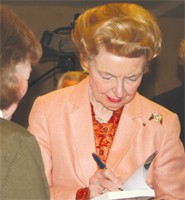
Starting at 9am and running into an evening dinner session, the conference attracted some 150 middle-aged white people who filled the large, round dining tables in the Vineyard Room of the Doubletree Hotel. There, they listened to a variety of speakers, including their guru, the 81-year-old notorious anti-feminist Phyllis Schlafly.

Touted as the leader of the women’s conservative movement, Schlafly–and the Eagle Forum–were leaders in defeating the Equal Rights Amendment (ERA) during the 1970s. If the ERA had been ratified, this federal constitutional amendment would have guaranteed equal rights to all Americans regardless of gender.

Schlafly chose the name “Eagle Forum” because she was “impressed with how the eagle flies into the wind and then uses the wind to raise it even higher,” according to Orlean Koehle, president of the Eagle Forum of California and a main organizer of the recent conference.

Over the years, and with Schlafly still at the helm, the Eagle Forum has branched out to promote a full spectrum of “pro-family” and “Christian values” issues. Her signature blonde bouffant still impeccably in place, Schlafly was forceful, articulate and even humorous at the March conference, expounding without notes her latest political thorn in her side: “activist” judges. “There’s one good thing that George Bush said,” she quipped. “He won’t stand for activist judges.”

While Eagle Forum members support Bush for his “pro-family” platform, it turns out they oppose his policy of creating closer ties between the United States, Canada and Mexico. Strangely, the conference was not exactly a Bush administration love-fest.

Lashing out at the federal judiciary, Schlafly admonished the circuit courts for decisions involving the Boy Scout jamboree, parents’ rights in schools, teaching about Islam in public schools, the Ten Commandments, the Pledge of Allegiance, immigration, abortion and pornography. “The federal courts are uniformly antiparent and pro-public schools,” she complained. “Their decisions are mostly pro-homosexuality. Diversity is becoming the new religion of public schools.”

She also objected to the Massachusetts state court decision in favor of same-sex marriage, saying one of the judges, who comes from South Africa, was influenced by “foreign sources.”

“Now we have liberal majorities on all of the circuits except the 15th,” she continued. “And you can’t count on Republican presidents; seven out of the nine last appointments were made by Republicans.”

Her goal, she said, is to pass legislation to “limit the jurisdiction of the Supreme Court in areas where we don’t trust them.” Admitting that’s a hopeless task under a Democratic Congress, she exhorted her followers to “get together in study groups” the way the early Eagle Forum members did when they were fighting the ERA. “This is the way we’re going to take back the American self-government,” she said. “The Democrats won the last election by choosing candidates just a hair to the left of the Republicans.”

Koehle, a Santa Rosa resident, has been doing her homework for several years. She said she first became concerned about the schools when two of her children were required to take the California Learning Assessment Test. The test, which is no longer administered by the state, asked leading questions, according to Koehle. “There was an obvious agenda,” she says. “I became involved in standing up for what I thought was a very scary situation in the public schools.”

So she started a couple of local organizations to fight against what she sees as a liberal bias in the schools, then decided to join the Eagle Forum. Now she also works two to three days a week as a substitute teacher. “It lets me see what’s going on in our public schools,” she explains.

According to the speech she delivered at the Eagle Forum conference, one of the things Koehle saw was an emphasis on teaching children about Islam in seventh-grade world history. She said the state-approved text includes 78 pages about Islamic history and only 46 pages about Christianity. And it requires students to read and memorize such Islamic documents as the “Five Pillars of Islam,” but does not make the same demands concerning such Christian literature as the Bible.

Even worse, according to Koehle, the textbook appears to be biased in favor of Islam. “Throughout this book, it always mentions how tolerant the Muslims were of the Jews and Christians. Everything is always favorable about Islam,” she said. “There is always a little slant against the Christians. It’s part of the multiculturalism being taught today, that all cultures are equal.”

An independent survey of the text World History: Medieval and Modern Times instead reveals some 91 pages about Christianity and its historical influences, 65 pages about Islam and the Muslim Empire, 25 pages about Judaism and fewer pages about other religions, such as Hinduism and Buddhism.

As a long-term substitute teacher, Koehle said that when religion is on the lesson plan, she spends her time teaching about Christianity instead of Islam. “If I’m going to be teaching a religion, I want to teach the religion of my choice,” she told the conference to laughter and applause.

Koehle was also part of a group that protested against the Diversity Day program in Santa Rosa high schools a few years ago. Earlier this year, she testified on behalf of a family that is suing the Santa Rosa schools for alleged religious discrimination. At the conference, she talked about the possibility of suing the schools once again over the teaching of Islam.

“We believe in traditional education based on Judeo-Christian values,” Koehle told the Eagle Forum audience. She indicated that the current public school philosophy is based on the “Prussian” model, where “children belong to the state” rather than to their parents. “Such a system would make it ideal for a dictator to come in and take over,” she warned, setting up what would be a common theme for the conference: fear of domination from within or without the U.S.

The public school system is a main focus for members of the Eagle Forum. Not only are they attempting to inhibit teaching about diversity, but they also view environmental education as a danger.

Susan O’Donnell specializes in what she believes are “internationalist” influences in American education, with an emphasis on bashing the National Education Association for promoting so-called “progressive” education. “Our national education system is becoming of a branch of UNESCO,” she warned.

But the biggest threat to America’s schoolchildren, according to O’Donnell, is the teaching of environmentalism, or “sustainability,” with the primary culprits being Al Gore and the Green Party.

“Did you know Al Gore is causing people to go to therapists because of his global-warming theories?” she asked. “There’s a new malady: eco-anxiety. His film An Inconvenient Truth is targeted at children to advance a political agenda below the radar.”

As she continued, her voice grew louder until she was almost screaming. “Education for sustainability is a tool for the Green movement. They’re going to the children first because the American people would say no,” she exhorted, evoking Hitler, Lenin and Marx as examples.

“This is systems thinking. The goal is to completely transform education. It teaches the ideology of the Green Party by incorporating sustainability into all of the curriculum. This is ecological child abuse. The Greens have gotten God out of our schools. Humanism is the new order–that land cannot be bought and sold. This transcends all other systems. It diminishes the value of individual success, which is the cornerstone of our nation.” At this point, some audience members groaned. “If this continues unchecked it will result in rapid, nationwide indoctrination of our children to support the Green Party.”

In the same vein, Koehle described a classroom she observed where, after saying the Pledge of Allegiance, students also intoned a “pledge to the earth.”

“A little blue earth flag was hanging up next to the American flag,” she said, her voice filled with incredulity.

In a telephone interview some time later, Sebastopol Councilman Larry Robinson, one of four elected Sonoma County officials who are members of the Green Party, chuckled at O’Donnell’s evaluation of Green Party power.

“I appreciate their estimation of the Green Party and wish it were so, but there are only 7,000 registered Green Party members in Sonoma County. And the idea that the Green Party wants a world government, or to tell people what to do, is 180 degrees off. The Green Party wants decisions to be made at the most local level possible. Land-use decisions should be made by local governments and even neighborhoods. Of course, issues that affect the global picture clearly need to be worked out at the international level by international agreement. Wind blowing and rivers running don’t stop at national borders.”

In Robinson’s opinion, the Eagle Forum’s aversion to environmentalism has an economic basis or religious basis–or both. “It’s a misunderstanding of what sustainability is, or some other agenda,” he says. “Some religious-right people believe we are in the End Times and that resources should be consumed as quickly as possible in order to bring about the Second Coming of Christ,” he said. “This marries perfectly with the agenda of the extractive industries. Corporations are only interested in the next quarter’s profits. The Republicans are in both streams,” he concluded.

But Forum members’ fears about internationalism aren’t limited to attacking the left end of the political spectrum. They also rail against the Bush administration for its alleged promotion of something called “The North American Union.”

“We’re so upset with President Bush because he won’t stand up for American sovereignty,” Koehle said.

The North American Union is a phrase coined by a trilateral independent task force composed of representatives from the United States, Mexico and Canada that advocates a greater social and economic connection between the three countries. Eagle Forum members and others on the far right believe the task force’s report is a blueprint for a political union between the three countries, like the European Union. They fear it would impinge on U.S. sovereignty.

“We don’t want our laws harmonized with Canada and Mexico,” Koehle said in a telephone interview. “The European Union really has become a government for all 27 nations, and we’re afraid the North American Union would be like that.”

But Andy Merrifield, a political science professor at Sonoma State University, dismisses those fears, saying relations between the three countries of North America are not likely to include political homogenization.

“It’s a semi-offshoot of NAFTA,” Merrifield said. “I don’t know anybody who seriously thinks it’s going to be anything but a trade agreement. It is not similar to the European Union. There is no parliament that would hold power over the governments of the United States, Canada and Mexico.”

Merrifield reminds that it took the Europeans 50 years to create the E.U. and that the union’s parliament is more of a debating society with no real jurisdiction over the political affairs of its member nations. He also predicted it would be “500 years” before the United States would consider a political union with Canada and Mexico.

Another tenet of the Eagle Forum and other far right groups is the inalienable right to private property. Sebastopol resident Maria Donnelly spoke about her successful opposition to a plan to protect rivers and streams by requiring landowners to increase riparian corridor setbacks in the 2020 update of the Sonoma County general plan. Resistance to the plan has led the county to reconsider it.

“We have affected change because we have been sitting there at every meeting of the board of supervisors and the planning commission,” Donnelly explains.

This local effort, in which she was joined by Koehle, reflects the Eagle Forum belief that American democracy is based on the right to private property and that all efforts to protect wildlife habitat threatens to destroy that right. She described United Nations projects to protect and restore wildlife habitats around the world as “communism at its finest. Al Gore is leading America and the world down the path of destruction,” she decried.

Of course, a gathering of the religious right would not be complete without a choral arrangement of the Seven Deadly Sins, according to its own interpretation of the Bible.

At the conference, there were verses about assisted suicide, gay marriage, abortion and the “religious left.” The choir included a doctor from Sebastopol, a right-wing talk show host, the head of the Sacramento-based Campaign for Children and Families and a Petaluma priest who opposes the Episcopal Church’s acceptance of homosexuality.

Dr. Steven Crane, an emergency-room physician at Palm Drive Hospital in Sebastopol, linked assisted suicide with abortion and the financial difficulties hospitals are facing in Sonoma County and around the nation.

“God is withdrawing support from hospitals [because they perform abortions and allow expiring patients to die],” he warned. “That’s why they are failing. There have been 40 million abortions since Roe v. Wade,” he continued. “That’s a generation of children. I am concerned that abortion is intimately connected with assisted suicide. There won’t be enough young people to take care of the old people.”

The hero du jour of the local religious right came to the podium, fresh from a graveside memorial for one of his parishioners. Pastor David Miller of St. John Anglican Church in Petaluma, formerly St. John Episcopal Church, wept as he described his church’s withdrawal from the American Episcopal Convention over the national church’s acceptance of gay marriage and gay leadership. “The Episcopal Convention undermines the authority of the Bible,” he said to a chorus of amens from the audience.

Hughes had the last word when she claimed that “the ‘political left’ is manipulating the church to win the 2008 election. “I believe they are using religion to manipulate, to get a vote. All of a sudden the liberals have got religion. They have books saying how to take back the country from the right wing. Will the voters get it? They’ll get it if we tell them,” she said.

But despite Eagle Forum members’ obvious enthusiasm, Merrifield believes their anti-ERA heyday is over and dismisses their efforts as marginal.

“They are maybe useful in rallying the troops,” he said, “but at 80,000 strung all over this country in little groups, they are very small.”

Still, not unlike the far left, Eagle Forum members can affect local change, such as Maria Donnelly’s effort to protect private property rights in the Sonom County general plan update. And their conviction appears to be deeply rooted and even amiable. But Merrifield feels that it is misplaced.

“The reality is, they’re talking about a world that never existed, an America that never was,” he said.

Get Ready for Betty

0

May 16-22, 2007

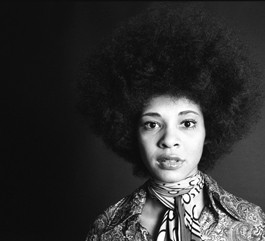
When Betty Davis first started making records, it’s possible there might have been something that sounded like her–a squealing spaceship, perhaps, or a jackknifed rig. One thing’s for sure, it wouldn’t have been human. Even this week, when Davis’ first two albums, Betty Davis and They Say I’m Different, are seeing the light of day for the first time in 30 years, finding an equal to Davis in both sound and attitude is impossible.

Before Lil’ Kim, Salt-n-Pepa, Millie Jackson, Chaka Khan and even a few crucial years before Tina Turner’s solo work, Betty Davis created an explosively sexual persona of independent fierceness, through which she growled, kicked and grinded her way. A prolific songwriter, her first song, written at the age of 12, was “I’m Going to Bake That Cake of Love.” By 1973, the same sentiment had grown up a little with her debut album’s opening track: “If I’m in Luck, I Might Get Picked Up.” The prowl was afoot.

As much as others may want to elevate the erroneous assumption that Davis was the first woman to sing about getting laid, Davis’ legacy–other than the stellar, gut-kicking funk she recorded–lies in her headstrong determination to make on her own terms it in a male-dominated business. A published songwriter for the Chambers Brothers even before she met and married Miles Davis–whose name she took at the altar and to whom she introduced her downtown friend Jimi Hendrix–she never dreamed of living in the volatile trumpeter’s shadow. But after Miles Davis jealously shelved an album the couple had been working on for Columbia, Betty strapped on her silver, thigh-hugging, high-heeled boots and walked out.

Quick to find new musical partners, Davis came to San Francisco and inked a deal for her first record, assembling a mind-blowing band: Graham Central Station’s Larry Graham on bass, Neal Schon of Santana and Journey on guitar, Merl Saunders on piano and Tower of Power’s Greg Adams on trumpet, to name just a few. She even enlisted three sisters named Pointer to sing backups, and the songs, all written and arranged by Davis, were vicious, visceral and undoubtedly ahead of their time. But despite the support of fans like Richard Pryor, Muhammad Ali, Maurice White and Cecil Taylor, Davis’ career fizzled out at the end of a decade, a star that burned hot and blinding for a quick flash before disappearing altogether.

These days, Davis lives in quiet obscurity somewhere outside Pittsburgh, turning down interviews and shying away from the spotlight. She’s acquiesced to the reissues of Betty Davis and They Say I’m Different, but will say no more about her reasons for retirement, her relationship with Miles or even what she’s been doing for the last 30 years. It’s hard to believe, but maybe, in some residual stroke of determination, she wants to let the music that she made speak for itself.

Betty Davis and They Say I’m Different, both reissued by Light in the Attic Records, are in stores this week.


Wine Tasting

0


Well, the final issue of Wine X magazine is still hanging on to the shelf, doing its fresh best even as it fades away. What killed the electric wine magazine? Was it the big money wineries, so unhip as to snub an upstart magazine that merely trashed them in its mission statement? Or do we blame the demographically targeted twenty-something consumers, maybe a little too hip on being hooked with a caricature of themselves?

Yet to hit the wine road these days, it would seem that the grand campaign to electrify twenty-something consumers has succeeded, even while its chief cheerleaders falter. To get a sense of how wine’s flowing through the pulse of generations X and beyond, I naturally looked to the must-be spot for the anti-wine snob–but it’s also temporarily out of service.

Roshambo Winery is only a victim of its own success. The facility sold, but the old hands at rock-paper-scissors central are building a new estate winery. In the meantime, a Roshambus wanders the byways, or you can track its product down in a new wine lounge that claims the “Generation” and ditches the “X.”

Generation Wines is improbably located in a Windsor industrial park. Opened in fits and starts over the past year, owner Ryan O’Harren says it’s now good to go five days a week. Generation is a multilabel tasting bar and wine shop, selling locals like Fanucchi and imports like Australian Barossa Valley Shiraz. There’s sofa seating and a tiki-style bar made of recycled sorghum stalks. An iPod mix plays in the background, Air thrown in with cha-cha-cha. O’Harren readily owns that he’s aiming to welcome a young crowd, but joint’s style is not painfully hip, and his affable mien make it chill, as the young folks say.

Generation currently offers two tasting flights, Bonneau and Roshambo, for $7 each. Pours are not stinted, and the fee is refunded with purchase. Here’s your chance to sample Roshambo’s 2002 “the Reverend” Zinfandel ($22), burly and brambly, and the 2005 “Justice” Syrah, which lays down licorice over sweaty leather, the aroma of roasted coffee beans wafting down the street.

Bonneau hits the spot with the 2004 Chardonnay Catherine’s Vineyard ($28), smelling almost of glinting gold with refined woodsiness and lemon honey. Bonneau’s got two disparate Zinfandels, brewer’s yeast and white pepper on the one hand–the 2005 Egret Zinfandel ($15)–and solid jam flavor on the other, the 2005 Shenandoah Valley Zinfandel ($28). Add in some light food that O’Harren says is in future plans, and what’s not to like about going a little out of the way in Windsor?

Generation Wines, 810 DenBeste Court, Suite 103 (at Conde Lane), Windsor. Open Tuesday-Saturday, 11am to 6pm, or by appointment. 707.836.9401.


View All

Music for the Eye

0

the arts | visual arts |

Photograph by Michael Amsler
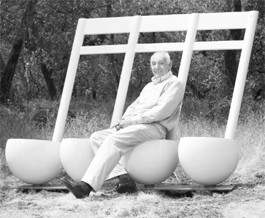
Noteworthy: Paradise Ridge owner Dr. Walter Byck relaxes on Robert Ellison’s musical sculpture.

By Gretchen Giles

‘There’s just one more thing,” sculptor Nicolas van Krijdt intones into the Bohemian‘s editorial voicemail system. “And it’s important. I started out wondering what my sculptures would sound like if I tried making music from them, and now I’m using music to make sculptures from the sound itself. OK then, thanks.”

Taken at face value, those are not complex sentences. None of the words is overly long or has elaborate Latinate roots. The syllable count doesn’t soar above three. But the concepts that van Krijdt regularly wrestles with and that he will be performing from at the Paradise Ridge Sculpture Garden on May 20 are indeed complex, if not particularly Latinate or multisyllabic.

As one of 15 sculptors participating in Paradise Ridge’s new annual round of outdoor installations, this year titled “Prelude,” van Krijdt has hung 16 of his steel or parchment paper vessels from a stand of trees in vintner Walter Byck’s five-acre pygmy oak grove high above Santa Rosa. Reminiscent of open pea pods, the vessels also resemble small boats and range in size from eight feet to four feet in length, and from 100 pounds to four pounds in heft.

One vessel in particular is special. Made of steel, it is strung down the middle with a length of airplane wire that crosses a fret-like structure and can be tuned. Under the ministrations of a cello bow, the vessel is played, making a high, mournful sound that retains the uncanny brightness of metal.

Recording ambient sounds onsite at Paradise Ridge for the past three months, van Krijdt has composed a site-specific sound sculpture for the grove that he will perform at the opening reception and as he sees fit over the next year. He is also hoping to put it in mp3 form on the winery’s website so that visitors can download it and listen as they walk around. “The whole idea is for the [sound sculpture] to be a subtle amplification of what’s here,” van Krijdt says, standing in the grove and gesturing to the leaves, branches, breeze, birds, wildflowers, moss. “The way that these pieces move around, I’m loving the minute composition of the movements.”

In the past, van Krijdt has done such art as walk a particular arrondissement in Paris recording the sounds, marking his audio path on an ordinary French map and then creating a musical chart from the aural cartography that matches the map with the sounds. The result is a uniquely three-dimensional musical composition that carries a nearly palpable heft.

For this piece, titled 16 Vessels, 28 Trees, van Krijdt has used the movement of the vessels as they sway from branches and limbs as markers to help him create a musical chart from which he plays and improvises. “When a classical pianist gives a recital, he or she will have the music in front of them, but they don’t mostly read it; it’s there for reference,” van Krijdt explains. “In my case, the notation becomes part of the art. It does the same thing for me as traditional musical notes do for traditional musicians.

“I invented my own instrument and my own way to write the music, and it’s not,” he laughs, “out of laziness!”

Actually, finding a lazy man at Paradise Ridge would be something of a feat. On a recent Friday morning, Petaluma sculptor Edwin Hamilton is riding an earth mover replete with crane and two assistants, placing several tons’ worth of stone objects in a southeast corner of the grove while Santa Rosa sculptor Riis Burwell pours a cement pad that Gale Wagner will use to support his massive antiwar sculpture at the front of the grove. Paradise Ridge owner Dr. Walter Byck, a man blessed with unstoppable energy, grins broadly.

“It’s the most frightening, furious creature,” he says, describing Wagner’s piece, “and it’s perched on the Washington Monument. It’s scary and it’s wonderful.” Other artists participating in this rotation include Albert Dicrutallo, John DeMarchi, Dan Dykes, Robert Ellison, Michael Hayden, Bruce Johnson, Kristina Lucas, Michael Maes, John Pashilk and Bryan Tedrick.

With his winery celebrating its 13th anniversary by unveiling a newly renovated tasting area and handsome outdoor layout, this is the 12th cycle of annual art shows for the sculpture grove. This year, it will be renamed to honor Byck’s late wife, Marijke Byck-Hoenselaars, who shared his great passion for outdoor art.

This year’s “Prelude” collection points to another future, that of the Green Music Center (GMC), under construction and sparking controversy over cost at Sonoma State University. Byck has donated Asia, Bruce Johnson’s totemic redwood archway originally crafted to honor Fountaingrove founding vintner Kanaye Nagasawa, to the GMC, where it will, he hopes, become as iconic of the new music center as it has been of Paradise Ridge for the past decade.

Though the GMC won’t be open for another year and a half at the earliest, Byck says that he decided to preview, essentially, what a sculpture garden on the SSU campus could look like. “Much of this might end up being part of the first exhibit,” he says. “Some of the pieces have to do with music or performance. Over the years, I’ve given a lot of tours of the grove and had a lot of opportunities to think about what gives people pleasure when they look at art. In part, ‘Prelude’ is what I think that the GMC should consider for its sculpture garden, pieces that interact with people who are coming to a concert; the art should enhance the experience just as much as a clean restroom does,” he smiles. “Having sculpture onsite is the most cost-effective way to add enjoyment to an experience. Surprising, provocative sculpture–it doesn’t necessarily have to be musical.”

Rightfully proud, Byck admits that this is the first time that he’s curated an entire art rotation in the sculpture grove himself. “I’m so lucky. It seems like I’m a great curator,” he says, “but I really just have great friends.”

‘Prelude’ kicks off with a winery reception and performance of ’16 Vessels, 28 Trees’ on Sunday, May 20. Winery open house from 11am to 3pm; artist reception and performance, 3pm to 5pm. Paradise Ridge Winery, 4545 Thomas Lake Harris Drive, Santa Rosa. Free. 707.528.9463.


View All


Museums and gallery notes.


Reviews of new book releases.


Reviews and previews of new plays, operas and symphony performances.


Reviews and previews of new dance performances and events.

Kiss My Grits

May 16-22, 2007

When Adrienne Shelly’s film Waitress wafted its way to Sundance, part of its divine afflatus was due to the director and writer’s tragic murder. Let’s overlook that matter for a second. For a little movie, it’s overproduced like crazy; this working-class waitress lives in a Craftsman bungalow house 600 large couldn’t buy. As the Deep South, Southern California gives its worst performance in years–it looks rich, it looks dry, it looks white, it looks secular, it looks like a movie set, even in the exteriors. Pull back from the scenery and the art direction, though, and note the essence of this patronizing fairy tale.

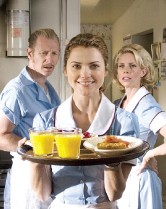
The way Shelly lays it out, the waitress Jenna (Keri Russell) is a country girl, a pie-baking sweetie at Joe’s Pie Cafe whose answer for any of life’s predicaments is to invent a new dessert. As in Like Water for Chocolate and many movies since, cooking interludes interrupt the action, as Jenna conceives of different pies with zany names: “I Hate My Husband Pie” and “Baby Screaming Its Head Off in the Middle of the Night and Ruining My Life Pie.”

At the beginning of the film, Jenna has just flunked a pregnancy test. It’s all because her estranged husband, Earl (Jeremy Sisto), got her drunk and had his way with her. Jenna won’t even think of doing what you might want to do if you’re pregnant and you don’t want to be, you don’t like babies in general and you hate your husband. Shelly sweeps that possibility off the table with the abruptness of a waitress clearing the way for a packed dinner rush. We’re meant to admire Jenna’s gumption for going through with it, deciding to link herself for life with a man she hates by having a baby she doesn’t want. In this, she has emotional support from her two sassy colleagues, played with the archness of a brace of drag queens.

Becky is Cheryl Hines, looking exactly like a tennis-playing Beverly Hills housewife trying to drawl like a Southerner. The late Shelly herself plays Dawn, a blonde mouse with eyeglasses. Dawn has a date who starts stalking her (“You won’t be able to get rid of me,” he promises). It’s a mark of this movie’s sexual politics that she ends up falling for him because he’s so devoted.

Meanwhile, Jenna starts up a heedless, passionate affair with the town’s new ob-gyn, Dr. Pomatter (Nathan Fillion), despite Earl’s insane jealousy. How happy can you be when you’re sleeping with a married doctor who has all the social power and mobility while you’re waiting tables with a second-trimester belly and cracking ankles? Adrienne Shelly may have been a wonderful person and a good mother, but she had about as much comprehension of being a waitress as Marie Antoinette had of being a milkmaid.

Maybe I’m being too literal about Waitress, which might have a grain of emotional truth under the pink and sugar-coated surface. During pregnancy, some women fall in hate with their husbands; by contrast, their obstetricians have all the answers, aren’t worrying about money and the future, and make no personal demands. (Sisto’s toneless pleading for sex–“Please. Please. Please. Please”–got a laugh from the women in the audience. Glad they were amused.)

Sisto is a monotonous, street-crazy type of actor who exhausted his range on Six Feet Under, and Earl is such a vicious, infantile bastard that Jenna looks even more foolish for sticking it out. On the surface, this movie seems to be a fantasy about a woman persisting, but she’s really waiting for a chance for rescue; the movie is a long celebration of diminished expectations relieved by geezer ex machina (Andy Griffith).

Being nice about the circumstances under which this film arrives–and overlooking its derivative, televisionistic qualities–might be a kindness to a dead artist, but it’s not doing the living any favors. This stale old pastry has all the originality of a convenience-store berry pie.

‘Waitress’ opens Friday, May 18, at the Rialto Lakeside Cinemas, 551 Summerfield Road, Santa Rosa. 707.525.4840.


New and upcoming film releases.

Browse all movie reviews.

Smart-Ass Sage

0

May 16-22, 2007

While the gifted white rapper isn’t quite as rare a beast as it used to be, it is still a singular animal that could win battle rap contests while sporting a Metallica T-shirt; that could float effortlessly between the worlds of poetry slams and underground hip-hop shows; and that could maintain any measure of credibility while spitting lines referencing Choose Your Own Adventure books. But then again, there truly is no other artist in music today quite like Sage Francis, who dropped his latest album, Human the Death Dance, this month through Epitaph Records.

Fans of Francis know that, even at his worst, he indulges the cleverest of clever wordplay. Human the Death Dance is no exception. His lyrics are conversational, approachable, intellectual and easy to relate to. They even add a multitude of layers to his albums; every time you listen to one, you catch a different witty metaphor or personal anecdote buried within. For the instrumental half of the equation, his beats are electric, energetic and eclectic. “Got Up This Morning” is country-fied, “Black Out on White Night” sports a plaintive string section and “Call Me Francois” brings a ’70s B-movie sci-fi sound. The beats inform the mood as much as the lyrics, moods that run the gamut from playful to somber. Throughout whatever stylistic detour the album takes, Francis keeps it all together with his emotionally honest and singular style of lyricism.

Human the Death Dance isn’t hip-hop meant just for people who love hip-hop; it’s hip-hop for people who love poetry, for people who love honesty and, finally, for people who love music.


Life of a Marriage

0

May 16-22, 2007


Jason Robert Brown’s immensely popular modern musical The Last Five Years was conceived as a show that could be staged with very little space and with very few actors–two, to be exact–one male, one female. As cash-strapped theater companies constantly beat the bushes for clever ways to do more with less, the notion of a two-human musical with a five-person orchestra–especially one that has generated a kind of rabid, CD show-tune cult of young people who swap Years bloggings and repeatedly listen to the original cast recording the way some people read spiritual texts–has to be attractive. With this in mind, it comes as no shock that the mighty Sonoma County Repertory Theater, considering which show to present as its first-ever musical, would end up anointing The Last Five Years as the chosen one.

It is also no surprise that the Rep, after choosing Years, would dare to take the beloved but never-before-seen-in-the-North-Bay musical and turn it all sideways, with noted director Ken Sonkin making significant changes to the way the show has always been staged.

“In terms of directing, the way I approach a show is as a storyteller,” says Sonkin, who was recently appointed to the theater department of the University of San Francisco. Seen last year as Teach in the Rep’s production of American Buffalo, Sonkin has directed several shows at Cornell College in Iowa, and has acted and directed with American Conservatory Theatre in San Francisco, the Berkeley Rep, the Marin Shakespeare Festival and many others. An acclaimed magician, he was also director for three years at the Theatre Artists Institute in San Jose. “I love to tell stories onstage,” Sonkin says. “So whether it’s a large-scale show or small-scale show, I look for ways to bring the story to life in as engaging a way as possible, and the thing that engages me, as a storyteller, is the interaction between people.”

So how does an interaction-is-key philosophy work in a show in which the main characters never interact? As constructed by Brown, The Last Five Years traces the five-year relationship of a young, modern, married New York couple, Jamie and Catherine, but does so in a series of music-centered scenes alternately told by the two characters. To make things even more interesting, Jamie tells his stories in chronological order, beginning with their first meeting and ending with the dissolution of the relationship, while Catherine tells the same story in reverse order, beginning just after the breakup and working backward toward the beginning. They share one duet only, meeting in the middle of their story to sing at their wedding.

In the Rep’s version of the play–featuring Alice Grindling and Robert K. Dornaus III as the likable but doomed couple–Jamie and Cathy still take turns, but as they play their way through various stages of their relationship, Sonkin finds ways of bringing those memories to life using both actors. When Cathy sings about an event that occurred between her and Jamie, the scene comes more fully to life with Jamie playing his part onstage, instead of through Cathy simply working the stage as she sings.

“This way,” says Sonkin, “we get to see the relationship, the love and romance, the dysfunction and the unraveling, instead of just hearing about it through beautiful music. This is live theater; it’s not a concert. I’ve found ways to make it even more theatrical.”

This production not only marks the Rep’s first dabbling in the world of musicals, it is also the first time the company has launched a co-production, working with Santa Rosa’s Sixth Street Playhouse, which will host the same show with the same cast and director in its newer, larger theater space next November.

“I don’t plan to make any significant changes when we move to the bigger space,” Sonkin says. “Maybe Jamie and Cathy’s apartment will get a little bigger, but not too big. This is New York, after all, and New York apartments are small.”

‘The Last Five Years’ runs Thursday-Sunday, May 18-June 24, at the Sonoma County Repertory Theatre. Thursday-Saturday at 8pm; Sunday at 2pm. 104 N. Main St., Sebastopol. $15-$20; Thursday, pay what you can. Opening night is sold-out. 707.823.0177.


Museums and gallery notes.

Reviews of new book releases.

Reviews and previews of new plays, operas and symphony performances.

Reviews and previews of new dance performances and events.

Cracklin’ Blues

0

May 16-22, 2007

At age 85, Jimmy McCracklin has met them all, played with them all, survived them all. Or something close to that. Given all his achievements, there are still some firsts left for McCracklin–his performance in Santa Rosa on May 20, for example, will be his first in Sonoma County.

McCracklin was born in Arkansas, but his music is steeped in a sound that was prevalent in the smoky, late-night juke joints of Oakland and Richmond in the 1940s and ’50s. It contains a lot of the boogie-woogie piano he learned as a boy from Walter Davis, with a heavy portion of rhythm and blues.

During an interview at his home in Richmond, four gold records on the wall reflected the early afternoon sun. With his eyes receding into the past, he spoke of meeting Big Mama Thornton at Peacock Records in Houston during the early ’50s and bringing her to California where she stayed with him and his wife for a long time because “she had no peoples out here.”

In 1958, McCracklin was in Chicago, where he remembers “working dead-end jobs, walking around for three weeks carrying this song I wrote.” He took it to Chess Records where it climbed to No. 7 on Billboard‘s charts, leading to an appearance on Dick Clark’s American Bandstand, a first for a blues artist. “Dance records started poppin’ out like hell after that,” he says.

McCracklin estimates that he wrote “about nine out of every 10-and-a-half” of the songs he recorded. His compositions have been covered by the Beatles, Jerry Garcia and Janis Joplin. Otis Redding and Carla Thomas took the squabble of his song “Tramp” high up the charts in 1967.

McCracklin has recorded over 30 albums but recognition has been sluggish. In April, he received a Hall of Fame trophy at the Bay Area Black Music Awards. On his piano at home are keys to the cities of Oakland, Richmond and Sacramento. There’s a picture of him at the White House with Ronald Reagan and one with former Oakland mayor Jerry Brown.

Looking forward on this sunny afternoon, McCracklin talked about his band–three horns, a guitar, bass and drums–and Sweet Nectar, a vocal group consisting of his three daughters. They have all been with him a long time. “I got to have my old band,” he said, “I like to sound like I did.”

McCracklin beamed. “I still love to play. I ain’t never stopped. Once I stop, I’m through with it.”

Jimmy McCracklin appears on Sunday, May 20, at the Last Day Saloon. Bill Noteman and the Rockets open; Bill Bowker hosts as a live radio show. 120 Fifth St., Santa Rosa. 6pm. $15. 707.545.2343.


The Byrne Report

May 16-22, 2007

The election of a neoconservative president in France has prompted thousands of worried French people to demonstrate and riot. On May 9, the Santa Rosa Press Democrat reported on that important situation with a tiny blurb on page three. The bulk of the daily newspaper’s front page that day burbled on about a women-only roller derby. Turning away from this journalistic doodle, I found solace, yet again, in the wisdom of C. Wright Mills’ 1956 study of American society, The Power Elite. Still fresh, Mills describes the social structure of our sad nation. He remarks that politicians and “warlords” rely upon advertising-news media to dull our senses with trivia, thereby diverting our attention from examining the cause of political upheavals.

In depicting the rise of a military-corporate-political complex, Mills notes, “Very little of what we think we know of the social realities of the world have we found out first-hand. Most of ‘the pictures in our heads’ we have gained from the media–even to the point where we often do not really believe what we see before us until we read about it in the paper.”

It is almost a truism to remark that a “news” story must be packaged in advertisements before a quasi-literate populace will find it credible. According to Mills, though, our very system of governance is based upon false advertising: “Americans cling to the idea that the government is a sort of automatic machine, regulated by the balancing of competing interests.”

He goes on to show that the Democratic and Republican parties are two sides of the same military-industrial bullet and that “in the absence of policy differences of consequences between the major parties, the professional party politician must invent themes about which to talk.” Hence, the media focuses on what amounts to differences in hairstyles while ignoring evidence that the executive and legislative branches (aided by the judiciary) are nothing but rich men’s clubs.

Mills included prominent sociologists as members of this elite group, saying that intellectuals often find “it is much safer to celebrate civil liberties than to defend them [or] to use them in a politically effective way.” Without the aid of public-relations fog cheerfully generated by professional liberals, observed Mills, the war machine would sputter out.

This brings us to liberal sociologist Alan Wolfe, who wrote the afterword to my Oxford University Press edition of The Power Elite in 2000. Ironically, Wolfe is a card-carrying member of the liberal wing of the power elite. He writes opinionated blather for the New York Times, Foreign Affairs, the Atlantic Monthly and The New Republic, and teaches political science and religion at Boston College. He gets lots of grant money to write books about the “crisis of American democracy,” praising it as an inherently healthy system of checks and balances, rather than as what it is: a plutocracy, a government by and for the wealthy. According to Wolfe’s afterword:

  • “Mills’ prediction that both the economy and the political system of the United States would come to be ever more dominated by the military is not borne out by the historical developments since his time.”
  • “Domestic political support for a large and permanent military establishment in the United States, in short, can no longer be taken for granted.”

  • “[T]oday the ideological differences between Republicans and Democrats are severe.”
  • Desiring to know if Bush’s global war on poor people has changed the professor’s historical assessment of Mills, I called Wolfe up for a chat. He “retracted” his pre-9-11 analysis that domination of politicians by the corporate-military sector is on the wane. But he says that the military establishment is more “nuanced” than the weapons and energy executives running the “dishonest” Bush-Cheney administration. Many generals, Wolfe says, were unhappy that the president did not send enough troops to do the job in Iraq.

    This is also the retrospective spin that many liberals use to distance themselves from the quagmire they helped to initiate. Wolfe says that he perceives the two-party system as “healthy.” He optimistically looks toward the Democrats to pull America out of the fire of Iraq. In short, he still denies Mills’ thesis that an American power elite, or militarized ruling class, calls the shots to facilitate corporate profit-seeking.

    I could not help asking the wonky Wolfe if he remembered the RAND Corporation’s Anthony Downs’ Economic Theory of Democracy, written in 1957. Downs said, famously, “In a two-party system, it is rational for each party to encourage voters to be irrational by making its platform vague and ambiguous.” Familiar with Downs’ essay, Wolfe said that the electoral triumphs of Republicans has required the Democrats to move to the “middle of the road.” But isn’t that what Mills . . .

    Fuhgeddaboutit. Let’s go to the roller derby!

    or


    Letters to the Editor

    May 16-22, 2007Dude, oh dudeSara Bir's piece is a vitriolic piece of tripe (May 9). To her credit, there is no hidden rhetoric. Her band bigotry is big and bold and available for everyone to see. She manages to froth out an article on naming a band complete with bullet points and veiled insults to local groups who...

    Right Thinking

    May 16-22, 2007It's a fair bet that almost nobody in the North Bay under the age of 50 has heard of the Eagle Forum. Maybe that's how the California branch of the 80,000-member-strong right-wing political organization managed to slip into Rohnert Park practically undetected for a March 31 education conference. Presentations at the event covered everything from gay marriage...

    Get Ready for Betty

    May 16-22, 2007When Betty Davis first started making records, it's possible there might have been something that sounded like her--a squealing spaceship, perhaps, or a jackknifed rig. One thing's for sure, it wouldn't have been human. Even this week, when Davis' first two albums, Betty Davis and They Say I'm Different, are seeing the light of day for the...

    Wine Tasting

    Music for the Eye

    the arts | visual arts | Photograph by Michael...

    Kiss My Grits

    May 16-22, 2007When Adrienne Shelly's film Waitress wafted its way to Sundance, part of its divine afflatus was due to the director and writer's tragic murder. Let's overlook that matter for a second. For a little movie, it's overproduced like crazy; this working-class waitress lives in a Craftsman bungalow house 600 large couldn't buy. As the Deep South, Southern...

    Smart-Ass Sage

    May 16-22, 2007While the gifted white rapper isn't quite as rare a beast as it used to be, it is still a singular animal that could win battle rap contests while sporting a Metallica T-shirt; that could float effortlessly between the worlds of poetry slams and underground hip-hop shows; and that could maintain any measure of credibility while spitting...

    Life of a Marriage

    May 16-22, 2007Jason Robert Brown's immensely popular modern musical The Last Five Years was conceived as a show that could be staged with very little space and with very few actors--two, to be exact--one male, one female. As cash-strapped theater companies constantly beat the bushes for clever ways to do more with less, the notion of a two-human musical...

    Cracklin’ Blues

    May 16-22, 2007 At age 85, Jimmy McCracklin has met them all, played with them all, survived them all. Or something close to that. Given all his achievements, there are still some firsts left for McCracklin--his performance in Santa Rosa on May 20, for example, will be his first in Sonoma County.McCracklin was born in Arkansas, but his music is...

    The Byrne Report

    May 16-22, 2007The election of a neoconservative president in France has prompted thousands of worried French people to demonstrate and riot. On May 9, the Santa Rosa Press Democrat reported on that important situation with a tiny blurb on page three. The bulk of the daily newspaper's front page that day burbled on about a women-only roller derby. Turning...
    11,084FansLike
    4,606FollowersFollow
    6,928FollowersFollow