
HASH(0x1c4c8a8)


FOLLOW US
HASH(0x1c4c8a8)
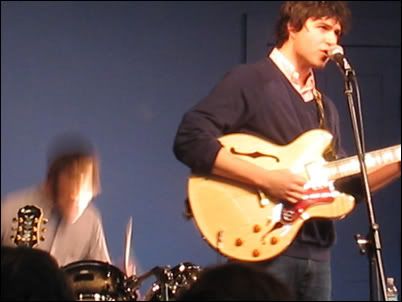 I walked into Amoeba a full hour before Vampire Weekend’s scheduled set on Friday night, only to see the first two aisles in front of the stage already filled with diehards waiting for their chance to watch, up close and personal, one of the suavest new bands of 2008.
The indie rock cognoscenti have been burbling about Vampire Weekend for months now, with descriptors like “Ivy-League Death Pop Woven With African Filament”—I mean, how can you resist?—and yet for Friday night’s hugely high-school-aged audience (ponytails, braces, and zits in abundance), it was all about the here and now. The band’s debut album, Vampire Weekend, just released, the 18+ show the night before at Popscene an unattainable dream, and twittering throng waiting anxiously between Amoeba’s Gospel and Rockabilly sections.
The rest of the store filled fast, with unknowing customers humorously caught off-guard by the commotion, and then, the big moment: in casual Harvard fashion, the band ambled out onto the stage and started their set with the first song from their album, a catchy two-minute blast called “Mansard Roof,” nailing all the high vocals, syncopated rhythms, and jaunty melodies.
After the second song, “Campus,” singer / guitarist Ezra Koenig acknowledged San Francisco—“It’s one of our very favorite cities, and we don’t just say that everywhere,” he commented, adding wryly, “Sometimes it’s very obvious that it’s not our favorite city.”
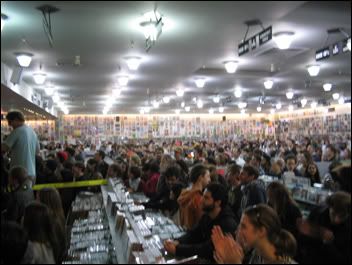
Vampire Weekend’s songs are what people call deceptively simple—both “Mansard Roof” and “Campus,” for example, rely on just a basic major scale for a riff—but the band kneads enough bizarre influences into the dough that listening to them is like deciphering a Rosetta Stone of music, from Sting to Sister Carol to Schubert to a healthy dose of Paul Simon’s Graceland. Live, the band rocks harder sans the string quartet on record, and, dispensing with collegiate reticence, Koenig passionately emphasized lines like “do you want to fuck?” from the South African-flavored “Cape Cod Kwassa Kwassa.” In the aisles, the kids ate it up.
After “I Stand Corrected,” “A-Punk,” and “Oxford Comma,” it was all over, truncating their already-short album (it’s a refreshing 34 minutes long) into just a six-song set. For a tiny short while, the innocence of pop music and the excitement of a great new band with oodles of potential lay bare in front of a crowd of fervent admirers, and on a cold, drizzling night in San Francisco, well, it’s hard to ask for more.
Best Lyrics: Magnetic Fields – Distortion

The album title, Distortion, refers to the Psychocandy-esque fuzz that permeates every song on this album—making it sound drearier and more hungover than anything you’d expect from Magnetic Fields. But holy bejeezus, the lyrics are a goddamn hoot. Some reviews of the album have actually complained about the lyrics in particular, citing Stephen Merritt’s ongoing “downtrodden, sad-sack schtick,” causing me to wonder if Noel Coward could very well be out of work if he was born in the 21st Century. Making mirth out of the morose is a tight market these days, apparently.
From “The Nun’s Litany”:
I want to be a topless waitress
I want my mother to shed one tear
I’d throw away this old, sedate dress
Slip into something a tad more sheer
I want to be an artist’s model
An odalisque au naturel
I should be good at spin the bottle
While I’ve still got something left to sell
From “Too Drunk To Dream”:
Sober, life is a prison
Shitfaced, it is a blessing
Sober, nobody wants you
Shitfaced, they’re all undressing
No one should listen to any Magnetic Fields album before they listen to 69 Love Songs, but for the already initiated, the sharply pained ribaldry of Distortion’s lyrics will remind you of at least one of a hundred reasons why you fell in love with the band in the first place. They’re playing two nights at the Herbst Theater in San Francisco on Feb. 28-29, and man, is it ever sold out.
Best Sonic Quality: Black Mountain – In The Future

I saw Black Mountain late last December and it was undoubtedly one of the year’s highlights. I drove down to the show in San Francisco on a complete whim and had no idea what to expect, brandishing only an ardent fascination with their self-titled debut, released three years ago.
The lights went down. The guitar amplifier billowed smoke. The drums illumined with each bass kick. The voices of Amber Webber and Stephen McBean cavorted together, intertwined, above a thundering morass. I was stupefied.
In The Future doesn’t quite capture all of Black Mountain’s hazy bombast, and its songs aren’t as classic as those on the band’s first record, but it’s a mind-transporting headphone album nonetheless that just sounds great. They’re playing at the Independent in San Francisco on Monday, Feb. 4.
Strange New Band: MGMT – Oracular Spectacular

They’re too hippie-sounding for the fixed gear crowd but they’re, like, too concerned with their own image for the stoner crowd. I still can’t figure out if I like ‘em or not. Their video, though, is an absolute work of art. So, yeah: strange new band.
 Between possibly getting engaged, starring in movies that aren’t as good as Ghost World, getting hot and steamy with Justin Timberlake, and acting as a modern-day Betty Grable visiting the troops in Kuwait, it’d seem that Scarlett Johansson’s dance card is totally full.
But in news that pretty much has the entire world’s panties in a bunch, Johansson’s been busy putting the finishing touches on a solo album. No big deal, you say? Then smoke on your pipe and put this in: it’s a solo album of ALL TOM WAITS SONGS.
To the casual observer, this in itself is pretty nuts. But to longtime Tom Waits fans, it’s even more insane, like Jesus coming back and ordaining Waits as the official MC for the resurrection. To further spark those indie-nerd juices, Johansson hit the Louisiana studio with the Yeah Yeah Yeah’s Nick Zinner on guitar and TV On The Radio’s Dave Sitek on production.
The track listing’s not been made available yet, but speculating about the hundreds of song choices available is half the fun (“Pasties and a G-String”? “Christmas Card From A Hooker in Minneapolis”? “Better Off Without A Wife”?).
Mark your calendars: the album, called Anywhere I Lay My Head, is due out on May 20 via Atco Records.

M ost Americans would think of Romania as a strange country, which is why the wave of first-rate films coming out of there has an added shock of recognition. Cristian Mungiu’s 4 Months 3 Weeks and 2 Days, the best film we’ve gotten from that corner of the world, is also a tremendously accessible film. It’s set in Romania in 1987, in the “Golden Age,” as Mungiu sarcastically calls it. The Ceausescus, megalomaniac husband-and-wife dictators, are just about to be toppled and executed.
Otilia (Anamaria Marinca) and Gabita (Laura Vasiliu) are students sharing a tiny college dorm room in a part of Romania that’s neither the capital nor the bereft, starved-out countryside. Otilia is the stronger of the two, a college student on the way up, with a boyfriend from a family of doctors. She’s very pretty, with that Champagne-colored hair that’s neither quite blonde nor quite brown. She has drive. Her roommate defers to her. Gabita seems younger, smaller, sadder. The two are about to leave on a mysterious overnight trip.
Otilia is efficient at gaming the system and knows the black market, bargaining for the cigarettes she needs as petty bribes to take care of things. And it’s Otilia who arranges the meeting with her friend’s illegal abortionist.
He (Vlad Ivanov) is a balding, furtive man in his late 30s; he calls himself Mr. Bebe. “Trust is vital,” Mr. Bebe insists, but the demands he makes aren’t met. It’s the wrong hotel so Mr. Bebe has to leave his ID card at the front desk. Gabita doesn’t make the connection in person like she was supposed to. Worst of all, Gabita has fudged the dates on her pregnancy. She’s actually four months gone. This takes what was already an illegal activity and puts it into a new category of offense, a murder with a five- to 10-year penalty.
Sitting at its customary middle distance, the wide camera takes in the three participants in their final stage of negotiation. Having his routine disturbed has inconvenienced Mr. Bebe, so he decides to add a special surcharge to his end of the deal. Both ladies will be required to pay in advance.
This film makes the worst of the Iron Curtain tangible in a way it probably never could have been back when the commissars ruled. It’s a dictatorship that only seems a few degrees different than our world; it’s like a mirror held at a narrow angle that reflects everything around us, only slightly skewed and with blurred margins we never noticed.
The greatness of 4 Months is in the natural, melodrama-free acting. We know that Otilia’s old life is over when we see her sitting in the white stillness of an empty tram car, on her way to a party she can’t stand to be at. At the party, she’s praised and teased by the boyfriend’s relatives, who are raucous and jolly and heavy-handed about the girl’s piss-poor rural background. The boyfriend would like some attention too, of course, being a young man in love.
Meanwhile, Gabita is in who knows what kind of state, bleeding, perhaps feverish, alone in a second-class hotel. And Otilia’s odyssey is not over yet, since it includes a nighttime trip to a dark high-rise that’s rather worse than any image in an Eli Roth film.
The film’s notes describe how abortion became illegal in Romania in 1966. It’s estimated that half a million women died from botched abortions during the Communists’ reign. Some 1 million abortions were performed the first year after the procedure became legal in 1980, “a number far greater than any country in Europe.”
One would surmise that poor women in a poor country short of contraceptives often find themselves faced by drastic measures. This isn’t the place to mark the 35th anniversary of Roe v. Wade or to note again that people who take their rights for granted soon lose them. For this reason, Juno’s portrayal of an abortion clinic as a last resort for skeevy, itchy people, or Knocked Up’s shying away from any mention of the word itself, seemed rather less than a joke to me.
An even worse joke is played by moralists who believe people can be forced into good behavior by the law. If there’s a practical, rational ground for people of either side of the abortion debate, this movie shows the way to it.
‘4 Months 3 Weeks and 2 Days’ opens Friday, Feb. 1, at the Smith Rafael Film Center (1118 Fourth St., San Rafael; 415.454.1222) and the Rialto Cinemas Lakeside (551 Summerfield Road, Santa Rosa; 707.525.4840).
New and upcoming film releases.
Browse all movie reviews.
P. Joseph Potocki, is a masterful researcher and observer of conditions in the North Bay area (“Wage Slaves in Paradise,” Jan. 23). His article on going broke while working in the midst of luxury and opulence and plenty for a few is heart-wrenching.
I had the pleasure of living in Santa Rosa for about six months. Then came the sad recognition that I could not afford it, so I returned to Denver.
However, it has ever been thus. The few control it all. How much longer can it go on? We are motivated to change only when crisis demands some kind of action. What will be that crisis?
Tell Potocki to keep it coming. Maybe someone with some clout who sits in one of those incredible homes in the hills will read and be touched. Potocki certainly has the gift for reaching people with his words.
P. F. Pingree
Denver, COlo.
I suppose it is your job to recommend somebody (“You Say You Want a Revolution?” Jan. 23). I was hypnotized by Barack Obama at first, too. But I’ve gotten over it. I was similarly hopeful in ’92 in the face of “outsider” Bill Clinton’s “clarity of ideas rooted in the depth of his convictions.” How long did it take for him to don the parlance of D.C.-speak (think locally, act globally) once installed in the White House? Less than one year. The only thing that changes is the rhetoric of the campaigning politician to that of the elected politician. The “rare buzz of excitement surrounding the 2008 primaries” that “Obama has been primarily responsible for” is little more than a rock-star-style PR campaign. Has he specified any of his plans yet? I don’t hear him taking preemptive strike off the table.
Ben Franklin attributed the success of our revolution in large part to an informed populace. We are oversaturated daily by a totally controlled media. But we do have the Internet, so let’s do some homework. Take a look at Obama’s (or any candidate’s) advisers, résumé, what they like to do and what they are likely to advise. The results of that research are not heartening.
The only thing that changes is the new face card fronting the ruthless agenda of this group. Bush Jr. and Reagen were ideal stooges for the task—in November, we’ll see who Diebold’s programming shall select to next “lead” this once-great nation now bankrupted by these people.
Malcolm Clark
Occidental
What a whiner (“Red Wine and Butter,” Jan. 16)! Geez! I hope Gretchen Giles didn’t go back to camp and inflict her self-focused rant on anyone else. Boot camp is not for everybody; only people who care about themselves and the people whom they love. It creates fitness, like lower blood pressure, lower resting heart rate—you know, the stuff that keeps you breathing—not just a great-looking body.
Perhaps the whiny Ms. Giles ought to put down that gargantuan sandwich, those artery-clogging chips and that scale-tipping beer and think of someone else besides her less-than-fit self. And stop complaining. Geez!
Cynthia
Petaluma
All the presidential candidates must think we’re a bunch of blind voters. Why else would they espouse universal health coverage, better educational opportunities, salvaging the economy and other pie-in-the-sky promises while not addressing the fiscal, physical and emotional realities of ongoing wars in Pakistan/Afghanistan/Iraq (and the possibility of an attack on Iran). Our eyes are open; why aren’t theirs?
Jeff Coykendall
Los Gatos
Accidental poetry we couldn’t refuse
Hey dancers, here are some recent items which have been left at Monroe Hall. Let me know if you think anything might be yours.
—Steve
a watch
a black scarf
wire-rimmed glasses
wedding books
polka-dot shoes & 2 thermos

I n the minds of most renters, interior design is the Eden-like province of homeowners, one of those nice little perks that lessen the responsibilities of mortgage payments, property taxes and homeowners’ insurance. Remodeling or changing anything to a rental unit, in contrast, is carte blanche for evil, reaming landlords and rental agencies on the predatory walk-through to make off with your cash. Time and again, the looming threat of losing one’s security deposit keeps tenants in the live-in equivalent of a hospital room—white walls, sterile décor, little or no design elements whatsoever and a TV in the corner. All because they can’t afford to own.
It doesn’t have to be this way. True, going over an itemized list of cracks, holes and carpet stains at move-out can be like pulling teeth with a landlord who wields power over the poor and pitiful poster-and-beer-sign-loving tenant who must patter pathetic pleas of “normal wear and tear.” But luckily there are some simple methods of basic design that circumvent the strict stranglehold landlords so eagerly apply on their renters. The surprise is that they’re cheap and easy.
Starting with the basics, there’s the important issue of wall color. The majority of renters are terrified of painting their walls, not only because it can turn into an expensive item on a security-deposit refund tally, but because it’s also the most obvious change. There is no possible way to hide the fact that once-sterile white walls have become indigo blue, unless your landlord is blind, in which case you are the luckiest person alive.
But if walls can become indigo blue, or banana yellow or striped green with purple polka-dots, then they can easily become white again. Depending on the size of the unit, a basic painting job usually only takes about a day, and there’s no reason not to set aside another day at move-out to paint the walls primer gray and then back to their original color. You’ll thank yourself, especially if you’re planning on living there for a while, and it can also take care of wall scuffs or holes that might end up being deducted from your deposit.
Another basic problem is wires, those pesky exposed power cords lumpily shoved under throw rugs, poorly hidden by houseplants or saddle-stapled along the perimeter of doorway trim. In an increasingly wireless age, the sight of jumbled wires everywhere comes off as gauche and claustrophobic. How about getting them out of sight completely?
Speaker wire, firewire cables and phone lines can be easily run underneath the floor, and all it takes is a drill and a willingness to brave the unit’s tight, dank crawlspace. Pry the baseboard and/or carpet off with a crowbar where the wires will both disappear and reappear, drill a hole large enough to accommodate the wires directly where wall meets floor (angling the drill downward, naturally), and place a flashlight shining down the holes for easy visibility. Underneath the house, inching along the dirty ground, pull the wires from one hole to the other, and wriggle back to the land of the living to reattach the carpet or baseboard back inside. Follow these steps backwards upon move out, and you’ll live pleasantly without wires hanging off every wall and bordering every room; plus, the concealed holes will be invisible during the walk-through.
Sometimes a space requires wall shelving, but the resulting holes in the wall would be a dead giveaway. You could put the shelves in anyway and patch the walls later with spackle or drywall compound, but if the job isn’t done smoothly, the landlord’s eagle eye will suss it out, and deposit deductions can ensue. Amazingly, landlords rarely inspect ceilings for damage, which is important to know when modifying a unit. Shelves that are hung from the ceiling by a chain, for example, are much less of a liability than wall shelves, and they look unique.
What about that treacherously ugly faucet—plastic spiky knob and all—that you’re dying to get rid of? Walk down any hardware store fixture aisle and you’ll be dismayed to find that the shower heads and faucets used in rental units are always the cheapest and flimsiest. If it’s worth the money to you to change the fixtures—swapping them back, naturally, when you move out—then you’ll be surprised at how easy it is to do it yourself. Get a good wrench, some plumber’s tape, plumber’s putty and a little bit of know-how, and you can keep the same good-lookin’ fixtures with you wherever you may move.
(As for that “know-how”: the book is out of print, but used copies of Time-Life’s Complete Fix-It-Yourself Manual can be widely found for under $10 online, and no house should be without it. Its chapters on appliances, plumbing, electricity and home electronics are written and illustrated in the simplest, easiest-to-understand way, and can save you the humiliating annoyance of calling the evil landlord and dealing with bumbling repairmen for basic fixes.)
Venetian blinds are one of the cruelest atrocities widely forced on renters, and they’re surprisingly easy to replace without doing significant damage. With just some J-hooks, curtain fabric, clamping curtain hangers and a simple wooden dowel, a room can be completely transformed from a plastic-looking office cell to a warm, cozy space by jettisoning those horrible, dust-collecting contraptions.
First, remove the sliding covers at the top to disassemble the blind from its cartridge, and unscrew the cartridge from the window casing. Attach two simple J-hooks to the wall above the window, and place the wooden dowel, cut to size, across the hooks. Cut and hem the fabric to the size of the window—slightly larger if you want a ripple effect—and clamp the hangers at 6-inch intervals across the top. Slide the hangers on the dowel and—voilà!—basic, inexpensive curtains that make a huge difference to the room, with only four patchable holes to deal with afterwards.
Even getting rid of the smallest and seemingly unobtrusive ugliness can make a healthy difference to a room when inexpensively swapped. A close examination of gaudy light switch covers, dingy cabinet handles or tacky glass lighting domes can reveal an easy, low-impact solution to sprucing up and modernizing your personal space. New stainless steel towel holders, for example, are cheap, and replacing those bulbous oak monstrosities along your merry renting way will make you happier than you can imagine.
Rental units may belong to someone else, but ultimately it’s the place where you live. Basic interior design doesn’t have to be an unattainable luxury, and with a few simple steps, a fearless but smart approach and a couple hundred dollars, an otherwise imposing hospital room can be transformed into a cozy home—and that’s something everyone deserves.
Former landlords can contact Gabe Meline at gm*****@******an.com

T ime was when folks could drive up to their local winery, bring their empty gallon jugs and have them refilled straight from the barrel. In fact, time was not so long ago when one of these old family wineries still offered the bulk-gallon deal in this century. I thought that that operation was gone, replaced by a “brand name” transplanted in time and place. But just as Martin Ray is there in name and spirit only, it seems that the old Martini & Prati winery has gone in name only. On an rainy day mission to investigate, I found that this old local favorite is a genuine, friendly and renewed favorite in its new guise.
Martin Ray believed he could make the world’s greatest Cabernet in the Santa Cruz mountains, and spent decades from the 1930s to the 1970s pursuing that task. Blackstone winery owner Courtney Benham discovered Ray’s legacy in 1990 and acquired rights to the name. After selling Blackstone in 2003, he hung the Martin Ray sign plate on Laguna Road at the Martini & Prati site, which has been in continuous operation since 1881. The winery now releases a quality midrange line, Angeline, from North Bay appellations, and revived its namesake’s focus on mountain Cabernet. And continuing the old tradition, folks can pick up a gallon of hearty Round Barn Red for $13.
Due to a label change, some of Martin Ray’s Angeline wines, normally a good value, are even more so right now. The Angeline 2005 Mendocino County Dry Riesling ($10) is a crisp quaff with mineral undertones, and aroma of green apples and blond raisins. Fresh and lively without acidic sting, the Angeline 2006 Russian River Sauvignon Blanc ($14) appears green-tinged to the eye, if only because of the lemongrass and honeydew melon information delivered to the tongue. A Russian River vs. Santa Barbara Pinot Noir taste-off may be offered; and those who have not the aptitude for the gallon can pick up a one-liter jug of 2003 “Red” California Table Wine ($14.99), a robust and balanced blend of Tempranillo, Syrah and Cab that makes a splash with cherry fruit steeped in vanilla oak, finishing sweet and fine. The Martin Ray 2005 Cabernet Sauvignon ($20) from the Napa Valley is easily bested by the 2003 Cabernet Sauvignon Reserve ($60). Steeped in mint and eucalyptus, dusted with cocoa powder, with a complex palate of blackcurrant and tobacco, it is a product of high on Sonoma Mountain. Martin Ray himself would not be surprised.
Martin Ray Winery, 2191 Laguna Road, Santa Rosa. Winter hours, Thursday–Monday, 11am–4pm for four complimentary tastes. 707.823.2404.

Before playwright David Lindsay-Abaire got into the Pulitzer-winning business with 2006’s achingly grounded, Tony-nominated Rabbit Hole, a stunning look into the lives of a family following the death of a child, the Boston-born writer made a very different name for himself writing unhinged, experimental comedies peopled with teenagers afflicted with rapid-aging diseases, amnesiac housewives, foul-mouthed sock puppets, phantom schoolgirls and other cartoonishly off-kilter oddballs who resemble everyday human beings only in peripheral, symbolic ways. In plays like Kimberly Akimbo, Fuddy Meers and Snow Angel, Abaire built a reputation on his whimsically sick and twisted imagination and his talent for inventing situations and spinning dialogue that are both funny-weird and funny-sad at the same time.
As a playwright, Abaire tends to write in broad strokes, with Rabbit Hole standing at one end as the least broadly drawn of his works, and with 2000’s Wonder of the World, which just opened a three-week run at Spreckels Performing Arts Center, standing at the opposite pole, a prime example of Abaire at his broadest, wildest and weirdest—and least convincingly human.
That said, this production by Pacific Alliance Stage Company, directed with obvious delight and fun, visual flair by Hector Correa, makes up for the play’s lack of depth and penetrating insight by emphasizing its outrageousness.
Cass (Alexandra Matthew) is a young married woman who discovers something shocking in her husband Kip’s sweater drawer (there’s no way you’ll guess what it is, it’s so astonishingly weird). She is accordingly shocked into a state of manic energy in which she seems to have lost all sense of tact, decorum or sensitivity. Armed with a long bucket list of things she hopes to accomplish before she dies, she is packing to leave when Kip (Michael Barr), befuddled and prone to tears, suddenly comes home for lunch. After imploring him to stand in the corner out of the way while she packs, she tells him, “I think I made a mistake.” When he wants to know when, she replies, “Remember that time you proposed—and I said yes?” And with that, she’s off to Niagara Falls, where she intends to catch up with the life she might have had were it not for Kip.
She soon adopts a sidekick (that’s one of the items on her list: get a sidekick) in the form of Lois (Tara Blau), a casually suicidal alcoholic who plans to drown herself in Niagara Falls. Lois initially resists Cass’ manic, motor-mouthed intrusion into her self-destructive weekend (“You’re kind of all over the place, aren’t you?” she asks early on), but eventually joins her as Cass takes helicopter rides, buys wigs off of strangers and initiates an affair with Capt. Mike (Michael Wiles), the sweet, lonely pilot of a Niagara tour boat.
What Cass doesn’t realize is that Kip has hired a pair of affably bickering husband-and-wife private investigators (Sylvia Anderson and Joseph Cicio), who, disguised as bellboys, are literally and figuratively carrying a lot of baggage of their own. All of this ultimately leads to Kip’s appearance, and a bizarre, six-person group-therapy session conducted like an episode of the Newlywed Game.
Into all of this mayhem wander a series of local oddballs, all played with maximum vigor by Shannon Veon Kase; this whole one-actor-playing-several-parts thing, which has become commonplace in modern theater, is beautifully satirized win a brilliant late-in-the-day revelation that is nothing short of brilliant.
The cast is certainly committed, with Blau and Matthew turning in the most nuanced performances, not an easy task with material this thinly drawn. Wiles and Barr are convincing as troubled men with deep, wounded feelings, but Cicio and Anderson, as the private eyes, seem to have given up on trying to find any shades or layers in their characters, playing them as the big one-note cartoons they are, while nailing the comfortable glee these two accomplices have found in each other’s presence.
One of the chief wonders of Wonder is the set by Elizabeth Bazzano, with bedrooms and hotel suites gliding on and off among puffs of mist, with docks, helicopters, boats and barrels cleverly and playfully suggested as they float, glide and bob about the stage. (Note to stage manager: you might want to keep the crew quieter backstage; the audience could hear them talking and thumping things into place on opening night.)
‘Wonder of the World’ runs Thursday&–Sunday through Feb. 10. Thursday at 7:30pm; Friday&–Saturday at 8pm; Sunday at 2:30pm. Spreckels Performing Arts Center, 5409 Snyder Lane, Rohnert Park. $17&–$20; Thursday, $15. 707.588.3400.
Museums and gallery notes.
Reviews of new book releases.
Reviews and previews of new plays, operas and symphony performances.
Reviews and previews of new dance performances and events.
A ccording to Dec. 21, 2007 figures, here’s how the top candidates in the Democratic and Republican primaries are spending their—and your—money.
Hillary Clinton
Last year, the Clinton campaign shelled out large for strategist Mark Penn, paying him some $1,860,611. Clinton’s other biggest expenditure? Donation refunds, to the tune of $1,778,494. Shame on you, Norman Hsu. Clinton had to return some $850,000 as Hsu prepares to go to prison on felony charges.
Clinton’s PR spending broke down to $3.8 million by year’s end, the majority of which, 56 percent, was spent on “other.” Of the rest, 16 percent went to Internet campaigning, on which she spent $204,000 to build her website when your kid could have done it for $199,000 less and only spent $406 on print media.
John Edwards
No news here. Edwards’ disastrously expensive haircut appears on his year-end statement, with Torrenueva Hair Designs, Beverly Hills (listed under “Political Consultants”), coming in at a sharp $800. Edwards also spent $346 for office supplies from Iowa Prison Industries.
The Edwards campaign spent $4.1 million on PR efforts in 2007, with 59 percent for telemarketing/direct mail and the teeniest 4 percent for Internet presence. Edwards paid former Howard Dean manager Joe Trippi a weirdly small $65,000 stipend (see Axelrod’s six figures for the Obama campaign) while blogger Amanda Marcotte got the web .02 rate: $1,500.
Rudy Giuliani
Mr. Nine Eleven lavished some $3.8 million on the Karl Rove-related consulting firm of Olsen & Shuvalov and somehow went all Ahab on the Moby Dick Airways, spending $288,448 for their air services. For PR purposes, Guiliani had spent $2.7 million by the end of 2007, of which a whopping $208,000 was spent on photography.
Mike Huckabee
These two campaign expenditures read like an Arkansas poem:
Mattress King: $963;
Christian Party Rental: $846.
Duncan Hunter
Who?
“Flag Expense: $764.”
What?
Alan Keyes
We had to look up information on this moral conservative from Texas who liberally uses ancient Ronald Reagan quotes to support his campaign. In 2007, Keyes mostly had to give money back, making donation refunds totaling $25,302, some 54 percent of his campaign’s total expenditure.
John McCain
McCain spent a total of $2.8 million on PR last year, with the majority of it (66 percent) going to telemarketing and direct mail efforts. Just 16 percent of his money was extended to media consultants, 12 percent to “other” and a mere 6 percent given to online marketing.
Barack Obama
In 2007, Obama paid former John Kerry consultants GMMB a whopping $3,518,225, while political strategist David Axelrod commanded $704,630 to help the campaign. The stress must have gotten to our man, which would explain the expenditure to Blue Turtle Yoga for $20.
Obama spent $9 milllion on PR activities in 2007, with 40 percent of that devoted to telemarketing/direct mail and 37 percent to broadcast advertising. The remaining monies were spent on the Internet (10 percent), to media consultants (8 percent) and the ubiquitous “other” (5 percent). Obama paid Google $193,000 for online advertising and was the candidates’ top broadcast spender, expending some $3,280,000 on TV and radio messages.
Ron Paul
The Liberatarian from Texas actually and truly spent campaign monies in 2007 on such as “Peters Cut Rate Liquor: $259” and “DJ Dad/MC Mom, Cedar Rapids, Iowa: $100.” Who could make that up? No wonder he’s such a hit with the frat crowd.
Mitt Romney
Romney makes one’s own personal gaffes seem easy to pull off, particularly after one learns that he easily spent $114,528 on photography—including $4,358 for framing—last year from his campaign funds. And meanwhile, the family that travels together never makes it out of the Republican primary together, as proven by the $61,436 spent on an RV for Romney’s five sons.
As with Clinton, an enormous amount of Romney’s PR spending (62 percent) went to the amorphous “other” category. Spending only 1 percent on media consultants, Romney spent $17.7 million last year on PR, including $614,000 on those horrendous robo-calls.
Fred Thompson
Like McCain, Thompson focused his promotional expenditures the old-fashioned way, with some 51 percent of $1.9 million spent in 2007 going to telemarketing/direct mail. His campaign rented mailing lists from the Florida GOP ($1000,000) and Students for Life ($650), which makes renting out lists sound like a very lucrative pastime. But Thompson’s most interesting 2007 expenditure was for $13,082 to the Sentimental Journeys limousine company, auspiciously named, as it turns out, as that’s what the campaign was for Thompson.
Stats reprinted with permission from the January 2008 ‘Primary Colors’ issue of ‘Mother Jones’ magazine.
Open Mic is now a weekly feature in the Bohemian. We welcome your contribution. To have your topical essay of 700 words considered for publication, write [ mailto:op*****@******an.com” data-original-string=”LGK1IQnwmdoCIjzzR0xA9w==06aBuWayRlcQ458LPn8aPFpALAUeDCTNMVInLqD/ALCqjtKCq1L9+gZDRoSGrVeqf4De6y8MGYMcuTusLJx7KhDHm+MHcm/15EbuRtiyCt+5oM=” title=”This contact has been encoded by Anti-Spam by CleanTalk. Click to decode. To finish the decoding make sure that JavaScript is enabled in your browser. ]op*****@******an.com.

FOLLOW US
Copyright © Weeklys All rights reserved.
Our Publications
