A Vine Frenzy

0

04.02.08

Winery owners are rich, self-important snobs with no established connection to reality. They hire relatives to run their wineries whether those relatives know anything about wine or not. Wine country tourists are boorish inebriates who think grape-picking is glamorous. Wine-industry marketing executives think that successful winemaking is all about sitting down and thinking up advertising ideas. Wine country fundraisers boast idiotic slogans like “Helping Africa has never tasted so good.” Vineyard managers are potentially psychotic. Winery managers are clueless and high-strung. Ostriches, and other colorfully ill-advised winery attractions, pretty much bite.

Please calm down. These are not accusations. They are plot points.

In the hilarious new mockumentary Corked , made by Sonoma County wine-industry insiders, nothing and no one is spared from the razor-sharp, brilliantly knowing gaze of the camera. Imagine Waiting for Guffman set among sun-drenched vineyards, atmospheric wine caves and million-dollar tasting rooms. Throw in an obsessive-compulsive winemaker, some rude tourists, a number of billionaires, the de rigueur crazy people, a few loud explosions, one or two mobsters, some epic wine spitting and those damned ostriches, and you have Corked , written and directed by Healdsburg’s Ross Clendenen and Paul Hawley (a tasting room “ambassador” for Bella Vineyards, and the son of legendary Sonoma County winemaker John Hawley, respectively).

The film, shot in Sonoma County during the 2005 harvest and edited over a long three-year process rife with its own drama and comedy, has its world premiere next weekend at the cozily wine-centric 2008 Sonoma Valley Film Festival, running April 9&–13. The filmmakers and much of the cast will be in attendance.

“Most people at the festival are going to love the movie,” says Clendenen, a Healdsburg High School graduate who studied film in Southern California before returning to Sonoma to pursue his dual passions. “And one or two other people,” he adds with a laugh, “are going to be offended—maybe more than one or two.”

Scheduled for the festival’s popular lounge venue ensconced within the Sonoma Community Center, Clendenen and Hawley’s fast-paced satirical comedy is expected to be one at the hits of this year’s festival, precisely because it might offend a few people.

“As critical and satirical as we are with all of this stuff,” Clendenen says, “there’s a lot of affection in the film, too. We love this business. We wanted to show as much of the actual process of winemaking as we can, in a relatively realistic way, while poking fun at the craziness and outrageousness that sometimes occurs.”

With a budget equal to the cost of “a pretty good new car,” Clendenen says that he and Hawley, along with producer Brian Hoffman, set out to make a film that didn’t look low-budget. The filmmakers began with a large, detailed script that contained an extremely large plot. “It was like the Lawrence of Arabia of mockumentaries,” he laughs. “But then we ended up just focusing on our favorite parts and letting our actors improvise a whole lot, and that became the film. In the end, we just fell back on the script when the improvs weren’t working, which wasn’t very often.”

The film focuses on four wineries located in the Dry Creek region of Sonoma County, various characters competing for the all-important approval of a high-powered wine critic and for a first-place trophy in the fictional Golden Harvest Award festivities. Petaluma actor Jeffrey Weissman—known to local theatergoers and anyone who’s seen the films Pale Rider, Back to the Future II and III, Twilight Zone: The Movie , and, ahem, Sgt. Pepper’s Lonely Hearts Club Band —plays Jerry Hannon, a winemaker with his sights set on winning the coveted Golden Cluster trophy.

His character is based on John Hawley, the father of co-writer and director Paul Hawley. John was the very first winemaker at Clos du Bois, and as the chief winemaker at Kendall-Jackson from 1990 to 1996, helped that company rise from producing 600,000 cases of Chardonnay a year to over two and a half million cases annually.

“What was interesting with what Jeffrey did,” Clendenen says, “was that, most of the time, we could just wind him up and let him go, but for a lot of the harvest scenes, we had John right there on the set, because it really was harvest. Since we based the character of Jerry on John, we basically told Jeffrey, ‘Watch John. See what he does, and do that.’

“John gets very . . . neurotic, shall we say, during harvest, and Jeffrey captured that. We would literally pull John out of the real winemaking production process, if he was shoveling grapes into the hopper or something, and we’d put Jeffrey in there instead, shoot him doing what John does, and then let John go back to doing his thing.”

“It was amazing, I had my character study right in front of me,” Weissman says, anticipating that Corked could prove to be a breakout role for him. Weissman also credits his wife, Kimball, who manages the tasting room at Freestone Winery, for interpreting the wine-speak and stream-of-thought vintner trivia that was a part of his character. “There is always homework in making a movie,” he says. “There’s research that an actor has to do to prepare for his part. But in my case, my research was handed to me on a golden platter.”

None of that prepared Weissman for some of the winemaking activities he had to pull off, including driving an ancient tractor, scaling enormous fermentation tanks and climbing inside a closed-quarters storage tank. “I overcame claustrophobia to do that one,” he says. “I did a lot of breathing exercises.”

Now that the film is complete, with the big film-festival premiere set for next weekend, the filmmakers are setting their sights on selling Corked to a national distributor.

“I think we have a shot,” says producer Hoffman, “because I think we have something unique, we have something funny, we have something smart and we appeal to a wide range of people. I think this film will really be a hit among wine drinkers, and may become a cult hit among that demographic.”

If the film does reach the levels of success Hoffman sees as achievable (and why not? Corked is funnier than the last two Christopher Guest films put together), he believes that success will be largely due to Weissman’s performance.

“Without Jeffrey, we wouldn’t have as funny a film as we have,” Hoffman says, “and it’s a very funny film.”

‘Corked’ screens Friday&–Saturday, April 13&–14, at the Ravenswood Lounge within the Sonoma Community Center, 276 E. Napa St., Sonoma. 3:30pm. $10. 707.933.2600.


New and upcoming film releases.

Browse all movie reviews.

News Blast

0

04.02.08

Chávez Health Fair

Families with little or no access to basic healthcare may attend this weekend’s César Chávez Health Fair, held at Roseland Elementary School in Santa Rosa. Marking the eighth year of the state’s César Chávez Day of Service and Learning, health professionals from area hospitals will be on hand to discuss and answer questions relating to any and all areas of healthcare, and free vision and hearing screenings will be offered along with basic dental check-ups. Participating health organizations include Kaiser Permanente, CalServes, St. Joseph Health System, Sonoma County Department of Health Services and Latino Service Providers. Over 500 families are expected to attend.

While nutrition, anemia and dental complications remain at the top of the list of concerns for low-income families, workers will be on hand to schedule follow-up appointments and offer financial counseling. Free bicycle tune-ups will be offered as well. Entertainment includes music, salsa dancing and a bike rodeo. A farmers market with fruits and vegetables rounds out the healthy festivities, and, yes, there’s even a free lunch. Everything is open to the public of all ages and free at the César Chávez Health Fair on Saturday, April 5, at Roseland Elementary School, 950 Sebastopol Road, Santa Rosa. 10am-2pm. 707.480.4660.

—Gabe Meline

Call for Entries

A shout out to all you pint-sized creators of slashing action-packed stage-performance, celluloid art pieces. Ahhh, waidaminute . . . methinks I read that wrong. Try this:

Hail the clarion trumpet announcing submission deadlines for your (no matter thy physical stature) short works of cinematic majesty and/or likewise brief but penetrating gems of stagecraft magic!

For you who thrive on pressure, this Friday, April 4, is the entry deadline for the North Bay Only (NOBY) filmmaker awards. Each jury-judged doc and drama short will showcase at Napa’s Nest Gallery in June. Best of all, winners in each of four award categories will be gifted $2,000 in cash prizes—and two of the award categories are for youths 17 years of age or younger. For more info, call 707.255.7484.

Playwrights seeking a romantic Russian River venue to vent their unpublished pleasures need but submit five- to 15-minute stage works to the third annual “Tapas: A New Short Play Festival,” to be held in the Pegasus Theater in Monte Rio. Every imaginable (and yet to be imagined) type and age of human being is invited to submit. And don’t forget to get the skinny on their “fabulous” playwright receptions. Deadline is June 30. Submissions should be sent to Tapas,

14290 Sunset Ave., Guerneville, CA, 95446.

—P. Joseph Potocki


Virtual Virtues

04.02.08


The basement room could hardly be more plain: unadorned windowless white concrete walls with fluorescent light fixtures hanging beneath industrial piping that snakes across the ceiling. Within this softly humming bunker, a thin, bearded young man is demonstrating his new “fork bomb,” a few lines of code that can force a computer defended with popular antivirus software to fill its hard-drive with useless cloned repetitions, crippling the machine within minutes and potentially rendering it useless. Observing from one side, George Ledin nods approvingly.

A professor of computer science at Sonoma State University, Ledin is watching the final presentations by six students from his quietly controversial “malware” course, an upper division class that studies an array of digital demons—viruses, worms, Trojan horses and more—and then asks the participants to devise one of their own. Their demonstrations, each representing a different sort of surreptitious approach and conducted in a meticulously isolated or “sterile” digital environment, are swiftly and methodically successful.

Offered for the first time last spring (a second section is underway now), Ledin’s class is, to his dismay, the only one of its kind offered at any university in the country, and it was reluctantly added to the curriculum only after months of urging by the professor.

The cadre of carefully chosen students have “seen the code of viruses and worms, something that computer professionals typically have never seen,” Ledin explains softly but seriously. “This is equivalent to a physician or nurse or any health practitioner never actually seeing anything microscopic.

“The idea that only the bad guys know how to do it is, to me, a travesty,” he continues. “If my students, who are beginners, can slip by all of the antiviral companies, then you can imagine what the Chinese and others are doing.

“Why is it that we aren’t more proactive? It’s absurd not to have any preparation.”

Ledin’s advocacy has made him a pariah in the realm of antivirus software makers. The major American companies not only refused to share information or participate in the SSU class, the professor says, but also vowed not to hire any graduating students who have taken it.

There is little love lost on Ledin’s side of that exchange, ether. He sees antivirus software, collectively, as “a complete placebo,” incapable of providing any meaningful protection from new assaults.

“There isn’t a single instance of a virus company thwarting a virus before it attacks,” Ledin scowls. “This is a $4 billion industry based on no science.”

The creations of the students in Marc Helfman’s SRJC class are less ominous and more tangible than the malware concocted in Ledin’s lab. Assembled from a huge tray of Lego pieces, according to an outline prepared by the instructor, these small, crablike rolling robots use repurposed Gameboys as their “brains.” But the bots themselves are a means to an end, the tools used by Helfman’s students to develop and apply their programming skills.

Offered for the first time last fall (and again this semester), Robotics Design and Programming is essentially a lab for students working with C, a widely used computer programming language. The students’ assignment is to craft instructions that will direct the robots to perform a series of moderately complex tasks: following a curving wall at a uniform distance, locating and removing an object from a designated area, distinguishing between light and dark colored targets and treating them differently.

“The students write a program on their computer in C and then, by hooking a cable into the contraption, they can download the program and connect the motors and various sensors, and then the robot’s able to do whatever they’ve told it to do,” Helfman explains. But once the instructions are downloaded, these robots are strictly hands-off.

“The intelligence is all in the program,” Helfman continues. “Once I press the button, it’s on its own. In this class—and most competitions—if you touch the robot, that’s it, you’re out of the game.”

The “game” in this class is a complex final exam, played out on a tabletop course set up to simulate a rescue or hazardous material removal situation. The students’ bots compete to quickly find their way into the correct chamber, search for and recognize the target object, then grasp it and remove it to the specified safe location.

“It’s a cumulative experience where they get to put together everything they’ve learned,” Helfman says, “and they were by and large successful with it.”

Gameboy-driven Lego-bots and home-made computer viruses may not seem to have much in common beyond their tech-based origins, but John Sullins sees a connecting thread. This semester, Sullins, a philosophy professor at SSU, is introducing a new course he’s titled “Digital Being” to begin exploring, among other things, the ethical implications of robotics.

“Are robots the types of things that deserve our moral consideration? How do they change our relationships with one another?” he asks. “Are some of my moral rights extended to my machines that are doing my bidding? What are the rights that we should extend to our technologies as they become more and more sentient? These are all very deep and difficult issues, things that have only really been thought about in science fiction.”

Sullins has also been carefully—and supportively—observing Ledin’s malware course experiment, keenly focused on the ethical question, “Should you teach someone how to use this very dangerous piece of technology?”

His answer echoes Ledin’s reasoning. “We should teach it because it allows us to deal with the reality that our students are going to face. They’re going to have to deal with this technology and understand it in order to defeat it or to use it beneficently.”

But Sullins’ considerations go further, to question if even the term “malware” is unfairly pejorative. “The name ‘malware’ would suggest to you that it’s just evil, that everything about it is wrong. But I’m not so sure about that,” he reflects. “Is malware really ethically wrong when it’s used as a way to maybe combat a tyrannical government?

“Malware has been used in China as a way of breaking down firewalls that prevent [citizens] from seeing the wider Internet, and it’s hard for me to say that’s necessarily wrong,” he continues. “So shouldn’t good people know how to use malware as a tool for forcing social change, as a way of disrupting a vicious system?”

John Aycock, a professor at the University of Calgary, is the only other educator in North America who is publicly teaching students how to recognize, write and repel malware. He sees these classes as critical to combating the growing number of cyber threats in the world, such as the mysterious attack that crashed many of the key systems in the Eastern European nation of Estonia early last year.

“The thing we’ve been worrying about,” Aycock says, “is the scale of some of these attacks. If you consider a bunch of bad guys who have 100,000 computers at their disposal which they’ve stolen access to, what are they going to do with them? Who knows?”

Ledin, who has also been warily pondering such questions, believes that an effective response ultimately lies in developing a comprehensive theoretical framework to understand destructive software, something he worries will take “a decade or two” if and when the effort seriously gets underway.

And even that might not be enough. Faced with the catastrophic consequences of a possible global cyber-terrorist onslaught, Ledin says, “Maybe we need to redesign the computer completely to be immune to this.”.


Ab Pirates

0

04.02.08


April is here, and for those who move like a snail, go wonderfully with butter in a hot skillet and can be legally harvested through November, abalone season is not the highlight of the calendar.

But for the nearly 40,000 recreational divers in California who pursue the big snails, spring, summer and fall are among the holiest times of the year. Along our craggy, kelpy North Coast thrives the most tenacious population of red abalone anywhere in the animal’s West Coast range.

The creature’s presence fuels many a road trip each season; economic stimulus in otherwise sleepy towns; its own festival in Mendocino each October; and one of the state’s most important recreational fisheries. The largest species of abalone in the world, Haliotis rufescens lives alongside six other species of Haliotis. The red abalone, though, is highly attractive for both its abundance and its high meat-to-shell weight ratio. It is also the only one that can be legally taken today.

The red abalone occurs naturally from Oregon to Baja California, from the tide pools to depths of more than a hundred feet. The good news is that, by many accounts, numbers seem to be holding relatively steady north of Marin. The bad news? Poaching is almost out of control. Department of Fish and Game (DFG) authorities estimate that only one lawless diver in 20 is apprehended, and the illegal harvest each year accounts for an estimated quarter-million abalone, making the total annual take somewhere around half a million individuals, which may or may not be a sustainable level. No one yet knows for sure.

Curiously, one of the greater threats to the fishery, say many law-abiding divers, could be restrictions on the recreational harvest. Shrinking legal bag limits and yearly quotas as well as the looming Marine Life Protection Act may eventually discourage legal divers, leaving the lonesome North Coast an unguarded poacher playground. 

Today, abalone are entirely protected south of the Golden Gate Bridge, and there is almost no poaching because there are almost no abalone. On the North Coast, though, the official season begins on April 1 and runs through November, with July a month of hiatus. During the seven months of harvest, throngs of divers overtake Salt Point State Park and regions beyond. Holding their breath without scuba gear, as the law requires, these divers pry thousands of abalone from subsurface rocks while generating some $14 million annually into seaside communities, where they rent gear, buy lunch and fill up on gas.

The abalone limit is strictly enforced at three per day per person, and 24 per year, with a minimum size limit of seven inches across the shell. Divers are required by law to document their catch on state-issued punch cards and return the slips at the season’s end. For 2006, DFG records show a total tally of more than 264,000 red abalone harvested. The previous year, divers took 235,000. Prior to 2002, when the limit was four per day and 100 per year, divers harvested over 700,000 per year.

Wildlife Crimes Pay

Poaching is more difficult to get an accurate handle on. Most poachers sell their “abs” door to door, to friends and to neighbors. Most avoid the restaurant circuit, as paper trails, secret informants and occasional inspections make doing business at licensed establishments risky. The price of a single abalone runs almost $100. For many people, the potential monetary gain of selling a few dozen abalone outweighs the prospect of getting caught, which may result in several thousand dollars in fines and perhaps a month in jail; the higher end of the court system is known for being rather gentle on poachers. 

“We just don’t feel that the punishments that poachers receive are strong enough,” says Steve Martarano, spokesman for the DFG. “We’d like to get it up to a felony or felony conspiracy when there are two or more people involved, but now it’s a misdemeanor in most cases. We can recommend a charge after we make a bust, but it’s ultimately up to the DA, and they’ve often got other priorities than wildlife crimes. They might see a guy who had six abalone and say, ‘Big deal.'”

There is every reason to take poaching seriously. Since 1997, state law has protected the species from any and all take south of the Golden Gate Bridge, but the slow-growing creatures, which may take over 12 years to reach the minimum size limit, have yet to rebound.

A quick, amateur survey of the seafloor anywhere south of Marin County will reveal the devastation that overharvesting can wreak upon abalone populations. Just a few decades ago, the animals littered the bottom, spilling out of crevices and sprawling over the tidal zones, and robust commercial and recreational industries thrived. Today, from the Golden Gate Bridge south, to see a large red abalone, even 30 feet under water, is a rare occasion. The big snails have declined at the hands of divers and sea otters, though small pockets of productivity in the Channel Islands host above-average densities.

Otters & Scattershot

Abalone may never recover in some regions. According to DFG senior biologist Ian Taniguchi, because of the presence of sea otters along the Central Coast, abalone diving there is likely a figment of the past.

“We have essentially no hopes for seeing a fishery within range of the sea otter. Wherever there are otters, they pretty much preclude any harvest of shellfish by humans.”

The predators’ numbers have steadily climbed since fur hunters nearly wiped them out in the 18th and 19th centuries, and they keep abalone at very low numbers between the Big Sur and San Mateo coasts. In 1987, the state began a relocation effort of sea otters to the Channel Islands, then halted the plan in 1990 due in part to fishermen’s arguments that the mammals would crush the recovering abalone population. The cause for concern is valid.

A 1994 report revealed that the red abalone population on parts of the Central Coast crashed by 84 percent within six years of sea otters’ reappearance in the area. The abalone density eventually stabilized as a furtive crevice-dwelling population just 7 percent of the estimated 1965 population. Along the North Coast, the sea otter has never recovered after the fur-trade slaughter, and the dense numbers of abalone that we see today, says Taniguchi, represent an artificial situation.

In southern regions, a major impediment to the recovery of red abalone is the inefficient nature of their reproduction. Abalone are “broadcast spawners,” meaning that males and females send out respective clouds of sperm and eggs. Biologists have determined that if abalone live at too low a density, their clouds of spawn will often dissipate into the blue before any eggs are fertilized, and the DFG considers 2,000 abalone per hectare to be the “minimum viable population” size. At numbers below this critical mass, reproduction success tails off dramatically.

ARM & Abs

The total population of red abalone is uncalculated, though periodic surveys provide snapshots of the creature’s health. Department of Fish and Game associate biologist Jerry Kashiwada says that he and several other state scuba divers survey eight “index sites” in Sonoma and Mendocino counties every few years.

Per site, the biologists scan 36 seafloor transects of 30 meters by 2 meters, and the density of snail per square meter has not dropped measurably over time, even in popular dive spots. The population seems to be holding at approximately 0.7 per square meter, or 7,000 per hectare, though Kashiwada has seen isolated spots where the animals are packed 10 to the square meter. Meanwhile, the DFG considers 6,600 red abalone per hectare to compose a “minimum sustainable fishery” density. 

At San Miguel Island off of Santa Barbara, local surveys have tallied up abalone densities at just 1,000 to 1,600 per hectare, far less than the optimum critical mass. Yet a growing number of voices, mostly commercial urchin divers and former commercial abalone divers, are arguing for reopening a limited commercial harvest. Milo Vukovich, president of the Sonoma County Abalone Network (SCAN), a nonprofit founded in 1995 which dedicates itself to the preservation and restoration of abalone populations, thinks the idea is preposterous.

“The Abalone Recovery Management Plan is supposed to be about the recovery of abalone, not about finding isolated, struggling populations and deciding how to fish them,” Vukovich says.

The “ARM Plan” was implemented in 1997 as part of a statewide overhaul of abalone harvest regulations, most notably the complete shutdown of the fishery south of the Golden Gate Bridge. The plan stipulates that any once-decimated population must achieve the critical 6,600-abalone-per-hectare density if fishing is to take place.

“They’re ignoring the rules we agreed on,” Vukovich charges. “They’re treating San Miguel Island like it’s another country and not part of California.” 

The fishery in Southern California is absolutely devastated, he says. Once bearing 86 percent of all the red abalone in California, waters south of Marin now have almost none, while the North Coast’s abalone population, which seems relatively huge today, represents just 14 percent of the state’s historical total.

Eyeballs in the Water

On the North Coast, the presence of the law and the absence of the sea otter, though unfortunate by some considerations, may ensure that the red abalone never dwindles. Wardens and park rangers patrol the coast at almost all hours throughout the season, spying on divers in the water with binoculars, watching from the bushes, waiting in parking lots to check those returning to their cars and conducting periodic Highway 1 checks of all passing vehicles.

But laws are only as efficient as those who enforce them, and on the North Coast, authorities are few. California has the lowest per-capita number of wardens of all 50 states, with one authority for every 185,000 residents. The odds may seem hopeless, and indeed, most poaching goes unseen.

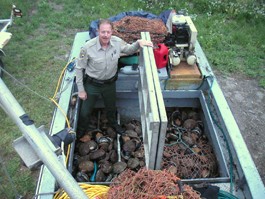
The occasional highly publicized case serves as a reminder of the trouble that can ensue when a diver is caught red-handed. In May 2004, Kurt Ward and Joshua Holt were busted by the DFG’s Special Operations Unit, a force of eight officers who watch for large-scale poaching rings. According to Lt. Kathy Ponting, leader of the unit, wardens searched the boat of the two Southern California commercial urchin divers after receiving a tip, and found 468 red abalone below deck.

Holt eventually received two years in state prison. Ward received three years. They were fined $10,000 and $15,000, respectively. Ward’s boat was impounded, and the two fledgling entrepreneurs were permanently barred from fishing ever again, commercially or recreationally, in California waters. The abalone were too far gone to survive, says Ponting, and wardens donated them to a food bank, a common course of action in the wake of poaching busts if the abalone clearly won’t survive replacement in the water.

But many law-abiding divers (many of whom have entered the poaching informant hotline 888-DFG-CALTIP into their cell phones) have complained that wardens unjustly cite them for the most trivial infractions, and a fine can run $1,000 or more for a single charge. These divers point out that there is a huge difference between one who actively poaches and one who accidentally neglects to follow a fine-print stipulation in the DFG’s ocean sportfishing regulations handbook.

“Ben,” a firefighter and part-time dive-shop attendant at Bodega Bay Pro Dive who doesn’t want his real name used, recounts a time two years ago at Fort Ross when he and three friends emerged from the water with limits of legal-sized abalone. On the beach was another foursome with “at least 70 or 80 abalone,” many undersized, he says. Ben and his friends jumped into their car and hurried up the road. They quickly flagged down a ranger and reported what they saw.

“He said, ‘OK, but did you guys fill out your punch cards?'” Ben recalls. Punch cards are supposed to be filled out before one lays a finger on one’s automobile and must note the date, time, location of the dive and how many abs were grabbed. “But we hadn’t because we’d gone looking for him. So he pulled us over and made us take out all our gear and had us there for two hours, and while he was searching us the other guys came up the road.”

The poachers were never apprehended.

President of SCAN Milo Vukovich concedes that rangers and wardens sometimes act inexplicably, though the greatest blame goes to the poorly written regulations handbook, which is notorious for being ambiguous and open to free interpretation. The most egregious sections are those that muse upon where and when divers must fill out their punch cards. Vukovich says that the DFG and SCAN cleared up all vagaries this winter, but for several years it was uncertain whether divers must fill out their documents on the beach, in the parking lot outside the car or while still in the water, clinging to a boogie board with numb hands, floundering in the waves.

Crawling with Cash

Big-time poaching is less of a problem today than a decade ago, officials say. Before 2000, there was no punch card, and taking a limit of abalone twice or more in a single day was relatively easy. Ponting recalls Operation Red Hat, in which she and several other wardens closely surveyed a team of nine people for three weeks as the gang made daily trips from Oakland up to Mendocino, took their legal limits of four abalone each, drove home, sold their catch, switched cars, swapped diving gear and returned for another round of limits. When the Special Operations Unit decided they had the evidence to nail the group on felony conspiracy charges, they swooped in and made arrests. Several received a year in jail, the two cars were confiscated and personal fines ranged from $2,500 to $12,500. 

Ponting says it can be troubling to watch one small group impact the resource so heavily, but allowing the suspects to build up their own case of evidence against themselves is often necessary.

“Other times, we take people down sooner than we want to if we think they’re damaging the resource too much. It’s a fine line, deciding when we finally go in and arrest them. If we can get the bigger picture really quickly and get a firm idea of all their commercial ties and who’s involved, then we won’t wait as long.”

Even with staunch guardians as Ponting and her team, the North Coast represents a lonesome, almost uninhabited poacher’s haven crawling with cash potential. Many lawbreakers are arrested every year and fined or jailed, but the regularity of repeat offenders is a discouraging syndrome.

Just one example: In January, Mark Fresquez, a Redwood City resident, was nailed for the third time in less than one year for poaching abalone. The first time, he was found at Fort Ross with seven abs. He received a fine and three years of probation. The second time, he was found in the company of another diver, and together they had landed 38 abalone. Fresquez served 30 days after being convicted of a misdemeanor. On the most recent bust, Ponting herself caught Fresquez with 11 abalone, and she is confident that they have a good case against the defendant this time.

Fresquez, who will be arraigned April 7, may lose his fishing license privileges for life, but to think that this restriction will affect such a fearless poacher seems optimistic. Higher fines and longer prison sentences are more likely the answer. Legislation last year increased abalone poaching fines by approximately 20 percent, but a proposal to make basic abalone poaching a felony was rejected; there are so many repeat offenders in this line of work that state prisons would soon be swamped with lifers, put away for good by the “three strikes” law, and the prison system can’t afford such an influx. 

“It’s kind of bleak,” says Vukovich. “If you poach every day and make thousands of dollars and you’re part of a poaching gang, then paying a $5,000 fine just becomes an expense of the job. There’s so much incentive that some of these guys just won’t quit, and with so little enforcement, I don’t see any way to stop it.”

Curbing the Catch

According to a 2005 DFG report, the half-million or so total abalone taken each year along the North Coast is a figure ominously close to the harvest levels that destroyed the Southern California fishery last century. To curb the catch, the DFG has been doing the easiest thing there is: cinching the noose on the legal harvest. Bag limits have dropped from 10 per day to seven to four to three, and from 100 per year to 24. But poaching remains a problem, and the reduction of legal limits may only facilitate the illegal take by discouraging law-abiders from ab diving anymore. For each such retired diver, there is one less guardian watching the resource, making the North Coast waters that much easier to pillage.

“At the rate they’re restricting things, there’ll end up being a lot fewer eyeballs on the water,” says Vukovich. “They could eventually be shutting down a fishery to accommodate poaching.”

Most of the six other abalone species in California waters are all in dire shape compared to the red, and none is legal to harvest anymore. The black abalone fishery closed in 1993. Pink, green and white abalone received full protection in 1996. A year later, red abalone diving south of the Golden Gate Bridge was banned. Now the Marine Life Protection Act is sweeping the state’s waters, and the North Coast will see some closures. Few divers, though, feel that the reserves will benefit abalone.

“As far as I can see, the closures won’t do much good,” says dive-shop owner Tom Stone of the Sonoma Coast Bamboo Reef in Rohnert Park. “The preserves might have more abs, but they don’t swim very far, and you’re just going to have the legal spots become more impacted.”

Vukovich holds the same opinion.

“You’re going to have fewer access points, and that will concentrate 40,000 divers into half the area.”

Surprisingly perhaps, most conversations with abalone divers end optimistically. While the odd cove has been “strip-mined” by poachers, most dive sites that crawled with abalone 30 years ago still crawl with them today. Most of the abs are seven-inchers, but a few are 10 and 11. Among them are the youths, grazing on algae, maturing slowly and hiding in crevices from the sea otters that may never arrive. Though the animals are frequently reported in Sonoma and Mendocino waters, most are just river otters on holiday at the beach.

Meanwhile, the most powerful protection abalone enjoy is not necessarily the officers who patrol the North Coast, but the isolated nature of the North Coast itself. And by far and away the best friends that abalone have are not the lawmakers who protect them or the activists who seek to halt legal diving, but the legal divers themselves.



Robyn Hitchcock Is Weirder When He’s Not Talking About It and Boy, Does Peter Buck Ever Hate Being In R.E.M.

0

It’s sort of counterproductive to watch a documentary about someone whose most attractive trait is mystery, and unless the film has something really, really juicy to offer, it risks revealing the man behind the curtain to be a bumbling hack.

That’s not exactly the case with Robyn Hitchcock in the just-released Sundance Channel DVD Sex, Food, Death. . . and Insects, but it’s close.
There are two perfect albums that Robyn Hitchcock has made: I Often Dream of Trains and Underwater Moonlight, with the Soft Boys. Buy them now. Relish in their evocative strangeness. Wonder boundlessly about the man who made them. And then don’t watch this documentary.
“Princess Robyn,” as he calls himself, spends much of his time on camera offering banal, universal observations about the songwriting process. He tells us that he’s obsessed with death and has a lot of rage inside, which is already evident in his music but severely diminished when it’s coming from the horse’s mouth. Delivering pronouncements about pylon cones and trolley bass, he comes off as trying unnecessarily hard to be weird. I mean, I love the Pink Elephant Car Wash sign in Seattle, but it’s certainly not worth a meandering philosophical analysis.
There’s a scene where Hitchcock premieres new material at a house party with his band (basically R.E.M., plus John Paul Jones and minus Michael Stipe & Mike Mills) and he hoodwinks a visibly tired Nick Lowe into singing backups. Lowe shuffles over to the microphone, Robyn compares him to Paul McCartney, but when the music starts it’s quickly apparent that Lowe does not know the song very well at all. It’s off-putting. Elsewhere in the film, Gillian Welch and David Rawlings explain how they were hoodwinked into making an entire album with Hitchcock (Spooked), and we start to wonder if we aren’t getting hoodwinked as well.
The main reason to watch this documentary, friends, is that Peter Buck takes every possible opportunity to demonize his experience in R.E.M. Try as he may, he can scarcely conceal his disgust with the band: “I just have to deal with such crap!” he complains. “I don’t want to spend four hours a day shaking the hands of people I don’t know!”
This year, Peter Buck goes on a nationwide tour with Modest Mouse and The National, traveling, as the members of R.E.M. do, in his own personal bus. When he moans about the ratio of “music to bullshit,” is it okay to not feel all that sorry for the guy?
R.E.M.’s new album, Accelerate, comes out this week.

Dana Carvey at the Wells Fargo Center

0

I told my agent, look, if I’m gonna do an HBO special. . . it’s gotta be in an old church near the freeway by Rohnert Park!

Is Dana Carvey really 52 years old? The nimble little guy who bounced all over the stage last night, unreeling rapid-fire impersonations and quick-witted jokes? Really?

For the most part, the adoring, sold-out crowd last night would have never guessed it. In youthful spirit, Carvey delivered fast-paced marathon descriptions of “the kind of religion that a Scientologist would find weird” (must be seen to be believed) and a spot-on impersonation of Andy Rooney firing up a fat joint and ruminating at stoner’s length on the exact meaning of the phrase “you’re shitting me.”

And yet Carvey, who appears to be in great health, spent a good portion of his set in older-man’s land: keeping one’s body from deteriorating, developing an “S”-shaped posture, performing special exercises for getting up off the toilet. This resonated with a crowd whose average age matched his, and when Carvey compared the music that “kids listen to these days” (a typical death metal impersonation with the growled lyrics “You’re gonna die, you puny little bitch / I’m gonna skin you alive and wear you like a hat”) to his generation’s music—the Beatles and Neil Young—the audience roared their approval.

Repeated concessions to age aside, Carvey last night was the same masterful comedian who most know from his Saturday Night Live days, almost 20 years ago.

Carvey’s slam-dunk impersonations alone were side-splitting, not least of all because he himself seemed to be having such fun doing them. He repeatedly cracked himself up in the exaggerated mannerisms of Deepak Chopra, Al Pacino, Tom Cruise and Jimmy Stewart. His famous Ross Perot and George Bush, Sr. impersonations drew wild applause in an athletic free-for-all called the “Reagan Oracle,” a fantasy scenario wherein Ronald Reagan, in 1988, assigns the presidency for the next 20 years—Al Gore, John Kerry, John McCain, Dick Cheney, Arnold Schwarzenegger, Bill Clinton (“the horny one”) and George Jr. (“the drunken one with the coke problem”) all made hilariously accurate appearances.

Lots of comedians in the last few years have stated outright that they won’t do George W. Bush material—it’s just too easy, they say. But Carvey dove right in, expertly aping the failed president’s garbled speech and smug self-satisfaction, the kind of comic brilliance that isn’t easy at all. Followed by an inspired routine where Kim Jong Il grammatically diagrams Bush’s tumor-riddled sentences, it was a perfect example of why Carvey films HBO specials instead of YouTube clips.

Carvey didn’t outwardly take sides on the current election, but let’s add it up: he made fun of Hillary Clinton’s bulging eyes, large cheeks, incessant pantsuits, and droning speeches, and he had Bill Clinton pleading sympathy for the Lewinsky affair because, “I mean, take a look at my wife!” He was much less vicious to Barack Obama, about whom the harshest line he could muster was that the Illinois senator looked “like a cross between the Mad Magazine guy and Urkel.”

This no doubt rankled some Hillary supporters, but it wasn’t an entirely irresponsible treatment; that’d be saved for later, when Carvey gave a groan-inducing monologue about keeping sex hot after 25 years of marriage to his wife. “You’ve gotta speak her language!” he instructed, simulating sex with dirty talk built around domestic chores like doing the dishes, carpooling the kids, and getting the mail. Lame.

Carvey was at his best in off-the-cuff moments, like when he dropped the microphone and it stopped working (“I’d like to thank Showtime!” he immediately quipped) or when he assumed a sprinter’s stance to receive the replacement microphone from the wings, following with TV-announcer Olympic Games-style commentary on his second attempt (“same joke, same position, 3.2 difficulty”).

This on-the-spot ability spilled into an encore where he singled out a couple in the audience, collected some background info, and sang an impromptu guitar love song, “Take Me, Winery Man,” to Dick and Ellen. (Dick Arrowood, by chance?) A gracious Q&A with the audience followed, with Carvey patiently answering questions, mostly about the old days (“Do you miss SNL?” someone dorkily asked, to which he shot back, “Do you miss high school?”).

An old neighbor of Carvey’s from Montana introduced himself, and Carvey could barely contain his excitement (“Mr. Davenport! Oh my God, I got laid in your poolhouse!”). At other questions, he beatboxed, impersonated John Lennon, and joked about someday making Wayne’s World III: The Viagra Chronicles.

When asked why he chose Santa Rosa to tape the HBO special, Carvey heaped praise on the people and the intimate theater. A resident of Marin County, he flipped when a couple people started chanting “Sebastopol!” and holding up peace signs. “That is definitely a healing-crystal, hemp-watch, spirulina-bar neighborhood!” he howled.

And of course, the Church Lady made a few appearances too. There’s now a Church Lady slot machine, believe it or not, and Carvey finished the night with a great story about walking through a casino, noticing a lonely guy playing a Church Lady slot machine, and not being able to control himself.“I don’t usually do things like this, ever,” he explained to the crowd, “but I crept up behind the guy and whispered in his ear. . .”—in the Church lady’s famously pious voice—“. . . Jesus doesn’t like what you’re doing!

Carvey returns for a second show tonight. It’s totally sold out.

Here’s What You Do If. . .

0

Here’s what you do if you’re Larry Ellison: You buy a 23-acre site in Woodside for $12 mil. Invest another $190 million “improving” your new property, and then, in an era when middle-class homes values plummet but rich folk “luxury” estates like yours are still going gangbusters, you go hat-in-hand to local officials begging for a devaluation of your property by more than 60 percent—and get it!  Save yourself a retroactive $3 million, and another cool mil a year from then on. And, believe me, you really need that extra loose dinero, since you’re only worth $25 billion.Here’s what you do if you’re J.P. Morgan: Conjure up a plan called Zippy Cheats & Tricks. Foist off sub-prime loans on as many suckers as you can. When you run low on marks, illegally goose the income figures on no-pay-to-play losers you’d normally not give the time of day to in order that they, too, are victimized by you and your fellow rapacious home loaners. You get your commission, and quickly get out. Oh, yeah—and don’t worry about the law, we got Republicans in that thar Department of “Justice.”Here’s what you do if you’re 22-year-old American arms dealer Efraim E. Diveroli: Make up a name for your business. Call it AEY, Inc. Hire a buddy as your company VP whose “arms” experience consists of rubbing limbs in his former profession as a licensed masseur. Next rent yourself an unmarked office in a gawdawful gaudy building in Miami Beach. Score $300 million in contracts from the U.S. government because you and your brand spanking new business are, well, time-proven and certifiably reliable. Now fulfill your U.S. government contract, sans oversight, shipping our faithful Afghan allies half -century-old “junk” ammo from former Soviet bloc countries, the same ammunition that our own government is actually paying these former commie governments to destroy because it’s worthless crap. Beat up two girlfriends and claim immunity from prosecution due to the “national security” nature of your quarter billion dollar-plus taxpayer rip-off. Know you’ll never get caught by the government, but hope and pray that by the time you launch your next criminal venture, the profession of investigative reporter will have been entirely eliminated from the media landscape.And finally. . .Here’s what you do if you live on Mars, but just happen to be the current President of the United States of America: You stand behind a podium at the National Museum of the U.S. Air Force and tell everyone who will listen just how wonderful things are turning out in Iraq on the very day a major oil pipeline has been hit, the number one spokesperson for your Iraqi puppet regime has been kidnapped—in broad daylight and despite his own onsite armed bodyguards—and major fighting has escalated in Basra while Bagdad explodes into widely scattered violence and the Green Zone looks like London during the Blitzgrieg. Ignoring all that, you say: “When it takes time for Iraqis to reach agreement, it is not ‘foot dragging,’ as one senator described it. . . . They’re striving to build a modern democracy on the rubble of three decades of tyranny.”

I hate to disagree with the prez, but just maybe the Iraqis are actually striving to simply survive in the rubble of five years of unprovoked illegal invasion and brutal occupation.P. Joseph Potocki

Funny Games Indeed

0

The employees at the Rialto were up to some shenanigans of their own tonight for the 9:30 showing of Funny Games, in which Naomi Watts and Tim Roth are tormented for a couple hours, mentally and physically, by two boys dressed in New England tennis attire—white sweaters, polo shirts, shorts, and gloves. I could go on and on about the film, but I won’t give away too much, except to say that a golf ball plays a recurring role. And that all in all, watching Funny Games is a fairly agonizing experience, leaving the viewer 1) drained, and 2) totally horrified of the tennis guys.

Never ones to miss out on an excellent joke, Matt and Jeff at the Rialto got together and dressed the part completely tonight. White shorts, sweaters, polo shirts, gloves—almost the same hair, even, as the tennis guys. It was an exact, eerie resemblance.

And when the movie got out, they stood in the hallway directly outside, bouncing a golf ball, waiting to deliver a menacing “have a good night” to the utterly shellshocked exiting the theater.

I missed most people’s reactions, but I’ll tell you this: Matt and Jeff each had one of those fantastic “we don’t get paid that much, but fuck it, we’re having fun” grins on their faces.Funny Games ends its run on March 27. I can say with all honesty that it’s better than the original.

Wine Tasting Room of the Week

0

Photograph by PHOTOCRED
PHOTOCAP: PHOTOCAP


M alolactic fermentation just doesn’t produce the same fizz these days. Everybody knows that malolactic isn’t Latin for “bad milk”; it’s a natural process that turns crisp malic acid into mellow lactic acid. Now the fashion is to tout its absence. That’s usually signaled by a “green apple” characteristic, but rarely is it the unreal Jolly Rancher wow of a green apple that pops out of Christopher Creek’s 2006 Sapphire Hill Vineyard Chardonnay ($27)—apple as created by white-coated flavor engineers. But then, I’d just recovered from a hot fermentation of my own, having suffered the flu. After cooking at 103 degrees for days, my sense of smell was just getting its mojo back, resulting in hallucinations—a René Magritte shower of green apples, covering my face.

Christopher Creek began as Sotoyome Winery, run by some ahead-of-their-times folks who bottled “Shiraz” way back in 1984. The modest Healdsburg estate was sold to folks who renamed it for their son (plus the creek down the hill), and later bought by Fred and Pam Wasserman, who kept the name, dropped the union jack from the label and added a thistle.

The tasting room is a small, wood-paneled anteroom to the 5,000-case winery, festooned with ribbons and stocked with bins of wine. There are no fountains, Italian tiles or anything not having to do directly with the business of sampling wines made on the premises. The gentleman who had been whiling away a slow afternoon with some paperwork lined up eight bottles and made only incidental reference to the existence of a wine club in course of the complimentary tasting.

With just 5 percent malolactic, the Chardonnay does have a light creamy finish, like apples with Brie. The 2006 Catie’s Corner Viognier ($28) hit me with a distinctive apricot cobbler on the nose, but pure lemon meringue pie in the mouth. Best known for reds, Christopher Creek’s 2004 Zinfandels—the Dry Creek ($26) and the Russian River ($26)—are brambly, jammy and dry as a thistle.

The 2004 Dry Creek Finlay’s Vineyard Cabernet Sauvignon ($32) has juicy and lively fruit, while the “flagship wine” doesn’t leap out of the glass, and for now, that’s a good thing; the big, closed and reductive 2005 Estate Petite Sirah ($32) bristles like some beast in its den. There’s nothing to do but let it sleep for another half decade in the bottom bin. Hinting darkly of blackberry-plum syrup, it may be worth the wait. In the meantime, how about them apples?

Christopher Creek Winery, 641 Limerick Lane, Healdsburg. Open Daily 11am–5pm; no tasting fee. 707.433.2001.


View All

For the Duration

03.26.08

T he story of David Schwimmer’s Run Fat Boy Run is sturdy and old-timey, with a healthy balance of high and low humor, though it does go quite low. Here is the principal laugh-getter of 2008: the display of a spongy-bottomed man in bun-huggers. So is a new variation of the old pie in the face, using a half-quart of bodily fluid. Underneath the crowd-pleasing gunk is a sturdy plot, though. Almost any well-built comedy of today will turn out to have the same structure as a good silent movie, and the 1926 Harry Langdon comedy Tramp Tramp Tramp might make a good double bill with Run Fat Boy Run .

Dennis (co-writer Simon Pegg, recently of Hot Fuzz and Shaun of the Dead ) was a runaway groom at his wedding to the visibly pregnant Libby (Thandie Newton). He has had five years to regret his weakness. Now a pot-bellied slob who works as a security guard at a lingerie shop, he lives in a flat surrounded by beer bottles. When he comes to pick up his son, Jake (Matthew Fenton), Libby hints of a new man in her life. He’s Whit (Hank Azaria), a rich and insufferable American businessman who is preparing to run in a 26-mile Nike River Run marathon through London.

Dennis, who claims “I’m not fat, I’m unfit,” decides to show Whit up and prove to Libby he can start something he’ll finish. He’s coached in this epic athletic event by his portly landlord Mr. Ghoshdashtidar (Harish Patel), as well as his best friend (and Libby’s cousin), the decadent Gordon (Dylan Moran). The latter has indebted himself heavily in a bet that Dennis will make the finish line.

Seeing The Bank Job a top-notch heist film set in 1970, it occurred to me what I liked most about the film was seeing so much of London. Like The Bank Job , and like Shaun of the Dead, Run Fat Boy Run is a film that insists on the stalwart nature of brick walls, cigs, pints and baked beans for breakfast. Pegg’s Dennis is a nostalgist, with a collection of T-shirts from bands of the early ’80s. His cinema is almost as besotted about the old London as Jacques Tati was about the old Paris.

Azaria’s Ralph Bellamy-ing is prime; his camel-like face is supplemented with a computer-supplied hard body to flaunt in the gym. Having complimented Azaria, I have to add a love letter to standup comic Dylan Moran, an Irish comedian also featured in Shaun of the Dead , who is not as well-known in America as he needs to be. He is a crouching, furtive party with the black tousled fur of a canal-drowned cat. A dangling cigarette complements the customary snarl, a snarl that changes to a hyena’s smirk of beguilement when he wants something. In Moran’s voice, the almost musical sarcasm of James Mason meets the bray of an affronted German officer.

On the BBC, Moran invented and played Bernard Black, wine-darkened proprietor of Black Books , a dank bookstore decaying into a compost heap. In one episode, the shop even drew snails. During three seasons of the show, Moran went where no one but John Cleese had gone before him, in showing cowardice, spleen, wrath and the sensible desire to not be pestered by anything good, clean or decent.

Moran is perhaps a little softer in Run Fat Boy Run , in one moment giving up his Rolex to help out his good friend Dennis. Fortunately, Gordon also tries to knock some sense into Dennis with a fistfight, a rather inept slapping contest that plays like a pair of differently-abled children trying to give each other pink-bellies.

Schwimmer’s direction isn’t as light-footed as his cast, but he’s strong on the plot points, and that helps more than it seems. He insists on the logic of the story and makes sure that the reason why Dennis ran away—and the reason why Libby might be willing to forgive—are worked out. The attention to structure allows the comedians to go wild, and the romantic comedy makes a harmonious blend with the slapstick.

‘Run Fat Boy Run’ opens on Friday, March 28, at the Rialto Lakeside Cinemas, 551 Summerfield Road, Santa Rosa. 707.525.4840.


New and upcoming film releases.

Browse all movie reviews.

A Vine Frenzy

04.02.08Winery owners are rich, self-important snobs with no established connection to reality. They hire relatives to run their wineries whether those relatives know anything about wine or not. Wine country tourists are boorish inebriates who think grape-picking is glamorous. Wine-industry marketing executives think that successful winemaking is all about sitting down and thinking up advertising ideas. Wine country fundraisers...

News Blast

04.02.08Chávez Health FairFamilies with little or no access to basic healthcare may attend this weekend's César Chávez Health Fair, held at Roseland Elementary School in Santa Rosa. Marking the eighth year of the state's César Chávez Day of Service and Learning, health professionals from area hospitals will be on hand to discuss and answer questions relating to any and...

Virtual Virtues

04.02.08The basement room could hardly be more plain: unadorned windowless white concrete walls with fluorescent light fixtures hanging beneath industrial piping that snakes across the ceiling. Within this softly humming bunker, a thin, bearded young man is demonstrating his new "fork bomb," a few lines of code that can force a computer defended with popular antivirus software to fill...

Ab Pirates

04.02.08April is here, and for those who move like a snail, go wonderfully with butter in a hot skillet and can be legally harvested through November, abalone season is not the highlight of the calendar. But for the nearly 40,000 recreational divers in California who pursue the big snails, spring, summer and fall are among the holiest times of...

Robyn Hitchcock Is Weirder When He’s Not Talking About It and Boy, Does Peter Buck Ever Hate Being In R.E.M.

It's sort of counterproductive to watch a documentary about someone whose most attractive trait is mystery, and unless the film has something really, really juicy to offer, it risks revealing the man behind the curtain to be a bumbling hack. That's not exactly the case with Robyn Hitchcock in the just-released Sundance Channel DVD Sex, Food, Death. . . and...

Dana Carvey at the Wells Fargo Center

“I told my agent, look, if I’m gonna do an HBO special. . . it’s gotta be in an old church near the freeway by Rohnert Park!”Is Dana Carvey really 52 years old? The nimble little guy who bounced all over the stage last night, unreeling rapid-fire impersonations and quick-witted jokes? Really?For the most part, the adoring, sold-out crowd...

Here’s What You Do If. . .

Here's what you do if you're Larry Ellison: You buy a 23-acre site in Woodside for $12 mil. Invest another $190 million "improving" your new property, and then, in an era when middle-class homes values plummet but rich folk "luxury" estates like yours are still going gangbusters, you go hat-in-hand to local officials begging for a devaluation of your...

Funny Games Indeed

The employees at the Rialto were up to some shenanigans of their own tonight for the 9:30 showing of Funny Games, in which Naomi Watts and Tim Roth are tormented for a couple hours, mentally and physically, by two boys dressed in New England tennis attire—white sweaters, polo shirts, shorts, and gloves. I could go on and on about...

Wine Tasting Room of the Week

Photograph by PHOTOCRED PHOTOCAP: PHOTOCAP ...

For the Duration

03.26.08T he story of David Schwimmer's Run Fat Boy Run is sturdy and old-timey, with a healthy balance of high and low humor, though it does go quite low. Here is the principal laugh-getter of 2008: the display of a spongy-bottomed man in bun-huggers. So is a new variation of the old pie in the face, using a...
11,084FansLike
4,606FollowersFollow
6,928FollowersFollow