The Ugly American

04.16.08

 There comes a time in every humorist’s life when he has to ask himself, “Is my facetiousness actually contributing to global ignorance?” (P. J. O’Rourke should have asked himself that question 25 years ago.) In the new Morgan Spurlock documentary, the matter of whether Spurlock’s ignorance is comically assumed or genuine begins not to matter. This is an average-guy schtick that makes Michael Moore look like Noam Chomsky.

In Where in the World Is Osama Bin Laden? , Spurlock tours the Muslim world from Morocco to Pakistan, allegedly on the trail of the world’s No. 1 most wanted man, and what he discovers will flabbergast only the most ostrichlike solipsist.

After the stunt-eating documentary Super Size Me, Spurlock is trying here for something a little bigger. It’s growing-up time. His wife is pregnant with their first child, and in the interests of world peace for his offspring, Spurlock leaves her to gestate and prepares for a trip to the Middle East. He gets injections for yellow fever and malaria, and trains with a security company to learn what to do in case of kidnapping.

What he unveils could have been discovered with a fast web search. Spurlock goes to Egypt and learns that the nation is run by a corrupt government, propped up with U.S. cash. Has been for decades, apparently. In Israel, he finds that Palestinians are second-class citizens, kept behind walls. He learns that the Gaza Strip is terrifying, and that Tel Aviv gets bomb threats. (Admittedly, Spurlock gets in the general vicinity of harm’s way while touring with the U.S. Army in Afghanistan.)

Dish-dashed and bearded, Spurlock tours Saudi Arabia. This sequence is perhaps the best, due to the unapologetic religious totalitarianism of the kingdom. The most telling moment in the film is when Spurlock corners a pair of very nervous high school students being watched by their teachers. The students are not allowed to express an opinion or to answer Spurlock’s questions about Israel.

And that’s the documentary. It’s him and his crew catching the sleeves of shoppers, passersby and taxi drivers, while enjoying the world-famous hospitality of Islam. And if you think I’m being facetious about that hospitality, then this movie is just right for you. Where in the Worldis a long man-on-the-street interview in many Middle East streets. Repeatedly, Spurlock makes an ugly American out of himself by asking passersby where Osama bin Laden is. The most heartfelt answer comes from an anonymous Pakistani: “Fuck him and fuck America.”

The titles are amusing, a video game scored to hoe-down music, while an animated Spurlock uses a magic ‘stache to throttle the wily terrorist. Caricaturizing bin Laden might be a better response to terrorism than instituting panic and rainbow-colored alerts.

While one understands Spurlock’s desire to cut bin Laden down to size, Where in the World is more like an act of tourism than an act of exploration. There are libraries full of harder journalism on the subject of Middle East strife, containing work by everyone from Spurlock’s interviewee Peter Jouvenal to Fantagraphics’ Joe Sacco. The cartoonist/journalist Sacco is a much better starting point for answering that mind-boggling question, “Why do Arabs hate our freedom?”

Spurlock’s voyage in the name of his baby son is, for all its deliberate snark and silliness, as emetic as Sting asking if the Russians love their children, too.

 ‘Where in the World Is Osama bin Laden?’ opens on Friday, April 18, at Rialto Cinemas Lakeside. 551 Summerfield Road, Santa Rosa. 707.525.4840.


New and upcoming film releases.

Browse all movie reviews.

Going to the Chapel

0

04.16.08

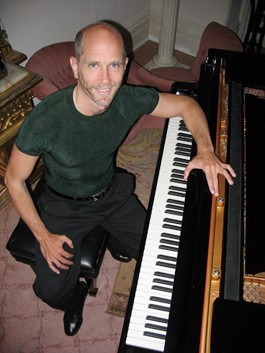
Flyers depicting a slender, sensitive-looking man in leather seated at a grand piano began popping up all over Guerneville last summer. A leather daddy playing Liszt? This was intriguing.

Soon the musically knowledgeable were reporting that the guy with his naked chest poking out between the flaps of a leather vest was a hell of a pianist. Turns out he had taken up residence in the former Guerneville mortuary, brought in a handful of pianos and was offering concerts practically every day of the week. He needed to rehearse anyway, he said, so he might as well make public performances out of his practices.

At the same time, another award-winning concert pianist was moving to Guerneville with her husband and children—go figure the odds in a town of about 2,000 people—and mutual friends decided the two should meet.

It was musical kismet. Seth Montfort, a pianist who founded the San Francisco Concerto Orchestra, and Haley Yount Severe, a vocalist and pianist who left her longtime Mill Valley music studio for greener hilltops, decided to join forces and create the Russian River Performing Arts Center.

The timing was perfect. Montfort had just lost a roommate, because the roommate’s toy dachshunds barked incessantly when he played. The building on Mill and Fourth streets was too big for a single renter but just large enough, with its main room and side offices, for a modest music conservatory.

It might seem like a pie-in-the-sky idea in a town as small as Guerneville. How can you fill 40 seats often enough to pay the rent?  But consider that the lower Russian River communities already support a year-round theater company, a nightly jazz club, a movie theater and several art galleries, and it seemed potentially doable.

The two pianists are a force to be reckoned with. Severe, who says she really gets going when people tell her something is impossible, and Montfort, more reserved by nature but equally determined, are pulling it off.

It didn’t hurt that Montfort has top-notch musician friends in the San Francisco Concerto Orchestra, an organization he founded 10 years ago so professional musicians could have the starring roles often denied them in their regular symphony jobs. In the early months, those players showed up regularly to perform, 20 or 30 of them, with their instruments, often squeezing into the tiny former embalming room and memorial chapel.

John Moran, performing and literary arts manager for the Sonoma County Arts Council, dubbed these endeavors “the Mortuary Orchestra.” Montfort and Severe are still deciding if they want to make the name official.

What Severe brings to the mix, other than her expertise at the keyboard, is years of teaching piano and voice to both children and adults, a background in theater, television and radio, and a way of relating to people that makes them want to keep coming back for more. 

While they both started their careers as child prodigies, Severe and Montfort are otherwise a study in contrasts. Short of five feet tall and 100 pounds, Severe has been married for 26 years to the man she fell in love with on her first day of college. Severe’s musical background includes a childhood spent in the Southern Baptist Church in Oklahoma City and piano lessons beginning at age five. By age 12, she was the youngest student at the Oklahoma City University Performing Arts Conservatory, where she studied Italian, French, German, opera, musical comedy and classical piano, and played the bassoon in the university orchestra. She toured the country, representing the university in vocal competitions, and was named female vocalist of the year by the National Association of Teachers of Singing in 1978, earning a full university scholarship.

While she was still living in Oklahoma, Columbia Records invited her to Los Angeles to audition for Star Search. She didn’t make the cut because she sang the wrong kind of song—it was evidently country and Western year—but it brought the Severes to California, where they have lived happily ever after.

With their children finishing college and going out on their own, Haley and her husband decided to leave now-urbanized Mill Valley for Wild West Sonoma County, landed in Guerneville and began this new chapter of their life.

Montfort, the self-appointed foreign ambassador of the pair, spent the last half of March and early April fulfilling a lifelong dream of playing Latin American&–inspired music in Latin America. He had booked himself on a musical “Temple and Jungle” tour of Mexico, beginning with a concert at the Hotel Villa Maria in Merida, next door to a famous Aztec pyramid.

Montfort says he has always been drawn to the jungle and music that comes from the jungle, whether traditional or composed.

“When I was a child,” he says, “I wanted to be a naturalist. I grew orchids in my room and the paint peeled off the walls.”

Now, he frequently performs pieces by Heitor Villa-Lobos, Brazil’s most renowned composer, and writes his own music, inspired by the ancient sounds of the Latin American jungles. Originally from Colorado, he grew up in a musical family. Both his grandmothers played piano in silent-movie houses, and his brother Matthew heads the highly successful world-fusion band Ancient Future.

Seth Montfort began playing the piano on his own as a child and was quickly drawn into the world of music competition without much formal training.

“I got my training by being onstage, and by being onstage with mean people [who considered him an upstart],” he says. “I actually didn’t play very well for the first 10 years.”

After he moved to San Francisco, he stopped performing for seven years to compose his own music, then reinvented himself as the head of the San Francisco Concerto Orchestra, which not only performs regularly, but also sponsors competitions that have served as a springboard for numerous new musicians. At the Russian River Performing Arts Center, one of his personal goals is to create an exchange program for Mexican and American music students. He believes the two musical cultures have a great deal to share with each other.

Montfort explains that the leather outfit he wears when he plays Liszt is really just a costume. “I don’t have just one personality when I play, but I try to be what the music is,” he says. “When I heard Liszt concerts, they always sounded like leather to me, so I started playing them in leather.”

But, even though Montfort’s leather is more showmanship than lifestyle, it is also an expression of the center’s pervading attitude that you can be a serious musician without taking yourself seriously. It’s a fun place to be. There is a friendly give and take between performers and audience that is rare, especially at a classical music event.

For example, last autumn, following a symphony performance of Saint-Saëns’ “Carnival of the Animals,” the audience sent up bravos after the finale. The playing had been passionate and sprightly, and the accompanying verse by Ogden Nash was a hoot. So the orchestra leader asked, “Do you want us to play the finale again?” When the audience shouted yes, the pianist, a wild woman from Philadelphia who played like a virtuoso in heat, proclaimed, “Only if you dance to it!”

There was no dancing, but there was a second finale and smiles all around.

The center’s combination of concert offerings is as unconventional as the ambiance: folk, worldbeat, jazz standards, piano solos, a weekly “healing with music” session, an open mic, an African percussionist playing duets with a classical violinist—you name it, or suggest it. The Friday night concerts are broadcast live from the center over Guerneville’s low power station, KGGV-FM.

There is also the conservatory aspect of the center, primarily Severe’s piano and vocal training, which she says is her favorite part.

“I want to have students imagine what they can do with their gifts,” she says.

She carries musical expression as a regular part of life philosophy into all her teaching, working with students in whatever way they need to be successful. Recently, one of her teenage students was so nervous about what was going on in her personal life that she couldn’t sing. Then the student burped, and Severe countered her with a big loud one of her own. It quickly turned into a belching contest and, within minutes, the two were rolling on the floor, belching, laughing and crying.

After that, the young woman was able to sing her song.

The Russian River Performing Arts Center, 16375 Fourth St. (at Mill), Guerneville. 707.604.7600. www.sfconcerto.org.


Wine Tasting Room of the Week

0


Imagine what residents thought upon hearing that a big Napa winery was coming to Freestone. Oh boy, here come the industrial vineyards. This is a little hamlet at the start of the Bohemian Highway, once probably home to more sheep than people, where all the news of the town can be heard while having a coffee at the bakery on Saturday morning. So wisely, Joseph Phelps Vineyards took nearly 10 years to ease into the scene. In 1999, they broke ground on an 80-acre biodynamically farmed vineyard overlooking Freestone, opening a gravity-flow winery in time for the 2007 crush. Phelps seems to have done right by West County.

Newly opened, the tasting room is in a building that formerly housed, going back a few years, the woolens store Pastorale. As yet there is no sign; however, it’s the only business on the road. The casual, airy space is furnished in a whitewashed country French theme. Knickknackery is at a bare minimum; the small collection of fleecewear is no doubt a boon to unprepared tourists headed for what they imagine is the sun-drenched Pacific Coast. Visitors are encouraged to sit down at long tables and even have a picnic; at the copper-topped bar, it’s easy to move through a short tasting list, a nice feature for beach-trippers with the curvy coast highway ahead of them. They’ll want to linger over each sip.

As a good-neighbor gesture, Freestone offers free tasting for locals through June, and 20 percent off most wine purchases. Fittingly, Freestone’s Fogdog label is named for a nautical term denoting a bright spot that breaks through the fog. Fogdog 2005 Chardonnay ($40) greets the nose with a thin haze of heavy toast, like woodsmoke drifting across the field on a cool spring burn day. Caramel and butter herald a crisp palate, lightly sweet like wet, blonde hay.

The 2006 Ovation Chardonnay’s ($60) muted tropical fruit is brightened by a pinpoint sweet spot, tart walnut and a lemon drop finish. The burgundy-hued (can we still say “burgundy”?) Freestone 2005 Pinot Noir ($75) is imbued with black cherries, dark wood and clove. That Pinot is powerful, but I like the Fogdog 2005 Pinot Noir ($40) better. The dark fruit is more lively—strawberries crossed with plums, with accents of split redwood, cedar, earth and a substantial, velvety texture. As we’ve seen with neighbor Marimar Torres’ Doña Margarita vineyard, there are some gorgeous wines coming off this slope. Now, if they could just get a flock of sheep back up there to biodynamically graze the green hills.

Freestone Vineyards, 12747 El Camino Bodega, Freestone. Open Friday–Monday, 10am to 4pm (but warm to closing-time callers). Tasting fee $10–$20, complimentary to locals through June. 707.874.1010.


View All

Stock Crash

0

04.16.08

The axe has officially fallen on commercial salmon fishing this year, following a dismal Chinook salmon run in Central Valley rivers last fall. Worse, no one even knows what’s caused the drop-off. This is the first time in history that the Pacific Fishery Management Council (PFMC), which advises federal policy makers, has ever closed down the entire West Coast of the United States to salmon fishing for a whole year.

The decision came after federal and state fishery managers detected only 63,900 Chinook (also called king) salmon swimming upriver to return to their spawning habitats in the Sacramento and San Joaquin rivers, where they lay their eggs and die after several years at sea. That’s about one-third of an average year.

The sudden drop in numbers—some call it a collapse—resulted in a crisis-tinged meeting of the PFMC March 10-&–14, when the council drew up three options for U.S. Department of Commerce officials to consider. One option banned all West Coast salmon fishing, without exception. The second allowed only the taking of salmon for scientific purposes. The third allowed limited commercial and recreational fishing (with seasons lasting two to six weeks, depending on the region). At presstime, only river fishing has not yet been suspended.

The sudden decline of Chinook came as a huge shock. Hundreds of miles north, on the Oregon border, Klamath River populations saw plummeting numbers in the 2005 and 2006 seasons. But the Central Valley fall run was widely considered a reliable anchor in an otherwise threatened network of salmon spawning habitats throughout California. Last year, it numbered a robust 277,224 fish.

There are so many natural and man-made dangers facing an individual salmon—starting from its birth in a Central Valley river tributary through its migration to the Pacific Ocean and its journey back to that same tributary to lay eggs and die three to five years later—that it’s almost impossible for scientists to keep up with them all, says UC Davis Department of Fisheries biology chair Peter Moyle.

“When the salmon are in as much trouble as they seem to be right now, it’s because a combination of things are not going well in the freshwater habitat and a combination of things are not going well in the ocean,” he says. “That’s what’s going on right now.”

Steven Lindley, chair of the Fisheries Ecology Division at the federal government’s Southwest Fisheries Science Center in Santa Cruz, studies the freshwater part. The two main rivers the Central Valley Chinook call home are the Sacramento and the San Joaquin. In 2007, Lindley took his magnifying glass to the hundreds of dams lining these two rivers. While he focused most of his research efforts on the spring-run Chinook, a population that has been affected more by damming than the fall runs, his research uncovered some problematic trends for both groups.

Fall-run salmon mostly spawn below the dams on these rivers, so they aren’t blocked when swimming upriver from the ocean to their spawning grounds. But the tweaking of the river’s flow to generate power or provide cities with water during a drought introduces a great deal of uncertainty into the salmon habitat.

“The fish have evolved to the conditions that were natural for thousands of years. When those conditions change, that will generally be detrimental to them,” Lindley says. “If you have a dam taking water for hydropower development, the river will rise and fall. Fish will lay their eggs in relatively shallow areas when the flow is high, and then [dam managers] drop the flow down and the eggs are stranded and exposed to the air.”

If the salmon eggs survive this threat and hatch, then they must begin the long journey through the Sacramento-Bay Delta to the Pacific Ocean. Swimming downriver and then through the Delta, the salmon face yet another human-manufactured threat. Thousands of water pumps line the rivers and Delta, sucking water toward thirsty cities and the lucrative croplands that supply nearly half the nation with fresh produce.

In 2005, the year most fall-run salmon returning this year would have been negotiating this pump-infested water network, a record 6.3 million acre-feet of water was diverted from the Delta alone. To get a sense of the sucking power some of these pumps employ, consider that the Tracy pumping plant utilizes 135,000 units of horsepower during peak operation.

Moyle and others theorize this huge sucking power doesn’t just kill the Chinook; it also radically disorients them.

“It makes it much harder for the salmon to find their way through the system. They’re much more likely to be dragged into areas that are less favorable due to poor water quality, or they just get lost.”

Big Fish, Little Fish

Once the salmon find their way to the Pacific Ocean around September, they’re usually greeted by a lavish buffet. Their favorite food—small fish and krill—mill about in the near-shore marine environment, hunting the plankton that have materialized thanks to nutrients provided by coastal upwelling. The upwelling is caused by cold air blowing in from the Arctic North meeting warm air off the West Coast, which causes cold, nutrient-rich water from the deep ocean to mix in with warmer surface water.

This upwelling is the foundation of the food web, but in 2005 there was a problem in the ocean’s kitchen.

Bill Peterson, a research scientist with the National Oceanic and Atmospheric Administration (NOAA), has set out on his trusty research boat off the coast of Newport, Ore., every two weeks for the past 13 years. Skimming along the coast, he collects data on temperature, salinity, plankton and krill. Then he goes back to shore and plugs it into a huge database that compares the conditions to the measurements of previous years.

Peterson reports that 2005 was one of the worst years in his decade-plus history of monitoring ocean conditions. On a scale that rates the likelihood of salmon survival in the ocean from one to 10, with 10 being the worst, 2005 rated a nine.

Peterson says a “blocking ridge” created an atmospheric traffic jam that prevented the crucial Arctic air from blowing in. It wasn’t cleared up until midsummer, meaning the upwelling started nearly five months late, compromising the entire food web.

“You get upwelling starting really early, and that kicks the food chain into gear—food gets produced and nutrients make their way up the food chain,” Peterson explains. “That didn’t happen until July, so all the things that spawned or laid eggs in the springtime found nothing to eat in the ocean. It happened to the seabirds, the salmon, rockfish and a whole list of other marine organisms.”

Swimming on empty stomachs, the salmon may then have encountered some unwelcome company. Since 2001, a highly adaptable predator has been extending its reach at a terrific pace. The Humboldt squid has made a mad dash from its original balmy home near the equator all the way to the chilly tip of Alaska in a seven-year-long marine invasion that is baffling scientists and being touted as evidence of accelerating climate change.

William Gilly has been investigating these slimy beasts for the past five years as part of a quarter-century of squid research at Stanford’s Hopkins Marine Station in Pacific Grove. Gilly has been in frequent communication with NOAA researcher John Fields, who has conducted dissections of the squid stomach to see what they fancy for dinner. Gilly says Fields did not find any salmon bones in his dissections of the squid, but he doesn’t think that means the hungry invaders can be completely ruled out as a factor in the salmon’s demise.

“The timing of the salmon problems and the squid arrival is pretty coincidental,” says Gilly, who is quick to mention there is more unknown than known about the squid. “The squid may not be eating the salmon in the areas where they’re capturing the squid, or if the squid are eating the big salmon, they’re probably only eating the flesh.”

Yet these kinds of face-offs might not have to occur for the Humboldt squid to interrupt the marine ecology. “The squid is a new predator that didn’t exist five years ago, so they could be upsetting the balance,” Gilly says.

Overall, it seems fair to conclude that the salmon swimming downriver and out to the ocean in 2005 faced a very hostile world, both from natural and human-manufactured threats. All the factors haven’t even been added up yet—the PFMC has a checklist of 46 they’ll be going through over the next year—but coming up with partial solutions to these problems is a high priority for Moyle and other like-minded researchers.

“There are a number of factors that come together to cause these declines,” says Moyle. “So the question for us [humans] is, ‘What are some things we actually have control over?'”


From the Bitch and Moan Dept.: Santa Rosa

0

(Gabe took this picture, found on an area lamp post when the diagonal downtown crossing was first instituted.)Just returned from a sun-drenched stroll in downtown Santa Rosa. Had a hot dog at Ralph’s rolling stand and sat in the Square on an ArtStart-decorated bench, licking mustard from my fingers. The Square was temporarily empty of meth freaks, homeless folks and that lady I’ve seen deal drugs from her baby’s carriage. (Turns out the bike cops were gathered just a half a block away in front of the newly closed bagel store that never got around to taking the Wolf’s Coffee awning down. They were talking pastries.) Had a can of soda. Had nowhere to put the damned can when it was empty, so stuffed it in my purse to bring back to work in order to recycle. This brings up one Santa Rosa-borne irritation and it immediately harkens others.

Upcoming MIPA Meeting

0

04.16.08

In a world that made sense, recreational fishermen and environmentalists would stand on the same side—but not as we enter the final weeks of public involvement in the implementation of the North Central Coast phase of the Marine Life Protection Act (MLPA). Public meetings in San Rafael, April 22&–23, will allow fishermen and other stakeholders to voice their opinions on the current state bid to indefinitely close parts of the North Coast to fishing, which will be decided on before the year’s end. 

Of five initial draft proposals for the North Central Coast, three remain: 1-3, 2-XA and 4. Many recreational fishermen adamantly oppose proposal 4, which, among other things, would close almost all recreational bottom fishing at Duxbury Reef, a popular destination for Bay Area boat fishermen. Other important fishing and diving sites along the coast of San Mateo, Marin, Sonoma and Mendocino counties would be closed as well, while leaving the virtually inaccessible waters off Sea Ranch open, a relatively empty gesture. Many opponents of proposal 4, however, support 2-XA, which would allow continued fishing at Duxbury and other popular sites. 

Coastside Fishing Club, a web-based community of 14,000 California fishermen, has largely fueled the opposition to the MLPA, and has strongly influenced the drafting of proposal 2-XA, what many fishermen feel is the least of three evils. Club secretary Mike Giraudo sees the MLPA as just one part of a long-term attack on recreational fishing; he believes that there will be no turning back, ever, once the proposed closures are implemented. “Once they get their teeth into this and get us used to the restrictions, I don’t think they’ll ever go away.”

Various environmental organizations have supported and funded the MLPA process with the hope of ending commercial and recreational fishing in many locations, but many fishermen have voiced the opinion that “enviros” are barking up the wrong tree and that the fishermen themselves are, in fact, enviros. (The full word is disdained by many fishermen.)

“The truth is, most fishermen aren’t bad guys out to catch the last fish,” Giraudo says.

Passed in 1999, the MLPA has since made sweeping changes in regulations and restrictions on marine life harvest along portions of the California coast. The ultimate goal of the MLPA is to promote recovery of depleted fisheries, but some fishermen only foresee the end of their favored pastime. Those who wish to speak out for or against MLPA draft proposals are encouraged to attend the meetings. This could be the final call.

Meetings are scheduled Tuesday&–Wednesday, April 22&–23, at the Embassy Suites Hotel, 101 McInnis Parkway, San Rafael. 9:30am.

More info is available at [ http://www.dfg.ca.gov/mlpa/meetings.asp#brtf ]http://www.dfg.ca.gov/mlpa/meetings.asp#brtf.


Hair Goo

04.16.08

In his letters to me, my father wrote extensively on the superiority of Italian sensibilities in particular and the Italian race in general. If one wanted proof of his theory, one needed look no further than the average American’s complete ignorance in the matter of good food. To my father, bad food was more than just an insult to the body and palate; it was a crime against humanity.

For this reason, when I arrive at Fiorini Italian bakery and cafe in order to learn about a hair-recycling program in Sonoma, I am preoccupied with the pastries, the ambiance and my own nostalgia. Rather than interviewing attendees and asking pointed and important questions, I soon find myself buying sweets and doctoring up an espresso, despite the fact that it’s almost 5pm and now I will be up all night.

The event, organized by stylist Ally Ox of Bianchi Salon, located just behind Fiorini, is replete with Champagne, delicate pastries and a small panel of speakers. Ox brings stylists together to learn about Matter of Trust’s hair-recycling program, and how, with a little organization, North Bay hair salons can do their part to soak up oil spills across the nation.

Matter of Trust has collaborated with thousands of salons throughout the United States and abroad to gather donations of hair clippings, which are then made into mats that soak up oil spills. Salons pay for postage to send their swept-up hair to a recycling depot in California. Bianchi Salon acts as a catalyst, organizing and providing information to other salons in hopes that Sonoma will soon have a drop-off center, so that local stylists can bring in their hair clippings and work together to make the process efficient and sustainable.

While waiting for the discussion to begin, I chat with attendee Leslie Sheridan. Sheridan runs a consulting and marketing company, and is attending this event not because she has hair to spare, but because she knows Ox from Green Drinks, a social-networking group for business people who believe in people, plus profit, plus planet.

After discovering that many of our local Chambers of Commerce refuse to take stands on causes Sheridan holds dear—such as a living wage, the GE-Free Sonoma County effort and affordable housing—she began to look elsewhere for like-minded business associates. She found them at GreenDrinks.org, and she’s here to learn something new and support her fellow Green Drinks member.

Once the talk begins, I learn all sorts of things. The Sonoma County Business Environmental Alliance is on-hand to discuss resources for greening your business. What appears to be a cut-off dreadlock that got run over repeatedly by a semi-truck is actually a hair mat made from salon clippings. This hair mat can help deal with the millions of gallons of oil that somehow end up in our oceans. Each hair mat can be used, wrung out and then used again and again. Founder Lisa Craig Gautier tells us that oil spills are not the only use for these mats. Now that California is banning the weed killer Roundup for municipal use, counties are desperate for an alternative, and these hair mats could be just the solution for natural way to reduce weeds.

Next up is Greg Starkman, founder of Innersense Organic Beauty, who discusses the need for hairstylists to move away from chemical-laden professional products to those more organic and sustainable. Keeping dyes and chemicals out of the waterways is one key issue, as well as increasing our understanding of what we are putting on our skin and hair, and how the chemicals included in most products can affect our health.

Back home, I’m too wired from my double espresso to sleep, and so I check out a website recommended at the event by Ox, www.cosmeticdatabase.com. This is a free site that allows you to type in the name of your favorite beauty products and discover where they fall on the “safety” barometer. My face lotion rates six out of 10, with 10 being the most toxic. If my father were still alive, I imagine that he would tell me that the problem is that my face lotion is not Italian. Italian face lotions could never cause cancer.

For more information on Sonoma’s hair recycling program, contact Bianchi Salon at www.bianchi-salon.com. For more information on the Sonoma County Business Environmental Alliance, go to [ http://www.sonoma-county.org/bea/ ]www.sonoma-county.org/bea/.


Love Immortal

0

04.16.08

Get ready to rumble. Buy lots of extra Kleenex. Romeo and Juliet, those star-crossed lovers from Verona, Italy, are getting ready to kill themselves again, and this time, they’re making it a double date with two crazy kids from New York City. As the grand finale of the 2007&–2008 Sonoma State University theater arts program, two of the greatest and saddest love stories ever put onstage—Shakespeare’s Romeo and Juliet and Laurents, Bernstein and Sondheim’s West Side Story—will play back to back in rotating repertory, a veritable dead-teenager marathon. Romeo and Juliet, directed by Paul Draper, opened last week, and West Side Story, under the direction of Amanda McTigue with musical direction by Lynne Morrow, starts this week, after which both plays will alternate back and forth, sometimes on the same day, through May 11.

“These are students who are coming to this material fresh,” says Draper, standing in the lobby of the Evert B. Person Theatre, where he is joined by his Romeo and Juliet (Rob Ratchford and Greta Marh) along with McTigue and West Side Story’s Tony and Maria (Arturo Spell and Christa Durand). “They have their own things to say about the world they live in. This experience gives them the opportunity to relate this great material to what they are experiencing, to allow them to think, ‘What do I feel now?’ rather than ‘What would they think then?’ In so doing, they are reclaiming this material and making it powerfully strong, fresh and significant. They are making these plays their own.”

“It’s true,” says Marh. “I mean, who doesn’t know Romeo and Juliet? We do make it fresh by making it our own. What I’ve been focusing on is making it my Juliet. It won’t be like anyone else’s Juliet, which takes a lot of pressure off me, while also putting a lot of pressure on.”

According to McTigue, that same principle is at work on West Side Story. This version, for example, features a racially mixed cast that circumvents the all-white Jets and all&–Puerto Rican Sharks casting that most audiences expect. In these gangs, racial identity is not so black and white—or brown and white.

“This production,” McTigue says, “highlights the play’s underlying issues of identity and race, examines issues of who’s who, asks the questions about what a gang means and demands to know what all this hatred is based on. The makeup of our cast alone breaks that open in a new way and forces us to examine those questions.”

“In West Side,” says Christa Durand, “we’ve been working a lot at stripping away the dated stuff, particularly the way the language is performed. If we keep the original language, it sounds kind of 1950s-ish, so we’ve been working on contemporizing our body language, throwing in a few ad libs here and there. But really feeling the language as if it were today, not falling back on characterizations from the 1950s.”

The action in West Side Story is updated as well, says Durand, with the fight scenes reconceived to look less like Jerome Robbins’ modern dances, as in most versions, and more like actual fighting. “Whenever I watch the opening scene, the opening fight between the gangs,” she says, “I always tear up because it’s so real, so filled with hatred and ridiculousness between these two gangs. I think we’ve been focusing on digging down to the real drama, to the real emotions, and not just putting on some cute high school show.”

“In Romeo and Juliet,” says Ratchford, “the fighting is also pretty real, with bats and sticks and swords and all kinds of weapons. When the fights come, it looks pretty scary, because violence is scary.”

“Yeah, this play is about conflict and hate, but it’s also about love,” says Spell. “I’d never seen West Side Story until I was cast as Tony, and then when I found out that I die, I was like, ‘Man, that sucks.’ But when I put myself into this character, I think about what would happen between me and Maria if I didn’t die, even with all of this anger and hatred and stuff going on. Maybe if Chino didn’t get me at the end, maybe if Maria and I somehow survived and ran off to the desert, just me and her, we would have made it.

“I wonder if, in the real world, that would have been possible, a multiracial couple, just running away and leaving all this stuff behind. To me, I have to say, ‘Yes. Yes, they would make it.’ Because even in a world where interracial relationships are not approved of everywhere, especially back in the 1950s when this was written, even with all of that, I believe love conquers all, and hope springs eternal.”

“There is one scene in Romeo and Juliet that is so pure,” Draper says, “so absent of any kind of cynicism or negativity, and that’s the famous balcony scene. Every time I watch it I think, ‘How is it possible to be any place except wanting love?’ And when that love gets pulled apart, what Shakespeare is doing—and what hopefully we will be doing—is pulling the audience apart a little too.”

“There’s one part in the show,” Marh says, “where Romeo has to go off to Mantua, and I always think, ‘Why am I not going to Mantua?’ I always want to climb down the balcony and go after him. Why can’t we just run away together?”

“It’s a fantastic moment as an actor,” Ratchford says, “because everyone knows we’ll never see each other alive again, but we don’t know that. I don’t know that. At that moment, I, as Romeo, as we’re parting, I have to believe that I am going to see this person again, that this is my wife and I’m coming back to get her. Rob says that if Tony didn’t die, he and Maria would find a way to stay together, no matter how hard it would have been, and I feel the same way about Romeo and Juliet. Juliet is his equal.

“He tells Friar Lawrence, ‘The one I love now doth grace for grace and love for love allow.’ In other words, he’s saying, ‘I’ve found the one I’ve been looking for. Juliet is the one.’ If they hadn’t ended up killing themselves, you know they’d have found a way to make it all work.”

‘Romeo and Juliet’ plays April 18, 26 and May 2 and 10 at 8pm; April 19 and May 3 at 2pm; April 27 at 5pm; April 29 and May 7&–8 at 7:30pm. ‘West Side Story’ plays April 16&–17 and 30, May 1 and 6 at 7:30pm; April 19 and 25, May 3 and 9 at 8pm; April 20 and May 4 at 5pm; April 26 and May 10 at 2pm; The two plays are a double feature April 19 and 26 and May 3. $8&–$15. Evert B. Person Theatre, SSU, 1801 E. Cotati Ave., Rohnert Park. 707.664.2353.


Museums and gallery notes.

Reviews of new book releases.

Reviews and previews of new plays, operas and symphony performances.

Reviews and previews of new dance performances and events.

Above the Fold

0

the arts | visual arts |

‘Dancing crane, Opus 460’: Made from just a single piece of paper, this bird is a minor triumph in Robert Lang’s extraordinary repertoire.

By David Templeton

When people are first exposed to truly complex origami, they often have very strong, very unpredictable reactions,” says Dr. Robert Lang, a former physicist and engineer, now hailed globally as one of America’s best, most original origami artists. Lang is the kind of a guy whose idea of relaxing at the end of the day involves folding a piece of hand-made paper into a sculpture of a bug, a brontosaurus or a Black Forest cuckoo clock. With several origami books to his name, more than 400 designs catalogued and diagrammed (many on display in museums in Paris, New York, Boston, Tokyo) and over 40 patents related to his former field of lasers and semiconductors, Lang is now a full-time origami practitioner.

And he has become a rock star in the origami world. In 1992, Lang delivered a speech at the annual convention of the Nippon Origami Association in Japan, making him the first Westerner to be so honored. Without question, he is one of those who had a strong, life-changing response to his first encounter with professional-grade origami.

“Certainly, some people don’t have that strong a reaction,” he says. “Some people might look at an origami sculpture and think, ‘That’s lovely, that’s cool, that’s beautiful,’ and that’s where it ends. But other people, they see their first complex origami sculpture, and they are instantly hooked; they become passionate about it, as if they uncovered some part of their brain that was made for origami, as if the concept of origami plugged their brain like a key into a lock.”

Lang hopes to be unlocking some of those unsuspecting brains when he appears April 23 at Sonoma State University to give a lecture titled “From Flapping Birds to Space Telescopes: The Art, Math and Science of Origami.” The afternoon lecture, part of the SSU math department’s weekly math colloquium, will be fully illustrated with photos of Lang’s own extraordinary origami creations, along with examples of origami-inspired technologies and scientific applications of origami concepts.

“Origami,” he explains, “has been undergoing a revolution over the last several years, both on the art side—all the amazing things people are able to do these days with origami—and also on the scientific side. Surprisingly, origami has turned out to have many practical applications in the areas of space, medicine and industrial design.”

As examples, Lang rattles off a string of inventions and procedures inspired by origami. There’s the high-tech heart stint, developed by Dr. Zhong You, which opens and closes using basic origami principles. Automotive airbag designers use origami algorithms to determine where the fold lines should go in flattening and condensing an unexpanded airbag. And then there are what Lang calls “Brobdingnagian space telescopes,” currently staring down at us from space, thanks to the miracle of origami.

“There are several large human-made objects currently floating in space,” Lang says. “Solar sails employ origami principles to collapse them down small enough to fit in the spacecraft that originally deposited them in the cosmos. Origami inspired those solutions to the problem of taking a large thing into space in a small ship.”

In the art of origami, as in the science of physics, it pays to be a bit of a perfectionist. Asked if there are any specific origami designs he has attempted but not been successful at, Lang responds, “Oh, always. All of them. Nothing I’ve ever tried has been fully successful—not enough to satisfy me. But fortunately, I’ve come close enough with some things to put them on my website or display them or sell them or whatever. Insects, for example, are very intriguing, because each time I do one, I think it’s pretty good, then after a while I realize I haven’t succeeded as well as I could have, so I come back and I try it again a different way.”

He cites the legendary “bug wars” of the late 1990s (chronicled by Susan Orlean in The New Yorker), when origami artists around the world began producing better, more detailed, more complex origami representations of insects and bugs in an escalating, international game of one-upmanship. His works are so mind-bogglingly complex and impossibly detailed that it seems amazing that he could feel they were less than perfect.

For Lang, it’s a philosophical issue.

“In some ways, everything I’ve ever folded is only an approximation of an ideal imagining of what it could have been,” he says. “There have been close approximations of that ideal. There have been distant approximations, things where I feel like I didn’t come very close, but nothing has hit the mark perfectly. But that’s good. That’s why I still have something ahead of me to strive for—forever. In the art of origami, artists always strive to get closer and closer to perfection, even though they know they’ll never reach it.”

Recently, Lang has challenged himself by folding a series of sculptures inspired by Indian clay and ceramic pottery, tackling the problems of how to create patterns, lines, spots and other designs in the body of the elegantly flowing sculpture. Asked to explain his artistic goals in regards to this pottery series, Lang keeps the conversation in the realm of philosophy.

“The goal,” he says, “quite simply, is to make something three-dimensional that is more evocative of a ceramic piece of pottery than it is of a sheet of paper, though on one level it never stops being a sheet of paper.” Some “sheets of paper,” of course, become less paperlike than others, and some origami sculptures are so difficult to create that Lang is happy to have only attempted them once. “There’s a rattlesnake I did,” he laughs. “It has about a thousand scales and required a huge amount of folding to create that scale pattern. I probably won’t ever try that again.”

Not surprisingly, Lang is committed not to just creating more and better origami sculptures, but to spreading his origami fever to more and more people, all around the country.

“In my own work, I’m interested in using origami ideas and techniques to push the boundaries of what’s possible,” he says. “But beyond that, I definitely want to reach people, people like myself who are hard-wired for origami, because they may not know their life passion is out there. But if origami turns out to be their life’s passion—as it has for so many people, as it’s been for me—I would like them to have a chance to discover it.”

 Robert J. Lang speaks on Wednesday, April 23, at Darwin Hall, SSU, 1801 E. Cotati Ave., Rohnert Park. 4pm. Free. 707.664.2368.


View All


Museums and gallery notes.


Reviews of new book releases.


Reviews and previews of new plays, operas and symphony performances.


Reviews and previews of new dance performances and events.

First Bite

0

E ditor’s note: First Bite is a new concept in restaurant writing. This is not a go-three-times, try-everything-on-the-menu report; rather, this is a quick snapshot of a single experience. We invite you to come along with our writers as they—informed, intelligent eaters like yourselves—have a simple meal at an area restaurant, just like you do .

When celebrity chef Bobby Flay visited Nick’s Cove last November for his television show, he compared the oysters served there to Viagra-on-the-half-shell. He also had this to say about the views of Tomales Bay, upon which waters the little restaurant literally sits: They “aren’t bad.”

Even if his words were hardly eloquent, it’s a conclusion that diners at Nick’s may find themselves repeating. Because as sumptuous as the setting is—smack on the shoulder of the skinny, winding Highway 1, framed by towering eucalyptus/redwood/rolling hills and with the lovingly and expensively renovated historic building sprawling out to pylons above the Pacific—the food can quickly overpower with its significant charms.

Indeed, a friend and I set the specific time of sunset to meet for dinner one recent evening, to take in the breathtaking light that drops from the western sky into a brilliant, pink-red-blue-gray curtsy behind the floor-to-ceiling windows spanning the back of the restaurant. We admired, awestruck, yet when our food came, we barely looked up from our plates again.

Fresh oysters ($2 each) are a specialty. Drawing from nearby Hog Island Oyster Farm and its neighbors, oft-changing selections might include Sweetwaters, Kumamotos or the Marin Miyagis and Preston Points we chose. Creamy, briny, demanding to be bit and savored instead of swallowed, the buttery meat didn’t need (but was wonderful with) accompanying classic Champagne mignonette and a highly appealing “hog wash” of vinegar and jalapeño. The ritual is elegant, plucking a shell from its perch atop a sparkly tray of ice, loosening the muscle with a tiny silver fork, then slurping the salty goodness.

Fish also shines. Local salmon being as precarious as it is right now, Nick’s has brought in Scottish ($24), which has the advantage of being some of the finest farmed variety in the world. It was advertised as coming bagna cauda (Italian for “bath,” essentially an anchovy sauce), though on my visit it was barely a splash over a bed of Peruvian purple potatoes and roast cauliflower. Nothing was missing, however, from Bodega Bay Dungeness crab cakes ($16) served as a trio of luxuriously meaty, golden-edged disks tinged with fennel and resting on a puddle of bright Meyer lemon aioli.

While Nick’s has a fine repertoire of non-seafood entrées—almond grilled Creekstone rib eye ($31) or apple sage stuffed pork loin ($19), for example—one of the most hugely satisfying plates is the cheeseburger and fries. It’s pricey at $16, but first-rate, the beef fresh-ground and hand-formed into a thick patty, layered with Spring Hill cheddar or Point Reyes blue and a scattering of housemade pickles.

This is also an important tidbit for a would-be diner at Nick’s to know: reservations are strongly recommended. Walk-ins are welcomed at the crowded bar or at the raw bar (full menu served), but landing a seat can be an awkward game of musical chairs. The fastest feet—or most virile appetite for oysters, perhaps—win.

Nick’s Cove. Open for lunch and dinner daily; dinner only, Tuesday. 23240 State Route 1, Marshall. 415.663.1033.


View All

Quick-and-dirty dashes through North Bay restaurants. These aren’t your standard “bring five friends and order everything on the menu” dining reviews.

The Ugly American

04.16.08 There comes a time in every humorist's life when he has to ask himself, "Is my facetiousness actually contributing to global ignorance?" (P. J. O'Rourke should have asked himself that question 25 years ago.) In the new Morgan Spurlock documentary, the matter of whether Spurlock's ignorance is comically assumed or genuine begins not to matter. This is an average-guy...

Going to the Chapel

04.16.08Flyers depicting a slender, sensitive-looking man in leather seated at a grand piano began popping up all over Guerneville last summer. A leather daddy playing Liszt? This was intriguing.Soon the musically knowledgeable were reporting that the guy with his naked chest poking out between the flaps of a leather vest was a hell of a pianist. Turns out he...

Stock Crash

04.16.08The axe has officially fallen on commercial salmon fishing this year, following a dismal Chinook salmon run in Central Valley rivers last fall. Worse, no one even knows what's caused the drop-off. This is the first time in history that the Pacific Fishery Management Council (PFMC), which advises federal policy makers, has ever closed down the entire West Coast...

From the Bitch and Moan Dept.: Santa Rosa

(Gabe took this picture, found on an area lamp post when the diagonal downtown crossing was first instituted.)Just returned from a sun-drenched stroll in downtown Santa Rosa. Had a hot dog at Ralph's rolling stand and sat in the Square on an ArtStart-decorated bench, licking mustard from my fingers. The Square was temporarily empty of meth freaks, homeless folks...

Upcoming MIPA Meeting

04.16.08In a world that made sense, recreational fishermen and environmentalists would stand on the same side—but not as we enter the final weeks of public involvement in the implementation of the North Central Coast phase of the Marine Life Protection Act (MLPA). Public meetings in San Rafael, April 22&–23, will allow fishermen and other stakeholders to voice their opinions...

Hair Goo

04.16.08In his letters to me, my father wrote extensively on the superiority of Italian sensibilities in particular and the Italian race in general. If one wanted proof of his theory, one needed look no further than the average American's complete ignorance in the matter of good food. To my father, bad food was more than just an insult to...

Love Immortal

04.16.08Get ready to rumble. Buy lots of extra Kleenex. Romeo and Juliet, those star-crossed lovers from Verona, Italy, are getting ready to kill themselves again, and this time, they're making it a double date with two crazy kids from New York City. As the grand finale of the 2007&–2008 Sonoma State University theater arts program, two of the greatest...

Above the Fold

the arts | visual arts | 'Dancing crane, Opus...

First Bite

11,084FansLike
4,446FollowersFollow
6,928FollowersFollow