Bees ‘R’ Us

06.18.08


I hold the torn piece of cardboard in my hand as I nervously stand on the ladder and prepare myself. There’s really no easy way to do this, I think. Joey shouts encouragement from below. “Nice and easy! Just like shaving Grandpa!”

And with that advice, I plunge the cardboard into a cluster of thousands of buzzing bees, scraping gently and resolutely. They fall in large bulbous chunks, like old pudding, landing gloppily into a casserole pan that I gingerly hold in my other hand. Feeling that this is a task one must do without pause, like walking on coals, I continue to move the cardboard steadily across the gigantic conglomeration of bees and fill the pan with plop after plop of pure insect.

Bees weigh more than one would think, and when the heft of my haul finally registers, I clutch the ladder, look at the enormous hive just inches from my face and laugh. I laugh giddily and uncontrollably and loudly and light-headedly. This is crazy.

For Liz and Joey R, however, it’s just another day at work. Doing business as R Honey Pots (the “R” represents a legal last name, coined upon marriage), Liz and Joey specialize in humane beehive removal from all manner of unusual places where humans would rather the insects not reside; they’ve even removed bees from the county jail. Most importantly, the Rs do not kill the bees. Their task instead is to encourage the swarm to relocate out of people’s homes and into a wooden box, whereupon they’re moved to an apiary in western Sonoma County to colonize, reproduce and make honey in peace and quiet, a much better fate than that which comes from a can of Raid.

Ten years ago, Liz and Joey, then a just-married couple, joined the Peace Corps and traveled to Paraguay together. Joey was assigned agriculture; Liz got bees. (“I was so jealous,” Joey says.) When the two returned to Sonoma County, Joey worked construction and Liz taught at a charter school, but it was apparent that they’d gotten the bug. They started a small apiary and took on swarm-removal jobs here and there. Slowly, their expertise grew, and nowadays they work roughly two to three removal jobs per month.

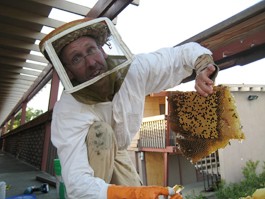
Today’s job is at the Los Robles Lodge, the Santa Rosa hotel that closed two years ago and has sat empty while the city and developers hash out a condominium plan. When I arrive, Liz and Joey have already torn the wooden planks away from the inhabited stucco deck to reveal a massive hive measuring 10 feet long. Approximately 80,000 bees are swarming all around. I’ve never seen anything like it. “Do you want a veil?” Joey asks me, but I’m tough and I brush it off. Within 30 seconds, however, what I’m brushing off is an irate bee. Zing! I am stung on the ear.

Humbled, I accept the veil, a mesh cloth draped over a toy hat with a plastic police badge on the front. (“I like the little star,” Liz says. “I feel like the bee sheriff.”) I tuck my pants into my socks. I put on some rubber gloves and I try to stay calm when bees land on me, which is almost constantly. I never get stung again.

Underneath the hive, Liz works a smoking teapot in one hand and a serrated knife in the other, looking like a character in a poorly conceived British horror movie. Soon, I figure it out: the teapot’s smoke startles the bees, and once they’ve cleared away, the knife cuts away pieces of the hive. Liz pulls chunks of comb away, often dripping with honey and usually still covered in bees, and hands them up to Joey on the deck’s landing, above the hive, one by one.

Some married couples don’t work well together, but Liz and Joey call this their “romantic time.” They call each other “honey” and “baby cakes” and other endearments while they work. Even under the direst circumstances, they maintain a level of calmness, cooing pleasant phrases like, “Hey, baby cakes, I’m sorry, but this large chunk of honeycomb is slipping and I’m in horrible danger of having bees fall all over my face, d’you think you could help me out, honey, please?”

They also affectionately call the bees “ladies.”

The goal here, really, is to find the queen bee, because once she’s moved, the other bees will follow suit. But two hours pass, and still no queen bee. What we’re looking for is the honeybee equivalent of a Lil’ Wayne video, a cluster of hoochie bees with their asses in the air. Finally, she’s found, and I get a good look, it’s amazing how much larger, browner and tougher-looking she is. No wonder Liz has a tattoo of a queen bee on her back.

Minutes later, Liz shrieks excitedly. “It’s another queen!” she cries. Sure enough, the swarm starts making a different sound, and I can spot the beautiful matriarch. I try in vain, wearing honey-gunked gloves, to get a good photo of this second queen—two queens in one hive is really rare—but I have to settle for second best: a line of hoochies with their asses in the air.

As Joey assembles comb into wooden boxes, he breaks off some “uncapped” honeycomb for me—that is, comb with fresh honey that hasn’t been sealed up yet by the bees with wax. “Try it,” he says, “just bite the whole thing.” So I chomp down and—holy shit!—it’s 10 times fresher than the coagulated stuff in the plastic bear at home.

At the end of the job, the total sting count is me, 1; Joey, 4; and Liz, 7. Amazingly, the two bees that got underneath Liz’s suit and have been stuck inside her cleavage for the last hour didn’t sting her at all. Joey, on the other hand, says he likes the stings. “Those stings are reminders for me that we don’t have ultimate control,” he says. “I like the fact that a little small creature can wake up and create that much awareness. To me, that’s respect.”

“What’s the worst you’ve ever been stung?” I ask the two.

“Oh, one time I put my whole arm down a hole,” Liz says, “and got stung 10 times all at once and went into anaphylactic shock and went to the hospital. But,” she adds with a grin, “it was a really cool hive.”

The Rs send me on my way with a bucketful of honeycomb, and I stay up late that night running it through cheesecloth and strainers. “Los Robles Lodge Honey” might not sound like the most attractive-tasting stuff in the world, but man, it’s delicious.

A couple weeks later, I meet up with Liz at the apiary, a collection of about seven boxes, each labeled with the location where they’re from. I find the box marked “Los Robles” and wave to my old friends, but Liz, who’s just suddenly been stung, has ceased calling them “ladies.”

“I’m not even touching your hive, beyotches!” she says.

We meet up with Joey at the Ace-in-the-Hole Pub, and we talk about the urge most people have to call exterminators when faced with bees. If there’s anything the Rs want us to know, it’s that pesticides not only worsen colony collapse disorder but don’t finish the job properly. The pest company will spray reachable parts of the hive, Joey says, “but are they gonna reach that 10 feet that you saw at Los Robles? Is that gonna reach all the way in there and kill the queen? Naw. Is it gonna get rid of all that honey, all that fuckin’ brood? Naw. It’s still gonna be there. It’s just gonna create a place for vermin, for ants to come in. It’s a surface solution for a deeper problem.”

“I feel like they’re the most direct connection to the whole natural system,” Liz says of bees. “Ninety percent of the stuff that we have is thanks to bee pollination. They’re so integral to our way of life.”

Joey’s reasoning is even more gut-level. “They communicate how I would like to communicate, which is this“—he places both hands on Liz’s arm and shoulder—”I’m touching. It’s hugging. They communicate tremendously well. They can tell you where a honey source is five miles away by how they dance! That’s just like—there are how many millions of years of evolution that have gone into the creation of bees? And that we’re still developing? We can learn a lot from bees.” 

“They’re our children,” adds Liz. “We don’t have human children. We have bee children.”

“Yeah,” says Joey. “We have to work together—for them.”

 More information about bee removal services can be found at [ http://www.rhoneypots.com/ ]www.rhoneypots.com.


ICE Storm

06.18.08

It happened again. Early on Thursday, May 22, Immigration and Customs Enforcement (ICE) officers parked their unmarked cars in front of an apartment building in the Canal district of San Rafael. Brandishing warrants, they pounded on doors, insisted on entry and questioned everyone within on his or her citizen status. In the end, they arrested 17 illegal immigrants: 10 from Mexico, six from Guatemala and one from El Salvador. Four people were deported immediately. The rest were processed in Bay Area detention centers.

This was the largest raid in Marin County since March 2007, when ICE swept three apartment buildings in the Canal neighborhood. The raids have not just been limited to Marin, however. Since October, ICE says it has arrested 1,600 illegal immigrants in Northern California alone.

“The raids have been happening all around the Bay,” says Tom Wilson, executive director of the Canal Alliance. “They have been happening around the nation. ICE claims to have deported a large number of people. Their goal is to deport all 12 to 15 million people in this country without documents. They have a very big task on their hands.”

In addition to the raids, ICE uses other tactics to track down illegal immigrants. In Sonoma County, ICE agents have been riding along with police to question Latinos who are pulled over for traffic violations. The department also encourages citizens to report any suspicious activities in their area.

The raids, ICE says, are for immigrants who have received deportation orders from a judge and failed to leave the United States or who were already deported and came back into the country.

“They have already had their day in court before the judge,” says ICE spokesperson Lori Haley. “They just didn’t like the answer that they got.”

The department claims it conducts the raids so that it can conserve resources; it gathers the last known addresses of several illegal immigrants and arrests them all at one time. But they also use the opportunity to interrogate everyone else in the residence and demand proof that they are here legally. Anyone who cannot prove residency may be arrested.

Naturally, the raids have left some people terrified. Two days before the most recent ICE raids in San Rafael, Kathryn Gibney, principal of San Pedro Elementary School in San Rafael, testified to Congress about the effect the March 2007 raids had on her students.

San Pedro Elementary School is 96 percent Latino. On the day of the raids, ICE officials shined flashlights in the faces of children who had their parents handcuffed right in front of them. The next day, 40 students were absent from school, seven times the normal absentee rate.

“Throughout the day, muted and trembling voices asked teachers if agents would come to school and take them away,” Gibney testified. “What would happen to their mommy or daddy or aunt or uncle, and what would happen to them?”

The impact of the raids was “devastating,” Gibney said, with absentee rates soaring, test scores dropping and children increasingly distracted in class.

After this last raid, Luis Gonzalez saw a similar reaction in his own five-year-old son. Even though Gonzalez and his wife are in the country legally, on the morning of May 22, his wife called to tell him that ICE officers were pounding on the door. The officers were speaking English. Gonzalez’s wife, who only speaks Spanish, didn’t know what to do.

But Gonzalez had learned that the ICE officers were carrying administrative warrants, which allowed occupants to keep them out of their residence. He told his wife to refuse to open the door. And while that stopped the officers from coming in, it didn’t stop his son from being scared by the incident.

“He asked me why the police were over here and would they arrest me and mom,” Gonzalez says. “He kept saying, ‘I don’t want to go to Guatemala. I’m scared.'”

Gonzalez is not the only person to hear about the administrative warrant. Fewer people opened their doors to ICE this time around, most likely because they knew they didn’t have to.

But ICE can always get a court-ordered warrant if necessary, which requires occupants to open up, explains Haley.

“ICE is committed to restoring integrity to our immigration laws,” she says. “And that includes deportation orders by a judge. The bottom line is, we are a nation of immigrants, but we are also a nation of laws. And those laws have to be enforced.”


Letters to the Editor

06.18.08

Parent-teachers

Amanda Yskamp’s article on home-schooling was informative and balanced. How nice that you didn’t let all home-schoolers come across as extremists.

I am writing because as the parent of four home-school “graduates,” I was dismayed that your listed resources did not include the HomeSchool Association of California (HSC). Started in 1987 by a small group of Bay Area home-schooling moms, the HSC is the oldest secular home-school group in California. This grassroots nonprofit volunteer organization has been monitoring California legislation and working to keep home-schooling available to all Californians in its current noninvasive form for 20-plus years. This group was the first to hold a statewide inclusive home-school conference which has become an annual summer event.

Thanks for adding www.hsc.org to your list of home-school resources.

Melissa Hatheway

Petaluma

You try it, sistah

I am a credentialed teacher who has taught for the past 14 years at five different public high school sites. I am one of the few public high school teachers I know who is in favor of a parent’s right to home-school their children. However, I really object to Dawn Martin’s uninformed comments and misinterpretation of statistics. If she thinks that credentialed teachers (and yes, there are some really bad ones whom I have worked with) are the primary cause of California’s poor public school showing and that she could do a better job, then I challenge her to spend a month in a public school classroom of 30-plus students with vast needs and skill levels that vary from the abused kid of crack-addicted parents to the kids given a sense of entitlement by their parents that would put British royalty to shame.

It’s easy to judge a public school teacher when you get to teach a few kids you have known all your life (your own), you have very involved parents (yourselves) and you have the ability to discipline and encourage in ways completely unavailable to any public school teacher.

Get real with your conclusions or walk in my shoes for awhile.

Steve Salkovics

Sebastopol

DIY Kudos

Inspired by his own personal headaches, Joe Meisch’s temple massager is the perfect tool for the 21st century: made in the U.S.A., nonpolluting, personally relaxing and self-administered. An added plus is his generous donations to fellow vets. I wish this entrepreneur the best of luck in promoting his handiwork. I’m ordering several for my fellow co-workers so they can relax.

Virginia Strom-Martin

Duncans Mills

Dept. of Corrections

One could blame it on the fine weather, the end-of-school jones or just plain stupidity. Given the choices, we prefer to stick to our Protestant underpinnings and blame it on the fairies.

Bad fairies!

Their gossamer wings a’flutter, the fairies overlooked two now-smarting recording studios in Leilani Clark’s otherwise fine roundup of audio palaces (“The Hills Are Alive,” June 4). Focused Audio (www.focusedaudio.com) and Studio E in Sebastopol would each like you, the rapacious recording consumer, to know that they, too, are open for business and would welcome yours.

Trailing small scraps of rose-colored silk, the fairies next evilly engineered the loss of a K in photographer Jocelyn Knight’s surname (“Stop the Spray,” Green Zone, June 11). Evil silken fairies!

In that same issue, the fairies—after restoring themselves with delicate sips of early morning dew from gilded acorn cups—managed to distract me just long enough that the tag information on the Stage review (“Men Behaving Badly”) became duplicated by their cunning, dew-infused ways. The Sam Shepherd fraternal warfare drama True West plays through June 29 at the Spreckels Performing Arts Center. Leading Ladies, the kind of farce that fairies love best, continues through July 6 at the Sixth Street Playhouse.

Cunning, dew-infused fairies!

The Ed.

gathering moss


&–&–>

Khan Do

0

06.18.08

Forget Zohan, what about Genghis Khan? Now there’s somebody you don’t want to be messing with. Which might explain his cultural staying power, and why a movie about him made seven centuries beyond the man’s lifetime could actually find an audience. From Russian director Sergei Bodrov (fondly if barely known to American audiences for 1996’s Prisoner of the Mountains) and co-written with Arif Aliyev, Mongol is a beauty. As world-conqueror biopics go, this is sort of the anti-Alexander, consistently dignified in the way Oliver Stone’s picture was consistently risible, and justified by its enthusiasm alone in a way the latter certainly wasn’t.

At once sweeping and intimately confidential, with durably magnetic performances by Japan’s Tadanobu Asano as the adored warlord and China’s Honglei Sun as Jamukha, his blood brother and eventual enemy, the subtitled Mongol, a 2007 Best Foreign Film Oscar nominee, has to be by far the best action epic of 12th- and 13th-century Asian nomads screening this month.

And besides, really, how else would we get to know the founder of the Mongol Empire, one Temudjin by birth, whose heavily burdened boyhood and intensely stoic manhood combined to bring about his inevitable Khanhood? It’s no use holding out hope for the definitive written record of his early life, so an honorably dramatized, handsomely photographed motion picture record will have to do.

We all know about the rape and the pillage. But what about the honor and the justice? As a youngster, Temudjin (well played by Odnyam Odsuren) brazenly chose a bride from the wrong clan (or, more accurately, let her choose him), saw his father poisoned and his own clan betrayed from within, suffered long and grueling periods of slavery, watched helplessly as his wife got stolen, earned a break or two from the god Tengri, bringer of thunder and, yes, made himself into a willful, fearless warrior. None of this is at all easy to watch, but thanks to Bodrov’s clarity of purpose, it compels.

The first installment in a proposed Genghis Khan trilogy, Mongol is the movie that’s supposed to leave us thinking, “Oh, so that’s why he was so aggressive.”

“Mongols need laws,” Temudjin says about midway through the movie. “I will make them obey, even if I have to kill half of them.” To many a hawkish pundit’s dismay, they’re just not teaching this stuff in the MBA programs and legislative chambers nowadays.

But back in the day, or at least in the Year of the Earth Tiger (1218), well, guess who got some serious results with that particular strategy of governance? Doing so meant negotiating variously shifty and potentially deadly alliances, maintaining an unflappable determination to rescue his kidnapped wife (Khulan Chuluun) and enduring no shortage of blood-spraying combat on her behalf—and, of course, his own. It also helped that he wasn’t afraid of thunder.

True, simply having presided over the biggest contiguous empire in history doesn’t make him automatically interesting to everybody. To get the most out of Mongol, you’ll probably have to give a damn about the Greatest of All Rulers to begin with. But the richness of the movie’s detail and its overall temperament, demonstrably more at home in the art-house than in the multiplex, tend to seduce.

Shot on location in the snowy steppes of Kazakhstan and Inner Mongolia, Bodrov’s tale can’t help but seem ancient and authentic. The pace is commendably unhurried and the scope swells up in a way that is organic to a character-driven story, instead of simply eager to get to the next CGI-enhanced battle scenes. If it feels longer than its two-hour running time, it’s only in the best possible way. And if some of Bodrov’s sequences occasionally seem to drift and hiccup, the net effect remains an arresting piece of portraiture—not to mention an invitation to partake of his trilogy’s next two installments. The movies may not last another seven centuries, but thanks to their contribution, the Genghis Khan mythology certainly will.

  ‘Mongol’ opens on Friday, June 20, at the Smith Rafael Film Center, 1118 Fourth St., San Rafael. 415.454.1222.


New and upcoming film releases.

Browse all movie reviews.

Best Pests?

06.18.08

From a certain global, neo-Zen perspective, no bugs are really bad; they merely have interests that are counter to our own.

According to Donna Diehl, a trained master gardener, bugs and insects inspire many of the questions and concerns she confronts while on duty. On the website for the Sonoma County Master Gardeners, a program of the agriculture and natural resources department of the University of California at Davis, there is a list of the “Top Ten Most Wanted Pests,” a veritable who’s who of miniature garden terrorists. Diehl, who makes it clear she is no pest expert, but who does have access to a large library of useful information, spent some time recently describing all 10 of these irritating organisms, in reverse order of nastiness, with the help of a few of her favorite textbooks.

10. Apple Coddling Moth “Here in West County, where apples used to be the No. 1 crop, the apple coddling moth is especially problematic,” Diehl says to the sound of quickly flipping pages. She explains that the moth’s method of attack is to breed larvae, which then penetrate the fruit and work their way to the cores of apples, pears, walnuts and plums. “The apple coddling moth,” she adds, “is a very common pest.”

9. Cucumber Beetle “The Western spotted cucumber beetle,” Diehl says, “is a very common pest. It looks much like a ladybug—and ladybugs are my favorites—but the cucumber beetle is green, so it’s a case of red versus green, with red being the good guys and green being the bad guys.” The cucumber beetle, the reference book says, primarily attacks squash, watermelon and pumpkins, and reproduces very quickly. “Their secret weapon,” she says, “is that they make so many of themselves that they are difficult to eradicate.”

8. Stink Bug Shaped like a shield, as if it were wearing a large triangle on its back, the stink bug gets its name from the offensive smell it emits when disturbed. Though it is destructive to tomatoes and all fruits with pits, it also eats smaller bugs, which makes it not entirely bad. “Most of the guys who eat insects,” says Diehl, “are good guys, so they are a mixed blessing. They leave blemishes from the little bites they make on the fruit, and they also leave little brown drops of excrement. So they are sort of disgusting, but not all that destructive. It would take a huge swarm of these to do a lot of damage. They actually annoy the fruit rather than kill it.”

7. Spider Mite Named for the fact it has eight legs and spins webs, the spider mite eats almost anything, and multiplies rapidly. “You don’t find just one spider mite,” Diehl says. “You find hundreds of thousands of them.”

6. Olive Fruit Fly “There are many kinds of fruit flies,” Diehl says, succinctly. “These ones like olives.”

5. Argentine Ant “The most common ant we have here is the Argentine ant,” Diehl explains, pointing out that the primary problem with ants is not what they do to fruits and vegetables, but that they raise aphids (“They milk them,” she says), and aphids are bad for plants.

4 & 3. Snails and Slugs Snails are problematic for reasons most people might not expect. “Snails like to live in ivy,” Diehl says. “And rats like to eat snails, so ivy is often full of rats.” Slugs, she says, especially the little brown garden slugs, are a problem because you can’t see them as easily as snails. “Snails leave a slime trail that is clear evidence of their presence,” she says, “but slugs leave no visible traces, beyond the damage they do to your garden.”

2. Aphids “Aphids also multiply really quickly,” Diehl explains. “You might see one little patch on a leaf this morning, and by tomorrow it’s covered. They suck out the plant’s fluid. They’re like vampires.”

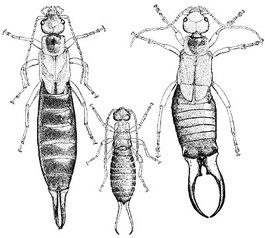
1. Earwigs “Oh, yuck,” Diehl laughs. “Nasty little critters. Earwigs have a real hold here. They can reduce a marigold to nothing but a stem in no time. These are my least favorite because they are so hard to kill. You can step on them, and they just crawl away. To kill an earwig, you have to step on them—and then twist your foot. It’s a little dance we do.”

To learn more about the master gardener program and other pests, go to http://groups.ucanr.org/sonomamg.


Yummy Maggot Cheese

06.18.08

For centuries, rural cheese makers and big city aficionados in various parts of modern Italy, Germany and France have enjoyed what we’d consider a bizarre and repulsive cheese product certain never to be stocked anytime soon: European farm cheeses deliberately infested with locally favored fly eggs or larvae.

Sardinia’s version is called formaggio marcio, meaning “rotten cheese,” or casu marzu, “maggot cheese.” Both names abundantly apply. This time-honored sheep’s milk cheese not only gets aged into a near toxic viscous goo, attracting enthusiasts with its napalm burn, outhouse aroma and fermenting microbes, maggot cheese likewise lays claim to a mouth-feel difficult to put into words.

Casu marzu was outlawed until 2005 when “raised” flies, rather than “wild” ones, became available to produce the maggots. And, yes, it’s actually considered a delicacy. Sardinians enjoy this rare delicacy by slathering heaping glops of casu marzu on rinsed slices of local flatbread. They fold the wetted bread around their prize before gobbling their treasure down. The casu marzu snaps, crackles and pops effervescently with each bite as hundreds of maggots prance merrily about the insides of one’s grateful maw. Word is strong red vin ordinaire is the must accompaniment. It’s not hard to imagine why.

Diners customarily brush extra-eager squirmies who don’t make it all the way to one’s mouth off shoulders and out of hair before returning to civilization. As you might expect, casu marzu provides local medical practitioners with certain challenges we’d hope not to see here in the States. It seems that undigested maggots have the nasty habit of eating straight through a human’s stomach lining.

Quick dining snapshots by Bohemian staffers.

Winery news and reviews.

Food-related comings and goings, openings and closings, and other essays for those who love the kitchen and what it produces.

Recipes for food that you can actually make.

Hop On!

0

06.18.08

Rejecting the detachment and often harsh realism of the popular French New Wave cinema movement, the award-winning 1981 film Diva helped usher in the Cinéma du look in all its vivid, hipster glory. Embracing stylish filmmaking in urban settings centered on trendy and disillusioned youth, Cinéma du look is perfectly encompassed in writer-director Jean-Jacques Beineix’s blend of high art and pop culture.

Rialto Cinemas proprietor Ky J. Boyd says that Diva “changed his life” and is one of the main reasons he became an art-house operator. No surprise, then, that his Santa Rosa theater made room in its already crowded summer movie schedule for a one-week-only run of a new 35 mm print of the film. But beyond the heaping piles of praise heaped upon it, what really makes Diva worth seeing is how darn entertaining and original it is.

Jules (Frédéric Andréi) is a mild-mannered, Moped-driving mailman obsessed with American opera star Cynthia Hawkins (Wilhelmenia Wiggins Fernandez), a diva who refuses to immortalize her singing with any sort of recording. After he secretly records one of Hawkins’ concerts for his own private collection, Jules naturally assumes that the dangerous men following him are intent on recovering the stolen performance.

While there are a couple of Taiwanese gangsters who know of his bootleg and are driven to retrieve it for their own monetary gain, Jules doesn’t know that a prostitute also recently hid a tape recording of damning evidence against the head of an international drug and prostitution ring on his person just before she was murdered. On the run for reasons he doesn’t fully understand, Jules, with the help of his eccentric bohemian friends Alba (Thuy An Luu) and Serge (Richard Bohringer), struggles to evade his pursuers long enough to make a romantic connection with Hawkins herself.

Beineix devotes ample attention to populating his world with full and wildly original characters. The diva of the title is a MacGuffin in the grandest sense; the storyline doesn’t revolve around her, but her presence nonetheless drives the narrative along. Jules plays something of a straight man to everyone around him from sunglass-wearing, awl-obsessed hitman Le Curé, played by Dominique Pinon (French film fans will recognize him as popular director Jean-Pierre Jeunet’s frequent collaborator), to the rollerskating, thieving, would-be fashion model Alba.

But the most unique of all is the enigmatic Serge, a recurring character in a series of novels from the author of the book on which the film is based. With his Zen-like demeanor and mysterious lifestyle, Serge is both a wild card and deus ex machina; we are never quite sure of his motivations and place in the story until the very end. And what an end!

Diva opens for one week only on Friday, June 20, at the Rialto Cinemas Lakeside. 551 Summerfield Road, Santa Rosa. 707.525.4840.


New and upcoming film releases.

Browse all movie reviews.

A Simple Vin

0

06.18.08

Grape juice, yeast and a vintner. Around the world, these three honest ingredients converge as they have for millennia to create the potent product that so many of us love. But deep within the modern winemaking industry, mysterious creatures lurk. In the vineyard and winery, synthesized preservatives, additives, coloring agents and a slurry of names from the periodic table compose a list of aids that rewrites the very idea of bottled poetry.

Some in the industry shrug, saying these methods and materials are there to protect quality standards, to make wine look and taste good and, ultimately, to please consumers. Wine, after all, can spoil if not treated correctly, and sulfites, or sulfur dioxide, the most heavily relied upon preservative, has been used by winemakers to a limited extent for many hundreds of years.

However, not until the 19th century did winemakers declare en masse chemical warfare on vineyard pests and winery microbes. The unsettling reality today is that many wines are a highly processed form of food; the federal government permits the use of dozens of synthetic and natural materials in the making of wine. Some linger in the bottle, say industry watchdogs, and, thanks to hard lobbying by the wine industry, the use of no additives other than sulfite must be divulged on the label. What lies beneath that wine-dark surface usually remains entirely open to speculation.

Virtuous Viticulture

For makers of organic wine, it’s an entirely different rulebook. Governed by personal ideals, loyalty to traditions and, most of all, the USDA, these men and women make up a tiny but growing portion of the industry. Less than 10 percent of California’s wine-grape acreage is grown organically, without the use of petroleum-based products, sewage sludge or irradiated materials. Just a quarter of California’s winemakers use any organic grapes at all, even though there is little question that for the health of farmworkers, the environment and the grapes themselves, organic farming is a hugely virtuous art.

More debatable is the practice of making entirely “pure,” certified organic wines, which cannot contain any added sulfites. Less than 10 wineries along the West Coast produce such a product. Sulfites are very effective at preventing spoilage and oxidation, which materializes as a brown wine with a flat metallic taste, and most winemakers just don’t see the point of skimping on this relatively harmless material, which helps ensure a long life in the bottle.

No Shitty Wines

Darryl Mason, winemaker at Vinatura in Humboldt County, produces certified organic wines. He has dedicated himself to replicating pre-industrial winemaking techniques, and though it has taken him 18 years of battling hazy wine, sediment layers, occasional spoilage and instability in the absence of sulfites, Mason says he has finally achieved his objective in his line of bold red wines.

As an amateur scholar of history, music and wine, Mason says his inspiration to make wine like the ancients did came from listening to college professors explain that pre-Christian societies in the Mediterranean region drank only low-quality wine; they could make nothing better due to a lack of additives and knowledge of microbiology. Mason never believed it. He points out that ancient civilizations achieved famed heights in technology, science, math and engineering.

“And you’re telling me that these people were drinking shitty wine?” he exclaims. “I don’t think so.”

Phil LaRocca of LaRocca Vineyards in Butte County also looks to the old days of the Old World to attempt the craft of organic winemaking. He favors literature from France’s Middle Ages. Winemaker Paul Frey of Mendocino’s Frey Vineyards, the largest and oldest organic winery in the country, has also studied old documents on ancient winemaking and has referred heavily to the writings of Mago, Cato and other agricultural scholars of Mediterranean societies.

Like other organic winemakers, Frey says there is nothing new, progressive, innovative or experimental in his and his family’s methods. To the contrary, many of their practices mirror techniques that dominated the industry for thousands of years. One of their latest and ongoing experiments was inspired by Pliny the Elder, who described a process of aging white wine for 20 years in clay amphorae. Five years ago, the Freys began doing the same, filling 10 seven-and-a-half gallon clay jugs with several wines, sealing them with beeswax and a pine-sap resin, and inviting time to do the rest. These wines may eventually be retailed.

What’s Organic?

Organic wines are produced under intense eyeballing from USDA-approved certifying agencies, such as California Certified Organic Farmers (CCOF), Stellar Certification Services, Quality Assurance International, Oregon Tilth and scores of others around the nation. These watchdogs follow the standards set by the USDA’s National Organic Program. The USDA also reviews products imported from overseas to verify if their own organic claims are valid.

Viella Shipley, director of marketing and sales with CCOF, says organic products bearing third-party certification on the label are entirely trustworthy. In the case of wines, “certified organic” or “organic” means the product was made with all organically grown grapes and without added sulfites. “Made with organic grapes” or “Made with organically grown grapes” means that 100 percent of the grapes were organically grown, but that sulfites may have been added. There is one notable hitch: “Made with organic Chardonnay grapes” (or any other specified varietal) leaves open the possibility that other nonorganic grape constituents may compose up to 30 percent of the wine. The USDA seal may or may not be used on the former of the labels, but never on the latter.

In conventional wines, the list of additives permitted by the Tax and Tobacco Bureau is a long-winded, ugly mess. The additive known as “mega-red” (also marketed as “mega-purple”) secretly serves as a very attractive food coloring for many well-known red wines. A touch of calcium carbonate can adjust the pH. Tartaric acid can cover the taste of unwanted residual sugar. Diammonium phosphate, a yeast nutrient, can aid struggling yeast colonies and malolactic bacteria. Potassium metabisulfite sterilizes equipment. Enzymes may be added to break apart polysaccharides that could otherwise create a haze in the bottled wine. Copper sulfate may be stirred into a vat of fermenting wine to combat the rotten-egg odor of hydrogen sulfide, a byproduct of fermenting yeast.

Many conventional winemakers avoid these items—and many say they wouldn’t touch them with a two-foot pole—but there’s really no way for a consumer to know without a list of ingredients on the bottle. In the vineyard, too, various agents play regular roles in the upkeep of the otherwise regal terroir. Although growers may say they follow organic practices, organic advocates recommend against trusting these claims if the wine bottles don’t bear the label to prove it.

“This green thing has just exploded,” says Martha Barra, co-owner of Barra of Mendocino, whose wines are made only with organic grapes. “There are a lot of people who want to get on the bandwagon, but unless there’s that third-party inspection seal on the back, you need to be skeptical.”

Meanwhile, organic vineyards follow historically favored techniques to counter the enemies that prowl among the grapes. Bird boxes on the property welcome raptors, which prey on rodents. Blackberry bushes around the perimeter provide shelter for many predatory insects which prey on those that enjoy grape leaves. Unwanted weeds in the vineyard are dealt with by hand or machine and left to compost naturally among the vines. Some are left to co-exist with the vines.

David Koball, vineyard director at Hopland’s Fetzer Vineyards, says organic winemaking is easy once a farmer determines to do it. “It just requires a different mindset,” he says. “You don’t wait until you have a problem. Instead, you pay attention to the vines and you keep them healthy.”

Naturally Technical

In organic wineries, things get slightly more technical. To combat oxidation, organic winemakers try to keep their vats filled entirely to the brim until bottling. They may also put a layer of nitrogen or carbon dioxide over the wine to blanket it from the air, which floats above these heavy gases. To eliminate the rotten-egg odor of hydrogen sulfide, organic winemakers simply aerate their fermenting wines.

Organically grown grapes are said to carry more natural nutrients, and this eliminates the need to add synthetic nutrients to aid the yeast through fermentation of the juice. To remove cloudy proteins from the wine, additions of organic egg whites can bond with the offending proteins and sink them to the bottom. Some wineries, including Frey, LaRocca and Medlock Ames in Healdsburg, even make vegan wines, substituting bentonite clay or diatomaceous earth for the egg whites.

But the most commonly discussed distinguishing point between organic wines and conventional wines is the presence of sulfites, a highly renowned and proven preservative. Organic winemakers in the United States cannot add them at any point in the winemaking process. Conventional wines may use up to 350 parts per million, a limit imposed by the FDA, although most wines carry no more than 100 ppm or so.

Sulfite levels in wine are verified by the Tax and Tobacco Bureau through mandatory lab analysis of every vintage of every commercial wine. It is generally known that sulfites occur naturally as a very scant byproduct of fermentation, and wines without added sulfites occasionally carry up to 10 naturally occurring parts per million. Other organic wines measure out at zero, and many organic winemakers feel that the issue of naturally occurring sulfites is unjustly inflated to counter any significance of “sulfite-free” wines.

Tony Norskog, winemaker at the Nevada County Wine Guild, says, “There might be some sulfites in my wine at parts per billion, but that’s really splitting hairs. A part per million is a Ping-Pong ball in an Olympic-sized swimming pool. A part per billion would be like one Ping-Pong ball in a thousand swimming pools. Find that ball.”

Mason is also suspicious of the sulfite accusation. “If they have everyone believing that sulfites exist in all wines, then it kind of negates everything we do.”

Mason refers to heavily sulfited specimens as embalmed mummies, calling them “Frankenwines.” Sure enough, sulfites do work to preserve wines for decades, and wines without them sometimes don’t last at all. Many people still recall the 1970s, ’80s and even the ’90s when several releases of new organic wines tasted memorably bad. Cloudy with proteins, highly oxidized or downright spoiled, consumers didn’t forget about it, and these wines left their legacy.

“They gave the whole genre a black eye,” says Norskog, who admits that a few of his wines “have gone south of the border” after bottling. No longer. Our Daily Red, Norskog’s most esteemed organic wine, is the bestselling organic wine in the country.

LaRocca also recounts his time two decades ago as a learning winemaker, when he saw several vintages spoil and others peak at much less than excellent. He has polished his art, however, and tied up loose ends, and his wines, especially the late-harvest Zins, have won numerous awards since. Still, LaRocca sees a tiresome and lingering stigma against organic wines.

“If you’re at a tasting and you have a bad conventional wine and it doesn’t stand out, you say, ‘Oh, that’s a bad wine,’ and move on. But if you notice that it’s organic you say, ‘Aha! It’s organic. That’s why it tastes bad!’ and it sticks in your mind.”

And the Point Is?

Given the endless concern of an organic wine suffering oxidation or spoilage, one may wonder what is even the reason for making it. Bolinas winemaker Sean Thackrey sees little point at all. Although Thackrey reveres old writings and values ancient traditions of winemaking, he doesn’t entirely approve of the pursuit of organic winemaking. He calls the practice “ideological” and likens it to a religion, a practice based more on faith than on any science.

Norskog admits that the fees and paperwork involved in the organic certification process can be a hassle, but he does note that organic wines are a noticeably “clean-burning” beverage, easy on the body and much less liable to leave headaches and hangovers. LaRocca says his family in Sicily made organic wines and that he is carrying on the family tradition. And for Mason, it’s a matter of art, history and principle: “What could be more authentic,” he asks, “than a wine that’s got nothing in it but grape juice and indigenous yeast?”

But for people interested in ecologically sustainable practices and socially responsible winemaking, the sulfite debate doesn’t much matter. What’s important is what occurs in the vineyard. That is why Benziger Family Winery in Glen Ellen has been certified biodynamic since the mid-1990s, with many of the winery’s estate vineyards and outside grape contractors currently in transition.

“Adding sulfites isn’t really something that affects the environment,” says Mark Burningham, vice president of wine growing. “We believe in doing the right thing in the vineyard, which is really where it matters.”

Benziger produces several biodynamic wines, a class of products considered by many to be among the most ecologically sound and holistically pure in the industry. Yet the entire biodynamic genre, which requires third-party certification just like organic, faces scrutiny by those who misunderstand it as a form of pagan religion.

“Biodynamic farming requires a complete and dedicated attention to what you’re doing,” Burningham says. “Other winemakers just look at the calendar to see if it’s time to spray or fertilize. In biodynamic farming, there’s a very spiritual connection to the earth and seasons, and a dedication to the vineyard, but it’s not voodoo.”

Benziger’s 2005 Tribute, a blend of Cabernet Sauvignon and Cabernet Franc, provides a velvety smooth mouthful of strawberry jam, ham, licorice and mint. By the objectives of biodynamic farming, this vibrant red is a perfect and convincing snapshot of the estate vineyard’s flavorful terroir. 

Burningham regularly invites grape growers to taste Benziger’s estate wines, and their quality is convincing. This year, he says, a third of the winery’s outside grape suppliers, after tasting Benziger’s biodynamic wines and examining the vines, decided to pursue organic certification. Several more growers are already biodynamic or are in transition. Burningham assures that in a blind taste test, his biodynamic wines, which carry 100 ppm of sulfites or less, will win.

Norskog grants that sulfite-free winemaking may have little practical purpose, but he has no doubts about the virtues of organic grape growing. He planted two acres of vines on his estate in 1985, dedicating half to organic grapes, half to conventionally treated grapes. The organic vines, he says, attained better health and produced more flavorful, brilliant fruit than their counterparts, and today his entire estate and all his outside suppliers are certified organic.

Bottled Poison

Norskog also believes firmly in organic grape growing for reasons of human health, not the least that of his own family. How, he asks, can you spray your land with a clear conscience while your own children are picking strawberries among the vines? The dangers of synthetic pest killers are plain to Norskog, who has seen two of his own friends die of cancer.

“They were in their sixties, but they looked pretty hardy until they started growing grapes.”

Neither of them, says Norskog, followed organic practices. In fact, some of the highest rates of cancer in the United States occur among workers at conventional farms, according to Mark Kastel of the Cornucopia Institute, a progressive farm-policy research group and aggressive organic-industry watchdog in Wisconsin. Kastel strongly believes in the merits of biodynamic farming and organic farming, and he says the conventional grape-growing industry of both wine and table grapes is one of the most avid users of toxic substances that ultimately can trickle down into the bodies of farmworkers and even nearby residents.

Wine drinkers, too, may be at risk. A startling study reported this year by the Pesticide Action Network found that of 40 wines from several continents, 35 contained traces of residual pesticides, including two French wines over $300. All the uncontaminated wines were made from organic grapes, and only one organic wine in the study was contaminated, a surprise later traced back to chemicals used on an adjacent farm.

Good-to-Go Orgo

Sales of organic wines are on the rise. Frey Winery, which sells 80,000 cases per year, saw wine sales increase by 10 percent between 2006 and 2007, and its wines have ranked in competitions among well-made conventional labels. Frey’s 2006 Syrah smells of ham, licorice and butter with a perfectly round, earthy taste of meat, lavender and a daring trace of motor oil. The Petite Sirah is loud and fruity with black cherries, a scent of herbal soap and chocolate. LaRocca’s 2006 Chenin Blanc glows an unusual gold, smells of apple, pine and honey, and tastes like a blend of mead and retsina, an appealing rough effect that is tempting to attribute to the wine’s sulfite-free status.

California Certified Organic Farmers’ North Coast winery inspector Elizabeth Whitlow believes that the explosion in the organic wine industry is just beginning. The level of consumer interest in organic wine, despite some lingering mistrust, is accelerating, and more and more wineries and vineyards every year express interest in attaining organic certification. Already CCOF is building its staff in anticipation of the increased demand for facility inspections.

California acreage of organically grown grapes is tiny yet expanding. Of more than half a million acres of wine grapes statewide, those certified as organically grown increased from 7,761 in 2004 to 9,240 by 2007. In Mendocino County, the belief in sustainable farming is particularly strong, and nearly 25 percent of wine grapes grown there are certified organic. Consumer demand is having its effect, and Badger Mountain in Washington ceased adding sulfites to its esteemed organically grown wines in 1995 in part to meet requests from retailers. The winery’s production has accelerated by 30 percent in the last five years.

Still, organic wines without added sulfites are very rare, produced by a scant handful of wineries in the States. Wines made with organically grown grapes but containing added sulfites are far more numerous and include Barra of Mendocino, Yorkville Cellars, Bonterra, Jeriko, Medlock Ames and Cabot Vineyards. Benziger has enacted its own “sustainable” program, called Farming for Flavors, which arose as a reaction to so many other producers abusing words such as “green,” “eco-friendly” and “natural.”

Farming for Flavors requires that its growers meet rigorous standards in watershed protection, biodiversifying the local ecosystems, managing pests organically and following other basics. The program now includes 45 winegrowing families and was audited and approved for the first time in 2006 by Stellar. Other sustainable programs are being developed, but consumers must always remember to watch for the third-party certification on the label.

A valid discussion of organic wines goes far beyond mere sulfites. It leaves the winery and moves out to the vineyards. On this soil, organic farming ruled the earth for thousands of years, when farmers dirtied their hands and never thought twice about whether to wear a gas mask as they worked their land. Fertilizer was manure, pesticides were bugs, organic was everything and farming was sustainable.

So why can’t it be now?

Quick dining snapshots by Bohemian staffers.

Winery news and reviews.

Food-related comings and goings, openings and closings, and other essays for those who love the kitchen and what it produces.

Recipes for food that you can actually make.

Wine Tasting Room of the Week

0


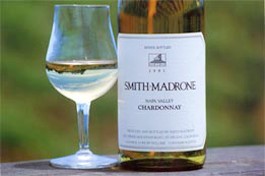
It’s among the most popular of wine country photographs. From the cover of Sunset magazine to various books, Mt. St. Helena rises above fog-shrouded Napa Valley, while terraced vineyards arc across the foreground in the first light of morning. UC Davis graduate Stuart Smith established vineyards here in 1971, joined in a few years by his brother Charles. While the valley below churns with change, Smith-Madrone practices independent, artisan winemaking at the top of the world.

Well, fairly high up on Spring Mountain, anyway. When Stu Smith logged the dense, second-growth forest, he found old redwood grape stakes throughout. The land had once before been cleared for vineyards, in the 1880s. Smith says that he was among the first winemakers to return to the hills after Prohibition, 25 years before others ventured out of the Napa Valley.

Now and then, this column has had a little fun with the cult of the mountain vineyard; Stu Smith isn’t one to wax poetic about the magic of rocks. The brothers’ opinions, in fact, often run counter to the trends, and they’re not too shy to publish them on their website, along with more conventional stuff like wine data sheets. An FAQ about one of their most noteworthy wines turns into a detailed critique of tightly spaced vineyards. Smith-Madrone vineyards have been dry-farmed for three decades way up here among the madrone trees, and the brothers lambaste the water-wasteful trend toward planting de-vigorated little vines on thirsty rootstocks.

The winery’s remote location hinders tourism of the regular sort. It’s not even on the map, but appointments are made for dedicated visitors as time allows. An iconoclast, Smith is no recluse, having long been active in Napa County community politics, serving on committees and heading up auctions and charities.

As noted in these pages last week (“How Sweet Is Dry?” June 11), Riesling is Smith-Madrone’s main fame claim. Its Riesling has steadily gained fame while Napa Valley Riesling in general has become a rare antique. The 2007 Riesling out of the tank is styled dry, at just 0.7 percent residual sugar. This fresh, new Riesling’s austere citrus character is livened by a hint of honey and flowers. Smith describes the 2006 Riesling as being like a 60/40 split between typical Alsace and Germany styles. As for those Napa standbys Cabernet Sauvignon and Chardonnay? Of course, and they’re quite good. To answer the question of just how good, one has only to climb the mountain.

Smith-Madrone Vineyards & Winery, 4022 Spring Mountain Road, St. Helena. Visits by appointment only. 707.963.2283.


View All

Cool Kids

06.18.08

T hose with small children know how hard it can be to go on a date. Even if the date takes place—the plans made, the babysitter procured, the money accounted for—things can go terribly wrong. For instance, if it has been a long time since the last date, one might make an inappropriate choice for a romantic evening, and decide to go see Al Gore’s Inconvenient Truth . Luckily for children across the country, Marin County’s Carleen and Jeff Cullen made exactly this error, one so depressing that when they left the theater, they put thoughts of further romance aside and decided to take action on behalf of the planet instead.

Their first step was to lease An Inconvenient Truth , as well as a movie theater, and show the film free for two days. After each viewing, they facilitated a community discussion, not as environmental experts, but as concerned citizens of the planet. The entire experience was energizing, Carleen Cullen says over the phone. Everyone came up with such great ideas and seemed so motivated and inspired. The Cullens handed out lists of practical carbon-reducing steps, and then went home, feeling like something good had been done and there was hope after all. This sense of euphoria soon came crashing down, however, when they checked in with some of the filmgoers and discovered that all motivation had rapidly dissipated.

This was when the Cullens realized that they had been working with the wrong crowd. Adults tend to be cynical; they want things to be better, but they all too often can’t face the sheer grandiosity of the challenge. Carleen realized that if she could get children to believe, however, they could take the message home with them and convince their parents that we can solve the climate crisis. Furthermore, the only reason parents would need would be standing right in front of them, waving a coupon book in their face.

Cullen reminds me of the good old days, when parents felt perfectly comfortable driving while chain-smoking cigarettes with the windows up, four kids in the car and no one wearing a seatbelt. (Frankly, I get nostalgic just thinking about it.) Then she recalls how things started to change. Education began in the schools, she says, and the kids brought the message home, over and over and over again.

It’s simple: educated children can influence their parents. This is the idea that inspired the Cool the Earth program, a nonprofit designed by the Cullens, for which they work almost incessantly for no fee. The program is designed to be implemented in K-8 classrooms with little to no impact on either the teachers or the school’s finances. So far, 23 schools have taken on the Cool the Earth program, and together saved over 10 million pounds of carbon, the equivalent of taking 850 cars off the road. This summer, Cullen says, their goal is to reach 75 Bay Area schools and another 25 across the country.

Rather than trying to bring curriculum into already saturated classrooms, Cool the Earth is run by parent volunteers, and is brought to the entire school via assemblies and a simple but competitive coupon program. Coupons feature specific carbon-saving tips that anyone can do. Students attend educational and fun assemblies featuring a different play for each year of this three-year program, acted out by teachers in costume.

Each month, there is a spotlight on a particular coupon to keep the interest alive. Kids might build collages out of junk mail, for example, or do a fundraiser selling reusable water bottles. A banner that tracks the coupons used is prominently displayed.

Cool the Earth is about education, inspiration and action. Kids get excited and realize not just what the problems are, but what can be done to help solve them. Right now, the program is reaching 10,000 kids. Add in those influenced parents, and that could be some 20,000 people.

Not only does Cool the Earth aim to keep the program costs at a minimum, but the organization finds the funding for schools that can’t afford it. Right now they are working on getting more costumes together, so that each school can have its own, as opposed to the current borrowing system. Cullen laughs when she tells me that she’s getting a little bit tired of people coming in and out of her garage trying to find an extra polar bear head.

As a high school teacher, I have firsthand experience with individuals who cannot tell the difference between a garbage bin and a recycling bin. The reality is frightening. I only wish that each of my students had been lucky enough to have had a program like Cool the Earth in their early days. Maybe then they wouldn’t be so color blind.

For more information go to www.cooltheearth.org.


Bees ‘R’ Us

06.18.08I hold the torn piece of cardboard in my hand as I nervously stand on the ladder and prepare myself. There's really no easy way to do this, I think. Joey shouts encouragement from below. "Nice and easy! Just like shaving Grandpa!"And with that advice, I plunge the cardboard into a cluster of thousands of buzzing bees, scraping gently and...

ICE Storm

06.18.08It happened again. Early on Thursday, May 22, Immigration and Customs Enforcement (ICE) officers parked their unmarked cars in front of an apartment building in the Canal district of San Rafael. Brandishing warrants, they pounded on doors, insisted on entry and questioned everyone within on his or her citizen status. In the end, they arrested 17 illegal immigrants: 10...

Letters to the Editor

06.18.08Parent-teachersAmanda Yskamp's article on home-schooling was informative and balanced. How nice that you didn't let all home-schoolers come across as extremists. I am writing because as the parent of four home-school "graduates," I was dismayed that your listed resources did not include the HomeSchool Association of California (HSC). Started in 1987 by a small group of Bay Area...

Khan Do

06.18.08Forget Zohan, what about Genghis Khan? Now there's somebody you don't want to be messing with. Which might explain his cultural staying power, and why a movie about him made seven centuries beyond the man's lifetime could actually find an audience. From Russian director Sergei Bodrov (fondly if barely known to American audiences for 1996's Prisoner of the Mountains)...

Best Pests?

06.18.08From a certain global, neo-Zen perspective, no bugs are really bad; they merely have interests that are counter to our own. According to Donna Diehl, a trained master gardener, bugs and insects inspire many of the questions and concerns she confronts while on duty. On the website for the Sonoma County Master Gardeners, a program of the agriculture and...

Yummy Maggot Cheese

06.18.08For centuries, rural cheese makers and big city aficionados in various parts of modern Italy, Germany and France have enjoyed what we'd consider a bizarre and repulsive cheese product certain never to be stocked anytime soon: European farm cheeses deliberately infested with locally favored fly eggs or larvae. Sardinia's version is called formaggio marcio, meaning "rotten cheese," or casu...

Hop On!

06.18.08Rejecting the detachment and often harsh realism of the popular French New Wave cinema movement, the award-winning 1981 film Diva helped usher in the Cinéma du look in all its vivid, hipster glory. Embracing stylish filmmaking in urban settings centered on trendy and disillusioned youth, Cinéma du look is perfectly encompassed in writer-director Jean-Jacques Beineix's blend of high art...

A Simple Vin

06.18.08Grape juice, yeast and a vintner. Around the world, these three honest ingredients converge as they have for millennia to create the potent product that so many of us love. But deep within the modern winemaking industry, mysterious creatures lurk. In the vineyard and winery, synthesized preservatives, additives, coloring agents and a slurry of names from the periodic table...

Cool Kids

06.18.08T hose with small children know how hard it can be to go on a date. Even if the date takes place—the plans made, the babysitter procured, the money accounted for—things can go terribly wrong. For instance, if it has been a long time since the last date, one might make an inappropriate choice for a romantic evening, and...
11,084FansLike
4,446FollowersFollow
6,928FollowersFollow