Cats and Dogs

07.02.08


When Clare Booth Luce’s comedy-drama The Women opened on Broadway in the final days of 1936, the play, about the rocky love lives of several upper-class NYC socialites, was seen as shockingly, inappropriately modern. The show became a huge and scandalous success, with its casual dropping of such previously forbidden words as “sex,” “impotence,” “pregnancy” and (gasp!) “divorce,” and its inside look into the 1930s mechanics of marriage, mistress-keeping and marriage dissolution. (In those days, the quickest place to get a divorce was Reno, Nev., which became a kind of vacation refuge for jilted women waiting for the papers to be filed.) To modern audiences, Booth’s script will surely sound dated and museum-like, though the basic issues of security, abandonment, betrayal and love have certainly not gone out of style. Soon to be released in an updated film version starring Meg Ryan, Annette Bening and Eva Mendez (the 1939 Joan Crawford and Rosalind Russell version is considered a pre-feminist classic), The Women can be seen in its original form as part of the current Summer Repertory Theater season at Santa Rosa Junior College.

Directed by Luke Yankee, SRT’s lean, emotionally balanced production is being staged on the smallish Newman Auditorium stage, a perfect choice for a play that basically takes place in a series of shops and living rooms.Mary Haines (Rebecca Mason-Wygal, excellent in a difficult role) is a happily married mother who learns that her wealthy husband is having an affair with a gold-digging shop girl (Sara Hogrefe). Her scandal-addicted friends, led by gossip queen Sylvia Fowler (Julia Goretsky), know about the betrayal long before she does, and it is Mary’s eventual redefinition of her relationship to these “friends” and her gradual awakening as a power-packed woman that forms the dramatic spine of the play.

The comedy, and there is a feast of it, comes mainly in the language. Booth, a journalist and congresswoman, had a knack for bitchy-snarky, as when one woman observes, “I think it’s in bad taste for a man to try and mate his wife’s friends—especially when they’re bald and fat.” Though clearly a product of its day, there is much about The Women that remains spot-on, and with its hard-working, all-female cast, this production keeps it all fresh, frisky and funny.

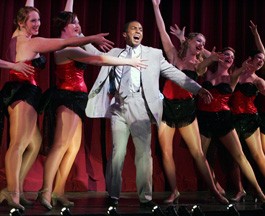
From the old to the new. With Mel Brooks’ Producers, directed and choreographed by Amanda Folena, SRT continues its parade of big Broadway hits making their North Bay debut. Brooks’ 1968 movie of the same name follows an unscrupulous Broadway producer and a neurotic bookkeeper attempting to cash in on their investments by staging an enormous flop. The stage musical version takes the original story and uses it to parody Broadway musical conventions, to giddy, goofy effect.When producer Max Bialystock (William McNeill, the multitalented SRT mainstay last seen in Beauty and the Beast and The Man Who Came to Dinner) and accountant Leo Bloom (a superb Nathan C. Crocker) realize that money can be made from producing a flop—merely by promising all of your investors 50 percent of the profits—they start looking for the worst script ever written. They find it.Springtime for Hitler, written by the crazed, Hitler-worshipping Nazi holdout Franz Liebkind (Tyler Seiple), is an unproducible mess, an offensive white-washing of Hitler’s rise to power written as a light-hearted comedy. Sensing a show so bad it will close on opening night, Bialystock and Bloom hire the worst director in the business, the outrageously gay, taste-challenged Roger De Bris (Jacob Mahler, making a radical shift from the imperious Governor Danforth in SRT’s currently running Crucible). Much of the second act deals with the haphazard preparations for opening night.

Throughout are a string of hilariously tasteless, over-the-top production numbers, from Crocker’s crowd-pleasing “I Wanna Be a Producer” to the spirited theater-insider anthems “Keep It Gay” and “You Never Say Good Luck on Opening Night,” to the side-splitting badness of “Springtime for Hitler,” performed with tap-dancing Aryan youth and a massive swastika in bright pin-wheeling lights.

The heart of The Producers is the evolving friendship between Bialystock and Bloom, each lending the other some strength or bit of humanity they had previously lacked. It is part of this production’s success that, thanks to Folena, Crocker and McNeill, there is an enduring sweetness that remains among all that inspired madness.

‘The Women’ runs through Aug. 3. July 2, 12, 17&–18, 22&–24 and Aug. 1&–2 at 8pm; July 13 and Aug. 3 at 7:30pm; also July 13, 23 and Aug. 3 at 2pm.’

The Producers’ runs through Aug. 9. July 7, 12, 17&–18, 22&–24, Aug. 1&–3, 5 and 9 at 8pm. July 13 and Aug. 3 at 2pm and 7:30pm. Newman Auditorium, Santa Rosa Junior College, 1501 Mendocino Ave., Santa Rosa. $8&–$15. 707.527.4343.


Museums and gallery notes.

Reviews of new book releases.

Reviews and previews of new plays, operas and symphony performances.

Reviews and previews of new dance performances and events.

The Counterculture Colonel

0

07.02.08


It was billed as a panel discussion on “the global shift in human consciousness.” A half-dozen speakers had assembled inside the Heebie Jeebie Healers tent at Burning Man, the annual post-hippie celebration in Black Rock, Nev., where 50,000 stalwarts braved intense dust storms and flash floods last August. Among the notables who spoke at the early evening forum was Dr. Alexander (“Sasha”) Shulgin, the Bay Area&–based psychochemical genius much beloved among the Burners, who synthesized Ecstasy and 200 other psychoactive drugs, and tested each one on himself during his unique, off-beat career.

Sitting on the panel next to Shulgin was an unlikely expositor. Dr. James S. Ketchum, a retired U.S. Army colonel, told the audience, “When Sasha was trying to open minds with chemicals to achieve greater awareness, I was busy trying to subdue people.”

Ketchum was referring to his work at Edgewood Arsenal, headquarters of the U.S. Army Chemical Corps, in the 1960s, when America’s national security strategists were high on the prospect of developing a nonlethal incapacitating agent, a so-called humane weapon, which could knock people out without necessarily killing anyone. Top military officers hyped the notion of “war without death,” conjuring visions of aircraft swooping over enemy territory releasing clouds of “madness gas” that would disorient the bad guys and dissolve their will to resist, while U.S. soldiers moved in and took over.

Ketchum was into weapons of mass elation, not weapons of mass destruction. He oversaw a secret research program that tested an array of mind-bending drugs on American GIs, including an exceptionally potent form of synthetic marijuana. (Most of these drugs had no medical names, just numbers supplied by the Army.) “Paradoxical as it may seem,” Ketchum asserted, “one can use chemical weapons to spare lives, rather than extinguish them.”

Some of the Burners were perplexed. Was this guy cool or creepy?

Shulgin, a critic of chemical mind-meddling by the military, was wary when he first met Ketchum at a 1993 event honoring the 50th anniversary of the discovery of LSD. But Ketchum is not your typical military bulldozer type. An intelligent, gracious man with a disarming sense of humor, in his own way Ketchum has always been a free spirit. He and his wife, Judy, who currently reside in Santa Rosa, became close friends with Sasha and his formidable partner, Ann. They stayed in frequent contact and occasionally socialized together. When the Shulgins invited them to Burning Man, the Ketchums joined the caravan of RVs driving to the desert.

“I’m kind of a Sasha worshipper,” Ketchum, who reads neuropharmacology textbooks during his leisure hours, confessed. Tall and lanky, the colonel, now 76, is one of the few people who can actually understand what Shulgin, six years his senior, is talking about when he lectures on the molecular subtleties of psychedelic drugs, waving his arms furiously like a mad scientist. Sasha took Ketchum under his wing and welcomed him into the fold.

Shulgin wrote the foreword to Ketchum’s self-published memoir, Chemical Warfare: Secrets Almost Forgotten (www.forgottensecrets.net), which lifts the veil on the Army’s little-known drug experiments and illuminates a hidden chapter of marijuana history. A graduate of Cornell Medical College, Ketchum describes how he was assigned as a staff psychiatrist to Edgewood Arsenal, located 25 miles northeast of Baltimore, in 1961.

“There was no doubt in my mind that working in this strange atmosphere was just the sort of thing that would satisfy my appetite for novelty,” Ketchum wrote. Soon he became chief of clinical research at the Army’s hub for chemical warfare studies. Although the Geneva Convention had banned the use of chemical weapons, Washington never agreed to this provision, and the U.S. government poured money into the search for a nonlethal incapacitant.

Red Oil

The U.S. Army Chemical Corp’s marijuana research began several years before Ketchum joined the team at Edgewood. In 1952, the Shell Development Corporation was contracted by the Army to examine “synthetic cannabis derivatives” for their incapacitating properties. Additional studies into possible military uses of marijuana began two years later at the University of Michigan medical school, where a group of scientists led by Dr. Edward F. Domino, professor of pharmacology, tested a drug called “EA 1476” —otherwise known as “Red Oil”—on dogs and monkeys at the behest of the U.S. Army. Made through a process of chemical extraction and distillation, Red Oil (akin to hash oil) packed a mightier punch than the natural plant.

Army scientists found that this concentrated cannabis derivative produced effects unlike anything they had previously seen. “The dog gets a peculiar reaction. He crawls under the table, stays away from the dark, leaps out at imaginary objects and, as far as one can interpret, may be having hallucinations,” one report stated. “It would appear even to the untrained observer that this dog is not normal. He suddenly jumps out, even without any stimulus, and barks, and then crawls back under the table.”

With a larger dose of Red Oil, the reaction was even more pronounced. “These animals lie on their side; you could step on their feet without any response; it is an amazing effect and a reversible phenomenon. It has greatly increased our interest in this compound from the standpoint of future chemical possibilities.”

In the late 1950s, the Army started testing Red Oil on U.S. soldiers at Edgewood. Some GIs smirked for hours while they were under the influence of EA 1476. When asked to perform routine numbers and spatial reasoning tests, the stoned volunteers couldn’t stop laughing.

But Red Oil was not an ideal chemical-warfare candidate. For starters, it was a “crude” preparation that contained many components of cannabis besides psychoactive THC. Army scientists surmised that pure THC would weigh much less than Red Oil and would therefore be better suited as a chemical weapon. They were intrigued by the possibility of amplifying the active ingredient of marijuana, tweaking the mother molecule, as it were, to enhance its psychogenic effects. So the Chemical Corps set its sights on developing a synthetic variant of THC that could clobber people without killing them.

Enter Harry Pars, a scientist working with Arthur D. Little Inc., based in Cambridge, Mass., one of several pharmaceutical companies that conducted chemical-warfare research for the Army. (Two Army contracts for marijuana-related research were awarded to this firm, covering a 10-year period beginning in 1963.) A frequent visitor to Edgewood, Pars synthesized a new cannabinoid compound, dubbed “EA 2233,” which was significantly stronger than Red Oil.

At the outset of this project, Pars had sought the advice of Dr. Alexander Shulgin, then a brilliant young chemist employed by Dow Chemical. Shulgin was a veritable fount of information regarding how to reshape psychoactive molecules to create novel mind-altering drugs. Eager to share his arcane expertise, Shulgin gave Pars the idea to tinker with nitrogen analogs of tetrahydrocannabinol (THC). Pars never told Sasha that he was an Army contract employee. A declassified version of Pars’ research was published in the Journal of the American Chemical Society (August 1966), in which he thanked Shulgin for “drawing our attention to the synthesis of these nitrogen analogs.”

The U.S. Army Chemical Corps began clinical testing of EA 2233 on GI volunteers in 1961, the year Ketchum arrived at Edgewood Arsenal. When ingested at dosage levels ranging from 10 to 60 micrograms per kilogram of body weight, EA 2233 lasted up to 30 hours, far longer than the typical marijuana buzz.

‘I Just Feel Like Laughing’

In an interview videotaped seven hours after he had been given EA 2233, one soldier described feeling numb in his arms and unable to raise them, precluding any possibility that he could defend himself if attacked. “Everything seems comical,” he told his interlocutor.

Q: How are you?

A: Pretty good, I guess. . . .

Q: You’ve got a big grin on your face.

A: Yeah. I don’t know what I’m grinning about either.

Q: Do things seem funny or is that just something you can’t help?

A: I don’t—I don’t know. I just—I just feel like laughing. . . .

Q: Does the time seem to pass slower or faster or any different than usual?

A: No different than usual. Just—just that I mostly lose track of it. I don’t know if it’s early or late.

Q: Do you find yourself doing any daydreaming?

A: Yeah. I’m daydreaming all kinds of things. . . .

Q: Suppose you have to get up and go to work now. How would you do?

A: I don’t think I’d even care.

Q: Well, suppose the place were on fire?

A: It would seem funny.

Q: It would seem funny? Do you think you’d have the sense to get up and run out or do you think you’d just enjoy it?

A: I don’t know. Fire doesn’t seem to present any danger to me right now. . . . Everything just seems funny in the Army. Seems like everything somebody says, it sounds a little bit funny. . . .

Q: Is it like when you’re in a good mood and you can laugh at anything?

A: Right. . . . It’s like being out with a bunch of people and everybody’s laughing. They’re just—

Q: Having a ball?

A: Yeah. And everything just seems funny.

Q: Would you do this again? Take this test again?

A: Yeah. Yeah. It wouldn’t bother me at all.

EA 2233 was actually a mixture of eight stereoisomers of THC. (An isomer is a rearrangement of atoms within a given molecule; a stereoisomer entails different spatial configurations of these atoms.) Eventually, Edgewood scientists would separate the eight stereoisomers and investigate the relative potency of each of them individually in an effort to separate the wheat from the psychoactive chaff and reduce the amount of material needed to get the desired effect for chemical warfare.

Only two of the stereoisomers proved to be of interest (the others didn’t have much of a knockdown effect). When administered intravenously, low doses of these two synthetic cousins of tetrahydrocannabinol triggered a dramatic drop in blood pressure to the point where test subjects could barely move. Standing up without assistance was impossible. This was construed by cautious Army doctors as a warning sign—a sudden plunge in blood pressure could be dangerous—and human experiments with single THC stereoisomers were suspended.

Looking back on these studies, Ketchum wonders whether his colleagues made the right decision. “This hypotensive [blood-pressure-reducing] property, in an otherwise nonlethal compound, might be an ideal way to produce a temporary inability to fight, or do much else, without toxicological danger to life,” Ketchum says now. Given the high safety margin of THC—no one has ever died from an overdose—and the likelihood that the stereoisomers would display a similar safety profile, Ketchum believes the Army may have spurned a couple of worthy prospects that were capable of filling the knock-’em-out-but-don’t-kill-’em niche in America’s chemical-warfare arsenal.

As for the two exemplary stereoisomers weaned from EA 2233, Ketchum speculates, “They probably would have been safe in terms of life-sparing activity. . . . But a person who received them would have to lie down. If he tried to stand up and get his weapon, he would feel faint and lightheaded and he’d keel over. Essentially he would be immobilized for any military purpose until the effects wore off.”

The colonel’s assessment: “A safe drug that knocks people down—what more could you ask for?”

Volunteers for America

With THC isomers on the back burner, the U.S. Army Chemical Corps focused on several other compounds—including LSD, PCP, methylphenidate (Ritalin) and a delirium-inducing ass-kicker known as “BZ” (a belladonna-like substance similar to atropine)—all of which were thought to have significant potential as nonlethal incapacitants.

Ketchum insists that the staff at Edgewood went to great lengths to ensure the safety of the volunteers. (There was one untoward incident involving a civilian volunteer who flipped out on PCP and required hospitalization, but this happened before Ketchum came on board.) During the 1960s, every soldier exposed to incapacitating agents was carefully screened and prepped beforehand, according to Ketchum, and well treated throughout the experiment. They stayed in special rooms with padded walls, while medical professionals monitored their situation 24/7. Antidotes were available if things got out of hand.

“The volunteers performed a patriotic service,” Ketchum says. “None, to my knowledge, returned home with a significant injury or illness attributable to chemical exposure,” though he admits that “a few former volunteers later claimed that the testing had caused them to suffer from some malady.” Such claims, however, are difficult to assess given that so many intervening variables may have contributed to a particular problem.

A follow-up study conducted by the Army Inspector General’s office and a review panel convened by the National Academy of Sciences found little evidence of serious harm resulting from the Edgewood experiments. But a 1975 Army IG report noted that improper inducements may have been used to recruit volunteers and getting their “informed consent” was somewhat dubious given that scientists had a limited understanding of the short- and long-term impact of some of the compounds tested on the soldiers.

Ketchum draws a sharp distinction between clinical research with human subjects under controlled conditions at Edgewood Arsenal and the CIA’s reckless experiments on random, unwitting Americans who were given LSD surreptitiously by spooks and prostitutes. “Jim is very certain of his own integrity,” says Ken Goffman (aka R.U. Sirius). “There is little doubt in his mind that he was doing the right thing. He felt he was working for a noble cause that would reduce civilian and military casualties.” Former editor of the psychedelic tech magazine Mondo 2000, Goffman helped Ketchum edit and polish his book manuscript, which vigorously defends the Edgewood research program.

Strange bedfellows, the colonel and the counterculture scribe. Or so it would appear. But these days, Ketchum and Goffman see eye to eye on many issues. Both feel that the alleged dangers of marijuana and LSD have been way overblown. No doubt, LSD could wreak havoc on the toughest, best-trained troops, derailing their thought processes and disorganizing their behavior.

When used wisely, however, LSD can be uplifting. Ketchum notes that some soldiers had insightful and rewarding experiences on acid, lending credence to reports from civilian psychiatrists that LSD was a useful therapeutic tool. “I had an interest in psychedelic drugs long before my interest in chemical warfare,” Ketchum says. “I was intrigued by the positive aspects of LSD, as well as the incapacitating aspects.”

Mystery Stash

One morning, Ketchum arrived at his office in Edgewood and found “a large, black steel barrel, resembling an oil drum, parked in the corner of the room,” he recounts in his book. Overcome by curiosity, he opened the barrel and examined its contents. There were a dozen tightly sealed glass canisters that looked like cookie jars; the labels on the canisters indicated that each contained about three pounds of “EA 1729,” the Army’s code number for LSD. By the end of the week, the 40 pounds of government acid—enough to intoxicate several hundred million people—vanished as mysteriously as it had appeared. Ketchum still doesn’t know who put the LSD in his office or what became of it.

But this much is certain: some officers at Edgewood were dipping into the Army’s stash for their own personal use. “They took LSD more often than was necessary to appreciate its clinical effects,” Ketchum admits. “They must have liked it.”

The colonel was personally a bit skittish about trying LSD. Eventually, he worked up the courage to experiment on himself. Under the watchful eye of a knowledgeable Edgewood physician, he swallowed a small dose and proceeded to take the same numerical aptitude tests that the regular volunteers were put through to measure their impairment. Constrained by the white-smock laboratory setting, his lone LSD experience was somewhat anticlimactic. “Colors were more vivid and music was more compelling,” Ketchum recalls, “but there were no breakthroughs in consciousness, no Timothy Leary stuff.”

Ketchum also sampled cannabis shortly after he began working for the Chemical Corps. His younger brother turned him on to marijuana, but the first time Ketchum smoked a joint nothing happened. “Later, I read about reverse tolerance. Some people don’t get high on marijuana until they use it a few times,” Ketchum explains.

It wasn’t until he went on a paid, two-year leave of absence from Edgewood that he started smoking pot socially. Ketchum had convinced the Surgeon General of the Army that it would be in everyone’s best interest if he studied neuroscience at Stanford University. How better to keep abreast of the latest advances in the field? In 1966, he joined a team of postdoctoral researchers mentored by Karl Pribram, a world-renowned expert on the brain and behavior.

Ketchum related well with his academic colleagues. “I got together with a few of my friends at Stanford and we had some cheap marijuana, which I smoked, and I got a real effect for the first time,” he says. “I liked it. It was very sensuous. But I didn’t use it very often. I didn’t have any of my own.”

Ketchum’s West Coast hiatus coincided with the emergence of the hippie movement in San Francisco. “I was fascinated with this spectacular development,” he gleams. “Luckily, I caught it at its peak.”

Occasionally, Ketchum took his home movie camera to Haight-Ashbury, the epicenter of hippiedom, and filmed the procession of exotically dressed flower children strutting through the neighborhood high on marijuana and LSD. “I was always interested in drugs, primarily because I’ve always been interested in how the mind works,” he says. “So when this wave of psychedelic users descended upon San Francisco, I thought maybe I’d learn more by going there.”

Ketchum attended the legendary Be-In in Golden Gate Park in January 1967, sitting cross-legged on the lawn with 20,000 pot-smoking enthusiasts, soaking up the rays and listening to rock music, poetry and antiwar speeches. A few months later, the colonel began working as a volunteer doctor at the Haight-Ashbury Free Clinic, where he treated troubled youth with substance-abuse problems.

Life After Edgewood

Ketchum returned to Edgewood in 1968, but the mood back at headquarters was not the same as before. Growing opposition to the Vietnam War and public disapproval of the use of napalm and toxic defoliants cast a lengthening shadow over classified research into chemical weapons. When journalists briefly got wind of the Army’s ambitious psychochemical warfare program, they scoffed at the notion of making the enemy lay down their arms by turning them on.

The colonel saw the writing on the wall. Army brass consented when he asked to be transferred to another base in the early 1970s. By this time, the Chemical Corps had concluded that marijuana-related compounds would not be effective in a battlefield situation, but the testing of other incapacitating agents under field conditions would proceed. And drug companies continued to supply a steady stream of pharmaceutical samples for evaluation by the military.

In 1976, Ketchum retired from the Army and embarked upon a new career as a civilian psychiatrist in California. Commissioned by the California Department of Justice, he collaborated on a 1981 study comparing the effects of alcohol and smoked marijuana on driving performance. The results were somewhat surprising. “When combined with alcohol, cannabis produced little additional impairment,” he concluded.

“While alcohol had an adverse impact on steering, THC affected a driver’s ability to estimate time. But the combination of both drugs did not substantially increase the impairment produced by either one alone. . . . In fact, there was an antagonistic effect. Marijuana seemed to offset some of the problems caused by alcohol, and vice versa.”

Ketchum feels that drug prohibition is bad public policy. “It’s the refusal to look at the evidence that keeps pot illegal. They misrepresented marijuana as an evil weed. . . . I’ve always had a libertarian attitude toward drugs. I believe people should be able to do anything as long as it’s not harmful to somebody else.”

In the years ahead, Ketchum would reach out to medical marijuana trailblazers, prominent psychedelic advocates and drug-policy rebels working inside and outside the system to end prohibition. He joined the National Organization for the Reform of Marijuana Laws and became a member of the Multidisciplinary Association for Psychedelic Studies (MAPS).

Founded by Rick Doblin, MAPS has spearheaded the revival of scientific investigations into the therapeutic potential of LSD, ecstasy, psilocybin and ibogaine, while also challenging bureaucratic roadblocks that prevent independent cannabis research in the United States. Col. Ketchum attended fundraising events and wrote letters to potential donors, praising the work of MAPS.

During the 1960s, Ketchum supervised thousands of drug experiments, yet he barely scratched the surface of the awesome potential of cannabis and LSD. “Jim is not apologetic for what he did before,” Doblin says, “and I don’t think he sees it as incongruous with supporting research into the therapeutic aspect of psychedelics. These tools have tremendous power, but he only looked at a narrow slice of it while he was at Edgewood.”

Today, Ketchum steadfastly maintains that cannabis and LSD are safe drugs compared to many legal substances. This is what the Edgewood experiments and other studies have shown, he contends. Given his status as a retired army officer who had extensive, hands-on experience testing psychoactive compounds, he speaks with a certain authority that most medical and recreational drug users cannot claim.

Medical Marijuana

After Californians broke ranks from America’s drug-war orthodoxy in 1996 and legalized medical marijuana in the Golden State, Ketchum got a recommendation from his family doctor to use cannabis for insomnia. “I have personally found it helpful, especially for sleep,” he says. “I’ve had problems with sleep for a long time.”

It was at a picnic hosted by the Shulgins that Jim and Judy Ketchum first met Tod Mikuriya, the controversial Berkeley-based physician who has been described as “the father of the medical marijuana movement.” One of the prime movers of Proposition 215, the successful med-pot ballot measure, Dr. Mikuriya quickly took a liking to the Ketchums and taught them how to use a vaporizer for inhaling cannabis fumes without tar and smoke.

Like Ketchum, Mikuriya was a maverick psychiatrist who once worked for the U.S. government. In 1967, the National Institute of Mental Health (NIMH) recruited Mikuriya to direct its marijuana-research program. One day, after leaving his position at NIMH, he got a phone call from Dr. Van Sim, a cohort of Ketchum’s at Edgewood Arsenal. A major figure in the Chemical Corps’ secret drug-testing efforts, Sim told Mikuriya of Army studies which indicated that cannabis has valuable therapeutic properties. Sim asserted that marijuana “is probably the most potent anti-epileptic known to medicine.” Unfortunately, much of this data remains classified.

Army scientists also inadvertently rediscovered the powerful antispasmodic effect of cannabis, a medicinal boon subsequently confirmed by many multiple sclerosis and AIDS patients who smoked marijuana and ate ganja-laced cuisine to ease nerve spasms and painful bouts of peripheral neuropathy. “We weren’t looking for benefits,” Ketchum concedes. “When I was at Edgewood, I wasn’t aware of the medicinal history of cannabis.”

With Mikuriya tendering introductions, Ketchum befriended some of the leading lights of the ’60s counterculture, including Tim Scully, the prodigious underground chemist who manufactured millions of hits of black market LSD (remember Orange Sunshine?) while the colonel was administering hallucinogenic drugs to soldiers at Edgewood. “Jim and his wife visited me at my home in Mendocino County,” Scully says. “I enjoyed their company. We found that we shared idealistic beliefs about the potential for good in psychoactive drugs, as well as sharing some wry understanding of the pitfalls, too.”

As for their divergent paths in the past, Scully remarks, “I don’t really see his work as having been in conflict with mine. I believe Jim sincerely hoped to save lives by helping in the development of nonlethal weapons as an alternative to conventional weapons.”

An incurable iconoclast, the colonel has made common cause with counterculture veterans and anti-prohibition activists. His endorsement of the therapeutic use of marijuana and LSD confers additional credibility on views long championed by his newfound allies. Validation, in this case, goes both ways. Embraced as one of the elders, a peculiar elder to be sure, Ketchum somehow fits right in.

“I don’t have a problem with being difficult to categorize,” he says.

Sonoma County writer Martin A. Lee is the author of ‘Acid Dreams: The Complete Social History of the LSD—The CIA, the Sixties, and Beyond.’ He is writing a social history of marijuana.

Much Obliged

0

07.02.08

The gas station attendant came outside. Wow, I thought, full-serve! Ignoring me, she flung a magnetic price decal on top of the price per gallon. Regular unleaded had gone up 20 cents in the time it took me to drive from the curb to the pump.

“You’re kidding me,” I moaned.

“It’s 3 o’clock,” she shrugged. “Just got the new price.”

There has to be a better way, I thought. And there is.

It isn’t drilling in the Alaskan wilderness.

It sure isn’t John McCain’s plan to offer $300 million to the first person to come up with a longer-lasting car battery.

Gas prices could hit $7 a gallon before long, but Americans take a little comfort in the fact that Europeans have paid more than that for years. But Venezuelans pay a mere 19 cents per gallon. It’s 38 cents in Nigeria. Turkmenistanis might not have electoral democracy, but they only shell out $4.50 to fill a 15-gallon tank. Before we replaced Saddam Hussein with . . . whatever they have in Iraq now, Iraqis paid less than a dime for a gallon of gas.

One of the things that these countries have in common, of course, is that they’re oil-producing states. Iran, Saudi Arabia, Egypt, Burma, Malaysia, Kuwait, China and South Korea are just a few of the countries that keep fuel prices low in order to stimulate economic growth.

But they also share something else: common sense. Strange as it might sound to Americans used to reading about big oil windfalls, these nations consider cheap gas more of an economic necessity than lining energy company CEOs’ pockets. They don’t consider energy a profit center. To the contrary, government subsidies (Venezuela spends $2 billion a year on fuel subsidies) and nationalized oil companies keep gas prices low.

Unlike corporations, governments don’t care about turning a profit. They care about remaining in power. Like the rest of the world, Venezuelan consumers have been squeezed by rising prices, and even shortages, of groceries. In 2007, Venezuela’s socialist-leaning government decided to do something about it. First it imposed price controls on staple items. When suppliers began to hoard supplies to drive up prices, President Hugo Chavez threatened to nationalize them. “If they remain committed to violating the interests of the people, the constitution, the laws, I’m going to take the food storage units, corner stores, supermarkets and nationalize them,” he said. Food profiteers grumbled. Then they straightened up.

Not even international corporations are immune from Chavez’s determination to put the needs of ordinary Venezuelans ahead of the for-profit food industry. Faced with severe shortages of milk earlier this year, Chavez threatened Nestle and Parmalat’s Venezuelan operations with nationalization unless they opened the spigot. “This government needs to tighten the screws,” he said in February 2008, promising to “intervene and nationalize the plants” belonging to the two transnational corporations.

Miraculously, milk is turning up on the shelves.

When it works, nothing is better at creating an endless variety of reality TV shows than free market capitalism. But when it doesn’t, it isn’t just that extra brand of clear dishwashing liquid that goes away. Businesses fold. Banks foreclose. People starve. And no one can stop it.

The G8 nations met in Osaka recently to try to address soaring food and energy prices, a double threat that could plunge the global economy into a ruinous depression. But the summit ended in failure. “Any hope that the G8 meeting would result in coordinated monetary action—or concerted intervention in foreign exchange markets—to counter rises, principally in commodity prices, was dispelled by their failure to agree on the phenomenon’s underlying causes,” reported Forbes.

The problem isn’t the weak dollar or the nonexistent housing market. It’s capitalism. A sane government doesn’t leave essential goods and services—food, fuel, housing, healthcare, transportation, education—to the vicissitudes of “magic” markets. Nondiscretionary economic sectors should be strictly controlled by—indeed, owned by—the government.

Consider, on the one hand, snail mail and public education. The Postal Service and public schools both have their flaws. But what if they were privatized? It would cost a lot more than 42 cents to mail a letter from Tampa to Maui, and poor children wouldn’t get an education.

Privatization, particularly of essential services, has always proven disastrous. From California’s Enron-driven rotating blackouts to for-profit healthcare that has left 47 million Americans uninsured to predatory lenders pimping the housing bubble to Blackwater’s atrocities in Iraq, market-based corporations’ fiduciary obligation to maximize profits is inherently incompatible with a stable economy and a decent quality of life.

No one should pressure industries that produce things that people need in order to live to turn a quarterly profit. No one should go hungry or remain sick because some commodities trader in Zurich figured out some nifty way to take an eighth of a point arbitrage spread between the price of a hospital stock in New York and in Tokyo.

P.S. If you’re reading this in Caracas, please mail me some gas.

Ted Rall is the author of ‘Silk Road to Ruin: Is Central Asia the New Middle East?’ an in-depth prose and graphic novel analysis of America’s next big foreign policy challenge.

Open Mic is now a weekly feature in the Bohemian. We welcome your contribution. To have your topical essay of 700 words considered for publication, write [ mailto:op*****@******an.com” data-original-string=”ioRBnbp92oNow5mqmIjEEg==06atvy3QWcxuJIGsrMOyHz0WfCwBtxWooTHE4nIgFTsKkXoKpRlHtQNy39djo+OEqOpgxHRVXKfdN5I+7x+M/ma1voyDFMufaxL0jmrJXwYYIQ=” title=”This contact has been encoded by Anti-Spam by CleanTalk. Click to decode. To finish the decoding make sure that JavaScript is enabled in your browser. ]op*****@******an.com.


Letters to the Editor

07.02.08

dehumanizing

Thank you for your recent article that put a human face on the impact of the ICE raids in our communities (“ICE Storm,” June 18). I was saddened to see people who are undocumented referred to as “illegal immigrants” though. People aren’t illegal. Such wording dehumanizes.

It also carries with it a perverse sense of moral authority, as though we who aren’t undocumented are justified in our presence here, while the undocumented are not. These people whom we refer to as “illegal” were here first. Their ancestors were migrating over the Rio Grande while my ancestors were still in Europe. 

“Illegal” also carries a sense that there is a disrupting of an otherwise orderly system. Our system relies on people who are undocumented. These people build our homes, harvest our agriculture, bake our bread and care for our elderly. We couldn’t function without them.

The article ends with an unfortunate quote from an ICE spokesperson: “[We] are a nation of immigrants, but we are also a nation of laws. And those laws have to be enforced.” It’s a tragedy that we violate the Geneva Convention, ignore the Bill of Rights, ignore SEC violations, but go full tilt after some of the most vulnerable, defenseless members of our society.

Kevin O’Connor

Sebastopol

from the Passive-Aggressive Files

We very much appreciated Lois Pearlman’s June 25 feature article on the current (and deteriorating) state of mental healthcare in Sonoma County (“Insane Situation”), but were appalled at your paper’s stigma-perpetuating use of the words “insane” and “crazy-making.” Such words tend to undo too much of the good that your fairly complete article might have done.

It is regrettable that the “Clip ‘n’ Go Guide” did not mention the organization which for 25 years has been providing helpful services to those in our county who have a mental illness and to their families: NAMI-Sonoma County, the local affiliate of the National Alliance on Mental Illness.

Liz and John Maxwell

Bloomfield

Hi: Thanks for taking the time to respond to our publication. Please know that the author did include notice of NAMI for the “Clip ‘n’ Go” but that we deleted it regretfully at the end due to space constrictions. This is to confirm receipt of your letter.

Best regards,

Gretchen Giles

Gretchen,

Thanks for your reply. We would certainly like to have the opportunity to meet with you and discuss the whole subject of mental healthcare in greater detail.

Two things. First, you totally ignored the main topic of my letter—the completely inappropriate use of the pejorative words in the article’s titles.

Second, as someone very familiar with publishing software and for years having edited and published periodicals, I will not accept your glib reason of “space considerations” for the censorship of NAMI-SC from your “Clip ‘n’ Go” sidebar.  Judicious use of either leading or font sizes would have permitted the inclusion of NAMI-SC and its free services along with the other nine groups under the Non-Emergency category (two-thirds of which charge for their services!).

Call us if you are able to work us into your schedule. Thanks again for your attention.

Um, I don’t think so.

Here’s the info we had to cut because we have an actual style book and template.

NAMI (National Association on Mental Illness) National organization offering education for people with mental illness and family members, support groups, a mental health library, a hotline during business hours, referrals, political advocacy and other resources. 1717 Yulupa Ave., Santa Rosa. 707.527.6655.

Buckelew An affordable independent housing project in Petaluma for people with serious mental illness. For information, call Gary Pierce at the Sonoma County Mental Health Department. 707.565.4943.

• Also, Chrysalis Counseling Services for Women would like to add that they use both interns and licensed clinicians in treating all ages and gender.

Dept. of Corrections

“Surely you can tell that’s a wasp,” said the exasperated woman on the phone. We peered more closely at the image accompanying a story about the glassy-winged sharpshooter (“Trouble That Never Came,” June 18). “Sharpshooters are leaf-hoppers,” the woman patiently stressed, as if that were an explanation. “Well, the University of California at Riverside doesn’t think it’s a sharpshooter, does it?” she asked, referring to the photo credit. No. We asked permission to reprint and they gave it. A leaf-hopper, huh? 

The Ed.

stung


&–&–>

Headaches on the Hill

0

07.02.08


We have been panting, waiting!” says Jeanne DeJoseph, who is renovating and readying her house in San Mateo to put on the market. “We are so ready to move!”

DeJoseph, 64, and her partner, Suzanne Dibble, 61, have been together for 24 years. This September, they will be legally married in the state of California. Both are professor emerita at UCSF, and for the past three years have been at the top of the waiting list for the Fountaingrove Lodge, a unique upscale gay and lesbian retirement community still to be built in Santa Rosa.

Aegis Senior Living, the Santa Rosa&–based development company behind the recently opened upscale Varenna retirement community in Fountaingrove, has built over 32 retirement communities on the West Coast. But they haven’t broke ground yet for the Fountaingrove Lodge. Although over 50 percent of the Lodge’s planned units have been reserved by eager retirees since 2005, the development remains at the center of a long and bitter battle between neighbors, city planners and developers—a battle that keeps DeJoseph and Dibble on hold in San Mateo.

When built, the Lodge will be the only LGBT retirement community of its kind in the country. Its full spectrum amenities and on-site healthcare will be similar to Varenna’s, as will its high price tag (initial buy-in fees for the units top out at $1 million&–plus, with an additional monthly payment of about $3,000). The key difference is that it will be specifically geared toward the gay and lesbian community.

That’s good news for DeJoseph, who met the sad facts of old age when she placed her own mother in a retirement community. “Just sort of in passing, I asked the folks there what it would be like—could we be part of that facility?” she says. “And they said no, that only people who were connected by blood or marriage could live together. That’s still true there today.”

Aegis marketing director Wes Winter says that because of its unique scope, the Lodge concept has taken on life as a de facto core for Sonoma County’s aging LGBT community. “There are organizations regarding different healthcare initiatives like HIV,” he says, “and there are great youth service organizations like Positive Images, but there’s nothing, really, for adults, folks in their middle and senior years.”

Also because of its unique scope, the gay and lesbian factor remains an issue in the project’s planning. “Early on, there were some things that were said that were uncomfortable to hear,” Winter says. “Since that time, the conversation has obviously become more sophisticated. And so it’s sort of hard to weed out what’s based on perhaps a homophobic response and what’s based on something else.”

Aegis partner Bill Mabry cites the disparity between the neighborhood’s response to Varenna, the larger and more widely visible 29-acre Aegis project just up the hill, and its sudden involvement in the Lodge project. For Varenna, Mabry says, “we didn’t have anything from the homeowners association but positive response.” When the smaller, 10-acre Lodge was announced, he says, opposition suddenly arose, even for a temporary model unit to be built near the Lodge site.

“They were concerned about [earthquake] faults running through the site that aren’t there,” Mabry says. “They were concerned that if the dam broke from Fountaingrove Lake that it would wash away the site. Are you getting it?”

Skip Epperly, president of the Fountaingrove Ranch Master Association (FRMA), says that the claims of homophobia are outrageous and untrue. “I can tell you where that came from,” he says. “I got a call from Jennifer Onley about two years ago from Channel 7 in San Francisco. She’s a reporter. And Wes Winter, who’s their marketing rep, called Jennifer and said, ‘Jennifer, these folks in Fountaingrove are a bunch of homophobic people, and they are opposing our project for homophobic reasons.’ At that point, I went ballistic. There must be any number of gay couples that live up here. Several of the residents who are our friends are gay and lesbian friends. Wes Winter is where that came from. It’s no secret.”

Epperly charges that Winter fabricated statements made by neighbors, denies that any name-calling or inflammatory remarks were made at meetings, and says he’s seen no actual homophobia among Fountaingrove residents toward the Lodge at all. “That was a mean-spirited, untrue campaign on Wes’ part to get a toehold—sympathy, I don’t know what,” he says, “and it didn’t work.”

As for not originally opposing Varenna, Epperly says at this point the FRMA only has itself to blame. Varenna’s retaining walls and multistory design are clearly a problem for Epperly. “The prior board of directors for the homeowners association chose not to get involved in the [design] review,” he says. “It was a big mistake. It was a big mistake. A big mistake. Did I say big mistake? Big mistake.”

Much of Aegis’ irritation with the FRMA stems from concerns which prompted the city council, in August 2006, to request an environmental impact report on the Lodge site. (Though Varenna required an EIR, Aegis did not anticipate needing one for the smaller, flatter, less-visible Lodge.) The EIR and its 20-month waiting period have cost Aegis over $1 million, estimates Winter, although Epperly, who had a 29-year career with Contra Costa County Public Works before moving to Fountaingrove in 2004, claims that’s a normal figure. (“Look at the scope of the project. Look at the value of this project. What is it, a $37 million&–plus project? And what’s an environmental review cost? It’s a speck!”)

Earlier this month, the long-awaited EIR came back for review, and even Epperly admits that it fits within the land-use criteria the city had. However, he points to the design review as another step entirely. Epperly is unsure at this point what the FRMA’s comments will be at the upcoming July 24 planning meeting, nor can he specify any of the association’s potential concerns before the design review board. “We haven’t formulated them into ink yet,” he says.

“We’re certainly concerned that the city looks at the Lodge project with a little more consideration of how this community feels it’s a fit,” Epperly says. “We’re looking for a balance. We’re looking for something that fits.”

Epperly does not state which other types of residences he would rather see built on the Lodge site. He further denies speculation that the FRMA wants the Lodge to be built smaller or that it should be set back farther from the road or that the site should remain undeveloped.

One thing Epperly remains firm about, however, is refuting accusations that Fountaingrove residents are in any way homophobic. “It’s an untruism, and it’s an insult,” he says. “It’s an insult to our intelligence, and I would say that the people up here are an intelligent group of people. And when we got blindsided by Wes Winter’s gay/lesbian tactic, we were shocked. And then we were mad. I’m not happy with Wes.”

For his part, Winter asserts that ABC News initially contacted him about alleged homophobic response to the Lodge, and that he never fabricated any statements. “That’s simply not true,” he says. “We had heard actual comments that were made by Fountaingrove homeowners that we were trying to turn it into the ‘Swish Alps’—just silly statements that were definitely homophobic remarks.

“Ultimately, when they didn’t fight Varenna—when there was no problem with Varenna—why are they fighting the Lodge now? The Lodge has less impact, it’s smaller, it’s less visible to the community. What’s the real difference between Varenna and the Lodge?” Winter asks rhetorically. “The only one that we can come up with—and this is not just me, this is the company—is the nature of who the residents are.”

In the middle of all this is the city. “In the beginning of the project,” says Santa Rosa acting mayor John Sawyer,  who is himself openly gay, “when it was first known by the public that this was going to be a retirement community marketed to the gay community, there were some of what I would characterize as unfortunate remarks. But in my opinion, it was a very small minority who voiced those concerns.”


Sawyer says that among the city council, he has seen “nothing but support” for the Lodge, but adds that waiting is simply part of the process.

“With most municipalities in California,” he says, “at least in areas where the property values are high, these projects take a lot of time.”


First Bite

Editor’s note: First Bite is a new concept in restaurant writing. This is not a go-three-times, try-everything-on-the-menu report; rather, this is a quick snapshot of a single experience. We invite you to come along with our writers as they—informed, intelligent eaters like yourselves—have a simple meal at an area restaurant, just like you do.

While contentedly lazing in pad Thai–induced food comas, my friends and I always ask each other which ethnicity we would want to be for its food alone. Masala Jack’s in Cotati, a self-described “original ol’ Indian curry house” that hails from Glasgow, Scotland, gives me no reason to wish for anything other than my original ol’ Indian roots.

Having been taught to make a perfect roti (tortillas for the East Asian set) at age 12, Indian cuisine is something I am picky about. I took my mom, whose love of hot and spicy foods verges on the extreme.

After being seated by a smiling waitress with colorful and jangling bangles adorning her wrists, I ordered a mango lassi ($1.95), a creamy yogurt drink. These can be dangerously sweet or too thick, but this was just right. I felt none of the usual guilt I feel after finishing one of these caloric bombs. Mom got right to the appetizers. The starters alone are not only extensive but ridiculously cheap, and it’s tempting to order the entire dinner off the list. We settled on the palak pakora ($3.95), doughy spinach and cheese bites, and bhel puri ($3.95), a classic street food that is rarely seen on a menu. The pakora are a deep-fried and crunchy delight, and the accompanying mint chutney is hot like it’s supposed to be. The bhel puri, a dish of fried pieces of vermicelli, puffed rice and tamarind daal, is the perfect kicky appetizer.

As I was admiring the colorful prints of elephants and camels on the walls and taking a quick look at the campy Bollywood music videos that played on a single TV screen, an old friend of mine caught me on his way out and recommended the mesquite eggplant (benghan bharta, $5.95). It was by far the calmest dish of the night; complementing the fluffy and buttery naan ($1.95), it was subtly spiced and tasted of tomatoes, which gave my by now pleasantly flaming palate a little break.

Seeing my mother’s love for chutneys, the waitress brought out complimentary plates of both fresh mango chutney and lotus root achar. I’m not usually one for chutney, especially the sweet mango variety, but Masala Jack’s creation completely charmed me.

The piece de resistance of the night was the tandoori machi ($9.95), fish cooked with a spicy coating, which we split. My nose started to run almost instantly, which Mom says is the sign of great Indian food.

After much deliberation, dessert was the gajar halwa ($1.95), a carrot based dish with cashews and cardamom and gulab jamun ($1.95), a doughy ball in a sugar syrup flavored with cardamom seeds and rosewater, which was offered hot or cold (tip: always get it hot). Gulab jamun can run very sweet, but Masala Jack’s hit the middle mark with ease—not too heavy and just enough for a serving.

The final bill came to about $40, and we were stunned. The food was top-notch, and we had a whole bag’s worth of leftovers to boot, all for the price of an appetizer at Cyrus! I briefly considered transferring to Sonoma State University to be close to this gem of a restaurant.

The next time I’ve eaten too much pad Thai and can’t seem to lift my head and my friend asks me “If it was just for the food?” I’ll say Indian, thanks to Masala Jack’s.

Masala Jack’s, 7981 Old Redwood Hwy., Cotati. Open daily, 11:30am to 9pm. 707.795.2251.


View All

Quick-and-dirty dashes through North Bay restaurants. These aren’t your standard “bring five friends and order everything on the menu” dining reviews.

News Blast

0

07.02.08

old yerp

Mark Schapiro is the editorial director at the Center for Investigative Reporting. His work has appeared in Mother Jones and the New York Times Magazine, and he is a regular guest on NPR. His new book is Exposed: The Toxic Chemistry of Everyday Products and What’s at Stake for American Power.

Bohemian: The European Union is doing something about the connection between disease and chemical exposure. Tell us about that.

Mark Schapiro: Increasing amounts of evidence suggest that many of the chemicals we encounter in our daily lives are responsible for a whole array of health problems. The Centers for Disease Control went out and tested Americans. What they found out is that all of us are walking around with 148 chemicals in our bloodstream right now. These are chemicals that we never asked to have in our bodies, but they’re there. We’re all walking around in this soup of chemicals.

The EU took a look and, starting in 2005, banned all carcinogens, mutagens and reproductive toxins from use in cosmetics and hair dye. In Europe, companies are finding alternatives to these substances. It’s not like European women are running around not using cosmetics. Industry is coming up with alternatives left and right because there’s a resurgence of research into green chemistry because of these initiatives.

The EU’s regulations have been in effect for a while now—are companies going broke complying with them?

I investigated what happened when the companies began removing these substances, to find out the economic impact. Number one, they all went out and found alternatives. Two, the economic cataclysm that had been predicted both by European industry and American industry never happened. The loss of jobs never happened. You have European industries now producing products that have undergone a toxic screen, and you’ve got American products that haven’t undergone a toxic screen. Many of our industries are now losing ground to European industry.

When it comes to electronics, there’s a label on the back of them. If it has a “CE” on it, that means it’s been approved by the EU’s regulatory process. The sad fact is that if you’re going to buy cosmetics, other than the small-brand natural cosmetics, you’re going to be a lot safer buying European ones.

Of course you can make individual decisions, but there’s no substitute for holding politicians’ feet to the fire when it comes to demanding laws that require the removal of these kinds of substances, because in the end that’s what’s going to force industry to make these changes.


Satansville Revisited

0

07.02.08

Last month, the New Yorker magazine had a little write-up of an upcoming Swervedriver show in its “Night Life” listings. As a Swervedriver fan, I paid special attention to the brief mention, especially its last sentence: “Swervedriver lasted from 1989 to 1999, but it has since re-formed for a second stab at stardom.”

The word choice of that last phrase bugged me. Swervedriver’s following is small but devoted, and their importance in the general scheme of popular music is fairly minute—their first stab at stardom was marked with record label setbacks and the eclipsing glare of grunge. But it seems dubious that the motivating factor for the band’s reunion is fame; though currently touring internationally, Swervedriver have no new album to support, and the band members, fairly unassuming guys at the starting end of middle age, are not the type to seek the spotlight.

By the time the New Yorker‘s Swervedriver preview appeared, I’d already seen the band when their tour passed through my neck of the woods. Mr. Bir Toujour had been eagerly awaiting the show, and even though we’d already purchased our tickets, he kept on asking, “You still want to go, right?”

Yes, but wanting had nothing to do with it. This was Swervedriver, who I’d never managed to see live, and not going was inconceivable, just as we were duty-bound by our place and time in pop culture to see the new Indiana Jones movie, no matter how disappointing it might be.

My main reference point of what to expect from the show was Mr. Bir Toujour’s description of his experiences seeing Swervedriver through the 1990s. At one show in San Francisco, the band didn’t emerge onstage until nearly one in the morning, they wore sunglasses and they played all kinds of loud.

Such behavior should be met with approval, I suppose, but part of me was dreading the prospect of hating Swervedriver for making me stand around for hours while they fiddled with their sunglasses backstage. The last half-dozen shows I’d been to were all marked with narcoleptic episodes of napping, occasionally while standing up, and if I fell asleep seeing one of my favorite bands, what kind of music fan would that make me?

On the big night, I wore slacks and clogs to the club. There was a time when it was of vital importance to me to dress the part of a rock ‘n’ roll concertgoer; picking out an appropriate outfit was part of the fun. I probably would have worn motorcycle boots, black jeans and a T-shirt, but my boots were in bad need of re-heeling, and all of my once-favorite jeans are worn to shreds, not replaced because current fashion has made it impossible to find replacement pairs that do not make me look like an anorexic 19-year-old boy in art school.

It was already about 10pm when we got to the club. The place was only a third full, if that, and just as I steeled myself for prolonged waiting, Swervedriver took the stage and began playing “Sandblasted.”

Everybody paid attention, and most of us cheered, but I wondered where the energy was. The band played fine, tight—uptight, maybe. It was like a sightseeing tour of Swervedriver’s best-loved songs. I felt stiff, detached and inhibited. Why weren’t there more people at the show? And why weren’t those of us there going absolutely bat-shit?

But eventually the band loosened up, as did the crowd, and I was happy to be there, even if they didn’t completely blow my mind. Swervedriver left the stage well before midnight, and I wondered if any of them perhaps had kids back in England that they couldn’t wait to call.

This was not a stab at stardom, but a celebration of how music can—or did—make us feel. Not even slacks or clogs can totally keep it away.


Ice Sage

0

07.02.08

After a career full of odd films, Werner Herzog made one of his oddest with The Wild Blue Yonder (2005), in which Brad Dourif plays an alien who speaks directly to the camera. Surrounding Dourif’s bizarre monologues/rants about aliens and humans, Herzog alternated between footage of astronauts aboard a NASA shuttle and footage shot beneath the Antarctic ice shelf; the latter was meant to represent the alien’s home planet.

The film, as tedious as it was daring, was barely released. On the upside, it inspired Herzog to make a new documentary, Encounters at the End of the World, another triumph in a string of astounding, highly personal nonfiction works that includes Grizzly Manand The White Diamond. The underwater world of unbelievable creatures, shapes and displays of light apparently continued to fascinate Herzog well after the completion of The Wild Blue Yonder, and so he journeyed to the earth’s southernmost point to learn more.

At the start of Encounters, Herzog arrives at Antarctica’s McMurdo Station, the headquarters of the National Science Foundation, where some 1,100 people live on top of the massive, groaning ice chunks. He interviews some locals, described as “full-time travelers and part-time workers.” But Herzog is as disappointed as he is enchanted, and he allows these conflicting emotions to comfortably mix throughout the film.

Herzog describes McMurdo as an “ugly mining town,” filled with tractors and black, muddy tire tracks. He’s even more repulsed by the idea of a remote yoga studio (he calls it an “abomination”). He devotes some time to the legendary Antarctic explorer Ernest Shackleton, whose adventures in that pristine land make our modern-day nomads look lazy.

Nevertheless, Herzog dutifully interviews several scientists to get details about things like shifting ice, neutrinos and volcanoes. But he also follows his instincts and lets his curiosity lead him to the next sequence. Other times, he becomes enthralled by minor, almost incidental characters, such as a plumber (David R. Pacheco Jr.) who shows proof of his royal Aztec/Incan lineage with his odd-shaped fingers (his first and fourth fingers and second and third fingers are exactly the same length).

When talking to an antisocial penguin scientist, Herzog’s interview stalls, and so he begins asking increasingly absurd questions (“Are there gay penguins?”). He eventually becomes more fascinated by a single penguin that strays off from its course and begins wandering alone toward the mountains—and toward an almost certain death. Herzog adds some poetic narration, wondering about the penguin’s lonely, perhaps pointless journey.

Encounters at the End of the World does contain a few facts about Antarctica, and most viewers will walk away smarter than they were before, but it’s also a kind of rambling, exploratory mess, alternately curious and fastidious. That’s why our lonely penguin gets more love than all the scientists and all their facts: the film is really more about Herzog than Antarctica. Far too many PBS-style documentaries claim to be journalistically accurate on subjects like this, and so when Herzog blatantly scraps objectivity, it comes across as refreshing as an icy breeze.

‘Encounters at the End of the World’ screens at the Smith Rafael Film Center, 1118 Fourth St., San Rafael. 415.454.1222.


New and upcoming film releases.

Browse all movie reviews.

Dogs and Monkeys

07.02.08


At the first American show in November 1938 at the Julien Levy Gallery in New York City, critics noted the “primitive but meticulous technique” of a new artist. Timeobserved, “Little Frida’s pictures” have the “playfully bloody fancy of an unsentimental child.” B-list Algonquinist Frank Crowninshield later described her as “the most recent of Diego Rivera’s ex-wives . . . apparently obsessive with an interest in blood”—”As if they didn’t have blood in their own veins,” to quote Pauline Kael’s remark about critics’ blinkered reaction to Mexicanophile director Sam Peckinpah.

Now Frida Kahlo is honored in a centenary show of 42 paintings at SFMOMA. It’s a knockout. Seeing “Frida Kahlo” is like visiting the Musée Picasso in Paris and getting the full force of that one particular talent. The difference is that Picasso’s force was spread over many media and artistic stages. Kahlo’s force is more tightly focused. Her study is the study of herself—that sensual hirsute face, the joined brows like the silhouette of a blackbird in flight, her face slightly turned or more often full, shining in its sense and sensuality as well as its suffering and isolation.

The show is co-curated by Hayden Herrera, whose book Frida: A Biography of Frida Kahlo is still essential reading. Organized at the Walker Art Center in Minneapolis, the exhibit is augmented with an exhibit on Frida and Diego’s relatively calm times in San Francisco. Key to this show is one of the treasures of SFMOMA, the 1931 painting of the then-cozy couple. “An elephant and a dove,” moaned her parents.

Mostly what we see are small autoretrato—self-portraits, small panels, usually oil on Masonite or copper, sometimes tin or aluminum. The works have a Medieval flatness that recalls Henri Rousseau. They get richer and more intimate as Kahlo grew in confidence. Being a patient for most of her life led Kahlo into anatomical interest. The largest painting on view, 1939’s famous Two Fridas, shows two dissected secular hearts, rather than sacred ones. Underneath her own romanticism, Frida must have realized that love is physiology.

In another retablo, Frida records her sufferings at the Henry Ford Hospital in the blistering-hot Depression summer of 1932. The division between the sick and the well appears at its most drastic in 1945’s Without Hope, where Frida is paralyzed, crammed full of rotten meat with a funnel. Her dessert will be a Oaxaca-style sugar skull, with her name on its forehead.

Some question whether to place the importance of Kahlo as a world or a Mexican artist. Seeing the power of this show, I prefer the former. However, in Mexico, they make real saints out of secular figures. Jesús Malverde, a bandit hung in 1909, is still prayed to by the smugglers of today. Some travelers ask a regional saint called Juan Soldado for safe transit across the border. Frida will be getting her own prayers before long. If some blasphemer painted a mustache and a unibrow on the Virgin of Guadalupe, who wouldn’t understand?

  ‘Frida Kahlo’ runs through Sept. 28 at the San Francisco Museum of Modern Art; see www.sfmoma.org or call 415.357.4000 for details.


Museums and gallery notes.

Reviews of new book releases.

Reviews and previews of new plays, operas and symphony performances.

Reviews and previews of new dance performances and events.

Cats and Dogs

07.02.08When Clare Booth Luce's comedy-drama The Women opened on Broadway in the final days of 1936, the play, about the rocky love lives of several upper-class NYC socialites, was seen as shockingly, inappropriately modern. The show became a huge and scandalous success, with its casual dropping of such previously forbidden words as "sex," "impotence," "pregnancy" and (gasp!) "divorce," and...

The Counterculture Colonel

07.02.08It was billed as a panel discussion on "the global shift in human consciousness." A half-dozen speakers had assembled inside the Heebie Jeebie Healers tent at Burning Man, the annual post-hippie celebration in Black Rock, Nev., where 50,000 stalwarts braved intense dust storms and flash floods last August. Among the notables who spoke at the early evening forum was...

Much Obliged

07.02.08The gas station attendant came outside. Wow, I thought, full-serve! Ignoring me, she flung a magnetic price decal on top of the price per gallon. Regular unleaded had gone up 20 cents in the time it took me to drive from the curb to the pump. "You're kidding me," I moaned. "It's 3 o'clock," she shrugged. "Just got the...

Letters to the Editor

07.02.08dehumanizingThank you for your recent article that put a human face on the impact of the ICE raids in our communities ("ICE Storm," June 18). I was saddened to see people who are undocumented referred to as "illegal immigrants" though. People aren't illegal. Such wording dehumanizes.It also carries with it a perverse sense of moral authority, as though we...

Headaches on the Hill

07.02.08We have been panting, waiting!" says Jeanne DeJoseph, who is renovating and readying her house in San Mateo to put on the market. "We are so ready to move!"DeJoseph, 64, and her partner, Suzanne Dibble, 61, have been together for 24 years. This September, they will be legally married in the state of California. Both are professor emerita at...

First Bite

News Blast

07.02.08 old yerpMark Schapiro is the editorial director at the Center for Investigative Reporting. His work has appeared in Mother Jones and the New York Times Magazine, and he is a regular guest on NPR. His new book is Exposed: The Toxic Chemistry of Everyday Products and What's at Stake for American Power. Bohemian: The European Union is doing something...

Satansville Revisited

07.02.08Last month, the New Yorker magazine had a little write-up of an upcoming Swervedriver show in its "Night Life" listings. As a Swervedriver fan, I paid special attention to the brief mention, especially its last sentence: "Swervedriver lasted from 1989 to 1999, but it has since re-formed for a second stab at stardom."The word choice of that last phrase...

Ice Sage

07.02.08After a career full of odd films, Werner Herzog made one of his oddest with The Wild Blue Yonder (2005), in which Brad Dourif plays an alien who speaks directly to the camera. Surrounding Dourif's bizarre monologues/rants about aliens and humans, Herzog alternated between footage of astronauts aboard a NASA shuttle and footage shot beneath the Antarctic ice...

Dogs and Monkeys

07.02.08At the first American show in November 1938 at the Julien Levy Gallery in New York City, critics noted the "primitive but meticulous technique" of a new artist. Timeobserved, "Little Frida's pictures" have the "playfully bloody fancy of an unsentimental child." B-list Algonquinist Frank Crowninshield later described her as "the most recent of Diego Rivera's ex-wives . . ....
11,084FansLike
4,446FollowersFollow
6,928FollowersFollow