Live Review: Crooked Fingers at the Great American Music Hall

0

Hey John,
It’s too bad that you didn’t come down to the Crooked Fingers show. I didn’t like their new album at first, either, but it started sinking in these last few days. The big question is: why did we convince ourselves that they’d only play a bunch of new songs? The show was amazing, and they played stuff from every album.
Eric Bachmann came out, strapped on his nylon-string and played “You Must Build a Fire,” from Dignity and Shame—a beautiful start. The band picked up their instruments for a completely reworked rock version of “Bad Man Coming,” from Red Devil Dawn, then “Crowned in Chrome” from the first record, then fucking “Islero,” and then “Man of War” from To the Races!
I’ve got this thing sometimes where if I know that a friend of mine would have really, really loved a show, I try to downplay how wonderful it was, you know, “Aw, you didn’t miss much.” But I can’t lie, man. Crooked Fingers last night was something very moving and special.
I know that you’re a big Red Devil Dawn fan—me too—and part of what’s great about that album is that it’s so serious; it’s a real deep meditation on love and redemption. That’s the way it hits me, at least, and it coulda just been the time frame that it came out and what was going on in my life and all—Perfecting Loneliness and Tallahassee were both around the same time—but anyway, Crooked Fingers weren’t all super-serious onstage, and it was cool.
Eric Bachmann announced that he’d hit a deer in the van last night, and everyone at the Great American Music Hall sighed this big “awwwwww” of sorrow, which made him laugh. “Yeah,” he said, “this is San Francisco. I’m from North Carolina. We’re like, jaded.” (Or maybe he said, “Didja eat it?’” It was hard to tell.)
They had this really cool girl, Miranda Brown, in high-rise jeans and brown leather boots playing bass and singing; there was this other girl Elin Palmer who I think’s been in the band a long time playing violin and singing, too, and occasionally, for songs like “Sleep All Summer” (which was fucking AMAZING) they’d stand like angels with their hands behind their backs, cooing wordless backup vocals while Bachmann was all, “Why won’t you fall back in love with me?”
The high-rise jeans girl sang this funny tune between songs about cocks and balls being strung across the ocean, which I guess was her response to the front wheels falling off of their tour van or something, it was pretty funny.
All in all, they only played five songs from their new album, which come on, it’s not that bad. Please listen to it some more. Oh, and the Great American was only half-full, which was sad, in a way. At one point, I stood at the back, during “New Drink for the Old Drunk,” looking at the sparse crowd, thinking, “Can this be for real? Like, am I wrong, or is this one of the world’s greatest songwriters and performers here right now and, like, only 150 or so people are here?”
It coulda been that it was a Tuesday night, maybe, or I wonder if it has anything to do with Crooked Fingers currently not having a label that could give them some good tour support. It’s interesting and all that they did their own record, but c’mon. Merge! Why would you leave that?!
Oh, shit, I almost forgot, they did three Archers of Loaf songs. “White Trash Heroes,” which was really great, and “Harnessed in Slums,” fuckin’ a, and believe it or not, “Web in Front.” Dude! They closed the night with “Little Bird,” and it was so sweet and awesome.
I hate to rub it in, but you really missed out. Maybe you could drive to Los Angeles to see ‘em tonight, it’d totally be worth the eight-hour drive.
Anyway, see you around. Interpol still blows.
Love,
Gabe

Cohousing Communiqué

0

11.12.08

The application window for a new cohousing project in Sebastopol has been extended, says Neil Saxby of Affordable Housing Associates. Petaluma Avenue Homes, which is currently under construction as the first affordable, rent-based cohousing project in California, is still accepting applications for tenancy past its original deadline.

Petaluma Avenue Homes is modeled after other successful local cohousing communities, like FrogSong in Cotati or Yulupa Cohousing in Santa Rosa. A key difference is that the one- to three-bedroom units, tailored to low-income families, are offered only for rent, a rarity in cohousing projects. This makes the monthly payment for tenants far more affordable; rents will range from $437 to $1,213.

Consisting of 45 units surrounding two courtyards, Petaluma Avenue Homes follows the traditional cohousing model with many shared spaces. A 3,000-square-foot common house includes a communal dining room, living room, sitting room, kids room, computer room and two offices. A shared outdoor area and community garden complete the 2.5-acre site.

Is a gung-ho attitude about the philosophy of cohousing a requirement? “That’s not necessarily going to make or break an application,” says Saxby. “We’re definitely interested in people who are enthusiastic about being part of this cohousing community, because it is the first rental affordable-cohousing concept in California. But more importantly, it’s based on income. That’s the main criteria.”

The application process is not unlike applying for an apartment, although being a low-income project, a maximum income in addition to a minimum income is required. This maximum income is 60 percent of the area mean income. One person seeking to live at Petaluma Avenue Homes must make at least $10,488 per year but no more than $32,700. As usual, HUD requirements are subject to change.

Cohousing is designed to incorporate individual private spaces and shared community spaces. Interaction and group planning for social activities is encouraged. Preference is given to those applicants who live or work in Sebastopol; one pet per household is allowed.

Petaluma Avenue Homes is scheduled for completion later this year and anticipated for occupancy early next year. Applications can be downloaded from [ http:-/www.ahainc.org- ]www.ahainc.org.


All Over But the Drinking

0

Ah, terroir! The word leaps off the tongue with Gallic flourish. The mere act of pronouncing it is often thought to make wine taste better. It’s not enough to say that the concept of terroir is simply misunderstood, because it’s so murky in the first place, a gift to wine marketers, a photogenic vista of emerald waves of grape vines, suitable for framing. Generally, terroir is a unique combination of soil, terrain and climate. The myriad decisions of the winemaker add at least as much nuance to the product. If there is someone who can to tease out the differences between terroir and style, it should be Kerry Damskey.

Damskey’s Terroirs is the newest addition to tiny downtown Geyserville, wine country’s perfect hamlet, bifurcated as it is down the middle of the street into production and consumption. Irrigation supply, tractor dealership and men’s ranch wear on one side; fine restaurants and winetasting rooms on the other.

Like Locals down the street, Terroirs features a variety of wineries and regions. The difference is this: While Locals collects small area wineries into one retail spot, Terroirs’ wines are all made by the same winemaker. A very busy winemaker. As well as consulting for California and Washington State wineries, Damskey makes the rounds in India, China and Bulgaria. At Terroirs, the team of Kerry and Daisy Damskey have assembled a few wines from Godwin Family Wines, Hughes Family Vineyards and Peña Ridge as well as their own Palmeri label.

It can’t always be cool and rainy on a visit to Terroirs, but it doesn’t hurt. The refurbished brick interior soars with dramatic, airy space, yet it’s warm and cozy by the monumental gas hearth. There’s ample room for a busload at the long concrete bar or to lounge around in big chairs by the fireplace, but in this season visitors are likely to have the floor to themselves. The view is of shiny new Kubota tractors across the street—for me, as enticingly scenic a vista as any.

Damskey describes his own Palmeri Wines 2004 Alexander Valley, Van Ness Vineyard Syrah ($53), as a “wild” wine; indeed, it’s got an earthy bouquet of forest floor and mushrooms that resolves into the more typical violets and licorice. Another animal entirely, the 2003 Napa Valley, Stagecoach Vineyard Cabernet-Syrah ($53) is not the work of a single-varietal purist. By adding some Syrah to flesh out the structure of this mountain Cabernet, Damskey makes a more full, complete “terroir-driven” wine, with all the bold fruit flavors of each.


One could complain that the stylish but spare Terroirs doesn’t do much to explicate its core organizing theme—not that a bunch of maps would necessarily help, nor one of those ubiquitous heaps of rocks on the tasting bar. Maybe that’s because it’s not so much what’s out there, somewhere, as what’s inside the bottle.

Terroirs Artisan Wines, 21001 Geyserville Ave., Geyserville. Open daily 11am–5:30pm. 707.857.4101.


View All

All That Rises

11.05.08

I‘ve had about all the bad economic news I can take. I keep waiting for some authority figure (not you, President Bush) to say things are finally under control and the situation is going to get better, but that seems a long way off. So rather than follow Wall Street’s latest meltdown, I’m trying to find the upside to the current financial malaise.

While it may be hard to find a silver lining when you’re out of a job, losing your house or trying to salvage what’s left of your 401k account, I think there are some upsides to the current crisis. I don’t know about you, but as the wheels have come off the U.S. economy, it’s become all too clear to me how important it is to get rid of high-interest debt and to have ample savings for rainy days, because it’s really starting to pour out there. Americans have one of the lowest saving rates in the world, and perhaps now our credit-card culture of spend-now-pay-later is finally about to end. I wish I could say I was debt-free, but I’m more motivated than ever to reach that goal. All the financial uncertainty has also made me examine what I buy.

As part of my new austerity plan, I’ve taken a closer look at what I spend on food each month, since that’s a big source of my discretionary spending. I was stunned at my grocery bill. It’s nearly double what I thought it was. Now it’s hard for me to make the case that Pinot Noir, $6 pints of gelato and Humboldt Fog cheese qualify as staples anymore.

I’ve gone over my receipts line by line to see where I can save, and as someone who loves to cook, I’ve decided to make as much food as I can. My first step was to start making my own bread. A loaf of bread costs me about $3.50. But I can spend $5 on a pound of flour and make about five loaves of bread. You do the math. What’s cool is the bread I bake is better than the store-bought stuff.

A friend was kind enough to give me some of his 14-year-old sourdough starter a few months ago, and I’ve been an avid baker ever since. I’m still perfecting my technique, but I make a couple of loaves a week. Because of the slowly fermenting wild yeast in the starter, it takes about 24 hours to make a loaf, but I’ve come to love watching the flour and water slurry transform into a crusty sourdough loaf. Instead of expecting bread from a plastic bag, my four-year-old son now knows what fresh bread looks and tastes like, and he recognizes the smell of a fresh loaf in the oven.

Now that I make my own bread, I’ve become inspired to make other things that I used to pay others to make for me: beer, sauerkraut, salsa, salad dressing, soup—the list goes on. I’m also planning on turning my front lawn into a vegetable garden. I’d much rather water lettuce and tomatoes than a patch of grass I can’t eat.

Growing and making my own food not only tastes better, but I take pleasure in knowing my self-reliance eases the impact that food production and transportation have on the environment. You can’t get more local than your own backyard and kitchen.

Quick dining snapshots by Bohemian staffers.

Winery news and reviews.

Food-related comings and goings, openings and closings, and other essays for those who love the kitchen and what it produces.

Recipes for food that you can actually make.

Male Glaze

0

11.12.08

Don’t be intimidated by Lola Montès. Yes, it’s the kind of movie they don’t make movies like anymore. But honestly, they never did. Only Max Ophüls did. And only once. And then he died.

Arguably, it was Lola Montès that killed him. The 1955 film, Ophüls’ first color production—an opulent, romantic costume epic in vivid Cinemascope—had the terrible fortune to be both a budget bloater and box-office revenue shriveler. Thus was it forcibly gutted and resequenced by panicked producers, and history has since recorded several competing versions of the thing in three languages (French, German and English) and, as of the new Cinémathèque Française restoration currently in limited American release, five distinct lengths (the original was 140 minutes, which, for context, should be pointed out is exactly as long as The Dark Knight).

The ambition and the heartache of this film understandably wiped its maker out, who didn’t last long enough to read the influential Village Voicefilm critic Andrew Sarris’ 1963 comment, “In my unhumble opinion, Lola Montès is the greatest film of all time, and I am willing to stake my critical reputation on this one proposition above all others.” But by now that remark is just another part of its essential lore—another reason, yes, for potential intimidation.

In the final analysis, the backstory of Lola Montès, the movie, probably won’t overshadow the even more elaborately melodramatic backstory of Lola Montès, the woman. She was, in fact, a real person, a courtesan and dancer who lived from 1821 to 1861. She was, in fact, a lover of (among others) composer Franz Liszt and King Ludwig of Bavaria—whose subjects did, in fact, rise up against him on account of her influence.

But never was she, in fact, a circus showpiece. That’s Ophüls’ invention. That’s the burden and the genius of the film—a comment on the cruel, canned whoredom of celebrity and the titillating romance of movie watching, on the way reverence objectifies female beauty and time steals all pleasures.

The story’s frame is that circus, in which a stoic Martine Carol plays Lola like a cipher or a doll, carefully set within Ophüls’ intricate and ambulant compositions, surrounded by clowns and acrobats and a whip-cracking Peter Ustinov as her partner and ringmaster, who calls her “the most scandalous woman in the world” and takes from the audience impolite questions about her life. These prompt extended flashbacks to what we must take on faith, in the same way we might allow for the irregular but assertive logic of a dream, as the story’s substance: selected highlights of the life itself.

Here, within these inviting, brightly theatrical tableaux, we will meet her composer (Will Quadflieg), her king (Anton Walbrook) and a couple of the less historically significant but nonetheless indelible young men in between (Ivan Desny, Oskar Werner). We will lose track of the threshold between memory and fantasy, between passion and compulsion.

This Lola was a hedonist, it’s fair enough to say, who did manage to live as she wished. But to celebrate the nourishment she felt from being loved was always to be yearning for it. And for all his heavy, painstaking orchestrations, Ophüls somehow maintains this awareness with a feather-light touch. What emerges as the film’s emotional through line is the notion, impervious to a demeaning display of captivity, that even the most dysfunctional of Lola’s relationships were conducted generously, as affirmations of pure romance. Whose notion is it? The protagonist’s? The director’s? The circus-goers? Ours? In any case, it’s more than welcome back on the big screen.

  ‘Lola Montès’ opens on Friday, Nov. 19, at the Smith Rafael Film Center, 1118 Fourth St., San Rafael. 415.454.1222.


New and upcoming film releases.

Browse all movie reviews.

Abbatoir Blues

0

The Inedibles Room, the corner nook of a former killing floor in the hundred-year-old SlaughterhouseSpace, does not smell anymore. Instead, with an atmosphere not unlike a concentration camp, it feels. The cold air weighs heavy on the skin, a dense, eerie imposition, and one cannot help but imagine the horrors of the inedibles, whatever they may be.

Through a pair of swinging doors, visitors find the slaughterhouse’s main room overseen by large winches, thick with rust-covered chain, which hang from the 35-foot-high ceiling. Bolted firmly to oversized rafters, the enormous mechanisms tower over stern concrete walls, used in their former life as hoists for stringing up doomed livestock. “Cows,” explains current owner Pat Lenz grimly, “are heavy animals.”

Once known as the Van Der Hoof Meat Co., this white building, echoing with a century’s worth of industrialized death, has been transformed by Lenz into an art space. If art is in fact life, as the saying goes, then Lenz’s exhibits and installations here serve to slowly erode the room’s former purpose. “This place served as a killing floor for many years,” she says. “Now it illuminates the experience of living.”

On Nov. 16, the SlaughterhouseSpace illuminates life by hosting its second annual Humane Slaughter Acts Festival, a daylong series of performance art by artists from around the Bay Area, hosted by Lenz and curated by Bay Area artist Jordan Essoe. “In a sense,” says Essoe, standing amid beef scales and carcass racks, “all of the work is site-specific to this space. The whole point is to get away from the white cube of the gallery space.”

Indeed. The tour continues past meat hooks and spikes to the hog room, where a solitary light shines down through cobwebs to a dusty hog stunner, a long, clawlike mechanism wrapped in dry, brittle duct tape. “They killed the pigs with this electric prod to the back of the head, this dual-prong prod. The cows were killed with that—you saw No Country for Old Men? That’s what they used. And this”—she motions to a rototiller-looking device—”is what they ripped the bristles off the boars with. It’s actually a beautiful machine.”

Lenz is a vegetarian and a PETA supporter (outside the building, a red neon sign flashes the words “Eat” and “Death”), but she consistently uses words like “fascinating,” “impressive” and “beautiful” to describe the residual industrial tools of death. A trio of Kentmaster reciprocating splitting saws, used to cut the heads off cows, are “quite amazing,” and she talks of possibly enshrining them on concrete pedestals.

“The building has this history, and I think it’s not anything I ever wanted to conceal,” she explains. “I find it inspiring. Art has a redemptive power, a way of healing what went on here.”

Lenz and her husband bought this property 10 years ago; they also own the adjoining Duchamp Estate Winery and the Duchamp Hotel in Healdsburg. Vineyards flank the driveway leading to a lawn-surrounded pool and numerous sculptures by Lenz, including a large bust of Marcel Duchamp. Louie, the golden retriever, wiggles and pants on the deck.

A sculptor and art major of Sarah Lawrence and Columbia University, Lenz knew she wanted to transform the property’s abattoir into a gallery. Last year at Miami Art Basel, she met Essoe. The two clicked immediately, and she offered him the opportunity to curate a performance-art festival.

“There was, in 1958, this legislation called the Humane Slaughter Act,” explains Essoe, now in the hog room, “which essentially attempted to find a legal way to mandate how killing could or could not be humane.”

“An oxymoron,” interjects Lenz.

“And I thought, well, that’s a conversation piece. That’s a good conceptual point to start at. That’s what I threw at the artists last year,” he says. “Some of them were a little bit more literal with that conversation, others were more abstract, and that’s exactly what we wanted. We didn’t want some overly didactic conversation about the rights and wrongs of slaughter. Because the space is already so heavy with that.”

Last year’s festival was a resounding success. This year’s theme is “Crosscut,” collecting nine different artists in a day of social practice work, bondage, fugitive forms, interviews, interactive video, interventionism and more. The festival is free, something that Lenz says is a reaction to the commercialism of the art world. “There’s something so refreshing—so generous—about performance artists. I think the idea of being generous back is nice.

“Plus,” she adds, “initially I wasn’t sure how it would fly in wine country. It’s an area where people come to almost escape from the harsher realities of the world. And performance art can be very—how should you call it?—in your face. It can embarrass people—not that that’s what we purposefully do—but it can make people uncomfortable, it can deal with issues that are not particularly comfortable issues.

“And so, it’s a risk. And people who come here are going to be taking a risk to see something which they may not even understand at first. So the idea of not charging right now is quite nice.”

Essoe agrees, pointing out that the remote, bucolic area charges the art with even more meaning. “Maybe it would be more subversive if it was in [San Francisco’s] Mission district, but there’s a lot of stuff like this going on there. The fact that even, as a visitor, you have to give so much just to come here, it really completes a utopic vision. It’s an act of mutual giving.”

Essoe grew up in Big Bear Lake in Southern California before attending the San Francisco Art Institute. A multidisciplinary artist, he works in video, performance, painting, photography and sculptural assemblage. He’s written about art for the San Francisco Chronicle and Artweek, and currently lives in the East Bay.

Lenz grew up in New York, where she studied sculpture at Columbia University in a program founded by the sculptor David Smith. For years, she sculpted with welded steel, but recently has favored fiberglass (“I have a finish fetish, what can I say?”). In addition to the annual festival, she hosts exhibits, installations and under-the-radar events at SlaughterhouseSpace.

When asked how often this cross-generational duo spend time together, they both respond, in unison, “Not enough.” Most of the time they share is spent under the coagulated grime and rods of unknown purpose at the SlaughterhouseSpace. But between Essoe’s production and Lenz’s support, the two share an obvious electricity for art and a love of the unusual starkness of the room’s history.

“It really just felt correct to have artists relate to the space,” Lenz says. “It didn’t de-sanctify it, you know what I mean? We do it on a killing floor. I don’t know how many animals were slaughtered here. There was a sense here that I didn’t want to spoil.”

The Humane Slaughter Acts Festival, featuring performances by Takehito Etani, Margaret Tedesco, Linda Ford, Jennifer Locke, Pam Martin, Travis Meinolf, Meredith Tromble, Kathrine Worel and Michael Zheng, takes place on Sunday, Nov. 16, at SlaughterhouseSpace, 280 Chiquita Road, Healdsburg. 3:30pm to 7pm. Free. 707.431.1514.

I Want My Check

0

11.12.08

Dear Gov. Schwarzenegger:

Super Gov! What is going on? I know, I know—I don’t write often. Actually I have never written you at all. Although I am a lifelong Democrat, for a Republican, you are an OK guy in my book.

Anyway, Super Gov, I am writing you in concern about implementation of the passage of Proposition 8. Sadly, this initiative passed, officially enshrining bigotry and homophobia as the law of the land. Last Tuesday, much to my surprise and horror, the great state of California took a giant step backward.

I am a native Californian. I have never ceased to be amazed at the incredible diversity this wonderful chunk of geography offers its inhabitants. I pay my taxes. I am a decorated, honorably discharged veteran who served my state and nation for six years in the United States Navy. I vote. My car’s registration is up to date. I have insurance. I even remember to put my trashcans away the same day they are emptied. Usually my lawn and front yard are in pretty good shape, so my neighbors don’t have to suffer an eyesore. I work hard. I am back at school, furthering my education to pursue a vocation I love. I exercise and quit smoking some years back. I am a friend of Bill W. and have searched the past five-plus years to pursue a path of sobriety and spiritual growth. I have tried to be a good son, a loyal friend, an able co-worker and a good neighbor.

Oh, and I am gay.

So, since the majority has decided to use the law as a weapon against a minority, I am asking for a little help. What I would like is to have my tax bill lowered. I understand that in these tough times, trying to recover from our national headache caused by supply-side wonder kids and the false brilliance of Wall Street, this is a bad time for me to want some cash back. But I deserve it.

Since the majority of my state has decided to strip me of rights, I think it only fair that I get a refund of the tax money that supports rights, privileges and perks that they enjoy and I cannot. This law should give me back money that covers the cost of issuing marriage licenses, paying for the clerks who do that work and conduct civil marriages, refund the cost of those costly conjugal visit trailers for married couples in which one of them is a “guest” of the state. I’d also like to be paid for any advertising that promotes California as a tolerant place or great spot to get married. Send back my portion of tax dollars that benefit in anyway a married or heterosexual person in manners that I cannot also utilize. A legislative analyst should get involved to figure out how much each of us newly minted second-class citizens are to get back.

Here is a partial list where the Legislature can start looking for my refund: assumption of spouse’s pension; automatic inheritance; automatic housing lease transfer; bereavement leave; burial determination; child custody; crime victim’s recovery benefits; divorce protections; domestic violence protection; exemption from property tax on partner’s death; immunity from testifying against spouse; insurance breaks; joint adoption and foster care; joint bankruptcy; joint parenting (insurance coverage, school records); medical decisions on behalf of partner; property rights; reduced rate memberships; sick leave to care for partner; visitation of partner’s children; visitation of partner in hospital or prison; and wrongful death (loss of consort) benefits.

If the state in any way, shape or form has money tied up in these issues—even if it is only in clerical or administrative functions that have to be paid for—I want my check.

The proponents of Prop. 8 were quite clear in stating that they had to save marriage. I’m not sure what they had to save it from; after all, it is not like heterosexuals have done such a great job with the institution themselves.

Mostly, sir, I am disappointed. I had hoped beyond hope that my fellow Californians had moved past this. Oh, I can hear the choruses of “But civil unions are still around.” They are, and for that I am very grateful. But let’s cut the crap, civil unions don’t carry the same weight or power as the legally sanctioned contract between two consenting, sentient adults committing themselves to a contract to sharing their lives as one.

This is a civil rights issue. What if we were to re-establish same-race-only marriages as California once “enjoyed”? Or what if we were to vote on an initiative that dumped marriage completely in California? I mean, if it really is not such a big deal for all citizens to share in, why have it at all? Let everyone have civil unions!

I would never presume to tell a church who can marry within its walls. Those who do continue to enjoy the full protection and benefits of society that I, now, cannot. I would never presume to tell a family what to teach their children, even if that lesson is homophobia. What they do behind closed doors or believe is their business. They, too, will continue to reap the protections and benefits that I and other newly created second-class citizens help to fund.

Someone with far more intelligence, money and time will find a way to continue to challenge this repugnant alternation of equality. Some test case will come along—perhaps a couple from Massachusetts who watched their rights melt away as they crossed our borders to come live here will get active. Maybe that couple will have the strength to challenge this new law in federal court under the “full faith and credit” clause of the U.S. Constitution. Or maybe some energetic young lawyer will take up the cause and find a way to persuade the U.S. Supreme Court to overturn this and all other similar insane, punitive and ridiculous laws as it violates the equal protection clause of the 14th Amendment to the U.S. Constitution.

Who knows. Anyway Super Gov, I will be looking forward to that check. And so will my friends.

Sincerely Yours,

Sean L. Wall

 Open Mic is now a weekly feature in the Bohemian. We welcome your contribution. To have your topical essay of 700 words considered for publication, write [ mailto:op*****@******an.com” data-original-string=”IxC+Td4qus7iNRl0+mypVg==06aX9gf8hgXfR7+YgD2ubK/8W1SnE8uLm7uFJa7+YL5OeSq/EZZC20T7fMdoCTgk8UuU2yPQBcXimq6fJG6o07jIrEWdnBr5SlJRTMf+t6n6s8=” title=”This contact has been encoded by Anti-Spam by CleanTalk. Click to decode. To finish the decoding make sure that JavaScript is enabled in your browser. ]op*****@******an.com.


Sweet Baby Ben

0

11.12.08

T alk about a gene pool—Ben Taylor seems to have won the lottery. As the offspring of the ultimate singer-songwriter merger of the ’70s, James Taylor and Carly Simon, it seems somewhat natural that Taylor would follow in his parents’ footsteps. Even after a disastrous foray into the music world—including a couple of years that had Taylor considering farming instead of singing—he has continued to make music. His latest album, The Legend of Kung Folk, Part 1 (The Killing Bite) , has just been released, albeit at a much smaller scale than the height of his parents’ success.

Asked if he thinks it was fated because of his bloodline to get into the business, Taylor thinks for a minute. “It didn’t seem important until I, all of a sudden, wanted a career and realized that [music] is what I’m most qualified to do,” he says, lounging inside his tour bus. “It hit me like ‘Eecchh,’ as if to say, ‘Oh no, this is what I’m going to end up doing, and I know how this can be bad. And I know what I have to live up to.’ Nonetheless, I feel good about it.

“Now that it’s happening—and I’m proud of it—there are still people whose expectations haven’t been met because I’m just not my parents. I’ve been educated by my parents, so for whatever extent, the vocabulary is similar, that’s there. If people don’t hear my dad and my mom’s influence in me, they don’t have very good ears. If they want me to sound exactly like them, then go out and buy the old albums instead.”

Taylor concedes to a different paradigm than when his folks started. “My business model is completely different than my parents’. When they began, they weren’t socially conscious about the world, not like they are now. And the recording industry has totally changed.” He discovered the difference when his debut for major label Sony ended up in the garbage. “At the time, it was painful,” he says. “As soon as you understand that something is a powerful lesson, it’s a learning experience, you’re fine. The industry, as you know, is in such a position of flux.

“Even though it’s uncomfortable to think about following in the footsteps, the shadows of my family,” he sums up, “there’s also something comforting about going into the family business.”

Ben Taylor plays a free show at noon on Thursday, Nov. 13, at the Russian River Brewing Co., 725 Fourth St., Santa Rosa. Later that night, Taylor opens a sold-out show with John Hiatt at the Mystic Theatre, 21 Petaluma Blvd. N., Petaluma. 8pm. $50&–$60. 707.765.2121.


Big As a Whale

0

11.12.08

With spacey synthesizers, ’60s girl-group harmonies, post-punk guitar and openly gay Fred Schneider’s distinctive spoken-word, the B-52s’ self-titled debut still sounds innovative 30 years later. This Friday, the “world’s greatest party band,” who heralded the still-vibrant Athens, Ga., music scene shortly after forming in 1976, visit the Marin Center’s Veterans Memorial Auditorium armed with last year’s Funplex, their first album since 1992.

For singer Cindy Wilson, the most vocally versatile new wave siren ever, the wait has been even longer—since 1989’s Cosmic Thing, to be exact. In 1990, after 14 years together—and just a few years after her brother and original guitarist Ricky Wilson’s death—she needed a breather. “The success of that record was great, but with success comes a lot of work,” says Wilson from her Atlanta home. “It was on the heels of Ricky’s death, and I think I just got burned out.” Wilson left to start a family, but soon regretted the decision. “I moved back to Georgia, totally thinking that that’s what I needed,” she remembers, “but I needed the structure of the band, too.”

During this period, the band released, without Wilson, 1992’s Good Stuff. It would be an album that many felt suffered from the splitting of the famous vocal duo, leaving the soaring vocals of Kate Pierson to fare alone. For proof of Cindy Wilson’s indispensability, look no further than their biggest hit, “Love Shack” (“Tiiiiiiii-in roof! Rusted”), or the 1979 classic “Dance This Mess Around,” which she begins sultrily before unleashing her delicious non sequitur shriek “Why don’t you dance with me? I’m not no limburger!”

Wilson eventually rejoined in 1994 only to leave a few years later on maternity leave before returning in 2001. The mother of two is grateful for her band mates’ understanding. “They let me step in and out with my pregnancies,” she says. “They were very, very, very gracious to let me do that.” We spoke on Halloween, a day before the band played a show in New York City. “I think it’s going to be my kids’ last Halloween [trick-or-treating], so I asked that we not work on Halloween,” Wilson says with a laugh.

Although the B-52s have toured consistently between side projects and family raising, their return to recording was a conscious effort to escape the nostalgia-act route. “We were really itching to do that, to show that we’re still artists,” Wilson says. “And if we were going to keep doing this, we wanted to have some new material, new songs; it’s just a muscle you want to flex.”

While another solid set of utopian anthems, Funplex breaks new ground for the band thanks to an electro-funk yet raw production by Steve Osborne (New Order, Happy Mondays). From the throbbing dance-rock groove of opener “Pump” to the poppy punk of the new global anthem “Keep This Party Going,” the band is a tight, well-oiled unit, which is no accident. “Everyone would meet in Atlanta and we’d all jam to the music [guitarist] Keith Strickland brought to the band,” Wilson says. “It was just throwing ideas out, and we would write stuff and then go into the studio and kind of just wing it. It was a pure group effort.”

Even after such a long hiatus from touring and living in separate states (Wilson is the only one still based in Georgia), the chemistry was intact for Funplex. “When I get together with the band, there’s a really cool energy and we bounce off each other so well,” she reports. “Sometimes it could be one entity with four heads.”

No word yet on the next B-52s album, but the band remains united. “Everybody brings something so special,” says Wilson, who still enjoys the B-52s above all other projects. “You get to use your imagination and be an artist and a poet and a singer and a clown.”

Artistic satisfaction aside, fun is still paramount. “I’m having more fun now with the new show and the way it is than I had in a long time,” says Wilson, “and the crowds are all very excited to see us.”

 With the sad passage of Proposition 8, the Bay Area needs the B-52s more than eve. They perform on Friday, Nov. 14, at the Marin Center, 10 Avenue of the Flags, San Rafael. 8pm. $35&–$90. 415.499.6800.


Peak Eating

0

11.12.08

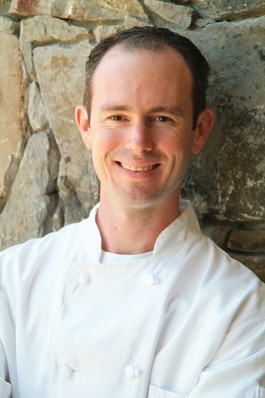
Julia’s Kitchen executive
chef Jeff Mosher

COPIA was established in Napa seven years ago by vintner Robert Mondavi, his wife, Margrit, and chef and author Julia Child to embody a vision of “a small institution to educate, promote and celebrate American excellence and achievements in the culinary, winemaking and visual arts arenas.” The trio couldn’t have imagined a better interpreter of l’art culinaire than Jeff Mosher.

Mosher is executive chef at COPIA’s notable, nonpareil Julia’s Kitchen. If he at first appears to be an unassuming young man, don’t assume that he is. Better than wearing his considerable pride on the sleeve of his immaculate, white chef coat, he plates it. Julia’s offerings, since Mosher donned its exec toque four years ago, have come to stand alongside the best, most innovative and certainly the freshest in the North Bay’s inestimable wine country.

If you’d like to know what’s on Mosher’s mind more than simply how good he is at what he does, skip the next several paragraphs and turn the page to the interview of this rising (more like fully risen) culinary star, conducted on premises on a perfect, sunny, late October afternoon.

Mosher’s affair with French cooking began with a junior year semester abroad from Oberlin College to Strasbourg, France. After graduation, he moved to San Francisco and began his cooking career as a line chef at E&O Trading Company. Soon he was a sous chef at Clouds, then lead line cook at North Star. Moving up quickly, his last position, before becoming sous chef at Julia’s Kitchen in 2004 and its executive chef two years later, was at Campton Place, cooking four-star contemporary cuisine under noted chefs Laurent Manrique and Daniel Humm.

Mosher is, at once, quietly charming and fully forthcoming. But words can’t reveal the chef compleat. So after our hour’s chat, I accepted his invitation to prepare my lunch. I dined at Julia’s Kitchen long before Mosher’s reign. That meal was excellent. This one, assuredly, surpassed.

The menu is “a tribute to Julia Child’s original recipes interpreted by . . . Jeff Mosher.” Julia would be pleased with Mosher’s take on her classic recipes. I purposely selected a light entrée, a “garden-herb crusted big eye tuna salad,” because I wanted to know what truly fresh vegetables tasted like. COPIA takes the locavore principle to a ridiculous extreme. The vegetables I’d be served were perhaps still growing this morning not 10 yards beyond my window table, plucked while sun-warmed from COPIA’s copious three-and-a-half acre garden.

My first dish was a smooth, sage-frothed butternut squash soup followed by the salad of fork-tender, lightly seared tuna, greens, cold potato coins, haricot verts, hard-boiled organic egg lightly dressed with a Dijon-caper vinaigrette. Worthy of note, too, was the doughy, house-made sourdough bread and, most memorable of all, a tiny amuse teacup of intensely savory tomato soup upon which floated a raft of crisped baby basil. Gone in a gulp, but not soon to be forgotten.

Julia Child put her legacy into a simple statement that Jeff Mosher likes to quote: “French cooking isn’t fancy cooking, it’s just good cooking.” The French-inspired Julia’s Kitchen dishes reflect just that: good, perhaps great, cooking. Mosher indicates he may still be at the Kitchen five years from now, but I suggest you take a meal there soon. Talent like his tends to move on.

 Bohemian: What would Julia Child think of COPIA and her eponymously named restaurant today?

Jeff Mosher: I think she’d love it because of how we’ve held to her food philosophy, even, often, her recipes. Remember, she was the first to introduce basic country French cooking to America, to emphasize the use of fresh, seasonal ingredients—and not mess with them—the first to search out the best local ingredients and use the whole animal: the chicken breast for fricassee, the legs for coq au vin, the rest for stock. What she expounded 50 years ago, I follow today.

Name your favorite Bay Area restaurants.

I had a fabulous meal at Cyrus in Healdsburg. Doug Keane is doing some amazing stuff there. In San Francisco, I like Del Fina and A16 for small, reasonably priced Italian. And in Napa, Ubuntu for vegetable-centric dishes. At whatever price, they’re all ingredient-based restaurants. They start with the best kinds of stuff.

And for cheap eats?

Well, I have kids, so I like to stay in Napa where we live. I like Pizza Azzurro, Las Palmas for Mexican, especially the burritos and Taylor’s for burgers. 

Name it, if you care to, but what’s the worst meal you’ve ever had, or worst restaurant you’ve ever visited?

I won’t name the restaurant, but it was the service that ruined the evening. It took 15 minutes to be waited upon, the food came in the wrong order and it went downhill from there. Bad service can ruin a good meal.

What is your philosophy of cooking?

I’m a member of Slow Food Nation. We use the best seasonal ingredients obtained from local sources, I like to introduce new ideas based on classic recipes, and I keep my flavors distinct and clean, and my plates simple.

Who influenced your cooking the most?

Jacques Pepin. Especially one of his cookbooks on preparation that both clearly explained and showed his techniques.

If you were somehow allowed only a single cookbook to use, would that be it?

Yes, but I’d also want Julia’s classic Mastering the Art of French Cooking. And maybe [Auguste] Escoffier. I guess that makes three. Is that OK?

Sure. I noticed your menu offers a foie gras appetizer. You spent a semester in Strasbourg, the birthplace of foie gras. How do you justify foie gras in light of the recent controversy over its preparation?

Not all foie gras is prepared the same. Animals are raised to be food, but we make sure that our sources are reputable and that they treat animals humanely. Our fowl are from Sonoma, and we know they’re raised in a humane fashion. Our pork is “heritage” pork. We know the farmers who raise it.

Brining seems to be growing in favor today. Do you brine your meats?

We brine our pork chops for six to eight hours in a solution of salt, sugar and various spices. Mostly for flavor, and it helps make them a little more tender.

Where would you like to be five years from now?

I think I’ll still be here in the Napa Valley. If I’m not at Julia’s Kitchen, I’ll probably be running some other fine restaurant. I may find a wealthy backer or something, but I don’t know if I want to be an owner. I don’t think I’d want to open a restaurant now in this economic climate. 

Chef Mosher’s Chestnut
& Wild Mushroom Stuffing

The true knowledge—and, perhaps, mettle—of a chef can be told through his recipes. With the holidays in the offing, here’s a Mosher recipe you may want to try.

1/2 loaf pain de mie or other white bread, unsliced
1 medium sweet yellow onion, small-diced
4 celery ribs, small-diced
6 garlic cloves, minced
1/2 c. bacon lardoons (Chef’s note: We make our own bacon, but a nice applewood smoked bacon will do.)
2 c. peeled chestnuts
3 c. assorted wild mushrooms cut into 1-inch pieces
3 tbsp. chopped fresh marjoram
1 c. duck fat
2 c. chicken stock
salt and pepper to taste

Trim crust off bread and slice into 1-inch cubes. Toss with 1/4 cup duck fat, season with salt and pepper and toast in 350 degree oven for seven minutes. Sauté on medium: onions, celery and bacon lardoons in 1 tbsp. of duck fat. Once bacon begins to color, add garlic and sauté an additional two minutes. In separate pan, using 1 tbsp. duck fat, sauté mushrooms on high for 3&–4 minutes, season with salt and pepper. Cut chestnuts in half, add 1/4 cup duck fat, season with salt and pepper and roast at 400 degrees for 8&–10 minutes until a nice, golden brown then combine all ingredients in large mixing bowl. Add marjoram, as much of remaining duck fat as you wish, and the chicken stock. Stir all ingredients together and check seasoning. If stuffing a bird, omit chicken stock. If making separately, place stuffing in ovenproof pan, cover with foil and bake at 350 degrees for 15 minutes before serving. Serves six. Bon appetit!


Quick dining snapshots by Bohemian staffers.

Winery news and reviews.

Food-related comings and goings, openings and closings, and other essays for those who love the kitchen and what it produces.

Recipes for food that you can actually make.

Live Review: Crooked Fingers at the Great American Music Hall

Hey John, It’s too bad that you didn’t come down to the Crooked Fingers show. I didn’t like their new album at first, either, but it started sinking in these last few days. The big question is: why did we convince ourselves that they’d only play a bunch of new songs? The show was amazing, and they played stuff from...

Cohousing Communiqué

11.12.08 The application window for a new cohousing project in Sebastopol has been extended, says Neil Saxby of Affordable Housing Associates. Petaluma Avenue Homes, which is currently under construction as the first affordable, rent-based cohousing project in California, is still accepting applications for tenancy past its original deadline.Petaluma Avenue Homes is modeled after other successful local cohousing communities, like FrogSong...

All That Rises

11.05.08I've had about all the bad economic news I can take. I keep waiting for some authority figure (not you, President Bush) to say things are finally under control and the situation is going to get better, but that seems a long way off. So rather than follow Wall Street's latest meltdown, I'm trying to find the upside to...

Male Glaze

11.12.08Don't be intimidated by Lola Montès. Yes, it's the kind of movie they don't make movies like anymore. But honestly, they never did. Only Max Ophüls did. And only once. And then he died.Arguably, it was Lola Montès that killed him. The 1955 film, Ophüls' first color production—an opulent, romantic costume epic in vivid Cinemascope—had the terrible fortune to...

Abbatoir Blues

The Inedibles Room, the corner nook of a former killing floor in the hundred-year-old SlaughterhouseSpace, does not smell anymore. Instead, with an atmosphere not unlike a concentration camp, it feels. The cold air weighs heavy on the skin, a dense, eerie imposition, and one cannot help but imagine the horrors of the inedibles, whatever they may be.Through a pair...

I Want My Check

11.12.08Dear Gov. Schwarzenegger:Super Gov! What is going on? I know, I know—I don't write often. Actually I have never written you at all. Although I am a lifelong Democrat, for a Republican, you are an OK guy in my book.Anyway, Super Gov, I am writing you in concern about implementation of the passage of Proposition 8. Sadly, this initiative...

Sweet Baby Ben

11.12.08 T alk about a gene pool—Ben Taylor seems to have won the lottery. As the offspring of the ultimate singer-songwriter merger of the '70s, James Taylor and Carly Simon, it seems somewhat natural that Taylor would follow in his parents' footsteps. Even after a disastrous foray into the music world—including a couple of years that had Taylor considering...

Big As a Whale

11.12.08With spacey synthesizers, '60s girl-group harmonies, post-punk guitar and openly gay Fred Schneider's distinctive spoken-word, the B-52s' self-titled debut still sounds innovative 30 years later. This Friday, the "world's greatest party band," who heralded the still-vibrant Athens, Ga., music scene shortly after forming in 1976, visit the Marin Center's Veterans Memorial Auditorium armed with last year's Funplex, their first...

Peak Eating

11.12.08Julia's Kitchen executivechef Jeff MosherCOPIA was established in Napa seven years ago by vintner Robert Mondavi, his wife, Margrit, and chef and author Julia Child to embody a vision of "a small institution to educate, promote and celebrate American excellence and achievements in the culinary, winemaking and visual arts arenas." The trio couldn't have imagined a better interpreter of...
11,084FansLike
4,606FollowersFollow
6,928FollowersFollow