Chimera

0

10.08.08


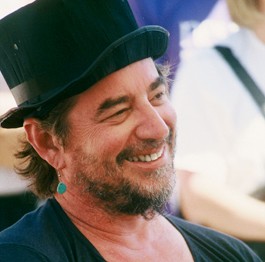
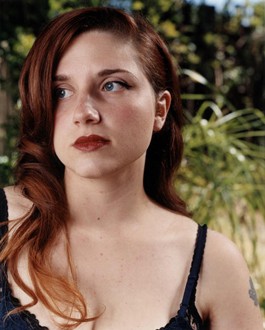
Best known for a low-fi, woodsy sound, Jolie Holland is about to rock—and she salutes herself. “I really love my new band. I was kind of in rock bands when I was a teenager, but I never fronted [one] before. It’s super exciting,” Holland says by phone from rehearsals in Portland, Ore. Her voice bubbles with enthusiasm, as yet unaltered by a recent move from San Francisco to Brooklyn. The tour in support of her latest album, The Living and the Dead, includes an Oct. 15 stop at Bimbo’s.

Catalpa, a series of home recordings that became Holland’s first release in 2003, was nominated by Tom Waits for a Shortlist Music Prize. But the jazz- and folk-inflected singer-songwriter has rediscovered rock and roll in an unconventional way, by becoming inspired by Daniel Johnston, the artist with bipolar disorder featured in the 2006 documentary The Devil and Daniel Johnston.

When Holland admitted that she’d never heard music by the prolific and troubled Johnston—who has a penchant for writing simple, heartfelt rock tunes about ghosts, superheroes and unrequited love—a musician friend acted as though it was a “medical emergency.” He quickly sent her a mix tape of Johnston’s best songs. It changed Holland’s life.

“The tape stopped and I just started writing,” Holland says. “Fifteen minutes later, I had a song. It really changed the whole direction of my writing. I was going to put that on the record, but it was personal. It’s called ‘Feminist Response to Daniel Johnston.'”

While that song didn’t make it on to the album, “Sweet Loving Man,” an old-school country paean to the difficulties of love, did. “‘Sweet Loving Man’ was really influenced by a Memphis Minnie song that I love a lot,” says Holland. “What I was trying to do was to have a conversational sort of song, where the center is missing. Where you don’t really say exactly what you are talking about.”

Like one of her heroes, the folktale collector and writer Zora Neale Hurston, Holland has made a career out of sampling vintage sounds, transforming them into something brilliantly new in the process. Since her time spent playing in Canadian traditional bluegrass band the Be Good Tanyas and through three previous, well-received albums (including Escondida, recorded at In the Pocket Studios in Forestville), Holland has grown progressively more confident in both her vocal stylings and her use of instruments beyond the guitar. The song production on The Living and the Dead makes use of everything from an ancient Mozzani harp guitar to bleeping robot sounds.

The new album also features appearances by Marc Ribot, who brings his signature Lounge Lizards guitar style to the mix, as well as M. Ward and drummer Rachel (Decemberists, Bright Eyes) Blumberg. With multi-instrumentalist Shahzad Ismaily handling much of the production work on the album, the resulting sound is brighter and more fully realized than Holland’s previous efforts.

“Everybody is so amazingly good. Good in that sort of spiritual way,” says Holland about the recording sessions that spanned four days in Portland and another two months in Brooklyn. “They understood that it’s about vibe and it’s not about perfectionism. It’s about bringing the energy instead of bringing your music-school books.”

Holland’s distinctive voice has been compared to everyone from Billie Holiday to Cat Power to Blind Willie McTell. Sounding like a mixture of molasses and sandpaper, she tunnels through one word in the time it might take another singer to enunciate 10. As a result, the listener is invited to take in lyrics that might otherwise be obscured, including those on “Mexico City,” the first track on the album.

Being a true storyteller, Holland winds down our conversation with the story of how she came to write “Mexico City,” an exuberantly road-weary tune based on the story of Joan Vollmer, who was shot by her husband William S. Burroughs in 1951 during a drunken game of William Tell.

“I dreamt that I was Joan Vollmer and that I woke up in bed with William Burroughs. Years later, I told the story on a radio show,” says Holland. “I was playing in Lawrence, Kan., and Burroughs’ partner of 23 years, James Grauerholz, came up to me and said, ‘Hi, I’m William Burroughs’ wife. I heard about your dream.’ Then he kissed me on the lips. Yeah, it was just too weird. I had to do something with it.”

 Jolie Holland performs on Wednesday, Oct. 15, at Bimbo’s 365 Club in San Francisco. ‘The Living and the Dead’ is in stores this week.
Wedding Party

10.08.08

Mixing two great flavors that don’t belong together, Rachel Getting Married has Jonathan Demme trying out a French New Wave&–style profile of a guilty prodigal daughter. He stages this intimate character study as what Spike Lee calls a “joint.” More than just slang for a film, I would interpret that term as referring to Lee’s work at its most dense, as social dramas acted out against a thick blend of audio mix, boutique clothing and art direction.

One of the best examples is Demme’s own Something Wild. The art direction isn’t so distracting in that meaty, sexy love triangle, any more than it is in Demme’s tasty, trifling remake of Charade. The surfaces and the audio wallpaper of Rachel Getting Married are maybe too enticing. Rarely have I been so overwhelmed with the feeling o “I must have this house, even if all the people in it have to get out, even Robyn Hitchcock.”

The setting is an early fall country wedding at a rambling Connecticut Victorian. In the genteel funky interiors, we see more acoustic musical instruments scattered around than in a Lark in the Morning store. Rachel Getting Married is more of a jam session than a movie, with the muffler-wrapped Hitchcock leading an alfresco musical group in the backyard.

For reasons unexplained, the theme is Indian chic. The bridesmaids come wrapped in lilac-colored saris, and the centerpiece is a Wedgwood cake with decorative elephant and howdah. Paul (Bill Irwin), the lord of the manor, delivers a line about how the duties of a father of the bride are twofold: to grin like a jack-o’-lantern and to keep writing checks. His wife, Carol (Anna Deavere Smith), has even fewer duties; she just chokes back tears and looks maternal. Irwin is so abstracted that you never get answers to questions like who are these people and how do you get a house like this.

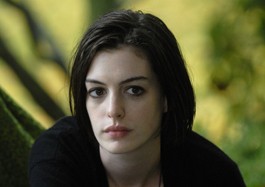
The daughter, Rachel (Rosemarie DeWitt), is marrying into an African-American family, although the groom is as unstereotypical as can be. The prenuptial dinner unfolds as a good-feeling harmonious blur, set in a room lined with silvery Russian icons. “This is what heaven is like,” says an aged lady. All the disharmony is embodied by the film’s real main character: the witchy sister Kym (Anne Hathaway), a former-model-turned-train wreck, just out of the latest stretch of rehab.

As Kym, Hathaway deglams seriously. Her hair is self-cut and indifferently washed. She chain-smokes and croaks out her putdowns with a crowlike voice. But in repose, nothing can take the shock of beauty away from the wide mouth and wider dark eyes. In moments of reacting, she nails it down. Hathaway is a fine reactress, and that’s a start.

Her toast to the bride, where she introduces herself as “Shiva the Destroyer,” is a good sharp joke, considering the Indianoisieries of this event. In this film of Jaglomian looseness, Hathaway wires things up. And Kym holds her own in a clash with her mom, Paul’s first wife. Debra Winger plays this silky queen of denial in a welcome return to the screen, proving herself as an actress too tough for the kind of films they make in 2008.

Still, Rachel Getting Married ends up as a clash of atmosphere and star. Ultimately, our sympathies have to be with the former, with the people lucky enough to bathe in this distractingly rich eclecticism shot by Declan Quinn with the self-declared intention of creating “the most beautiful home movie ever made.” The film’s strategy is smart on one level. It doesn’t blame the family for Kym’s raging addiction. Still, there’s none of that sense of the nibbling forlornness that made the similar Margot at the Wedding more believable.

The way Demme sets up this marvelous party, you have to ask what kind of close-minded person could resist such a polycultural tornado. The answer: some will. Rachel Gets Married is a little out of it. The testimonials at the wedding seem endless, discursive; the dancing goes on for a long piece after the emotional climax of the film; and Jenny (daughter of Sidney) Lumet’s script is sometimes vague. Truth is, there’s always more than one pooper at any party.

  ‘Rachel Getting Married’ opens on Friday, Oct. 10, at the Century CineArts at Sequoia, 25 Throckmorton Ave., Mill Valley. 415.388.4862.


New and upcoming film releases.

Browse all movie reviews.

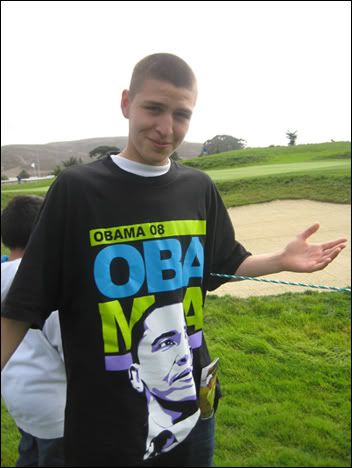
Chillin’ on the 14th Fairway

0

Women’s LPGA World Championship, Half Moon Bay:

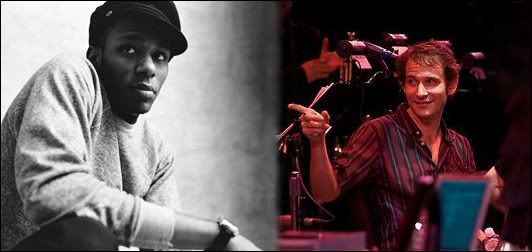
1-2-3, Mos Def and Adam The-eis

3


Just got off the phone with old pal and former Santa Rosa resident Adam Theis, who’s meeting with Mos Def tonight to discuss their upcoming collaboration for the Band Shell Music Summit in San Francisco. If you’d’ve told me eight years ago that Adam Theis would be working with Mos Def, I’d say you were crazy. But then I’d think about it, and I’d totally believe you, because Theis is among the most talented and dedicated musicians I know.
Here’s the deal: Theis’ Realistic Orchestra is the backing band for Mos Def in a free show on October 18 at the Golden Gate Park Bandshell, between the De Young Museum and the new Academy of Sciences. You can’t just show up, though—you have to go to this website, lie about your income, feel guilty about not taking public transportation and say if you have an energy efficient lightbulb in your house or not. Kinda weird, but whatever—print out the voucher, and you’re in.
Theis says he and Mos Def are working on about a collaborative half-hour set with the Realistic Orchestra for the event, and is quick to point out that the rest of the day’s lineup—with Mingus Amungus, Lavay Smith, Kim Nalley, and some dude from Dave Matthews’ band—should be pretty great as well. The next night, the collaboration hits the stage again at Ruby Skye to benefit the Blue Bear School of Music. Tickets are $50. Go to the free thing instead.
Incidentally, Theis is also working on a two-hour opus commissioned by a prestigious Emerging Composer grant from the Gerbode-Hewlett Foundation, to be premiered next spring as part of the SFJAZZ festival by a 50-piece orchestra. No shit: a 50-piece orchestra. And all this after arranging horns for Lyrics Born’s last album, and the Mighty Underdogs’ last album, and J-Boogie’s last album, and oh, pretty much dominating the Mission District every Tuesday night at Bruno’s.

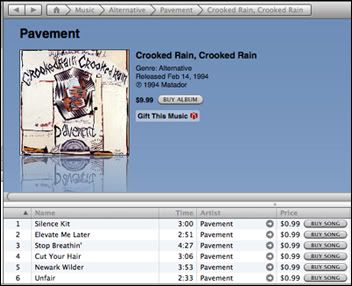
Steve Jobs Craps Pants, Cries In Corner Over Royalties

3

Apple has announced that if the iTunes Music Store is forced by a Library of Congress-appointed Copyright Royalty Board to increase their royalty rate for publishers and songwriters by six measly cents per song, then boo hoo, waah waah, they’re going to have no choice but to shut down the iTunes Music Store altogether.
From Wired:
“If the [iTunes music store] was forced to absorb any increase in the… royalty rate, the result would be to significantly increase the likelihood of the store operating at a financial loss—which is no alternative at all,” wrote Apple iTunes vice president Eddy Cue in a statement filed with the board last year, according to Fortune. “Apple has repeatedly made it clear that it is in this business to make money, and most likely would not continue to operate [the iTunes music store] if it were no longer possible to do so profitably.”
It’s easy to see that Apple is bluffing its ass off in an attempt to get record labels to absorb the six cents. But what’s even more infuriating is that they have the full stupid support of music fans who’ve been indoctrinated for the last ten years to believe that anything except 100-percent free music is the product of the evil recording industry and who clearly don’t know the difference between the record label, the recording studio, the RIAA, and the publisher.
One comment is indicative of many:
“As much as I have been an apple hater over the years and despise the i-tunes concept becuase of the DRM, kudos to them for taking such a hard line stand. The studios know the end of i-tunes will pretty kill their last existing business model. It’s about time somewith the power has the moxy to tell the RIAA F-YOU”
Now, I’m aware that Internet comments are by nature an intellectual cesspool, but what worries me is that everyone takes this knee-jerk “fuck the record industry” stance without understanding that this mechanical royalty rate increase is a move to actually help the artist. Of the four categories above—label, studio, RIAA, and publisher—there’s one that does right by the artist, and that’s the publisher. Nearly all songwriters work with a publishing company which pays them songwriting royalties. And everyone knows that songwriting royalties are the best and most feasible way for musicians to support themselves.
I’ve personally known musicians who’ve released 10 albums and hardly seen any paychecks at all. Then, bam! One day their song gets covered by a more famous artist, or used in a commercial, or played in the background on a made-for-TV-movie that airs in Australia, and all their hard work finally pays off—to say nothing of the many obscure artists who share songwriting credit for hip-hop samples, or those important figures who’ve maybe never even recorded a song but have written hit after hit.
Six cents might not sound like a lot, but try telling that to David Axelrod, the Los Angeles musician whose “Holy Thursday” was tapped for a sample on Lil’ Wayne’s mega-selling The Carter III. Try telling that to Rowland Salley, whose beautiful “Killing the Blues” was included by Alison Krauss and Robert Plant on their mega-selling Raising Sand. Try telling that to Tom Waits, whose “The Long Way Home” from Norah Jones’ mega-selling Long Way Home earned him more royalties than his entire brilliant 1972-1980 catalog combined.
So to Steve Jobs: Quit your crying. In the immortal words of Seth Tobocman, you don’t have to fuck people over to survive. Pay the six cents and earn yourself a little goodwill.

Lights, Camera, Action

0

10.01.08

W hat can I do?” More than any other question posed to staff and volunteers during the annual 10-day Mill Valley Film Festival, those four words—”What can I do?”—form the one query that, according to, MVFF director of programming Zoe Elton, has been deemed by the festival as most deserving of an answer. Sometimes posed as an invitation to join the army of volunteers who grease the festival’s wheels year after year, the question is also routinely uttered by moviegoers as they leave a particularly moving film, one that has inspired them to take some sort of action to make the world a better place.

“People really do come up to me all the time after films,” says Elton, “especially with films about so-called social issues, environmental issues, racial issues. People want to know what they can do to effect some sort of change in the world. We decided that beginning this year, we were going to be ready with some answers.”

Now in its 31st year, the festival, this year running Oct. 2&–12, features over 200 films, as well as panel discussions, celebrity appearances, ceremonies, contests and other movie-related happenings, and marks the official launch of Active Cinema, a kind of socially conscious connective thread linking together many of the movies and events that showcase important ecological and humanitarian issues. Concurrently, the California Film Institute, which presents the festival and runs the Christopher B. Smith Rafael Film Center in San Rafael, has launched the three-year Green Initiative, intended to educate the public through film as it transforms all CFI facilities to conform with the highest green business standards.

“Active Cinema,” Elton explains, “is a way to connect the dots between activist films, the audiences interested in those issues and the various nonprofits and organizations dedicated to the issues portrayed onscreen.” In addition to marking certain featured films as “Active Cinema” in the guidebook, organizers have upped the activism level on many of this year’s postfilm Q&As, inviting guests and experts who can answer the “what can I do?” question with practical advice.

On Sunday, Oct. 5, the first annual Active Cinema Roundtable will feature a lively discussion between filmmaker and Annenberg Foundation trustee Charles Annenberg Weingarten, Brazilian activist and native chief Almir Narayamonga Surui (featured in the film Children of the Amazon), and Amazon Conservation Team director Vasco van Roosmalen, plus Jenny Yancey and Weezie Yancey-Siegel of YouthGive. The festival even promises to introduce environmental and activist elements into its popular Cinema Sports contest, in which filmmakers make a film from scratch in a single day, incorporating a list of “ingredients” provided at the kickoff to all contestants. According to Elton, this year’s ingredients will steer the films in a decidedly socially conscious direction.

“In a way, the threads of Active Cinema have always been part of the Mill Valley Film Festival,” Elton says. “We’ve always had films that deal with environmental issues, social issues, human rights issues. Those kinds of films come with the film festival territory, but they also come as part of the community we live in here in Northern California, the consciousness of people in the Bay Area. Activism, social efforts, environmental efforts—these have always been present in the programming, but this year the festival plans to build that activist impulse into the fabric of the festival.

“I see Active Cinema as people actively using film as a way of understanding and expressing important social issues,” Elton continues. “We really want to bring people together to network, to talk, to meet people and see new ways they can connect with organizations that are doing something proactively.”

Which brings Elton to the matter of the tree.

“The tree, yes!” she laughs. “This year, there are several films that relate to trees and environmentalism,” she continues. “Children of the Amazon and Taking Root both have to do with issues of deforestation, so the dots started connecting, and we thought it would be an appropriate ritual—here as we are planting the seeds of an important new project, here in the kickoff year of Active Cinema—to actually have a ceremonial tree-planting during the festival.”

As it so happens, right in the middle of the square by Mill Valley’s Book Depot is a dying tree slated for removal. So the Active Cinema tree-planting will take place right in the center of Mill Valley.

“Which, metaphorically,” Elton adds, “is kind of great, and we hope it will inspire people to plant more trees on their own, at home or in other areas where new trees would be beneficial.” The ceremony will take place on Saturday, Oct. 4, at 10am.

“There is something about film,” Elton says, “probably because it is based in storytelling—regardless of whether it’s a documentary or a narrative film—that can take a theme and make it a part of the audience’s consciousness. In a remarkably personal way, a film can give you an emotional understanding of the story it is telling, because in film we are allowed to become a part of that story. We see ourselves in these stories. And when inspired, we want to take those feelings and turn them into action. That’s what Active Cinema is all about.”

The films tagged as Active Cinema this year include Tim Disney’s American Violet, a true story featuring Alfre Woodard as the mother of a young woman unfairly arrested on drug charges, a case taken up by the ACLU. The real-life lawyer in the case will be on hand at the screening to answer questions about what can be done to battle racism in similar situations.

Also featured is Where the Water Meets the Sky, in which 23 Zambian women tell their own stories as they learn to use video cameras distributed to their community. Burning the Future: Coal in America looks at the devastating aftermath of “mountaintop coal mining” in the Appalachians, and Fire Under the Snow follows Tibetan monk-activist Palden Gyastso, arrested by the Chinese government for attending a pro-Tibet rally and held for 33 years. These are just a few, each a representation of how a strong story well-told can move people to activism.

“I think film is a very important tool, because it  can touch people,” says filmmaker Denise Zmekhol, director of Children of the Amazon. “Film,” she says, “can educate people while entertaining them, it can bring a lot of awareness to important situations going on in the world. I really believe this. That’s why I do it.”

In Children of the Amazon, Zmekhol returns to the Surui and Negarote tribes of the Brazilian rainforest to find out what become of the children whose faces she photographed 15 years ago, pictures that became a world-famous traveling exhibition. This time, she didn’t just take pictures, she made a movie.

“When you get engaged in something like what my film is about—the destruction of the Amazon—film is especially effective because it doesn’t just tell you what is happening, it shows you,” she says. “If people don’t understand how we are all connected—that what we do here in America affects the lives of the people there, and that whatever they do there is going to impact out life here—we’re going to lose something we will never get back. It’s important for people to learn and understand so they can make a choice about what’s important to them, and film is a powerful way to touch them. Whether they just take it as entertainment or become moved to activism, what they do with their feelings after that is up to them.”

 Most screenings take place at the Century CineArts Sequoia (25 Throckmorton Ave., Mill Valley; 415.388.3862) and the Smith Rafael Film Center (1118 Fourth St., San Rafael; 415.454.1222). For a complete listing of MVFF films and events, visit [ http://www.mvff.com/ ]www.mvff.com.

Bright Lights

Other highlights of the 2008 MVFF

Israeli director Eran Riklis (The Syrian Bride) brings us Lemon Tree (Oct.12), the story of a Palestinian widow with a lemon grove near the volatile border with Israel, where everyone is a suspected terrorist. In Flash of Genius (Oct. 2), starring Greg Kinnear, the true story of the man who invented the intermittent windshield wiper and was subsequently cheated by the automotive industry comes to life in a film by Marc Abraham, the producer of Tuck Everlasting and Children of Men.

The tuneful documentary Hair: Let the Sun Shine In (Oct. 6 and 11) tells the story behind the ’60s most outrageous Broadway musical. The Lost Skeleton Returns Again (Oct. 3 and 5) is a sequel to Larry Blamire’s hilarious 2001 spoof, The Lost Skeleton of the Cadavra, which promises more black-and-white mayhem as people “do science” and escape the clutches of aliens, jungle dwellers and a badly manipulated skeleton.


New and upcoming film releases.

Browse all movie reviews.

Bottled Charisma

0

10.01.08

Photogenic winemakers still take the cover page of industry magazines and weekly wine sections, but a growing number of these artisans are backing out of the spotlight, removing their hands from the grape juice and letting the wine make itself. One of the surest means to accomplish this goal is by making single-vineyard wines, or vineyard designates, on which the vintner tends to minimize his or her influence. The result is a bottle full of terroir, that sense of place that affects any product of the earth and takes the imaginative consumer on a daytrip to the country.

“A single-vineyard wine connects a person to a place,” says Ramona Nicholson, co-owner of Nicholson Ranch in Sonoma. “We all like a sense of being somewhere. People might not set foot on my vineyard, but in their mind they can be there if they drink my wine, whereas if it’s a general California Syrah, you won’t have any special sense of location as you drink it.”

The matter is one of opinion, but most will agree that not just any vineyard can ably produce a wine sufficiently balanced for single-vineyard designation, and such vintages may be best blended with other juice that requires a little fine-tuning itself. This softens the edges and polishes the surface of a product that, on its own, might be too unconventional to sell. But for some winemakers, making charismatic wines—not pleasing the masses—is the whole point of a single-vineyard wine.

“We’re really hoping to make wines that have a lot of character,” says Adam Lee, who made 19 vineyard-designate Pinot Noirs last year with Siduri Wines in Santa Rosa. “Some people will like one of our wines but say they don’t like that one. That never bothers me. That’s part of what we’re about.” 

Lee makes a pair of Santa Lucia Highlands Pinots from vineyards less than a mile apart. One, Rosella’s Vineyard, is bright, crisp and tangy, with a layer of tobacco and full of toast. The Pinot from Gary’s Vineyard is quiet, mushroomy and earthy. Two of Nicholson Ranch’s single-vineyard Syrahs come from nearly the same patch of land in Sonoma County but taste wildly different: the specimen from Bennett Valley Vineyard, southeast of Santa Rosa, is savory, tame and European; the Las Madres Vineyard is lush, ripe and fruity. As Nicholson says, “The only reason we would make several Syrahs is to celebrate their differences.”

Nicholson Ranch’s winemaker, Jacqueline Yoakum, takes a minimal-intervention approach to her craft, including the use of indigenous yeast and no filtering. Her scheme allows the land’s voice to be heard in the absence of distracting background noise. Pali Wine Company in Lompoc does the same, though at an even more restrictive level. The winery currently carries eight single-vineyard Pinot Noirs, and to showcase each one’s vineyard of origin, winemaker Aaron Walker makes each wine by precisely the same methods and techniques—same pressure during crush, same fermenting time of 21 days, same sized three-quarter-ton tanks, same 100-percent French oak aging scheme and same bottling schedule.

Yet there are still stark differences between the wines, variations which can only be attributed to the place where the grapes were grown. “Each wine is made by the same formula, so all you’re tasting is that specific site,” Walker says.

Pali’s next-door neighbor, Loring Wine Company, follows the same model in its 14 single-vineyard Pinots. “We process all the fruit exactly the same to make sure that the nuances come from the vineyard and not from how you barreled them,” says owner and winemaker Brian Loring. “Still, they’re all unique.”

This is terroir at work, and it’s very interesting for those who care. Not everyone does. The general public still wants a wine that is easy to drink and asks for little brain-work while sipping, and talented wine-smiths know how to meet their tastes with easy-drinking, mass-market grape cocktails.

Winemaker and consultant Marco Cappelli, though, finds his job far more interesting and rewarding if he allows the land and the vintage to create the wine. The resulting product may be a blockbuster hit or a semisuccessful underground cult attraction, but it always holds a level of integrity that would be lost through sales-driven blending.

Cappelli owns Herbert Vineyard, a block of El Dorado County, which includes six acres of Zinfandel. The Zin is divvied up among five separate labels. Made by different winemakers at different facilities, the various Herbert Zins are all consistently peppery, very sharp at the edges, tangy with acid and thick with tannins.

“If I’d wanted to appeal to a broad range of people, I would have blended in a sweeter, softer wine,” says Cappelli, who himself makes the Herbert Vineyard Zins for two of his clients. “That high acidity makes it appeal to a narrower range of people. Most consumers want an easy-to-drink, approachable wine, but there are a few people who like the distinctive personality of the wine.”

Nicholson also prefers wines with strong charisma. Many wineries, she explains, specialize in making wine for the general public “because they want to make a likeable Chardonnay.” Nicholson Ranch’s current 2006 estate Chardonnay is not for the general public. It smells and tastes of strong raw almond and zesty lemon mint—unconventional but memorable, the way vineyard designates are supposed to be.

Single-vineyard winemaking can also be a business strategy. Grape growers, especially, stand to benefit financially if their wine goes to bottle unaccompanied by wines from other properties, as the name of their vineyard will likely appear in large, loud letters on the front label, and if the wine is good, it can serve as an effective real estate ad. Grape growers know this and may even choose to do business with only those wineries that promise not to blend the wine and to put the vineyard name on the label. Cappelli concedes that a similar tactic has governed his own business dealings with Herbert Vineyard fruit.

“Making single-vineyard wines from the estate was actually part of my long-term business strategy, because if people don’t recognize the name of your property, then it’s just another Zin, but if you can make a name for it, then people will recognize it and you’ll ultimately get more money for your wine.”

Among consumers, vineyard designates are gaining appreciation. “Varietal” became the nerd-word of the day several years ago as wine fans embraced a focused approach to winetasting. This inevitably led to the next level of appreciation, single-varietal wines. Now, enthusiasm for single-vineyard wines is rattling the market.

“A faction of society is becoming more and more interested in this intellectual approach to winemaking and wine drinking,” says winemaker Adam Richardson, who appreciates the art of blending but would rather “get a wine right from one vineyard.” Richardson made three single-vineyard wines at Concannon Winery in Livermore in 2006, the proudest wine of which is the bright yet acidic Nina’s Cuvee, a Petite Sirah. Next year, Richardson and winery managers plan to make 10 single-vineyard wines in response to consumer interest.

But Lee of Siduri Wines wonders if some winemakers are getting carried away.

“If there are too many single-vineyard wines, it begins to call into question marketing decisions, like, is it easier to sell two 400-case lots than it is to sell one 800-case lot?”

A small batch of wine with a vineyard name on the label, he says, can sell itself through word-of-mouth recommendation, while bigger batches require marketing efforts. Cohn says that far too often he has tasted a lineup of wines from hopeful growers only to inform them that all they’ve got is so many barrels of “blenders”—not bad wines, but simply not exciting enough to stand alone. Brian Loring, too, acknowledges the importance that every vineyard designate be remarkable.

“If they were all the same, the single-vineyard concept would have no meaning, and it would start to look like a marketing ploy.”

Whether due to demand, quality or prestige, single-vineyard wines often boast the highest prices on the wine list. To the uninitiated, these wines still taste like plain old satisfactory wine, but to the sophisticated drinker, wines of a vineyard accomplish much more. They capture a time and a place that might otherwise have been lost from the annals of winegrowing history through blending. As such, each one is a sort of time capsule—a message in a bottle—and the message of a vineyard designate is as easy to comprehend as that Hawaiian beach sand your grandmother keeps in a jar. The wine, though, is much more fun to taste. 

Quick dining snapshots by Bohemian staffers.

Winery news and reviews.

Food-related comings and goings, openings and closings, and other essays for those who love the kitchen and what it produces.

Recipes for food that you can actually make.

Over and Under

0

10.01.08

Nighttime is beautiful to Greg Brown. Keeping warm by the fire with your true love in your arms, whispering to each other about eternity. Smelling the nape of each other’s necks at night. Making love in the tall grass as the raindrops fall on the flowers. Kissing under the full moon.

Then the day rolls around and everything goes to hell. Boys drown in a lake, old people rue their wasted lives, shiftless husbands die from careless gunshots and nagging wives succumb to heart attacks. The mill closes down, the fields burn. Trains crash. Strip malls take over.

It’s not correct to call Greg Brown’s music bipolar, unless you’re willing to call life itself bipolar. More than any other folk musician, Brown is able to take snapshots of life and put them into song with his low, graveled baritone, from ends both euphoric and miserable. The depressing experience of loading into another grungy club is succinctly laid out in “Mose Allison Played Here”; the utter joy at falling in love is encapsulated perfectly in “Hey Baby Hey.”

In Sonoma County, Greg Brown’s less gritty self is the more popular, but after 24 albums released on his own Red House label, popularity is hardly a driving force for the 59-year-old native Iowan. The last time Brown was here, in 2003, he sat down with lanky ace Stratocaster accompanist Bo Ramsey and played an entire set of stark, hopeless blues songs. The war had just been announced. People shouted requests from Brown’s more uplifting albums, like Further In and The Poet Game. They were ignored.

Though now married to fellow folksinger Iris DeMent and the new father of an adopted child, Brown isn’t exactly one for bright new leases on life. Since albums like Slant 6 Mind and Over & Under, Brown’s continued as a purveyor of truth through poetry, intellect and humor, and the truth isn’t always pretty. His latest album, 2006’s The Evening Call, continues the constant push-pull of optimism and darkness; in “Eugene,” he sings that “World peace is surely on the horizon / Once us old fuckers die.”

It’s a dismal thought, world peace being achieved only after one’s death, but the fact is that the war is still going on, and sometimes it actually does seem like world peace isn’t in our lifetime. And what can you do in the meantime? Of course. Keep warm by the fire with your true love, whisper about eternity, make love in the tall grass, kiss beneath the full moon and go see the brilliant Greg Brown on Saturday, Oct. 4, at the Mystic Theatre, 23 Petaluma Blvd. N., Petaluma. 8pm. $25&–$28. 707.765.2121.


Pedal Power

10.01.08

I derive no pleasure from cardio exercise. I have never owned a bike that wasn’t $30 or less from a garage sale. I was the type of child to take head-over-handlebar spills, landing face first into whatever happened in my path. Being laid-up on the couch for a couple of days from bike-inflicted wounds was not unheard of. Factor in my fear of dogs and traffic, and the chances of catching me in a spandex suit with crotch padding is close to nil. Just the same, when I catch sight of Steve Muscarelli preparing to mount and ride, I can’t help but stop and inquire.

No doubt it is the solar panels attached to the rear of his bike that catch my attention. Later, Muscarelli will tell me that the solar panels, which jut up like a beetle’s wings, are more for looks than anything else. People kept asking him where his solar panels were, so he put some on to satisfy the crowd. Far more useful is the electric motor, which is installed on the front wheel, and the pull cart attached to the rear of the bike, which carries batteries with plenty of room left over for strapping in groceries and speakers for the tunes.

I tell Muscarelli I want to see more, and he kindly agrees to meet up with me later for a more complete tour of his creations.

A few weeks later, we meet at the Sebastopol Farmer’s Market. Muscarelli arrives on one of his six converted bicycles with friend Danya Parkinson of the Pyrokinetics art collective. Parkinson is with his family in his solar electric pedal hybrid. Parkinson’s hybrid is built on a “social tandem,” a two-seater with a canopy, most regularly found conveying tourists on the boardwalks of seaside towns. Parkinson’s tandem is decked out to the hilt, with custom saddlebags and pillows sewn by his wife, a full solar-paneled roof, satellite radio, a seatbelt-ready front basket for the children, and a simple throttle system so effective that one need only pedal when especially inspired.

This baby goes up to 25 miles per hour, has a 40- to 50-mile radius (more if it’s sunny), and lighting for evening rides. This is a bolt-and-bracket design, Parkinson tells me, which means that the integrity of the original bike has been maintained, and the entire operation can be taken off and put on another bike if desired. Accustomed to working with large sculpture with extreme fire effects, Parkinson is ready to move his art in a more environmentally friendly direction.

Both Parkinson and Muscarelli speak highly of their collaborative efforts on the converted social tandem. With this type of work, bringing people together who have varied skills and talents is not just essential, it’s part of the joy of it. But what about those of us who want a hybrid bike, but have no skills to offer? Not to worry. In the last few months, Muscarelli has converted a total of eight bikes for use by others.

Muscarelli has been car-free for almost three years. In the winter, he puts fenders on his bikes, dons full rain gear and has rain covers for all of his stuff. The quality, lightweight battery packs hold up against moisture, and he is able to get everywhere he needs to go, 365 days a year, on his bikes alone. On the bike path, Muscarelli tells me, he is legally allowed to travel 15 miles per hour, which he does with pure leg power, using an electric boost whenever he pleases. On the road, his bike is allowed to travel at 20 miles per hour. Driving a 3,000-pound vehicle from point A to point B, for what are often the most menial and simple of tasks, is ridiculous, Muscarelli says, and with a bike like his, why get in the car?

Muscarelli even offers roadside service for his customers. These bikes are so simple, he says, that there are rarely any problems, but should a rider get stranded for any reason, Muscarelli can be called day or night. He will arrive with his tools in tow (which he can charge, by the way, on his bike), and the rider will be back up again in no time. Muscarelli sees the cultural climate of car reliance shifting, and with more bikes on the road, he predicts that a new paradigm is not far behind. “The stuff works,” Muscarelli tells me. “That’s the bottom line.”

Suffice it to say that I now want one quite desperately.  

For more information, call 707.206.8659.


Chimera

10.08.08Best known for a low-fi, woodsy sound, Jolie Holland is about to rock—and she salutes herself. "I really love my new band. I was kind of in rock bands when I was a teenager, but I never fronted before. It's super exciting," Holland says by phone from rehearsals in Portland, Ore. Her voice bubbles with enthusiasm, as yet...

Wedding Party

10.08.08Mixing two great flavors that don't belong together, Rachel Getting Married has Jonathan Demme trying out a French New Wave&–style profile of a guilty prodigal daughter. He stages this intimate character study as what Spike Lee calls a "joint." More than just slang for a film, I would interpret that term as referring to Lee's work at its most...

Chillin’ on the 14th Fairway

Women's LPGA World Championship, Half Moon Bay:

1-2-3, Mos Def and Adam The-eis

Just got off the phone with old pal and former Santa Rosa resident Adam Theis, who’s meeting with Mos Def tonight to discuss their upcoming collaboration for the Band Shell Music Summit in San Francisco. If you’d’ve told me eight years ago that Adam Theis would be working with Mos Def, I’d say you were crazy. But then I’d...

Steve Jobs Craps Pants, Cries In Corner Over Royalties

Apple has announced that if the iTunes Music Store is forced by a Library of Congress-appointed Copyright Royalty Board to increase their royalty rate for publishers and songwriters by six measly cents per song, then boo hoo, waah waah, they're going to have no choice but to shut down the iTunes Music Store altogether. From Wired: "If the was forced...
Lights, Camera, Action

10.01.08W hat can I do?" More than any other question posed to staff and volunteers during the annual 10-day Mill Valley Film Festival, those four words—"What can I do?"—form the one query that, according to, MVFF director of programming Zoe Elton, has been deemed by the festival as most deserving of an answer. Sometimes posed as an invitation to...

Bottled Charisma

10.01.08 Photogenic winemakers still take the cover page of industry magazines and weekly wine sections, but a growing number of these artisans are backing out of the spotlight, removing their hands from the grape juice and letting the wine make itself. One of the surest means to accomplish this goal is by making single-vineyard wines, or...

Over and Under

10.01.08Nighttime is beautiful to Greg Brown. Keeping warm by the fire with your true love in your arms, whispering to each other about eternity. Smelling the nape of each other's necks at night. Making love in the tall grass as the raindrops fall on the flowers. Kissing under the full moon.Then the day rolls around and everything goes to...

Pedal Power

10.01.08I derive no pleasure from cardio exercise. I have never owned a bike that wasn't $30 or less from a garage sale. I was the type of child to take head-over-handlebar spills, landing face first into whatever happened in my path. Being laid-up on the couch for a couple of days from bike-inflicted wounds was not unheard of. Factor in...
11,084FansLike
4,446FollowersFollow
6,928FollowersFollow