
Time to move on
Congratulations to reporter Bruce Robinson (“Voices Parry,” March 25). He apparently actually read most of the pertinent and readily available public documents concerning the infrastructure problems, code violations, mishandling of Corporation for Public Broadcasting (i.e., taxpayer) funds, botched elections and failed mediation attempts at our KBBF public radio station. It is a rarity but essential to understanding what all the fuss is over the competence of the current board of directors and general manager.
Last fall, after the documents showing that the station general manager Jesus Lozano was a convicted methamphetamine trafficker and preparing to begin a five-year incarceration in a federal prison became public, the station directors promised through the new general manager Joseph Slali a complete and public disclosure of how a convicted felon managed to receive unquestioning support from them for three years.
Presumably the report would have included a complete report on the missing or mishandled station funds and other property. The general manager and board of directors have since reneged on this promise. Slali has stated that “it is time to move on.” He’s right about that, of course, but not in the sense he thinks.
David Janda
Santa Rosa
Power of Low-power
KBBF’s “plague” (“Voices Parry”) sounds like the same disease that has run rampant in our nation’s capitol with misappropriated federal funds.
At a time when most commercial radio stations have been taken over by large conglomerates, community stations such as KBBF are needed more than ever. Ironically, KBBF’s troubles have become the very news story a noncommercial public station would endeavor to report.
Fortunately there are alternatives for those who want radio “as a vehicle to communicate with the local community.” Sonoma County is home to the following low-power community stations (all on FM): KGGV 95.1, Guerneville; KOWS 107.3, Occidental; KSVY 91.3, Sonoma; and KWMR, 90.5 Pt. Reyes Station.
Cathy Corzine
Occidental
This old stoner
In Gabe Meline’s Critic’s Choice (“Talkin’ Tampons,” March 25), he points out how new country stars Montgomery Gentry changed Robert Earl Keen’s lyrics around because they find Pampers less offensive than tampons. What a couple of douche bags! Disposable shit and “new country” music—there’s probably a connection somewhere . . .
A few years ago, Emmylou Harris, Dolly Parton and Linda Ronstadt covered Neil Young’s “After the Gold Rush” and changed his lyrics from “There was a band playing in my head, and I felt like getting high” to “There was a band playing in my head, and I felt like I could cry.” That one bugs this old stoner!
Doug Jayne
Santa Rosa
Track ’em All!
Recently, Attorney General Jerry Brown suggested violent-prone parolees/probationers be fitted with GPS devices. I agree with this proposal, but suggest a device be fitted to violent-prone perpetrators that would protect citizens and law enforcement to the nth degree.
A bracelet with a GPS tracking device, a radio beacon that would identify a potential violent subject to law enforcement, and a Taser capability to incapacitate a subject before citizens or law enforcement come to harm is possible.
Let’s think out of the box to protect our society from these proven violent individuals. Of course, the ACLU will have a field day with this proposal.
Lee Tolbert
Cloverdale
Dept. of arrrgggh
Contrary to what we might have—OK, actually did—print in our March 18 Best Of issue, Petaluma’s Out West Garage is located in, say, Petaluma. Sometimes we mistake butter and eggs for hemp and quinoa and for that we are sorely sorry.
The Ed.
distracted by cheetos
&–&–>
Truqué Winery & Vineyard
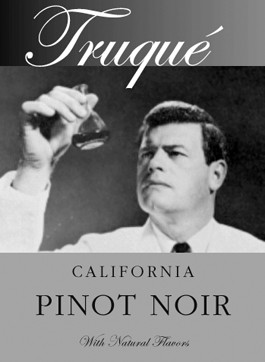
Silicon Valley escapees Paul and Sui Yi Mason started out with a nauseatingly familiar story. Paul, a chemist, cofounded a startup that developed a microchip which takes the “thumbprint” of organic compounds and analyzes them with software. He sold his share at the market’s peak, and took early retirement. Avid wine collectors, the Masons delved headlong into their new Sonoma lifestyle.
Truqué is located in a remote industrial park. Surrounded by machine shops and warehouses, the only indication that I’m at the right place is a pair of scraggly grapevines in planter barrels. Mason pokes his head out the door: “I see you’ve found the vineyard. Ha ha ha!”
Mid-40s, with spiky, graying hair, Mason moves around the lab with a geekily youthful enthusiasm, pouring tastes from test tubes. At first, the couple worked a harvest at a local winery. They weren’t impressed. “For me, it was the earwig bugs—thousands, all over the grapes. And one time, a dead bird! I was like, ick!” Sui Yi shudders. All in all, it seemed like a lot of mucking around. Mason decided to go back to his roots, and make it the only way he knew how: in the laboratory.
Mason starts with a bulk wine base—sometimes bargain appellation throwaways—clarifies it, then adds flavoring compounds, pigments and stabilizing agents to approximate the diagnostic profile of the world’s finest wines. To legally call it wine, they only have to print “with natural flavorings” on the label. “But it isn’t soda pop,” Mason says. “It’s a challenge. It’s just not a mystery when you take it down to this level.”
But what about craft, what about the unique terroir of the vineyard? Paul and Sui Yi collapse into well-practiced, comic gagging motions. “But seriously,” Mason recovers soberly. “I respect winegrowers. They led the way. The farmers of Burgundy were early scientists, if you think about it; they observed, selected, experimented. These days, winemakers do all kinds of tricks they don’t tell you about: acidulation, reverse osmosis, Franken-yeasts. I’m just taking it a step further. OK, maybe two.”
Truqué’s 2006 Thompson Seedless Chardonnay ($15) has toasty, buttery, baked-apple hallmarks. It’s realistic, and I wonder, is the concoction barrel-aged? Mason rattles off a list of compounds: “Diacetyl, trans-methyl-octalactone, cinnamic acid, a dash of methyl furfural. Same result.” The 2007 California Pinot Noir ($20) has a brash nose of black cherry, cola and over-the-top clove. It’s too much; everything in the book.
For the 2007 Russian River Grand Truqué ($35), Mason went further. He was beguiled by the smoky bouquet of his favorite Romanée-Conti, and it eluded him—for weeks. Then he nailed it. It turned out to be an off-the-shelf ingredient used mainly in ballpark franks. “I get it from a lab in New Jersey,” he says, swirling a beaker. “It’s pricey, but a liter lasts me five vintages. Ha ha ha!” The wine has a delicate framboise nose with dried red cherries, damp earth, roast meat and bacon fat. If I didn’t know it was a fake, I’d say . . . But, no! I don’t want to give it that credit. If enchanting, silky wine could come not from terroir, but out of a beaker, what would tomorrow hold?
Truqué Winery and Vineyard, 1 April Fool Way, Santa Rosa. Tasting by appointment only. If the phone rings, it’s the future calling.
Populism over Payday
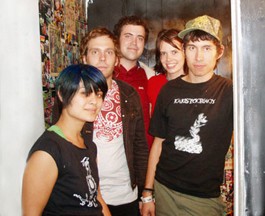
Lack of money is a central theme in The Prize Winner of Defiance, Ohio, the book and film about a struggling mother who composes commercial jingles to win contest money for her family. For the ebullient acoustic punk band Defiance, Ohio (from Bloomington, Ind.), lack of money is also a central theme—their noncommercial folk-punk jingles are designed staunchly against financial gain. They’ve turned the 21st-century inevitability of losing money as a musician into not only an art but an asset, and created a viable track where a basement full of people screaming along is far more valuable than any royalty check.
The things I remember most about seeing Defiance, Ohio two years ago at a garage in Arcata have less to do with their actual music, which was a blistering blur of sweat and screams, and more to do with their DIY, anti-capitalist ethic. Before their set, singer-guitarist Geoff Hing wrote in a hand-sewn tour journal made from ripped-up grocery bags, and afterward he split the tip jar equally with every other band on the bill. For years, the band has refused to sell CDs for more than $6, and all of their songs are downloadable for free under a Creative Commons license on Archive.org.
The bonus: their music’s great. “Folk-punk” as a genre has exploded in the last five years, and Defiance, Ohio is one of the scene’s most compelling and popular bands, shouting populist lyrics accompanied by a banjo, a cello and violin. “Petty Problems” is an expert sing-along about consumerism during wartime, and “Oh, Susquehanna” details the suburban tract-home existence perfectly: “The kids who populate these cul-de-sacs will never know what stood beneath those cookie-cutter houses: fields and streams and woods,” Hing sings. “They’ll sit in cars and wait for mom to drive them out of this boring neighborhood.”
Fans of the Andrew Jackson Jihad, early Against Me! or This Bike Is a Pipe Bomb will find much to love about Defiance, Ohio; they are at the forefront of a movement that lays to waste the notions that acoustic music necessitates wimpiness and that anger necessitates distortion. They bring their danceable revolution with handmade patches, low-cost albums and prizewinning anthems to town with Dichotomy, GRUK and Excuse the Blood on Sunday, April 5, at the Phoenix Theater, 201 E. Washington St., Petaluma. 8pm. $8. 707.762.3565.
Bananas
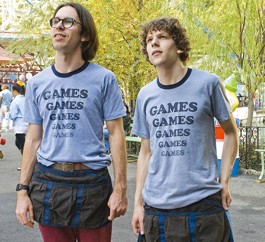
Both the intelligence and the malaise level in Adventureland are fairly high considering that the film is, deep in its bones, a barf-boner-and-bong teen comedy. The action is set in the summer of 1987 and will, in the popular mind, stamp out real memories of that year, just as American Graffiti overwrote the real 1950s.
Adventureland doesn’t capture much of the essence of its time. The closest thing to political comment comes in a scene of the hero’s drunken father snoring through the Iran-Contra hearings on TV. Sometimes, the film substitutes shots of Plymouth Dusters and AMC Gremlins for the more serious currents of the era.
Still, if it weren’t that Apatowland and its suburbs were all about the frat-boy worldview, you could say that director Greg Mottola really took this perennial teen material to college. Mottola, of Superbad and The Daytrippers, is seasoned enough to realize that Holden Caulfield was sort of a snob.
James, the Caufieldish privileged student going to Columbia, is played by Jesse Eisenberg. Expecting a European tour after graduating high school, James gets an unhappy surprise. His father’s money has run out, and James will have to land a job somewhere to pay for college. (If Adventureland is a success, part of it will be due to the timeliness of that kind of story.)
Right at the bottom of James’ employees-wanted list is the amusement park Adventureland (actually Kennywood in West Mifflin, Penn.); when he gives up and applies, James is hired to work the carnival games. He is saved from trouble right off by Em (Kristen Stewart), a sharp but quiet girl who is heading to NYU.
During the summer, James deals with the local bullies and the dopes, as well as his childhood acquaintance and co-worker, a gross clown called Frigo (Matt Bush), who delights in sucker-punching James in the cubes. James finds better company with Martin Starr’s Joel, a poverty-stricken intellectual whose delusions of being Sartre lead him to walk around smoking a pipe.
Bill Hader and Kristen Wiig play the couple running the amusement park. These two robust comic actors hold together the film’s episodes as well as Bill Murray held together Caddyshack. As James becomes increasingly fond of Em, he fails to realize what we know: that she’s carrying on with Mike (Ryan Reynolds), a handyman at the park, who is married.
In a sense, Eisenberg reprises his acting in The Squid and the Whale; his James has the same mix of sensitivity and clumsy, unexpected self-centeredness. Mottola includes a rather fine specimen of the adolescent brain fart. James tells Em that he wasn’t in love the one time he got a chance to lose his virginity; James knew it wasn’t love, because it wasn’t what he had felt when he was reading Shakespeare’s Sonnet 57. No matter how James really felt about the experience, this counts as a line he’s feeding a girl. And Adventureland has enough dimension—and dimension isn’t what you customarily get in Apatowland—to make us realize it is a line, no matter how much honesty is in it.
You can’t blame James for exaggerating his feelings a little. Stewart broke out of the pack as the guitar-playing girl at the desert crash pad who almost seduces Emile Hirsch in Into the Wild. If Twilight is giving Stewart a worldwide audience, Adventureland proves why she is going places. She has the poise, the serenity and the slightly off-sync quality of the real star.
It is a surprise to see what she does with the part. Em isn’t much of a construct on the script page—she bears some lingering pain about her mother’s death from cancer, and that’s why she suffers from low self-esteem. This is bad ’80s novel motivation, but Stewart makes it work.
Superbad‘s amusing silliness gives way here to the perfect compromise: an apparently happy ending that is actually, if you think about it, an open ending.
‘Adventureland’ opens on Friday, April 3, at the Boulevard Cinemas (200 C St. at Petaluma Boulevard South, Petaluma; 707.762.7469) and the Century Regency 6 (280 Smith Ranch Road, San Rafael; 415.479.5050).
New and upcoming film releases.
Browse all movie reviews.
Song of the Knuckleheads
04.01.09
Somewhere in the throat of a mourning dove resides unfathomable emotion, gathering all that other species can’t express, in a voice rich enough to get even a human to feel it. This makes the mourning dove something like those professional mourners at an Irish wake, the ones who “raise a keen” for the dead, moaning a primitive lament. They channel unrestrained grief, helping everyone find within themselves sorrow’s universal bell tone. The vibrations of audible grief strike a sympathetic resonance in the chest cavity where the heart is supposed to reside and feel things. Not every heart will feel the impending loss of birds. But the left half of the brain might register the metrics of loss: one in three bird species are facing an unsustainable life in the United States. And this is sad, whether or not you happen to resonate with avian spirit, flight or song.
Avid birders will feel it. Audubon membership in Sonoma is 1,800; in Marin, 1,500; in Napa-Solano, 1,000. And many more than these 4,300 registered North Bay bird lovers get all happy to spot a rare one or a favorite. Myself, I stroll daily to meet my favorites early in the day when I am the only person walking in the neighborhood. I go two blocks east and stop at the brown-shingled craftsman house, with the gargantuan privets-turned-trees, to hear the mourning doves.
My grandfather used to lure mourning doves by scattering seed on the ground outside the back porch, enduring the presence of lesser species that landed for the feast, including the ubiquitous pigeon. He merely ignored the interlopers and focused eyes and ears on the mourning doves, waiting for them in silence. In my grandfather’s presence, I learned to listen and to wait and to love above all birdsong the sound of these elegant, soft gray and pale brown beings.
“They mate for life, you know,” a friend said one day as we watched a few land on the old magnolia on Palmer Street. I pretended not to hear that fact recited once again. Even those who know little about birds in general always seem to name which species accomplish naturally that for which some humans may lack the necessary genes.
Early today, I stopped to listen to the doves. I lately listen more closely to these birds than perhaps to any other sound. So even when I got home and read about bird species in danger, the song of the mourning dove was still resonating in me. They are not on the list of birds now disappearing quietly in the aftermath of habitat loss, oil spills and climate change. I don’t have the heart yet to study the recent federal report on our 800 bird species to check the status of other birds I love. But this brings to mind a book I once read about extinction, called The Song of the Dodo by David Quammen. The book explains, through intellectually and literally exploring island biogeography, why it is so that the more we dice up habitats, the more extinction we cause.
Birds are disappearing up in Alaska’s oil messes and down here in the build-more-Wal-Marts mess. The swallows don’t return to Capistrano any more. But mourning doves are not in any trouble yet. They are out there in big numbers, cooing plaintively in every continental biome and a few islands beyond. I know they made it to Hawaii in the past, but I’m not sure about Mauritius. That’s where Portuguese sailors docked in 1598 to discover flightless birds easy to catch and kill. “These birds must be stupid,” reasoned the sailors, dubbing them dodos—stupids. Dodos were extinct by 1681, and we have no recording of their song.
Now even far from the sea, we are making islands of loss whenever human development replaces habitat. If galactic sailors were to moor on this planet and look at our impacts, they’d have to dub us knuckleheads, too. I hope when we’ve finally made ourselves extinct there will be at least one pair of mourning doves left that might, in Gaelic tradition and genuine grief, be left to “raise the keen” for us.
True Tales
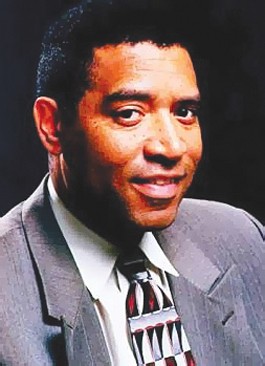
Oakland journalist Chauncey Bailey made just one mistake, and it was a fatal one: He wouldn’t stop investigating a story. When Chauncey was murdered in 2007, most likely by members of the Your Black Muslim Bakery family, all of us lost a fearless reporter willing to make a personal sacrifice for the greater good. Just like journalism used to be.
In his documentary A Day Late in Oakland, emerging Bay Area filmmaker Zack Stauffer traces the Bailey case and shows the arc of that editor’s life, the disregard the mainstream media showed to his warnings about the Bey family and the “day late” efforts to unmask his killers after his death. Screening April 3 as part of the Fairfax Documentary Film Festival, A Day Late is just one of several stellar new works being screened.
It’s not all tales of woe, however, given the April 5 screening of results of the festival’s annual challenge. On the fest’s opening day, filmmakers are given a cinematic treasure hunt to complete in making an off-the-cuff instant doc about the quirky town of Fairfax, and then they must actually show it to others. The Fairfax Documentary Film Fest screens April 3&–5. See Film listings, adjacent.
New and upcoming film releases.
Browse all movie reviews.
Missed Manners
04.01.09
Though not yet extinct, exemplary service is irrefutably waning. With less to spend than ever before, service more often than price determines where my greenbacks end up. Regardless of the deals offered, I won’t shop at a store that employs obtuse, unmotivated drones. Though I like to think of myself as an egalitarian, I’m decidedly snobbish on this issue.
Since I work in hospitality, I have high service expectations. My response to bad service is based on the degree of the infraction. In most cases, I’ll simply look stern but keep my mouth shut, as when a cashier does not greet or sometimes even look at you until she announces the amount due. If I’ve managed to keep quiet up to that point, I’ll pay up and with as much saccharin sweetness as I can muster, will chirp “Have a great day!” while brandishing a wide, forced grin. I’m sure the lesson is lost on most, and I end up just looking crazy.
About eight years ago, I began to inwardly boil when it came to this issue. I mark the beginning of my “Peter Finch in Network” exasperation to inferior service with a Burger King experience. My two kids and I approached the counter. “Hello,” I said. The clerk said nothing. “Here’s the part where you say ‘Hi’ back,” I said. She still said nothing, though she shifted her weight to another hip. (I think this might have been the first time my kids murmured to me, “We’ll be in the car.”) I placed my order and paid, but vowed to voice my displeasure with bad service going forward. Perhaps that’s why it’s kind of my poor-service talisman.
For your consideration: My most recent brushes with horrific service.
• A transaction at PetCo that went something like this. “Hi, how are you?” I said to the clerk. “Well, I’m here, aren’t I?” she replied, taking a long drag of her soda through a straw. “At least you’re working,” I said. “Yeah, well I’d rather be somewhere else,” she said. She dropped her soda. “Crap!” she cried and bent over a microphone. “Clean up, reg two.” She went back to taking my money, looking more disgruntled than before.
• When shopping for jeans at Macy’s, I asked the clerk for recommendations. “Not too low, not too high,” I told her. “Well, this is a popular brand,” she said, holding up a pair of pants. “They fall below the waist, but aren’t real low, so nobody’ll see your coin slot or anything.” I stood silently, trying to decipher what she had just said. Believe it or not, I had never heard the term previously. The Macy’s girl must have registered my look of shock as the realization of what she meant occurred to me. “Oh, sorry,” she said. “Yeah, you probably shouldn’t use that kind of terminology with someone who’s old enough to be your mother,” I told her.
• I recently called a local high-end restaurant that bears the name of its chef to inquire about the dress code. “Oh, you know, wine country casual,” the man who answered the phone said. “So long as the guys aren’t in sideways ballcaps and the gals not in hoochie-momma shorts or belly shirts, they’ll be fine.”
• I was in Tiffany’s in search of their repair department. I came upon a solitary woman reading a ledger who took a full minute before she looked up to address me with haughty disdain. “Where is your repair department located?” I asked her nicely. “Up the stairs, to the back left,” she replied brusquely, immediately returning to her ledger. I was reminded of a line in The Two Mrs. Grenvilles: “NOCD. Not our class, darling.”
Folks in my generation complain that the younger generation is rude and lazy, that they have a sense of entitlement, no ambition and even less motivation. The older generation claims overly permissive parents have spoiled them and that we are to blame, but I think I remember hearing that same argument when I was a kid.
Regardless of what’s at the core of poor customer service, in these tough times an increase in civility would serve as a much welcomed emotional poultice to us all. Slow down. Treat yourself and others with respect. Love one another. After all, the best things in life really are free.
Lara Flak’s high expectations for customer service result from her experiences in working everywhere from McDonald’s to Windows on the World with other restaurants, wineries and hotels in between.
Open Mic is now a weekly feature in the Bohemian. We welcome your contribution. To have your topical essay of 700 words considered for publication, write op*****@******an.com.
Delta Blues

04.01.09
DRY FARMING: Mike Robinson’s family has been growing on the Delta for over 120 years.
Story and photos by Curtis Cartier
Dawn on the Delta. As the sun peeks out from behind the John A. Nejedly Bridge near Antioch, a small flock of terns flap up to the concrete trusses and rest on a set of nooks in the construction.
Below, on the San Joaquin River, the low buzzing of an outboard motor mixes with the calls of the terns and thethud-thud-thud of wheels rolling over the bridge’s ribbed surface. The smell of wet marsh air mostly overpowers the occasional hit of fertilizer, carried east on the winds from some nearby farm, while slowly the water world comes to life under the yawning gaze of a new day’s sun.
This is morning on the new San Francisco Bay-Sacramento-San Joaquin River Delta. True, the birds have been around for eons, the bridges are fairly old and most of the farms have been here for a hundred years or more. But the Delta seen on this March morning is different from the one seen last year or the year before. It’s an environment which, through erosion, damming, dredging and river redirection, has changed so dramatically that maps more than 20 years old are nearly useless.
It’s also an environment on the brink. More than two-thirds of California residents get their drinking water from the Delta, and more than 3 million acres of the state’s crops are fed from it. Hundreds of species—more than 20 of them endangered—live or travel through its countless tributaries, streams and bays.
While nearly everybody agrees that more change is coming, whether that change will be for better or worse for California’s ecology, economy and health and welfare is still up in the air. All that’s certain is that with aging levees, dying species and the slow intrusion of seawater into the overpumped soil, things can’t go on the way they are now.
Scientists & Shepherds
Phil Sandstrom counts fish. To be precise, the approximately 50 underwater receivers at the bottom of the Delta’s many rivers count the fish, and only those that have been pretagged with ultrasonic sensors embedded in their body cavities. Sandstrom putters around the Delta in a 27-foot UC Davis fishing boat, yanking receivers out of the muck and downloading their data into a matrix used by countless environmental groups, universities and military analysts. This morning, he, along with volunteer Gabe Singer, is harvesting four-month-old data from receivers at Decker Island and Three Mile Slough.
“We’ve seen some high mortality rates in certain species,” Sandstrom says, while the data from the pipe-bomb-shaped monitor downloads into his laptop. “But it takes a lot of work to keep track of it, and we’re just not getting the money we need.”
Sandstrom is a doctoral student whose dissertation is based on salmonid research. He and his fellow researchers use data from the monitors to track how dozens of species of fish move through the Delta and how they respond to the changing environment. Though his funding has been cut completely this year due to California’s financial lockdown, he’s still on the water at least twice a week because, as he puts it, “the work still has to be done.”
Sandstrom has firsthand knowledge of disappearing fish like the Chinook salmon, Delta smelt and longfin smelt. These species have been pushed to the edge of extinction due to habitat destruction, competition from invasive species and massive water pumps that change currents and confuse the salmon’s reproductive instincts, or, in the smelt’s case, suck them up outright.
As the boat nears Frank’s Tract, a “sunken island” reduced by years of erosion and now a breeding ground for the invasive Brazilian egeria weed, Sandstrom’s obvious distaste for the destructive invader begins to show.
A notorious agent of erosion, the plant is damaging to the Delta’s critical levee system because it displaces native plants that strengthen the soil locked in the aging dikes.
“The levees protecting this entire area are more than a hundred years old, and they’re going to fail soon,” Sandstrom says as he pulls the boat away and heads back to the dock at Rio Vista. “And when they do, this whole area could be underwater.”
Sandstrom may be worried about the century-old levees, but local farmer Mike Robinson thinks they’ll be just fine. “These are ancient levees. They’re settled levees and they’re sturdy,” says the third-generation Delta farmer, looking out at crusty dirt rows that will soon be alive with tomato plants. “We farmers are the best shepherds of the land there are. I never understood why people don’t realize that.”
Robinson’s tomato, alfalfa and hay fields are in the heart of the wetlands and get all the water they need. Thus, he is one of the few people content to keep the Delta as it is, although he admits that will require changes of its own. He believes the Gov. Schwarzenegger–sponsored plan to create a peripheral canal that diverts Sacramento River water around the Delta would be a “disaster,” and says his family’s 123-year-old water rights trump any other public or private needs for the water.
Robinson views the battle over Delta resources as another clash between Northern and Southern California interests, and he’s certain that once cities like Los Angeles and San Diego get the extra water they’re demanding, any interest in saving the region’s agriculture and animal species will vanish.
“Everyone’s attention is on the Delta right now because people need the water,” he says. “But what happens once they get it? And they will, somehow. We’ll still be here, taking care of the land. But will anyone care?”
WATERY:GRAVE The effects of the Sacramento Delta’s fragile ecosystem are felt all over the Golden State.
A Common Well
Even though not a single drop of Delta water makes its way into the faucets, sprinklers and irrigation pipes of the North Bay, the two regions’ fates are inextricably linked.
“Besides the environmental obligations, we should be concerned [about the Delta] from an economic point of view,” says Ron Duncan, field manager of the Soquel Creek Water District. “What’s bad for farmers anywhere in the state is bad for us here. There is an interdependency and a relationship that connects us on the state level.”
This statewide connection resides in the water policies that are continually shaped by the Delta’s ability to support both its own ecosystem and the millions of thirsty people and plants throughout the state that depend on it. If less water is flowing to farms in the San Joaquin Valley, less produce is being exported around the country and world, and less money is coming into the state’s economy. And if more cities like San Diego and Los Angeles are forced to look elsewhere for water, it may be the reservoirs of the North Coast where they turn next with their enormous demands.
U.S. District Court Judge Oliver Wanger knows perhaps better than anyone the power that the Delta wields over the state. It was he who, in 2007, ruled that increased pumping by the Department of Water Resources had led to the near extinction of the Delta smelt, and ordered water exports out of the Delta slashed by 14 to 30 percent. His decision shook California’s agricultural and environmental communities to the core, forcing farms to grow crops with less water and cities to tap additional local watersheds and rivers.
Wanger has spent more than 20 years of his judicial career presiding over cases involving the Delta.
“I’ve been on these cases for 20 years, but they go back even further than that,” says Wanger, who comes across as only slightly jaded from his decades-long tenure dealing with this single subject. “You’ve got 20 million people in water districts with contracts for huge amounts of water. You’ve also got animals like the smelt that need to be preserved. All these parties can’t agree, and I don’t see that changing anytime soon.
“Even throwing money at the problem doesn’t help, because no one can agree on how to spend it. Eventually, I think it may come down to fish versus humans.”
River to Redemption
None of the Delta’s problems happened overnight. It took more than 41 years of annually increased pumping by the Department of Water Resources, Central Valley Project and others before salt water began seeping into the soils around Antioch and Pittsburgh. It took mismanagement by the Department of Fish and Game which, in 2005, played down any problem with local fisheries, claiming it was impossible to know if species like the Delta smelt were in danger. And it took decades of shortsighted planning by California cities, both northern and southern, which never invested in water conservation strategies like storm-water recharge and water recycling, instead demanding more and more exported water to support their booming populations.
Blame, it seems, is the most abundant resource coming out of the Delta these days. But blame won’t repair the decrepit levees or restock the depleted fisheries. Instead constructive solutions are needed that provide for farmers, wildlife and residents alike.
The peripheral canal vilified by Robinson and other Delta farmers is the most popular single solution on the lips of lawmakers today. If built, this 42-mile canal would divert billions of gallons of Sacramento River water around the Delta. Robinson and some others who live in the heart of the wetlands say any decrease in water flowing through the region could turn it into a stagnant swamp. But Schwarzenegger and several other powerful lawmakers argue it would eliminate the need for the fish-killing, current-changing pumps and, overall, would be an improvement for the ecosystem while at the same time making more water available for the rest of the state.
But such a canal was shot down once before in 1982. And with a price tag that could reach $17 billion, and construction times measuring several years by every account, any harm or benefit from the canal may come too late.
Groups like the Sierra Club contend that a host of steps are needed throughout both the Delta and the state if any hope exists in saving the fragile ecosystem.
“First, we need to reduce the exports of water coming out of the Delta,” says Jim Metropulos, a senior advocate with the Sierra Club. “We need efforts to reduce pollution runoff. We need programs to help species like salmon and the smelt. We need to be restoring habitat and planting trees at the river’s edge. And we need cities to step up and do their part in recycling water and conserving water.”
Yet even if every one of Metropulos’ solutions is enacted, and even if the peripheral canal is installed in record time and is everything it’s hyped to be, at the end of the day there is no way to change the Delta back into what it was before California demanded its resources.
In today’s new Delta, the people’s right to live, farm and drink is not separate from the environment’s ability to sustain itself, but instead dependent on it. The only certainty is that when the sun rises tomorrow it will be shining on a changed Delta.
People Messing Up, People Not Messing Up
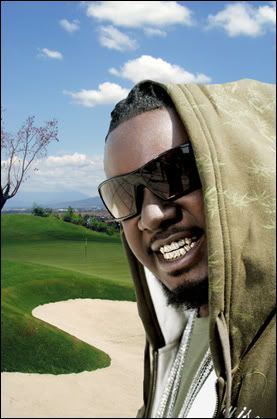 A couple days ago I asked if there was anyone besides Biz Markie who felt that hip-hop and golf go together. I got my answer: T-Pain. According to reports, T-Pain busted out four teeth in a golf cart accident over the weekend, forcing the rappa-ternt-robot-sanga to cancel his appearance with Lil’ Wayne in San Jose.
“There’s a lot of talk that I flipped over in a golf cart,” T-Pain told the crowd in Universal City, returning to the stage on Sunday night, “That’s fuckin’ true. It did happen, like three days ago. My ass is on fire right now. My side hurt, my mouth hurt… I’d show you the marks, but I don’t wanna pull my pants down right now.”
T-Pain confirmed that he got four teeth fixed in an emergency dental procedure, and that his golf cart actually flipped over. This surprises me, since when I saw him last year with Lil’ Wayne, he navigated a Segway around the stage with great accuracy. Maybe just golf-path rage? Don’t let those double bogeys get you down, T-Pain!
In related news, Andre 3000, who very much needs to finish his long-delayed new album instead of working on his fashion line, was clocked driving 109 mph in his Porsche. This makes me love him even more, for some reason. And Stephen Jackson, who provides some of the most entertaining interviews on TV, throws himself a birthday party at Mezzanine in SF this Friday before having toe surgery next week, effectively knocking him out of the rest of the Warriors season. The headliner, coming correct for Crazytalk Jackson, is none other than Snoop Dogg.
I watched Mannequin last night. I cannot think about Mannequin without thinking of Ween, who are not a hip-hop group but embody a lot of the same flamboyance and theatricality, and thinking of their song “Freedom ’76.” All of the non sequiturs make sense now. Mannequin was filmed in—and Boyz II Men are from—Philadelphia, PA. Actually, I found out last night that Ween must have been high (no surprise) when they wrote “Freedom ’76”: Mannequin was filmed at Wanamaker’s, not Woolworth’s. (Bonus Baby-Boomer Alienation Quote: I still think Starship’s “Nothing’s Gonna Stop Us Now,” which plays over the closing credits, is better than anything else Grace Slick ever recorded.)
And in a final touch of the inevitable, Green Day’s Grammy-winning punk rockera American Idiot is officially being turned into a musical, to be premiered at Berkeley Repertory Theater in September. Every song from American Idiot will factor into the story somehow, and though Green Day is heavily involved in the production, they won’t be on stage. Instead, a cast of 19 will sing the story, with a hired backup band. Weird, huh?
Live Review: Will Oldham at the Orchard Spotlight

In 1992, when I moved out of my parents’ house to a small apartment on Slater Street, I felt old. Not grown-up old, mind you, but world-weary old. You know the deal. I had a penchant for drinking Cisco mixed with Hawaiian Punch, listening to syrupy, sentimental Reprise-era Frank Sinatra albums like Cycles, and basking in the unique bitterness and nostalgia that only the hardened, grizzled age of 16 brings.
Living in the same town long enough produces some extraordinary occurrences. Tonight, during a spellbinding show at the Orchard Spotlight, Will Oldham provided one in the form of “Cycles,” the Frank Sinatra song that I used to replay over and over just a few blocks away.
“So I’m down, and so I’m out, but so are many others…”
Oldham and his band completely claimed the song as their own, while I, amazed that he’d chosen such an unusual song to cover, thought about age. Do we ever really feel as old as we do when we’re 16? We hit our 30s and all of that hard-earned “wisdom” and half-fledged nostalgia fades away, and we grow ever open to new experiences even as the opportunities for new experiences occur less and less.
What’s happening? Why do we lose our toeholds of self-assurance as we get older? Why do people’s feathers get so ruffled over age? Why is it easier to make young people feel old than it is to make old people feel young? Why don’t young people realize they have the rest of the blobby, unsure, aging world in their hands?
Why does Will Oldham sometimes stand on one leg like a stork?
“I’ve been told, and I believe, that life is meant for livin’…”
Tonight, Oldham, a.k.a. Bonnie ‘Prince’ Billy, age 38, played the world-weary music he’s played since he too was a teenager, and showcased perfectly why his live shows are at least twice as good as his albums, if not more. His outstanding band broadcast a new cosmic American music inside the Orchard Spotlight, with crests and turns and tangents and silent forks upon which to dwell on life’s mysteries. His songs ballooned both inward, outward and lateral, and sounded like Oldham’s music has always sounded—wiser than its age.
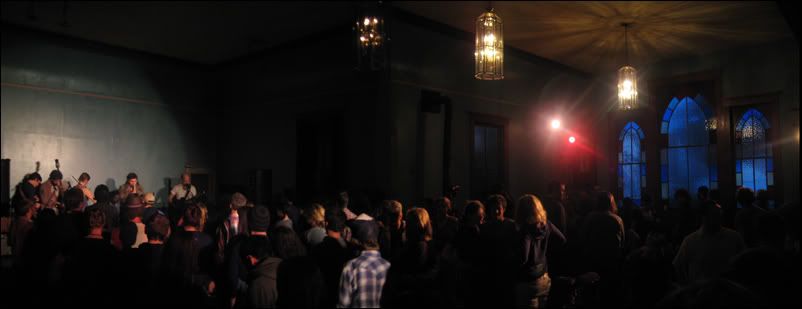
The sheer fact that Oldham even played the Orchard Spotlight on this trip is impressive enough. This is Oldham’s “real” tour, where instead of playing the Old Western Saloon in Point Reyes, like he did in 2004, or Pegasus Hall in Monte Rio, like he did in 2002, he’s playing the Fillmore; there’s commercials on television for his new album, Beware, and almost all his shows are in large theaters. Last year, however, local soundman Ross Harris walked up to him in San Francisco and asked if he’d like to play a beautiful old church in downtown Santa Rosa. Sure, Oldham replied.
Tickets, limited to 130, sold out in about a day, and diehards, begging for extras on Craigslist, flocked from miles around. I met a guy at the show who’d driven all the way from Tahoe. “I saw him once in the middle of a forest outside of Athens, where I used to live,” he told me, more than happy to make the trek to pick up a last-minute ticket at the Last Record Store. “He’s worth a four-hour drive.”
 The show began in grand fashion: Oldham, wearing a stained V-neck T-shirt, white cap, polyester slacks and no shoes or socks, hit the stage with the squat giddiness of a teenager and launched his band into the Carter Family standard “Nobody’s Darlin’ on Earth,” with each member of his band and the opening band taking verses in a steam-train hootenanny usually reserved for ending instead of opening a set.
“We’re back in the country, building the confusion hill brick by brick,” Oldham announced, referencing the Humboldt County roadside attraction they’d passed earlier in the day. He then asked, to no one in particular, “What was your favorite song growing up?”
“Shout at the Devil!” someone said. “No, no,” Oldham said, “growing up!” “Growin’ Up!” some clever person said. “I Want a New Drug!” said another. “Yellow Submarine,” said yet another. Oldham launched into “Beware Your Only Friend,” the first song from Beware, and midway through began singing, “In the town / Where I was born / Lived a man who sailed the sea…”
When Oldham gets excited, he manifests it in strange ways. He shoves his hands all the way down into his pockets and pulls his pants up to his chest. He yanks his cap off and holds it high with an animated face. He ravels his arms in pretzel-like patterns, and splays them out into the air like a drag queen, and rolls one pant leg up, and throws his head down and sticks his gut out and falls to his knees.
Is it intentional, or improvised? The question could also be asked of his band—his band!—who could thunder down the line like a Southern Pacific for one song (“I Don’t Belong to Anyone”), wander in a semi-Haggard haze for another (“Love Comes to Me”) and then fall apart in beautiful, formless atmosphere for the next (“There Is Something I Have To Say”). Drummer Jim White, often looking like an angry Ron Jeremy, was a particular standout; he’d explore the drum kit like free-jazz pioneer Sunny Murray, nail down hi-hats like Booker T. & the MG’s Al Jackson, Jr., and lay back behind the beat like Tonight’s the Night’s Ralph Molina. Oldham’s band on this tour is exceptional—all of them, truly, were excellently in tune with each other and engaging to watch—but White’s the reason it feels the way it does.
Sometime soon after the semi-gospel coda of “I am Goodbye” and the brilliant reclamation of “Cycles,” Oldham brought out Faun Fables’ Dawn McCarthy, an old tourmate and studio partner who I can only assume lives in Sonoma County now (she played at Aubergine a couple weeks ago, and won a yodeling contest at the Mystic Theater last month). Oldham introduced his band to her, but not to the audience, and had a conversation about her new baby, which slept in the room behind the stage. McCarthy took center stage for most of the rest of the set. They sang the duet “Lay and Love,” and Oldham was happy—he grabbed his big toe and pulled his foot as far behind his back as it could go.
Maybe Oldham stays young by playing old music. Maybe when he sings, during “I Called You Back,” that “the older that we get we know that nothing else for us is possible,” he’s offering a warning rather than a truth. Sure, we’re getting older. It happens. Let’s bask in it, like we did when we were 16. On nights like this one, this one special night in Santa Rosa, we can spill out of a fantastic show and walk home through the deserted streets, and it’ll feel like everything else for us is possible.
Letters to the Editor
Populism over Payday
Bananas
Song of the Knuckleheads
True Tales
Missed Manners
Delta Blues



