Today’s Brighter Future

0

05.27.09

VULCAN VS. LUCASIAN Mr. Spock (Zachary Quinto) and Captain James T. Kirk (Chris Pine).

I won’t comment on the plot of the new Star Trek film or the way director J. J. Abrams relays a familiar cosmology with glittery action, snappy dialogue and voluptuous intricacy. Unlike many fans, I am cold to the “old pals effect,” the tedious crutch of reintroducing the same characters in every sequel.

I care little about James T. Kirk or even Mr. Spock. No, what always entranced me about Trek—helping turn this physicist into a science fiction author—was the vision it offered, exploring human destiny, confronting big issues and pondering a unique notion, seldom expressed anywhere else—that our descendants might somehow be admirable.

Optimism doesn’t come easily to post-Hiroshima science fiction, nor should all tales of tomorrow be sunny. Some futuristic cautionary tales, like George Orwell’s Nineteen Eighty-Four, warn usefully about potential failure modes. If they gird us sufficiently, these stories rise to the august level of self-preventing prophecy.

Other works, and a majority of sci-fi films, base their pulse-pounding, heroic action on a single assumption: that civilization is, and will always remain, stupid, a cliché that can’t be helpful to our can-do, problem-solving spirit.

But that spirit has a home. It’s embodied in Star Trek, an epic storytelling universe that broke with reflex cynicism, asking instead, “What if children can learn from the mistakes of their parents?” Suppose (oh, unique thought!) our heirs begin living up to some of our deepest hopes? Won’t they still have interesting problems, like what to do when we become mighty star travelers? Humanity has yet to crawl beyond the moon, yet we are already contemplating how to behave under the light of distant suns. Shall we interfere in the development of younger intelligent species, for example? Could a mix of pragmatism and sincerity prevent us from repeating the mistakes of the conquistadors?

Premature or not, such thought experiments may be a sign of a precocious maturity, a lifting of the eyes. And many of these ruminations—engaging millions of fascinated minds—have taken place under the banner of Star Trek.

Central to Trek is the image of a large, quasi-naval vessel called Enterprise, based on 19th-century sailing ships like the HMS Beagle, dispatched to practice peacemaking and war, diplomacy and science, tutoring and apprenticeship, all in equal measure. How different from the tiny fighter planes featured in Star Wars, each piloted by a solitary knight, perhaps accompanied by a loyal squire, or droid, symbols as old as Achilles.

In contrast, the Federation starship in Trek is a veritable city, cruising toward the unknown. Its captain-hero is a plenipotentiary representative of his civilization and parent figure to the crew, but during the next adventure, any one of those normal men and women may suddenly become heroes themselves.

Moreover, this ship carries something else, the Federation’s culture and laws, industry and science, its consensus values, such as the Prime Directive, all embodied in the dramatic diversity of its crew. Each time Enterprise passes a test, so does civilization. Perhaps even one worthy of our grandchildren.

Compare this to the old Republic, in the Lucasian universe: a hapless, clueless mélange of bickering futility whose political tiffs are as petty as they are incomprehensible. Sound familiar? The Republic never perceives, never creates and never solves anything. Not once do we see any part of it function well. How can it? The people, the Republic, decent institutions—these cannot be heroes or even helpers. There is no room aboard an X-wing fighter for civilization to ride along. There’s just enough for a knight and squire.

Are critics right that Star Trek is naive for portraying technology as useful and liberating, if at times also dangerous? Or for calling education a great emancipator (as with the Starfleet Academy)? For putting trust in the potential for an honest, decent society?

In fact, the Trek films and television episodes often dealt with outbreaks of incompetence, secrecy, corruption and suspicion of authority, only with the faith that these are the exceptions. When authorities are defied, it is in order to overcome their mistakes or to expose particular villainies, not to portray all government as inherently hopeless. Good cops sometimes even come when you call for help!

Ironically, this image fosters useful criticism of authority, because it suggests that any of us can gain access to our flawed institutions—if we are determined enough—and perhaps even fix them with fierce tools of citizenship. That has happened, now and then. Imagine it happening more often.

Today, for now, cynics rule. But if this hope is futile and naive, then shouldn’t we give up? Suppose, just for a change, it isn’t. What if there truly is a path ahead, through the minefields of our times? One leading to a posterity we might be proud of? Aren’t we more likely to find that twisty, arduous way—and won’t our descendants feel much better toward their ancestors—if we embrace this challenge in the spirit of Star Trek?

David Brin is the Hugo Award–winning author of the bestselling novels ‘Earth,’ ‘The Postman’ and ‘Kiln People.’ His nonfiction book, ‘The Transparent Society,’ won the Freedom of Speech Award of the American Library Association.


Museums and gallery notes.

Reviews of new book releases.

Reviews and previews of new plays, operas and symphony performances.

Reviews and previews of new dance performances and events.

Do No Harm?

0

05.27.09

TIME TO HANG UP THE STIRRUPS: Dr. Newhard’s patient ‘Kathy’ was used to his off-color jokes, but when he touched, pinched, slapped and prodded her inappropriately, she took action.

After three days of testimony, a judge last week ordered a 79-year-old Novato family practice physician to stand trial on a charge that he sexually assaulted one of his patients.

Dr. Horace Newhard denies the charge and, through his attorneys, insists that his pelvic and breast examination of a 60-year-old Sonoma woman was medically appropriate. In taped testimony played during his preliminary hearing, though, he did admit to both the patient and a police detective that he was attracted to the patient. The married physician also conceded in the tapes that he may have acted improperly in September 2007 when he hugged, kissed and pulled the patient toward him after he completed what she described as painful and sexualized pelvic and breast exams.

With his wife, daughter and one of his longtime patients sitting in the courtroom, the white-haired physician displayed no emotion when Marin County Superior Court Judge Paul Haakenson ruled that “there’s at least a strong suspicion that he harbored sexual intent” when he inserted his finger in the Sonoma woman’s vagina.

Newhard has been practicing family medicine in Novato since 1973. After the district attorney’s office filed criminal charges against him last fall, the state medical board restricted his license so that a chaperone must be present when he examines female patients.

The board has never disciplined Newhard. But in response to a February article about the charges in theMarin Independent Journal, nine other former patients reported to Novato police what they perceived as the doctor’s inappropriate and sexualized behavior. Detectives testified that former patients accused Newhard of taking advantage of his position of trust and violating professional boundaries in a variety of ways, from groping a patient’s breasts to volunteering to teach a patient to masturbate.

Some of the alleged indiscretions took place more than 30 years ago, when reports of sexualized medical examinations rarely came to light. One former patient told Novato police detective Sophia Winter that in the 1970s, while Newhard was performing a pelvic examination, he asked her a series of intimate questions about her sex life and then touched her clitoris. “She told me she’s never told anyone about it, including her own husband,” Winter testified. “She was too embarrassed.”

The former patient who brought the current charges testified over the course of two days, at times breaking down in tears and averting her eyes from the doctor. Named as Jane Doe in the criminal charges, the patient allowed prosecutor Lori Frugoli to call her Kathy in court. Now 62, her chin-length brown hair frosted with highlights, Kathy testified that she brought the charges against the doctor who has overseen her care for more than 30 years because she did not want anyone else to suffer as she had.

 “It could have been my daughters,” she said, her hands clasped before her on the witness stand. “And what was done I don’t want to happen to anybody else.”

Kathy said she was used to Newhard’s off-color jokes. He would tell her, for example, that she could always get a job as a topless dancer. But she was shocked when he insisted that she come in for a Saturday appointment and sent his assistant home just before rapidly thrusting something three times into her vagina. Kathy was prepared for the doctor to look at her vagina, which had been itchy, but she was unprepared for the unexplained penetration.

Kathy testified the doctor then pulled on her nipples. After Kathy got dressed, she said Newhard put his hand on her buttocks, pulled her toward him and kissed her on the lips.

“I got into my vehicle, and I can remember putting my head on my steering wheel and thinking this could not have happened,” Kathy testified.

She at first told no one about the incident. Then, two weeks later, on a Saturday morning, Newhard called her. He inquired about how Kathy was feeling on the medication he had given her to relieve the vaginal itch. Then he told her he was going to Sonoma and invited himself to her home. He asked if she was dressed. When she replied she had not yet put on her clothes, she testified, crying, “He said he wanted to come to my house because he wanted to help me put my breasts in a bra.”

Feeling compelled to report the doctor’s behavior, Kathy then made a series of calls that led to a Novato police investigation of Newhard. In October 2007, police taped a so-called pretext call Kathy made to the doctor. The prosecution played a tape of the call in court.

In the tape, Kathy asked Newhard why he kissed her, and he responded, “Because I like you. I’ve been hugging and kissing my patients a lot more lately. I’m not trying to come on to you, Kathy. You’re a very attractive lady.”

He went on to apologize for his “exuberance.”

In November 2007, Kathy went to Newhard’s office under the pretext of talking to the doctor about her thyroid lab work with a tape recorder hidden in her purse. One Novato police officer monitored the tape from the waiting room, and another officer monitored it from the parking lot.

The prosecution played the tape of Kathy’s visit in court. When she asked him about that day in September 2007, the physician replied, “I sort of got carried away. I don’t have a good explanation for it. I’m particularly sorry that I got exuberant. I thought I got some feeling from you, and I misinterpreted it.”

“You thought I was accepting your advances?” Kathy asked.

“Yeah,” Newhard said. “I’m sorry.”

“We were in here alone,” Kathy said. “You sent [your assistant] home. I’m 61 years old. What’s going on here?”

“What really bothered me is what would I have done if you had been responsive,” Newhard said. “That really worried me.”

In July 2008, Detective Winter asked Newhard to come to the police station, where she videotaped a 25-minute interview with him. Asked why he kissed Kathy, Newhard said, “I kiss a lot of my patients. You get old, and you kiss a lot of people you haven’t seen in a long time.”

He said he did not intentionally dismiss his assistant on the day in question. But he did admit that he found Kathy attractive.

“The grabbing of the butt was a mistake,” he said. “I know that. She was very enthusiastic about seeing me, and I responded to that. I’m sorry it happened, because Kathy’s a nice person.”

None of the red flags, however, constitutes criminal behavior. The alleged criminal behavior came from the vaginal examination, which Newhard’s lawyer and an expert witness say was medically appropriate.

“His actions served a clear and reasonable medical purpose,” Dr. Seven Fugaro, a San Francisco internist, testified for the defense. But Dr. Kimberly Duir, a Martinez family practice physician who works for the medical board as an expert reviewer, testified she saw no medical purpose for Newhard’s inserting his finger into Kathy’s vagina.


Judge Haakenson acknowledged the conflicting evidence. “But,” he ruled, “the evidence of the medical point of inserting the finger was somewhat limited.”

Newhard faces a possible prison sentence but remains free pending an as-yet-unscheduled trial.

After the hearing, Ivan Weinberg, one of Newhard’s three attorneys, said, “I haven’t changed my views in the slightest that Dr. Newhard will be vindicated. What this was about was whether the medicine that was practice was appropriate. I believe it was.”


Man and Machine

0

Far and Wide

05.27.09

Eddie Cochran was so sure there was no cure for being cash-strapped in summer that he co-wrote a song about it in 1958 and people are still singing, “Sometimes I wonder what I’m a-gonna do, ’cause there ain’t no cure for the summertime blues.” Back when the song came out, it was merely the plight of teenagers who yearn for fun while “working all summer just to try to earn a dollar.” Now, having difficulty financing summer adventure is almost a universal predicament. But cheer up, everyone! Travel can still be sustainable. The best local or international experiences of your life are not for sale anyway; they are for trade. Any person of any age who’s long on wanderlust and short on funds can simply barter her way out of the summertime blues.

If there’s money enough for a ticket to your dream country but not much more, consider the kind of work you enjoy doing or the kind of skills you’d like to learn. Want to help restore a house or create an organic garden in rural France? Help with a straw bale house on the Spanish coast? An eco-resort in India could use a few hands, and a turtle project in Costa Rica needs workers. These are current project listings at Workaway (www.workaway.info), the networking organization that connects travelers with work-exchange opportunities.

“Helping people to travel around the world without spending a fortune” is the goal of the two European travelers and organizers behind Workaway. Show up in the country you want to visit, and in exchange for “five hours of honest work” each day, you’ll receive your meals and a place to stay, plus the opportunity to gain work experience and foreign-language skills. Better yet, you’ll forge the kind of relationships that don’t present themselves at Club Med.

Want to stay local but still hear a melodious “Bon jour” at the breakfast table? The Workaway site also offers a means to host other travelers. Fortunately for us, Marin, Sonoma and Napa counties are destination spots, so those of us who can’t get away at present might invite travelers to come speak with the kids in languages not limited to French, German, Swedish or Japanese. List a childcare or yard-work job or maybe an ethnic cooking job.

Speaking of cuisine, food-growing is another way to help pay for a travel adventure while learning organic farming practices. Certain of these travelers are called “WWOOFers” from the acronym for World Wide Opportunities on Organic Farms (www.wwoof.org). The verb of their coinage, “wwoof,” means to volunteer on a farm in exchange for room and board.

Wwoofers can stay close to home and learn food and ranching techniques common to the western United States, or they can choose to farm in an exotic island setting such as Hawaii or the Virgin Islands. From Costa Rica to Africa, organic-farming operations holding membership with this global network offer employment and travel experiences as varied as the people living close to the land. Find your people, from vegans to Buddhists, and select your top farm experience, from seal herding to biodynamic lettuce cultivation.


For more money and less risk, there are travel service programs hosted by Habitat for Humanity, Elderhostel, Sierra Club, Global Volunteers and others. But I’m drawn to the experiences without middlemen to step in and save you from a full-on encounter with the locals or their livestock. So, aiming for Scotland, I checked out wwoofing opportunities near the capital city and was delighted that many farms favored musicians. “A wee organic farm and ecology centre nestled in the rolling hills of Fife” claimed views of ocean and loch, broadband internet in a tree house, lobster-catching and day trips to Edinburgh—all with the caveat that “outgoing people who know how to laugh” and who bring “an instrument or some kind of talent to share are more likely to be accepted.”

Sounds great. I can easily imagine myself laughing in the gloaming, bagging a few lobsters and breaking out my guitar—not for “The Bonnie Banks o’ Loch Lomond,” but for a howling, tongue-in-cheek rendition of Cochran’s “Summertime Blues.”


News Blast

0

05.27.09

Arnie says it’s High Time

Gov. Arnold Schwarzenegger’s choice of Cinco de Mayo to light up the legalized marijuana debate intrigues, given that the 1937 law first outlawing the plant was prompted largely by racist fears of Mexican immigrants, who, along with “Negro” musicians, were portrayed as being both horribly addicted to the “killer weed” and compelled to “push” its usage on lily-white, post-jazz age innocents. (Less glamorously, so did timber, paper and pharmaceutical interests play their own self-serving roles in promoting pot’s prohibition.)

Consequently, the nation deprived itself of revenues from a ridiculously profitable tax-free luxury item. Today, it’s estimated that marijuana generates at least $36 billion yearly in the United States, much of which is or could be grown, sold and taxed here in California. Add to that the costs of drug war propaganda, law enforcement, courts, attorneys and incarcerations; and the incalculable costs to families and communities of the tens of thousands of productive lives lost to the prison-industrial complex.

Now it seems legalization of recreational marijuana is gaining national traction and momentum, particularly here in California. A recent Field Poll finds that 56 percent of California voters now favor the legalization and taxation of marijuana. President Obama’s new drug czar has banished the iconic phrase “war on drugs” and, on May 18, the United States Supreme Court refused to hear a case challenging California’s medical marijuana laws.

Last February, California assemblyman Tom Ammiano introduced AB390, a bill designed to regulate recreational marijuana use. Should it pass statehouse muster, Ammiano’s legislation would legalize personal cultivation of as many as 10 marijuana plants for every person 21 years of age and older. It’s unclear whether these homegrown plants could or would be taxed. However, should the next step be into the retail arena, the State Board of Equalization expects yearly state tax revenues to add $1.3 billion to California’s coffers.

The supreme irony of all this is that Great Depression legislation outlawing pot use may ultimately be scuttled because so many of the socioeconomically well-heeled citizenry that these laws were, at least officially, designed to protect, have increasingly developed wine-connoisseur-like tastes for ever-pricier marijuana. The rationale is that their tax dollars might help plug this Next Great Depression’s economic dike. Still, when a prominent governor from the very party that’s flogged the 40-year “war on drugs” for votes, money and political power hoists the white flag, the issue transcends moral irony. Legalizing pot has transmogrified, it seems, into hardnosed fiscal policy.


Honored to Meet

0

the arts | visual arts |

Photograph by James Garrahan
ELEGANCE AND WIT: Former SSU professor David Bromige.

By Bart Schneider

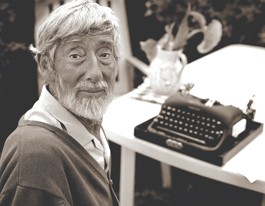
Last weekend, I had the opportunity to meet the distinguished Sebastopol poet David Bromige. Now in failing heath, the 75-year-old Bromige taught for more than two decades at Sonoma State University and is a former Sonoma County poet laureate.

Bromige maintains a small legion of admirers who value the taut intelligence of his poems. He’s routinely described as a “difficult” poet, but I don’t buy it. If the standard for transparency is Billy Collins, then maybe Bromige is difficult. Some of his poems experiment with syntax and a fracturing of the language, but these poems are no more difficult to enter, if you let your ear and senses guide you, than most 20th-century chamber music.

A typical Bromige poem cracks itself open, as if it were a hairy husk of coconut, and one discovers inside a nutrient composed of logic, wit and irony. Many of his shorter poems are wonders of composition. They often animate the inanimate, and are fired by their own engines, driving straight through the finish with intention. Consider the following two poems, which appear on facing pages in Bromige’s volume, Desire. The first, “Abstract,” strikes me as a cerebral painting, with a measure of theology tossed in, while the second poem, “The Object,” seems like a form of country-western love song.

Abstract
My desire precedes me
who am its shadow for the light
glows from beyond its further side.

 the flame to burn this shadow up
when I am one with light.
And so I live as darkness

 and would to this end be
proof
that that flame flames, that object

interposes, absolutely solid.
I can’t spare breath on happiness
nor any of its relatives, description

of this kind must be distraction.
For the God I am the shadow of

once seared me in the flame,
and sealed my lips. I hurt
to talk. My god
must prove my spokesman:

he adores the thing I am;
the flame, the glowing happy flame,
and sets an obstacle between.

The Object
Years afterward
I cherished a black scarf
and would show it to close friends
and say, It once was hers.
I last saw you in April ’55.
I found the scarf in December ’56,
working as a janitor,
in a city where you never were.
A cheap thing, unpleasant to the touch,
rasping & thin. Some scent
persisted, cheap also,
as reminder of the girl,
a girl, unknown to me.
I felt dirty when I handled it.
Desolate, when I lost it.
You meant the world to me.

David Bromige grew up in London and leapt the pond to do his undergraduate work at the University of British Columbia. At a legendary poetry festival in Vancouver in 1963, Bromige met a number of American poets, including Robert Creeley, Charles Olson, Allen Ginsberg and Robert Duncan, who would have a huge influence on him.

Around this time, Bromige moved to Berkeley, with a Woodrow Wilson Fellowship, to do graduate work. In 1968, Black Sparrow Press brought out his volume The Ends of the Earth, the first of 11 of his books they’d publish over the years. His Black Sparrow volume Desire: Selected Poems 1963–1987, won the Western States Book Award. Bromige has a new Collected Poems coming out in 2010, published by the English press Reality Street Editions.


It was an honor to meet Bromige. It’s moving to meet a man, a legend of elegance and wit, as he’s fading. But he was present. He sat in his wheelchair at the kitchen table. His good friend, Monte Rio poet Pat Nolan was there, as was his wife, Cecelia Belle.

When I asked him if he thought his reputation has suffered from living so many years in the provinces, he flashed me an amused smile. From time to time during our conversation, Bromige faded, but he came back wryly, “Did I tell you about my very recent trip to Scotland?”


View All


Museums and gallery notes.


Reviews of new book releases.


Reviews and previews of new plays, operas and symphony performances.


Reviews and previews of new dance performances and events.

Letters to the Editor

05.27.09


Not All Nope in Napa


I want to thank you for the article (“Rock Among the Vineyards,” May 13). Hopefully, enough people outside this tourist trap will read it and see that we have more to offer. Our band is called Pasnuta and the Maximals and I have been getting a bit pissed off at my fellow youth for their lack of drive. It seems that the bands are the only people fed up with the fact that if you’re not a wealthy wine lover there is nothing to do here except go hiking in a few spots to avoid running into the cops.

People complain every day, but when concerts start to happen, I look around and I’m disappointed and it makes me wonder WTF is going on. Are TV and video games so important or more exciting than live shows? It is my dream to have a venue designated for music where people can practice and not have to worry about noise complaints. Wouldn’t it be sick if a winery donated something like that, cuz God knows the town won’t do shit. But I guess this is the beginning of something good, and I wanted to thank you for the opportunity.

Nate Beatty
Napa

btw im srry

Dear Editor: I would like to apologize to Jennie McNulty for texting during her performance. Jennie did a wonderful standup comic performance for women’s weekend up in Guerneville. I got the spotlight on me when she caught me texting during her show! Her quick wit and comic style forced me to put away my phone. I remember Jennie asking if I was getting a good text? “It was family-related.” Most audience participants that night gave more information on who they were. I remained silent on who I was and will continue to do so. I had a lot of friends in the audience and guard my privacy during certain moments. Let’s just say I’ve learned my lesson and will never forget it. Now, in the future, if I catch someone texting during a reading I am giving, I can turn the spot light on them.

The Texter
Santa Rosa


Science to the Rescue?

Our culture is impressed with future inventions such as the sleek Hovercar 3000 that uses garbage as fuel. We look forward, confident that scientists are busy experimenting with brightly colored vials while we sleep, solving crises as they arise. This may be true. Renewable science is growing, but we cannot rely on the future; so far, most modern technology has only created more problems. Fast cars pollute the atmosphere, cellular towers radiate cancer and pesticides bioaccumulate up the food chain until human breast milk is contaminated.

Technology is not going to save us, but it may help us. Consider Rizhao, the solar-encrusted Chinese city, where the government has subsidized solar power for funded research that produces superior models. There, 99 percent of homes have solar heating, but remember that solar panels use cadmium, a by-product of copper that is toxic to humans.

We’ve begun the heavy climb to a balanced existence with the earth, but in the meantime, let’s turn down the AC, buy local food and live by the hundreds of “green” tips, until the scientists solve all our problems. When that happens, I’ll take the Hovercar 3000 in inferno red.

Sammy Vanek
Sebastopol


Dept. of Corrections

Regarding the “Free Okili” piece (Blast, May 20), we got a few facts in this story off-kilter and we apologize. Okili Nguebari was not in a cafe when ICE arrived, he was walking home from the cafe. Nguebari has dual citizenship from the Congo and France, and was never allowed to apply for U.S. citizenship due to a previous marriage. Instead, he applied for amnesty under a special program and was denied after the case pended for some 10 years.

What a lot of heartache!
The Ed.
Clutching Her Birth Certificate


Fighting to Win

0

05.27.09


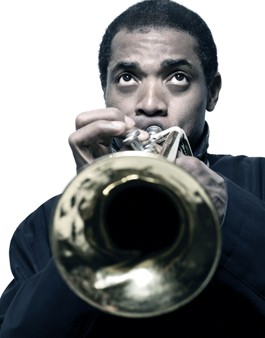
For decades, the afrobeat genre has been synonymous worldwide with the Kuti family name. The late Nigerian legend Fela Kuti pioneered the hybrid style in the 1970s, giving it a name and a role as the militant voice of his common countrymen. Not far behind was eldest son Femi Kuti, the current torchbearer who brings his modern innovations to the Sierra Nevada World Music Festival and San Francisco’s Fillmore next month. Kuti’s first album in eight years, Day by Day, shows him forging his own musical identity and moving past his father’s shadow with tinges of gospel, soul and afro-jazz.

“The compositions are more mature, and I was more experienced in the studio,” says Kuti via phone from his Lagos home. For the set, he honed his piano and trumpet skills to complement his usual alto saxophone. “And I’ll try to make something much better than Day by Day as well!”

Always looking forward, Kuti has been a progressive force ever since he joined his father’s group as a teenager in 1978. In ’86, he formed his own 17-piece band, Positive Force, which still incites rapturous acclaim for vibrant performances. Kuti’s demand skyrocketed 11 years later when his father died from AIDS. He also lost his sister in a year poignantly revisited in the song “97.” Refreshing for music legend’s spawn, Kuti exhibits no chip on his shoulder.

“I love my father, so [the comparisons are] not a big deal,” says Kuti. “He’s my father, and I can’t run away from that fact.”

Rather, Kuti has augmented his father’s legacy for the 21st century, from the hip-hop theme of 2001’s Fight to Win to his personal life, which contains none of Fela’s polygamy, drug use and promiscuity.

“I wish he did things differently,” says Kuti, who is a married family man who promotes safe sex and refrains from drinking or smoking. “Maybe I’d have had an easier life, but maybe I wouldn’t be where I was today. Life is about obstacles, and you just have to find a way around them.”

Sadly, the disease that claimed his father has since ravaged the entire country. In Nigeria, about one in 25 people is infected, due, Kuti feels, to a lack of education and the same naive government who banned his pan-African hit “Beng Beng Beng” for its sexual subject matter.

“I’m still scared for Nigeria, because we’re still very far from the ideals,” Kuti says. “We should have good education and good healthcare for everybody, electricity, good politics, no corruption. The corruption now is a cancer, a very bad cancer.”

Although Nigeria boasts one of the world’s largest oil reserves, nearly 60 percent of its 140 million population live in poverty. Even in Lagos, electricity is still not ever-present. Kuti believes increased trade and tourism and political empowerment is crucial to brighter days. “If I want to be optimistic, I would say yes, there’s always room for change,” he says. “People may move in a positive direction, but the way we are right now, it will take more than a miracle to really change things.”

Still, Kuti is a Nigerian for life, especially with the Shrine. His thriving Lagos club is a hub for progressive youth, much like his father’s Kalakuta Republic, and the site of bi-weekly performances. “I try [new songs] out for at least a year before the studio,” he says. “I like to see the reaction of the people, and to really trim it down or get it close to perfection.” The attack on patrons by local soldiers last year—and the Nigerian media’s willful ignorance—does not deter Kuti.


“Nigeria is my home, my life. There are too many who depend on and admire me staying here my whole life and not running away from the problem,” he says. “I couldn’t abandon them because I wanted a better life. Too many people have said, ‘You never left the struggle for greener pastures.'”

While his father sought the presidency at one point, Kuti’s goals are more humble. “I’m always striving for a good life and for a better self,” he says. “I want to make my family happy, and if I can please many people with my music, I’ll be content.”

 Fela Kuti headlines the Sierra Nevada World Music Festival, running June 19&–21, at the Mendocino County Fairgrounds, 14400 Hwy. 128, Boonville. Single-day tickets $55&–$65. For more info, call 916.777.5550 or visit www.snwmf.com.


Meet the Cheese Dude

0

05.27.09

As though makers of artisan cheese in California did not have a sure enough foothold in the culinary marketplace, now the industry is looking to push its products into the cheese-less wilderness of Asia, and they’ve hired just the man to do it: the Cheese Dude.

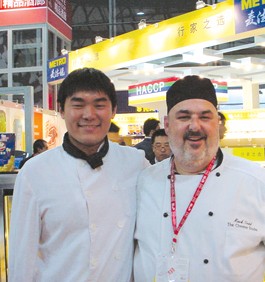
Otherwise known as Mark Todd, the 49-year-old Monte Rio dairy consultant makes a living promoting and consulting for the Wisconsin Milk Marketing Board, the U.S. Dairy Export Council, the California Milk Advisory Board and a smattering of smaller enterprises. Todd’s main focus—and the passion of his life—is teaching people to enjoy the pleasures of eating cheese with beer and wine.

Much of Todd’s writing appears on BeyondWonderful.com, an educational food and drink forum, but as the Cheese Dude, he regularly takes his job on the road, and in early May he returned from a two-week tour of Asia hosted by the California Milk Advisory Board. The journey, Todd’s third voyage to the Far East in two years, led the Dude and three other marketing specialists into the populated centers of Ho Chi Minh City and Jakarta, where the team visited hotels, culinary schools and restaurants to conduct cheese and wine tastings and lead chefs through pizza-making seminars. Pizza, says Todd, literally serves as an efficient vehicle for delivering cheese to the table in cultures that have never taken dairy production beyond the milk stage.

Cheese-making is believed to have begun about 7,500 years ago in the Middle East, and the tradition migrated westward. A genetic mutation that allowed humans to digest lactose beyond infancy followed, and today in northern Europe some 80 percent of the population can pass cheese through their systems almost as smoothly as whole kernel corn. About 40 percent of southern Europeans are lactose tolerant, and in northern Africa, 10 percent of the population can easily digest dairy. But in Asia, the mutation is less prevalent.

As for cheese itself, the average American eats some 30 pounds of cheese every year. The average Greek, about 60 pounds per year, more than in any other nation. But the average Chinese citizen—of which there are approximately 1.5 billion—eats no cheese at all.

“If China went from zero to just half a pound per year—you do the math,” says Todd, who notes that the California dairy market is in a position to profit since most of Asia does not have the available land to produce cheese. “If you have a product that can ship across the world, then it behooves you to get in on a market that makes up nearly one-fourth of the world’s population.”

Todd traveled the Asian tropics on his latest tour with a crusty, smelly cargo from a multitude of California dairies, including Bravo Farms, Marin French Cheese Company, Point Reyes Farmstead, Sierra Nevada Cheese Company, Rumiano Cheese, Three Sisters and Fiscalini. At evening receptions at each location that they visited, Todd and his men featured tasting tables spread with a wide array of cheeses, California wines and Asian lagers. Guests were invariably fascinated by Fiscalini’s Purple Moon, a cheddar soaked in Cabernet Sauvignon. Todd reports that they also enjoyed aged cheddars and pepper jack.

But during pizza-making seminars, students conveyed a particular fondness for smoked mozzarella melted on the dough, and while many Asian pupils were skeptical of the potency of blue cheese standing alone, it proved popular as a flavorful pizza topping. For many of the chefs and culinary advisers who attended the Cheese Dude’s seminars, pizza was a new thing entirely.

“You’d be amazed at how many did not know pizza,” Todd says. “A few had seen it, some had tasted it, but almost none had ever made it.”

Pizza is a highly versatile food base in that it accommodates all manner of toppings; Korean barbecued beef or General Tso’s chicken will sit on a cheesy pizza more gracefully than some highly charismatic cheese would melt its way vice-versa, says Todd. In such a harmonizing relationship, Todd would like to see Asian and Western cuisine meld together without necessarily interrupting existing food traditions.

Japan and South Korea are saturated with pizza joints, with mayonnaise one of the most revered toppings, but in other parts of the Orient, pizza chain giants have found a resistant market. Dominoes, for instance, failed after a late-’90s launch in China. The corporate monster had established itself without sufficient consumer research, offering delivery service only—and it was not what the Chinese wanted.

“They don’t really look at pizza as fast food,” Todd says. “In China, going out to pizza is a fine-dining experience. They don’t just want it brought to their door and shoved in their faces in a box.”

But Americans generally do. We eat roughly 100 acres of pizza per day, almost a third of which is produced by just four companies—Papa John’s, Little Caesar’s, Pizza Hut and Dominoes—making for a rather homogenized industry.

But with the California Milk Advisory Board encouraging Asian chefs and consultants to employ artisan products into the art of pizza making, the pizza market is liable to remain a more diversified entity in Asia than what it has become in the United States. Such a colorful pizza industry could provide a playground of profits for California’s artisan cheese makers.

The Cheese Dude’s objectives are not just corporate-driven. He equates artisan cheese—as well as bread, beer and wine—to skilled societies in which products are made locally start to finish, by hand, and in which people know the ones who produce their food. In Todd’s own life, artisan cheese and the people who make it have served as a conduit to elevated satisfaction and interpersonal relations, and Todd believes that cheese could likewise benefit the rest of the world.

Before he became “the Cheese Dude”—a title bestowed upon him unofficially by friends in 1995—Todd managed a Goodyear Tires store in Sunnyvale. But when he hit 30, Todd decided to move on and began looking outward for sources of excitement. His attentions drifted toward the North Bay wine country, and in 1990 Todd and his wife bought a house in Monte Rio.

Still in professional transition, Todd befriended one Allen Hendricks, then a promoter of Wisconsin cheese and a carver who scraped sculptures out of tremendous wholesale blocks of cheddar and displayed them at high-society events and festivals. Hendricks introduced Todd to the finer points of cheese, whether crumbly, soft, young or old. With a foot in the door of the industry and with a hardwired love of beer and wine, Todd began to promote cheese and beverages himself, and his next life as the Cheese Dude came blooming like a desert watered by rain.

But Todd and the dairy industry still have lots of work to do. Even America remains in the infancy stages of cheese appreciation. In Europe, 85 percent of cheese is consumed as a table product, enjoyed on its own before or with a meal. Fifteen percent is integrated into recipes. In the States, the numbers are almost exactly reversed; Americans eat most of their cheese camouflaged on pizza and in macaroni, lasagna and other foods. Relatively rarely do we nibble on a block of cheese or spread a soft one over crackers at a dinner party, though the tide is turning.

“I’d like to see Americans wake up to artisan cheese as a table product,” Todd says, “and in Asia, I want to see people wake up to cheese as a food, period.”

Todd envisions Asians eventually shifting from using cheese as a mere pizza topping to consuming it as a standalone table treat. Someone would then need to produce the stuff for a billion-some-odd folks, and as China does not have the available land to do so, California’s artisans could get the job. Cheese prices would almost certainly climb.

It could be bad news for American gourmets, but hey—we’ll always have cheap pizza.

Quick dining snapshots by Bohemian staffers.

Winery news and reviews.

Food-related comings and goings, openings and closings, and other essays for those who love the kitchen and what it produces.

Recipes for food that you can actually make.

May 28-June 1: Circo Osorio at Sonoma County Fairgrounds

0

You’ve picked up the special coupons at area drugstores and taquerias, you’ve fielded phone calls from other parents and now it’s finally time for Circo Osorio! The big top goes up for just five short days, during which children of all ages can thrill to the wacky antics of Coconut the Clown, the daring maneuvers of tightrope walkers and trapeze artists, and the gravity-defying stunts performed by gymnasts and unicycling jugglers. Unrenewed immigration exemptions for temporary work visas are threatening smaller traveling circuses such as Circo Ososrio, a wing of the American Crown Circus, so the time is now to finally load up the kids and show them a disappearing vestige of pure entertainment. They’ll be talking about the amazing motorcycle “Globe of Death” for days after the fantastic tent show, which runs Thursday–Monday, May 28–June 1, at the Sonoma County Fairgrounds. 1350 Bennett Valley Road, Santa Rosa. 6pm and 8pm. $15 adults; kids under 12, free. 707.592.7812.Gabe Meline



Today’s Brighter Future

05.27.09 VULCAN VS. LUCASIAN Mr. Spock (Zachary Quinto) and Captain James T. Kirk (Chris Pine). I won't comment on the plot of the new Star Trek film or the way director J. J. Abrams relays a familiar cosmology with glittery action, snappy dialogue and voluptuous intricacy. Unlike many fans, I am cold to the "old pals effect," the tedious crutch of reintroducing...

Do No Harm?

05.27.09 TIME TO HANG UP THE STIRRUPS: Dr. Newhard's patient 'Kathy' was used to his off-color jokes, but when he touched, pinched, slapped and prodded her inappropriately, she took action. After three days of testimony, a judge last week ordered a 79-year-old Novato family practice physician to stand trial on a charge that he sexually assaulted one of his patients.Dr. Horace...

Man and Machine

Far and Wide

05.27.09Eddie Cochran was so sure there was no cure for being cash-strapped in summer that he co-wrote a song about it in 1958 and people are still singing, "Sometimes I wonder what I'm a-gonna do, 'cause there ain't no cure for the summertime blues." Back when the song came out, it was merely the plight of teenagers who yearn...

News Blast

05.27.09 Arnie says it's High TimeGov. Arnold Schwarzenegger's choice of Cinco de Mayo to light up the legalized marijuana debate intrigues, given that the 1937 law first outlawing the plant was prompted largely by racist fears of Mexican immigrants, who, along with "Negro" musicians, were portrayed as being both horribly addicted to the "killer weed" and compelled to "push" its...

Honored to Meet

the arts | visual arts | Photograph by James Garrahan ELEGANCE AND WIT:...

Letters to the Editor

05.27.09 Not All Nope in Napa I want to thank you for the article ("Rock Among the Vineyards," May 13). Hopefully, enough people outside this tourist trap will read it and see that we have more to offer. Our band is called Pasnuta and the Maximals and I have been getting a bit pissed off at my fellow youth for their...

Fighting to Win

05.27.09For decades, the afrobeat genre has been synonymous worldwide with the Kuti family name. The late Nigerian legend Fela Kuti pioneered the hybrid style in the 1970s, giving it a name and a role as the militant voice of his common countrymen. Not far behind was eldest son Femi Kuti, the current torchbearer who brings his modern innovations to...

Meet the Cheese Dude

05.27.09As though makers of artisan cheese in California did not have a sure enough foothold in the culinary marketplace, now the industry is looking to push its products into the cheese-less wilderness of Asia, and they've hired just the man to do it: the Cheese Dude. Otherwise known as Mark Todd, the 49-year-old Monte Rio dairy consultant makes a...

May 28-June 1: Circo Osorio at Sonoma County Fairgrounds

You’ve picked up the special coupons at area drugstores and taquerias, you’ve fielded phone calls from other parents and now it’s finally time for Circo Osorio! The big top goes up for just five short days, during which children of all ages can thrill to the wacky antics of Coconut the Clown, the daring maneuvers of tightrope walkers and...
11,084FansLike
4,446FollowersFollow
6,928FollowersFollow