May 16: Walter Mosley at Book Passage

0

Mosley.jpg

In 1990, the first Easy Rawlins mystery novel Devil in a Blue Dress joined a long line of books that take Los Angeles as its muse and antagonist. Written by Walter Mosley, the book was set in Watts, and introduced Rawlins, an African-American veteran who ends up broke and unable to find work. Eventually, Rawlins finds himself taking up detective work, and Mosley found himself with a thriving detective series. Little Green is the latest installment. It finds Rawlins navigating a new sociopolitical landscape in 1967 L.A., one permanently altered by the Watts riots and the rise of hippie culture. The book promises to be yet another clever exploration of the intersection of race, class and mystery in California’s most intriguing city. Walter Mosley appears on Thursday, May 16, at Book Passage. 51 Tamal Vista Blvd., Corte Madera. 7pm. 415.927.0960.

May 15: Ash Reiter at Lagunitas Tap Room

0

th.jpg

Back in the days when cassettes ruled the world, if I really liked a song, I would record it over and over in order so that I could listen to it on repeat without rewinding. “I’ve Got Something I Can Laugh About,” by Bay Area indie pop band Ash Reiter, is a song that bears repeating, and would have definitely had a cassette entirely to itself back in 1986. Led by Sebastopol-bred Ash Reiter, the Berkeley-based band has exited the singer-songwriter ghetto and entered the sweet spot with their latest album, Hola, which showcases the frontwoman’s lush, swoon-worthy vocals all wrapped up in effervescent pop melodies. It might be a cliché, but this truly is a band that you want to see now, so when they hit the big time, you can say, “I knew them way back when . . .” Ash Reiter puts the pop in pop on Wednesday, May 15, at Lagunitas Tap Room. 1280 N. McDowell Ave., Petaluma. 707.778.8776.

News Agencies Fight Back

0

AP-logo.jpg

It’s hard enough to get someone to pick up the phone when you’re a regular reporter. But what will happen now that the Associated Press has announced the Department of Justice has subpoenaed phone records from its reporters?

A lot of people are very concerned this will create a space where people are even less likely to talk to the press, effectively making whistleblowers scared to tip off reporters to important information.

In a letter to Eric Holder signed by 50 news organizations, from NPR to the Bay Area News Group to Politico, Reporters Committee for the Freedom of the Press wrote:

The scope of this action calls into question the very integrity of Department of Justice policies toward the press and its ability to balance, on its own, its police powers against the First Amendment rights of the news media and the public’s interest in reporting on all manner of government conduct, including matters touching on national security which lie at the heart of this case.

The letter goes on to say that by subpoenaing two months of records from 20 phone lines, the DoJ has gone against all guidelines set forth about phone records. It goes on to call for a shield law:

The Department’s actions demonstrate that a strong federal shield law is needed to protect reporters and their newsgathering materials in a court of law where the adversarial process ensures a fair weighing of the issues. While Congress should provide that remedial legislation, there is still much that this Department can do to mitigate the damage it has caused.

Right here in Sonoma County, in Rohnert Park, someone started a petition calling for legislation against this practice.

Paradise Loss

I spent two weeks this past month vacationing and riding my road bike around the stunningly beautiful, rugged country of western Sonoma County. Levi Leipheimer wasn’t exaggerating when he described your home as world-class cycling country.

A local cyclist told me that the number of road cyclists has really increased in the last five years, and it’s no wonder why. The climate, terrain and amenities are superb; great food, beer, wine and accommodations all attract healthy, vigorous, affluent cyclists. This demographic group is great for local businesses, the kind of visitors you really should encourage.

However, a couple of serious flaws exist in your cycling paradise. First, your county roads are in terrible shape, potholed and badly patched when patched at all. They are worse than our Idaho county roads! Bad roads can be dangerous for cyclists. Flat tires, broken wheels and, worse, crashes causing injury can all result from an unexpected smash into a pothole. Your roads are also typically narrow, with no shoulders.

Second, some drivers are very inconsiderate and even dangerously aggressive about passing. Cyclists have a right to be on the roads; we pay gas and property taxes, too.

Cyclists almost always will stay as far to the right as possible, but if there are no shoulders, and the road edge is littered with gravel, debris, broken glass and trash, cyclists must ride in the travel lane. It really isn’t much fun to fear for your life from speeding cars and trucks while riding up a steep hill at your limit, hugging the white line, trying not to wobble at all.

Cyclists also need to be more considerate of drivers. I saw a number of riders in large groups backing up traffic or riding in the middle of the travel lane for no reason. Inconsiderate behavior like this is unsafe and guaranteed to make some drivers annoyed.

I truly hope that drivers and cyclists will learn to co-exist with mutual respect and consideration, so no cyclists are killed or injured while doing what they love. All it takes is a little bump with your rearview mirror, and you’ll send a cyclist into a tree or a ditch, and on to the hospital, or the morgue.

John Borstelmann lives in Driggs, Idaho.

Open Mic is a weekly op/ed feature in the Bohemian. We welcome your contribution. To have your topical essay of 350 words considered for publication, write op*****@******an.com.

Amista Vineyards

0

Anyway, like I was saying, Syrah is one versatile grape. You can press it, crush it, punch it down, co-ferment it, saignée it, méthode champenoise it. There’s red Syrah, Syrah rosé and even sparkling Syrah. That’s about it. Amista’s got them all.

Proprietors Vicky and Michael Farrow envisioned Amista—which loosely means “making friends,” although my translation widget suggests “fabricación de amigos,” a winery name one notch cooler, don’t you think?—as their retirement project. I’m guessing that they made fast friends with a viticultural adviser in thrall to the late-’90s “boom” in Syrah, because they ended up planting a good deal of it. So what if people come to Dry Creek Valley mainly for the Zinfandel? The Farrows made “sparkling Syrah”—and it made them a lot of friends.

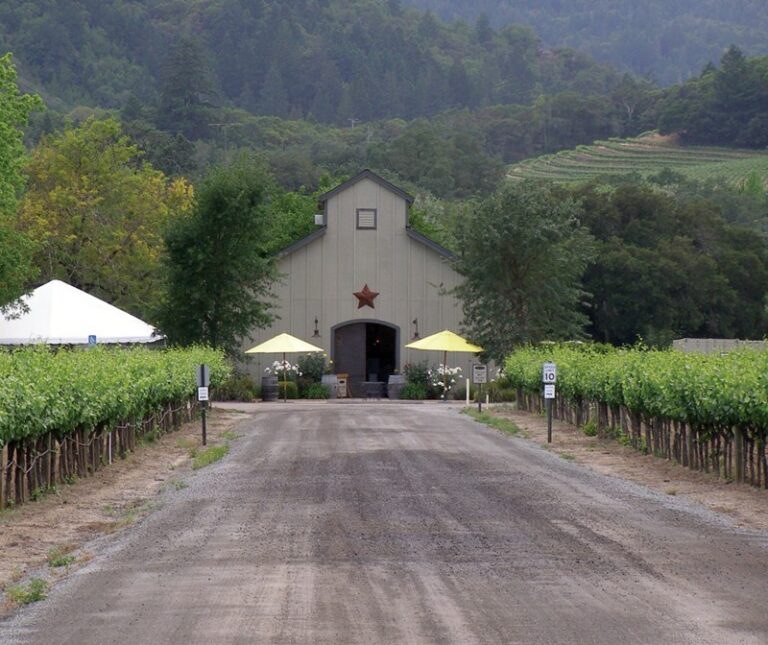
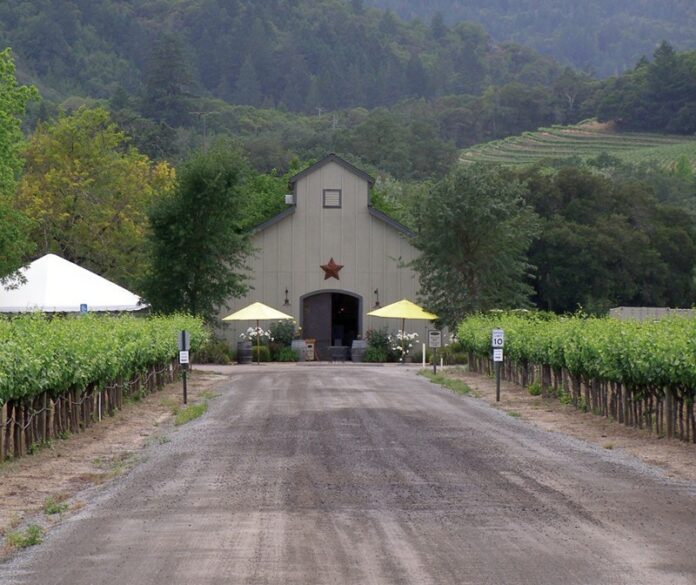
Amista’s just off Dry Creek Road, at the end of a long, purely functional gravel driveway separating two vineyard blocks. Conveniently close to the Dry Creek General Store, Amista’s shaded patio is a popular bring-your-own-picnic spot. Wine club members often make reservations for a small patio party. Inside, clues abound that the tasting room was intended to be a 10,000-case working cellar—the center drain, the roll-ups, the ventilation—but, well, retirement isn’t supposed to be a full-time job. Staff are friendly, and I didn’t overhear any heavy wine-club pitches. All wines are from the estate’s Morningsong Vineyards, Dry Creek Valley, unless noted.

First up, there’s a bonus bubbly, the NV Blanc de Blancs ($34). Made up of estate-grown Chardonnay, and fizzed up at Hopland’s Rack and Riddle, this solid sparkler smells of dried apple wafers and sour apple candy—bright, green Granny Smith flavor and just half a teaspoon of sweetness on the finish.

Amista gets its Zin grapes from down the road. The 2008 Saini Farms Zinfandel ($34) is toasty and sweet, raspberry jam on graham cracker, with malted carob ball—I’m just grazing from the bulk bins today—and a warm, well-knit finish.

I’m told that the NV Sparkling Syrah ($32) makes a really good mimosa. But not a sunrise mimosa: this isn’t that blood-red sparkling Shiraz; it’s pink, creamy and vaguely aromatic of seashell or oysters—or maybe that’s just the food pairing. The 2011 Rosé of Syrah ($20) is sound, crisp and dry; unusual for Dry Creek Valley the 2006 Syrah ($30) displays the wild, smoky, animal-fur and old-lawn-clipping aromas of a cool-climate Syrah, with substantial tannin, in comparison to the 2007 Syrah’s ($30) juicy, claret-like berry liqueur with vanilla highlights. But that’s how it is with vintage years. You never know what you’re going to get.

Amista Vineyards, 3320 Dry Creek Road, Healdsburg. Daily, 11am–4:30pm. Tasting fee, $10. 707.431.9200.

Letters to the Editor: May 15, 2013

BottleRock Blues

Napa has indeed changed (“Start of Something Big,” May 8).

It’s the Monday after the BottleRock festival. I watched from a distance the effect this gathering (for profit) has had on the Napa Expo neighborhood. And I purposely did not attend, and avoided the area to keep out of traffic jams.

The reason why I did not attend, and I’m not alone in this reason: I could not afford the ticket price. I quickly dismissed the offer to volunteer after finding out on the website that there would be a $15 processing fee to apply to volunteer. That gave me a sign of what the promoters were all about.

The ultimate comment should really be coming from the many residents of the Juarez Street to East Avenue to Fairview Drive neighborhoods, who were subjected to the crowds that saturated the Expo area. I wonder what percentage of them look forward to BottleRock 2014, for which, in the spirit of promotion, tickets are already on sale?

Don’t know about the 2014 volunteer application process.

Napa

Top Chefs

I’m certain that chefs Kronmark and Doppelfeld were able to offer top-notch training for our returning veteran warriors (“Kitchen Call,” May 8). Both have the professional demeanor that lends itself to proper guidance and direction rather than the idiotic, stereotypical shouting matches that are popularized by some current TV shows. These men have what it takes to provide the necessary ingredient for our wounded recovering veterans—and that ingredient is heart.

Calistoga

Beautifully Played

I just wanted to say thank you to the Healdsburg Jazz Festival for the Marcus Shelby Orchestra with Faye Carol and the HJF Freedom Jazz Choir show at the Community Baptist Church in Santa Rosa last Saturday night. The atmosphere was great, and the performance of “a musical suite . . . inspired by the civil rights movement” was absolutely fantastic, emotional and beautifully played. The jazz big band was scorching, and to see a hundred local people in the choir was a thrill.

San Rafael

Oyster Myopia

I am shocked to see the misleading signs regarding Drakes Bay Oyster Company popping up around Sonoma and Marin counties. These signs should say “Save Pt. Reyes Wilderness.” I strongly support organic, sustainable agriculture and I love oysters, but the attempt by Drakes Bay Oyster Company and their corporate allies to deny wilderness status to Drakes Estero has nothing to do with farming and everything to do with opening publicly owned wilderness lands to development.

Pt. Reyes National Seashore is a wonderful example of cooperation between agriculture, the national park system and wilderness. My family, friends and thousands of other people worked for years to protect this national treasure. The current owners bought the oyster company in 2005 with seven years remaining on their permit, knowing that the Estero is a designated wilderness area. They should honor their lease agreement and contracts, follow the rules and policies and respect the 1976 wilderness designation.

This is not an issue of “farmer” vs. big government. The real issue here is that private development and industry interests have been working for years to overturn environmental laws and allow natural-resource extraction and commercial development in the wilderness areas, national parks, oceans, estuaries and other publicly owned and protected lands. As a member of the public, one of the millions of owners of the Point Reyes National Seashore, I urge all Americans to protect Drakes Estero wilderness and stop the attempt to privatize and commercialize our national park and wilderness systems.

American taxpayers have waited 40 years for wilderness designation for Drakes Bay Marine Estuary in our beloved Point Reyes National Seashore. Please let any restaurant or business displaying one of these signs or serving Drakes Bay oysters know that you support our National Parks, the law and wilderness designation for Drakes Estero in Pt. Reyes National Seashore.

Occidental

Write to us at le*****@******an.com.

Best of the Fest

0

Perry Farrell, shitfaced and horny, hitting on girls in the front row. Huge clouds of dust swirling above the pit during Bad Religion. A bleach-blonde from Lake County in non-ironic mom jeans boot-scootin’ to Dwight Yoakam.

Baby boomers packed like sardines singing “Take It Easy” with Jackson Browne. Patrick Carney from the Black Keys Instagramming a photo with Guy Fieri. John Popper from Blues Traveler on a golf cart, blowing kisses to nobody who cared. Levi Leipheimer watching Primus. A dominatrix in a rubber dress signing people up for a sex-toy raffle.

Trash cans overflowing hourly. Planter boxes of fresh herbs on tables inside the Whole Foods artisan food court. A framed portrait of chef Morimoto. No actual chef Morimoto.

Drunk guy on Third Street offering $20 to ride your bike. Drunk woman passed out and shuttled to the medical tent. Drunk guy giving away free fourth beer because he can only hold three at a time. Drunk fans chanting shuttle driver’s name when he gives everyone free water for being 30 minutes late. Nighttime sign at wine-pouch booth: “You Drank It All!”

Couple sucking face for five minutes during Wyatt Cenac’s comedy set. Couple waltzing, finishing with a dip to Iron & Wine. Couple fighting near the local band stage, girl yelling, “You’re a fucking liar!” and dropping pulled-pork sandwich into the dirt. Guy picking up pulled-pork sandwich and eating it.

Festival cofounder Gabe Meyers in front of the Black Keys stage, motioning to the band, “How about that?!” Festival cofounder Bob Vogt, watching Macklemore, plotting to increase staff at ID checks. Cop telling girl in line for free water, “Just get some water from the spigot over there.” Different cop chewing out same girl for using the spigot. Spigot removed the next day. Lots of mud where spigot once was.

Wayne Coyne from the Flaming Lips, cuddling a baby doll connected to huge laser umbilical cords. Ben Harper and Charlie Musselwhite, trading licks, creating eerie ambiance. Edward Sharpe & the Magnetic Zeros leading a new Jim Jones–type revival. Only 26 people waiting to see Sharon Van Etten at 1pm. The Shins trying to follow Alabama Shakes. Macklemore telling everybody: “There’s nothing wrong with Playstation and jacking off.”

Parking on Juarez Street, sign says: “$40.” Next day, sign changed: “$50.” Residents selling sodas, water, hot dogs. Residents on the porch, passing around a 40-ounce. Tourists calling neighborhood “crackhouses.” Oxbow nearly empty at 3pm. First Street a ghost town at 10pm. Crowds waiting for shuttles. Napa Pipe looking like the apocalypse.

Music wafting to be heard miles away. Cleanup crews working overtime. Tickets already on sale for next year.

Fists of Glory

More than 40 years after John Carlos and Tommie Smith—the U.S. bronze and gold medal winners in the 200-meter sprint at the 1968 Olympics in Mexico City—raised their fists in a black power salute on the Olympic podium, the iconic image still induces goose bumps. Carlos and Smith planned the statement in solidarity with the Civil Rights movement as a way to protest the racism and poverty afflicting so many African Americans in the United States, and they paid dearly for having a political conscience in a supposedly apolitical and commercialized sports world.

The two men were ordered suspended from the team by the International Olympic Committee and ultimately expelled from Mexico. On their return to America, ostracized from the professional sports world, Carlos and Smith received death threats and had a hard time finding jobs to support their families. In a television interview, Carlos stood by his actions, saying, “We were trying to wake the country up and wake the world up!”

Carlos tells his tale in The John Carlos Story, the 2011 book co-written with firebrand sports editor of The Nation Dave Zirin. An activist to this day, the champion track athlete is a founding member of the Olympic Project for Human Rights and was elected to the National Track and Field Hall of Fame in 2003.

Carlos is on a speaking tour coinciding with the book’s publication, and the SRJC Black Student Union and the NAACP of Sonoma County host an evening with John Carlos on Saturday, May 18, in the Bertolini Student Center, room 4608. 1501 Mendocino Ave., Santa Rosa. 4pm. $50. 707.527.4647.

Steep Climb

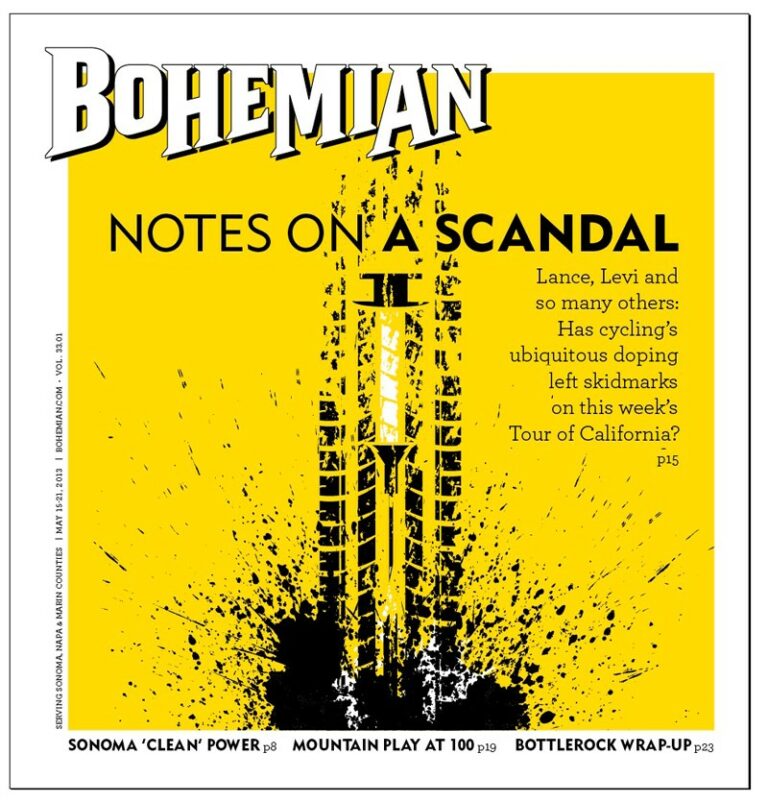
By now, we all know about the wreckage. In January, Lance Armstrong sat down and told Oprah Winfrey, and thereby the world, that he used illegal performance-enhancing substances to win a record seven consecutive Tour de France titles. Now disgraced, Armstrong had lived an elaborate lie for years, having apparently taken ethics classes from Professor Tiger Woods. Even LiveStrong, the cancer research foundation he founded after beating the disease, asked him to step down to avoid infection from public disgust over the scandal.

Alberto Contador, Tyler Hamilton, Floyd Landis, Ivan Basso—the list of cyclists who doped goes on and on. But none hurt as much for Sonoma County as Levi Leipheimer.

Just before Armstrong’s fallout, Santa Rosa’s hometown hero also admitted to years of doping—and ratted out Armstrong, his former friend, in exchange for a reduced suspension in the form of a six-month ban. (Meanwhile, Armstrong can never compete again in a professional organized race.) Leipheimer still trains in Sonoma County, taking on the hills and two-lane back roads, and his annual GranFondo ride remains a successful fundraiser—it’s raised $60,000 in each of the last two years to keep the Tour of California in Santa Rosa. But he has yet to find a team to take him in.

This year, the three-time ToC winner won’t be competing in one of cycling’s biggest races, which finishes this year in his own front yard.

With Santa Rosa hosting the final stage of the race, this could possibly mitigate any decrease in public interest resulting from the doping scandals. On May 19, racers will cross the final finish line downtown, the champion will don the yellow jersey, and thousands of cycling fans will cheer on a nationally televised broadcast, as if the sport hadn’t been tarnished by a doping scandal with a trail longer than a vine of hops. At least, that’s what race organizers are predicting.

“People who love bicycle racing are always going to love bicycle racing,” says Chris Coursey, a volunteer with the ToC organizing committee. “They may have anger or disappointment over revelations from the last few years, but the sport is still there. It’s still one guy riding 120 miles in almost 100-degree temperature.” Casual fans who might be turned off by steroid scandals still appreciate a good show, and “that’s what we do well here in Santa Rosa,” says Coursey.

But another loss for the casual fan are all the big names. Leipheimer’s six-month ban is over, but he hasn’t found a team. Minus even more stars barred from riding, or without a team—and minus Chris Horner, who’s treating a knee injury—many major household names aren’t riding in this year’s ToC.

Will it affect attendance? Already, there are fewer official team afterparties planned than in past years, but still, many cyclists seem eager to watch the grand finish. “Did Barry Bonds doping mean you stopped caring about baseball?” asks Blake Godwin, a diehard cyclist raised in Santa Rosa. “People dope in every sport, but in that era of cycling, everybody did. I’m not making excuses, but that does change the framing.”

“If you use supplemented oxygen, cocaine and Diamox to get to the top of Everest, no one would ever say you didn’t climb Everest,” says Santa Rosa cyclist Marcos Ramirez. “These are amazing athletes, and I’m proud to have bicycle culture be so alive and well in Sonoma County. So the style and politics of racing will change. This is good.”

Coursey is optimistic as well. “Levi wasn’t the first person to promote bicycling in Sonoma County,” he says, “and he won’t be the last.”

[page]

Since the scandal’s peak about six months ago, very few major bombshells have gone off in the cycling world. “I don’t know if there’s going to be additional reaction,” says Raissa de la Rosa, Santa Rosa economic development specialist and co-chair of the local organizing committee for the ToC. “It doesn’t seem to have had an effect overall on people’s enthusiasm in cycling.”

Is hosting the race still a good investment for the city? De la Rosa says yes. Santa Rosa has hosted the ToC five times, and in 2012 hosted the race’s start, with teams and ToC crewmembers calling the city home for about a week beforehand. That generated about $7 million in revenue for the city, says de la Rosa, with a total investment of about $500,000 raised through sponsorships with big companies like Ghilotti Construction and the Ratto Group, fundraising from Levi’s GranFondo, and various in-kind donations.

This year, the cost to host the ToC is approximately $300,000, and the city hopes to see $1.2 million or more in revenue. But the biggest bonus of hosting the finish is the two-hour commercial for beautiful Sonoma County, with Santa Rosa as the focal point, on NBC’s televised broadcast of the final leg of the race. “It’s huge to be the highlight city for that,” says de la Rosa. “It adds to the perception of Santa Rosa as an iconic city for the tour.”

Strategically, and not without risk, the city put in only one bid for this year’s race: hosting the final stage. Last year’s race opener took an enormous amount of work. To make the efforts put in motion pay off, says de la Rosa, “the thing that made sense to us was to do the overall finish. It’s an honor.”

Santa Rosa is home to two teams: BMC and Bissell. As Coursey explains, BMC is the perennial Tour de France contender, while Bissell has to work extra hard to be invited to compete in that race. For local fans, the absence of Leipheimer will stand out. “He’s won it three times—he’s the face of the tour,” says Coursey. “But it’s a great race without him, also.”

Santa Rosa has other riders in the race, like Jeremy Vennell and Michael Torckler, the latter of whom was informed one day before the race began that he would be riding on team Bissell. Torckler came back from a horrific injury sustained in a hit-and-run accident last year on Pine Flat Road. “It’s an incredible story that he’s even riding a bike this year, let alone in this race,” says Coursey. (BMC’s biggest name, Cadel Evans, is riding in the Giro d’Italia, which takes place the same week as the ToC.)

Despite the doping scandal and loss of big names, the ToC is pedaling on. And yet de la Rosa stops short of confirming Santa Rosa’s participation in next year’s event. “I’m more thinking about five years from now, and how we can build it up,” she says.

Indeed, this year may prove to be a barometer of the public’s ability to forgive a sport in the wake of a scandal.

[page]

WHO TO WATCH

Andy Schleck This 27-year-old 2010 Tour de France winner broke his sacrum in a crash in 2012 and hopes to finish strong for team RadioShack Leopard in the ToC this year.

Peter Sagan He won five stages in last year’s ToC, including Santa Rosa’s starting leg, and has won eight legs of the race in his career. The 23-year-old from Slovakia is currently hailed as the world’s No. 2 cyclist.

Jens Voigt The legendary German rider is now in his 40s but can still put the pedal to the metal—er, the foot to the pedal. This tough rider doesn’t make excuses and is always a force to be reckoned with.

Tejay van Garderen The American rider finished fifth in last year’s Tour de France, fourth in the ToC and was named the Best Young Rider of the race. He’s been called a clear favorite to win this year’s race for BMC of Santa Rosa.

Jeremy Vennell This Santa Rosa rider was honored last year as the ToC’s most aggressive rider, and reports say he has been riding well in his training courses.

Michael Torckler Another Santa Rosa local, he was seriously injured in a hit-and-run accident while riding on the notoriously steep Pine Flat Road in Geyserville. He found out the night before the ToC began that he would be riding in the 750-mile race.

Ryan Eastman A 20-year-old Petaluman on the Bontrager team, this is already his second year riding in the ToC.

THE AFTERPARTY

Meet the RadioShack Leopard and Bontrager U23 team, including Andy Schleck, Jens Voigt and Axel Merckx. Q&A and autograph session. Proceeds benefit the Sonoma County Bicycle Coalition. Trek Bicycle Store, 512 Mendocino Ave. 4pm. $20–$25, includes one beer and appetizers. 707.546.8735.

The Final Four

With the tentative approval of Sonoma Clean Power by the Sonoma County Board of Supervisors, each of the county’s municipalities has a choice to make. With a short-list of four potential energy suppliers, the county’s Community Choice Aggregation—which would break with PG&E to buy power on the open market—is poised to go forward pending each city’s yea or nay. Like Marin Clean Power, individuals will be given the ability to opt-out and continue receiving service from PG&E.

What may sound like a no-brainer for green-conscious, PG&E-wary Sonoma County is complicated by the concept of buying power from one of four out-of-state bidders, each offering a different mix of fossil-fuel, nuclear and renewable options. According to Cordel Stillman, who is heading up the research for the nascent program on behalf of the Sonoma County Water Agency, the final four were chosen based on overall price, financial viability, power supply, use of local renewable energy and assistance during startup. Sonoma County will examine the specifics of each supply more thoroughly during the next bidding round, he says.

Below, we take a look at the final four, including their top employees, the mix of energy they offer and any iffy business practices or human-rights violations they’ve been associated with. Like the cities prepping to make a choice, readers can make their own decision as to how truly “green” these corporations are, and whether they top PG&E.

NRG ENERGY

Headquarters West Windsor Township, N.J., and Houston, Texas

At the helm David Crane, president and CEO, has been with the company for 10 years, working in various positions at International Power and Lehman Brothers before that. Kirkland Andrews, VP and CFO, also comes from banking, working with Citigroup and Deutsche Bank prior to joining NRG.

Energy mix Of its nearly 100 plants and facilities sprinkled around the United States, roughly one-tenth is solar or wind, with the rest generating power from fossil fuels. Crane has stated a goal of curbing the company’s carbon emissions, but though its use of coal and oil total only about one-fifth of the total mix, NRG relies on fracked natural gas. All of its California plants use natural gas. As of 2012, it owned a 44 percent share in one nuclear facility in South Texas.

DIRECT ENERGY

Headquarters Houston, Texas

At the helm Badar Khan replaced longtime CEO Chris Weston in April of this year. Before his 10 years with Direct and its parent company, Centrica, Khan worked for a variety of corporations and consultants, including the controversial pair KPMG and Deloitte. While the former company created fraudulent tax shelters for high-ups in the finance industry—withholding as much as $2.5 billion—the latter has been accused of money laundering for the Iranian government and publishing false information on behalf of the tobacco industry. Former CEO Weston has been an outspoken advocate of governmental deregulations of the energy industry.

Energy mix The company purchases electricity from five wind farms in Texas and owns 4,600 natural gas wells in Alberta, Canada, purchased from Suncor Energy and Shell Canada. Ratios of the company’s fossil fuel-to-renewable power sources are not published on its website.

The dirt Between 2001 and 2004, Direct Energy was found by several regulators to have signed up unwitting clients in four U.S. states and two Canadian provinces. According to a newspaper report, the company brought attention to itself by accidentally signing up an Atlanta man who had been dead for over 20 years. It was charged with unethical business practices and fined $500,000 stateside and $150,000 in Canada.

CONSTELLATION (NOW EXELON)

Headquarters Baltimore, Md., and Chicago, Ill.

At the helm Kenneth Cornew is the current president and CEO of Constellation, which was purchased by Exelon in 2012. He has been with the parent company since 2003. Christopher Crane, president and CEO of Exelon, comes from nuclear energy, working in management for plants in Texas and Arizona before joining Exelon in ’98.

Energy mix Not surprisingly, considering its CEO’s background, Exelon bills itself as the largest owner and operator of nuclear plants in the United States. With 10 plants and 17 reactors, roughly 55 percent of the company’s total energy is nuclear. Another 35 percent is fossil-fuel-based, with hydro, wind and solar making up another 10 percent.

The dirt Though Exelon has supported cap-and-trade legislation—the largely nuclear organization would likely benefit if such policies limited the availability of fossil fuels—it is not without environmental blemishes. In 2005, it was fined $600,000 for a sulfur dioxide leak from a generation station in Pennsylvania. In 2006, the company disclosed that one of its Illinois nuclear plants had leaked more than 6 million gallons of water laced with radioactive hydrogen, known as tritium, since the ’90s.

CONEDISON SOLUTIONS

Headquarters New York City

At the helm Kevin Burke, the CEO of parent company Consolidated Edison, has been with the organization in various positions since 1973.

Energy mix An energy retailer, ConEdison Solutions offers several “green” packages, including wind from national farms and wind from farms in consumers’ regional area. The company will also install solar systems upon request. In New York City, its parent company supplies customers with a mix of electricity and heat imported from a hydroelectric plant in Quebec and a handful of gas and electric utilities.

The dirt Like PG&E, many of ConEdison’s problems have involved maintenance—and lack thereof—of New York’s aging pipe system. According to a report by Public Campaign, ConEdison was high on a list of companies—topped by GE and PG&E—that paid no federal taxes between 2008 and 2011. During that same period, the company reportedly spent almost $2 million in lobbying fees.

May 16: Walter Mosley at Book Passage

In 1990, the first Easy Rawlins mystery novel Devil in a Blue Dress joined a long line of books that take Los Angeles as its muse and antagonist. Written by Walter Mosley, the book was set in Watts, and introduced Rawlins, an African-American veteran who ends up broke and unable to find work. Eventually, Rawlins finds himself taking up...

May 15: Ash Reiter at Lagunitas Tap Room

Back in the days when cassettes ruled the world, if I really liked a song, I would record it over and over in order so that I could listen to it on repeat without rewinding. “I’ve Got Something I Can Laugh About,” by Bay Area indie pop band Ash Reiter, is a song that bears repeating, and would have...

News Agencies Fight Back

Reporters don't mince words in a letter to the Department of Justice

Paradise Loss

An Idaho visitor has some tips for our 'cycling mecca'

Amista Vineyards

Up Dry Creek Without a Zinfandel

Letters to the Editor: May 15, 2013

Letters to the Editor: May 15, 2013

Best of the Fest

Things we saw at BottleRock

Fists of Glory

More than 40 years after John Carlos and Tommie Smith—the U.S. bronze and gold medal winners in the 200-meter sprint at the 1968 Olympics in Mexico City—raised their fists in a black power salute on the Olympic podium, the iconic image still induces goose bumps. Carlos and Smith planned the statement in solidarity with the Civil Rights movement as...

Steep Climb

Will the doping scandal affect public interest in America's biggest bike race?

The Final Four

So just how 'clean' are the companies vying for the Sonoma Clean Power job?
11,084FansLike
4,606FollowersFollow
6,928FollowersFollow