It’s a Christmas wish engraved in the grain of our culture: an official Red Ryder Carbine-Action 200-Shot Range Model Air Rifle. And even as “You’ll shoot your eye out, kid” has turned into an overused catchphrase, there’s a reason little Ralphie’s desperate wish from A Christmas Story resonates. Every one of us, at one time or another, once wanted something with a similar fervor—more than anything in the world.
Wish is universal. A while back, we here at the Bohemian started telling each other about our personal Red Ryders in the office one day. All our stories were different, but every one was relatable, and we’ve included them below. Hopefully, you’ll see a little of yourself somewhere in here—or, for those going over wish lists from children, you’ll see how kids process desire all these years later.
On with the unwrapping . . .
The Verbot
By Gabe Meline
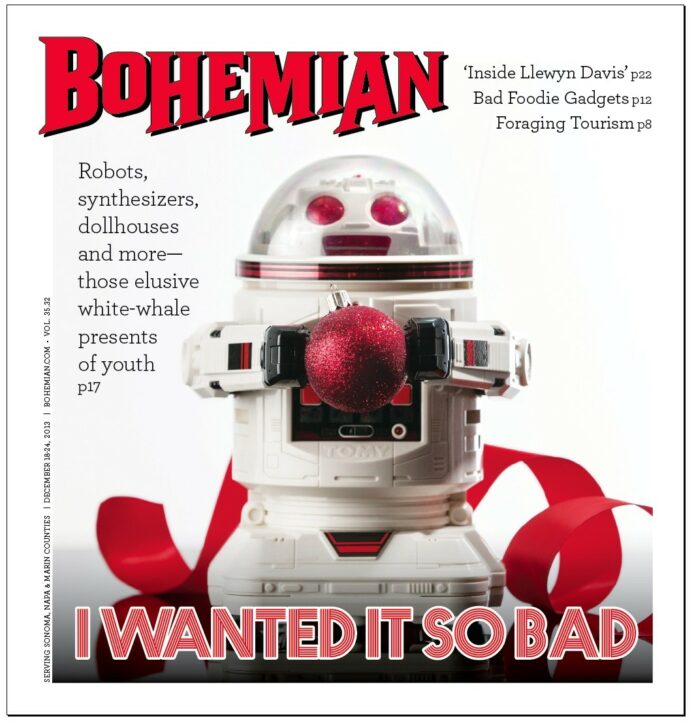
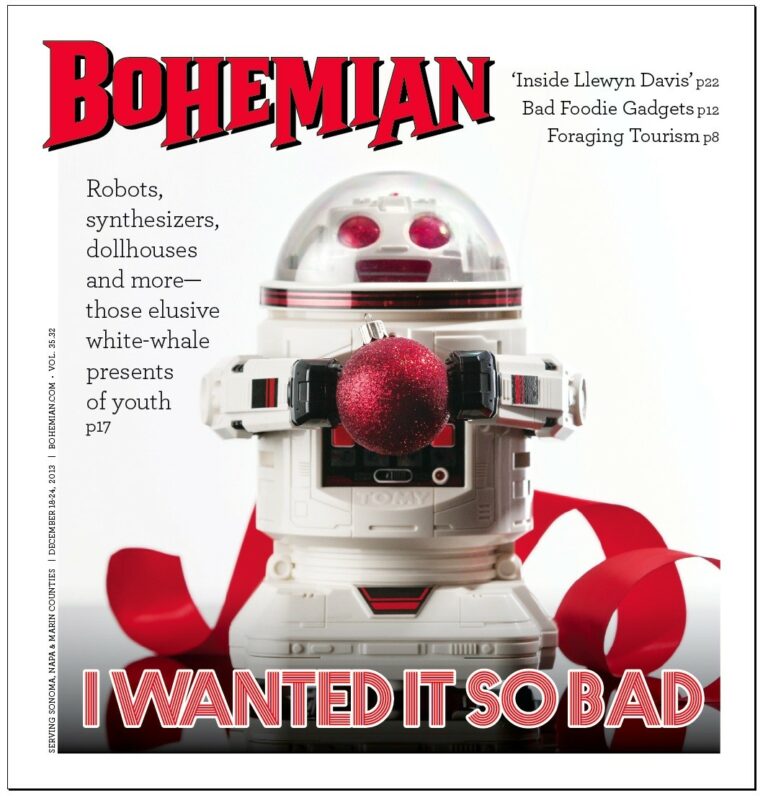
It must have been the TV commercials sandwiched between The Cosby Show and Family Ties that did it. The year was 1984, the “future” was “now,” synthesizers and jetpacks and Commodore 64s and hoverboards were in the collective consciousness, and all I wanted for Christmas was a Verbot. To a precocious kid interested in the possibility of artificial intelligence at the young age of nine, a voice-controlled robot that could bring a Milk Bone to the dog or deliver a cup of hot chocolate with just a simple vocal command was a futuristic dream come true.
“We can’t afford it,” said my mom, and she was probably right. A Verbot cost $75, and we were just barely off drinking Alba powdered milk and eating Appian Way box pizza. Still, if it was the only thing I asked for, I reasoned, I might have a chance. And so every trip to Toys “R” Us on Santa Rosa Avenue was spent staring at the box. I learned to draw a Verbot, and left scraps of my sketches all over the house. I even babbled at the dinner table about the Omnibot—the larger, better, $200 model—in a concerted effort to show my parents that I was at least asking for the more affordable option.
As my robot dreams gathered silicon, so my mom’s denials gathered volume. “You’re going to have to be happy even if you don’t get a Verbot,” she’d say. “Besides, a robot is a luxury. There are kids starving in Ethiopia, you know.” (Yes, my mom really said that, and often.)
When I woke up early on Christmas morning, I ran into the living room. There, near the tree, unwrapped, was my beautiful, magical Verbot! I rushed to unbox it and started playing with it—flipping through the manual, moving the arms up and down, turning the control microphone on and off. And then my mom walked into the room. She was still dressed.
“What are you doing?!” she demanded. “It’s 11:45!”
It is an unsettling sensation for a nine-year-old to be made to go back to bed after just receiving the most anticipated Christmas present of all time. But she was right; 11:45 was too early. It wasn’t even Christmas yet, technically. So I went back to bed, clutching my beloved Verbot, and slept under the covers—that is, until 3am, when I woke up again.
As it turned out, my robot love affair was short, but intense. Realistically, there simply wasn’t a whole lot Verbot could do. Move forward, move backward, turn left and right, pick things up, put them down and “speak,” which meant flashing lights and 8-bit bleeps. Plus, the voice activation was spotty, and I soon learned it was nothing at all like the TV commercial. I probably got bored of it after three weeks.
A person never forgets that elusive toy of their dreams. While others look up YouTube videos or even go on eBay to reclaim a portion of their youthful innocence, I’ve still got my Verbot. In fact, it sits in residency as the office mascot here at the Bohemian. In our minds, he’s a talisman of the newsroom. He tells the copy editor what to mark with red ink, and tells the calendar editor what to list as an “Event,” and shamelessly hits on the married staff writer. We blame all our typos on his bad influence. It’s hard living with him sometimes, but I’ve stopped telling him what to do. He gave me the most joy possible once, and for that, I owe him for life.
The Playmobil Dollhouse
By Rachel Dovey
It had window boxes full of pink and white flowers and wallpaper that you had to paste on yourself. There were lace curtains to assemble and doorframes to attach, and if you were lucky enough to have the kitchen set (I was), you could hang ladles and rolling pins from a shelf and arrange Tic Tac–sized silverware in a drawer that slid open and shut. I’m talking, of course, about the Playmobil dollhouse—the four-story Victorian one with two balconies, none of that modern suburban crap.
I was nine, it was December 1994 and oh my did I love Playmobil! I had all the furniture advertised in the catalogue—the kids’ bunk beds and doll carriages, the parents’ twin beds that you could snap together or keep apart (depending on how you were raised), the carpets and ferns, chairs and fireplaces and bookshelves for tiny, individual books. Currently, all the little plastic people and their earthly goods lived in a purple tub that I would pour onto my bedroom floor on Saturday mornings at 6am, as soon as I woke up. Going back and forth between my divorced parents every week, I never once forgot that tub.
I called them “figgies,” short for figurines, a title that worked well around this time of year. “Oh bring me a Figgie pudding, oh bring me a Figgie pudding, oh bring me a Figgie pudding and bring it right here!” I’d sing, hoping the hint was direct enough. Usually my mom sighed and looked extra weary, so I figured she was catching on.
I know now that the four-story mini-mansion cost her upwards of $400—no small chunk of change for a single mom. It was money she could easily have spent on rent or utilities or tuition for the Ph.D. program she was completing slowly in incremental bits.
I know it was yards of petroleum-based plastic that will wind up in a landfill one day. I know it did strange things to me, encouraging my already manifesting tendencies toward OCD. I would arrange and rearrange for hours—this wallpaper with these flowers, those curtains but with that stick-on portrait, those chairs, placed at a perfect right angle on the edge of the rug. And God help anyone who tried to assist me. “You’re so mean!” my friend Danielle screamed the fifth time I called her patio set-up “kind of disgusting,” hurling a marble-sized vase against my bedroom wall so hard it cracked.
I know it was extremely gendered, and if I’d built airplanes with Legos, maybe I’d be earning enough money now to afford a real house like that. But my mom still has a picture of me that Christmas morning. My hair is messed up from sleep, I’m wearing some kind of hot pink cape over my pajamas, my mouth is round in a gasp and I’m holding a huge box that could only be one thing, my arms stretched as wide as they could possibly reach.
The Casio PT-82
By Leilani Clark
When I was 12, what I most wanted for Christmas was a Casio PT-82 synthesizer, the one that played “Greensleeves” and came with exotic built-in rhythms like “samba” and “beguine.” I knew the acquisition of this keyboard, alongside a steady diet of living-room lip-sync practice, was essential in my quest to become a Kids Incorporated cast member. I hounded my mom about it for months, and come Christmas morning, ran toward the oblong box under the tree, knowing it to be my envoy to synth heaven.
As the paper fell away, I don’t know what burned more, the anticipation or the crushing disappointment. What I uncovered was not the Casio, but a knockoff—a bulky purple thing, the Barney of keyboards, really—nothing like the white, streamlined melody machine of my dreams. I threw a fit, crying, pouting and holding it against my mom that we didn’t have the money to get the real deal.
She must have broken down and exchanged the thing, because I have later memories of crouching over a white Casio with my sister, following along with the blinking lights and competing to see who could play “Greensleeves” the fastest.
Last week, I called my mom to confirm all of this, but she claims not to remember the incident. But she admits that she probably didn’t get me the Casio originally because it was too expensive.
“I think I wanted to get you a really, really good keyboard,” she adds, talking loudly over the sounds of my three-year-old nephew playing in the background. “Maybe I returned it and got you the Casio later?”
She starts listing all of the other gifts that my sister and I received over the years. The Barbie Corvette. The Barbie Playhouse. The Barbie Styling Head. My Little Pony . . .
I stop her.
“Mom, this isn’t a story about how deprived Antonia and I were at Christmas time,” I say. “This is a story about what a brat I was and how I threw a hissy fit when I didn’t get what I want.” But she’s totally blocked out the fact that I was your run-of-the-mill Veruca Salt–style holiday ingrate.
I then called my sister, trying to get to the bottom of this ancient Christmas mystery. She’s less delicate than my mom and always willing to remind me what a jerk I could be when we were kids.
“I totally remember that Casio,” she says with a laugh. “I talk about it all the time.”
She reminds me how I ended up playing a white Casio PT-82 on tour with in an indie electronic band. But she doesn’t remember the first disappointment either—the generic purple keyboard that caused such woe.
“It does sound completely plausible,” she confesses. “You know how Mom is. I do the same thing. I’ll get the cheapest thing, or the second cheapest thing, and hope it works out, and then feel bad and maybe return it for something better.”
In the end, my bad behavior paid off and I was rewarded with the lusted-after PT-82, though it must have cost more than what my parents would have liked to spend.
But did it get me a guest spot on Kids Incorporated? Alas, no.
The Major Matt Mason Action Figure
By David Templeton
In 1968, as Christmas approached, my mom was broke. We lived in a tiny apartment in Glendora, and the meager monthly welfare benefits my mom received were barely enough to pay the rent and feed us all—my brothers Steve and Jef included—let alone provide much in the way of Christmas presents.
Still, if I could have had anything that year—with my eight-year-old mind still reeling from the recent manned orbiting of the moon by the crew of Apollo 8—it would have been a Major Matt Mason action figure. The TV commercials for the new toy were electrifying. “He lives on the moon! We may all be there soon!” teased the deep-voiced narrator, as two boys played in their yard, dangling Matt Mason from a string, flying him around his spectacular plastic moon base.
God, I wanted one of those.
I didn’t care that the little bendable arms of Major Matt Mason were already known to break after just a few hours of play, the wires inside snapping so that he could only stick his arms out like a man walking a high wire. Somehow, that just made him seem even cooler.
On Christmas Eve, hoping against hope that my dream of space adventure would come true, my mom gathered us boys together to tell us that, sadly, there was not enough money that year for presents or even a tree. Later that afternoon, a knock came at the door, and outside was an entire pack of Boy Scouts, standing there on the balcony with a fully decorated tree, bags full of holiday food and boxes of presents. Our name was evidently on a list of families in need, and the Boy Scouts were doing their part to make Christmas happen for . . . well, for us.
As tears rolled down my mom’s face, the scouts set up our tree, sang a Christmas carol or two, and left us with all of those alluringly wrapped gifts. That one of them contained a Major Matt Mason was more than I could actually believe.
I mean, if that happened, if there actually was a Major Matt Mason in one of those packages, not even allowing myself to think there could also be a Matt Mason moon base set, well then, maybe everything they said about the magic of Christmas was real.
Of course, the magic of Christmas was that we had anything at all—presents, a tree, plenty of food. And on Christmas morning, I had to content myself with that, because there was no Major Matt Mason in any of those boxes. I seem to remember a squirt gun of some kind, an Etch-A-Sketch and a box of toy soldiers.
I must have been disappointed, but all I remember is the look on my mom’s face as she watched us open presents on a Christmas morning that she’d thought wouldn’t bring her anything to be thankful for at all. By the next winter, Mom was working again. In July of 1969, the crew of Apollo 11 successfully made the first landing on the moon. By Christmas, Apollo 12 did it again, but by then, I’d already been there myself, in my imagination, having traveled to the moon with the entire Major Matt Mason moon base set my mom had given me for my ninth birthday. By that Christmas, I already had the entire men in space action figure team, and I am happy to say, I’d already broken all of their arms.
The Super Nintendo
By Nicolas Grizzle
Christmas 1992, a life-changing moment. On that fateful morning, a wrapped box sat beneath my stocking, atop the wood stove. I prolonged the anticipation of opening that box by inspecting the meager contents of my stocking: candy, small toys I would forget about in a few weeks, maybe some cool pencil toppers—I don’t remember. But what I’ll never forget is that moment when I ripped the paper off the box to reveal the greatest gift ever given: a Super Nintendo.
The new console was released just in the past year, and I was finally one of the cool kids who had one. This was a big deal, because I was never a cool kid. I didn’t typically have the latest gizmos and gadgets, and I really liked wearing sweatpants to school (they were comfortable and came in so many different colors!). I was even friends with certain kids because they had a Super Nintendo, and they’d let me come over to play it. It was so expensive—at that age, $200 seemed like $1 million. We weren’t millionaires, so I just tossed out the idea of ever having my own.
But that morning, it was like I had won the lottery. “Whooaaaaaaaaaa!” I yelled. Sure enough, my parents then came stumbling downstairs, muttering something about Santa (I was so over the Santa game by then, but played along to milk the last drops of childhood). All I could say was “I got a Super Nintendo!” as if they didn’t know, and I hooked it up myself (RCA and composite cables into the VCR, TV has to be on channel 3, TV/VCR button must be on VCR). Immediately, the 16-bit universe of Super Mario World blew my mind. I had played it before, but this felt special. I didn’t have to wait my turn. I didn’t have to ask permission. In my mind, there was no better way to celebrate the holiday, because surely, this is what Jesus would buy himself as a Christmas present. Hallelujah!
I was walking on air all day. Nothing else mattered—I might as well have donated those other presents, because I wouldn’t be using them unless they plugged into the TV. This new system, a little too new for my parents to really understand, unleashed a love of technology that stays with me to this day. These days, video game consoles cost $600 and require an internet connection, but they look the way I wish my dreams did and their wireless controllers have joysticks and headphone jacks. But even as the technology evolves, the feeling of unwrapping that unexpected, life changing gift will always be the same.
The Barbie Jeep
By Tara Kaveh
Santa, I want a jeep like my Mommy’s, I scribbled with my periwinkle crayon.
Playing in the cornstalks and tall grasses, our acre of lush land was a magical forest. My cousin Daniel lived with my family, and for him and me, at age five, this little piece of land was our kingdom. Our wild imaginations took us on adventures up and down the trees, through the fields and into valleys of mystical flowers and enchanted animals. He was the king, I was the queen, and our English springer-spaniel was our loyal companion and ferocious protector. There was only one thing missing: we needed a proper jeep to take us on safaris through the unruly kingdom.
“A toy car is too expensive,” my parents said, so Daniel and I had to get inventive. We tried bikes and skateboards, which only ended in tearful eyes, cuts and bruises after we went over rugged terrains. We were ready to try the wagon until my mom ran out frantically yelling and waving her hands to stop before we took the plunge, practically freefalling down a 30-foot drop to the bottom of the hill. After that, there was nothing with wheels left to try, so I’d try riding the dog, but she didn’t like it very much and abandoned us while we were up against a pack of giant eight-legged bears.
Without a source of transportation through our kingdom, our parents began to worry about the scrapes that were quickly turning into bigger and bigger gashes (and about the fact that the dog would run away at the sight of Daniel or me). On Christmas morning that year, I nearly cried at the sight of little boxes under the tree. Surely, there was no jeep in there. I began to slowly let go of my dream as the boxes left to unwrap became smaller and smaller.
But as Daniel and my little brother played with their new toys, my parents took me outside where, lo and behold, there it was—a bright pink Barbie jeep. I called for Daniel, and in the blink of an eye we were off riding through our magical forest.
After a few days, Daniel wanted to drive more and more, but that was OK—just as long as there was a crisp breeze to blow on my face. Now that I had my jeep, no monster, lion or crazy jungle person could hurt us.
As time went by, the kingdom lost its king to a faraway land called Sweden, and I was the only one left to watch over the magic forest. My jeep began to slow down, and with every rain, the bright pink color faded. Time had rendered the jeep too slow and small—just as the act of growing up had done to my once-wild imagination. Eventually, the faded Barbie jeep sat worn and torn on rocks aside the once-magical forest, rarely touched by an older me, as a reminder of days of innocence, imagination and true joy.