July 22: Matt Schofield at City Winery

0

matt_schofield.png

His blonde locks and baby-face bely guitarist Matt Schofield’s 36 years, but when the British musician takes the stage, he’s a blistering blues artist. He’s already received accolades across the pond and in the States, Schofield is storming venues with his tasty licks and stellar songwriting. His latest collection, Far As I Can See, sees the guitarist in top form, and this week Schofield takes the stage on Tuesday, July 22, at City Winery, 1030 Main St., Napa. 8pm. $15—$18. 707.226.7372.

Riesling Rising

0

The more I discover about Riesling—which is world-class not only in “cool climates” like Alsace and the Rhineland, but also in places like Clare Valley, Australia, where it stands nearly shoulder to shoulder with Shiraz—the less I accept the conventional wisdom about why it’s lost favor in the North Coast. Here are some local surprises:

Gustafson 2013 Heritage Tree Vineyard Dry Creek Valley Riesling ($20) A nice, fresh style, smelling of powder-coated Aplets & Cotlets, lightly frozen, with flavors of zippy pineapple and pear.

Calder 2013 Napa Valley Riesling ($20) Sour lemon, melon rind with cashew nut, jasmine and Bartlett pear. From a dry-farmed, 50-year-old, half-acre block of Riesling vines in the middle of Cab-is-king Rutherford. Refreshing, but I’d like to see one or two more Brix.

Trefethen 2013 Oak Knoll District Dry Riesling ($25) Elegant balance of melon-rind bitterness and pear and lime fruit, plus a subtle hint of mineral oil (Riesling may display an aroma similar to diesel fuel—yet strangely attractive—especially after aging). Hailey Trefethen says that this family favorite gets the full treatment: two picks and special yeasts. I’ll bet two years will add to its appeal. Runner-up of the tasting.

Imagery Estate 2013 Pine Mountain-Cloverdale Peak Riesling ($24) A light apple rain from the clouds; fitting for this new mountain vineyard, where Malbec is also grown. Faint pear, faint honeysuckle and searing green grape acidity.

Chateau St. Jean 2013 Alexander Valley Riesling ($15) Pear candy, flowering vines, lime rind with a bite of white peach. Disciplined palate, fruity and crisp. winemaker Margo Van Staaveren confirms my suspicion that this bottling’s residual sugar has been reduced in recent years.

Dutton-Goldfield 2013 Chileno Valley Vineyard Marin County Riesling ($30) The orchard is ripe, but what kind of fruit? Maybe fruit cocktail, the kind in cans, especially that peeled white grape. Both weighty and zingy, with apricot and bitter melon.

Weingut Edelweiss 2010 Fence Row Block Napa Carneros Riesling ($17.10) Holy Alsace. This voluptuous, haughty honey is the real deal, displaying a toastiness, mineral oil and lemon marmalade quality that’s miles away from the others. Perhaps it’s unfair to include this with the 2013s, and I couldn’t really taste it blind, as its hue is markedly deeper than the others. Nevertheless, I did not know what to expect from this ingenuously named small project from two industry denizens who wear their hearts on the bottle’s back label. (There’s a tally of how many relationship crises went into the bottle). But they hit it out of the park here. I can recommend all of the above wines, but this one stokes my hope for North Coast Riesling.

Letters to the Editor: July 16, 2014

Ravitch’s Decision

What if everyone was allowed to admit mistakes, even law enforcement officials? What if honesty and humility were considered signs of strength? What if the asking for and giving of forgiveness were met with compassion? What if asking for and giving forgiveness were signs of strength? What if understanding was more important than blame? Might not the aftermath of Andy Lopez’s death have unfolded differently?

Sebastopol

A tough situation. Emotion aside, it’s clear that this is not a case of criminal behavior by the officer, but rather a severe failing of civilians, young and old, being taught how to correctly act when being approached and spoken to by a policeman. Incidents of this sort—miscommunication leading to tragedy—happen constantly, and I really believe a firm understanding of how to respond to an officer would save a lot of heartache.

Via Facebook

It seems the toy is an exact replica of the real thing. That’s the problem.

Via Facebook

I grieve for the family of this young man. This must be a deeper cut to bear, like going through it all over again, I am sure. I am of an age where I remember when the police used to protect and serve. Now many officers see us as easy prey as they hide in cars that are barely recognizable as a police car, a car in the past that was easily recognizable and one you could turn to for help. When officers’ first impulse is to shoot and ask questions later, how are we to feel safe as parents when children are walking home? Everything is backwards these days.

Via Facebook

Last Straw

What a country we live in (“Welcome to Gun County,” Boho Blog July8): In open-carry states, a mostly white group of chubby, Second Amendment “gundamentalists” have taken to carrying actual assault weapons into retail and fast-food outlets with not much pushback from police, while in California, a 13-year-old Latino kid gets shot and killed by police while openly carrying a toy gun in a semi-rough Santa Rosa neighborhood. Meanwhile, there’s a school shooting practically every week—and thus the battle lines are drawn between arming everybody and, gee, how about some sane gun laws?

No child is allowed to open-carry. No one in California can own a non-neutered semi-automatic rifle. Open-carry activists usually inform police of their actions beforehand. There is not a school shooting every week, but over 50 percent of gun-homicide victims are African-American. How about constructive policy rather than your anti-NRA “gun laws” that do nothing to help anyone? Talk about drinking the Kool-Aid. Strawman much?

If you cared at all about ending gun violence, you would be talking about poverty, the war on drugs, black-on-black crime and the failure of anti-gun policy. But you’re not. You’re repeating talking points that don’t make sense. You’re demonizing your enemies and you’re tugging at the heartstrings of racism in the United States. Unbelievable.

Via online

Clean Facts

Sonoma Clean Power (“Growing Power,” July 9) “made geothermal deals in recent months with the big-industry likes of Calpine and Constellation/Exelon in the Geysers.” Calpine is one of the operators at the Geysers project in Sonoma and Lake counties. Constellation (which merged with Exelon in 2012) is not one of the operators at the Geysers or any geothermal project in California. In fact, geothermal is barely mentioned on their website (www.constellation.com). Constellation is headquartered in Pennsylvania.

Via online

Editor’s response: You are correct. Constellation Energy, a subsidiary of the Exelon Corporation, does not have a geothermal power-production contract with Sonoma Clean Power as Tom Gogola reported. SCP says: “Constellation provides hydropower, wind, biomass and power from natural gas in our current contract. We are working on a second contract with them that would potentially supply power from additional sources as well. Calpine provides geothermal power in our current contract.” The Bohemian regrets the error.

Water Wise

I may be wrong (“Saving Water in California,” Bohemian Facebook page, July 9), but I think California is relatively efficient and has become more so over recent years. The commercial water deals that big commercial farms (not new, smaller ones) have been getting, though, should be renegotiated and made more fair, IMO. In any case, we have no choice but to be much more efficient, since demand is still high and water supply is low.

Via Facebook

Write to us at le*****@******an.com.

London Calling

0

As the show begins, the sun sets over the hillside vineyard visible just beyond the stage. By the time it all ends, the moon has fully risen over the makeshift outdoor theater.

While the main draw of Transcendence Theatre Company’s annual Broadway Under the Stars shows in Jack London State Park are the Broadway performers, the obvious co-star of the series is the setting itself.

If One Singular Sensation, the exceptional two-weekend-long revue that kicked off the summer’s lineup of song-and-dance extravaganzas, is any indication of things to come this summer, then Transcendence Theatre Company has definitely hit its stride. It’s quite amazing what these performers can pull off using a bare stage, very few props (some stools and chairs, notebooks, a bowler hat or two), and no fancy stage effects—though incorporating real horses into a performance of “Fugue for Tinhorns,” from Guys and Dolls, came pretty close to being a special effect.

After three full seasons, artistic director Amy Miller demonstrates that she still has plenty of tricks up her sleeve. Though each show follows the same basic road map—25 or so tunes from Broadway shows performed in different configurations by a company of about 15—the choice of songs and the clever way Miller arranges, interprets and choreographs the numbers just keeps getting better.

Of course, repeat audiences are beginning to notice certain “traditions” beginning to evolve, from Miller’s opening recitation of Jack London’s famous “meteor” quote, to the inclusion of one or two non-Broadway songs (things like “Bye Bye Blackbird” and “How Can I Keep from Singing?”) presented in surprising ways—and at least one clever, comedic cameo by co-executive director Brad Surosky.

There is also a sense of consistency to the way the ever-changing (many of whom takes breaks from Broadway and L.A. careers to perform at Jack London) always includes a few regulars. Stephan Stubbins (the other co-executive director), with his solidly dramatic performances that swing from hilarious to heartbreaking, is a consistent local favorite, along with the amazing singer-songwriter Carrie Manolakis, the superb Lexy Fridell and the always-surprising Leah Sprecher.

Though specific shows change titles and tunes throughout the season, one thing can be counted on every time: Broadway Under the Stars is among the North Bay’s best, most entertaining onstage theatrical experiences—inside or outside an actual theater.

Rating (out of 5): ★★★★★

Full Speed Ahead

No matter the context—boom, internet or videogame hedgehog—when the word “sonic” comes up, people think of speed.

As for Sonic.net, the Santa Rosa–based internet provider, its growth hasn’t been as fast as others, but it’s picking up steam 20 years after its founding. Sonic is the first company to offer residential gigabit fiber internet service in California and is expanding into areas outside the North Bay. It survived the dotcom bust of 2001 and has made a name for itself as a champion of internet privacy. Not bad for a company founded by a guy who didn’t finish high school.

STARTED WITH A CRIME

It’s hard to find an internet company that’s been around as long as Sonic. Dane Jasper and Scott Doty started Sonoma Interconnect, which was later shortened to Sonic, as Santa Rosa Junior College student employees in 1994. The company celebrates its 20th birthday this month.

For perspective, how about a timeline: earlier in 1994 Yahoo! had just launched; AOL would come online the following year; Google was four years away from existence; the iMac (1998) wasn’t even a gleam in Steve Jobs’ eye; Napster and the debate of internet piracy was still five years away; Facebook friends had to wait 10 years before they could be approved; and the ubiquitous video site Youtube was still 11 years prenatal. Sonic found a market before there was a market, banking on the global shift that the internet would bring and getting in on the ground floor on their own terms.

Jasper was 21 when he cofounded Sonic. He and Doty were in the SRJC’s burgeoning computer department, “doing things like hooking up a computer lab to the campus network, loading drivers on staff machines so they could connect,” says Jasper. Santa Rosa was also the first community college in the state to offer internet access to students. But even then, internet trolls and identity thieves popped up now and again.

“One of the customers was acting rudely” in a chat room, says Jasper, and was cursing at people through text on the screen. “Back then, I guess that was grounds for calling the school hosting the student,” he says with a smile, “back when the internet was a friendlier place.”

This particular customer didn’t seem the type who would act in this manner. It was discovered he was really a male high school student. “Through that we learned that accounts had been sold on the black market, so to speak—sort of a primitive identity theft.” says Jasper. “That was really what made me realize there was a commercial interest in internet access.”

HIGH SCHOOL DROPOUT

At age 16, Jasper was done with high school. “You could take a test for a certificate of high school proficiency,” Jasper says, “so I didn’t graduate. Then I went and worked.” He took retail jobs not unfamiliar to teenagers, at places like RadioShack, Domino’s and Software Etc., all the while maintaining his interest in computers and bulletin board systems (BBS), a kind of primitive internet network popular in the early ’90s.

“When I was a kid, I had run bulletin board systems. Then when I was 17, I got a job working for a guy who had an eight-line BBS,” says Jasper. When he was 18, Jasper got a job helping students in SRJC’s computer lab before moving on to installation, mainframe and networking projects.

[page]

“I’ve known Dane since the ’90s,” says Dale Dougherty, a Sebastopol resident who started the nationwide Maker movement and founded MAKE magazine and Maker Faire. “Dane is representative of a small independent ISP who’s done really well by providing service and the kinds of support that people need,” he says. “I’m always rooting for people like Dane to succeed.”

Jasper’s honesty and candor when speaking about issues that many other companies dare not wade into is admirable. He doesn’t try to hide his business practices or opinions on issues in the industry. And he actually cares about his customers beyond just the bottom line.

Jasper was an outspoken critic of the Stop Online Piracy Act (SOPA) two years ago, in which the overreaching movie and music industries tried to pass legislation allowing for government takedowns of practically any site they chose, in order to curtail piracy. The legislation didn’t pass, thanks to wide public outcry and opposition from companies like Sonic, Google, Microsoft and others. It was apparent that legislators pushing for SOPA didn’t have enough technological knowledge to suggest such regulation, Jasper said in a 2012 interview on TechCrunch with Andrew Keen. “I think the answer is to make content available fairly and broadly.”

Regarding the current issue of net neutrality, Jasper himself has stayed fairly neutral. “It’s interesting to see the FCC’s attempt to take on the issues surrounding network neutrality, and they have been a bit clumsy about it,” he says. “The public has reacted in an unprecedented way to them.” That has, so far, included hundreds of thousands of letters, phone calls and emails to the FCC and a hilarious skewering by comedic news host John Oliver on his HBO show Last Week Tonight.

The reaction was set off by the FCC’s announcement that it would allow internet service providers to create a “fast lane” and a “slow lane” for internet traffic—in other words, to intentionally slow down connection speeds in order to charge customers and content providers, like Netflix, more money for the same service. “The worry is that service providers get so big that they can dictate the terms at which content reaches those customers,” says Jasper in a 2011 TWiT.tv interview with Triangulation host Leo Laporte. That could force customers to pay extra on both ends of the internet pipe. “Isn’t that frustrating?”

This illustrates the problem with the FCC’s plan: any ISP can choose to slow down or block content from any website it chooses, but can alleviate that congestion if a fee is paid. It’s the same tactic the mafia uses: “That’s a pretty nice front window you’ve got on your store, there, it would be a shame if, I dunno, someone were to throw a brick through it. We can make sure that never happens if you pay us a protection fee.”

This wouldn’t be a problem if there were more than three nationwide options for internet service. Sonic is one of the largest independents outside of Comcast/Time Warner, AT&T and Verizon, and it’s only available in 110 cities in California. “It’s good for Sonic if duopoly providers behave badly,” says Jasper, who speaks methodically with pauses just short enough to avoid awkwardness.

The majority of Americans only have two or fewer choices for broadband internet, and the federal government doesn’t foresee that changing much. The government’s National Broadband Plan website explains that it sees Sonic as the exception to the trend: “Building broadband networks—especially wireline—requires large fixed and sunk investments. Consequently, the industry will probably always have a relatively small number of facilities-based competitors, at least for wireline service.”

But Sonic signs up many new customers who are just fed up with the big three’s shenanigans. “We’re an example of how there can be more choices. You wouldn’t have a neutrality problem if you had a hundred Sonics,” says Jasper. “Availability of competitive access would solve the neutrality problem.”

[page]

PRIVACY, PLEASE

In 2011, Sonic fought a sealed court order to hand over records of one of its customers to the federal government. Jacob Applebaum, a Sebastopol resident and Sonic customer, was involved in the Wikileaks case. The fight, which Sonic lost, made national news after Twitter successfully petitioned to have a similar seal lifted.

“The orders to us in that case were, and are, under seal,” says Jasper, “so I’m not permitted to comment on that case.”

But even without comment, the statement made by Sonic’s action was loud and direct: we care enough about our customers’ privacy to fight federal requests in court. For a small company, that kind of statement makes waves, and for the past three years the Electronic Frontier Foundation has honored Sonic with a perfect score, the only ISP to receive such an honor. “We will review every law enforcement order we receive, and we will fight those where it is warranted to do so,” says Jasper. “We have demonstrated a willingness to do that. We are not a refuge for criminals or pirates. My goal is to protect the rights and privacy of my law-abiding customers.”

He points to Sonic’s size as a reason why this is possible. “When you’re a large internet access provider and you get 50 orders every day, you just have to minimize your cost of responding to those orders, whereas maybe we get one a week and we have the luxury of having a few moments to take the time and energy to look at each of these things critically.”

But as Sonic grows—it’s doubled in size in the past three years, an expansion to more than 200 employees—is that same commitment to privacy scalable? Jasper points to privacy commitments from large companies like Twitter, which also received a perfect rating from the Electronic Frontier Foundation, and Google, which has publicly fought government requests for data on its users.

SPEED OF GROWTH

In his 2012 TechCrunch interview, Jasper is quite candid about his business costs. “Internet transit is effectively too cheap to meter,” with most money going to “the interaction between us and customers,” he says, adding that Sonic spends almost 20 times more on customer care than actual bandwidth. “We make internet access; we make it out of ether. It’s not a natural resource.” And right now, Sonic is focusing on making that internet access a whole lot faster.

Here’s a quick history of internet speeds: In 1995, the movie Hackers features a scene where the characters geek out over a 33.6 kilobits per second (kbps) modem in a laptop. In 1998, DSL was introduced over phone lines, with a whopping
1.5 megabits per second (mbps), 45 times faster than that impressive Hackers modem. Sonic and others currently offer speeds up to 20 mbps, 13 times faster than original DSL, for less than what dialup used to cost.

Fiber internet, which is what Sonic has installed in Sebastopol and Brentwood in eastern Contra Costa County, is 1 gigabit per second—50 times faster than the current standard, and 29,250 times faster than the impressive 36.6 kbps from one year after Sonic was founded.

Maybe that’s why Jasper has a bronze cast of a cheetah, the fastest land animal, in full stride as one of the few decorations in his office. That, and it looks really cool.

Google chose Sonic as the contractor to install the first residential gigabit fiber service in California for its 2010 pilot program at Stanford University. Fiber is capable of much higher speeds than copper lines. Jasper couldn’t comment much on the project, citing Google’s privacy policies, but called it a “great opportunity.” Last year, Sonic installed gigabit fiber in downtown Sebastopol, where 42 percent of the city’s internet subscribers are Sonic customers, and is expanding this year to the outer reaches of the city.

Now it’s onward to Brentwood where Sonic has been digging up the streets and hanging cables in the air for a new fiber infrastructure to be activated later this year. Then it’s on to other cities, possibly Santa Cruz, Berkeley or Ukiah, where Sonic also has a high subscriber rate. Parts of Santa Rosa could be next too, says Jasper.

In February, Google identified San Jose as one of nine cities as potential sites for installation of its Google Fiber network. When this news was shared on Sonic’s web forum, Jasper, who comments with some regularity, responded to the idea that it is a “mixed blessing,” since Sonic is currently installing fiber in Brentwood and is looking to explore other cities in California. “The fibering of America is a decade-scale process, and there are plenty of communities to go around,” he writes. “They’ll build one, we’ll build another, etc. It’s a big task, and it makes sense that it will take multiple companies to achieve it.”

Debriefer: July 14, 2014

0

In the aftermath of Sonoma County District Attorney Jill Ravitch’s decision not to file charges against sheriff’s deputy Erick Gelhaus for the shooting of Andy Lopez, a task force set up last winter to examine police accountability vowed to push harder for reform, even as one member of the task force said she wasn’t surprised by Ravitch’s move to pass on charging Gelhaus.

“Not a lot of people thought it was in the realm of possibility that he would be charged,” says Robert Edmonds, co-chair of the Community and Law Task Force, a citizens’ advisory group established by the Sonoma County Board of Supervisors in December.

As a criminal matter for the district attorney, the Gelhaus decision turned on use-of-force issues. Yet Edmonds stresses that the task force isn’t out to rewrite the police training handbook, but to broadly account for 56 officer-related fatalities in Sonoma County over the past 15 years and take whatever steps necessary to limit civilian fatalities and build community trust. While some of the 56 victims were shot by officers, others deaths involved suicide and illness while in custody.

The task force’s major focus, says Edmonds, is to translate community concerns over policing into “meaningful oversight where people feel like their concerns are addressed.”

The task force has until December to come up with recommendations for enhancing police accountability and reviewing options for community policing.

Speaking personally, Edmonds says he would like to see Sonoma County establish new rules to enhance accountability and transparency in police discipline proceedings.

Task force member Amber Twitchell stressed her personal, good-faith view of law enforcement: “I do not believe that there is any intentional wrongdoing at any level of law enforcement in our county,” she writes in an email.

“A system for oversight allows for law enforcement to focus on protecting our community and takes them out of the middle of investigations,” she says, adding that the same system “also allows an effective methodology to emerge that can take a hard look at the policies and systems around use of force and make any recommendations that can only make our community more safe.”

Task force chairperson Caroline Banuelos also notes that the 20-plus member group, while not charged to focus on use-of-force issues, “posed the question to [Sonoma] county counsel in terms of the standard of objective reasonableness being applied in criminal cases. . . . These cases are happening all over the country yet charges are rarely filed. We’re trying to understand—from a legal perspective—why.”

As chair, Banuelos says her major role is to make sure that Latino and other concerned voices in Santa Rosa are heard as the task force moves toward recommendations by year’s end.

“I want to encourage the public, especially now, to come to our meetings,” she says, “and make their feelings known to the task force about what they think our recommendations should be—and how they believe healing might come about.”

Return of the Pie Man

0

John Sabbatini says he’s done just about everything in his 20 years as a chef and caterer—from a stint at Harry’s Bar to a run as sous chef at the now-closed Noonan’s in Larkspur. These days he’s working at An Affair to Remember, a big catering outfit in San Rafael—and, praise the Lord and pass the pepperoni, he’s again making pizza in Bolinas.
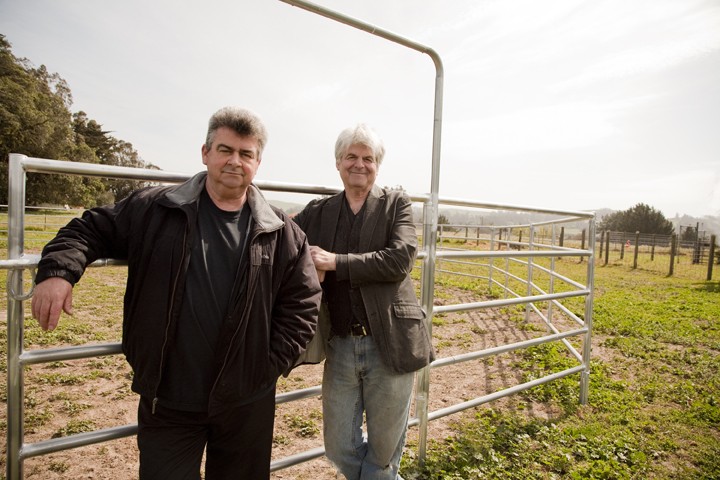
His Pirate Pizza Tuesdays had been on hiatus, but Sabbatini recently returned to the kitchen at the Bolinas Community Center, to the delight of the people of Bolinas (including this writer).

“I had a lot of people calling me, asking, ‘Where’s the pizza?'” says Sabbatini, a Marin County native who worked in a Novato pizzeria as a 14-year-old. “It’s good to serve the community,” he says. He serves the community with popular thin-crust pies such as the Island Heat, which features pineapples, pepperoni, garlic and jalapenos.

He cranks out up to 40 pies a night and offers it by the slice too.

Sabbatini started his business, Barbary Coast Bistro, several years ago with an emphasis on pizza and barbecue. Now he’s exploring a Kickstarter campaign to finance his Barbary Coast Bistro mobile cooking truck—or even a storefront pizza joint in Bolinas.

His vision for the truck, he says, includes organic sandwiches and tacos using locally sourced ingredients, along with the pizza. “I’m not looking to go fancy or high-end,” says the 34-year-old. “I’ve done foie gras and filet mignon. Now I’m interested in clean, wholesome, unpretentious food made with good ingredients.”

Enlightened Art

0

Tashi Dhargyal has big dreams—like, 300-square-foot-canvas dreams. And he’s making one a reality in his Sebastopol art studio.

At the Tibetan Gallery and Studio in Sebastopol’s Barlow retail district, Tibetan-born Dhargyal takes a rare break from painting to watch a World Cup match. Tibet doesn’t have a team in the tournament, but the nation is working on one, he says; it’s a long process—much like the 20-foot-tall traditional Tibetan thangka painting he’s been working on for the past year in the studio, and which will take another four years to complete.

“People pay attention to big things,” he says.

One of the reasons the thangka master is painting on a large canvas, known as a thanbochi, is to raise awareness of the ancient art form. Dhargyal is the first Tibetan artist to paint a thanbochi outside of Tibet. “I want people to see this art and learn about it,” he says.

A thangka is a Buddhist scroll painting usually featuring a Tibetan Buddhist deity or a mandala. There are six stages to creating a thangka. First, an artist creates the grid, which is based on the height of the central figure’s eye. All other parts of the painting are based on increments of this measurement. It took Dhargyal two months to draw his thanbochi with this grid.

Second is shading the sky and grass with mineral-based paint. The kind Dhargyal uses is hand-ground in India. Then comes the painting of solid colors, which is the stage Dhargyal’s massive masterpiece is in now. Next he will shade in all parts, giving the painting a three-dimensional look. After that is outlining the figures.

The final steps are what pushes thangka paintings over the top and distinguishes them from cheap imitations. Solder-like gold is melted with animal glue over steam from tea, then painted on as embellishment. Finally, tiny details are etched into the painting with an agate stone.

A striking facet of thangka paintings is their standard appearance. There are set measurements laid out in books detailing the art form, and the idea of artists signing their names to their work is relatively new. “This is a totally unique composition, but it is completely correct,” Dhargyal says about his thanbochi.

When the thanbochi is completed, it will tour museums before heading to its permanent home in a Tibetan monastery. But in the mean time, it will remain on display in Sebastopol while being being completed.

The Sebastopol transplant learned his craft at the Institute of Tibetan Thangka Art in India, which was founded on a request from the Dalai Lama and which has since been turned into a nonprofit dedicated to preserving the art form. The gallery sells pieces from artists at the school, and does not take a commission on the sales.

Why I Volunteer

0

I’m certain there are nearly as many reasons why people volunteer to help others as there are individuals who volunteer. For me, it was learning to cope with my wife’s death.


Like many of us, I had become a familiar witness to homeless people living on the streets. Like others, I often chose to ignore their plight or to assuage my conscience and feed my ego by handing them a few dollars and walking on. These people were anonymous and not like me, right?

One day, my bereavement counselor handed me a poem written by Molly Fumia. It spoke about that point when one truly enters into sadness, there comes “a precious moment of understanding the absolute value of one human being” and that “you will remember what you have learned, and never allow a single life to be devalued again.”

Reading this poem was an epiphany. I knew suddenly that the best way for me to address such devaluation of human life was to work with people who were homeless.

A week later, I was volunteering at my first Friday morning breakfast for the homeless.

The effects went far beyond providing a bowl of warm oatmeal and a cup of coffee to these folks. I left that morning feeling better than I had for many months. It was a feeling close to the “precious moment of understanding” that Molly Fumia wrote about.

Since that day, I have come to know the people on both sides of the table at the homeless breakfasts. I have come to appreciate them as individuals. I have learned that homelessness is a problem as complex as human society, and that there is great wisdom in the old saying that “there but for the grace of God go I.”

Thanks to Catholic Charities and the staff and clients whom I interact with every week, I am once again making my life meaningful and happy.

John Brundage is a Santa Rosa resident and volunteer for Catholic Charities.

Open Mic is a weekly feature in the ‘Bohemian.’ We welcome your contribution. To have your topical essay of 350 words considered for publication, write op*****@******an.com.

Sexual Healing

0

When FBI agents raided and shut down the MyRedBook.com sex-for-sale website in San Francisco a few weeks ago, thousands of solicitation and masseuse ads quickly disappeared—but so too did numerous ads on the site offering “sex surrogacy” services for men with special needs.

For some men, seeking out sex surrogacy on sites such as MyRedBook is the only option known to them, says a sex surrogate who contacted the Bohemian after the crackdown. The surrogate says the federal sting, along with recent masseuse-parlor busts in Petaluma and an enhanced focus on arresting johns, has the North Bay sex-surrogacy community fearing for its survival.

“A lot of guys have no social skills, and this is the only way that they can get touched by a woman,” says the source who like many sex surrogates works outside state-sanctioned channels of sex therapy and requested anonymity.

If prostitution is the world’s oldest profession, then sex surrogacy is perhaps the second-oldest—but one field has nothing to do with the other, says Vena Blanchard, a pioneer in the American sex-surrogacy movement at the International Professional Surrogates Association (IPSA), a training and certification organization based in Los Angeles.

A key facet that distinguishes sex surrogacy from prostitution, in the legal sense, says Blanchard, is that “surrogates are not soliciting clients to come to them—they are working with therapists.”

Men who use the services of sex surrogates include amputees and guys with other disabilities, 40- year-old virgins (hey, it happens) or men who, for whatever reasons, simply cannot develop healthy, intimate relations with women. Married couples will engage in surrogate-partner therapy to help teach men a little more tenderness.

The sex-surrogate source who contacted the Bohemian says the value in advertising on places like MyRedBook is that it draws men who may not find their way to sex therapy because they’re intimidated, can’t afford it or don’t know it’s out there. There are several dozen IPSA-certified sex surrogates in the country, and those come to clients via referrals from licensed sex therapists.

“Some guys have no other outlet” than to find a sex surrogate, says our source, who adds, “I don’t see any free therapy going on out there.”

The source’s concerns about legal exposure may be overblown, says a veteran Bay Area sex therapist.

“As far as I know there has been no legal hassle of surrogate partners or their clients in the 30 or so years I’ve been practicing and writing,” says sex-advice therapist Isadora Alman, who writes the popular “Ask Isadora” advice column.

The source’s MyRedBook ad, she says, emphasized gentle and healing touch, no fishnet stockings or other sexy lures—contrasted with the salacious sea of some 35,000 ads for escorts and happy-ending masseuses.

“Sex therapists have a hard time forwarding to sex surrogates,” says the source, who has been a professional sex surrogates for decades, she says. “It’s a scary time to have to start scrambling for business.”

Blanchard says sex surrogates were “ill advised” to advertise on sex sites like MyRedBook.

Legally speaking, “surrogate-partner therapy doesn’t exist in a gray area,” says Blanchard, thanks in no small measure to State Attorney General Kamala Harris, who, while an Alameda County prosecutor, affirmed the legality of regulated sex therapy, including the use of sex surrogates.

Harris told the San Jose Mercury News in 2010: “If it’s between consensual adults and referred by licensed therapists and doesn’t involve minors, then it’s not illegal.”

Even then, says Blanchard, “only a teeny, tiny percentage would even be considered ‘sex’ under California law. Most of it is about relaxation, nonsexual touch; it’s about learning how to focus attention on your partner.”

“I don’t have a problem with the sex-work industry,” Blanchard adds, “but it’s not at all the same thing as surrogacy.” Mixing the ads, she says, “can be confusing to the public, and possibly to law enforcement, if you start fuzzying the boundaries between them.”

Clients in sex-surrogacy programs learn some basic stuff, like how to hug, and Blanchard describes the therapeutic process as a months-long “gentle progression” toward—maybe—actual sex with a surrogate.

“You can’t resolve the difficulty if you can’t get close to the behavior,” she says.

July 22: Matt Schofield at City Winery

His blonde locks and baby-face bely guitarist Matt Schofield’s 36 years, but when the British musician takes the stage, he’s a blistering blues artist. He’s already received accolades across the pond and in the States, Schofield is storming venues with his tasty licks and stellar songwriting. His latest collection, Far As I Can See, sees the guitarist in top...

Riesling Rising

The more I discover about Riesling—which is world-class not only in "cool climates" like Alsace and the Rhineland, but also in places like Clare Valley, Australia, where it stands nearly shoulder to shoulder with Shiraz—the less I accept the conventional wisdom about why it's lost favor in the North Coast. Here are some local surprises: Gustafson 2013 Heritage Tree Vineyard...

Letters to the Editor: July 16, 2014

Ravitch's Decision What if everyone was allowed to admit mistakes, even law enforcement officials? What if honesty and humility were considered signs of strength? What if the asking for and giving of forgiveness were met with compassion? What if asking for and giving forgiveness were signs of strength? What if understanding was more important than blame? Might not the aftermath...

London Calling

As the show begins, the sun sets over the hillside vineyard visible just beyond the stage. By the time it all ends, the moon has fully risen over the makeshift outdoor theater. While the main draw of Transcendence Theatre Company's annual Broadway Under the Stars shows in Jack London State Park are the Broadway performers, the obvious co-star of the...

Full Speed Ahead

No matter the context—boom, internet or videogame hedgehog—when the word "sonic" comes up, people think of speed. As for Sonic.net, the Santa Rosa–based internet provider, its growth hasn't been as fast as others, but it's picking up steam 20 years after its founding. Sonic is the first company to offer residential gigabit fiber internet service in California and is expanding...

Debriefer: July 14, 2014

In the aftermath of Sonoma County District Attorney Jill Ravitch's decision not to file charges against sheriff's deputy Erick Gelhaus for the shooting of Andy Lopez, a task force set up last winter to examine police accountability vowed to push harder for reform, even as one member of the task force said she wasn't surprised by Ravitch's move to...

Return of the Pie Man

John Sabbatini says he's done just about everything in his 20 years as a chef and caterer—from a stint at Harry's Bar to a run as sous chef at the now-closed Noonan's in Larkspur. These days he's working at An Affair to Remember, a big catering outfit in San Rafael—and, praise the Lord and pass the pepperoni, he's again...

Enlightened Art

Tashi Dhargyal has big dreams—like, 300-square-foot-canvas dreams. And he's making one a reality in his Sebastopol art studio. At the Tibetan Gallery and Studio in Sebastopol's Barlow retail district, Tibetan-born Dhargyal takes a rare break from painting to watch a World Cup match. Tibet doesn't have a team in the tournament, but the nation is working on one, he says;...

Why I Volunteer

I'm certain there are nearly as many reasons why people volunteer to help others as there are individuals who volunteer. For me, it was learning to cope with my wife's death. Like many of us, I had become a familiar witness to homeless people living on the streets. Like others, I often chose to ignore their plight or to assuage...

Sexual Healing

When FBI agents raided and shut down the MyRedBook.com sex-for-sale website in San Francisco a few weeks ago, thousands of solicitation and masseuse ads quickly disappeared—but so too did numerous ads on the site offering "sex surrogacy" services for men with special needs. For some men, seeking out sex surrogacy on sites such as MyRedBook is the only option known...
11,084FansLike
4,446FollowersFollow
6,928FollowersFollow