Water World

‘Love is for the bold! You have to be willing to risk everything!”

So exults Belmira, an impetuous young bride-to-be in Marisela Treviño Orta’s stunning River Bride, one of four plays that just opened the Oregon Shakespeare Festival in Ashland.

The flirtatious Belmira is speaking of romance and escape, but she could just as well be describing the artistic risks taken by Orta with her extraordinary script, first staged in San Rafael in 2014, now given a magical makeover in Ashland by director Laurie Woolery.

A slinky blend of Grimm’s fairy tales and Brazilian river mythology, the play was developed locally as part of the AlterLab new play development program, an arm of Marin County’s award-winning AlterTheater. Co-directed in San Rafael by Ann Brebner and Jeanette Harrison, the original production used only a few wooden blocks as set pieces. In Ashland, this deeply affecting tale of transformation and heartbreak has itself been transformed, with the use of ingeniously simple effects that bring the Amazon River and its fishing villages to life.

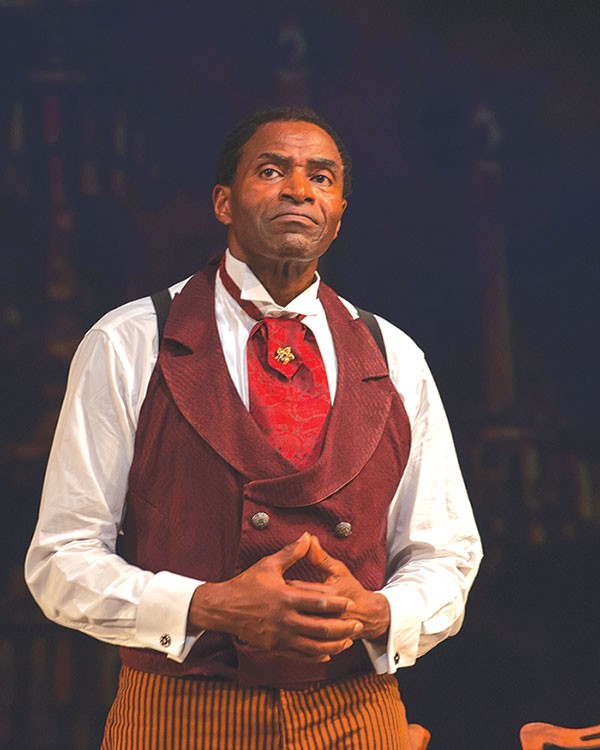
With the wedding of Belmira (a playfully sexy Jamie Ann Romero) and local fisherman Duarte (a coiled and intense Carlo Albán) just three weeks away, the bride’s older sister, Helena (Nancy Rodriguez, spectacular), is doing her best to hide her own broken heart, having loved Duarte since childhood. During a stormy day of fishing, Duarte and the sisters’ goodhearted father, Senhor Costa (a delightful Triney Sandoval), haul up their nets to discover they’ve caught a well-dressed, unconscious stranger named Moises (Armando McClain, who makes an art of enigmatic smoldering). Initially suspicious, Senhora Costa (Vilma Silva, also excellent) soon welcomes the soft-spoken newcomer, who quickly forms an instant bond with Helena.

The scenic design by Mariana Sanchez places simple set pieces—a wooden dock, a boat, a framed house on stilts—above a glistening splash of watery blue. The video design by Mark Holthusen works wonders, from a glittering sprinkle of stars and the rising and setting of the sun, making us wonder if the whole story is no more than a dream itself—or perhaps only the echo of life-altering love, nearly found, but lost at last in the depths of the river.

Rating (out of 5): ★★★★★

Projections, the photographic kind, also play a significant part in Christopher Liam Moore’s equally bold – but far less consistently satisfying — staging of Shakespeare’s gender-bendy Twelfth Night. Amongst Shakespeare’s most popular and enduring comedies, Twelfth Night is the story of a grieving, shipwrecked woman named Viola (played her by the effectively tom-boyish Sara Bruner), disguising herself as a young man while making her way in a strange land—and since lands don’t get any stranger than Hollywood, the story has been moved from ancient Illyria (aka Croatia) to Tinseltown of the 1930s. Viola soon finds herself at the center of an entertainingly uncomfortable triangle of unrequited love, balancing her sense of loss (she believes her brother just drowned in the shipwreck that her here) with the bipolar giddiness of new love.

The show opens with a black-and-white “newsreel,” firmly establishing the movie-world premise, cleverly tossing in a crowd-pleasing “Illyria Studios” logo, complete with roaring bear. An onstage pianist plays an appropriate soundtrack to the ensuing mayhem, which includes one of the Bard’s best cast of supporting players—a grieving, also somewhat love-struck, washed-up movie star and full-time drunken uncle, Sir Toby Belch (Daniel T. Parker); a gleefully clueless, martini-swilling suitor (Danforth Comins); a pleasantly acerbic song-and-dance comedian (Rodney Gardiner), and Olivia’s assistant, the tender-hearted yet not-to-be-trifled with Mariah (Kate Mulligan).
That’s only one of about two-dozen major alterations Moore has made to Shakespeare’s play, practically daring purists to ask whether it is acceptable to shoehorn Shakespeare’s plays into containers they don’t quite fit into. In answer to that question, Moore takes a tip from Cinderella’s stepsisters, and simply lops off anything that doesn’t fit. If that notion offends you, then you probably won’t be able to enjoy the messy, mirthful, emotionally powerful, slapstick-driven, frequently confusing, constantly inventive, occasionally frustrating, even angering, but often joy-filled and free-spirited, totally manic-depressive overhaul of Shakespeare’s classic story.

Much of this doesn’t work, but just as much of it does.
Once attached as assistant to Illyria Studios’ owner and primary movie director Duke Orsino (Elijah Alexander, spouting a pouty German accent, and generally behaving so oddly as to make his usually magnetic character almost attraction-free), Viola—using the name Cesario—becomes her/his boss’s reluctant emissary, taking love notes to the beautiful, suddenly reclusive, Olivia (a stunning, and stunningly good Gina Daniels), who is grieving the recent death of her father and brother. In a flash, she falls in love with Cesario/Viola, who’s already fallen in love with Orsino. Complicating matters is the recent arrival in town of Viola’s presumed-dead twin brother Sebastian, also played by Bruner. That choice, to have one performer play both Viola and Sebastian, solves one of the biggest problems inherent in Shakespeare’s text, which is that in Illyria – sorry, in Hollywood! – everyone keeps confusing the two identical twins for each other. Well, in this production, that’s east to see why, because, despite Bruner’s careful attention to giving each twin a different body posture, even the audience becomes occasionally confused about which one is which.
That confusion is just one of the problem’s Moore’s “solution” brings with it. The ending, for example, when the twins finally see each other for the first time, is assailed here in a truly creative and impressively high-tech fashion, but unfortunately it is entirely drama crushing and momentum-killing. Yes. It’s true to the Silver Screen theme of the production, but like an enormous FX overload at the end of a superhero movie, it’s so big it distracts from the joy of the moment, and from the simple, honest and beautiful emotional truth the actors have worked so hard to create.

And then, Moore suddenly regains that lost sense of joy by re-embracing the Hollywood concept one last time, in a lavish, curtain-closing tap dancing spectacle featuring the entire cast in tuxedos and gowns, joining together in an upbeat Cole Porter-style setting of the song Shakespeare wrote to close the show, with a few additional lyrics borrowed from one of the Bard’s sonnets.

Whether you leave this transgressive, transcendent staging of ‘Twelfth Night’ believing it to be a hot mess with a large number of brilliant moments, or an ingenious production with a fair number of bold-but-astounding failures, will ultimately depend entirely on your own personal tastes.

★&#9733&#9733

That may also be true of ‘The Yeoman of the Guard,’ staged in the small Thomas Theater as a wild country hootenanny in the middle of which a British comic opera breaks out. Adapted (read: thoroughly rewritten) by Sean Graney, Andra Velis Simon and Matt Kahler (the latter of whom also directs), the show is done in the same audience-participation style that the collaborators developed for their popular Chicago-based theater company The Hyprocrites.

The key component of a Hypocrites show is the notion of “proscenium seating,’ in which audience members purchase (in advance) a seat on the stage. In this case the stage—surrounded by bank of traditional seating from which the more timid audience members can safely observe—is a kind of over-the-top honkytonk complete with pool table, hay-bales, fully functional rocking horses, and various platforms and planks on which to sit. There is even a working bar at one corner, which remains open during the entire 90-minute show, and yes, audience members are encouraged to go get a beer on tap at any moment they feel like it.

And yes, that’s a little distracting.

And yes, that’s part of the point.

At a time when theater is simultaneously undergoing a kind of rough restart, as young theater-loving artists work hard to develop new ways of doing theater for a new less-formal generation, this production of ‘invigorating crazy-quilt sense fun that theater, at times, can so brilliantly bring. That it uses methods that were tested in the “underground theaters” of the Sixties and Seventies, doesn’t make it feel any less revolutionary.

The setting of Gilbert and Sullivan’s 125-year-old operetta was the Tower of London, and the story dealt with an innocently convicted man sentenced to die, and the various attempts of local friends, lovers and visiting minstrels to save him. In the OSF version, the story has been given a gleefully cartoonish country western vibe, with names and situations altered wildly to fit the new theme.

The impressive cast is a seamless ensemble of OSF company members and imports from Chicago, and it doesn’t take long to figure out their blend of cartoonish postures and over-the-top emotional distress. Standouts include Michael Sharon as Shadbolt the Jailer, who frequently laments, “I am hideous,” with so much comic despair, it’s hard to know weather to laugh or cry. And then there are the brilliant K.T. Vogt as the avaricious local warden Carruthers and Anthony Heald as the goofily cowboy-ish Deputy Dick Chumlee. Also excellent are Jeremy Peter Johnson as the imprisoned Fairfax (who is almost upstaged by his stunning “signature beard”), Kate Hurster as Elsie, a wandering country singer who becomes involved in the plot to save Fairfax, and Britney Simpson as both Phoebe Meryll, who loves Fairfax (The way she says “I love him” is like a three course meal of dead-serious emoting) and Crazy Kate, whose name fits.

Then there’s the dialogue, which includes much of Gilbert’s tongue-twisty wordplay, but throws in such corn-fed bon mots as “That’s sweeter than a squirrel playin’ Scrabble with a kitten!”
The cast rises nicely to this heightened level of lunacy, all of them playing musical instruments to accompany the abbreviated versions of the giddy, word-drunk G&S songs, which work surprisingly well as country western tunes.

But the star of the show is the concept.

With 70 extra human beings on stage, most of them sitting in places the cast occasionally needs to stand, there is a sense of controlled mayhem and traffic control going on at all times, with people standing up to get out of the way of singing and dancing actors, then looking for another place to sit. One enterprising youth discovered a safe spot near the pool table, under which she’d duck whenever she saw the actors coming.

Does any of this enhance the story or add to the dramatic arcs of the characters? Of course not. Eventually, the experience is only half about watching the story unfold, and half about watching a brave and bold band of performers pull it all off. For the purists, there are always other productions that focus on the plot and the music. For those looking to remember that theater, at its heart—and certainly in Shakespeare’s time—always felt a little bit dangerous, immoral and wrong, this is the show for you.

&#9733&#9733&#9733½

The most traditional of all the newly opened shows is a world premiere adaptation of another classic. Charles Dickens’ ‘Great Expectations’ has never been an easy story to adapt. Most movie versions choose to focus on the gothic elements—the graveyard, the spooky house, the crazy lady in a tattered wedding dress—and let the emotional core of the story, in which a young boy learning what it means to be a good man, fall by the wayside.

In this lovely, emotionally grounded, truly beautiful adaptation by Penny Metropulos and Linda Alper, the flashier elements are all represented, though Metropulos (who also directs) uses a vast, mostly bare stage to strong effect, cleverly providing one or two visual prompts—fog in the graveyard, a flash of red light during a climactic fire—and allows the audience’s imaginations to fill in much of the detail. The heavy lifting here is done not my a sense of visual spectacle, but by the powerhouse poetry of Dickens’ words, and the brilliant performances of a large, tone-perfect cast.

Pip (played as a boy by Bohdi Johnson, then by Benjamin Bonenfant) is an orphan, apprenticed to a kindly blacksmith (Al Espinosa) but constantly reminded of his social position by his abusive older sister (Erica Sullivan). After an encounter in the graveyard with a terrifying escaped convict (Derick Lee Wheeden, magnificent), Pip steals food to feed the criminal, an act he sees as sinful and cowardly, setting up an internal moral fracture that he will wrestle with for the rest of his life.

It’s that moral question—“When is an act of cowardice or cruelty also an act of kindness, and does the part erase the bad, or vice versa?”—that is at core of Dickens’ story, and the adapters wisely embrace the question at every turn.

After Pip is hired to be the playmate of the wealthy Estella (Flora Chavez, then Nemuna Ceesay), who is the ward of the mysterious Miss Haversham (an excellent Judith Marie-Bergan), Pip soon falls in love, and believing himself to be unworthy, sets his sites on becoming a gentleman, rich and deserving enough of the beautiful Estella. Pip expectations are given a boost when the stern, disapproving lawyer Mr. Jaggers (Michael Elich, perfection) appears to offer the young man an opportunity in the form of a large monetary bequest from a secret benefactor, Pip’s journey into manhood is set on a series of unexpected courses.

Eschewing (with a few acceptable exceptions) the kind of showy, melodramatic performance Dickens is often treated to, Metropulos’s actors are first and foremost real people, and we see the broken hearts and fearful dreams that motivate them. The play is long (just under three hours) but is worth the time spent. Lovingly crafted, full of rich and transporting relationships, this ‘Great Expectations’ is one of the best and smartest stage adaptations of Dickens’ to come along in quite some time.

★★★★

Troubled Tenants

0

This story on rent control in Sonoma and Napa counties was removed on June 7, 2016 because a freelancer who co-authored the piece could not provide supporting documentation required by the Bohemian’s editorial standards.

Energy Bar

0

‘This place has a very high level of energy,” Jean-Charles Boisset says of his new tasting room in Yountville. Obviously, with Boisset in the room, it would have to, wouldn’t it?

With his own special blend of international playboy flash and down-to-earth biodynamic ideals, Boisset, the 46-year-old scion of a Burgundy-based wine group, has been busily buying and transforming Sonoma and Napa County wineries over the past 12 years. And while he has meticulously preserved and enhanced established brands like Raymond, DeLoach and historic Buena Vista, he couldn’t help but install a bit of “JCB” style in each. But in this combination wine boutique and gourmet deli, it’s all JCB all the time.

How to recognize JCB style: Do you see Baccarat chandeliers? Crystal skulls? Leopard-print upholstery? If you checked all of the above, you’re probably in a JCB property.

Wearing a sequin-lapeled jacket, Boisset was on hand recently to explain his eclectic vision to a group of media folks. At other times, his digital image still smiles at you from a touch-screen table (interactive tasting, $40). Visitors may sip the premium collection tasting ($30) at the bar, while lounging on leopard print, or at the long central table—”And that is a very high-energy table,” Boisset wants to remind us. Looking up, we see that the chandelier above the table has not stopped spinning. It functions as a sort of vortex, says Boisset, to assist in moving people through the room.

Curiosity is enough to draw one into the glittering Surrealist Boutique, in which a portion of the bar top is swirling as well as your flight of Surrealist wine ($50), so watch where you set that glass. Everything’s for sale—from walking sticks to decanters, plus brooches, cufflinks and earrings designed by Jean-Charles, with the exception of the items in the “bondage cabinet,” a visual non sequitur.

The other half of the joint is Atelier by JCB, a wine country deli gone wild. The mountain of local and imported cheeses is exciting enough; local gourmands with a Sonoma or Napa County address get a 10 percent discount on jamón ibérico, foie gras, Dijon mustard and Scottish smoked salmon. And, yes, escargot.

JCB wines retail from $25 to $350. “At $200, we barely make it,” Boisset says of the No. 50, a sparkling Chardonnay made from top Burgundy vineyards that floats like a butterscotch cloud over the tongue. Leaner and drier, the Infinity sparkling wine ($75) displays a fine bead that emerges in a perfect circle on the surface—or is it a vortex?

JCB Tasting Salon & Atelier, 6505 Washington St., Yountville. Daily, 11am–7pm. 707.934.8237.

Taking the 5th

0

Hunter S. Thompson, the mad genius of gonzo journalism, saw fear and loathing in Las Vegas, Miami, Washington, D.C., and San Francisco. He also recognized it at the Kentucky Derby and in the horse race known as electoral politics, especially in the race for the White House, but on the local level as well.

This spring, he’d probably notice much the same phenomenon around the country and in the 5th District in Sonoma County, where two women candidates face off against one another furiously, while undecided voters smile politely and say, “Have a nice day.”

With steep mountains, lush valleys, a rugged coastline, the meandering Russian River, plus vineyards, wineries, marijuana gardens and award-winning restaurants, the 5th offers a rich cultural mix to locals and tourists who come year-round and who have made it a popular destination.

The 5th is also a complex political landscape with fierce loyalties and deep-seated rivalries that, insiders say, offers a glimpse into the new profile of the California electorate and the decisive role that millennials and Mexican-Americans will likely play in selecting office holders and defining issues and solutions.

Efren Carrillo, the incumbent, currently represents the district on the Sonoma County Board of Supervisors that does double duty as the board of directors of the Sonoma County Water Agency, which has increased responsibilities for conservation in a time of drought.

Arrested twice in the last five years and dragged through the mud in the media, Carrillo has chosen not to run for reelection and risk further embarrassment and injury to his image. In 2012, he was arrested at a nightclub in San Diego and charged with battery and disturbing the peace. In 2013, police officers took him into custody in Santa Rosa and charged him with burglary and prowling while under the influence of alcohol.

What’s at stake in the race for Carrillo’s replacement isn’t only the political future of the 5th, but also the direction of Sonoma County and, one might say, its very identity. The two leading candidates, Noreen Evans and Lynda Hopkins, offer alternative visions and approaches, in much the same way that those two Democrats, Bernie Sanders and Hillary Clinton, offer alternative visions and approaches on the national level, though it’s probably not fair to compare Noreen and Lynda to Hillary and Bernie. The representative from the 5th will be the swing vote on the five-member board and in a position to shape matters that affect water, land use, housing and more.

On the surface, the 5th might not seem ripe for “fear and loathing,” a term which could be translated as “the dark side.” Still, staff members in county offices, and veteran political pundits such as Sonoma State University professor David McCuan, say the 5th is indeed Thompson territory and that his brand of gonzo journalism is sorely needed today.

“Hunter was about honesty with oneself and one’s psyche,” McCuan says from his office on campus. “He was also about taking risks and challenging the status quo, with the potential to flame out in a blaze of glory.” Indeed, he put a gun to his head and took his own life at the age of 67.

Forty-three years after he published Fear and Loathing on the Campaign Trail ’72—the book in which he dissects Richard Nixon, George McGovern and Edward Kennedy—Thompson sounds spot on. In fact, he might have been talking about 2016, not 1972, when he observed that “Covering a presidential campaign is not a hell of a lot different from an assignment to cover a newly elected district attorney. You find unexpected friends on both sides, and in order to protect them you wind up knowing a lot of things you can’t print, or which you can only say without hinting where they come from.”

Frank Robertson knows what Thompson means. A longtime journalist who has written insightfully about West County politics for more than three decades, Robertson says that politicians and their aides often insist that their comments are off the record, though, as he points out, “off the record is a movable definition.” Part of the story of almost any campaign is the invisible side that’s rarely if ever covered in the media.

Indeed, politicians and reporters, for different reasons, collude with one another and keep vital information from the public. “Sad but true,” a veteran editor who has worked for Esquire, Life and Bloomberg News told me.

Reporters, especially those with a beat at a daily paper, tell me they’re bound by the rules of newsgathering and can’t disclose their sources or reveal information because it’s protected under the rubric of confidentiality. What made much of Thompson’s reporting so compelling was that he stretched the rules. Robertson does, too, in his own way, and he’s kept his job for decades.

[page]

West County candidates, he says, have suggested that, in his role as a journalist, he smear their rivals, even as they mean to keep their own hands clean. Robertson tells me he’s declined to do their bidding. In fact, he could write a history about fear and loathing in the 5th that would go back to the days of Congressman Doug Bosco and the “Bosco boys,” otherwise known behind closed doors as the “Bosco mafia.”

In West County, journalists find friends and enemies on all sides of the political divide. Thompson would probably hear strictly confidential comments about Noreen Evans, 60, Lynda Hopkins, 32, the two frontrunners in the race. Jack Piccinini, a Santa Rosa firefighter who added his name to the list of candidates when he learned that Evans was running, dropped out of the race. “I didn’t want a professional politician to engineer their way into the 5th District,” he said.

Three other candidates, Timothy Sergent, a Forestville resident and special-education teacher; Lew Brown, a Guerneville resident and attorney; and Marion Chase, a West County resident and county eligibility worker, are in the running but for now considered long shots.

From the start, mudslinging has defined much of the campaign. It went front and center when opponents of Evans pointed out that she bought a house in Sebastopol so that she’d be eligible to run for office in the 5th. Bennett Valley had been her home. Voters wonder who truly belongs to West County and who will best represent its interests. Even Evans’ supporters describe her as a “carpetbagger.”

A lawyer, two-term Santa Rosa City Council member and Sacramento insider, Evans served in the California State Assembly for six years. With endorsements from three members of the current board of supervisors, she’s probably the candidate of the establishment and big labor too. Unions like her and she likes them.

Hopkins has never held elected office, though she was the executive director of Sonoma County Farm Trails. Transparency in government is one of her rallying cries. A Stanford graduate, organic farmer—with her husband at Foggy River Farm west of Windsor—and author of The Wisdom of the Radish, she’s been called “a spoiler” by some. Indeed, her grassroots campaign threatens to upset Evans’ road to what looked like a shoo-in victory at the June primary.

It’s not the presence of two women that brings the element of fear and loathing to the 5th, though two women front-runners offers a big change for the district. For the most part, the 5th has been dominated for decades by testosterone-rich wheeler-dealers.

Before the current supervisor, Carrillo, there was Mike Reilly; before Reilly, there was Ernie Carpenter, and before Carpenter there was Eric Koenigshofer, the new kid on the block when he was first elected in 1976. Now he’s a kind of behind-the-scenes decisionmaker—an éminence grise, the French would say—and the lawyer for the Ratto Group, which handles most of the county’s lucrative garbage and recycling business.

At first, Koenigshofer tried to persuade Hopkins not to run for office on the grounds that she couldn’t defeat Evans. Then, when he didn’t succeed, he endorsed her. If you can’t beat ’em, join ’em.

Ever since Koenigshofer’s election 40 years ago, an old boys’ club (with a few women added to the mix) has dominated the political landscape in the 5th. It might well be on the way out. Either Hopkins or Evans will join Susan Gorin, from the 1st District, and Shirlee Zane from the 3rd, and give women a majority on the Sonoma County Board of Supervisors. That would be a first, though Helen Rudee, now 98, broke the glass ceiling in 1976 when she was elected to the board of supervisors and shifted the conversation about gender and power.

Women between the ages of 50 and 70 tend to support Evans. Here and elsewhere they also tend to support Hillary Clinton rather than Bernie Sanders. In December 2015 at Foggy River Farm, Hopkins described herself in a conversation with me as a Sanders supporter and “a change-the-world and shake-my-fist kind of person.” She’s feisty, spunky and radiates a kind of folky glamour.

Sebastopol mayor Sarah Glade Gurney, 63, stands firmly with Evans, though so far, she has not broadcast her affiliation. She identifies more with boomers in her own generation than with millennials, and, though she has heard no end of complaints from citizens during her 12 years in government, she likes to think of Sebastopol as a friendly town where everyone knows everyone else and gets along just fine.

“I have a good sense of humor,” she tells me at her office just off the plaza. “Humor makes it possible not to take disagreements too personally.”
Hopkins is too new to the political game to not take the comments that she hears about her and her campaign personally. She can be defensive when she feels herself under attack, but she’s also outspoken about a political system that she insists has failed the democratic process and abandoned transparency on the national and local level.

More than anything, it’s probably the lack of transparency, as she sees it, that has motivated her campaign. Then, too, she’s fired up by the lingering influence of old-school rules. The glass ceiling, she argues, wasn’t broken once and for all, and that an old boys’ network continues to operate in Sonoma County.

[page]

Still, she has backers on nearly all sides and from almost every persuasion, including Janet Nicholas, a Republican and a winery owner who served on the California State Board of Education. (Perhaps there’s an old girls’ network to rival the old boys’.) Hopkins went to college with Nicholas’ daughter and values the encouragement she has received from the mother.

Moreover, in addition to an endorsement from supervisor James Gore, Hopkins has the support of the Sonoma County Alliance, a broad-based organization that includes businessmen and women who are concerned, the website proclaims, “about the economic, social and environmental development of Sonoma County.”

Compared with Evans, Hopkins’ experience is spotty at best. Even Herman G. Hernandez, 30, Hopkins’ handpicked, trusted campaign manager, points to Evans’ long, respectable political record close to home and in Sacramento. “I think she did a great job on the Santa Rosa City Council and when she was in the State Senate,” he says. “She has always acted to protect the coast, and her record on labor is 100 percent.”

Herman G. Hernandez—son of Herman J., founder of the Latino leadership group Los Cien and a Latino mover and shaker—doesn’t dislike Evans as a candidate and private citizen. He doesn’t sling mud in her direction. It’s just that he firmly believes that Hopkins would be much better in office than her principal and principled opponent.

For starters, Hernandez explains that his candidate won’t merely sit in an office, talk on the phone and send emails. Rather, she’ll actually be out and about in the community as a public servant—not just an elected official—working for the good of the whole community, which means protecting the coast and providing services for the homeless.

“Lynda has education, experience and energy,” Hernandez tells citizens when he pounds the pavement and knocks on doors in Roseland, the inner city neighborhood that he knows from the inside out, to Guerneville, where he was raised and where he lives now after college away from home at San Diego State University.

“Lynda is a champion of the environment,” Hernandez adds, “supports sustainable, organic, farming and wants to move agriculture into the 21st century. Then, too, she aims to create jobs, encourage small business and represent the working class. Moreover, as the mother of two toddlers, she understands the importance of early childhood education.”

From his perch at Sonoma State, McCuan keeps a close eye on the race. A realist, he looks at statistics and doesn’t let himself be swayed by political rhetoric.

“I’m a data agnostic,” he says. Still, he admires Bernie Sanders and seems to lean toward Hopkins and Hernandez, though he also argues that they’re probably using one another to advance their own careers. But as he knows, that’s often the norm on the campaign trail.

McCuan watches the 5th to see what the race there might say about the future of politics, not just in Sonoma County, but all across California. Indeed, as the 5th goes, so may the Golden State. “This election offers a window on the changing face of the new electorate,” McCuan says. “In 2016, there might very well be a changing of the guard. In some ways, the race here as elsewhere depends on the hipsters who are age 25 to 35 and who fled from the cities and flocked to the countryside. Their vote is crucial. Kamala Harris, the state’s attorney general, and Gavin Newsom, our lieutenant governor, both appeal to that demographic.”

McCuan doesn’t want to make predictions about the outcome of the campaign in the 5th, but he suggests that Hopkins might not yet be ready for prime time. Occasionally, she seems to share his perceptive. “If I lose, I can still go back to farming,” she told me. Still, she’s not slowing down, and neither is Hernandez. Indeed, they’re both fearless and hopeful and resolved not to turn back or become sidetracked.

“We’re going all out,” Hopkins says. “We’ll spend more energy, knock on more doors and talk to more people than anyone else running in the 5th.” So far that’s been true. A candidate at 32 can almost always out-hustle a candidate at 60. Youthfulness has advantages over experience.

Not long ago, when Hopkins met with Supervisor James Gore, she asked, “Is politics like farming, where you don’t know what you’re getting into until you’re over your head?” Gore laughed and nodded his head yes.

A few months into her campaign, Hopkins is already head over heels in love with politics and eager to go bravely into unknown territory. Maybe Hunter S. Thompson, a bear with a heart, would cheer her all the way to the finish line.

Jonah Raskin lived in West County for 28 years. He’s the author of ‘Marijuanaland: Dispatches from an American War’ and ‘Field Days:
A Year of Farming, Eating and Drinking Wine in California.’

Letters to the Editor: March 9, 2016

Fry Guy

Share a large fry and celebrate existence at Sequoia Burger, a national treasure (“Satisfaction,” March 2).

Via Bohemian.com

Wine Money

Look into how much money winery owners are giving to Bill Dodd’s campaign, and yet deforestation and pesticide/herbicide cancer rates are soaring in the Napa Valley (“Dodd & Country,” Feb. 10). Someone is “bought.”

Via Facebook

Good Glasses

I find restaurants with Coravin offerings have saved me from drinking either poorly chosen wines by the glass or the aforementioned poorly stored and cared for wines by the glass (Swirl, March 2).

Via Bohemian.com

Cannabis Compliance

We would like to address the issue brought up in the letter “Doing the Right Thing” (Feb. 24). It is true there has been a lack of participation in farmers registering with the water board, but the important question is, why? In complying with this registration request, farmers will be exposing themselves to being placed on a publicly accessible site, thereby relinquishing their privacy and being at risk of vandalism. While this waiver is indeed another step toward compliance, the lack of protection and safety for the farmers, their families and their livelihood is a major concern that needs to be addressed immediately.

We at the Sonoma County Growers Alliance (SCGA) are working daily to support farmers developing responsible best-management practices regarding the environment and their community. We applaud those that are taking steps toward compliance with the new laws. In order for the next generation of cannabis operators to be successful, it is imperative that people feel comfortable moving out of the shadows and becoming more actively engaged community members.

We at SCGA are helping to facilitate this transition and we appreciate the Bohemian for its continued coverage of cannabis happenings throughout the county. Twice a month, SCGA hosts educational workshops, the Learning Laboratory, as well as monthly social mixers for professionals across all industries to network. Representatives are in attendance at the board of supervisors meetings as well as local city council meetings keeping a finger on the pulse of the industry in Sonoma County, so together we can be informed and active in the formation of fair legislation.

Via Bohemian.com

Write to us at le*****@******an.com.

Debriefer: March 9, 2016

0

NO GOOD DEED

Here’s a snapshot that dials in on the love-hate dynamics of urban policing, circa 2016: Debriefer went on a police ride-along with the Santa Rosa Police Department a few weeks ago. At one point, the officer pulled over a woman who was driving sans headlights; his partner in another squad car arrived to assist, “in case anything goes sideways,” as the officer put it.

Officer James Page (aka Jimmy) approached the car, only to discover the registration was out of date, and the car wasn’t insured. On top of it all, the driver was having a very, very bad day. So the officer showed some mercy and cut her a break—a warning about the insurance.

The driver was visibly grateful as the officer wrote up a ticket for the registration lapse, just as another car sped by and its passengers flipped off the cops. They just laughed. The woman went on her way.

CRABBER RELIEF

U.S. Rep. Jared Huffman was at Fisherman’s Wharf in San Francisco last week to tout his Crab Emergency Disaster Assistance Act, which aims to help state crabbers who have been hit hard by a ban on commercial Dungeness crab fishery. The bill comes on the heels of low-interest loans offered to the fishermen from the Small Business Administration and a federal disaster declaration prompted by Gov. Jerry Brown.

Huffman’s bill would appropriate $138.15 million for state crab fishermen and related businesses, and send $1 million for crab testing and another
$5 million “for competitive grants distributed by the National Oceanic and Atmospheric Administration for research on harmful algal bloom prediction and domoic acid toxicity.” Sen. Barbara Boxer has introduced a similar bill in the Senate.

Huffman’s bill requires a congressional vote, but those have been in short supply of late as Congress wrestles with late-stage Obama Derangement Syndrome, a fate even worse than domoic poisoning. Word is, the Senate won’t even think about the Supreme Court vacancy until next year, pledges Sen. Mitch McConnell. But it’s not like Huffman and Boxer are proposing to replace Antonin Scalia with Crusty the Crab.

ROSELAND AND THE RENT

Housing is on everyone’s mind these days, and so is the proposed annexation of Roseland into Santa Rosa. That historically Latino part of the unincorporated city may very quickly find itself in the crosshairs of developers once it is annexed into the city of Santa Rosa later this year. Once annexation happens, Santa Rosa also acquires “a large number of developable sites,” says city councilwoman Julie Combs. As our news story relates this week (page 6), Combs is pushing for a rent stabilization program in the city and says Roseland is a perfect—if perfectly at-risk— candidate.

“As we annex and improve on the roads and infrastructure, Roseland is at risk for gentrification and displacement,” Combs says. “The key is to do [the annexation] and preserve what is really good in that community—a cultural characteristic that’s a real pleasure. We don’t want to lose that diversity.”

Pond Farmers

0

Situated near Guerneville in Armstrong Woods, the Pond Farm is the legacy of ceramic artist and educator Marguerite Wildenhain. This month, the Healdsburg Center for the Arts (HCA) revisits the memory of the Pond Farm with an exhibit of sculpture and pottery from Wildenhain and the generations of students who studied under her.

After studying sculpture at Bauhaus art school in Germany, Wildenhain immigrated to the U.S. in the 1930’s and later came to the North Bay, where her artistic prestige continued to grow. It was at Pond Farm that Wildenhain began her career as an instructor, taking on pottery students each summer for three decades and offering intense artistic training sessions. Wildenhain passed away over 30 years ago, though her Pond Farm has remained intact and is now a designated National Treasure under the Park Service’s National Register of Historic Places.

The new exhibit at the HCA shows work from Wildenhain and her students, showcasing pieces that were created at Pond Farm. There are also photos from famed photojournalist Otto Hagel, captured at the studio in the mid-20th century, and a potter’s wheel designed by Wildenhain.

“Full Circle: Pond Farm Revisited” is on display though April 10 and opens with a reception on Saturday, March 12, at the Healdsburg Center for the Arts, 130 Plaza St., Healdsburg. 5pm. Free. 707.431.1970.

Pie in a Pinch

0

Last year, right around this time, the Bohemian held its annual Best Of winners’ party at the Flamingo Hotel in Santa Rosa. As often happens at these sorts of work-play events, I hardly ate a darned thing all night, just a few noshes off a tray. Happens all the time. By the end of the party, I was famished. I had a hotel room booked nearby, but by the time I got back to it, the kitchen was closed and room service had called it a night.

This is where your friends at NY Pie come in. They are expert at the desperate nocturnal pie for one, delivered speedily. The front desk receptionist handed me a flier for the pizzeria, which reminded me that they deliver a pie until 3am. And deliver they did, with anchovies.

A slice at NY Pie will run you about $3 for a big, gloopy offering in a triangular one-slice box (a very Sbarro’s gesture). But NY Pie’s been closed for a couple weeks while it expands into an adjacent space at its Brookwood Avenue digs, a few steps up from the dry cleaner and Abyssinia Ethiopian Restaurant. I stopped by the other day for a slice, but the whole place was torn up, the ovens cold, and the owner said to check in
for the grand reopening scheduled for
March 17. He promised lots of new tap beers and deliveries that will continue to stretch deep into the hunger-pang night. NY Pie,
65 Brookwood Ave., Santa Rosa. 707.526.9743.

Real Worlds

0

Entering its ninth year, the Sebastopol Documentary Film Festival is focusing on the “why” of filmmaking and film festivals, aiming to present films that showcase cinema’s power to reach people from all backgrounds and to create community.

Presented by the Sebastopol Center for the Arts and taking place March 17–20 at various venues in Sebastopol and west Sonoma County, the festival is screening films from around the world, including the uplifting documentary Rwanda & Juliet.

Directed by Canadian filmmaker Ben Proudfoot, Rwanda & Juliet follows Dartmouth professor emeritus Andrew Garrod, who travels to Kigali, Rwanda, to stage a production of Romeo and Juliet with Rwandan college students. The film opens with the very sobering facts about the Rwandan genocide 22 years ago, when the majority Hutu population slaughtered over 1 million people of Tutsi and moderate Hutu backgrounds. Most people in the United States remember the headlines of that terrible event, but few have any idea what Rwanda looks like today.

Certainly, Garrod is naïve about the environment he steps into. His desire to offer a therapeutic experience to what he perceives as a nation of orphans is genuine, yet his awakening to the realities of Rwanda are as much a part of the film as staging the play.

As Garrod begins rehearsing the production with the Rwandan cast, he envisions that the story of star-crossed lovers who belong to feuding houses will resonate with the students, though the conflicts in the play pale in comparison to the brutality of the Rwandan genocide. Soon, Garrod’s professorial manner clashes with the actors, many of whom still remember the genocide.

As tensions mount and the play’s opening night approaches, Rwanda & Juliet goes through many of the familiar paces of such a journey, with obstacles like money problems and cast members who can’t seem to memorize the lines building suspense toward the finale. In the end, the play is a small aspect of the experience. It’s the Rwandan actors and their stories of perseverance that make Rwanda & Juliet an unforgettable and enlightening film.

Other highlights of the festival include the opening-night screening of Hitchcock/Truffaut, based on the famous 1966 meeting and interview between legendary directors Alfred Hitchcock and Francois Truffaut that was originally published as a book of the same name. In this new film, filmmakers, including Martin Scorsese and Peter Bogdanovich, recall the impact that this meeting had on their careers.

Filmmaker Ben Proudfoot will be in attendance when ‘Rwanda & Juliet’ screens on March 18 at the Sebastopol Center for the Arts’ Little Red Hen Theater, 282 S. High St., Sebastopol. 7pm. $10. For more info on screenings and tickets, visit sebastopolfilmfestival.org.

Sons and Brothers

0

When Darren O’Brien calls the Restless Sons a band of brothers, he means it literally. The guitarist and songwriter has been playing music in some form with his older brother, guitarist Bucky O’Brien, and Bucky’s childhood friend, bassist Neil Thollander, since they were 13 years old.

Seventeen years later, the three inseparable musicians, along with new friend and drummer Bryan Goodrich, who joined the mix in 2012, have built the Restless Sons like a family band and bonded over a melodic and fun punk-rock sound.

Band members are split between Calistoga and Sonoma County, and this summer they’re satisfying their wanderlust with an ambitious tour of Japan, where the band will be performing in Tokyo, Osaka, Kyoto and Kobe in June.

As a band, the Restless Sons work in a multitude of arrangements, be it fully electric, semi-acoustic or as a duo with O’Brien on guitar and Goodrich on a cajón box drum.

“The reason why I picked up guitar really was Social Distortion,” says O’Brien. “I loved that rock sound that wasn’t super-fast; it was something you could still groove to. So we definitely took the speed down from our old punk days.”

The Restless Sons formed after O’Brien started writing acoustically based rock songs and playing them around the local bars. “I had these songs, and I always dreamed of them being so much bigger,” O’Brien says. “Once I let my brother in on the project, he did just that.”

Bucky O’Brien added lead guitar licks to his brother’s rhythms and bolstered his acoustic songs with electric energy. With their familial bond, the O’Brien brothers intuitively complete each other’s melodies, like finishing each other’s sentences. The group has self-released two EPs, and their forthcoming full-length album is due this summer.

But first the Restless Sons have some traveling to do.

“I’m always looking for things that are way beyond our immediate reach,” says Goodrich, who found a Japan-based booking agent after looking into distributing albums in Japan.

“I won’t say it’s a once-in-a-lifetime opportunity, because hopefully we’ll be able to go back once we’re big in Japan,” laughs O’Brien. “But it is a golden opportunity to do something bigger than what I thought we were capable of doing.”

“It’s really one of the biggest things I’ve ever done in my life, personally as well as musically,” Goodrich says. “And the fact that I get to go with these boys and share the experience with them makes it that much better.”

Water World

'Love is for the bold! You have to be willing to risk everything!" So exults Belmira, an impetuous young bride-to-be in Marisela Treviño Orta's stunning River Bride, one of four plays that just opened the Oregon Shakespeare Festival in Ashland. The flirtatious Belmira is speaking of romance and escape, but she could just as well be describing the artistic risks taken...

Troubled Tenants

This story on rent control in Sonoma and Napa counties was removed on June 7, 2016 because a freelancer who co-authored the piece could not provide supporting documentation required by the Bohemian’s editorial standards.

Energy Bar

'This place has a very high level of energy," Jean-Charles Boisset says of his new tasting room in Yountville. Obviously, with Boisset in the room, it would have to, wouldn't it? With his own special blend of international playboy flash and down-to-earth biodynamic ideals, Boisset, the 46-year-old scion of a Burgundy-based wine group, has been busily buying and transforming Sonoma...

Taking the 5th

Hunter S. Thompson, the mad genius of gonzo journalism, saw fear and loathing in Las Vegas, Miami, Washington, D.C., and San Francisco. He also recognized it at the Kentucky Derby and in the horse race known as electoral politics, especially in the race for the White House, but on the local level as well. This spring, he'd probably notice much...

Letters to the Editor: March 9, 2016

Fry Guy Share a large fry and celebrate existence at Sequoia Burger, a national treasure ("Satisfaction," March 2). —Andrew Hobbs Via Bohemian.com Wine Money Look into how much money winery owners are giving to Bill Dodd's campaign, and yet deforestation and pesticide/herbicide cancer rates are soaring in the Napa Valley ("Dodd & Country," Feb. 10). Someone is "bought." —Leonore Wilson Via Facebook Good Glasses I find restaurants with...

Debriefer: March 9, 2016

NO GOOD DEED Here's a snapshot that dials in on the love-hate dynamics of urban policing, circa 2016: Debriefer went on a police ride-along with the Santa Rosa Police Department a few weeks ago. At one point, the officer pulled over a woman who was driving sans headlights; his partner in another squad car arrived to assist, "in case anything...

Pond Farmers

Situated near Guerneville in Armstrong Woods, the Pond Farm is the legacy of ceramic artist and educator Marguerite Wildenhain. This month, the Healdsburg Center for the Arts (HCA) revisits the memory of the Pond Farm with an exhibit of sculpture and pottery from Wildenhain and the generations of students who studied under her. After studying sculpture at Bauhaus art school...

Pie in a Pinch

Last year, right around this time, the Bohemian held its annual Best Of winners' party at the Flamingo Hotel in Santa Rosa. As often happens at these sorts of work-play events, I hardly ate a darned thing all night, just a few noshes off a tray. Happens all the time. By the end of the party, I was famished....

Real Worlds

Entering its ninth year, the Sebastopol Documentary Film Festival is focusing on the "why" of filmmaking and film festivals, aiming to present films that showcase cinema's power to reach people from all backgrounds and to create community. Presented by the Sebastopol Center for the Arts and taking place March 17–20 at various venues in Sebastopol and west Sonoma County, the...

Sons and Brothers

When Darren O'Brien calls the Restless Sons a band of brothers, he means it literally. The guitarist and songwriter has been playing music in some form with his older brother, guitarist Bucky O'Brien, and Bucky's childhood friend, bassist Neil Thollander, since they were 13 years old. Seventeen years later, the three inseparable musicians, along with new friend and drummer Bryan...
11,084FansLike
4,446FollowersFollow
6,928FollowersFollow