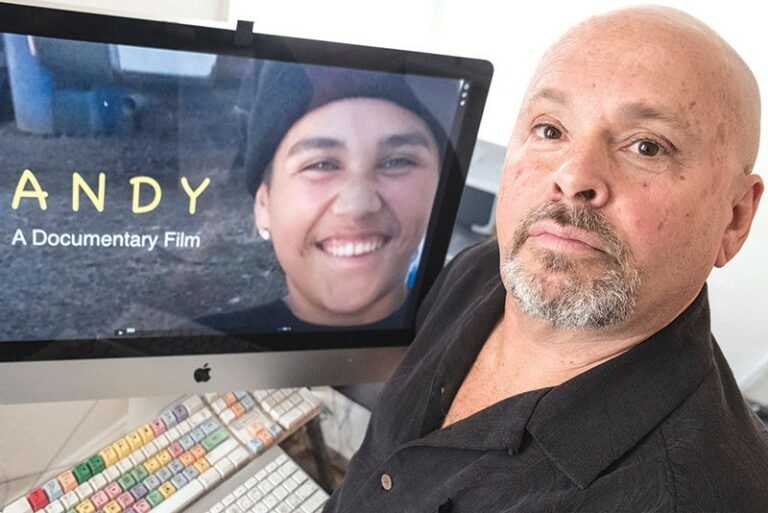
Sonoma County Sheriff Steve Freitas is on-screen on a video monitor set up in the Worth Your Weight cafe in Santa Rosa being interviewed by documentary filmmaker Ron Rogers.
It’s a Sunday evening in late January, and the cafe has been given over to a fundraising event for Rogers’ documentary about the Roseland shooting of Andy Lopez by a sheriff’s deputy
“Some people made their mind up right away that what the deputy did was wrong,” Freitas says, as the crowd looks on intently. “Some people made their mind up right away that what the deputy did was OK.”
It’s been more than three years since Lopez’s death on Oct. 22, 2013, and Freitas’ response characterizing a divided community still rings true. Gauging from the tenor and tone of the questions put to Rogers at the fundraiser, it was a bad shooting.
“When we held that fundraiser,” says the filmmaker, a Sonoma County resident and producer at Blue Coast Films, “I realized that emotions are still raw.” Rogers is aiming to release his film this fall and hopes for an airing on PBS. Besides Freitas, Rogers interviewed more than 40 people and needs to raise additional funds to pay for an edit. He’s pledged to make a balanced and sensitive film about an event that tore a city apart. Rogers says he was moved to make the film based on the circumstances of the Lopez killing: a young boy carrying an Airsoft replica AK-47, walking past an abandoned lot frequented by kids playing war, gunned down in broad daylight by a cop, in his own neighborhood.
“It just got to me,” Rogers says. In a community divided by tragedy, he says, “there are actually some people who are trying to find common ground”—and the community can expect to see those voices in his film, along with those for whom the Lopez incident was a life-changing event they’re still struggling to get over.
THE REFORMS
Law-enforcement reform took hold in Sonoma County in the wake of the Lopez shooting—but so too did a persistent belief that the subsequent investigation had been whitewashed by the Santa Rosa Police Department and by Sonoma County district attorney Jill Ravitch. Ravitch’s office cleared Erick Gelhaus, the sheriff’s deputy who shot Lopez, of any criminal wrongdoing. A civil lawsuit filed by the Lopez family is pending in the Ninth Circuit U.S. Court of Appeals in San Francisco.
Meanwhile, as the civil suit lingers, sheriff’s office reforms have taken root and include the creation of the Independent Office of Law Enforcement Review and Outreach (IOLERO), headed by attorney Jerry Threet. The agency investigates complaints against sheriff deputies. Sonoma County sheriff’s deputies started wearing body cams about a year ago, but the Sonoma County Sheriff’s Office (SCSO) says that didn’t stem from the shooting.
“There are clearly some opinions in the community that aren’t aligned with ours, and we accept that,” says SCSO spokesman Sgt. Spencer Crum. He cited a number of steps Freitas has taken since the shooting—”numerous community healing meetings” and other outreach efforts that include radio appearances and neighborhood meetings. “We are looking for more opportunities like this to engage with the public whenever possible,” Crum says. As for the body cams, “it’s just another example of our efforts to be transparent, and [our] attempts at gaining public trust.”
The body cams were put to good use in a recent incident in Boyes Hot Springs that led to a felony assault charge against a deputy who no longer works for the SCSO. Body-cam footage was key in Freitas’ decision to push for a criminal investigation into the incident and to push the deputy off the force.
Civilian complaints are part of the job, but the sheriff’s office says they are pretty rare. “We deal with people in times of personal crisis,” Crum says. “We put them in jail, we write citations and enforce laws. These negative encounters will result in some complaints.” How many? In 2013, Crum says the SCSO had contact with over 200,000 people “and had only 68 complaints.”
Short of termination, there’s a range of disciplinary actions that the SCSO can undertake with deputies: written admonishment, verbal admonishment, a requirement for additional training, time off without pay. Threet, who meets monthly with Freitas, says he has encouraged the sheriff to consider a year-end summary of excessive-force complaints that protects the rights of deputies while also giving the public some sense of an accountability process that’s currently shielded by a state law that protects personnel records from public scrutiny. Crum describes the relationship between the IOLERO and the sheriff’s office as “a collaborative effort that is continually evolving. We have found that Mr. Threet takes his responsibility to the public very seriously.”
As for the summary proposed by Threet, Crum says go for it: “It is our understanding that Mr. Threet is going to publish an annual report. We also report our complaints annually to the DOJ as required by law.”
READING OF THE SHARDS
For SCSO officers on the beat, the Lopez shooting still casts a shadow, but the nuts-and-bolts work of policing work goes on outside the headlines and viral-video outrages.
It’s gloomy and quiet in downtown Guerneville on a recent weekend morning as Deputy Sheriff Bryan Jensen contemplates a small pile of broken meth-pipe glass on the hood of his SUV-style cruiser.
Jensen’s got a quizzical look as he sifts through the glass, removed from a coat pocket of a person he knows is not a meth user. He looks up and has a visible a-ha! moment. Turns out the garment belongs to someone else who does use meth, and Jensen knows that person too.
[page]
Jensen is a 38-year-old beat cop and a training officer at the SCSO substation in West County, and he’s interviewing a citizen who has already starting drinking and getting belligerent with another of the bedraggled souls who nod off or get nasty along the pee-stinking back streets of Guerneville.
As Jensen sifts through the blackened shards of glass, it’s like he is sifting through all of the gritty details of a life on the beat. It seems nearly every person out here in the river-and-redwoods vacation mecca knows the officer—and they all seem to be violating the terms of their probation, subject to arrest and remand at his discretion.
The intoxicated citizen has a water bottle that’s half-filled with vodka. Jensen sniffs it and pours it out.
There will be a fight later on today, Jensen figures. He’s seen this play out before, so this citizen is going to jail for violating a probation order that said no alcohol. On the drive to the Main Adult Detention Facility in Santa Rosa, he talks about some of the other shards of detail that go along with the job: dealing with the death of a child in an overturned car last summer; the fact that, despite all the fear in the community, the only immigration-related question he ever asks is, “Do you want to call the consulate?” And he stresses, over and over again, that respect is a two-way street.
Over the course of a few hours Jensen interacts with numerous individuals. He tells a young man that it’s OK to dance in public, just don’t crank the music too loud or get too animated, we’ve been getting complaints. He knocks on a tent-flap out at Vacation Beach along the Russian River, a big homeless encampment before the winter rains washed nearly everyone out, and gives a hello as a man emerges from the tent. People have been complaining, Jensen says, and gives some advice on the proper disposal of drug needles. The man thanks him and shakes his hand and returns to the tent. All in a day’s work.
THE WEIGHT
Readers of the Press Democrat woke up on Halloween 2013 to a front page that showcased a large, peaceful rally in Santa Rosa held after a grueling week of anger, bewilderment and raging sadness over Lopez’s death.
It was one of the worst weeks in Santa Rosa history, for law enforcement and citizens alike, and news of the Lopez shooting reverberated across the country and into the hallways of the United States Department of Justice. The FBI announced on Oct. 25 that it had opened a “full investigation” into the shooting, and reporters around the region noted that it was the first time the FBI had involved itself in the criminal investigation of a Sonoma County police-involved shooting since the late ’90s.
Most news reports on the FBI’s pledge to fully investigate the shooting highlighted Lopez’s age. The announcement prompted a media circus, even if Gelhaus had no way of knowing that Lopez was 13 years old when he shot him. Ted Nugent went nuts over the FBI’s decision to investigate a cop, as reported on Media Matters for America at the time. And it appears that the FBI may have followed the either-or Lopez script laid out by Freitas—and jumped to a provisional conclusion that it was likely a bad shooting, worthy of a full parallel criminal investigation. That would mean lots of manpower and FBI resources. But then the agency quietly shifted its prioritization of the shooting.
According to an unclassified FBI internal memo dated Oct. 30, 2013—less than a week after it opened the Lopez file on Oct. 25—the agency moved to de-prioritize its involvement in the case from a “full investigation” to an “assessment,” the lowest order of priority. The letter reads, “The captioned case was inadvertently opened as a full investigation. Per a conversation with executive management, the case will be closed and the matter will be opened as an assessment.”
Imagine the community’s reaction to a Oct. 31, 2013, headline reading, “FBI Backs Off from Pledge of Full Investigation of Lopez Shooting.”
San Francisco–based FBI spokesman Prentice Danner says that while the reclassification indicates that the investigation was put on the lowest tier of the FBI’s classification priorities, it didn’t represent a downgrading of the agency’s commitment to the case. “There is not a whole lot of difference” between an assessment and an investigation, he says.
The last local police-related-shooting FBI investigation involved a shooting in Rohnert Park and a full criminal investigation of the incident by the FBI, parallel to the local investigation. The widespread media conflation of the FBI’s respective involvement in the two cases, Danner concedes, is an “interesting point.”
He couldn’t provide a timeline of the FBI’s involvement in the Lopez shooting. The Department of Justice didn’t complete its investigation until after the district attorney and the Santa Rosa Police Department concluded theirs—and as part of its assessment, the FBI was provided with the results of those agencies’ investigations. But Danner stressed that the FBI did not rely on their conclusions to reach its own. “We still do our due diligence,” he says, “we’re not in the business of taking another agency’s word for it. We owe it to the people and the communities that we serve—that is not how we do business.”
[page]
Eventually, the Civil Rights Division of the U.S. Department of Justice issued a conclusion in the form of a letter to the SCSO and the Lopez family. The determination: Andy Lopez’s civil rights weren’t violated.
The FBI’s decision to reclassify its role raises some questions three years later. Did any Sonoma County officials know about the reclassification? “As far as the FBI’s involvement after the Lopez case,” Crum says, “we had no involvement with them whatsoever. They may have been in contact with [the Santa Rosa Police Department] or the DA’s office. We have no knowledge of an assessment versus an investigation.”
Lt. Mike Lazzarini of the Santa Rosa Police Department’s Investigations Bureau says their investigation was sent to the district attorney and shared with the FBI, but he couldn’t speak to “the FBI’s administrative handling or classification of that case.”
The district attorney’s press office did not respond to questions about the Oct. 30 FBI memo, but in response to a public records request, the county counsel’s office says it has no record of any communication with the FBI by any county official, elected or otherwise, in the immediate aftermath of the shooting, including anyone at the district attorney’s or sheriff’s office.
JUSTICE IN THE WEEDS
It’s a hazy and warm sunny Saturday afternoon on Moorland Avenue at Andy’s Park, an unofficial memorial created at the site of Lopez’s death. The park is overgrown with weeds and empty except for a woman and her dog, who wade through the thigh-high growth to sit on a picnic bench. An ice cream truck circles, but there are no kids chasing its music. Down Moorland toward Todd Avenue, a Latino man with a tattoo above his left eye walks up the road, carrying a case of beer. A few doors down, children play with their parents in the driveway. Along the edge of the park are a number of abandoned toddler’s walkers.
It’s not hard to imagine that the parents of these toddlers may have brought their kids here to take their first, tentative steps—hopeful if unsteady steps, down that same street where Lopez lost his life. Those baby steps provide a poignant metaphor for the ongoing efforts at police reform in Sonoma County. There’s also a sense that time has stopped here—and won’t start up again until some tangible measure of justice for Lopez is achieved.
His memorial is painted with the words, “Start Healing,” and it’s been over a thousand days since the shooting. But the sign that ticks off the days since the shooting cuts off at day 968, and the grass is so high now that the word “Justice” is blocked from view. This week, the Sonoma County Board of Supervisors was moving forward on plans for Andy’s Unity Park, but for now there’s a sense that a community has been stunned into a kind of stasis by the tragedy. One interviewee in Rogers’ trailer recounts how the event traumatized a friend of Lopez’, the boy whose Airsoft rifle was in his hands when he was shot. And Andy’s best friend still hasn’t been back to school.
Another of Rogers’ interviewees is Santa Rosa pediatrician Meredith Kieschnick, who has worked with at-risk children for decades. Her voice softly rose as she cast the shooting as a community-wide traumatic event involving a child at play, and emphasized “restorative justice” as the way forward for the community—police and citizens alike. In that model, victims and perpetrators come together in a spirit of healing.
Kieschnick observes with quiet passion that kids in Lopez’s part of the county have a tough road to walk already. Many live in poverty, some have family immigration issues, others face gangs and crime, and lack “the basic things that young people need to do well”—especially “an attachment to a kind, caring adult.”
KNOWING IS POWER
A troubled man sits in a local cafe in Guerneville hovering over a notebook. He made a threatening comment to a patron and is still seated at his table when Jensen enters with two other deputies. They’ve never seen him before.
Amid a national convulsion over viral-video police shootings, much of the job of 21st century policing involves street-level interactions at the front-line of a society that has failed to account for its most vulnerable citizens. There’s a basic low-level constancy of petty crime, mental-health issues and addiction—and discretion and patience and good humor—that animates much of an officer’s day, and where decisions have to be made that can have an enormous impact on someone’s life. For example, committing someone on a psychiatric hold is not a step to be taken lightly—and Jensen doesn’t. “I’m taking away your civil rights if I do that.”
The young man is wearing an A’s hat, and Jensen—a die-hard Giants fan—gently teases him for the hat and tells him to stay out of the cafe. Nobody wants to press charges—not the cafe or the person who was the subject of the threat. Jensen shakes the man’s hand and sends him off, and the man seems genuinely surprised at the gesture of respect.
Jensen says the No. 1 misperception that the public has about his profession is that “one deputy is just like the next.” He takes issue with a media-fueled notion that the SCSO agency is aloof and disengaged and doesn’t know, or care to know, the communities it serves. Jensen worked in Roseland for five years and engaged with countless citizens on the beat there, he says—but even still, it’s impossible to know everyone. And even if you do, Jensen recalls an incident right after the Lopez shooting where a child was with his parents and Jensen knew them and rolled up in his cruiser with a hello. The kid flipped him off.
THE AFTERMATH
This is the still-raw dynamic that Rogers has chosen to explore in his film. He’s planning two more fundraisers to raise the cash necessary to edit the movie. One is in Oakland at 1611 Telegraph Ave. on May 4 at 6pm; the other is in Petaluma on April 25 at 6:30pm at Aqus Cafe. Rogers will be showing his trailer, and attendees can consider their own views of the shooting in light of Freitas’ observation about a divided community. The other option is to “face the heart-breaking potential of the same tragedy happening again,” Rogers says.
It’s heartbreaking to imagine how things might have played out differently back on Oct. 22, 2013. In the alternative scenario on Moorland Avenue, a deputy drives down the street and sees a familiar person and yells out the car window, “Hey, Andy, what’s going on?”
It’s too late for that storyline to play out. But Lopez’s ultimate legacy remains to be written in a county forever changed by his death. What will his legacy be? Rogers asks.
“Surely it is worthwhile to find out.”