A Light in the Dark

0

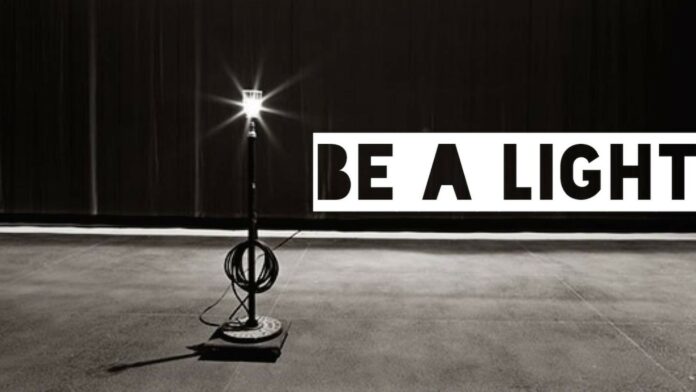
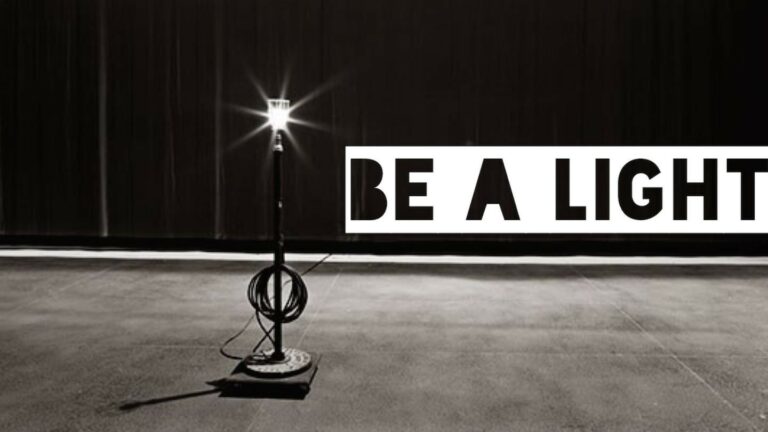
The “ghost light,” an enduring theatrical tradition, is about to be reclaimed, now as a powerful political statement. This Thursday, thousands of theater companies around the country—including a handful in the North Bay evening—plan to gather together in solidarity, just after sunset, all across the United States.

“It’s important that we make it known to everyone everywhere,” explains Steven David Martin, Artistic Director of the Raven Players in Healdsburg, “that our theaters will always be places of light and safety, always open and welcoming to absolutely everyone, no exceptions, who enter our doors.”

The Ghost Light Project – formed by a collective of theater artists on both coasts – was created as form of positive, peaceful protest, planned for Jan. 19 at 5:30 p.m., on the eve of the inauguration of Donald Trump. The project is fueled by fears that a Trump administration could bring artistic and journalistic censorship, rising discrimination and increases in race-and-religion-focused violence. In other words, the next four years could be dark and dangerous for everyone.

Those participating in the Ghost Light Project, primarily members of the theater community including actors, directors, playwrights, technical artists and the audience members who value theatrical expression – will assemble in front of local theaters, bearing flashlights, lamps, lighters, and other illuminating devices. The Ghost Light website, with suggestions on how to participate, has a downloadable poster on which people can identify themselves and what they plan to be fighting for over the next months and years.

In addition to the Raven Players, other theater companies planning to hold gatherings this Thursday include Marin Theatre Company in Mill Valley, Main Stage West in Sebastopol, 6th Street Playhouse in Santa Rosa, and Sonoma Arts Live, in Sonoma. The public is invited to join in, and theater artists from all theater companies are welcome to join in as well.

“To be fair and transparent,” says Craig Miller, Artistic Director of 6th Street Playhouse, “I don’t think that we have always done the best we possibly can here, in creating a space that has been as inclusive, or as reflective of the immense diversity of our community as it could, or should be. Art imitates life. We are supposed to be holding a mirror up to nature.”

6th Street will be participating with a presentation of readings by local theater artists, along with a statement of commitment to being a beacon of light in the future, plus a group singing of “Seasons of Love” from the musical Rent, and the ceremonial lighting of a lamp to remain in the front window of the theater at all times.

Adds Miller, “The Ghost Light Project gives us, and all theaters and their communities, an opportunity to renew that vital commitment to stand for and protect the values of inclusion, participation, and compassion for everyone regardless of race, class, religion, country of origin, immigration status, disability, age, gender identity, or sexual orientation. We strive to be that theatre company, and hope to be a beacon of that message in our community in perpetuity.”

Observed for over two hundred years, the “ghost light” is traditionally a literal light – usually a single lamp, though before electricity small lanterns were often used – left on overnight once a theater has closed its doors. For many, it’s a mere safety precaution, though the tradition first sprang from the belief that every theater has at least one resident ghost. The lamp allows the spirits of the place to take the stage overnight, telling its own stories till daylight returns. As metaphor – a light in the darkness, calling the lost and forgotten – the image of the “ghost light” has become a symbol of the theatrical arts at their best.

“Many of us are legitimately frightened at what this administration could bring,” says Beth Craven, Artistic Director of Main Stage West, which recently staged Si Kahn’s immigrant musical “Hope.” “The timing couldn’t have been more perfect, because a lot of us all over the country are struggling right now to find a way to keep our own hope alive. Given what this man says he plans to do, the rights and freedoms he plans to take away, keeping a light burning is more than just a metaphor. It’s a necessity.”

On Thursday, artists from Main Stage West, and local theater supporters, will be lighting candles and singing at least one song from “Hope” on the sidewalk in front of the theater.

Martin, with the Raven Players, says he wanted his theater family to be part of this project because of the many ways the theater has always worked to provide a safe place for the marginalized and under-heard.

“We need to stand strong with our brothers and sisters across the country to ensure there is always a light for everyone,” he says. “And this is our chance in face of potential dark times to stand together and stand up for human rights and human decency. We are storytellers and we need to include every aspect of our eclectic society to participate in sharing our stories. I hope we see a lot of our fellow theatre artists at the Raven this Thursday night, or that they join the Ghost Llight Project at their respective theatrical homes.”

To learn more visit www.theghostlightproject.com

Jan. 12: Beer Scholar in Healdsburg

0

It’s hard to think of a cooler nickname than ‘the Pope of Foam,’ the title given to brewing scientist Charles Bamforth. Born in Britain and currently working at UC Davis, Bamforth has spent his life researching, educating and making beer, and he loves nothing more than to share his passion—and maybe a couple of pints—with as many people as he can. Bamforth is also the author of several books on the subject, and this week, the Healdsburg Literary Guild welcomes him for a talk and tasting event featuring Bear Republic brews on Thursday, Jan. 12 at Shed, 25 North St., Healdsburg. 7pm. $15. 707.431.7433.

Jan. 13-14: Freshly Made Films in Windsor

0

Now in its third year, the grassroots, nonprofit Windsor International Film Festival once again features an exciting array of short films from independent filmmakers near and far. Not only does the festival screen works from over 20 different countries, it also spotlights more than a dozen North Bay filmmakers. With 50 films to choose from this year, the festival has organized its showings in thematic blocks, offering films in groups such as crime dramas, romantic films, relationship dramas, altered realities and more. See for yourself on Friday and Saturday, Jan. 13–14, at Windsor High School, 8695 Windsor Road, Windsor. windsorfest.com.

Jan. 13-15: Get Feisty in Napa

0

San Francisco playwright and performer Charlie Varon channels his inner grump in his funny one-man show, ‘Feisty Old Jew.’ Taking on the role of 83-year-old Bernie, Varon chronicles the rapidly changing landscape of San Francisco through the eyes of a lovable Luddite stuck in a car with three young techies. As Bernie rants against the fashion boutiques and cappuccinos of the younger generation, he also energetically convinces his car-sharing techie friends to let him try his hand at surfing for the first time in his life. Will Bernie catch a wave? Find out Friday through Sunday, Jan. 13–15, at Lucky Penny Community Arts Center, 1758 Industrial Way, Napa. Friday–Saturday, 8pm; Sunday, 2pm. $50. 707.266.6305.

Jan. 15: Party Like a KOWS in Occidental

0

West Sonoma County community radio station KOWS 107.3-FM is a big proponent of free speech. Maybe that’s why they’ve timed their annual fundraising show to fall on Martin Luther King Day for a party with plenty of music and fun. Songwriters Rachel Tree, Tami Gosnell and Kym Trippsmith will share the stage with lead guitar virtuoso Leesa Gomez while an extensive selection of food and drinks get the party in gear. Then, local DJs keep the good times going, as a raffle helps raise funds for KOWS. The party starts on Sunday, Jan. 15, at Barley and Hops Tavern, 3688 Bohemian Hwy., Occidental. 6:30pm. Admission by donation. 707.874.9037.

Helping Hands

0

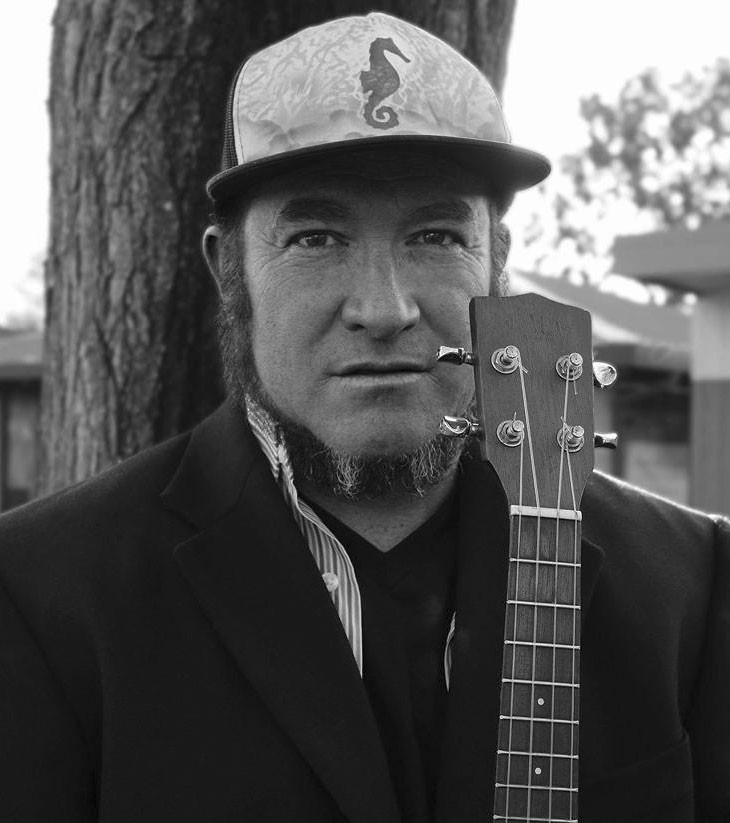
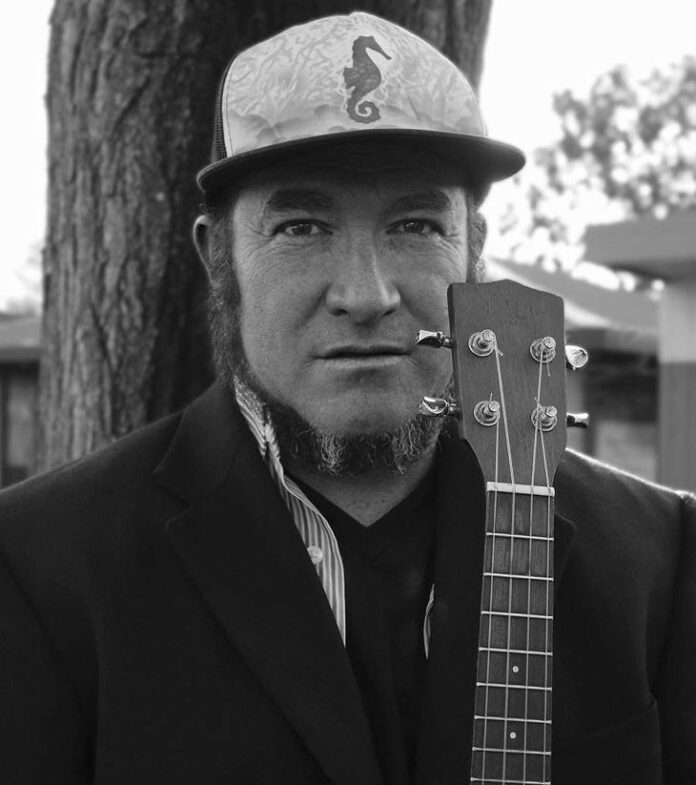
Longtime North Bay musician, teacher and father of five Jon Gonzales knows the value of community.

He sees it every month when he hosts HopMonk’s Songwriters in the Round series, which returns to the Sebastopol tavern on Wednesday, Jan. 18. And he saw it in the efforts of North Bay nonprofit organization Matrix Parent Network & Resource Center when his first son, Jasper, was born with a traumatic brain injury.

Gonzales’ musical life started when he moved to Sonoma County from his hometown of Bakersfield to attend Sonoma State University in 1993. “It’s so creative up here. It motivated me to play the guitar, start doing open mics and the like,” Gonzales says.

He graduated with a degree in English and began mixing a day job teaching with a nightlife playing upbeat folk pop songs around town. When Jasper was born in 2004, Gonzales put music on hold.

“I was really invested in my kids, raising a special needs child who was getting bigger,” Gonzales says. “But I still did a lot of music at home, just to be inwardly creative.”

After discovering the ukulele and teaming with local producer Michael Lindner, Gonzales reentered the musical community with the 2012 album

Water ‘n Whiskey and its 2015 follow-up, Hump.

The sound of his self-described “ukulele hook-folk” is hard to pin down, and Gonzales is deft at going from sunny pop jam to self-reflective ballad with ease. His next album is shaping up to be a stripped-down folk collection inspired by the artists he welcomes to the Songwriters in the Round events.

“Between teaching and the ukulele, I have a large network of people and opportunities,” Gonzales says. And he always pays it forward.

“I’ve always gone full-force to be there any time there are benefits for kids with special needs,” he says.

In that vein, Gonzales performs with his string band at the Hops & Harmonies benefit for the Matrix Parent Network on Jan. 17 at the Lagunitas Brewing Company in Petaluma. The organization assisted Gonzales and his wife by providing the help of a couple of caretakers for Jasper.

In November 2014, Jasper died unexpectedly, an event that Gonzales says froze him creatively for over a year, yet the musician regained his motivation with the help of his friends.

“I met [folk singer] Bruce Cockburn last year,” Gonzales says. “And he said in times like now, when it feels dark politically or backwards civilly, the artists are relied upon. It’s important to keep going.”

Top Crop

0

California’s agricultural bounty is fabled, from the endless olive and almond groves of the Central Valley to the world-class grapes of the Napa Valley. But the biggest crop in California’s agricultural cornucopia is cannabis.

According to a report last month in the Orange County Register, California’s marijuana crop is not only the most valuable agricultural product in the nation’s number one ag state, it totally blows away the competition.

Using cash farm receipt data from the state Department of Food and Agriculture for ag crops and its own estimate of in-state pot production, the Register pegs the value of California’s marijuana crop at more than the top five leading agricultural commodities combined. Here’s how it breaks down, in billions of dollars: marijuana, $23.3; milk, $6.28; almonds, $5.33; grapes, $4.95; cattle, $3.39; lettuce, $2.25.

That estimate of $23.3 billion for the pot crop is humongous, and it’s nearly three times what the industry investors the Arcview Group estimated the size of the state’s legal market would be in the near post-legalization era. So how did the Register come up with that figure?

The newspaper extrapolated from seizures of pot plants, which have averaged more than 2 million a year in the state for the past five years, and, citing the UN Office on Drugs and Crime, used the common heuristic that seizures account for only 10 to 20 percent of drugs produced. That led to an estimate of 13.2 million plants grown in the state in 2015 (with
2.6 million destroyed), based on the high-end 20 percent figure.

The report then assumed that each plant would produce one pound of pot at a market price of $1,765 a pound. Outdoor plants can produce much more than a pound, but indoor plants may only produce a few ounces, so the one-pound average figure is conservative.

The $1,765 per pound farm gate price is probably optimistic, especially for outdoor grown marijuana, which sells for less than indoor.

And maybe law enforcement in California is damned good at sniffing out pot crops and seizes a higher proportion of the crop than the rule of thumb would suggest. Still, even if the cops seized
40 percent of the crop and farmers only got $1,000 a pound, the crop would still be valued at $8 billion and still be at the top of the farm revenue heap.

That’s a phenomenon that’s not going to stop when California’s legal marijuana market goes into full effect. It’s not going to stop until people in states like Illinois and Florida and New York can grow their own. In the meantime, California pot growers are willing to take the risk if it brings the green.

Phillip Smith lives in Sebastopol and is editor of the AlterNet Drug Reporter and author of the ‘Drug War Chronicle.’

Let It Rain

0

The deluge of rain in recent days has been a boon to local reservoirs that have been under intense scrutiny over these past eight years of California drought. The Sonoma County Water Agency (SCWA) reported Jan. 3 that Lake Sonoma was at 100.3 percent of capacity, while Lake Mendocino was at 115 percent of capacity that same day. So is the drought over, or what?

“The drought is definitely over in our neck of the woods,” says Brad Sherwood of the SCWA.

Both reservoirs are under the operational control of the U.S. Army Corps of Engineers, which monitors water levels along with the local agency and manages the reservoir levels via controlled releases of water. The capacity levels at the reservoirs delineate the line between the so-called flood control pool and the water supply pool, and once the water levels creep into the former, the Corps takes measures to release water to avoid flooding.

According to the SCWA, the Mendocino reservoir had dropped to 113.5 percent of capacity by Jan. 7, owing to a reservoir release protocol that saw two hundred cubic feet per second released from the brimming reservoir, whose flood-control trigger is around 72,000 acre-feet of water.

How much rain has fallen? Between Jan. 3 and Jan. 7, according to SCWA data, Lake Sonoma’s depth rose five inches, to 105 percent of capacity. The “water year” that begins on
Oct. 1 has seen 19 inches of rainfall in the Santa Rosa Basin through Jan. 2; the average over that time period is just under
12 inches.

Off the Streets

0

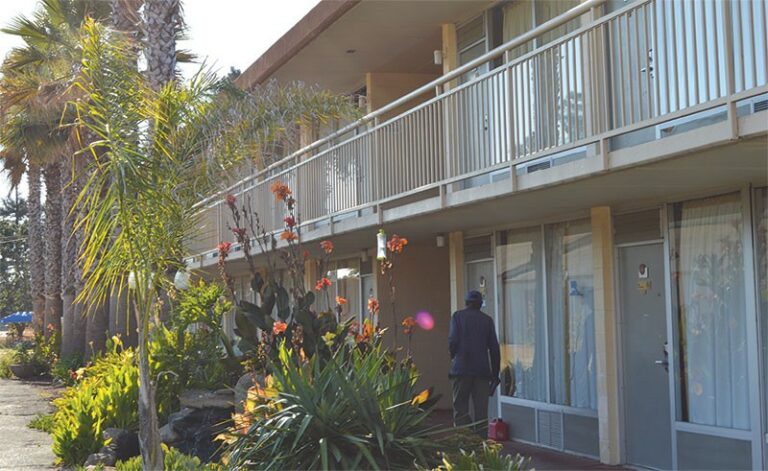
It’s a quiet weekday morning, and there’s
a lull in the rain at
the Palms Inn in unincorporated Santa Rosa. Roy Burress is volunteering at the converted motel’s cafe-bookstore and talks about the deaths of residents that have taken place here in recent months. He’s bearded and wears glasses and a baseball hat from the USS Theodore Roosevelt.

Burress is a Vietnam veteran and one of 114 residents at the Palms Inn, which was converted into apartments for the formerly homeless last year to much fanfare from local housing activists and Sonoma County officials. They heralded the Palms project as a key piece of the county’s push to deal with its stubborn homeless problem.

Burress rattles off the fatalities he’s aware of among residents here—seven of them, he says, including an overdose and a suicide, in 2016. He speaks of at least one former tenant who tried to better himself but gave into his pain and ended up taking his life. He remembers others who arrived at the Palms with terminal illnesses. “They were going to die.”

With a minimum of red tape and a full acknowledgement of the county’s homeless crisis, the Palms Inn opened last summer within three months of its conception as a go-to residence designed to siphon county residents off the streets and into some semblance of normalcy.

Based on the nationally renowned “housing first” model, the Palms project has found housing for a client base that is split between veterans and referrals from Catholic Charities; the latter are generally considered a more vulnerable and needy population.

But months into the Palm’s grand opening, the fatalities lend to the question of whether the Palms is set up to handle its de facto role as hospice caregiver—a role that was considered but not codified into any specific policy as the Palms was moving toward its opening last year.

According to the Sonoma County Sheriff’s Office, two deaths occurred on-site at the Palms in 2016 and one was a suicide. An administrator at the facility confirms that there have been fatalities among the residents this yearthe others died after being transported to a hospitaland that the Palms is geared up to spring into action when there’s a death and take care of residents who might be distressed.

“When we have been confronted with people passing away, it’s like family, like losing a family member,” says Catholic Charities’ Jennielynn Holmes. “This is a revolutionary project for Sonoma County,” she adds, highlighting its foundation in the housing first model—where all good things lead from having a roof over one’s head (see “Palms Not Bombs,” Aug. 17, 2016.)

And yet, even as it has offered transitional or long-term housing for forward-looking formerly homeless people, it’s not surprising that some residents who arrive at the Palms might soon die at the Palms, says Holmes.

“We are screening the most vulnerable people, people with severe physical and mental-health needs,” she says. “People who were terminally ill, we brought them here. Otherwise they would have died on the streets. At least they get end-of-life care here.” Some tenants receive in-home services subsidized by the state and administered by the county.

Holmes highlights findings from resident surveys this year which found that residency at the Palms had served to push back the numbers on several key arbiters that typify life on the streets, all of which saved taxpayers money. According to the survey, admittance to the emergency room and in-patient hospitalization fell by 45 percent; interactions with law enforcement dropped 77 percent; ambulance transportations fell by 56 percent; and usage of crisis service interventions such as suicide hotlines went down 98 percent.

The seven deaths, Holmes says, are “below the average of other housing first programs and we are targeting the most vulnerable homeless individuals in Sonoma County.”

The survey reveals most residents are taking advantage of the roof over their heads, even when they arrive with significant health problems. For some residents, an expected or imminent death is a part of life at the Palms. “But this is normal, and it’s important to provide this level of care to individuals,” Holmes says.

Holmes further highlights the “revolutionary” aspect of the program that helps enhance care for residents. Many signed up for Medicare and Medicaid when the program was getting off the ground last summer.

“The relationship to health and homelessness is just huge,” Holmes says as she credits the much-maligned Affordable Care Act with helping to ease the strain on homeless people turning to the emergency room for primary care. “The ACA has really allowed us to get people in medical [facilities], where before they would show up in the emergency room,” Holmes says.

“It’s been pretty huge to the people who we serve,” she adds—including those who die, who at least pass with some semblance of dignity, instead of in a Fourth Street alcove huddled against the wind and the rain.

“A person who is homeless,” Holmes says, “has no access to hospice.”

Hot and Heavy

0

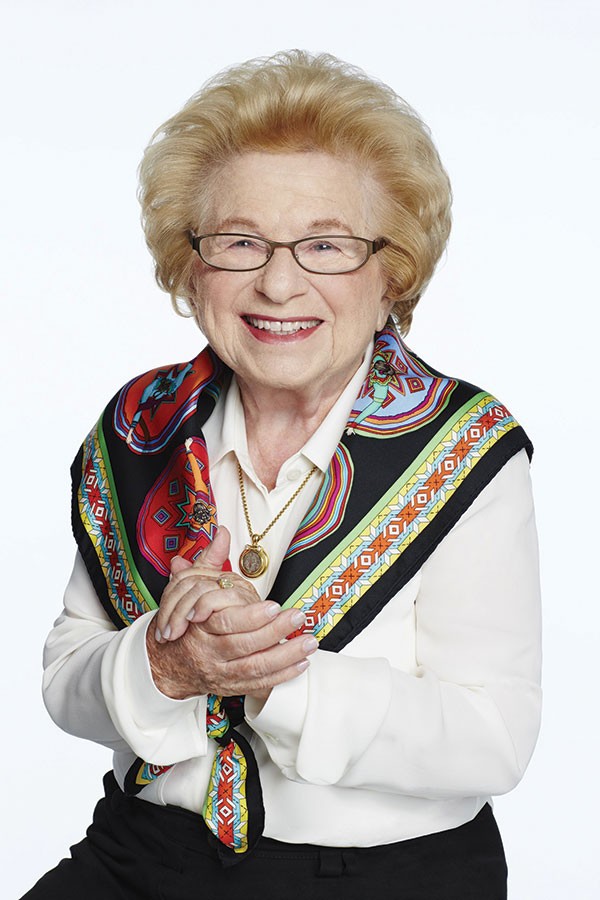
‘Good sex is like downhill
skiing,” says
Dr. Ruth Westheimer early on in Main Stage West’s engaging, surprise-packed solo-show Becoming Dr. Ruth. “Both require instinct, good movement and a willingness to take risks.”

That description, apparently, applies to Westheimer herself.

Throughout the unexpectedly rich script by playwright Mark
St. Germain, the true details of Dr. Ruth’s extraordinary life are revealed, strip-tease-style, one bit at a time. As the play opens, Westheimer is packing up her New York City apartment after the recent death of her third husband, Fred. In the midst of arguing on the phone with her daughter, she suddenly notices the audience.

“Hold on,” she tells the caller. “I have company.”

What follows is as loose, relaxed and occasionally bizarre as an actual living-room conversation with an eccentric friend—one who, in this case, just happens to have escaped Nazi Germany as a child, spent years as a sniper for the Israeli army and worked for Planned Parenthood in New York, all on her way to becoming America’s most unlikely advocate for positive sexuality and honest, open discussion about a subject few people actually talk about.

As Dr. Ruth, Ann Woodhead is wonderful. Though with a bit less energy and volume than the way Westheimer so delightfully comports herself on TV and radio, Woodhead skillfully captures the famous figure’s twinkly-eyed and straightforward approach to life, laughter and love, and even her clear-eyed embrace of the uglier facts of life. She simultaneously nails the parade of one-liners, and carefully modulates the heavier elements, which includes the death of Ruth’s family in the concentration camps. After she escaped to Switzerland via the international Kindertransport rescue effort, Westheimer never saw her parents again.

The direction by Elizabeth Craven is generally light-handed and purposefully simple, with clever use of projections to emphasize the moments when
Dr. Ruth shows photographs of her family. The effective set by David Lear is crammed with thoughtful visual details, though the show’s unnecessarily busy, uncredited light design is frequently baffling and distracting. That said, the light of the show, appropriately enough, is the real Westheimer, whose sheer lifelong determination and resilience is entertainingly moving, illuminating and truly inspiring.

Rating (out of 5): ★★★★

A Light in the Dark

The “ghost light,” an enduring theatrical tradition, is about to be reclaimed, now as a powerful political statement. This Thursday, thousands of theater companies around the country—including a handful in the North Bay evening—plan to gather together in solidarity, just after sunset, all across the United States. “It's important that we make it known to everyone everywhere,” explains Steven...

Jan. 12: Beer Scholar in Healdsburg

It’s hard to think of a cooler nickname than ‘the Pope of Foam,’ the title given to brewing scientist Charles Bamforth. Born in Britain and currently working at UC Davis, Bamforth has spent his life researching, educating and making beer, and he loves nothing more than to share his passion—and maybe a couple of pints—with as many people as...

Jan. 13-14: Freshly Made Films in Windsor

Now in its third year, the grassroots, nonprofit Windsor International Film Festival once again features an exciting array of short films from independent filmmakers near and far. Not only does the festival screen works from over 20 different countries, it also spotlights more than a dozen North Bay filmmakers. With 50 films to choose from this year, the festival...

Jan. 13-15: Get Feisty in Napa

San Francisco playwright and performer Charlie Varon channels his inner grump in his funny one-man show, ‘Feisty Old Jew.’ Taking on the role of 83-year-old Bernie, Varon chronicles the rapidly changing landscape of San Francisco through the eyes of a lovable Luddite stuck in a car with three young techies. As Bernie rants against the fashion boutiques and cappuccinos...

Jan. 15: Party Like a KOWS in Occidental

West Sonoma County community radio station KOWS 107.3-FM is a big proponent of free speech. Maybe that’s why they’ve timed their annual fundraising show to fall on Martin Luther King Day for a party with plenty of music and fun. Songwriters Rachel Tree, Tami Gosnell and Kym Trippsmith will share the stage with lead guitar virtuoso Leesa Gomez while...

Helping Hands

Longtime North Bay musician, teacher and father of five Jon Gonzales knows the value of community. He sees it every month when he hosts HopMonk's Songwriters in the Round series, which returns to the Sebastopol tavern on Wednesday, Jan. 18. And he saw it in the efforts of North Bay nonprofit organization Matrix Parent Network & Resource Center when his...

Top Crop

California's agricultural bounty is fabled, from the endless olive and almond groves of the Central Valley to the world-class grapes of the Napa Valley. But the biggest crop in California's agricultural cornucopia is cannabis. According to a report last month in the Orange County Register, California's marijuana crop is not only the most valuable agricultural product in the nation's number...

Let It Rain

The deluge of rain in recent days has been a boon to local reservoirs that have been under intense scrutiny over these past eight years of California drought. The Sonoma County Water Agency (SCWA) reported Jan. 3 that Lake Sonoma was at 100.3 percent of capacity, while Lake Mendocino was at 115 percent of capacity that same day. So...

Off the Streets

It's a quiet weekday morning, and there's a lull in the rain at the Palms Inn in unincorporated Santa Rosa. Roy Burress is volunteering at the converted motel's cafe-bookstore and talks about the deaths of residents that have taken place here in recent months. He's bearded and wears glasses and a baseball hat from the USS Theodore Roosevelt. Burress is...

Hot and Heavy

'Good sex is like downhill skiing," says Dr. Ruth Westheimer early on in Main Stage West's engaging, surprise-packed solo-show Becoming Dr. Ruth. "Both require instinct, good movement and a willingness to take risks." That description, apparently, applies to Westheimer herself. Throughout the unexpectedly rich script by playwright Mark St. Germain, the true details of Dr. Ruth's extraordinary life are revealed, strip-tease-style,...
11,084FansLike
4,606FollowersFollow
6,928FollowersFollow