This year, the third warmest in recorded history, spring has come a month early, with regions all across the United States experiencing May temperatures in March. While warmer temperatures are welcome after a cold, wet winter, the cause is not.
Oceans are warming and rising, and last year was the fourth consecutive year of mass seal pup strandings along local beaches due to reduced populations of anchovies and sardines. Glaciers are melting and collapsing at record rates. Heat waves and fires are likely to threaten our placid summers. Worse disasters loom in our children’s future.
Despite what the Trump administration says, climate change is here. As Naomi Klein pointed out in a 2011 article in
The Nation, climate deniers know its consequences full well: addressing climate change means not only ending the flow of their black gold—it’s the end of their entire way of life.
“To lower global emissions,” she writes, “can only be done by radically reordering our economic and political systems in many ways antithetical to their ‘free market belief system.” Hence, oil companies have invested billions to convince much of the voting public that climate change is a hoax and accomplished the ultimate coup d’état with the installation of a like-minded government that will raise the temperature, and the consequences, even more.
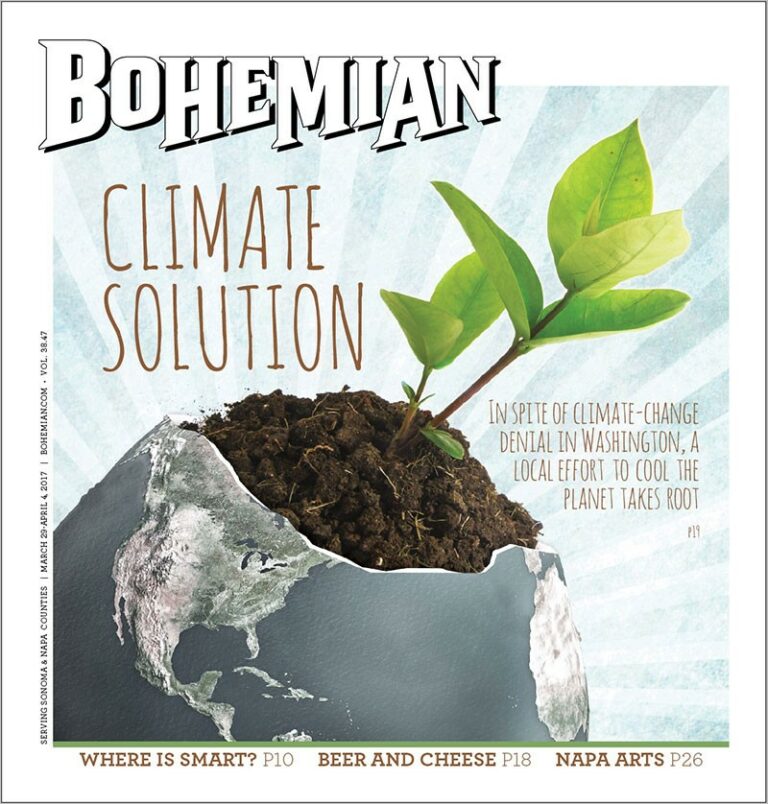
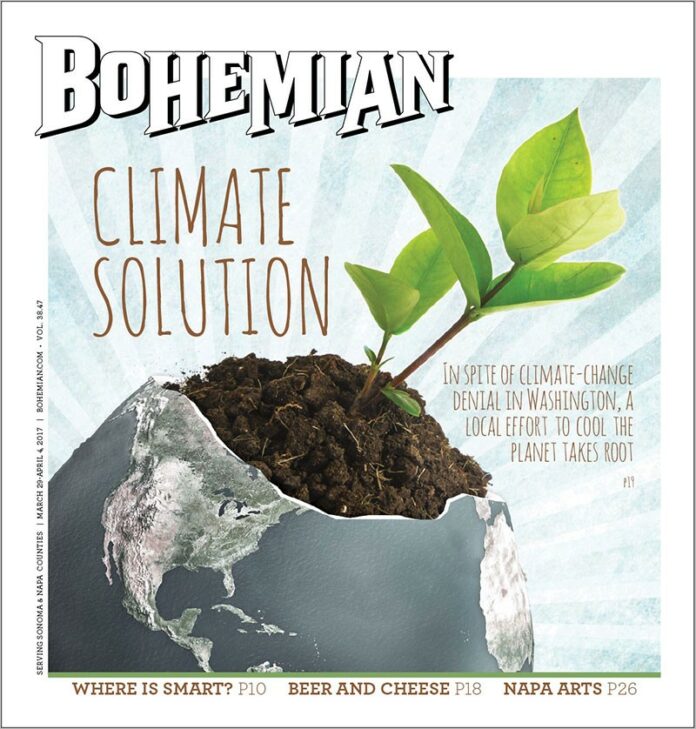
But we still have a chance to pull back from our race to the edge. There is a climate-change solution that can take root at the local level which can actually reverse climate change by at least 40 percent. By changing the way we grow food, we can actually draw down carbon from the atmosphere and put it to good use where it belongs: in the soil. Call it carbon farming.
HEALTHY SOILS
North Bay farmers have led the way with these techniques, and with the help of climate-advocacy groups, they won state support to promote a program that just might save the world.
The Healthy Soils Initiative, launched Jan. 11 in Sacramento by the National Resource Conservation Service and the California Department of Agriculture, encourages farmers to adopt carbon-friendly farming methods by offering grants and training assistance. Grant applications will be accepted later this spring.
Judging from the number of people who turned out for the September Healthy Soils Summit—over 200 for the conference itself and many more via webcast—interest in this carbon-friendly “regenerative” soil-management program is growing. It can’t come too soon: the very existence of topsoil is at risk.
The World Wildlife Fund reports that over half the topsoil worldwide has been lost over the past 150 years, mostly due to industrial agriculture. Some sources say the loss is more like 70 percent. It’s possible that in 60 years, the topsoil on heavily grazed and monocropped farmlands will be gone, leaving nothing but an impervious layer of hardpan in its place, conditions that led to the Dust Bowl phenomenon in parts of the United States and Canada in the 1930s. Without its thin skin of topsoil, fertile land turns to desert, a process that has been accelerating all over the world in large part because of intensive industrial agriculture.
But David Runsten, policy director of the California Association of Family Farmers, says agriculture can be part of the solution. He began working with the California Climate and Agriculture Network (CalCAN), a nonprofit that advocates for climate-friendly agricultural policy, in 2009 to get state officials to embrace carbon farming.
“Finally, the governor said he would support Healthy Soils,” says Runsten.
The legislation passed last summer and allocates $7.5 million for the program, $3 million for demonstration projects and up to $4 million in grants of up to $25,000. Gov. Brown is sold on the program. He originally asked for $20 million once he embraced the idea.
Funding for the program comes from the California Air Resources Board’s cap-and-trade program.
California’s cap-and-trade program generates money from big emitters who are required to buy permits to emit greenhouse gases, says Renata Brillinger, executive director of CalCAN.
“The Legislature and the governor decide how much [of that] money to spend and on what. It’s billions of dollars that we can influence through a democratic process,” she says.
Healthy Soils projects must be directly linked to climate change, she says. “Farmers are getting money to do things on their farm that draws down carbon or reduces emissions. It is the only source of funding in the United States that will pay farmers to do that.”
One of the pioneers of carbon farming is the Marin Carbon Project (MCP). The nonprofit took it upon itself to provide scientific evidence to substantiate the benefits of carbon farming. Working in concert with Whendee Silver, professor of ecosystem ecology at UC Berkeley, the MCP found that adding a half-inch of compost to the soil increased soil carbon by one ton, or 40 percent, per hectare.
Most dazzling was the discovery that the amount continued to increase by the same rate year after year without adding more compost. This research demonstrated that carbon farming “can improve on-farm productivity and viability, enhance ecosystem functions and stop and reverse climate change,” explains Torri Estrada, executive director of the Carbon Cycle Institute, a Petaluma-based organization partnered with the MCP.
[page]
THE CARBON CYCLE
Plants sequester carbon from atmospheric CO2 by photosynthesis, using the airborne carbon to create carbohydrates and relaying the excess sugars to microbes in the soil. In turn, microbes return carbon to the soil. The more microbes, the more carbon is taken up, the stronger the roots and the more productive and resilient the plant. Adding organic matter to the soil feeds the fungi and bacteria, and enhances the effect.
In addition to providing fertility to the plants, microbes release a protein called glomalin, which makes soil clump together. Healthy soil, which holds more microbes per teaspoon than there are people on the planet, is porous, so it holds water more efficiently. It also keeps pests at bay, while nourishing earthworms, who enrich the soil with their castings. Keeping the land covered with some form of plant material, or even mulch, protects it from erosion and keeps the carbon from going back into the atmosphere as carbon dioxide. The more plants that grow in the field, the more carbon dioxide will be drawn down from the atmosphere and retained in the soil.
“Some scientists have projected that 75 to 100 parts per million of CO2 could be drawn out of the atmosphere over the next century if existing farms, pastures and forestry systems were managed to maximize carbon sequestration,” reports Michael Pollan in a 2015 story in the Washington Post. “That’s significant, when you consider that CO2 levels passed 400 ppm this spring. Scientists agree that the safe level of carbon dioxide in the atmosphere is 350 ppm.
At the 2015 United Nations Climate Change Conference in Paris, the French government proposed that all nations sign on to its “4 Pour 1000 Initiative” (four per 1,000), based on the belief that if soil carbon were increased worldwide by .4 percent, climate change could be reversed.
“A small amount,” comments MCP founder Jeff Creque, “but if everyone did it, the greenhouse gas problem would be solved.”
How long the carbon remains in the soil depends mainly on what happens afterward, Creque explains. “If you go in and plow, the carbon will go back into the atmosphere,” because “tillage breaks up the root systems that disperse the carbon to the microbes in the soil.”
Reducing or eliminating tillage is one of the three basic carbon farming techniques, says Creque, one that’s emphasized in the Healthy Soils Initiative. Research has found that two-thirds of soil carbon is released into the atmosphere through poor soil management, mostly tillage.
LOCAL SOLUTIONS
Farmers Paul and Elizabeth Kaiser met in the Peace Corps in Africa where Paul taught farmers how to revitalize desertified ecosystems through agroforestry. The Kaisers are now in their 11th year at Singing Frogs Farm in Sebastopol. When they bought the property 10 years ago, it had been lightly farmed according to standard practice.
“There were no nutrients or organic matter in the light, sandy soil,” says Paul Kaiser. “It didn’t hold water and turned to concrete in summer.”
They began with standard organic farming techniques, “which we understood to be the best method,” he says, but they quickly found that it wasn’t sufficient. Plowing and tilling produced only one crop per year. “We couldn’t pay the mortgage.”
One day in 2004, Deborah Koons Garcia, who was making the film, Symphony of the Soil, visited the farm.
[page]
“She wanted shots of earthworms,” says Kaiser, “but there were none in the beds that we had rototilled. But the beds that hadn’t been tilled were chock-full.”
Not only were there earthworms, but, as they later learned, there were microbes that help plants consume carbon. The Kaisers began to read everything they could find on innovative farming methods. Seeking ways to improve the soil to produce more than one crop, they incorporated three key practices recommended by the U.S. Department of Agriculture to support healthy soils: disturb the soil as little as possible (no tillage); keep the ground covered at all times, with green growing plants whenever possible; and encourage species diversity on the farm.
Now, with no tillage, no amendments except compost, and with minimal irrigation, the three-acre farm grows more than a hundred varieties of produce for its CSA and farmers markets, and grosses $100,000 per acre per year.
It’s been a very wet winter, but due to the farm’s superior water retention, the land didn’t flood like some other farms in the neighborhood. Singing Frogs Farm has been growing a dozen different vegetables for its customers through the winter, says Kaiser, who plans on sharing his methods with the California Association of Family Farmers and its network of small farms.
Livestock raised in typical feedlots generate enormous amounts of methane, polluting creeks and trampling soils. Methane is a potent greenhouse gas. But raising livestock can be beneficial to the climate. Rotational grazing allows animals to munch a variety of grasses; as they’re moved to other pastures, they deposit manure along the way that strengthens carbon sequestering plants.
Stemple Creek Ranch in Tomales is one of three MCP demonstration farms. One day last spring, rancher Loren Poncia drove me out into the pasture to see his “happy cows,” who came bounding through the tall green grasses to greet us. They frolicked with one another, their fine black coats gleaming in the sun.
Stemple Creek had been using a number of best-practice techniques on the ranch before the MCP invited the ranch to be a test case for its compost study. Poncia’s father had begun the practice of planting dozens of trees, thereby creating windbreaks and inviting many new species of wildlife to take up residence, especially birds. Poncia is particularly proud of his “duck tubes,” which are placed in the pond each spring. These sturdy nests, made from wire netting stuffed with natural forage, provide safe nesting habitat for the wild mallards that visit.
Stemple Creek’s cattle are all grass-fed. They consume no grain. Grass is better for the animals because it is the natural diet of ruminants, whereas feeding cattle grain produced intestinal distress—and lots of climate-warming methane gas.
Poncia’s beef is sold at some local Whole Foods and at select markets throughout the state. The ranch is doing so well that Poncia has been able to give up his “day job” selling animal pharmaceuticals to veterinarians.
GETTING THE WORD OUT
While the state’s Healthy Soils Initiative will help recruit more carbon farmers, getting growers to see the financial and environmental benefits remains a challenge. But a nearly 90-year-old federal agency may help spread the word.
The national network of Resource Conservation Districts (RCDs), governmental entities that provide technical assistance and tools to manage and protect land and water resources, came into being during the Dust Bowl era. There are more than 3,000 RCDs in the country.
“Soil health has been our focus for 75 years,” says Brittany Jensen, executive director of the Gold Ridge RCD in Sebastopol.
“After the Marin Carbon Project brought to light how you could increase soil carbon with the application of compost, we shifted our emphasis,” says Jensen, “developing carbon farm plans for farmers and ranches with the extra lens of how we increase carbon and more planned grazing.”
Jensen says one of the most powerful ways of drawing down carbon is planting trees in riparian corridors. The RCD also helps farmers plant windrows, trees to block the wind and increase forage productivity. The Gold Ridge RCD is working with other RCDs on the North Coast to develop practices for various crops, including grapes.
What about home gardeners? The same principles apply, says Jensen. “It gets back to holistic landscaping. Plant more bushes and trees, don’t disturb the soil, perhaps take out that driveway and replace it with a more porous surface, make your own compost . . .”
According to the UN’s Intergovernmental Panel on Climate Change, “a large fraction of anthropogenic climate change resulting from CO2 emissions is irreversible . . . except in the case of a large net removal of CO2 from the atmosphere over a sustained period” (emphasis mine).
While the Trump administration denies climate change, California’s science- and market-backed Healthy Soils Initiative offers a viable way forward.
For more information on the Healthy Soils Initiative, visit cdfa.ca.gov/subscriptions/#environmental.
Stephanie Hiller is a Santa Rosa Junior College writing instructor and freelance writer who lives in Sonoma. She can be reached at
hi**************@***il.com.