Life After Trauma

The New Thanksgiving

One year after the Tubbs fire, it would be too easy for a lot of us in Sonoma County to feel sad this week. Everything from the newspapers to the Kaiser wellness groups I attend say that we’re going to be blue. No one would blame us for frowning, crying or being short with others.

Instead, I think we in Sonoma County should make Oct. 9 a New Thanksgiving. If you think it’s strange to feel thankful today, let me take you back to some of North America’s first English settlers. No, they weren’t the Pilgrims you learned about in elementary school, but the men and women who founded the Jamestown colony.

The Jamestown colonists arrived in present-day Virginia in 1607. The place they chose, though far away from Native American tribes, had unfarmable land, undrinkable water, lots of mosquitos and drought. To add insult to injury, a hurricane took out a resupply mission intended to arrive in 1609.

And you thought Matt Damon had it rough in The Martian.

The majority of the colonists died during the winter of 1609–10, a period known as the “Starving Time.” It got so bad that a few of the deceased went on the menu. But more ships came, and the survivors rejoiced. Though no official record exists, I do not doubt that they had a feast to mark the occasion and give thanks.

So, Thanksgiving has as much to do about overcoming hardship as it does about being thankful. Even the Pilgrims who celebrated the official first Thanksgiving had plenty of obstacles to overcome before they sat down at the dinner table in 1621.

So today, on the first anniversary of the Tubbs fire, I want to give thanks for what I have.

In no particular order, I am thankful for the roof over my head; my warm bed; the first sip of coffee in the morning; my laptop; my supportive parents; my growing freelance writing business; my latest short story to appear in a literary journal; going to Russia earlier this year and getting paid to drink beer there; Temptation on tap and chicken wings at the Russian River Brewing Co.; my extended family; getting out on my own again early next year (anyone have an open granny unit?); the beautiful weather; the ocean; the golden hills; In-N-Out; getting up when I want to every morning; the fact that today I’m hanging out with my best friend, whom I haven’t seen in four years; getting a check in the mail; Dillon Beach; Tomales Bay; Bodega Bay; Ramen Gaijin; Hana Sushi; caring for a family friend with Alzheimer’s; scratch-off Lotto tickets; cobalt-blue skies; the winter rain; the 3pm Petaluma wind; my health; knowing how to cook; tax deductions; Obamacare; Treehorn Books; Point Reyes Books; taking power walks every morning; studying abroad in college; teaching at-risk teenagers for four years; earning my master’s degree; doing what I love for a living; and still having the wonderful memories of the things the Tubbs fire stole from me.

To honor my list, I resolve to imbue this and all future Oct. 9ths with a spirit of Thanksgiving. As you break bread with friends and family this week, it is my sincerest hope that this sentiment fills your heart as well.

Happy New Thanksgiving, Sonoma County.

—Thomas Broderick

Thomas Broderick lost his Coffey
Park home to the inferno.

[page]

On the Arts Front

While the arts help the North Bay heal from wildfire trauma, artists continue to suffer.

That’s the finding of San Francisco–based research firm Learning for Action, which reached out to artists and arts organizations in the area with a survey to determine the extent of the fires’ impact on the arts communities in the North Bay.

Commissioned by Northern California Grantmakers, with funding from the William and Flora Hewlett Foundation, the new report, “North Bay Fires and the Arts, One Year Later,” found that physical and economic loss as well as emotional trauma has dramatically affected local artists’ ability to rebuild their businesses and produce new creative work.

“The arts bring communities together, breathing life and vital energy that strengthens connection and understanding,” says Ellen LaPointe, president and CEO of Northern California Grantmakers in a statement. “This is especially important during times of trauma and struggle, when art is a powerful means to help people grieve and heal. Artists and arts organizations are also a vital part of the North Bay economy. For all of these reasons, the profound impact of the fires on North Bay artists is a matter of great concern, and warrants concerted attention and investment.”

Learning for Action compiled information from 98 individual artists known to have experienced some level of loss, and 39 arts organizations.

The report notes that many working artists in the region shared their personal and business spaces, meaning that those who lost their homes often lost their studios and offices, supplies and existing projects. Photographer Norma I. Quintana lost her home, photo studio and over 250 vintage cameras to the Atlas fire. Musician and music producer Marcos DeFluri of Mendocino’s ‘Round Back Studio lost his home, his home recording studio and 30 years’ worth of instruments and gear. The report also finds that more than half of arts organizations in the region have seen a decrease in earned income, largely due to decreased funding and donations over the last year.

Beyond detailing the art community’s loss, the report discusses how arts have played a large role in the North Bay’s overall healing process, serving as “second responders” for a public suffering from trauma and looking for respite. In the last year, fundraisers and community-building arts events have blossomed, from BottleRock Napa Valley’s series of benefit concerts last fall that raised nearly a half-million dollars for fire-relief funds, to the Children’s Museum of Sonoma County offering an interactive firefighters playhouse to engage local students in therapeutic play.

October is going to be filled with anniversary events that use the arts to remember and rebuild. This weekend, the Santa Rosa Symphony performs a new piece of music from Santa Rosa–born composer Paul Dooley, “Sonoma Strong,” as part of its season-opening program of music Oct. 6–8. Also this weekend, Sonoma County Regional Parks Foundation welcomes several artists, musicians, comedians and more to participate in activities and performances at Shiloh Ranch Regional Park in east Windsor for an anniversary event, Community Healing Together, that focuses on using artistic expression to foster well-being.

The report also notes that both artists and arts organizations are still feeling uncertain about their immediate future, and with rising rents and a diminishing number of available studios and workspaces, housing is still a primary concern for many individual artists.

The next year may prove the most challenging for artists and arts organizations, as donation fatigue sets in and public attention moves on, while artists continue to struggle to survive. The role that the arts play in our recovery deserves emotional support as much as it needs financial support, and the North Bay’s response will have lasting effects on the culture and economy of the region.

—Charlie Swanson

[page]

The Juxtaposed

I was unlucky enough to be in New York City both times the terrorists attacked the World Trade Center, and while I can’t say that covering last year’s North Bay wildfires was a “triggering” event, I can speak a little bit to how disasters are often attended by strange and poignant moments of juxtaposed sets of images.

I have an enduring memory of 9-11 when, several hours after the planes crashed into the buildings and not long after both buildings collapsed, I got on my bike and headed downtown to see for myself the horror that had been wrought.

As I rode down the West Side of Manhattan, along a park that fronts the Hudson River, I was taken aback by how people were responding to the unfolding nightmare. Some were having very public and very emotional breakdowns. They wept and they wailed and they screamed and cursed. I mean, people were just totally freaking out, all over the place.

And yet other people were just going about their business—taking a jog, fishing in the river, walking hand-in-hand with a lover. As if nothing had happened. So weird.

I remember 9-11-2001 just as I’ll always remember 10-9-2017, when my editor texted me early in the morning as the wildfires swept through Santa Rosa. I live 50 miles from town and awoke to a smoky West Marin and an urgent text. “Get on up here,” was the gist of the instruction.

I got my head together and drove north, and had no idea what I was going to do when I got to Santa Rosa. Not a clue. When I got to the Highway 12 exit off the interstate, I decided to just follow the nearest fire trucks to wherever they were headed. I wound up at a suburban cul de sac where I encountered a weird juxtaposition of apparent calm during the firestorm. A man and a woman were entering a home, casually and without much of a sense of apparent urgency, even as right behind the house, a big plume of smoke menaced an otherwise everyday sight.

Later in the day, I encountered a juxtaposition of panic and quiet in downtown Santa Rosa, outside of Peet’s on Fourth Street, where a couple walked in the acrid and smoke-filled city, while nearby a person with apparent mental-health issues was totally losing it.

There’s a very moving scene in the 2015 film about the late novelist David Foster Wallace, The End of the Tour, where the author is trying to explain to reporter David Lipsky what it’s actually like to be a deeply wounded and depressed person.

Wallace references a passage from his 1996 magnum opus Infinite Jest, which explores the psychology of having to make a very difficult decision under conditions best described as hopeless. He asks Lipsky: What compels a person to jump out of a burning building to escape the flames, even knowing that they’ll be dead on the pavement?

It’s a haunting and harrowing examination, and one that Wallace put his mind to years before people actually did hurl their doomed bodies out of the Twin Towers rather than get burned up. There’s also a striking photo from 9-11, “The Falling Man,” which was the subject of a 2003 Vanity Fair article by Tom Junod, and a subsequent 2006 documentary. The photo is striking in that it depicts the man who jumped out the window in a state of balletic equipoise; there’s an intentionality to his decision implied in the photo, and a jarring grace to the head-down pose captured by the photographer.

But it was a fleeting moment of grace—photos snapped before and after the “The Falling Man” show him flailing in the air as he plunged to his death. At the time, the photo lent a sense of calm determination in what was an extraordinarily chaotic day.

I thought about that photo over the weekend and the one I snapped last year of that man and woman entering the home. I wondered what happened when they entered the house, and after they left it. Did that sense of calm give way to panic at the encroaching flames?

I was lucky enough to live in New Orleans for a few years after Hurricane Katrina and was always blown away by the juxtaposed images that city coughed up on a very regular basis as it rebuilt itself after the deluge. I lived there while NOLA was undergoing its own rebuilding, and everywhere you looked there were signs of recovery and resistance—just as there were constant reminders of the storm. There were days when you could practically feel the Katrina panic oozing off of the streets, years after the storm. I remember driving down to Delacroix down in the Mississippi Delta one day four years post-Katrina, and there was still a big refrigerator perched about 20 feet up in a tree.

Sonoma County is filled with its own sets of physically jarring juxtapositions of recovery-in-progress and not-long-ago disaster. This imagery is especially potent in Coffey Park. Everywhere you look there are scraggly and stripped-bare trees commingling with fresh pallets of lumber and new houses underway. At some point, the former will outweigh the latter, even if a larger looming dynamic—the end of human civilization itself—can’t be addressed through resiliency and rebuilding.

If we’re to believe that raging wildfires are indeed the new normal in this state—and that global warming’s impacts are now putting a serious existential question around the fate of humanity itself—well, what now? In this headlong pursuit of rebuilding and getting on with life after the 2017 firestorm, is there another option for the fate of humanity itself, besides getting burned to death or flying out the window to escape the flames? Hey, at least it’s raining this week.

—Tom Gogola

Jerry Brown: Hero of the ‘Pro-Life’ Movement?

Now here’s a subject line in an email you don’t see every day: ‘CA Governor Jerry  Brown becomes newest hero of the pro-life movement.’

Today the Alexandria, Virginia–based organization Americans United for Life applauded Brown for his veto Sunday of a bill that “would have required public universities in California to offer abortion bills on campus,” said the organization in a statement.

SB 320 was first proposed (and written) by students at UC Berkeley and has been debated over the past year, after a 2017 bill was introduced by Inland Empire Democrat State Sen. Connie Leyva.

A late-August story in the Berkeley student newspaper the Daily Californian, argued that “for thousands of students enrolled in California public universities who could face unwanted pregnancies, SB 320 could be the difference between finishing college and dropping out.” It highlighted the challenges for college students seeking an abortion and argued that the on-campus medical-abortion option would ease access to for students seeking their constitutionally protected right to have an abortion.

According to votesmart.com, Brown has been a lifetime champion of reproductive-choice rights for women and has a 100 percent rating from NARAL Pro-Choice America.

Now he’s a pro-life hero in the eyes of AUL President and CEO Catherine Glenn Foster, who says in a statement that “Governor Brown recognized that in a state where Medicaid already pays for elective abortions, there is no issue of access, since, as he said yesterday, ‘the average distance to abortion providers in campus communities varies from 5 to 7 miles, not an unreasonable distance.’

Foster also argued that “college health clinics are not equipped to handle the very serious risks of chemical abortion drugs, which, as AUL testimony against the bill pointed out, the FDA warns can cause life-threatening hemorrhaging of blood and bacterial infection.”

Leyva told the Daily Californian today, “I’m so incredibly disappointed in the Governor, and I think it’s yet just another example of old white guys thinking they know what women need,” Leyva said. “For him to say he doesn’t think (the commute is) inconvenient, he just completely missed the whole point of the bill.”

She vowed to reintroduce the bill again next year, when Brown is no longer governor. 

Air Resources Board Considers All-Electric Bus Fleet by 2040

The California Air Resources Board is meeting this morning in Sacramento to hear expert testimony on a proposed rule that would mandate a statewide zero-emissions bus fleet by 2040.

The ARB reports that transportation emissions are at their highest levels in ten years—what?!—and today’s meeting will zero-in on the board’s Innovative Clean Transit Rule, an ambitious effort to electrify buses in municipalities from Chula Vista to Yreka.

Closer to home, Santa Rosa is already on the stick: This week the Federal Transit Administration announced $366 million in competitive grants had been awarded for bus and bus-facility infrastructure projects. California clipped $29 million of the federal greenbacks, including $1.8 million directed to Santa Rosa.

The FTA reports that Santa Rosa will use the money to fund the purchase of zero-emission buses, as the city begins to transition from its stinky fleet of exhaust-spewing buses, to an all-electric fleet of clean, mean, transporting machines. $1.8 million can basically get you two electric buses. 

A June 2017 feature on electric buses that appeared in the online Marketplace.org noted that a diesel bus costs around $500,000; electric buses cost about $800,000—but the added cost is offset by fuel savings over the vehicle’s lifetime.

Today’s hearing in Sacramento begins at 9am and will feature testimony from EarthJustice, Sierra, the Coalition for Clean Air, the Union of Concerned Scientists, and the American Lung Association of California.

Sayeth the ARB: “Experts say California cannot meet its clean air or federal ambient air quality standards so long as the state’s vehicle fleet is dependent on fossil fuels,” as it notes that the state already has a thriving electric-bus manufacturing industry.

The Marketplace.org report highlighted one of the California companies building the next-gen fleet, Proterra. They’ve got a good problem, noted the article’s author, Andy Uhler: “It can’t build buses fast enough to keep up with demand.” 

Just Say Kavan-no.

It’s been quite an emotional day in America as Dr. Christine Blasey Ford took the stand before the Senate Judiciary Committee to describe her alleged sexual assault at the hands of Supreme Court nominee Brett Kavanaugh. The hearings today have prompted dozens of House members to ramp up their demand that Sen. Mitch McConnell postpone the confirmation hearings until the FBI conducts an investigation into multiple allegations of sexual misconduct and assault that have been levied against the former frat boy Kavanaugh.

Ford and two other women, Deborah Ramirez and Julie Swetnick, have come forward in recent days to describe horrific acts allegedly committed by Kavanaugh, who was nominated to the Supreme Court by a president who has himself been accused of sexual assault and misconduct. Kavanaugh has denied everything and .

Local U.S. Rep. Jared Huffman is one of the 65 congressional Democrats to sign the statement sent to McDonnell today. He sent along the statement this afternoon, which reads, in part: “These courageous women have nothing to gain by speaking their truth and every reason to stay silent and avoid the harassment and death threats they are currently receiving for coming forward.” McConnell has assured Kavanaugh supporters that he will be seated on the bench. Today’s hearing may perhaps throw that assurance into doubt.

Downstate U.S. Rep. Ted Lieu signed the statement, as did U.S. Rep. Mark Takano, from Riverside. Those are a few of the handful of men who signed it. U.S. Rep. Mike Thompson, whose congressional district comprises Santa Rosa, did not sign the statement calling for McConnell to pause the proceedings, nor did Nancy Pelosi.  

Name Games

0

‘What are you doing to my wine?”

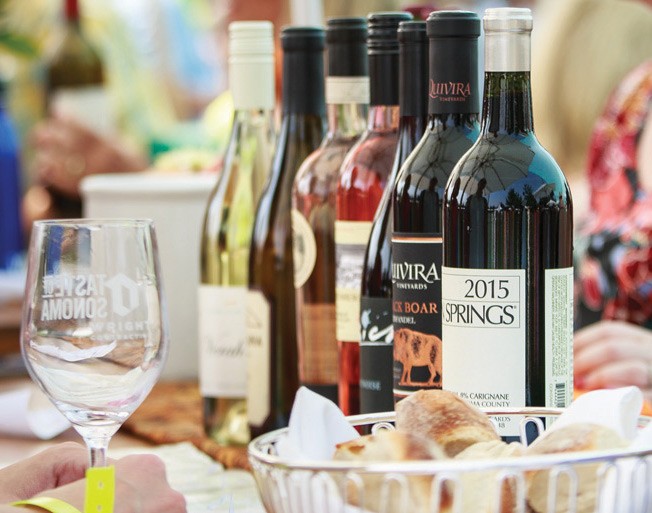
That’s what Karissa Kruse, president of the Sonoma County Winegrowers, heard from more than a few consumers in response to the organization’s ambitious sustainability initiative. The voluntary program is aiming to make Sonoma County the nation’s first 100 percent sustainable wine region by the year 2019.

The organization says it’s taking on the project to ensure the long-term viability of grape growing and agriculture in Sonoma County, but also to help move the region a peg up in the global marketplace.

Consumers do not reward organic labeling the same way they do when shopping for food and other products, and, apparently, some people confuse “sustainable” and organic wine, which was just too darn crunchy for them.

“Historically, we’ve seen that more around biodynamics and organics,” Kruse says. “There’s been some consumer confusion—that the practices that go into it impact the taste of the wine.” In other words, people were making the age-old association of dirt with “dirty.”

But increasingly, consumers are getting a new message: sustainability is green, and “clean.” The feedback they’re getting to questions like, “Why would you buy sustainable wine?” is the opposite, Kruse says. “It’s because they think the quality is better.”

The five-year sustainability plan was launched in 2014. As 2019 approaches, Sonoma County winery and vineyard operators have implemented progressive environmental and personnel development projects too numerous to list here.

But as the Sonoma Sustainable label rolls out to consumers, are wineries aiming to have their Chardonnay and drink it, too—passively benefiting from the positive messaging of organic farming practices while evading inconvenient prohibitions on fertilizers and pesticides?

In recent years, I’ve noted a war of words in discussions about organic and sustainable certifications that does not seem necessary. It’s not enough to tout the benefits of one; the other must also be put down. Sometimes, those who favor organics complain that when a winery says it’s sustainable, it doesn’t mean anything. More often, winery representatives tell me that sustainability “goes beyond organics.” I was once told, in all earnestness, that sustainable farming only selectively targets pests, like a smart bomb, while, “in organics, they kill everything!”

It isn’t the Sonoma County Winegrowers pushing this view. “We have growers that are organic and biodynamic and sustainable,” Kruse says. “And they’re all good. Any time farmers are focused on what they’re doing is good. I think people try to pit the programs against each other, and I don’t think that’s fair to the farmers who are trying real hard to do the right thing.”

The Winegrowers’ reports on the initiative’s progress published since 2015 do a great job of explaining their goals, and include many profiles of local growers and ag leaders who have found cost savings or other benefits by implementing best practices in energy use, habitat and human resources. It’s worth noting that the reports make minimal mention of organic or biodynamic certified vineyards. For example, one report discusses how Ridge Vineyards uses cover crops, but doesn’t say the vineyards are certified organic.

What does it mean to be sustainable for the Winegrowers? Is it more than just marketing? To get a better idea of the nuts and bolts of the program, I sat down with former Winegrowers sustainability manager Emily Farrant last year to discuss the grape growers’ self-assessment, the first step of the certification process. She’s now an independent auditor of the program.

To become Sonoma Sustainable, there are four ways to go. The California Sustainable Winegrowing Alliance certification program is the main standard the Winegrowers use. Three other programs with their own rules are also accepted: Fish Friendly Farming, Lodi Rules and Sustainability in Practice. Organic certification will not get you a Sonoma Sustainable seal of approval.

Here’s how it works: the workbook has 16 chapters, each dealing with an aspect of vineyard management, human resources, winemaking practices and other topics. Each section contains a series of statements in four categories, and respondents are asked to choose which category best describes their operation.

For example, in section 7-5 on wine quality, answering “Knowledge of wine quality consisted of only tasting local wines or none at all,” will get you category 1. The better answer is, “Wine regions elsewhere in the state and internationally had been visited and toured,” one of three prerequisites for best-practices category 4.

In section 3-3, on leaf removal, category 2 states, “Leaf removal was sometimes done, or very lightly done, to minimize costs.”

Most of the best-practices answers here have been taught for decades as simply good, modern farming. Doing just a little better than showing up will earn a category 2.

But growers cannot hang out in category 2 forever and be re-certified, Kruse says. “Every year, you’re having to do something, whether lowering water use or doing something for employees. You have to do something that shows you’re moving the needle in one of the assessments.” Continual improvement is the mantra of the program.

[page]

Best practices guide growers to use fewer chemicals, but they are not prohibited.

All of this isn’t free, except for the initial self-assessment paperwork. After that, administration fees and auditing costs can run up hundreds of dollars—small change for big wineries, but a burden for small growers. Currently, Winegrowers is offering to help defray costs. Also, it’s holding up the notion that consumers will be willing to pay a buck or two, even $7 and change, according to one Wine Intelligence survey, for wines that bear a sustainable label.

Now that I know what the Sonoma County Winegrowers mean by sustainable wines, what do those consumers know?

Not much. Glance at any number of cheery articles about sustainable and organic wine, and you’ll often find the terms used interchangeably. According to consumer research commissioned by the Winegrowers in 2017, a higher percentage of frequent premium wine consumers would be more likely to buy a certified sustainable wine than could identify what it means.

A 2018 report issued by the nonprofit Wine Market Council finds that almost the same portion of respondents who felt “fairly confident” about the meaning
of “sustainably produced wine,”
43 percent, also believed it meant “no use of synthetic pesticides/fertilizers,” at 45 percent. That’s incorrect, and is actually the definition of wine made from organic grapes, which 87 percent did get right.

But while an equal number agreed that sustainably produced wine “conserves local water resources and habitat,” only 17 percent agreed that “wine made from organic grapes” does the same. While the updated National Organic Program standards contain a number of points on soil stability and water quality, along with wildlife and woodland conservation, perhaps the perverse takeaway from informal interactions with sustainability promoters like I have had is working. Do wine consumers think that organic standards don’t protect the environment?

A 2017 report from Liz Thach, professor of wine at Sonoma State University, finds that among 301 wine consumers surveyed with the question “What appeals most to you,” statements about sustainable wine beat those about organic wine at 44 percent to 20 percent.

The phrasing of the statement is interesting. “Certified sustainable wine: made in a way that is environmentally friendly, equitable to employees and economically viable to winegrowers. No agri-chemicals are applied, unless necessary to save the crop.” The first three parts mirror the “triple bottom line” approach of the Winegrowers, the so-called three

p‘s of “people, planet and profit.” The fourth is something of a misrepresentation of the certification requirements, failing to acknowledge the routine use of what you might call the fourth p—pesticides.

Mention that in the feel-good context of the sustainability initiative, and you might as well be tagged with two more p‘s, for party pooper.

About the above survey, Kruse makes an oft-heard argument: “Organics uses pesticides and chemicals, too—so it’s the same definition.”

Organic and biodynamic growers are allowed to use certain products that kill bugs or inhibit mildew, but qualitatively, the chemistries are different. In 2017, the California Sustainable Winegrowing Alliance issued an addendum to the workbook: a “red list” of 28 materials that are prohibited in the second year of certification, and a “yellow list” of 10 chemicals that may be accepted if justification is provided.

Red list materials that were used in 2016 in some Sonoma County vineyards, according to pesticide use reports (PUR) available from the California Department of Pesticide Regulation, include carbaryl, mancozeb and zinc phosphide. Yellow list materials included 2,4-D, abamectin, diphacinone, paraquat dichloride and simazine.

Notably absent from the 2016 PUR is chlorpyrifos, a nerve agent that was banned for home use 17 years ago, but wasn’t prohibited outright until this summer when the Ninth Circuit court overturned former EPA administrator Scott Pruitt’s efforts to keep the substance legal. Yet in this past year, chlorpyrifos turns up under the brand name Lorsban in several Sebastopol locations—used on apples as well as wine grapes, by the way.

Diphacinone is a tricky substance. This anticoagulant rodenticide can be fatal to the very rodent-hunting owls that the sustainability code recommends building nest boxes for, if operators choose to double down and employ both methods.

Glyphosate, a systemic herbicide better known by its Monsanto brand name Roundup, has come under increasing scrutiny. It was named a probable human carcinogen by the World Health Organization, and was recently banned from use in parks by Santa Rosa and Windsor due to public concern. It’s widely used to keep vineyards weed-free.

[page]

If consumers are to believe that Sonoma County is now using such chemicals only when necessary, or are committed to decreasing their use, what’s the record been since the Winegrowers launched its sustainability initiative four years ago?

We’re up, we’re down, but there is no dramatic downward trend, according to DPR statistics. In 2014, 76,975 pounds of glyphosate were applied in Sonoma County; 92,698 pounds in 2015 and back down to 76,890 pounds in 2016.

A comparison to other grape-growing counties does not indicate that Sonoma is reining in the Roundup, even compared to Fresno County, which put on 65,577 pounds on wine grape acreage in 2016. (To be sure, Sonoma County grape growers are not in the same league as Fresno almond growers, who put 68,081 pounds of chlorpyrifos on their trees in the same year.)

Hoping to gain insight from a longtime West County winegrower who’s surrounded by neighbors in the Green Valley of the Russian River Valley region, I ask Joy Sterling, partner and CEO of Iron Horse Vineyards, for her thoughts on the sustainability program. “I think it’s better,” Sterling says. “You can be organic and not be sustainable.”

A local leader in green practices, Iron Horse has irrigated its 164-acre estate with recycled Forestville water since 1990 and is certified by Fish Friendly Farming.

But I’ve hardly begun to ask about the misgivings some county residents have about farming inputs, when Sterling says she’s become depressed, comparing them to the protesters at the recent Climate Summit. “It’s never enough for some people,” she sighs. “We do our very best.”

Up on Sonoma Mountain, vintner Tony Coturri is also dismayed, for a different reason: he didn’t realize that people elsewhere are still spraying paraquat. “I’m just amazed. That’s just amazing to me. Wasn’t that Agent Orange?”

Coturri’s out of the loop with his five acres of uncertified vineyards farmed without chemical inputs, however. While his wines have gained recognition in the natural wine bars of New York City and Los Angeles he says he doesn’t register with Sonoma County Winegrowers.

“Nobody’s talked to me,” Coturri says. “I’m pretty much a pariah in the business.”

Like Coturri, other organic and biodynamic winegrowers I talked to acknowledged that farming without modern systemic chemicals involves trade-offs, like more tractor passes in the vineyard to control mildew.

“There’s a little give and take there, sure,” says Sophie Drucker, vineyard manager at Boisset Collection. “But I think it’s overstated to say we’re polluting the environment because we’re farming organically.”

Drucker says that, for her, it amounts to an extra tractor pass or so per year. “But organic sets a higher standard and is much more limiting as far as what tools you have to accomplish your farming.” Boisset Collection, which includes DeLoach Vineyards, also got certified sustainable, but pays a premium to its contracted growers for organic grapes.

Dry Creek Valley’s Ferrari-Carano Vineyards isn’t known for its biodynamic practices, yet vineyard operations manager Todd Clow says that the winery’s sustainability efforts have encouraged him to work on a proposal to achieve a biodynamic certificate for a small vineyard in an environmentally sensitive area.

“The cynic in me,” Clow says, “agrees with people’s misgivings about the sustainable certification, because there are holes in the program.”

Although Ferrari-Carano farms over a thousand acres conventionally, it is among those operations working to move away from Roundup, Clow says, as well as proactively aiming for category 3 and 4 sustainability targets. “From what I’ve seen in the last decade, we’ve made a lot of progress, and we have a lot more progress to make.”

Still, says Clow, “we can’t apply biodynamic or organic farming principles to 1,500 acres; we wouldn’t be in business if we did that.”

In Sebastopol, winegrower Paul Sloan is undecided on the sustainability program, slowing down in the midst of a busy harvest to ponder the question. Sloan agrees that organic wine carries a stigma that is lagging 20 years behind the larger marketplace. But he says he farms his Small Vines vineyard, where his family also lives, with only organically approved inputs for reasons of wine quality and environmental health, not for marketing purposes.

If he was asked to self-assess for the sustainability initiative, which he says he hasn’t been so far, Sloan is philosophical.

“It’s a waste of my time, but it is possible that it is better for the whole of the growing community, for me to go though the process,” Sloan says. “Or maybe I stand on the soapbox a little bit. I don’t want to be a negative to the whole, but at the same time I don’t think this has gone far enough. It’s a pretty good step in the right direction, but it’s not enough—it’s just one step in the process.”

Winegrowers president Kruse says that some growers are so committed to eventually taking extra steps to best-practices categories in the sustainability code, that they ask her, “What if we max out everything we can do to improve?” Kruse says. “Well, I hope we get there.”

Redemption

0

Jail can be hell. But not many people know that jail cells can also be a
place of rebirth. Yarrow Kubrin lives in San Francisco with his wife and children. A longtime marijuana grower and dealer, he knows the two extremes that exist behind bars and inside
thick walls.

Kubrin will not harvest a crop this year, though he has a bumper crop of memories in his head. As a religious Jew, he knows the joy and the sadness of Sukkot, the Jewish holiday celebrated at the end of September that traditionally marked the end of the harvest time and the culmination of the cycle of the agricultural year.

“I understand why people connect to spirituality while in jail,” Kubrin says. “Spirituality is a natural reaction to depravity.”

Locked up for six months, Kubrin saw the kind of depravity he had never seen before. He also experienced a sense of spiritual uplift.

Kubrin’s life crashed all around him in 2010 when he was arrested and charged with possession of marijuana with intent to sell. It was the third time he was busted on pot charges. In 2010, Sonoma County police found the three big no-no’s—cash, cannabis and guns—in his house. District Attorney Jill Ravitch depicted him as a threat to public safety and a menace to his own family. Local media wrote damning articles. The stories about him continue to haunt him.

What about the guns?

According to Kubrin, the weapons that the police confiscated—many of then unfired collectables intended for sports hunting—were legally acquired, legally registered and locked away. He says he did not have the key to unlock the cabinet were they were kept.

“I come from a family in which guns were part of our heritage,” Kubrin says. “My father, David Kubrin, helped to register black voters in the Deep South in the 1960s. The KKK pursued him. He raised me with the idea that every family should have a rifle.”

Prosecutors say Kurbrin had assault rifles, flak jackets and a shrine to the Sopranos.

What’s also significant in Kubrin’s case is that none of his or his father’s guns were at the site where cannabis was cultivated, though a friend who was also a deputy sheriff was living at one of his properties. That deputy had a gun, a snub nose .38.

“He was not a member of our collective or our operation,” Kubrin says. “He was a pal who needed a place to stay.”

A longtime Sonoma County marijuana activist who spoke in confidence told me, “Every American has the right to have guns. That right applies to marijuana growers.”

Kubrin echoes that sentiment. “Jewelers can have guns to protect their diamonds,” he says. “Cannabis cultivators should have the same constitutional right.”

After his arrest, Kubrin was lucky to be able to rely on his wife, Heather, his kids, his friends who showed up in court to lend their support, and his lawyer, Chris Andrian, who has defended marijuana growers and dealers for decades. Kubrin also had the backing of a rabbi named George Gittleman and the congregation at Shomrei Torah in Santa Rosa.

“It was a hard time for Yarrow,” Gittleman says. “His whole life was turned upside down. Prison wasn’t on his agenda.”

Gittleman pauses for a few moments and then adds, “Most of us don’t know what it means to go to jail. You lose your time and you can lose your humanity.”

Gittleman’s comments come just after the celebration of Rosh Hashanah and Yom Kippur at Shomrei Torah, which were followed by Sukkot. Thousands of years ago, Sukkot was the most important Jewish holiday because it was the time of the year when people found out whether they had enough food for the year ahead, or would starve.

[page]

“Sukkot is about the fragility of physical existence,” Gittleman says. “Yarrow Kubrin came to understand that fragility when he went to jail. After visiting him, I knew he’d be OK and would likely go on to counsel others. He had a great attitude.”

Jews like Kubrin, who observe Sukkot, Rosh Hashanah and Yom Kippur, and who worship at synagogues, don’t ordinarily find themselves in handcuffs and in court facing years behind bars.

Judge Rene Chouteau sentenced Kubrin to six months in jail and four years under supervision. Before he surrendered to the authorities, Kubrin gave up his real estate license, said goodbye to everyone he loved and entered Sonoma County’s North County Detention Facility, where he served six months. He has until October 2019 before his four years of supervision are over. He still spends time in Sonoma County, he says—on the weekends.

“My sentence felt like a bullet coming at me in slow motion,” Kubrin says, adding, “It injured my soul, but there was a silver lining to my experience. I shawshanked my conviction.”

In the movie The Shawshank Redemption, two convicts, played by Tim Robbins and Morgan Freeman, are redeemed by their acts of human kindness.The characters in the film inspired Kubrin. But he was also disappointed by the realities of the criminal justice system

“Unfortunately, the emphasis in the probation department, here and elsewhere, is on punishment, not on rehabilitation,” Kubrin says.

Behind bars, Kubrin—who grew up and went to public schools in San Francisco—made the best of a bad situation. It helped that Rabbi Gittleman visited him regularly. It helped, too, that Kubrin signed up for classes, studied the Old Testament, wrote letters for inmates who needed a bit of his poetic license, befriended “men with terrible addictions” and steered clear of trouble.

“I was the only openly practicing Jew in the jail,” Kubrin says. “If you’re a Jew behind bars, you’re a distinct minority and you’re viewed as the enemy by many of the other prisoners who think Jews are inferior human beings.” He adds, “I saw more swastikas while in jail then while watching the History Channel for years. Most of the swastikas were tattooed on white inmates as a symbol of white pride.”

Kubrin was released on Halloween 2015. That night, he went out trick-or-treating with his son and daughter in Sebastopol. This September, he celebrated the Jewish New Year. Then it was on to Sukkot.

Six months after he was released from jail, Kubrin began to volunteer with the Sonoma County Growers Alliance. Soon afterward, he became a cannabis-industry consultant. Later, he returned to the Healdsburg real estate office where he had worked for years and where he had built up an extensive clientele. But he returned as an unlicensed associate and as a marketing manager, not as an agent.

Since his release from jail, Kubrin has also talked to his congregation about cannabis and shared his experiences behind bars.

California Assembly Bill 1793, which has passed both house of the California State Legislature, but has not been signed by Gov. Brown, would allow for some marijuana convictions to be expunged from the record. Kubrin thinks he won’t be eligible. After all, he deposited large amounts of cash from the sale of marijuana in an Exchange Bank account. In the eyes of the law, he was guilty of money laundering.

On the earthly scale of saints and sinners, the old Kubrin falls somewhere between the two. In jail, among men with criminal records, he was delivered from the unthinking, risk-taking life he’d been living and became aware of his own flawed humanity. Out of denial came acceptance.

Editor’s Note: An earlier version of this article contained several reporting errors that have been corrected or removed from this article. Kubrin lives in San Francisco, not Sonoma County. He spent six months in jail, not a year. We regret the errors.

Story Teller

0

In the landscape of Americana music, few songwriters travel as much ground as well as veteran songwriter Walter Salas-Humara.

The child of Cuban refugees, Salas-Humara embodies the melting pot of the American experience and shares his story through his songs. This week, he also shares the bill with Jeff Crosby when they appear in the North Bay for two shows.

“There’s a couple different ways to approach a musical adventure, so to speak,” Salas-Humara says. “One is to create and identify yourself with a sound, and the other is to tell stories that connect emotionally with people.”

Salas-Humara has crafted two dozen albums of rock, country and Americana over his 30-year career. The bilingual songwriter first made his mark as the founder of longtime New York City country-rock revival group the Silos in 1985. Now living in Flagstaff, Ariz., he embraces his culture and heritage on his latest solo album, 2018’s

Walterio, which features traditional storytelling folk, psychedelic rock and Latin-inspired sounds.

“Over the years, you get categorized in certain ways,” Salas-Humara says. “Now they call it Americana, or whatever. But I’ve also been compared to everything from Nirvana to Townes Van Zandt, which usually pisses artists off, like, ‘I’m so misunderstood,’ but to me the whole thing’s funny.”

Throughout Walterio, Salas-Humara’s lyrics alternate from funny to poignant, with two tracks sung in Spanish, including the opening track “El Camino de Oro,” which he describes as a “power to the people” anthem. The record also contains some of his most melodic ballads to date, such as the reflective “Come in a Singer,” sung from the point of view of an aging artist.

“When you’re young, you think, ‘I’m going to be a great artist, because art is so important, one of the important things in life,'” he says. “When you get older, you realize it’s just about making the art for yourself. If you start worrying about if anybody gives a shit or not, you’re screwed.”

Partnered with Nashville-based songwriter Jeff Crosby on the current tour—with the performers sharing band members—Salas-Humara is excited to visit the North Bay. “It’s really a tight band,” he says. “There’s a good mix of dancing, beautiful singing to spark emotions, and Jeff’s really sexy. Well, I’m like the old sexy guy and he’s the young sexy guy.”

Senior Strains

The medical marijuana dispensary located on Todd Road in Santa Rosa is hosting a field trip of sorts for the recently established Oakmont Cannabis Club. Members of the club, most of whom are residents of the Oakmont Village retirement community, peruse the dispensary shelves in search of alternatives to what ails them.

Oakmont Village resident Tina Hoogs, a founding member of the Oakmont Cannabis Club, studied medicinal marijuana at Oaksterdam University in Oakland, which touts itself as “America’s first cannabis college.” Hoogs envisioned the club as an alternative for members of the retirement community disillusioned with the cost and effectiveness of traditional pharmaceuticals.

“It’s about making it less mysterious for most elderly people who have a preconceived notion that a dispensary is like a headshop,” Hoogs says.

Last May, Hoogs, founding member Jim Byrne, and club spokesperson Heidi Klyn put up a flyer proposing the club to Oakmont residents. “The first day we thought we’d get maybe 10 people. We had almost triple that,” Hoogs says.

The Oakmont Village Association eventually held a meeting
and voted in favor of formally recognizing the club as an organization; now, more than a year later, the club has over 200 members.

Retirement communities have long been synonymous with more traditional recreational activities like arts and crafts, gardening and pickleball—the last of which caused a minor scandal in Oakmont Village over the construction of new courts in 2017.

“During that whole pickleball controversy I said, ‘Can’t we all just a get a bong?'” Byrne says. He estimates that the club has helped anywhere from 50 to 100 members successfully quit opioids.

“What seniors stand to benefit the most from legalization is treating their ailments with minimal side effects,” says Michael Zick Doherty, a business and marketing consultant in the Sonoma County cannabis scene who hosted a workshop for the club on how to properly extract cannabis to infuse into edible substances like butter or oil for cooking. “We would love to see the club become a model for other senior residential communities in the area,” he says.

Despite issues and concerns associated with legalization for senior citizens—the cost, feeling comfortable in dispensaries—the potential of the plant’s healing power can’t be overlooked.

“I know one person who has been battling breast cancer, and felt that chemo was literally killing her, and chose to use cannabis instead,” Hoogs says. “A year and a half ago she looked like very ill, and now she seems like a picture of health.”

Fare Thee Well

0

Yesterday, Sept. 25, was my last day at the Bohemian and Pacific Sun. After four and a half years, I’m leaving my position as editor and hanging up my newspaperman’s fedora. Well, sort of.

I’ve taken a job at Harvester Clothing Co. in Sebastopol, where I’ll be writing and curating stories of compelling people and places from Crescent City to Oaxaca in support of made-in-California apparel.

I’m excited for this new chapter in my life, but I will miss the privilege of reporting on life in the North Bay, particularly at this fragile time in our nation’s history.

The Bohemian and Pacific Sun will be in good hands. Gary Brandt, who has been with the Bohemian for 17 years and has worked on more than 800 weekly issues, has been promoted to managing editor and will be responsible for shepherding the papers to press. Charlie Swanson will take on an expanded role as arts editor and producing digital content. News editor Tom Gogola will have an expanded role as well, as he expands the Bohemian and Sun‘s coverage of local issues, public affairs and investigative journalism.

As a 20-year veteran of news business, I’ve long believed in the value of a free press. With our democracy teetering on the whims of a venal and ignorant president, I don’t think it’s hyperbolic to say the press and the ballot box are all that stand between us and Tweet-powered authoritarianism.

With the contraction of the media landscape, I also believe independent, alternative journalism is more critical than ever. The Press Democrat, Napa Valley Register and Marin Independent Journal all do fine work, and we’re lucky to have them. But democracy thrives on a range of voices and the willingness of journalists to go where daily newspapers can’t or won’t. The Bohemian will continue to go there to tell the stories we think need telling.

It’s been a privilege to serve as editor of the Bohemian and the Pacific Sun. Thanks for trusting us with your stories and, most of all, thanks for reading.

Open Mic is a weekly feature in the ‘Bohemian.’ We welcome your contribution. To have your topical essay of 350 words considered for publication, write op*****@******an.com.

Letters to the Editor: September 25, 2018

Show Yourself

I read the rabid fan letter attempting to gloss over the sleazy conflict of interest and self-dealing practices of Gallaher Homes and Bill Gallaher’s Poppy Bank (Letters to the Editor, Sept. 19) and found it worthy of comparison with Donald Trump playing his own publicist on the phone. What a colossal joke this obvious shill for Bill Gallaher is!

Makes me think that this anonymous writer just might be ol’ Bill himself. Otherwise, BananaBolt, why the pseudonym instead of having the courage to use your real name? Furthermore, just how dumb do you think we really are?

BananaBolt criticized Bohemian reporter Peter Byrne and the Bohemian for publishing the previous week’s piece “One-Stop Shop.” However, I found that piece to be excellent reporting—comprehensively researched and well-written—and was grateful as hell to see it in print.

But now I have my own criticism of the Bohemian: for Pete’s sake, don’t allow cowardly wimps such as this one see the light of day! Please, no more anonymous letters to the editor.

Santa Rosa

What a Rip!

Read with interest the recent Nugget article “Exodus” (Sept. 19). It’s pretty simple why legalization has failed. I recently went to a dispensary in Sonoma County. A package of B+ grade weed went for $35 a gram. There were slight discounts for buying an ounce, but still over $350 an ounce. You can now get two things on the black market: cheaper weed and weed that is not brimming with pesticides. You know why? Because you know the people you’re buying from.

What incentive do small growers (including those who don’t make a living off weed) have to pay ridiculous prices with ridiculous taxes and fees when you can get better quality and cheaper? That’s real true capitalism. What’s going on now with legalization is a combination of extortion and throwing legitimate growers out of the market. For what? State taxes. The ripoff market is never going to be fully realized until the state reduces profits and taxes. Then maybe it will get the revenues it needs. Right now, it’s a classic ripoff.

Penngrove

Hot-Tubbers Who Care

Hardly a day goes by when the reality of homelessness in Marin County doesn’t hit home and break your heart. It’s heartwarming to realize that in one of the most affluent communities in the world, a spirit of compassion and empathy lives large. From Adopt a Family of Marin, to the St. Vincent de Paul Society, and many more caring resources in between, it is with an outright sense of pride to be residing among those citizens a politician once referred to as “misguided Marin County hot-tubbers.” May Marinites always be so misguided.

Sausalito

Write to us at le*****@******an.com.

Life After Trauma

The New Thanksgiving One year after the Tubbs fire, it would be too easy for a lot of us in Sonoma County to feel sad this week. Everything from the newspapers to the Kaiser wellness groups I attend say that we're going to be blue. No one would blame us for frowning, crying or being short with others. Instead, I think...

Jerry Brown: Hero of the ‘Pro-Life’ Movement?

Now here's a subject line in an email you don't see every day: 'CA Governor Jerry  Brown becomes newest hero of the pro-life movement.' Today the Alexandria, Virginia–based organization Americans United for Life applauded Brown for his veto Sunday of a bill that "would have required public universities in California to offer abortion bills on campus," said the organization...

Air Resources Board Considers All-Electric Bus Fleet by 2040

The California Air Resources Board is meeting this morning in Sacramento to hear expert testimony on a proposed rule that would mandate a statewide zero-emissions bus fleet by 2040. The ARB reports that transportation emissions are at their highest levels in ten years—what?!—and today's meeting will zero-in on the board's Innovative Clean Transit Rule, an ambitious effort to electrify...

Just Say Kavan-no.

It's been quite an emotional day in America as Dr. Christine Blasey Ford took the stand before the Senate Judiciary Committee to describe her alleged sexual assault at the hands of Supreme Court nominee Brett Kavanaugh. The hearings today have prompted dozens of House members to ramp up their demand that Sen. Mitch McConnell postpone the confirmation hearings until...

Name Games

'What are you doing to my wine?" That's what Karissa Kruse, president of the Sonoma County Winegrowers, heard from more than a few consumers in response to the organization's ambitious sustainability initiative. The voluntary program is aiming to make Sonoma County the nation's first 100 percent sustainable wine region by the year 2019. The organization says it's taking on the project...

Redemption

Jail can be hell. But not many people know that jail cells can also be a place of rebirth. Yarrow Kubrin lives in San Francisco with his wife and children. A longtime marijuana grower and dealer, he knows the two extremes that exist behind bars and inside thick walls. Kubrin will not harvest a crop this year, though he...

Story Teller

In the landscape of Americana music, few songwriters travel as much ground as well as veteran songwriter Walter Salas-Humara. The child of Cuban refugees, Salas-Humara embodies the melting pot of the American experience and shares his story through his songs. This week, he also shares the bill with Jeff Crosby when they appear in the North Bay for two shows. "There's...

Senior Strains

The medical marijuana dispensary located on Todd Road in Santa Rosa is hosting a field trip of sorts for the recently established Oakmont Cannabis Club. Members of the club, most of whom are residents of the Oakmont Village retirement community, peruse the dispensary shelves in search of alternatives to what ails them. Oakmont Village resident Tina Hoogs, a founding member...

Fare Thee Well

Yesterday, Sept. 25, was my last day at the Bohemian and Pacific Sun. After four and a half years, I'm leaving my position as editor and hanging up my newspaperman's fedora. Well, sort of. I've taken a job at Harvester Clothing Co. in Sebastopol, where I'll be writing and curating stories of compelling people and places from Crescent City to...

Letters to the Editor: September 25, 2018

Show Yourself I read the rabid fan letter attempting to gloss over the sleazy conflict of interest and self-dealing practices of Gallaher Homes and Bill Gallaher's Poppy Bank (Letters to the Editor, Sept. 19) and found it worthy of comparison with Donald Trump playing his own publicist on the phone. What a colossal joke this obvious shill for Bill Gallaher...
11,084FansLike
4,446FollowersFollow
6,928FollowersFollow