Lessons Learned Can Cypress avoid the pitfalls that delayed its New Orleans Katrina Cottage experience?
Balloons flapped like giant, inflatable grapes in the hot wind of Santa Rosa’s Fountaingrove area as a host of leaders heralded the completion of the first “Sonoma Wildfire Cottage” on a recent Friday afternoon.
Against a backdrop of under-construction cottages and a corporate parking lot, Sonoma County Supervisor James Gore took the mic and announced that the project underway was a portent of things to come. The cottages, he declared, represented the first metaphoric sparks to kick off a wildfire of public-private housing build-outs in Sonoma County.
Habitat For Humanity’s nine-unit pilot program is housing, if only temporarily, families displaced by the 2017 wildfires. It’s a partnership with the Washington D.C.–based lobbying firm The Cypress Group.
The homes are located on a seemingly unusual plot of land on the Medtronic medical equipment campus and provide a visual symbol of the $1.2 million private-public partnership. The emphasis is on private contributions and public assertions that this is how Sonoma County is going to house a handful of wildfire victims short-term, while also setting a path forward to address the county’s crippling 25,000-unit housing deficit that predated the fires.
Officials from all walks of government were on hand to celebrate the completion of “House #1,” a tidy, white two-bedroom, shotgun-style cottage whose components were built off-site and constructed on the lot. Hand-made quilts were ceremoniously presented to the new occupants and reporters were able to tour the unit built to withstand fires. Can they also withstand local politics and zoning issues?
Gore was joined at the event by co-supervisor Shirlee Zane, Rep. Mike Thompson and Santa Rosa Mayor Tom Schwedlhelm. Everyone lauded the effort and declared it a huge moment in the history of Sonoma County’s housing crisis. Efren Carrillo, the former county supervisor and current executive with Burbank Housing, was also on hand.
The cottage community is an ambitious, complicated project that has attracted private sponsors from around the region—everyone from the Piazza Hospitality Group to Safeway Inc. has contributed to the effort—and was sponsored by a group called Wine Country Rebuild that’s comprised of young winemakers.
Senses Wines in Occidental founded Wine Country Rebuild after the 2017 wildfires. Thew group crowdfunded $1.2 million for wildfire cottages (Senses was co-founded by Christopher Strieter, Myles Lawrence-Briggs and the actor Max Thieriot). The project is being built by the national housing organization Habitat for Humanity, which has extensive experience in sweat-equity partnerships with would-be homeowners. This is a different kind of project for HFH—volunteers from Medtronic and regional construction firms provided much of the sweat equity here.
But what of The Cypress Group? The organization’s website says when it comes to its strategic-advisory services “we view political risks as the probability that changing laws or regulations will create loss or change for a client.”
And it looks as if the group did see some risk in engaging with Sonoma County’s rebuilding efforts. In his remarks to the crowd gathered in mid-August to check out the Wildfire Cottages, HFH’s outgoing Interim Executive Director John Kennedy noted the powerhouse lobbyist jumped on board the project with reluctance. It was an off-hand remark but one that’s worth exploring, as it may signal whether The Cypress Group is really up to the task of coordinating Sonoma County and Santa Rosa’s multi-faceted rebuilding efforts.
The Cypress Group is a strategic advisory and lobbying organization in D.C. that emerged from the wreckage of Hurricane Katrina in 2005 as an untested housing developer with deep connections in Louisiana Democratic politics and a stated desire to do something about their nearly-destroyed state and city of New Orleans. With Democratic Governor Kathleen Blanco in the statehouse, Cypress leveraged their influence in Baton Rouge and Washington to manage the Katrina Cottages program that took root after the storm.
Cypress Partner Patrick Cave, a proponent of the New Urbanism school that highlights walkable communities and scaled-housing solutions, linked up with New Urbanist Marianne Cusato to locate some 450 “Katrina Cottages” under FEMA rebuilding programs after the storm. The Cypress Group created an organization called the Cypress Community Development Corporation (CCDC) and put Cusato in charge of it. They’ve heralded the Sonoma Wildfire Cottage program as not just the solution to Sonoma’s housing crisis, but possibly for the whole state. The CCDC stresses its role as a not-for-profit division of the lobbying and advisory organization that “specializes in developing innovative housing solutions for disaster rebuilding and workforce housing.”
Those issues have intersected in a negative, high-rent manner in Sonoma County, where workforce housing is scant and pricey and where a natural disaster burned thousands of homes and businesses.
Habitat for Humanity contacted the organization after the 2017 wildfires, but the Cypress non-profit was initially reluctant to take on the rebuilding effort in Sonoma County, says Kennedy. In his remarks to the crowd gathered at the Medtronic campus, he recounted Cypress leaders telling him, “We had some experiences with New Orleans that weren’t exactly good, but we’ll team up.”
Kennedy didn’t elaborate to the crowd as to the source of The Cypress Group’s “hesitation” to join the Sonoma County-City of Santa Rosa rebuilding effort.
In a follow-up interview he says their reluctance was two-fold. First, he said, the firm was hesitant because the Sonoma Wildfire Cottage program is utilizing numerous contractors and developers to execute the vision of affordable (or at least, more affordable) homes for local residents. That’s a recipe for an inefficient construction management plan that’s potentially fraught with political considerations, with local and regional contractors vying for a piece of the Habitat for Humanity plan.
The Sonoma Wildfire Cottage project is already a year past Wine Country Rebuild’s schedule. The company’s website says that “construction on the cottages is expected to begin in the summer of 2018 and the anticipated date for occupancy late fall and early winter of 2018.” A year later, one cottage has been completed and occupied.
And, Kennedy told this reporter that The Cypress Group doesn’t necessarily hold the same sway in Washington housing agencies under President Donald Trump as it did with previous administrations. Trump’s been bad for the state on numerous fronts, Kennedy says with a slight laugh, including housing.
But Cusato, and Cypress Group promotional materials, insist the firm is well-positioned to deliver on its promise, despite a build-out of similar intent in New Orleans that was anything but smooth: “The Cypress Model for neighborhood building is distinctly applicable to housing families in the wake of a disaster—quickly, safely and cost-effectively—with a view of the long-term health and stability of the family in a stable and permanent community,” says the company website.
As I reported in 2012 for the online investigative website The Lens, the Cypress Model in the Crescent City was anything but a quick and cost-effective build-out, and included a last-minute rush to remediate Katrina Cottages that had been heavily damaged after sitting out in the elements for years before being placed in their permanent locations around New Orleans.
Back in 2012, The Cypress Group was under the gun to beat a FEMA deadline for delivery of around 15 highly nomadic Katrina Cottages that had been moved all over the state before winding up in New Orleans and that accrued nearly $1 million in remediation costs along the way.
So, quickly and cheaply? Not so much, at least in New Orleans. The Katrina Cottage program did play out much more smoothly in other parts of the state and in Mississippi. But in New Orleans, after a five-year odyssey that was promised as a quick and long-term solution to residents displaced by Katrina, the last of the Katrina Cottages were sited in the city’s Lower Ninth Ward in 2012.
New Orleans housing officials had a difficult time trying to site the Katrina Cottages, owing to designated lot sizes that turned out to be too small to accommodate the houses, or weren’t zoned to accept the homes.
Is this the source of The Cypress Group’s “hesitation” to jump on the Sonoma Wildfire Cottages, which are already a year behind the proposed schedule outlined by Wine Country Rebuild? Cusato says there was no hesitation at all—simply a concern about the ambitious, multi-contractor arc of Habitat’s plan.
By the time those cottages were completed and residents moved into them, so much time had passed between the promise and the reality that they weren’t even calling them Katrina Cottages in New Orleans anymore. The promise of a quick and efficient post-disaster response that didn’t involve toxic FEMA trailers was never realized in New Orleans. And now the same company is expressing reservations about doing business in Sonoma County, based on its NOLA experience. The Sonoma Wildfire Cottages, says Kennedy and Cusato, have yet to be matched with a lot in Santa Rosa.
The Cypress Group has positioned itself as a high-flying strategic advisory and lobbying organization with a robust client base that includes a few clients that might raise eyebrows among North Bay liberals. The company has billed out some $2 million in lobbying fees so far in 2019, according to online records. Lobbying clients include Koch Industries and Grupo Salinas, among others. The latter is a California-based consortium that represents the interests of Advance America Cash Advance Centers, a business targeted by workforce activists for its high-interest, payday loans. Other Cypress clients include Wells Fargo, Prudential, Citi and Metlife.
The Cypress Group has long been held as an example of the “revolving door” lobbying community in Washington. Its founder, J. Patrick Cave, was an Assistant Treasury Secretary before leaving government and founding The Cypress Group. The revolving door apparently keeps spinning, and it looks like, on paper at least, the organization took measures to get some traction with the Trump Administration: In April 2018, according to the Wall Street Journal, the company hired former Trump White House Deputy Chief of Staff Rick Dearborn as a partner.
And now there’s a robust public-private partnership playing out in Santa Rosa. The mantra at last week’s Sonoma Wildfires well-attended opening on the Medtronic campus was that one house built is one less house that needs to be built to address the city and county’s growing homelessness and affordable housing problem.
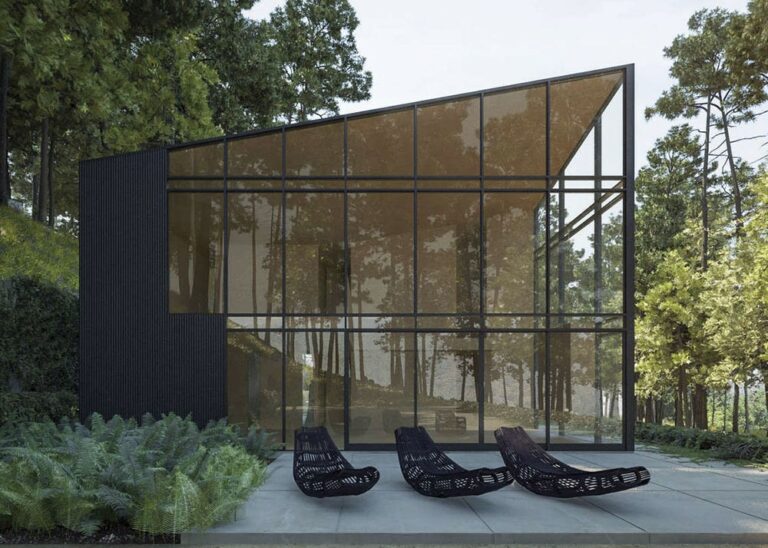
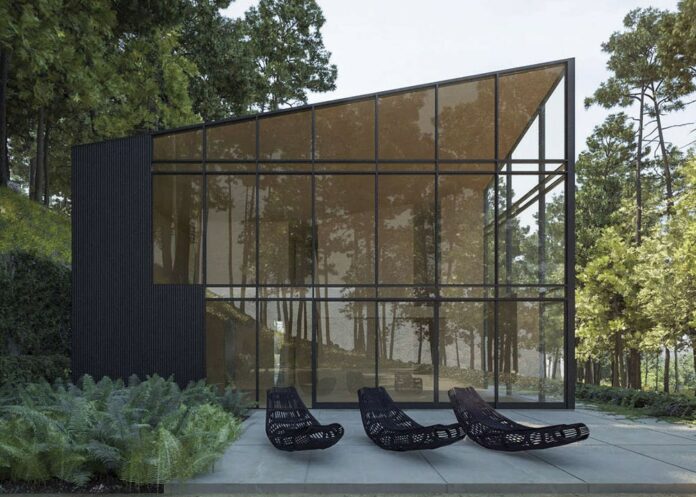
The nine houses were designed and built by different firms and range from a one-bedroom house that looks like a Frank Lloyd Wright pool cabana to shotgun cottages that wouldn’t look out-of-place in New Orleans. The Wright-ish house and a handful of others others like it are pre-built homes that were placed on the Medtronic campus with a crane. Those homes, says Kennedy, would fetch $350,000 on the open market.
The remainder are two-bedroom shotgun-style homes that are largely pre-constructed and then assembled on site. Those, says Kennedy, are the ticket—or possible ticket—to solve an affordable housing crisis that’s so massive, he says, you’d need a China-like mass-manufacture of cottages to ease the local strain.
In Habitat for Humanity’s grand vision, that’s the local model moving forward, explains Kennedy. He’s excited about the possibility of California replicating the Habitat For Humanity model in Edmonton, Canada, where there’s a HFH house-building factory that pumps out housing components that come together, not quite Acme-style, but pretty quickly, on site. Those homes, he says, would list at $400,000 in the Sonoma County housing market. Habitat for Humanity has leased a 30,000 square-foot property in Rohnert Park, he says, in an effort to replicate its Edmonton mass-buildout model.
For now, the homes are being rented to wildfire survivors who were among the last victims unable to secure permanent housing after the 2017 inferno. The renters come from a familiar stream—they were selected by Catholic Charities from a pool of more than 40 families and individuals who are still sleeping on friends’ couches and elsewhere two years after the fires.
Under its arrangement with Medtronic, the houses will be on this plot for two years. Kennedy says it could be up to five years, but that’s yet to be finalized. The final resting place for these homes remains an open question—subject to finding a plot of land, dealing with any zoning or other local issues that may arise, and finding a buyer through Habitat for Humanity.
Adrienne Lauby is the president of the Board of Sonoma Applied Village Services, a local nonprofit that’s taken up the call for finding affordable housing solutions in a city and county that aren’t always amenable to grassroots notions about tiny houses, solar yurts and parking lots populated with trailers and campers.
She’s been fighting for funding and grants under the county’s Home Sonoma network and received word last week that her group will be getting a $450,000 grant from a $500 million state fund for housing programs (Sonoma County got $12.6 million of that grant). They’ve got the green light to explore tiny houses and parking-lot communities. The next step, says Lauby, is to try and find a place to develop those programs.
Lauby is supportive of the Sonoma Wildfire Cottage plan and believes that every bit of housing helps. She cautions, however, that local leaders need to focus on the plight of the some 2,000 regional homeless persons who’ll likely be sleeping out in the elements again this winter.
“There’s no doubt that it requires a community response,” she says, invoking the wildfires’ impact on an already-compromised Sonoma County housing dynamic. Small business, big business, government—she says they all need to come together but also notes there’s a disconnect in the county and Santa Rosa between homeless people.
She cites “a disparity between the ‘good homeless’ who were hurt by the fire and the ‘bad homeless’ who were already homeless.” The latter’s plight was exposed for all the world to see following the wildfires, much as Hurricane Katrina served to highlight a city that had suffered decades of poverty and neglect.
“The city, county and the state have all declared a homeless emergency, but none of them are doing anything,” Lauby says. Since the wildfires, Santa Rosa has turned back numerous grant proposals from local housing nonprofits such as Homeless Action, mostly on technical grounds and because of the rules of the grant (ie, proposals for grant monies were too small to be considered).
The federal and state money now arriving in Sonoma County, through the state’s Homeless Emergency Aid Program, says Lauby, “tends to go into brick and mortar housing” projects and isn’t pegged at smaller-scale solutions.
So, while Sonoma Wildfire Cottages is pushing out $400,000 for potential workforce housing, Lauby says tiny-home solutions in the $5,000 range have been brushed aside as private-public partnerships such as this one have found favor with local officials. The city of Santa Rosa has been especially aggressive in keeping tiny homes, trailer-park parking lots and other small-scale homeless solutions out of the city.
Lauby says everyone’s in the same boat when it comes to finding a place to for new housing—whether it’s a tiny home or one of the Wildfire Cottages. She cites the excruciatingly slow pace of local permitting as a factor even as she notes that the county is the biggest property owner in Sonoma County.
“There are things like vet’s buildings, corners of parks, unused baseball parks,” she says, which could and should be considered for alternative housing solutions in her view. But her organization, she says, has been stymied by safety issues raised by first responders when they’ve submitted small-scale grant proposals, and by what she says is an over-reliance on working within established rules and guidelines. She says the safety issue is mis-construed: It’s not safe, she argues, to sleep outside or under a freeway overpass.
And she notes that if the county and Santa Rosa can accommodate a village of corporate-friendly homes in an industrial zone, why can’t local electeds be more amenable to solutions to help the very poor and the chronically homeless, who were here before the fires and whose plight has only sharpened with the loss of 5 percent of the region’s housing stock?
She also notes there’s competition afoot in the county for what Cypress is angling to accomplish—whether it’s apartment complexes made from repurposed shipping containers or a big push from the manufactured-housing industry. “Cypress is in a crowded market,” she says.
In an interview, Cusato says that Cypress was never hesitant about teaming up with Habitat for Humanity. “We actually always wanted to do the project,” she says. “It’s our business model.” She said any reluctance on Cypress’ part was a function of Habitat’s adding the variable of multiple builders to the project and that the Cypress nonprofit “helped shape the program with them. We asked them, ‘are you sure you want to enter in to this with all these variables, all these different builders on site sort of bumping into one another?”
She says Cypress came to realize the benefit of having multiple builders working on the cottages, since it would provide a point of comparison to determine which builders were up to the task of delivering on-time, high quality homes.
Cusato also brushed aside concerns about Cypress’ political juice in Washington these days and stressed that their housing model is a bipartisan approach and that “this has nothing to do with one administration over another. This has to do with the fact that we have a broken system. It doesn’t matter who is in office.”
The Cypress housing nonprofit’s next move in the Sonoma Wildfire Cottages project is the release of a lessons-learned report which, says Cusato, would be useful to any California municipality that wants to consider a Cypress-HFH public-private program. “There’s a whole lot of potential here to help other communities in California,” she says. There were lots of lessons learned from the Katrina and Rita experiences but one key takeaway is the persistence of localism in the face of proposed mega-projects. “What we’ve learned is that every place is unique, and every place is universal. Every place is 100 percent local, but patterns emerge that are all similar.” One of the Katrina Cottage community build-outs in coastal Louisiana was rejected by locals because the cottages looked like manufactured homes even though they weren’t. “The NIMBY’s came out and said we can’t do this here,” she recalls.