Stay Heavy

0

Aftertayst is back.

Dan Kabanuck, guitarist with the storied Sonoma County metal band, says there was a time when he thought his band was finished.

“We did it for 12 years,” Kabanuck says. “We worked it really hard. We got really close. We hung out with Metallica. We opened for Testament and Death Angel. We played with some really big bands. We were there. We were right there. We could taste it.”

And then, it was over.

All that was left were some old posters, a stack of recordings no one had ever been entirely satisfied with and great memories tinged with a bit of regret.

“There’s an invisible veil that you can’t get through from this side unless someone on the other side reaches over and pulls you through,” Kabanuck says. “For whatever reason, that never happened. We never attracted quite enough attention to be pulled through. And ultimately we just imploded.”

Kabanuck eventually returned to his original career as a real estate broker.

“I took a hiatus from real estate to become a rock star,” he says, “then came back because, you know, I didn’t become a rock star.”

Now, not only is Aftertayst back—and getting ready for a huge reunion show with the band Krawl at Spancky’s Bar in Cotati—the band is redoing the group’s entire catalog with state-of-the-art technology at Cotati’s legendary Prairie Sun recording studios.

“The thing is, we never got a really good CD,” he explains. “We recorded a lot of our stuff. It never worked out. But my youngest kid started listening to my old music, and he was liking it. Eventually, I thought, ‘We should really re-record a few of our songs, and do it right this time.’ And then ‘a few songs’ turned into all of the songs, and now here we are, 22 songs recorded out of a 30-song collection we plan to release sometime later this year.”

But first, there’s that big reunion show at Spancky’s.

“I think we still sound good,” says Kabanuck. “We’re fast, we’re furious, we’re good old school metal.”

Aftertayst and Krawl play Saturday, June 29, at Spancky’s Bar, 8201 Old Redwood Hwy, Cotati.9 pm to 1 pm.
$5. 707.664.0169.

E-Truckin’ Ahead

0

Work used to be simple for the California Department of Transportation: widen highways, fill potholes, build new freeways.

Alas, those quaint days
are gone.

To get an idea of what planners must prepare for, state officials recently hosted a demonstration of a drone air taxi that will require devising a “highway above the ground,” said Reza Navai, a Caltrans transportation planner. “If you think transportation on the ground is complex….”

Such sci-fi-like transit is one of many high-tech changes coming as California implements its planned electrification of transportation to radically reduce greenhouse-gas emissions. The path to “zero,” as in zero-emission vehicles, extends well beyond flying taxis and the 5 million electric cars the state hopes will drive its roads by 2030. Everything—everything—will be replaced with an electric analog: from boats, planes and trains to delivery vans to farm tractors and even forklifts. The to-do list stretches as long as California’s seemingly endless blacktop, with freight as a major challenge.

The state’s transportation gurus envision technology that pings driverless vehicles with an automated message when they stray from their lanes, “smart” roads that charge electric cars and trucks as they pass and an electrified Interstate 5, the West Coast’s main freight corridor. California has already widened its painted lane stripes to six inches from four so self-driving vehicles can better “see” the road. Ultimately, the highways themselves will be redesigned and constructed with different materials.

California’s transportation agency, which updates its master plan every five years, is currently preparing a look at 2050. While officials cannot predict each new technological wrinkle, Navai said, “we must be able to consider all possibilities.”

To achieve a carbon-free transportation future, California will need to cover a lot more ground in a short time frame.

“If California’s trying to be a leader, we have to go as fast as possible,” said Lew Fulton, who studies sustainable transportation at UC Davis’ Institute of Transportation Studies. “Policies are critical to try to speed this up and try to push the envelope, and get all the manufacturers scared enough that they start producing what we need. Carrots and sticks. Carrots being pricing and incentives, sticks being regulatory.”

The state has spent more than $1 billion in the last five years to encourage research, subsidize the exchange of internal combustion vehicles for zero-emission options, formulate cleaner fuels and expand vital charging infrastructure.

It’s working with technology firms to clean up heavily polluting marine fuels belching from container ships at California ports, and state funds are helping Central Valley farmers, who are on a waiting list to replace their aging farm equipment with fuel-efficient models and to receive rebates.

Such projects may get a boost from California’s Tesla-owner governor, Gavin Newsom, as budget negotiations wrap up this month. His proposed spending plan includes nearly $24 billion for all aspects of transportation, a 6 percent increase.

Few transportation modes have clean-engine options as advanced as those for passenger cars. Buses are the exception. The Chinese company BYD, manufacturing electric buses in Lancaster, is the largest in North America and has produced more than 300 buses, including nearly half of the Antelope Valley Transit Authority’s pool.

The city of Los Angeles has pledged to convert its bus fleet—second-largest in the country—to electric by 2030, though mechanical and performance problems plagued the rollout of its BYD vehicles. Many other transit districts have similar goals that include school buses. The financial burden of those commitments is softened by state vouchers for up to $200,000 toward the purchase of each zero-emission bus.

The availability of some electric all-terrain recreational vehicles, farm machinery and specialty equipment such as cherry-pickers and front-end loaders has produced niche markets. Generally, though, the readily available transportation technology stops where the road ends: Electrification of trains, planes and ships is less advanced.

A state analysis found that ocean-going vessels still depend on heavily-polluting marine fuels and, aside from nuclear-powered engines for military use, zero- and near-zero technologies are not currently available. Among smaller vessels, San Francisco Bay’s famed Red and White fleet added a new hybrid-electric ferry this week.

Ships docking in California’s ports frequently forgo using diesel generators to operate and instead plug into shore-side electric power. But even when stationary, big vessels have a massive appetite: A nine-cylinder ship engine—five-stories tall and weighing 1,500 tons—can produce enough power to run 30,000 homes for a year.

But trucking is the major freight challenge for California. More than 97 percent of the state’s big rigs operate on diesel fuel, which is highly polluting and a significant contributor to detrimental health effects on those residing near transit corridors. Currently only a handful of electric or hybrid heavy-duty truck options exists, mostly prototypes.

“I see 100 percent electrification as being far off; there just aren’t any of those trucks on the road,” said Brandon Taylor, director of transportation for GSC Logistics, a freight company operating at the
Port of Oakland.

Freight represents a transportation problem somewhat of our own making: We desire—and order online—more and more products, for delivery right now. With each mouse click, delivery vans and trucks flood the state’s highways and neighborhood streets, dispatched to cover what supply-chain planners call “the last mile” of residential delivery.

About 20 percent of trips in the United States are, in fact, less than a mile. But it’s too late to shut off the merchandise-delivery tap, and freight accounts for about a third of the California Gross Domestic Product.

The influx of these trucks and vans runs counter to one of California’s bottom-line goals: to reduce not just the number of vehicles on roads but also, and more critically, the miles they travel. The mid-sized delivery vans taking the package handoff from heavy-duty trucks are turning over odometers at a dizzying rate; in Southern California, an estimated 85 percent of truck traffic is dedicated to local deliveries and short hops.

The future is likely to include on-demand trucking. Predictably, there’s an app for that, Uber Freight, which launched in California in 2017. It’s one of a handful of load-matching apps that connect shippers with smaller, more nimble trucks plying local routes. The system is intended to increase efficiency and decrease total miles driven. Additionally, electric trucks can return to a home base at night to be recharged.

Big rigs in California aren’tt subject to the smog inspections that have applied to cars since 1982, partly due to early pushback from trucking companies and insurmountable complexities involved in regulating out-of-state vehicles. But that could change: A bill advancing in the Legislature would create smog checks for big diesel trucks.

The state will need to retrofit highways to allow charging of electric freight trucks, which some experts say may still be a decade away. Planners are examining exactly what an electric-truck stop would require: Big trucks need big batteries and very large charging infrastructure.

Utility companies in California, Oregon and Washington are underwriting a study that will examine how to provide electric charging and hydrogen fueling along the entirety of Interstate 5, with bays for next-generation semi-trucks running on batteries or hydrogen gas.

State regulators recognize that innovation doesn’t always align with government goals and deadlines and are planning for clean technology where feasible. Like everything else, it’s not going to be cheap.

The cost of an electric semi-tractor trailer, $300,000 or more, is more than twice that of a traditional diesel truck. That can be a burden on mom and pop companies, 90 percent of whose fleets contain six or fewer trucks and who operate on relatively tight margins.

“It’s going to be tough,” even with state subsidies, said Chris Shimoda, lobbyist for the California Trucking Association.

Shimoda said his members don’t care what type of fuel the state requires. “Everybody knows this is the direction California is going,” he said. “It’s easy to say we have a goal of eliminating fossil fuels, but as I think everyone would admit, the details of how to get there are important.”

At the Port of Oakland, with freight-train horns blaring in the background, Taylor said by phone that it’s eerie to see—but not hear—his company’s electric big-rig pull into one of the loading bays. “It kind of sneaks up on you,” he said.

The company’s been testing the truck for more than a year, underwritten partly by a state grant, and expects delivery of two more in the fall. Taylor uses the truck to move containers around the port but has yet to put it on the road, echoing the “range anxiety” associated with electric cars. His truck’s battery runs out and needs recharging after 120 miles.

“I guess it can only get better with electrics,” he said. “I’m not sure how it’s all going to work, but it’s happening.”

Making Bank

0

PQ:

“The activities of the top big banks in fossil fuels and many other activities gives us limited, to no options regarding large, socially responsible banking options. We are truly stuck between Scylla and Charybdis until a public banking option is available.”

Too Big? Public bank advocates want to see cities invest in Main Street, not Wall Street.

For Shelly Browning, it’s been a long road from the Arab Spring to the Occupy Movement to Santa Rosa’s support of a public banking bill now under consideration in Sacramento. Browning’s a Santa Rosa small-business owner who’s been active on the public banking front for years and says her inspiration to get Santa Rosa to divest from Wall Street banks begins in Cairo’s Tahrir Square—and ends, perhaps, with an eventual “North Coast” public bank that would exist alongside Chase and other Wall Street banks.

She’s been meeting with city leaders to raise awareness of the public banking bill. Browning was moved, she says, by the small-businessman who was arrested in Tunisia for failing to have a permit in 2011, and whose suicide sparked protests in Egypt that then gave rise to the Occupy moment in the United States. The economic forces that gave rise to Tahrir Square are the same that are driving the push for public banking: All roads lead to
Wall Street, while Main Street
gets crushed.

“Private banks’ mandate is to serve the shareholders,” says Browning, who runs a foreign language–translation service that does business with the state. “Public banks’ mandate is to serve the public interest.”

Assembly Bill 857, authored by Assemblymen David Chiu and Miguel Santiago, sets out to create a regulatory framework to allow California to license public banks that would give cities the option to stop doing business with the likes of JP Morgan Chase and Wells Fargo, and invest taxpayer money into local communities instead of Wall Street banks.

Chase and Wells Fargo have significant investments in the so-called “extreme fossil fuel” industry, which includes coal mining (Chase) and fracking.

A public banking law would make good on the California Public Banking Alliance’s slogan of “Our Money. Our Values. Our Bank.” That’s the idea, anyway. The getting there is a different story, and, upon review of the city of Santa Rosa’s investment portfolio, it’s a story that’s as much about investment as it is about divestment, given Santa Rosa’s high-performing investments in foreign banks with big investments in extreme fossil fuels.

The public banking bill sailed through the state assembly with support from local assemblymen Jim Wood and Marc Levine, and now rests in two senate committees, awaiting a hearing and a vote. It’s a feel-good bill of sorts and a pretty safe bet given that it doesn’t require anyone to do anything. The bill merely opens the door to localities who’d like to pursue the option. It’s gotten endorsements from a handful of cities around the state, including Oakland and Santa Cruz, and from the California State Democratic party as a whole. The California Banking Association and the state’s community banks have come out in opposition, though Browning notes that a handful of community banks around the state have individually endorsed the bill. None of the North Bay’s community banks, including Redwood Credit Union and Exchange Bank, have weighed in on the bill.

The bill is now parked in the Senate Government and Finance committee chaired by North Coast Sen. Mike McGuire. McGuire’s office did not respond to requests for comment.

If signed into law, the bill would allow municipalities to apply for a banking charter from the California Department of Business Oversight. The bill encourages those entities to partner with credit unions to extend credit to communities and their residents, and, says Browning, provides the opportunity to build a socially and environmentally responsible banking system, “by enabling cities and counties in California to recapture public dollars and reinvest in their local communities.” Residents would rely on community banks for their personal banking needs, and the local public bank could, for example, offer residents stock options for local schools, instead of making investments in the booming domestic dirty energy economy.

Browning envisions a North Coast bank that could serve Sonoma, Mendocino and Humboldt counties. Santa Rosa, as the largest city in the tri-county region, would be the key to make this dream a reality. As a practical matter—and based on the North Dakota public bank that’s held as a model—the well-versed Browning explains that there’s a scalability issue with public banks; you need a sufficient tax base to generate the revenue needed to support a commercial lending institution in the public domain. North Dakota’s 100-year-old state-run public bank is a success in a state with a population of 750,000. The aggregate population of Sonoma, Mendocino and Humboldt counties is right around that same number. It’s a heady idea that’s taken hold of the public imagination around the state. Imagine, says, Browning, being able to buy stock options in local schools from a municipal or regional bank—instead of endless rounds of higher taxes levied on residents to pay for school services.

But even as the Santa Rosa City Council voted to support the bill this week, the focus on divestment from the fossil fuel industry raises questions about the city’s investment strategy. Since the wildfires, the city has made big investments with banks that invest in fossil fuels—the same fuels that are linked to the rise of climate change-fanned fires. The city, however, says one has nothing to do with the other.

According to city documents, Santa Rosa has made more than a dozen investments in foreign-owned banks that invest in the unclean end of the fossil fuel industry. And, it banks with the single largest financier of fossil fuel industries, JP Morgan Chase, according to a comprehensive study on fossil fuel investments by domestic and foreign banks.

According to its May 2019 investment report, 13 investments in banks such as UBS, Credit Suisse and the Bank of Montreal total $43 million from interest-bearing securities (certificates of deposit) that are earning between 2.6 and 3.9 in interest. Of the 13 investments, 11 were made after the 2017 wildfires that punched a $20 million hole in Santa Rosa’s $122 million operating budget. The post-fire investments range from between $3.25 million with USB and $4.2 million with the Royal Bank of Canada, both of which are detailed in a new study, Banking on Climate Change: Fossil Fuel Report Card 2019, for their poor showing in the extreme-fossil-fuels department. As of last month the investments had accrued nearly $480,000 in interest. Despite the timing of the investments—most took place through 2018—the city says they had nothing to do with fiscal fallout from the 2017 wildfires.

Banking on Climate Change is an annual analysis undertaken by the Rainforest Action Network that details domestic and foreign banks’ investments in various fossil fuel industries and grades them on their climate change awareness as reflected in those investments. Most of the 13 foreign-owned banks that Santa Rosa has invested taxpayer money in received poor grades in the report because of their fossil fuel investments. Browning notes the benefits brought to bear by the nation’s only public bank, the Bank of North Dakota, which came into the public spotlight during the Standing Rock demonstrations that peaked at the end of 2016.

“There is an alternative,” says Browning, and time is running out to adopt it. “We’ve got 12 years to turn it all around,” she adds, a reference to the accepted wisdom of our time that says climate change impacts will really start to accrue in about a decades’ time. “The time is now to turn it around.”

Banking on Climate Change reports that Chase is the nation’s leading financier of the nation’s booming domestic energy industry, with $64 billion in total investments. Wells Fargo is not far behind at $61.4 billion. A review of the city’s investments reveals that they’ve gone into business with some of the least environmentally conscious foreign banks in the world after the 2017 wildfires. Except for one bank.

The Nordea File

There’s one bank that Santa Rosa does business with that doesn’t appear anywhere in the extreme fossil fuels report, but that does appear in numerous investigative reports that tell a different sort of dirty-business story—raising another set of questions about the city’s investment strategy.

In December 2016, executives from Nordea visited Standing Rock and stood in solidarity with the Sioux and their blockade of the pipeline. Before reporters, the company warned is fund managers to divest from any company associated with the pipeline. The climate-change divestment movement took note. The environmentalist-journalists at Ecowatch reported that “Nordea had put companies behind DAPL on watch,” and in early 2018, Nordea made good on its word and banned its fund managers from investing in firms tied to the Dakota pipeline.

Stateside news reports on Nordea’s altruism made no mention of the banks’ connections to the Panama Papers, or to money laundering allegations associated with the bank. For those reports, you’d have to turn to the Scandanvanian-based Yle News and the Organized Crime and Corruption Reporting Project, whose detailed reports on Nordea read like they are straight out of a footnote to the Steele Dossier, with allusions to Russian oligarchs, money laundering and possible organized crime.

Just this month Yle News updated its previous reports on money laundering allegations with a report on a data dump that revealed “a secret network of shell companies that have funneled billions of euros through the global banking system,” using shell accounts in Nordea banks. The bank has denied any wrongdoing.

Did Nordea’s pro-Sioux posture influence the city’s decision to invest $5.8 million with the bank that same month? Santa Rosa communications director Adriane Mertens says it did not.

The Nordea CD was scheduled to mature on Nov. 30 2018, and paid a 1.72 percent interest rate on the investment. According to city documents, at the time of the October 2017 wildfires, the Nordea investment was losing money.

The investment reports indicates that in February 2018, the city sold $3.25 million of its poorly performing Nordea security back to Nordea Bank of Finland, and then reinvested the $3.25 million in Nordea Bank AB NY, at a yield of 2.72 percent. That note is due to mature in February 2020. The new investment left $2.25 million of the initial 2016 investment with Nordea Bank Finland at the original, 1.72 rate of accrual. By April 2018, both investments were earning a positive yield.

Investments in these negotiable CDs are managed by the city’s outside investment advisor, Public Finance Management (PFM), says Mertens. “The inclusion of these securities is consistent with the objective of managing a diversified portfolio,” she adds, and the city’s been investing in the negotiable CDs “since at least 2012.”

Santa Rosa city council member Julie Combs weighed in on the city’s investments as Santa Rosa was expected to pass a resolution in support of AB 857. “We have established a socially responsible investing policy several years ago under a different council,” she says. “At the time I believed the policy was not clear enough and it has a loophole that is not made clear,” she adds, without identifying the loophole. The city council approved the new rules even after Combs tried to get an investment criteria added to the rules that would require the investments be “socially beneficial.” That effort failed.

Combs is supportive of the concept of a regional public bank and supports AB 857, but recognizes the challenges, adding that she’s “aware of trying to ensure we bank locally as much as possible, but many of our local banks and credit unions are not able to work with the large sums because they must have more cash on hand than they do. They are insufficiently capitalized.”

The city defends its investment in banks with ties to the extreme fossil fuel made in its name by Public Finance Management, and says the timing of the investments had nothing to do with the 2017 wildfires, Nordea’s posture around DAPL,
or any other factor other than the fiscal health of the city. “The events and circumstances referenced in [your questions] caused no change in investment strategy,” says Mertens. “All the negotiable certificate of deposits in the portfolio meet the investment advisors credit criteria and the inclusion in the portfolio is consistent with the city’s investment objectives. These types of securities are widely held by public agencies with objectives similar to Santa Rosa.”

The investments underscore the difficulties inherent in divesting from the fossil-fuel industry as the public bank moment in California gains steam in Sacramento, San Jose, Oakland and at Santa Rosa City Hall. Combs notes that “the activities of the top big banks in fossil fuels and many other activities gives us limited, to no options regarding large, socially responsible banking options. We are truly stuck between Scylla and Charybdis until a public banking option is available.”

For public banking advocates like Alison Malisa, it’s time to bring those legendary sea monsters to heel. She’s a Sebastopol teacher with a background in economics who, like Browning, was moved by the domestic activism of Occupy that was itself inspired in part by the Arab Spring. There’s a triple bottom line at play, she says—people, profits and the planet. She repeats the public banking mantra—Our money, our values, our bank—and says that whether it’s the city or Chase bank, fossil fuel investments present a stark choice during stark times: “It’s either a vicious or virtuous cycle,” she says.

Right Moves

0

Shakespeare’s Romeo and Juliet has been the source material for umpteen movies and plays. The tale of star-crossed lovers had its most successful theatrical iteration with the 1957 Broadway musical West Side Story, which is playing now through July 7 at Santa Rosa’s 6th Street Playhouse.

Groundbreaking at its time for its innovations in dance and music and its frank addressing of social issues, Arthur Laurent’s version of Romeo and Juliet transplanted Shakespeare’s Verona to New York’s Upper West Side and transformed the feuding Montague and Capulet families into rival white and Puerto Rican street gangs. Leonard Bernstein composed the music, Stephen Sondheim’s lyrics made their Broadway debut and Jerome Robbins handled stage direction and choreography. West Side Story was then followed by a multi-award-winning film adaptation.

Casting requirements (and the possible criticism of “whitewashing”) along with a very difficult score make West Side Story an extremely challenging show to produce, and Jared Sakren surmounted these obstacles, in part, by casting numerous Latinx performers in this production. Program bios indicate many of these performers are in, or graduated from, the Santa Rosa Junior College theater arts program, or participate in their high schools’ drama or dance programs. This results in a wide range of on-stage actor experience and, while it shows, it proves to have been a tradeoff worth making.

Jonah Robinson (as Tony) and Carmen Mitchell (as Maria) have significant training and experience behind them and it shows. Both exhibit fine voice, though I found Mitchell’s accent a bit forced at times, and Robinson was plagued with microphone issues at the performance I attended.

Good character work is done by Denise Elia-Yen as Anita (despite also suffering from sound issues), Justin Thompson in the dual roles of Lt. Schrank and Gladhand, and Al Kaplan as Doc. Notable among the younger cast members are Benjamin Donner (Chino), Katerina Flores (Consuela), and Noah Sternhill (Action).

Joseph Favalora’s choreography honors Robbins’ original work while making the necessary adjustments for the varied dance experience of the large cast. Favalora was fortunate to have a number of experienced dancers to literally do the heavy lifting.

Music director Ginger Beavers and a seven-piece orchestra more than meet the challenge of the Bernstein/Sondheim score and fill the house with such classic numbers as “Maria”, “Tonight”, “America”, “I Feel Pretty” and “Somewhere”.

Despite the obstacles any production of West Side Story faces, the 6SP artistic team has managed to mount a pretty respectable production.

Rating (out of 5):★★★&#189

Kaiser Could be a Model

The pending strike by psychotherapists at Kaiser hospital has highlighted the ongoing challenges members have in accessing services. Most of the proposed solutions include staff recruitment, retention and compensation. While necessary, in the long run these strategies fall short. If the goal is to improve mental health outcomes, then the solution requires a wider lens. Here are my suggestions:

Every medical unit would have a designated mental health professional. We need a 24/7 mental health urgent care system in person and online that is actively promoted as crisis intervention. Contract with a network of private providers and adequately compensate them to provide services for members with mild or moderate issues. Clinicians should be able to work part-time. Kaiser therapists should focus on specific populations such as those with severe mental health issues, those with complicated co-occurring physical and mental health or medication issues, and those who can’t find a therapist through the network. Treatment plans should indicate individualized services that are not based on what is available. Each Kaiser member should be entitled to four hours a year assistance for problems such as transportation, childcare and employment problems that can impact on mental health.

Kaiser members contract to receive all medically necessary and appropriate services, sometimes paying high premiums and out-of-pocket costs. Kaiser won’t pay for them to go outside of their system. Kaiser is not keeping its end of the contract and is missing an opportunity to develop a national model.

Rohnert Park


Tickled by
Pickles

I want to compliment writer James Knight on the “Pickle People” article (June 12) and his writing. It was informative and I’ll try the pickled stuff, but mostly it was a treat to read. Some of the turns of phrases are so clever and funny that it kept me happily reading in anticipation of the next ones.

Fairfax

I Have a Plan

What’s better than raising the minimum wage (“Minimum Rage,” June 12)? Reducing rents! Why? Because: Nobody says lower rents would force employers to cut staff. Nobody says lower rents would feed into higher prices for the poor. When you allow for income tax and withdrawal of welfare, a dollar saved is worth much more than a dollar earned. By definition, the benefit of lower rents isn’t competed away in higher rents as a rise in wages would be. Landlords might even try claw back the “gross” increase in wages Lower rents mean lower barriers to job creation. Jobs can’t exist unless (a) the employers can afford business accommodation, and (b) the employees can afford housing within reach of their jobs, on wages that employers can pay.

And how do we reduce rents? Impose rent control? No! That makes it less attractive to supply accommodation. But a tax on vacant lots and unoccupied buildings makes it less attractive not to supply accommodation. Better still, the economic activity driven by avoidance of that tax would broaden the bases of other taxes, allowing their rates to be reduced, so that the rest of us would pay less tax.

Via Bohemian.com

Write to us at le*****@******an.com.

Sole Man

0

Two years ago, Petaluma-based singer-songwriter and bandleader Saffell seemed to have it all.

On the surface, he had a great relationship to the band members in his piano-driven

funk-rock ensemble. Gigs were coming, fanbases were growing, but Saffell found himself struggling personally and creatively.

“I got to the point where I’d been grinding so long like all musicians do,” he says. “I knew I wanted to keep doing it, but it was the way I was doing it. Something wasn’t working.”

So, he stopped to take stock and says he had to find a new balance in the joyful-versus-jaded approach to making music. For that, he stepped into the unknown, turning Saffell into a one-man show both live onstage and on his new LP, Lay It on the Line, which he debuts on Saturday, June 22, at Twin Oaks Roadhouse in Penngrove.

“There was a sound I had in my mind, of an album that I always wanted to make, but it required a lot more production, and I never had the money to do that,” says Saffell. Once the band dissolved, Saffell returned to the idea of that album just as he was gifted some recording gear and found a cheap grand piano. Suddenly, he had the tools he needed, and he spent the last two years diving deeply into the engineering side of recording, mastering live-looping and embracing the electronic effects that would become the basis for much of Lay It on the Line.

“I didn’t want to end up with a bedroom demo,” he says. “I wanted to have the time to learn, explore, investigate and reach those sounds.”

Keeping the music funky and fun, Lay It on the Line sounds like a full band effort in its made-from-scratch beats and blips, while also keeping the emotional core of Saffell’s songwriting intact.

“The trick is not to get lost in the tech,” he says. “I stayed rooted in the songwriting. I want the song to be able to live and breathe with just me, the piano and my voice.”

That said, the upcoming album-release show promises lots of techno-flair, with Saffell performing with synthesizers, organs and live-looping and with opener Sebastian St James and analog-visual artist Bill Wiatroski projecting real-time modulated images.

“One thing worth mentioning, live-looping is not meant to replace a band,” says Saffell. “I think it’s its own craft, as a different kind of artistry.”

Saffell performs on Saturday, Jun 22, at Twin Oaks Roadhouse, 5745 Old Redwood Hwy, Penngrove. 8pm. $8. saffellmusic.com.

The Walking Meh

Like the zombies it depicts, Jim Jarmusch’s The Dead Don’t Die is dead on its feet and ambles toward no clear destination. The existential nonchalance of Jarmusch’s many films (Down By Law, Only Lovers Left Alive, Patterson) harmonizes well with love stories of bemused, alienated characters. But it doesn’t quite work with horror-show material.

“Centerville, Population 738: A real nice place”, reads the welcome sign. Fans of Zappa’s 200 Motels—this one’s for you. When Chief Cliff Robertson (Bill Murray) and officer Ronnie (Adam Driver) investigate a chicken theft, the mild-mannered pair are easily run off by the accused thief, Hermit Bob (Tom Waits), who’s living in the bushes. As they head back to the cop shop, the policemen worry about the unnatural amount of daylight and televised reports that polar fracking may knock the globe off its magnetic axis. “This isn’t going to end well,” says Ronnie.

Other signs and wonders mirror troubling disturbances in the small town, until Chief Robertson stumbles into a hole in the cemetery and discovers the dead gophering their way out of their graves.

For unknown reasons, the ensuing zombie attacks make the two cops more laconic than they already are. Officer Mindy (Chloe Sevigny), the other member of the three-cop police force, is the only one who actually expresses emotions and she alone faces the hordes of walking dead with some degree of hysteria.

By the time the fourth wall is broken—a tacit admission that the film isn’t working—The Dead Don’t Die has regressed from puzzling, to just plain dull. Though zombies have served as a parody of hypnotized consumers for 40 years now—ever since the first Dawn of the Dead—Jarmusch can’t find new flavor in this long-standing cliche.

Jarmusch tries his usual method of directing warm, humane actors as they negotiate a zone of vagueness and disconnectedness. It doesn’t work here, even with celebrity zombies including Selena Gomez, Carol Kane and Iggy Pop. From foreshadowing to end-game turkey shoot, it’s an exhausting movie.

‘The Dead Don’t Die” is playing in limited release.

Deep Roots

0

Need evidence that cannabis is now fully in the mainstream? The Museum of Sonoma County has debuted a summer-long exhibit on the weed’s local and national history.

It will likely blow minds both in and out of the cannabis industry with stunning photos and pithy quotes about hemp and cannabis from the likes of botanist Luther Burbank, novelist Jack London—who loved hashish—and the Emerald Cup entrepreneur genius Tim Blake.

The exhibition is supported by many of the usual North Bay suspects: Mercy Wellness, CannaCraft, Fiddler’s Greens, Lagunitas Brewing Company, Rogoway Law Group and Sonoma Patient Group.

I can claim some credit for the exhibit that’s billed as “Grass Roots: From Prohibition to Prescription,” which traces how we as a culture got into the pot mess and how we’re slowly digging our way out. Nearly 10 years ago, I suggested to the museum’s history committee that it was imperative to mount an exhibit devoted to marijuana. “You planted the seed,” says Eric Stanley, the co-curator of “Grass Roots,” a week before the show opened. “The idea has always been in the hopper. Now is a perfect time for it to become a reality. We’re post Prop-64, and, as a society, we’re trying to figure out where we go from here.”

If 2019 is a perfect time for “Grass Roots,” Santa Rosa is a near perfect place for it. After all, for more than 50 years cannabis has been grown both indoors and outdoors, in and around Santa Rosa by farmers of
all kinds and not just by first-, second- and third-generation hippies. The city has also provided, unintentionally, the locations of hundreds, if not thousands, of clandestine deals where cash and cannabis changed hands.

Conveniently located between the vast cannabis-growing regions to the west and the north, and the huge markets to the south, Santa Rosa has for decades been a truck stop on the cannabis highway. Much of that story has never been told in print or on film. Some of it might never be told. Dealers have disappeared. Records are non-existent and the black market days of old have faded. Still, the Museum of Sonoma County has located a trove of long-hidden materials.

In fact, the “Grass Roots” exhibit breaks new ground, though the Oakland Museum of California hosted a cannabis show in 2016 and helped raise awareness with voters who approved of Prop 64 in November of that year. The museum brings the history, the politics and the culture of cannabis to visitors who’ve never entered a dispensary nor understood the lyrics to Little Feat’s 1978 hit, “Don’t Bogart That Joint.” After all, it’s not everyday that marijuana memorabilia appears in a museum as a subject for serious attention.

Forestville’s Nathan Henry Silva installed much of the exhibit and says he enjoyed nearly every moment of it.

“I have a personal connection to the topic,” he says as he holds a power drill in his right hand. “My parents used marijuana and I use it, too, so it’s not totally new to me. But I’m learning a lot of the history as I work. I’m glad to see that marijuana users are being de-stigmatized and people are realizing that cannabis is less harmful to minds and bodies than alcohol.”

Stanley learned the hard way that mounting a cannabis exhibit was more challenging than many of the other exhibits he’s curated. Over the last few months, he’s been a detective looking for clues and evidence to tell a vital story.

“A lot of the history of cannabis has been underground,” he says. “People who have been involved haven’t documented their activities. Sometimes we can’t find the kind of solid, reliable information, like names and dates, that are necessary for a museum.”

Still, members of the community have come forward, offered their expertise and shared hundreds of posters, flyers and photos, some of which will be displayed. Vince Dugar, an amateur archivist from Petaluma, offered his cannabis collection of memorabilia. Joe Rogoway’s Santa Rosa law office made a cannabis timetable for the exhibit and Sarah Schrader from Americans for Safe Access handed over a box of her old photos.

“Sonoma had a medical cannabis ordinance in 1993, six years before the state,” Schrader says. “I’m excited that the exhibit will highlight some of the pioneering role that our county has played.”

With help from Schrader and others, Stanley has uncovered a treasure of cannabis lore, legend and real products manufactured in Sonoma County, including a remedy for corns concocted by a Sebastopol pharmacist more than 100 years ago. Stanley also unearthed an 1883 news story from The Press Democrat about a 12-foot hemp plant that grew in Santa Rosa, prompting locals to wonder why hemp wasn’t grown as a commercial crop.

“Grass Roots” is divided into five sections that cover almost everything related to cannabis including its origins, classification, medical use and commercialization.

Commercialization is what’s happening now. There’s also a section at the end of the exhibit that Stanley calls “a fun space” that has humorous cartoons, like those of the stoned hippie icons, the “Fabulous Furry Freak Brothers” who appeared in underground newspapers in the 1960s and ’70s.

Co-curator Brian Applegarth is as excited about the exhibit as anyone else at the museum. A cannabis tourism pioneer and historian, he says, “As we go forward into the multi-billion dollar global hemp and marijuana industries, we need to remember the history and the pioneers and preserve the positive values of the past so they aren’t swept away.”

What are those values? “Reverence for nature, appreciation for sustainability and mindfulness,” Applegarth says.

Forty-five years ago, when I first saw cannabis cultivated in direct sunlight in Sonoma County, I never imagined the day would come when it would be the star of a museum show. We’ve come a long way since helicopters raided gardens and sheriffs deputies’ arrested growers, took them to jail in handcuffs and stigmatized them as the enemies of society. Maybe there’s hope for the future of cannabis, after all.

Reflux Redux

0

Whiskey fans have even more reason to celebrate the arrival of summer on June 21, when Sonoma Distilling Co. officially reopens for tours and tastings.

The first time I visited the distillery’s new digs in Rohnert Park, founder Adam Spiegel stood in a then-empty corner of the warehouse beneath a large overhead crane, and promised there’d be a bar and tasting room there the next time I stopped in. A month later, there’s a bar in the corner alright, but the crane’s still suspended above it, a leftover from the previous tenant, a machine shop. And it’s still a warehouse, not the expensively-styled artisanal whiskey lounge I’d pictured.

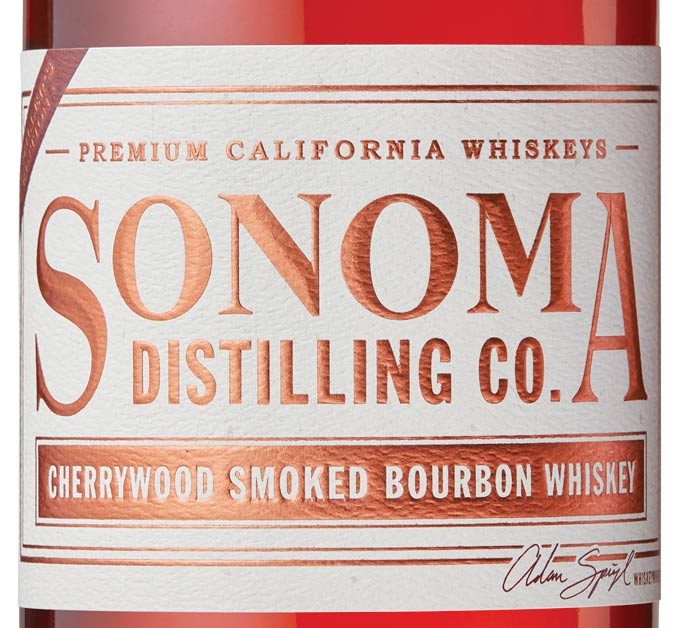
That’s the right style for Spiegel. It’s bare-bones, it’s industrial, it’s authentic, says the whiskeymaker, who’s rebranded Sonoma Distilling Co. (formerly Sonoma County Distilling Co.) yet again, this time with a simple, somewhat retro label. The company’s singular new-and-shiny luxury piece is around the corner—a 3,000 gallon copper still. Spiegel designed the one-of-a-kind gleaming behemoth himself; Forsyths in Scotland built it after await of a few years—the customer in line before him was Macallan.

The body of the still is based on those used by Highlands distiller Glenfarclas, while the top mimics the 250-gallon traditional alembic stills which now handle the secondary distillation, Spiegel explains on a tour of the facility. But with increased volume, he’s actually brought prices down.

So, how about that whiskey? Hang on. Tours, and the transparency of the operation to consumers, are important to Spiegel, who says he’ll be jumping in now and then to relieve his tasting room manager, and lead groups of up to 12 visitors himself. He’s sure to point out that the new fermenting tanks, constructed in Healdsburg, capture ambient yeast from the Rohnert Park air, and to note that leftover water is used by a local farmer.

Got it. Now, the whiskey? Sonoma Distilling Co’s signature spirit is the all-rye Sonoma Rye Whiskey ($39.99), made with 20 percent malted rye. It’s a dry, minty rye with the structure for cocktails, but with a vanilla cream soda note to please the neat sipper. The Sonoma Bourbon ($39.99) is only on the slightly sweeter side, and the Cherrywood Rye ($49.99) is made with malted barley that’s smoked onsite with California cherry wood, to evoke a Manhattan cocktail or a slightly smoky Scotch—just the right style for me.

Sonoma Distilling Co., 5535 State Farm Dr., Rohnert Park. By appointment at 11am, 2pm and 4pm, Friday–Sunday. $15. Schedule a tour and tasting at sonomadistillingcompany.com or call 707.583.7753.

New Outdoor Venue Coming to Downtown Napa

0

64675518_472337913527555_953447602584551424_n
This Summer, Rock & Roll Hall of Fame members The Steve Miller Band and country legend Marty Stuart & His Fabulous Superlatives perform in the kick-off concert for a new series of outdoor events at Napa’s newest outdoor venue, the Oxbow RiverStage, located at the Oxbow Commons in the heart of historic downtown Napa.
The festival-style venue, which will hold up to four thousands attendees, opens with the two headlining icons on August 25, and the producers of the forthcoming series, Blue Note Entertainment Group and Another Planet Entertainment, have announced that this inaugural 2019 season will feature both ticketed and free concerts, spanning many genres of music.
More concerts will be announced in July. Tickets for the August 25 concert go on sale Friday, Jun 21 at 10am and can be purchased at OxbowRiverStage.com, Ticketmaster.com and at the Blue Note Napa box office located at 1030 Main Street in downtown Napa.

Stay Heavy

Aftertayst is back. Dan Kabanuck, guitarist with the storied Sonoma County metal band, says there was a time when he thought his band was finished. "We did it for 12 years," Kabanuck says. "We worked it really hard. We got really close. We hung out with Metallica. We opened for Testament and Death Angel. We played with some really big bands....

E-Truckin’ Ahead

Work used to be simple for the California Department of Transportation: widen highways, fill potholes, build new freeways. Alas, those quaint days are gone. To get an idea of what planners must prepare for, state officials recently hosted a demonstration of a drone air taxi that will require devising a "highway above the ground," said Reza Navai, a Caltrans transportation planner....

Making Bank

PQ: "The activities of the top big banks in fossil fuels and many other activities gives us limited, to no options regarding large, socially responsible banking options. We are truly stuck between Scylla and Charybdis until a public banking option is available." Too Big? Public bank advocates want to see cities invest in Main Street, not Wall Street. For Shelly Browning, it's...

Right Moves

Shakespeare's Romeo and Juliet has been the source material for umpteen movies and plays. The tale of star-crossed lovers had its most successful theatrical iteration with the 1957 Broadway musical West Side Story, which is playing now through July 7 at Santa Rosa's 6th Street Playhouse. Groundbreaking at its time for its innovations in dance and music and its frank...

Kaiser Could be a Model

The pending strike by psychotherapists at Kaiser hospital has highlighted the ongoing challenges members have in accessing services. Most of the proposed solutions include staff recruitment, retention and compensation. While necessary, in the long run these strategies fall short. If the goal is to improve mental health outcomes, then the solution requires a wider lens. Here are my suggestions: Every...

Sole Man

Two years ago, Petaluma-based singer-songwriter and bandleader Saffell seemed to have it all. On the surface, he had a great relationship to the band members in his piano-driven funk-rock ensemble. Gigs were coming, fanbases were growing, but Saffell found himself struggling personally and creatively. "I got to the point where I'd been grinding so long like all musicians do," he says. "I...

The Walking Meh

It may not have much going for it, but 'The Dead Don't Die' does have Tom Waits in full hermit-mode

Deep Roots

Need evidence that cannabis is now fully in the mainstream? The Museum of Sonoma County has debuted a summer-long exhibit on the weed's local and national history. It will likely blow minds both in and out of the cannabis industry with stunning photos and pithy quotes about hemp and cannabis from the likes of botanist Luther Burbank, novelist Jack London—who...

Reflux Redux

Whiskey fans have even more reason to celebrate the arrival of summer on June 21, when Sonoma Distilling Co. officially reopens for tours and tastings. The first time I visited the distillery's new digs in Rohnert Park, founder Adam Spiegel stood in a then-empty corner of the warehouse beneath a large overhead crane, and promised there'd be a bar and...

New Outdoor Venue Coming to Downtown Napa

This Summer, Rock & Roll Hall of Fame members The Steve Miller Band and country legend Marty Stuart & His Fabulous Superlatives perform in the kick-off concert for a new series of outdoor events at Napa's newest outdoor venue, the Oxbow RiverStage, located at the Oxbow Commons in the heart of historic downtown Napa. The festival-style venue, which will hold up to four...
11,084FansLike
4,446FollowersFollow
6,928FollowersFollow