Musical Bandits

0

After a one-year hiatus forced upon them by the renovation of Santa Rosa Junior College’s Burbank Auditorium, the Summer Repertory Theatre program returns with a full schedule of three musicals and two plays running in “rep”. The plays will continue to be performed in Newman Auditorium while the musicals are being done in the SRT Performance Pavilion; an enclosed, air-conditioned, hi-tech tent erected over the campus tennis courts that seats 300 in-the-round.

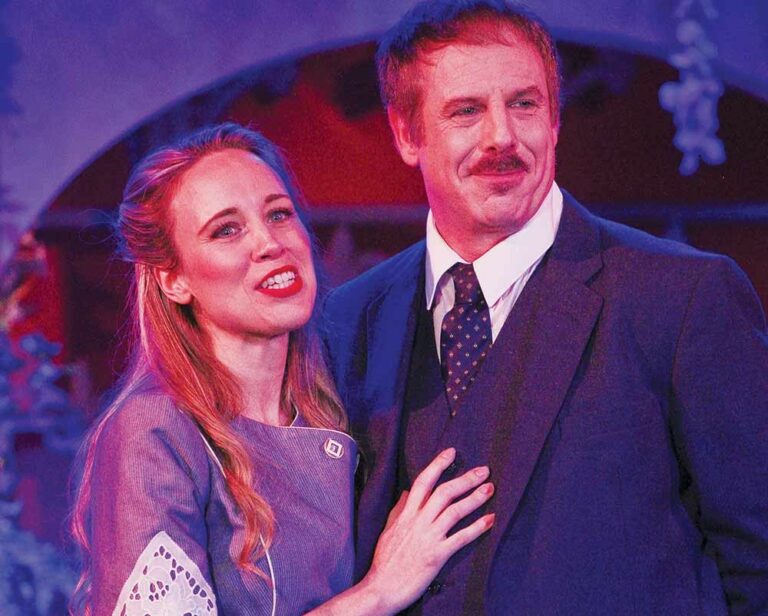
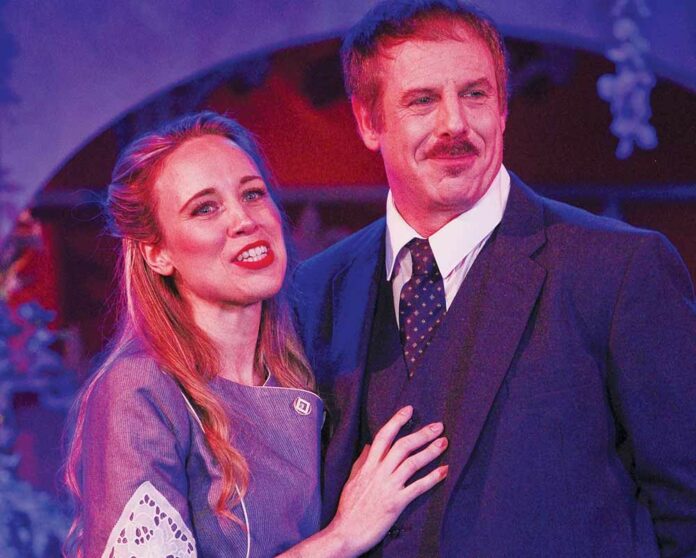
Their season opened in June with the 147th Bay Area production of Mamma Mia! and continues with the musical Bonnie & Clyde. It had a brief Broadway run in 2011 before being relegated to the regional and community theatre circuit. Opening with the deaths of Bonnie Parker (Jamie Goodson) and Clyde Barrow (Cameron Blakeley), it travels through time from their childhood to their violent end.

Young Bonnie (Evie Goodwin) wants to be a movie star like Clara Bow and Young Clyde (Liev Bruce-Low) wants to be an outlaw like Billy the Kid. Their older counterparts meet cute and in no time one of their dreams comes true. Along for the ride is Clyde’s brother Buck (CJ Garbin), his wife Blanche (Gabbi Browdy), and local constable Ted Hinton (Jeremy Beloate) who pines for Bonnie but will soon join forces with the lawmen sent to track the gang down.

Taking a cue from the 1967 Hollywood blockbuster starring Warren Beatty and Faye Dunaway, the show presents a highly fictionalized and romanticized version of the story with a book by Ivan Menchell, music by Frank Wildhorn and lyrics by Don Black. Music director Jane Best and a nine-piece orchestra (tucked behind a curtain in the back) do a good job with the mostly-unmemorable mixture of country, blues, and gospel music.

The young cast who, in a rarity, are actually close to the ages of the protagonists, do well by their roles with particularly strong work done by Goodson and Browdy. Beloate shines in the show’s stand-out number “You Can Do Better Than Him”.

Director James Newman mostly meets the challenges of performing in-the-round, though sight-line and audio issues are present, especially for those sitting directly in front of the orchestra. The minimalist set by Sarah Beth Hall works and there’s creative use of crates, suitcases and trunks to create various set pieces. Terrific costuming by Megan Richardson evokes the period.

SRT’s Bonnie & Clyde is a well-crafted and well-performed production of a mediocre musical.

Rating (out of 5):★★★&#189

‘Bonnie & Clyde’ runs through Aug. 7 in the SRT Performance Pavilion at Santa Rosa Junior College, 1501 Mendocino Ave., Santa Rosa. Dates and times vary. $25–$28. 707.527.4343. summerrep.com

Crowdfunded Journalism

The Bohemian is free in print and online. It’s going to stay that way. But we are a small staff and we want to do much more. That takes money. Independent, critical journalism is a public good and, I daresay, a key component of a functioning democracy. But competition for ad dollars, content aggregators and the proliferation of media channels have challenged local media outlets in profound ways. We are ready to meet the challenges, but it will require creativity, flexibility and reader support. Enter crowdfunded journalism.

The concept isn’t new. Several publications, like Propublica, the Guardian, the San Francisco Public Press and the Boston Review have reached out to readers as partners to help them produce stories that they would otherwise be unable to. In some ways, crowdfunded journalism reminds me of community supported agriculture, where a monthly or one-time fee goes to help grow nutritious, local food. In our case, we aim to produce local journalism that’s good for the body politic.

In the coming days, we’ll be launching a poll that will ask readers what subjects they’d like the Bohemian to cover in a more comprehensive way—and would they be willing to support to make it happen. Is the topic affordable housing? Local health care? The impacts of climate change? Crime and justice? I’m proposing to create a new, or expanded beat that covers the subject most valued by our readers and then ask readers, nonprofits and local businesses to help pay for that reporter’s salary. The funds will allow the reporter to dig into his or her beat for two years or more. Contributions would be held and disbursed by a nonprofit organization that will not only make your contributions tax deductible, but transparent. You’ll know exactly how your dollars are spent.

My commitment is to produce unique, locally based stories that matter to our readers and to make ourselves accountable in new ways. I’ll create a reader advisory group to receive feedback and criticism in an effort to make our reporting responsive to the readers we serve. That’s you.

So I ask again: what subject is most important to you and will you join us in making that reporting possible? Please let me know at sh*******@*******ws.com.

Stett Holbrook is the group managing editor of Metro Newspapers

Ride On

0

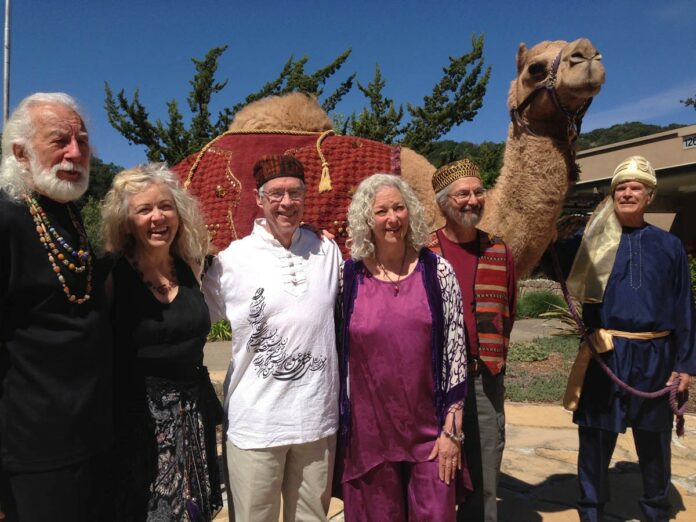
If you happen to see a corncob-headed loudmouth in a red jacket gallivanting around your local parks this summer, you may have come across the Imaginists, Santa Rosa’s most out-there theater troupe, who are bringing their Art is Medicine Show to Santa Rosa parks through July for the 11th year in a row.

Originally inspired as a response to the 2008 market crash, the Art is Medicine Show gives the community a new production each summer.

“We’ve always been fans of the theater that took place during the Federal Projects of the Roosevelt Administration and the Federal Theatre Project,” says Imaginists co-founding artistic director Brent Lindsay. “It was keeping actors and technicians at work (during the Great Depression), but it also made theater available to communities, and not just cities, but small towns across the United States.”

This Friday, July 5, the Imaginists ride into Juilliard Park in Santa Rosa for the first show of the season. Other scheduled performances include July 12 at Bayer Farm, July 14 at Andy’s Unity Park and July 19 back at Juilliard Park. Lindsay notes that the community should double-check times on the Imaginists’ website.

In addition to performing their shows for free, the Imaginists also make their shows bilingual, a component that Lindsay calls a no-brainer. “We want to make sure the invitation is felt across communities,” he says.

As for the bicycles, which the company exclusively uses to transport actors, costumes, props and staging, Lindsay points to theater traditions that go way back. “We’re fans of the circus coming to town and thought the bikes parading through the streets would attract attention. Also, obviously we were thinking of our environmental footprint,” he says. “But, it’s also something that’s not using anything but what the ancient Greeks would use.”

Speaking of the Greeks, this year’s show is another new production, Peace: the Redacted Version, that is a loose adaptation of Greek playwright Aristophanes’ ancient comedy, Peace.

‘I would say it’s hardly an adaptation at all,” says Lindsay. “We’ve adapted Peace in the past. Aristophanes is a very political satirist, and pieces of the play leapt out at us for this. But, if you’re coming to see Aristophanes you’re going to be sorely disappointed, or maybe not, I don’t know.”

Peace: the Redacted Version features a president who resembles maize; the personifications of Peace, Liberty and Democracy; and an overcrowded field of superheroes.

“We live strictly in the fantasy realm here, we never mention Trump by name,” laughs Lindsay. Instead, it’s President Corn and Senator Cracker, two reoccurring characters who this time imprison Peace, Liberty and Democracy while the wannabe superhero candidates fight each other over the chance to rescue the prisoners.

With 15 actors taking on over 20 characters in the show, this is the Imaginists biggest Art is Medicine Show yet.

“It’s doubled in size,” says Lindsay. “We always have amazing new people, along with old veterans, at these shows.”

Seeing Is Believing

0

Say What? A crudely manipulated video of Nancy Pelosi that seemed to show her slurring her words went viral in May, egged on in part by President Trump.

Deep Dive Andrew Grotto, a research fellow at Stanford University’s Hoover Institute and Center for International Security and Cooperation, is studying how deepfakes impact the electoral process and messaging.

The future of misinformation is here. It reared its ugly head in May in the form of a doctored video of House Speaker Nancy Pelosi—manipulated to show her slurring her words, as if she were drunk. The trick was simple; the footage of Pelosi, speaking at a conference on May 22, was merely slowed down 25 percent. In the world of video editing, it’s child’s play.

The video went viral shortly after Pelosi said that Donald Trump’s family should stage an intervention with the president “for the good of the country.” The faked video surfaced on Facebook, where it was viewed more than 2 million times within a few hours. It was also shared by Trump lawyer and apologist Rudy Guiliani with a caption (since deleted) that read: “omg, is she drunk or having a stroke?” followed by “She’s drunk!!!”

The incident called to mind an even cruder video dust-up in 2018 involving footage of CNN reporter Jim Acosta, manipulated to give the impression that he had behaved aggressively against a White House intern at a press conference.
The deceptive clip was actually released by press secretary Sarah Huckabee Sanders.

The country’s most powerful people lending their authority to objectively bogus video as a political weapon is enraging enough. But compared to what’s coming over the digital media horizon, the Acosta and Pelosi videos will soon look and feel as antique as a Buster Keaton short alongside Avengers: Endgame.

Cue Bachman-Turner Overdrive’s “You Ain’t Seen Nothin’ Yet.” Welcome to the Age of Deepfakes.

The term “deepfakes” is a portmanteau, a reference to artificial intelligence-assisted machine learning, a.k.a. “deep learning.” It’s an emerging technology that can potentially put the kind of highly realistic video and audio manipulation once only accessible to Hollywood in the hands of state intelligence agencies, corporations, hackers, pornographers or any 14-year-old with a decent laptop and a taste for trolling. In its most obvious application, a deepfake can create an utterly convincing video of any celebrity, politician or even any regular citizen doing or saying something that they never said or did. (For the record, the Pelosi video is not technically a deepfake; it is to deepfakes what a stick figure drawing would be to a high Renaissance painting).

The buzz about deepfakes has penetrated nearly every realm of the broader culture—media, academia, tech, national security, entertainment—and it’s not difficult to understand why. In the constant push-pull struggle between truth and lies, already a confounding problem of the Internet Age, deepfakes represent that point in the superhero movie when the cackling bad guy reveals his doomsday weapon to the thunderstruck masses.

“If 9/11 is a 10,” says former White House cybersecurity director Andrew Grotto, “and let’s say the Target Breach (a 2013 data breach at the retailer that affected 40 million credit card customers) is a 1, I would put this at about a 6 or 7.”

Deepfake videos present a fundamentally false version of real life. It’s a deception powerful enough to pass the human mind’s Turing test—a lie on steroids.

In many cases, it’s done for entertainment value and we’re all in on the joke. In Weird Al Yankovic’s face-swap masterpiece, “Perform This Way”—a parody of Lady Gaga’s “Born This Way”—nobody actually believes that Weird Al has the body of a female supermodel. No historian has to debunk the idea that Forrest Gump once met President John F. Kennedy.

But the technology has now advanced to the point where it can potentially be weaponized to inflict lasting damage on individuals, groups, and even economic and political systems. For generations, video and audio have enjoyed almost absolute credibility. Those days are coming to an abrupt and disorienting end. Whether it’s putting scandalous words into the mouth of a politician or creating a phony emergency or crisis just to sow chaos, the day is fast approaching when deepfakes could be used for exploitation, extortion, malicious attack or even terrorism.

Of course, creating fake videos that destroy another person’s reputation, whether it’s to exact revenge or ransom, is only the most individualized and small-scale nightmare of deepfakes. If you can destroy one person, why not whole groups or categories of people? Think of the effect of a convincing but completely fake video of an American soldier burning a Koran, or a cop choking an unarmed protester, or an undocumented immigrant killing an American citizen at the border. Real violence could follow fake violence. Think of a deepfake video that could cripple the financial markets, undermine the credibility of a free election, or impel an impetuous and ill-informed president to reach for the nuclear football.

Why now?

Ultimately, the story of deepfakes is a story of technology reaching a particular threshold. At least since the dawn of television, generations have grown up developing deeply sophisticated skill sets in interpreting audiovisual imagery. When you spend a lifetime looking at visual information on a screen, you get good at “reading” it, much like a lion “reads” the African savanna.

Discerning the real from the phony isn’t merely a vestige of the video age. It was a challenge even when the dominant media platform wasn’t the screen but the printed word. Psychologist Stephen Greenspan, author of the book Annals of Gullibility, says that the tensions between credulity and skepticism have been baked into the American experience from the very beginning.

“The first act of public education was in the Massachusetts Bay Colony, long before the country even existed,” said Greenspan whose new book Anatomy of Foolishness is due out in August. “The purpose of that act was to arm children against the blandishments and temptations of Satan. It was even called ‘The Old Deluder Act.'”

The advent of still photography, movies, television and digital media each in turn added a scary new dimension to the brain’s struggle to tell true from false. At one point, video technology was able to create realistic imagery out of whole cloth, but it quickly ran into a problem known as the “uncanny valley effect,” in which the closer technology got to reality, the more dissonant small differences would appear to a sophisticated viewer. Deepfakes, as they now exist, are still dealing with that specific problem, but the fear is that they will soon transcend the uncanny valley and be able to produce fake videos that are indistinguishable from reality.

“It would be a disaster,” Greenspan says of the specter of deepfakes, “especially if it’s used by unscrupulous political types. It’s definitely scary because it exploits our built-in tendencies toward gullibility.”

How they work

Deepfakes are the product of machine learning and artificial intelligence. The applications that create them work from dueling sets of algorithms known as generative adversarial networks, or GANS. Working from a giant database of video and still images, this technology pits two algorithms—one known as the “generator” and the other the “discriminator”—against each other.

Imagine two rival football coaches, or chess masters, developing increasingly complicated and sophisticated offensive and defensive schemes to answer each other. The GANS process works when the generator and discriminator learn from each other, creating a kind of technological “natural selection.” This evolutionary dynamic accelerates the means by which the algorithm can fool the human eye and ear.

Naturally, the entertainment industry has been on the forefront of this technology, and the current obsession with deepfakes might have begun with the release in December 2016 of Rogue One, the Star Wars spin-off that featured a CGI-created image of the late Carrie Fisher as a young Princess Leia. A year later, an anonymous Reddit user posted some deepfakes celebrity porn videos with a tool he created called FakeApp. Shortly after that, tech reporter Samantha Cole wrote a piece for Vice’s Motherboard blog on the phenomenon headlined “AI-assisted Fake Porn is Here and We’re all Fucked.” A couple of months later, comedian and filmmaker Jordan Peele created a video in which he put words in the mouth of former President Obama as a way to illustrate the incipient dangers of deepfakes. Reddit banned subreddits having to do with fake celebrity porn, and other platforms, including PornHub and Twitter, banned deepfakes as well. Since then, everyone from PBS to Samantha Bee has dutifully taken a turn in ringing the alarm bells to warn consumers (and, probably, to inspire mischief-makers).

The deepfakes panic had begun.

Freak Out?

Twenty years ago, the media universe—a Facebook-less, Twitter-less, YouTube-less media universe, we should add—bought into a tech-inspired doomsday narrative known as “Y2K,” which posited that the world’s computer systems would seize up, or otherwise go haywire in a number of unforeseen ways, the minute the clock turned over to Jan. 1, 2000. Y2K turned out to be a giant nothing-burger and now it’s merely a punchline for comically wrongheaded fears.

In this case, Y2K is worth remembering as an illustration of what can happen when the media pile on to a tech-apocalypse narrative. The echoing effects can overestimate a perceived threat and even create a monsters-under-the-bed problem. In the case of deepfakes, the media freak-out might also draw attention away from a more nuanced approach to a coming problem.

Andrew Grotto is a research fellow at Stanford’s Hoover Institute and a research scholar at the Center for International Security and Cooperation, also at Stanford. Before that, he served as the senior director for cybersecurity policy at the White House in the Obama and Trump administrations. Grotto’s interest in deepfakes is in how they will affect the electoral process and political messaging.

Grotto has been to Capitol Hill and to Sacramento to talk to federal and state lawmakers about the threats posed by deepfakes. Most of the legislators he talked to had never heard of deepfakes and were alarmed at what it meant for their electoral prospects.

“I told them, ‘Do you want to live and operate in a world where your opponents can literally put words in your mouth?’ And I argued that they as candidates and leaders of their parties ought to be thinking about whether there’s some common interest to develop some kind of norm of restraint.”

Grotto couches his hope that deepfakes will not have a large influence on electoral politics in the language of the Cold War. “There’s almost a mutually-assured-destruction logic to this,” he says, applying a term used to explain why the U.S. and the Soviet Union didn’t start a nuclear war against each other. In other words, neither side will use such a powerful political weapon because they’ll be petrified it will then be used against them.

One of the politicians that Grotto impressed in Sacramento was Democrat Marc Berman, who represents California’s 24th District in the state assembly. Berman chairs the Assembly’s Elections and Redistricting Committee, and he’s authored a bill that would criminalize the creation or the distribution of any video or audio recording that is “likely to deceive any person who views the recording” or that is likely to “defame, slander or embarrass the subject of the recording.” The new law would create exceptions for satire, parody or anything that is clearly labeled as fake. The bill (AB 602) is set to leave the judiciary committee and reach the Assembly floor this month.

“I tell you, people have brought up First Amendment concerns,” Berman says over the phone. “It’s been 11 years since I graduated law school, but I don’t recall freedom of speech meaning you are free to put your speech in my mouth.”

The Electronic Frontier Foundation, which for almost three decades has fought government regulation in the name of internet civil liberties, is pushing back against any legislative efforts to deal with deepfakes. In a media statement, the EFF conceded that deepfakes could create mischief and chaos, but contended that existing laws pertaining to extortion, harassment and defamation are up to the task of protecting people from the worst effects.

Berman, however, is having none of that argument: “Rather than being reactive, like during the 2016 [presidential] campaign when nefarious actors did a lot of bad things using social media that we didn’t anticipate—and only now are we reacting to it—let’s try to anticipate what they’re going to do and get ahead of it.”

Good & Evil

Are there potentially positive uses for deepfake technology? In the United States of Entertainment, the horizons are boundless, not only for all future Weird Al videos and Star Wars sequels, but for entirely new genres of art yet to be born. Who could doubt that Hollywood’s CGI revolution will continue to evolve in dazzling new directions? Maybe there’s another Marlon Brando movie or Prince video in our collective future.

The Electronic Frontier Foundation touts something called “consensual vanity or novelty pornography.” Deepfakes might allow people to change their physical appearances online as way of identity protection. There could be therapeutic benefits for survivors of sexual abuse or PTSD to have video conferencing therapy without showing their faces.

Stanford’s Grotto envisions a kind of “benign deception” application that would allow a campaigning politician to essentially be in more than one place at a time, as well as benefits in get-out-the-vote campaigns.

But here at the top of the roller coaster, the potential downsides look much more vivid and prominent than any speculative positive effect. Deepfakes could add a wrinkle of complication into a variety of legitimate pursuits. For example, in the realm of journalism, imagine how the need to verify some piece of video or audio could slow down or stymie a big investigation. Think of what deepfakes could do on the dating scene, in which online dating is already consumed with all levels of fakeness. Do video games, virtual reality apps and other online participatory worlds need to be any more beguiling? Put me in a virtual cocktail party with my favorite artists and celebrities, and I’ll be ready to hook up the catheter and the IV drip to stay in that world for as long as possible.

If the Internet Age has taught us anything, it’s that trolls are inevitable, even indomitable. The last two decades have given us a dispiriting range of scourges, from Alex Jones to revenge porn. Trolling has even proven to be a winning strategy to win the White House.

“Let’s keep walking down the malign path here,” said former White House cybersecurity chief Grotto from his Stanford office, speculating on how deep the wormhole could go. Grotto brings up the specter of what he calls “deepfake for text.” He says it’s inevitable that soon there will be AI-powered chatbots programmed to rile up, radicalize and recruit humans to extremist causes.

What now?

In addressing the threat of deepfakes, most security experts and technologists agree that there is no vaccine. Watermarking technology could be inserted into the metadata of audio and video material. Even in the absence of legislation, app stores would probably require such watermarking be included on any deepfake app. But how long would it be before someone figured out a way to fake the watermark? There’s some speculation that celebrities and politicians might opt for 24/7 “lifelogging,” digital auto-surveillance of their every move
to give them an alibi against any
fake video.

Deepfakes are still in the crude stages of development. “It’s still hard to make it work,” Grotto says. “The tools aren’t to the point where someone can just sit down without a ton of experience and make something” convincing.

He said the 2020 presidential election may be plagued by many things, but deepfakes probably won’t be one of them. After that, though? “By 2022, 2024, that’s when the tools get better. That’s when the barriers to entry really start to drop.”

This moment, he says, isn’t a time to panic. It’s a time to develop policies and norms to contain the worst excesses of the technology, all while we’re still at the top of the roller coaster. Grotto says convincing politicians and their parties to resist the technology, developing legal and voluntary measures for platforms and developers, and labeling and enforcing rules will all have positive effects in slowing down the slide into deepfake hell.

“I think we have a few years to get our heads around it and decide what kind of world we want to live in, and what the right set of policy interventions look like,” he says. “But talk to me in five years, and maybe my hair will be on fire.”

Spidey Vacation

It’s not yet July 4th and audiences can already experience Summer Movie Leakage. Spider-Man: Far From Home commences with Nick Fury (Samuel L. Jackson) examining a trashed Mexican village. Was this the same town Rodan took apart in Godzilla, King of Monsters? In fact, it was a windstorm: “the cyclone had a face,” Fury rumbles. The giant wind beast returns and coalesces like a thunderhead, and out of the skies comes…a guy named Quentin Beck, aka Mysterio (Jake Gyllenhaal), a flying superman in a glass helmet, a denizen of a parallel Earth come to save our own.

Meanwhile, Peter Parker (the eager and charming Tom Holland) longs to be a 16-year-old neighborhood hero he once was instead of an Avenger. It being summer, he’s slated for a school vacation in Europe’s most decorative capitals. Familiar teenage summer-vacation stuff ensues among the canals and the castles, with Curb Your Enthusiasm‘s J.B. Smoove and Martin Starr as the inept chaperones. Parker draws the attention of new mentors, good-cop (Jon Favreau’s Happy Hogan) and bad-cop (naturally, Samuel L.) and it’s off to Venice, Prague and London, where each city is besieged by an uninspiring kaiju that must
be wrestled into submission by Spider-Man’s new fishbowl-headed pal from the multiverse.

As MJ, the one-named Zendaya continues a good impression of miffed, off-kilter appeal, but the dialogue reiterates the best moments in Spider-Man: Homecoming.

To his credit, director Jon Watts takes the odd route whenever possible. Sometimes it seems Watts has an altar somewhere with a DVD collection of Freaks and Geeks on it surrounded by candles and incense. Still, there’s relevance to burn in Spider-Man: Far From Home’s payoff in villainy that deals in distraction and deep fakery, with arsonists playing firemen, and smoke and mirrors.

‘Spider-Man: Far From Home’ is playing in wide release.

Plugging In

0

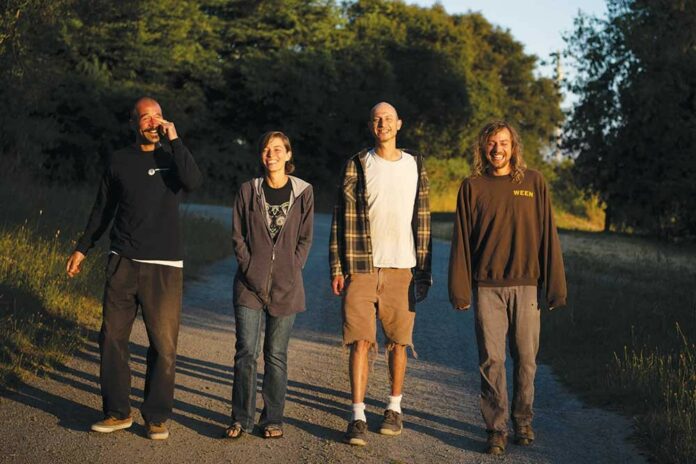
After more than a decade of collaboratively fronting string band ensemble Brothers Comatose, San Francisco singer-songwriter and Petaluma native Ben Morrison is striking out on his own with a forthcoming debut solo album and tour this summer.

“I’ve been in the Brothers Comatose for over 11 years now,” says Morrison. “And last year there were some changes to the band.”

With the departure of band members Gio Benedetti and Ryan Avellone, Morrison and his brother Alex put the band on hold while they recruited new musicians. At the same time, Morrison took a much-needed breather from touring and playing over 100 dates a year with the band.

“We took a little bit of downtime to figure out the next step,” says Morrison. That next step turned out to be a detour into rock ‘n’ roll, and Morrison’s new batch of songs finds him incorporating electric guitars and drums, something not seen on a Brothers Comatose stage.

“I’ve always wanted to make a record with drums,” he says. “Sometimes, I write songs that don’t quite fit Brothers Comatose, so it was nice to have a different outlet for that.”

Currently being pressed and due out at the end of summer, Morrison’s forthcoming debut solo record, Old Technology, features both older songs that he’s kept on back burners and new material written especially with this project in mind.

“It was really cool approaching writing in a different way,” he says. “A different sound in mind, a different angle to work from.”

Until the album comes out, curious listeners can find Morrison’s latest single and music video, “I Hope You’re Not Sorry,” on his website. “The song was inspired by a stalker I had, and no longer have,” says Morrison. “It’s a love song to lost stalker love, like realizing that your stalker no longer comes to your shows anymore and wondering what you did wrong.”

Filmed by fellow San Francisco raconteur Sam Chase, the music video finds Morrison clutching a Fender guitar and singing to an empty chair in a smoky bar before donning a white jacket and fronting a full band.

That full band will back up Morrison when he performs on July 4 in St Helena, returning to Long Meadow Ranch Winery & Farmstead. “It’s always been really cool,” he says of the venue. “It’s a laid back atmosphere, and there’s delicious barbecue wafting through the air.”

Ben Morrison performs on Thursday, Jul 4, at Long Meadow Ranch, 738 Main St, St Helena. Doors at 5pm; Show at 7pm. $35-$55; kids 12 and under. 707.963.4555. benmorrisonmusic.com.

Program Notes

0

The Luther Burbank Center (LBC) is one of the North Bay’s premier arts and events center. While the facility enjoys being recognized as the go-to regional venue for big name performances, it has struggled to promote the educational programs that are as much a part of its mission as a Trevor Noah appearance.

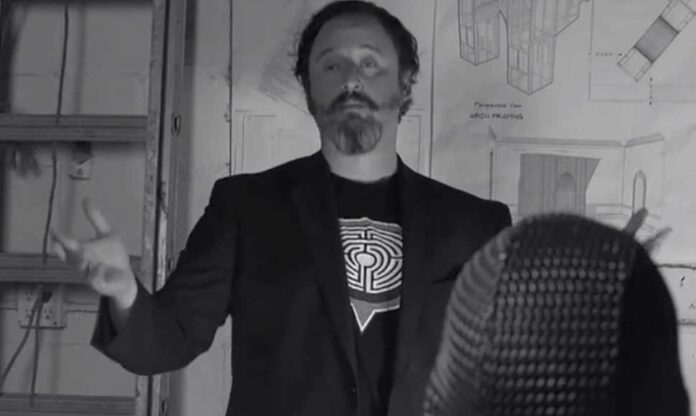
Enter Mark DeSaulnier, the LBC’s new director of marketing. His first goal since taking the reins is to ramp up the public’s knowledge of programs on offer at LBC. Can he elevate the venue’s more civic-minded profile?

“I think one of the big misconceptions is the idea that all we do is put on shows,” says DeSaulnier. “We do these world-class performances here, but we are really a nonprofit arts organization. Our larger goal is to be an arts organization to the community, and those are the initiatives we are pushing now.”

The center’s three-E’s denote its broader mandate: Enrich. Educate. Entertain. Its most recent financial statements from 2017-18 bear out an organization that’s provided education and outreach to some 40,000 children and provided discounted tickets to some 15,700 community members a year.

DeSaulnier joins an organization with a $12.7 million operating budget as of 2017-18 and with $10 million in operating expenses over that year, 77 percent of which goes to program services. Administration costs account for some 15 percent of its annual budget.

It enjoys donor support from a wide range of Sonoma County persons and business—donations have flowed from PG&E, to the Redwood Credit Union, to Healdsburg Democratic Party power brokers Tony Crabb and Barbara Grasseschi. State Senator Mike McGuire’s a big fan, too, and helped broker a $100,000-plus donation from Redwood Credit Union and the Press Democrat after the 2017 wildfires that damaged the center.

The LBC’s arts programs are mostly aimed at kids and the organization works to help parents scale the typical hurdles families might run up against when considering an arts program for a child. That’s mostly about money.

“We look for ways to tear down any barriers that may come up, whether it be pricing—most of our programs are free of charge—or whether it be accessibility. We offer subsidized transportation,” says Ashleigh Worley, director of education and community engagement. “We want to be where we are needed.”

The center emphasizes programs that cater to overlooked members of the community, creating an Alzheimer’s singing group and launching a Latinx advisory council in recent years. If Luther Burbank was himself an alleged eugenicist along with all of that great stuff he did with plants, the center named in his honor has taken a more multicultural-friendly view of the world, if not Sonoma County.

DeSaulnier sees this outreach as critical to the future identity of the LBC. “The important question is ‘how can we continue to inspire inclusion? What does that look like? How does that affect our programming? How can we communicate that all are welcome.’ That is the key question to always be asking.”

DeSaulnier comes to the LBC from his previous role as executive director of the Oakland Interfaith Gospel Choir where he emphasised inclusion and celebrated difference. Indeed, he was responsible for bringing the choir to the Green Mountain Center for the Arts last year (See “Choir on Fire,” Jan. 30, 2018). In his executive role, he brought together the Oakland Gospel Choir and the San Francisco Gay Mens’ Chorus. His goal is to bring that same spirit to the LBC.

He’s nothing if not strident in his belief in the power of the arts as a catalyst for community-building and DeSalunier gives props to Elton John and his poignant “Goodbye Yellow Brick Road” which he heard when he was around 14. The opening lyrics are just about as iconic as they come, and DeSalunier took the “old man” Elton’s message to heart:

When are you gonna come down?

When are you going to land?

I should have stayed on the farm

I should have listened to my old man

The song goes on from there to describe a man who has given up the penthouse for the plough—proverbially in Elton’s case. But here’s DeSalunier, taking up that same proverbial plough in the ag-lands of Sonoma County on behalf of the LBC.

“Up to that point,” he recalls, “I was only thinking about having fun.”

There Ought to be a Law

Thanks for this news article, I didn’t know California was considering a public banking law (“In Us We Trust,” June 19, 2019). Good idea! I’ll be writing to Sen. McGuire in support of it.

Via Facebook

The Horrors

It is unfathomable to me that there are those who have lost so much compassion and empathy for their fellow human beings that they legitimize child detention centers
and the horrors within on purely political partisanship.

“I screamed at God for the oppressed and incarcerated child until I
saw the oppressed and incarcerated child was God screaming at me.”
—Author Unknown

Sausalito

In the United States detention means you have to stay after school in the principal’s office for chewing gum in class. It does not mean little kids are now automatically relegated to the lowest caste of untouchables where you will likely remain imprisoned in filth, hunger, and distress, as your family goes crazy with fear, until you die or are saved by Democrats.

Novato

The Road Ahead

St. Helena, California, has been classified by some as a dying town, conflicted about what steps must be taken to remain a viable community. How did a beautiful, world-class tourist destination end up in such a dilemma? We can look to five stages of decline as identified by Jim Collins in his book How the Mighty Fail for insight where identifies things like “hubris born of success,” the undisciplined pursuit of more” and “denial of risk and peril.”

The perceived path to salvation is now in contention. We have a debate regarding the future of 5.6 acres of vineyards, in a prime location just a couple blocks from downtown, owned by the city. In the simplest terms, one group wants to sell the property for privatization and the other wants the property preserved for civic use only.

Here is where it gets interesting. A Saint Helenian recently stated “it is nice the city gathers ideas from the citizens. However, infinite wisdom is not held in the mind of the masses. Leadership, with professional advice and the courage to make decisions is fundamental to a better future for Saint Helena.”

I tend to agree with the statement with a caveat. Which professionals exactly will be the ones from whom we derive the advice and will the wisdom of the citizens of our town be factored into the process? We did, after all, get in this rabbit hole in part by following professional advise over the last several decades.

St. Helena

Write to us at le*****@******an.com.

Musical Monsters

0

Filmmaker Mel Brooks struck gold with his musical adaptation of The Producers and hoped lightning would strike twice with the same approach to Young Frankenstein.

It didn’t. Young Frankenstein ran for about 2,000 performances less than its predecessor and while The Producers rang up a total of 15 Tony nominations (winning a then-record 12), YF received a scant three nominations and took home none.

Does that mean it’s a bad show? No, in many ways it’s a better show. It adheres closer to its original material and while The Producers is essentially a one-joke concept (albeit a great joke), Young Frankenstein affectionately spoofs an entire genre and Broadway itself.

The despised Victor von Frankenstein (Robert Bauer) has passed, and it’s up to his grandson Frederick Frankenstein—pronounced Fronk-en-steen—(Troy Thomas Evans) to return to Transylvania and claim his birthright. How long before Frederick and Igor—pronounced Eye-gore—(Bill Garcia) get back in the family business?

If you like the film, you’ll like the show, but you’re going to have to get past some casting issues. Evans is a talented young performer who’s done good work, but he’s decades too young for the role of Frederick. Whether his constipated take on the role was his or director Katie Watts’ decision, it didn’t work. Garcia does fine as Igor, but it occurred to me as the show drew to a close that, for a number of reasons, he should have played Frederick, and Evans would be better suited for the role of Igor.

The supporting cast is strong, with Tory Rotlisberger stealing scenes as Frau Blücher and Madison Scarbrough a hoot as Frederick’s vainglorious fiancé Elizabeth. Robert Bauer does double duty as Inspector Kemp and Grandpa Frankenstein, and Eric Yanez does well as the monster.

Watts also choreographed the show, and she exhibits a much stronger hand with that task in several well-done production numbers including the classic tap dancing extravaganza “Puttin’ on the Ritz.”

It’s a Mel Brooks piece, so the humor runs from the clever to the crass. A great deal of laughter comes from familiarity with the material, as evidenced by the audience’s raucous responses to some jokes despite the delivery being somewhat wobbly.

You know what you’re gonna get with a show like Young Frankenstein, and while you do get a lot of it, this monster could have been stitched together better.

Rating (out of 5):★★&#9733

‘Young Frankenstein’ runs through July 14 at the Raven Performing Arts Theater, 115 North St., Healdsburg. Friday–Saturday, 8 pm; Sunday, 2 pm. $10–$35. 707.433.6335.

Tall Order

0

What’s this about American whiskey not having the same good reputation as Scotch whisky, Irish whiskey or even Canadian whisky? Sad to say, it’s true, according to Jeff Duckhorn, head distiller at Redwood Empire Distilling in Graton. But what about the currently unquenchable consumer thirst for American spirits like bourbon and rye? It’s all in a name.

Pipe Dream is the name of Redwood Empire’s newest product, which joins a lineup that includes a rye named Emerald Giant and a blend of straight whiskeys named Lost Monarch. Duckhorn explains that the category “American whiskey” is seen by consumers as somewhat downmarket, even if it contains the very same blend of whiskeys distilled across America in Indiana, Kentucky, Tennessee and California. It’s all more or less the same stuff—except now there’s more of that California stuff.

When I toured this cellar two years ago, it was creaking with crusty, old casks that’d spent years in rickhouses back East. This time, it’s brimming with new oak barrels that Duckhorn and team have filled in batches, four at a time. Selecting the oak makes a difference in the glass, says Duckhorn. He likes oak staves that are aged for 36 months before they’re made into a barrel, for a softer whiskey, and he’s even experimenting with Oregon oak. But before we get lost in the woods, Hey, aren’t those whiskeys named after famous North Coast sequoias? Yes, and the labels bear quotes from naturalist John Muir. The distillery connects the themes by partnering with Trees for the Future, which pledges to plant one tree, mainly in tropical areas facing deforestation, for each bottle sold.

While building up stocks for a “bottled in bond” whiskey, which must be distilled in Graton and aged there for four years, Duckhorn blends up to 10 percent of his own “grain to glass” whiskey with the purchased spirit.

Redwood Empire Pipe Dream bourbon ($44.99) has a warm, spicy character, and while dough and caramel round out the palate, it isn’t overly sappy or woody with oak. It’s got some earthy spice, a hint of banana peel, and cinnamon and is a big success on the rocks.

Spice fans will find something to like in the Redwood Empire Emerald Giant rye ($44.99). If not quite like cereal grains fresh-picked off the stalk, crushed between fingers and inhaled, that’s where the spicy grain aroma is going. Dry on the palate, it’s backed up by woody, caramel flavor. Softer yet, with juicy grain flavor and herbal overtones, a small flask of Redwood Empire Lost Monarch blended straight whiskey ($44.99) will make a fine companion on my next walk with nature.

Musical Bandits

After a one-year hiatus forced upon them by the renovation of Santa Rosa Junior College's Burbank Auditorium, the Summer Repertory Theatre program returns with a full schedule of three musicals and two plays running in "rep". The plays will continue to be performed in Newman Auditorium while the musicals are being done in the SRT Performance Pavilion; an enclosed,...

Crowdfunded Journalism

The Bohemian is free in print and online. It’s going to stay that way. But we are a small staff and we want to do much more. That takes money. Independent, critical journalism is a public good and, I daresay, a key component of a functioning democracy. But competition for ad dollars, content aggregators and the proliferation of media...

Ride On

If you happen to see a corncob-headed loudmouth in a red jacket gallivanting around your local parks this summer, you may have come across the Imaginists, Santa Rosa's most out-there theater troupe, who are bringing their Art is Medicine Show to Santa Rosa parks through July for the 11th year in a row. Originally inspired as a response to the...

Seeing Is Believing

Say What? A crudely manipulated video of Nancy Pelosi that seemed to show her slurring her words went viral in May, egged on in part by President Trump. Deep Dive Andrew Grotto, a research fellow at Stanford University's Hoover Institute and Center for International Security and Cooperation, is studying how deepfakes impact the electoral process and messaging. The future of misinformation...

Spidey Vacation

It's not yet July 4th and audiences can already experience Summer Movie Leakage. Spider-Man: Far From Home commences with Nick Fury (Samuel L. Jackson) examining a trashed Mexican village. Was this the same town Rodan took apart in Godzilla, King of Monsters? In fact, it was a windstorm: "the cyclone had a face," Fury rumbles. The giant wind beast...

Plugging In

After more than a decade of collaboratively fronting string band ensemble Brothers Comatose, San Francisco singer-songwriter and Petaluma native Ben Morrison is striking out on his own with a forthcoming debut solo album and tour this summer. "I've been in the Brothers Comatose for over 11 years now," says Morrison. "And last year there were some changes to the band." With...

Program Notes

The Luther Burbank Center (LBC) is one of the North Bay's premier arts and events center. While the facility enjoys being recognized as the go-to regional venue for big name performances, it has struggled to promote the educational programs that are as much a part of its mission as a Trevor Noah appearance. Enter Mark DeSaulnier, the LBC's new director...

There Ought to be a Law

Thanks for this news article, I didn't know California was considering a public banking law ("In Us We Trust," June 19, 2019). Good idea! I'll be writing to Sen. McGuire in support of it. —Leslie 2 Via Facebook The Horrors It is unfathomable to me that there are those who have lost so much compassion and empathy for their fellow human beings that...

Musical Monsters

Filmmaker Mel Brooks struck gold with his musical adaptation of The Producers and hoped lightning would strike twice with the same approach to Young Frankenstein. It didn't. Young Frankenstein ran for about 2,000 performances less than its predecessor and while The Producers rang up a total of 15 Tony nominations (winning a then-record 12), YF received a scant three nominations...

Tall Order

What's this about American whiskey not having the same good reputation as Scotch whisky, Irish whiskey or even Canadian whisky? Sad to say, it's true, according to Jeff Duckhorn, head distiller at Redwood Empire Distilling in Graton. But what about the currently unquenchable consumer thirst for American spirits like bourbon and rye? It's all in a name. Pipe Dream...
11,084FansLike
4,446FollowersFollow
6,928FollowersFollow