SMART Board Will Receive Budget Report Today

This afternoon, the board which controls the North Bay’s only commuter train service will hear a staff report on just how badly the transit agency’s finances have been impacted by the Covid-19 pandemic.

Even before the pandemic drastically reduced the Sonoma-Marin Area Rail Transit agency’s ridership, the transit agency was facing a somewhat uncertain future.

In early March, voters in Marin and Sonoma counties rejected Measure I, a ballot item that would have extended the sunset date of the agency’s quarter cent sales tax from 2029 to 2059.


Supporters of the measure said that approving the extension well in advance of the end of the current tax’s lifespan would allow SMART to refinance its debts and repurpose the money to bolster train service.


But, after an insanely well-financed campaign for and against Measure I, skeptics of SMART won out. Measure I’s backers failed to win the two-thirds support the measure needed.


Since then, a worldwide pandemic has lowered transit ridership across the country and SMART is expecting a drop in ridership and sales tax revenues in the coming years.

At their meeting today, SMART’s board will hear an update on the agency’s budget projections for the current and coming fiscal year.

The meeting will be streamed on Zoom beginning at 1:30 pm. The agenda and information about how to view the meeting are available here.

Deadline for Petaluma SMART Station Land Deal Delayed

A crucial deadline in a complicated deal intended to finance Petaluma’s second train station—and hundreds of housing units along with it—has been set months back.

At a May 4 meeting, the Petaluma City Council voted in favor of an agreement with the Sonoma-Marin Area Rail Transit (SMART) agency, the last agreement meant to seal a three-party deal.

The third party in the deal is Lomas Partners, a company that hopes to develop housing on sites near the planned second station at Corona Road and the existing Downtown Petaluma station. Lomas Partners is owned by Todd Kurtin, a Southern California businessman.

If completed, the deal—which already includes separate agreements between SMART and Lomas Partners, and Petaluma and Lomas Partners—will define the appearance of downtown Petaluma and a long-planned Corona Road station for decades to come.

Lomas Partners would be allowed to develop 110 housing units at the Corona Road site in exchange for giving 1.27 acres of land to SMART for a 150-space parking structure.

To finance SMART’s construction of the Corona Road station, Lomas Partners will purchase 315 D St., an underused downtown Petaluma lot, from SMART for $8 million. Lomas Partners plans to sell the land’s development rights to a Texas-based developer that plans to build 402 on-site units of mostly market-rate housing.

Under an Oct. 12 agreement between Lomas Partners and SMART, the 315 D St. property was required to be in escrow by May 19, 2020. Otherwise, the whole deal would fall apart.

But, a week before the Petaluma City Council’s May 4 meeting to consider the city’s agreement with SMART, Lomas Partners and SMART changed a crucial date in their agreement. Instead of requiring SMART to close the sale of the downtown property by May 19, they pushed the effective out to November 19, according to Eric Danly, Petaluma’s city attorney. Julia Gonzalez, a SMART spokesperson, said that Lomas requested the delay and SMART agreed to it.

Prior to that, at a meeting in February, the City Council approved an agreement with Lomas Partners and directed city staff to develop a separate agreement with SMART in order to give the city more certainty moving forward.

Since then, the city and SMART have held multiple negotiations over the agreement with SMART.

Meanwhile, SMART’s financial standing has become much more uncertain. In March, North Bay voters rejected Measure I, a quarter-cent sales tax extension that would have given SMART more long-term certainty. Then the Covid-19 pandemic eliminated most of SMART’s ridership.

To complicate the matter further, the Petaluma Community Alliance, a group of residents represented by Hanson Bridgett, a San Francisco–based law firm, filed a lawsuit against Petaluma over its handling of the development-approval process.


The city council discussed the Petaluma Community Alliance case in private during its May 4 meeting and ultimately voted 5 to 2 in favor of the agreement with SMART.

Councilmembers who voted in favor of the agreement said that, although it is flawed, the current deal represents the city’s best opportunity to construct a second station.

“There are definitely things in it I don’t care for and things that were added by SMART that appear to give them wiggle room, but this is important to our community,” city councilmember Kathy Miller said before voting for the agreement.

Mayor Teresa Barrett and Vice Mayor D’Lynda Fischer voted against the agreement, citing concerns about both the possibility that the station may never be built despite the agreement with SMART and what will happen if construction costs on the Corona Road station run over the current $8 million project budget.


Open Mic: Raise The Wage

On Tuesday, May 19, the Santa Rosa City Council will consider a request by the California Restaurant Association to delay implementation of the city’s $15-an-hour minimum-wage ordinance. The legislation, approved last September, requires large employers to pay $15 an hour and small employers to pay $14 an hour—two dollars more than the state minimum wage—beginning July 1.

Why should the city implement the higher minimum wage on July 1?

First, unemployment has skyrocketed and the economy has collapsed due to the Covid-19 pandemic. Raising the minimum wage will act as a stimulus to spur greater business activity, particularly for small businesses, as low-wage workers spend their increased earnings locally for basic needs. The Federal Reserve Bank of Chicago reports that every $1-an-hour wage increase for a minimum-wage worker results in $2,800 in new consumer spending by that worker’s household over the following year.

Second, according to the UCB Labor Center, more than one in three Santa Rosa workers earn less than $15 an hour; thus, approximately 25,000 workers would receive a pay raise. These low-wage workers are, on average, 33 years old; contribute one-half of their family’s total income; and three out of four belong to working poor families earning less than $50,200 a year.

Moreover, according to the Public Policy Institute of California, most Santa Rosa workers providing essential frontline services during the Covid-19 crisis earn low wages. These workers are disproportionately women, workers of color and immigrants employed in the grocery, food, retail, child care, domestic, farmworker, transit-related, home care and health care, janitorial and cleaning, warehouse and delivery industries.

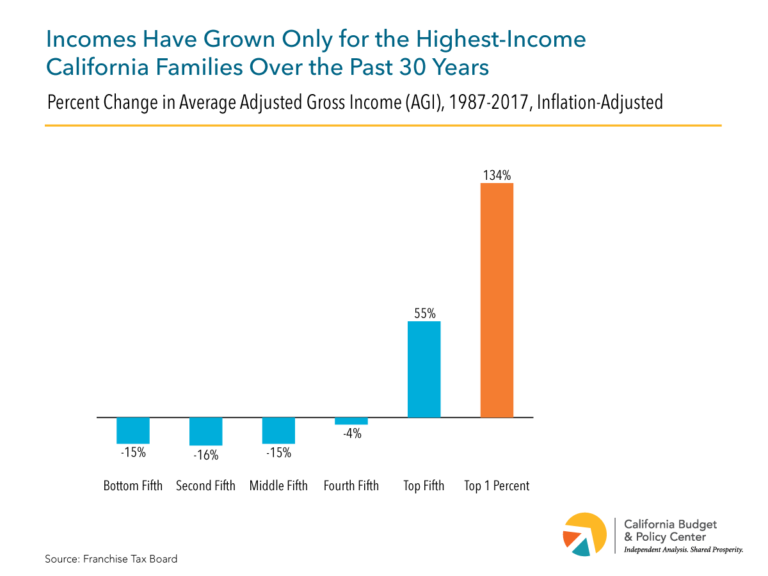
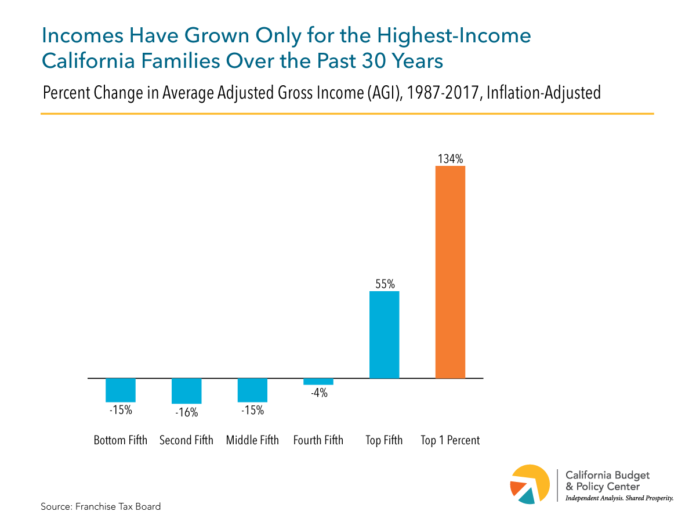
Third, between 1987 and 2017, the adjusted gross average incomes for the top 20 percent of North Bay and California families rose by 55 percent, while the incomes for the bottom one-fifth dropped by 15 percent.

Fourth, between 2006 and 2017 in the North Bay and across California, median household rent rose by 16 percent, while median annual earnings for the typical full-time worker increased by just 2 percent.

Finally, the City of Petaluma implemented a minimum-wage law on January 1, 2020, boosting the minimum to $15 for large employers in that city. Elsewhere in California on July 1, 10 municipalities and one county will either raise their existing citywide or countywide minimum wage to $15 an hour (City and County of Los Angeles, Pasadena, Santa Monica, San Leandro, Alameda and Fremont) or move forward with a Cost of Living Adjustment to an existing citywide minimum wage now set above $15 an hour (Emeryville, Berkeley and San Francisco). None of these cities are considering delays.

Soaring inequality, the rising cost of living and economic justice demand a small raise for the lowest­-paid workers. As Covid-19 amply demonstrates, they do the essential work for us all.

Martin J. Bennett is Instructor Emeritus of History at Santa Rosa Junior College and a Research and Policy Associate for UNITE HERE Local 2850.

Rep. Huffman’s New Legislation Opposes Fossil-Fuel Bailout

North Coast Congressman Jared Huffman has introduced legislation intended to bar fossil-fuel companies from receiving relief funding from the $500 billion federal CARES Act stimulus bill.

Huffman and other Democratic lawmakers introduced the legislation, known as the ReWIND Act—the Resources for Workforce Investments, not Drilling Act—on May 5.

The bill comes after the Trump Administration began signalling the president’s intent to steer CARES Act funds to the struggling oil and gas industries.

The ReWIND Act would make “sure [that CARES Act funds] are not used to pay off bad debt taken on by fossil fuel corporations before the public health crisis,” according to a statement released by Huffman’s office.

“The relief allocated by Congress in the CARES Act is intended to benefit families and small businesses, not bail out oil and gas companies that were failing long before the coronavirus pandemic hit,” Huffman said in a statement.

Among other things, the ReWIND Act would prevent banks using certain CARES Act programs from issuing loans to oil companies, and institute a moratorium on new federal fuel leases until the end of the Covid-19 pandemic.


Sonoma-Marin Fair Canceled Amid Pandemic

After some uncertainty, the organizer of the Sonoma-Marin Fair canceled plans for this June’s annual event.

The 4th District Agricultural Association Board of Directors decided to cancel the event

during a May 1 emergency virtual meeting due to local regulations barring mass gatherings during the coronavirus pandemic.

“We hoped that as the shelter in place deadline of May 3rd approached, we would be able to move forward with our fair. We explored all the options, but we understand that this is the right decision for the safety and well-being of our community,” Allison Keaney, the Sonoma-Marin Fair’s CEO, said in a statement released after the meeting.

The fair offers a combination of agricultural attractions and musical performances. Perhaps the fair’s best-known competition is the annual World’s Ugliest Dog Contest.

Organizers are planning to hold a Virtual Fair between June 24 and June 28. The details of the event have not been announced. More information is available at www.sonoma-marinfair.org.

Wildfire Prevention: Chipping Program Starts Today

Today marks the first day of the season for Sonoma County’s Residential Curbside Chipper program. This free curbside chipper service supports residents in creating defensible space around their homes and reduces vegetation along access routes.

This program is for properties in unincorporated Sonoma County. There have been some changes made this season to enhance the program. The most important change is residents must use SoCo Report It, the County’s Online Reporting System, to submit applications. Paper applications will no longer be accepted. The County crew will provide up to two hours of complimentary chipping which, on average, is enough time to chip a pile of vegetation that is approximately 50 feet long, 3 feet tall, and 8 feet wide.

The program, which is offered May-November (weather dependent), is available on a first-come, first-serve basis. Because of the commitment to promote and assist in creating defensible space, a total of 468 jobs were completed in 2019.

“This program provides an essential element to help promote community safety as we move towards fire season,” stated Sonoma County Fire Marshal James Williams; “By reducing vegetation and creating defensible space around structures, property owners play an active role in helping their communities to be safe.”

At the start of this season, over 90 residents are already signed up for participation, spanning the County from Cloverdale/north to Sonoma/south; Kenwood/east to Jenner/west. Those interested in participating are encouraged to submit their online applications as soon as possible.

To learn more about this program and to find out how to sign up visit sonomacounty.ca.gov/fire-prevention/chipper-program


[embed-1]

Virtual Career Week Hopes to Help Students Find Work During Pandemic

The current shelter-in-place ordeal in Sonoma County and across the US has created massive unemployment, and students who just went through at-home graduation ceremonies may not be feeling especially great about their prospects in the job market.

To help meet the challenge of finding a job in the midst of a Covid-19 pandemic, Santa Rosa Junior College and Sonoma State University are partnering up for a Virtual Career Week happening Tuesday, May 5, through Thursday, May 7.

The three-day online event features employers who are currently hiring or who anticipate to be hiring within the next six months, and is open to all current students and alumni from both the SRJC and SSU. Each featured employer will have a specific date and time during which they will host a 75-minute virtual ‘booth’ with an associated Zoom link.

Employment categories include Summer, part-time and remote jobs; as well as work in Health, STEM, Wine, Beverage and Hospitality, Economics, Sales, Marketing, Social Services, Education, Government, Arts and Communications.

Visit the Virtual Career Week page and register for participation, here.

Sonoma County Agency Releases Draft of Affordable Housing Plans

The county agency in charge of funding affordable housing projects throughout most of Sonoma County released a draft of its plans for the coming year on Friday.

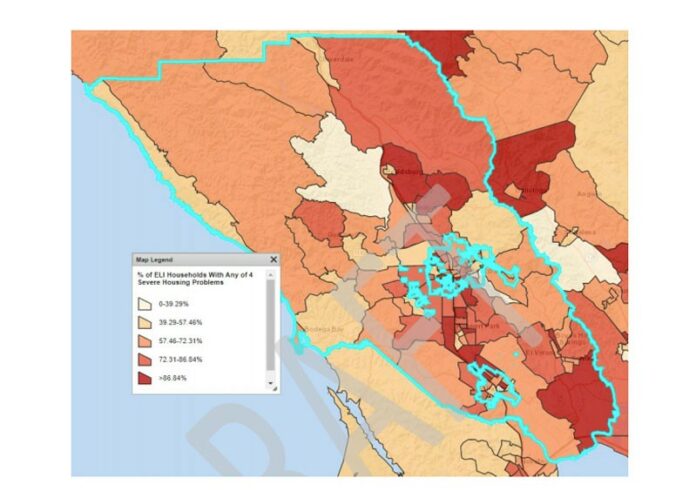
The Sonoma County Community Development Commission (CDC), which covers all of the county except for Santa Rosa and Petaluma, published a copy of its 2020 Consolidated Plan and the Fiscal Year 2020-2021 One Year Action Plan. The document was prepared and published in accordance with federal housing requirements.

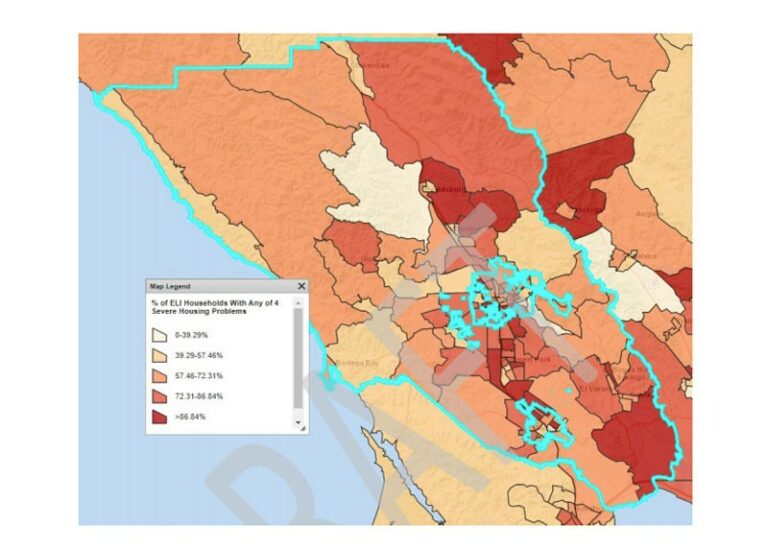
While poring through dozens of pages of numbers and jargon may not seem like fun, the document offers an important glimpse into the current housing situation faced by Sonoma County’s poorest families.

“Cost-burden is the most common problem …” the plan states. “Using [federal housing] data from 2011-2015, a period before several more years of double-digit rent escalation, the figures still yield staggering numbers of severely cost-burdened renters.”

There were 103,147 households and 266,489 residents in the regions covered by the CDC in 2017, according to the CDC draft plan.

Based on the 2011–2015 data, 7,388 extremely low-income households (68 percent of that income category) paid more than half their income towards rent. A May 2019 data set from the National Low Income Housing Coalition showed that 76 percent of extremely low-income households now pay more than half their income in rent, the CDC plan states.

The second half of the document offers a draft of the CDC’s plan to spend federal housing money on affordable housing projects in the coming year.

Members of the public have until May 31 to comment via the CDC’s website. A link to the full report is available on the same page.

Desserts Go Digital For LBC Fundraiser

Luther Burbank Center for the Arts’ long-running and super tasty benefit, The Art of Dessert, was originally scheduled for early last month, though the Covid-19 pandemic put the plan on hold, until now.

In the spirit of social distancing, the Art of Dessert Virtually takes the annual event online with an extravaganza featuring digital auctions for first-class wines, delectable and beautifully designed desserts and cakes, and one-of-a kind gifts and experiences to enjoy in the future.

Proceeds from the online auctions go towards LBC’s Education and Community Engagement programs, which currently provide virtual events and classes until the center’s campus re-opens.

Registration is open now to view auction items, bidding begins online, Sunday, May 3, at noon and runs until Saturday, May 9, at 9pm at lutherburbankcenter.org.

Opinion: PG&E bankruptcy exit deal bad for Californians

0

By Jessica Tovar and Tré Vasquez

As millions of Californians scrambled to navigate life in a
pandemic, Governor Newsom negotiated a deal with PG&E and placated the
failed utility’s investors. And it’s not a good one.

For survivors, Newsom’s deal means being handed company
stocks that are plummeting in value and locked in a trust they can’t even
control.

The deal would load the new PG&E with at least $38
billion in debt – billions that will eventually be added to our monthly bills,
making it impossible to pay for necessary safety upgrades.

With more wildfires and PG&E shutoffs coming, Newsom’s
deal does little to address the grid’s fundamental safety issues, and only
triggers substantive change if PG&E burns down more families and homes.

In the North Bay, we’re still restabilizing our communities
after surviving fires in 2017 and 2019. Rents increased 36 percent in Sonoma
County immediately after the 2017 fires, and in a region where 1 in 10 of jobs
are in hospitality, the pandemic has left many unemployed, wondering how we’re
going to pay rent and bills. We’re still grappling with the loss of our homes
and the deaths and displacement of our loved ones from the fires. We cannot
allow PG&E to continue robbing our communities to pay for their negligence.

Our collective health and safety depends on housing,
healthcare, energy to refrigerate our food and hot water to wash our hands. To
protect that, we need utilities that prioritize safety and serve the public
good, not just extract profits.

Energy and water should be human rights and shared
resources, not commodities. Temporary moratoriums on evictions and shutoffs
won’t cut it – we need real debt forgiveness on utility bills.

Now is the time for system change. We need full and fair
cash compensation for fire victims, no additional debt that ratepayers will
have to pay, and a plan to transform PG&E into a community-and-worker owned
entity with a safe, reliable, climate-resilient grid.

Governor Newsom said “Bankruptcy turned out to be an extraordinary opportunity for the state.” And it is. But if he doesn’t reverse course soon,
that opportunity could become a recurring nightmare.

—-

Jessica Tovar is an Oakland-based organizer with the Local
Clean Energy Alliance. Tré Vasquez lives in Santa Rosa and is a staff member
with Movement Generation. Both are part of the Reclaim Our Power Utility
Justice Campaign.

SMART Board Will Receive Budget Report Today

This afternoon, the board which controls the North Bay’s only commuter train service will hear a staff report on just how badly the transit agency’s finances have been impacted by the Covid-19 pandemic. Even before the pandemic drastically reduced the Sonoma-Marin Area...

Deadline for Petaluma SMART Station Land Deal Delayed

A crucial deadline in a complicated deal intended to finance Petaluma’s second train station—and hundreds of housing units along with it—has been set months back. ...

Open Mic: Raise The Wage

On Tuesday, May 19, the Santa Rosa City Council will consider a request by the California Restaurant Association to delay implementation of...

Rep. Huffman’s New Legislation Opposes Fossil-Fuel Bailout

North Coast Congressman Jared Huffman has introduced legislation intended to bar fossil-fuel companies from receiving relief funding from the $500 billion federal CARES Act stimulus bill. Huffman and other Democratic lawmakers introduced the legislation, known as the ReWIND Act—the Resources for Workforce Investments, not Drilling Act—on...

Sonoma-Marin Fair Canceled Amid Pandemic

After some uncertainty, the organizer of the Sonoma-Marin Fair canceled plans for this June’s annual event. ...

Wildfire Prevention: Chipping Program Starts Today

Today marks the first day of the season for Sonoma County’s Residential Curbside Chipper program. This free curbside chipper service supports residents in creating defensible space around their homes and reduces vegetation along access routes. This program is for properties in unincorporated Sonoma County. There have been some changes made this season to enhance the program. The most important change...

Virtual Career Week Hopes to Help Students Find Work During Pandemic

Online event is open to SSU and SRJC students and alumni

Sonoma County Agency Releases Draft of Affordable Housing Plans

The county agency in charge of funding affordable housing projects throughout most of Sonoma County released a draft of its plans for the coming...

Desserts Go Digital For LBC Fundraiser

Luther Burbank Center for the Arts’ long-running and super tasty benefit, The Art of Dessert, was originally scheduled for early last month, though the Covid-19 pandemic put the plan on hold, until now. In the spirit of social distancing, the Art of Dessert Virtually takes the annual event online with an extravaganza featuring digital...

Opinion: PG&E bankruptcy exit deal bad for Californians

By Jessica Tovar and Tré Vasquez As...
12,121FansLike
4,936FollowersFollow
6,928FollowersFollow