The Pacific Gas and Electric Company faces a crucial deadline: Before June 30, it must get both the state of California and a federal judge to approve its plan for getting out of bankruptcy. If it doesn’t meet the deadline, it won’t be eligible for help from the state Wildfire Fund—help that is needed to make the plan work.
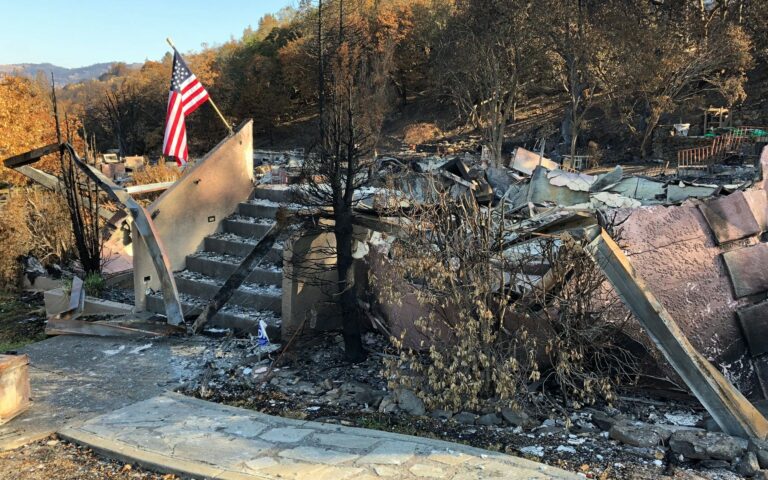
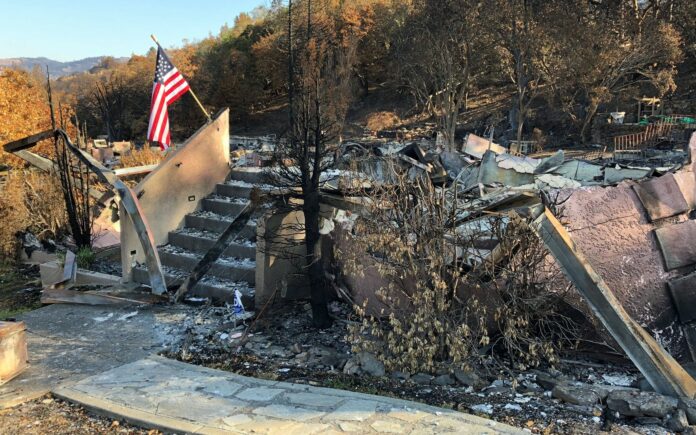
The company entered a Chapter 11 bankruptcy process in January 2019 because it couldn’t pay an estimated $30 billion in legal claims from 2017 and 2018 wildfires, which killed more than 100 people, destroyed tens of thousands of buildings and burned vast areas of forest. In March, Gov. Gavin Newsom announced he and the company had agreed on a proposed plan that would mean “the end of business as usual for PG&E.”
The plan outlines complicated financial strategies for “reorganizing” the debt, issuing new debt and stock, and paying specific amounts from shareholders’ dividends and assets. It also would make major changes in PG&E management and give state regulators more “accountability tools,” Newsom said. And the deal provides for a state takeover of the utility if PG&E doesn’t meet its financial, safety and reliability obligations.
Many fire victims, insurers and creditors have signed off on the plan. But at the May 7 meeting of the California Public Utilities Commission, which oversees PG&E, there was “a big show of activists against the deal,” said Mari Rose Taruc of the Reclaim Our Power Utility Justice Campaign, a coalition of many of the states’ major environmental and social-justice organizations.
Critics say the deal shortchanges fire victims, fails to ensure safety, lacks strong enough accountability measures and would result in higher rates for customers. Reclaim Our Power is planning a pandemic-appropriate protest in San Francisco, with a car caravan, street art and more on May 20, the day before the commission is scheduled to vote on the proposal. The commission’s approval is required for the plan to go forward.
Some critics are calling for specific changes in the plan, especially tighter rules for state oversight of financial decisions and safety improvements. Reclaim Our Power wants to take it further.
“PG&E is not going to change to the point where we can be confident that the utility and the government will protect us during the upcoming wildfire season from getting burned up or having our power shut off,” Taruc said.
Her coalition wants the state to transfer control of the utility from PG&E and Wall Street to democratic decision-making by frontline communities and workers.
The proposed settlement would give $13.5 billion to people who lost homes, businesses or loved ones in the 2017–18 fires. By some estimates that’s less than half of what they are due, and half of that amount is to be paid in PG&E stock rather than in cash. But in a vote held May 15, the deal won overwhelming support from fire-victim plaintiffs.
Some fire victims remain critical.
“There should be immediate payment in cash directly to survivors and impacted communities, not a split of stocks and cash,” said Gabriela Orantes of Sonoma County’s North Bay Organizing Project.
Her organization is part of the Justice Recovery Partnership, a group of “grassroots organizations that have been on the ground in communities that have experienced fires and power shutoffs.” They don’t think it’s fair to ask fire victims to share in the risk of PG&E’s volatile stock price, especially when the plan also calls for payment in cash to the other claimants—insurance companies and local governments.
Orantes added that some of the payment won’t come until 2021 or 2022 and is contingent on the success of particular financial maneuvers. A group called Survivors of the PG&E Fires reported that fire victims were subject to a high-pressure campaign to get them to vote “Yes,” including by some of the lawyers representing them.
In addition to the fires, last summer’s power shutoffs created serious problems, especially for people with disabilities.
“They affect us in many ways differently from people without disabilities,” said Jay Shalizar, of the Disability Justice Culture Club. Some people need ventilators and other equipment to survive, or medication that requires refrigeration, she said.
During last year’s power shutoffs, Shalizar asked a friend who uses a ventilator what she would do if she lost electricity.
“She said, ‘Lie here and die,’” Shalizar said. Shalizar said she and others “had to pool resources, get extra batteries for her ventilator and her wheelchair. Then we bought her a generator.”
The group also mobilized to protect people with heart and lung problems and chemical sensitivities from the effects of wildfire smoke.
“People got really sick because of how polluted the air was,” she said. “We ended up going to people’s houses, did DIY air purifying, sealed doors and windows, pooled resources to pay for hotels.”
PG&E has committed to cutting the duration of power shutoffs in half, but Shalizar said the reorganization proposal doesn’t include “anything to help people stay alive” during future power shutoffs. Disability-rights activists have joined in protests against PG&E, including a blockade of its headquarters last December, which also included Reclaim Our Power, youth climate activists and others.
Of course, a main goal of any plan for PG&E is to prevent future wildfires. The proposed deal calls for a Wildfire Mitigation Plan, but the specifics are not yet determined. Governor Newsom’s current proposed budget would add more staff to the Public Utilities Commission’s Wildfire Safety Division, which must approve PG&E’s annual wildfire safety plans. But Taruc said these measures don’t reassure her.
“These plans might be in place,“ she said, “but PG&E is in charge of implementing the plans. That’s a huge oversight issue.”
She is skeptical about whether the Public Utilities Commission has the ability or the will to provide effective oversight. That’s a central issue running through criticisms of the proposed plan. Critics are not convinced that the restructuring and accountability provisions are strong enough to fulfill the plan’s goals.
PG&E has committed to restructuring its management to provide more accountability. Fifty percent of board members will be California residents, with state oversight of board appointments. The board’s Safety and Nuclear Oversight Committee will be appointed in consultation with the state and will get new powers. The company will appoint an “executive-level” Chief Risk Officer and Chief Safety Officer, consulting with the state about who is appointed and spelling out plans for them to report to the board and the Public Utilities Commission. The company also will create an Independent Safety Advisor position and a six-step oversight process that would kick in if there’s another big problem like a major wildfire.
These plans don’t sound strong enough to the plan’s critics.
“Generally, we want enhanced oversight,” said Mindy Spatt, of The Utility Reform Network.
Her organization is calling for some specific changes. Instead of a PG&E safety advisor, they want an Independent Safety Monitor appointed immediately by the Public Utilities Commission. They’re also calling for a more-streamlined process to address safety problems and a mandate for board members to prioritize safety.
A brief filed by three statewide environmental-justice organizations adds that the safety monitor should report to the legislature and the public as well as to the Public Utilities Commission. Spatt commented that her organization has “often had concerns that the CPUC is not hard enough on PG&E. It’s not just a question of whether they have the tools, it’s whether they have the will to get this company under control”
The environmental-justice brief also calls for at least half the board members to be not just California residents, but specifically residents of PG&E’s service area, from communities affected by wildfire, gas pipeline, or other safety issues, or representing utility workers. It calls for more power for PG&E’s Disadvantaged Communities Advisory Group, including their say in key appointments, and for special measures to mitigate the effects of wildfires and power shutoffs in vulnerable communities. And it argues that the proposed plan, while commiting PG&E to continuing current efforts to move toward renewable energy, doesn’t do enough to advance California’s climate and environmental goals. For example, the brief calls for an aggressive plan to close polluting gas-fired power plants in low-income communities.
Critics also charge that the plan, although required by law to be “neutral on average” for ratepayers, will actually result in customers paying for PG&E’s misdeeds. Under the plan, PG&E, which went into bankruptcy with a little more than $22 billion in debt, would exit bankruptcy with a debt of almost $44 billion, according to a letter signed last November by 23 mayors. The plan proposes extremely complex financial maneuvers, such as paying off higher-cost debt with lower-cost debt, raising money by issuing more stock and selling debt to investors who also hold PG&E stock.
“It’s confusing because it’s supposed to be,” said John Geesman, a lawyer who represents the Alliance for Nuclear Responsibility, as he tried to explain the intricacies of the plan.
“PG&E is expected to pay over a billion dollars to the attorneys and financial analysts who have worked out the complex details of this latest bankruptcy plan,” said Spatt, of The Utility Reform Network. “Those may be hard to follow, but the money isn’t. Wall Street is agog over the plan, which was the whole point all along.”
Geesman said that, despite PG&E’s assurances, customers will end up paying some of the costs of its debts. For example, the PG&E corporate structure has two levels: the utility and a holding company that owns the utility. This structure is a holdover from the 1990s deregulation. The current reorganization plan calls for the holding company to raise money by selling “junk bonds,” for which the utility will not be responsible. But the plan allows charges to pay off the bonds to be added to customers’ bills.
In addition, Spatt said, customers have to pay insurance premiums that are extra costly because of PG&E’s past problems. Environmental organizations worry that some of the cost will also be passed on to community-choice electricity agencies, which pay exit fees to PG&E.
And the state’s new Wildfire Fund, the money PG&E is counting on for its bankruptcy plan, will be funded by contributions from PG&E and the state’s other electricity companies. Each company’s contribution is to come half from shareholders and half from customers.
Taruc, of Reclaim Our Power, said, “This plan is built on such rickety finances that kicking the can down the road will only open everyone up—the state, the fire survivors, the investors—to another possible bankruptcy that we all would end up paying for.”
In addition, according to a recent letter signed by five mayors including Oakland’s Libby Schaaf, PG&E will need to make “tens of billions of dollars” in safety improvements to prevent future wildfires. Spatt said it’s not clear how much of this expense will be passed on to customers. Her organization frequently argues before the Public Utilities Commission about PG&E requests to charge customers for expenditures TURN sees as unjustified or ineffective.
The mayors’ letter rejects the financial plans outlined in PG&E’s proposal, saying, “The sixteen million Californians already imperiled by the company’s serious lack of safety, financial stability and reliability … cannot place their homes, their livelihoods and their futures on the prospects of a company that issues junk bond debt.” The letter said the company should raise more of the money by issuing stock and less by increasing debt.
An earlier letter, signed last November by 22 mayors, initiated by Mayor Sam Liccardi of San Jose and signed by Schaaf, Berkeley’s Jesse Arreguin and Richmond’s Tom Butt, called for the state to take over PG&E and convert it to a “mutual benefit corporation” owned by its customers—a consumer cooperative. It argued that a cooperative could borrow the money needed for safety improvements more easily and at lower rates, would be exempt from federal taxes, and would not have to pay dividends to shareholders. In addition, giving the public a role in decision-making would restore confidence.
The mayors’ May letter stopped short of calling for a public takeover, saying only that if PG&E “cannot emerge as a financially viable, reliable utility, then the Commission should pursue another path.” PG&E and the International Brotherhood of Electrical Workers, which represents 12,000 PG&E employees, both oppose a public takeover.
But the Reclaim Our Power coalition continues to press for replacing PG&E with an electric utility controlled by the public. One of its organizations, the Local Clean Energy Alliance, points to PG&E’s conviction for manslaughter in the 2010 San Bruno fire and guilty pleas in recent wildfire deaths. Although The Utility Reform Network has not called for a public takeover, Spatt agreed that “We basically have a career criminal in charge of our electric system.” Taruc of Reclaim Our Power said California should “use this [crisis] as opportunity to reimagine and rebuild” a clean, decentralized energy system that’s democratically controlled.
A public system taking over from PG&E would still have massive financial burdens: paying off the debt and investing in major safety improvements. But a public entity would have the advantages outlined in the November mayors’ letter, and “there are more equitable ways to spread the costs,” Geesman said.
Michael Wara, a lawyer and expert on climate and energy policy at Stanford Law School, said he shares some concerns about PG&E’s proposal. He said he doesn’t approve of paying wildfire survivors’ claims half in stock while other creditors get cash, and agrees that the survivors are not fully compensated. The proposal is “transferring risk from the company to the fire victims, probably also to the state and ratepayers.”
But Wara favors accepting the deal because it would be “enormously disruptive” if the bankruptcy plan is not completed by the June 30 deadline. Liabilities from the upcoming fire season would throw PG&E’s finances into even worse shape, and fire survivors could end up with a lot less. It’s not justice, he said, but “the bankruptcy process is not designed to produce justice, but to maximize claims of creditors.”
Wara pointed out that Governor Newsom’s preference is for the utility to remain a private company. In addition, he said, there isn’t enough time before the June 30 deadline to create a blueprint for a public takeover, which would be a long and controversial process.
Taruc responded, “There was active discussion of all kinds of restructuring proposals—we analyzed a dozen of them. What shut all that down was Newsom’s cave-in to PG&E’s plan in March. Newsom holds responsibility for this predicament.” She said the state should not be pressured to accept a plan that “looks very much like the same PG&E that caused the wildfires and the shutoffs.” Instead, it should reopen the discussion of alternative proposals, extending the June 30 deadline if necessary, “to give us a chance to open up those other possibilities and have a safe, reliable, climate-resilient, worker- and community-controlled electricity system.”
A shorter version of this article appeared in the May 20 issue.