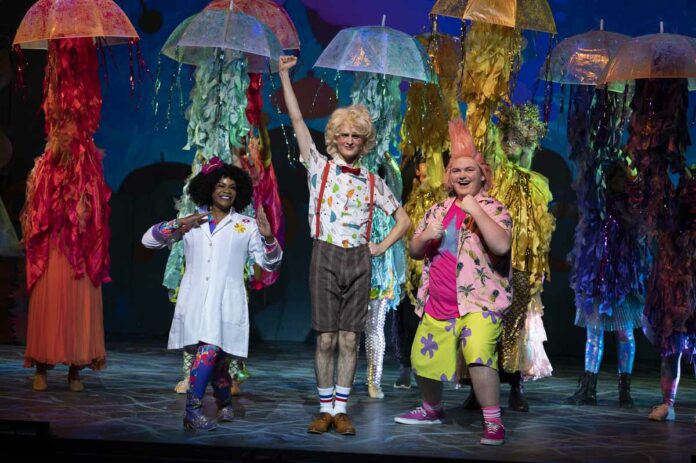
Jukebox musicals tend to be happy, peppy shows, where the hits of an artist or genre are strung together with a minimal story to create a fan-pleasing production. But what do you do with a story that ends with its star dead in the backseat of a Cadillac?
If you’re Randal Myler and Mark Harelik, you start with that depressing bit of business and then go back to the beginning, which is just what they did with Hank Williams: Lost Highway. Santa Rosa’s 6th Street Playhouse has a Michael Butler-directed production running through May 1.
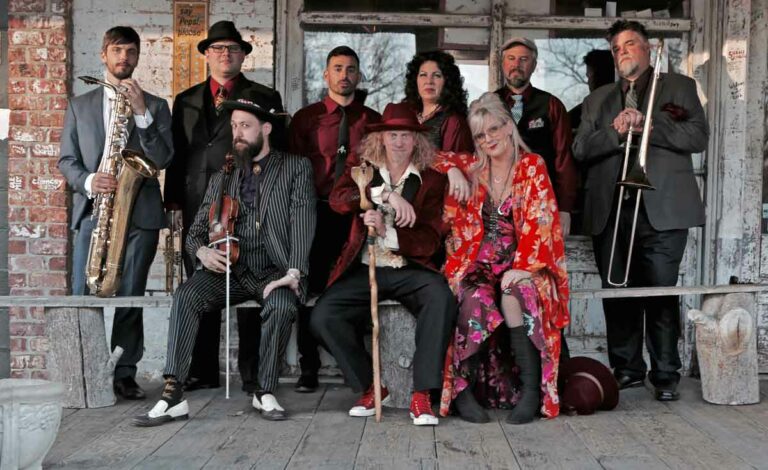
Audio of a radio announcement of Williams’ death opens the show, followed by the introduction of Hank’s mother, “Mama Lilly” (Jill Wagoner). She starts reminiscing about Hank (Steve Lasiter) as a young boy, his mentoring by Rufus “Tee-Tot” Payne (local music legend Levi Lloyd), drives to honky-tonk one-nighters with his band (Michael Leal Price, Derek Brooker, Paul Shelasky, Michael Capella), his marriage to Audrey Sheppard (Jennifer Barnaba), and finally hitting it big after connecting with music publisher Fred “Pap” Rose (Peter Downey).
The second act brings Hank’s descent, the end of his marriage and the end of his life on that final road trip.
But, oh, the music that is played. You’ll hear all of Williams’ hits (“Lovesick Blues,” “I’m So Lonesome I Could Cry,” “Hey, Good Lookin,” etc.) and songs you might not have previously heard. Lasiter bears little physical resemblance to Williams, but he vocally captures the spirit of the hillbilly singer/songwriter and does fine with the character. The band is great, with Shelasky’s fiddlin’ a definite highlight. Lloyd acts as sort of a one-man Greek chorus, demonstrating why he’s one of the area’s finest blues musicians.
Wagoner is solid as Mama Lilly (and is sorely missed in the second act), as is Downey as Rose. Barnaba does well as the woman in Hank’s life with musical aspirations of her own. Ellen Rawley handles her role as an exposition-spouting waitress with aplomb.
Even if you’re not a fan of country music, you might enjoy Hank Williams: Lost Highway. It hits all the right notes.
Hank Williams: Lost Highway runs through May 1 in the GK Hardt Theatre at 6th Street Playhouse, 52 W. 6th St., Santa Rosa. Thur., Fri. & Sat., 7:30pm; Sat. & Sun., 2pm. $32–$45. 707.523.4185. 6thstreeetplayhouse.com. Proof of vaccination and masking are required to attend.
The quests of many fantasy novels lead to a specific destination. If you’re under four feet tall and travel barefoot, say, chances are you’re going to J.R.R. Tolkien’s Mordor to unload some troublesome jewelry.
Readers of the genre of all sizes (but preferably with shoes) will be happy to know that a new destination awaits: Word Horde Emporium of the Weird & Fantastic, just past Rivendell in the shire known as Petaluma. Proprietor Ross Lockhart, a veteran bookseller and publisher, specializes in weird, horrific, fantastic and speculative fiction for all ages (including a “spooky kids zone”).
The store quickly became a favorite of my 12.5-year-old son, an avid fantasy reader, who recently interviewed Lockhart for a school project. And since I’m not above cribbing notes from my own kid, I’ve poached from his interview for this annual Spring Lit edition.
“I have worked in a lot of bookstores over the years… I had in the back of my mind that I wanted to have my own bookstore,” says Lockhart, who had previously worked for a small press that met its untimely demise in San Francisco, which spurred him into his own publishing venture, under the Word Horde imprint, in 2013. “I was out of a job, so I said, ‘I’m going to publish books.’ And then this past year, just because with the pandemic going on and everything, we decided we were going to take that step and open up a bookstore.”
Suffice it to say, it takes a particular kind of stoutheartedness to open a new business during a pandemic and with specialty products like horror and fantasy books and role-playing games. But the roll of the 20-sided die is paying off as fans, friends and families have embraced the store. Moreover, Lockhart relishes that he gets to “talk about books with people all day.”
On the horizon is a quest for a new space.
“Ideally, I want to find a bigger place,” says Lockhart, who’s on the hunt for more permanent digs (the sands of local real estate tend to shift under the feet of scrappier ventures). His ambition is to create “a good community hub.”
“They call it the third place,” says Lockhart citing the work of urban sociologist Ray Oldenburg. “It’s not your home, it’s not where you go to work, but it’s a place where you can gather and talk and create community.”
In case y’all haven’t heard yet, today’s hilariously hypocritical Republican Party of Matt Gaetz (R-FL), Marjorie Taylor Greene (R-GA), Lauren Boebert (R-CO) and her convicted sex offender husband, Jayson Boebert (R-CO Jail), are some seriously sick sex freak fascists who love to snort cocaine and attend orgies. Or so said the photogenic, paraplegic 26-year-old Republican congressperson from North Carolina, Madison Cawthorn on March 24:
“The sexual perversion that goes on in Washington… Being kind of a young guy in Washington when the average age is probably 60 or 70… you look at all these people, a lot of them that I’ve looked up to through my life, then all of a sudden you get invited: ‘Hey, we’re going to have a sexual get together at one of our homes. You should come.’ I’m like, ‘What did you just ask me to come to?’ Then you realized they asked you to come to an orgy… Some of the people that are leading on the movement to try to remove addiction in our country, then you watch them do a key bump of cocaine in front of you…”
Religious Right founder and full-blown bigot Jerry Falwell’s so-called Moral Majority of the 1980s, which was politically triumphant in its time, has since then devolved into Jerry Falwell, Junior’s Immoral Minority of putrid perverts who misuse Jesus’ name to financially fleece their foolish flock. And you thought partisan political gridlock was the cause of the GOP’s long-standing inability to get anything done in Congress, but no–as it turns out, the real reason is these days the GOP stands for nothing more than Greedy Old Perverts.
And if you actually need additional proof of the randy Republican Party’s prevalent perversions, I have but just two dirty words for you that sum up the GOP’s hypocrisy on this issue perfectly: DONALD TRUMP. Need I say more? I do? OK then, speaking of snorting cocaine, how about DONALD TRUMP, JR?
On the day after my birthday, we got matching tattoos—see picture—and it got me thinking, about tattoos in general, and what a phenomenal fashion statement they are.
I have—as last I counted—nearly 40 tattoos. I love every single one, especially the three I did myself with a sewing needle and India ink. Since I was very small I’ve known I’d have a significant amount of tattoos, and used to tell my mother to prepare herself. She was always sure I’d change my mind, but 30 years and 40 tattoos later, we’ve come to an understanding.
Before I dive into tattoo shops I love in Sonoma and Marin County, two things. First, as this is the literary roundup edition, my favorite tattooed character in literature is without doubt Queequeg from “Moby Dick,” whose tattoos are modeled after the traditional Māori Moko patterns—closely linked with an individual’s identity, as are tattoos everywhere. Second, tattoos are magnificent. Despite any judgment Puritan-influenced culture might try to place on them. I still sometimes get disapproving looks, or the occasional comment about what a shame it is that I’ve chosen to get tattoos. To this I lovingly say, thanks but no thanks! Catch up.
So, if you’ve been considering it, go get tatted! It’s tremendously on trend at the moment, FINALLY.
Here are two shops per county to start with.
Sonoma County
Hidden Coast Tattoo
Sebastopol
Amazing ambiance and incredible artists, including Kara Ferro—a rad artist and badass woman. Go support her!
Faith Tattoo
Santa Rosa
Phenomenal shop owned by one Nick Paine, an all-around stellar human being. Faith is philanthropically-inclined—they just did a drive supporting The Living Room, a shelter for abused or struggling women and children—and full of talent.
Marin County
Spider Murphy’s
San Rafael
In operation since 1996, this shop is as fun to be in as rib pieces are agonizing to sit for. Go get some alchemical flash from Pavel Brodsky.
Aces Over Eights
Petaluma
A great shop in downtown Petaluma! Aces is a sweet vibe, and artist Danielle Holyoak does phenomenal butterflies.
I remember the days when almost every woman I knew in northern California poured over Alice Walker’s new age novel about women who love other women, and wore something purple.
Some were even inspired to come out as lesbians.
Walker has continued to write and publish ever since The Color Purple won the Pulitzer Prize for fiction in 1982. Stephen Speilberg turned it into a movie and gave Walker international star power.
When I was teaching American literature in Europe in the mid-1980s, students wanted to know all about her. They would have benefited greatly by the journals she kept from 1965 to 2000 that have just been published under the title Gathering Blossoms Under Fire: The Journals of Alice Walker, 1965–2000 (Simon & Schuster; $32.50). They have been edited, though nothing significant seems to have been omitted.
Walker writes about her Jewish, civil rights lawyer husband Mel, her Black lovers, including the historian Robert Allen, and the singer/songwriter Tracy Chapman, plus her fractious relationship with her daughter, Rebecca Walker, an author in her own right.
In Gathering, readers have the opportunity to see Alice up close and personal, though they won’t know everything about her, up to the last minute. The book stops in 2000.
I’ve never met Walker, but I heard her deliver an inspiring speech to seniors at Mendocino High School, where she said, “Walk alone, be an outcast.” I also interviewed her by phone soon after U.S. troops went into Afghanistan. “We have all been called to awaken right now,” she told me, and helped to fuel the current woke phenomenon.
These days, Black women writers are all over best seller lists. Walker was one of the first to break out of the literary ghetto and appeal to both white and Black people. To do that, she worked exceedingly hard promoting herself. Not surprisingly, she writes in Gathering, “I want a year of not being Alice Walker.” In another journal entry from around the same time, she asks, “Why do I keep on trying to figure out what’s wrong with me?”
What seems to have made her relatively happy and even content with her lot in life, has been her time among back-to-the-landers. As she explained during the interview I conducted with her: “It’s so peaceful and rural, and I like my neighbors who are regular people. Mendocino County is a wonderful place to grow a garden and an idyllic place to write. In Boonville, I wrote The Color Purple.”
She added, “The Mendocino County I know and love is similar to the countryside in Georgia where I grew up.”
Still, it’s curious that a woman from a poor Black sharecropping family found herself in northern California, far from any big city literary marketplace. Predictably, Walker has never been entirely happy in Mendo. In Gathering, she writes about her weary, world-wide travels, the many expensive properties she buys in California and New York, and her “house complex.” I applaud her candor and her willingness to reveal her flaws, contradictions and frustrations with friends and lovers. “The nomadic life has got to stop,” she writes. Read Blossoms to find out if she has slowed down. Become a voyeur or pretend you’re reading a long gossip column in which the columnist strips herself naked—almost.
Jonah Raskin is the author of ‘Beat Blues: San Francisco, 1955.’
The new book from Greg Sarris, Becoming Story: A Journey Among Seasons, Places, Trees, and Ancestors, is a personal memoir of 13 essays in four sections, exploring connection to place, past, present and future.
I first encountered Sarris’ work in 1994, when I read his book of short stories, Grand Avenue. Sarris, an author, activist, producer and playwright, is also Chairman of the Federated Indians of Graton Rancheria. Like Sherman Alexie and Oakland author Tommy Orange, Sarris has portrayed Native American life in a non-romantic, realistic way in his past work. Becoming Story maintains this, but also takes on a more dreamlike quality, as Sarris evokes memories from his past and incorporates landscape, weaving them into a whole narrative.
“What’s important is how the stories evoke certain ethics and esthetics that predicate a culture and of people’s relationship to the land,” he says.
While Grand Avenue is fiction focused on intertwined Native American families and their dynamics and challenges in Santa Rosa, Becoming Story’s personal memoirs, evoked by moments with others in place, are all part of Sarris’ past and present story. The collection of essays begins with the seasons, entitled Frost, Iris, Osprey and Scar, and ends with The Last Woman From Petaluma. In between are essays about trees, ancestors and local places, including one about the charms (pun intended) of Tolay Park and another discussing the devastation of Sudden Oak Death in Sonoma and Marin’s Oak trees.
“My whole experience consists of what I experienced and know from the past, what I know and experience in the present, and how I might be imagining my experience in the future,” he explains, “The parameters of what constitutes our ethnicity, our identity, even the stories we read, is ultimately dialogical, consciously or not.”
The book began with work he had already published in newspapers and journals, which Sarris expanded into a narrative about places and people, the moments where they intersect and how they inform each other.
“Colonizing cultures too often bring their own story to the landscape that they encounter, rather than stories evolving as a result of a long relationship with the landscape itself,” he says.
Living a long time in one location, and generational memory can activate how a story is told as well as what is told.
“Our experience will always shape how we see things and read things around us,” he says, “If we are open, and if we are flexible, we will be able to hear the landscape and other stories for what they might suggest to us and the ways in which they may get us to rethink our own stories and our own experience in a place.”
Ultimately, story reflects who we are and who we want to become. Do we anticipate our place in a landscape that sustains life or in a place that destroys life?
“All that we know and all that we are about are stories,” Sarris says. He then asks, “Will those stories suggest and reinforce a sustainable respectful relationship with the landscape, or will they suggest and shape a harmful disconnected relationship with the landscape and world in which we live? That is the question.”
The new poetry book from Sixteen Rivers Press, Plagios (Plagiarisms) Volume Two by Mexican poet Ulalume González de León, couldn’t have come at a better time.
During National Poetry Month, emerging from the pandemic, and grappling with war in Ukraine, González de León’s poems are more timely than ever. They discuss the relationship between the living and dead, in addition to her reworked texts, which she called “plagiarisms.”
This volume is the second in a three-volume set of the works of González de León in Spanish and English. The dual language book, wonderful for Spanish and English speakers, is the only English translation of this poet’s body of work.
González de León, born in Uruguay in 1928, studied at the Sorbonne in Paris and the University of Mexico and became a Mexican citizen in 1948. She was part of a movement of women writers whose work experimented with personal identity and language itself.
This second volume, like the first, was translated from Spanish into English by local trio Terry Ehret, Nancy Morales and John Johnson. The first volume in both languages of her work came at the beginning of the pandemic, and this second one comes as we begin to emerge. Notably, the translation process for volume two was almost entirely on Zoom.
Ehret, poet laureate of Sonoma County from 2004 to 2006, says, “Our usual process of bringing our individual translations to a group meeting to hash out a version we could all agree to benefitted from the give and take of an in-person conversation—not to mention good food and glass of wine.”
Fortunately, when the pandemic began, they could meet online.
“Zoom allowed us the opportunity to continue to translate. Still, we experienced the obstacles of working from home within a new medium,” explains Morales. “Defining a work rhythm and how to inform our translation with so many competing factors became real. This project felt simultaneously bright and grim. Bright because we were making art, and grim because it was so charged and uncertain.”
Entirely new worlds emerge when we read writers that communicate in other languages besides English. And the world of González de León is worth the immersion.
Volume two contains work that Diego Alcázar Díaz says, “holds an essential part of Ulalume González de León’s literary project: reworking of texts and themes that at first do not seem poetic, but become so as they are masterfully crafted by that duende which Rosario Castellanos said characterizes Ulalume’s work.”
Duende is a Spanish term meaning a heightened state of emotion manifesting into authentic actions. Ehret describes the challenge and pleasure of translating the work with regard to duende.
“One of the best ways to read these poems is with the original text she was borrowing in hand, just to see the playfulness and duende at work,” says Ehret.
Johnson agrees, “Ulalume’s poetry reminds us over and over that we live in a world of others, among the words of others, and that we are all participants in the act of meaning-making, which is above all a pleasure.”
Purchase the book at Amazon or sixteenrivers.org. An online reading is at 7pm, Tuesday, April 12 (RSVP required at bit.ly/read-plagios) featuring the poetry of González de León read by translators Ehret and Morales, with guest poet-translator William O’Daly.
It’s no secret that Congress is polarized. Rarely does an issue receive strong bipartisan support. That’s why it’s so striking that four out of five voters agree that we must do more to safeguard our democracy from presidential corruption.
No president, regardless of party, should be able to exploit weaknesses in our political system for their personal gain. That’s where the Protecting Our Democracy Act comes in. If passed, it would prevent future abuse of presidential power and corruption, increase transparency and ensure presidents of either party can be held accountable.
If the average person used their office for personal gain, they’d go to jail. If the average person could pardon themselves, there would be no rule of law. Therefore, no president should be above the law. It’s time we put safeguards in place to prevent a corrupt president of any party from abusing the power of their office.
Joelle St. James
San Rafael
Power Play
Republicans and Democrats should be able to agree that no president, regardless of party, should be able to obstruct and undermine the will of the American people or exploit weaknesses in our political system for personal gain.
That’s where the Protecting Our Democracy Act comes in. If passed, it would prevent future abuse of presidential power and corruption, increase transparency and ensure presidents of either party can be held accountable.
Strengthening the guardrails on presidential power is just common sense. If the average person used their office for personal gain, they’d go to jail. If the average person could pardon themselves, there would be no rule of law.
No president should be above the law. That’s why I’m urging Congress to pass the Protecting Our Democracy Act. We must prevent future presidents of any party from abusing the power of their office.
“It’s been kind of hard being a trans person lately,” said Jennifer Rihl, her words met by a light chuckle from audience members.
A small crowd is gathered on the patio outside Brew Coffee & Beer House in downtown Santa Rosa. Most, like Rihl, are familiar faces, members of Sonoma County’s tight-knit but often overlooked queer community. On March 31, they gathered to acknowledge and celebrate International Transgender Day of Visibility with an evening of live performances, heartfelt speeches and what soon becomes a tense game of Jenga.
Held annually since 2009, the day is a celebration of the shared strength, resilience and courage of the transgender community. It was founded by Rachel Crandall-Crocker, a Michigan-based transgender activist, who had become tired and disillusioned by the representation of transgender people in the news and popular media.
“I wanted a day when, rather than talking about those who passed away, we could talk about those of us who were alive,” Crandall-Crocker wrote in a 2021 essay. “And I wanted a day that would bring together trans people from all over the world.”
Rihl, who spent 36 years in the closet before transitioning over the course of several years, says that visibility is something that fills her with an immense sense of confidence and self-love.
“[Visibility] gives me pride because even in the face of adversity, I’m still happy,” she says. “I spent 36 years hiding, you know, being in the background. Not anymore. I like living out loud.”
“There’s something uplifting about stepping into the world every day as the person that you actually are,” she says. “Most [cisgender, heterosexual] people don’t really understand that feeling. They don’t understand the years of torment that so many trans people go through.”
However, this year’s Transgender Day of Visibility isn’t all sunshine and rainbows. Last year was the deadliest on record for the transgender community, with at least 57 reported deaths—and in the last three months, state lawmakers around the country have introduced an alarming number of anti-LGBTQ and anti-transgender bills.
According to data from the American Civil Liberties Union and LGBTQ advocacy group Freedom for All Americans, more than 240 anti-LGBTQ bills have been proposed by state lawmakers in the last three months, with half of them targeting transgender people and youths. By comparison, only 41 anti-LGBTQ bills were proposed in the entirety of 2018—a nearly 400% increase in anti-LGBTQ legislation in the last four years.
Emerson Robles-Tuttle (L) speaks at a Transgender Day of Visibility event at Santa Rosa’s Brew Coffee & Beer House. Joya Calvino (R) provides ASL interpretation.
“The fact that we are seeing a lot of retaliation for us being loud, and being ourselves and being openly proud of who we are—I think that it was inevitable that that was going to come through,” Emerson Robles-Tuttle, a youth advocate with LGBTQ Connection, says. “There is strength in visibility, but there can also be harm.”
“There’s a lot of reasons why many trans people choose not to be visible. There’s safety risks to that,” says Orlando O’Shea, one of the founding committee members of TransLife Sonoma. “The more visible we become, the more of a backlash there is.”
Events like Transgender Day of Visibility, says O’Shea, are a reminder that no matter the adversity they face, the transgender community is not going anywhere.
“I always see it as kind of a revolutionary act to be visible,” he says. “[Visibility is] saying we’re here; we won’t be erased.”
Specifically, how the age-old cycles of nature collide with the cycles of American politics.
On the surface, Dunaway’s book, which recently won a Spur Award from the Western Writers of America, chronicles the unlikely role of a Sonoma County activist in a decades-long campaign to protect a breathtaking piece of Alaskan wilderness from oil drilling.
In 1980, Congress established the Arctic National Wildlife Refuge, a 19-million acre region in northeastern Alaska. In the establishing legislation, lawmakers designated a 1.5 million-acre coastal region, formally known as the 1002 area, as open for oil drilling in the future pending Congressional approval. Ever since the ANWR was created, there has been a fight over opening the 1002 area for drilling.
The political fight in Washington, DC rises and falls every few years. Meanwhile, almost like clockwork, tens of thousands of Porcupine caribou converge on the 1002 area once a year to give birth to their calves.
Studies show that oil drilling in the calving grounds could have terrible impacts on the caribou and numerous other Arctic animals.
But that’s not all. Drilling would also endanger the Gwich’in, Native people whose territory overlaps with the Wildlife Refuge. The Gwich’in culture, which, needless to say, long predates the oil interests intent on expanding into the 1002 area, is tightly connected to the caribou. For countless generations, Gwich’in have hunted caribou for meat and other uses. If the calving grounds were ever developed, it would impact the caribou, numerous other animals and the Gwich’in Nation.
Lenny Kohm, the focus of Defending the Arctic Refuge, entered the political fight in the late 1980s.
Kohm, a jazz drummer turned photographer and activist, shot most of the images used in an influential slideshow presentation designed to convince Americans of the importance of protecting the Arctic National Wildlife Refuge. At the time the slideshow was created, Kohm lived on The Art Farm, an artist cooperative outside of the city of Sonoma.
After tiring of life as a touring musician, Kohm became radicalized on a trip to the Arctic National Wildlife Refuge. When he returned to California, he was determined to find out how to help save the refuge from oil drilling.
As part of this effort, Kohm helped produce a slide show presentation, titled The Last Great Wilderness, with a group named the Sonoma Coalition for the Arctic Refuge. The show was presented using two synchronized slide projectors, fading between images in time with voiceovers and songs. Over the next decade, Kohm, other environmental activists and members of the Gwich’in nation presented TheLast Great Wilderness hundreds of times in towns and cities throughout the country in an effort to influence politics from the ground up, at a time when national environmental organizations were prioritizing Washington lobbyists.
Many of the themes evoked in the slideshow still ring true today. The presentation reflects on climate change, America’s endless drive for resource extraction at home and abroad, the sense of powerlessness felt by those trying to resist these expansionary forces and the wisdom of Indigenous cultures.
The state of environmentalism in the 1980s makes the show an intriguing and important historical relic.
At the time, mainstream American environmentalists often used narratives largely focused on the need to maintain the Refuge as a pristine piece of nature, untouched by humans. The Sonoma Coalition’s slideshow and other advocacy efforts helped to center the centuries-old relationship between the Gwich’in and the Porcupine caribou in the debate over drilling in the refuge.
“Instead of trying to salvage a ‘sample of the pioneer frontier,’ a central myth of frontier colonialism, Lenny and the Gwich’in spokespeople framed refuge protection in terms of Indigenous cultural survival,” Dunaway writes.
Of course, not all credit should go to Kohm for this shift or the successes of the broader anti-drilling campaign. Before and after Kohm picked up the cause, the Gwich’in engaged in their own advocacy efforts, and the debate around Arctic drilling may have come to focus on Indigenous rights even if Kohm had not appeared. Still, Indigenous people quoted by Dunaway credit Kohm and the slideshow with playing a meaningful role in the effort to prevent drilling in the Arctic Refuge in partnership with Gwich’in advocates.
“Lenny was not a savior single-handedly rescuing the Arctic. He knew that true power came only from organizing and mobilizing collective voices,” Dunaway writes.
Gwich’in leader Sarah James speaks at a 2005 anti-drilling rally in Washington DC. Courtesy of Subhankar Banerjee.
In recent years, many American environmental organizations have shifted focus to environmental equity and Indigenous rights, rather than focusing on preserving pristine wilderness.
Meanwhile, the debate over drilling in the 1002 area continues to crop up in the national discourse every few years. In 2017, Republicans successfully passed legislation to open the contested area to drilling as part of the $1.5 trillion tax cut package. Celebrating the victory, Trump bragged that he had accomplished what several of his Republican predecessors had aspired to accomplish during their time in office.
Over the next few years, the Trump administration cut one corner after another in their effort to auction off the oil rights before the end of Trump’s first term.
On Jan. 6, 2021, the auction occurred. But, from the perspective of the oil-backers, it was an unmistakable dud. The sale raised only $14.4 million in revenue for taxpayers from three bidders, in an auction Republicans promised would bring in roughly $1 billion.
The prevailing theory seems to be that changes in the energy markets combined with sustained pressure from activists on business interests and politicians, helped to cool the economic interest which drilling backers hyped for decades. Is that the end of the story?
Not quite. As always, the cycle of American politics continues. After Russia invaded Ukraine, there were once again calls, citing National Security, to increase oil drilling domestically, including in the Arctic Refuge.
Joe Biden’s administration opposes drilling in the 1002 area, but has approved drilling permits on other public lands at an astounding rate.
Once again, a quote from The Last Great Wilderness seems relevant: “Will we be more secure when we’ve developed our last oil field? When through our addiction to the use of fossil fuels, we’ve added more to the dangerous global warming trend?”
Jukebox musicals tend to be happy, peppy shows, where the hits of an artist or genre are strung together with a minimal story to create a fan-pleasing production. But what do you do with a story that ends with its star dead in the backseat of a Cadillac?
If you’re Randal Myler and Mark Harelik, you start with that depressing...
The quests of many fantasy novels lead to a specific destination. If you’re under four feet tall and travel barefoot, say, chances are you’re going to J.R.R. Tolkien’s Mordor to unload some troublesome jewelry.
Readers of the genre of all sizes (but preferably with shoes) will be happy to know that a new destination awaits: Word Horde Emporium of the...
In case y’all haven’t heard yet, today’s hilariously hypocritical Republican Party of Matt Gaetz (R-FL), Marjorie Taylor Greene (R-GA), Lauren Boebert (R-CO) and her convicted sex offender husband, Jayson Boebert (R-CO Jail), are some seriously sick sex freak fascists who love to snort cocaine and attend orgies. Or so said the photogenic, paraplegic 26-year-old Republican congressperson from North Carolina,...
On the day after my birthday, we got matching tattoos—see picture—and it got me thinking, about tattoos in general, and what a phenomenal fashion statement they are.
I have—as last I counted—nearly 40 tattoos. I love every single one, especially the three I did myself with a sewing needle and India ink. Since I was very small I’ve known I’d...
I remember the days when almost every woman I knew in northern California poured over Alice Walker’s new age novel about women who love other women, and wore something purple.
Some were even inspired to come out as lesbians.
Walker has continued to write and publish ever since The Color Purple won the Pulitzer Prize for fiction in 1982. Stephen Speilberg...
The new book from Greg Sarris, Becoming Story: A Journey Among Seasons, Places, Trees, and Ancestors, is a personal memoir of 13 essays in four sections, exploring connection to place, past, present and future.
I first encountered Sarris’ work in 1994, when I read his book of short stories, Grand Avenue. Sarris, an author, activist, producer and playwright, is also...
The new poetry book from Sixteen Rivers Press, Plagios (Plagiarisms) Volume Two by Mexican poet Ulalume González de León, couldn't have come at a better time.
During National Poetry Month, emerging from the pandemic, and grappling with war in Ukraine, González de León’s poems are more timely than ever. They discuss the relationship between the living and dead, in addition...
Polarized
It’s no secret that Congress is polarized. Rarely does an issue receive strong bipartisan support. That’s why it’s so striking that four out of five voters agree that we must do more to safeguard our democracy from presidential corruption.
No president, regardless of party, should be able to exploit weaknesses in our political system for their personal gain. That’s where...
“It’s been kind of hard being a trans person lately,” said Jennifer Rihl, her words met by a light chuckle from audience members.
A small crowd is gathered on the patio outside Brew Coffee & Beer House in downtown Santa Rosa. Most, like Rihl, are familiar faces, members of Sonoma County’s tight-knit but often overlooked queer community. On March 31,...
Reading Finis Dunaway’s Defending the Arctic Refuge: A Photographer, an Indigenous Nation, and a Fight for Environmental Justice, it’s hard not to think about the passage of time.
Specifically, how the age-old cycles of nature collide with the cycles of American politics.
On the surface, Dunaway’s book, which recently won a Spur Award from the Western Writers of America, chronicles the...