Local Toys

0

Child’s Play

By David Templeton

A quality toy,” defines Sebastopol entrepreneur Barbara Kane, “is a toy that brings out the best in the child. A child meets the toy–and finds out something about himself or herself. The best toys are toys that leave a lot of room for the child’s own imagination. And of course, a quality toy is a toy you feel good about giving–just like it says in the catalog.”

That catalog is HearthSong, a several-times-a-year offering that goes out to 10 million households annually. With six Bay Area retail stores, including HearthSong’s very first, in Sebastopol, the 13-year-old business was developed by Kane, a registered nurse with a degree in science, as an antidote to the trendy, media-oriented, action-and-aggression toys, most of them with a tie-in to a movie or TV show, that fill the shelves of mainstream toy stores. Now owned by an Illinois-based corporation, Foster and Gallagher, HearthSong still encourages parents to allow their children time for creative, imaginative play.

“I wanted parents to know there were alternatives to everything that’s advertised on TV,” she says, speaking on the phone after a long day of preparations for a new retail store.

Typical of HearthSong’s offerings are such stalwart items as alphabet blocks, rag dolls, chess sets, and multicolored dominoes, all made of wood, as well as Chinese checkers, canvas teepees, wooden stilts, puzzles, and fanciful hand puppets, plus a variety of simple craft kits that enable children to make everything from gingerbread houses and beeswax luminarias to glycerin soap and beaded jewelry. Most items are acquired from small independent toymakers, an increasing number of which are locally based.

“It seems that we have begun to have a significant influence on the toy industry in this country,” Kane adds. “We develop a lot of our own toys. But there are more and more toys independently designed that we can now tap into, wholesome toys that didn’t used to be around. It’s pretty gratifying to me.”

And apparently appreciated.

The arrival of the HearthSong catalog in the mail is a small event in many households, with parents vying with children over who gets first peek. The goodies displayed are likely to stir up as much wistful nostalgia in the parents as they inspire the inquisitive enthusiasm of the little ones.

“There’s a growing demand for the basic toys that are timeless–much more so than there was 10 years ago,” Kane says. “I think parents are reaching some kind of limit with these trendy toys that everyone just had to have. People enjoy giving things like a wagon, a ball, a baseball glove, a toy stove.”

In other words: the classics. In addition to offering these tried and true artifacts of childhood, HearthSong has an active product development department, responsible for designing 40 to 50 new toys and crafts each year, sold exclusively through the catalog and in the retail stores.

One perennial favorite is Topsy-Turvy Trolls, a terrific set of interlocking, colorful wooden figures designed by HearthSong’s creative director Lynn Ostling, who lives in Sebastopol. The 20-piece set fits geometrically. The 2 1/4-inch trolls easily interlock to build towers and walls. Or use them for board game pieces. “I had some wooden gnomes from Germany at home which gave me the inspiration, and I remembered how my two boys loved to play with tiny standing figures that they could line up and put in interesting formations,” Ostling explains. Her retired father cut the prototypes in his home woodworking shop. Recommended for ages 3 to adult, each 20-piece troll set comes with game suggestions and costs $9.95.

“A child does not need a lot of toys,” Kane insists. “Just a few, well-chosen toys. Toys that speak to who a child is. With those and their own imagination, children will simply thrive.”

From the December 5-11, 1996 issue of the Sonoma Independent

This page was designed and created by the Boulevards team.
© 1996 Metrosa, Inc.

Jack Elliot

0

Telling Tall Tales


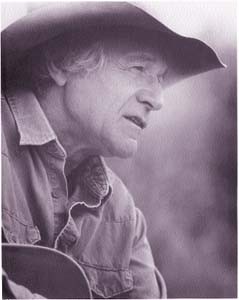
Ramblin’ Man: Elliot’s tales of his musical career have the charm of true-to-life American folklore.


Ramblin’ Jack Elliot’s awfully big adventures

By Bruce Robinson

I’M REALLY A SAILOR at heart,” musician Ramblin’ Jack Elliot insists laconically, adding, “It’s not so evident in my picking and singing. I sing more cowboy and landlubber stuff. I’ve been turned off by the people who sing seafaring songs, by all the ‘Yo, ho, swash’ stuff,” he continues. “I never believed sailors would sing that way, and I never wanted to get mixed up in that genre.”

Elliot has willingly interrupted a session of sanding and painting his beloved schooner, “a 49-year-old racing dinghy,” to talk about his nearly 50 years of music-making, but not without recalling fondly that “I had the same kind of a boat that I have now when I was a kid.”

That was back in Brooklyn, where “I was originally being trained to be an officer in the merchant marine” by a retired seaman who lived next door, Elliot says. But he never cared much for city life, and ran away to join the rodeo at the age of 14. “I thought I was destined to be a cowboy,” he recalls. But after working for three months at the less-than-princely wage of “two dollars a day with no food thrown in,” he packed it in and went back home to finish high school. “It wasn’t the broncos and the bulls that tired me out,” he grins, “it was the food. Two dollars a day wasn’t enough to feed a growing boy.”

But Elliot’s rodeo adventures gave him firsthand exposure to authentic cowboy songs, sung by genuine cowboys, and even back in the city he was hooked. He picked up a guitar–an instrument that had not held much interest for him before–learned how to play a handful of songs, and soon began performing.

In the early ’50s, he hooked up with folk legend Woody Guthrie, who Elliot freely admits, “was the biggest influence on my singing and picking style.” The two were frequent companions for several years, until Guthrie’s declining health forced him to abandon the road.

Elliot, however, has remained steadily active, recording 40 albums over the years and performing some 60 live dates annually, “maybe a little bit more since I won a Grammy a few months ago,” he says modestly. That award, for Best Traditional Folk Album, was earned by The South Coast (Red House), a record he actually cut almost three years ago.

Now 64, Elliot is hard at work on his next recording, learning a new studio discipline at the hands of slide-guitar ace Roy Rogers, who is producing the still-untitled set. As they meet on those infrequent days when both musicians are off the road and back at their respective Marin County homes, the sessions have been a case of working quickly when the opportunity is there.

“I’m a lazy guy and never would have believed I would have worked well under pressure. Roy has imposed a new kind of work regimen on me, and it amazes me that I’m able to stand up under the pressure and come up with some good material,” Elliot chuckles. “I guess that’s his way of getting me going.”

So far, they have completed nine tracks with such musicians as folkie son Arlo Guthrie, songstress Rosalie Sorrells, the ever-Dead Bob Weir, guitarist Jerry Jeff Walker, and wild man Tom Waits, with upcoming sessions planned to jam with John Prine and Willie Nelson. They’re shooting for a late spring release date.

As with Elliot’s extensive past catalog, the new disc will feature songs by other writers.

“I’ve never really been a songwriter,” Elliot confirms. “I’ve only written about five songs in my life. It galls me.”

Ramblin’ Jack Elliot performs on Saturday, Dec. 14, at the Spirit of Christmas Craft Faire at the Sonoma County Fairgrounds’ main pavilion. 1375 Bennett Valley Road, Santa Rosa. Fair entrance is $2-$4. 575-WELL.

From the December 5-11, 1996 issue of the Sonoma Independent

This page was designed and created by the Boulevards team.
© 1996 Metrosa, Inc.
Medical Marijuana

0

Up in Smoke

By Fred Gardner

AT THE CANNABIS BUYERS CLUB in California the sigh of relief seemed more pronounced than the cry of triumph as the Nov. 5 election results came in: San Francisco, 78-22, yes; Los Angeles 54-46, yes. . . . There was hardly a joint being passed around the second-floor office, where club founder Dennis Peron and friends instead were exchanging hugs and expressions of pride at having made history–until Orange County came in at 51-49 percent, yes.

California would now permit the use of marijuana for medical purposes by a 56-44 margin.

“All our opponents kept saying that Prop. 215 was a vote to legalize marijuana,” Peron told Channel 4 news, pushing the baggie, as always. “Are they going to keep saying that now that the votes are in? I’m sure they’re right: a lot of people voted yes because they think the marijuana laws are too harsh and severe.”

Marijuana, like heroin and LSD, is on the Drug Enforcement Agency’s “Schedule I,” which means it cannot be prescribed by doctors and no research is permitted without a special license. Although the wording of Prop. 215 was derided as “loose,” the initiative was crafted with help from lawyer William Panzer of Oakland to free doctors from the responsibility of writing marijuana prescriptions in direct violation of federal law. Under the law, a doctor can testify that he or she recommended marijuana as a treatment for, say, epilepsy.

One test case on the fast track involves Al Martinez, 40, an in-home caregiver who was arrested in Santa Rosa in August for cultivation of six plants. He has been using marijuana for nearly 20 years to prevent seizures, ever since a Southern California neurologist recommended that he try it. “I found that I felt more debilitated by the phenobarbitol I had been taking,” says Martinez, who had never smoked pot before trying it for medicinal use. “After a seizure, I usually smoke a pipeful to relax.”

Now that the Santa Rosa Police Department has confiscated his stash, Martinez purchases marijuana at the Marin Cannabis Buyer’s Club.

Martinez will be the subject of a state Health and Safety Code hearing Dec. 17 in Sonoma County Municipal Court to determine the guidelines of his case. “It should be interesting,” says Panzer, his lawyer. “We’re going to be tackling a lot of interesting issues. For instance, is it up to the state to establish that a defendant does not qualify for medical use? Or is it up to the defendant to prove that he does qualify under that category?”

Panzer also will ask the court to allow Martinez’s doctor to testify confidentially, so that the physician is not subjected to possible federal prosecution.

Another possible test case involves Peron and five other people who bought and sold pot for the San Francisco Cannabis Buyers Club. The club was closed down Aug. 4 after a raid by agents of the state Bureau of Narcotics Enforcement. A lengthy investigation by undercover agents had revealed that people could buy pot there under false pretenses (with a fake doctor’s letter, for example). Peron says that Prop. 215 is, in part, a referendum on his right to operate the club, and that he expects the case against him to wither away. “I hope to reopen by New Year’s Eve,” he says, “as a Cultivator’s Club, where sick and dying people can come and hang out and water their plants under the grow lights.”

Peron expects his Cultivator’s Club to be a model for others, and that within a year there will be hundreds of thousands of members. “I expect the price of marijuana to come down by half,” he says.

The founder and maitre d’ of the Cannabis Buyers Club is the perfect Puck to preside over such a green world–wiry, charming, mischievous, compassionate. Now 50 and white-haired, he has been challenging the marijuana laws by direct action since 1969, when he arrived in San Francisco from Vietnam with two pounds of the illegal herb in his Air Force duffel bag, and by legal and political means since 1970, when he was first arrested. In the ’70s and ’80s, he was busted for selling pot more than a dozen times. After each bust, including one in which he got shot in the thigh and served seven months at a San Bruno jail, he would resume selling out of his living room or a nearby flat that in due course turn into a legendary salon.

Peron was a libertarian who refused to accept that he didn’t have a right to smoke marijuana. “And the right to smoke it means the right to get it,” he would argue, “which means people have to have the right to grow and sell it.”

He became serious about making marijuana available for those in medical need when his longtime companion, Jonathan West, was dying of AIDS in 1990. “Marijuana was the only drug that eased his pain and restored his appetite and gave him moments of dignity in that last year,” Peron recounts. “And of course I had hundreds of friends with AIDS who relied on marijuana for the same reasons.”

In 1991, Peron founded the Cannabis Buyers Club, which over the years outgrew a couple of locations and evolved into a cozily decorated fern bar/floating support group occupying a five-story building on Market Street in downtown San Francisco. More than 11,000 people–including Sonoma County residents–became members by bringing letters from doctors stating that they suffered from an illness the weed could help treat.

The biggest seller, at $5 per eighth of an ounce, was leafy Mexican, which many cancer patients said they preferred because it suppressed nausea without getting them too high.

The club employed more than 90 workers, most of whom had AIDS, as budtenders, food servers, carpenters and custodians, and all clerical staff, as well as buyers who dealt with the dealers and growers. Peron paid $300 a week in cash, plus pot. He had 16 bakers working at home as independent contractors. “It was all I could do to keep up with the demand,” he says.

“I would get the leaf from growers and provide it to the bakers. I was selling between 300 and 500 baked goods a day–brownies, Rice Krispies, pudding–every baker had a different specialty.” The club also served $1 plates of simple, wholesome fare like curry or spaghetti. The cooler was stocked with liquid nutritional supplements for members who couldn’t keep their food down.

All this, however, was at risk on election day.

PROP. 215 SANCTIONS the use of marijuana in treating “cancer, anorexia, AIDS, chronic pain, spasticity, glaucoma, arthritis, mi-graine, or any other illness for which marijuana provides relief.” It was written mainly by Peron, who insisted on the bit about “any other illness” over the strenuous objections of allies in the reform movement.

“I wanted the initiative to reflect the reality we were seeing every day at the club,” he says. “Am I supposed to turn away a gentle woman who has epilepsy? ‘Hold it, you’re not on the list.’ What about people in wheelchairs? People with asthma? The treatments they try should be up to them and their doctors.”

As of 12:01 a.m. Nov. 6–at which point the party of the Cannabis Buyers Club was going strong–Article 11362.5 of the Health and Safety Code became available as a defense to “seriously ill Californians” busted for possession or cultivation of marijuana. Dennis Peron looked into a camera and said, “We’re looking forward to giving [state] Attorney General Lungren all our cooperation as he enforces the will of the people.”

The next morning the attorney general announced plans for an emergency “All Zone Meeting” at which sheriffs, police chiefs, and district attorneys will consider the “implications of this new law for the ‘cop on the beat’ and the filing deputy in the prosecutors’ offices.”

Lungren released interim guidelines to the BNE, advising officers to keep the “medical necessity” defense uppermost in mind when making an arrest. “The officer should ask early whether the person is taking medication, what medication, for what condition, at which doctor’s direction, and the duration of treatment.

The officer should attempt to verify the information when possible. An officer should ask whether the individual is a patient or caregiver. If he or she says patient, then ascertain name of doctor and caregiver. If caregiver, ascertain for whom, for how long, and on what basis [responsible for housing, health or safety of the patient].

“The officer should attempt to verify the information when possible.”

In Washington, President Clinton’s drug czar, Gen. Barry McCaffrey, met Nov. 13 with U.S. Attorney General Janet Reno and is promising a federal enforcement effort. The old prohibition refrain “The revenuers are comin’, Pa!” may soon be heard if DEA agents start trying to bust small-time growers as well as doctors willing to testify in connection with a medical marijuana defense.

Those who question the validity of the evidence for marijuana’s medical effectiveness charge that it is “merely anecdotal.” Proponents counter that the reason the voluminous anecdotal evidence has never been rigorously tested is that the federal government stands in the way.

In 1994, Donald Abrams asked the DEA for a license to conduct a rudimentary study of marijuana’s effects on people with AIDS. Abrams is professor of clinical medicine at San Francisco General Hospital and head of the Community Consortium, an organization of caregivers who treat the majority of Bay Area AIDS patients.

He intended to test marijuana at three different dosages (joints per day) and compare its effectiveness to Marinol–an expensive, corporate-developed, government-approved pill containing synthetic 9-delta-THC, the main active ingredient in marijuana.

Patients told Abrams and his colleagues that smoking marijuana made it easier to fine-tune for dosage and in many cases seemed more effective than Marinol in reducing nausea. “We were very concerned about safety and were also going to look at pulmonary function, at the impact on patients’ immune systems, and on their viral load,” he says.

His protocol was critiqued, tweaked, and approved by the Food and Drug Administration, the California Research Advisory Panel, and the UC San Francisco Institutional Review Board, but in April ’94 the DEA turned him down, objecting to his plan to import marijuana that a Dutch firm had offered to donate. So Abrams went through channels, requesting 5.7 kilograms for research purposes from the National Institute on Drug Abuse. “I didn’t hear back from them,” he recounts.

In April ’95, NIDA rejected Abrams’ request for marijuana on scientific grounds. “They didn’t like the idea of doing an outpatient study,” he says. “How did I know how much marijuana the patients were really smoking? How did I know they weren’t giving it away? We weren’t controlling for caloric intake.”

WHEN NIDA director Alan Leshner indicated that a favorable peer review would prompt a reconsideration, Abrams designed an in-patient study to be conducted at his hospital and applied to the National Institutes of Health for a grant–i.e., peer-review approval. Two colleagues who had studied the HIV wasting process signed on as co-investigators, and highly regarded scientists agreed to do the pulmonary-function tests, pharmacology, HIV viral-load testing, and immune studies.

In August, Abrams got a rejection notice, soon followed by a detailed critique, of which he says, “people are unduly prejudiced by their own baggage. How can they have it both ways? They say there is no information that marijuana does anything, and then they don’t allow you to study it.”

“Western medicine has forgotten almost all it once knew about the therapeutic properties of marijuana,” laments Tod Mikuriya, a Berkeley psychiatrist who was the first director of marijuana research at the National Institute of Mental Health back in 1967. In the Cannabis Buyers Club, Mikuriya saw a unique research opportunity.

Hoping to confirm or add to descriptions in the pre-prohibition literature, he began inter-viewing club members in 1994, and he has since collated the anecdotal evidence from more than 200 respondents. “Cannabis appears to be a unique immunmodulator analgesic that is useful in the control of autoimmune inflammatory diseases throughout the body,” Mikuyira generalizes.

He also thinks it has great potential as a “gateway drug back” for alcoholics and heroin addicts, a use Mikuriya traces back to Scotland in 1843. With the passage of Prop. 215, he expects many doctors and patients in California to try it.

From the December 5-11, 1996 issue of the Sonoma Independent

This page was designed and created by the Boulevards team.
© 1996 Metrosa, Inc.
Missing in Action

0

Still Sinning


colors in yellow peril

By Gretchen Giles

Your family has been here for generations, farming or keeping store or otherwise doing business. While you may speak the language of your ancestors when at home, out in the world–at school and at work–you speak English, like those other Americans who are your friends, colleagues, and lovers.

Then the United States goes to war with the country from which your parents or grandparents or great-grandparents first came. Because of your hair, your complexion, your very eyes–you are branded as an enemy by those who formerly welcomed you into their homes and classrooms. Simply put, you are a Japanese American enduring the torture-at-home of World War II.

The particulars of Japanese internment during the war–a time in which some 110,000 people were imprisoned and had their homes, businesses, and personal possessions taken from them for the crime of simply being Japanese–is the basis for Sonoma State University Communication Studies professor Michael Litle’s short film, The Miyazaki Family: Missing in Action, showing Dec. 4 on KRCB, channel 22.

Based on a short story culled from writer and Sonoma State professor Gerald Haslam’s collection That Constant Coyote, Missing in Action chronicles with hallucinogenic effect the events of one Fourth of July holiday in which an Anglo father and son confront the sorrows and mistakes of the past.

Like David Guterson’s best-selling story of internment and regret, Snow Falling on Cedars, Haslam’s story was evidently prompted by the true-life burning of a Japanese family’s home on Puget Sound during the war. This and other small acts of violence resonate in a manner that circle out far beyond the individuals of family and community within which they occur. Presented with strength by Litle and co-director Amy Glazer, Missing in Action argues the thesis that such degradations cannot be erased by time, and that the sins of the father are an inevitably tarry legacy endured by the son. And the grandson.

While waiting for a parade to pass, an older man (Petaluma actor Lou Ganapolar) is surprised by an image thought long forgotten. A woman (Sachiko Makamora), dressed in the traditional garb of the Japanese farm woman, hauls a child’s wagon loaded with dumpster-derived lettuce past his truck. He blinks in surprise and she is gone. But as the man drives out to his son’s house, drinks a beer in the shade of a backyard tree, and argues with his son (Michael Bellino) about the circumstances of the war fought so long ago at home, she reappears, wandering by the fence, superimposing her plight upon his vision until he is no longer certain that what he has always believed is right really is.

As the two men pass the day in a long and desultory discussion of the mores of the past, the older man begins to question what he has always left as unquestionable. We learn that the Miyazaki family, local farmers and purveyors of a roadside stand, had been ordered from their home to the camps, their son having fought in Italy but having never returned. Coming home themselves after the war, the Miyazakis discover that their home is no more, having been lost to them by a bank demanding mortgage payments from the penury of prison, and then burned by locals enraged at finding a charred American uniform in the abandoned home’s fireplace. Surely the Miyazakis were spies.

Informed by images of resonant beauty (the moon seen through the circulating spikes of a windmill), and enlivened by Litle’s splendid editing at the film’s start, Missing In Action is the first of a series Litle plans to complete that explores the varied natures of cultural identities. Entitled Many Peoples, One Planet–Countering Prejudice, this project is intended as an educational tool, and this must be kept in mind while viewing its pilot effort.

The winner of CINE’s Golden Eagle award and of the Silver Apple awarded by the National Educational Media Festival, Missing in Action is overly earnest but clear. There are no muddy intentions here. The entire Miyazaki family ends up missing–whether physically or psychically, while the Caucasian families soften in the internal rot caused by the rashness and stupidity of their betrayals.

While he may regret the actions of the past, the arguing son, like all the sons and daughters born to immigrants on this soil, is inescapably tied to the mistakes and atrocities of the past. There is no going back.

The Miyazaki Family: Missing in Action plays Wednesday, Dec. 4, at 9:30 p.m. KRCB, channel 22.

From the November 27-December 4, 1996 issue of the Sonoma Independent

This page was designed and created by the Boulevards team.
© 1996 Metrosa, Inc.
Talking Pictures

0

Ahoy, Matey!


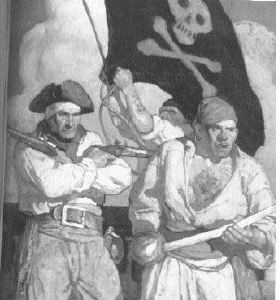
N.C. Wyeth

Avast: Why do we love those sea-faring, sword-wielding rascals?

David Cordingly skewers the romantic myths of pirate flicks

By David Templeton

Writer David Templeton takes interesting people to interesting movies in his ongoing quest for the ultimate post-film conversation. This time out, he meets with English pirate expert David Cordingly, not in a theater, but on the deck of a historic sailing ship.

AN OMINOUS EXPANSE of dark gray cloud moves threateningly across the sky as author David Cordingly gracefully climbs up onto the deck of the Balclutha, a 100-year-old, three-masted schooner, docked at the Hyde Street Pier, the dockside “wing” of the National Maritime Museum in San Francisco.

My companion is a former director of England’s National Maritime Museum in Greenwich. He is in the United States to promote the unveiling of his excellent, bubble-bursting Under the Black Flag: The Romance and the Reality of Life Among the Pirates (Random House, 1995), a book that punches holes in all my favorite swashbuckling fantasies. As a starry-eyed fan of pirate films, I prepared to meet Cordingly with the same mixture of emotions one might have before meeting the person who’s conclusively disproven the existence of Santa Claus.

“As someone who shares your love of pirates, I understand the discomfort this brings you,” Cordingly offers consolingly. “But as a historian, I must say that discovering the truth is really quite thrilling.”

Finding a seat beneath the ship’s foremast, Cordingly continues. “I’m fascinated with the contrast between our romantic image of pirates and what they were actually like. Pirates were quite vicious, they were barbarous, not glamorous at all–so where did we get this romantic image? Why do we talk about buried treasure and treasure maps and parrots and walking the plank and all that sort of thing? Those things never happened–or only very rarely.

“One of the interesting things about pirates is that before they were glamorized by Errol Flynn and the swashbuckling movies of the ’40s and ’50s, the pirate was traditionally always the villain in melodramas on the London stage. There was the moment when it was ‘Enter Pirate,’ and everyone hissed and booed, because he was always the villain. And of course he’d be foreign–Indian or a Muslim, but never British. This was so that you could wheel on the British navy at the end and have patriotic songs and drums, and the jolly British Jack Tar would save the day. So for two centuries the pirate was always synonymous with the villain. Then came the movies, with such films as Captain Blood and The Black Swan, and we began to portray him as a heroic, free-spirited, somewhat charming character.”

And why was popular culture suddenly so willing to embrace a new improved image of those seafaring, sword-wielding rascals?

“I suspect it has much to do with the exotic locations that pirates operated in,” he smiles, a breeze rumpling his hair. “As people’s lives became increasingly city-bound and stressful, I think the notion of sailing a ship in the Caribbean, living like a free spirit, swinging through the rigging and all was rather a nice notion to people. And the pirate movies gave us that.” Cordingly, though fond of some of the earlier pirate films, gives mixed reviews to the swords-and-cannons epics of the last decade.

Cutthroat Island was thoroughly unconvincing,” he says. “They were just going through the motions. Roman Polanski’s Pirates was a dreadful movie, a complete no-go. Strangely, I thought Steven Spielberg’s Hook was terrific. It had a bright-eyed boyish love of the pirate myths all through it.

“I’m still waiting for the really great pirate movie to come along,” he adds. “All they need to do is to read the actual, historical stories more closely. Look at Captain Blackbeard! He’s so astounding you can hardly believe he’s real, until you read the documents of the day and you read what the newspapers were saying about him.

“There’s Henry Morgan, a rags-to-riches tale–this bluff soldier who ends up sacking Panama City. This would have to be an epic. Cast of thousands. He’s sent back to England in disgrace, but ends up in Jamaica with a knighthood and the honorary post of lieutenant governor. He lives happily ever after! I can see a movie about Mary Reade, who actually joined the army disguised as a man and lived as a soldier for a number of years.

“You see, I feel much as you do about pirates,” he concludes gently, standing to face the sky, now clearing across the bay. “I think pirates are a wonderfully romantic image to have in one’s mind. But you can substitute the myth with the authentic, amazing, wonderful truth. In the end, I think the truth would make a far better movie.”

From the November 27-December 4, 1996 issue of the Sonoma Independent

This page was designed and created by the Boulevards team.
© 1996 Metrosa, Inc.

Patrick Ball

0

Playing Ball


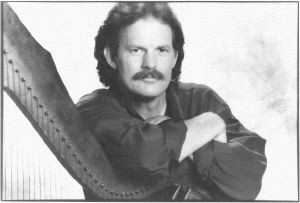
Irish Eyes Are Smiling: Patrick Ball emcees this year’s Festival of Harps.

Celtic harp master celebrates source of his inspiration

By David Templeton

I’D BEEN TO IRELAND twice already,” recalls Patrick Ball, the local musician and storyteller who is widely regarded as the reigning musical master of the 1,000-year-old steel-stringed Celtic harp, an instrument that was banned from Ireland by the British over 200 years ago. “I’d heard the gut-stringed harp, but had never tried to learn the instrument. Then–it was 1980 or so–I went to the Renaissance Pleasure Faire in Novato with the girlfriend of my best friend. She was in real estate and had quite a bit of money,” he continues, warming to the tale.

“So there we were, walking along. All of a sudden I heard this sound. I thought it was the most captivating sound I’d ever heard in my life.”

Following the music, he found a seller of small, wire-stringed lap harps. “I had no money, so I said to my friend, as a joke, ‘Gad! You should buy one of these things for me.’ She said, ‘All right,” and plunked down 500 bucks and bought me my first harp.

“I paid her back eventually, of course, but in a way, I will never be able to repay her.”

Ball had his first lessons from Jay Witcher, the maker of the harp, who showed him how to pick using his fingernails instead of the fingerpads used on softer stringed harps. Within six months, Ball had outgrown the lap harp, and he asked Witcher to make him a full-sized instrument. He uses it to this day.

“I had studied so much Irish folklore and history,” says Ball, whose solo shows invariably feature much Celtic storytelling, “but when you play this ancient instrument it immediately illuminates the whole period. All the information and books are secondhand, but as soon as you hear the music, it’s exactly what you would have heard back in those times. It’s exactly what those individuals we read about were listening to. It bonds us to them.”

He laughs again, adding, “It really is living history.”

THAT the difficult-to-play ancient harp is making something of a comeback among world music enthusiasts is a fact that this Sebastopol resident acknowledges with obvious pleasure. He responds with equal enjoyment to the assertion that his own ethereal recordings on this instrument are the chief reason for its revival, though he adds a dose of heartfelt humility.

“It’s probably safe to say that my work has had a lot to do with it,” he murmurs, adding, “But I was very fortunate. My first album came out in the early ’80s. It was one of the very first recordings of the wire-stringed harp, and it sold a lot of records. So I did get in on the ground floor.” He has since recorded numerous CDs, including the perennial The Christmas Rose (Fortuna) and the score for the popular Rabbit Ears children’s recording of The Ugly Duckling, with narration by Cher.

Ball will take the stage locally, playing master of ceremonies at the Festival of Harps, an annual event held Nov. 30 at the Spreckels Performing Arts Center, with an eclectic mix of harpists on the roster.

In addition to his emcee duties, Ball will be performing excerpts from a full-length theater piece he’s written with Bay Area playwright Peter Grazer. Titled Turlough O’Carolan’s Farewell to Music, the play (which Ball premiered in its entirety during this fall’s Sebastopol Celtic Festival) illuminates the life of Ireland’s most famous harpist. O’Carolan, blind from smallpox at age 18, was a musician and composer who rose above the circumstances of his life in the late 18th century to become a beloved folk figure of his country.

“Turlough! He’s the man,” Ball enthuses. “His stuff is the reason I started playing the harp in the first place. That and the sheer beauty of the sound of the wire-string harp. What intrigued me about O’Carolan was that he wrote these beautiful, sprightly, stately things. I was always fascinated with how this blind guy living under such ghastly oppression could write pieces of music like that.

“Some force of character within him prompted him to write beautiful music,” he marvels. “It makes for quite a good story.”

Festival of the Harps–featuring Ball, the Andres Jazz Ensemble. jazz harpist Lori Andrews, Konghou harp player Cui Junzhi, the Pacific Arts Trio, and classical pedal-harp player Natalie Cox–takes place Saturday, Nov. 30, at the Spreckels Performing Arts Center. 5409 Snyder Lane, Rohnert Park. Tickets are $13-$17. 584-1700.

From the November 27-December 4, 1996 issue of the Sonoma Independent

This page was designed and created by the Boulevards team.
© 1996 Metrosa, Inc.
Spo-Dee-O-Dee

0

Party Spirits

By Steve Bjerklie

AH, THANKSGIVING, Oh, Tannenbaum!, Hanukkah, Kwanzaa, New Year’s, and that insufferable office get-together. Like it or not, it’s time to warm the wassail. Warning: Lots of drinking ahead. Lots of food, too. And lots of people. And so, ah, that’s our problem of the day. With so little, how do you give so much to so many? Face it: Winston Churchill notwithstanding, the RAF you’re not.

Of primary importance–choosing a wine to accompany the jungle of flavors and textures presented by your typical party’s hors d’oeuvres tray. What kind of wine, for example, goes well with both goat cheese and tortilla chips? How about with slices of kiwi fruit and slices of salami? Or with Swedish meatballs and cocktail weenies? (Call me a traditionalist: I refuse to attend a party without cocktail weenies. I bring my own as necessity requires. Doesn’t the Bible say that Jesus once turned a cord of firewood into a bowl of cocktail weenies? I’m sure it does. But I digress.)

Fortunately, the wine industry provides a number of fine solutions to our problems, which are all, as it happens, providentially available right now. Here are three suggestions to get you through the grueling calendar of upcoming holiday engagements.

Lithos 1994 Napa Valley Chardonnay Barrel Select. The buttery, almost cheesy nose of this excellent value might be a bit strong for some, but the wine’s strong, full, oaken flavor makes it an ideal white-wine party choice. This baby will stand up to the toughest you can throw at it: guacamole, jicama spears, cheese niblets. Rather than fighting off clashing flavors, the Lithos diplomatically blends them. Another plus: At a party last year a gentleman who apparently had a disagreement with me poured an entire glass of this wine on my shoes, yet the next morning–no stain! Two stars. $6.47.

Davis Bynum 1994 Russian River Valley Pinot Noir. Turkey-based meals such as those served on Thanksgiving and Christmas are real challenges for wine. The old adage about white wine going best with poultry doesn’t work at all: the strong flavor of roast turkey knocks any white wine right out of the house. Not only that, but those damn cranberries are total wine-killers. I learned after several years that pinot noir is actually the best wine to accompany turkey, and this Davis Bynum–with a mildly cedary, brambly nose and a not-too-tannic, not-too-dense yet very smooth flavor–is my table’s choice this year. Try it with the yams. Three stars. $9.79.

Hacienda Brut, Methode Champenoise. Sparkling wine experienced a revolution in the 1980s and early ’90s, and we–meaning everyone who can’t imagine a party or reception without a tulip glass in hand–are the winners. Where once there were two kinds of bubblies, super-expensive and super-awful, now there’s a nicely populated middle-class of tasty, affordable sparklers. This Hacienda is very dry, so not only will it stand up to a wide variety of party food, but the dryness will discourage anyone from drinking too much of it without eating some food as well. But some of you will want to know: Are the bubbles small enough? How the hell should I know? There are bubbles, lots of bubbles. They look plenty small to me. Two and a half stars. $5.99.

Appearing on a regularly irregular basis, Spo-Dee-O-Dee explores $10-and-less wines fitting today’s real-life lifestyles, without bias toward snob appeal, rarity, or source.

From the November 27-December 4, 1996 issue of the Sonoma Independent

This page was designed and created by the Boulevards team.
© 1996 Metrosa, Inc.

Talking Pictures

0

Board Games

By David Templeton

Writer David Templeton takes interesting people to interesting movies in his ongoing quest for the ultimate post-film conversation. This time out, he experiences the souped-up new film William Shakespeare’s Romeo + Juliet along with renowned Bard-busting comedian Reed Martin.

Shakespeare.

Filmmakers just can’t leave him alone, a remark that is meant in more ways than one. In the current downpour of Bard-based films, only the upcoming Hamlet, directed by Kenneth Branagh, is presented untouched, untrimmed, unmessed with. Looking for Richard, by Al Pacino, intercuts the story of Richard III with man-on-the-street interviews examining popular culture’s take on the meaning of Shakespeare’s work. Trevor Nunn’s Twelfth Night updates the Renaissance comedy to the Victorian era, with an emphasis on gender-bending kinkiness, a definite stretch of the author’s original vision.

“Stretched” is an understatement, however, when discussing Baz Luhrmann’s daring, hallucinogenic new take on Romeo and Juliet, English lit’s all-time favorite teen suicides. is a bold modernization of the tragedy, set in a tacky, hip-hop fantasy world where feuding families wave guns and shout Elizabethan curses while driving fast cars and dropping Ecstasy. Though critics have torn it asunder, R+J is nevertheless so enticingly strange and feverish, so campy and full of fun, that filmgoers have gobbled it up, placing it in the top 10 for four weeks running, in spite of the fact that it represents a near-total trashing of the original work.

“If you don’t shake them up now and then, Shakespeare’s plays just die,” explains Shakespearean comedian Reed Martin, emerging from the theater where R+J has just screened to an enthralled audience. “You have to work him over once in a while or he sort of becomes a museum piece.”

Martin is a long-standing member of the traveling comedy troupe The Reduced Shakespeare Company. Known around the globe for their witty, irreverent stage shows, the RSC caused a theater-world stir in the mid-’80s by cheekily condensing the complete works of William S. into a single performance. Currently they are touring two non-Shakespeare shows, spoofy condensations of equally untouchable subject matter: the Bible, and the history of the U.S.A.

“I think it’s fair game to do whatever you want with Shakespeare, or God, or history,” Martin asserts, taking a sip of a post-film latté. “God can handle it, trust me. And I really don’t think Shakespeare would mind. He wasn’t an icon yet. He knew he was writing for the popular audience.”

So what did Martin think of Romeo + Juliet?

“I think this is a very serious movie about the dangers of teenage sex,” he deadpans. “It frightened me.

“The actors’ handling of the text was a mixed bag,” he adds, making a stab at serious criticism. He chides the mumblings of Leonardo DiCaprio and Clare Danes, who play the lovers, while praising Pete Postlethwaite, who does much better as Friar Lawrence, the potion-pushing priest who puts Juliet in a fake coma, thus bringing about the libidinous kids’ doom.

“Anything people take too seriously is ripe for lampooning,” he says, returning to his original train of thought. “In my work, we always look for something with weight to it, to undermine and make fun of. That weight comes when people take a thing too seriously–and then they want everyone else to take as seriously as they do.”

At my suggestion that a Romeo and Juliet sequel may be in the offing if the film’s popularity continues, Martin concocts the storyline he’d devise were he called in to write the screenplay.

“It would be called, R+J: Part 2–The Cure,” he pronounces. “Friar Lawrence has been fiddling in his lab, and he comes back and gives them a new potion, thus bringing them back to life. They immediately go after all the people who screwed them over when they were alive. They’d get the friar first, then the CEO of delivery service that failed to get the crucial message to Romeo. It will be a cross between R+J and Frankenstein. Maybe we’ll call it William Shakespeare’s and Mary Shelley’s, R+J 2. The posters could say, ‘Romeo and Juliet–They’re Back, and They’re Pissed!'”

Gee, would they still like each other? “Oh, sure, they’d have to,” he insists. “People would hate it otherwise.” And would it have as much sex and violence as the original? “More. Lot’s more.” Martin sips his coffee a moment.

“You know, we’re so quick to put down all the films with sex and violence,” he suggests, “but Shakespeare was full of sex and violence. The Bible is full of sex and violence. These are universally compelling themes, that have always been compelling. Same thing with politics. Everyone says how nasty political campaigns have become. I’m reading this book, sort of debunking the myths of American history, and [the authors] say, ‘You know what? Political campaigns have always been nasty.’

“I think Americans know so little of history that they sort of lose track that a lot of what we say is so terrible about modern society has in fact been around forever. The names they called George Washington and Thomas Jefferson would shock you.

“It’s a very old sport, this pulling down of icons,” he grins. “As old as sex and violence.”

This page was designed and created by the Boulevards team.
© 1996 Metrosa, Inc.

Drug Use & DARE

0

Truth or DARE?


Janet Orsi

Is Bill Clinton really to blame for the sharp rise in teen drug use? Or is the nation’s leading anti-drug program failing our children?

By Bruce Robinson

MARY KADRI RECALLS driving to San Francisco one day with her 14-year-old niece when the National Public Radio program they were listening to broadcast a segment on heroin addiction. “Heroin addicts were talking about how the thrills were very short-lived and then the need was so purely physically without any attendant entertainment or fun value, and the pain of quitting was so intense, excruciating pain in the fingertips,” Kadri says, “and she commented to me, ‘What are they talking about?’

“I said, ‘They’re talking about heroin and how bad it is.’

“She said, ‘I never heard any of this before.’

“‘Haven’t you learned it in DARE?'”

“‘No, they never tell you anything really about specific drugs. They just tell you they’re very bad and to stay away from them. And to just say no.'”

Back at her Petaluma home, Kadri and her niece spent several hours with the family encyclopedia, looking up drug names and slang terms, reading up on “medical facts, not just propaganda,” Kadri explains. “I know that afterward she felt she’d really learned a lot and it was going to be very helpful to her. She said, ‘I don’t know why DARE doesn’t tell you any of this. I think it would make a much bigger impact if they did.’ “

DARE–Drug Abuse Resistance Education–is the dominant drug education program in America’s schools today. But even as DARE proliferates in Sonoma County public schools, parents and law enforcement officials across the nation are beginning to question the efficacy of this popular anti-drug program–and some are even starting to turn their backs on it.

Founded by former Los Angeles Police Chief Darryl Gates in 1983, DARE is now used in nearly three-quarters of the nation’s public school systems, and has been circulated in all 50 states and abroad. By design, it is taught exclusively by uniformed police officers, such as Rohnert Park police officer Rich Mathis, who has led the DARE program in the Rohnert Park­Cotati School District for the past three years.

A large, avuncular man who came to police work late in his career, Mathis feels that he serves a dual role in the classroom, acting as both a role model and a source of more authentic information. “The officer knows, supposedly, more than the teacher about what’s going on on the outside,” he explains.

DARE is now taught to all fifth graders in the Rohnert Park­
Cotati School District, a total of 14 one-hour classes on nine campuses, as well as at one local Lutheran private school, with Mathis supervising six other patrol officers who share in the instructional effort. The 16-week DARE curriculum is incorporated into the students’ health studies, and the entire program is provided to the cash-strapped school district at minimal cost.

“Basically, it doesn’t cost anything but my salary,” says Mathis, and that cost is shared between the budgets of the school district and the Rohnert Park Public Safety Department. Donations from local Rotary and 20-30 Clubs, the Rohnert Park Police Officers Association, and other groups pay for the workbooks, other materials used in the classrooms, and T-shirts.

DARE is also taught in public schools in Petaluma and Sonoma, and is being introduced this fall at two campuses in Windsor. In addition, the Sonoma County Sheriff’s Department is preparing to launch a DARE program in the Geyserville area.

“DARE is exciting because we go in once a week and talk to the class about real-life issues,” says Sheriff’s Deputy John Blenker, who took the 80-hour teaching training in Los Angeles last summer, before starting the program in Windsor in September. “It’s not like the traditional ways that I was introduced to when I was in school.

“Years ago they used to say if you do [drugs], your brain will be fried right away, but I don’t do that. I tell them prolonged use of anything is harmful, and that’s what the curriculum is based on.” Blenker cites other differences between the 1996 version of DARE and older drug education efforts. “One of the lessons is based on dealing with consequences, dealing with the police. [Also] what peer pressure is and how it works, the fight-or-flight syndrome,” he elaborates, “stuff that I can’t recall getting when I was in high school.”

BUT KHARLA VEZZETTI has other memories of her experiences as a DARE student at a junior high in Southern California. A Santa Rosa resident who has been active in the campaign for medical use of marijuana, Vezzetti says that when DARE’s absolutist stance cannot be reconciled with the students’ own experiences, the anti-drug teachings are invalidated. “By the time I was a freshman in high school, I was having the teachers and movies on one side telling me the horrors of drugs, and I remember thinking, ‘That’s not true because I know this boy over here, and he smokes pot, and that didn’t happen to him.’

“Whom are you going to believe at 14 or 15–people telling you things, or what you see?

The classes laid on heavy-handed scare tactics meant to reinforce the basic “just say no” message, Vezzetti says. “They showed us this movie, and the one story that stuck in my mind was this woman who was high on PCP and had fried her baby in a frying pan! It must have really upset me because I remember joking with my friends about it. That’s how we handled something that atrocious at the age of 12 or 13, we made jokes.

“You can’t scare teenagers into submission,” she says firmly. “They’re too smart for that.”

“Research proves [that scare tactics] really don’t work,” agrees Hillary Abramson of the Marin Institute for the Prevention of Alcohol and other Drug Problems. “It’s like drunk driving. You go into the high school and you bring in some kid in a wheelchair who was drunk driving and it’s very shocking. But it doesn’t stop them from getting in a car and drunk driving. That kind of scare stuff, research proves, does not permanently stop the behavior you’re trying to prevent.”

The DARE program designers have learned that lesson, says Mathis. In the current version of the curriculum, which was updated in 1994, “We’re not telling them not to take drugs. We’re telling them what drug abuse can do to the body and to the mind. We let the students decide what the problems are of too much alcohol or becoming addicted to tobacco or marijuana.”

THE CENTRAL FOCUS of DARE is on what are termed “gateway drugs”–alcohol, tobacco, and marijuana–chosen because “they are usually the easiest to obtain by the younger students,” Mathis explains. The curriculum also mentions cocaine and inhalants, but there is scant reference to speed, LSD, crack, downers, heroin, or the dangers of mixing drugs. The program has incorporated a significant anti-gang thread, with a strong emphasis on avoiding violence.

DARE is also supported by a nationwide non-profit corporation, DARE America, which provides standardized training for officers who serve as DARE instructors at five regional training centers from California to North Carolina. In addition to active fundraising, the stated goals of DARE America are to create “a national awareness of the DARE program, encourage the adoption of DARE in all states and in all communities,” and “protect the DARE trademarks from misuse and exploitation.”

This kind of aggressive marketing has made DARE the unquestioned leader in “name brand” recognition among drug education curricula, a status that is continually reinforced by hundreds of logo-bearing goodies–pins, T-shirts, banners, flags, rulers, balloons, bumper stickers, Frisbees, etc.–that are sold to local supporting groups and passed out to the kids in the DARE classrooms. “I have a reward system for the kids who participate in class” using DARE paraphernalia, Deputy Blenker says. “Pretty much everybody gets something.”

But DARE is also very touchy about people who make fun of the program. Mark Hornaday, a retailer of hemp products in Claremont, east of Los Angeles, says he was harassed by his local police department for selling T-shirts emblazoned with the DARE logo that said, “I turned in my parents and all I got was this lousy T-shirt.”

In March 1995, “someone from trademark management” representing DARE, and accompanied by the police officer who taught the program locally, visited Hornaday’s store, the Hemp Shack. “He told me that I must cease and desist selling the shirts,” Hornaday recalls. They also wanted to take his supply of parody T-shirts and wanted to know where they came from.

When he subsequently continued to sell the shirts, his store was visited again, this time by an undercover police officer sent “to determine if I was still selling those evil T-shirts.” A raid with a search warrant followed on July 19. “They seized five shirts and searched my entire shop from top to bottom.” Hornaday says. “You’d think they were looking for things besides T-shirts, although that’s all there was on their search warrant.”

Hornaday was charged with four counts of selling counterfeit merchandise, a laughable case that was quickly dismissed after his attorney went public with it, threatening an embarrassing countersuit. “Cops have tried to do this before and it has failed. It’s parody and satire and it’s protected under the First Amendment,” he says. “I haven’t heard from DARE in almost a year.”

The wiseacre T-shirts clearly hit a sensitive nerve, and anecdotes abound about youthful DARE enthusiasts who have led authorities to their drug-using parents, friends, or family members. To avoid such situations, “we tell the kids they can’t use names” when discussing others’ behavior. “It’s got to be, ‘someone I know,'” says officer Mathis. Even when a student tells him privately about someone’s illegal drug use, “that’s confidential information. I’m not going to go out and arrest the guy, because it was told to me in confidence.”

But the biggest question facing DARE these days is also the most basic: Does it really work? According to an analysis of multiple tests and studies of the DARE program conducted by the Research Triangle Institute and published in the American Journal of Public Health, the answer is yes, but not all that well. Studies of changes in the patterns of reported drug use by students taking the program “suggest that D.A.R.E.’s core curriculum effect on drug use . . . is slight, and except for tobacco use is not statistically significant,” the authors write. While this may be attributable to “the relatively low frequency of drug use by elementary-school pupils targeted by D.A.R.E.’s core curriculum,” they continue, “there is no evidence that D.A.R.E.’s effects are activated when subjects are older,” a finding that is consistent with other studies of the long-term effects of drug education.

However, their article also concludes that DARE students do benefit in the areas of knowledge about drugs and social skills. “Other D.A.R.E outcomes, such as its impact on community law enforcement relations, also may yield important benefits,” they write.

But the researchers also suggest that the policemen who typically administer the DARE program “may not be as well equipped to lead the curriculum as teachers,” adding that even if they were, “the generally more traditional teaching style used by D.A.R.E. has not been shown to be as effective as an interactive teaching mode.”

Ultimately, the article concludes, “D.A.R.E.’s limited influence on adolescent drug use behavior contrasts with the program’s popularity and prevalence. An important implication is that D.A.R.E. could be taking the place of other more beneficial drug curricula that adolescents could be receiving.”

Predictably, this conclusion is not welcomed by the program’s proponents. “D.A.R.E Michigan Answers the Critics,” a rebuttal written by Robert E. Peterson, director of that state’s Office of Drug Control Policy, spends more than half of its 11 pages denouncing “drug-using parents angry that D.A.R.E has made their children too anti-drug!”

In a section headed “The Drug Culture’s Attack on D.A.R.E,” Peterson poses the rhetorical question “If D.A.R.E is so ineffective, one might ask why leaders of pro-pot and pro-drug legalization groups are so intent on destroying the program.” As evidence of this destructive intent, he cites a single critical article in the June 1994 issue of High Times.

Elsewhere, Peterson acknowledges that there are “sincere concerns regarding D.A.R.E. program effectiveness and evaluation that require thoughtful review and response.” After noting that the National Institute of Justice declined to publish the Research Triangle Institute study, Peterson lists a series of methodological criticisms before concluding, “It certainly has serious limitations and there is a potential for various interest groups to use it to promote an anti-D.A.R.E. agenda. The study may also be viewed as providing some interesting insight and opening up a range of issues worthy of further exploration.”

DESPITE SUCH EFFORTS to defuse criticism, the accumulation of questions about the program’s efficacy is beginning to trigger defections from the DARE ranks. The city of Oakland dropped the program two years ago, its officials saying they saw few results for the $750,000 a year that was being spent. Spokane and Seattle have recently made similar decisions. So has Fayetteville, N.C., whose police chief, Ron Hansen, recently told CBS News, “Ever since we changed our philosophy on D.A.R.E., I’ve gotten calls from police chiefs all over the country, saying, ‘I wish there was a way out, because I feel the same way, but it’s a political hot potato.'”

DARE’s defensiveness toward critical examination is often shared by the educational establishment that collaborates in delivering the curriculum. A $100,000 study commissioned by the California Department of Education, which analyzed data from 5,000 students, was quietly shelved after it concluded that drug education in state schools is not working.

According to the findings of Dr. Joel Brown of the Pacific Institute for Research and Evaluation in Berkeley, more than 40 percent of the students said their classes had no effect on their own substance use, and many found the basic “just don’t do it” premise at odds with their own experience. Most damning, Brown’s study found that zero-tolerance school policies tend to drive substance-abusing students out of schools, rather than providing any means for them to address their problems.

The report, “In Their Own Voices: Students and Educators Evaluate California School-Based Drug, Alcohol, and Tobacco Education (DATE) Programs,” does not examine DARE exclusively, but summarizes the results of the estimated $1.6 billion that the state has spent on substance-abuse education over the past five years. DARE has been the dominant component in that effort.

“The kids who have a true abuse problem are the first ones kicked out of the school system,” Brown says. “And what [the report] shows in the students’ own voices is that they understand that paradox. These results show that a majority of these middle- and high-school students are aware of what a drug problem is; many question why the school is not helping them or their friends when they have such a problem.”

Had Brown’s research been conducted a decade earlier, Kharla Vezzetti could have contributed similar input. “I remember just wanting desperately for my teacher to distinguish between use and drug abuse,” she recalls. “It set up a very destructive climate of guilt and fear for teenagers, where if they feel they may have a problem with a substance, they really don’t know whom they can go to. They’re taught that if they smoke pot, they’re really bad persons. We weren’t really given the skills to look at ourselves.”

Marsha Cameron, a special education teacher with the Sonoma County Office of Education, believes that critical self-examination is the key to developing drug programs that can truly be effective. “We have to start by being very honest with ourselves: What drugs do we use? Why do we use them?” she says. “We absolutely have to tell our kids the truth. And before we can tell kids the truth, we have to know the truth ourselves.”

The criminalization of substance abuse tends to perpetuate the problem, Cameron says, especially with young people. “Once they start using the drugs, they’re criminals. It puts them in a place where they can’t discuss them openly and honestly. And I see much more of a problem with alcohol than any other drug.”

The passage this month of Proposition 215–which legalizes the medical use of marijuana–may be an opening for a less hysterical attitude toward pot, Cameron hopes, which in turn may allow drug education in general to concentrate more on education and less on shaping behaviors.

“I’m not advocating for kids to use drugs,” she concludes. “What I want is for them to understand what drugs do and why people use them. Drugs are not the problem, they’re merely symptoms.”

From the November 21-27, 1996 issue of the Sonoma Independent

This page was designed and created by the Boulevards team.
© 1996 Metrosa, Inc.

Kelly Joe Phelps

0

Honest Blues


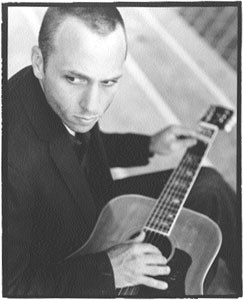
No Fret: Kelly Joe Phelps plays dobro style, strumming and plucking.

Photo by Chris Strother


Kelly Joe Phelps: Seeker with a bottleneck slide

By Gretchen Giles

THE PRESS has been making much about the fact that the newest blues sensation to hit the club circuit is really just a white guy from Washington state. Though his silvery slide guitar–played dobro style across his lap–and his low smoky voice combine to elicit thoughts of sultry, Delta, after-church Sundays spent waiting on the porch for supper to cook, Kelly Joe Phelps is more of the flannels of the Northwest than the chitlins of the South.

Moreover, Phelps is singularly unimpressed by all the hype. In fact, his greatest hope as a musician is to get old. Really old.

“Sometimes you think that you’re telling the truth, and you find that you’re really not,” says the soft-spoken 37-year-old musician by phone from his Vancouver, Wash., home. Noting that his belief is that increasing age tends to increase one’s ability to be honest, Phelps cites the work of country blues master Fred McDowell as the artist whose music persuaded him six years ago to switch from jazz to blues. “It seems so succinct, what he does. He is very folk-oriented, but there’s a lot of improvisation going on. His music is also plainly visceral, very tied into the earth, very pure and straighforward, and the considerations all seem to be in lyric and expression.

“It’s stripped away of all youthful ambitions.”

In the Phelps lexicon, youthful ambitions get smack in the way of telling the truth, and it is truth-telling that means the most. “What I mean by that is being willing and able to lay myself completely out and on the line,” he says. “The things that I think about, including the inconsistencies: who I am as a person. Being able to put myself out fully, so that if there are some areas that I don’t understand about myself, that’s going to show too.”

Produced in 1994, Phelps’ last album, Lead Me On (Burnside), is composed of 13 songs, six of which are originals. This seductive, quiet disc pulls the listener into a world of traditional beauty, evoking the kind of cross-legged intimacy that comes from floor-sitting silently next to a singer. He’ll be headlining Nov. 23 in the angel’s share of the Mark West Winery on the last Full Moon Blues show of the season.

“People respond when someone is giving straight from the heart,” Phelps says. “I’ve tried to maintain that as well as I can, but I don’t feel that I’ve reached into uncomfortable areas; they seem to have come for reasons that I can’t pin down.”

Born to a Seventh Day Adventist household where music was a prime pastime, Phelps grew up playing piano, switching to guitar as a teen. Seduced by the free exchange of ideas exemplified in the playing of such jazz artists as Miles Davis, John Coltrane, and Ornette Coleman, Phelps made a living playing combos around the Pacific Northwest, picking up teaching gigs here and there. Then he really heard the country blues.

“For me, it’s the same thing,” Phelps says of the two musical styles. “I went through this period when I playing nothing but jazz. I found that the interactive creativity was a big drawing card for me. The way that you put your instrument in your hands and get right into something inside you, trying to get some sort of musical conversation going. That’s one of the most beautiful things in music, because that’s the way that I get to experience the power of the music almost the same way as the audience does. It’s the sense of hearing something for the first time–we all end up sharing something which is different than if I just wrote songs and played them the same way every time.

“It’s very demanding to have to create something new every time.”

But it is through his solo career that Phelps has been able to get to the heart of his work. “When I play by myself, I stand a better chance of being honest,” he says. “With someone else, you’re sort of battling it out, trying to meet in the middle. It’s beautiful–but it’s much different.”

Fighting repetition, Phelps refuses to perform by rote, still struggling to create a conversation with the audience that is meaningful to both. “I keep it fresh by keeping the structure of an individual song very loose,” he says. “The way I play on [Lead Me On]–you’ll never hear that again. The songs stay roughly the same; those are things that I use as the outline or a blueprint. I try to keep the foundational things of a song as unthought-out as possible.”

Kelly Joe Phelps headlines the Full Moon Blues show on Saturday, Nov. 23, at 8 p.m. Guitarist Rusty Zinn opens. Mark West Winery, 7010 Trenton-Healdsburg Road, Forestville. Tickets are $15. 544-4813.

From the November 21-27, 1996 issue of the Sonoma Independent

This page was designed and created by the Boulevards team.
© 1996 Metrosa, Inc.

Local Toys

Child's PlayBy David TempletonA quality toy," defines Sebastopol entrepreneur Barbara Kane, "is a toy that brings out the best in the child. A child meets the toy--and finds out something about himself or herself. The best toys are toys that leave a lot of room for the child's own imagination. And of course, a quality toy is a toy...

Jack Elliot

Telling Tall TalesRamblin' Man: Elliot's tales of his musical career have the charm of true-to-life American folklore.Ramblin' Jack Elliot's awfully big adventuresBy Bruce RobinsonI'M REALLY A SAILOR at heart," musician Ramblin' Jack Elliot insists laconically, adding, "It's not so evident in my picking and singing. I sing more cowboy and landlubber stuff. I've been turned off by the...

Medical Marijuana

Up in Smoke By Fred GardnerAT THE CANNABIS BUYERS CLUB in California the sigh of relief seemed more pronounced than the cry of triumph as the Nov. 5 election results came in: San Francisco, 78-22, yes; Los Angeles 54-46, yes. . . . There was hardly a joint being passed around the second-floor office, where club founder Dennis Peron...

Missing in Action

Still Sinningcolors in yellow perilBy Gretchen GilesYour family has been here for generations, farming or keeping store or otherwise doing business. While you may speak the language of your ancestors when at home, out in the world--at school and at work--you speak English, like those other Americans who are your friends, colleagues, and lovers.Then the United States goes to...

Talking Pictures

Ahoy, Matey!N.C. WyethAvast: Why do we love those sea-faring, sword-wielding rascals?David Cordingly skewers the romantic myths of pirate flicksBy David TempletonWriter David Templeton takes interesting people to interesting movies in his ongoing quest for the ultimate post-film conversation. This time out, he meets with English pirate expert David Cordingly, not in a theater, but on the deck of...

Patrick Ball

Playing Ball Irish Eyes Are Smiling: Patrick Ball emcees this year's Festival of Harps.Celtic harp master celebrates source of his inspirationBy David TempletonI'D BEEN TO IRELAND twice already," recalls Patrick Ball, the local musician and storyteller who is widely regarded as the reigning musical master of the 1,000-year-old steel-stringed Celtic harp, an instrument that was banned from Ireland...

Spo-Dee-O-Dee

Party SpiritsBy Steve BjerklieAH, THANKSGIVING, Oh, Tannenbaum!, Hanukkah, Kwanzaa, New Year's, and that insufferable office get-together. Like it or not, it's time to warm the wassail. Warning: Lots of drinking ahead. Lots of food, too. And lots of people. And so, ah, that's our problem of the day. With so little, how do you give so much to so...

Talking Pictures

Board GamesBy David TempletonWriter David Templeton takes interesting people to interesting movies in his ongoing quest for the ultimate post-film conversation. This time out, he experiences the souped-up new film William Shakespeare's Romeo + Juliet along with renowned Bard-busting comedian Reed Martin.Shakespeare.Filmmakers just can't leave him alone, a remark that is meant in more ways than one. In the...

Drug Use & DARE

Truth or DARE?Janet OrsiIs Bill Clinton really to blame for the sharp rise in teen drug use? Or is the nation's leading anti-drug program failing our children?By Bruce RobinsonMARY KADRI RECALLS driving to San Francisco one day with her 14-year-old niece when the National Public Radio program they were listening to broadcast a segment on heroin addiction. "Heroin addicts...

Kelly Joe Phelps

Honest BluesNo Fret: Kelly Joe Phelps plays dobro style, strumming and plucking.Photo by Chris StrotherKelly Joe Phelps: Seeker with a bottleneck slideBy Gretchen GilesTHE PRESS has been making much about the fact that the newest blues sensation to hit the club circuit is really just a white guy from Washington state. Though his silvery slide guitar--played dobro...
11,084FansLike
4,606FollowersFollow
6,928FollowersFollow