
Herbal Remedies

Nature’s Way


Christopher Gardner

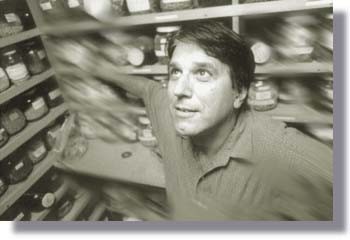
Supplemetal Income: Pioneer herbal therapist Michael Tierraattributes the upswing in mainstream interest in herbal cures to “theinadequacy of conventional medicine. People are looking for other solutions,”he says. “And those solutions are here to stay because people are gettingresults.”

To some a plague, to others a godsend, herbal remedies are flying off theshelves and into the mouths of mainstream Americans

By Christina Waters

Scenario: Sometime in the near future. MDs are folding uppractice and learning computer graphics to upgrade their employment skills.Botanical companies with names like Rain Forest Rush and Forever Young topthe Fortune 500. Americans regularly spend half their monthly incomes onherbs, plankton, and vitamins. Budgets are slashed for scientific research ondisease control. Fewer malpractice lawsuits are balanced by increase indeaths due to herb abuse.

IT MAY NOT BE SO FAR-FETCHED. Echinacea. Astragalus. Ginseng. Valerian.Goldenseal. Not long ago, these herbal remedies would have been consideredthe antique arsenal of apothecaries and backwater eccentrics. In themid-1990s, I can grab a cheap vial labeled “Tiger Ginseng” at almost any gasstation. At Trader Joe’s in Santa Rosa, I can snap up bargains in echinaceaand goldenseal, right across the aisle from discounted single-malt whiskies.Ginkgo has joined the expanding vitamin shelves in Safeway markets, andvalerian is available in drugstores all over the country.

Have we suddenly run out of aspirin, Valium, and antihistamines? Are doctorswriting a mass prescription for exotic herbs? Au contraire. This growing rushto herbal judgment has very little to do at all with traditional, Western,AMA-style medicine. In fact, it might represent a collective vote of noconfidence in the kindly GP of yore, and his high-priced, drug-dispensingcolleagues.

Heady with self-empowerment–fueled by aggressive herb and vitaminadvertising claims–ordinary Americans are taking the state of their healthinto their own hands. A widely quoted 1993 report in the New EnglandJournal of Medicine revealed that a whopping one in three Americans hadexplored some alternative therapy during the past year. The same studyindicated that not only were people seeking the counsel of alternative healthpractitioners, but they had spent–out of their own pockets, sincealternative strategies are seldom covered by insurance–over $10 billion onthis care. Such a figure indicates a serious courtship between alternativehealth options and mainstream clients.

It’s no big surprise, given the current honeymoon herbal supplements areenjoying with the self-healing public, that vitamins and supplements haveremained the top-growth category in natural products stores for the pastthree years, according to market research done by the Council for ResponsibleNutrition.

But the mass market also seems to be experiencing a sizable bloom of herbsand vitamins. A 1994 survey by trade consulting group Natural FoodsMerchandizer puts the U.S. natural products market at around $8 billion, withvitamins and supplements as the highest growth category. The Wall StreetJournal noted that supplement sales increased by almost 25 percent duringthe first quarter of 1994. There’s no end in sight.

“We’ve definitely seen growth in the herbal category over the last twoyears,” says Michael Polzin, spokesperson for Walgreen’s, the largestdrugstore chain in the country. “The idea of natural vitamins is appealing toa lot of people,” Polzin says. “There’s more awareness because there’s moreadvertising.”

“And it’s a nationwide trend,” agrees Sharon Findley, over-the-countercategory manager for Longs Drugstores. “Supplements are performing very well.The whole category of dietary supplements is up 10 percent.”

Sonoma County–home to the acclaimed California School of Herbal Studies inForestville, the Shaman Healing and Massage Center in Santa Rosa, and theSebastopol-based Traditional Medicinals herbal tea company–is a bastion ofnatural cures. Local health food stores and quality supermarkets–includingRosemary’s Garden, Fiesta Market, and Nicole’s Health Food Store inSebastopol; Food for Humans in Guerneville; Oliver’s Market in Cotati;Organic Grocers and Community Market in Santa Rosa; Petaluma Natural Foods;and the Food for Thought chain–maintain well-stocked herbal remediessections.

Only the least conscious among us has failed to feel the surge of promotionalfroth over “natural,” non-synthetic pharmaceuticals–often called botanicalsor nutriceuticals. Products and magazines appear overnight, featuring adizzying array of supplements du jour. First it was echinacea–with agrassroots campaign so successful that even my mother now prescribes it to mewhen I come down with a cold. Then came melatonin, which spawned an empire ofbooks and talk-show chatter. Now it’s blue-green algae for energy, wild yamfor estrogen control, and gingko to combat senility. No red-blooded Americanmale over the age of 45 would be without his daily dose of saw palmetto, thealternative shield against prostate enlargement.

Herbalism Continued:

More about Echinacea, the cold killer,
and Ginseng, the energy booster.

For detailed information, access the huge and informative files of the Herb Research Foundation or consultthe vast archives of the National CouncilAgainst Health Fraud.

A Natural Reaction

Reasons for the high-profile affair between alternative and mainstream healthagendas are abundant. Baby boomers are aging, the same baby boomers who didtheir own thing in their youth and already are tuned in to exploringalternative options. There’s increasing distrust of drugs–the very wordresonates with danger–and the anti-additive, all-natural attitude is in stepwith a groundswell toward sustainable lifestyles and environmentalstewardship.

But lest you think this is all an altruistic, love-and-peace proposition,keep in mind that big bucks are the bottom line here. And since this isAmerica, the advertising campaigns have been impressive. Flip through anynumber of the new publications–bearing titles like Health, Delicious,Eating Well, The Natural Way–and be dazzled by the ads.

There’s no mistaking the message of a product called Rocket Fuel–subtitledAction Caps. “Max your energy,” the ad shouts, “with ginseng, bee pollen,sarsaparilla and licorice.” The ad also points out that this product containsno ephedra (which is also known as ma huang and has been linked to overdosedeaths), nor does it contain caffeine (that questionable stimulant in coffee,tea, cola, and even cocoa).

So–in the midst of the growing prohibitionism of a culture that isanti-tobacco, anti-alcohol, anti-mind-altering drugs–we can get high on aquartet of natural substances, which the company has helpfully packagedtogether for us. I’m getting the picture. Another ad pulls another string.”Would you pick your phyto nutrients from the earth,” it asks coyly, “or alab?” Laboratories are the bad guys, Dr. Frankensteinian shops from whencespring toxic substances and chemical additives. Many ads work the libido beatwith photos of healthy, attractive men and women clad in outdoor exerciseclothing and an aura of romance.

So the natural, alternative market is growing the old-fashioned American way,with hype–what’s the problem?

Act Naturally

Echinacea is a little purple flower that grows wild on the North Americanprairie. Ginseng root has been used for 5,000 years in Chinese medicine.Increasing numbers of people flee Western technology to experiment withtime-honored, plant-based nutrients, which all seem simpler, more romantic.Who doesn’t want to strengthen their immune system, improve their vision,enjoy more stamina, sleep better, slow the aging process, and increase brainfunction? Could it really be this easy? And if so, why aren’t we all downingdaily doses of ginseng, echinacea, and St. John’s wort? Possibly becausewe’re too damn cautious.

Since 1994, herbal supplements have been legally bundled into a twilight zonecategory of “dietary supplement” that is neither food nor drug. As such, itmay make no outright preventative or curative claims, but labeling mayindicate uses and effects on bodily functions. Valerian can’t claim to cureinsomnia, for example, but can be labeled with wording like “may be helpfulin inducing sleep.” More important, dietary supplements are not held to thesame testing standards as required of drugs by the FDA. Drugs must undergodouble-blind, randomized testing. Drugs must provide documentation about use,safety, ingredients, indications, warnings, and dosage.

Herbal supplements require no such regulation.

But what’s really causing the vociferous battle in the media (Newsweek,Consumer Reports, Herbalgram) over natural vs. FDA-approved? Is it simplywatchdog paternalism vs. freedom of choice? Or is it something that looks andsounds a whole lot like greed?

In a paper he recently presented to the National Institute of Health’s newOffice of Alternative Medicine, herb honcho Rob McCaleb theorized that thedemand for strict scientific regulation of herbal supplements was hinderingaccess to traditional healing techniques. The price of all the rigoroustesting to meet FDA approval can be as high as $300 million, according toMcCaleb and other experts in his field. The inventors of Prozac probablywouldn’t mind that kind of investment, given the juicy patent waiting at theend of the laboratory trail.

But what if it turned out that a daily dose of St. John’s wort could achievethe same anti-depressant results for a fraction of the price and noprescription needed?

“Yes, that’s why double-blind testing isn’t done for something likeechinacea,” says McCaleb, founder of the Colorado-based Herb ResearchFoundation and recent appointee to the Presidential Commission on DietarySupplements. “Nobody gets a payoff.”

Patent medicines are just that–medicines that have been syntheticallycreated, and whose chemical formulae have been patented. He who patents,prospers. It’s because no one can patent–i.e., own–an herb; no one canexclusively profit from it. Hence, no one stands to gain by proving–throughlong, costly testing–that Herb X cures cancer. Nobody, except cancerpatients and their families, that is.

So far, claims for botanicals and herbs remain primarily anecdotal–accountsof trial and error, personal sagas of use and effectiveness–rather thanempirical test results that can be retested and verified in labs anywhere inthe world. In a capital-driven society, what generates patented profits iswhat we get.


Christopher Gardner

Supporting Evidence: New studies back claims of the curativepowers of such herbal remedies as echinacea.

The ‘Sick Care’ System

Nonsense, says Dr. William Jarvis, director of the National Council AgainstHealth Fraud Inc. “It’s only because we’ve had strong food and drug laws inthis country that the American pharmaceutical industry has become the worldleader in its field,” says this hunter of charlatans. “It’s not because theyare angels from heaven. It’s just that they’ve had to meet the law.”

Jarvis, professor of consumer health education at Loma Linda University andrenowned thorn in the side of alternative health claims, feels thatbotanicals’ lack of standardized testing is a clear case of industriallaziness. “If they test them, maybe they’ll find that they don’t really doanything. It’s kinda like this old saying, ‘If you build a better mousetrap,the world will beat a path to your door.’ Well, in quackery, if you cancreate the illusion that you’ve built a better mousetrap, the world will beata path to your door. “As long as you can keep the illusion alive, it’s justas effective as if you’d actually built the mousetrap.”

Obviously many disagree with Jarvis’ grouse about the ineffectiveness ofherbs and they welcome the growing numbers of cross-over health seekers andpractitioners. “We know pediatricians who are recommending echinacea to theirkids for colds and sore throats,” says McCaleb. “Some doctors are turningtheir patients on to valerian instead of benzodiazotenes. And it’s becausepeople are increasingly concerned that what we have in the United States is a’sick-care’ system, instead of a health-care system–we wait until diseasehas set in and then look for dramatic interventions.”

Herbalists offer “the major answer to the health-care problem,” saysherbalist James Green of Forestville’s California School of Herbal Studies.Commonly prescribed drugs have produced a virtual epidemic of dire sideeffects. For example, 20 of the more than 250 prescription drugs thatshouldn’t be used by older adults account for 80 million prescriptionspurchased by that same population–to the tune of more than $1 billion ayear. The usually affable Green is hardly sanguine when he talks about themedical and pharmaceutical industries, which, despite their unsavory recordand with the blessing of the FDA, are allied in defending their turf againstinroads being made by alternative therapies such as herbalism. The medicaland drug behemoths would like to convince the public that herbalism is basedon faith and whimsical logic, Green says, and they submit “shoddy evidencethat certain herbs are lethal. But herbs are powerful, and one must know howto use them.”

McCaleb points to the provincialism of American attitudes. “In the Europeanmarket, when synthetic and botanical medicines are sold side by side, thenatural remedies outsell the synthetics almost every time. When people have achoice, they just trust the natural more.” Critics note with chagrin that alltoo often consumers equate “natural” with “safe.” And McCaleb, weary of allthe high-profile press condemning botanicals as unsafe because untested,likes to remind consumers that the same doctors who won’t go on the recordabout the benefits of Vitamin E “are themselves taking vitamin E forcardiovascular protection.”

McCaleb admits that consumers are demanding greater “quality and potency andconsistency in natural remedies. And the industry is responding.” He alsoagrees that the glut of glitzy advertising stands to blur integrity ofclaims. “Everybody’s trying to get the consumer’s attention in a louder way,”he says.

Meanwhile, McCaleb is convinced that the new commission formed in response tothe Dietary Supplement Health and Education Act of 1994 will improve thesituation by “examining supplement regulation and recommending changes to thelabels–to make them more informative and science-based. The mainstream,”says the respected ethnobotanist, “has definitely begun to take an interestin herbal supplements.”

Lasting Solutions

If you think that’s just a facile claim by a professional in the alternativehealth field, try firing up your modem and key up your favorite search enginewith the words “alternative health.” Not only is there enough botanical lore,research, and archival material available on the World Wide Web to give everyone of us a degree in pharmacognosy, but there are growing numbers ofrespected medical schools now offering courses in alternative therapies,herbal medicine, and Eastern healing techniques.

And this is just as it should be for those who’ve paid their dues in thefields of herbal therapy for the past several decades–waiting for the restof the world to catch on.

“I think the increased attention to herbal supplements is a wonderful,incredible thing,” says herbalist Michael Tierra. “That’s the way it shouldalways have been. People should always use herbs before they go to drugs. Ifthe herbs aren’t helping them, and they’re not getting the results they need,then they should look for other means. But I figure that herbs can take careof 85 to 90 percent of the problems that most people are having with theirhealth.”

Tierra, a pioneer herbal therapist, author of the much-reprinted Way ofHerbs and teacher at Santa Cruz’s East/West Herb and Acupuncture Center,says there’s a single reason for the current revival of herbal alternatives:”The inadequacy of conventional medicine. People are looking for othersolutions, and those solutions are here to stay because people are gettingresults.”

Tierra emphatically states that any negative effects due to herbal ingestionare “incredibly minuscule, especially compared to over-the-counterprescriptions. I don’t think regulation is required. People will always findall kinds of ways to hurt themselves. It’s just not necessary to regulatemost herbs,” he says.

For Tierra, the real danger involved in this debate is that “if we don’t havea voice as professionals in the herbal field–like we now have with thepresidential commission, then someone else will do the regulating for us.”

Such insistence on freedom of choice is “just a stupid way of thinking,” toDr. Jarvis. “It’s just folly. You’re putting something in people’s hands thathas a great potential for harm and then saying, well, anybody should be ableto do as they please. You don’t let children play with firearms or poisons.”

As for the presidential commission that’s been formed to provide someguidance on the question of regulating dietary supplements, Jarvis scoffinglyagrees with Tierra. “It’s definitely an industry group. It’s stacked with theleading advocates and those who stand to gain from the marketing of theseproducts, like the Herb Research Foundation.”

Boom or BS

William Jarvis is happy to trash the prevailing theories that aging boomersor failure of confidence in medical doctors have generated the herbal boom.”There is no boom–at least not among consumers. The boom is amongmarketers,” Jarvis laughs. “What you have here is a very interesting set ofdevelopments: In 1962 when the Kefauver-Harris amendment was passed requiringproof of efficacy of drug products, a lot of products were grandfathered.They were given time to get their act together, essentially.

“Then in the late ’80s and early ’90s,” he lectures, “the FDA began takingproducts off the market by the hundreds that hadn’t met the efficacystandard. Into this vacuum of essentially useless products, 60 companiespetitioned the FDA to market homeopathic products–a lot of which areherbal–and then the herbal market took off. Now we have the the new DietarySupplement law.

“What happened was that the marketers got the government to acknowledgecategories that did not have to meet the efficacy requirement. And theseproducts are moving into the void left by pulled standard products.

“So you have a marketplace phenomenon going on here–anybody who thinks thatthis is a consumer thing is naive.”

Despite the emotional rhetoric on both sides of the issue, it seems clearthat sales and use of herbal supplements will continue. And the intensifiedinterest by McCaleb and other botanical professionals in adding scientificcredibility to claims parallels the traditional health community’s interestin educating consumers about all their options.

Even Jarvis believes there should be a different category created for herbalmedicines. “I don’t think you have to take each product and test it on arandomized, controlled clinical trial,” he says. “But if you work from thebasic constituents and the pharmacological knowledge of those, and have aprovision to track unanticipated adverse effects, then I think you could goforward with it.”

Judging from McCaleb’s recommendations to the National Institutes of Healthand the recent National Council Against Health Fraud position paper onover-the-counter herbal remedies, the two camps are moving closer to accord.Both urge something less costly than full double-blind testing, requesting”realistic standards of evidence for established plant medicines,” asMcCalebs notes.

In its detailed listing of recommendations to bring greater credibility andsafety to the herbal medicine market, the NCAHF paper states that “many[over-the-counter] herbal remedies could be marketed without costly andlengthy clinical trials if basic principles of consumer protection areattended to. While caveat emptor should still be the consumer’s guidingprinciple, it will be that same consumer who wins, should the warringfactions–those who want to provide informed access to life-enhancingsubstances, and those who want to protect the innocent from potentialfolly–meet each other halfway.

From the January 16-22, 1997 issue of the Sonoma County Independent

Thispage was designed and created by the Boulevards team.
© 1997 Metrosa, Inc.
Echinacea

Echinacea

By Christina Waters

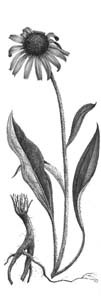
ONE OF THE PRIMARY medicines among native peoples of North America,Echinacea angustifolia–purple coneflower– was used in a favoritepoultice against snakebites, as a cold treatment, and to ease the aches ofarthritis. European settlers in the Midwest quickly adopted echinacea as aremedy, attracting the attention of the East Coast medical community, whichsoon sent samples of the flower and roots to colleagues across the Atlantic.

By the turn of the century, echinacea was a fixture in every medicine cabinetand enjoyed favor as a cold remedy until the raging debate betweenalternative healers and the AMA practitioners sent its use into a steepdecline. Once patent medicines and antibiotics came on the scene after WorldWar I, echinacea almost disappeared from use in the United States.

Today echinacea enjoys huge sales, largely owing to its widely reportedeffectiveness against that most stubborn of maladies–the common cold.Echinacea seems to be most potent as an extract. Confirmed users report thatif taken at the first sign of a scratchy throat or plugged-up nose, echinaceacan actually prevent a cold from developing.

How it does this occurs in several ways, according to a body of Germanstudies done over the past several decades. Echinacea not only acts toprevent infection from invading tissue, but is believed to strengthen theimmune system. Echinacea appears to boost the white blood cells’ ability tokill germs.

Studies also indicate that it can increase levels of infection-fightingT-cells, and even more important–in terms of possible cancer-fightingimplications–echinacea simulates the infection-fighting abilities of ahormone called interferon, which is produced by the body. Purists can trygrowing their own echinacea, using organically grown seeds packaged by Seedsof Change.

From the January 16-22, 1997 issue of the Sonoma County Independent

Thispage was designed and created by the Boulevards team.
© 1997 Metrosa, Inc.
Ginseng

Root Up

FOR UNTOLD thousands of years the root of Panax ginseng has been usedby Asian healers as an all-round tonic, said to increase the potency ofone’s Qi, which probably best equates with what Westerners might calllife force. A great deal of 100 percent owl puckie has been slung concerningthe powers of this unglamorous groundcover.

As you can guess, most of them centered on sexual potency, and it was as analleged aphrodisiac that ginseng made fortunes for its savvy traders.

Sexual potency aside, alternative practitioners classify it as an adaptogenand provide anecdotal support for ginseng as an energy booster (that’s whythose vials of Tiger Ginseng are sold at gas stations and 7-Elevens), as astress fighter, and to restore youthful vigor.

In a controversial 1995 study conducted by Consumer Reports, 10different ginseng products were found to have wildly varying amounts of theactive ingredient–ginsenoside–and at least one of the brands contained noneat all. Soviet studies support ginseng’s powers as an immune system stimulantand a protector of liver function. And ginseng may reduce cholesterol levels.

Ginseng is on the FDA list of “safe” herbs. I wouldn’t start the morningwithout 10 drops of Siberian and 10 drops of Korean ginseng in my orangejuice.

From the January 16-22, 1997 issue of the Sonoma County Independent

Thispage was designed and created by the Boulevards team.
© 1997 Metrosa, Inc.

Engelbert Humperdinck

0

Release Him


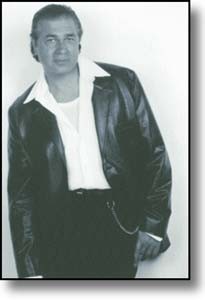
King of Romance: Fans stay true to Engelbert Humperdinck.

Photo by David Mayenfisch


Crooner Engelbert Humperdinck
revamps his cool quotient

By Todd S.Inoue

ONE OF THE GRANDEST moments I’ve ever experienced at a concert was watchingTony Bennett upstage the Lemonheads’ Evan Dando at a Live 105 Green Christmasconcert two years ago. Bennett’s jaunty set of jazz standards, played withimpeccable class and showmanship, stirred the crowd of alterna-teens into afrenzy. The meek poster boy Dando followed Bennett with 10 minutes of moperock and disappeared quietly behind the curtain.

Serves the punk right. During these turbulent times of “anti-rock star”posturing, folks are returning to the past to bask in a more civilized erawhen being a celebrity was a blessing, not a curse. A desire for somethingmore real and gratifying, a lot of this is media-fueled, but if and when thenovelty wears off, we’re left with some great albums filled with music thatwe can give to our parents.

The recycling machine has revived the careers of Bennett, Harry Belafonte(courtesy of Beetlejuice), Mel Tormé (Mountain Dew), BarryWhite (Budweiser), and Tom Jones (Art of Noise, EMF). Now it’s EngelbertHumperdinck’s turn.

Good, moral-thinking people should not feel threatened by the warm vibrato orthe thin mustache he sometimes sports. As cheesy as it sounds, Humperdinck’sre-entry into the consciousness of America’s youth is wholesome compared tothe current crop corrupting our children like Urkel or the cast of MelrosePlace. At least with Humperdinck, the kids will get a lesson in romanceand performance, etiquette and fashion (imagine youths tossing out thoseridiculously baggy pants for wide-lapeled suits).

Humperdinck’s enduring image as an MOR crooner and underwear outfielder washelped along by manager Gordon Mills, who did similar work with Tom Jones.Under Mills’ guidance, the early Arnold Dorsey switched his name to that ofthe frequently misspelled, yet infinitely hard-to-forget composer ofHansel and Gretel.

With the name and baubles in place, Humperdinck quickly got the juicesflowing. His big hit in the ’60s, “Release Me (and Let Me Love Again),” wasfollowed by an unsteady string of Top 40 hits in the ’70s: “There Goes MyEverything,” “The Last Waltz,” “Am I That Easy to Forget?,” and thecoffee-and-cigarettes classic “After the Lovin’.” Not one to rest on laurels,he recorded albums in Spanish, German, and Italian and as recently as 1992cut an album of hits with the Royal Philharmonic Orchestra. With 64 gold and23 platinum albums on his walls, this “king of romance” reigns over thelargest fan club in the world, boasting some 8 million members. He must bedoing something right.

A fragrance, named after the hit single “Release Me,” did bang-up business onthe Home Shopping Channel. But before Humperdinck could be sentenced to astint on the Psychic Friends Network, he refinanced his net cool bycollaborating with the most respected pair of tastemakers since Siskel andEbert: Beavis and Butt-head. The single “Fly Lesbian Seagull” can be heardover the closing credits of the hit movie Beavis and Butt-head DoAmerica and next to the Red Hot Chili Peppers on the accompanyingsoundtrack.

The velvet-throated singer obsessed with style and panache is finally gettinghis turn in the cheese-colored glow of ’90s nostalgia. Like the cake left outin the rain in “MacArthur Park”–it took so long to bake it, but baby, he canreally cook.

Engelbert Humperdinck holds forth on Wednesday, Jan. 29, at 7:30 p.m., at theLuther Burbank Center, 50 Mark West Springs Road, Santa Rosa. Tickets,$27.50­$39.50, are reserved. 546-3600.

From the January 16-22, 1997 issue of the Sonoma County Independent

Thispage was designed and created by the Boulevards team.
© 1997 Metrosa, Inc.

The Scoop

A Mouthful

By Bob Harris

THERE’S A PLACE called Boone County in the mountains of West Virginia, allMail Pouch signs and old coal mines. The people are as honest as they arehard-working, and they work too damn hard to be as poor as they are.

Boone County doesn’t get a lot of visitors from down the hill. The ones itdoes get are often federal law enforcement types, so it takes a while to earntheir trust. They also have to deal with being considered stupid just becauseof where they live. Most of the folks down in Buckleyville–the big city inthese parts–consider themselves superior, even though all most of them knowabout the mountains is what they’ve seen on Hee-Haw.

Strangely, there’s also something of a language barrier. Because of theirisolation, Boone County’s soft Southern accent is still decorated byShakespearean-sounding Elizabethan phrases outsiders have troublecomprehending.

The challenge is cool–it’s neat to be addressed as “thou” with a straightface, but when you realize they aren’t just playing around and (gadzooks!)they really do talk this way, the effect is more off-putting thanyou’d expect. Still, it’s no huge deal. The Boonies, as they laughingly callthemselves (even as others try to use the word as an insult) are as smart,funny, and kind as anyone.

Last year, I-62–the Sen. Robert Byrd Highway–was completed, and everythingchanged. Boone County is now off Exit 47, just up the hill from a Stuckey’sroadside restaurant. Roads lead to cars and buses. Recently, the mountainchildren began to attend Buckleyville’s posh new Rockefeller Elementary.

Problem: The kids from Boone were as curious and creative as any, but becauseof the language barrier, their English scores were terrible. This in turnaffected all their other course work.

One of the Buckleyville soccer moms spoke for many when she wrote a column inthe local paper stating that Boonie kids “just don’t want to learn,”preferring a “tortured, degenerate gutter offspring” of standard English. “Hopefully,” she added, “they’ll either have to learn right or go back wherethey came from.”

Note how the grammar nazi herself misuses adjectives, adverbs, andparticiples–all in one sentence. (OK, I also misuse, bend, and conflatewords all the time. But I do it because it’s fun.)

Was an entire community of American children really failing, just becausebeing born poor and in the wrong place makes you slow? Nope.

The simple problem was obviously the dialect: Buckleyville teachers justcouldn’t understand what Boone children said, and vice versa. Both sidestuned out. Nobody’s fault. Easy to fix.

Solution: Recognize the differences, train teachers to understand themountain dialect (“Boonic”) so they can better assist the transition tostandard English, and go from there. Anything wrong with that? Of course not.Except that Buckleyville and Boonic are fictional. Oakland and Ebonicsaren’t.

The difference is truly just skin deep.

At its heart, the Ebonics controversy has nothing to do with the best way toteach kids. The Linguistic Society of America, which would know, considersOakland’s plan “linguistically and pedagogically sound.”

The only real problem here is that most white people just plain don’t likethe sound of black English, and those with race or class prejudicesmindlessly assume that the speakers are lazy, stupid, or even speaking in acontrived anti-white code.

The poor phrasing of Oakland’s announcement is also partly to blame for allthe hoo-hah. Ebonics isn’t a separate language, and by no means is it”genetically based.” Turns out what the school board was trying to say isthat it’s a recognizable dialect with its own rules (true), primarily spokenby one ethnic group (also true).

But while it’s not exactly encouraging to watch language professionalsstruggling to find the right words, at least someone is trying to finda way to improve our urban schools that doesn’t involve surveillance camerasand cavity searches.

Come on, you really think folks out in WalMartPlatz know what poorcity kids need more than the teachers who are right there in the room withthem every single day? Unless my study and my books be false, theargument you held was wrong in you.

That’s not Ebonics–that’s Shakespeare. Henry VI, Part 1 (Act 2, Scene4).

The Scoop is archived on the web andis available spiffy RealAudio.

From the January 16-22, 1997 issue of the Sonoma County Independent

Thispage was designed and created by the Boulevards team.
© 1997 Metrosa, Inc.
Aqua Hockey

0

Deep Six


Janet Orsi

Getting Along Swimmingly: A member of the Santa Rosa Sharksunderwater hockey team moves in for a goal.

Aqua hockey is a watery workout for all ages

By Dylan Bennett

TWELVE FEET beneath the water’s surface, six members of the 10-man Santa RosaSharks team, blunt weapons in hand, swim in a hurried swirl of antagonism.With its flurry of fins and goggles, the seascape of scissoring legsresembles the obligatory underwater knife-fight scene in a James Bond movie.

Welcome to the bizarre world of underwater hockey, a sport so odd you’d thinkit’s a bad joke–until you try it.

Reality kicks in when you merely swim to the bottom of Santa Rosa’s Ridgewayswimming pool. The acute pressure on human eardrums at 12 feet is thefirst opponent, but you get used to it. The objective–to push a two-poundlead puck with a short wooden stick into a long, flat metal goal–requiresall of the physical strength and mental daring a beginner can muster. It’sdaunting but rewarding.

Indeed, underwater hockey is the best reason to swim to the bottom of deepwater since childhood mud fights in a murky country pond meant frequent crashdives for more ammunition.

Thankfully, adrenaline eases the pressure on your ears. For a few fleetingmoments during 90 minutes of aqua hockey, I sweep up the puck and kick downthe sideline without opposition. Where is everybody?, my oxygen-deficientbrain wonders. They must be getting air. I thrust for the goal. Visions ofbeginner’s luck splash across my face mask. Just six more feet. It won’t belong now. Down from the sky plunge the defenders. I pull a cheap move to theright. No such luck. I lose control of the puck and my lungs redline.

There’s nowhere to go but up.

“I like the rush I get at 12 feet,” says local enthusiast Brian Tucker, 28, aphysical education teacher who can scrimmage at the pool bottom for a fullminute or more before coming up for air. Tucker has traveled around thenation to play aqua hockey and even hosts a Web page devoted to this esotericsport.

Underwater hockey players spawn mostly from the local ocean free-divingscene, says Tucker, who is one of maybe 25 underwater hockey players inSonoma County, a group that also includes many competitive swimmers, divers,and water polo enthusiasts.

“Most do it to stay in shape,” says Cotati butcher Scott Becklund of thegrowing interest in underwater hockey. There are only a few hundredenthusiasts nationwide.

The Sharks–or Rasta Sharks, as they are sometimes known–are part of thePacific Coast Champions aqua-hockey league, which includes teams fromSeattle, Vancouver, Fresno, and San Francisco. The teams compete for a chanceto play in the annual nationals. The United States also fields a nationalteam in the world aqua-hockey championships.

Although the game calls for terrific stamina, skill, and guts–and visuallystimulating uniforms that include bathing caps, ear protectors, masks,snorkels, duck fins, gloves, and rough-hewn push sticks–underwater hockey’spopularity is limited by one main factor: until someone builds a glass-walledswimming pool, this will never be a spectator sport.

Too bad, too. Underwater hockey is remarkably inclusive of gender, age, andphysique. At a recent game, 68-year-old Charlie Anderson skillfully dueledhis own 15-year-old son at the goal under three meters of water. And a chunkyguy at least 50 pounds overweight lithely kicked for repeated breakawayscores. Women also play, and mixed teams are common.

While most of the local enthusiasts are men, women and co-ed teams alsocompete and the league sponsors summer children’s clinics.

Water is the great equalizer that counteracts weight and size in therighteous fight for control of the watery depths.

The Santa Rosa Sharks’ underwater hockey games are open to the public eachThursday at 8 p.m. at the Ridgeway Pool, Ridgeway High School, 325 RidgewayAve., Santa Rosa. For more information, call Brian Tucker at 585-8235.

From the January 16-22, 1997 issue of the Sonoma County Independent

Thispage was designed and created by the Boulevards team.
© 1997 Metrosa, Inc.

From a Voyeur’s Diary

0

Being There

By Gretchen Giles

FIRST OF ALL, I think that the human form is a very beautiful form and shape,” artist Alv Wilenius says, standing before the paintings hung ’round his under-house Rio Nido studio. Larger than life, painted in the distinct creams, tans, and pinks of the flesh, Wilenius’ figurative works–mostly of caul-faced men who seem to float in the viscous world of the canvas–have a heavy beauty, the limbs as thick with the fullness of life as Wilenius’ own. Probably because they’re modeled on Wilenius’ own.

“With a face, if you make it too specific, it also takes on a specific meaning,” he continues, gesturing towards an eyeless man, whose paint-shrouded face leans upward on the wall. “So sometimes I like to obscure the face to maintain a vagueness. I started out doing portraits, and I did some pretty nice pieces, but maybe because I was working as a mental health worker, [the patients] became more interesting as a subject matter than regular people.

“Because regular people, they have a lot of stuff, too,” Wilenius–whose day job indeed brings him in daily contact with the mentally disabled–says, looking directly at the reporter. “But it’s shielded, it’s hard to see. Whereas with mentally ill people, you can really see what’s happening with them.”

Seeing what’s happening with them is the theme of an exciting new exhibit, “From a Voyeur’s Diary,” now mounted by the Cultural Arts Council of Sonoma County in its storefront SoFo Gallery. Featuring works by Wilenius, Petaluma painter Susan Wolcott, Sonoma State professor Shane Weare, and sculptor Carol Setterlund, this examination of the little-seen and the intimate is staggeringly powerful in its scope.

Planning to mount a figurative show, co-curator Barbara Thoulion based the theme for this exhibit on the work she saw in Wilenius’ studio. “This is figurative work that is very vulnerable,” she says, standing in jeans amid the new-paint smell of the gallery, the show’s works arrayed on the floor or put casually against the walls in readiness for hanging. “I wanted it to be as though [viewers] are peeping into someone’s emotional secrets.”

After deciding on Wilenius, Thoulion approached painter Susan Wolcott, who prepared large, gromet-spiked canvases that reward long looking. Centering on the small, giving intimacies of the body–the back of the knee, the taut vulnerability of the Achilles tendon, the softness of the inner arm–Wolcott’s smart, chewy canvases grudgingly give their beauty away, her superb draftsmanship highlighted next to more abstract figures, repeating forms from E-Z Sew pattern transparencies married to the surface, hearts dropping like ripe plums from the opening in a chest.

Painter Shane Weare’s colors offer the disgruntled hues of burned scrambled eggs, yellow and brown washing the canvases from which nightmarish images of skull, monkey, chieftain, and anguished nude loom darkly. Surprisingly, gifted Cloverdale sculptor Carol Setterlund’s busts weigh in lightly amid her colleagues, much of her stronger work consigned already to a college exhibit in Southern California. Placed on found-wood podiums, these rakishly topped heads (she plops on one a nature-perfect tree branch) are clearly having too much fun–beachy and cool–for the darkness of this exhibit. Of exception is one of Setterlund’s older pieces, a curiously serene female bust–the slope from shoulder to breast cracking–that sits erectly postured and completely enfenced.

THE PURPOSE in my painting is not to produce these images that have all of this emotional content,” Wilenius says, back in his Rio Nido studio. “I paint because I want to paint and because I enjoy it. That’s the first thing–I really enjoy painting. The second thing is how I paint: how I use the material, how I dry the paint on the surface. And the third thing is what happens when I paint: what comes out in the struggle, what images appear.”

Known for the strong emotional content of his work–his rendering of a Norse god rising from the sea dangerously near another man’s genitals got him briefly booted from the Quicksilver Mine Co.’s then-Guerneville window–this Swedish native trained as an architect before coming to the States and enrolling at the San Francisco Art Institute. There the instructors, steeped in the school’s abstract expressionistic history, taught the painter to make figurative work with an abstract bent, adding a charged dimension to his heavy men.

We walk to one canvas hanging on the studio wall. A man lies cradling the egglike fragility of his head. He is at rest, limbs curved round, his genitals softly exposed. Above the figure a large expanse of canvas remains unmarked, the paint soothing and smooth. But at the top, a beaked vulva waits with perhaps a predatory patience. “You spoke of my paintings being dark,” Wilenius says, pointing at the canvas. “And this is the opposite to me. This is a happy picture to me. Because he’s all closed in and folded in on himself, and he’s content–there’s no drama going on.”

But what about the menacing genitals? “It’s the only thing that’s going to wake him up,” Wilenius laughs. “Maybe that’s what life is about. Anyway,” he chuckles again, “it’s my attempt to be happy.”

“From a Voyeur’s Diary” shows through Feb. 28 at the SoFo Gallery, 602 Wilson St., Santa Rosa. A reception for the artists is planned for Friday, Jan. 17, from 5 to 7 p.m. Gallery hours are Monday-Friday, noon to 5. 579-ARTS.

From the January 16-22, 1997 issue of the Sonoma County Independent

This page was designed and created by the Boulevards team. © 1997 Metrosa, Inc.

Talking Pictures

0

Rach Star


Black and White: ‘Shine’ depicts pianist David Helfgott’s keysto sanity.

Pianist Jeffrey Kahane shines

Writer David Templeton takes interesting people to interesting movies in hisongoing quest for the ultimate post-film conversation. This time out, hemeets up with esteemed pianist/conductor Jeffrey Kahane of the Santa RosaSymphony to discuss the musically savvy, critically acclaimed filmShine.

RENOWNED MUSICIAN Jeffrey Kahane is a man so desperately busy that he has notbeen out to a movie theater in days, weeks, months. Furthermore, I ampolitely informed, he probably won’t make it to a movie anytime soon.

Though intrigued by my offer to see the brilliant new film –thestory of Australian pianist David Helfgott and his roller-coasterrelationship with sanity and Rachmaninoff’s Third Piano Concerto–andadmittedly eager to see it, Kahane has expressed concerns that he would notbe able to find the spare time to go off to a show.

Fortunately, a conveniently released videocassette of the film (intended forhomebound Oscar voters; Shine is still in its initial theatricalrelease) has made its way into my timely possession, and I quickly arrange todrop the film off for Mr. Kahane’s private viewing.

“All right. I may have a moment after midnight,” he says.

The hard-working pianist and former rock musician is currently holding a postas conductor of the award-winning Santa Rosa Symphony, a choice job that hesandwiches between numerous recording projects and international tours. Lastyear, Kahane saw the release of Made in America (Sony Records), apassionate assemblage of works by Gershwin and Leonard Bernstein, on which hecollaborated with acclaimed violinist Yo Yo Ma, whom he met while playingwith the Gardner Chamber Orchestra in Boston. The duo frequently worktogether, as in last year’s successful tour of South America.

“I hope you like your coffee somewhat strong,” Kahane warns. A man ofboundless natural energy, he nevertheless clearly enjoys the extra punch of agood cup of joe; this stuff is explosive.

Of course, he was up pretty late.

“There is an extraordinary sequence in the film,” Kahane says, setting hiscup on a blank music sheet, “where the young David Helfgott performsRachmaninoff’s Third Concerto for the first time. All of a sudden–he can’thear the music, we can’t hear the music, but he’s playing. We hear thepounding of his fingers on the keys, the pounding of his heart, and when wedo hear the music, it sometimes seems out of phase with his playing.

“This really happens,” Kahane says earnestly. “Most performers experiencesomething like this at one time or another. It’s very difficult to explain.I’ve certainly had that experience–though not to the severity that Daviddoes.”

At the end of that sequence, Helfgott, soaked in sweat, finishes the concertoand promptly passes out. He is next shown receiving shock therapy in anasylum. The implication is that his attempt to master Rachmaninoff’s ThirdPiano Concerto–nicknamed “Rach 3”–has been so traumatic that it pushes thealready unstable young man over the edge. Indeed, the piece is considered oneof the most difficult works in classical music, with some pages nearly blackwith notes. The remainder of the film details the adult Helfgott’s ultimateredemption, as he rises out of a schizophrenic fog and finds his way back tomusic. The real David Helfgott could not resist returning to the Rach 3,either. His CD recording of the piece is now considered the definitiveperformance of the work.

“I love the Rachmaninoff Third,” Kahane says. “It’s a piece I’ve played alot. For me, as it is for most aspiring pianists, it’s something you have todo. Once you’ve accomplished that, it’s like climbing a greatmountain–you’ve really done something.”

And is it the kind of piece that could drive one to madness?

“Oh yes,” he affirms mildly. “It could put you right over the edge. Manypianists injure themselves, physically, trying to play it. And if you arepsychologically vulnerable, as David was–yes, I believe it could do that toyou.” Kahane himself learned the piece when he was 22, but did not perform itpublicly for several years. He has performed it frequently since.

“What I love about the movie, ultimately, is its depiction of the redemptivepower of music,” Kahane continues. “I’ve devoted myself so much to the ideathat music does have that kind of power. David was saved by the powerof music, and the power of love, of course, with the love of his wife, whosaw who David was even though everyone around him just saw a nut case.”

Asked to verify a rumor that Rachmaninoff had tremendously large hands,Kahane laughs.

“That’s true, that’s what they say,” he says. “He could reach an octave and afifth! Way beyond the reach of most pianists.”

Holding up his own hands, spreading his fingers to demonstrate his reach,Kahane adds, “My hands, however, are definitely on the smaller end of thespectrum. Interestingly, though, Rachmaninoff’s work can be played with avery small hand, unlike that of other composers: Brahms, Liszt, Bartok. Ican play Rachmaninoff, and I am eternally grateful to him for making thatpossible.

“My life,” he smiles, “has certainly been the richer for it.”

From the January 16-22, 1997 issue of the Sonoma County Independent

Thispage was designed and created by the Boulevards team.
© 1997 Metrosa, Inc.

Sorbets

0

Forest Flavors


help sustain the rain forest

By Bruce Robinson

A LOT OF ENTREPRENEURS relish a challenge, but businessman Doug Stewart takes them on by the scoopful. The founder and owner of Howler products, Stewart has developed a line of exotic sorbets flavored with rain forest fruits, an endeavor in which he is trying to educate the American palate, support native agricultural cooperatives in Brazil, create a model for “green trade” in Amazon rain forest products, and, oh yes–make enough of a profit to sustain all the other objectives.

All with fruits that are totally unknown to even the most adventuresome California palates. But the same flavors are hugely popular in their homeland, and Stewart remains confident that they can find a following here, too.

“When I was [in Brazil] for the first time, I had a roommate who had been raised in a forest family,” Stewart, a Sonoma native, recalls during a quiet moment at the Howler processing facility in San Francisco. “The first thing he did was take me to a fruit shop and show me all the 50 different fruits he was raised on.

“They have an incredible variety, but they don’t appeal to everyone.”

Stewart was in Brazil as a researcher, working with one of his Stanford professors to document the rapacious rate at which the rain forest was being destroyed. That work was ultimately published as a book, After the Trees: Living on the Transamazon Highway (University of Texas Press, 1994). But it also sowed the seeds for his move into eco-capitalism.

“My research was looking at how people were using the rain forest, and they were generally using it destructively. I was looking at what would be a more sustainable, ecological endeavor than cattle, and one way would be to maintain a forest and manage it for fruit production,” he says. “Don’t cut it down, just plant stuff under it.”

The leap from theory to practice was not a big one, as Stewart explains it, even if he did have to quit his job teaching history at a Palo Alto middle school and max out his credit cards to get the new enterprise started.

Rain forest fruit sorbet is “the most obvious thing in the world if you’ve been there,” he shrugs. “It’s not a novel idea. They sell ice cream like the dickens.” He reports that “scoop shops” offering a wild array of flavors are everywhere in Brazilian towns and cities, “sort of like 31 flavors, except it’s 78 flavors.”

So why not bring the same idea back home? “A lot of people had thought of that,” Stewart says, “but nobody ever did it.” He soon found out why. The key was “infrastructure: how to get the fruit here at a reasonable cost. If we have a niche, it’s that we know how to do that,” he says, citing his discovery of a cooperative farm outside of the Brazilian city of Belém that provides consistent, quality fruit products.

Then there is the question of creating a market for something that most people have never heard of, much less experienced. “It’s a large uphill battle,” Stewart concedes cheerfully. “We sell a lot more mango and passion fruit than we sell cajá or cupuaçu.”

In deciding which of the multitude of rain forest fruits to export, freeze, and market, Stewart used two basic selection criteria. “I picked the ones that I liked most, just for starters. Secondarily, I picked the ones that were the most popular in the Amazon.”

That led to an immediate setback, when his favorite fruit, the açai (which he likens to a cinnamon-cassis taste) was coldly rejected by Bay Area consumers. “I thought the market was ready for a wild, complex thing, and it wasn’t,” Stewart says resignedly. He is now working on a new blend, pairing the açai with raspberries.

He has also made an effort to identify the new fruit flavors in terms that consumers can more easily digest. The bright citrus Cajá is now presented as “Tropical Tangerine,” the vitamin C­rich Acerola is identified as “Caribbean Cherry,” and the piña colada­like taste of Cupuaçu is emphasized. Other Howler flavors currently in production include Passion Fruit, Guava-Berry, Primal Scream Coffee Bean, and Guanábana, which Stewart predicts “is about to bust into the mainstream over the next five years.” Leading the charge in that popularization is Jeanette Stewart of Sebastopol–Stewart’s mother, staunchest booster, and the spearhead of his marketing department.

Now produced at a recently acquired gelato plant in San Francisco, the Howler line (named for the small, fruit-eating monkeys that swing through the rain forest canopy) is impressively smooth and creamy, despite being both fat-free and 100 percent non-dairy. Pints are sold at independent food stores throughout Sonoma County and the Greater Bay Area, along with individually packaged Howler bars–a sorbet pop on a stick.

With their new facility came the ability to produce 1.5-gallon cartons for restaurant use, something that opened up another eager market. “Right now we’re selling more product in restaurants than we are in pints,” Stewart says, since word of mouth among chefs has spread quickly and positively.

Among the Sonoma County eateries offering Howler sorbets are Topolos’ Russian River Restaurant and the Willow Wood Market Cafe in the west county, Lo Spuntino, Piatta, and the Bear Flag Cafe (co-owned by Stewart’s brother, Peter) in Sonoma, and, curiously, Kaiser Hospital in Santa Rosa.

From the January 9-15, 1997 issue of the Sonoma County Independent

This page was designed and created by the Boulevards team.
© 1997 Metrosa, Inc.

T.J. Kirk

0

Fusion Freaks


David Mayenfisch

It’s a Jazz Thang: T.J. Kirk’s soul-jazz tributes are funky fun.

T.J. Kirk quartet melds jazz,
soul, and rock into loopy fun

By Greg Cahill

THE PREMISE is deceptively simple. Toss funk-drenched dance grooves, hard-bop improvisations, and assorted experimentation into a musical Cuisinart to create a hip funk/jazz hybrid based on the prodigious influences of three musical giants.

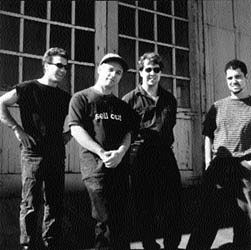
But the Bay Area quartet T.J. Kirk–guitarists Charlie Hunter, John Schott, and Will Bernhard, plus drummer Scott Amendola–never banked on this side project leading to a major label deal, critical raves, and national tour dates that would divert them from their own ambitious solo projects.

First, let’s explain that unusual moniker. The “T” is a tribute to bebop legend Thelonious Monk; the “J” is a big soul shout for funkmeister James Brown; and the “Kirk” refers to theatrical reedman and postmodern jazz explorer Rhasaan Rolan Kirk, who used to play several wind instruments simultaneously. “The vibe is funky, outside, and harmonically rich,” Guitar Player opined about the band’s 1995 eponymous debut.

It’s really like putting your head into a blender–that’s how Schott describes the band’s oddball approach. “Actually, I stole that phrase from Ted Nugent,” he laughs, during a phone interview from his Berkeley home. “We wanted to take these three composers and have them bounce off of each other in a conversation,” he explains. “You know how people are always saying, ‘If you could have a dinner party and invite three people, who would you invite?’ Some people might say, Einstein, Socrates, and Aretha Franklin, or something.

“The idea here is a musical conversation between three great composers in which their compositions interpenetrate each other to create a dialogue.”

Typically, T.J. Kirk may lay down a James Brown groove and add a Monk song altered with Kirk’s eclectic signatures. For example, their “Meeting at Termini’s Brilliant Corner,” from their recent, second disc If Four Was One (Warner Bros.), blends Brown’s “I’ve Got a Bag of My Own,” “Brilliant Corner” by Monk, and “Termini’s Corner” by Kirk. “So by the end of the performance, you have all these elements swirling around,” Schott says, “and their individual identities as compositions are broken down into fragmented motifs with their sources almost obscured.”

ASK SCHOTT about the band’s decision to worship at the feet of this holy trinity and he waxes philosophical. For instance, here’s what he has to say about Soul Brother No. 1 James Brown: “To me, he’s yet one more incredible iconoclast musician along the lines of Charles Ives, Harry Parch, and Ornette Coleman.” American classical composer Charles Ives? King of early-20th-century polytonality? “Yeah, Brown really invented a unique musical language,” Schott observes. “He took elements of the vernacular that he found around–like the music of Hank Ballard and Jackie Wilson–and ultimately transformed that language into a very interesting and still quite misunderstood musical universe. I mean, both Brown and Ives used tonality in non-conventional ways that were almost a kind of quotation of tonality sometimes.

“I don’t want to get too technical, but if you listen to James Brown’s music, there are really interesting things going on under the surface that often aren’t fully appreciated.”

Appreciation also is coming slowly to the members of T.J. Kirk, though they’re well known in contemporary jazz circles. Hunter, a eight-string guitar player who used to perform with the Disposable Heroes of Hiphoprisy, fronts his own power jazz quartet. Bernhard can be heard with the Peter Apfelbaum Sextet and recently was declared “criminally ignored” by the Detroit Metro Times. Schott, a Seattle native, released the 1995 solo album Junk Genius on the New York­based Knitting Factory label and debuted his 40-minute cantata In These Great Times last fall at the Lincoln Center for the Performing Arts. And Amendola lays down the beat for Hunter’s own band and recently recorded The Oranj Symphonette Plays Mancini (Gramavision/Ryko) with the Philip Greenleif/Scott Amendola Duo.

Will fame and fortune ever find T.J. Kirk? Schott remains stoic. “I think the new album will catch on,” he says dryly, “though it may be 2013 before its contribution to Western musical culture is fully recognized.” Is that bad? “No, I know our time will come and we’ll eventually be seen as the latter-day Horaces that we are,” he says. Then he adds, with more than just a touch of irony: “I just hope that inflation hasn’t invalidated all previous contracts by then or that we’re not all being paid in forget-it-all tablets.”

T.J. Kirk performs Sunday, Jan. 19, at 8 p.m. the Mystic Theater and Saloon, 21 N. Petaluma Blvd., Petaluma. Tickets are $8. Call 765-6665.

From the January 9-15, 1997 issue of the Sonoma County Independent

This page was designed and created by the Boulevards team.
© 1997 Metrosa, Inc.

Herbal Remedies

Nature's WayChristopher GardnerSupplemetal Income: Pioneer herbal therapist Michael Tierraattributes the upswing in mainstream interest in herbal cures to "theinadequacy of conventional medicine. People are looking for other solutions,"he says. "And those solutions are here to stay because people are gettingresults."To some a plague, to others a godsend, herbal remedies are flying off theshelves and into the mouths of...

Echinacea

EchinaceaBy Christina WatersONE OF THE PRIMARY medicines among native peoples of North America,Echinacea angustifolia--purple coneflower-- was used in a favoritepoultice against snakebites, as a cold treatment, and to ease the aches ofarthritis. European settlers in the Midwest quickly adopted echinacea as aremedy, attracting the attention of the East Coast medical community, whichsoon sent samples of the flower and roots...

Ginseng

Root UpFOR UNTOLD thousands of years the root of Panax ginseng has been usedby Asian healers as an all-round tonic, said to increase the potency ofone's Qi, which probably best equates with what Westerners might calllife force. A great deal of 100 percent owl puckie has been slung concerningthe powers of this unglamorous groundcover. As you can guess, most...

Engelbert Humperdinck

Release Him King of Romance: Fans stay true to Engelbert Humperdinck.Photo by David MayenfischCrooner Engelbert Humperdinckrevamps his cool quotientBy Todd S.InoueONE OF THE GRANDEST moments I've ever experienced at a concert was watchingTony Bennett upstage the Lemonheads' Evan Dando at a Live 105 Green Christmasconcert two years ago. Bennett's jaunty set of jazz standards, played withimpeccable class and...

The Scoop

A MouthfulBy Bob HarrisTHERE'S A PLACE called Boone County in the mountains of West Virginia, allMail Pouch signs and old coal mines. The people are as honest as they arehard-working, and they work too damn hard to be as poor as they are.Boone County doesn't get a lot of visitors from down the hill. The ones itdoes get are...

Aqua Hockey

Deep Six Janet OrsiGetting Along Swimmingly: A member of the Santa Rosa Sharksunderwater hockey team moves in for a goal.Aqua hockey is a watery workout for all agesBy Dylan BennettTWELVE FEET beneath the water's surface, six members of the 10-man Santa RosaSharks team, blunt weapons in hand, swim in a hurried swirl of antagonism.With its flurry of fins...

From a Voyeur’s Diary

Being There By Gretchen Giles FIRST OF ALL, I think that the human form is a very beautiful form and shape," artist Alv Wilenius says, standing before the paintings hung 'round his under-house Rio Nido studio. Larger than life, painted in the distinct creams, tans, and pinks of the flesh, Wilenius' figurative works--mostly of...

Talking Pictures

Rach Star Black and White: 'Shine' depicts pianist David Helfgott's keysto sanity.Pianist Jeffrey Kahane shinesWriter David Templeton takes interesting people to interesting movies in hisongoing quest for the ultimate post-film conversation. This time out, hemeets up with esteemed pianist/conductor Jeffrey Kahane of the Santa RosaSymphony to discuss the musically savvy, critically acclaimed filmShine.RENOWNED MUSICIAN Jeffrey Kahane is a...

Sorbets

Forest Flavorshelp sustain the rain forest By Bruce RobinsonA LOT OF ENTREPRENEURS relish a challenge, but businessman Doug Stewart takes them on by the scoopful. The founder and owner of Howler products, Stewart has developed a line of exotic sorbets flavored with rain forest fruits, an endeavor in which he is trying to educate the American palate, support...

T.J. Kirk

Fusion FreaksDavid MayenfischIt's a Jazz Thang: T.J. Kirk's soul-jazz tributes are funky fun.T.J. Kirk quartet melds jazz,soul, and rock into loopy funBy Greg CahillTHE PREMISE is deceptively simple. Toss funk-drenched dance grooves, hard-bop improvisations, and assorted experimentation into a musical Cuisinart to create a hip funk/jazz hybrid based on the prodigious influences of three musical giants.But the Bay...
11,084FansLike
4,606FollowersFollow
6,928FollowersFollow