Alan Williamson

Four-Square

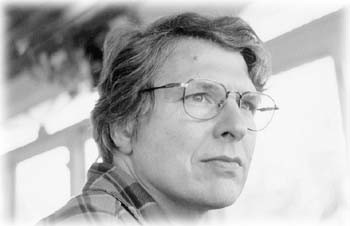
By the Books: English professor Alan Williamson uses poetry to understand the practice of mindfulness.

Zen and the art of poetry

WHAT DO THE TEACHINGS of Buddha, the scholarly leanings of U.C. Davis English professor Alan Williamson, and the understanding of chronic pain experienced by physician Jon Kabat-Zinn all have in common with the work of poet T. S. Eliot?

As the Buddha himself might once have said: Shucks, a lot.

While Buddha will be there in spirit, Williamson and Kabat-Zinn–who was recently featured in the Bill Moyers PBS special Healing and the Mind–are gathering in the flesh March 22 to discuss the practice of Buddhism and Hinduism in connection to Eliot’s Four Quartets. Planning a day of meditation and discussion, the two will select passages of poetry for contemplation as well as lead conversational forays into the relevancy of Eliot’s writing to the practice of Zen.

“One reason that both John and I wanted to do this,” Williamson says thoughtfully by phone from his Berkeley home of this upcoming event, “is because in some circles there’s too much expectation that you’ll get to a grand, soulful freedom easily from Zen, and that it comes most naturally to those who are originally rather mellow and at ease with themselves. I think that that’s not often the case.

“I think that people are often driven to a spiritual practice because there is a lot inner angst and pain in their lives.”

Published in 1943, while London was shuddering under the German blitzkriegs of World War II, Four Quartets takes the musical rhythm of a concert piece and renders the inward, intellectually informed, and illuminatingly difficult work for which this writer is revered. Part of a vast body of writing that includes The Wasteland and The Love Song of J. Alfred Prufrock, as well as many volumes of criticism, Four Quartets is generally acknowledged as being one of this master poet’s masterworks.

Friends since their undergraduate days, Williamson and Kabat-Zinn roomed together while pursuing postgraduate work, sharing a love of poetry among other interests. Both eventually came to the Buddhist path for enlightenment. Discussing Eliot in terms of their spiritual experiences has been a natural meeting place.

“A lot of the experience in the Four Quartets has parallels to meditative experience,” Williamson continues. “That is, the idea that there’s a kind of stillness at the heart of all of the motion of the world, and also the idea of moments of illumination or insight that take us out of the dulled state that we’re usually in in everyday life; how we can prolong that by an attentiveness to our lives even when we’re not feeling illuminated. All of that seems very relative to what people experience as they take up a meditative experience.”

Possessing an intimate knowledge of the poet that few can boast, Williamson’s father was an Eliot scholar, and Williamson–whose scholarly essay My Father’s T. S. Eliot and Mine has won him acclaim–was introduced to the great man when he was but a lad of 7. What does he remember of this once-in-a-lifetime experience?

“I remember his knees,” Williamson chuckles of the American-born poet. “I remember being told that he was British–he was represented to me as British–and that British people had very stern standards of how children should behave. I knew that he was a very famous man, and I remember coming up and looking at his knees and extending my hand up to shake hands.”

Grey flannel knees, one presumes.

“Yes,” Williamson laughs.

Agreeing that there are many other poets to whom he and Kabat-Zinn could tie an investigation of art and mindfulness, the question arises: Why Eliot and Zen? “He converted to the Episcopal Church and was devoutly religious,” says Williamson. “But at an earlier stage in his life, when he was studying philosophy at Harvard, he had gotten very interested in Hindu and Buddhist texts. In the first of the Four Quartets, he refers to the lotus–which is the sacred flower of Hinduism and Buddhism–along with the rose, which is the sacred flower of Christianity.

“There seems to be a kind of deliberate eclecticism and a desire to speak to an audience that includes non-Christians as well as Christians.”

Alan Williamson and Jon Kabat-Zinn appear in a benefit for the California Diamond Sangha on Saturday, March 22, from 10 a.m. to 5 p.m. Luther Burbank Center, Concert Chamber, 50 Mark West Springs Road, Santa Rosa. Tickets are $55; bring a copy of Four Quartets and lunch. 763-9466.

From the March 20-26, 1997 issue of the Sonoma County Independent

This page was designed and created by the Boulevards team.
© 1997 Metrosa, Inc.

Sonoma Radio

0

Air Wars

By Greg Cahill and Gretchen Giles

THE RADIO GODS giveth and the radio gods taketh away. Faster than you can say Arbitron, Sonoma County went overnight last week from a three-country FM station market to a three-oldies FM station market. Well, actually, one oldies–KMGG (97.9-FM)–and two classic rock–KHBG (96-FM) and KGRP (100.9-FM)–stations. But we’ll leave it up to the programmers to handle the fine tuning.

What’s it all mean?

First a little history–and don’t pay too much attention to the alphabet soup; it all changes before the end of the story anyway. Last year, KRSH owner Fred Constant announced that he was starting a new venture–KRZY–to go boot-to-boot with local country radio heavyweight Q105. “We think we can create a country station that will have lots of fun and excitement and that will be uniquely different in this market,” Constant told the Independent last May.

Meanwhile, four local stations–KSRO, KXFX, and KLCQ, owned by Fuller-Jeffrey Broadcasting of Massachusetts; and KMGG, owned by Pacific Radio of Santa Rosa–were purchased by the Amaturo Group of Fort Lauderdale, Fla. Two other new local stations–KJZY of Sebastopol and Healdsburg’s KHBG (known as the Bridge)–also hit the local airwaves.

And then country-oriented KFGY (92.9-FM)–Froggy–hopped into the market.

Three country radio stations and you still couldn’t find skewed Texas singer-songwriter Lyle Lovett on the dial.

To appreciate the latest twist, you have to note that Froggy metamorphosed from the aforementioned KLCQ, a classic rock station that pumped out a steady diet of Tom Petty, Joan Jett, and other ’60s, ’70s, and ’80s FM staples.

Thanks to an aggressive $100,000 marketing campaign that targeted a younger (25- to 44-year-old) audience and included a decorated Froggy-mobile and a Frog-zilla mascot, KFGY handily won the upstart slot in the local country radio market.

Then Constant and the owners of KHBG–which had gone on the air last January with programming that leaned toward Sting, Natalie Merchant, and other modern adult contemporary acts–did separate marketing surveys. Guess what? They both concluded that the county needed a classic rock station to fill the void vacated by KLCQ when it went country.

Say hello to the Grape–KGRP (formerly KRZY, which is broadcast from a tower atop Mount St. Helena in Napa County and housed in an old railroad car in Santa Rosa)–and a revamped KHBG, which has traded in its slick Euro-pop for Chicago’s greatest hits.

“The research showed there was a hole in the market for classic rock,” explains KHBG’s new general manager Kent Bjugstad, who jumped ship a couple of weeks ago from oldies station KMGG. “I guess [KGRP] did the same research and came to the same conclusion.”

These days the Bridge is shooting for a slightly more mature audience (30- to 45-year-olds) and plans to offer the Doobie Brothers, Bruce Springsteen, the Eagles, Elton John, Dire Straits, the Cars, and other tracks rooted in the ’70s.

Over at the Grape–simpatico in name with Wine Country Radio owner Fred Constant’s other local radio venture, the Crush–consultants found the same hole. And they’re going to fill it with, well, pretty much the same programming as at the Bridge.

“The Grape will be a hit-oriented radio station,” says Constant, who believes that the country radio market is shrinking. “We did a very sizable research project . . . and since there already were three country stations here, we decided to change.”

That’s fine by Froggy owner Lawrence Amaturo. “Sonoma County residents are listening to country,” he says. “Nationally, it’s true that country is waning [in the urban markets], but in the rural markets such as this, country is thriving. In only five months, Froggy has matched Q105 [in the ratings] and exceeded [the now defunct] KRZY by six times. We have a superb signal and we encourage people to find us.

“As with real estate, in radio there is only one key: signal, signal, signal.”

Stay tuned for updates.

From the March 20-26, 1997 issue of the Sonoma County Independent

This page was designed and created by the Boulevards team.
© 1997 Metrosa, Inc.
Project Censored

0

Uncensored


George Lange

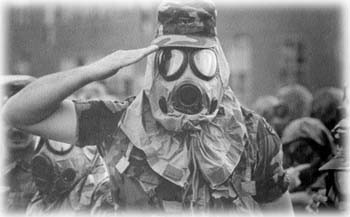
Un-ease, Soldier: Sorry, private, did we forget to mention that deadly radiation?

All the news that gave ’em fits

Edited by Greg Cahill

IT WAS A GOOD YEAR for censorship. One of the most provocative stories of 1996–the San Jose Mercury News series about possible CIA connections to the nation’s inner-city crack epidemic–received more than the usual derision from the media czars at the New York Times and the Washington Post. Those two influential dailies went out of their way to discredit journalist Gary Webb, who had reported new revelations about the alleged link between America’s national security agency, ultra-right wing Contra insurgents, and drug traffickers.

But for fans of Project Censored–the annual review of the year’s most underreported stories compiled by the Sonoma State University­based media watch group founded in 1976–the CIA/cocaine story is old news. It had been the topic of several alternative news stories selected for Project Censored’s 1989 Top 10 list.

“Most of the stories that aren’t covered represent decisions by the powerful corporations and governments in our society that potentially impact us one way or another,” says Project Censored director Peter Phillips, who took over the post this year from founder and SSU professor emeritus Carl Jensen. “These are stories that are not being fully discussed by the press that is controlled by the powerful themselves.”

This year’s list was culled from hundreds of entries by 125 SSU faculty, students, and community experts. The final lists are selected by a national advisory panel that includes, among others, author Susan Faludi; UC Berkeley professor emeritus Ben Bagdikian; Judith Krug of the Office for Intellectual Freedom, American Library Association; and Frances Moore Lappé of the Center for Living Democracy.

Project Censored formally will announce this year’s 10 most censored stories of 1996 on Tuesday, March 25, at 7 p.m. at the Evert B. Person Theater on the SSU campus. Gary Webb will be the keynote speaker. Admission is $5/general, and $3/students. A reception will be held at 6:15 p.m.

Here are this year’s finalists:

1. Nukes in Space

The world press had fun with the Chicken Little scenario last year when a Russian space probe packing 200 grams of plutonium-238 broke up in the atmosphere and crashed into the South Pacific. But the news media paid very little attention to NASA’s plan to launch the Cassini probe this year loaded with 72 pounds of the same deadly radioactive substance.

But Saturn-bound Cassini won’t be America’s first use of plutonium-238. At least two other missions–which have received a lot of coverage for their groundbreaking scientific impact, but not for their payload–also carried the isotope to power their batteries in the frigid regions of space. The Galileo probe was launched in 1989 with 49.25 pounds of plutonium on board, and the Ulysses space probe, launched in 1990, carried 25.6 pounds.

Cassini doesn’t have enough propulsion to get it to the gaseous giant, so NASA will slingshot the craft around Venus and buzz Earth at a speed of 42,300 miles an hour and an altitude of just 312 miles (some three times the speed of and at about the same altitude as a space shuttle orbit), using the gravitational pull of our planet to boost Cassini’s speed for its long flight through the solar system.

The problem? If Cassini comes too close to Earth during its fly-by, it could burn up in the atmosphere and rain deadly radiation across the planet. According to the NASA environmental impact statement for the mission, “Approximately 5 billion of the estimated 7 to 8 billion world population at the time of the swingby could receive 99 percent or more of the radiation exposure” if there is an inadvertent re-entry of the probe.

Here’s the catch. The plutonium is not a necessity for the mission, according to science writer Karl Grossman. The plutonium will generate a mere 745 watts of electricity to run scientific instruments, a task that could be accomplished with solar energy technology expected to be available within five years.

Sources: Covert Action Quarterly, Summer 1996; Progressive Media Project, May 1996.

2. Shell’s Oil, Africa’s Blood

In the wake of Nigeria’s execution of nine environmental activists involved in protests against the Royal Dutch/Shell Group in southern Nigeria’s Ogoniland, including Nobel Prize winner Ken Saro-Wiwa, evidence has mounted that the Shell Oil Co. not only failed to use its influence to prevent the unjustified executions, but also contributed to unfair trials for the activists.

The protests began in October 1990 when Nigerian villagers occupied part of a Shell facility, demanding compensation for farmlands that had been destroyed by Shell. Military forces summoned by Shell’s division manager fired on the crowd, killing nearly 80 people and destroying or severely damaging 495 homes. A Nigerian court later called the protests peaceful. Shortly afterward, Saro-Wiwa formed a movement to continue protests against Shell. Still, Saro-Wiwa and the others later were charged with fomenting civil unrest.

According to opposition activists, Shell’s managing director offered to stop the executions only if Saro-Wiwa would cut a deal and call off the protests. He refused and Shell did not intervene. Meanwhile, the Village Voice reported that two key prosecution witnesses were offered bribes by Shell officials to give unjustly incriminating statements against Saro-Wiwa and that the oil giant has been bankrolling the Nigerian military’s efforts to quash the protests.

In response, Shell has launched an international publicity campaign to combat the negative reports.

Nigeria’s government, under the dictatorship of General Sani Abacha, gets 90 percent of its foreign revenue from oil exports. The United States, home to the Houston-based Royal Dutch/Shell Oil Co., imports about half of Nigeria’s oil.

Sources: San Francisco Bay Guardian, Feb. 2, 1996; Texas Observer, Jan. 12, 1996; Editor & Publisher, March 23, 1996; World Watch, May/June 1996; Bank Check, Feb. 1996.

3. Minimum Wage Scam

Big perks for the wealthy were hidden in legislation that boosted the federal minimum wage last year from $4.25 to $5.15 an hour. In fact, the Small Business Job Protection Act of 1996 harbored at least 10 significant provisions that helped neither the owners of small business nor their employees.

The new bill helps the rich by eliminating a surtax on yachts, luxury vehicles, and one-year pension withdrawals over $150,000. It also reinstates tax incentives that encourage leveraged buyouts axed by Congress in its 1986 tax reform legislation and retroactively allows companies to claim tax deductions for exorbitant fees paid to investment banks and advisers. It also weakens retirement and pension protection by eliminating the requirement that companies must offer the same benefits to lower-wage employees as to higher-wage employees.

Source: The New Republic, Oct. 28, 1996.

4. Secret War on Activists

American corporations are spending millions on public relations firms and false non-profit organizations that target activists and legislation considered bad for big business. Most of these bogus organizations focus on labor, environmental, and consumer issues.

Through the PR industry, these companies mobilize privates eyes, lawyers, and undercover spies; influence editorial and news decisions; launch phony “grassroots” campaigns; and use hi-tech information systems to manipulate public opinion and policy.

For example, the Health Insurance Association of America not only supported but created the Coalition for Health Insurance Choices to defeat the Clinton administration’s attempt at health-care reform. In the environmental arena, “greenwashing” corporations are using “Astroturf lobbying” to create synthetic grassroots movements.

These anti-public interest campaigns generate the false impression of public support. As a result, dissenting voices are muffled, scientifically proven unhealthy chemicals and practices are legalized, and public opinion is profoundly influenced.

Sources: Covert Action Quarterly, Winter 1995/96; Earth Island Journal, Winter 1995/96.

5. Corporate Crime Whitewash

White-collar crime costs America 10 to 50 times more than street crime, yet the federal Department of Justice takes little interest in the problem. Meanwhile, the U.S. Chamber of Commerce and the National Association of Manufacturers continue to complain that corporations are burdened by heavy-handed regulations and are calling on Congress to scale back environmental, health, and safety laws.

Based on DOJ records, the federal government almost never brings criminal charges against big businesses. Of the more than 51,000 federal criminal indictments filed in 1994, only 250–less than one-half of 1 percent–involved criminal violations of the nation’s environmental, occupational health and safety, and consumer product-safety laws.

In 1987 alone, 50,000 to 70,000 workers died prematurely from on-the-job exposure to toxins, roughly triple the number murdered the same year.

Source: Covert Action Quarterly, Summer 1996.

6. Big Banks, Big Risks

In 1995, record bank mergers–that saw Chase Manhattan and Chemical Bank join to create the nation’s largest bank with $300 billion in assets, and First Interstate and Wells Fargo create a giant $100 billion bank–led to the huge consolidation of the America’s banking resources.

The reason: The Federal Reserve has failed to apply a requirement to test how well the public is being served by the mergers. The result: 71.5 percent of U.S. banking assets are controlled by the 100 largest banking institutions. The implication: a banking system in which big banks are acquiring “too big to fail” status. The federal reserve requires that banks cover just 1.25 percent of insured deposits. Consequently, the bailout of a megabank would come straight from taxpayers’ pockets.

Worse yet, the trend toward megabanks is closing out community access and making it harder to get loans.

Source: Multinational Monitor, June 1996.

7. Cashing in on Poverty

Corporate America is reaping the rewards of a poverty business that preys on the destitute. An estimated 60 million poor people in the United States, without bank accounts or access to competitive-rate loans, must rely on pawn shops, check-cashing outlets, rent-to-own stores, finance companies, and high-interest mortgage lenders.

Those businesses generate $200 billion to $300 billion in annual revenues and are increasingly owned or subsidized by such Wall Street giants as American Express, Bank America, Citibank, Ford Motors, and Western Union.

The enterprise is so lucrative that in 1993, Ford Motors derived three-fifths of its earnings from car loans, mortgages, and consumer loans–outstripping its car sales division. In fact, non-bank finance companies like Ford make small loans at rates as high as 300 percent in some states.

Source: The Nation, May 20, 1996; Houston Chronicle, July 15, 1996.

8. Big Bro’ Goes Hi-Tech

New technologies are placing large segments of the population under surveillance in a trend that is making social satirist George Orwell’s predictions a reality in the so-called free world.

In Britain, nearly 150,000 closed-circuit TV cameras are monitoring the population with powerful zoom lenses that can read a cigarette pack label from 100 yards.

Another type of camera under development can penetrate clothing to search for concealed weapons without the knowledge of the target. The manufacturer of that device reports that he has been flooded with calls from interested law enforcement agencies, though the device has raised new questions about its violation of the Fourth Amendment, which protects against unreasonable search and seizure.

Meanwhile, new biometric technologies, already being tested by U.S. Immigration authorities, can measure such personal characteristics as fingerprints, retinal patterns, and the geometry of the hand.

Sources: Covert Action Quarterly, Spring 1996; Insight, Aug. 19, 1996.


George Lange

No Tanks: The U.S. Army used depeleted uranium shells in the Gulf War. Just one catch: Nobody bothered to tell the tank crews about the danger.

9. Gulf War Glow

During the Gulf War, the U.S. Army deployed depleted uranium weapons, used to penetrate tanks and other armored vehicles, for the first time on the battlefield without warning troops about possible dangers of contamination.

While the Pentagon, Congress, and veterans’ groups debate whether chemical and biological weapons contributed to so-called Gulf War syndrome, the atomic connection went largely unreported.

A memo warning that tank crews should regard targets hit by the hardened DU penetrator rounds as contaminated wasn’t issued until eight days after the end of the 1991 air and ground conflict. Unaware of the danger, the 144th Army National Guard Service and Supply Company performed DU cleanup for three weeks in Kuwait and southern Iraq, where the U.S. Army fired at least 14,000 rounds of DU ammunition.

According to Nuclear Regulatory Commission records, steady transfers of DU shells have been flowing to Britain, France, and Canada during the past decade.

Sources: Multinational Monitor, January and February 1996; Swords to Plowshares, Nov. 7, 1995; The VVA Veteran, March 1996; National Catholic Reporter, Jan. 1, 1996.

10. Facing Global Hunger

The world’s stock of rice, wheat, corn, and other grains has fallen to its lowest level in two decades, leading to projections that world grain prices will double by 2010.

This slide from surplus to scarcity parallels the increasing diversion of water from crop irrigation to use in crowded cities. Thus, as the world population grows and there are more hungry mouths to feed, there also is less land and water available for cultivation of food supplies.

In developing countries, the food shortage will become even more acute because the November 1996 World Food Summit–convened for the first time in 22 years by the U.N. Food and Agricultural Organization–decided that poor countries will be responsible for feeding their own people without the aid of wealthier nations.

However, the World Bank and FAO’s predictions of continuing surpluses contradict those of the Japanese Ministry of Agriculture and other observers, leading to difficulty in mobilizing support for investment in agriculture or family planning that could stabilize population growth.

Source: World Watch, November/December 1995.

From the March 20-26, 1997 issue of the Sonoma County Independent

This page was designed and created by the Boulevards team.
© 1997 Metrosa, Inc.
The Scoop

Brass Balls

By Bob Harris

BILL CLINTON announced this month that the corruption caused by private campaign financing can be solved by requiring broadcasters to provide free TV time to candidates. The president suggested that such a measure would help “free our democracy from the grip of big money.”

What he didn’t add is that a grip, applied two ways, is called a handshake.

Just hours after making the proposal, Clinton attended a $25,000-a-plate swordfish dinner in the Crystal Ballroom of the Carlton Hotel. In exchange for some grins with the guests and a couple of Kodak moments, Clinton raised over half a million dollars–90 percent of which would have been illegal under the man’s own guidelines.

Brazen? It gets better. As the speculators and land sharks savored their candied chestnut ice cream, Clinton actually rose up and speechified about the need for reform, saying that “there is much more to do.” Besides looking in the mirror, apparently.

We’re talking serious brass. I’m surprised the TV mikes don’t pick up the rhythmic clanking when the president jogs.

Why the lip service? Needing to happy-face the daily revelations about White House fundraising–go to the side door, small bills only, ask for Lenny–Clinton is cleverly trying to lower the heat by posing as a do-gooder, advocating a populist reform that he knows has zero chance of happening in the near term.

Make no mistake, the free TV proposal would help, and it’s entirely doable, at least hypothetically. New legislation isn’t even necessary; the FCC can mandate free time for political candidates whenever it wants. (The mythical “free market” doesn’t apply here, since the broadcast industry wouldn’t even exist without government-protected monopolies over individual frequencies.)

Not that such a mandate is likely. You’re asking for concerted altruism from a bunch of silk-suited politicians and TV execs. You might as well ask a humming swarm of locusts to play “Kumbiya.”

See, the Democrats want to keep the White House in 2000, which means Al Gore is about to eat more seafood dinners than Moby Dick. As will Kemp, Gramm, and the other whales of the GOP.

Once that first 50 million or so is burning a pocket hole, where do you think Al’s gonna blow it? As you’ve probably realized, the ultimate recipient of much of the money spent in political campaigns is TV itself.

Next election season, go visit a TV station and sit in the lobby for an hour or two. You’ll see an amazingly constant stream of opposing campaign staffers buying time and dropping off their latest attack ads and rebuttals. As you’d imagine, the more panicky the one-upmanship gets, the calmer the station bean counters become.

It’s like watching a poker game where no matter who raises the bet, the casino gets to keep every chip.

In turn, the medium reinvests a big chunk of cash in candidates who favor proposals to make the Murdochs and Perelmans even richer. Clinton himself was financed last year in large part by Time-Warner, which, you’ll notice, was the one media company Bob Dole consistently singled out for verbal abuse.

You think Clinton and Gore are gonna turn their backs on that cash by pushing the FCC to mandate free ad time? Sure, and Chevy Chase is just in a creative lull.

Predictably, the National Association of Broadcasters doesn’t care for the idea of giving away what they can sell, and losing the influence the ad money buys. So they’re ready to start using their government-granted monopolies to synonymize private financing of TV ads, “free speech” (for those who can afford it), and the American flag until we’re all half-convinced that Paul Revere brought coaxial cable to Concord and the Boston Tea Party was hosted by ex-Playboy bunny-turned-MTV hostess Jenny McCarthy.

Free TV for candidates simply can’t fly if the medium won’t give it air.

Besides, there’s only one real long-term solution–a public campaign financing system. Getting it will require citizen activism on a civil rights scale.

Which sounds like a big deal, but it’s not asking much. We’ve no right to expect a healthy democracy until we behave as though we actually have one.

From the March 20-26, 1997 issue of the Sonoma County Independent

This page was designed and created by the Boulevards team.
© 1997 Metrosa, Inc.
Talking Pictures

0

Feeling Lost

By David Templeton

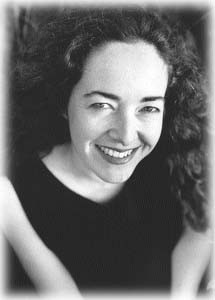
Writer David Templeton takes interesting people to interesting movies in his ongoing quest for the ultimate post-film conversation. This time out, he escorts author Naomi Eppell to see David Lynch’s unfathomable new creep show, Lost Highway.

Just ahead of us, a young man is chatting with the ticket taker–apparently steeling his courage before heading in to the theater to see Lost Highway–the latest cinematic oddity from director David Lynch (Blue Velvet, Twin Peaks).

“So,” he asks brightly, “is it really as weird as I’ve heard?”

The ticket taker shrugs. “Abandon all reason,” he ominously suggests. “Try think of it as a dream. It kinda makes sense that way.”

Two hours later, as the film concludes, we know exactly what he means, though in the professional opinion of my guest–author and dream expert Naomi Eppell–the word nightmare might be more accurate.

Eppell is the author of the captivating book Writers Dreaming (Random House, 1994), an exploration of the connection between the dreams and the literary work of writers such as William Styron, Anne Rice, Stephen King, and Isabelle Allende.

“OK. You tell me the story of the movie, as if it were a dream you had. First person. Go on,” Eppell says as she and I are seated at a small outdoor cafe. After 30 minutes of intense discussion over coffee and biscotti, we have yet to make any logical sense out of the adulterous mayhem of Lost Highway. Now–having exhausted all traditional means of conversational exploration–we will attempt to interpret the film as if it were a dream. I take a deep breath.

“I dreamed I was a saxophone player,” I say slowly. “I was played by Bill Pullman. Everything was wrong and off kilter. My wife was Patricia Arquette, and her lipstick was always smeared.”

“Tell it in the present tense,” Eppell suggests. “That’s the best way to remember a dream.”

“I am now talking with the Devil at a party,” I continue. “He has no eyebrows. I go home and find another video. This one has me covered in my wife’s blood. She’s lying in pieces beside me. Suddenly I’m in prison with a terrible headache. I wake up, and I’ve turned into Balthazar Getty.” The details of the movie are beginning to grow fuzzy in my mind. I remember something about a pornography ring and a cabin burning in reverse.

“We’re both already forgetting it,” Eppell laughs. “It is like a dream. A very paranoid dream, probably about suspicion and not trusting your own instincts.”

She nibbles her biscotto, then says, “I think the reason that it works as a dream but not as a movie is that those symbols are personal to David Lynch and [screenwriter] Barry Gifford. They haven’t taken the step of translating it into something that we, as viewers, really care about. Its got a lot of provocative imagery, but those symbols are their symbols. They don’t add any coherence–which is what art is supposed to do.²

“So, as a dream,” I ask, stirring my coffee, “would you think the dreamer was working through normal anxieties or is he a dangerous psychotic?”

“Well, we’re all psychotic,” she laughs, “when we dream, anyway.”

“Pardon me? We’re all psychotic in our dreams?”

“Sure. What makes someone psychotic is that their filters are off, right? They are not able to filter information, to make sense of it, to sort it out. I think that that’s true in dreams, where information and images are coming in raw. You’re not filtering things with logic. You’re just throwing things out in symbolic form, without the filters. That’s how the unconscious works, and I think that’s how this movie is structured.

“For example,” Eppell continues, “I had a dream the other night that had something to do with fruit. Preserved fruits and ripened fruits. And then I was at a party looking for a dentist to check my teeth. I think it all had to do with transition out of the marriageable stage as a woman. It was an exploration of that theme. I mean–there were cherries and tomatoes, and bananas, right? And it made no logical sense. But it was a useful dream. An interesting dream. As a movie, it would be awful.”

“Imagine what Lynch might do with those symbols,” I tease.

“But he wouldn’t,” she counters. “Cherries and bananas and dentists are my symbols. Burning cabins and dismembered women and the Devil with a camcorder–those are his symbols. As far as the dream-movie he’s made, I can’t guess if it was cathartic for him or not. But it does explore ideas in a very filters-off way, which is interesting, if not very enjoyable.”

We’ve now spent the better part of 90 minutes on Lost Highway. I personally am exhausted and can’t help but wonder if conversations like this weren’t precisely what Lynch and Gifford hoped to inspire.

“I’m sure that David Lynch finds a lot of beauty in the movie,” Eppell adds. “Then again, I think Lynch’s idea of beauty is probably different from that of the rest of us, don’t you think?”

Web exclusive to the March 20-26, 1997 issue of the Sonoma County Independent

This page was designed and created by the Boulevards team.
© 1997 Metrosa, Inc.
Cynthia Lamb

Family Secrets


The Devil Made Her Do It: Cotati author Cynthia Lamb’s new novel traces her heritage.

Photo by Joshua B. Rosten


Cynthia Lamb shakes her family tree

By Gretchen Giles

TALK ABOUT your closet full of skeletons. While some families may admit to an adulterer or two, an attic-bound mad aunt, or the occasional homicidal maniac, Cotati writer Cynthia Lamb finds herself in direct lineage to the Devil. The Jersey Devil that is, the bogeyman of the Eastern Seaboard, feared through the centuries by over-mothered children who have been told that if oatmeal isn’t eaten, bedtime not observed, the Jersey Devil will come sweeping from the boggy swamps and carry them away.

“It’s a little bit like saying that you’re related to Bigfoot,” Lamb laughs merrily. “Because it’s just this creature that lives in the pine barrens and scares little children.”

Legend has it that Lamb’s maternal ancestor Deborah Smith–a woman of noted healing and witching abilities–came to these shores from England in 1704, betrothed to Japhet Leeds, a man whom she had never met. She bore him 12 children without unusual incident, but then came unlucky baby No. 13. According to lore, the middle-aged Deborah invoked the name of the Devil during the agony of her last child’s birth. When the umbilical cord was cut, the babe grew from infant to man to green-scaled monster in a matter of minutes. It flew the confines of the room, spouting the hot sulfurous breath of the underworld, finally crashing through the window while the midwife and other birth attendants dove to the floor.

By morning, the neighboring farms had been ravaged of their animals, the milk was curdled, the butter spoilt, and the legend of the originally named Leeds Devil had been born.

Lamb’s family name of Leeds was excised in 1939 when New Jersey formally adopted the Devil as its own state demon. Titling a professional ice hockey team after the monster was clearly the next logical step.

“My great-aunts and grandparents have always been proud of the legend, and they’ve kept it alive,” says Lamb, seated on the outside patio behind her country house. Pots of herbs and yet-to-bloom flowers are set low around her, the green vast fields of Cotati broken dully to the north by the newly built strip malls near the freeway. “But at this point in the popular folklore, the family connection has been lost for the most part. Historians and folklorists know about it, but not the general layperson.”

Lamb has set out to change all of that. Intrigued by the fantastic aspect of the legend as well as by her ancestor’s supposed healing and wiccan powers, she began historical research on her family while still in college. What she discovered was that Deborah Leeds, known respectfully as Mother Leeds, was a historical enigma. Curious about her powerful ancestor, Lamb endeavored to discover her in fiction.

The resulting novel, Brigid’s Charge (Bay Island Books, $14), traces Deborah’s early training in the wiccan path, following her across the Atlantic to the cold Jersey shores and on through her early dotage.

“I haven’t heard from the New Jersey clan yet,” says Lamb of her East Coast relations. “I’m chicken about it. They’ve always been proud of [their heritage], but Deborah’s pretty out there. No one’s ever told Mother Leed’s story before. It’s one thing to have a single line in a [historical record] that says that Mother Leeds was a healer and a witch; it’s another thing to have a whole book that makes her a heroine.”

Exhaustively researched, the project took Lamb nine years to complete.

“The book really wrote itself,” she smiles, “and I like to live with my characters for a long time. One of the advantages I think of setting it in a Quaker community is that they were so progressive that they do seem modern. I read their journals, and the women had the same concerns that modern women would have. Not our generation per se,” says the 34-year-old Lamb, “but the generation before: When a woman would preach, she often would go through a lot of the same self-doubting of her worthiness that the feminists of the ’70s went through. So it does have a modern feel to it. I always thought that was helpful; it’s authentic.”

Most authentic of all is Mother Leeds, a woman uneasily accommodating her affection for another woman; a midwife and a healer; a pagan who can feel the bloodlines pulsing through trees. “She just came to me,” Lamb says. “I have very little information about her specifically. I hope that there is a [diary] out there in someone’s attic and that person will write to me and say, ‘Here it is.'”

Planning a sequel to Brigid’s Charge set some 100 years after the Devil’s first arrival and concerning Deborah’s great-great relatives, Lamb continues to write without outline or plan, allowing the characters and plot to happen as they wish.

“What I’m really in awe of is that I sit down and I don’t know what’s going to come out, and then a few hours later I have a chapter,” says Lamb. “And that’s how I wrote Brigid’s Charge, I didn’t plan any of it. I think that what’s exciting about the writing process is not knowing what’s going to happen next, so that I’m in the same place as the reader. I love that. I love that.”

From the March 13-19, 1997 issue of the Sonoma County Independent

This page was designed and created by the Boulevards team.
© 1997 Metrosa, Inc.

Psychedelic Mushrooms

Natural High

By Gretchen Giles

IN AN INTERVIEW published in the June 1993 issue of New History magazine, Marin author and LSD pioneer Terence McKenna (True Hallucinations) posits that because the human race sprang from the Psilocybe-rich grasslands of Africa, eating the psychedelic mushrooms appearing on dunghills and in the savanna was an early way of life.

They were a foodstuff, not just some leathery dreck to be choked down by college students. The resulting and continuous acts of mental alteration, McKenna asserts, brought a depth of understanding to our early ancestors that allowed them to create a society based on orgiastic mating–preventing fathers from claiming any particular baby as their own, thus creating a community family–an absence of gender domination, and an opportunity to create such far-seeing human attributes as ethics, morals, aesthetic values, language, and altruism.

The Ice Age put a chill on all of that, he notes, changing the ecosystems that supported the mycological magic, and evolving darkly into what McKenna terms “a very neurotic and repressive social style . . . which is typical of Western civilization.”

And oh lucky us, we’re stuck with it. But with a well-informed eye and some free Sunday afternoon time, it is possible to find a bit of that earth-connected wonder right at home without killing yourself in the picking process.

Noting that psychedelic mushrooms are difficult to find in the wild, Washington state mycological specialist Paul Stamets suggests in his philosophical field guide Psilocybin Mushrooms of the World (Ten Speed Press, $29.95) that they are actually more readily found growing right outside the condo door.

As hardy and adaptive as cockroaches, fungi containing psilocybin have reacted through the ages with a “can’t beat ’em join ’em” response to the human desecration of former habitats. Stamets recommends nosing around in decorative garden bark, pawing through the ground coverings surrounding electrical substations, and discreetly peering through the plantings outside the town courthouse and police department (spores drop off arrested “psychonauts,” as Stamets terms them)–all excellent places to find psilocybin mushrooms.

But don’t put anything in your mouth yet. Part polemic (according to Stamets, he once correctly predicted a flood while high and believes that psilocybin ingestion connects one to the fibers of the organic universe), part tips for trippers, and big part standard field guide, Psilocybin Mushrooms of the World reminds the gentle reader that possession and ingestion of the fungi are illegal (and Ten Speed Press devotes an entire page to tiptoeing away with its attorneys) and that misidentifying one can be deadly. Stamets then proceeds to detail exactly how to find, identify, store, ingest, and enjoy this ritualistic
substance.

Writing with the verve of a geeky-cool biology student–genus and phylum play a dizzying role here, though a complete layperson’s glossary is provided–Stamets admits to using magic mushrooms only once or twice a year for psychically purgative effects and nicely offers his wife’s recipe for brewing up a heady, fungus-infused tea.

Safety plays a large role in this book’s focus, with Stamets reserving an entire chapter to the discussion of such deadly caps as those in the Galerina genus, which possess many of the same physical characteristics of potentially hallucinogenic mushrooms but bark much bigger for the bite. The presence of psilocybin in a safe mushroom, he explains, is often indicated by the stem acquiring a bluish stain upon being pressed and by the dark purplish color left when the cap is pressed against white paper.

Stressing that this natural drug is not to be taken lightly, Stamets offers dosage suggestions based on weight and such extenuating circumstances as mood, diet, and life problems. One to two grams of dried mushrooms are a good beginning, he says, and more can be taken after an hour or so for a deepened effect. Other tips for tripping include being in a safe environment with those whom you trust, informing an experienced mushroom lover who is not joining you about your plans–and, if you have dogs, include them.

“Dogs seem to know when you are tripping,” he writes with the assurance of one who knows his audience. One caveat: If you think you hear Rover telling you so, then you’ve taken too much.

From the March 13-19, 1997 issue of the Sonoma County Independent

This page was designed and created by the Boulevards team.
© 1997 Metrosa, Inc.

Taqueria Santa Rosa

La Familia

By Michael Hirschberg

WITHOUT DOUBT, the success of Sonoma County’s wine industry has caused the emergence of many topnotch local restaurants; great wines create a demand for great cuisine. The fame of such local favorites as John Ash, Lisa Hemenway’s, and Willowside Cafe (to name only a few) has helped to make our area a mecca for food and wine aficionados.

That said, one must allow that one does not live on goat cheese or foie gras alone. Sometimes the most satisfying meals are found at the simplest of places. We locals know that while some may consider a white tablecloth prerequisite to “fine dining,” it certainly is not an essential part of dining well.

High on my list of life’s simple pleasures are the tacos served at the Taqueria Santa Rosa on Mendocino Avenue. Yes, the decor–an odd kitsch-mix of papier-mâché parrots, plastic chili peppers, video screens, and artificial flowers–is a touch bizarre, but much of the food coming out of the kitchen is sublime.

Day and night, the place always seem to be filled with an eclectic assortment of customers lining up to order at the long Formica counter. Spanish is spoken at one table, English at the next. Waitresses dart nimbly between the 11 tables, delivering food and drink in sync with the rhythm of the salsa and tejana music blaring from the jukebox.

The success of this establishment, now 10 years old, has spawned a small chain for the Sahagun family, who currently own and operate five taquerias in this area–three in Santa Rosa, including their new location in the Montecito Center, plus one in Sebastopol and another in Calistoga. Their simple slogan, “Real Mexican Food,” cuts right to the heart of their appeal, and the family’s natural instinct of providing genuine hospitalidad ensures that customers are well cared for.

At first glance, the extensive list of choices painted on the wall behind the counter seems no different than most standard Mexican menus–tacos, burritos, enchiladas, chiles rellenos, etc. Read more closely, however, and you’ll find all sorts of interesting choices.

“Many of the dishes such as menudo [tripe stew] and taco de lengua [tongue taco] were originally designed for our Latin customers, but now we find lots of other Americans ordering them as well,” says Lorena Anaya, daughter of the restaurant’s founder, Francisco Sahagun. “Of course, burritos are still our most popular selection,” she adds.

Let me say up front that I think burritos, as popular as they may be, are insipid and unimaginative: the equivalent of taking all the things on your dinner plate and folding them together into a nondescript pile. To sample what this kitchen does best, try one of the interesting seafood dishes introduced to the menu by Uncle Leobardo. Arguably the best is the ceviche tostada served with lime, avocado, and a bottle of pepper sauce. The coctail de camarones, combining sweet juicy shrimp with tomato, avocado, minced jalapeño, and lime in a tall parfait glass, is also a knockout.

But best of all is the pollo asado–grilled chicken. Unlike the bland boiled chicken featured in just about every Mexican restaurant from here to Tijuana, this chicken is firm, juicy, and flavorful. Piled into a soft taco and dressed with cilantro, onion, and salsa, it is spicy and sensational.

Indeed, it is the “Real Mexican Food” that sets Taqueria Santa Rosa apart from the crowd. A boastful sign by the serve-out window reads: “La competencia es buena, pero nosotros somos mejores” (Our competition is good but we are the best).

I won’t argue.

Taqueria Santa Rosa

1950 Mendocino Ave., Santa Rosa; 528-7956
Hours: Monday-Friday, 10 a.m. to 10 p.m.; Saturday-Sunday, 8 a.m. to 10 p.m.

Michael Hirschberg owns and operates Mistral Restaurant in Santa Rosa. He will occasionally offer a look at lesser-known Sonoma County restaurants.

From the March 13-19, 1997 issue of the Sonoma County Independent

This page was designed and created by the Boulevards team.
© 1997 Metrosa, Inc.

Ezines

0

‘Zine Scene


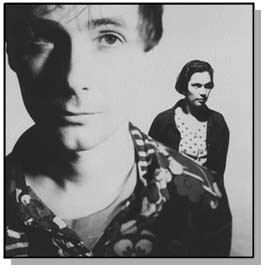
U is for Unusual: Stereolab members answered ‘Ultra’ zine’s alphabetical interview.

Online music mags on the rise

By Matt Galloway

MICHAEL GOLDBERG would like nothing more than for you to never get another paper cut from a music magazine. In fact, the savvy West Coast entrepreneur and former Rolling Stone scribe would prefer that you never flipped through a conventional music publication ever again.

As editor, publisher, and founder of the Internet-only music magazine Addicted to Noise, Goldberg has made it his business to avoid the paper industry altogether. Online since December 1994 and averaging 400,000 visits per month, ATN balances a slate of daily music news with a monthly issue packed with interviews, reviews, and essays by journalism heavyweights Greil Marcus and Dave Marsh.

While countless “real” magazines and newspapers flip their regular content onto a Website, it’s the increasing number of publications that exist strictly within the Internet that are taking full advantage of the technology.

“From the start, the idea was that this would be the place to get news and information concerning rock and roll and pop culture,” Goldberg boasts.

With ATN‘s success as a sort of Rolling Stone of e-‘zines have come the expected cries of corporate meddling. Goldberg stands by the integrity of his magazine.”That criticism is uninformed and could only come from someone who doesn’t read the magazine daily,” snorts Goldberg. “Some guy in a suit isn’t going to tell me what to write about.”

Like their pulp kin, the Web pages of Addicted to Noise still manage to overlook huge swaths of the music underground. Search the Net and between the endless Star Trek and X-Files pages are a few gems like the superb, London-based music publication Silencer.

Silencer covers sacred ground, dealing with musicians on the edge of the rock frontier. The current issue offers interviews with the Dirty Three and Ui, as well as numerous reviews and think pieces.

The Belgian Web ‘zine Ultra takes a markedly less serious approach to similar music. Rather than the usual Q & A, members of Stereolab and studio curmudgeon Steve Albini are subjected to alphabetical interviews, where the victim comments on a word beginning with a chosen letter–A for analogue, B for breakbeat, C for Combustible Edison.

The UK’s Fly magazine deals almost exclusively in electronica and the rise of DJ culture. For jazz fans, Gallery 41 offers photos and interviews with avant-garde jazz musicians like Don Cherry, Sonny Simmons, and Vijay Iyer.

With the price of admission little more than the cost of dialing up a potential worldwide audience, publishers online have been quick to realize that they’ve got a good thing going here.

“Everything we’ve ever done is online,” laughs ATN’s Goldberg. “If you want to see everything we’ve written on Beck, you just type it in. [Without online], you’d have to have a closetful of Spin Magazines–and then find a few years to read through the stuff.”

From the March 13-19, 1997 issue of the Sonoma County Independent

This page was designed and created by the Boulevards team.
© 1997 Metrosa, Inc.

The Scoop

Big News

By Bob Harris

THIS WEEK, the papers are aflutter with a new study from something called the Coalition for Excess Weight Risk Education (now, do they mean the weight’s excessive, or the education?), which ranks 33 U.S. cities by the general heftiness of their populace.

Their findings? New Orleans should change its nickname to the Big Greasy, with a whopping 38 percent of its adult population clinically huge. Other burpin’ burgs include Norfolk, San Antonio, Kansas City, Cleveland, Detroit, Columbus, Cincinnati, Pittsburgh, and Houston.

At the tapered end of the tallow are Denver, Minneapolis, San Diego, Phoenix, St. Louis, and Tampa. The bad news here, as noted by coalition spokesman Dr. Roland Weinsier (whose name anagrams into “Inner lard, so weird”), is that even Denver, at 22 percent, is still gloopier than it should be.

Obviously, we’ve got a problem here. Obesity afflicts about a third of U.S. adults. Every year, about 300,000 of us kick from stuff like hypertension, heart disease, diabetes, cancer, and stroke. And like smoking-related deaths, most of this carnage is preventable.

Self-importantly, the coalition brags about bringing “new attention to this important public health issue, by providing insight into some of the factors that contribute to excess weight.” So says chairman Dr. Xavier Pi-Sunyer (anagram: “Sex? I pay driver, run”). Evidently, knowing the relative poundage of your hometown might actually mean something.

Don’t get your heart rate up just yet.

The report’s data come from about 20,000 people who self-reported their height and weight. Which means this whole deal probably measures vanity as much as health. There’s no way to tell if the numbers are true.

Moreover, the study was funded in part by pharmaceutical companies developing anti-obesity drugs. So there’s an agenda here: The fatter you feel, the more likely you are to take a pill.

That’s dangerous, too. For example, in California, shady clinics are handing out Fen-Phen weight control pills like candy, often without so much as a physical exam. Most patients seem to be losing weight OK; too bad about the 4 percent developing irreversible, fatal heart damage.

To make the report seem meaningful, the coalition’s researchers did what they term “in-depth anthropological research,” interviewing residents, reading the local papers, and watching people on the street. Just as you and I do every day.

Roll over, Louis Leakey. Here are some of their brilliant insights:

The weight level in Cleveland may be related to high-fat ethnic foods. Obesity in Dallas may result from the local preference for Texas-sized portions. Atlanta residents eat a lot of fatty Southern foods.

And so on. Major screaming, duh.

The adiposeurs also claim that obesity correlates with high unemployment, low income, and a lot of rain. Maybe so: Poor folks usually have to eat the cheap crap, and comfort munching can get you through a gloomy day.

However, since the data are fairly meaningless anyhow, we can also explain it a lot of other ways. For example: Five of the sludgiest cities are within 200 miles of my sister’s house in Akron. And she makes amazing pasta. The other five nosh pits have extremely active chapters of the Christian Coalition. So of course they’re fat–those people will swallow anything. (For the record, “Pat Robertson” anagrams into “Robot Parents.” Make of that what you will.)

On the other hand, the list of skinny cities indicates that thinness correlates to (a) losing the Super Bowl, or (b) having a team too lousy to make the NFL playoffs in the first place. Which makes sense–a weekly routine of cursing, throwing things, and kicking the dog involves every major muscle group.

What should be all over the news is this: Good health doesn’t come in a pill, good research doesn’t try to sell you something, and good newspeople check to see if a study is actually legit before duck-speaking its enormities.

If you’re fat and you want not to be, there’s one good way out. A while back, I lost 50 pounds by not eating garbage and by jogging every day for a year. It ain’t tasty, and it’s certainly not “in-depth anthropological research,” but that’s the recipe.

The best thing to do with extra padding? Burn it. Especially if it’s in your morning newspaper.

From the March 13-19, 1997 issue of the Sonoma County Independent

This page was designed and created by the Boulevards team.
© 1997 Metrosa, Inc.

Alan Williamson

Four-Square By the Books: English professor Alan Williamson uses poetry to understand the practice of mindfulness.Zen and the art of poetry WHAT DO THE TEACHINGS of Buddha, the scholarly leanings of U.C. Davis English professor Alan Williamson, and the understanding of chronic pain experienced by physician Jon Kabat-Zinn all have in common with the work of poet...

Sonoma Radio

Air Wars By Greg Cahill and Gretchen GilesTHE RADIO GODS giveth and the radio gods taketh away. Faster than you can say Arbitron, Sonoma County went overnight last week from a three-country FM station market to a three-oldies FM station market. Well, actually, one oldies--KMGG (97.9-FM)--and two classic rock--KHBG (96-FM) and KGRP (100.9-FM)--stations. But we'll leave it up to...

Project Censored

Uncensored George LangeUn-ease, Soldier: Sorry, private, did we forget to mention that deadly radiation?All the news that gave 'em fitsEdited by Greg CahillIT WAS A GOOD YEAR for censorship. One of the most provocative stories of 1996--the San Jose Mercury News series about possible CIA connections to the nation's inner-city crack epidemic--received more than the usual derision from...

The Scoop

Brass Balls By Bob HarrisBILL CLINTON announced this month that the corruption caused by private campaign financing can be solved by requiring broadcasters to provide free TV time to candidates. The president suggested that such a measure would help "free our democracy from the grip of big money." What he didn't add is that a grip, applied two ways,...

Talking Pictures

Feeling Lost By David Templeton Writer David Templeton takes interesting people to interesting movies in his ongoing quest for the ultimate post-film conversation. This time out, he escorts author Naomi Eppell to see David Lynch's unfathomable new creep show, Lost Highway.Just ahead of us, a young man is chatting with the ticket taker--apparently steeling his courage before heading in...

Cynthia Lamb

Family Secrets The Devil Made Her Do It: Cotati author Cynthia Lamb's new novel traces her heritage.Photo by Joshua B. RostenCynthia Lamb shakes her family tree By Gretchen GilesTALK ABOUT your closet full of skeletons. While some families may admit to an adulterer or two, an attic-bound mad aunt, or the occasional homicidal maniac, Cotati writer...

Psychedelic Mushrooms

Natural High By Gretchen GilesIN AN INTERVIEW published in the June 1993 issue of New History magazine, Marin author and LSD pioneer Terence McKenna (True Hallucinations) posits that because the human race sprang from the Psilocybe-rich grasslands of Africa, eating the psychedelic mushrooms appearing on dunghills and in the savanna was an early way of life. They were a...

Taqueria Santa Rosa

La Familia By Michael HirschbergWITHOUT DOUBT, the success of Sonoma County's wine industry has caused the emergence of many topnotch local restaurants; great wines create a demand for great cuisine. The fame of such local favorites as John Ash, Lisa Hemenway's, and Willowside Cafe (to name only a few) has helped to make our area a mecca...

Ezines

'Zine SceneU is for Unusual: Stereolab members answered 'Ultra' zine's alphabetical interview.Online music mags on the riseBy Matt GallowayMICHAEL GOLDBERG would like nothing more than for you to never get another paper cut from a music magazine. In fact, the savvy West Coast entrepreneur and former Rolling Stone scribe would prefer that you never flipped through a conventional...

The Scoop

Big News By Bob HarrisTHIS WEEK, the papers are aflutter with a new study from something called the Coalition for Excess Weight Risk Education (now, do they mean the weight's excessive, or the education?), which ranks 33 U.S. cities by the general heftiness of their populace. Their findings? New Orleans should change its nickname to the Big Greasy,...
11,084FansLike
4,606FollowersFollow
6,928FollowersFollow