Stephen Mitchell

Act of God


Logos: Poet and translator Stephen Mitchell has given us vibrant readings of Rilke, Zen, and God.

Photo by Samantha Dunscombe


Poet Stephen Mitchell translated Genesis, and it was good

By Gretchen Giles

TO LOOK at Stephen Mitchell, you’d never guess that the man is at the end of the second leg of a national tour, gave seven interviews yesterday before flying home, and was fortunate to obtain a whopping four hours of sleep this morning after enduring the de rigueur layover-from-hell in the Las Vegas airport with its one-armed bandits and clinking silver. His eyes are clear and his face almost completely unlined. “Have you ever been there?” he asks with mock horror about the Las Vegas airport. “What?–people can’t wait to gamble until they hit the casinos?” He shakes his head, taking a sip from his soda as we sit in the waning warmth of a Sonoma garden cafe. “OK,” he smiles, sitting back, “let’s start.”

And start we shall, in the beginning, right after I run out and sign myself up at the local Zen monastery. Because it is his 30-odd years of Zen practice that have stood Mitchell in such good stead, kept the lines from his face, and made him so completely relaxed and genial about spending yet another hour with a stranger, away from his family, answering questions for the umpteenth time about Genesis, one of the oldest and best-known books in the world.

One of the pre-eminent translators and poets of our time, Mitchell, 53, has translated works as diverse as the Tao Te Ching, The Selected Poetry of Rainer Maria Rilke, The Gospel According to Jesus, and The Book of Job. Just out and causing all of this traveling trouble is his rendering from the Hebrew of Genesis: A New Translation of the Classic Biblical Stories, inspired by PBS journalist Bill Moyers as an adjunct to his new television series on the ancient book, traditionally ascribed to Moses.

Written in supple, modern English, Mitchell’s Genesis reads as close to the original spoken Hebrew as he could mold it, making these most familiar stories of the Western world as accessible as they’ve ever been. In fact, this is such a modern edition that it’s even dedicated to television producer Norman Lear. Of all people.

“Norman Lear called me up one day out of the blue in 1988 because he had been given [an audio] copy of the Tao Te Ching,” Mitchell says with a twinkle. “He told me that it had changed his life, and that he woke up every morning listening to the tape and went to bed every night listening to the tape and that he had it in the car. That’s a wonderful friendship for which I’m enormously grateful, and which has led to meeting a number of other wonderful people, including Bill Moyers. So, in a sense, Norman’s responsible for the book.”

When Moyers approached Mitchell about appearing on his program to discuss the relevance of the Genesis stories in modern-day life, Mitchell wavered. “I couldn’t say yes, sure, immediately, because I didn’t know immediately if I had the kind of affinity for it that I needed to have in order to become involved,” he remembers. “If [Moyers] had said, ‘I need a program on the Tao Te Ching,’ I would have said OK immediately. But Genesis is a much more uneven book, and I didn’t know if I had inner permission for that. That was why I told him that I needed three days to muse about it.

“As I said in the introduction [to Genesis], after I found that I did have a deep connection with a few powerful places in the book, I felt that I could go ahead. The necessity to translate it, which came up a few days later, was really a question of doing my homework with enough fairness that I could say yes totally, and for me, it was really a question of intimacy. For me, a way of deepening intimacy with anything that I’m attracted to is to translate it. So it was a good decision.”

This search for intimacy has long been the driving engine of desire behind Mitchell’s work. Drawn to the book of Job after his first important love affair failed while he was a graduate student in the Comparative Literature Department at Yale, Mitchell immersed himself in a study of Hebrew in order to more fully own the text. Fluent in only one language at the start, Mitchell now reads eight, knowing as a child only as much Hebrew as “every reformed Jewish kid does, which is practically nothing,” he smiles.

When the work of Rainer Maria Rilke called out to him, Mitchell absorbed German thirstily. Years of study led him to a self-imposed academic and intellectual exile while he followed the path of Zen Buddhism, taught by the master Seung Sahn. This search resulted in his first book, Dropping Ashes on the Buddha.

Groomed to take over Sahn’s work, Mitchell opted instead to return to the world of literature, and biblical literature, at least, has never been the same, benefiting from the sensible, sensual cast of Mitchell’s English tongue.

As much poet as linguist, Mitchell is a highly acclaimed practitioner of the tricky art of translation, where tone and clarity, nuance and colloquialisms, meter and rhythm, all have to be tipped carefully from one language to the next, like mercury from a jar.

“It’s a question of a deep sympathy,” he says. “It’s like meeting somebody and falling in love and knowing somebody completely even though you may not know anything about her life and the cares of it. You look at this person and there’s this deep connection there, that’s already there from the beginning. Both of you know it. It can be deepened, the intimacy can be deepened and refined, but what was already there in the beginning is constant. It’s kind of like that.

“Knowing another consciousness from the beginning and being able to enter and to see from the middle of that consciousness, and then the process of living with that poem or that book is just a question of deepening it, but it’s already there,” he continues. “I’ve gone through in my work a series of falling in love with people. It’s really like that–that’s a very close analogy.

“And once that intimate connection exists, I don’t have to make decisions, I don’t have to figure it out or intellectually walk any kind of line, it’s really more a matter of listening deeply and the way I’ve said it here,” he says, patting the Genesis edition on the table before him, “is hearing into existence an English that would have that same kind of music. And it’s more crucial preserving the music than the content, though the content is certainly important. I think that that kind of deep sympathy is what’s important.”

Stating that the Genesis stories “are mostly about conflict and darkness,” Mitchell avers that most people “live in pain and conflict,” making the stories appealing in a magnetically awful way to our own worst selves.

However, the stories are “bookended in joy,” he affirms, beginning with the simple, joyous act of creation itself, and ending in the complexity of the forgiveness and trials in the Joseph story. “All of the darkness and conflict of the main part of the book is bounded out in joy, and that gives it a very peculiar and touching tone, for me. But I’ve had so many people on this tour, for instance, say that it feels to them that the Genesis stories are accessible precisely because the characters are so messed up,” he grimaces.

But from the massed firmament does come beauty, and Mitchell isn’t done with Genesis yet. A book of poems, titled In the Beginning, is among the books this prolific writer is preparing for publication within the next two years. “Those are my personal interpretations of many of the great stories that I felt were too personal to include in this book,” he says, pointing to the volume near him, “because this is really a book of Genesis as seen by me but for people who aren’t interested in how the stories feel when I take them in and retell them through my own experience.

“So, it’s a great joy to be working on those, and I feel that it’s a great completion of my work on Genesis, because for me, this didn’t go far enough in a certain way.”

Our time coming to an end, Mitchell politely rubs his eyes. “I am amazed that I am still conscious,” he laughs.

I, however, am in no way amazed.

Stephen Mitchell will read from and discuss Genesis: A New Translation of the Classic Biblical Stories on Thursday, Oct. 3, at 7 p.m. at Copperfield’s Books, 138 N. Main St., Sebastopol. Free. 823-8991. He will also appear on Friday, Oct. 25, at 7:30 p.m. at the Sonoma Community Center, Andrews Hall, to read from and discuss the anthology he recently edited, The Bestiary. 126 E. Napa St., Sonoma. $5 donation. 939-1779.

From the September 26-October 2, 1996 issue of the Sonoma Independent

This page was designed and created by the Boulevards team.
© 1996 Metrosa, Inc.

‘Parallel Lives’ & ‘Playboy’

0

Double Bill


Jane Krensky

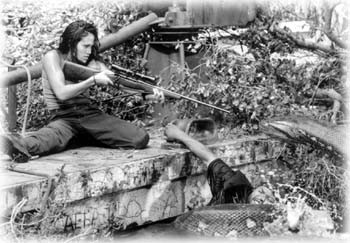
Bar Girls: Priscilla Sanborn (left) and Jennifer King in ‘Playboy.’

‘Parallel Lives’ and ‘Playboy of the Western World’ take bows

By Gretchen Giles

THE FALL THEATER season is in full crackle, with both Parallel Lives at Actors’ Theater and Playboy of the Western World at Main Street Theatre opening last weekend.

It was frighteningly familiar to me, having a tin ear from way back, to sit uncomprehendingly through the first long minutes of Main Street Theatre’s excellent production of Playboy of the Western World. Sporting thick brogues as bushed as spring heather, the cast burred and rolled it through most of the first act until the silent click finally came through, and wonderfully, miraculously, I could understand the fun of this patricidal Irish comedy.

Penned by J. M. Synge at the turn of the century, this is a fresh, silly tale of Christy (Matt Sutherland), a foolish young man who gains strange, admiring notoriety for bashing his father over the head with a shovel and leaving him for dead. He’s particularly appealing to the ladies, especially the Widow Quin (Priscilla Sanford), who comes by her bereavement the honest way: she killed ‘im. Sighing in a romantic aside, “There’s great temptation in a man who’d destroy his Da,” Quin sets a lusty, straightforward mark on poor Christy–poor, because frankly, you come to feel for the simple lad as the women gyrate avariciously around him. Also vying for Christy’s hand is Pegeen Mike (Jennifer King), a barmaid with a drunken Da she’d just as soon see dead, and an ineffectual lover (Anthony Martinez), an eejit who couldn’t bash anyone on the head if his life depended on it. Added to this down-home courting–Sanborn fills the phrase “shearing sheep” with a deadly sexuality–is a Da who won’t quite stay dead (Scott Phillips, of course), and who is able to recognize his son solely by his style of spitting, making Playboy as raucous a farce as any by Feydeau.

MST director Jim dePriest makes his usual sure way through the material, staging for highest comic effect and coaxing the best from his performers. While the cast is uniformly excellent, of particular note are Sanborn’s lust-queen, King’s pursed-mouth sweet shrew, and Matt Sutherland’s Candide of a Christy (though someone should tell him that literally picking his feet is an ugly bit of stage business).

CREATED BY those feminist pranksters Mo Gaffney and Kathy Najimy, progenitors of The Kathy and Mo Show, Parallel Lives is an ambitious ensemble piece that gives a lazy slap to most everything one holds dear. Positing the pleasantly freakish notion that the caprices of the world are controlled by two Ping-Pong-playing deities who casually decide to gift men with huge egos and women with that childbirth thing, Parallel Lives is composed of a series of vignettes featuring four solid, comedic, and affecting actresses: Deborah Luce, Julie Schellin, Janice Ray, and Jennifer Weil.

In a dizzying 14 scenes, this quartet of actresses roll up their sleeves and wade into the material, tackling just about every small issue in modern female life. Often quite funny, Parallel Lives has some wonderful ideas about feminism itself, not shying away from satirizing the deadly serious hear-me-roar aspect of the movement, as in the “Las Hermanas” scene set in a lesbian bar. And then there are those terrific strap-on breasts worn by Lady Ann (Luce) and Lady Anne (Weil) in the “Shakespeare” scene, the agony of an airhead date (who eventually triumphs by ruling Bosnia), and the mute frenzy of “Silent Torture,” in which the cast desperately mimes the morning dressing ritual of hose and horrors.

But funny can’t last forever, and Parallel Lives is simply too long by at least a third. With as many scenes, thoughts, spoofs, and beauty bits as are being offered to the audience, there is a dogged length to the material. Writers Gaffney and Najimy hang deathlessly onto their scenes, and director Brenda Starr can’t quite close her eyes and clip. Which is exactly what needs to be done in deference to the fine actresses she’s got spinning out on the stage, dismayed to find that they are losing audience interest as vignettes stretch well beyond 15 minutes, while sentiments that began funny get mawkish, and we are certainly all more than aware of the point by the scene’s end. Additionally–and please don’t write–making mean fun of men stopped being funny ’round about 1987. Now it’s just mean.

Parallel Lives has the cast, the performances, and the ideas. With a slight trim and tuck, it would provide a full belly of fun.

Playboy of the Western World runs Thursdays-Saturdays through Oct. 12 at 8 p.m. with special performances Sept. 22 at 2 p.m., and Sept. 29 and Oct. 6 at 7 p.m. Main Street Theatre, 105 N. Main St., Sebastopol. $12. 823-0177.

Parallel Lives plays Thursdays-Sundays though Oct. 11. LBC, 50 Mark West Springs Road, Santa Rosa. Thursdays-Saturdays at 8 p.m.; Sundays at 2 p.m. $6-$12. 523-4185.

From the September 19-25, 1996 issue of the Sonoma Independent

This page was designed and created by the Boulevards team.
© 1996 Metrosa, Inc.

School Cafeteria Food

0

Mystery Meat

By David Templeton

AMY, A WAITRESS at a downtown Petaluma coffeehouse, slides my steaming latte across the counter, chatting amiably about elementary school cafeteria food as she takes my two dollars and makes the change. “Cafeteria food made me throw up in second grade,” she gleefully confides, lowering her voice to avoid offending the other customers. “When I stood in line at El Verano Elementary in Sonoma, this smell came out of the cafeteria and just about knocked me over. I threw up my breakfast. Fruit Loops. I couldn’t eat lunch, and I never went back.”

I can’t help wondering what was on the menu that day. Amy, evidently, has blocked the actual entrée out of her mind.

“It was something meaty and saucy,” she shrugs. “Whatever it was, it was extremely gross.”

WITH SUCH THOUGHTS in my head, I prepare myself to head out to eat lunch at a couple of local schools. It’s been 20 years since I’ve eaten in a public school cafeteria, where sloppy joes were standard fare and fresh fruit existed primarily to be our favorite airborne projectile. Fish sticks were thought of as health food and ketchup was considered our helping of vegetables.

So how much has school food changed over the years? Well, this year just about half of the children in the United States, some 25 million of them, will eat lunch provided by their schools, lunches that the federal government has recently declared should contain at least one third of the recommended daily allowances of, well, everything. With over 50 new recipes distributed to school kitchens and a larger-than-ever larder of USDA food supplies, school lunches are bound to come into the 1990s before the decade is over. But owing to the individuality of Americans, the success of these health-prone practices has been felt in varying degrees.

Though most public schools have gotten the message, food service professionals walk a fine line between what is available with existing budget constraints, what is nutritious and energy-building for the students, and what the students will actually put into their mouths.

In the main, there seems to have been in recent years a remarkable local effort to improve the quality of the food. Santa Rosa schools have brought in nutritionist Elena Debolt to redesign the food, along with the environment in which students eat. Cafeterias are now called food centers, and each sports a colorful sign that bears the motto “Food with Attitude,” a nutrition-conscious blend of good food that is attractive to youngsters.

“There is a definite shift away from the less healthy school food of the past,” Debolt affirms. “In Santa Rosa we’re trying to do it in a way that kids will respond to.”

Unconfirmed rumors of bean sprout sandwiches and tofu salad in certain west county schools persist. And the four-school Old Adobe School District has the distinction of being one of the few schools in the Bay Area to bake its own bread every morning.

“We bake our bread, and we cook up healthy meals. It’s beautiful food,” says Billye Raye Lipscomb, Old Adobe district’s superintendent. “Last year we sent all four chefs to be trained for a few days at the California Culinary Academy. I thought that was a real kick in the britches. We found that they were offering a terrific deal, and we thought ‘Why not?'” For a modest $125 training fee, Old Adobe’s cafeteria workers spent time at the San Francisco­based CCA, considered one of the finest teaching facilities in the world, learning some of the healthful, inventive menu-making tips that have distinguished the academy.

“We wanted to make healthier food that kids wouldn’t balk at,” Lipscomb explains. “Less salt, less sugar, less fat. That kind of thing.” The standard fare includes such things as baked chicken, mashed potatoes, fresh vegetables, and garlic bread, along with staples such as pizza and hot dogs.

Fortunate with its funding, each Old Adobe district school was built with its own kitchen, an amenity many campuses lack. But with an emphasis on the bottom line, Old Adobe is simply cooking up what other schools possessing their own kitchens could also be doing. “We all get the same kinds of commodities,” says Lipscomb of the USDA and bulk foods provided to the various districts. “And I’m amazed at the quality of what comes to us.

“Most kids are brought up eating junk food,” she continues. “You offer some people a baked chicken and they don’t know what to do with it. So we’re not removing the kids’ favorites, but we are serving it in a more healthy way.” Later, she laughs, “It’s kind of like being at home–you show that you care about people by feeding them.”

MY RESPONSIBILITY is to give the kids what they want, and to also balance the budget,” says Deana Pucciarelli, food services supervisor at Healdsburg High School, an institution that seems caught between the old way and the new way, culinarily speaking. A recently passed bond measure has made possible a new kitchen facility, which will begin construction in May, and will allow Pucciarelli, also a CCA-trained chef, more room to expand creatively. A salad bar is even possible, though she is quick to point out that past attempts to offer vegetarian dishes resulted in pounds of food going to waste. “If it’s not reinforced at home,” she adds, “it’s difficult to influence the kids’ eating habits at school alone.”

Later, standing in the HHS cafeteria, I am besieged with free advice. “Do yourself a favor,” pleads a student named Shannon. “Don’t eat that.” I have just procured a square-shaped slab of pizza and a bowl of Tater Tots. Other choices at the snack bar­like counter include burritos, nachos, and chicken chimichangas.

“Here’s how you eat the Tater Tots,” interjects someone from the next table. “Order the nachos. Dump the corn chips and pour the cheese over the Tater Tots. They’re kind of OK that way.”

“It’s disgusting and greasy,” says Kelly, a junior, summing up her view of the school food in general. “I usually just go to McDonald’s.” Candice, another junior, would like to see a salad bar on campus, but she appears to be in the vegetarian minority.

I glance at my pizza, still untouched. Standing up, I hold the carton in the air and face the table across the aisle.

“Who wants a free piece of pizza!” I shout, as hands shoot up all around me. Seconds later, it has been entirely devoured.

“Is it good?” I ask the recipient of my lunch. He shrugs. “It’s good enough.”

From the September 19-25, 1996 issue of the Sonoma Independent

This page was designed and created by the Boulevards team.
© 1996 Metrosa, Inc.

Richard Thompson

0

Both Ways


Peter Sanders

Voltage Enhanced: Songwriter Richard Thompson comes to the LBC.

Richard Thompson’s six-string stories

By Bruce Robinson

RICHARD THOMPSON wants to have it both ways. A remarkably accomplished folk-rock guitarist, he frequently performs acoustic solo, a format that gives full exposure to his incisive lyrics and nuanced vocals. But when plugged in and amplified, his taut, often modal soloing takes on additional compelling power.

On his latest recording, the two-CD set you?me?us? (Capitol), Thompson gets to have it both ways–one disc, “Nude,” is mostly acoustic; the other is aptly entitled “Voltage Enhanced.” But apparently he still can’t make up his mind, as two of his new songs appear on both discs in contrasting arrangements.

“Out of sheer selfishness, I thought I’d let the public suffer through two records,” the elfin Thompson jokes by phone from a Midwestern hotel room early in the two-month tour that brings him back to the Luther Burbank Center Sept. 27. “Originally we had this wild, madcap scheme, which was to do all the songs electric and all the songs acoustic,” he elaborates more seriously, “which would have been about 34 tracks. That began to seem a bit of a chore, so we abandoned the idea. But the dual versions of ‘Razor Dance’ and ‘Hide It Away’ survived.

“We thought they both had virtues, and we weren’t sure which were the best versions, so we kept them both.”

A similar ambivalence colors his approach to live performances. In his last visit to Santa Rosa, Thompson delivered a mesmerizing performance of his artfully crafted songs with just his own guitar and the rich double-bass work of Danny Thompson (the former Pentangle bassist, who is not related to Richard). This time he is bringing a full four-man band. ” I like to think I can perform everything solo, but it’s probably only 70 percent,” he says. “If I have the band over here, I can do a lot more. I can play more representative of the way things are on the records, for instance.” But that doesn’t mean the whole show rocks out. “We also have an acoustic section and a solo section,” Thompson adds. “A full family show.”

In addition to bassist Thompson, the band includes multi-instrumentalist Peter Zorn, (an expatriate from Phoenix who was “one of 150 musicians in the New Christy Minstrels at one time or another,” Thompson teases) and drummer Dave Mattacks, whose history with Thompson extends back to the early days of Fairport Convention, the seminal Celtic folk-rock band that first fused British traditional music with rock elements in the late ’60s. That influential fusion served as a springboard for Thompson’s celebrated work with his now ex-wife Linda. As a duo, they incorporated an ever-widening range of styles–musical hall and burlesque, Middle Eastern chant, pop, and blues into a singular blend captured on the universally praised Shoot out the Lights and a series of preceding albums–until the couple parted bitterly in the early ’80s.

An impressive string of solo albums has continued to feature Thompson’s varied and virtuosic writing, which includes disarmingly simple balladry, rockers laced with acidic wit, and carefully wrought narratives of loves lost, discovered, and remembered.

DESPITE almost constant acclaim, Thompson has never enjoyed a hit, although he notes with pleasure that you?me?us? enjoyed a stay at the top of the adult album alternative-radio format charts earlier this year. In 1993, he was the subject of Watching the Dark, a three-disc, 47-song retrospective released by Hannibal Records. And his esteem among other artists is such that his songs have been spotlighted in two separate tribute albums, one featuring a number of high-profile American acts (R.E.M., Bonnie Raitt, Los Lobos, X, David Bryne) and the other on a small Celtic-oriented label.

“It’s very flattering, very embarrassing. It took me a while to get used to it,” Thompson says of the tributes. “It’s a bit of a shock to hear that much of your own material coming back all at once.” He cites the Dinosaur Jr. cover of “Misunderstood,” as well as the tracks by Bonnie Raitt and Bob Mould as three that impressed him. “I’m not allowed to say which are my favorites,” he admits, hastening to add, “I’m sure I could name lots more if I could sit down and look at the label.”

The Richard Thompson Band performs Saturday, Sept. 27, at 8 p.m. LBC, 50 Mark West Springs Road, Santa Rosa. $19.50. 546-3600.

From the September 19-25, 1996 issue of the Sonoma Independent

This page was designed and created by the Boulevards team.
© 1996 Metrosa, Inc.

Les Blank

0

Les Is More


Man with a Movie Camera: Les Blank has spent the past three decades making acclaimed documentaries.

Samantha Dunscombe


Director Les Blank films artists, musicians, and shoe eaters

By Zack Stentz

LES BLANK HAS captured some pretty peculiar things on film. After all, this is the guy who, in his 35 years of film work, has taken the art of the documentary to new heights by bringing his camera to bear on everything from East Coast polka fanatics (In Heaven There Is No Beer?) to Cajun musicians and cooks (Always for Pleasure) to lovers of the stinky rose (Garlic Is as Good as Ten Mothers), deftly mixing music, food, and ethnography together in a style so natural that the viewer feels more like a participant than an observer.

Speaking on the phone from his El Cerrito home, Blank is polite, friendly, soft-spoken–just the sort of person one would imagine slipping easily into the cultural inner sanctums of various ethnic and social subcultures with his trusty 16mm camera in hand. His serious, non-judgmental voice never slips, even when describing the time he filmed eccentric German director Werner Herzog (Fitzcarraldo, Every Man for Himself and God Against All) eating his shoe in front of an audience at the University of California theater. “Werner Herzog had been talking to a UC Berkeley student named Errol Morris,” Blank explains, “who had up until then been a failure at everything he had tried–being a mathematician, a writer, a cello player–and Werner said, ‘Since you’ve failed at everything in life, you have the perfect makings to be a filmmaker.’

“But Errol protested that he had no experience, or friends in film, or money, and Werner told him that you don’t need money, you need guts to be a filmmaker. He said that if Errol succeeded in making a film that was shown at the Pacific Film Archive in Berkeley, he would come back and eat his shoe.”

Thus motivated, Morris scraped together the resources to make Gates of Heaven, a quirky documentary about the moving of a Bay Area pet cemetery. And true to his word, Herzog came back and ate his own boot, cooked in duck fat by none other than Chez Panisse’s Alice Waters while Blank filmed the proceedings. “I tried a little piece myself, washed down with bread, garlic, and beer,” says Blank. “It was awful.”

Morris went on to become the acclaimed maker of The Thin Blue Line, A Brief History of Time, and other non-fiction features, and Blank’s own association with Herzog would yield yet more bounty. In 1982, Blank followed Herzog to the Amazon jungle to document the making of Fitzcarraldo. The end product, Burden of Dreams–a film about an obsessive director making a film about an obsessive man–became Blank’s best-known film, garnering more praise in some quarters than Herzog’s own movie. “I’ve heard that,” says Blank. “And if I did make a better film, it’s only because I had better subject matter. Werner Herzog was a far more fascinating character than any fictional person he could shoot.”

Given Blank’s interest in the extremes of the creative urge, it’s only appropriate that the Sonoma Film Institute will be showing two films on the subject: Sworn to the Drum: A Tribute to Francisco Aguabella and The Maestro: King of the Cowboy Artists. “They’re both about non-compromising artists,” he says of the two works. “The Maestro is a man who makes art for the love of creating it and isn’t bound by the rules of the marketplace. And Francisco Aguabella gave up the financial security of being a regular band member for the likes of Peggy Lee, Frank Sinatra, and Paul Simon to stay true to his drumming ancestors and respect the sacredness of the [Afro-Cuban] Santeria tradition that he works within.”

But Blank needn’t have traveled far to find artists who forsook fame, fortune, and financial security to instead honor their consciences and idiosyncratic artistic visions. Looking in the mirror would have done the trick just as easily. A failed fiction writer himself, Blank was inspired to make films after being bowled over by a screening of Ingmar Bergman’s Scandinavian bleak-fest, The Seventh Seal. “Finally, I thought as I walked out of the theater,” recalls Blank, “I’ve found someone more depressed than I am.”

As Blank explains it, his own distinctive filmmaking style evolved out of a stint he spent making the sort of cheesy instructional films familiar to anyone who’s been forced to sit behind a balky 16mm projector in a fifth-grade classroom. “When I got out of school and didn’t have the money to do narrative films, I ended up working for a company making industrial films for the army and instructional films for companies,” Blank says. “It was a small company, so they let me shoot, edit, record, and mix sound– everything.”

Despite the valuable experience Blank received on the job, he chafed in the shackles of the format’s ham-fisted linear editing and voice-over narration. “I grew to hate that kind of filmmaking,” he recalls. “I thought there must be a more direct way to provide for the audience the kind of experience I had while making the film.”

THUS WAS BORN Blank’s characteristically naturalistic, unobtrusive, loosely structured style of documentary. “Some people seem to like it, and others don’t,” he says with characteristic modesty. “One critic said about Always for Pleasure that it looked like it was shot by a guy wandering through New Orleans with a bottle of beer in one hand and a camera in the other.”

While that viewer may not have understood what Blank was up to, many others did, and continue to eagerly anticipate the completion of each new Blank project. In the planning stages for Blank are projects on radio storyteller Garrison Keillor, a Romany (Gypsy) musician/dancer living in the Rajasthan region of India, and a Marin man who journeys annually to the mountains of western China to buy tea. “I’m applying to the Rockefeller Foundation for a grant right now,” he says, “and they’re really interested in films about other cultures, so they’ll probably like the Gypsy project the best.”

But the drying up of available grant money and spiraling costs of 16mm film stock and developing have combined to put the financial squeeze on Blank’s style of filmmaking. To economize, he’s preparing to buy a state-of-the-art digital video camera, which, while not providing the warmth and resolution of film images, will reduce costs considerably and allow him to keep bringing his quirky, intensely creative work to audiences. “I prefer working with 16mm film,” Blank says with a verbal shrug. “I like seeing images projected up on the big screen. But if it’s between shooting in video and not making any films at all, then I’ll shoot in video.”

Sworn to the Drum: A Tribute to Francisco Aguabella and The Maestro: King of the Cowboy Artists will play at the Sonoma Film Institute Sept. 27-28 at 7:30 p.m. SSU, 1801 E. Cotati Ave., Rohnert Park. $2.50-$4. Les Blank will appear in person at the Sept. 28 screening. 664-2606.

From the September 19-25, 1996 issue of the Sonoma Independent

This page was designed and created by the Boulevards team.
© 1996 Metrosa, Inc.

Green Eggs and Ham

0

Kid Stuff

By David Templeton

THE GREAT CLASSICAL masters of musical history would no doubt raise their terpsichorean eyebrows and shrug in wonder at the unconventional extravaganza that the Santa Rosa Symphony and conductor Jeffrey Kahane have cooked up for their big September social event.

Green Eggs and Ham–yes, you read that right–with a libretto lifted entirely from the classic picture book by Dr. Seuss, will be presented in a staged musical program next weekend as a kickoff to the symphony’s upcoming season, one that will put special emphasis on young musical performers. Though hardly Handel’s Messiah, the short Seuss program, preceded by an audience hopping segment with Kahane, will draw heavily on classical music motifs in an innovative score by Robert Kapilow.

“One of my great passions in life is trying to get kids involved in music,” Kahane said last week, moments after performing a spirited piano concert in Santa Rosa’s Courthouse Square.

“So with this season, what I wanted to do was to salute young performers. Almost all of the guest soloists we’re using this season are under 20. And with Green Eggs and Ham, we know we’ve got a program that will draw people of all ages, some of whom will be going to the symphony for the first time.”

Acknowledging that classical music still has a hard-to-shake reputation for being stuffy and serious, Kahane notes that Green Eggs‘ message is intentionally appropriate.

“It’s about a grouchy guy who won’t try this unfamiliar dish, no matter how it’s served,” Kahane laughs. “It’s about having preconceived ideas about something. It’s a metaphor for making up your mind about something you haven’t yet experienced, which is certainly the case with many people as pertains to classical music.”

The piece will be simply staged, with minimal props and no costumes. The orchestra will be scaled back to a small ensemble, with two singing roles: Maria Jette as the greenaphobic grouch and Gabe Kahane (the conductor’s 17-year-old son) as the tenacious Sam I Am.

And how is it for Dad to work with his own progeny?

“It’s great!” Kahane laughs. “He’s an amazingly talented actor and musician. I thought long and hard about using him, wanting to avoid accusations of nepotism. But we’ve never really worked together before, and this seemed like a good opportunity. He’s certainly more than qualified. And besides–he’s right there in the house so we can work together whenever we want.”

Green Eggs and Ham will be performed on Saturday, Sept. 21, at 3 and 4:30 p.m. at the Luther Burbank Center, 50 Mark West Springs Road, Santa Rosa. Tickets are $15 and $10 for adults, $7 and $5 for children, and $40 for a family (two adults, two kids). 54-MUSIC.

From the September 12-18, 1996 issue of the Sonoma Independent

This page was designed and created by the Boulevards team.
© 1996 Metrosa, Inc.

Mavis Jukes

0

Girl Talk

By David Templeton

WHEN I WAS a kid in the late ’50s, early ’60s, most of the information we girls got about reproduction was from those little pamphlets that came along with pads, you know, like Modess,” proclaims author, educator, and lawyer Mavis Jukes, demonstrating with a flash of a smile her customary knack for straightforward talk. “The pamphlets would always talk about ‘The Egg,'” she continues, eyes widening in remembrance of the mysterious phraseology, “and that when The Egg was Fertilized, it would suddenly grow into an Embryo.

“Well, we’d keep turning back to that page, reading, “When the egg is fertilized, and thinking, ‘What is the fertilizer?’ And of course that was never answered at all. It was just some minor detail that was skipped over. But we all wondered about it.”

Jukes, an award-winning novelist and the author of numerous children’s books, is sitting on the front deck of the Cotati farmhouse she shares with her husband and two daughters. She is discussing a subject that she has spent the last several years thinking about, namely, the importance of providing preteen girls with information about the mystifying transformations of adolescence. It’s a Girl Thing: How to Stay Healthy, Safe and in Charge (New York: Knopf, 1996; $12) is the author’s first book of non-fiction, and it is devoted to the demystification of everything from menstruation and reproduction to birth control and sexually transmitted diseases.

There are sections on selecting the proper bra and ways to fight acne, along with info on drug and alcohol abuse, sexual harassment, and all the overwhelming details of personal hygiene. Whimsically illustrated by Debbie Tilley, packed with informative nuggets, and enlivened with anecdotes from Jukes’ own girlhood, this thoroughly researched, affectionately written book has received high marks by critics, health-care professionals, and parents since its release earlier in the year. Ms. magazine has appropriately dubbed the book “A pre-teen Our Bodies/Ourselves.”

“I give kids a lot of credit,” Jukes continues. “If they really know about the health issues associated with alcohol and drug abuse, and also about the health issues associated with having sex with a partner when they are too young, then they can make some healthy choices. But without that information . . .” She waves her hand at the street and, presumably, the country at large.

“In this society, information is hidden,” she remarks. “Our pregnancy rate is triple that of England. According to the most recent statistics, 43 percent of all American girls become pregnant between the ages of 13 and 19. That comes right out of the morbidity and mortality report. It’s not something that’s been trumped up.

“There are also studies that show that the more kids know about sex, the more likely they will be to postpone it. I think parents will be very reassured to know that. I think people are coming around and realizing that keeping kids in the dark about these things is a very bad idea.”

When I comment that her writing voice achieves the comforting tone of a friendly and trustworthy aunt, she grins delightedly. “Well, thank you! I want to be a friendly, trustworthy aunt to my readers, and it took years to get the book that way. I have thought this book upside down, inside out, and backwards. This has been the most carefully thought-out thing I’ve ever been involved in and probably ever will be.

“This book was designed partly by the teacher in me and partly by the lawyer in me,” she continues. Jukes works as a language arts specialist in the Sonoma County School District, and volunteers as an attorney in matters of juvenile defense. “What was important to me was that kids could get all the information they need to be safe, and that there was nothing misleading. There are single pages in this book that I worked on for 30 hours.”

She is especially proud, she mentions, of the section on sexual preference, which reads as perhaps the most humane, open-minded, and uncomplicated explanation of that subject that I have come across.

“A lot of people just don’t know how to approach some of these subjects with their kids,” she says. “And the other thing is that a lot of kids don’t feel like talking to their parents about it. I think that’s fine. I don’t think parents should view that as a failure. Honestly, when was the last time you wanted to talk to your mom or dad about sex?

“But parents should make themselves available,” she insists. “Communication is extremely important, and if they are approached, parents should be honest and open.” She thinks about it a moment, and nods.

“Between books, and school, and parents, and peers, I think we should be able to get everybody straight on this stuff.”

From the September 12-18, 1996 issue of the Sonoma Independent

This page was designed and created by the Boulevards team.
© 1996 Metrosa, Inc.

Eileen Drew

0

Into Africa


Far away, so close: Though she writes about the interactions between Africans and Westerners, these days author Eileen Drew makes her home in the hills above Sebastapol.

Photo by Steven Underhill


Eileen Drew spins her Peace Corps experience into fiction

By Zack Stentz

PEOPLE SURE SEEM to love pigment-deprived reptiles. White gator Antoine Le Blanc packed ’em in at San Francisco’s Academy of Science exhibit. Kevin Spacey’s Albino Alligator is one of the most eagerly anticipated films of the fall season. And now Sebastopol author Eileen Drew’s new novel, Ivory Crocodile (Minneapolis: Coffee House Press, 1966; $21.95), is wowing readers across the nation, getting a heavy promotional push from mega-chain Barnes & Noble, and prompting book critics to muse on the mythological significance of the title.

“In the African legend of the ivory crocodile,” wrote the critic for Kinesis in a glowing review, “the white crocodile is prized for its skin color, but is in fact the deadliest reptile of all.”

Oooh, scary. Only one problem. According to Drew, there is no African legend of an ivory crocodile. “I don’t know where the writer got that from,” Drew says bemusedly. “There’s no such legend that I’ve heard of, and it’s not anywhere in the book.”

In an inadvertent way, though, the reviewer did strike an important chord of Drew’s novel. Like her acclaimed 1989 collection of short stories Blue Taxis, Ivory Crocodile takes as its theme the messy, awkward interactions between Westerners and locals in the various nations of west Africa. In writing these tales, Drew was able to draw on her own background as the child of an American diplomat in Nigeria, Guinea, and Ghana, then later as a Peace Corps worker in Zaïre.

So was Drew consciously hunting and gathering fiction material even while living in Africa? “I suppose I did,” she replies. “I kept a journal while I was in Zaïre, so while I wasn’t able to write fiction while I was there, I did go back and use material from my journals when writing stories.”

Indeed, astute readers will recognize more than a touch of the real-life Zaïre (run for the past 31 years as a virtual kleptocracy by the brutal President Mobutu) in Ivory Crocodile‘s fictional setting of Tambala, complete with its corrupt, CIA-backed president and intrigue-filled frontier with Marxist Angola. Drew explains that setting the story in a fictional nation was a boon from a creative standpoint. “It wasn’t that I was trying to hide it, but fictionalizing things gave me a lot of creative freedom,” she says. “I didn’t have to get every custom of every tribe right, and I could use the building of a bridge into Angola as a plot point, when in fact, that never happened.”

Aside from the challenge of fictionalizing a very real setting, Drew also wrote with the full knowledge of those literary titans who had trod the ground before her. Anyone dipping their toe into the Westerner-in-the-Third-World genre is bound to be compared to the likes of Graham Greene and Joseph Conrad, both daunting acts to follow. “They’re my favorite writers–Conrad, especially,” says Drew. “But they weren’t intimidating, because they were writing about a different world than I was–the world of colonialism.”

And speaking of pith-helmeted European empire-builders, it seemed inevitable that despite their obvious differences, book reviewers would seek to link Drew to the grande dame of faded imperial glory herself, Isak Dinesen. “She’s another writer I love,” Drew says charitably, “although she’s a real colonialist, and that paternalist attitude comes out in her writing. Again, she wrote about a very different Africa than the one I did.”

Not that the critics seemed to care. After all, Dinesen was a white woman like Drew, writing about Africa. What are 50 years and 2,000 miles’ difference–particularly in light of memories of Meryl Streep and Robert Redford prancing through the veldt in that extended Ralph Lauren commercial Out of Africa–when readers might actually recognize Dinesen’s name? “There are other writers who are closer to me,” acknowledges Drew, “but she’s a bigger name, so it’s easier for a critic to pull her out of a hat.”

Much closer to Drew’s own work is Anglo-Indian (by way of Trinidad) author V. S. Naipaul, who cast a rather jaded eye upon idealistic Westerners blundering about through developing countries in such novels as Guerrillas. “Naipaul also wrote about Zaïre in A Bend in the River,” Drew says, “and that was a bit intimidating, because he wrote about a Zaïre that’s much closer to my own.”

But whatever the intimidation factor, Drew says she does take her literary predecessors into account while writing about her own, decidedly post-colonialist Africa: “I think about them a lot, and how their Westerners approached the situations they were in.”

The situations in Ivory Crocodile tend to revolve around power and cultural difference, especially the contrast in women’s roles between the America of Drew’s narrator and the tribal culture she finds herself in. Refreshingly absent are the usual nature documentary clichés of lions, cheetahs, and zebras that figure so prominently in most Western views of Africa. “I didn’t go to Africa for the wildlife,” Drew says. “I went for the people. Their lives and culture are what I find interesting and wanted to write about.”

Sitting in her comfy writing room on a typically chilly west Sonoma County morning, this particular Westerner couldn’t be farther from the humid forests and wide alluvial plains that inspired her earlier work. And for now, Drew is content to leave Africa behind as she looks closer to home for inspiration in writing her next book of stories. “I’m less interested in African material than California material now,” Drew says. “But I couldn’t really get out of Africa until I finished that book.”

From the September 12-18, 1996 issue of the Sonoma Independent

This page was designed and created by the Boulevards team.
© 1996 Metrosa, Inc.

Talking Pictures

0

Bad Attitude

By David Templeton

Writer David Templeton takes interesting people to interesting movies in a quest for the ultimate post-film conversation. This time out, he takes notoriously civilized NPR Radio guru Sedge Thomson to see the pessimistic disaster flick The Trigger Effect.

The clock on the restaurant wall shows that it is nearing midnight. The pizza dishes have long since been cleared away, yet we remain ensconced at our table, unwilling after nearly two hours of discussion to leave without having uncovered some little shred of meaning or importance in , a film about a massive power failure that transforms peaceful suburbanites into nasty, gun-wielding maniacs after three long days of no television or cold beer. It is a film that fairly reeks with serious intentions but ultimately says almost nothing at all.

“One thing we can say about it,” offers my guest, Sedge Thomson, host of National Public Radio’s West Coast Live, a quirky and ultra-civilized variety show that is broadcast live from San Francisco every Saturday morning (10 to noon; KCRB 91.1-FM). “It gives the lie to the saying that ‘an armed society is a polite society.’ If anything it shows that an armed society is a society primed and ready to panic.”

“The veneer of civilization portrayed in the movie was pretty thin,” I reply, glancing about for someone to refill our water glasses. “Even without all the gunplay.”

“I would submit that the veneer of civilization is thin everywhere we look,” Thomson laughs. “I was driving down a private city street last week. The traffic was very slow. A guy in a flashy new 4X4 decided he wanted to muscle his way into traffic, which included sort of insinuating his way in front of me. Driving right up on the sidewalk and then cutting in. I slammed on my brakes, and then he started yelling at me. When he ran out of things to say about me, he started attacking my car. ‘Why don’t you get a new car! What an ugly car you’re driving!’ It became very funny and all I could do was laugh.

“What prompted him to suddenly drive on the sidewalk and then call my car names, unless it was some sort of total breakdown of any sense of social structure and order? How else to account for such unprovoked rudeness?”

Thomson, known to thousands of listeners as the laid-back, deep-throated, even-keeled force of nature who holds weekly court over a variety of well-mannered, civilized group of writers, musicians, scientists, and comics, seems the kind of man who would have little patience for such phenomena as unprovoked rudeness and impolite sidewalk procedure. In fact, with an on-air persona that often seems a cross between Ed Sullivan and Mahatma Gandhi, Thomson surprises me tonight when he segues into something of a rant (though a polite one) against the phone company.

“Social structure isn’t all that’s breaking down,” he asserts. “I think the phone company is breaking down. The phones, I predict, are going to stop working in either March or April of 1997. I’ve noticed entropy encroaching on the system. I deal with all kinds of different phone services. Business lines. ITNS lines and so forth. And PacBell is constantly mixing up orders. Cutting things off when they shouldn’t be cut off. Mixing up lines. I’ve reached people after long waits on voice mail who can’t help you and can’t transfer you to the proper department.

“When the phone company starts breaking down,” he asks, “can the rest of civilization be far behind?”

“I was somewhat struck by what somebody once described as ‘the tyranny of neighbors,’ as it was represented in this movie,” Thomson says a bit later. “None of the neighbors seemed at all cooperative or interested in who their neighbors were.”

“I found their behavior believable if it were in a time of no catastrophe,” he goes on. “But in times of catastrophe or a major blackout or something, I believe people would be more helpful than they were in this.

“I remember the aftermath of the earthquake of 1989, here in San Francisco. Power was out for a very long time. There was some fear of looting, but as I recall, most people tried to work together.

“It’s the little things, rather–the tiny courtesies–that are being removed one by one from our interactions, that ultimately do the most harm.

“One of the classic stories is Pacific Bell dropping the “please” from their information lines. They used to say, ‘What city, please?’ and now it’s ‘What city?’ By cutting the “please,” they’ve saved themselves a half a second per call that comes in multiplied by several millions of calls they get per day. They save a lot of money.

“Meanwhile, aren’t we trying to teach our children to be polite? To say “please” and “thank you”? Good manners and the ability to articulate are the lubricants of our society that make it possible for different people to brush up against one another and not get caught on each other’s rough edges. And here, for the sake of expediency, these corporations will barely even talk to you.

“That,” he laughs, “is the breakdown in civilization that I’m most concerned about.”

This page was designed and created by the Boulevards team.
© 1996 Metrosa, Inc.

Night Reading

Well-Read Bed

By Gretchen Giles

PEOPLE DON’T READ anymore, television has taken over our minds with a mush-creating mediocrity that has wrecked the culture, ruined our children–worse, ruined our dinners!–and has flung the humble written word right out the door with all of the ceremony accorded cabbage water and kitty litter.

Bah, bosh, humbug.

Because, oh naysayers, it appears that people are reading, they’re just doing it where no one else can see: in bed. Snuggled down, with tea or wine, alone or accompanied, most of us are going to bed with books. And unless the majority of our below-listed respondents are lying–and we don’t mean vertically–we’re all going to bed with good books.

Do most of these readers know who wrote these terrific works? Of course not–Rodney Dangerfield don’t know nuthin’ about respect compared to what writers get refused. Are the names of these provoking pieces of literature cherished by these readers? Get real. Therefore, take along a big ol’ grain of salt and head off with us to the dog-eared private world of the reading community.

“You caught me at absolutely the best possible time,” laughs Sonoma State University special programs director Bruce Berkowitz. “I’ve just finished a three-book run of real books.” Berkowitz takes the advice of any piece recommended by NPR personality Terry Gross, recently finishing Rivethead, a non-fiction work about the lives of steelworkers on the assembly line. He has also been breaking the spine on that examination of the effects of psychedelic drugs on society, Storming Heaven, and gnashed his way through the latest Patrick O’Brien seafarin’ novel. Nope, he can’t remember it’s title. But he’s certain that it was darn good.

What do the Independent’s writers read in bed?

Spreckels Performing Arts Center director Michael Grice spends most of his nights reading plays, so any diversion from work has to be fueled by Grice’s own unique adjective: “detectivy.” He’s been lost in the shut-up-and-talk world of neo-pulpist James Lee Burke, journalist Carl Hiaasen’s Skintight, and this one terrific book about how the Irish monks saved Western civilization. “I loved that book,” gushes an Independent editor about the latter. But can he muster up a memory of the title?

People, people.

Up in Healdsburg, Raven Theater co-owner Don Hyde offers a trio of alluring books, among them one of the early hard-boiled detective novels of the 1920s, The Adventures of Race Williams by Carrol John Daly. To counterbalance the molls and palls of that, Hyde is also reading short-fiction mistress Gina Berriault’s latest collection, Women in Their Beds, and Norman Mailer’s Oswald. We diss Mailer for a few minutes (this reporter will never forgive Mailer for his nosy speculation in his fictive bio of Marilyn Monroe of how she must have smelled), but Hyde has to admit he likes Oswald. “It’s pretty engrossing. The last couple of times that I tried [Mailer], I couldn’t get through him, but this is different.”

SSU lecturer Sue Carrell will at first admit only to snuggling down with School Girls, Peggy Orenstein’s study of how American girls learn (or don’t learn) in traditional classrooms, tending to be dissuaded by subtle instructional pressure from pursuing careers in science and mathematics. Under mild questioning, Carrell breaks down and offers up the real dirt: The Rainmaker by “that formula lawyer John Grisham,” she admits with a laugh. Carrell lost a few brain cells to that tome on the plane home from the recent Democratic Convention. “That was a party,” she chuckles of the convention.

Blues singer Sarah Baker and English professor J. J. Wilson are (separately) reading The Soloist by Mark Salzman. “It’s a critical thinking exercise,” declares Wilson. “It’s very fascinating, about a musician,” says Baker, who is also lugging The Complete Shorter Fiction of Virginia Woolf off to bed when she’s not entertaining herself lightly with The Musical Experience of the Composer, the Listener, and the Performer by composer Roger Sessions.

Wilson divides her nighttime between the Salzman novel and The 16 Pleasures by Robert Hellenga. “It’s advertised as erotica,” she says of this novel about a conservator working to restore books damaged by a flood, “but the most sensual parts of the book are the descriptions of rebinding.”

Guerneville mail artist Harley reads a perfect quatrain of the gorgeous and trashy before bed, including Nelson Mandela’s inauguration address (“It’s very, very beautiful and incredibly generous, considering that he’s someone who’s spent most of his life in jail”), Pierre DeLattre’s Tales of a Dalai Lama, NPR commentator Bailey White’s comic Sleeping at the Starlight Hotel, and the non-fiction The Romanovs: The Final Chapter. “It gives you an overview of what happened to Nicholas and Alexandria,” Harley says of Final Chapter, “including the finding of their bones. And, surprisingly, one of the Romanov princes now lives in Pt. Reyes,” he remarks, noting that this Romanov–an artist–is easily identified in recent family photos: he’s the only one wearing Birkenstocks. “But he’s a wretched painter,” Harley concludes.

Suzanne da Rosa, the Sonoma-based promoter who helps Readers’ Books stage the annual Poetry Festival, was moving when she came across her long-ago beloved copy of Gabriel Garcia Marquez’s 100 Years of Solitude. Surprised at how much she had forgotten of the plot since her first read, da Rosa is firmly lost once again in the magic and the realism. Copperfield’s Books’ Tom Montan is immersed in Where Wizards Stay up Late, the “down-dirty inside scoop” on the Internet, and Cindi Newman of North Light Books has gone south, recommending Little Altars Everywhere by Rebecca Wells, about a Louisiana family, and Midnight in the Garden of Good and Evil by John Berendt, a true murder mystery in the tradition of In Cold Blood, set in Georgia.

But our favorite is musician Jeff Martin, bassist with Joanne Rand and the Little Big Band. Martin admits to a predilection for Buddhist texts and Mix magazine, asserting however, that “I always read the Independent when I want to go to sleep.”

From the September 12-18, 1996 issue of the Sonoma Independent

This page was designed and created by the Boulevards team.
© 1996 Metrosa, Inc.

Stephen Mitchell

Act of God Logos: Poet and translator Stephen Mitchell has given us vibrant readings of Rilke, Zen, and God.Photo by Samantha Dunscombe Poet Stephen Mitchell translated Genesis, and it was goodBy Gretchen GilesTO LOOK at Stephen Mitchell, you'd never guess that the man is at the end of the second leg of a national tour, gave seven...

‘Parallel Lives’ & ‘Playboy’

Double BillJane KrenskyBar Girls: Priscilla Sanborn (left) and Jennifer King in 'Playboy.''Parallel Lives' and 'Playboy of the Western World' take bowsBy Gretchen GilesTHE FALL THEATER season is in full crackle, with both Parallel Lives at Actors' Theater and Playboy of the Western World at Main Street Theatre opening last weekend. It was frighteningly familiar to me, having a...

School Cafeteria Food

Mystery MeatBy David TempletonAMY, A WAITRESS at a downtown Petaluma coffeehouse, slides my steaming latte across the counter, chatting amiably about elementary school cafeteria food as she takes my two dollars and makes the change. "Cafeteria food made me throw up in second grade," she gleefully confides, lowering her voice to avoid offending the other customers. "When I...

Richard Thompson

Both WaysPeter SandersVoltage Enhanced: Songwriter Richard Thompson comes to the LBC.Richard Thompson's six-string storiesBy Bruce RobinsonRICHARD THOMPSON wants to have it both ways. A remarkably accomplished folk-rock guitarist, he frequently performs acoustic solo, a format that gives full exposure to his incisive lyrics and nuanced vocals. But when plugged in and amplified, his taut, often modal soloing takes...

Les Blank

Les Is MoreMan with a Movie Camera: Les Blank has spent the past three decades making acclaimed documentaries.Samantha Dunscombe Director Les Blank films artists, musicians, and shoe eatersBy Zack StentzLES BLANK HAS captured some pretty peculiar things on film. After all, this is the guy who, in his 35 years of film work, has taken the art of...

Green Eggs and Ham

Kid StuffBy David TempletonTHE GREAT CLASSICAL masters of musical history would no doubt raise their terpsichorean eyebrows and shrug in wonder at the unconventional extravaganza that the Santa Rosa Symphony and conductor Jeffrey Kahane have cooked up for their big September social event. Green Eggs and Ham--yes, you read that right--with a libretto lifted entirely from the classic picture...

Mavis Jukes

Girl TalkBy David TempletonWHEN I WAS a kid in the late '50s, early '60s, most of the information we girls got about reproduction was from those little pamphlets that came along with pads, you know, like Modess," proclaims author, educator, and lawyer Mavis Jukes, demonstrating with a flash of a smile her customary knack for straightforward talk. "The pamphlets...

Eileen Drew

Into AfricaFar away, so close: Though she writes about the interactions between Africans and Westerners, these days author Eileen Drew makes her home in the hills above Sebastapol.Photo by Steven UnderhillEileen Drew spins her Peace Corps experience into fiction By Zack StentzPEOPLE SURE SEEM to love pigment-deprived reptiles. White gator Antoine Le Blanc packed 'em in at...

Talking Pictures

Bad AttitudeBy David Templeton Writer David Templeton takes interesting people to interesting movies in a quest for the ultimate post-film conversation. This time out, he takes notoriously civilized NPR Radio guru Sedge Thomson to see the pessimistic disaster flick The Trigger Effect.The clock on the restaurant wall shows that it is nearing midnight. The pizza dishes have long since...

Night Reading

Well-Read BedBy Gretchen GilesPEOPLE DON'T READ anymore, television has taken over our minds with a mush-creating mediocrity that has wrecked the culture, ruined our children--worse, ruined our dinners!--and has flung the humble written word right out the door with all of the ceremony accorded cabbage water and kitty litter. Bah, bosh, humbug. Because, oh naysayers, it appears that people...
11,084FansLike
4,606FollowersFollow
6,928FollowersFollow