Liquid Gold
Michael Amsler
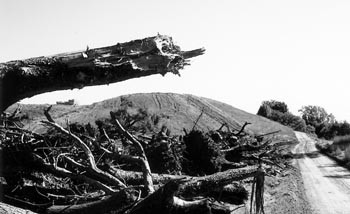
How the Mighty Have Fallen: The broken limbs of fallen vintage oaks, above, pierce the skyline at E&J Gallo’s Westside Road project.
One man’s view on the corporatization of Wine Country
By Shepherd Bliss
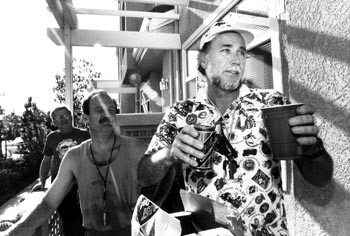
GEORGE DAVIS POINTS to a tall hill studded with majestic redwoods on the land adjoining his 35-acre Porter Creek Winery in Healdsburg. “E&J Gallo owns that hill and plans to cut it,” he laments, referring to the environmental exploits of the world’s largest winery. As he speaks, the afternoon stillness is broken by a deep rumble as a large land mover lumbers down the road toward the 500-acre project on Westside Road where Gallo aims to convert 174 acres of prime forest into steep-slope vineyards. “Their huge D-9s are the biggest thing you can transport on the roads,” Davis explains. “What Gallo is doing has been a disaster.
“See that pile down there,” he adds, pointing to a huge mound of splintered debris. “Those were once living oaks–now it’s like an oak Auschwitz.”
But despite the apparent environmental damage, Davis–as with many other local farmers–stops short of calling for more government regulation. He prefers voluntary guidelines and a hands-off approach to existing winery operations. “If we make too many regulations for hillside vineyards, only Gallo will have the money to afford them,” he says.
Instead, Davis–who helped organize Friends of the Twin Valley, a group that is challenging the Gallo project–advocates pressure from within the agriculture community. “There has been enough pressure that Gallo is attending [community] meetings on the matter,” he says. “We need to reward sustainable forestry practices and offer incentives to do the right thing.”
Davis favors hillside plantings properly done in pastures and other existing farmland to counter the loss of forests and wildlife habitat. “You get the best fruit off the hills–it is more concentrated,” Davis explains. “But we are losing critical areas where such animals as bobcats and pumas move through. We need riparian corridors that are not fenced, so that animals can get to the water. With extensively recontoured vineyards you get a cartoon landscape, rather than a natural one.”
Vineyards as Commodities
THERE’S GOLD in those hills!” an excited vineyard developer exclaims. Millennia of submersion under water, dense forestation, and favorable microclimates have created an environment in Sonoma County from which the wine industry can produce liquid gold. A modern-day gold rush digs to extract treasure from the region’s rolling hills and process it into premium wine.
Parts of those hills–like the Gallo property on Westside Road–look as if they have been bombed, thanks to the bulldozers and heavy-handed development practices. And heavy pesticide use often follows in their wake as vineyard managers fumigate the soil with the toxic methyl bromide. To complicate things, the fall vineyard rush and early rains carry eroded topsoil into nearby ditches, muddying local creeks and polluting the Russian River.
Hillside vineyards have become the key factor in Sonoma County agriculture, the region’s most prosperous industry. And they are a key target of local environmentalists who contend that steep-slope planting of vineyards is contributing to increasing environmental degradation of local lands and waterways, prompting a push by Sonoma County Conservation Action, the Sierra Club, and other groups for a countywide steep-slope ordinance.
But questions remain: How will this gold rush affect our land, plants, animals, other natural resources, agriculture, and residents? Short-term economic benefits may be derived by a few, but what will be the long-term costs and who will be the casualties?
To get the liquid gold, Gallo recontours slopes by removing the tops of hills, eliminating the steepest ridges. In the process, the clear-cutting of trees and other forest vegetation threatens animals and their habitats, weakens genetic and ecosystem diversity, erodes soil, muddies streams, and depletes the supply of renewable and non-renewable natural resources, such as water.
There has never been a greater demand for this valuable asset–land prices already have skyrocketed. “In 18 years of my business, I’ve never seen such a feeding frenzy,” admits John Statzer of the Cloverdale-based Agricultural Properties. Undeveloped vineyard property cost up to $30,000 an acre in 1996, up 45 percent from 1990. Now buyers pay as much as $50,000 an acre for planted vineyards. A well-worked acre of premium chardonnay grapes can generate a $15,000 annual harvest, though the average countywide is much lower, according to the Sonoma County Agricultural Commissioner’s Office. These days, Sonoma County vineyards and wineries have become hot investment properties.
But when vineyards become mere commodities to distant owners, accountability to the land, the environment, and the community suffers.
Only the wealthy can afford good farmland here. Most family farmers and younger people are being excluded as small, diversified family-owned farms are replaced by corporate-industrial agribusiness, many of whose owners and managers live outside the county.
As the owner of Kokopelli Farm, a small organic farm specializing in berries and free-range chicken eggs, this trend concerns me. Members of various local agricultural groups with which I work–the Community Supported Agriculture Alliance, Community Alliance with Family Farmers, and Sonoma County Farm Trails–are also worried.
Farmers in these groups tend to practice what is called sustainable agriculture. Simply defined, sustainable agriculture is economically viable, environmentally friendly, socially responsible, and long-term. The wine-grape monoculture nurtured by corporate wineries is not sustainable because it reduces biodiversity, thus increasing the possibility of disease. Wine is a notorious boom-and-bust product; the next crash is predicted to be as early as the year 2000.
Wine-grape monoculture damages Sonoma County’s environment by converting wildlands to croplands, and undermines agriculture by replacing diverse crops with a single crop. Sonoma County currently has the second highest number of registered organic farmers in California–525–only 15 of whom are grape growers. The rapid expansion of the thirsty $2 billion local wine industry will reduce the sources of homegrown food, as it did in Napa County.
The owners of Taylor Maid Farms near Occidental are among the small organic farmers concerned about the corporate wine industry. Taylor Maid farm manager Michael Presley observes, “Some people are planting vineyards who want the prestige and are hobbyists. They are investors rather than farmers. Or Kendall-Jackson buys 80 forested acres, clear-cuts it, and plants a vineyard. They are rewarded by getting cash from the wood and then from the grapes.
“Small organic farmers are threatened by the wine industry today.”
What can be done to preserve the land?
The Public Perception of Wine
THE WINERY INDUSTRY is perceived as an asset to Sonoma County and a good neighbor. It certainly has many fine qualities, which the industry articulates well–wine advertising jumped 23 percent in 1996 to $83.6 million in the United States. Wine contributes to the county’s economic health, to open space, and to the region’s identity as “wine country.” Romance and even a sacred mystique surround vineyards and wine.
But with the highly visible–and environmentally degrading–hillside vineyards, this carefully and expensively cultivated image is changing. As Gallo slashes rolling hills and as Kendall-Jackson axes heritage oaks, they cut into that romantic myth and reveal a dark, shadowy side of the wine story. The alluring image of the grape obscures the development problems of a rapidly expanding wine industry that has an insatiable appetite for premium wines.
In addition to visible vineyards and tasting centers, the wine industry also includes such manufacturing services as crushing, processing, bottling, labeling, storage, and shipping. The 1997 harvest was large, so 43 percent of wineries plan to expand production facilities, according to Mill Valley wine broker Joe Ciatti.
Hummingbird Hill Ranch’s Carrie Chase is one of those concerned with what she calls the “worship of the wine industry.” She thinks that “this is an appropriate time to discuss how the influx of vineyards is creating vast green deserts with absolutely no diversity of life. Even the dreaded subdivisions have birds, insects, and other wildlife.”
Grapes and wine are on a pedestal in Sonoma County; yet perhaps it is time to take them down and examine the industry carefully. Perhaps it’s time to go beyond grapes to explore how the burgeoning wine industry may influence Sonoma County’s future. After all, of the top 10 news stories for 1997 listed in the local daily, three involved the wine industry.
First, a little history. Grapevines have been cultivated in California since Spanish missionaries brought them in the late 1700s. Premium wine grapes were brought to Sonoma County from Europe in 1856 by the colorful Hungarian Count Agoston Haraszthy. In the beginning, wine was perceived largely as a dubious beverage made by immigrants in basements. That all changed when Napa’s premium-wine industry boomed in the late ’60s and transformed wine into a symbol of high culture. Suddenly winemakers were heralded as artists, and the owners of wineries were celebrated as a new class.
Owning a winery became a status symbol, like owning a second home, a boat, or a lake.
The temptation to plant grapes is strong for growers, since making money in agriculture is difficult. I investigated converting my boysenberry field on a gentle slope into a vineyard, but discovered that I get more for my specialty niche crop. If grapes had proven more lucrative, I might have become a grape grower.
I do enjoy good wine, especially from the smaller North Coast wineries. But as I watch the regimented grape rows displace our gentle hills, apple orchards, old barns, valley oaks, and redwoods, a host of negative feelings arise: sadness, indignation, disgust, and anger. Sonoma County, once rugged and diverse, is becoming more like neighboring Napa, making it difficult for family farmers and others to live and work here.
Where Are All the Farmers?
NAPA HARDLY has any farmers left,” laments a longtime Napa activist who asked to remain anonymous. “We have to import vegetables and basic foods, in spite of our rich agricultural land. Though wine begins with grapes, it is mainly a value-added product, so most of the money goes to those in the industrial parts of the operation.
“Who can afford to compete with luxury wines and to farm food here?”
When Napa’s gold rush began 30 years ago, that county still had numerous small farms where cattle, prunes, and walnuts competed successfully with grapes. In 1965 the Napa Valley had only about two dozen wineries. By l990 that number had grown to about 200, which is what the larger Sonoma County now boasts.
As long ago as 1989, the National Bank of the Redwoods reported, “Investor interest in Sonoma County vineyards is following a pattern set by Napa County 10 years ago. . . . Grapes represent 34 percent of Sonoma County’s agricultural production, while they represent 92 percent of Napa County’s total.”
Today wine grapes represent 45 percent of Sonoma County’s cash crops.
Sonoma County prides itself on a tradition of small, local, and independent grape growers and wineries committed to excellence. In contrast to Napa’s showy and luxurious wineries, ours have tended to be rustic, countrylike, and laid-back–Napa’s millionaires have been compared to Sonoma’s just plain folks. Yet this is changing rapidly as Sonoma County wines advance in the global economy and large national and multinational corporations buy existing wineries and plant new vineyards on environmentally sensitive hillsides.
Despite the change, many people still have the image of the little vineyard in the backyard. True, those small operations continue strong in Europe, with its ample regulations. But wine in the United States is more about agribusiness than farming. As Kenwood Vineyards president John Shella observes, “The wine industry in Sonoma County has changed from a sleepy, jug-wine business to a highly technical, capital-intensive premium-wine business.”
That change has come with a cost. Traditional winemaking uses nature as the guide. This legacy reigns stronger today in older European winemaking than in California’s corporate winemaking. The European tradition tends to feature smaller, family-owned wineries that emphasize quality and variety. “Wine is not just liquid in a bottle,” according to Yiannis Boutari, the man behind Greece’s oldest family-owned wine company.
“It is part of nature, like the skies and the rain and the earth.”
Michael Amsler
Winery owner and painter Lois Stopple-Davis captures the gentle rolling hill adjacent to her property. The hill, on Gallo property, is slated for radical “recontouring.”
Winemaker as Warrior
THE WINEMAKER is a warrior,” wrote patriarchs Ernest and Julio Gallo, beginning their autobiography with a line of Italian poetry.
Ernest Gallo apparently quotes this line frequently. One wonders what the Roman god of wine, the ecstatic Bacchus, would think to hear that his sons the Gallos served the war god Ares, turning into industrial masters, modern-day warriors excelling at wielding the weapons of our culture.
The world’s largest wine company buys 40 percent of California’s wine grapes, and bottles about a quarter of all wine produced in the United States. Its annual sales are estimated at over $1.5 billion. Gallo uses colossal earthmoving equipment, bought from the trans-Alaska pipeline builders, to move small mountains to plant vineyards. Since its 1996 purchase of the 1,530-acre Healdsburg ranch once owned by the late actor Fred McMurray, Gallo has owned more acres of Sonoma County vineyards than any other winery, totaling more than 3,500 acres.
Gallo offers no public tours or tastings and puts up no signs at its facilities. In December, local farmworkers took to the streets in Santa Rosa to protest Gallo’s continuing refusal to honor the United Farm Workers chapter that the workers voted 80-21 to join in l994.
Gundlach-Bundschu Winery, on the other hand, commissioned two Hispanic artists to paint a 120-foot mural as a tribute to Mexican farmworkers. And even the Glen Ellen Winery–owned by the huge Heublein beverage corporation–has held fundraisers for local Hispanic charities. Winemaker Lance Cutler comments, “There wouldn’t be a California wine industry without Hispanic workers. These people put their sweat in . . . and rarely get the credit they deserve.”
Complaints about Gallo often revolve around its development and labor practices. Yet Gallo’s farming practices are a modified organic regime, and they are leaders in dealing with soil erosion and the reuse of wastewater. Also to its credit, Gallo does seem to take a long-term view. However, since the l993 death of Julio Gallo, the company has retreated from organic farming. It once had 1,500 certified organic acres in Sonoma–now it has none.
Jess Jackson at Kendall-Jackson is Gallo’s main antagonist for premium Sonoma County wines. The former San Francisco trial lawyer shifted his battlefield from the courtroom to the grape field in the l980s. He is spending over $60 million to build new wineries in Sonoma, Napa, and Monterey counties. K-J owns over 2,000 acres in Sonoma County alone and about 10,000 acres in the whole state, as well as substantial holdings in Latin America and Europe. The company’s 1996 revenues of $240 million from its local vineyards were by far the highest of any winery in the county.
K-J tends to anger its neighbors, cutting native oaks in Windsor to put in a vineyard, building a huge new winery in Alexander Valley, and logging redwoods to plant a vineyard in the Occidental Hills. West County resident Laura Goldman, a K-J neighbor, complains, “Where I live outside Occidental is fast becoming a sprayed and sterile boutique vineyard heaven, and to hell with the neighborhood and the environment.”
According to one of his industry opponents, “Jess Jackson is a wine baron in the tradition of the 19th-century railroad barons.”
Wine Business Monthly editor Rich Cartiere describes Ernest Gallo and Jess Jackson as “very aggressive, very dominating business people.” George Davis, who has owned the small Porter Creek Winery since l978, laments, “The whole ethic in winemaking has changed.” Sonoma County’s wine industry has shifted at the top from being family-based operations of people who love working the land to big business run by people who love making money.
Yet the wine industry retains its benign image.
Among other wine-industry warriors now at work here is Dick Godwin, who was undersecretary of defense during the Reagan administration. Once Godwin sat in the Pentagon shaping our nation’s defense. Now he is CEO of the expanding Associated Vintage Group and shapes its offense, expanding its processing and bottling facilities while combatting the AVG’s neighbors in tiny Graton.
In a Business Journal interview, Godwin speaks about the military, fighting, and wine, concluding, “All industries are driven by money. Whether it’s defense or show biz or wine, you need money and there are ways of getting it.”
Actually, European models of winemaking are driven by values other than mere moneymaking, like love of the land and what some call “earth economics,” or “natural economics.” European vineyards tend to use fewer chemicals and to be more organic than U.S. vineyards.
But the big wineries are not the worst offenders in eroding the soil. Sonoma County independent vintner Kenneth Wilson faces civil fines up to $36 million for sediment that state regulators say washed from his vineyard in the rugged hills north of Cazadero into a tributary of the Gualala River. At press time, the North Coast Regional Water Quality Board was scheduled to decide on Jan. 21 on the amount of his fine.
The case has been under investigation for a year.
“Wilson’s project is the worst case of negligence I have ever seen. He obviously has a total lack of concern for the environment,” Fish and Game Warden Paul Maurer writes in a state report. Water runoff down the hillside left ditches six feet deep and eight feet wide on Wilson’s property.
Wilson’s defense? “It was an act of God.”
The Sonoma County District Attorney’s Office has filed a criminal complaint against Wilson, whom it found guilty in 1994 for his timber-harvest operation. In that case, Wilson paid a fine and was put on probation.
Still, some local wineries operate with values other than merely the bottom line. Those offering environmentally friendly wines grown without chemicals include Davis Bynum, Adler Fels, and Benziger. Among local wineries that have certified organic wines are Coturri and Sons, One World, Kenwood, Mark West, Wild Hog, Michael Brody, and Topolos.
Though Mendocino’s wine industry is much smaller, it has a more active organic component, having produced half the organic wine sold domestically at the beginning of the 1990s. “Approximately half of Mendocino’s grape growers are certified organic [farmers] or practice sustainable farming techniques,” according to a 1995 Wine Business Monthly article. And the leader among those vintners is Fetzer, owned by a behemoth that, contrary to the usual corporate image, is proving to be environmentally responsible.
Other grape growers make positive contributions to Sonoma County’s environment, including Marty and Joyce Griffin at Hop Kiln Winery, Bill and Sandra MacIver at Matanzas Creek Winery, and Terry and Carolyn Harrison at Sonoma Antique Apple Nursery. Sam Sebastiani at Viansa Winery is active in such conservation groups as Ducks Unlimited, which seeks to protect wetlands.
And last year, the Sonoma County Grape Growers Association began a program of giving away valley oak seedlings. They plan to give away 500 in January and hope to have 2,000 planted by 2006.
The Colonization of Sonoma County
RURAL AMERICA,” contends Kentucky farmer/writer Wendell Berry, “is in the power of an absentee economy once national and now increasingly international.”
Sonoma County residents have historically exercised substantial local control, thus preserving the county’s individuality and uniqueness. That “soul” is threatened by outside companies like Modesto-based E&J Gallo.
Sonoma County is not the Central Valley. Our scale is small and our terrain is diverse. Respect for the county’s unique character is required to preserve its quality and beauty. Gallo and other large, outside corporate interests seem intent on turning Sonoma County’s rolling hills into the flat Central Valley.
As new and pending national and international financial partnerships focus on the county, major decisions about our natural resources will increasingly be made outside our borders, with little regard for local culture and the environment. The ownership and control of rural land is shifting out of the county to distant boardrooms.
“Voices of the countryside, voices appealing for respect for the land and for rural community, have simply not been heard in the centers of wealth, power, and knowledge,” farmer Berry asserts. “Limitless growth, limitless wealth, limitless power, limitless mechanization can enrich and empower the few [for a while], but they will sooner or later ruin us all.”
Sonoma County, I fear, is becoming a colony. This could lead to the “ruin” that often follows colonialism, where natural resources are plundered to benefit the colonizer.
“Buy Sonoma!” the slogan suggests. But increasingly that local winery may be owned by a Central Valley, East Coast, Texas, or European corporation. Sonoma grown, yes, but most of the benefit and profit leave the county.
Of the top 14 Sonoma County wineries in 1996 revenues, only one remains owned by a historic local wine family: Sebastiani. Only four are now locally owned by people with deep roots in Sonoma County: Jordan, Korbel, Geyser Peak, and Kenwood. The others are foreign-owned, owned by large corporations, based outside the county, or owned by recent arrivals. But the true owners and silent partners are sometimes carefully concealed. Discovering who owns Sonoma County wineries is important, though not always easy. Clos Du Bois is British owned; Piper Sonoma and Simi are French owned; Buena Vista and Robert Stemmler are German owned; Domaine St. George is Thai owned; and Gloria Ferrer and Marimar Torres are Spanish owned. Until recently, Chateau St. Jean was owned by a Japanese firm.
Several Australian wineries, including the giant Southcorp, are looking for winery acquisitions in the county.
The Swiss company Nestle owned Chateau Souverain and various wineries until 1996, when the most valuable winery and vineyard acquisition in U.S. history occurred. For $350 million, Texas Pacific Group and Silverado Partners bought Wine World Estate, which includes Chateau Souverain, Chateau St. Jean, the prestigious Beringer Vineyard in Napa, and several other wineries.
Schlitz owned Geyser Peak from l972 for a decade; in l989 the Australian company Penfolds, part of Southcorp, bought 50 percent of Geyser Peak, co-owning it with the local Trione family, which now is the sole owner.
Chevron Oil owned the Gauer Estates until recently.
Rodney Strong Vineyards was bought by a New York company in l986, which was then bought by the British giant Guinness in l988. More recently it was bought for $40 million by Klein Foods in Stockton.
Last year, Guinness and Grand Met, two British corporate giants, were planning to merge, but the French giant LVMH wanted to be part of the merger–they each own Sonoma County wineries. A triple merger would create the world’s largest alcohol beverage company.
According to wine-industry insiders Glen Martin and Jay Stuller, authors of Through the Grapevine (HarperCollins, 1994): “Recent trends indicate that in coming decades, only the big wineries and distributors will survive. The big fish are already eating the little fish; in a few years, only whales may remain.” Martin, former publicity coordinator at Robert Mondavi Winery, and Stuller of Chevron’s public affairs division, add: “In l992 Brown-Forman, the Kentucky whisky kingpin, bought Fetzer. The deal was good for the Fetzer family, but it didn’t bode well for smaller winery operations. The message was: Get big or get out.”
Among the giant food companies who have tried and not done so well in the North Coast wine industry are Coca-Cola, Pillsbury, and Beatrice. Among those who have done well are U.S. Tobacco, Nestle, and Seagram. According to insiders Martin and Stuller, “Seagram sells about 150 brands of wine worldwide, and after Gallo, had been the second largest marketer of wine in the United States, until the Canandaigua buyout of Taylor and Masson.”
Laments one independent vintner, “So many of the surviving wineries and labels in the future are going to be owned by the likes of Seagram, Heublein, and companies backed by Nestle and U.S. Tobacco.”
Another vintner concurs, “More and more small wineries are going to sell out to large corporations. The big liquor companies–the Brown-Formans, the Seagrams, the Canandaiguas, and such–will become bigger players.”
Global Threat
IN SONOMA, vineyard acreage of the top ten wineries and growers surged 104 percent over the last five to seven years,” according to the Wine Business Monthly. “Complex, multi-partnered property deals” by members of what is known as the “vineyard royalty” produced this doubling.
Kendall-Jackson “had virtually no Sonoma County acreage before 1990,” according to the article. By 1996, it was at the top of the Sonoma list (since displaced by Gallo) and sixth in the state. When wineries are bought by large corporations, they often retain their labels. K-J owns over a dozen premium estate vineyards, managed corporately as Artisans and Estates. During the 1990s, a few wineries have even gone to Wall Street to sell stock. K-J/Gallo court battles reveal an intense struggle for turf. The nationalization and internationalization of Sonoma County wine will change the county and will have unintended consequences.
For example, the recent deterioration in Asian financial markets reveal a gathering crisis in the global economy. Once-vibrant national economies have already been pulled down by that global crisis, which could shatter Sonoma County’s agricultural economy if it becomes a monoculture tied to the global economy.
The financial trend is toward monopolization. Family ownership of large wineries diminishes as they go to Wall Street and as conglomerates, holding companies, investment companies, and real estate investment trusts become involved in the wine industry.
How important is globalization? The year’s largest wine-industry trade conference, occurring this week in Sacramento, has adopted the theme “Vineyards and Vintners: A Global Perspective.” The Unified Symposium’s chair, Ed Weber of University of California Extension, comments: “Thinking of ourselves as the California, Oregon, or even American wine industry is too limiting. . . . We have no choice but to view this business globally.”
That may not be far-fetched. The Sonoma County Wineries Association and United Airlines recently announced a major marketing agreement that will increase the visibility of Sonoma County and its wines on United’s air flights. “There really is no limit to the potential in this relationship,” Linda Johnson, executive director of the Sonoma County Wineries Association, told the local daily.
This “no limits” approach is cause for concern because land and water, in fact, are finite, regardless of enthusiasm to the contrary.
“This is the largest marketing program that any association related to the wine industry has ever achieved,” boasts Jaimie Douglas, a wineries consultant. We used to call such largesse “Texas talk.” Douglas admits to selling the “Sonoma County lifestyle and image.”
But what do Sonoma citizens get from this aggressive selling of their community as a commodity? Fewer tree-covered hills and a muddier Russian River.
And we could become more of a tourist destination after United spreads Sonoma County wines across the friendly skies, but in the process our comfortable lifestyle and its environmental base will suffer, since grape monoculture reduces biodiversity and increases pesticides, pollution, and traffic. With most of our fiscal eggs in one basket, the county’s economy is more vulnerable to disease wiping out that crop, to changes in tastes, and to the inevitable boom-and-bust cycle of the wine industry.
Industrialists contend that globalization of markets and multinational corporations can help an economy. But they displace local economies. I prefer to buy locally, to decentralize, and to work regionally rather than globally. After all, how much character do more featureless vineyards add to our county? Are we really content to travel the route of Santa Monica, where I was born, and other Southern California as well as Silicon Valley communities that have lost their identity as they became a part of monotonous urban sprawl?
From the January 22-28, 1998 issue of the Sonoma County Independent.
© Metro Publishing Inc.