
Pirate Radio

0

Rebel Radio

Michael Amsler


Local pirate-radio broadcasters are electrifying the airwaves, much to the chagrin of licensed stations

By Dylan Bennett

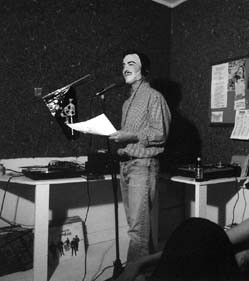
Frank Black’s radio program has it backwards. Instead of brief talk segments punctuated by commercials, news, and station identification, the Frank Black Cocktail Party on West Pole Radio (88.1FM), features about 30 minutes of wide-ranging, irreverent conversation interrupted by a few underground pop songs, followed by another long rap session. The signal from this illegal 12-watt transmitter, located in a hush-hush studio on the edge of Santa Rosa, reaches only about 10 miles. But given the luxury of time, Frank Black chews on some big subjects.

Like oral sex.

“That’s disgusting,” says Black flatly, standing at a microphone beside a table full of audio gear. “If a girl absolutely insists I go down there I will, but I won’t stay a second longer than I have to. It’s not clean, man. I mean, I don’t want to get sick. It’s not healthy.”

Is this man crazy or just kidding?

Ask Black’s guests. On this evening, they are the Wind Goddesses, that’s Star and Venus. And they’ve come to counterbalance just this kind of chauvinistic pap coming from Black. “Frank is coming from a place of paranoia and fear,” concludes Star. In the one-room studio, the guests sit on an old lumpy couch, wearing sensual loose dresses. Flowers adorn their cascading black and auburn hair. The air in the cramped, closet-sized studio is a little stuffy, but the atmosphere is warm and familiar. Sitting next to Star is Black’s sidekick, Cougar, a hard-bodied young jokester not far out of high school. Monkey Boy sits on the floor against the wall and chimes in whenever the topic gets boring or strays too far afield.

At the moment, that’s not a problem. “The problem is most men don’t know what a woman likes,” says Star. “They use their tongues like some sloppy washcloth. The clitoris is stimulated by consistent, gentle pressure. So don’t change what you’re doing when she starts to like it.”

There are no commercials, but this definitely isn’t National Public Radio.

Because West Pole is pirate radio, Frank Black commits a federal crime by broadcasting without a license. Borrowing the local nickname for the small west county town of Occidental, the station began broadcasting from a clandestine Sebastopol location in January and moved to Santa Rosa last month.

Other pirates have operated in the Redwood Empire over the last year, and West Pole’s emergence in Sonoma County’s largest city marks the local ripening of the nation’s most dynamic and democratic trend in mass media. West Pole is one of an estimated 500 to 1,000 low-power radio stations operating illegally in the United States, broadcasting to local listeners without the sanction of the Federal Communications Commission.

The result is an unregulated, radically populist medium that provides a platform for common citizens to distribute their politics and culture to their own neighborhoods and beyond.

The movement provokes no uncertain opposition from the FCC and the National Association of Broadcasters. Radio pirates universally regard these two agencies as the bad guys. The FCC, they say, is the government enforcer of that monopoly rather than a fair regulator of the public airwaves. The NAB is an influential lobbying organization for the mostly corporate broadcast industry that pirates believe hold a monopolistic cartel over the radio dial.

Across the country, free-radio stations are known to broadcast everything from working-class and environmental politics to high school football games, city council meetings, and interviews with political candidates. Such stations serve housing projects, small towns, rural counties, and big-city neighborhoods. The pirate community cuts across ideological lines, and includes a network of Black Liberation stations and plenty of conservative Christian radio as well as extreme right-wing elements. And as at West Pole, pirates typically broadcast an eclectic mix of music not found on the current hit parade.

In California, pirates flourish and skirmish with the FCC in San Rafael, San Francisco, Fresno, San Jose, Santa Cruz, and Salinas, beaming out left-wing politics to folks in Berkeley, traditional Latin music and labor politics to migrant workers in Salinas, new history in Lake County, and bilingual programming in San Francisco’s Mission District.

In addition to West Pole, Sonoma County is home to several other self-styled underground radio stations, including River Rat Radio in Monte Rio and KSRF 96.9FM in Sebastopol, run by local teenagers on the weekend. Others broadcast in Petaluma, Bodega, and Rohnert Park. West Pole Radio runs from 5 p.m. to midnight on weekdays, but many pirate stations operate on unpredictable schedules–and frequencies–to elude detection.

“Our plan is to push the limits of pirate radio as far as we can get away with,” says Black. At first, West Pole doesn’t appear to push the limits very far. Black and his collaborators say they are not political. They don’t use their real names. Programs like co-founder Brown Jenkin’s Bachelor Pad, featuring “beer, bikes, and music,” don’t seem like much of challenge to the status quo.

Yet, in that instance, the music is fiercely independent, underground rock, funk, and jazz; the bicycles are a new ethic in transportation. Even the Frank Black show, in its ongoing exploration of “the mysterious mating rituals of human beings,” confronts a vital menu of social politics, poses prickly philosophical questions, and talks openly about sex and drugs.

Black, while often indulging in cheap male belligerence, is actually a skillful journalist. He forces listeners to evaluate their own thoughts. Isn’t the schoolboy who sleeps with his teacher just getting lucky? Is the journalist who distributes child pornography while infiltrating that underworld industry to get the scoop guilty when he’s caught in a police sting?

“This Frank Black character, this alter ego, is just an expression to entertain people but bring somewhat serious topics to the light,” says Black. “But I do it in a humorous manner to get people thinking about certain things that are, for the most part, taboo subjects, or subjects that aren’t discussed but should be discussed.”

Unlicensed broadcasting is a federal crime punishable by a year in jail and a $100,000 fine from the FCC. So how are so many people getting away with it?

Low-power radio transmitters are small, portable items about the size of a textbook. They are the most affordable form of mass media. For as little as $500, a station can get started, and for an average of $1,500 pirates can broadcast over a 10-mile radius. This availability lends a powerful organizing tool and political forum to even the most poorly funded voices of opposition and activism.

“It’s a low-tech crime with old-school technology,” says Black, who thinks the chances of getting busted are nonexistent. By strength of numbers, pirate stations constitute a guerrilla media army performing electronic civil disobedience in open defiance of the existing law and commercial media.

Pirates call on a higher law of free speech, he adds, due process, and fairness under the law.

“I have vowed to put 10 stations on the air for every one the FCC shuts down,” says Stephen Dunifer, founder of Free Radio Berkeley and unofficial figurehead of the free-radio movement. “The government doesn’t have the resources to shut everyone down.”

To meet his goal, Dunifer markets a catalog of low-cost products needed for setting up a microradio station.

In California, all eyes are on the FCC’s bellwether case against Free Radio Berkeley. Last November, federal Judge Claudia Wilkin rejected the FCC’s latest request to shut down the station that Dunifer started five years ago. Until the case goes to trial in a year or two, some consider unlicensed low-power broadcasting to be virtually legal.

“It’s not illegal until Dunifer goes to trial,” asserts pirate broadcaster Bonnie Perkins of Lake County Radio (88.1/90.3FM). For her weekly program, titled “Censored History,” she proudly says that some locals call her “the Noam Chomsky of Lake County.” Perkins, a self-described “housewife,” says, “Nobody has been touched since the Dunifer case–in California.

“They hit in Arizona and Florida, that we know of. They were horrible raids. [The feds] destroyed everything, just like in Waco.”

Well, not just like Waco, and pirate radio is not exactly legal.

FCC spokesman David Fiske says any notion that unlicensed broadcasting is legal is “simply not true.” The FCC starts with warning notices, followed by seizure of equipment and fines. Ninety pirate stations “voluntarily” shut down in 1997, after receiving warnings from the FCC, and seven were physically closed by federal marshals. In several cases in which pirates have refused to turn off the mike, FCC policy has translated into a SWAT-like team with machine guns bursting through the front door.

Last November in Tampa, Fla., heavily armed cops reportedly busted down the front door of radio pirate Doug Brewer’s house, held Brewer and his wife on the floor at gunpoint, seized his equipment, and ransacked the house. “I had absolutely no political agenda–at least not until they came in here with guns,” Brewer told the Los Angeles Times. “I just thought Tampa radio sucked and we had to do something to improve it.”

This year 65 stations have closed after getting warnings, according to the FCC. Arthur Kobres, also of Tampa, was convicted in late February on 14 counts of broadcasting without a license. He faces up to 28 years in jail and a $3.5 million fine. His conviction is thought to be the first of its kind in many years.

At the center of the free-radio world is Dunifer, a self-described anarchist, member of the radical Industrial Workers of the World, and a veteran of resistance politics, from the Vietnam War to old-growth redwoods. A tireless crusader for free radio, Dunifer manufactures and sells transmitters from his home, and offers assistance to all comers, including communities in Mexico and Haiti.

Dunifer found his inspiration in such pirate radio pioneers as Mbanna Kantako, a legally blind man living in a Springfield, Ill., housing project who started broadcasting Black Liberation Radio in 1987 on a one-watt transmitter. At first ignored by the FCC, Kantako was fined $750 and found himself the subject of harassment after he addressed police brutality in Springfield. Regarded as the father of the microradio movement, Kantako still broadcasts Human Rights Radio in Springfield.

In the early days, the 46-year-old Dunifer on occasion transmitted from a car, sometimes even a backpack in the Berkeley hills. He wears long straight gray hair, a foot-long beard, glasses, and a blue denim jacket. He shakes hands gingerly because of a degenerative form of arthritis, but he speaks with the strength of deep conviction.

“The status quo is the corporatization of our lives, like when a kid gets kicked out of school for wearing a Pepsi shirt on Coke Day,” Dunifer recently told a Sonoma State University media law class at which the students were peppered with Nike logos. “The yoke of the new feudalism sits on the neck of every person on the planet.”

Behind the battle between the pirate radio and the FCC lies the core issue of media ownership. Free-radio advocates argue that the concentration of media ownership in the hands of just a few giant media conglomerates, along with the enormous cost of licenses, makes broadcast media the exclusive activity of the very rich.

“The FCC has raised the barrier so high that only the wealthy and well-endowed have a voice,” argues Dunifer. “The real pirates are the corporations who stole the airways. At the very worst, we can be portrayed as attempting to return stolen property.”

In April, at the NAB’s Las Vegas convention, Louis Hiken, one of eight attorneys providing pro-bono services to Free Radio Berkeley, presented a position paper titled “Broadcasting, the Constitution, and Democracy.”

Notes Hiken: “Let’s look at radio, the media sector most thoroughly affected by the recent Telecommunications Act. The act relaxed ownership restrictions so that one company can own up to eight stations in a single market. In the 20 months since the law came into effect, 4,000 of the nation’s 11,000 radio stations have changed hands, and there have been over 1,000 radio company mergers. Small chains have been acquired by middle-sized chains, and the middle-sized chains have been gobbled up by the few massive companies that have come to dominate the industry.

“This sort of consolidation permits the giant chains to reduce costs by downsizing their editorial and sales staffs, and running programming out of the national headquarters. According to Advertising Age, by September 1997 in each of the 50 largest markets, three firms controlled over 50 percent of advertising revenue [and programming]. In 23 of the top 50, three companies controlled more then 80 percent of the ad revenues. CBS alone has 175 stations, mostly in the 15 largest markets.”

Ben Bagdikian, author of Media Monopoly, Pulitzer Prize-winning journalist, and professor emeritus at the UC Berkeley School of Journalism, says that 12 major corporations dominate the mass media, down from 50 just a few years ago.

“The significance of the whole movement of the pirate stations is, while it is obviously against the law, a symptom of the failure of the FCC to demand of local stations that they allot a certain amount of time to local groups,” says Bagdikian. “And they used to do that. In the last 30 years or so they have failed to do it.

“The present trend is to worsen things,” he adds, “moving toward more and more consolidation of national chains in radio. More and more limitation to a few fixed formats that have very little place for local access. And especially in the major markets. Local community groups, including quite significant ones–ethnic groups, civic action groups–have almost no access to those stations. And that used to not be the case. It used to be that if you had a radio license, or a TV license for that matter, when the renewal time came up, the FCC wanted to know how much you had served your own community.”

Dunifer agrees. “Mainstream radio does not reflect diversity,” he says. “Microradio is very diverse, which speaks to the whole issue. The great appeal is the culture to be expressed. People gravitate to it because the regular outlet is denied. Microradio is not just a bunch of crazy anarchists from Berkeley, but an incredible diversity that promotes civil discussion across the spectrum of ideas.”

FCC officials say that pirate radio endangers the public by interfering with aviation and public safety frequencies; and that pirates interfere with licensed stations and don’t participate in the Emergency Alert System.

John Earnhardt, spokesman for the NAB, representing 5,000 radio stations and 12,000 TV stations, echoes the FCC policy concerns about air traffic safety and frequency interference. “It’s serious,” he says. “Not just because it’s illegal, but because it gets to putting some lives in danger.”

Mitch Barker, p.r. representative of the Federal Aviation Administration, says the FAA has documented five cases of interference with aviation frequencies, including a Sacramento case in which a poorly constructed transmitter interfered with airplane traffic. The FCC’s Fiske says an airport in Puerto Rico was nearly forced to shut down owing to extensive interference before authorities nabbed the guilty pirate station.

In Seizing the Airwaves: A Free Radio Handbook, edited by Dunifer and Ron Sakolsky, Dunifer agrees that interference is a legitimate concern and explains how pirates can study their local radio dial to avoid interfering with traffic control signals. Usually, he says, there are plenty of available slots in the radio spectrum to accommodate low-power community radio. “The whole point is to be a community asset, not a community nuisance,” says Dunifer. “It’s ludicrous for the FCC to stand in the way of a community to start its own voice for $1,500.”

In Sonoma County, licensed broadcasters express mixed feeling about rebel radio outfits like West Pole Radio. “If it’s one or two stations it’s not relevant, because there are 60 choices on the dial,” says Lawrence Amaturo, whose family owns local stations KMGG, KXFX, KMGG, KFGY, and KSRO, and two more radio stations in Southern California.

“But if it’s 20 stations,” continues Amaturo, “it becomes very relevant to our ability to maintain a level of quality because our revenues would be measurably impacted by that sort of proliferation. Every broadcaster in this town works extremely hard, and we have the privilege of serving our community–and a responsibility. Pirate radio has none of that. It’s just about themselves. They just play what they want. They’re not constrained by any FCC regulations. They have no watchdog to watch for them broadcasting inappropriate material.

“And that’s problematic.”

Brent Farris, the gregarious vice president of programming for KZST, spoke, along with Dunifer, to the SSU media law class. “I’m very sympathetic to pirate radio,” says Farris, noting his credentials as a former practitioner of “free-form hippie radio” in the 1970s. “My only concern is that anybody can do it. Which means that the people with good intentions can do it and the people with bad intentions can do it. That’s why you regulate it. Doesn’t matter if you’re right-wing, left-wing, fanatic, conservative, liberal. Does that scare you? It scares me.

“And I believe in free speech.”

At KRCB public radio, program director and acting station manager Robin Pressman considers the non-commercial station to be a pirate station with a license. “I certainly understand the movement because of what’s happened in the world of radio, the conglomeration of radio stations, so that something like eight companies own all of the radio stations in the United States,” says Pressman. “There are very few locally owned stations anymore. [The big companies] are ruining radio in dictating play lists from a central office so that the same things are being played on every radio station. It’s a very narrow band, what’s available… .

“We are definitely simpatico with the people who are doing pirate radio.”

But Maria Fincher, station manager of Santa Rosa’s KBBF-FM–the first bilingual public radio station in the nation, now celebrating 25 years on the air–opposes the pirates on principle. “I don’t approve, because you have to find the right channels and follow the rules. I’m public radio. And I don’t have the money that commercial radio does. I can’t do the things they do. If I can’t do that, then I just can’t do it.

“I can see their point, but it’s an easy way to get what you want.”

Media law attorney Hiken has proposed that low-power stations be allowed to occupy unused frequencies, formally register with a simple application form, keep their signal under 50 watts, and follow basic technical criteria. His proposal envisions one station per organization, no commercial sponsorship, and no content requirements.

Such calls for the legalization of low-powered community stations appeals to some at Lake County Radio. However, the diversity of the movement also imprints itself on this question. “The day we have a license, we won’t be able to do any of this,” says Frank Black.

I don’t think that’s the route to take,” says Bagdikian. “The necessity is for the FCC to take cognizance of the fact that low-powered stations have a real community function and that there should be a demand that stations provide significant time to local groups. What I hope is that the legal cases of the pirate stations, whatever their outcome, will dramatize the fact that, though they’re illegal, they reflect a need that the government has not provided.”

Meanwhile, at the new West Pole digs, Black enjoys a little elbow room, even a window, and a growing list of sponsors: Punch Street Wear, Flying Goat Coffee, Slice of Life vegetarian restaurant, Bohemian Cafe, Box Office Video, and Village Bakery.

Apparently somebody is listening.

“I think they’re doing a great thing,” says David Burns, owner of Slice of Life. “There’s room and a need for people doing things like that. There’s a lot of people who have some good information and other, alternative types of entertainment that would never ever be heard because not everyone can afford an FCC license. Why just leave it to all these people with big corporate bucks?”

From the May 14-20, 1998 issue of the Sonoma County Independent.

© Metro Publishing Inc.
Talking Pictures

0

Love Bird


Peter Iovino

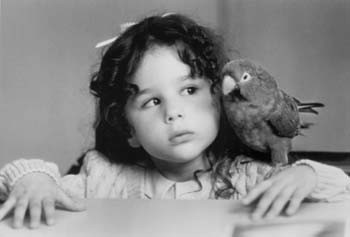
Fine feathered friends: Hallie Eisenberg and co-star Paulie.

Jeffrey Masson shares a few words on talking birds and the movie ‘Paulie’

By David Templeton

In his ongoing quest for the ultimate post-film conversation, David Templeton discusses interesting movies with interesting people. This week he phones up Dr. Jeffrey Masson to discuss the offbeat new talking-bird movie Paulie.

WHEN JEFFREY Masson went to see Paulie–a strange, low-profile adventure about a talking parrot on a quest to find his way back to the little girl he loves–the renowned author’s expectations may have been unrealistically high.

As demonstrated in his best-selling books When Elephants Weep (Delta, 1996) and Dogs Never Lie About Love: Reflections on the Emotional World of Dogs (Crown, 1997), Masson maintains a notably rich appreciation of all animals. After years of research and study on the inner lives of beasts and birds, one could say that he has come to feel their pain–as well as their joy, love, anger, frustration, petty jealousies, and the occasional fit of existential angst. So when a movie pops up claiming to offer a peek into the hopes and dreams of a homesick parrot, Masson knows exactly how potent that movie could be.

Paulie, alas, falls short of Masson’s mark.

“They weren’t telling me anything I didn’t already know about birds,” he good-naturedly grouses, speaking by phone from his home in Berkeley. “Though some of the bird scenes were remarkable.”

“There is something magical, isn’t there,” I tentatively suggest, “in the ‘talking animal’ genre of movies, with Francis the talking mule wandering up and spouting flawless Midwestern vernacular?”

“I think that’s why movies like Babe get under our skin,” Masson replies. “We love talking animals.”

“And isn’t that part of why we are so taken by parrots?” I further probe. “With parrots we can almost believe that animals could start to talk.”

“But animals can talk,” Masson playfully chides. “They just don’t speak English.

“You know, I was reading one of the great books on parrots recently,” he suddenly recalls. “It’s called Parrots of the World, a huge, magnificent volume, the best work ever written about parrots. In a very short introduction, the author says, ‘People don’t know that much about the behavior of wild parrots, but one thing we do know is that parrots do not imitate sounds in the wild.’ And I thought that was fascinating.

“Here we have a type of bird that is famous, in our world, for imitating human sounds, and yet in the wild, the parrot never does that. It doesn’t imitate other species. So it really makes you think, what is a parrot doing then, in captivity, when it imitates human speech?”

“What do you think it’s doing?” I wonder.

“Well, I think they are trying to communicate with us,” he says, matter-of-factly . “I don’t believe they are merely imitating us. I think they are trying to figure out how to talk! Thanks to Irene Pepperberg, who’s a very great scientist, scientists now know that certain parrots–African grays in particular–are indeed capable of understanding words. They can learn the meaning of up to 50 words. They can count. They can tell the difference between a round object and a square one. And if you ask them certain simple questions, they can answer yes or no and always be correct. So it turns out that parrots are not just ‘parroting’ us, as we’ve always thought. They actually know something.”

One example–prominently featured in When Elephants Weep–is Alex, Pepperberg’s African gray, a parrot with a nasty fear of veterinarians.

“Alex had to be left at the vet for an operation once,” Masson retells the tale. “When Irene started to leave, Alex screamed out, ‘Stop! Please! Don’t go! I love you! Come back!’

“She says there’s no way Alex knew those individual words–he didn’t know the word ‘I,’ he didn’t know the phrase ‘come back’–but somehow he managed to piece that together, and he got both the words and the music correct. What he was really trying to say was something emotional: ‘Don’t leave me, don’t abandon me, I need you.’ And that was unmistakably his message.

“I had a parrot that used to bite my girlfriend’s toes,” I offer. “He was insanely jealous. He’d chew up her shoes when she wasn’t looking.”

“Parrots are among the most emotional of animals,” he affirms, appreciatively. “They can be very jealous, they can get embarrassed, they can be humiliated, they can be lonely. They get nostalgic and pine for lost loved ones.”

OF HIS OWN parrot experience, Masson says, “My parrot would routinely fly away from our balcony. We lived up above Tilden Park in Berkeley. About once a month he would suddenly decide, this is it, he was leaving, and off he’d go into the hills. The first time it happened I thought, ‘Oh my god, there’s one gone parakeet,’ but about 2 in the morning, I heard this incredible screaming. It was my parrot. I jumped up and ran out, and down in the middle of some valley, screaming his head off, there he was. It was clear to me that he was calling me, so I ran down and found him, and brought him back. He did that three or four more times.

“Eventually he did disappear,” he notes with a hint of sadness.

“That’s the theme of the movie, isn’t it?” I point out. “Lost bird trying to get home.”

“And that’s perfectly legitimate,” he agrees, “that that kind of bond could form between a parrot and a person. A parrot probably would try to find its way home.

“But back to the notion of parrots talking,” he skillfully segues. “It would be a good idea if we spent more time trying to understand what parrots–animals in general– are already saying to each other, rather then trying to teach them our language.

“Nobody, as far as I know, though, has ever lived with a pack of birds,” he admits. “There are myths of people being raised by packs of wolves, but it would be harder of course to join a flock of parrots. How would we keep up with them?

“It’s not impossible, though,” he brightly adds.

“And it would make a pretty good movie,” I mention.

“It would,” he laughs. “In fact, I think people would flock to see that one.”

From the May 14-20, 1998 issue of the Sonoma County Independent.

© Metro Publishing Inc.
Urban Growth Boundary

0

UGB Blasted


Michael Amsler

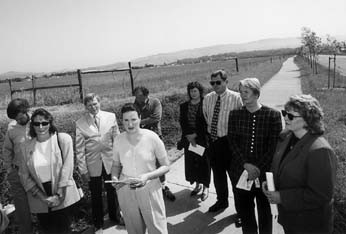
Field of dreams: Sonoma County politicos and conservationists, including Christa Shaw of Greenbelt Alliance, held a press conference last week, branding a new Rohnert Park growth measure “a cynical attempt to confuse voters.”

Chorus of critics assails proposed developer-friendly Rohnert Park urban growth boundary

By Paula Harris

WHILE THE DEBATE simmers about whether urban growth boundaries curb sprawl and allow a community to retain its charm, or whether UGBs unfairly hinder economic development by placing a blanket restriction over expansion, local voters could encounter three distinct growth-curbing measures on upcoming ballots.

In one of those instances, a new UGB has sparked allegations that Rohnert Park officials and local developers are teaming up to steamroll growth limits adopted two years ago. In 1996, Rohnert Park, Sebastopol, Healdsburg, and Santa Rosa gave the nod to UGBs, and voters countywide agreed to a measure that requires the county to respect municipal UGBs. The latter three cities adopted the first voter-approved, 20-year urban boundary initiatives in the United States; Rohnert Park’s UGB was supposed to stand for four years.

Now that sprawling suburb is the first city in the nation to face what critics say is “a cynical” challenge to the law by development interests.

The newly proposed UGB that has found its way onto the June 2 ballot in Rohnert Park–Measure A–raised the hackles of some environmentalists. Greenbelt Alliance representatives claim that the new measure actually will repeal the earlier voter-approved UGB and contains a loophole that gives the City Council authority to expand the boundaries of the growth limit without voter approval.

Greenbelt Alliance’s North Bay field director Christa Shaw, who works for the non-profit Bay Area conservation group that has spearheaded or supported every UGB measure in Northern California, warns that Measure A is a sham that ultimately will benefit big developers. “Other cities that have passed UGBs carefully constructed exceptions to make sure they could provide state-mandated low-income housing,” she explains. “On the other hand, [because of a loophole in the resolution] Rohnert Park’s City Council can expand the boundary without voter approval for any kind of housing. It’s really misleading, and it gives people a blueprint on how to destroy every other UGB.”

Others agree. “Other cities passed UGBs after a lot of public input. Here in Rohnert Park, the City Council majority is putting the cart before the horse,” says Rohnert Park City Councilman Jake Mackenzie, one of the council minority that opposes Measure A and has formed a group called Citizens United for Urban Boundaries, or CURB.

“The real plan is to increase the population of Rohnert Park by 13,000 over the next 20 years, which would require about 5,000 more houses,” he contends.

He recalls that the Rohnert Park council members who are pushing Measure A were adamantly against UGBs 18 months ago. “It’s an amazing conversion to this religion,” Mackenzie dryly observes. Rohnert Park City Councilman Armando Flores, who sponsored the ballot initiative, did not return calls for comment this week, but he has publicly stated that the measure is intended simply to encourage economic vitality and provide space for population growth.

This does not bode well, according to some community leaders and elected officials, who last month gathered to voice their concerns at the edge of a grassy Rohnert Park field, that is slated for development should Measure A pass. “Voters in Sonoma County have stated clearly and repeatedly that they want to control growth,” said Leah Gold, chairperson of the Healdsburg Urban/Rural Boundaries Committee, as she gazed at the pastoral backdrop of undulating hills. “[Measure A] is a cynical attempt to confuse voters.”

UGB INITIATIVES are riding a wave of popularity locally. In January, 72 percent of Windsor voters passed a 20-year growth measure, making it the largest such vote getter in the county to date. “Windsor was the fastest-growing community in the county,” says Windsor City Councilwoman Lynn Morehouse. “Voters told us to slow down.”

While Greenbelt Alliance’s Shaw says it is still too new to show immediate impact, she is very optimistic about the Windsor measure. “The UGB will give Windsor room to grow, but not to jump over boundaries,” she says.

This public acceptance of the county’s first urban boundaries is inspiring conservationists to wage a continuing fight for slow growth. “This is a big deal,” says Shaw. “It’s why we’re fighting Measure A. We demand high standards for UGBs. We’d like to think we’ll get a real urban growth boundary measure on the ballot for Rohnert Park by November [if Measure A fails in June]. If Measure A passes, we’ll still work to overturn it, but probably not in November.”

Meanwhile, the trend is accelerating. With a new environmentally friendly city council majority, Petaluma–Sonoma County’s second-largest city–is busy drafting a growth measure for the November ballot. Mark Green, director of the Sonoma County Conservation Action Committee, has been canvassing the sprawling riverfront city. He says the majority of Petalumans favor such a moratorium.

“Our field staff walked two thirds of the city and found an overwhelming support for UGBs,” Green says. “The only negative feedback we got was that it should have happened a long time ago. [The idea of] urban growth boundaries is not difficult to communicate or get people to buy into.”

The Cotati City Council may follow Petaluma’s lead by placing a UGB measure on the November ballot. Cotati Mayor Richard Cullinen says the matter is under discussion (at press time, the council was scheduled to consider adopting the wording of the measure), noting that council members unanimously favor placing a UGB on the November ballot.

“If the council takes action and gets the necessary support from planning to draw this up, we could qualify for the November ballot,” he says. “We’ve all longed for a strong UGB around the city of Cotati contingent on completion of the general plan.”

From the May 14-20, 1998 issue of the Sonoma County Independent.

© Metro Publishing Inc.
The Scoop

Strange Customs

Plush-toy cavity searches and TV blues

By Bob Harris

AT LAST, I SAY it’s high time that our government finally decided to crack down and seal our borders from the harmful contraband affecting the lives of our kids. No, I’m not talking about cocaine. Or marijuana. Or heroin, or tamales, or Tijuana Bibles. I’m not even talking about the Mexican border. I’m talking about our northern boundary with Canada, thousands of miles of unprotected frontier now facing a never-ending stream of … contraband Beanie Babies.

That’s right. Our kids are addicted. Canadian kids aren’t. So in response to the unequal demand, Beanie Baby smugglers are now muling the cuddly contraband into our great nation.

But fear not, fellow citizens, for the brave-hearted men and women of the U.S. Customs Department are on the case. Customs policy now states that “a consumer is allowed … one beanie … for personal use every 30 days.” This is compassionate use, indeed, allowing addicted children a maintenance fix of Beanie Baby methadone.

So as you read these words, customs agents are searching incoming vehicles from Bellingham to Calais, seizing the scourge on sight. Two Beanies for your daughter’s newborn? Sorry, Grannie, out of the car and up against the wall.

And some of the tiny plush toys aren’t even genuine, but knock-off Beanie Babies, presumably cut with baking soda. But rest easy, citizens. As one customs official explained (and this is for real): “If we think it’s a phony, what we can do is detain the Beanie Baby and submit it for verification.”

Hallelujah. Here’s yet another stirring example of our tax dollars working to keep America safe: You and I are actually paying government officials to protect a private corporation’s trademark by stopping plush toy puffins at the border and demanding, “Your papers, please.”

If you’ll excuse me now, I’m going to go lose my mind just so I can blend in around here.

OK, so the other day this guy stops traffic in Los Angeles and waves a shotgun around, so of course the TV stations drop everything and go live to the scene. Eventually the guy points the shotgun at himself, and suddenly a couple of thousand school-aged kids viewing at home have something new to ask mom and dad about.

And then afterward we have this huge debate: Should TV stations have covered the whole thing, especially during an hour when school kids are just getting home? And if the answer is yes, then should the TV guys have cut away before the suicide?

And if the answer is yes, then did they have enough time to see he was suicidal? And if the answer is yes, then what do we do in the future to keep all this from happening again?

All of which is a bunch of rubbish, since this whole TV debate is always accompanied by even more clips of the guy about to kill himself, which, if they’re actually concerned about the questions they’re asking, they wouldn’t even be showing. And still, there’s one thing missing in this whole debate: the guy. Remember him? The actual human being here?

Why’d he pull the trigger?

Oh, yeah, he spread out a big message about HMOs being in it only for the money–this just in!–and a smaller message about safe sex. Apparently life taught the guy some lousy lessons, and he wanted to share them with us on his way out.

Y’know what? Just for a second, let’s take the guy at face value. I don’t know anybody who’s happy with their HMO. Wouldn’t it be nice if, in the aftermath and debate, somebody on TV bothered to report on what’s happening right now in managed care, and what sort of alternatives might exist? And safe sex is something worth talking about anytime a whole group of kids are about to become teenagers. Which is every single month.

In the middle of all of the media fuss about all the media fuss, wouldn’t it be nice if for just one minute we pretended that maybe this guy might have been an actual human being, and not just a money shot?

Granted, some folks worry that all the TV coverage glamorized the thing so much that now we’re gonna have a whole bunch of other people staging spectacular exits, just to get 15 minutes for their own little causes.

Not to worry. Nobody’s going to repeat the show to make a point. It obviously wouldn’t work. The guy on the highway might have erased himself, but the media’s complete self-absorption managed to erase the reason he did.

From the May 14-20, 1998 issue of the Sonoma County Independent.

© Metro Publishing Inc.
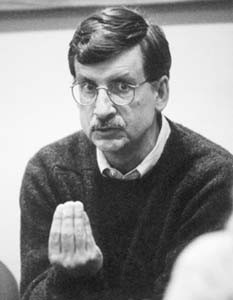
Meg Hitchcock

0

Shock of the Few


Michael Amsler

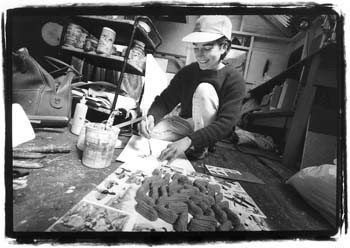
Icky art: Meg Hitchcock glues together one of her unusual candy works.

New emerging artists’ exhibition has a lot on its mind–and its head

By Gretchen Giles

SOME ARTISTS are lauded for the beauty of their design, concept, brushstrokes, color work, their proficiency with stone, marble, steel, or wood. Others are hailed for the technical virtuosity of their video images; the scenes that they cull from the darkness of the human soul; the gorgeous quality of the paint; the ineffability of the light captured on canvas; the inimitable rendering of the human form in silver gelatin.

Santa Rosa artist Meg Hitchcock’s compliment came the other way.

“I walked into her studio,” remembers Guerneville artist Harley with a chuckle, “and I said, ‘These are icky! These are really icky!’

“Her little face just fell, so I said, ‘No! Don’t worry! These are icky in a good way.'”

What could be so icky about Hitchcock’s work, paintings that, after all, are done by a highly skilled and well- trained artist? The human hair. Oh, yeah–and the candy.

Possibly producing the grandchildren of the surrealist fur cup that left a shocking taste in the mouths of Parisian aesthetes some 70 years ago, Hitchcock has a regular deal with two local salons to visit weekly and get her hair done. That is, done up from the scraps on the floor and scooped into bags to take home to her studio and wax onto canvases.

Hitchcock is among the six artists featured at the California Museum of Art’s upcoming “Ingress” show, spotlighting those local artists whom CMA director Gay Shelton and co-curators Harley and arts writer Sandy Thompson feel deserve more attention.

Joining Hitchcock are Healdsburg painter Susan Preston, who works on such found paper as those heavy waxed boxes that house the frozen ravioli her husband particularly favors; Santa Rosa photographer Deirdre Favreau, who contributes an installation based on the rigors of childhood; Santa Rosa tapestry artist Annette Kaplan, whose computer-designed works will be shown in both physical and conceptual form; Petaluma abstract painter William O’Keeffe, whose work centers on the gorgeous qualities of color and of the paint itself; and Santa Rosa painter Mark Jacobson, whose work Shelton hesitantly describes as “humble,” for lack of a better word.

“It’s very beautiful,” she asserts. “It’s not overblown.”

But we’re talking to Hitchcock, whose paintings are certainly not icky, except in a good way. Take “Orthodox Gummies” for example, one of the pieces she’s contributing to “Ingress.” This large canvas painted with a light cross hangs in her rural studio. It is covered with regularly spaced candy gummy worms, each surrounded by a complete halo of human hair. The effect is both humorous and visceral. From a distance, the image is that of devout paramecia, yet one knows the feel of the slick smoothness of the gummies in the mouth, a feeling that is surmounted by the remembrance of that shock when both the car window and your mouth are open and your own hair comes flying onto your tongue like a horde of unwelcome caterpillars.

Add some wet worm-shaped candies to the mix and you’ve got … ick.

Hitchcock is getting used to this. Recently exhibiting at the Meridian Gallery in San Francisco, she was shocked to learn from the gallery owner that visitors’ reactions were so negative.

“I guess that it really disturbed people,” says Hitchcock, a petite woman with terrific brown hair of her own that was a whole bunch longer until she decided to produce “Self-Portiat” (sic), a mandala of tresses waxed onto silk canvas, last fall.

“It’s so innocuous,” she shrugs, “it’s just hair. But I guess that there are a lot of associations that people just made.”

Hitchcock firmly declines these connections, all the while acknowledging that viewers may see sexual, corporeal, and possibly even fascist metaphors in her work. “If I defined it, and if I said that this is what it means, it wouldn’t go any further,” she says strongly. “This way, it can be anything that people want it to be. Anything. And that’s true of so much in life. As soon as it’s defined, it just stops. I’m doing it because it’s what I do. For the pleasure of it.

“And what anyone would like to read into it is just fine.”

Hitchcock is used to going her own way. Right-handed by birth, she paints with her left hand. Proud of her spelling and writing abilities, she finds nonetheless that her left hand can’t make use of either. Trained for years in her art, she deliberately paints like a child. Brainy and aesthetically driven, she listens to talk radio and empties her mind of all thoughts as she paints.

“I spent a lot of years studying, and all of my work was really dry and boring to me,” Hitchcock admits. “I wasn’t having fun doing it. At some point, I made a conscious effort to forget all the rules, and every time a rule came into my head to let it go. Then I did a series of drawings that were very childlike, and it felt really good. You’re always told, ‘Never use acrylics on top of oils.’

“So, I thought,” she says with a mischievous smile, “‘that’s a good reason to try it.'”

“Ingress” exhibits May 27 through July 19 at the California Museum of Art. A reception and gallery talk with the artists is scheduled for Friday, May 29, from 5 to 8 p.m. Luther Burbank Center, 50 Mark West Springs Road, Santa Rosa. Admission is $2 for non-members. For details, call 527-0297.

From the May 14-20, 1998 issue of the Sonoma County Independent.

© Metro Publishing Inc.
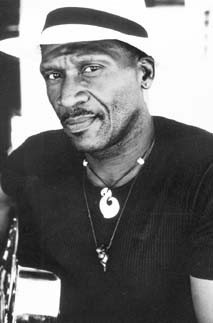
Talking Pictures

0

Moby Deal

By David Templeton

In his ongoing quest for the ultimate post-film conversation, David Templeton takes a meeting with renowned Fortune columnist, corporate insider and novelist Stanley Bing to discuss Michael Moore’s entertaining new business-bashing documentary The Big One.

When Stanley Bing sat down last week to watch The Big One–Michael Moore’s fascinating new comedy-documentary about corporate greed in America–his initial response–as he explains it this morning–was somewhat, um, multi-leveled.

“I had a complicated reaction to it,” Bing admits, with a quick, matter-of-fact nod of his head. “I agreed with the politics of it, but I find Michael Moore himself to be somewhat problematic. I like his combination of extremely passionate, heartfelt, focused, and intelligent politics about corporate America, with which I agree 100 percent. What I find hard to take is the cult of personality that Michael Moore surrounds himself with. The movie is all about him, Michael Moore, and his goodness-in-the-face-of-evil.

“As much as I agree with what he says in the movie, I do find him to be a bit obnoxious,” he adds, then pauses an instant, as a tiptoeing technician– preparing for a radio interview Bing will give shortly– lays down cable beside us. After a moment of thought, Bing’s eyebrows raise and he says, “I really didn’t mean that to sound as harsh as it came out.”

In spite of it’s flaws, The Big One stands as among the most entertaining, provocative, and downright funny movies of the year so far. Kind of an “author/activist’s travelogue,” the film follows Moore–who previously brought us the groundbreaking Roger & Me–as he embarks on a cross-country book tour to promote his book popular Downsize This. Along the way, Moore alternates between playing working-class stand-up before throngs of faithful fans, and doing what he does best: invading corporate lobbies in an attempt to ask the CEO some difficult questions, mainly, “Why are you laying workers off at a time when you are enjoying record profits?”

“A very important question,” Bing agrees. “The thing that makes him so important as a social critic is that very few people are asking those questions right now. Most people are asking, ‘How can I get 15 percent on my investment instead of 12 percent?” He bursts into laughter, adding, “That’s the pervailing cultural question right now. And so Moore goes and makes an end run around the whole fatuous debate about investments and what’s a smart investment and all this other stuff, and he’s saying, ‘We’re destroying the fabric of American life so that we can keep this spiral of ever increasing profitability going. Maybe it’s time to ask if there isn’t perhaps a saner paradigm.’

“There is a wonderful, powerful naiveté underneath his work, because he expects better of capitalism. While a less idealistic person would say, ‘Well, this is America. We chew people up and spit them out. That’s what we do here.'”

Bing, in his long-running Big Biz humor column in Esquire and Fortune magazines, and now in his terrific new novel Lloyd: What Happened–A Novel of Business (Crown, 1998), deftly tackles many of the same issues that Moore does, though with a far lighter touch and a much different perspective.

The pseudonymous Stanley Bing is, in fact, Gil Schwartz, a senior V.P. of communications working within the belly of the beast at corporate giant CBS. In his new novel, best described as a board-room screwball comedy, Bing/Schwartz gives us Lloyd, a nice-enough mid-level executive saddled with the horrifying task of implementing his company’s downsizing, all in service of an impending merger affectionately known as “Moby Deal.” Lloyd’s comic attempts to retain some shred of his rapidly peeling morality–illustrated by delightfully off-the-wall, full color graphs and charts–is the heart of Bing’s loosely plotted but fast-paced, sharp and biting satire.

Like Moore, Bing takes offense at the way employees are treated by the very companies that benefit so greatly from their hard work and dedication.

“In this movie,” continues Bing, “I’m most fascinated and most interested by the view of the people of America that Moore shows, the visceral feeling you get of what it means to a person to have just lost their job–which is incredibly powerful and beautifully done. The points that he makes are trenchant and incredibly important, because I don’t believe that anyone else is really making them the way that he’s making them. When you see the actual faces of people–that woman that came up to him in the book store, and said that she’d just been laid off that day–corporations don’t see that.

“When they downsize, they don’t really think about that person.”

“How can they not?” I can’t help but ask . “How can a corporation not realize that the payroll checks are being cashed by real humans with real lives?”

“They know, but they don’t think about it,” Bing states. “There are a lot of rationalizations that businesses make. You may lay off thousands, but look! There are 80 thousand that you are safeguarding! They remind themselves that this is business, that you are doing it for the shareholders, whatever rationalization allows them to sleep at night. And they do sleep at night. Very well, in fact.

“I don’t think that it’s written in stone, though, that you have to do terrible things in order to serve your stockholders,” he laughs. “Doubling your profits every year, though, you probably have to do some pretty nasty things.”

Which brings us back to Lloyd.

“In an almost obverse way, a different way than Moore is looking at things, Lloyd is going at some of the same points,” Bing observes. “As Lloyd becomes more successful, it is necessary for him to become a worse person. And the actions that he is forced to take– both by his company but also by his desire to support his family and to be successful and to, you know, to live his life–these actions bounce back eternally and undermine whatever native goodness he might have. He’s tormented about the things he has to do.

“But not to the point where he would ever not do them.”

“He does come around … somewhat,” I point out, referring to Lloyd’s plan to harpoon Moby Deal in order to save his friends jobs. “And though he may be only fictional, I find his actions hopeful.”

“Lloyd finds a higher ethic, yes,” the author smiles. “The higher ethic that Lloyd decides to practice at that point is friendship. For Lloyd, friendship transcends greed. That’s about as good as it’s going to get at that level. In the end, though I wouldn’t say Lloyd suddenly ‘gets religion,’ but he does suddenly decide to do the right thing.”

Not that Michael Moore would ever see Lloyd as a hero, I suspect.

“I don’t know about that,” Bing retorts, happily. “I would hope that Michael Moore would see my picture of corporate America, and recognize it, and find the truth in it–and find my moral outrage to be equal to his.” With a final chuckle, he adds, “It’s just that he uses a bludgeon to express himself and I use a scalpel and a very fine tweezer.”

From the May 7-13, 1998 issue of the Sonoma County Independent.

© Metro Publishing Inc.
Full-time Teaching

F/T Job Wanted

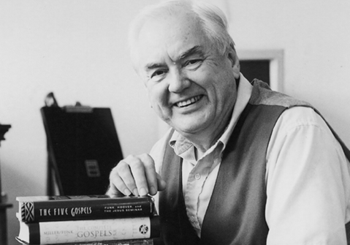
Making a fine point: SRJC history instructor and Academic Senate member Marty Bennett gathers support to back a bill hiring more full-time faculty.

Michael Amsler


SRJC instructors join statewide call for more full-time teaching positions

By Paula Harris

IT’S 5:30 A.M. as part-time Santa Rosa Junior College history instructor Alix Alixopulos edges his old Ford van (actually a traveling makeshift office–crammed with text books–that has logged more than 200,000 miles) onto freeway commuter traffic.

The longtime Sonoma County adjunct instructor and Santa Rosa resident spends tedious hours on Highway 101 shuttling between college campuses. He teaches morning classes in Pleasant Hill, beyond Vallejo, then drives back to Santa Rosa to teach afternoon and evening courses at SRJC.

Alixopulos, 57, a “freeway flyer” (the term used for traveling adjunct faculty) for about 13 years, calls his situation a form of migrant labor. He hates the instability and the commuting but tolerates the exhausting lifestyle because of his love for the work. Alixopulos longs for a full-time position, but, in his own words, “it’s never going to happen” because of the disparity between full- and part-time faculty positions at community colleges.

“[Administrators] would rather hire part-timers, or someone at the lower end of the pay scale,” says Alixopulos, who has 30 years’ teaching experience. “People like me get kind of trapped, but I teach because I love it.”

According to the California Federation of Teachers, two out of three faculty members in community colleges statewide are part-time employees. In the fall of 1997, the part-time instructors in California’s community colleges composed 43 percent of staff positions, a far cry from the 25 percent mandated by law 10 years ago. A December 1997 report by the state chancellor’s office found that only four of California’s 71 community college districts have achieved that goal–SRJC is in a three-way tie for the 16th ranking in the state for the highest percentage of hours of credit instruction taught by full-time faculty.

Typically, in a trend that’s being increasingly felt nationwide, employers are hiring part-timers as a cost-cutting measure. These faculty members are poorly paid, receive no benefits, and have little in the way of support.

“A part-timer is paid 62 percent of what a full-timer is paid in hourly assignments,” says Marty Bennett, an SRJC history instructor and a member of both the CFT and the American Association of University Professors. SRJC has 305 full-time faculty and 755 part-time instructors, he says.

In addition, tenured faculty are not being replaced when they depart or retire, leaving few instructors on the time-honored tenure track. Critics say the total effect undermines the teaching profession and erodes the overall quality of higher education.

However, there are some attempts to reverse this budget-driven trend. Last week, the SRJC Academic Senate, which represents the faculty, unanimously passed a resolution recommending that the college commit an annual portion of its budget to increasing the ratio of full-time to part-time faculty by at least 20 percent over the next five years.

The Academic Senate also voted to create a resolution on giving pro-rata pay to adjunct faculty.

Bennett says some SRJC departments, such as computer information sciences, English, and English as a second language, are seriously hurt by the imbalance. “We envision having a task force to look at needs of particular departments on campus,” says Bennett.

The move by SRJC is tied to the statewide effort to boost staffing levels. A number of legislative bills seek to create 2,000 new full-time faculty community college positions annually for five years. Other bills would create a permanent budget category to fund full-time jobs and would require part-time faculty to be compensated at a salary of a full-time faculty member with comparable training and experience.

ON MONDAY, a rally in Sacramento sponsored by the CFT and co-sponsored by the state Academic Senate, the California Teachers Association, and the Faculty Association for California Community Colleges underscored the situation.

“There’s a great need for change,” says rally organizer Tom Tyner, president of the Community College Council of the CFT, during a telephone interview from his Fresno office.

“Part-time staff are at a great disadvantage, and the majority are not choosing to work part-time, but they have no option. It’s the only avenue into community college teaching right now.”

Critics say the overreliance on temporary part-time faculty is detrimental to students. Through no fault of their own, part-time faculty are not as accessible on campus, are less available for mentoring, and have little say in the decision-making at the college. “Now most of my energies are spent commuting,” says Alixopulos, adding that there’s little time left to plan classes.

“You’re reduced to what you can do without too much preparation.”

Tyner says such hiring practices send a negative message to students. “They see the hypocrisy and irony of our educating and training them for gainful full-time employment while using primarily part-time employees. It’s exploitation,” concludes Tyner, who likens the situation to the United Parcel Service’s strike last August when part-time UPS workers made a compelling case that garnered widespread public support.

“We’re hopeful that the legislative route will be successful. If not, there are other alternatives for us to pursue like the UPS workers did,” says Tyner, adding that a strike is definitely a possibility. “When you have over 30,000 part-time faculty throughout the state, you have the numbers to shut the entire system down if the situation gets desperate enough,” he warns.

He says the money is available to create the jobs through legislation, but that the public needs to be made aware of the situation. “Any support we can get at the local level filters up to the state level,” he says.

“Ultimately it will depend upon public concern and financing from state and local levels.”

Meantime, Alixopulos and thousands of other freeway flyers continue to take to the roads to pursue their dream of academia. “Most part-timers would give anything to be able to work full-time,” he says. “Teaching isn’t a hobby for us.”

From the May 7-13, 1998 issue of the Sonoma County Independent.

© Metro Publishing Inc.
Spins

0

American Classic

James Michin III


John Fahey CD sets the record straight

John Fahey
America
(Takoma/Fantasy)

IN 1971, John Fahey released the single LP America that many consider a masterpiece–a classic example of solo acoustic guitar from the man who defined the instrumental folk genre. Unfortunately, only about half of the original work made it onto vinyl because someone convinced the guitarist that a double album wouldn’t sell. Now. thanks to the ability of digital technology to squeeze lots of info onto a single shiny CD, Fahey fans for the first time get to hear this landmark work in its entirety (actually, two minutes were cut since current CDs can hold only about 79 minutes of music).

It’s a real treat.

The reissue is rapturous in its beauty–a majestic, spacious work as grand in its deceptive simplicity as the early American landscape from which it draws inspiration. This new version features nine additional songs that were meant to make up the first LP of the ill-fated two-record set, including inventive recastings of American hymns, gospel, and folk songs; a cover of country blues legend Skip James’ “Special Rider Blues”; a breathtaking arrangement of the third movement from Dvorak’s Eighth Symphony; and the lost masterworks “America” (thought to be the only recording of Fahey playing a 12-string guitar) and the 11-minute mini-opus “Dalhart, Texas, 1967.”

Considering that this brilliant Maryland guitarist rarely records or performs anymore–beset by a deep depression and inner demons–and is seldom able to attain the same level of virtuosity when he does, this release is all the more welcome.
Greg Cahill

Fastball
All The Pain Money Can Buy
(Hollywood)

THE LEAD SONG and modern-rock radio hit “The Way” begins with the static sounds of a radio straining to lock onto a weak broadcast signal while the opening verse unfolds. By the second verse, the band kicks in as you’re transported to rock-radio heaven on this Tex-Mex-styled tale of an older couple who set out in an RV for a family reunion, but never make it. And so it goes throughout this young Texas trio’s sophomore album of quirky, guitar-fueled songs, which achieve both a classic rock and a thoroughly modern vibe at once. With nary a dud among the 13 tunes, influences leap out of the shadows, from Beatle-ish (“Got to Get You into My Life”) horns and Byrdsian guitars to Who-like drum flourishes and alternative legend Big Star-tinged harmonies. A cinch for cruising those upcoming hot summer days and nights.
TERRY HANSEN

Soulfly
Soulfly
(Roadrunner)

SINGER MAX Cavalera may have quit his job as frontman for the champion heavy-metal band Sepultura, but he hasn’t strayed far from their path. His last solo project, Nailbomb, was daring and sample-oriented, but the eponymous debut disc from his new group Soulfly sometimes sounds like a carbon copy of Sepultura’s landmark 1996 disc Roots. That’s good news for fans of that band’s growling, snappy ferocity, as Soulfly echo Sepultura’s embrace of the crisp rhythms and deep tones of their native Brazil. But Cavalera almost misses the very thing that makes Sepultura’s minimalisn work: an undeniable and urgent sense of purpose. Hip-hoppers might say that he is keeping it real, just as rockers say his song remains the same.
KARL BYRN

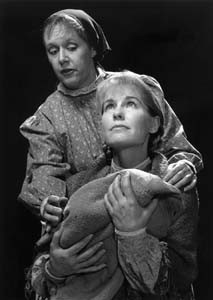
Taj Mahal and the Hula Blues Band
Sacred Island
(Private Music)

OVER THE YEARS, singer and songwriter Taj Mahal has gone from blues purist to pop idol to blues purist to… . well, the name of his current outfit says it all. This adventurous tunesmith–and former Hawaii resident–has hitched a ride with veteran members of the International Messengers Band, laying down gentle island rhythms, reggae covers, calypso/blues hybrids, and some of the most scintillating after-hours jazz I’ve heard in ages. Occasionally Taj overreaches on this potpourri of sound–ironically, the album’s only straight-ahead Hawaiian number is a bit of clunker–but name another modern bluesman with his sense of exploration or downright funkiness.
G.C.

From the May 7-13, 1998 issue of the Sonoma County Independent.

© Metro Publishing Inc.

Robert Funk

Bible Belter


David Light

Da Funk: Jesus Seminar scholar Robert Funk is shaking up religious convention.

The Gospel according to Robert Funk

By Patrick Sullivan

ONCE UPON A TIME, Robert Funk was a teenage evangelist preaching to packed revival meetings. “I did that when I was starting out, sort of being a hotshot. I knew how to make people laugh, make them cry,” Funk recalls with a self-deprecating chuckle, voice tinged with regret. A lot has changed since those evangelical days.

Now, as he sits in his busy Santa Rosa offices, the bespectacled, white-haired Funk is preaching a new gospel … literally. The architect of a collaborative scholarly effort called the Jesus Seminar, Funk is the focus of a massive firestorm of controversy over the group’s radical reinterpretation of the heart of the New Testament.

Essentially, the Jesus Seminar places Jesus Christ under the scholarly microscope. The deeds and words of Jesus as portrayed in the gospels are collected and evaluated by experts from various fields in an effort to establish their historical authenticity. The results then have been published in the seminar’s 1995 bestseller The Five Gospels and in the newly released The Acts of Jesus (HarperSan Francisco; $35).

The shock waves generated by the final tallies have yet to quiet down. “We found that only 16 percent of the events we evaluated from the gospels were likely to be authentic,” says Funk, a distinguished biblical scholar.

Indeed, the portrait of Jesus that emerges from the two books is deeply at odds with Christian orthodoxy. Forget the miracles: Funk dismisses anything like the idea of Jesus walking on water or raising the dead. Even the cozy stable in Bethlehem is out; it seems Jesus was actually born in Nazareth. More seriously, the historical Jesus is portrayed by the Jesus Seminar as a charismatic iconoclast who attacked contemporary religious institutions and social mores with revolutionary zeal and biting humor.

Of course, scholarly challenges to religious doctrine are nothing new. Riven by uncertainty, fraying into fundamentalism, Christianity might seem to some to be an easy target. But Funk argues that the Jesus Seminar’s findings constitute an important new crisis for the faith.

“The rediscovery of who Jesus really was has powerful implications for the Christian tradition, for the institutions that grew out of this figure,” Funk says. “If we allow him to have something to say about those institutions, they’re going to suffer a new and sweeping reformation.”

THIS CONTROVERSIAL effort had its beginnings here in California in 1985, when Funk, troubled by religious doubts and hungry for truth, put out a call for scholars to come together to discuss biblical issues. He was pleasantly surprised to have 35 people show up to the first meeting.

“Nobody had ever inventoried all the words attributed to Jesus or collected all the stories told about him, so I wanted to do that first,” Funk says. “I guess I have the Tom Sawyer approach to painting fences. You have a big fence to paint, you get a bunch of people to help you paint it.”

The big question tackled by the Jesus Seminar concerned the origin of what we now accept as the standard accounts of the life of Jesus. The first written narrative gospel, the Gospel of Mark, wasn’t put down on paper until 50 years after the crucifixion. So how was information about these remarkable events transmitted across this half-century gap?

Circulated by word of mouth, subjected to reinterpretation and distortion, the discrete stories and sayings of Jesus were further shaped and augmented by Matthew, Mark, Luke, and John when the evangelists turned the tales into coherent narratives.

“They were told and retold and passed around as single anecdotes,” Funk says. “The same thing happens in the transmission of jokes today. We hear them and retell them and change them a little every time.”

The scholars of the Jesus Seminar attempted to evaluate how much truth survived by watching for anachronisms, historical inaccuracies, and narrative impossibilities. They also asked medical experts to help explain accounts of miraculous healing and came up with some surprising theories, including the notion that Jesus may have exercised his powerful charisma to cure what we would today consider psychosomatic afflictions.

To people of faith unsettled by all of these revelations, Funk offers his compassion. For decades, he has struggled to hold on to his own deeply held religious beliefs, and he knows how troubling it can be to see them slipping away. While he still considers himself a Christian, he also knows that every day new scientific discoveries punch holes in the old framework of belief.

“I have a very deep sympathy for those people who are losing their faith,” says Funk. “The myths that we live by have deep emotional roots–they’re wrapped around our hearts.”

Of course, not everyone accepts the Jesus Seminar’s findings. Critics argue that the portrayal of Jesus as an iconoclastic opponent of religious institutions is suspiciously close to exactly what the seminar might be expected to find–God in their own image. To that criticism, Funk replies with some heat. “Most people who criticize that way never stop to think that the same thing also applies to them,” he argues.

“The thing to do is to look at the actual evidence.”

But he also acknowledges that the uncertainty among religious scholars holds true even among his allies. No one is sure what Christianity will look like in the new millennium. “I know many of the theological leaders of the churches, and I know they’re at sea, as all of us are,” Funk says. “We’re about to cross a watershed of enormous significance. What’s on the other side is difficult to say.”

From the May 7-13, 1998 issue of the Sonoma County Independent.

© Metro Publishing Inc.

The Quilters

Sleepy Time

Quilters is nothing but existential bleakness.


‘Quilters’ prone to induce slumber

By Daedalus Howell

WARNING: Pacific Alliance Stage Company’s production of Molly Newman and Barbara Damashek’s Quilters may cause drowsiness. While viewing, avoid consuming sedatives or tranquilizers. After viewing, use caution when driving a motor vehicle or operating heavy machinery. Keep out of reach of theater critics.

Directed by Wendy McGlothlin Wisely, Quilters is the hodgepodge metaphysical travelogue of matriarchal colonist Sara (Elizabeth Benedict) and her progeny. Together, they traipse across a frontier America studded with hardships and sacrifices dutifully recorded in the blocky hieroglyphs of quilt squares. Add music, stir in schmaltzy revelations, give myriad nods to tradition, and Quilters is a joyously American and imminently marketable populist romp.

Yes, quilting is a valuable part of the American cultural milieu, an art form rife with its own symbolic vocabulary and systems that have spanned generations, but a prosaic mosaic of sketches stitched together with a gossamer thin plot line does not constitute an interesting production no matter how clever an analogy it is to its namesake.

Those with a penchant for quilts, sugar-coated American history, or zealot girl-power, however, will forgive this musical’s foibles and appreciate the talents behind it–indubitably doing their best with an inadequate script.

Fresh-faced, Bambi-eyed Hollie Martin plays kid sister Dana with a charming guilelessness apropos of the Brady Bunch’s pigtailed munchkin Cindy. In the course of one act, Dana–who eventually freezes to death–cradles an afflicted-looking cornhusk doll, pleads God to throw the on-switch for her menstruation, and dresses like Shirley Temple whenever “talent scout” is uttered (her tedious character arc warrants this last, trifling embellishment).

Martin’s ability to stave off a self-indemnifying smile while playing the naive Dana betokens a poker face carved from stone, and though she makes a noble attempt to inflate the flat role, her obvious talents only cram in its singular dimension.

The part of elder sister Lisa, admirably endured by Donna Turner, is also an uninspired wax dummy in the shape of a pioneer woman. Turner is one of the lucky ones, however, as she is allowed to drop the hayseed persona during her character’s brief tenure as an officious schoolmarm (throughout the production, the players speak in the grating, rough-hewn dialect of the pioneer era as though they used the Webster’s to jack the wagon ’cause the wheel was broke).

Benedict, Cindy Brillhart-True, Leslie Cook, Susan Lamb, and Kristen Greer also turn in performances that swell against the suture of their characters’ shoddy stitching. They sing and harmonize well and undoubtedly benefit from Wisely’s direction talents– but the show, as written, squanders their abilities.

Under the expert musical direction of bassist Tom Martin, the band does a damn fine job finessing the Andrew Lloyd Webber out of Damashek’s wannabe traditional bluegrass-folk score. Flanked by fiddle, mandolin, and clarinet virtuoso Gus Garelick and guitarist Carl Sokol, Martin proves an able bandleader with an impressive proclivity for airy musical interpretation.

Set designer Jeremy Hamm and light designer John Kelly forge a play area that so epitomizes existential bleakness that, were The Wasteland scribe T. S. Eliot to see it, he would chuck his Nobel Prize in the furnace from shame. Dominated by a barren, sparsely lit, gray backdrop with a low, jagged horizon line done up in fiery hues, Hamm’s set deftly underscores the alienation early settlers must have felt in America’s virgin terrain.

The wanderlust of Quilters’ characters may prove contagious by the close of the second act such that audience members may pioneer into the parking lot and go westward home.

The Quilters plays May 7 at 7:30 p.m., May 8-9 at 8, and May 10 at 2:30, at the Spreckels Performing Arts Center, 5409 Snyder Lane, Rohnert Park. Tickets are $8-$14. 707/584-1700.

From the May 7-13, 1998 issue of the Sonoma County Independent.

© Metro Publishing Inc.

Pirate Radio

Rebel RadioMichael AmslerLocal pirate-radio broadcasters are electrifying the airwaves, much to the chagrin of licensed stationsBy Dylan BennettFrank Black's radio program has it backwards. Instead of brief talk segments punctuated by commercials, news, and station identification, the Frank Black Cocktail Party on West Pole Radio (88.1FM), features about 30 minutes of wide-ranging, irreverent conversation interrupted by a few underground...

Talking Pictures

Love BirdPeter IovinoFine feathered friends: Hallie Eisenberg and co-star Paulie.Jeffrey Masson shares a few words on talking birds and the movie 'Paulie'By David TempletonIn his ongoing quest for the ultimate post-film conversation, David Templeton discusses interesting movies with interesting people. This week he phones up Dr. Jeffrey Masson to discuss the offbeat new talking-bird movie Paulie.WHEN JEFFREY Masson went...

Urban Growth Boundary

UGB BlastedMichael AmslerField of dreams: Sonoma County politicos and conservationists, including Christa Shaw of Greenbelt Alliance, held a press conference last week, branding a new Rohnert Park growth measure "a cynical attempt to confuse voters." Chorus of critics assails proposed developer-friendly Rohnert Park urban growth boundaryBy Paula HarrisWHILE THE DEBATE simmers about whether urban growth boundaries curb sprawl...

The Scoop

Strange Customs Plush-toy cavity searches and TV bluesBy Bob HarrisAT LAST, I SAY it's high time that our government finally decided to crack down and seal our borders from the harmful contraband affecting the lives of our kids. No, I'm not talking about cocaine. Or marijuana. Or heroin, or tamales, or Tijuana Bibles. I'm not even talking about the...

Meg Hitchcock

Shock of the FewMichael AmslerIcky art: Meg Hitchcock glues together one of her unusual candy works.New emerging artists' exhibition has a lot on its mind--and its headBy Gretchen GilesSOME ARTISTS are lauded for the beauty of their design, concept, brushstrokes, color work, their proficiency with stone, marble, steel, or wood. Others are hailed for the technical virtuosity of their...

Talking Pictures

Moby DealBy David TempletonIn his ongoing quest for the ultimate post-film conversation, David Templeton takes a meeting with renowned Fortune columnist, corporate insider and novelist Stanley Bing to discuss Michael Moore's entertaining new business-bashing documentary The Big One. When Stanley Bing sat down last week to watch The Big One--Michael Moore's fascinating new comedy-documentary about corporate greed in America--his...

Full-time Teaching

F/T Job Wanted Making a fine point: SRJC history instructor and Academic Senate member Marty Bennett gathers support to back a bill hiring more full-time faculty. Michael Amsler SRJC instructors join statewide call for more full-time teaching positions By Paula Harris IT'S 5:30 A.M. as part-time Santa Rosa Junior College history instructor Alix Alixopulos...

Spins

American ClassicJames Michin IIIJohn Fahey CD sets the record straightJohn FaheyAmerica(Takoma/Fantasy)IN 1971, John Fahey released the single LP America that many consider a masterpiece--a classic example of solo acoustic guitar from the man who defined the instrumental folk genre. Unfortunately, only about half of the original work made it onto vinyl because someone convinced the guitarist that a double...

Robert Funk

Bible BelterDavid LightDa Funk: Jesus Seminar scholar Robert Funk is shaking up religious convention.The Gospel according to Robert FunkBy Patrick SullivanONCE UPON A TIME, Robert Funk was a teenage evangelist preaching to packed revival meetings. "I did that when I was starting out, sort of being a hotshot. I knew how to make people laugh, make them cry," Funk...

The Quilters

Sleepy TimeQuilters is nothing but existential bleakness.'Quilters' prone to induce slumberBy Daedalus HowellWARNING: Pacific Alliance Stage Company's production of Molly Newman and Barbara Damashek's Quilters may cause drowsiness. While viewing, avoid consuming sedatives or tranquilizers. After viewing, use caution when driving a motor vehicle or operating heavy machinery. Keep out of reach of theater critics.Directed by Wendy McGlothlin Wisely,...
11,084FansLike
4,606FollowersFollow
6,928FollowersFollow