
Street to Designer Fashions

0

Culture Vultures


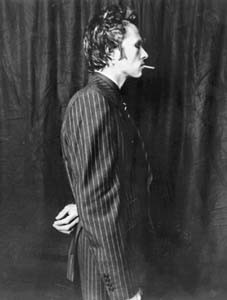
Trend Friends: Tommy Stinson, former bassist for the Replacements and front man for the band Perfect, and model Mandy cavort as thrift grifters.

Photo by Christopher Gardner


Designers are jonesing for street wear

By Laura Compton

MY FRIEND JEFF used to be the most devoted thrifter I knew. An accountant by day and artist the rest of the time, he visited Salvation Army sometimes twice a day, hit garage sales and flea markets every weekend, and created wallets and art out of construction signs and other unlikely elements. Recently, however, his personal style has evolved from vintage gabardine shirts, white T-shirts, and paint-splattered khakis to baggy designer jeans and flamboyant Nikes.

In short, he’s gone from a thrift scorer to a fashion junkie.

Fashion junkies used to be slaves to European couture dreams–the fancies of designers inspired by art, history, certain French actresses, and perhaps a period epic such as Amadeus. The media still propagate this version, with their coverage of the seasonal runway shows, designer and supermodel cults of personality, and the endless litany of what’s in, what’s out, and what’s back.

But these days, the true fashion Zeitgeist is firmly entrenched in the States. The unique styles of some of America’s most disenfranchised, marginalized groups are being systematically raided and appropriated. Add in the forces of pop culture, music, and good, old-fashioned capitalism, and the result is a syncretic “low” fashion that increasingly blurs the lines of its origins. Smart designers tweak and steal street fashions, then send them back out as hip new products, all while charging outrageously high prices.

Look no further than the Macy’s display windows, Foot Locker, or the Pavilions’ boutiques, and you’ll see items that look eerily familiar–but are suddenly way out of your price range.

“It’s now about chase and flight: Designers and retailers and the mass consumer [are] giving chase to the elusive prey of street cool,” Malcolm Gladwell wrote in the New Yorker magazine earlier this year. The article, which introduced the term “coolhunt” into the popular lexicon, explained how athletic-shoe companies such as Reebok and Converse run prototypes of new products by urban youth in “happening” cities such as New York, Detroit, Los Angeles, Chicago, and Philadelphia.

The reasoning goes like this: Cool kids want the real shit and often create their own trends. They know what’s hot instinctively, know what they and their friends will buy, and don’t take kindly to lame imitations. Models, rap and hip-hop musicians, and sports figures might popularize the styles to the masses via MTV and style magazines such as Details and Grand Royal, but it’s a symbiotic relationship that originates in the street.

Designers often revamp or scrap styles based on initial street reaction. Older trends, such as the Converse One-Star basketball shoes and Hush Puppies, are now back in force because they were selling so well in thrift and secondhand stores.

How big is this market? Unbelievably, basketball shoes alone are a $7.5 billion market worldwide. “It’s ironic that the same demographic group demonized by right-wing politicians, harassed by the police, and ignored by employers is the most sought-after by many of America’s richest entertainment and apparel companies, who seek the blessings of their authenticity, then sell it back to them for an inflated price,” comments an article in a recent Spin magazine.

But it goes beyond irony. The same baggy clothes and athletic wear that can land ethnic teens on “gang wannabe” lists are now marketed to suburban teenagers who want the tough image without the reality. Hip-hop style has permeated youth fashion and become so commercialized in recent years that much of it has been rendered innocuous, but it’s a process of constant evolution. As creative modes of dressing continue to come up through the streets, they will inevitably continue to be redone with designer names and exorbitant prices.

Hip-hop culture is just one example. Culture vultures know no boundaries; other groups whose distinct elements have become fashion fodder include skateboarders and snowboarders (baggy pants, Vans); Latinos (baggy shorts, tank tops); punks (studded belts and jewelry, Converse, men’s pants); and riot grrrls (Mary Janes, barrettes). The act of appropriation not only divests these symbols of power, but also blurs their origins until they are no longer distinguishable.

One term you’ll never see mentioned in fashion ads or media is class. Instead, its surrogate code words are campy, kitschy, hip, retro. Trailer parks, alleys, and bedraggled urban areas are the backdrops for both ads and editorial spreads. Take the short-lived, much-ballyhooed “heroin chic” fashion stance that President Clinton and others were so up in arms about. Ads and fashion layouts from such designers as Diesel and Calvin Klein, with their malnourished, drugged-looking models in hooker get-ups, were glamorizing poverty, not heroin. In today’s political climate, with its rapidly unraveling welfare system and safety net, low-income women are simultaneously blamed for society’s ills and held up as fashion plates.

Magazines such as Spin and Rolling Stone, with their double-page color ads and au courant fashion spreads, function as a guidebook of co-optation as designers desperately try to sell cool and rebellion.

Often the co-optation goes beyond the styles to the sources. Declassé styles of yesterday that we once held up as examples of bad taste or age–polyester, leisure suits, loud prints–have now been recycled and revived for a several-decades-removed generation. Thrift stores, a perennial font of older styles, have been pillaged. It’s bad enough that retailers are remaking old styles and charging an arm and a leg for them, but it’s truly galling to find Thrift Town picked over, and polyester shirts selling for $20 (versus $2 or $3) at Urban Outfitters.

A September fashion spread in Spin advises readers on how to trade in ’70s designer fashions for ’80s variations. “Feeling imprisoned by that suit and tie?” it asks. “Longing for the grunged-out Courtney?”

Ironically, in recalling the time when Courtney Love’s clothing choices expressed personal sentiments more than designer ones, Spin seemingly contradicts Harper’s Bazaar, which recently put Love on the cover because her “severe good looks and sensational background (the drugs, the booze, the rawness) suddenly conform with fashion’s hard-edged glamour.” However you choose to frame it, it’s still about selling a look, whether it’s kinder-whore or Klein.

Isn’t a fashion-blind society, where our differences are obscured and thus become unimportant, a worthy goal? Maybe in theory. But fashion is a form of personal expression. In our visually oriented age, it sends an immediate first impression. Throughout history, disenfranchised and minority groups such as beatniks, hippies, punks, gangs, and gays have been able to identify one another and bond based on certain clothing and accessory choices. Fashion statements are often anti-fashion statements. Seattle rockers didn’t wear flannel shirts because they were fashionable; they wore them because they were practical and cheap. L.A. street kids wear Hanes tank tops because they’re sexy and cheap.

Whenever a distinctive look, culture, or type of music becomes marketed on a mass level, it loses its impact. By its very nature, mass marketing mutes complexities. When we appropriate the styles of classes or cultures other than our own, respect and understanding are rarely part of the exchange. We can dress up like part of a rebellious group without taking any of the risks or truly understanding its mindset. Short of ignoring the trends, there’s no easy way around this. But being conscious of the ways in which the fashion industry sells marginalized cultures’ styles is a start.

From the December 31, 1997-January 7, 1998 issue of the Sonoma County Independent.

© Metro Publishing Inc.

Sonoma County Himalayan Restaurants

0

Mountain High


Michael Amsler

Mountain Men: The Himalayan Sherpa Cuisine restaurant’s Pasang, Nurbu, and Chhiring Sherpa smile from the kitchen.

Local Himalayan restaurants hit highs and lows of mountain food

By Paula Harris

WE HAVE TO ADMIT that we thought it was a gag when a reader wrote several weeks ago to inform us about a new Himalayan Sherpa restaurant in Glen Ellen. But when we discovered that a second restaurant featuring Nepalese food from the same highlands region (between China and India) had opened in Santa Rosa, we got serious. While perhaps not on par with trekking to base camp on Mt. Everest, exploring these new ethnic eateries was definitely on our itinerary.

First we journeyed to the Kathmandu Kitchen–a Nepalese and Indian restaurant that opened in October in Santa Rosa’s former Taj Mahal spot. Not much has changed decor-wise: There are still white walls with decorated archways, and the harsh overhead lighting is still disconcerting.

Since the servers speak very little English, it was difficult to get any help with questions about the extensive menu, which features some 70 items. (During a second visit, the owner’s son, who usually works at the family’s other Kathmandu Kitchen restaurant in Davis, was much more helpful. It’s a pity he doesn’t work in the Santa Rosa location regularly.)

The wines are simply listed by varietal–“cabernet,” “Gewürtztraminer,” etc.–and are all priced at $14 a bottle, $4.50-$5 a glass. When we asked a server for more information on the wines, he muttered something about “Sutter Home” and ambled off. We finally ordered Indian Taj Mahal beer ($5.25), which has a sharp and fruity flavor, and cinnamon-infused Himalayan tea ($1.50). Unaided, we selected some items and prepared for an exotic feast.

For starters, we tried the jingha til-tinka ($5.95), deep-fried, spicy-flavored prawns coated with sesame seeds and yogurt. Though slightly tinged with hints of mace and cardamom, the dish was still strangely bland and needed a good dose of the accompanying tamarind sauce to wake it up.

The alu tiki ($2.50) are oily, deep-fried potato patties on a bed of iceberg lettuce with a side of mango chutney. Although the menu promises a dish made with ginger, garlic, onion, and roasted cumin powder, these heavy patties were in dire need of more seasoning.

The entrées came with a dal lentil soup that was a little thin and needed salt and pepper. To sop up the curries, we also tried the garlic and cilantro nan ($2), a leavened, pillowy bread with a good flavor.

According to the menu, the mismas tarkari ($8.50) are “seasonal fresh vegetables cooked in the Nepalese style,” but these veggies–which included carrots, green pepper, potatoes, and sweet corn kernels–were so flavorless and so uniformly diced that it was hard to believe that they weren’t poured directly from a bag of frozen vegetable medley.

An interesting version of chicken tikka masala ($10.95) included pieces of charcoal-roasted boneless chicken cooked with the cardamomlike spice fenugreek and was given a dash of brandy. The rich orange-hued sauce had a good, velvety texture and the chicken was tender, but the flavor combo became starchy and cloying. The chicken tandoori ($10.50), served sizzling atop a bed of onions and fresh cilantro, was a far superior dish.

The best entrée we tried was the beigan bharta ($8.50), an eggplant purée roasted in a clay pot with tasty scallions, garlic, bell pepper, and spices. The dish was slightly sweet, with a pleasing smoky tang that went well with the plain basmati rice.

We declined the Himalayan ice cream ($2.95) and ordered kheer ($2.75), a cool and creamy rice pudding with slivered almonds and sultanas. However, the servers were so slow to clear the table that they did not remove most plates or clean the table before plunking down our dessert on a surface strewn with food debris, half-eaten entrées, and various plates. It was a fitting end to a disappointing experience.

OUR NEXT EXCURSION was to Himalayan Sherpa Cuisine, a small, no-frills eatery on the outskirts of Glen Ellen. The restaurant has a warm decor featuring colorful rugs and posters of the Himalaya Mountains on the walls. There’s also a Tibetan altar and a prayer rug. A tape of haunting, bell-like Himalayan bowls music–which is used for meditation–played softly.

The menu selection is fairly small, mostly featuring curries, rice, and noodle dishes. The dal soup, which accompanied the entrées, was thick and rich with lentils–a satisfying, hearty winter broth with a pleasant chalky texture.

We ordered a bottle of Markham sauvignon blanc ($14) from the modest but varied wine list. It tasted surprisingly soft and mellow for a sauvignon blanc but was a perfect quaffing wine to accompany the intricate food flavors that followed.

Fried mono ($4), eight deep-fried Tibetan dumplings stuffed with either beef or vegetables, were served with sesame-based sauce. They looked like little parcels wrapped in pastry and had a delicious spicy cabbage filling, reminiscent of a Chinese spring roll. As the British say: very more-ish.

Tibetan fries ($3) sound exotic, but are simply golden, bite-size potato wedges served with a tasty chili-tomato dipping sauce. We enjoyed their non-greasy crispness. The pakoura ($4)–potato and vegetable fritters dipped in garbanzo bean batter, fried, and served with sesame sauce–was another winning appetizer. Our curry-based entrées included bangoor ($8), tender pieces of pork cooked with onion, ginger, and Himalayan spices. The star here was coriander, which paired wonderfully with the meat.

The vegetable curry ($7.50) was a taste treat in which individual flavors of vegetables–such as cauliflower and potato enveloped in a mild curry sauce–came through as fresh-tasting, and not overcooked.

Masu tarkari ($8.25) is a savory stew of chicken pieces cooked in fresh garlic, ginger, tomato, and onion sauce. The chicken was succulent and the highly seasoned sauce was bursting with flavor. Fluffy basmati rice, a flatter, crisper version of nan bread ($2), and a silver bowl of extra-spicy sauce made good sidekicks.

For dessert, we tried the gulab juman ($2.50)–deep-fried milk and cheese balls in a light honey and rosewater syrup. Sometimes this exotic dish has a wet-flannel texture, but this version was deftly made and just right. The kheer rice dessert ($2.50), served plain, was rich and creamy.

Our server, a member of the family that owns the restaurant, was extremely friendly and accommodating throughout the meal. At one point, he pulled out a Tibetan drum and pounded out an accompaniment to an impromptu chorus by fellow diners, who broke out in a rhythmic Tibetan folk song. As we left, he even offered to tape us a copy of that wonderful Himalayan bowls music.

I think we’re hooked.

Kathmandu Kitchen
535 Ross St., Santa Rosa; 579-8471
Hours: Lunch, Monday-Saturday, 11:30 a.m. to 2:30 p.m.; dinner, nightly, 5 to 10 p.m.
Food: Nepalese and Indian cuisine
Service: Inadequate; some servers unable to communicate
Ambiance: Uninspiring; harsh lighting at dinner
Price: Moderate
Wine list: Eight varietals listed on menu, no other information
Overall: One and a half stars (out of four stars)

Himalayan Sherpa Cuisine
929 Madrone Road, Glen Ellen; 996-8194
Hours: Monday-Saturday, lunch, 11 a.m. to 3 p.m.; dinner, 5:30 to 9 p.m. (10 p.m. Fridays and Saturdays)
Food: Tibetan and Himalayan dishes
Service: Excellent
Ambiance: Cheerful
Price: Inexpensive
Wine list: Small selection, but diners can bring their own wine for a $3 corkage fee
Overall: Three stars (out of four stars)

From the December 31, 1997-January 7, 1998 issue of the Sonoma County Independent.

© Metro Publishing Inc.
Talking Pictures

0

Male Bonding


Piercing Stare: In his second foray as Bond, Pierce Brosnan almost fills the role.

Paying homage to agent 007

By David Templeton

In his ongoing quest for the ultimate post-film conversation, David visits the in-home shrine of James Bond fan Jeff Rubin to discuss the latest 007 flick, Tomorrow Never Dies.

I GUESS IT’S OBVIOUS that this is the Wizard of Oz room,” says Jeff Rubin, an articulate, soft-spoken man in his early 30s, waving his arm toward one wall of his spacious, memorabilia-packed, two-bedroom Marin County apartment. A museum’s worth of authentic posters and old framed photos hangs in an immaculate display, including autographed pictures of all Oz‘s stars, except for Judy Garland. “I’ll finally get my signed photo of Judy next month,” he beams. “I’ve been making payments on it for months.”

He beckons me to follow.

“Now let me show you the Bond room.” Just around the corner, a jarring transition occurs, as the fairy-tale whimsy of Oz gives way to the giddy machismo of Ian Fleming’s notoriously womanizing superspy. “James Bond has been featured in 18 movies, not counting spoofs like Casino Royale,” Rubin explains, as he points out each of the vast number of artifacts–pictures, posters, and models–that inhabit his self-created monument to the myth of Agent 007. “I’ve got original posters of all but the first two films. And these,” says Rubin, who is employed as a worker’s comp claims adjuster, “are my prize possessions.”

All in a row are three movie posters: The Spy Who Loved Me with Roger Moore as Bond, On Her Majesty’s Secret Service with George Lazenby, and Diamonds Are Forever, featuring everyone’s favorite Bond–Sean Connery. Each framed poster is signed by its respective star. Each bears the inscription “To Jeff.”

“I had to wait six hours in the cold to get Sean’s autograph,” Rubin recalls. “He was in San Francisco filming The Presidio, so I hauled the poster down there and just waited. People say, ‘Oh, why’d you get it personalized? Now it’s not worth as much.’ But I’m never going to sell these. It may be devalued for a collector, but, you know, it’s more special to me.”

The Connery poster, I observe, is prominently placed, shrinelike, over the room’s only bed. “Bold of you to place an image of James Bond above the bed,” I remark, “he being an ultimate symbol of virile masculinity and all.”

“I agree,” Rubin bobs his head amiably. “That’s why the other room is my bedroom.”

Back out in the living room–in a state of mild disarray following a party the previous night to celebrate the opening of the latest Bond film, Tomorrow Never Dies, with Pierce Brosnan making his second saunter through the role–Rubin shows off a display case crammed with even more items: a Bond action figure; a model of the secret agent’s famous Aston Martin miracle car; more Wizard of Oz stuff.

(Of the odd disparity between his two filmic obsessions, Rubin only shrugs. “I like both of ’em,” he sensibly explains. “I don’t think it means anything.”)

He takes a seat on the couch.

“I thought the new movie was a lot like the 1960s Bond movies,” he says. “I think it was really geared to James Bond fans. The supervillain–Jonathan Pryce–was properly insane. And Brosnan is more like Connery than any of the others. He even makes his little quips out of one side of his mouth, like Sean, where Roger Moore would just stand there and enunciate so everyone could hear exactly what he was saying. But the overall feeling I had was, ‘Wow! Bond is back!’ “

Rubin does not mean to suggest that the new film is perfect. Like most Bond fans, he holds some pretty strong opinions about how Bond is handled in these movies.

“I think Brosnan needs to fill out a little,” Rubin says, referring to the lanky British actor’s build. “And I think the k.d. lang song that played at the end should have played over the opening instead of that Sheryl Crow song.”

He even displays a mild touch of indignation about the audience with which he saw the film. “There was that end credit, in memory of [long-time Bond producer] Cubby Broccoli. I don’t think that many people picked up on it,” he says, shaking his head. “People didn’t really clap, yet he could have dissolved the series back in the late ’70s. He even hand-picked Pierce Brosnan, as the last act before he died. He deserved a little more respect than he got from that audience. I shouldn’t be so sensitive about it,” he adds. “It’s not like the theater was packed with film history majors or anything.”

He plugs in a video of Dr. No, the first Bond film, to illustrate a point about the evolution of the series’ distinctive credit sequences, with all but No featuring scantily clad women dancing in silhouette as the theme song plays.

“The new film still features the dancing women in the credits,” Rubin says, “but it’s gotten a lot artsier. The whole series is slowly making its way into the 1990s. Back in the ’60s, during the Cold War, he represented the good boys, everything that was good about NATO, the promise of someday crushing the Evil Empire. We don’t have that threat anymore, so now he’s just perceived as the cool spy guy. He still ‘gets the girl’ and stuff like that, but he also gets slapped by the occasional woman.”

Rubin admits that, as a boy, he saw Bond as a role model. He even had a special secret-agent pocket telescope he carried everywhere.

“Oh yeah, I wanted to be James Bond,” he laughs.

“But will he be a suitable role model for young men of the 21st century?” I wonder.

“From one standpoint, no,” Rubin replies. “I mean, he’s still a womanizer who apparently doesn’t practice safe sex. But there’s the fact that he really believes in what he’s doing. He believes in protecting those who are close to him. He sticks to his principles, and he puts his own life on the line for those principles. I don’t know about you, but I think that’s a pretty good message.”

From the December 31, 1997-January 7, 1998 issue of the Sonoma County Independent.

© Metro Publishing Inc.

Spins

0

Double Dating


Nick Knight

Mystery Lady: Icelandic pop princess Björk stays abstract.

1997’s end spins before our eyes

By Karl Byrn

TECHNO, RETRO, global fusion, drum ‘n’ bass, neo-folk, and ’90s women–what was pop music doing this year? These pairs of powerful 1997 discs offer some distinctive clues:

Various Artists
Nuyorican Soul
(Blue Thumb)

Apocalyptica
Plays Metallica by Four Cellos
(Mercury)

THESE DISCS defy the fractured pop market with a vision that crossover music is necessary. Nuyorican Soul seamlessly and organically blends salsa, soul, house, and hip-hop in a tight, percolating ensemble set in which Latin jazz veterans share the spotlight with dance newcomers. Apocalyptica is four Finnish classical students who focus the Kronos Quartet model into something like “Eleanor Rigby” without vocals. It’s a given that rock is a 20th-century foundation, as metalhead Metallica’s material provides style cues to create seething, complex chamber music.

Steve Earle
El Corazon
(Warner)

The Chemical Brothers
Dig Your Own Hole
(Astralwerks)

FASHION ADS say that image is everything, but these discs show that personality matters most. Country-outlaw Earle delivers roots-rock’s finest moment on a disc bookended by elegaic ballads; in between, his bluegrass and hard rock make worthies like Alison Krauss and Tom Petty jealous. The Chemical Brothers shine in the electronica-equals-rock-star sweepstakes: Their high-energy psychedelic break-beats are smarter and friendlier than Prodigy’s, and less obtuse than those of Aphex Twin.

Wyclef Jean
Presents the Carnival Featuring Refugee All-Stars
(Columbia)

Ani DiFranco
Living in Clip
(Righteous Babe)

HERE, THE IDEA is creating community. Jean’s spinoff project from the rap group the Fugees achieves what their 1996 album The Score only pretended to do: He recasts hip-hop’s ghetto anger as a multihued world music. DiFranco’s double-live set is about a moment when a rising cult star and a growing audience share the enjoyment of each other’s folk-punk contradictions.

The Waco Brothers
Cowboys in Flames
(Restless)

The Offspring
Ixnay on the Hombre
(Columbia)

WHILE IT’S FASHIONABLE for alt-indie rockers to be songless impressionists, these old-school punks prefer messages. The Waco Brothers sound like the Clash covering George Jones; their irreverence, however, is a see-through mask that hosts a gospel-based vision of solemnity and dread. The Offspring’s terse, time-honored Orange County skate-core has a lyrical edge: They don’t hate the world or want to change it; they want it to make sense.

Notorious B.I.G.
Life After Death
(Bad Boy)

Wu-Tang Clan
Wu-Tang Forever
(Loud/RCA)

AS IF TO OVERSTATE the depth of hip-hop’s creative well (fact: many electronica acts correctly credit hip-hop as their source), these and other artists released solid double discs as sophomore efforts. In his posthumous release, Notorious B.I.G. inhales the breadth of current R&B and exhales a work of operatic drama and intensity. The Wu-Tang Clan, always gunning its potent DJ/multi-MC emphasis, struts complex rhyme schemes, and the eerie, chunky sound it has created–which now dominates R&B–has infected rock.

Bob Dylan
Time Out of Mind
(Columbia)

Jonny Lang
Lie to Me
(A&M)

THIS YEAR SAW rock’s grandfathers succeed alongside new teens on the block. Dylan’s best work since 1974’s Blood on the Tracks bristles with the haunted, detailed blues revelations he’s always mastered. Lang is nothing special, having received the blues from Joe Cocker and Stevie Ray Vaughn, but that foundation has already brought him past Hanson.

Mirabel
Mirabel
(Warner)

Jai Uttal
Shiva Station
(Triloka)

CURRENT POP discussion often centers on a volley between roots-purity and techno-modernism. These crossover populists don’t care–they’re translators, not sellouts. Self-described “alter-native” Mirabel adds heartland rock to Native American chants and drumming, while Uttal treats Indian ragas as jazz fusion.

Whiskeytown
Stranger’s Almanac
(Outpost)

Missy “Misdemeanor” Elliot
Supa Dupa Fly
(East/West)

ARE SUBGENRES made to be broken or to be utilized? Whiskeytown’s aching alt-country shows how sadly Nashville is missing the tide of country-rock bands that are at ease with the Replacements. Missy Elliot stretches the pop savvy of En Vogue and Wu-Tang’s family style across her own rap-soul canvas.

Björk
Homogenic
(Elektra)

Patty Griffin
Living with Ghosts
(A&M)

THE PRIME SIN of ’90s pop is that vague soundscapes are valued over human-interest detail. Björk means to assert her place in the avant garde, so her thin songs say little; instead she offers mystery and playful contrast that are at best intriguing abstractions. Griffin means to say something, so she foregoes the hip shroud of ambiance; instead, her rich portraits are passionately sung and acoustically played.

Megadeth
Cryptic Writings
(Capital)

Future Sound of London
Dead Cities
(Polydor)

“ROCK IS DEAD” isn’t just a silly idea; history continues to prove it’s a lazy one. Rock doesn’t die, it reassesses itself. Megadeth are old dogs confident enough with their straight thrash to avoid new tricks like ska or techno. FSOL ‘s techno-ambient symphony (it’s stranger and denser than Dark Side of the Moon) has a very rocklike sense of desperate purpose.

From the December 24-31, 1997 issue of the Sonoma County Independent.

© Metro Publishing Inc.
Forbes 400

0

Heavy Hitters

Who’s Who on the Forbes 400

By Peter Werby

ACCORDING to a yearly study published by United for a Fair Economy, a Boston think tank, not only are the rich getting richer at the expense of the classes below them, but the pace is accelerating. For instance, Microsoft billionaire Bill Gates, the richest American, doubled his wealth last year to a net worth of almost $40 billion.

Some people find his rapid increase in riches so fascinating that there’s even a website Wealth Clock devoted to him.

Each year UFE releases its survey “Born on Third Base: The Sources of Wealth of the Forbes 400” to coincide with the World Series and employs baseball language to assess the status of the very rich. Its data track the financial and biographical origins of the 400 richest individuals and families listed in the October issue of Forbes magazine. “Forbes celebrates what they call the bootstrappers, the Horatio Alger stories” says Charles Collins, co-director of UFE. “We thought it would be interesting to look at who inherited their way onto the list or had a wealthy head start.”

He adds sarcastically that the key to great riches is choosing wealthy parents or grandparents. Two thirds of those on the Forbes list, according to Collins, began with substantial start-up capital, and nearly half inherited enough wealth (Born on Home Plate) to rank in the 400 at birth.

Being Born on First, Second, or Third Base, according to the study, means the individual began with considerable income or family assistance. Less than a third actually did the rags-to-riches route, and are considered by UFE to have Started in the Batter’s Box. The current Forbes poll shows that entry to the coveted circle has become more costly. Last year you needed $415 million to make the list; that’s increased this time to a net worth of $475 million.

Here are the rankings:

Born on Home Plate (42 percent)–inherited sufficient wealth to rank among the Forbes 400. This percentage is higher than that listed by Forbes for inheritors. The reason: Forbes listed as a “self-made” those people who actually inherited substantial sums or property and later built that stake into a greater fortune. One example is Philip Anschutz (1997 net worth: $5.2 billion), who is listed as “self-made” man even though he inherited a $500 million oil and gas field.

Born on Third Base (6 percent)–inherited substantial wealth in excess of $50 million or a large and prosperous company and grew this initial fortune into membership in the Forbes 400.

Born on Second Base (7 percent)–inherited a medium-sized business or wealth of more than $1 million, or received substantial start-up capital for a business from a family member.

Born on First Base (14 percent)–biography indicates wealthy or upper-class background that was to our knowledge less than $1 million, or received some start-up capital from a family member. Owing to the study team’s conservative coding rule, it is likely that some of those listed as Born on First Base actually belong on Second or Third Base.

Started in the Batter’s Box (31 percent)–individuals and families whose parents did not have great wealth or own a business with more than a few employees.

At the same time that the wages of average Americans continue to stagnate, the number of billionaires in the United States has jumped from 135 to 170 in just one year. The combined net worth of the wealthiest 400 individuals increased 30.5 percent from at least $478.1 billion in 1996 to at least $623.9 billion in 1997.

“Wealth creating wealth at the top is particularly troubling when we look at the widening gap between the rich and everyone else,” says Collins. “While a growing number of Americans have stagnating incomes, declining savings, and limited retirement options, the inherited asset-holdings at the top are multiplying. There may be 26 percent more billionaires, but there are not 26 percent more homeowners or 26 percent fewer children growing up in poverty.”

Census data confirm that trend. The top 5 percent of the population holds 60 percent of the nation’s net worth, while the rest of us unequally split up the remainder.

The result of this increasing disparity is reported in another recent study, “Hunger in a Global Economy: Hunger 1998,” released by the Washington, D.C.-based Bread for the World Institute, showing the United States with the highest wage inequality of any industrialized nation.

According to David Beckmann, president of the food advocacy group, 4 million U.S. households suffer from moderate to severe hunger. “We sat by quietly,” says Beckmann, referring to last year’s budget debate, “while federal efforts to reduce poverty and hunger were dramatically scaled back. The only thing that got cut were programs affecting poor people.”

Bread for the World is urging Congress to pass the Hunger Has a Cure bill, which would fund nutrition programs that were previously cut or eliminated.

Collins’ UFE also wants a change. “For the past 20 years,” he says, “American workers have stepped up to the plate and hit sacrifice flies so our nation’s rich can score. “It’s time to correct the imbalance.”

The UFE study is available from UFE, 37 Temple Place, Fifth Floor, Boston, MA 02111; 617/423-2148. The hunger report can be obtained from Bread for the World, 1100 Wayne Ave., Suite 1000, Silver Spring, MD 20910; 301/608-2400.

From the December 24-31, 1997 issue of the Sonoma County Independent.

© Metro Publishing Inc.
Jonathan London

London Calling


Michael Amsler

London Calling: Graton children’s author Jonathan London animates one of his own stories for Sean London, 11, and Leah Engel, 10.

Children’s book author Jonathan London invokes the magic of childhood

By Patrick Sullivan

ELEVEN-YEAR-OLD Sean London crouches in the driveway, fakes left, then deftly fires the basketball through a pair of defending hands. The ball swishes smoothly into the net, and the boy’s dad laughs: “Pretty good, isn’t he?”

Every inch the proud father, Jonathan London clearly prefers shooting baskets with Sean outside his family’s Graton home to talking about his work. But family involvement has not prevented London from becoming a phenomenally successful children’s author whose books hold a place of honor on bedroom shelves across the country.

The innocently wise (and often hilarious) animals who populate London’s books have been spilling out of the author’s pen since the late ’80s. From Froggy Gets Dressed (Puffin) to Puddles (Viking), these tales have captivated young children with their lyrical language and compelling story lines.

They often revolve around events any 5-year-old can understand, like the struggle to get dressed up to play outside in the snow.

London gives much of the credit for his work to his relationship with his own kids. In fact, his career actually began at their bedtime.

“My children started wanting me to read them a book before bed,” London says. “When I didn’t have a book to read, I told them a story. One of these was really a lullaby that I called The Owl Who Became the Moon.”

After writing that tale down in 1989, London began to wonder if other people might want to read it. He picked up his kids’ copy of Winnie-the-Pooh and saw that the book was published by Dutton, so he casually decided to send his story to them.

“They shocked me by saying that they wanted to publish my book,” London says, still sounding a bit surprised.

Since then he has written steadily and successfully, drawing insight and assistance from his sons, Sean and Aaron, and his wife, Maureen. London has used the ordinary triumphs and trials of growing up to fuel engaging, often thought-provoking stories. Sean’s troubles with asthma, for instance, became the inspiration for one of his father’s first books, The Lion Who Had Asthma.

“Sean didn’t want to use a nebulizer for his condition,” London recalls. “So we had him pretend he was an airplane pilot, because they wear those masks. After that, he wanted to use it even when he wasn’t sick.”

Some of London’s best books have the feeling of profound poetry. The author’s acute sense of rhythm and obvious joy in language were not acquired by accident.

For some 20 years before he penned his first children’s book, London was writing poetry and short stories for adults. In the early 1970s, he was reading his poems in San Francisco jazz clubs, and those experiences found their way into his witty children’s book Hip Cat, which has been featured on the PBS children’s television show Reading Rainbow.

London’s blue eyes narrow slightly as he discusses the goal of children’s literature. Many of his books have a message about the environment or social issues like cooperation, but he says writers have to be sure to put the story first.

“If a book can be appealing as a reading experience and also have some message, then great,” he says carefully. “But if a message is all it has, if it doesn’t appeal to kids, then it’s a failure.”

Still, it’s tough to imagine any kid walking away from many of London’s books without having gained a greater appreciation for animals and the earth. The author’s vision encourages a sense of innocent wonder toward the natural world. Perhaps the best example of this ability is Let the Lynx Come In (Candlewick Press). A dream inspired London to write this tale of a boy’s nighttime adventure with a wildcat.

“I woke up with the words ‘Let the lynx come in’ in my mind,” London says. “I just had a vague sense of a lynx at the door and that phrase. It made my hair stand on end.”

Of course, Lynx has more going for it than poetic language and a remarkable story. Richly textured illustrations by Patrick Benson perfectly capture a profound sense of mystery. Indeed, London says having the right artist is crucial. But that choice is not usually left up to him.

“Generally, the publisher gets to choose the illustrator,” London explains. “It’s a very important decision. The story and the illustrations have to work together for the book to succeed.”

Working with different illustrators, and occasionally with co-authors, London has produced literally dozens of books. Most have appeared under his name, but some have come out under a pseudonym, which still remains a secret. So many of his stories have been published, in fact, that he can’t recall the exact number.

“It’s around 34, I think,” he says with a grin.

London is also amused (and perhaps a little stung) by the fact that some people think he might be too prolific. Only the ubiquitous R. L. Stine (of the children’s Goosebumps horror series) saved him recently from winning an ironically intended award for most overexposed children’s author.

London points out that he has won many genuine recognitions from organizations like the National Science Teachers Association. But he also says he couldn’t slow down even if he wanted to. The latest installment in the popular Froggy series, Froggy’s First Kiss, will be out in time for Valentine’s Day.

“I can’t help it,” London says. “Writing for kids is more fun than work. I really enjoy it. Actually,” he smiles, “I love it.”

From the December 24-31, 1997 issue of the Sonoma County Independent.

© Metro Publishing Inc.
Sparkling Wines

0

Feeling Bubbly


Janet Orsi

Champagne Kisses: Local sparkling wines enliven the year’s end.

Holidays lead to sparkling conversation

By Bob Johnson

IF YOU’RE PLANNING to attend a New Year’s Eve party next week, chances are you’ll be imbibing a bit of the bubbly. And whether it’s a pricy bottle of Dom Perignon or a cheap bottle of Asti Spumante, no beverage says “party” better than champagne.

So as to avoid an international incident, let me quickly point out that the only true champagne comes from the Champagne region of France. The French are very persnickety about this point: There can be no Spanish champagne, Italian champagne, or Sonoma County champagne. They’ve even instigated litigation on the subject.

This is why any champagnelike bottling not from France is usually referred to by the generic term “sparkling wine.”

Talking about champagne and/or sparkling wine can be almost as much fun as drinking it. And since we often find ourselves conversing with complete strangers at parties, a ready supply of sparkling conversation can come in handy. To prepare yourself for New Year’s Eve, try committing the following fascinating facts to memory so that you may call upon them during those inevitable awkward and silent moments …

Dom Perignon, a Benedictine monk who lived from 1638 until 1715, generally is credited with “inventing” champagne. Not true. His contribution was to improve champagne through better vineyard, blending, and cellaring practices.

Napoleon Bonaparte is reputed to have hauled bottles of champagne with him onto battlefields. “In victory you deserve it,” he said, “and in defeat you need it.”

The glass used for champagne bottles is thick and heavy for a very good reason: to keep the bottle from exploding. Typically, champagne’s carbon dioxide gas produces more than 13 pounds of pressure–equivalent to the pressure used to inflate a car tire. By the way, it’s the second fermentation of the wine inside the bottle, stimulated by the carbon dioxide, that gives champagne its prise de mousse–a fancy French term for bubbles.

The best way to enjoy champagne is in a flute-style glass, which allows the wine to “sparkle” for an extended period of time. You can drink champagne in a regular wine glass, but the effervescence will dissipate much more quickly. And champagne without bubbles is like (analogies are very personal things; please fill in your own) …

Legend has it that the traditional saucer glass used for drinking champagne was molded from Marie Antoinette’s breast. However, it is not known whether the left or right breast.

Speaking of breasts–always a good party topic–champagne is said to have assisted the birth of jazz. Legendary jazz pianist Jelly Roll Morton claims to have “invented” the musical style in 1902, although jazz historians dispute Morton’s claim, since in 1902 he was still a year away from adolescence. However, historians do not dispute the assertion that Morton was a jazz pioneer, nor that much of his inspiration came while hanging out in New Orleans bordellos where he enjoyed sipping fine Cliquot champagne.

NOW THAT YOU KNOW enough about champagne to be dangerous at a party, why not purchase a bottle or two? The Sonoma County sparklers that follow are rated on a scale of one to four corks: one cork, OK to drink in a traditional wine glass; two corks, Napoleonic in stature (you need it and you deserve it); three corks, the French be damned, this is great champagne; and four corks, worthy of Marie Antoinette herself.

Gloria Ferrer 1989 Brut
Very spritzy, with layers of ripe apple and butter flavors leading to a tart citrus finish. Well melded. 4 corks. Also from Gloria Ferrer: Sonoma Brut, 3.5 corks; and Blanc de Noirs, 3.5 corks.

J. Wine Co. 1993 J Sparkling Wine
A leesy, citrusy nose leads to cherry and peach flavors and a cherry/citrus finish. The stylized “J” on the bottle makes this wine a marvelous gift. 4 corks.

Van der Kamp 1993 English Cuvée
A big, bold style with toasty buttery qualities, a citrus fruit flavor, and a long, lingering afterflavor. 3.5 corks.

Geyser Peak 1993 Sparkling Red Wine
What happens when you take an Aussie’s cabernet-shiraz blend and decide to do a méthode champenoise? Here is winemaker Darryl Groom’s answer, and a pleasing one it is. Heady, ripe red fruit flavors are in the nose and on the palate, leading to a clean, fruity finish. This highly unusual bottling isn’t for everyone, but I wouldn’t mind finding it under my Christmas tree. Available only at the winery. 3.5 corks.

Iron Horse 1990 Blanc de Blancs LD
A very yeasty, creamy nose leads to alluring lemon oil and nutty flavors and a pleasing, lingering finish. 3.5 corks. Also from Iron Horse: 1989 Brut LD, 3.5 corks; 1992 Classic Vintage Brut, 3.5 corks; 1992 Russian Cuvée, 3.5 corks; 1991 Vrais Amis (“True Friends”), 3.5 corks; 1994 Wedding Cuvée, 3 corks; and 1991 Brut Rosé, 3 corks.

Domaine Carneros 1992 Brut
Crisp and clean with attractive banana and caramel nuances and evident toastiness. 3.5 corks.

Schug 1995 Rouge de Noir Brut
Tasty strawberry and cherry aromas and flavors in a clean, crisp style. The Wine Spectator panned this bottling; it may not be the best sparkler to date from Schug, but it’s quite tasty and refreshing. 3 corks.

Korbel Natural California Champagne
A flowery nose leading to sweet citrus and green apple flavors. 3.5 corks. Also from Korbel: Kosher Champagne, 3 corks; Brut Champagne, 3 corks; 1991 Le Premier Champagne, 2.5 corks; Rouge Champagne, 2 corks; Extra Dry Champagne, 2 corks; and Chardonnay Champagne, 1.5 corks.

From the December 24-31, 1997 issue of the Sonoma County Independent.

© Metro Publishing Inc.

Smoking Bans

0

Puff Puff

By Michael Sims

Illustration by Magali Pirard


Tobacco is a filthy weed,
That from the devil does proceed;
It drains your purse, it burns your clothes,
And makes a chimney of your nose.
–Benjamin Waterhouse

“STATES Declare War on Cigarettes,” the Chicago Tribune headline announced. “Nearly Every Legislature Considering Best Measures for Restriction.” The Tribune called the anti-smoking movement a crusade and pointed out that only two states lacked anti-smoking legislation. The other 43 states were marching ahead to rid the country of tobacco. If the math doesn’t seem to add up, it’s because, when the Tribune headline was published, the United States comprised only 45 states. The news story didn’t appear recently. It appeared in 1901. One of the myths about the modern anti-smoking movement is that it is a new crusade. In reality, smoking and opposition to it share a long and colorful history. In October 1492, three boatloads of Eurotrash looking for India bumped into a whole new world. A couple of weeks later, Cristóbal Colón, whom English speakers remember as Christopher Columbus, wrote in his journal that, while exploring, two of his men met native “women and men, with a firebrand in the hand, and herbs to drink the smoke thereof, as they are accustomed.”

By the time the Europeans arrived, tobacco had been established throughout the Americas for hundreds, if not thousands, of years. Archaeologists have found widespread evidence of the popularity of smoking. But thanks both to the character of Native American record-keeping and to the plunder of the invaders, most of our information about tobacco use dates from after the arrival of Columbus.

The European explorers may have mocked the yokels’ customs, but they brought tobacco home with them, with predictable results. There is a perennially repeated story–too good to be true–that a servant who saw Sir Walter Raleigh smoking for the first time did what any faithful attendant would do when finding his employer on fire: He flung a pitcher of water on him.

Smoking has been common for so long we forget that, once upon a time, it was a revolutionary concept. When other luxury items, such as chocolate and tea, arrived in Europe, they were novelties, but they were consumed in the same manner as other food and drink. When smoking came along, not only was the product new, but there was not even a name for what one did with it. At first people referred to “drinking tobacco” or “drinking smoke.” One satire against it was entitled “Dry Drunkenness.”

AS THE TONE of that title indicates, opposition to the new pastime began early. By the 1570s, one historian was already denouncing tobacco as “a foul and pestiferous poison of the Devil.” In the early 1600s, King James took time out from reading his new Bible to condemn smoking as “a custom loathsome to the eye, hateful to the nose, harmful to the brain, dangerous to the lungs, and in the black, stinking fume thereof, nearest resembling the horrible Stygian smoke of the pit that is bottomless.”

Other monarchs opposed tobacco–Peter the Great, Louis XIV. In Russia smokers were beaten. In India their nostrils were slit. But the award for most effective smoking cure may go to Turkey, where offenders were deprived of their offending heads. Although beheading didn’t leave the nation completely smoke-free, in individual cases it worked quite well.

The famously brutal Murad the Cruel, a 17th-century Ottoman sultan, was so anti-smoking that he played undercover cop. Some stories claim that he disguised himself and entrapped Istanbul merchants. If they succumbed to greed and sold him tobacco, Murad either had them killed or whipped out his scimitar on the spot and beheaded them, leaving the corpses as proof that smoking can be hazardous to your health.

In the United States, opposition to tobacco hasn’t been quite so dramatic, but it has always been around. The tone of the early debate is expressed in the 1798 pamphlet “Observations upon the influence of the Habitual use of Tobacco upon Health, Morals, and Property.” Later, opinion makers such as Horace Greeley joined the fight. He defined a particular cigar as “a fire at one end and a fool at the other.”

Tobacco’s most dangerous incarnation, the cigarette, came along in the mid-19th century. In 1854 a doctor in New York complained that “some of the ladies of this refined and fashion-forming metropolis are aping the silly ways of some pseudo-accomplished foreigners, in smoking Tobacco through a weaker and more feminine article, which has been most delicately denominated cigarette.”

Obviously, even smokers did not immediately embrace the newcomer. Detractors claimed that cigarettes were made from cigar butts found on the street, or that workers urinated on the tobacco to give it that certain “je ne sais quoi.”

The suspect paper wrapper itself was said to be soaked in opium.

Yet cigarettes caught on. With the invention of a practical cigarette-rolling machine in 1885, tobacco achieved its greatest popularity ever–and the modern American anti-smoking campaign was born. “Society is becoming more and more neurotic,” a surgeon announced in 1889, “and this is due to alcohol and tobacco.”

That same year a cartoon personified cigarettes as a skeleton greeted by devils, with the caption, “The Presiding Deities of Alcohol and Opium Welcoming Their New Ally, the Demon of the Cigarette.”

THE ANTI-SMOKING rhetoric of a century ago seems eerily familiar, much of it focused upon advertising aimed at the young. Cigarettes were less expensive and more mild than cigars and pipes. From the first, they appealed to boys who wanted to imitate dear old dad. Observing this enthusiastic group of potential addicts, cigarette manufacturers began to bait their hooks with coupons and illustrated cards. Enough coupons could be redeemed for a lithograph album. Long before bubblegum cards, each cigarette pack carried one in a series of cards featuring such educational themes as “Sporting Girls” and “Fifty Scenes of Perilous Occupations.”

In response to the marketing assault, parents and health advocates united to fight back. An 1888 editorial stated flatly, “There is no question that demands more public attention than the prevailing methods of cigarette manufacturers to foster and stimulate smoking among children.”

Reaction to those methods reached hysteria. In 1890 the New York Times described the death of an 8-year-old boy from “excessive smoking” in a tone that sounds like Reefer Madness: “He would stay away from home several days at a time, eating nothing but the herbs and berries of the neighborhood and smoking constantly. Sunday he became ill and delirious. He died Tuesday in frightful convulsions.”

Anti-smoking advocates attributed many ills to cigarettes. Those children who escaped immediate death could look forward to color blindness, baldness, sterility, drunkenness, insanity, and constipation. Boys might become either promiscuous or impotent. Girls would grow mustaches.

A school commissioner described the smoky road to hell: “The ‘cigarette fiend’ in time becomes a liar and a thief. He will commit petty thefts to get money to feed his insatiable appetite for nicotine. He lies to his parents, his teachers, and his best friends. He neglects his studies and, narcotized by nicotine, sits at his desk half stupefied, his desire for work, his ambition, dulled if not dead.”

“Something heroic must be done for the suppression of this monstrous evil,” one newspaper declared, so passionate that it went on to forget its grammar, “or the coming American man will be a pigmy and a disgrace to their race. Let our legislature come to their rescue.”

Many elected officials held out a placating hand to the voters and an open hand to the tobacco lobby. An industry insider described the routine: “A bill would be introduced to a legislature to prohibit the manufacture or sale of cigarettes; it would be referred to a committee and our people would have to get busy and pay somebody to see that it died.” Whenever a law actually passed, vendors usually discovered that enforcement was halfhearted.

Then, in the 1890s, a woman named Lucy Page Gaston spearheaded the anti-smoking campaign of the Women’s Christian Temperance Union. Deputized, she appeared in court more than 600 times in 10 years. Gaston harangued audiences, distributed tracts, and led boys and girls in the Clean Life Pledge: “I hereby pledge myself with the help of God to abstain from all intoxicating liquors as a beverage and from the use of tobacco in any form.”

Most states banned the sale of tobacco to minors by the turn of the century. Nebraska and Wisconsin banned cigarette sales entirely in 1905, and Indiana outlawed even the possession of tobacco. Over the next few years several other states joined them.

And yet smokers, including tens of thousands of children, continued to puff away. In 1907, a magazine described some case histories of young addicts. Case No. 1 was typical: “Began habit at 4,taught by boys 6 and 7. Almost physical wreck now at 13. Sight poor, voice like a ghost, hearing impaired. Steals. In first grade.”

THE NATIONWIDE campaign kept going. Businessmen from Henry Ford to Thomas Edison revealed that cigarette smoking alone might prevent an applicant from being offered a job. Connie Mack, manager of the Philadelphia Athletics, said flatly, “No boy or man can expect to succeed in this world to a high position and continue the use of cigarettes.”

All along, the anti-smoking activists were fighting the right enemy with the wrong weapons. Inevitably, they undermined their own credibility with outrageous “case histories” and unsubstantiated statistics. Many physicians, still unconvinced of nicotine’s dangers, hastened to distance themselves from activists they considered fanatics. Others pocketed tobacco money and pronounced cigarettes harmless, if not absolutely medicinal.

Another factor was that cigarette smoke is inhaled in ways that cigar and pipe smoke is not, resulting in quick and easy addiction. Also, in the era of the telephone, the elevator, and the motor-car, cigarettes suited the defining characteristic of the times–acceleration. They were cheap and effortless. In the city, they seemed the best way to use tobacco, while, in the country, they were losing their damning city-slicker image. Soon, in fact, movies would be presenting cigarettes as the indispensable accessory of the true sophisticate.

Soon states began to repeal their laws against the sale and consumption of cigarettes. Indiana was first, in 1909, with other states following over the next few years. The few remaining anti-cigarette statutes were mostly ignored. The anti-smoking movement was losing momentum.

World War I was good for tobacco companies. The cigarette manufacturers couldn’t have bought such wonderful publicity. Medics harped on the importance of cigarettes as anesthetics. One surgeon reported, “As soon as the lads take their first ‘whiff’ they seem eased and relieved of their agony.” General Pershing sent a famous cable to Washington: “Tobacco is as indispensable as the daily ration; we must have thousands of tons of it without delay.”

No patriotic American could ignore such a plea. A National Cigarette Service Committee was formed, as was an Army Girl’s Transport Tobacco Fund. Anti-smoking activists were scandalized to find even the YMCA sending cigarettes across the Atlantic. Soon cigarettes were provided by the military itself.

THEN CAME Prohibition. The triumph over demon rum briefly re-energized the opponents of smoking. “Prohibition is won,” evangelist Billy Sunday declared; “now for tobacco.”

The anti-smoking groups targeted a new enemy. To the dismay of old-timers, women were openly smoking. Soon members of the Women’s Christian Temperance Union could be seen standing on street corners holding a sign. It had no words, only a picture of a mother holding a baby in her arms and a cigarette in her mouth. This was the era that Virginia Slims cigarettes would later satirize. Its slogan, “You’ve come a long way, Baby,” would contrast the secretive lives of early female smokers with the new equal opportunities for lung cancer.

Finally, the immoral women got so out of hand that the law was brought to bear on them–usually with little success, because the times were changing. In 1908 New York City passed an ordinance, the Sullivan Act, forbidding women to smoke in public. The very next day, a woman named Katie Mulcahey was arrested after striking a match against the wall of a house and lighting a cigarette.

The standard story claims that the officer protested, “Madame, you mustn’t! What would Alderman Sullivan say?”

“But I am,” Mulcahey replied calmly, “and I don’t know.”

In night court she stated her views to the judge, who was, of course, a man: “I’ve got as much right to smoke as you have. I never heard of this new law, and I don’t want to hear about it. No man shall dictate to me.”

The Sullivan Act lasted only two weeks before being vetoed by the mayor. Opposition to women smoking wasn’t confined to the United States, of course. The last gasp of that era’s attitude survives in Ermanno Wolf-Ferrari’s prewar opera Il Segreto di Susanna (The Secret of Susanna). Her secret is that she smokes. Susanna’s husband, Gil, doesn’t smoke, but he keeps smelling cigarettes around the house. It doesn’t occur to him that his wife is smoking; he assumes she has a lover.

Finally, Gil walks in on Susanna while she’s indulging in her private vice. When he reaches behind her to see what she’s hiding, he burns himself and realizes that her secret is not another man. They light up together and join in a dance.

It was an increasingly popular sentiment. By the 1920s, women were wearing short skirts and silk stockings, and they were engaging in two new sports–illicit drinking and experimenting in that mobile biology laboratory, the automobile. And, like the men and boys before them, right out in public in front of God and Calvin Coolidge, they were smoking.

For a while that seemed to be the end of the anti-smoking movement. Tobacco had lost some skirmishes, yet it had still won the battle. But the war wasn’t over. Over the next few decades, undeniable medical evidence of the hazards of tobacco would culminate in the new restrictions and legislation we see in the news every day.

But the first fight, the early, seemingly absurd campaigns, would be largely forgotten.

From the December 24-31, 1997 issue of the Sonoma County Independent.

© Metro Publishing Inc.

The Scoop

’97 Blue-Byes

By Bob Harris

Nineteen-ninety seven turned out to be full of bizarre surprises. In just the last 12 months, we’ve had cloned sheep, Hale-Bopp cults, El Niño, mad cows … and now it looks like Titanic might even turn out to be pretty good. You just never know.

Heck, Los Angeles has actually started locking celebrities up, one by one. Finally.

Now comes this latest weirdness: Physicists have figured out a rudimentary form of teleportation. It ain’t “Beam Me Up, Scotty,” exactly, but it’s also a lot faster than Greyhound.

TV sci-fi teleportation usually means breaking stuff down into energy particles, shooting them in a beam toward their destination, and then rebuilding everything on the far end. But it turns out that’s not practical, and the reason is cool to think about, especially while listening to Pink Floyd on the wrong speed: You can’t build something without an exact plan, and at a small enough level, matter doesn’t really have one.

Remember the atom they taught you about in school–billiard-ball protons and neutrons, electrons whizzing around in orbit? It’s complete baloney, actually, but it’s close enough for 10th grade, and who looks that close at a proton anyway?

The real deal–which was mostly figured out by a half-dozen guys with frighteningly Teutonic names ending in “grr”–involves something called the Uncertainty Principle. (Which pretty much explains my whole freaking life. But I digress.)

Subatomic particles aren’t little billiard balls at all, but sort of, uh, probability zones where location and momentum can’t quite be pinned down because–get this–when you get that small, that stuff simply stops existing in the exact sense you and I normally understand.

Which makes no sense, I realize. But then, if most physicists had any sense, they’d take off the goggles and go meet a girl. The new teleportation trick doesn’t involve breaking matter down. Instead, there’s this truly odd phenomenon called “entanglement,” where distant particles mirror each other for (leaving aside a bunch of stuff you don’t need to know, unless you’re planning on building your next Buick out of a big pile of quarks) pretty much no damn reason. Even Einstein was freaked.

And what the labcoats just figured out is how to use this entanglement deal to perfectly reproduce stuff across space.

The bad news is, it’s still not gonna replace Amtrak. For one, they can do it only with a single photon, and I don’t care how much you dig that Spinning class at the gym, you’re not gonna get there. Second, the original is always annihilated in the process. And that’s already enough of a risk on public transportation.

So Star Trek is still science fiction. For at least a few more weeks, anyway.

Dictators are getting some pretty bad press lately. Cults of personality, sharply bounded groupthink, and savage attacks against ideological opponents just don’t play all that well on TV. Although they seem to do OK on the radio.

So how does the up-and-coming young totalitarian try to polish his rep these days? Hey, it’s the ’90s, babe. How else? By advertising. And in the New York Times, no less.

That’s right. I missed it myself, but the Reuters newswire says that if you flipped through the Times the other day, you saw a full-page ad from none other than Kim Jong Il, the new maximum leader of North Korea.

This I have got to see. It’s hard to imagine the following in America’s Newspaper of Record: a giant picture of Kim himself, dressed up in full military doodads, titled “Kim Jong Il Emerges as the Lodestar for Sailing the 21st Century.”

(I don’t know what a “lodestar” is, either. Apparently it has something to do with sailing. You learn something new every day.)

Kim wasn’t elected, of course. He’s just gets to be lodestar and all because his dad was Kim Il Sung, the previous dictator. That’s the same reason Steve Forbes is rich, actually. But Steve Forbes doesn’t run a totalitarian state, and probably wouldn’t even want to. Kim Jong Il does.

So what the heck is the New York Times doing accepting this ad, anyway? Granted, $85K is a nice piece of change, but they’ve turned down ads for political reasons before. Heck, while they’re at it, why doesn’t the Times just go ahead and take ads from other Presidents for Life? You can see where this is going. …

“Castro: This Is Not Your Father’s Bolshevik.” “Indonesia: We Do the Work, So You Won’t Have To.” “Saddam Hussein: Give Us a Week, We’ll Take off the Throw-Weight.”

North Korea’s in the middle of this massive famine, but Pyongyang sees fit to pour $85,000 into a masturbatory ad, and the Times simply pockets the money.

Couldn’t that cash have been used to maybe, oh, feed somebody? Wouldn’t that be a better way for North Korea to get some decent press–and for the Times to provide it?

From the December 24-31, 1997 issue of the Sonoma County Independent.

© Metro Publishing Inc.

Talking Pictures

0

Tom Waits for No One

By David Templeton

Writer David Templeton takes interesting people to interesting movies in his ongoing quest for the ultimate post-film conversation. This week, he catches up on some long-overdue correspondence in preparation of the upcoming new year and the 52 weeks of transcendental moviegoing that will be known as 1998.

Dear Tom Waits,

Well, it’s been an another provocative year for the tiny journalistic entity known as ““–47 movies with 59 people, and no more than a handful of life-threatening situations–yet I still haven’t been able to persuade you, Tom Waits, arguably one of the most interesting people walking the planet, to agree to go to the movies.

Maybe you don’t go to the movies. Perhaps the very efficient publicity people at your label haven’t been forwarding my requests, such as this, one of the first, dated August of 1993: “Dear Mr. Waits. Here’s another suggestion. What about the reissue of Snow White? It’s dark and full of twisted psychological imagery; your songs are dark and full of twisted psychological imagery. I’m sure it’ll give us plenty to talk about over a hot latte or a cold beer. Looking forward to your response.”

That first time, if I remember correctly, they said you were in Germany, “rewriting Alice in Wonderland.” I can respect that. And though I don’t know what you were up to on subsequent occasions–that being the only time I received any formal response to my invitations–I’m far from bitter. I understand. Being one of music’s great innovators–an eccentric genius on the level of Mozart, Fats Waller, and Frank Zappa–takes a tremendous amount of energy and time. For the record, President Clinton, Lawrence Ferlinghetti, the Duchess of York, and that guy who walks around dressed like Jesus have all declined my offer as well.

But in spite of having gone through another Tom Waits-less year, it must be said that for sheer moviegoing adventure, 1997 has been pretty much unparalleled in the short, five-year history of taking people to movies for fun and profit.

Let’s see. There was that yelling match in September between the married political comedians Will and Debby Durst, after seeing the film Con Air. Following the film, we went to a bar with music so loud we had to holler to be heard, and since the Dursts were basically disagreeing (he thought the movie was “sick and depraved,” she “kind of liked it”), people nearby thought they were witnessing a scene of potential domestic violence. Everything ended up cozy, though, as the conversation led to a sweet reminiscence of a romantic evening spent sneaking into movie theaters. That was memorable post-film conversation for sure.

As was my chat with Larry King, following a viewing of Woody Allen’s romantic musical Everyone Says I Love You. To my surprise, I ended up essentially receiving Mr. King’s confession for all past wrongs committed while in the throes of unrequited passion. He’s thrown a suitcase or two, he admitted. He ended up singing “I’m Through with Love” as a demonstration of his youthful desire to be Vic Damone. And speaking of singing, the year’s high point had to have been meeting folksinger Joan Baez to see the inspirational World War II drama Paradise Road, after which we ended up singing “Amazing Grace” while sharing a poppyseed cake in a coffee shop. She’d never known you could sing that song’s lyrics to the tune of the “Theme from Gilligan’s Island.”

Then there was the boisterous conversation on such subjects as fistfights and vasectomies that took place in a San Francisco gay bar after seeing Kurt Russell’s Breakdown with the bombastic Von Hoffman Brothers–authors of The Big Damn Book of Sheer Manliness–and a weird underground meeting (literally) with professional snake-keeper Ken Howell, in the dark labyrinthine passages beneath San Francisco’s Academy of Sciences. Our discussion of the B-movie Anaconda was ultimately cut short by the arrival of a shipment of frozen mice.

And I’ll never forget two recent outings: a lunchtime conversation on the topic of the terrorist film The Jackal took on a fresh edge when my guest–Hot Zone author Richard Preston–produced a weapon of mass destruction in the form of an anthrax dispenser designed to decimate whole armies, and set it on the table of the Ritz hotel’s restaurant as a kind of centerpiece.

That’s not the life-threatening experience I referred to earlier. That came while watching the delightful family drama Soul Food, during which my companion–Sheri Reynolds, author The Rapture of Canaan–and I were rudely evacuated from the theater when an angry, gun-waving madman stood up to protest the presence of crying children in the front row. We ended up talking about family bonding, saintly grandmothers, and our tentative grasp on sanity in modern-day America.

So you can see it’s been a busy year for me as well, full of occurrences both unexpected and brimming with things to ponder. And now, as the old year gives way to a brand new version of itself, the best we can hope for is more of the same. Should you have a spare few hours in 1998, feel free to call me up.

The offer stands until such time as it doesn’t.

Best Regards,
David Templeton

P.S. If you know anyone else interesting, please send them my way.

Web exclusive to the December 24-31, 1997 issue of the Sonoma County Independent.

© Metro Publishing Inc.

Street to Designer Fashions

Culture VulturesTrend Friends: Tommy Stinson, former bassist for the Replacements and front man for the band Perfect, and model Mandy cavort as thrift grifters.Photo by Christopher GardnerDesigners are jonesing for street wearBy Laura ComptonMY FRIEND JEFF used to be the most devoted thrifter I knew. An accountant by day and artist the rest of the time, he visited Salvation...

Sonoma County Himalayan Restaurants

Mountain HighMichael AmslerMountain Men: The Himalayan Sherpa Cuisine restaurant's Pasang, Nurbu, and Chhiring Sherpa smile from the kitchen.Local Himalayan restaurants hit highs and lows of mountain foodBy Paula HarrisWE HAVE TO ADMIT that we thought it was a gag when a reader wrote several weeks ago to inform us about a new Himalayan Sherpa restaurant in Glen Ellen. But...

Talking Pictures

Male BondingPiercing Stare: In his second foray as Bond, Pierce Brosnan almost fills the role.Paying homage to agent 007By David TempletonIn his ongoing quest for the ultimate post-film conversation, David visits the in-home shrine of James Bond fan Jeff Rubin to discuss the latest 007 flick, Tomorrow Never Dies.I GUESS IT'S OBVIOUS that this is the Wizard of Oz...

Spins

Double DatingNick KnightMystery Lady: Icelandic pop princess Björk stays abstract.1997's end spins before our eyesBy Karl ByrnTECHNO, RETRO, global fusion, drum 'n' bass, neo-folk, and '90s women--what was pop music doing this year? These pairs of powerful 1997 discs offer some distinctive clues:Various ArtistsNuyorican Soul(Blue Thumb)ApocalypticaPlays Metallica by Four Cellos(Mercury)THESE DISCS defy the fractured pop market with a vision...

Forbes 400

Heavy HittersWho's Who on the Forbes 400By Peter WerbyACCORDING to a yearly study published by United for a Fair Economy, a Boston think tank, not only are the rich getting richer at the expense of the classes below them, but the pace is accelerating. For instance, Microsoft billionaire Bill Gates, the richest American, doubled his wealth last year to...

Jonathan London

London CallingMichael AmslerLondon Calling: Graton children's author Jonathan London animates one of his own stories for Sean London, 11, and Leah Engel, 10.Children's book author Jonathan London invokes the magic of childhoodBy Patrick SullivanELEVEN-YEAR-OLD Sean London crouches in the driveway, fakes left, then deftly fires the basketball through a pair of defending hands. The ball swishes smoothly into...

Sparkling Wines

Feeling BubblyJanet OrsiChampagne Kisses: Local sparkling wines enliven the year's end.Holidays lead to sparkling conversationBy Bob JohnsonIF YOU'RE PLANNING to attend a New Year's Eve party next week, chances are you'll be imbibing a bit of the bubbly. And whether it's a pricy bottle of Dom Perignon or a cheap bottle of Asti Spumante, no beverage says "party" better...

Smoking Bans

Puff PuffBy Michael SimsIllustration by Magali PirardTobacco is a filthy weed,That from the devil does proceed;It drains your purse, it burns your clothes,And makes a chimney of your nose.--Benjamin Waterhouse"STATES Declare War on Cigarettes," the Chicago Tribune headline announced. "Nearly Every Legislature Considering Best Measures for Restriction." The Tribune called the anti-smoking movement a crusade and pointed out that...

The Scoop

'97 Blue-ByesBy Bob HarrisNineteen-ninety seven turned out to be full of bizarre surprises. In just the last 12 months, we've had cloned sheep, Hale-Bopp cults, El Niño, mad cows ... and now it looks like Titanic might even turn out to be pretty good. You just never know. Heck, Los Angeles has actually started locking celebrities up, one by...

Talking Pictures

Tom Waits for No OneBy David TempletonWriter David Templeton takes interesting people to interesting movies in his ongoing quest for the ultimate post-film conversation. This week, he catches up on some long-overdue correspondence in preparation of the upcoming new year and the 52 weeks of transcendental moviegoing that will be known as 1998.Dear Tom Waits,Well, it's been an another...
11,084FansLike
4,606FollowersFollow
6,928FollowersFollow