Della Santina’s

0

That’s Italian!


Michael Amsler

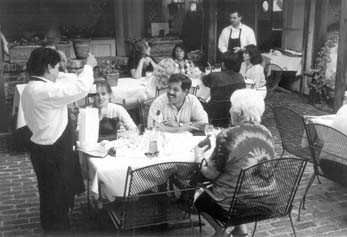
Secret garden: The atmosphere is cozy and mellow in the courtyard at Della Santina’s just off the Sonoma Plaza.

Delightful outdoor dining at Della Santina’s

By Paula Harris

AFTER a monotonous succession of cool gray days, the sun suddenly cracked through the clouds late one recent Sunday afternoon. The sure-fire tonic to El Niño blahs was to hit the road and follow the streaming golden light as it beckoned between the long shadows slanting across the vineyards all along Highway 12 between Santa Rosa and Sonoma. The clouds clung to the tip of the Mayacamas mountains in a single charcoal band, and the air smelled of lavender and honeysuckle. Finally summer!

Our destination: Della Santina’s, a combination trattoria/rostic-ceria/pasticceria, an informal, family-run Italian eatery, which also features roasted meats and house-made pastries. Once housed in a cramped space on one corner of the plaza, the restaurant has now expanded into the choice location that was previously Les Arcades, and more recently, East Side Oyster Bar and Grill.

The restaurant has a pleasant indoor dining room with artwork on the pale walls and starched white linen tablecloths, but we needed to prolong the sensation of fresh air and sunlight. Tucked out of view from the street is Della Santina’s hidden gem: a small rustic patio garden, which is reached by strolling through a wrought-iron gate, along a narrow uneven brick walkway and past oversize terra-cotta urns that sport cascading greenery.

The garden is naturally sheltered by a canopy of spindly shade trees, hanging overhead grapevines, and an ivy-covered trellis. There is also a retractable canvas awning shielding one section. Several tables with comfortable wrought-iron chairs are placed beneath decorative heat lamps. During our visit each table was set with a spray of miniature crimson carnations in a bud vase beside a bottle of golden-green olive oil. A fountain gurgled and splashed, cheerfully accompanying singer Andrea Bocelli, whose sweeping voice surged from the outdoor sound system.

We whetted our appetites with a small spinach and radicchio salad ($4.25) that arrived fresh, crisp, and lightly dressed with a subtle roasted- garlic vinaigrette.

The minestrone del contadino ($5.25) was a hearty country-style vegetable soup brimming with generous chunks of cabbage, tomatoes, carrots, and celery. Even without the beans or pasta, found in many Italian vegetable soups, this broth tasted lush and full-flavored.

There was a good broad spectrum of Italian and California wines. To elevate the Sonoma-Italia experience, we chose one of the five California-grown Italian varietals: a 1994 Atlas Peak Sangiovese ($28). A medium-bodied, well-balanced red, it tasted of plummy fruits and a hint of licorice.

Our server was friendly but unobtrusive, and he recommended the day’s special pasta dish: house-made penne with mushrooms ($12.25). This was a pleasing blend of expertly cooked, ribbed penne pasta cloaked in a rich savory sauce containing pieces of porcini and portobello mushrooms.

Next we tried the prawn dish, gamberoni dorati ($15.50), which was a disappointment. Listed on the menu as “prawns dore in a wine, lemon, and butter sauce,” the prawns arrived coated in a limp egg batter that we found gave an unpleasant texture and flavor. We asked about this, and the server told us this was the correct preparation for a “dorati” dish. The prawns came with roasted potatoes and steamed broccoli.

The gnocchi of the day ($10.95) was a better choice. The plump mouthful-sized pillows of potato pasta came with a rosy glaze of tomato and basil, a lovely sauce that was delicate and light but slightly creamy.

DELLA SANTINA’S rosticceria boasts a mouth-watering selection of roasted meats. There’s spit-roasted chicken redolent with fresh herbs ($12.95); herb-filled loin of pork in natural juices ($12.95); roast turkey ($11.95); Petaluma duck with wild rice ($14.75); and spit-roasted rabbit ($13.50). As the last item was not available on two recent visits, bunny-fanciers may want to call ahead.

A combination plate of any three roasted meats ($14.75) is a great choice for indecisive diners. We sampled the chicken, pork, and duck medley. Plainly roasted with herbs and basted with natural juices, each succulent item was a study in simplicity. The roasts were accompanied by crunchy, flavorful oven-browned potatoes and steamed asparagus spears.

As the sun eventually slipped down, a server brought out a tray of shimmering votive candles and set one on each table. The atmosphere outdoors was cozy and mellow, and it felt as though we were lingering in a friend’s garden after dark.

For dessert, we selected a couple of house-made goodies. A lemon tart ($5) had a smooth, slightly acidic citrus topping and a dense pastry base that was hard to break into with a fork. We preferred the spongy, creamy tiramisu ($5) edged with ladyfingers and layered with whipped cream, cocoa, and mascarpone cheese. Although it looked heavy, this was an airy puff of a dessert that dissolved in the mouth.

As we prepared to leave, we noticed KGO-TV’s Dr. Dean Edell seated at a neighboring table. Although we subtly craned our necks and squinted in the semi-darkness, we could not see whether he’d ordered low-fat fare. We mused that it was a pity his colleague meteorologist- celeb Pete Giddings wasn’t also at the table–we would have liked to ask him if the sudden balmy weather would last.

If it does, Della Santina’s is definitely a fine place to enjoy it.

Della Santina’s
Address: 133 E. Napa St., Sonoma; 935-0576
Hours: Open daily; lunch, 11:30 a.m. to 3:15 p.m.; dinner, 5 to 9:30 p.m.
Food: Italian, specialties of pastas and roast meats
Service: Friendly, and unobtrusive
Ambiance: Rustic garden patio and indoor dining
Price: Moderate
Wine list: Good selection of California and Italian offerings
Overall: *** (out of 4)

From the July 9-15, 1998 issue of the Sonoma County Independent.

© Metro Publishing Inc.

Babatunde Olatunji

0

Rhythm King

Michael Amsler


Babatunde Olatunji taps soul of Africa

By Greg Cahill

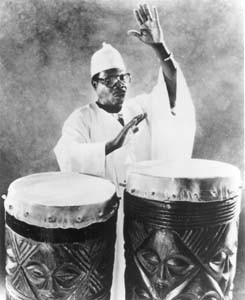
RHYTHM is the soul of life,” Babatunde Olatunji likes to remind those not in the know-zone. For his massive impact on the sound of music worldwide, this percussionist is widely recognized as the djahlibah of African percussion playing, the undisputed African drumming master. “Apart from the human voice, the drum is the next best instrument that, because of its evocative power, can bring more people together,” he says.

“It is a unifying force.”

Though jazz legend John Coltrane was his most noted student, the Nigerian’s admirers are legion, especially among musicians. Over the past 40 years, he has worked with a long list of improvisational music movers and shakers, including saxophonist Sonny Rollins, trumpet player Freddie Hubbard, drummer and bandleader Max Roach, and jazz flautist Yusef Lateef, among others.

But today, the irrepressible 71-year-old percussionist has other things on his mind. “I just got back from South Africa,” says Olatunji, his sonorous voice belying his enthusiasm, during a phone call from the Esalen Institute in Big Sur, where he teaches advanced drumming seminars. “I’m putting together something called Voices of Africa, which is a non-profit literacy project that can address this rampant problem of illiteracy.

“We cannot wait on the political leaders any longer to tackle this situation.”

On a continent where illiteracy can run as high as 85 percent, Olatunji has enlisted the help of a few friends to draw attention to this crisis. He recently met with newly repatriated South African singer Miriam Makeba, Afro-pop legend Manu Dbango, jazz and pop trumpeter Hugh Masakela, jazz pianist Abdulla Ibrahaim, and others, laying plans for corporate sponsorship of a world concert tour to raise millions of dollars over the next seven years in an effort to provide free education for every child in Africa.

“We’re going to make sure every child goes to school,” he says. “I’m tired of criticizing political leaders. Now it’s time to ask, What can we do for Africa?”

This isn’t the first time Olatunji has set out to conquer a formidable obstacle. In 1959, the then-unknown percussionist became the first African musician to hit the U.S. pop charts, all with a contagious blend of African beats and ostinato Yoruba chanting. His ebullient Drums of Passion (Columbia)–a milestone release on a par with Miles Davis’ Kind of Blue and Dave Brubeck’s Take Five–became a landmark, a percussion exploration unlike any American audiences had ever known. Here drums were liberated from their metronomic duty, music critic Mark Keating wrote last year, as servants to the melody. These drums were tonal, projecting harmony as well as rhythm.

“It’s a universal message–that’s what it is,” Olatunji says when asked to explain why Americans at the tail end of the Eisenhower era responded to his exotic sound. “I was able to bring it to them, but they were waiting for it–people were ripe for it. After all, Americans love to travel, and America being the kind of society that it is, everybody gets a chance to get listened to.

“If you have something worthwhile to say, it will be embraced–it will be welcomed.”

Olatunji got his 15 minutes of fame and used it for good purpose. He appeared on the Tonight Show and other TV programs, and used his earnings to fund a pivotal African cultural center in Harlem. In the process, Olatunji blazed a path for the world-beat explosion that followed; without Drums of Passion, there might never have been Paul Simon’s Graceland or David Byrne’s Rei Momo.

And the Grateful Dead’s percolating percussion jams? Forget ’em.

At a chance encounter at a Long Island high school with Olatunji–who after the success of Drums of Passion and a subsequent stint at the 1964-65 New York World’s Fair had begun lecturing at New York public schools–a then-teenage Mickey Hart, the Grateful Dead’s future percussionist, decided to become a drummer.

Hart later got a chance to return the favor. In 1985, Hart invited Olatunji–who had been without a record deal for 10 years–to sit in with the Grateful Dead at a New Year’s Eve show at the Oakland Coliseum. Hart later brought Olatunji into the studio to record with Carlos Santana, Airto Moreira, and others.

THE RESULTING CDs, 1986’s Drums of Passion: The Beat and 1988’s Drums of Passion: The Invocation, both produced by Hart on his acclaimed Rykodisc world music series, put Olatunji back in the spotlight.

Olatunji later conceived of the Planet Drum tour in which Hart showcased many of the world’s top drumming masters, including Olatunji and Hamza El Din of Sudan. Olatunji also chalked up some impressive stage and screen credits, composing the score for Lorraine Hansberry’s A Raisin in the Sun and later collaborating on the soundtrack of Spike Lee’s She’s Gotta have It. More recently, Olatunji earned a Grammy Award nomination for last year’s Love Drum Talk (Chesky), a collection of drum-propelled love songs.

But it is onstage that Olatunji really shines. “That is the happiest moment of my life,” he says breathlessly. “Of everything I do, it is the most uplifting. I feel at home. I feel … accomplished. The joy, the happiness–I’m sharing the moment I’m onstage. I give all that I know, all that I can express. I am lifted far beyond what you can imagine.”

Babatunde Olatunji and Drums of Passion perform on Friday, July 10, at 9:30 p.m. at the Mystic Theater, 21 Petaluma Blvd. N., Petaluma. Tickets are $15. For details, call 765-6665.

From the July 9-15, 1998 issue of the Sonoma County Independent.

© Metro Publishing Inc.

Talking Pictures

0

Real Gone


‘The Goners’ creators get scared at The X Files

By David Templeton

In his ongoing quest for the ultimate post-film conversation, writer David Templeton sends interesting people to interesting movies. This time out, he asks the popular science-fiction writing team of Jamie Simons and E.W. Scollon to check out the very-scary film version of T.V’s phenomenonal The X Files.

There are two kinds of people in the world, somebody once said: those who divide space-aliens into two different categories–and those who don’t. E. W. Scollon and Jamie Simons do.

The creator/writers of The Goners, a remarkably popular science-fiction book series for kids, have observed that throughout modern literature– including movies and television–extraterrestials are either kind and benevolent, possessed of magical powers and good intentions, or they are snarly, drooling monsters that want mainly to frighten us, enslave us, use our bodies for gestation, and suck out our our brains for dessert.

For the record, Simons and Scollon prefer the former, such as the gung-ho, time-traveling, teenage aliens in the Goners books (Avon, 1998, $3.99 each); all they want to do is save their elders, long ago marooned on Earth and taken to impersonating humans. Remember Thomas Jefferson? He was a Goner, along with several other historical figures known for their goodness and wisdom. With the possible exception of Napoleon–a partially mutated space-case with an overly-developed sense of order and control–there’s not a scary alien in the bunch.

The good-hearted adolescent heroes of Scolon and Simons’ epic adventures would, in fact, probably be scared out of their wits if they ever came face-to- face with the kinds of slimy, horrific, slobbery fellows that make an appearamce in The X Files, the latest in a long string of movies suggesting that if something is out there, it’s probably hungry.

And what did Scollon and Simons think of the film?

“I got through it all right,” chuckles Scollon, shortly after returning from the theater, “But Jamie …”

“I walked out after 10 minutes,” Simons confesses with a laugh. “I admit that I don’t like being scared. This was way too much for me.”

The film–based on the phenomenal TV series of the same name–follows intrepid FBI agents Fox Mulder and Dana Scully as they scamper in and out of trouble while tracking down the truth behind a certain global conspiracy to cover up the existence of the aliens, who may be planning to colonize Earth, and whom appear to have a very low opinion of the human race.

Come to think of it, Scollon and Simons don’t always seem to think very highly of humanity either. Earth, after all, is frequently referred to in the Goners books as “the least known of the Lesser Planets,” and most– but not all–of history’s great peacemakers turn out to be non-human.

So why not turn Earth into a giant smorgasboard–and just be done with us?

“I’d rather we not be eaten, to tell you the truth,” Scollon admits. “But we make the case that humanity hasn’t always lived up to its potential.”

“I do think we’re probably at the bottom of the planetary heap,” laughs Simons. “We’re not much to write home about. I’m personally not very encouraged by what we’ve done with the planet Earth. But in fiction, we can make things right with the world.

“You know,” she continues, “until I started writing the Goners, I never really liked the science fiction genre. The only science fiction book I’ve ever read and loved is Arthur C. Clark’s Childhood’s End, because I liked the idea of aliens coming to earth to help us mend the mistakes we’d made. I read that book in college, it was in the middle of the Vietnam War, and I could think, ‘Yes, we are blowing it, but someone’s going to come and help us.’

“I do believe there’s life out there on other planets,” she adds, “and it’s very comforting to me to believe that someone out there is doing things better, and that maybe they’ll come help us out some day.”

Simons admits that one or two people have been disturbed at the Goners notion of our home planet as being insignificant to the Universe at large.

“One friend of mine thought it was a terrible message to give kids,” she reveals. “That humans might not have behaved well enough to deserve more honor in the universe.”

Ray Bradbury’s The Martian Chronicles is mentioned. A book that was also once criticized, it describes the first travellers to Mars as arrogant rogues, carelessly dumping litter into the pristine Martian canals, racing through the ancient Martian cities, using everything in sight as target practice.

“Typical least-known-of-the-lesser-planets behaviour,” says Scollon.

“It gets back to that thing of, ‘Are we going to be the heroes of the Universe or are we going to be just one part of the whole stew,’ Simons says. “Is it even possible for us to see ourselves as part of a giant intergalactic stew, or we will always view ourselves as masters of the universe. Will we ever grow up?”

“One element of The X Files that I like,” Scollon points out, “is the sense of wonder that Mulder has, in spite of all the frightening things he sees and experiences. Its almost childlike, his point of view. Toward the end, in Antarctica, when he finally does see a space ship lift of and fly overhead, Mulder breaks out in a big smile, even though he’s on the verge of freezing to death. So through his eyes, we get a sense of the kind of glorious strangeness of childhood, where anything is possible and even the scary stuff is slightly wonderful.”

“Kids do feel that anything is possible,” Simons agrees. “That there is more out there. I think that’s the appeal of the books–and the appeal of The X Files and all these kinds of movies–is the idea that we’re not alone. There could be something out there. In The X Files it’s a horrific something.

“But who knows?” adds Scollon. “It might be something wonderful.”

Web extra to the July 9-15, 1998 issue of the Sonoma County Independent.

© Metro Publishing Inc.

Porn Probe

0

Porno Probe Still Unresolved

WHILE THE STATE Board of Corrections review is being conducted, a separate internal probe involving nearly half the male correctional officers remains unresolved. On April 15, the Independent reported that at least 29 correctional officers–and maybe as many as 50–are under investigation for downloading Internet pornography while on duty.

One guard, dismissed during his probationary period, reportedly in connection with the porn probe, was on duty the night Harris committed suicide. Sheriff’s Department officials declined to state whether he was using the Internet that night.

The lingering eight-month investigation involves guards at both the Main Adult Detention Facility (the county jail) and the North County Detention Facility (the honor farm), both in Santa Rosa. The internal affairs division has been investigating the male staffers for allegedly spending up to several hours a night downloading pornographic images into personal files on the department’s new computer system and using county phone lines to participate in sexually explicit Internet chat lines.

According to knowledgeable sources who asked for anonymity out of fear of retaliation, the investigation has targeted members of the county jail’s elite Special Emergency Response Team and facility training officers, as well as rank-and-file guards.

McDermott has insisted that the probe involves seven correctional officers. Two months ago, he reported that the department’s internal affairs division was “putting the finishing touches” on the investigation. But no public report has been issued. “The investigation is for all intents and purposes complete,” McDermott said this week. “I hope to wrap it up soon.”

He has promised that the department will discipline guards “if … warranted.”

Critics charge that the Sheriff’s Department is downplaying the magnitude of the scandal to cover up the extent of the activity, especially in light of the department’s poor record in sexual harassment cases involving female deputies and jail staff members.

The Independent has learned that as of two weeks ago the state Board of Corrections officials reviewing operations at the jail are not looking into reports that a large segment of the male correctional officers may have downloaded pornography during the night shift and allegedly shirked their duties.

From the July 2-8, 1998 issue of the Sonoma County Independent.

© Metro Publishing Inc.

Sonoma County Jail Abuse

0

Jail House Blues

Michael Amsler


In the wake of recent in-custody deaths, escapes, and a porn scandal involving correctional officers, new allegations of abuse surface at the Sonoma County Jail

By Greg Cahill and Paula Harris

JOAN MCMILLAN’S journey “through hell and back” started last April on a short bus ride from the honor farm near the Santa Rosa Airport to the Sonoma County Jail’s main adult detention facility. Six months pregnant and busted for supplementing her welfare income, the 44-year-old faced jeers from male inmates sharing the ride. “I started having contractions,” she recalls. “I already had some [pregnancy] complications.”

It was a bad omen. At the jail, correctional officers placed McMillan in a tiny holding cell for nine hours, she says, and her physical condition began to deteriorate. “After eight hours I was experiencing dizziness and almost blacking out,” McMillan recalls. “My body was going into some kind of weird shock. I was sweating and I lay on the floor, freezing and shaking … .

“The next thing I knew, a female guard was kicking me on my hips and thighs, calling me ‘drama queen’ and ‘bitch.'”

That night the county jail staff moved her to an infirmary cell, but things didn’t improve, McMillan says. “I was throwing up, dehydrated, a total wreck,” she remembers. “The medical treatment was horrible. I would ring the emergency buzzer when I was having contractions, but the guards, especially the younger ones, seemed preoccupied at the computers. They would ignore the buzzers as long as they could.”

Seated at a wooden table in the kitchen of her old farmhouse in rural Freestone–with several excitable dogs at her feet, and a mellow, sweet-faced 10-month- old baby girl on her knee–McMillan wears no makeup, her blondish hair scraped back in a ponytail topped by a baseball cap. She has clear, contemplative eyes and an easy smile that belies an air of melancholy as she speaks.

“I almost died there,” she says in a low, steady voice. “I still have bad dreams from the experience.”

Porno probe still unresolved.

Investigation reveals at
Sonoma County Jail has an ugly past.

Allegations of Abuse

McMillan is one of numerous inmates and their relatives who have contacted the Independent in the past 18 months with allegations of abuses at the Sonoma County Jail, ranging from substandard food to alleged acts reminiscent of the Soviet gulags.

For example, inmate Darlene Baldridge, now in custody at the jail’s mental health unit, wrote on June 8: “The treatment I have received here at the main jail has caused me to consider suicide. I have never attempted suicide, but I made a noose. [When it was discovered], I was stripped naked and locked in a ‘safety cell’ for two days and subjected to a constant parade of male guards coming by the cell to tell me I was ‘disgusting, indecent, ugly, and shameful.’ They took away my clothes and then tortured me for being naked.

“Everything, before I have been to trial,” she adds. “If this is how innocent people are being treated in America, someone needs to rewrite the Constitution. I thought people were innocent until proven guilty, but you don’t need a trial for a dead inmate.”

When asked about that incident, Assistant Sheriff Sean McDermott, who heads the county jail, is dismissive. “That’s an inmate in mental health,” says McDermott, who doesn’t recall any formal complaint about alleged verbal abuse in the Baldridge case. “If we believe someone is actually suicidal, we’ll put them in a safety cell. We do take their clothes. We issue paper safety gowns until they pass an evaluation with the psychiatrist.”

Former inmate Sean Raab wrote on Sept. 16 that he unsuccessfully battled jail medical staff to receive a diabetic diet because he suffered from hypoglycemia. He says it took almost a year to recover from a bout of malnutrition while he was incarcerated. “Being punished by jail time is one thing,” he wrote, “but malnutrition should not be a part of that in modern times.”

The private food service at the jail is a frequent source of complaints from inmates. On Aug. 30, then-inmate Steve Woodward wrote: “After working in the kitchen, [I’ve observed that] the quality of the food and the condition of sanitation is enough to make me appreciate the fact that I didn’t eat very much while I was there.

“If the kitchen were a commercial one, it would have been closed down by the [county] health department due to blatant violations of basic hygiene.”

Ten days later, Woodward wrote: “Several inmates experienced food poisoning after eating tainted soup. According to inmates working in the kitchen, one of the supervisorial staff is loath to throw anything out, and is known for adding borderline rotten food, as well as food [that] has been improperly stored, into the soup kettle.”

McDermott defends the conditions of the jail kitchen. “The jail is routinely inspected by public health, especially the food service, for cleanliness, dietary needs, and nutrition,” he says. “We meet that every year. We pride ourselves in absolute cleanliness in our facility. We challenge anyone to find the facility to be unclean.”

Admittedly, it’s difficult to verify these reports, because of the closed nature of the jail. The Independent had requested a jail tour in connection with this article. McDermott refused to allow a reporter and photographer access to the facility.

But the frequency and similarities of these and other allegations suggest a pattern and beg the question of whether there are fundamental deficiencies in the policies and procedures used to care for county jail inmates.

County jail officials contend the reports are fabrications. “In reality, the people we have in this institution aren’t here because they are very truthful,” says McDermott, “and their behavior isn’t so positive that it would warrant they not be here.”

In the past, McDermott has sung the praises of correctional officers and medical personnel at the jail. “We train our staff to high standards to deal with these circumstances,” he said recently on KPFA-FM’s Flashpoints show.

The Sonoma County Jail is one of 16 out of 135 similar facilities around the state that met compliance with all state Board of Correction standards last year. The county is also one of 19 in the state that has fully accredited medical facilities.

State Review Ordered

But in March the county Board of Supervisors, at the request of Sheriff Jim Piccinini, approved a $35,000 review of county jail conditions and operations, including medical and mental health services (which are handled by the Sonoma County Mental Health Services Division). The results of that state Board of Corrections review are expected within the next two weeks.

The review follows six in-custody deaths, at least three suicide attempts, two escapes, and one attempted escape, all within the past 18 months.

Among the recent incidents at the jail, the June 4, 1997, death of Joanne Marie Holmes, 35, who died in custody after being arrested for a traffic offense and outstanding warrants, sparked a storm of protests from longtime critics of jail conditions. According to an autopsy report, Holmes suffered a seizure and other complications of heroin withdrawal. A wrongful death lawsuit filed by her estranged husband, Robert Holmes, claims that jail medical staff “failed to evaluate and treat her condition” or to provide medical assistance “even after [Holmes] became visibly ill.”

Crystal (who asked that her real name not be used), a former inmate who was incarcerated in Sonoma County Main Jail for four days and three nights in June 1997, was confined two cells away from Holmes. Crystal says that when she met Holmes on the first day, Holmes appeared to be physically healthy, but she didn’t see her again for a couple of days. “[Holmes] never came out of the cell,” Crystal says. “One day, she finally came out for about 10 minutes and I didn’t recognize her. Her eyelids were pulled away from her eyes, she smelled bad, and her skin was gray. She went back into the cell and I never saw her again.

“On the first night [Holmes] kept pressing the call button because she was sick. They gave her a form to fill out and said, ‘The doctor will be with you in a couple of days.’ At night, I could hear [her] gasping for air, vomiting, and moaning all night long.”

“[Holmes] was only buzzing the first day. She gave up because no one was helping her,” says Crystal. “She was too sick to move … .

“When I got home, I heard the next day that [Holmes] had died.”

In a Feb. 2 press release, Sonoma County District Attorney Mike Mullins stated that his investigation found no criminal neglect in the Holmes case, and noted that Holmes never reported her addiction to medical staff or correctional officers. “Health care staff will see [about 20 to 25 inmates a year undergoing drug withdrawal and who do not die] … and based on their experiences, [they] believe that inmates do not die from drug withdrawal. In fact, other than Ms. Holmes, there have been no deaths in the [county jail] due to complications from withdrawal in recent history. These facts would lead staff to believe withdrawal does not involve a high degree of risk of death.”

The contention that jail staff see only a couple of dozen drug-addicted inmates each year is contradicted by Dr. John P. Hibbard, an addictionologist and staff physician at the Sonoma County Jail who also is named in the Holmes lawsuit. In an essay on the Sonoma County Medical Association website, Hibbard wrote:

“For the last year, I’ve worked at the county jail and have become ever more convinced of the futility of criminal sanctions [for addicted inmates]. Most of the more than 900 prisoners are chemically dependent. Many of these men and women, unless effectively treated, are destined to become permanent wards of the state under the rigors of the ‘three strikes’ system. The inhumanity and crushing expense of this system, as opposed to the ruinous social costs of substance abuse, pose a true dilemma for policymakers.

“I believe we have a resolution for the dilemma, although not an easy one … . Only when this view gives way to the newer perspective of addiction as an illness can we start to make genuine progress.”

More recently, Drue Harris, 30, arrested after an altercation with a female companion, hanged himself Feb. 24 in a county jail infirmary cell after being in custody 17 hours. According to family members, inmates report that Harris was crying and distraught an hour before his death and would still be alive if correctional officers had intervened.

Jailers say Harris showed no signs of distress.

According to the coroner’s investigation, “[Harris] was found in a sitting position at the foot of his bed. Spare jail clothing had been used to wrap around his neck. The clothing had been attached to the springs of the bed on the inside of the footboard. It is speculated that the decedent then somehow somersaulted over the end of his bed ending up in a sitting position hanging himself.”

Jamie Harris, Drue Harris’ mother, is not convinced by the report. She believes her son did not commit suicide but died of an untreated head injury allegedly suffered shortly before his arrest.

She complains that the District Attorney’s Office refuses to give out any information about the case, and that situation is hindering her from filing a lawsuit against the county. “They say there’s a pending investigation [into the suicide], but it seems like a tactic,” she says. “I have no faith in any of this; it’s just completely whitewashed.

“The whole environment is totally silent, secret, and without accountability.”

Experts agree that these types of medical and mental health cases pose a significant challenge to correctional facilities. “I’d say you have a lot of deaths [in Sonoma County],” concludes Dr. Terry Kupers, an Oakland-based physician and psychiatrist who testifies in class-action lawsuits regarding inmate conditions, and who testified in a 1992 settlement about conditions at the Sonoma County Jail. “The population that comes to jail is often medically sick and physically prone to suicide. Something is wrong when you have that many deaths in that short of a time.

“It’s an emergency, and you need to reform medical health and mental health services.”

Medical Malaise

Last week, the Independent reported that Correctional Medical Services, the St. Louis-based firm contracted by the county for almost $3 million a year to provide private health care at the jail, was named in 1997 in nearly 800 lawsuits nationwide alleging medical negligence. Since 1992, county supervisors have continued to approve that contract each year without close examination of CMS’ track record.

Locally, CMS is named in a wrongful death suit filed in Sonoma County Superior Court by Holmes’ estranged husband, Robert Holmes.

It was the March 9 suicide of Carolyn Telzrow, 47, that once again drew attention to medical services at the jail. Telzrow, a licensed vocational nurse, was arrested for shoplifting. Her sister, Mary Hickerson, says Telzrow was on state disability for an injury because she had broken her back in a horse-riding accident. Telzrow was put on methadone by a community doctor for chronic back pain, and she was registered at a Sacramento-area methadone clinic. Telzrow was also under psychiatric care because she had a history of depression.

Telzrow was incarcerated at the Sonoma County Jail March 2-9. During that time, jail personnel did not consult with her psychiatrist or her community doctor, says Hickerson, adding that the jail doctor took Telzrow off the 100 mg. of methadone that had been prescribed for pain management.

“[The doctor] was not giving her anything for pain and she was going crazy–screaming, crying, and really in a lot of pain,” recalls Hickerson. “[The family] really feels that’s why she killed herself.”

Telzrow had been put on suicide watch for one day and then removed to remain in an infirmary cell. According to family members, inmates reported that Telzrow was in tremendous pain, screaming, “Help me, help me!” for two hours before her death, but jail staff reportedly did not respond. Telzrow eventually used her bra to hang herself inside the jail cell.

“She goes from suicide watch to not being watched at all, to killing herself,” marvels Hickerson. “What’re the criteria here? If there is a stated policy to give methadone, why didn’t they give it to her?

“Basically, she couldn’t stand what she was going through so she put herself to sleep,” says Hickerson. “In today’s world, in the medical field, there’s no reason for people to be in pain. My God, that’s prehistoric.”

County jail officials later gave Hickerson a courtesy tour of the facility. “I looked inside the cell where my sister had died and noticed there was a camera in there. I was told it was on her when she died, but they weren’t monitoring it,” she recalls.

When Hickerson returned with her lawyer, jails officials reportedly told her the monitor had been switched on to view an adjacent cell at the time that Telzrow killed herself.

Hickerson has filed complaints with the Sonoma County grand jury and the California Medical Association. She was not contacted by the state Board of Corrections for its review. “I didn’t even know they came,” she says. “But how can you investigate her death if you don’t have comprehensive information about Carol’s life before.

“She would be alive today if she hadn’t been in that jail, and I just don’t feel that what she did equated to a death sentence.”

A jail source, speaking on condition of anonymity, agrees. “[Telzrow] didn’t have to die, somebody should have been watching … . The officers were obviously preoccupied with other things. Whether they were working incredible amounts of overtime, or whether they were tuning in on the porn [see sidebar, “Porn Probe“], they missed those warning signs.”

Michael Spielman, executive director of the Drug Abuse Alternatives Center in Santa Rosa, says the jail is not at fault for not administering methadone to Telzrow. “If a person goes into the jail and is legally involved in taking methadone, it is up to the methodone clinic to dose them, it’s not up to the jail,” he explains.

He adds that DAAC’s Redwood Empire Addiction Program doses clients in jail, but some programs do not follow the same procedure. “Sometimes other clinics call us to do it. It’s called ‘courtesy dosing.'”

He says DAAC will dose clients for a maximum of 21 days. “If inmates are going to be in for a long time, we need to detoxify them,” he says.

Still, some inmates are fearful of telling jail personnel that they are addicted to narcotics because of possible third-strike charges. If they do not disclose this information, he adds, the jail is not at fault should the inmate go into withdrawal.

“The jail has to respond to the information provided by inmates,” Spielman says, “and it depends on whether people tell the truth.”

Meanwhile, jail officials dismiss the lawsuits. “We have a legitimate grievance process. We have grievance officers who take it very seriously, and we’ve effected changes on concerns raised,” says Assistant Sheriff McDermott.

“On the national average, inmates file tens of thousands of lawsuits, and about 98 percent are frivolous.”

Nowhere to Run

One fact that emerges from this investigation is how few watchdog agencies–public or otherwise–are keeping track of the conditions at the Sonoma County Jail in particular and at county jails statewide in general.

For this story, the American Civil Liberties Union in San Francisco referred Independent reporters to the Prison Law Office in San Rafael. That advocacy group doesn’t handle county jail complaints. Neither does the National Prisons Project in Washington, D.C.

“There’s nowhere to take complaints,” says Tanya Brannan of the Guerneville-based Purple Berets women’s advocacy group. “No one is really tallying and keeping track of the complaints. In this county, no one is really monitoring what’s going on inside. There are no outside advocates.”

Charla Greene, a Rohnert Park resident who works for Abolition Road, a group that keeps track of state prison issues, says, “The county jails fall through the cracks, and the county jails are even worse than the state prisons.

“Since inmates are basically invisible, authorities feel they can act with impunity,” Greene adds, “Also, public opinion is against inmates. The feeling is ‘they did something bad, so let them be treated bad.'”

Judith Volkart, chairperson of the local chapter of the ACLU, says that the group does receive some pleas for help from Sonoma County Jail inmates, but there is no comprehensive record of the complaints. “Not all the complaints are coming to us,” she says. “Maybe that’s a service we need to provide … . There needs to be someone keeping track of the information and a place to funnel complaints.”

Volkart plans to raise the issue at the ACLU’s next meeting. “It seems to me there needs to be a clearinghouse,” she adds, “so statistics can be gathered to see if there is any pattern [to the complaints].”

‘Holocaust’ Survivor

These days, Joan McMillan is worlds away from her county jail experience. Yet she clearly recalls the troubling details that led to Sonoma County Superior Court Judge Mark Tansil’s ruling last year that she should be released from the facility.

“He said I ‘could not thrive’ being pregnant within the Sonoma County Jail system,” says McMillan, pausing to adjust her shirt and gently shifting her daughter, Samantha Rose, into a nursing position beneath the fabric.

Undergoing a high-risk pregnancy at the time of her incarceration, McMillan wrote to Rep. Lynn Woolsey for help, and asked Judge Tansil to allow her to see her regular physician. Finally, McMillan was permitted a visit to the Occidental Area Health Center. “When the doctors saw me, their jaws dropped,” she recalls. “I had lost more than 10 pounds in two weeks.”

Dr. Trina Bowen, a physician at the health center, wrote to Tansil on McMillan’s behalf and asked him to reconsider her case. “[McMillan] didn’t seem to be a danger to society, and I didn’t see any reason for her to be incarcerated when that could be a threat to her pregnancy,” Bowen says.

In response, the judge changed McMillan’s criminal charges to a civil case, allowing her to pay restitution. He then released McMillan on conditional probation.

“I felt like a Holocaust victim when I got out,” says McMillan, who now breeds horses and plans to teach riding to children. “It was a miracle that I survived the conditions there and that my baby survived.”

From the July 2-8, 1998 issue of the Sonoma County Independent.

© Metro Publishing Inc.

Talking Pictures

0

Wild Girl-Child


Feminist theologian Patricia Lynn Reilly cheers for Disney’s Mulan

By David Templeton

David Templeton takes interesting people to interesting movies in his ongoing quest for the ultimate post-film conversation. This time out, he turns to e-mail for an online discussion–with author Patricia Lynn Reilly–of Disney’s wonderful new animated adventure, Mulan.

“You have mail,” announces my computer.

“Hmmmmm. I imagined I might,” I woefully murmur, catching my breath and taking a seat before the softly glowing screen. indeed, I’ve received an e-mail from author Patricia Lynn Reilly, the best-selling author and esteemed feminist theologian with whom I had hoped to witness Disney’s latest animated miracle, Mulan. Unfortunately, owing to a series of last-minute changes and a volley of mutually unreceived messages, we each ended up arriving on time, but at different theaters. (Fortunately, Reilly had seen Mulan once already, in Berkeley)

Lacking any better plan, I decided to see the film without Reilly and pray that I hadn’t, you know, alienated one of my favorite authors.

Happily, Reilly is fairly philosophical about the mix-up.

“Dear David,” she writes. “We missed each other all the way around. Too bad.”

As for the film–an artfully crafted retelling of the ancient Chinese legend of Mulan, a daring and inventive young woman who, disguised as a man, became a national hero as a soldier in her country’s all-male imperial army–Reilly is pleased. “It was a fantastic movie,” she says. “I love Mulan! Women of all ages were cheering and laughing and clapping all the way through … at least in Berkeley they were.

“Let’s continue by e-mail,” she finishes, signing off with her initials, PLR.

After gaining world-wide prominence with A God Who Looks Like Me (Ballantine, 1996)–an insightful, icon-dissolving exploration of female-centered spirituality–Patricia Lynn Reilly found herself battling against forces within the publishing industry, forces that sought to push her next book to even greater heights of financial success by limiting its central themes and concepts to mass market standards. Reilly ended up returning the majority of a five-figure advance, choosing to publish and market the new book–Be Full of Yourself : the Journey from Self-Criticism to Self-Celebration (Open Windows Press, 1998)–on her own, rather than submit to further compromises.

A guide for women locked into feelings of inadequacy and fear, Be Full of Yourself includes dozens of stories told by some extraordinary women, women who overcame years of insecurity and self-criticism by learning to trust their own innate inner wisdom and strength. Like Mulan, Reilly and friends have answered the statement, “You can’t do that. You’re a woman,” with, “I can do it because I’m a woman. Just watch me.”

It is somewhat surprising that Disney–the same people who’ve traipsed out one formula-female character after another since Snow White and the Seven Dwarves–have ended up with a heroine as strikingly non-Disneyish as Mulan, a woman who–though she does fall in love with a handsome soldier–never sacrifices her own dreams and ideas in order to earn the protection of the man.

“Mulan represents the girl-child we all were in the very beginning of our lives,” Reilly writes in her next e-mail. “She tells the truth. She is creative. She is in her body. She feels her feelings. She is presented as a whole human being.

“She is full of herself.

“The audience is supporting her, cheering her on as she rebels against traditional socialization. For those of us who rebelled, she reminds us of our courage. For those of us who capitulated, she is our daughter, granddaughter and niece. In cheering her on, we are cheering them on. We hope with all our hearts that Mulan is able to hold on to her fullness, truth, intellect, originality, and strength. So many of us lost it … the fight was too hard. We capitulated and became formula females.”

An early scene shows Mulan enduring a humiliating session at the house of the village matchmaker; her face, per tradition for wives-to-be, is painted white with bright red lips, her hair ratcheted into a motionless knot atop her head. Later, when she secretly dons her father’s armor and sword, she gazes in pleasant recognition at what she sees in the mirror.

“Mulan refused to be twisted out of shape to marry, to become the quintessential female,” Reilly continues. “She longed for her true reflection. When Mulan looked at herself in the mirror after preparing as warrior, she was satisfied with her reflection … an androgynous, strong face peered back at her. This felt closer to her essence than the clown-like face she saw reflected upon returning from disastrous wife-training session in town.”

At one point in the film–after her secret is revealed and her bravery firmly established–Mulan turns down the offer of a seat on the Emperor’s council.

“Do you wish she’d have taken the position?” I send to Reilly.

“We were not told the rest of her story,” she replies. “Mulan matures into a wise old crone whose wisdom is sought after by emperors and generals. She and her husband join the council together as partners. They are committed to the peaceful resolution of political and personal conflicts. They teach/model for their country a new way of being … woman and man side by side as partners and allies.”

“So is Mulan an acceptable role model for modern girls?”

Reilly is enthusiastic in her response. “Mulan is a wonderful role model,” she sends back. “It is my prayer that the image of Mulan will linger within every girl-child’s heart and support her to hold onto herself, to descend into herself, to discover and explore the richness of her capacities, to vow faithfulness to herself.”

Reilly goes one further.

“I imagine Mulan whispering these words into the ears of every girl-child who sees the movie:

‘Your body is your own. Do not allow society to twist it out of shape.
Your body is strong. Move in it with courage.
Your thoughts are your own. Do not allow others to mold them.
Your thoughts are strong. They create an impact on others. Speak them with courage.
Your feelings are your own. Do not allow others to express them.
Your feelings are strong. They are to be shared. Express them with courage.
Your life is your own. Do not allow it to be shaped by the expectations of others.
Your life is strong. It will not fall apart. Live it with courage.
Exert, initiate, and move on your own behalf without guilt or shame.
Hold onto your power. Don’t let others squash it.
Hold onto your courage. Don’t let others preach it out of you.
Hold onto your independence. Don’t let others scare it out of you.
You were not created to please others.
Refuse to surrender except to your truest self and wisest voice.'”

From the July 2-8, 1998 issue of the Sonoma County Independent.

© Metro Publishing Inc.
Hair

Hairy Issues


Michael Amsler

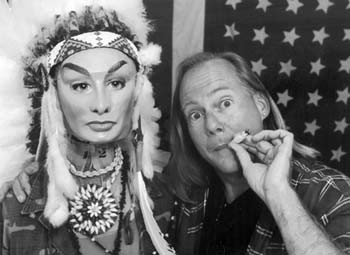
High times: Hair director Michael Fontaine takes a smoke break (it’s just a prop, honest!) in the SRT costume shop.

What does SRT’s new staging of an aging ’60s musical say about ’90s morality?

By Patrick Sullivan

THERE, THAT’S ME,” says Michael Fontaine, a funny smile playing around the corners of his mouth. He’s pointing to one blonde head in a picture full of shaggy young men and women, hair down around their shoulders, covered with peace signs and headbands. They look like residents of some ’60s commune, natives of the era of peace, love, and understanding, but it’s not so. The picture was actually shot during a Summer Repertory Theatre production of the musical Hair in 1983, during that grand old period of Reaganomics, nuclear nightmares, and unemployed air-traffic controllers.

Don’t trust anyone over 30, went the popular saying. But now, Hair itself has reached that critical mark. It’s been three long decades since this countercultural creation of two unemployed actors first appeared onstage to provoke both acclaim and outrage. In 1968, the musical’s profanity, drug use, nudity, and general disrespect for authority sent Nixon’s silent majority into shivering fits. But surely that’s well behind us: Today’s TV and movies seldom pause in their high-velocity delivery of profanity, naked bodies, and drug use (even if the last is most often featured on commercials for Partnership for a Drug Free America). Is there anyone in the country who might still bother to be offended by the likes of Hair?

The Summer Repertory Theatre isn’t taking any chances. “Warning: ’60s morals and profanity” reads the promotional materials advertising this summer’s production of the musical, which opens July 8 under the direction of Michael Fontaine, who played the role of Claude in SRT’s 1983 production. What exactly does “’60s morality” mean, you may ask?

“I thought it was a succinct way of warning people that if they didn’t like the ’60s, they probably won’t like the play,” says SRT promotions director Mollie Boice, who was also a Hair cast member back in ’83. “It was a time when anything went, and we’re kind of at the other end of that spectrum today.”

SRT may have good reason to be concerned. If the ’60s were an era of social conflict, and the ’80s one of material excess, then the ’90s are surely the decade of “Let’s cut arts funding to the bone.” Indeed, the artistic community has watched with growing horror as cultural conservatives have mounted a relentless (and highly successful) assault on alleged indecency, along with, some say, artistic creativity itself.

An embattled National Endowment for the Arts clings to life by the fingernails. Theater companies mount thoughtful plays with gay characters to critical acclaim, only to face the prospect of losing public funding faster than you can say, “No special privileges for homosexuals.” So, what on earth would today’s conservative firebrands have to say about Hair‘s “Sodomy” song, a charming little ditty about … well, sodomy, among other things?

“I think conservatives would run shrieking from the building if they thought their money was going to fund something like this,” says Fontaine. “Everything that they are objecting to–nudity, challenging authority, the use of marijuana–Hair celebrates all those things.”

Still, Fontaine also acknowledges that others might find the musical a bit tame by today’s standards. Sure, fake joints–“No, they really are fake,” Fontaine insists–and draft cards get lit up with merry abandon, and a few swear words are tossed around Burbank Auditorium. Meanwhile, plays on San Francisco stages casually include simulated fellatio. If Hair isn’t pushing the envelope, isn’t the musical just an exercise in nostalgia?

Hair.

T. Chown


FONTAINE DOESN’T deny the appeal of “remember when.” Indeed, he embraces it. There is value in remembering the countercultural spirit of that time, he insists, even for younger members of the audience who might think that the Chicago 7 probably had Michael Jordan playing shooting guard. For proof of that value, he points to his young cast, who were generally overjoyed to be dealt a part in Hair.

“I was really, really excited,” says Joseph Hutcheson, who plays Berger. “That was the one show that I wanted to do out of the whole season. I love the music and I love the period, for some reason. I’ve listened to the soundtrack about a million times.”

Hutcheson, 23, hails from American River College in Sacramento. Like other SRT actors, he has parts in several shows this season, including Harvey. But his green eyes light up as he explains the unique appeal of Hair.

“It’s more like a rock concert,” Hutcheson says with a laugh. “You get to be in a musical and be an actor and be a rock star, all at the same time.”

Hutcheson also says the show’s message of love and freedom has deep resonance for him. That’s why he doesn’t have any problem with the musical’s nude scene, which by the way, may or may not happen, depending on how the actors feel each night. Fontaine has decided to leave the decision to disrobe up to each individual cast member.

“I’m happy to say that there are a number of actors in the show who seem incredibly uninhibited,” Fontaine says. “I had one actor who didn’t seem too sure about the nudity at first. But when I mentioned that everyone had a choice, he said, ‘Darn, we were hoping we’d be nude the whole show.'”

As for censorship, the director says that no authority at the college or anywhere else has tried to water down the content of the musical. Still, even such a fervent free-speech advocate as Fontaine gets a bit guarded when talking about public reaction to controversial theater.

“An organization like SRT, which is affiliated with the college, has a responsibility to its audiences, and a responsibility to present the junior college in a favorable light,” Fontaine says. “At the same time, we need to present ideas that are challenging and stimulating for the audience members, without overtly offending them.”

Controversy over content is also a very real issue to Hutcheson. When the young actor is asked whether censorship will be a problem in his career, he doesn’t hesitate an instant before predicting that it will. In fact, he’s already crossed that bridge: “I’ve encountered situations in theater at the college level where things have had to be … ,” he pauses, “… trimmed. It certainly bothered me as an actor. The audience should be responsible for their own minds.”

Both Fontaine and Hutcheson predict that SRT ticket holders will be in easy agreement with that relaxed philosophy. In any case, ready or not, audiences will soon get their first whiff of fake marijuana smoke. The only question is, What if Jesse Helms is in the front row?

“It just depends on what he came to see,” Hutcheson says, grinning. “If he came to see some good rock and roll, he’s going to have a great time.”

SRT’s production of Hair plays July 8-9, 11, 15, 18-19, 22, 23-24, 26, 28, and 30, and Aug. 4. Showtime is at 8 p.m. most days and 7:30 on Sunday, with 2 p.m. matinees on July 11, 18-19, and 26 and Aug. 4. Tickets are $14/adult, $11/youth and senior; discounts available at Sunday and matinee shows. Santa Rosa Junior College, Burbank Auditorium, 1501 Mendocino Ave., Santa Rosa. 527-4343.

From the July 2-8, 1998 issue of the Sonoma County Independent.

© Metro Publishing Inc.
Hello, Dolly!

Lookin’ Swell

Hello, Dolly!


Mountain Play’s ‘Dolly!’ long on fun

By Patrick Sullivan

CYNICAL HEARTS sometimes find Hello, Dolly! tough to take. Even for a musical, this is light-hearted stuff, full of sappy songs and extended dance numbers. Without a solid peg to nail down the fluff, this play could float right off the stage.

It’s a lucky thing, then, that this year’s Mountain Play production has the best sort of anchor imaginable: The riveting talent of Meg Mackay in the title role brings this ’60s musical to vibrant, solid life. With her 1,000-kilowatt smile, charming stage presence, and incredible voice, Mackay has no problem catching the collective eye of the audience. What’s more, this diva knows exactly what to do with that attention once she has it: She simply entertains the hell out of us.

The story itself is almost besides the point. Dolly is a cunning but kindhearted professional matchmaker who, it turns out, has herself been lonely since the death of her husband. “Some people paint, some sew, I meddle,” Dolly explains. But living through other people’s romances is not enough. She decides to get married again and sets her sights on the unlikely figure of the curmudgeonly “half-millionaire” Horace Vandergelder.

Forget Bill Gates or Ebenezer Scrooge. Vandergelder could eat those guys for breakfast and still have room for a Howard Hughes or two. A sexist tightwad who treats his employees like plantation field hands, Vandergelder is played with cheerful, convincing nastiness by Norman Hall. It’s hard not to like a man who goes around shouting such gems as “99 percent of the people in the world are fools, and the rest of us are in great danger of contamination.”

Why Dolly is so set on this lovable fellow is a bit unclear, but who cares? The chemistry achieved between Mackay and Hall is wonderful: The funniest moments in the play occur during their verbal sparring. Stir into this volatile mix Vandergelder’s romantically inclined employees (played by Michael Temlin and Eric Carrillo) and the stage is set for comedy.

There are some wonderful singing voices in the cast. Mackay’s powerful, agile vocals sometimes blows the ensemble off the boards. Michael Temlin, as the amorous shop clerk, also brings real life and power to his songs.

For those who prefer movement to harmony, Hello, Dolly! offers plenty of lively dance and slapstick fun. Featured dancer Lawrence Pech wasn’t there on opening night, but his partner Wendy Van Dyck still kicked up a storm during the hilarious restaurant waiter scene. Also, Eric Carrillo revealed some intriguing talent during his short dance numbers.

There is one uncredited cast member who also makes a serious contribution to this whole experience: The rolling vineyards of Jack London State Park provide the perfect frame for musical fun. If the audience was pining for any of the elements of the traditional indoor musical experience, you wouldn’t have known it on opening night at the Mountain Play.

People sat in the bleachers or on the lawn, rocked and clapped to the music, and occasionally remarked on Mackay’s sometimes startling resemblance to Carol Channing. If pure entertainment was the goal, Hello, Dolly! clearly hit the mark.

The Mountain Play’s production of Hello, Dolly! plays July 4, 5, 11, and 12 at the Vineyard Theatre in Jack London State Park, Glen Ellen. All shows begin at 5:45 p.m. Tickets are $22/general, $17/seniors and those under 18; children under 3 admitted free. 415/383-1100.

From the July 2-8, 1998 issue of the Sonoma County Independent.

© Metro Publishing Inc.
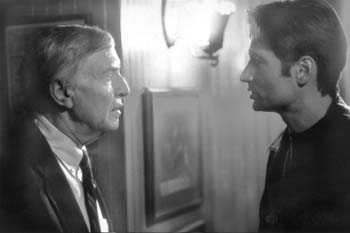
Reynolds Price

0

The Vision Thing

Author Reynolds Price finds redemption

By David Templeton

AT THE OUTSET of Reynolds Price’s lyrical new novel, Roxanna Slade–his 30th published work in 35 years–the story’s feisty, eponymous 94-year-old narrator playfully writes, “Every time somebody calls me a saint, I repeat my name and tell them no saint was ever named Roxy.”

It can also be said that no saint was ever named Reynolds, yet the noted author’s sterling literary reputation–coupled with public awareness of his long battle with a debilitating spinal cancer that led to his confinement to a wheelchair–has left the native North Carolinian with a certain unbidden aura of saintliness. In the eyes of numerous readers, the prolific author has more than met the requirements for canonization.

There’s even been a miracle or two along the way, though he’ll take none of the credit for that.

Price has written several plays and numerous volumes of short stories, poetry, and essays, but he’s best known as a novelist. His first novel, A Long and Happy Life, won the William Faulkner Award for notable first fiction in 1962, and his 1986 novel Kate Vaiden captured the National Book Critics Circle Award for fiction. Price, identifying himself as an “outlaw Christian,” has intimately questioned his own spirituality in a number of books, including his 1994 “cancer memoir,” A Whole New Life. In the breathtaking Roxanna Slade (Scribner’s; $25), Price gives voice to one of his most fascinating characters yet, as Roxanna–suspicious of the Church, yet deeply religious–reflects on the highs and lows of a long and more-or-less happy life.

Like Roxanna, Price admits to feeling uncomfortable inside a church–yet firmly believes he’s been touched by God. “Like most people who are getting along in their daily life, I hadn’t spent a whole lot of time paying attention to the spiritual aspects of my life,” Price smiles, positioning his wheelchair to face his guest within the sunlit San Francisco hotel room he’s occupying during his local stop in a cross-country book-signing tour. “And certainly since I’d dropped any regular connection with a religious institution since the age of 16, there wasn’t anything that resembled steady worshiping on my part.”

That changed when Price discovered in the spring of 1984 that he had a highly malignant tumor in the middle of his spinal cord. Suddenly, spiritual matters became pretty urgent. “All the medical opinion was that, at best, I had about 18 months to live,” he says. “Fourteen years later, here I sit.”

Ultimately, it was the experimental use of a newly developed laser scalpel that successfully removed the tumor from Price’s spine, after traditional surgery and radiation had failed. It was the intensity of the radiation treatments, in fact, that led to his paraplegia. That the pioneering technology came along when it did is, in Price’s view, no coincidence. “I believe God healed me,” he nods, his words coated with a honeyed drawl. “The laser surgery was the method he used.”

Price’s illness and recovery are eloquently recounted in A Whole New Life, a story that includes–and this foreshadows Roxanna Slade and her startling visions–a pair of miraculous mystical experiences of his own.

“The first was at a time in-between my having had surgery–where they were not able to remove the spinal tumor–and my beginning radiation,” Price recalls. “I’d been lying in bed, and then this alternate reality took hold: I had this vision that Jesus was pouring water down this huge incision in my spine, and he said, ‘Your sins are forgiven.’ And I thought, ‘That’s not what I want to hear,’ and I said, ‘Am I also cured?’ and he said, ‘That too.’

“My only other vision was later when I really got bad, and it appeared I was dying fast,” he continues. “I certainly was going paraplegic fast. I was lying there in the dark, and I just said, ‘How much more of this is there going to be?’

“And this voice very clearly said, ‘More.'”

Not long after, the laser surgery was proposed, and the tumor was gone at last.

Price, an educated, worldly-wise fellow by anyone’s standards, believes that these visions were from God, not from some recess of his subconscious.

“Why on earth, if my subconscious was inventing this to comfort me, didn’t it send me some more of these wonderful things? I remember as a teenage kid, sort of willing myself to have wet dreams,” he laughs. “But I couldn’t make myself have any more Jesus dreams.”

Price has received mountains of mail from strangers recounting similar uncanny experiences with illness.

“There’s a wonderful woman,” he recalls. “I think she’s 89. She lives in a Quaker home in Pennsylvania. She wrote me, not long ago, to say that she’d reread my cancer memoir. She said, ‘I’ve had a similar experience.’ She’d been undergoing some frightening medical tests. She was in the hospital, lying there one night … and all of a sudden she saw all these people gathered around listening to a man. She understood that the man was Jesus. And he looked up over the others, just looked at her, and said, ‘Yes.’ And she said, ‘Could you send someone to help me with the tests? They are very demanding.’

“And Jesus said, ‘How would it be if I came?'” Price pauses, surprised at the sudden emotion that’s arrived in his voice, briefly choking him up. “Isn’t that beautiful?” he finally asks. “I think I have to believe that these things have come from God. That’s what I want to believe.”

From the June 25-July 1, 1998 issue of the Sonoma County Independent.

© Metro Publishing Inc.

Comfort Food

0

Food Roots


Michael Amsler

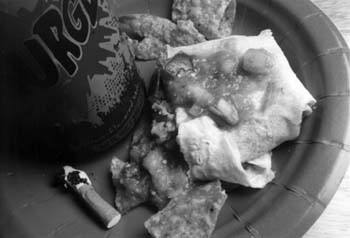
Burrito supreme: The starchy filler of my youth is the comfort food of today.

Confessions of a Burrito Queen

By Marina Wolf

While chatting with a fellow writer recently about professional goals, I confessed a desire to write for a certain glossy food magazine. “Well, you better take some classes,” said this person of nodding acquaintance, “because you need to know about more than burritos to write for them.”

I froze, paralyzed by almost primal shame. There in front of God and my peers–well, one peer–my food roots were showing.

After hearing the story, a sympathetic friend crowned me the Burrito Queen. But underneath the defiant laughter, I remained hurt and bewildered. Weren’t they enough, the mango-jicama quesadillas I made, the home-baked bread, the intricate Indonesian salads? And why was I so upset by an offhand remark from this guy, who had never sat at my table (and never would after a thoughtless crack like that). The truth is, he managed to hit uncomfortably close to the mark. I’ve learned a lot about the upper crust of gastronomy–enough to want it, enough to do it well–but just apply a bit of pressure and all the filling comes out.

Individual foodways show where we come from as clearly as a map. I grew up in a family of seven children and frequently underemployed parents. We always had food on the table, but it was usually bland stuff with starchy filler–ketchup-based spaghetti, oatmeal- heavy meatloaf, and, yes, burritos–and there was never much in the cupboards.

Meanwhile I began to covet the sugary cold cereal and potato chips that lay about lewdly in other people’s kitchens, and learned how to wangle a share of the generous dinners served in the comfortable dining rooms of strangers. After the loud, tense meals at home, at which everyone was hyperconscious of exactly how much was on each plate and how much was left in the pot, take-out eaten absentmindedly in front of the TV at a friend’s house was a positive luxury. And the ignominy of my 12th-year birthday party, organized around ragged scoops hacked from a freezer-burned, half-eaten, five-gallon bucket of generic ice cream, stung even more when contrasted with one acquaintance’s gathering, complete with pizza and two Baskin Robbins ice cream cakes.

No questions here about where my comfort-food choices come from.

If private preferences reveal where you’ve been, public practice shows where you want to go. Anyone who wants to blend and move up in the dominant food culture/economy can do it, with enough cash and energy. Fancy restaurants are a good place to start, offering a nicely literal context for the concept of conspicuous consumption: all it takes is a clean pair of slacks and a careful wad of greenbacks (or an overused credit card) and you’re in the door, puttin’ on the ritz, at least for one night.

GROCERY STORES are trickier; though you’re buying food for private use, you can bet that other people are noticing what’s going in that cart. Here a thoughtfully planned shopping list conceals a multitude of proletarian sins. Those who lack money can still spend their food stamps on high-quality goods; save for the scrutinizing eyes of the people behind them in the checkout line and the checkout clerk, no one will be the wiser.

But even the food products themselves tend to be arrayed on opposite sides of the tracks. For example, brand names are essential pillars in the system of grocery-store snobbery, though most producers will now admit that the tomatoes or peaches or whatever are often picked from the same field and processed at the same plant as their generic counterparts. Lean hamburger is generally more expensive than fatty meat, presumably to compensate for the extra labor involved in removing the fat that used to represent richness and well-being. And in an odd reversal, “peasant bread” made from plain materials costs double or triple what the heavily processed and scorned bread does for today’s workaday “peasants.”

WHAT DEFINES cuisine de hoi polloi changes from year to year, or even from season to season. When something becomes plentiful, the cost usually goes down, more people can afford it, and it loses its sheen of exclusivity. With each new development in food technology, or expansion in the means of production, or successful promotion of an obscure fruit (think kiwi!), the swells have to find some other foodstuff.

Appropriating a regional or era-specific specialty and presenting it with an ironic tweak is a time-honored culinary approach to this dilemma. Barbecue, meatloaf, and cream pies, once looked down on as hopelessly déclassé, are now receiving regular space in Gourmet and other big players in the food world.

Such magazines are great guides for motivated plebes like myself who want to keep up with the Joneses. The glistening color photos and ritualistic recipes promise Eleusian experiences beyond my wildest childhood dreams. But I’ve learned to eff the ineffable pretty well. Newspaper food sections, the World Wide Web, junk mail from Time-Life cookbooks: all are gleaned for my mental pantry.

I will probably never prepare a goose liver from France or own a wood-fired outdoor oven, but I sure can tell you what to do with them.

“Shabby genteel” is probably the most accurate description of the food habits that have emerged at my own particular junction of background and ambition. My cookware consists almost completely of thrift-store pans, supplemented by a Cost Plus wok with the non-stick coating flaking off and a Calphalon roasting pan (one thing at a time, right?).

I experiment with one new dish a week, but it’s as likely to be a ring of gooey pull-apart rolls as an East Indian stew.

And for Thanksgiving last year, our turkey was stuffed with figs, bacon, and homemade cornbread, which concoction I then happily ate during the middle two hours of a 12-hour X-Files marathon.

I call it “Revenge of the Burrito Queen,” living well–on my own terms–being the best revenge.

From the June 25-July 1, 1998 issue of the Sonoma County Independent.

© Metro Publishing Inc.
Della Santina’s

That's Italian!Michael AmslerSecret garden: The atmosphere is cozy and mellow in the courtyard at Della Santina's just off the Sonoma Plaza.Delightful outdoor dining at Della Santina'sBy Paula HarrisAFTER a monotonous succession of cool gray days, the sun suddenly cracked through the clouds late one recent Sunday afternoon. The sure-fire tonic to El Niño blahs was to hit the...

Babatunde Olatunji

Rhythm KingMichael AmslerBabatunde Olatunji taps soul of AfricaBy Greg CahillRHYTHM is the soul of life," Babatunde Olatunji likes to remind those not in the know-zone. For his massive impact on the sound of music worldwide, this percussionist is widely recognized as the djahlibah of African percussion playing, the undisputed African drumming master. "Apart from the human voice, the drum...

Talking Pictures

Real Gone'The Goners' creators get scared at The X FilesBy David TempletonIn his ongoing quest for the ultimate post-film conversation, writer David Templeton sends interesting people to interesting movies. This time out, he asks the popular science-fiction writing team of Jamie Simons and E.W. Scollon to check out the very-scary film version of T.V's phenomenonal The X...

Porn Probe

Porno Probe Still UnresolvedWHILE THE STATE Board of Corrections review is being conducted, a separate internal probe involving nearly half the male correctional officers remains unresolved. On April 15, the Independent reported that at least 29 correctional officers--and maybe as many as 50--are under investigation for downloading Internet pornography while on duty. One guard, dismissed during his probationary period,...

Sonoma County Jail Abuse

Jail House BluesMichael AmslerIn the wake of recent in-custody deaths, escapes, and a porn scandal involving correctional officers, new allegations of abuse surface at the Sonoma County JailBy Greg Cahill and Paula HarrisJOAN MCMILLAN'S journey "through hell and back" started last April on a short bus ride from the honor farm near the Santa Rosa Airport to the Sonoma...

Talking Pictures

Wild Girl-ChildFeminist theologian Patricia Lynn Reilly cheers for Disney's MulanBy David TempletonDavid Templeton takes interesting people to interesting movies in his ongoing quest for the ultimate post-film conversation. This time out, he turns to e-mail for an online discussion--with author Patricia Lynn Reilly--of Disney's wonderful new animated adventure, Mulan."You have mail," announces my computer."Hmmmmm. I imagined I might," I...

Hair

Hairy IssuesMichael AmslerHigh times: Hair director Michael Fontaine takes a smoke break (it's just a prop, honest!) in the SRT costume shop. What does SRT's new staging of an aging '60s musical say about '90s morality?By Patrick SullivanTHERE, THAT'S ME," says Michael Fontaine, a funny smile playing around the corners of his mouth. He's pointing to one blonde head...

Hello, Dolly!

Lookin' SwellHello, Dolly!Mountain Play's 'Dolly!' long on funBy Patrick SullivanCYNICAL HEARTS sometimes find Hello, Dolly! tough to take. Even for a musical, this is light-hearted stuff, full of sappy songs and extended dance numbers. Without a solid peg to nail down the fluff, this play could float right off the stage.It's a lucky thing, then, that this year's Mountain...

Reynolds Price

The Vision ThingAuthor Reynolds Price finds redemptionBy David TempletonAT THE OUTSET of Reynolds Price's lyrical new novel, Roxanna Slade--his 30th published work in 35 years--the story's feisty, eponymous 94-year-old narrator playfully writes, "Every time somebody calls me a saint, I repeat my name and tell them no saint was ever named Roxy." It can also be said that no...

Comfort Food

Food RootsMichael AmslerBurrito supreme: The starchy filler of my youth is the comfort food of today. Confessions of a Burrito QueenBy Marina WolfWhile chatting with a fellow writer recently about professional goals, I confessed a desire to write for a certain glossy food magazine. "Well, you better take some classes," said this person of nodding acquaintance, "because you need...
11,084FansLike
4,606FollowersFollow
6,928FollowersFollow