The Lady’s Not for Burning

Burning Passion


Hot date: Elly Lichenstein and Lucas McClure star in The Lady’s Not for Burning.

‘The Lady’s Not for Burning’ lights up Cinnabar’s 25th anniversary season

By Daedalus Howell

CRANK UP Richard Strauss’ Also Sprach Zarathustra, grab a femur, and get down like an awestruck monkey: There is a monolith in our midst (à la 2001). This season marks the silver anniversary of Petaluma’s Cinnabar Theater–a veritable monument to local theater, whose A-class productions have been emblematic of innovation for the past quarter century.

This landmark year opens with playwright Christopher Fry’s pyrotechnic verbal extravaganza The Lady’s Not for Burning, under the expert direction of Lucas McClure. Written in verse, Fry’s play is a riotous frolic of wit and romance set in millennial-mad 15th-century England.

Enter Thomas Mendip (the ever affable Lucas McClure), a world-weary ex-soldier who has become dead-set on taking leave of life after contracting a virulent bout of existential philosophy. He pleads guilty to the murder of a missing “rag and bone man” and demands capital punishment from Mayor Hebble Tyson (an appropriately supercilious Sean Casey), who, of course, thinks him too foolish for further thought. Complicating Mendip’s death wish is the arrival of Jennet Jourdemayne (a positively glowing Elly Lichenstein), who has been accused of witchcraft–specifically, of turning the same “rag and bone man” into a dog. Love ignites between the two even as sundry complications are foisted upon them, including an impending doom at the stake. Together, McClure and Lichenstein produce more onstage sparks than an ice skater going for the land-speed record on asphalt. McClure’s droll, vitriolic deliveries are well matched to the playwright’s exquisitely crafted repartee, and Lichenstein plays Jennet with refreshing intelligence, sass, and romantic appeal. The lovestruck couple achieves a sweet and sexy banter that spans the gamut from salvos to salvation in two (slightly trimmed) acts.

Jennifer Hirst also turns in an accomplished performance as the man-hungry Alizon Eliot, the initial love interest of fratricidal brothers Nicholas and Humphrey Devise (Eric O’Brien and Scott Mayer respectively, whose blustery delivery occasionally overwhelms the play’s subtle word-play).

Eugene Markoff shines as the venal Justice Edward Tappercoom, and Laurel Watt conveys a nuanced lunacy as the daft matron Margaret Devise.

But absolutely and unequivocally stealing the show for the duration of his lamentably brief stage time is J. Rene Bonel as the inebriated nincompoop Matthew Skipps. The broad comedy of the character’s rants and manner brings the house to convulsive laughter. If comedy is about timing, then clock-perfect Bonel is surely Swiss-made (even though he boasts the production’s only authentic English accent).

Cinnabar’s The Lady’s Not for Burning bodes well for the theater’s continued longevity and for the remainder of its 25th season. As they say, “It’s full of stars.”

Cinnabar Theater’s The Lady’s Not for Burning plays through Oct. 10 at 3333 Petaluma Blvd. N., Petaluma. Thursdays, Fridays, and Saturdays at 8 p.m.; Sunday matinee, Oct. 4, at 3 p.m., Oct. 4. Tickets are $10-$14. 763-8920.

From the October 1-7, 1998 issue of the Sonoma County Independent.

© Metro Publishing Inc.

The Dog Pound

0

Vegging Out

By Mad Dog

THE UNITED STATES government has just made it easier for us to eat a balanced diet. How did they do this? Not by requiring brewers to add 14 essential vitamins and minerals to beer. And not by passing a law that says no one can get up from the table unless they finish all their Brussels sprouts. No, they simply declared that from now on, salsa is a vegetable.

By promoting salsa from a lowly condiment to its new position, the Agriculture Department’s Food and Nutrition Service (motto: “Eat all you want, we’ll grow more”) made it so the nation’s schools can now buy salsa and be reimbursed for it. Before this they were free to serve it but had to either make it themselves or pay for it out of their own pocket, and we all know everything tastes better when it’s free.

How they did this was simple: they reclassified salsa as a vegetable salad. Right. And Godzilla‘s the new Gone with the Wind. If this is the beginning of a trend and they expand this Kondiments for Kids program, it won’t be long until the youth of America will be lunching on a healthy, hearty, and filling all-vegetarian meal consisting of salsa, mustard, pickles, and soy sauce. And why stop there? Let’s call Cheetos dairy, potato chips a vegetable, pretzels a grain, and fruit roll-ups a fruit serving.

The ketchup industry must be fuming. It wasn’t bad enough that they lost first place in the condiment race a couple of years back, with people buying salsa to the tune of $700 million a year, but now salsa has succeeded where they couldn’t.

You might remember when the Reagan administration tried to turn ketchup into a vegetable. Even with all of Heinz’s 57 varieties of lobbyist behind them they couldn’t muster the backing they needed. It might be political. It could be sociological. Chances are it’s just the difference between Reagan and Clinton. Well, other than the fact that Clinton doesn’t need Viagra.

It’s a good thing they didn’t succeed. I can envision children everywhere eyeing that big plop of ketchup alongside their Fish Stick Hash. Then they’d eat it and be so full they wouldn’t be able to touch the Lime Jell-O with Crunchy Gym Sweepings they got for dessert.

Now they’ll get salsa instead, which is supposed to be a major improvement. But is salsa really better for you than ketchup? Or is it just trendy right now? Personally, I think its popularity stems from the fact that there’s only one way to spell salsa and that makes everyone feel better about themselves when they write a shopping list, and we all know we need our Minimum Daily Requirement of Self-Esteem as set by the President’s Council on Misty Crystal Empowerment and Feeling Good about Ourselves.

Russians apparently don’t have this problem. Well, they may have the self-esteem problem but not the ketchup one. That’s because they don’t like the stuff. Recently, when three Russian sailors stopped in San Francisco on the final leg of a three-year trip, they bought a six-pack of ketchup to take with them. According to the captain, they did it for all the right American reasons.

“I don’t like ketchup,” he said, in an article in the San Francisco Chronicle. “None of us likes ketchup. But the ketchup was very cheap.”

If there’s one thing you learn after three years in a 40-foot boat it’s how to be a smart shopper. They say they’ll probably throw the ketchup overboard on the way to Hawaii, along with a four-pound jar of gourmet jelly beans. That’s a double slap in the face for Ronald Reagan. Someone needs to tell these guys the Cold War is over.

I THINK the real reason behind this salsa reclassification is that the United States is jealous of the European Union. The Europeans are busy signing up new members, preparing to issue new money, and creating new food rules. We, on the other hand, have no new members, our new paper money looks as if it came from a Monopoly set, and the best we can do is imitate them by making up our own food rules.

A couple of years ago–and I swear I’m not making this up–the European Union decided that, for the sake of trade, carrots are fruit, escargots (which the French consider to be not only snails but edible) are fish, quail are no longer poultry, curved cucumbers and bent bananas are illegal, and restaurants serving cheese and celery sandwiches must have separate boards to carve the cheese and celery.

This is serious stuff. Here in the United States these laws would be considered unnecessary and downright frivolous, especially the one about cheese and celery sandwiches. That’s not because we think it’s OK to cut those blasphemous ingredients on the same board, but rather that no one in this country could walk into any self-respecting restaurant and order a cheese and celery sandwich without having the waitress say, “Hey Bud, where do you think you are? The European Union?”

But now we’ve taken the international lead again, returning ourselves to World Power status by being the first country to make salsa a legally reimbursable vegetable. That’s something you couldn’t buy with all the Eurodollars in the world.

From the October 1-7, 1998 issue of the Sonoma County Independent.

© Metro Publishing Inc.

Talking Pictures

0

Father Figure

By David Templeton

For five years, Writer David Templeton has been taking interesting people to interesting movies in his ongoing quest for the ultimate post-film conversation. His guests have included Joan Baez, Larry King, Suzie Bright, Barry Lopez, and Ram Dass. This week, he meets up with best-selling author Gus Lee–a West Point graduate and former San Francisco deputy district attorney–to catch the latest Merchant-Ivory epic, an adaptation of Kaylie Jones’ autobiographical novel A Soldier’s Daughter Never Cries.

James Jones, the author of the classic novels From Here to Eternity, The Thin Red Line, and Some Came Running, was known to be a hard-drinking, hard-hitting man–but with a heart as soft as butter when it came to his children. He was a soldier, decorated with a Purple Heart during World War II, and a writer with a knack for clean, honest realism and a grasp of the dimension of human tragedy.

Of that there is little debate.

How good a father Jones really was, however, has been open to discussion since the 1990 publication of A Soldier’s Daughter Never Cries. Written by his daughter, Kaylie Jones, and now a film starring Kris Kristofferson and Barbara Hershey, the semi-autobiographical novel tells the story of the Willis family, an eccentric but genuinely loving American family living in France during the ’60s and early ’70s. In the film, lyrically directed by James Ivory, the parents’ alcoholism and temper tantrums are greatly downplayed. What is left is a complex, fascinating look at a haunted man whose parenting may have been progressive to a fault: He encourages truth-telling at all costs–to the point where his adopted son Benoit is never allowed to forget that his real mother abandoned him–and encourages his 14-year-old daughter Channe to have her boyfriend sleep over (“I’d rather have you doing it in your own bedroom than in the back seat of a car. Especially my car,” he says).

The film is sure to spark heated post-film discussions: Was James Jones an enlightened dad, way ahead of his time, or was he a permissive, oblivious screw-up whose “tolerance” actually amounted to emotional abuse?

“I think you can find the answer by looking at how his kids turned out,” suggests Gus Lee, the best-selling Colorado-based novelist and former San Francisco deputy district attorney. “In the movie at least, his son is so closed up he can’t even talk about his feelings, and his daughter has said yes to so many guys that now she’s afraid she’s earned a reputation as, in her own words, ‘the school slut.’

“I think,” he deduces, “that this is evidence that something was out of balance there.”

Not to say that Lee disliked the film. On the contrary, he agrees that Soldier’s Daughter is among the year’s best. He also agrees that Jones was an extraordinarily gifted writer.

From Here to Eternity was the first book I ever read about the military,” he recalls. “It had a melancholy sadness to it that I found remarkable.” The famous epic was one of 50 novels that were mandatory reading for all newcomers to West Point. Lee remembers it as the best of the batch.

As Jones did, Lee has used his military experience in his own writing career: Honor and Duty (1995) was based on his West Point experience, and autobiographical details were woven into 1991’s poetic China Boy. His lengthy stint with the San Francisco district attorney’s office brought him close to the issue of “at-risk teens,” a subject at the heart of his latest book, the superb courtroom thriller, No Physical Evidence.

Perhaps it is this issue in particular–the plight of children wounded by their own families–that is at the core of Lee’s surprisingly personal response to the film. That and the fact that he is a father as well–and has put enormous effort into assuring that his own son and daughters need not look elsewhere for love.

“In my case,” says Lee, his voice and manner both forceful and soft-spoken, “I set out, not only to avoid becoming the father that I thought my own dad was, but not to be a father at all. I was going to avoid marriage and fatherhood absolutely, because I was convinced that would be a failed venture. So when I ended up becoming a husband and a father, I really tried to be different.

“My father had no idea what his daughters were doing,” he explains. “He controlled them in areas in which he should have given them freedom, and in areas in which he should have provided care and attention and focus, he was absent.”

Later in our discussion, Lee will tell me that early this year, his father–at the age of 91–after a lifetime of anger and a turbulent relationship with his children, announced that he was all done with being angry. Shortly thereafter, he moved in with Lee and family in Colorado. Within two months, he had, in his son’s own words, “reversed half a decade of bad relationship.”

When Lee’s father passed away in March, enough healing had taken place that he was able to openly mourn the man he was once terrified of becoming.

“What I’ve done,” he explains, “is to listen to my kids in the way I wish my father had listened to me. I’ve tried to give them the respect I know they want, by listening, by paying attention, by providing time. When they come in, even if I’m in the middle of writing the best passage I’m going to come up with all week, and I know it–I’ll go, ‘How can I help you? What’s up?'”

“That’s to make up for the years, the first five years of my son’s life, when, if he interrupted me, I’d say, ‘Eric, I’m busy right now.’ In other words, ‘I’m doing something important, and you’re not. You don’t fit into the important category.’

“When I realized I was doing that,” he acknowledges, quietly, “I knew I was in danger. So I turned it around. I did not want my son and daughters to become the kind of kids that give up feeling, like Benoit, or to become the girl who sleeps with so many guys, like Channe. I didn’t want that for my kids. I didn’t want them to ring that bell and then regret it.”

Lee admits that it isn’t a simple matter to change, but points again to his father, able to learn a vital new trick at the age of 91.

“When a parent decides to change, though, it isn’t easy for the kids, either,” he smiles. “They’ll think, ‘What are you doing? Why are you suddenly going out of your way to listen to me?’ And hopefully there is a reason other than ‘I want you to avoid sexual promiscuity.’ Its more than that. It’s really, ‘You’re so much better than that. You’re so much better than the way I’ve treated you.’

“I’m convinced that if any of us succeed in life,” he adds, “we succeed because of the time that others were willing to invest in us. That’s how we learn what we are worth.”

As for James Jones, Lee concludes, “I think he meant well, but he had his own wounds he couldn’t drink away. And I think he ended up teaching his children the wrong lessons.”

Web extra to the October 1-7, 1998 issue of the Sonoma County Independent.

© Metro Publishing Inc.

Mill Valley Film Festival

0

Indie Scene

By Greg Cahill

UNTIL RECENTLY, Sonoma County film buffs found slim pickings when it came to independent films. Sure, there’s the good work of the Sonoma Film Institute, a long-standing local resource. And, more recently, local multiplex owner Dave Corkill has committed a screen at his theaters in Petaluma and Sebastopol to showing top independent films.

Are we grateful–believe it!

Yet, by virtue of its sheer magnitude–more than 110 films, ranging from big-name Hollywood features to animated shorts–the 20th-anniversary Mill Valley Film Festival, running Oct. 1-11, is a veritable smorgasbord of celluloid for ravenous North Bay film fans. This year is no exception. From the Oct. 1 opening-night gala–Down in the Delta, poet laureate Maya Angelou’s directorial debut–to the closing night screening of Pleasant-ville, Gary Ross’ modern fairy tale, the festival this year offers something for everyone.

Most screenings are at the Sequoia Twin Theatres in Mill Valley or the Lark Theatre in Larkspur. Call 415/383-5346 for details, or check online for schedule information.

Here are a few highlights:

Dancemaker (Oct. 3): As a protégé of the late, great Martha Graham, Paul Taylor over the years has shown spectacular strength, first as a dancer and later as a groundbreaking choreographer. Director Matthew Diamond delivers a candid, behind-the-scenes look into the usually closed world of the lofty New York modern-dance scene.

Genghis Blues (Oct. 3): In 1995, Paul Pena, a blind San Francisco bluesman, became the first foreigner to master the ancient esoteric art of Tuvan throat singing, traveling to that Central Asian republic of Tuva to participate in a tri-annual song competition. What a long, strange trip.

Nadro (Sunday, Oct. 4): Filmmaker Ivana Massetti’s stirring documentary about 75-year-old Ivory Coast poet, writer, and artist Frederic Bruly Bouabre. Beautifully photographed in black and white (except when Bouabre’s vibrant paintings are displayed at a Paris exhibit), Nadro ranks as one of the finest portraits of an artist ever committed to film.

Gods and Monsters (Oct. 6): A fictional account of the last days of Hollywood legend James Whale, creator of the classic horror films Frankenstein and Bride of Frankenstein. This adaptation of Christopher Bram’s acclaimed novel Father of Frankenstein features bravura performances by Ian McKellen (as the flamboyant and emotionally tormented Whale) and Brendan Fraser (as the homophobic Frankenstein-like yardman who befriends him). As the plot twists, Gods and Monsters reveals a melancholy and haunting tale about the plight of a creative genius who ultimately cannot distinguish the fictional monsters he has created from the monsters within himself. Highly recommended.

Maternal Love (Oct. 10): This Iranian film, set against the backdrop of strict Islamic society, tells the story of a street waif who becomes obsessed by the female counselor who ventures to his reform school. Often heart-wrenching, this universal tale of love features a remarkably mature performance by 10-year-old Hussein Solimani. A world premiere.

My Son the Fanatic (Oct. 10): Pervez is a Pakistani taxi driver living in the United Kingdom who loves everything British, including a prostitute he meets on the streets. At home, his teenaged son Farid is becoming consumed by his Islamic faith and is rejecting his father and everything that he stands for. This contemporary love story, set in the sometimes tragic, sometimes comic clash of cultures and generations, features a complex mix of sexuality and religion, freedom and constraint, love and transgression.

From the October 1-7, 1998 issue of the Sonoma County Independent.

© Metro Publishing Inc.

Estero Americano

Cool Water


Michael Amsler

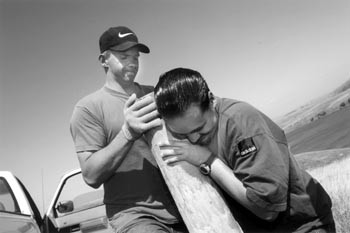
Nature’s way: Local teens hoist a fence post near the Estero Americano in a restoration project that helps rebuild their lives. The innovative project is co-sponsored by the Sonoma Land Trust and the Family Life Center of Petaluma.

Troubled youths find healing waters at environmentally damaged estuary

By Stephanie Hiller

A A windswept hill overlooking a dazzling estuary, a group of bright-eyed youth installing a heavy fence post, and the restoration of land trampled by cattle and invaded by roads make a very pretty picture. And when these are boys whose lives were once twisted by delinquency and abuse, the scene becomes charged with social significance.

An innovative partnership between the Sonoma Land Trust and the Family Life Center of Petaluma is behind this unique project, which was the brainchild of Rick Bennett, farm and public policy adviser for the UC Cooperative Extension and also an SLT trustee. “When the kids see the benefits of their work, there’s a tremendous sense of accomplishment and belonging,” says Bennett.

“Initially, the kids feel apart from the land, but after a week, they see it as friendly, as also home. If these young men get a sense of the land as a viable creature, maybe when they’re changing the oil in their cars, they won’t dump it down the drain.”

Bennett got together with David Katz, SLT executive director, to involve youth in its land restoration program for its newly acquired 86-acre parcel on the Estero Americano on the Sonoma-Marin border. “We were looking for ways to involve people with the land more than just walking around saying how beautiful it is,” says Katz. The SLT has been buying and restoring Sonoma County lands since it was formed in l976, to help stop the disappearance of open space in a rural area threatened by development.

More than 30 percent of the county’s open farmland–over 900,000 acres–has been lost to other uses since the 1950s. The Land Trust has more than 10,000 acres now under its protection, and over 60 volunteers who annually walk the properties to assess their condition, but the Estero project is the first time youth have been involved.

Strong winds race through tall grasses and ripple the shining waters of the estuary, which is within the Gulf of the Farallones National Marine Sanctuary. The isolated hilly grasslands on Estero Lane in Bodega Bay are a stunning landscape damaged by various types of erosion, resulting in siltation of marine breeding areas, disturbance of nesting areas, increased turbidity of the water, and raised water temperature. Home to migratory waterfowl, shorebirds, eagles, and red-tailed hawks as well as deer and small mammals, the land has been overgrazed by sheep for many years.

Native range grasses are nonexistent, and many invasive plants have begun to take hold.

Restoration of the wetlands will be visible in only one year, according to Bennett. Installation of a high-tensile fence will control grazing while allowing deer to roam freely. The road will be regraded and regraveled to reduce runoff, and existing erosion will be repaired. Some revegetation of the wetland area bordering the Estero will also be undertaken. When they revisit the land next spring and summer, kids will see the fruits of their labor. “It improves their self-esteem,” Bennett says, “which is so fundamental to who we are as people.”

THE YOUNG PEOPLE who come to live at the Family Life Center are youth whose sense of self has been damaged by the unfortunate things that have already happened to them in their short lifetimes. The FLC’s goal is to provide a stable and nurturing environment where they can recover from the wounding they have endured, emerging with renewed confidence to make a fresh start in their lives.

“Giving the child exposure to the land in an unspoiled area–[having them] actually be able to touch the land–lets their spirit come out and play,” says Jamie Goetz, wilderness program coordinator for the FLC. While kids are aware of the major threats to planetary survival, “a lot of them are pretty uninformed about the simpler things,” he adds, “[like] where their water comes from, where the water goes when you flush the toilet.”

The Wilderness Program, in which this restoration project will be an ongoing weekly activity, has the intent of “building a sense of community and self-confidence, [with youths] working together as a team to get things done that they wouldn’t be able to do for themselves.”

Out on the windy hillside, the kids look alert and engaged, as if the fresh cold gusts of air have relieved them of their masks of indifference and disdain, and reawakened their radiant innocence.

“It’s cool,” says Chris, 17. “It’s just, like, fresh. Not at all stagnant.”

He stares out across the Estero, where earlier he had noted a man driving a truck across the grasses (probably checking on his cattle, Chris surmised). “There’s more stuff to look at here. It gives me, like, a good feeling. Feel more free, kinda.”

Jason, also 17, had worked on the land last year. “I didn’t think anything we did was going to make a difference,” he says. “Now I see that it did make a difference. That makes me want to work even harder today!”

He doesn’t like being out there, though, preferring the city. “But if I can help nature,” he explains, “I’ll do it. Nature needs a lot of help.”

The rest of the boys are clumped together around the new fence post, taking turns with the tamper bar to pack the soil as hard as it had been before the post-hole digger penetrated the ground. One boy suggests they make sure it is absolutely level. Bennett walks to the back of the pickup truck to hand him a T-level.

He’s been smiling all the while, telling the kids how long it takes–10,000 years–to build topsoil, pointing out where the lines of erosion are. “Thousands of years ago,” he explains, “this whole place was under the ocean.”

The kids are intrigued. “Oh yeah?”

For Rick Bennett, too, this work is a healing. “I’ve seen these boys sit down with me in a meadow and share their hearts,” he concludes.

From the October 1-7, 1998 issue of the Sonoma County Independent.

© Metro Publishing Inc.
Loudon Wainwright

0

Loud ‘n’ Clear


Hugh Brown

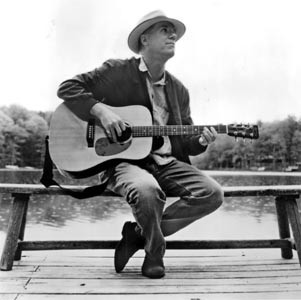
Troubadour: Forget road kill–Loudon Wainwright plumbs the depths of the soul

Loudon Wainwright III, storyteller on wry

By David Templeton

I’LL BE RIGHT with you,” says Loudon Wainwright III, answering the phone on the fifth ring. “I just want to turn down the old television–I’ve had Clinton up for a while.”

Oh. Right. Clinton. This interview is taking place, it so happens, on the very same day that the president’s infamous grand-jury video is being aired all over the world, part of the GOP’s transparent effort to turn its Democratic nemesis into road kill on the public opinion highway. Wainwright, who’s been keeping up with the whole debacle–and who doesn’t think Clinton looks half bad defending himself on the video–certainly knows a thing or two about road kill: Though he’s written hundreds of ingeniously crafted, inventive, and beautifully melodic songs throughout his 30-year career in music, he is probably best known for the campfire classic “Dead Skunk in the Middle of the Road,” a Top 20 hit in 1972.

Not to mention that he’s the father of rising music star Rufus Wainwright.

When Wainwright the elder arrives in Sonoma County Oct. 8 at the Mystic Theater in Petaluma, he’ll be performing songs selected from 16 albums recorded over the last three decades. His latest, Little Ship (Virgin), has been enthusiastically pointed to–by scads of publications from Entertainment Weekly to the New York Times–as an example of a singer-songwriter working at the top of his craft. With background vocals by Shawn Colvin, the CD is Wainwright doing what he does best: zigzagging from silly, tongue-tying goofball songs–the horny, pun-filled “Breakfast in Bed” and the manic-depressive “The World (Is a Terrible Place)”–to songs of heartbreaking honesty and frank personal insight (“Four Mirrors,” about his growing resemblance to his father, and the wise-in-hindsight “Our Own War”).

Then there are the songs, such as “Bein’ a Dad”–with the lyric “A daughter and son can be sort of fun, as long as they don’t defy you./ They’ll treat you like a king, they’ll believe anything, and they’re easy to frighten and lie to”–that can literally make an audience laugh and cry at the same moment. That’s a nasty little trick that Wainwright, a masterful worker of live crowds, seems to take special delight in.

“A show should be just that, a show,” he says when he picks up the phone again. “There should be a certain theatricality to it. I don’t see myself as a recording artist so much as a performer. I love to perform, to spontaneously banter with a crowd. The stage is the most natural environment for me.

“There are certainly nights when I don’t enjoy myself, for whatever reason,” he allows. “But in general, I love to stand up there and jump around and sing these songs.”

By “these songs,” Wainwright does not necessarily mean the one about the dead skunk. Though he will still occasionally surprise an audience with it, he rarely sings that particular song any more.

“That was a long time ago,” he says, good-naturedly. “And there are lots of other, better songs to sing.”

AS FOR THE PATENTED LW3 acerbicity, he doesn’t think he necessarily deserves a reputation as folk music’s reigning pessimist. This in spite of such songs as “The World,” with the verse “The world is a crappy old hole, from bottom to top and from pole to pole./ No, there’s no good news, this world’s useless./ I’m out of here, that’s my goal, ’cause the world is a crappy old hole.” This performed on a banjo, “the ‘happy’ instrument of folk music,” as Wainwright calls it.

“Well, the world is a crappy old hole, sometimes,” he laughs. “But ‘sometimes’ is the key word. I don’t want people to think I’m a complete misanthrope. The truth is that the world is interesting and amazing and beautiful–and it’s also a terrible place.

“Actually,” he adds, “I mainly wrote that song to mess with and piss off Pete Seeger,” the world’s greatest promoter of the Happy Banjo mindset.

As for son Rufus, Wainwright affirms that he’s done pretty damn well for himself. “As well he should,” he beams. “He’s extremely talented, I must say. His sister Martha, also, who sings on his record and who’s sung on my albums–she’s also doing very well. She’ll be cutting her own record soon, it looks like. So both of those kids are off and running.”

He pauses a split second, then adds one more remark to describe his parental pride. Not surprisingly, it sounds like the lyric from an LW3 song. “I’m proud of them, jealous of them, annoyed by them,” he says. “Hopefully, they’ll buy me a house.”

Loudon Wainwright III performs Wednesday, Oct. 7, at 8 p.m. at the Mystic Theater, 21 Petaluma Blvd. N., Petaluma. Tickets are $15. For details, call 765-6665.

From the October 1-7, 1998 issue of the Sonoma County Independent.

© Metro Publishing Inc.
Wild Mushrooms

0

Dig It!

Michael Amsler


A quick-and-dirty guide to the velvet underground

By Marina Wolf

THE SUN AT Salt Point State Park is strong. Even the cool air in the coastal woods has a toasted resin smell to it. But Pete Petersen, my contact at the Sonoma County Mycological Association and the planner of the day’s expedition 20 miles north of Bodega Bay, assures me that there already have been mushroom sightings here this season, so we may get lucky. Pete’s been ‘shrooming for 35 years, so I’ll follow his lead any day.

The rest of the party–Sue Davidson, Elissa Rubin-Mahon, and Elissa’s 13-year-old daughter, Ariel Mahon, all members of SOMA–are ready for the hunt, with wicker baskets, rusty knives, and well-worn guidebooks. And they are enthusiastic, even though their predictions have been dire about the likelihood of finding anything today.

“It’s very dry, much drier than last year,” says Elissa, who has been hunting mushrooms since 1981. “Last year was a really early year, and the mushrooms were abundant. This season at the places I was finding pounds of mushrooms last year, I’ve only found one very small one.”

This particular spot, known to generations of Russian- and Italian-Americans as a jackpot for succulent porcini and chanterelles, is seeing increased traffic as other hunting grounds closer to cities have been covered up by housing developments. “It takes generations of growth before boletes [porcini] and chanterelles come up,” Elissa says. “If you wipe out an area, they usually doesn’t come back for a while.”

Which is not to say that you need to travel to pristine wilderness to find good ‘shrooms. “I have a spot in my neighborhood that I check out now every year,” chirps Sue, a cheery older woman who looks as though she might teach home-ec when she’s not crawling around in the woods.

“Yeah, we have chanterelles that come up not too far from us in the winter,” Elissa answers absentmindedly from the little hollow to which she had made a beeline. She pulls up a stack of pine needles and lets out the first call of the day: “I found some!”

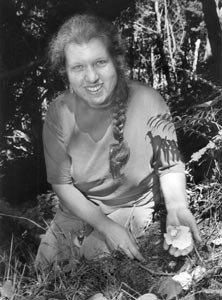
The creamy yellow lumps emerge under Elissa’s careful fingers. “They’re a little dry,” she says, “but they’re not old.” She cuts the two blooms free and hands the mushrooms over to Pete, who holds them up to my nose. They give off a faint apricot smell, overlaid by an irresistible aroma of dusty old velvet, and the pale skin darkens with exposure and handling to a burnished gold. Everyone is tangibly excited by this first find. “There’s a happiness in going out to the woods, hunting stuff,” Pete explains. “It goes back to when we were hunters and gatherers thousands and thousands of years ago.”

Sue nods her head vigorously. “You’re hardwired to do it. It feels really natural.”

AFTER THE THRILL wears off a bit, Sue and Ariel head off down the gully, while Elissa pares the stems clean. “Part of mushrooming is intuition,” she says matter-of-factly, scraping the tender flesh with casually perfect strokes. “I almost get a feeling in the pit, in the solar plexus, that something’s starting to happen, and I’ll come and look.”

Another part of mushrooming is, of course, practice, which is where SOMA comes to the rescue with frequent outings and workshops for dedicated seekers and curious members of the public alike. To ward off any mycological misadventures–every rainy season seems to bring on a small but well-publicized crop of ill-informed individuals in need of mushroom-related liver transplants–SOMA hosts a mushroom fair every winter, with mycologists on hand to indentify fungi, and the group sponsors a year-round helpline. Accessible through directory information, the recording gives contact numbers for some of SOMA’s senior members, outlines emergency procedures for bad- or worst-case scenarios, and reiterates the mushroom novice’s mantra: Don’t eat it until a pro says you can.

The pros on hand know exactly what we’re looking for. Elissa resumes her intent scrabbling around the pine trees, while Pete demonstrates the finer points of mushroom structure to the fascinated Independent photographer. I catch up with Ariel, who seems a precocious youngster indeed. Latin terms spring from her lips with unstudied ease, interspersed with gossip about other mushroom hunters and enthusiastic tales of her outings with mom. Ariel has been mushrooming since the age of 4. Sheesh.

I’m never going to catch up.

AS WE CLAMBER around the side of the ravine, the two older women exchange sites and recipes for their favorite fungi. We have covered a swath of hillside a couple of hundred feet long, and still I have found nothing.

I ask Elissa to come with me to the other side of the glen. By now, the bottom of her basket is thickly covered with chanterelles, and I harbor a vague hope of her mushroom magnetism rubbing off on me.

Then I look down at the base of a tree not 25 feet from the parking lot and see a glint of blonde in the dark forest floor. “Hey,” I call out weakly, the excitement mounting in my chest, “is this one?” The others come quickly, and Pete kneels down next to me for a closer look. Yes, it is a chanterelle. Grinning like an idiot, I wrap it proudly in paper towel and put it in Pete’s basket.

Back at the parking lot, my head fills with visions of a future full of wild, flavorful fungi. I could do this–a lot. But the logistics of mushroom hunting are daunting. Mushroomers can be secretive about disclosing their favorite spots–this group asked me to avoid naming the specific site that we’re hunting in–and in any case, only three public parks in Sonoma County are open for gathering: Salt Point, Tomales Bay, and Samuel P. Taylor.

“Basically you need to find people who own private property,” says Pete.

“We’re really trying to work toward getting all of the state parks open,” adds Elissa. “Right now, they’re saying, oh, there’s too much pressure, there’re too many people picking here. Our belief is that if they opened everything up they would spread the activity out.”

Potentially that leaves the gate wide open for commercial harvesters–who can pick up $2-$7 cash for a pound of chanterelles–for whom this particular group of mushroomers has a certain disdain. “The commercial pickers travel in caravans,” says Elissa. “They start in the summer in Alaska, in trailers and vans, and they work their way down. They’re not supposed to do it here. But I’ve seen at the north end of the park when bolete season is upon us, 20 or 30 vans of people.

“You know they’re out there doing it.”

Nods and murmurs from the others accompany Elissa’s complaint, but the conversation eventually turns back to recipes for the chanterelles in hand (general consensus calls for a quick sauté in butter).

It’s hard to stay worked up about porcini poachers after exercising one’s hunter-gatherer instincts, which are probably, as Ariel suggests, closer to the stomach than to the brain.

SOMA meets on the third Thursday of the month, from September through May, at 7 p.m. at the Sonoma County Farm Bureau (970 Piner Road, Santa Rosa). Membership is $15 per household. The mushroom hotline is 833-1097.

From the October 1-7, 1998 issue of the Metropolitan.

© Metro Publishing Inc.

Mark Fishkin & Mill Valley Film Fest

0

A Life in Film


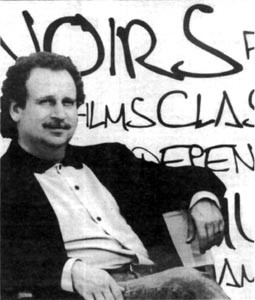
Cinematic vision: Mark Fishkin of Petaluma is executive director of the Northern California Film Institute, which presents the Mill Valley Film Festival.

Janet Orsi


Mark Fishkin ushers in
Mill Valley Film Fest

By Greg Cahill

ASK MARK FISHKIN, co-founder of the Mill Valley Film Festival, about his most embarrassing moment at the popular North Bay event and he shakes his head and moans. “There’s always the story about the time we showed Nicholas Ray’s last feature a dozen or so years ago,” he recalls, nursing a cup of espresso at a Petaluma riverfront cafe. “We were doing a tribute in memoriam to him. Acting legend John Houseman was in the audience, sitting next to me. We were going to show a short clip from Rebel without a Cause before showing Lightning over Water, his last film.

“Instead, the clip from Rebel without a Cause went on and on and on. Houseman turned to me and said, ‘Mark, are you going to show the whole movie?'” says Fishkin, impersonating the late thespian’s droll speech.

“I said, ‘No, of course not,’ and went up to the booth to find out what was going on. I found the projectionist lying on the floor with the whole print of Lightning over Water on top of him–he had dropped the platter.

“He looked up at me, red-faced, sweating, his eyes twice their normal size, and said, ‘It’s OK! It’s OK! Give me five minutes to fix it!’

“I spent the next half hour running back and forth to the concession booth and handing out free popcorn and wine before finally announcing that the tribute had to be canceled. It took the projectionist all night to put the print back together.”

These days, the popular film festival–which attracts a large contingent of Sonoma County film buffs–operates much more smoothly and has become quite prestigious.

The 21st annual Mill Valley Film Festival runs Oct. 1-11, with screenings held at the Sequoia Theatre in Mill Valley and the Lark Theatre in Larkspur. The fest will feature a wide selection of independent films and dozens of international features, including several world and U.S. premieres, a tribute to British actors Derek Jacobi (Love Is the Devil, I Claudius) and Helena Bonham Carter (A Room with a View, Howards End), several filmmaking seminars, and a children’s film series. It opens tonight with a screening of poet Maya Angelou’s directorial debut Down on the Delta and closes with the modern fairy tale Pleasantville, the new film from Gary Ross (Big, Dave).

Over the years, Fishkin adds, the film fest has become “more than a sum of its parts,” helping both independent filmmakers who don’t get enough support in the marketplace and a public faced with an increasingly narrow range of choices at the box office.

“We also have a hidden agenda where we illustrate what an amazing medium film is and how it can influence people,” confides Fishkin, 49, who lives in Petaluma with his wife, Lorrie, and their 9-year-old daughter, Lindsay. “We’ve all heard about how it can influence people negatively in terms of children viewing violence. One would also hope that you can influence people positively.

“I believe film gives us the ability to see who we are, where we are, and how we relate to each other, to the planet, to political, environmental, and social issues.”

Ironically, it was filmmaking, and not film programming, that lured Fishkin, a New York native, to the Bay Area in 1976. “I once heard Francis Coppola at the Telluride Film Festival talking about good ways to break into the film industry,” Fishkin says. “He confirmed my gut feeling that it should be done through screenwriting.

“Of course, I had visions of six figures dancing in my head.”

Appalled that a community the size of Marin had virtually no alternative cinema, Fishkin began programming a weekly College of Marin film series. For a while, he considered buying the old Plaza Theatre in Petaluma (now the Mystic Theater & Dance Hall), but decided it would cost too much to remodel the aging movie house.

He later took over Mill Valley’s legendary Saturday Night Movies held at the local Odd Fellows Hall. It was a logistical nightmare. The small staff, mostly student volunteers, had to set up and tear down folding chairs between each show. And then there were the auditorium’s poor acoustics.

“The sound in the hall was so bad that I really could only show films with subtitles,” he laughs.

When the “losses became too much and the headaches too great,” Fishkin bailed out of the enterprise. In October 1977, he and fellow film buffs Rita Cahill and Lois Cole organized a three-day film festival. It featured three film tributes, Coppola’s Rain People, and George Lucas’ The Filmmaker.

“We did a very innovative program that I would not be embarrassed to repeat today,” he says.

It was a big hit. Since then, the fest has gained considerable stature in the industry. It now ranks as one of the top U.S. film fests. Among its success stories was the 1987 world premiere of Walking on Water, with Edward James Olmas and Lou Diamond Phillips. That film later went on to achieve critical acclaim and commercial success as Stand and Deliver. It received a 10-minute standing ovation at its premiere.

Fishkin is especially gratified at the role the film fest has played in nurturing such independent films as The Crying Game, My Left Foot, Like Water for Chocolate, and Strictly Ballroom–films that until recently would have enjoyed only a limited audience but which have gone on to widespread success. “That’s encouraging,” he says. “I also feel some gratification that our growth has paralleled the growth of the independent filmmaker movement.

“I think we’ve had some role in that.”

And even though that early ill-fated homage to Nicholas Ray ended in disaster, many of the fest’s other tributes have ranked among Fishkin’s most memorable moments. Among those who have been spotlighted are Olmas (Zoot Suit, American Me), John Frankenheimer (Seven Days in May, The Year of the Gun), and Jack Arnold (The Incredible Shrinking Man, The Creature from the Black Lagoon).

“It was an especially great thing to see how the audience responded to Jack Arnold,” Fishkin points out. “People came to the midnight screening of The Creature from the Black Lagoon in 3-D glasses and even brought their kids because they wanted them to experience this classic horror film.

“Jack wasn’t in very good health even then, but he just wanted to acknowledge the crowd. When he stood up and faced the audience–with his 3-D glasses on–the roof almost caved in from the applause. He cried.

“It was an incredibly moving moment.”

The Mill Valley Film Festival box office is located at the corner of Blithedale and Throckmorton avenues in Mill Valley. For program and ticket information, call 415-383-5346.

From the October 1-7, 1998 issue of the Sonoma County Independent.

© Metro Publishing Inc.
Spins

0

Psyched!

Various Artists Nuggets: Original Artyfacts from the First Psychedelic Era, 1965-1968 Rhino

THEY SAY you always return to the music of your youth, so in the spirit of public disclosure I offer this fact: I was weaned on a steady diet of psychedelic nuggets.

Fuzz tone, feedback, and swirling Farfisa organs–I couldn’t get enough of ’em. The Standells, the Shadows of Knight, the Count Five–all were staples on my cheesy Sears & Roebuck phonograph.

That said, Nuggets–newly reissued as a four-CD box set, replete with 118 tracks and a 98-page color booklet–is something of a nugget itself. Originally released in 1972 as a two-LP anthology (compiled by Lenny Kaye, who went on to fame as punk diva Patti Smith’s guitarist and musical collaborator), the collection is one of the few sets consistently included on lists of all-time greatest rock albums.

In this digital age, Santa Monica-based Rhino Records several years ago released Nuggets as three separate CD volumes. This beefed-up version (which features the original two-LP version on one glorious disc) underscores the lingering influence of a subgenre that can still be heard on college radio (thanks to garage bands like the Lyres) and as source material for psychobilly bands like the Cramps and even Neil Young (who covered the Premier’s party hit “Farmer John,” which is included here).

While some of these tunes are featured on classic rock stations–most notably the Standells’ 1965 hit “Dirty Water” and the Kingsmen’s 1963 masterpiece “Louie Louie”–most of these truly qualify as nuggets of the psychedelic era. And you’d be surprised how many big-name then-unknowns pop up: John Fogerty (the Golliwogs), Todd Rundgren (Nazz), Ted Nugent (Amboy Dukes), Dan Hicks (the Charlatans).

But some of the best stuff is the hard-to-find long-out-of-print singles by regional teen bands who locked on to a blues groove here, a Yardbirds lick there, and ran with it for two minutes of unadulterated proto-punk garage rock. Case in point: “Primitive” by the Groupies, a New York band that transformed a rather poorly played guitar riff from Howlin’ Wolf’s trademark “Smokestack Lightning” into a monster track of malevolent mood.

An absolute must for any serious rock hound. GREG CAHILL

Patty Griffin Flaming Red A&M

IN GENERATION LILITH, Patty Griffin is a cut above the pack–a tough rocker who’s not self-absorbed like Courtney Love, an emo-folkie who’s not juvenile like Jewel, an idealist-dreamer who’s not vague like Sarah McLachlan. Her deepest strength is a soul-baring humanism that hits universals via detailed portraits. The new track “Tony,” for example, has as its object a suicidal homosexual teen, but its subject is the pervasive doubt that we all use to block human contact. Griffin’s new disc, Flaming Red, falls short of her gripping debut Living with Ghosts not because she replaces the debut’s acoustic starkness with a full-bore modern-rock sound, but because she doesn’t offer enough colorful portraits like “Tony” or the stunning stories “Poor Man’s House” and “Sweet Lorraine” from the debut. Still, her willingness to streamline her writing while exploding her sound is the sign of a brave artist who is pushing her audience to join her where her “heart is big and sore.” KARL BYRN

From the September 24-30, 1998 issue of the Sonoma County Independent.

© Metro Publishing Inc.
The Scoop

Porn Starr

By Bob Harris

NOW THAT Kenneth Starr has put his finishing strokes (cough) on his report concerning President Clinton, Monica Lewinsky, three cans of candied yams, a turnip, and a bag of elastic bands, stories about other politicians are now surfacing as well.

In fact, at least one, Sen. Dan Burton, has even pre-emptively released details of his personal life, just to ward off any future chance that his own interoffice mash notes might someday be released in paperback.

This is cool.

Something similar happened a few years ago when Washington went through a spasm of confessing past drug use. Clinton, as we all know, didn’t inhale, although now we can reasonably assume we know why his breath was so short. Newt Gingrich also admitted to the demon weed, rationalizing it was merely a function of his presence on a 1960s college campus. Which is a weird thing for him to say, since that also rationalizes free love, protesting the war, and living in a VW microbus, all of which done at the same time would get kind of crowded. And a bunch of other politicians chimed in with their own confessions of drug use until suddenly no one cared much anymore.

A similar level of story burnout might happen with the sex thing. In the last couple of weeks, in addition to the president’s tale of woe (and if you read footnote #210, it’s more of a tale of whoa!) we’ve also been treated to sudden revelations about (a) the aforementioned Sen. Dan Burton, R-Ind., a story that ran in two columns on page A5 in many papers; (b) Rep. Helen Chenoweth, R-Idaho, an admission that got 200 words page A14; and (c) Sen. Henry Hyde, R-Ill., a story that was passed by 57 news organizations before Salon.com tackled it.

At this rate, in six months Al Gore could get caught having oral sex with an endangered tree-fowl, and it wouldn’t even reach the papers.

Make up your own spotted owl jokes here.

Surveys indicate that while most of us certainly don’t approve of making the Oval Office an erogenous zone, we also wish this media circus would just stop, one way or another. In short: Let’s get Clinton resolved, and then let’s get these tawdry sex scandals out of the front pages and back into the sports section where they belong.

Which means that maybe the best thing we can do to make this go away is to start confessing all of our own sexual transgressions.

So as a public service, here are mine. I confess: I have had sex with people other than myself; I am filled with remorse and I can only ask for your forgiveness. This is a very difficult time, both for me, and … well, nobody else. But still, I hope I can now return to the important business of writing this commentary.

NOW THAT the Starr report is out in paperback, I wonder exactly in which section bookstores will stock the thing. Current Events and Politics would make the most sense, but really it could work in a lot of sections.

The White House staff would probably file it in the Horror and Mystery section, and a lot of Republicans would want it in True Crime, although it probably won’t wind up in either.

With all the publicity, Performing Arts might be a little more likely. Or given the speedy nature of the interludes, the report might better belong in the business section under Time Management.

Then again, the cigar thing makes me think it really belongs more in the Hobbies section, but Clinton’s long list of alleged girlfriends might also make the report appropriate to Collections.

Kramerbooks, the Washington, D.C., bookstore that got subpoenaed, probably stocks the report in Local Interest, and frankly I think Monica really ought to swing by and autograph a few copies, just as a thank-you for her own upcoming book deal.

My suggested title for Monica’s new book: Gargling with History.

Hey, if they do a Books-on-Tape version of the Starr report, who’s gonna narrate? The Democrats would probably want Woody Allen, whose delivery would suggest the sadly bumbling nature of the encounters–and whose presence would make Clinton look downright upright by example–but if you’re a Republican, there’s only one choice: James Earl Jones.

Imagine millions of people hearing the Starr text delivered in that Darth Vader Voice of Doom: “The president unbuttoned her blouse and touched her breasts without removing her bra. …”

You can almost hear the audience recoiling in fear: He’s a madman! Somebody stop him!

Then again, since (a) the sex scenes are less titillating than the personal ads in the back of most of the weekly papers that carry this column; and (b) the report barely mentions the serious stuff like Travelgate, Filegate, and Whitewater–all of which together got exactly two more mentions than my Aunt Treva, and she’s never even been to the White House–maybe we can already guess where a lot of copies of the Starr report will ultimately wind up: the Bargain Bin.

At least I hope my Aunt Treva hasn’t been to the White House.

From the September 24-30, 1998 issue of the Sonoma County Independent.

© Metro Publishing Inc.

The Lady’s Not for Burning

Burning PassionHot date: Elly Lichenstein and Lucas McClure star in The Lady's Not for Burning.'The Lady's Not for Burning' lights up Cinnabar's 25th anniversary seasonBy Daedalus HowellCRANK UP Richard Strauss' Also Sprach Zarathustra, grab a femur, and get down like an awestruck monkey: There is a monolith in our midst (à la 2001). This season marks the silver anniversary...

The Dog Pound

Vegging OutBy Mad DogTHE UNITED STATES government has just made it easier for us to eat a balanced diet. How did they do this? Not by requiring brewers to add 14 essential vitamins and minerals to beer. And not by passing a law that says no one can get up from the table unless they finish all their Brussels...

Talking Pictures

Father FigureBy David TempletonFor five years, Writer David Templeton has been taking interesting people to interesting movies in his ongoing quest for the ultimate post-film conversation. His guests have included Joan Baez, Larry King, Suzie Bright, Barry Lopez, and Ram Dass. This week, he meets up with best-selling author Gus Lee--a West Point graduate and former San Francisco deputy...

Mill Valley Film Festival

Indie SceneBy Greg CahillUNTIL RECENTLY, Sonoma County film buffs found slim pickings when it came to independent films. Sure, there's the good work of the Sonoma Film Institute, a long-standing local resource. And, more recently, local multiplex owner Dave Corkill has committed a screen at his theaters in Petaluma and Sebastopol to showing top independent films.Are we grateful--believe it!...

Estero Americano

Cool WaterMichael AmslerNature's way: Local teens hoist a fence post near the Estero Americano in a restoration project that helps rebuild their lives. The innovative project is co-sponsored by the Sonoma Land Trust and the Family Life Center of Petaluma.Troubled youths find healing waters at environmentally damaged estuaryBy Stephanie Hiller A A windswept hill overlooking a dazzling estuary, a...

Loudon Wainwright

Loud 'n' ClearHugh BrownTroubadour: Forget road kill--Loudon Wainwright plumbs the depths of the soulLoudon Wainwright III, storyteller on wryBy David TempletonI'LL BE RIGHT with you," says Loudon Wainwright III, answering the phone on the fifth ring. "I just want to turn down the old television--I've had Clinton up for a while."Oh. Right. Clinton. This interview is taking place, it...

Wild Mushrooms

Dig It!Michael AmslerA quick-and-dirty guide to the velvet undergroundBy Marina WolfTHE SUN AT Salt Point State Park is strong. Even the cool air in the coastal woods has a toasted resin smell to it. But Pete Petersen, my contact at the Sonoma County Mycological Association and the planner of the day's expedition 20 miles north of Bodega Bay, assures...

Mark Fishkin & Mill Valley Film Fest

A Life in FilmCinematic vision: Mark Fishkin of Petaluma is executive director of the Northern California Film Institute, which presents the Mill Valley Film Festival.Janet OrsiMark Fishkin ushers inMill Valley Film FestBy Greg CahillASK MARK FISHKIN, co-founder of the Mill Valley Film Festival, about his most embarrassing moment at the popular North Bay event and he shakes his head...

Spins

Psyched! Various Artists Nuggets: Original Artyfacts from the First Psychedelic Era, 1965-1968 Rhino THEY SAY you always return to the music of your youth, so in the spirit of public disclosure I offer this fact: I was weaned on a steady diet of psychedelic nuggets. Fuzz tone, feedback, and swirling Farfisa organs--I couldn't...

The Scoop

Porn Starr By Bob Harris NOW THAT Kenneth Starr has put his finishing strokes (cough) on his report concerning President Clinton, Monica Lewinsky, three cans of candied yams, a turnip, and a bag of elastic bands, stories about other politicians are now surfacing as well. In fact, at least one, Sen. Dan Burton,...
11,084FansLike
4,606FollowersFollow
6,928FollowersFollow

