
Helen Caldicott

0

Bombs Away

David Young/Carolyn Johns


Anti-nuke activist Helen Caldicott is back

By Dylan Bennett

AUSTRALIAN pediatrician Helen Caldicott says she is not a Christian, but speaking with her you find yourself muttering words like “Jesus” and “God.” That’s because she’s talking about Armageddon. No, not the blockbuster summer movie about asteroids from space, but the man-made reality of nuclear war and the possibility of radiation raining on Earth.

Caldicott, the co-founder of Physicians for Social Responsibility and the author of the 1979’s influential Nuclear Madness and three other books, is easily the world’s best-known anti-nuclear activist. And after 25 years of revealing the dark truths of the atomic age, Caldicott won’t sugarcoat her analysis. “I think that within 10 years, 10 countries will have the bomb, and within 20, if America doesn’t stop this madness, we’ll have a nuclear war,” says Caldicott, during a phone interview from New York. Her Australian accent, knowledge of medicine, and biting honesty–together with dry sarcasm and the scolding, loving tone of a mother and doctor–make for a successful oratorical style. “That’s my prediction. And my children and grandchildren will then have no future.”

Caldicott presents her lecture “Paths to Peace in the 21st Century” on Oct. 3 at Sonoma State University. Her appearance supports the Abolition 2000 movement, a global coalition of more than 1,000 non-governmental groups calling for the elimination of nuclear weapons and the reallocation of resources to human and environmental needs. The group hopes to stage an international nuclear abolition convention, similar to the successful landmine convention, in the year 2000.

But why all the fuss? Didn’t the nuclear threat decrease after the Cold War? “Well, everyone thought it had,” says Caldicott. “America has still got 12,000 [nuclear weapons]. And Russia’s still got 9,000–21 times the number needed to produce nuclear winter.” Caldicott, 60, argues that the combination of political and economic instability in both Russia and the United States and the development of new, improved nuclear weapons adds up to a high-risk situation. “[Russian President Boris] Yeltsin is clearly gone–he’s non-functional psychologically and mentally. And that’s a very scary situation. And when he goes, God knows who will be in,” Caldicott says. “This country is in a terrible catastrophe at the moment. Japan supports America’s foreign debt. Japan’s on the slide. If Japan keeps sliding, this country will collapse. Now, it’s under those situations that international politics become extremely unstable. With the world laced with nuclear weapons as it is now, we are in a very terrifying situation, and I think people don’t really understand that.

“We’ve got a new situation now where the scientists in the labs are building new and wonderful nuclear weapons to the tune of $4.5 billion a year for the next 10 years: more than they spent at the height of the Cold War. And that will encourage every country in the world to build nuclear weapons.

“So what is happening is pure evil.”

WHO BENEFITS from this dismal status quo? “The nuclear elite, the nuclear priesthood, the wicked ones,” answers Caldicott, once again waxing biblical. And why would they work so hard to pollute their own world when they clearly have enough money? “It’s power as well,” she says. “It’s testosterone poisoning.”

“Helen Caldicott is a very inspirational speaker,” says Elizabeth Anderson, director of the Sonoma County Peace and Justice Center, which is co-sponsoring the event. Anderson is calling on local residents to create a peace team as part of a global network to abolish nuclear weapons while focusing on environmental, health-care, and voting projects.

But how realistic is it to abolish nuclear weapons? “The ending of the Cold War wasn’t realistic, was it?” offers Caldicott. “I mean, I had eight death threats. If you had asked me if I really, truly believed the Cold War would end, I would had to have told you, no. But it did. So miracles occur. And we’re capable of doing the most enormously important things.

“If we give up on that, we might as well give up on the human race.”

Dr. Helen Caldicott will speak on Oct. 3 from 7 to 9 p.m. at the Evert Person Theater at Sonoma State University. Admission is $10 in advance, $12 at the door, $5 for students. 664-2122.

From the September 24-30, 1998 issue of the Sonoma County Independent.

© Metro Publishing Inc.
Eric Bentley

Center Stage

Music man: Bentley brings his cabaret act to Sonoma State on Sept. 29.

Author Eric Bentley still shaping theater

By Patrick Sullivan

FOR SOME FIVE decades, Eric Bentley has been a major force in the world of American theater. His criticism in The New Republic in the 1950s cut the likes of Tennessee Williams and Arthur Miller down to size. His own plays have provided fascinating reinterpretations of the lives of Galileo and Oscar Wilde. His books, such as The Playwright As Thinker, have helped shape contemporary ideas about the dramatic arts.

Last, but hardly least, Bentley’s translation and promotion of the works of Bertolt Brecht helped introduce the controversial German playwright’s work to the United States. Indeed, Brecht scholars have been eagerly awaiting the publication of Bentley’s latest work, Bentley on Brecht, due out this fall. That book was Bentley’s initial reason for his upcoming swing through the Bay Area, but things didn’t work out as planned.

“I was originally coming out to do some readings in bookstores of my new book,” Bentley says from his home in New York City. “But the book isn’t ready, and I’m coming anyway.”

Bentley, now 82, will instead appear at Sonoma State University on Sept. 29 to perform his unique cabaret act and to speak about his personal and professional relationship with Brecht.

But what exactly does Bentley think the world’s most famous communist playwright, who brought the class war to the stage, has to offer the apparently very capitalist world of the 1990s? Does Brecht have any relevance to contemporary theater?

“Well, yes, but I think it’s not along the lines of his politics,” Bentley says. “I was never really a part of that. I always maintained that Brecht’s work had merit quite independent of any communist propaganda. I’m glad I said that then, because it’s even more true now that the Soviet Union is gone. Either nothing is left or we’re left with good plays that simply happen to be good plays, like other people’s.”

Bentley first met Brecht in 1942 at UCLA and soon began translating the playwright’s work into English. It was Brecht’s strong interest in bringing ideas and issues to the stage that attracted the attention of Bentley.

“I was a budding playwright and an adapter of other people’s plays, and I was not happy with the theater scene as it was at the time,” Bentley says. “Brecht’s kind of theater appealed to me. It put me on a new track in my own life.”

After Bentley went on to become a theater critic, he quickly became well known for his blunt observations on contemporary drama. His caustic criticism put him at odds with some playwrights, including Tennessee Williams and Arthur Miller.

“I had arguments, even quarrels with them,” Bentley recalls. “But I was harsh on Brecht too, at times. I suppose I was a contentious kind of critic.”

Miller and Williams even teamed up to threaten Bentley with a lawsuit in the early ’50s after the critic argued in print that the two playwrights owed much of their success to Elia Kazan, the director who brought their work to the stage. But the lawsuit vanished after the two realized they wouldn’t win.

Bentley’s life has been jam-packed with accomplishments of a wildly eclectic nature. The playwright also made a name as a scholar at some of the most prestigious educational institutions in America. In the late ’60s he came out of the closet and declared that he was gay–an experience that he says helped inspire Lord Alfred’s Lover, his play about Oscar Wilde. But surely the venerable Bentley’s most surprising accomplishment is his decades-long career performing in nightclubs, in which he plays music from Brecht’s The Threepenny Opera, among other works.

Still, Bentley’s first love remains the theater. So he was extremely pleased when he was recently inducted into New York’s Theater Hall of Fame, though it also felt a bit strange.

“I was very flattered, and the people who handled it were very nice,” Bentley says with a chuckle. “The fellow who presented the citation was the drama critic of the Wall Street Journal, which I thought was good going for me and Brecht. We’re now recognized on Wall Street.”

Eric Bentley appears Sept. 29 at 7:30 p.m. at the Warren Auditorium, SSU, 1801 E. Cotati Ave., Rohnert Park. Tickets are $10 for general admission, $6 for students and seniors. 664-2353.

From the September 24-30, 1998 issue of the Sonoma County Independent.

© Metro Publishing Inc.
Transit Tax

0

Green Daze

Michael Amsler


Environmentalists split over transit tax measures

By Janet Wells

IF DIVIDE-and-conquer is one strategy of victory, Sonoma County’s pro-development community might benefit greatly from a split in the environmental community over November ballot measures to raise $811 million in sales taxes for local highway expansion and public transportation.

Most of the time, Sonoma County environmentalists and the business community occupy opposite sides of the table. But in this case, after eight years and 1,000 meetings, a substantial number of high-profile local environmentalists have signed on–along with business leaders–in support of a compromise plan that would increase the county’s sales tax 1/2 cent on the dollar over the next 20 years to pay for transit projects that other environmentalists now say would be “a tragedy in the making.”

The business community didn’t have to do much to instigate this fracture among the greens, a community that is as diverse as Sonoma County itself, with a wide range of issues, viewpoints, and agendas. The rift is pitting Sonoma County Conservation Action, the county’s largest environmental group and a proponent of the tax measures, against the 1,200 local members of the influential Environmental Defense Fund, a New York-based organization that opposes the sales tax.

Measure B, an advisory “wish-list” of transportation projects, and Measure C, a 20-year, 1/2-cent increase in the county’s sales tax, are “divisive on a couple of levels,” says Greenbelt Alliance North Bay field representative Chris Brown, whose organization is neutral on the Sonoma County tax measures.

“If it was just money for highways, environmentalists would be against it, I’d guarantee it,” Brown says. “But there are some good elements–bike paths, rail, other environmentally friendly forms of transit that are appealing to some environmentalists. But with these good features, it’s still a lot of money for widening roads, which encourages people to use cars.”

A polarized environmental community was on view last week at a transit tax forum with longtime environmental activists sitting on opposite sides of the dais during a panel discussion at the Santa Rosa Public Library.

The discussion was moderated by the Sierra Club, which has taken no official position on the two ballot measures. The non-binding Measure B gives no dollar amounts, but, according to Sierra Club figures, the wish-list would spend $564 million in new sales tax revenues over 20 years, allocating $228 million for widening the highway, $130 million for rail between Healdsburg and San Rafael, $97 million for local road improvements, $66 million for bike paths, pedestrian trails, and buses, $37 million for improvements to Highway 116, and $6 million for administration.

A separate Marin County ballot measure would raise an additional $300 million for a series of transit projects, including an extension of a proposed commute rail line from Willits to Larkspur.

Oddly enough, the outcome of both sides’ arguments is that either way voters will be giving in to the evil reign of the automobile, which, most agree, is at the root of Northern California’s air, traffic, and land-use problems. Proponents warned that a “no” vote will trash any chance of getting funds for rail, thus eliminating a major public transit option. Opponents cautioned that a “yes” vote will commit far too much money to a wider freeway, thus encouraging more car travel.

The 80 audience members clapped and cheered at most anti-car comments, but revealed during a show of hands that only three people had taken the bus that day, and only 10 sometime during the week. Morning commute patterns in Sonoma County show about 13 percent of people on public transit, 12 percent in car pools, and a whopping 75 percent driving alone in their cars.

“Sonoma County was developed around the automobile, but it can’t go on that way,” says Bill Kortum, chairman of Sonoma County Conservation Action, which has endorsed the measures. Kortum–regarded as the dean of the local green community–started working on a compromise solution after the 1990 defeat of similar transit measures in Marin and Sonoma counties that didn’t spell out how the money would be used.

“My effort is to use transportation as a mechanism to change the way we do business in this county. To change the pattern of the way we develop, away from sprawl,” he says. “How do you do that? You’ve got to have developers who are much more ingenious, who offer pedestrian and transit-oriented development.”

Kortum readily admits that rail, which naysayers have labeled “the train to nowhere,” would attract almost laughably low use–at first. “The rail would be the first in the nation with a suburban-to-suburban destination, and a fairly small number will ride it, but the beauty is that you build it as you need it,” he says.

Kortum cites consultant Peter Calthorpe’s recent study on Sonoma County transportation needs, upon which the transit plan is based. It states that 64 percent of all new jobs in Sonoma and Marin counties will be located less than a mile from train depots in Marin and Sonoma counties and could be served by rail.

“There is enough money to get the tracks up. We buy more as the demand is there, as people recognize that a transit-oriented lifestyle is much more preferable to getting stuck in traffic every day,” Kortum says. “My motivation is to have the public invest in that rail corridor, buses, and bike paths. We had to buy into the highway on this in order to get rail.”

Sierra Club member Don Sanders agrees: “People are deeply frustrated by congestion on Highway 101, and they want it fixed, even those who consider themselves environmentalists,” he says. Sanders calls Measures B and C an “imperfect solution, but necess-ary. Killing these measures inevitably will kill our chances for alterna-tive transportation measures in this county. People want the highway widened. If we don’t pass these measures in this election, demand will come back focused exclusively on more lanes.”

OPPONENTS of the measures say the specter of political blackmail isn’t worth settling for a system that will only make the county’s transport-ation problems worse.

“I don’t agree with my fellow environmentalists that we have to make this compromise,” says retired Windsor resident Richard Gaines, who served on the National Air Conservation Commission in the early 1970s and is part of the Campaign Against Wasting Millions. That group emerged two weeks ago. Gaines has several gripes with the measures: The rail system proposed is too slow and provides too few trains for efficient commuting; the freeway widening requires 10 million tons of gravel taken out of the Russian River, which will undermine the county’s drinking-water filtration system; and widening the freeway won’t alleviate traffic.

“The Calthorpe Report says that the project will result in a 10 percent reduction in delays in the morning commute. This means nine minutes [of waiting] instead of 10 for nearly $1 billion,” Gaines says. “We can’t build our way out of the traffic mess. What if we took the money we spend on roads and spent it on a rail system? Our problem is we don’t see ahead to the future.”

Many environmentalists would like to see no new lanes on any freeway, in step with the Sierra Club’s national transportation policy. But if highway expansion is inevitable, owing to political pressure or popular vote, user fees such as toll lanes or a gas tax would be the preferred way of getting people out of their cars.

“Sales taxes artificially lower the cost of driving. You pay when you buy diapers or shoes,” says panelist Michael Cameron of the Environmental Defense Fund.

“It hides the cost of the road from the person using it, so basically it encourages driving,” says Dan Kirshner, senior economic analyst for EDF. “Say it’s reasonable to charge higher sales tax for driving free. Why don’t we do that for movies? Do you think there would be longer lines if movies were free?

“Why do people drive so much? Because no one has to pay for it,” Kirshner adds. “We’re not anti-car. We’re just thinking that simple economics ought to apply to cars like everything else. A gas tax is a step in the right direction. At least when you drive more, it then would cost more.”

The fractured environmental community is mirrored by the board of the Greenbelt Alliance, a conservation group that has been in the forefront focusing on open-space issues in the county. Although former field representative Christa Shaw spent countless hours helping draft the measures that tried to balance environmental and development interests, several board members are adamantly against widening freeways, no matter what the peripheral benefits.

The group is remaining neutral on Sonoma County’s measures, with the idea that somebody will have to be around after the election to bring the environmental community back together.

“Staying neutral does give us the opportunity after the election to play peacemaker,” Chris Brown says. “We can walk through the minefield without offending anybody and get people talking again.”

From the September 24-30, 1998 issue of the Sonoma County Independent.

© Metro Publishing Inc.
Talking Pictures

0

Film Fight

Simon Birch.

Author Marianne Wiggins takes on the ‘Simon’-izing of ‘Owen Meany’

By David Templeton

David Templeton takes interesting people to interesting movies in his ongoing quest for the ultimate post-film conversation. This time out, Templeton inadvertently sparks a moral crisis for esteemed British author Marianne Wiggins when he invites her to see the controversial film Simon Birch.

WHEN I FIRST invited Marianne Wiggins to see Simon Birch–based loosely on John Irving’s best-selling novel A Prayer for Owen Meany–the esteemed British author (John Dollar, Almost Heaven) was more than willing.

An avid supporter of John Irving’s work (The World According to Garp, The Ciderhouse Rules, etc.), Wiggins had, in fact, once written a glowing review of Owen Meany for the Sunday Times in London; this was back in 1989, shortly after the book’s publication in England. At that time, Wiggins met Irving and immediately recognized him as a kindred spirit: a fearless moralist with a keen sense of the ironic and a passion for chronicling the outrageous flip-flops of fate.

Wiggins’ own work has for years explored similar territory. Her latest–the elegant, heart-stopping Almost Heaven–follows a troubled American war correspondent who returns home from Bosnia and is quickly thrown together with an enigmatic woman suffering from amnesia. What follows is a journey across the weather-battered American South, with the duo attempting to dodge God’s practical jokes (“Say what you will about that sonofabitch The Almighty,” says one character, “but The Bastard can aim when He wants to”) while searching for the missing pieces in both their lives.

An ample showcase of Irving’s mischievous genius, Owen Meany is the tale of an odd, enigmatic, dwarfish boy who claims to know the exact date of his future death, and who believes that he is the handpicked instrument of Almighty God (even though he has accidentally killed his best friend’s mother with a baseball–another example of God’s superior aim!). With its scathing indictments of Catholicism, moral hypocrisy, and the Vietnam War, Owen Meany still stands as Irving’s most fiercely political work.

It could have made a great movie.

What Wiggins did not learn until after she agreed to see the film–the plan was for her to see it in New York and discuss it with me afterwards–was that Irving, appalled at the studio’s handling of the material, has sought to distance himself from the movie. He’s forced Disney, the studio that made the movie, to state in the credits that the film was merely “suggested by” Irving’s book. Furthermore, Irving withdrew permission to use any of his characters’ names.

Which explains why little Owen Meany has been renamed Simon Birch.

“Gee, I feel I should apologize,” I find myself telling Wiggins, “for sending you to this movie.”

“Except, David,” she cuts in, gently, “you didn’t. You didn’t send me to it–you sent me away from it. I made the mistake of finding out that John Irving has distanced himself from this film. I respect John. So I’ve got a moral dilemma here,” she says. “If the author of the novel doesn’t want you to–well, basically, look, he just took the money and ran, didn’t he? We have to be fair about that, but he’s gone rather public with his impression that it is not true to the novel.

“And I’m a novelist,” she continues. “So I feel I must stand with Irving on this. Your asking me to go to see it wasn’t enough of a moral stimulus to make a flanking movement around the author of the book.”

Would that I had taken a similar moral stance, I quietly think. Perhaps Simon Birch does deserve to be judged on its own merits, but as a fan of the book, I was entirely unable to separate the movie from the much better, far richer story it chose to ignore.

“I remember when A Prayer for Owen Meany came out in England,” Wiggins recalls, “and the impression it made. I remember it exactly, because it was March of ’89, and believe me, ’89 was an important year for me, when I was reviewing this.” 1989 was the year that Wiggins went underground with her then-husband Salman Rushdie, fleeing the death sentence placed on Rushdie by Iran’s Ayatollah Khomeini as punishment for the author’s irreverent book The Satanic Verses.

“I should also like to make the point, being fair about this, that just because John doesn’t like the movie doesn’t mean it’s a bad movie,” Wiggins continues. “I think that movies are not books, as books are not movies, and gorgeous translations will always be argued about. There are those people who think that Anthony Minghella made a fabulous movie out of The English Patient. There are those who loved the book and hated the movie. There’s this constant discussion. That’s why we talk about movies. That’s why we talk about art in the way that we do.”

There is a brief pause.

“But now I have a problem with John for selling the book to people who … what? Wanted to make a different film. But I have to assume that the filmmaker was wanting to convey some of the irresistible moral questions of the book.

“That said, though, I must still keep my stand, that, boy! I would go to the barricades with John Irving. Because he is a strong moral voice, and he takes on these hard questions. Questions of ‘Now that we’ve lost our moral center, where are we going to go?’ And ‘What are we going to call a god that isn’t really a god?’ This is at the heart of all the people I want to stand side by side with. All the writers I respect are taking on those questions. And that includes artists and musicians, and yes–it goes into makers of cinema as well.

“If you’re grappling with how to explain the unexplained,” she suggests, “then you are making great art.”

That stops her for a moment. Marianne Wiggins pauses again to think it through.

“You know what?” she finally says, slowly, thoughtfully. “I suppose that if that’s what Simon Birch is attempting to do–to grapple with those questions–then who am I, really, to say it’s a movie that people shouldn’t go see?

“Who knows?” she adds, happily. “Perhaps after seeing Simon Birch, they’ll be inspired to read Owen Meany. And that wouldn’t be a bad thing at all.”

From the September 24-30, 1998 issue of the Sonoma County Independent.

© Metro Publishing Inc.
Betty Carr’s Apple Pies

0

Spice Girl

Michael Amsler


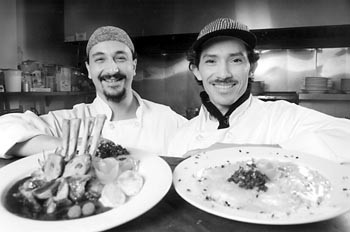
Platefuls of motherly love from Mom’s Apple Pies

By Marina Wolf

SLICES OF MOM’S Apple Pies are practically a fifth food group at the annual Harvest Fair, where “Mom,” aka Betty Carr, has been serving up flakey pieces of Americana for the past 12 years. Before Thanksgiving, more than a thousand of those juice-dribbled pies–baked in frenzied all-nighters with the help of her three adult sons and one hired assistant–will be boxed up and sold at 10 bucks a pop from their rambling roadside cafe on Highway 116 just south of Forestville.

Betty’s pies hold a place in the hearts and stomachs of residents countywide. But the owner of Mom’s Apple Pies still ducks her head like a little girl when talking about the word of mouth that has made her pastries a local institution.

“I don’t like to advertise and get people’s hopes up,” Carr says, her brown eyes twinkling. “If I ever don’t meet expectations, I’ll feel terrible.”

Seems odd for her to worry. As Mom, Carr has been baking and selling pies for almost 15 years. She freely admits that her husband, Harry Carr, who died in 1992, was the driving force behind Mom’s Apple Pies and the couple’s other projects, a Sebastopol egg farm, the Egg Basket store in Fulton, and Carr’s Drive-In in Forestville.

But Betty’s pies, with their simple fillings and tender crusts, put Mom’s on the map.

And it was Betty Carr’s city roots that kept them from migrating even further north, possibly all the way up to Oregon. “I didn’t want to be so far away from [San Francisco’s] Japantown. … I’m a city girl, I’m not really a country person,” says Carr, who had been born and raised in Nagoya, Japan, and had been living in Oakland at the time of her marriage.

But Carr adapted to life on the five-acre ranchette that they bought in the middle of the 500-acre Frei orchard in 1970. She recalls learning to drive stick-shift on an old pickup truck to get their farm’s eggs to a warehouse nine miles away in Santa Rosa’s Railroad Square. “Mr. O’Toole–well, now it’s Michael’s Garage–Mr. O’Toole could hear me grinding. ‘Oh, there goes Betty!’ ”

O’Toole, Frei, Walker … the familiar names of west county families are scattered through Carr’s reminiscences like butter in dough. Though many folks are still around, others are fading into street-sign obscurity. Carr notes each passing with a resigned shrug. She gets the dish from the farmers who come in and make their own coffee in the mornings, but of course she’s the first to notice when her sources get dug up for carefully wired rows of chardonnay.

Still, there are plenty of neighbors to help supplement the crop from the Gravenstein trees on Carr’s seven-acre property. Gravensteins aren’t good keepers–they turn mushy sooner than many other varieties–so it’s a good year when she can get cold-storage Gravensteins all the way through the winter holidays. Then Carr has to work with pippins or Granny Smiths from elsewhere.

This year the crop has been particularly limited owing to El Niño’s moist spring and also Carr’s switching over to organic growing methods on her own apple trees, which she says has improved the flavor but has substantially reduced the crop. “I will definitely be using fresh Gravensteinsthrough the Harvest Fair,” says Carr, “but after that it’s availability only.”

Truly the celebrated local apple makes an outstanding filling, with just enough inherent sweetness to minimize the need for added sugar. But whether there are Gravensteins or Grannies between them thar crusts, the fans come year-round. In response to popular demand, Carr is putting some Mom’s Apple Pies T-shirts in the dusty showcase out in the narrow hall. On the whole, however, she is not inclined to innovate.

She keeps the crooked little complex with its ancient trailer add-ons neat as a pin, and bakes her pies from the same recipes she learned in her home economics courses at a small Illinois college in the ’50s. She says nothing has changed, but deflects a request for baking hints. “Everybody has their own taste,” she demurs. “Some use more shortening, some more spice. But I really don’t do anything special.

“Well,” she pauses, “you shouldn’t handle the crust too much. It gets tough.”

The Harvest Fair on the weekend of Oct. 2-4 runs from 10 a.m. to 8 p.m. on Friday, and from 10 a.m. to 7 p.m. on Saturday and Sunday, at the Sonoma County Fairgrounds, 1350 Bennett Valley Road, in Santa Rosa. Admission is $5 for adults, $2 for kids ages 7-12 and, on Friday only, for seniors; kids under age 7 get in free. Discounts must be purchased by Oct. 1. 545-4203.

From the September 24-30, 1998 issue of the Sonoma County Independent.

© Metro Publishing Inc.
Chain Restaurants

0

Cheap Eats

By Marina Wolf

THERE’S A CERTAIN stigma attached to 24-hour restaurants–Denny’s, Lyon’s, International House of Pancakes–you know, where breakfast is served 24/7 and no matter what time of day you go in, one of the waitstaff has just got on the shift and hasn’t yet had to pick the tip out of a glass and therefore is fresh enough to be cheerful.

In spite of possessing such allurements, these establishments labor under a heavy burden of derision, for which I must claim some small share of responsibility. As someone who writes about food, I have never yet used my power to assert that sometimes organic, homecrafted, well-rounded meals are not the kind of food you need. I’m saying it now, and I speak from experience: There are times when only 24-hour-chain restaurant food will do.

When driving through Bend, Ore., for example, on your way to the Canadian border (never mind why), when it’s past the far edge of dinnertime and well into good-thing-you’re-not-sleeping-tonight-because- you’d-never-be-able-to-sleep-after-eating-this-late territory, you are not looking for a regular eatery, which all close, anyway, when the cows are in the barn.

No, you are looking for that brightly lit sign rotating 50 feet up over the freeway off-ramp.

When you go in, you can be secure in the knowledge that the food you’re gonna get is absolutely the same as that at any other all-night restaurant that you’ve ever been to. The soup of the day is the same degree of salty goodness, the pancakes are all the same size and thickness, the hamburgers are all dripping the same grease, down to hue and flavor when licked off your fingers, the steaks … well, the steaks you don’t want to spend too much time on.

I mean, you have to respect the limitations of the medium.

The key is never to have a meal appropriate to the actual time that you’re eating. At dinnertime, get a Grand Slam breakfast–two eggs, side of meat, short stack, and the appropriate beverages. It’s the cheapest dinner you can buy outside of a bag of microwave popcorn. A French dip sandwich, soggy with au jus, is perfect for when the rest of the world’s eating Wheaties. Of course, anything outside of standard meal hours (8 p.m. to 5 a.m.) is a wild card. When any meal of the day is more than five hours away, your biochemistry is screwed anyway, so go ahead and get the steak.

BUT ALL-NIGHT restaurants are more than reliable sources of comfort food: they’re vortexes of productivity and creative energy. I learned this at college when my roommates got too obnoxious and I took to studying at the IHOP. It was paradise: The lighting was bright, the smoking section was big, and the pots of coffee were bottomless.

Once I read Crime and Punishment there in a seven-hour, 30-cigarette marathon.

Over the course of several years, my friends and I came to know the people on the graveyard shift. They thought we were cute in a strung-out sort of way, and sometimes brought us sandwiches that had been made “by mistake,” but mostly we went through the night on coffee and water and an order of fries split five ways–we were poor students, salvaging our pride by pretending for hours that we weren’t ready to order yet.

We made up for it, though, at the beginning of the term, when shrunken pockets bulged with fresh installments of scholarship money. Giant plates covered the surface of the table and dripped gravy and syrup on our forgotten assignments. We ordered the overpriced glasses of orange juice and side orders of everything. If I was feeling particularly festive, I went for the corned beef hash, so intensely salty that it made my tongue curl. I ate it slowly, with many glasses of water, and scraped the plate clean.

Later in my adult life, after I started working at a high-stress, low-thrill job, a co-worker and I frequented a joint just down the street on Friday evenings. The warm starchy sandwiches and potatoes seemed to have a palliative effect. Or maybe it was simply that someone else would pick up the shrapnel of our despair.

Nowadays I have rediscovered the wisdom of my college years. Ensconced in the back corner booth at Lyon’s for hours at a time, I write, sucking on coffee that cools too fast, staring glassy-eyed at the fabric plants. The vinyl cushions press back reassuringly against my world-weary body, as I tap my spoon and smile absently at the young woman who refills my cup without asking. In an hour or two, after I’ve finished the rough draft, maybe I’ll get an order of fries (with a side of ranch) to celebrate. Crisply greasy, peppered and salted several times as I move through the pile, these fries are still enough to get me through the night.

From the September 17-23, 1998 issue of the Sonoma County Independent.

© Metro Publishing Inc.
Sonoma County Country Bands

0

Twangy Time!


Michael Amsler

Sonoma County hayride: Members of the new local band Twang–Sheila Groves, Steve Harder, and Charley Momey–mix dead-on bluegrass arrangements and deadpan lyrical humor.

Local acts hop on alt-country bandwagon

By Charles McDermid

BECAUSE Sonoma County is nearly as far from Nashville culturally as it is geographically, it may seem an unlikely place to observe an artistic shift in the world of country music. However, with such local bands as Cropduster, Clod-hopper, Twang, and the Feud, the alternative country movement, which is currently defying the creamy conventions of mainstream country, can be observed as close as one’s own backyard.

Labels abound for this inevitable reaction to the sanitized world of today’s pop-country: y’allternative, grange (as opposed to grunge), insurgent country, even No Depression, the name taken by a recently formed Seattle-based roots music magazine promoting “every kind of music but mainstream country.”

Whatever the term, it is clear that country music is in the process of rejuvenation, turning back and renewing itself at its source.

“Alt-country is getting more established as a viable subgenre. Initially we had to take people by the hand and explain what we were about,” says Rob Miller, president and co-founder of Bloodshot Records, a Chicago company specializing in such alt-country acts as the Waco Brothers and Split Lip Rayfield (a band that plays amphetamine-fast bluegrass using banjo, guitar, and a stand-up bass constructed from a Ford pickup truck gas tank and a single weedwhacker string). “Most of our bands exist as if Nashville hadn’t been around for the last 25 years.

“No one’s going to cite Ronnie Milsap as a stylistic influence.”

A glance at the stormy history of country music clearly anticipates the sneering opposition that alt-country now offers the country establishment. It’s the same diametric difference that existed between the first two recorded country artists in 1927: the Carter Family, the ultimate embodiment of rural, white, homespun values, and the “yodeling brakeman” Jimmie Rodgers, a rambling partier who lived hard and died young, lending greatly to the notion of country as “the white man’s blues.”

This division between the saccharine and the seedy led to the rebellion of the ’70s outlaw movement against the restrictive, increasingly pop-inflected Nashville Sound and is apparent today in the vast differences between the conservative, yet enormously profitable, world of mainstream country and the stylistically adventurous alt-country bands.

“I think [alt-country] is just people who like what country music is supposed to be,” says Danny Pearson of Sebastopol, the leader and founder of Clodhopper. “Real country was just singing songs for normal people–it’s centered around relationships and problems therein: drinking, joking, and such.”

Clodhopper, who recently opened for Emmylou Harris, titled their first album Red’s Recovery Room (My Own Planet) after receiving a certain inspiration from the dubious Cotati roadhouse of the same name. With an album review set to appear in an upcoming issue of GQ magazine, it not only bodes well for the band’s exposure, but marks the first time Red’s and GQ have ever been mentioned in the same breath.

“We’re not a cow-punk band, and we don’t play rockabilly,” explains Pearson. “We’re pretty much going for the balladry. Telling stories of life’s misadventures.”

This lyrical intent, coupled with Pearson’s claw-hammer banjo (“it’s the old-time mountain style–hillbilly hip-hop”) and a searing mandolin at times washed through a wah-wah pedal, makes Clodhopper an interesting, if elusive, addition to Sonoma County’s musical landscape.

Local favorite Cropduster provide nothing less than reverential treatment to the old honky-tonk style of Merle Haggard, Buck Owens, and the “cosmic American music” of Gram Parsons. “It was the stories in those old songs that attracted me,” explains vocalist/guitarist Andy Asp, whose own songs follow rightfully in the footsteps of the great honky-tonkers of the past, at once lamenting and celebrating the shady side of life.

Cropduster’s tightly harmonized sound and raucous live shows have built a loyal following. Their much anticipated debut CD, A Strange Sort of Prayer, set for release this fall from Petaluma’s Flying Harold label, should go a long way in determining the commercial viability of alt-country on the local market.

Interestingly, despite the obvious appreciation and aptitude for country music exhibited by both Cropduster and Clodhopper, neither band should expect any type of radio play from Sonoma County’s country radio stations anytime soon.

A representative at KFGY 92.9-FM (also known as Froggy), who wished to remain anonymous, states simply, “We play mainstream country; we don’t play alternative. We do all kinds of research, and research shows that people who enjoy country music will listen to our station. People like familiar artists. It’s the mainstream stuff that’s gotten us here. I really try not to argue with success.”

This is, of course, the correct business perspective. Fair enough: To mainstream country goes the money; alt-country takes the integrity. It’s inconceivable that these two camps ever wanted to share fans anyway.

“The country on the radio is mostly what I would call pop,” says local booking agent and singer Sheila Groves, whose new bluegrass band Twang features a mandolin, guitar, stand-up bass, frying pans, and a musical avocado (an inexplicable percussive device).

Twang plays traditional bluegrass (“We rehearse our butts off,” says banjo player Steve Kucera), the alternative angle being the engaging choice of unlikely cover material done bluegrass style.

“We do a whole TV-show medley–we start with ‘The Ballad of Jed Clampett’ and end with the theme from The Flintstones. We also cover Metallica and Motown stuff,” says Kucera. “We also do a disco medley and Ronnie Montrose’s ‘Bad Motor Scooter.’ It might not appeal to a purist. There is a certain mindset in bluegrass that the music is somewhat sacred and should not be touched. That’s great for them, but we have a broader appeal.

“We actually get into a banter with the audience. We work it into the show,” continues Kucera, whose own musical taste ranges from British ska to Japanese flutes. “A gimmick is fine, but what carries our group is the strong musicianship.”


Michael Amsler

Fresh crop: The Sonoma County band Cropduster has a new indie CD, A Strange Sort of Prayer, with a parcel of original songs inspired by classic country artists.

INDEED, the concept of “gimmickry” elicits a barrage from Bloodshot’s Miller. “I hate that mentality that you need a shtick to get noticed. That, to me, is the most offensive thing that gets thrown at us. If people cite or identify themselves with a gimmick and they’re making fun of it, it’s just ingenuous. There is a lot of jokey country out there that doesn’t understand what a dangerous thing this is.

“We’re not Goober and the Peas [an MCA recording act that performs Motown covers in a bluegrass style]–it’s inexcusable.”

If any band has a handle on this fine line it must certainly be the Feud. “A gimmick is something to grab the audience’s attention,” admits Feud member Paul Riley. “You have to have the talent to back it up.”

The music of the Santa Rosa-based Feud, who call themselves “rockabilly cowpunks,” provides a twist to the concept “you are everyone you ever met.” Accordingly, the Feud is every song they ever heard, and, needless to say, they’ve heard a great many (a belligerent take on Tammy Wynette’s “Stand by Your Man” is a frequent show closer).

Frankly, you’ve missed a definitive Santa Rosa experience if you’ve yet to see the Feud.

“The first goal of the band is to have fun,” explains Riley, “At this point our biggest influence in music right now is still beer. You know, the songs that beer taught us.”

From the September 17-23, 1998 issue of the Sonoma County Independent.

© Metro Publishing Inc.

Leslie Brody

War Stories

Red Star Sister takes a fresh look at a turbulent period.


‘Red Star Sister’ offers wry view of the ’60s

By Patrick Sullivan

THE STORY of the 1960s has been told so many times, in so many ways, that it has attained the cultural status of a fairy tale. Whatever the ideological stance or literary talent of the teller, the tale tends to be full of the same fantastic clichés: Either Richard Nixon or Abbie Hoffman winds up wearing the black pointy hat, commanding squads of nasty flying monkeys (with the face of Henry Kissinger), and cackling “I’ll get you, my pretty.” History flattens out like a pancake, and whatever insights (political or literary) the period has to offer are buried in simple-minded moralism and self-indulgence.

To its great credit, Red Star Sister (Hungry Mind Press; $16) avoids that trap by offering readers an astonishing amount of honest self-reflection.

Leslie Brody’s autobiographical account of coming of age in the vanguard of the ’60s counterculture covers a lot of ground: Brody was a high school anti-war activist in suburban Long Island, underwent paramilitary training with the radical White Panther Party (where she earned the moniker “Red Star Sister”), got her head bashed in by San Francisco cops, forged a career as an alternative journalist, and journeyed to the Paris Peace Talks in a quixotic effort to end the war by meeting with the Vietnamese delegation. She even found time to attend Woodstock.

Early on in this ambitious account, the author serves notice that she has no plans to handle her youthful self with kid gloves: “`Perhaps it was instructive that my goals were not unsimilar to those of a Miss America contestant whose sappy calls for ‘world peace’ were an embarrassing annual cliché. Miss America wanna-bes could smile thousand-watt smiles, but they were fuzzy on how to achieve peace for humanity. I suffered no such doubts.”

On the other hand, she’s not apologizing either. Her mistakes and misadventures are legion as she hopscotches across the country carrying her red suitcase and negotiating the cultural minefield of the turbulent decade. She joins a radical Ann Arbor commune and gets a bitter taste of conformity and group-think. She experiences firsthand the machismo and paranoia that were the toxic bproducts of the long war between U.S. leftist paramilitaries and the FBI.

But she never finds a good reason to endorse the conservative condemnation of her generation: “I’m sure brats abounded, as they do in every age. They disturb people with new scientific and political theories, compose symphonies, and write poetry of staggering beauty and vision. I admit brats can be annoying, but I’d always rather be on their side.”

The book renders many of Brody’s experiences in wonderfully vivid terms. Her account of participating in an anti-war demonstration and being beaten to a pulp by the police is hair-raising and provocative. The claustrophobia of her classrooms on Long Island is also conveyed with subtle power: The independent-minded little Jewish girl often provoked the wrath of disapproving WASPy teachers determined to hold back the ethnic tide.

Unfortunately, in other cases, the reader is left hanging, waiting for a denouement or explanation that never comes. Brody took LSD and lost her virginity while experiencing Woodstock, all in one fell swoop. Perhaps the whole thing was simply too intense to fully convey, but the author seems not even to try, content instead to sum up in a few flat details. In this, and a few other cases, her account simply leaves us wondering what the hell really happened.

On the whole, however, Red Star Sister takes care to keep the reader involved and interested in Brody’s tumultuous quest to find a good place to make her stand as an activist, poet, and free-thinker. Particularly compelling is the author’s slow evolution as a feminist in the very male world of the revolutionary counterculture. Brody is far from a knee-jerk male-basher, but her deft account of the prevailing sexism still at work at the dawn of modern feminism is priceless (and often very funny).

In the end, Brody–who now teaches at California’s University of the Redwoods–leaves us with an intriguing view of a fascinating period. With Red Star Sister, she has opened up her red suitcase of mementos just wide enough to give us a glimpse of a life lived with relentless determination, a good dose of foolhardiness, and a deep thirst for real meaning.

From the September 17-23, 1998 issue of the Sonoma County Independent.

© Metro Publishing Inc.

Talking Pictures

0

Dark Shadows

‘Touch of Evil’

By David Templeton

David Templeton takes interesting people to interesting movies in his ongoing quest for the ultimate post-film conversation. This time out, he treats award-winning mystery novelist Julie Smith to her first viewing of Orson Welles’ seminal crime thriller Touch of Evil.

Frankly, I’m shocked.

Touch of Evil, directed in 1958 by Orson Welles–starring Charlton Heston, Janet Leigh, Marlene Dietrich, and Welles himself–just might be the greatest B-movie mystery film ever made. Heston himself says so, and he knows a thing or two about B films.

Furthermore, at the risk of sounding like some nerdy regurgitator of fervent film-school vernacular, I could make the case that Welles’ seedy, black-and-white film noir classic stand as one of the seminal works of its kind, and that many of the film’s stylistic and structural innovations–reproduced so often since then that they are now considered cliché–influenced a generation of filmmakers, including Alfred Hitchcock–who appears to have borrowed whole pieces of Evil for his own 1960 masterpiece, Psycho.

So it is shocking, in light of the film’s far-reaching influence and renown, that Julie Smith has never seen it. Julie Smith, ranked as one of the best living writers of popular mystery fiction–with over a dozen novels to her name and a closet full of awards–has never seen Touch of Evil.

“I haven’t,” she laughs, cringing in mock shame. “I confess! I really don’t know how I missed it.”

“Well,” I reply, pushing PLAY on the VCR, “We’ll just have to take care of that for you.”

The New Orleans-based author–a former Bay Area resident and one-time star reporter for the San Francisco Chronicle–is revisiting her old stomping grounds for a few days, maneuvering through a series of readings and book signings. Her latest novel is 82 Desire (Fawcett, $24.00), the eighth to feature resourceful New Orleans police detective Skip Landon (the first, New Orleans Mourning, won an Edgar Award for best mystery novel); like the preceding Skip Langdon mysteries, 82 Desire puts Smith’s hard-boiled heroine in the midst of a case that unfolds gradually, in the time-honored tradition of a big old onion, to reveal ever-deepening (and ever-surprising) levels of malevolence and deceit.

Sort of like Touch of Evil.

In the film, a stalwart Mexican police official named Vargas (Heston), while on honeymoon with his American wife (Leigh), witnesses a car bombing at the Mexican/American border. Arriving on the scene is the charmingly repellent Detective Quinlan (Welles, in the best performance of his career), a local hero with a perfect professional record; for every case Quinlan has investigated, he’s never failed to find the culprit. Ever. Vargas soon discovers why, as Quinlan develops into one of cinema’s greatest screen villains, a self-loathing Bad Man of monumentally vile proportions.

Much ballyhooed of late, Touch of Evil–wrested away from Welles after principal filming and edited without Welles’ supervision–has now been restored by Oscar-winning film and sound editor Walter Murch, who re-edited the film according to a 58-page memo that Welles composed after seeing what the studio had done to his movie. In the memo, Welles conveyed hundreds of changes–some obvious, most very subtle–and all of them have been followed by Murch.

It is this new-and-improved version that Smith and I had expected to see today. Unfortunately, upon arriving at the secret downtown screening room where the film was to be unveiled–in advance of its public release–we learned that only half of the film’s reels have arrived, resulting in the cancellation of the screening.

“What do we do now?” Smith asks, brightly.

An hour later–after borrowing the uptown apartment of a friend’s friend, having stopped at a nearby video store to pick up a copy of the movie, in its original form–we are finally back in business. As long as the VCR works.

“I have to admit,” Julie Smith appreciatively nods, as the credits roll over Henry Mancini’s ominous jazz-tinged score, “that it was pretty darn noir.”

“It’s still kind of a jolt,” I mention, in reference to the film’s more “out there” elements: the abrupt, upside-down presentation of a strangled corpse; a nightmarish “reefer madness” scene with crazed dope fiends and leather-clad, greasy-haired “dyke” caricatures lurching about threateningly while torturous rock music blares away; the loony, hymn-singing motel clerk (Dennis Weaver, of all people!).

“I was never bored, that’s for sure,” Smith grins. “But what a dark movie. And what a great character!”

“Quinlan?” I assume.

“Quinlan,” she nods. “He’s really the one you end up interested in. Not an unrealistic portrayal of a cop, either.”

“Average cops aren’t out there fabricating evidence right and left,” I reply. “Or are they?”

“Oh, I think some cops do that, sure. Real cops will fabricate evidence,” she affirms. “And yeah–they do it because they believe it’s the right thing to do. They believe the end justifies the means. So Quinlan is probably a pretty realistic character.”

For several minutes, our conversation skitters about. We touch on several other crime movies, ending with the mention of Quentin Tarantino’s Pulp Fiction. That film–which Smith has seen several times–is “a study on the banality of evil.”

“I mean banality as in run-of-the-mill ordinariness,” she explains. “And yeah, to me evil is extremely banal,” she says. “Evil is two guys talking about cheeseburgers on their way to blow someone away.

“I have this theory,” she continues. “The detective story, on the whole, is about ‘mean streets,’ right? Anything can happen on the street. That’s where the evil is enacted. But where evil begins is in the ‘mean rooms.’ I’m talking about the places where child abuse takes place, certainly. But also I mean just plain everyday nastiness. The kind of tiny workplace evil that builds up until a mailman suddenly goes postal.

“We expect Evil to look really ugly,” she softly summarizes. “But more often it looks just like …” She pauses.

“Me and you?” I suggest.

“Well, I suppose we are capable of evil,” she laughs, shrugging. “Those seeds are in all of us. But my point here is that evil can look very ordinary. Imagine a drug trafficker sitting down for Sunday dinner, or sending his kids off to school while talking on the phone about the latest shipment. Quinlan is a good example of what I’m talking about. He looks like a law enforcement officer going about his routine business.

“But behind the closed doors, he’s committing monstrous acts of evil. He’s Evil, disguised as Good,” she says. “And evil–when it needs to–can be very, very, very good. More often than not, you never even know it’s there.”

Web extra to the September 17-23, 1998 issue of the Sonoma County Independent.

© Metro Publishing Inc.

Highway 101 Traffic

0

Big Spender


Michael Amsler

Morning grind: Anyone forced to sit in the local commuter snarl on Highway 101 hopes that the proposed Calthorpe plan will fix the mess. Of course, some have their doubts. What would you do with a $780 million fix-it kit?

Say someone hands you the delicate future of Hwy. 101 and $780 million …

By Janet Wells

WE ALL KNOW what the Sonoma County Board of Supervisors, along with a consortium of political and environmental mucky-mucks, propose as the solution to Highway 101 traffic: Tax ourselves to the tune of $780 million over 20 years, and spend it on new lanes for the highway, passenger rail service, and bike lanes.

Seems like a logical, something-for-everyone plan, right?

But, really, who’s going to add 45 minutes to their commute by taking the train? Who’s going to put up with biking to work and arriving all sweaty and tired? And who for a minute imagines that one more lane in each direction is actually going to alleviate the traffic mess?

Consensus, while a solid democratic theory, often results in a mediocre solution based on the lowest common denominator. But what if compromise wasn’t necessary? What if off-beat, less-than-politically-correct ideas suddenly were welcomed as “visionary” and “creative”? Just imagine. Go ahead and fantasize: the anti-gas tax.

And forget public transit. It sounds so civilized and modern and clean, but no one’s ever going to use it (one public opinion poll showed that while more than half of local voters support the concept of a passenger rail line, only 14 percent say they’ll actually use it)–unless they’ve got real incentive.

How’s this for a motivator? Pay people not to drive. We subsidize farmers and corporations, why not ourselves? Here’s how it works: In November, we approve the new sales tax, along with a slightly modified advisory measure to earmark the money for Sonoma County DUH (Driving Unnecessary Here). An electronic device that attaches to your car records every day that the car isn’t started. At the end of the month, everyone with a registered vehicle goes down to the DUH office and picks up their share of the fund.

Saves the environment, and with $780 million to distribute, the plan provides extra income for drivers keeping the county’s 346,763 motor vehicles off the roads. Suddenly buses and trains are wildly popular because we’re getting paid to use them.

DUH!

We’ll even give the interest accrued in the account to the county for Russian River cleanup, playing fields, bike lanes, and other green endeavors.

Downside: dramatically decreased sightings of “Mean People Suck” bumper stickers.

SUV Lanes

WHY BOTHER building new lanes when every other car on the road is a sports utility vehicle? These poorly reined-in vehicles have no place in the Bay Area to really strut their stuff, and it’s so sad to see SUV owners desperately clinging to their fading youth by buying $40,000 4-wheel -drive gas guzzlers to foray to the office and ferry the kids and groceries through the wilds of Sonoma County.

So, SUV drivers, why not give yourself a big adrenalin rush? Test those motor reflexes and see if your clearance really is high enough, all the while doing errands. Consider this transit solution: If you’re in an SUV on the highway, you must drive on the unpaved left-hand shoulder, negotiating gravel, large chunks of disabled tires, metal, and garbage, precarious shoulder drop-offs, and those really pesky places where the shoulder meets an overpass railing.

The tax will go toward erecting a barrier to keep the SUVs in their adventure-fraught lane and force SUV manufacturers to comply with clean-air and safety standards so everyone else can breathe easier.

Downside: Urban SUVing becomes wildly popular, and the powerful new SUV lobby is successful in pushing through a program to remove all highway pavement, creating off-road-only thoroughfares.

Transit tax could stall in courts.

Choo-Choo Goes the Bus

“PAVE THE RAILROAD tracks,” an idea first proposed for Northern California in the late 1980s and bandied around by some bold Golden Gate Transit District directors, was resurrected by Windsor physicist Carl Mears as his solution to ever-increasing gridlock:

“Use the tracks as an expressway for buses,” he says. “The problem with rail is that there’s no way to get from the station to where you want to go.”

The new tax provides funds to pave the track–already owned by the Golden Gate Transit District in partnership with North Coast counties–from Willits to Larkspur Landing. The new Northern California Busway would provide a traffic-free express ride unhampered by inefficient car-pool lanes.

When the bus gets to a town, it simply hangs a left or right and takes passengers to a central spot.

While the North Coast Rail Authority might squawk at losing contracts to run freight on the woefully underutilized line, eminent domain has its time and place.

As Mears says, “When was the last time you saw a train on those tracks anyway? It’s time to put that resource to better use.”

Downside: The Busway Beanie Baby–free with every full-fare “alltheway” ticket from Santa Rosa to the Bay–becomes such a sought-after commodity that schoolchildren cut class in record numbers.

Mass-Transit Mania

“FORGET SPENDING money on the freeway–there are never going to be enough lanes,” says Santa Rosa artist Steve Keller. “I’d make mass transit feasible.”

To really do the job right, Keller would reroute Highway 101 around Santa Rosa to unite Railroad Square and downtown, and eliminate half of the city’s bus stops to speed up travel time (“Make people walk the extra three blocks”).

Then Keller would go wild with bike lanes. By all rights, Sonoma County should be a bicycling haven: gentle rolling hills, wide streets, great weather. Yet cyclists often encounter drivers who seem unable to grasp the concept of sharing road space.

“Seven hundred and eighty million dollars’ worth of bike lanes,” Keller mused. “That would build a helluva system.”

Downside: Bike helmets become a hot consumer item, causing violent outbreaks over Nike’s $475 “Air Brain Bucket” model.

FASTrain

GRATON RESIDENT Ian Riedel would spend his $780 million on the Forget Automobiles Speed Train system down the center of the freeway corridor.

“It would be visible to all motorists stuck in traffic, with obvious signs informing them how much faster they would get to where they want to go on the train,” Riedel says. In addition, he would build toll booths all the way down Highway 101, with electronic meters to register at what time and how often the vehicle passes through.

“The highest users would have to pay much higher vehicle registration fees, which would go toward subsidizing the train.” Oh, and one more thing, adds Riedel, who commutes on his 1975 Honda 400/4 motorcycle: space on the train for cycles–both manual and motorized–as well as fare discounts.

“You roll your cycle up a ramp, lock the front wheel, go to the dining car, and roll your bike off when you get to your destination.”

Downside: Sonoma County drivers, suffering from addiction to their cars, file a class-action lawsuit against the county, citing egregious daily pain and distress from being trapped in gridlock while the train zooms by with a merry whistle.

Supported by the ACLU, drivers win $780 million in damages.

From the September 17-23, 1998 issue of the Sonoma County Independent.

© Metro Publishing Inc.

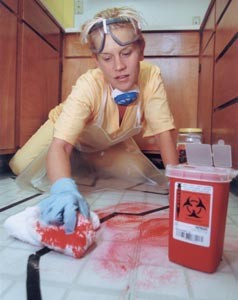
Helen Caldicott

Bombs AwayDavid Young/Carolyn JohnsAnti-nuke activist Helen Caldicott is back By Dylan BennettAUSTRALIAN pediatrician Helen Caldicott says she is not a Christian, but speaking with her you find yourself muttering words like "Jesus" and "God." That's because she's talking about Armageddon. No, not the blockbuster summer movie about asteroids from space, but the man-made reality of nuclear war and the...

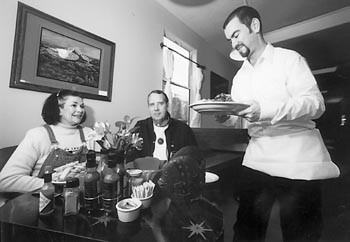
Eric Bentley

Center Stage Music man: Bentley brings his cabaret act to Sonoma State on Sept. 29. Author Eric Bentley still shaping theater By Patrick Sullivan FOR SOME FIVE decades, Eric Bentley has been a major force in the world of American theater. His criticism in The New Republic in the 1950s cut the...

Transit Tax

Green Daze Michael Amsler Environmentalists split over transit tax measures By Janet Wells IF DIVIDE-and-conquer is one strategy of victory, Sonoma County's pro-development community might benefit greatly from a split in the environmental community over November ballot measures to raise $811 million in sales taxes for local highway expansion and public...

Talking Pictures

Film Fight Simon Birch. Author Marianne Wiggins takes on the 'Simon'-izing of 'Owen Meany' By David Templeton David Templeton takes interesting people to interesting movies in his ongoing quest for the ultimate post-film conversation. This time out, Templeton inadvertently sparks a moral crisis for esteemed British author Marianne Wiggins when he invites her...

Betty Carr’s Apple Pies

Spice Girl Michael Amsler Platefuls of motherly love from Mom's Apple Pies By Marina Wolf SLICES OF MOM'S Apple Pies are practically a fifth food group at the annual Harvest Fair, where "Mom," aka Betty Carr, has been serving up flakey pieces of Americana for the past 12 years. Before Thanksgiving,...

Chain Restaurants

Cheap EatsBy Marina WolfTHERE'S A CERTAIN stigma attached to 24-hour restaurants--Denny's, Lyon's, International House of Pancakes--you know, where breakfast is served 24/7 and no matter what time of day you go in, one of the waitstaff has just got on the shift and hasn't yet had to pick the tip out of a glass and therefore is fresh enough...

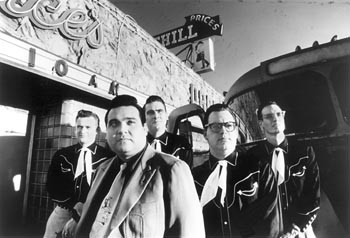
Sonoma County Country Bands

Twangy Time!Michael AmslerSonoma County hayride: Members of the new local band Twang--Sheila Groves, Steve Harder, and Charley Momey--mix dead-on bluegrass arrangements and deadpan lyrical humor. Local acts hop on alt-country bandwagonBy Charles McDermidBECAUSE Sonoma County is nearly as far from Nashville culturally as it is geographically, it may seem an unlikely place to observe an artistic shift in the...

Leslie Brody

War StoriesRed Star Sister takes a fresh look at a turbulent period.'Red Star Sister' offers wry view of the '60s By Patrick SullivanTHE STORY of the 1960s has been told so many times, in so many ways, that it has attained the cultural status of a fairy tale. Whatever the ideological stance or literary talent of the teller, the...

Talking Pictures

Dark Shadows'Touch of Evil'By David TempletonDavid Templeton takes interesting people to interesting movies in his ongoing quest for the ultimate post-film conversation. This time out, he treats award-winning mystery novelist Julie Smith to her first viewing of Orson Welles' seminal crime thriller Touch of Evil.Frankly, I'm shocked.Touch of Evil, directed in 1958 by Orson Welles--starring Charlton Heston, Janet...

Highway 101 Traffic

Big SpenderMichael AmslerMorning grind: Anyone forced to sit in the local commuter snarl on Highway 101 hopes that the proposed Calthorpe plan will fix the mess. Of course, some have their doubts. What would you do with a $780 million fix-it kit?Say someone hands you the delicate future of Hwy. 101 and $780 million ...By Janet WellsWE ALL KNOW what...
11,084FansLike
4,606FollowersFollow
6,928FollowersFollow