‘High Fidelity’

0

Author Bret Easton Ellis on guilty pleasures, illogical musical tastes, and the provocative film ‘High Fidelity.’

Writer David Templeton takes interesting people to interesting movies in his ongoing quest for the ultimate post-film conversation. This is not a review; rather, it’s a freewheeling, tangential discussion of art, alternative ideas, and popular culture.

“I never understood why some magazines do those annual ‘Guilty Pleasure’ lists,” says author Bret Easton Ellis, speaking by phone from his parent’s den in sunny Los Angeles. “You know the kind of list I mean? The one where some filmmaker or critic writes about all the movies he thinks of as ‘guilty pleasures?’

“Well, I never understood what that meant,” confesses Ellis, who’s visiting from New York. “I mean, why would pleasure be guilty? And why would you have a list of movies or songs that you think you should feel guilty about liking?

“Hey, if you liked it, you liked it.”

It is mid-afternoon, and Ellis–the controversy-causing author of Less Than Zero, American Psycho, and the recent Glamorama–has just returned from a matinee screening of High Fidelity, the critically-acclaimed film starring John Cusack.

Based on the best-selling book by British writer Nick Hornby, High Fidelity follows a callow, selfish, music-obsessed record store owner (Cusack). The main character is a not-quite-grown-up guy who is undergoing an extended psychological melt-down triggered by the unceremonious exit of his gorgeous girlfriend–she being the latest in a long string of humiliating romantic debacles.

Ellis liked High Fidelity–and he’s not ashamed to say so.

“Though I thought it would have been a stronger movie if it hadn’t had such a happy ending,” he admits. “But of course, this is Bret Easton Ellis speaking.”

Anyone who’s read the ultra-harsh American Psycho–or the sharp, fashion-world mayhem of Glamorama, for that matter–must know what he means.

Often deeply cynical, Ellis’ books aren’t likely to inspire a wave of rampant optimism among their readers. Even the relatively tame new movie-version of American Psycho, significantly less upsetting than the book, has added to Ellis reputation as a guy who doesn’t mind bumming people out. On the other hand, since the release of Less Than Zero in the late 1980s, Easton has not lacked for eager readers, so he’s clearly not alone in his views.

He even ends up on an awful lot of those ‘Guilty Pleasure’ lists.

And speaking of lists, the characters in High Fidelity are fairly obsessed with them. At the drop of a hat, Cusack and friends–specifically the acerbic, smart-ass record store clerk played by singer Jack Black–will invent a list of their five most degrading break-ups, or their five worst jobs, or the five top songs about death or rain or policemen or cowboys or just about anything.

“And what was sort of refreshing about the movie,” observes Ellis, “was its unapologetic elitist attitude about those songs, in terms of not caring if the audience knew a lot of these musical groups. It was cool that it didn’t pander to the lowest common denominator, that it stayed smart. These guys knew what they liked, and didn’t apologize for it.”

“On the other hand,” I point out, ‘They were disgusting snobs. They terrorized anyone with different musical tastes.”

“Exactly,” Ellis replies. “That’s the point. They were trying to be intellectual about something you can’t be intellectual about. And they learn that.

“We all have these intellectual notions and attitudes about music, all the things we learn from reading about music, the way we shape our own tastes and the way we want to present ourselves to the world–in terms of saying, ‘I really like this and this and this, and I don’t like that’–yet at heart, we really do react to music emotionally,” he continues. “We don’t react to it intellectually. The albums we might admire a lot are not necessarily the albums that we play the most, or the songs that mean the most to us.

“When you’re that age, and you’re of a certain class, there’s a part of you that is displaying yourself, that wants people to approve of you because of your cultural preferences. But really, at heart, the things that make you who you are the things you connect with on an emotional level, the things that matter the most to your heart and not your head.”

He pauses a moment.

“I know that, coming from Bret Easton Ellis, this must sound kind of sappy,” he allows. “But I do think it’s true. And I think that’s basically what High Fidelity is all about.

“It’s about growing up and accepting that who you are . . . is who you are.”

Who Bret Easton Ellis is, in terms of favorite movies, is a guy who especially loves The Phantom of the Paradise. The Paul Williams movie. From the seventies.

“Exactly,” he affirms. “I have to watch that movie at least once a year. I also own the soundtrack. Yet I know there are very few people who would put it anywhere near their top ten. What are your favorites?”

Well, since were sharing so openly, I deign to list my favorite movies, one of which–also from the seventies–is, um, Barbara Streisand’s A Star is Born.

“Really? Wow. Have you seen it recently?” Ellis asks. “It’s one of the worst movies ever made.”

“I know,” I reply. “I must have responded to it emotionally.”

He pauses. Perhaps he’s re-thinking his whole there’s-no-such-thing-as-a-guilty-pleasure argument.

“Well, that is totally valid,” he finally allows. “That’s why art is democratic. There isn’t a list of rules we have to follow in order to respond to something. It’s different for everyone. We respond the way we respond.”

Web extra to the April 27-May 3, 2000 issue of the Sonoma County Independent.

© Metro Publishing Inc.

‘Beautiful People’

0

Beautiful People, a new film by Jasmin Dizdar.

Crowd Scene

‘Beautiful People’ paints a rich portrait of a group of Bosnian refugees

By Nicole McEwan

“WAR IS LIKE LOVE,” wrote Bertolt Brecht. “It always finds a way.” But somehow the survivors endure–even prosper–just beyond its shadow, suggests Jasmin Dizdar in Beautiful People, his kaleidoscopic portrait of a group of Bosnian refugees trying to make sense of their new lives in London, circa 1993.

They’re strangers in a strange land, and their sense of wonder and confusion is succinctly captured in a film that applies comedy like a salve and accepts the deepest absurdities as routine occurrences. From its opening, in which two passengers brawl on a packed city bus, to the scene in which a naive housewife discovers heroin in her son’s jeans, takes a sniff, and proceeds hanging laundry, stoned out of mind, the film creates a tableau of wildly intersecting lives in which anything can happen, and does.

Drawing on a huge cast of characters, the former Yugoslavian writer/director takes on the human condition and the way synchronicity sometimes creates order out of chaos. It’s a style of storytelling commonly associated with Robert Altman, although Dizdar’s vision is not quite as sprawling and considerably shorter, at a mere 107 minutes. The result is a film that leaves you wanting more.

As it turns out, the transit hooligans were former neighbors in Bosnia, one a Serb, the other a Croat. Their passion-driven fisticuffs lands them both in the hospital–in the same room. Beside them, a sour-tempered Welsh anarchist stews in his own political agenda.

Angered by the bourgeois gentrification of his poor, yet picturesque village, the anarchist had attempted to firebomb some luxury vacation homes–the one plot that literally blew up in his face. Now his task is to keep his irrational roommates from killing each other–a pointed reference to the way war is more a state of mind than a point on a map.

The film’s other characters include the black-sheep daughter of a politician, her penniless ex-Yugoslavian beau, a BBC reporter whose latest trip to Bosnia brings on a spectacular nervous breakdown, and a harried OB/gyn (and father of twins) in the throes of a nasty divorce. The relative insignificance of Dr. Mouldy’s marital turmoil comes into sharp focus when he meets a young refugee couple who beg him to kill the baby he is about to deliver–a child conceived of rape.

Whimsical, tragic, but ultimately hopeful, Beautiful People is an intelligent, though flawed look at life after wartime. Particularly clunky is the too-rapid redemption of some fairly unredeemable characters in the film’s final moments–a regrettable dip into blatant sentimentality. Still, Dizdar is first-person-familiar with the material’s emotional landscape, so it’s hard to fault him for celebrating survival. Dr. Mouldy sums things up nicely in the film’s final line: “If life changes just a little bit in your favor, it can be so beautiful.” Lying in a cradle nearby is a cheerfully gurgling infant. Her name: “Chaos.”

From the April 27-May 3, 2000 issue of the Sonoma County Independent.

© Metro Publishing Inc.
Homemade Bread

0

Eager home bakers learn from bread champion

By Marina Wolf

HOMEMADE BREAD, in this country at least, is spoken of in almost spiritual tones. Oh, the feel, the smell, the whole rapturous process. But sit for a few hours under the tutelage of champion baker Craig Ponsford and you’ll be trading your touchy-feely tune for a calculator and a good electronic scale.

Not that the baker-in-chief at Artisan Bakery in Sonoma isn’t entirely devoted to bread. He earned first place in bread bakery at the Coupe du Monde in 1996 and coached the gold medal-winning American team at the International Baking Olympics in 1999. His reverence for bread is quiet, almost subliminal. What stands out is his utter faith in the science of baking.

This attitude can be a shock for students who attend his baking classes, such as the one held two weeks ago at Ramekins Sonoma Valley Culinary School. Ponsford’s weekend “clinic” is less about research than it is about detox and rehab: home bakers have to let go of baking habits that have sustained them for so long.

The class opens with a half-inch-thick packet and a barrage of timing and temperature: room temperatures, water temperatures, friction temperatures (the heat added to the dough during the mixing process).

This turns out to be the easy bit.

Ponsford then launches into Baker’s Percentages, the formulas for bread recipes that are based on the weight of the flour, with all other ingredients noted as percentages of the flour weight. This weekend’s loaves will have 70 percent hydration, that is, water is 70 percent of the flour weight. Salt is 2 percent, yeast is 1 percent. (Calculations must include the weights of ingredients in the pre-ferment, or starter.) Flour, water, salt, and yeast are all that ever go into a French loaf, but the variations and fluctuations in the formula are endless.

At this point, most class members are staring at the white board in some dismay. Though the muttering is indistinct, the meaning is clear: What do all these numbers have to do with bread?

It’s a good moment to move from theory to practice, and Ponsford moves to one of the work stations to weigh pre-ferment, flour, water, and salt into the mixer bowl. His mixers at Artisan handle 500 pounds of dough at a time; this one protests at five pounds, even when Ponsford carefully jacks the bowl up and down to more evenly mix the dough. Still, it takes only a minute or two before the dough is placed in a bowl, sealed in plastic wrap, and set aside to rise.

Now the home bakers eagerly huddle around their work stations, looking like high-school science students in their white aprons and with their smudged notebooks. Some have come from as far away as Oregon and Massachusetts to stare intently into the grinding maws of the mixers.

They don’t want to miss a thing.

AFTER THE DOUGHS have been set out for rising and the students take a quick break for lunch, Ponsford moves on to the much-anticipated critique session of the breads that the students were asked to bring to class. He starts with a soft-crusted French loaf, squeezes and hefts it with practiced fingers, then holds it to his nose, looking for all the world like some kind of bread psychic.

“Our doughs today were wetter than you’re used to, huh?” he asks, raising his eyebrows at the woman who brought the loaf. She nods–yes, a lot.

The pale bottom indicates insufficient heat from the stone. A pizza stone is the culprit, and Ponsford shakes his head sadly–it just isn’t thick enough to retain heat when the cooler loaf of bread hits it. Ponsford cuts open the loaf to reveal a very dense crumb, a very fine pattern of airholes that some people like, but are death to the classic definition of French bread. A dry dough like this means the dough is less elastic and can’t expand to accommodate the yeasty gases. “Don’t be afraid of wet,” he says, not for the last time today. The woman nods seriously, taking notes all the while.

Ponsford moves on to the other loaves, which range from a rustic ciabatta, whose charming crust hides streaks of unblended flour, to a stubby, anemic-looking baguette that he half-jokes about breaking the bread knife on. As he makes his way through the heap of hopefuls, Ponsford keeps asking the bakers about the recipes. They either don’t remember or they give him measurements in cups. “I can’t tell you what’s going on with these breads,” he says, setting aside a brick-shaped whole-grain loaf.

“I need to see the percentages.”

It’s the end of day one, and by this time most of the students’ doughs have overrisen, but no one objects to a quick shaping lesson before class adjourns. The dough is floating and soft as a cloud, but Ponsford merely folds it gently to increase its body. “I’ve never punched a loaf of bread in my life,” he says, deftly turning the dough mass and cutting pieces away for shaping.

“Punching is from a tradition of building up bread to handle machinery. It makes a strong dough, but it’s too tight for the gases to do their work properly.”

He quickly models batards and baguettes, his hand and thumb moving as fast as a sidewalk magician’s. “Don’t worry,” he says to the bakers crowding around him to stare at his hands. “Tomorrow at the bakery, you’re each going to have the chance to shape at least 10 or 15 loaves of bread.”

After class, Ponsford admits that it’s probably not fair to have them bring in their bread on the first day. “They’re bringing in everything that I trashed earlier,” he says, stretching his flour-dusted work boots in front of him. “But I don’t feel bad about knocking them a little bit, because if they listened to anything I said, they’ll have 100 percent improvement the very next time they bake bread.”

PONSFORD’S confidence is borne out the next day, when the students take their loaves out of the commercial-sized ovens at Artisan Bakery. They had arrived at the bakery at 7 a.m.–a lucky few had to get up at 1 a.m. to feed the pre-ferment.

Now, just before lunch, the fruits of their labor are coming out of the oven, golden and beautiful. Ponsford cuts open a few loaves, cautioning against making a quick judgment–“You have to taste it cold. Even Pillsbury dough tastes great to me out of the oven”–but the effects are apparent immediately, in the sturdier crust, the larger holes. There is some variation, of course, with four fermentation processes and 14 pairs of hands, but the improvement is easily 100 percent.

Over lunch, the students are tired, but enthusiastic about the results. Harvey, a civil engineer from Walnut Creek, says he was most impressed by the weighing of ingredients. Before, he used cups, and the results varied so much. “There was no precision, no real understanding of why I was doing it.”

Cindy, a homemaker from Sonoma, agrees. Though she’ll continue to use her whole grains and honey, any technique is an improvement. “You can read a book a thousand times, but you won’t understand what tacky or shaggy is,” she says, chewing tiredly on a cold piece of pizza. “There’s nothing like watching a baker do his stuff.”

From the April 27-May 3, 2000 issue of the Sonoma County Independent.

© Metro Publishing Inc.
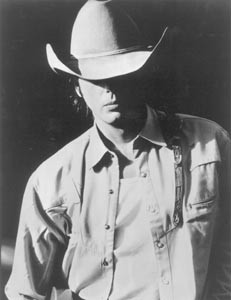
John Scofield

0

Funkified: John Scofield is one of the big three of contemporary jazz guitar greats.

Blue Notes

John Scofield–reluctant guitar hero– performs at the Mystic Theatre

By Greg Cahill

HE’S HEARD IT all before. John Scofield draws a deep breath and patiently answers yet another inquiry about his role in the oft-maligned jazz fusion realm. “I come from a time when there wasn’t a generic way to play fusion,” explains the former Miles Davis sideman. “I always liked rock and blues and funk, and jazz was something I studied my whole life and wanted to get into. Before I knew it, I was in fusion bands. But I hadn’t learned to play by listening to those kinds of bands. So I came up with my own version of it.

“You know, I’m a bebopper who rocks.”

And who knows how to strut some decidedly soulful funk.

Scofield’s most recent CD, Bump (Verve), is a contagious collection of 12 original instrumental funk-driven grooves that features members of the New England jam band Deep Banana Blackout and bassist Chris Wood of Medeski, Martin, and Wood.

It’s easy to see why Cashbox magazine once hailed Scofield’s hazy blue guitar style–he’s considered, along with Pat Metheny and Bill Frisell, part of the holy trinity of contemporary jazz guitarists–as “the missing link between mainstream and fusion guitaring.”

This visionary with six steel strings–the most imitated jazz guitarist alive–continues to eschew musical clichés and avoid the pitfalls that plague less imaginative players, as is evident in on his brilliant interpretation of “Coral” on the newly released tribute CD As Long As You’re Living Yours: The Music of Keith Jarrett (RCA). That track reinforces Scofield’s reputation as a fine balladeer, a notion underscored by 1991’s lyrical waltz “Time on My Hands” and 1996’s mostly acoustic Quiet.

In fact, Scofield, 48, is a skillful jazz improviser who consistently displays a level of inventiveness that most can only dream about.

The new CD is the follow-up to the uneven 1997 Medeski, Martin, and Wood collaboration, A Go Go (Blue Note), which failed to gel musically. This time out, Scofield knew exactly what he wanted and how to get it. “I wanted to do a record of my tunes in the groove area, rather than straight-ahead jazz,” says Scofield. “I wanted even more of a funk feel than I’d gotten before.”

Although having a 12-year-old son and a college-age daughter helps him keep his ears open to new sounds, it’s his own philosophical flexibility and musical agility that enable him to move from a session like Bump to an upcoming recording with drummer Billy Higgins, post-bop saxophonist Kenny Garrett, bassist Christian McBride, and pianist Brad Mehdau. Or to jam with Southern rockers Govt. Mule. Or to sit in with ex-Meters bassist George Porter Jr., drummer Zigaboo Modeliste, and the Dirty Dozen Brass Band horns.

“I guess I’ve had a pretty good look at some really great players,” Scofield says. “The soulfulness of your music goes up when you play with musicians at that level. It’s what makes jazz more real, more spiritual, and more of a celebration. They bring out what I thought jazz was all about to begin with–this great spontaneity where the whole becomes greater than the sum of the parts.

“That’s what I’m going for–keeping that tradition alive.”

OF COURSE, Scofield has had plenty of time to learn from the masters. The Ohio-born and Connecticut-bred guitarist has recorded or toured with such jazz giants as Kansas City pianist and bandleader Jay McShann, the late Charles Mingus (3 or 4 Shades of Blue), drummer and bandleader Billy Cobham (Life and Times, Funky Thide of Things), and, from 1982 to 1985, Miles Davis (Decoy, Star People, You’re under Arrest, Siesta).

“A lot of those guys were my favorite musicians when I was growing up,” Scofield explains. “You know, I just loved their records as a kid. And to play with them and observe them just humanized the music and made me see that it’s possible to do various things with music, achieve certain sounds.

“And it just made me stronger.”

As a prolific solo artist, Scofield has steered clear of the fastest-gun syndrome that has infected the fusion genre. “Yeah, well . . . ah, there are a lot of people who have rejected that,” he says, shrugging off the notion that he is a reluctant guitar hero.

“For me, it was never really much of a question. I like pure music, and all the people I admire do not rely on histrionics, although I do like Chuck Berry,” he adds with a laugh. “But the whole heavy-metal mentality never got to me at all.”

Instead, it’s “the honesty of the statement” that matters most.

“I’m just a guy playing a real story,” he concludes. “It’s so hard to play music, and there is so much involved that anybody who takes the time to showboat is almost ruled out in my book because I know how much it takes just to play.

“As soon as it becomes like show business, it becomes less interesting. One of the good things about jazz is that it’s not Hollywood–and that’s why I like it.”

The John Scofield Band, plus Las Macosas, performs Thursday, April 27, at 8:30 p.m. Mystic Theatre, 21 Petaluma Blvd. N., Petaluma. Tickets are $18 and $20. 765-6665.

From the April 20-26, 2000 issue of the Sonoma County Independent.

© Metro Publishing Inc.
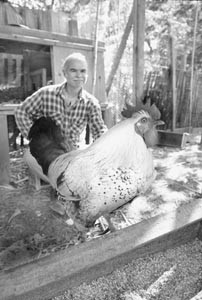
Huey Johnson

0

Photograph by Michael Amsler

Man with a (Green) Plan

Conservationist Huey Johnson knows how to save the planet

By Stephanie Hiller

FORGET ALL THAT doom and gloom about the destruction of the environment. Government and business may not be doing things sustainably yet, says conservationist Huey Johnson, 67, former state environmental czar under the Brown administration, “but they will.” Why? Because they’ll have to, he says.

As director of the Resource Renewal Institute in San Francisco, Johnson travels around the world to discuss what he calls “green plans,” engaging governments and businesses in deep conversations with environmental scientists to generate blueprints for sustainable development. “I see successful models elsewhere in the world,” he explains. “Others are doing it; so will we.”

His travels bring him to Healdsburg this week, where he will speak about the increasing threat to the Russian and Eel rivers.

From the Netherlands to New Zealand, governments have been working collaboratively with businesspeople and environmental scientists to virtually redesign their society to eliminate pollution and utilize renewable resources. “When you see what they’re doing in Holland, it’ll blow your socks off,” Johnson says. “And what’s sustainable is economically viable. Holland has the best economy in Europe.”

Johnson’s optimism about a sustainable future doesn’t stop him from pointing out what’s wrong with current governmental practices. For example, calling the Sonoma County Water Agency’s operation a “shell game” designed to confuse and delude the public, Johnson finds it “almost humorous they way they run the water distribution [system]. The fact that they allow gravel mining in the main artery which maintains the quality of life of the region, that makes no sense at all.”

TO STOP THE DECLINE of the Russian River, he says, it must first of all be designated a wild and scenic river. “We could have a clear plan for managing the river as a heritage resource by an independently established resource group, with a trust fund of $20 million for research, education, politics,” he suggests.

Wild rivers must have a sufficient flow to maintain fisheries, with limitations placed on how much water can be used for residential and agricultural uses. That requires the careful monitoring of consumption.

A Marin resident, Johnson is totally opposed to sending Russian River water to Marin communities. The Marin Municipal Water District now gets about 25 percent of its water from the Sonoma County Water Agency. That’s 8,000 acre-feet of water, and the agency has a contract to take up to 14,300 acre-feet. Controlling the future sale of water will definitely limit growth in the North Bay region, a policy that Johnson believes should be a goal throughout the United States.

As the need for water increases, he adds, “we’re going to have to fight hard to keep these wild rivers and to create and maintain a sense of the precious heritage that they represent.”

Sound water policy would take a regional view of the demands on the Russian River watershed and use that perspective as the basis for managing its uses. If the Eel River diversion to the Russian River is cut off to save the Eel’s beleaguered fisheries, which Johnson believes is inevitable, “you’ll learn how to manage your water better.

“There used to be a quarter million steelhead in that river,” Johnson explains. “Bring back the steelhead and you’d have the fishermen coming back, spending money in your restaurants and hotels. Tourism is a much better business than manufacturing.

“It’s the only thing that can last.”

He also believes that the gravel-mining industry has to be stopped from damaging delicate riverbeds. “People want gravel because they want to build things,” Johnson says. “In Marysville [in the Sierra foothills], there’s enough gravel there to last a hundred years, and it’s all above the ground,” the residue of gold-mining operations.

But campaign contributions and influence peddling promote county officials’ continued support of the gravel industry.

A trip to the Netherlands might cure all that–Johnson actually took the Marin County Board of Supervisors there to prove his point.

All 440,000 Dutch industries support the National Environmental Policy Plan adopted in 1989. That plan is a comprehensive approach to industrial manufacturing, regulation of natural resources, and recycling and reuse of consumer products. The phenomenal success of Holland’s environmental management is what inspired Johnson to form the Resource Renewal Institute and begin speaking to public officials and activists in other countries and states about developing green plans.

“To succeed,” he says, “everyone must be part of the discussion, especially business. In Oregon, Minnesota, New Jersey, wherever we’ve got a governor who’s interested, we show them a better way of doing things. We spend some time selling the idea. One of the remarkable accomplishments of America is that we know how to manage our affairs. But for some reason we don’t apply those principles to the environment.”

Does it make sense to import mussels from New Zealand when there’s enough protein growing on the rocks of the Marin/Sonoma coast to supply all the protein we need? he asks. “This is ‘stupid management,’ ” Johnson says bluntly.

He doesn’t blame anybody for such short-sighted practices. Instead, he says, you have to recognize the pressures that officials are under.

JOHNSON’S perspective stems from a unique combination of experiences in industry and government as well as conservation. Raised in Madison, Wisc., “when 10-year-old boys could take their guns and go rabbit hunting, and people trusted them to do that,” he got a job in the chemical industry after graduating from college.

He was doing very well for himself making plastics for packaging, until one day he noticed that all the plastic packages “stacked up as big as a house” behind one of his customers’ warehouses. He left his job and traveled around the world for a couple of years to do a little soul searching.

It was, after all, the ’60s.

“I very clearly saw that many of the conflicts of history had been over resource allocations,” he says.

After taking on a number of different jobs–including commercial salmon fishing–Johnson attended graduate school at the University of Michigan in the environmental management program. After that, he built up the Nature Conservancy, one of the most influential environmental organizations in the world, but when he saw it was serving only the elite, he created the Trust for Public Land to save open space in America’s urban centers.

One day, then Gov. Jerry Brown asked Johnson what he thought of his administration. In response, Johnson gave him low grades on the environment. Brown agreed to create a new cabinet-level post to deal with environmental issues and persuaded Johnson to become secretary of resources to help shape things up.

Johnson never looked back, continuing to this day to work tirelessly as a respected environmental activist.

“Humanity knows enough to solve the environmental problems,” he says. “But we’ve been making the mistake of thinking we can do it in one policy after another when in reality we’re managing a system.”

Now Johnson applies systems theory to the task of managing the environment. “I was down in Silicon Valley last week, where industry is very, very clean,” he explains, “but then you go outside and you can hardly breathe the air. Everyone is so focused on making widgets that they forgot about the air their children breathe!”

But is industry ready to do its part to live within the limits the environment requires? “We liberals make the mistake of painting everything with one brush,” he concludes.

“We have to judge industry on a broader scale. Most of the businesses in Sonoma County would have no problem being environmentally clean.”

Huey Johnson will be the keynote speaker at Free the Rivers, an Earth Day educational workshop sponsored by Friends of the Russian River, to be held Saturday, April 22, at 8:30 a.m., at the Raven Theater in Healdsburg, For details, call 524-9377.

From the April 20-26, 2000 issue of the Sonoma County Independent.

© Metro Publishing Inc.
Usual Suspects

0

SRJC part-time faculty up in arms over pay inequity

By Duane Dewitt

RUMBLINGS from the “academic underclass” at Santa Rosa Junior College have brought state legislators to the local campus to hear complaints from part-time instructors seeking equal pay for equal work. Two weeks ago, close to 60 adjunct instructors, as part-timers are called, met with state Assemblywoman Pat Wiggins; Jim Leddy, legislative aide for state Sen. Wes Chesbro; and Lorena Anderson, legislative aide for Virginia Strom-Martin. They told the legislators they are treated like an academic underclass by the college administration.

According to Michael Ludder, adjunct instructor of political science, “Here we get 63 cents on the dollar for teaching the same load as full-timers.”

During a two-hour session the instructors poured out their concerns about being paid less for working just as hard, causing many to feel as if they’re being treated as second-class citizens on campus. They want the state legislators to take action. Adjunct instructor Katie McDonald emphasized, “We are like the working poor. It is unbelievable. We have the same credentials. We’d like health benefits, equal pay, but most of all we want respect.”

Wiggins told the instructors she would be working to address their concerns on the state level, where the budget surpluses are bringing more requests for educational spending. However, she added, the future will hold more vocational programs because “we need an array of options for the kids who don’t go on to the university.”

Emphasizing that “somebody has to advocate for the other kids not going on to the universities,” she went on to say, “The money for salaries needs to be there.”

Anne Samson, of the college classified staff, told the legislators, “Our college has a sad tradition of relying on short-term nonpermanent staff. But this is not the case, because the positions are kept on a long time.” Many of the instructors have been part-timers for 15 years or longer at SRJC. Now that money may be available from the state surplus, they want parity with the full-time instructors, who are the minority on campus.

THE CALIFORNIA Postsecondary Education Committee released a report last year saying there will be nearly half a million more students coming into the California community colleges in the future. Over a decade ago, in 1988, the state Assembly passed AB 1725, mandating that 75 percent of instruction at community colleges be by full-time instructors. This number has not been reached yet, and many instructors doubt that it ever will be.

The adjunct activists took their case to the school board of trustees at the monthly meeting on April 11 and demanded there be changes in the way the college pays and treats them. Alex Alixopulos, an adjunct history instructor, recounted his story of being a “freeway flyer,” teaching nine courses at three colleges in the area. During 16 years at SRJC, he has been putting 200 miles a day on his car, commuting among schools to feed his family. He told the trustees, “Our responsibilities are the same as the full-timers. We want pay equity. It is basic fairness: equal pay for equal work.”

Allan Azhderian, who holds two academic degrees, including a master’s in fine arts, and has taught in the SRJC arts department as an adjunct for more than a decade, summed it all up for the frustrated part-time faculty, saying, “The system cheats, denigrates, and demoralizes the adjunct faculty.”

Now the faculty is hoping the trustees and school administration will work with the legislators to help raise their pay.

Trustee Mike Smith said, “I am interested in exploring how we can help our part-timers.” While trustee Carole Ellis also expressed interest in the plight of the part-timers. She supports having a committee look into the proposals presented by the part-time faculty.

In the past, the school administration has actively lobbied legislators in Sacramento to defeat pay raises for adjuncts.

That doesn’t sit well with part-time faculty. “We are determined to get our issues out there,” says adjunct instructor Michael Ballou, who is settling in for the long haul. “The deck is stacked against us at every level of campus government.”

From the April 20-26, 2000 issue of the Sonoma County Independent.

© Metro Publishing Inc.

Fashion: Sweatpants

0

Some clothing transcends mere fashion trends

By Dan Zevin

“DO YOU THINK it’s time to lose the sweatpants, maybe?” The words, they stung. Here I was at breakfast, enjoying my Cocoa Puffs, absorbed in “Zippy,” sporting my Sunday best. Out of nowhere came my wife Megan’s inflammatory remark.

“What, you don’t like the sweatpants?” I asked.

“Dan, go look at yourself,” she said.

So I did. And as I stood there staring at my reflection, here is what I saw: an individual in his 30s wearing sweatpants he got at the campus store during freshman orientation. Granted, they were a little tighter around the . . . everywhere than they used to be. And yeah, the peeling decal on the left leg now said NvU instead of NYU. But these nuances represented 16 years of loyal experience. When I looked those sweatpants straight in the v, I saw sweatpants with character, sweatpants with history, sweatpants that once found their way into the red plastic laundry basket of Hattie also-known-as-Hottie Ahearn, if you know what I am saying here.

Hell if I was going to abandon them now.

But that, perhaps, is because I exhibit a sick attachment to my old clothes. When we moved out of our last apartment, Megan filled eight (8) Hefty garbage bags with her old clothes for the Goodwill truckers to haul away. I filled a Dunkin’ Donuts bag with a pair of tube socks. (The only reason I tossed the socks, between you and me, is because they had holes in the big toe.)

An impromptu excavation of my wardrobe reveals many fascinating artifacts. In one drawer lies my first-ever concert jersey (ELO, Asbury Park, ’79). Wear me! it beckons each morning. I will make you feel hep again! On the shelf in my bureau resides the unwieldy wool sweater I got in Copenhagen my junior year abroad. Skol! it drunkenly shouts. I will add a touch of international intrigue to your image!

And who is that hanging in the downstairs closet? Why, it’s my old pal the Guatemalan hooded pullover thing that I got at the Hemp ‘n More Store that summer I drove to Boulder with my former friend Tim! Dude, it whispers. Slip me on over that 12-year-old tie-dye in your dresser and you’ll be feelin’ no pain in no time.

Part of my peculiar style of dress stems from my peculiar style of career. As a professional shut-in, or “self-employed person,” I am exempt from all dress codes. But I believe the other part has less to do with my job than with my gender. Like many of the male ilk, I am simply unable to construct a reasonable “outfit.” Well, maybe not so much unable as unwilling. Left to my own devices, I get dressed with one goal in mind: Maximum Comfort. If someone were to tell me that it is extraordinarily comfortable to wear underpants on your head, you’d best believe I’d be sitting here bedecked in a Jockey-shorts bonnet.

NATURE OR NURTURE? Who among us can say, really? But according to my research (a randomly selected control group of four friends I e-mailed an hour ago, one of whom still hasn’t responded), it appears that the ability to dress oneself in a contemporary manner is consistent with what experts call “blatant gender stereotyping.” Women are better at evaluating the way garments relate to each other. Women are more comfortable using verbs like “accessorize.” Women are able to evolve; adapt; wake up one morning in the late 1970s, look in their closets, and scream, “Gauchos? What was I thinking?!”

The male fashion sense, particularly among the hopelessly hetero, appears to start and end at age 15. At least it did for me.

The scene is 1978: Bobbie’s Boys, a clothing store in the Millburn Mall. A glum-looking teenage boy is scouring the “Groovy Getups” aisle for apparel that is considered haute couture at Millburn Junior High: Levi’s prewashed corduroys (straight-legged, not flared) and Timberland boots (beige, unlaced). His mother is at the opposite end of the store in a department called “Dressy Duds.” Mother: (holding up Andy Gibb-style velour Jordache dress slacks) “Hey, Daniel! How about these?” Son (under his breath): “Yeah, I’ll wear those and get my ass kicked from algebra class to the emergency room.” Mother (holding up a pair of Frye boots similar to those worn by Bo in The Dukes of Hazzard): “Hey, Daniel! These boots would look sharp on you!” Son: “I’d rather wear underpants on my head.”

But that was then.

Now I just avoid clothes shopping altogether. And on those rare occasions when I do find myself in an establishment where attire is purveyed, I am accompanied not by my mother, but by my wife. Megan, you see, feels it is enjoyable to shop. When she sees a garment hanging on a rack, she notices the fabric, the lines, the cut. I notice the little white tag that says it costs $89.99.

Then I put it back on the rack and wander over to the clearance section.

It’s not that I’m cheap, it’s that I don’t understand the concept of spending that kind of money on clothes. I’d rather spend it on travel, entertainment, an experience. An experience to which I will wear a flannel shirt from 1978.

Shortly after the sweatpants incident, I received (and, more significant, did not recycle) my weekly delivery of three J. Crew catalogs. What came over me I don’t know, but I wound up buying more new clothes in five minutes than I had in five years. It wasn’t until they arrived that I realized my new purchases were just updated remakes of all the old standards. Flannel shirts with goofy zippers instead of buttons. Black (not beige) Timberland rip-offs. A bad-ass gray down jacket that bears a remarkable resemblance to the bright-green one I used to wear to Millburn Junior High.

Ask me to part with any of these upstarts, and I’ll have the Goodwill truck over here pronto. But ask me to lose my ill-fitting, stained NvU sweatpants from freshman orientation and you’re asking me to lose a part of myself. Make no mistake. When it comes to clothes, despite appearances, I care. I care enough to wear.

This article originally appeared in the Boston Phoenix.

From the April 20-26, 2000 issue of the Sonoma County Independent.

© Metro Publishing Inc.

Fashion: Shoes

1

Foot Fetish

A good shoe is as important as . . . a good man

By Bev Davis

MEN DON’T understand women’s relationship–no, our obsession–with shoes. I spend my life in pursuit of the perfect pair of black shoes, and I am not alone. When I sold my house in Des Moines, I was shocked to discover how casually I discarded antiques, art, and closets full of clothes. I arrived in upstate New York to write my first book armed with the bare necessities: a computer and 24 pairs of black shoes.

Am I the only woman who suffers the angst of parting with old shoes or the supreme joy of finding another pair to hoard in the closet (bonus points if they are on sale or actually your size)? Why can’t we resist them? In part, we buy shoes because our weight changes seasonally and only our shoe size remains the same. We American women bloat up and skinny down throughout our lives. That’s why we shop constantly. And yet I had no problem ridding myself of old clothes. But shoes.

That’s different.

Women have a relationship with shoes that often outlasts lovers, jobs, or houses. My sister still has loafers from when she was pregnant with her 23-year-old daughter. She has divorced and remarried, changed jobs seven times, and switched addresses four times (twice out of state). But she still wears those loafers.

My obsession with shoes is a reminder of where I’ve been and a dream of where the next pair of black shoes may take me yet. Perhaps this is why I could never settle on those “sensible” shoes my mother stuck my little feet into during grade school. While my friends sported shiny black Mary Janes with paper-thin soles, my feet remained imprisoned in gray, leather numbers that never seemed to wear out. Always hated those shoes; as soon as I could, I started buying sexy, impractical ones.

Here’s the worst part: men don’t notice shoes. They notice breasts. They notice long, thin legs in short skirts. OK, the legs don’t even have to be long or thin. They notice anything but shoes.

My sexual fantasies are closely tied to shoes I buy and what could happen. I am as constantly in search of the perfect pair of black shoes as I am in search of the perfect man. Shoes seem easier to score than the guy. I prefer a man who is tall, strong, mysterious, exciting, intelligent, and sexy. I imagine him sauntering in, and I am transformed into that little girl in gray leather lace-up shoes lusting after Mary Janes.

Mom was right. Go for the practical. Shoes that will stand the test of wear and time. This translates into a square, slightly balding middle-aged man who worries about being a good father, who will hold my hand at the movies, and who will stack the firewood on a chilly January afternoon.

But, no, I want a new pair of exciting shoes and an exciting-type guy. This dichotomy between what I want and what I need drives me right into the store.

My addiction for shoes goes beyond anything reasonable or practical. Sure, I can change. But somehow I think this quirk will always lurk inside me, squashing any real relationship on the horizon.

From the April 20-26, 2000 issue of the Sonoma County Independent.

© Metro Publishing Inc.

Cantor Mark Childs

0

Soul Man

Cantor Mark Childs celebrates the power of song in Passover program

EARLY ON IN Cantor Mark Childs’ spellbinding 90-minute performance last weekend, the celebrated visitor–making his first professional appearance in Sonoma County at an evening concert at Congregation Shomrei Torah in Santa Rosa–set the tone for the evening by excitedly acknowledging the presence of his large family.

“Not only my mother, but my entire clan of siblings is here,” he announced, beaming as he pointed out three brothers and three sisters. “And each of them,” he joked, “will be glad to tell you they taught me everything I know.”

He then launched the show with a warm, joyful rendition of Algazi’s “Hinei Ma Tov,” taken from the scriptural text of Psalm 133, with the oft-repeated phrase “Behold, how good it is to gather together as family.”

The theme of family–appropriate enough at this time of the year as Jewish families gather this week for the observation of Passover–was woven throughout Childs’ eclectic repertoire.

Accompanied by pianist Bob Remstein, the renowned recording artist and full-time cantor–who has served for over seven years at Congregation B’nai B’rith in Santa Barbara–released his rich, powerful baritone on 17 songs, both sacred and secular, including an irreverent Tom Lehrer Hanukkah ditty and “The Ganze Mishpocha,” L. Midler’s hilarious homage to bar mitzvahs told from the point of view of an overwhelmed, sharp-witted 12-year-old boy: “They say my cousin’s about to become a man/ Well then, what sex is he now?”

Childs, whose youthful energy and passionate performing style have won the singer increasing acclaim (think of him as the Bruce Springsteen of cantors), showed himself to be as comfortable with Jewish religious songs–which Childs affectionately refers to as “Jewish Soul Music”–as he is with Broadway show tunes and bluesy folk-rock. Having made a mark as an opera singer, performing Don Giovanni and Die Fledermaus with the Santa Barbara Grand Opera, Childs has gained scores of fans with the release of Cycles and Symbols, his remarkable folk recording of great Jewish masterworks.

In recent weeks, he’s been touring extensively throughout the United States and Canada, almost always with Remstein’s assistance. Remstein, it should be mentioned, is the composer and performer of “Theme for the Children,” an instrumental piece on the recent compilation CD Love Shouldn’t Hurt (Qwest/Warner Bros.), which benefits the National Committee for the Prevention of Child Abuse.

Childs’ sense of humor and effortless singing style enriched the entire Sunday evening performance, part of a monthly music series at Congregation Shomrei Torah. Among the many lighthearted moments was a rendition of the rowdy boogie-woogie tune “Gefilte Fish”: “What’s that sitting on my plate? It looks like food that someone already ate.”

An early highlight, paired with the dramatic and soaring Psalm 23, was the gentle Yiddish love song “Ven Ich Volt Geven.” One verse, translated into English, claims, “If only I were a goldsmith/ I would make a wedding ring of pure gold for you/ and cover you with hot kisses/ But I am, after all, only a singer/ singing beautiful songs.”

With no offense intended toward the goldsmiths of the world, we can all be thankful that Mark Childs, an artist of extraordinary power, is content to be “only a singer.”

From the April 20-26, 2000 issue of the Sonoma County Independent.

© Metro Publishing Inc.
Stuntpeople

0

A day’s work up in smoke: Model Janis Bakken enjoys a hot time in Santa Rosa during the filming of a shoe commercial featuring an exploding car, one of what some hope is a growing number of local FX-filled film shoots.

Secrets of the Stuntpeople

Film industry stunt workers face an explosive combination of old dangers and new pressures to perform

“I’LL BE ON FIRE for 15 seconds,” says Joe Ordoz. “If I get too hot, my signal will be to fall flat on the ground with my arms out. If I do that–I don’t care who does it, but somebody–put me out.”

The tall and imposing Ordoz, a seven-year veteran of the stunt profession, who has worked on such films as Starship Trooper and Volcano, is addressing a group of suited-up firefighters armed with canisters of CO2.

Ordoz, who has already dodged a speeding car today by leaping into a pile of metal drums, now prepares for a dangerous stunt in which his body will be engulfed in flames.

As he talks, the stuntman brushes “pyro-gel” onto his black body suit. A powerful accelerant, the gel is the substance that will initially burn, though after 15 seconds the fire can begin to melt through the suit, with dire consequences for the person inside.

Once the outfit is sufficiently covered in pyro-gel, fellow stuntwoman Jennifer Klein helps Ordoz slop another kind of gel onto his arms and face and head, working the stuff all through his hair. He then pulls on a black ski cap, and more gel is lathered on.

“This is stunt gel,” says Klein of the gelatinous goo she’s glopping onto her cohort. Unlike the pyro-gel, she explains, stunt gel is designed so that it won’t ignite. In fact, its chemical properties are such that the stuff drastically reduces the temperature of the skin, essentially freezing the stunt worker just seconds before he or she is lit up like a Roman candle.

Explains Deputy State Fire Marshal Al Adams, who is supervising the stunt, “After that stuff is on their body a few seconds, these guys can’t wait to be put on fire. That gel is cold!”

“No kidding,” says Klein. “You stick your toes in this stuff for 10 minutes and your lips will turn blue.”

A final check that all is ready, and the stunt proceeds. Tension fills the air as Ordoz moves into position.

“OK. Go ahead and light me,” Ordoz tells Klein, flashing a smile. “Just keep it off my ass.”

He takes a deep breath, and holds it. Using a borrowed cigarette lighter, Klein lights a patch on Ordoz’s back. Within a few seconds, the blue flame is encircling his torso.

“One! Two! Three! Four! Five! Six! Seven!” shouts Adams, counting off the seconds as Ordoz flails about in circles–he’ll later refer to this as “playing”–until, at the count of 15, Adams yells, “Down!”

Ordoz drops to the cement, spreads his arms out to the side, and is immediately blasted with CO2.

“Do you have any hot spots?” asks Klein after the cloud of vapor dissipates and the firefighters step back. When Ordoz shakes his head, she gives the all-clear. Climbing to his feet, Ordoz pulls the mask from his face. Finally, he allows himself to take another breath.

“Just being extinguished doesn’t mean you can breathe,” Klein jovially points out. “You don’t want to ever inhale CO2. It’ll melt your lungs.”

The stunt that Ordoz has just performed is an expensive one. A Hollywood stuntperson can expect to receive $3,000 for such a performance. What makes today’s stunt different from most of Ordoz’s work is that there is no director on the set–and no actors or cameras either. In fact, there’s no movie set at all.

Welcome to the final day of Film and Television Fire Safety Officer Training. Taking place at the Santa Rosa Fire Department’s training facility, this intensive three-day course–a program of the California State Fire Marshal’s Office–has drawn more than 50 safety officials from Las Vegas, Santa Cruz, Salinas, and the Bay Area.

One of five such courses held each year, the program is designed to qualify professionals as official on-site safety coordinators for motion picture and television shoots. The Santa Rosa event–which was held here as a result of intense lobbying by Sonoma County Film Commissioner Catherine DePrima–has two purposes: to ensure safety on film sets throughout the state and to send a message to the film community that Sonoma County, as a potential film location, is prepared for whatever Hollywood wants to dish out.

Adams, whose primary job is to investigate fire-related accidents on film sets, says he’s more than happy to bring the training to Sonoma County.

“All the credit should go to the local community for stepping up to the bat and saying, ‘Hey, we need to know this stuff.'” he says.

For Ordoz and Klein–who have now taught 10 of these courses–it’s an opportunity to demonstrate the need for better safety conditions in the movie industry. High on their list of precautions is the all-important on-set safety meeting, a staple of the industry, yet one that is often overlooked or rushed through as an expensive time-waster.

Fire in the hole: FX coordinator Bill Curtin pours on the propane.

THE RAIN has soaked the crew for hours now, but director Tim Kerns is finally ready to blow up a car. But first, he has called a meeting.

“We don’t expect anything abnormal to happen,” he says, standing in front of a battered Buick, hooked up to a propane rig so the car can be turned on and off like a camp stove. A crew from the Santa Rosa Fire Department stands by. A shivering model, garbed in an off-white wedding dress, is mentally preparing herself for a pouty sashay in front of the burning car.

Members of the Spoonfed Films Consortium of San Francisco, Draper and friends have come to Santa Rosa to film a shoe commercial.

Bill Curtin, the FX coordinator on the shoot, steps up to say, “The most important thing to remember is this: If anything goes wrong, the fire department is here to control the situation. Don’t try to help. Let them do it.

“Does anybody have any unexpressed concerns? No? Then let’s do it.”

And with that they blow up the car.

The shoot goes off without a hitch. The propane fire performs like a trained professional. After each rain-soaked take, Draper calls, “Save the fire!” Curtin has the propane-fueled firestorm out within moments. The firefighters then dowse the smoking, cracking vehicle with CO2 for good measure, until Curtin is cued to turn the flames back up again.

“This is fun,” remarks one fireman. “Real car fires are a mess. They burn a lot bigger and uglier. Propane is nice and clean. Actually, it’s kind of fun to watch.”

After numerous takes, Draper calls a wrap. Throughout the shoot, there’s been only one problem, brought up by the brave model.

“My dress,” she says, “is totally soaked.”

“TIMES ARE CHANGING,” Ordoz tells the assembled safety coordinators-in-training. “There aren’t as many action movies being made as there once were, so competition among stunt workers is intense.”

He’s not kidding. While some 3,000 trained stuntpeople are registered with the Screen Actors Guild, only about 300 of them are actually able to find work at any given time.

“If one person refuses to do a stunt,” Klein adds, “word gets around that that person is a troublemaker. There’s a lot of pressure to shut up and take the chances. So as safety coordinators, it’s your job–not the stuntperson’s–to make sure that everything is safe before proceeding.”

As she speaks, Ordoz sets his hand on fire, then puts it out with a damp towel.

“Actually, motion picture special effects have one of the lowest rates of accident in any industry in the state,” says Adams, as the crew prepares to head outside for another demonstration–this time a series of firebombs and explosions that will result in numerous phone calls from concerned residents nearby. “Out of thousands of stunts a year, we only have a handful of accidents.”

Says Ordoz, stepping into the sunlight, “And we intend to keep it that way.”

From the April 20-26, 2000 issue of the Sonoma County Independent.

© Metro Publishing Inc.
‘High Fidelity’

Author Bret Easton Ellis on guilty pleasures, illogical musical tastes, and the provocative film 'High Fidelity.' Writer David Templeton takes interesting people to interesting movies in his ongoing quest for the ultimate post-film conversation. This is not a review; rather, it's a freewheeling, tangential discussion of art, alternative ideas, and popular culture. ...

‘Beautiful People’

Beautiful People, a new film by Jasmin Dizdar. Crowd Scene 'Beautiful People' paints a rich portrait of a group of Bosnian refugees By Nicole McEwan "WAR IS LIKE LOVE," wrote Bertolt Brecht. "It always finds a way." But somehow the survivors endure--even prosper--just beyond its shadow, suggests Jasmin Dizdar in...

Homemade Bread

Eager home bakers learn from bread champion By Marina Wolf HOMEMADE BREAD, in this country at least, is spoken of in almost spiritual tones. Oh, the feel, the smell, the whole rapturous process. But sit for a few hours under the tutelage of champion baker Craig Ponsford and you'll be trading your touchy-feely...

John Scofield

Funkified: John Scofield is one of the big three of contemporary jazz guitar greats. Blue Notes John Scofield--reluctant guitar hero-- performs at the Mystic Theatre By Greg Cahill HE'S HEARD IT all before. John Scofield draws a deep breath and patiently answers yet another inquiry about his role...

Huey Johnson

Photograph by Michael Amsler Man with a (Green) Plan Conservationist Huey Johnson knows how to save the planet By Stephanie Hiller FORGET ALL THAT doom and gloom about the destruction of the environment. Government and business may not be doing things sustainably yet, says conservationist Huey Johnson, 67, former...

Usual Suspects

SRJC part-time faculty up in arms over pay inequity By Duane Dewitt RUMBLINGS from the "academic underclass" at Santa Rosa Junior College have brought state legislators to the local campus to hear complaints from part-time instructors seeking equal pay for equal work. Two weeks ago, close to 60 adjunct instructors, as part-timers are called, met...

Fashion: Sweatpants

Some clothing transcends mere fashion trends By Dan Zevin "DO YOU THINK it's time to lose the sweatpants, maybe?" The words, they stung. Here I was at breakfast, enjoying my Cocoa Puffs, absorbed in "Zippy," sporting my Sunday best. Out of nowhere came my wife Megan's inflammatory remark. "What,...

Fashion: Shoes

Foot Fetish A good shoe is as important as . . . a good man By Bev Davis MEN DON'T understand women's relationship--no, our obsession--with shoes. I spend my life in pursuit of the perfect pair of black shoes, and I am not alone. When I sold my house in Des...

Cantor Mark Childs

Soul Man Cantor Mark Childs celebrates the power of song in Passover program EARLY ON IN Cantor Mark Childs' spellbinding 90-minute performance last weekend, the celebrated visitor--making his first professional appearance in Sonoma County at an evening concert at Congregation Shomrei Torah in Santa Rosa--set the tone for the evening...

Stuntpeople

A day's work up in smoke: Model Janis Bakken enjoys a hot time in Santa Rosa during the filming of a shoe commercial featuring an exploding car, one of what some hope is a growing number of local FX-filled film shoots. Secrets of the Stuntpeople Film industry stunt workers face an...
11,084FansLike
4,606FollowersFollow
6,928FollowersFollow


