
Old Vic

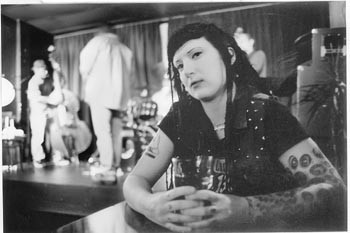
Clean and sober: Olive enjoys music and a nonalcoholic drink at the Old Vic.

Straight Edge

Nondrinkers hit the bar-and-club scene

By Shelley Lawrence

MS. OLIVE, 28, is six feet tall with six piercings in her lip. Actually, she’s got six small holes, because she took the piercings out a few years ago. Her hair is jet-black and down to her waist, braided into rags about a half-inch thick. Across her knuckles is tattooed the motto “LIVE FREE.” By the time your eye has traveled up to her shoulder, it has seen “HELL” (on her wrist), “IRONY” (encased in flames), and a fleet of UFOs swarming between inky planets. The entire “sleeve” has been tattooed with a Swiss-cheese effect so that the whole scene appears to take place under the skin of her arm.

Her boyfriend, Sean, 29, is just as imposing. His jet-black hair is spiked stiffly all over his head, and he sports numerous tattoos as well as facial piercings, scars, and stretched ear-holes with metal tubes stuck through them.

Not your typical teetotalers, but both are members of a 12-step recovery program and do not drink or do any other drugs. They do, however, have a great time clubbing and bar-hopping sans hooch. They go to shows, preferably punk or rockabilly. They frequent bars with friends to hear live music or to shoot pool. Sean says it’s easier to go out with friends from the program because the pressure to drink is lessened.

Olive tells me that if she’s feeling shaky or feeling the urge to use, she’ll stay home and cook or garden instead of going out, even if that means missing a show.

For 17 years, Sean used every drug he could, mainly heroin. He’s been clean and sober now for five months. Olive has been clean for four years and 10 months after using heroin, alcohol, and other drugs for six and a half years.

She laughs at herself now, saying she’s one of “those people” whom she used to scorn while getting high.

“And I like it!” she laughs when asked about her sobriety. “You would never have caught me going into a video store before. I’d be like ‘How boring!’ Drugs were my TV, that’s just what I did before. I used to hate people who’d go and watch a movie on a Friday night.

“Now I’ve become that person, and I like it. I mean, you pay two bucks [for a video] and you have entertainment for 12 people for two hours!

“You can’t beat that.”

Sean never drank too much while he was getting high, and now sometimes wishes he could have a cold beer.

Olive did drink a lot–so much that she suffered alcohol poisoning, which led to her quitting drugs and alcohol.

When it comes to going to bars, Olive has “mixed emotions.”

“I remember when it was fun other times going out,” she says, “but now when I go out, I see people in bars being violent and aggressive. I don’t care for drunks, unless I am one. Once recently, I saw this girl who’d been in the program and had relapsed. It was at a party at this punk-rock frat house. I really wanted to see her lying in a pool of her own vomit so I could think, ‘Show me [drinking] doesn’t work!’ It just doesn’t work.

“The party had been fun, and then she started this huge fight and it got ugly there.”

BOTH SEAN and Olive do a lot to stay busy, be productive, and keep themselves from drinking. They are heavily involved in activist work: Olive volunteers for the Purple Berets, the Sonoma County women’s rights organization; and Sean works with a radical environmental group.

Olive previously volunteered to work for the needle exchange in Berkeley, a program to stop the spread of disease among intravenous-drug users. The program offers free HIV tests, vaccinations against hepatitis A and B , clean needles in exchange for dirty ones, cleaning supplies for needles, condoms, and sex advice.

Sean still hangs out with people who use and drink, but has decided the lifestyle is no longer for him. Both Sean and Olive appreciate their fun now more that they are sober.

Olive says that they’ve relearned how to have fun.

“Being in the program, we’ve learned that recovery can kick ass. You’ve just got to meet people who have the same interests. The emotions that brought you to the program are the same. Even though everybody’s situations are very different, the feelings behind them are the same–that’s why we’re all here in this place.

“That’s what brought us here, and that’s what matters.”

Olive and Sean attend 12-step meetings three to seven times a week. Both say that the meetings are a social scene in their own right. Afterward, friends may congregate at an all-night diner for coffee and to pig out on greasy food.

Sometimes everybody winds up at Sean’s house.

As Sean, Olive, and I leave the coffee shop where we’ve met for our interview, I notice that one of Sean’s ears has a gaping hole in it, while the other sports a tribal “plug.”

When I remark that he’s missing an ornament, Sean just grins and answers, “Yeah, some drunk dude knocked it out of my ear in a bar last week.”

From the June 8-14, 2000 issue of the Sonoma County Independent.
© Metro Publishing Inc.

Club Fab

Club Fab ignites Guerneville nightlife

By Patrick Sullivan

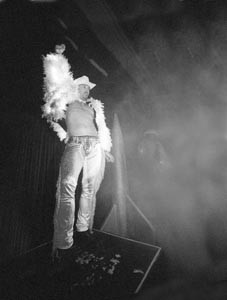
Roving spotlights prowl across a stormy sea of dancing bodies moving to the grinding beat of a booming sound system. Two muscular, scantily clad male dancers wiggle their bronze bodies atop two high platforms in front of a giant prop rocket. On a huge projection screen hanging from the ceiling, animated figures wander through computer-generated alien landscapes.

Tray held high, a smiling waitress makes her way across the chaotic dance floor. Just about the only woman in sight, she dodges two shirtless guys doing some hip version of the lambada, then makes a wide circle around a slender raver twirling a pair of glowsticks and watching the green trails in the huge mirrors on the wall.

But getting back isn’t going to be easy. Suddenly, as if by prearranged signal, a fresh wave of club-goers surges down the steps, bringing new energy and new body heat to the already crowded dance floor. All across the room, more shirts come off and the dancing gets wilder.

No, this isn’t some club in the Castro or some after-hours gay rave south of Market. Welcome to Saturday night at Club Fab in Guerneville.

Since it opened just over a year ago, the 7,000-square-foot dance club has been gradually building a reputation that now extends far beyond the boundaries of Sonoma County. Most summer nights, gay men and lesbians from Santa Rosa, San Francisco, and beyond pack the dance floor. But several new events are also attracting a growing number of straight patrons.

In the process of building an audience, Club Fab is doing its share to help reinvigorate nightlife in the river area. And that, says Greg Seiler, who co-owns the club with his partner, Edward Martinez, was the whole point of opening the doors in the first place.

“We just got tired of apologizing to our friends when they would come up from the city,” says Seiler, a San Francisco resident who has maintained a second home in Guerneville for more than a decade. “Following the ’95 flood especially, there was no nightlife. It just sucked. When this building became available, we just had to do it.”

“We wanted to bring a world-class entertainment venue so that people would have another reason to come up, because a lot of people were coming up and not taking the area seriously,” Martinez adds.

But before Club Fab’s doors could open, the new owners had a few challenges to overcome. The building, which occupies a prime position on Main Street, has a long and colorful history. Built in 1946 as the River Theater, it was a movie palace until 1984, after which it took on a new incarnation as a string of dance clubs and concert halls with names like The Pit and Ziggernaut. But time and neglect took their toll, and when Seiler and Martinez began making their plans, the interior was a mess.

“When we walked into that place, it was being foreclosed,” Seiler explains. “They had taken all the electrical equipment and clipped it loose with wire cutters. It was in a big pile waiting to be auctioned off. We had to put the whole place back together. It was kind of like rebuilding the Mayan Empire.”

After an extensive renovation (which carried a total price tag that Seiler estimates at somewhere close to $100,000), the building now sports a new dance floor, two state-of-the-art sound systems, and a multilevel arrangement of lounges, complete with pool tables and spots to check out the dance-floor action. And, of course, there’s the giant rocket.

“Edward owns the biggest prop house in San Francisco,” Seiler explains. “So we’re able to bring in all kinds of fun things. One night we brought in a 20-foot Egyptian Pharaoh.”

But props aren’t all that’s coming up from the city. Because the club also features an upgraded DJ booth with big-city-style equipment, Seiler and Martinez are able to attract guest DJs from San Francisco.

And their fans follow. Seiler estimates that, on many summer nights, roughly 70 percent of his patrons are from outside Sonoma County. But tourism from the south falls off during the winter months, which is one reason the club has worked hard to build a local audience.

The effort seems to be succeeding. For one thing, an increasing number of straight people are coming through the door, drawn primarily by Club SEXY, a dance party hosted by DJ Dave Matthias from radio station SEXY 95.9. The club’s cabaret nights, which feature drag talent from across the Bay Area, also draw a mixed audience.

“I’m amazed,” Seiler says, “by how many straight people show up on those nights.”

What does the future hold? For one thing, according to Seiler, Club Fab will play host to more live music. The west county-based Institute for the Musical Arts recently put on a concert at the club, and singer Vickie Shepard performed on Memorial Day. Expect to see more acts along the same lines, Seiler says.

“But it’ll be a different kind of music–nothing angry,” he adds with a laugh. “No angry music allowed.”

From the June 8-14, 2000 issue of the Sonoma County Independent.
© Metro Publishing Inc.

Mighty Mo Rodgers

0

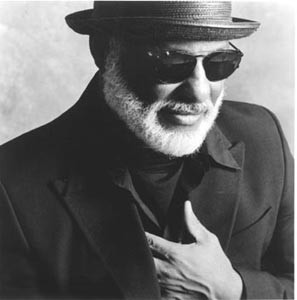
Mo better blues: Mighty Mo Rodgers performs June 18 at the Russian River Blues Festival.

Sound & Spirit

Mighty Mo Rodgers reclaims power of blues

By Greg Cahill

“Blues, which once was on the cutting edge of American music, has become as comfortable as an old chair now.”

–Mighty Mo Rodgers

THERE ARE many blues masters, but Mighty Mo Rodgers is one of the few who can lay claim to possessing a master’s degree in the blues. Indeed, a couple of years ago, when this 56-year-old singer, songwriter, and keyboardist–who appears this Sunday at the Russian River Blues Festival–first proposed earning a master’s degree in humanities for a study of the American musical idiom, the advisers at California State University at Dominguez Hills suggested that he submit a newly recorded solo album as his thesis. Rodgers–a former backup musician and record producer who can wax philosophical for hours about the ontological underpinnings of the blues–decided instead to write a thesis titled “Blues as Metaphysical Music.”

And then he turned the blues world on its collective ear. Last fall, Rodgers released his solo debut, Blues Is My Wailing Wall (Blue Thumb), financed by a $30,000 loan from his credit union and later picked up for international distribution by Universal, to rave reviews.

The album offers a refreshing, original take on an African-American music that has become formulaic. Billboard magazine opined that Rodgers is “a pungently gritty singer who pens tunes that work vigorous new wrinkles into the most timeworn of fashions. A revelation.”

The album earned Rodgers a nomination as New Artist of the Year at this year’s W.C. Handy Blues Awards, a prestigious national honor. While he didn’t walk away with the award, the ceremony gave Rodgers a chance to “meet and greet all of the blues police, as they say.”

Simply being nominated attests that he has made a mark on the blues establishment.

“I went into this to try and shake up the blues, to say something new and fresh,” says Rodgers, during an interview from his Los Angeles home. “I didn’t know if people would ‘get it,’ but the blues muse was pushing me to do it.

“I was shocked by the strength of the reviews. So I’m really flattered.”

Oddly, it’s been an uphill battle getting airplay on the few stations that still program blues music. “Some think the album is world beat,” he says, noting that while the album has garnered airplay on the East Coast, the largest blues station in the country, KLON in Los Angeles, is not playing Rodgers’ tracks.

“I’m not worried about it–that’s their problem, if they don’t hear these things.”

RODGERS conceived of the project, in part, as a way to show the hip-hop generation that the blues is still revolutionary. The concept album–which deals with the relationship of the blues and the heritage of slavery, the infamous Tuskegee syphilis experiment, the black community’s admiration of President Kennedy, and other more traditional blues themes–serves as a timeline that traces “this multifaceted thing we call the blues” from its African roots through its various rural and urban forms.

“I tried to tell the history of the blues as best as I could with 11 songs,” he says.

That Rodgers succeeded without any contrivance and free of clichés is a real wonder.

“That was my goal,” he says. “Blues has become cliché and very redundant in what I call The Blues. I mean, it’s hard to be original in any genre. Usually a genre will open up through some visionary who is iconoclastic and able to break down barriers. I’m not saying I am all of that, but I do have a vision and I know I see clearly. I was so bored and embarrassed with what I was hearing out there–the pedestrian and the maudlin.

“Blues, which once was on the cutting edge of American music, has become as comfortable as an old chair now. But if you listen to the fire and the power of a Robert Johnson or Elmore James or Muddy Waters, after 50 years it still comes off the record almost like it’s 3-D. People try to imitate that, but there can be only one Robert Johnson, one Elmore James. When these guys come along today and do the same thing over and over–the same songs even–it becomes boring and redundant.

“And that’s because most people in the genre are not too original.”

Rodgers is no mere academic–he has been immersed in the blues for more than 40 years, since he was a teen in East Chicago, Ind., where he heard such performers as Willie Dixon, Earl Hooker, and Jimmy Reed. After beginning his own performing career, Rodgers moved to California and became a session man and backup musician for T-Bone Walker, Bobby Blue Bland, Roy Brown, and others. In 1973, he produced blues duo Sonny Terry and Brownie McGhee’s album Sonny and Brownie (A&M).

But, in the mid-’70s, Rodgers grew fed up with the increasingly formulaic nature of the blues. He turned his back on the music business and devoted his attention to raising his son. Eventually, he enrolled at Cal State, Northridge, the first in his family to attend college. He resumed his songwriting, penning tunes for the Motown and Chappell labels. But he soon grew tired of that when they asked for more cliché-ridden compositions.

Last fall, Rodgers earned his master’s degree–a feat that has taken a back seat to his intense love affair with the blues.

“All the degrees in the world don’t mean shit–all the knowledge you now have pales compared to the powerful sound of a Sonny Terry or a Son House,” Rodgers says. “That power is primordial. It’s like looking at a Rothko painting–you know, the great abstract expressionist. There is heat coming out of it. It’s alive.

“And the blues is alive because it comes from God to deny the lie of our nothingness.”

Now he has set his sights on communicating that vision to a new generation in a new century. “There are a lot of young artists who are doing great things, blending the blues and hip-hop or whatever, so that the circle is complete,” he says. “I think that blues in its original form will always be there because that is the construct of the form that allows you to communicate through the call-and-response that originated in Africa with the maximum of communication and the minimum of redundancy.

“That’s basically the black voice, or as scholar Lewis Gabe says, ‘the blackened tongue.’ . . . But while its primordial voice came from black people who had lost everything, the blues has transcended that and become a world music. The blues is folk music that has gone around the world. I don’t care if you’re in Singapore or Stockton, you’re going to hear some Afro-American blues-centered music–R&B, hip-hop, rock ‘n’ roll.

“And that’s the real power of the blues–it’s ability to outrun its commodification.”

Fest Schedule

Sun, sand (or at least a lot of little pebbles), and sound abound at the annual Russian River Blues Festival on Saturday and Sunday, June 17 and 18, from 10 a.m. to 6 p.m. at Johnson’s Beach in Guerneville.

Saturday’s lineup (in order of their appearance): the Bobby Murray Blues Band, the Average White Band, guitarist Tommy Castro, blues legend Little Milton, and the Funky Meters (with Art Neville and George Porter), the originators of New Orleans funk.

Sunday’s lineup: Texas blues diva Angela Strehli, Mighty Mo Rodgers, the Duke Robillard Band, Los Lobos, and R&B great Etta James (above) and the Roots Band.

Tickets: in advance, $40 each day, $75 for a two-day pass; at the gate, $45 and $75. For details, call 510/655-9471.

From the June 8-14, 2000 issue of the Sonoma County Independent.

© Metro Publishing Inc.

Daring Drinks

0

Daring Drinks

Belly up to the bar and blow your mind

By Marina Wolf

By 1862 the first bartender’s guides were circulating, and British correspondents already were complaining about American drink names; “an obvious defect in manners,” said one.

You’ve seen them before: the shot glasses glowing with a liquid rainbow, the martini glasses radiating colors not found in nature, the coconut goblets topped with an umbrella, a plastic sword, and Carmen Miranda’s hat. They’re the drinks that make you wonder as you sip carefully at your vodka tonic, “What the hell is that?”

Believe it or not, they all have names, and some are listed in standard bartending textbooks. Most of them even make sense. Girl Scout Cookie? It’ll have mint and chocolate (provided by dark cacao and white creme de menthe, layered with Bailey’s in a shot glass). Russian Quaalude? Gotta have vodka, at least, and it does (along with Frangelico and Bailey’s).

But there are other names that reveal nothing: Bad Sting. Ice Pick. Wombat. Pangalactic Gargle Blaster (note: flaming not recommended).

These are all from a book called Simply Shooters: Coast to Coast Shooter Collection, which boasts “over 1150 recipes.” And mind you, that number’s just for shooters.

John Burton, owner of Santa Rosa Bartending School, teaches how to concoct over 100 mixed drinks, which is considered the bare minimum for today’s bartender. But in reality, there are an “infinite number of possibilities,” says Burton.

Two hundred years ago, when mixed drinks were first dubbed cocktails, things were a lot simpler. The cocktail was first described in print in 1906 as rum punch laced with bitters. By 1862 the first bartender’s guides were circulating, and British correspondents already were complaining about the vulgarity of American drink names; “an obvious defect in manners,” said one.

Even then the rage for the outrageous was alive, with names like Corpse Reviver and Chain Lightning. But the cocktails themselves were not absurd: whiskey, rum, and gin, mixed with soda or sours. These simple, strong drinks suited the tastes of the men who were the principal patrons of the saloons in the early 1900s. The women’s temperance movement, combined with a Victorian devotion to propriety, kept public consumption of alcohol to a minimum.

All this changed in the 1920s, when women became emancipated, both socially and politically, and took up drinking as almost a civic duty. A new drinking demographic was born. At the same time, Prohibition settled in, and a thirsty nation sought ways around the federally imposed drought. Speakeasies flowed with strong liquors that were the easiest to bootleg. Faced with liquor of dubious flavor, bartenders created new mixed drinks that simultaneously hid bad liquor and appealed to the new woman drinker.

The names, too, grabbed drinkers with their innuendo; Classic Cocktails lists some crudely named concoctions of the period whose popularity–and formulas–have faded, but whose names live on in a sort of soft-core, F. Scott Fitzgerald fantasy: Atta Boy, One Exciting Night, Bosom Caresser.

Since then, there have been several waves of adventurousness, mainly in response to new spirits and mixers on the market. When vodka and white rum become available in the ’40s and ’50s, lighter, sweeter cocktails appeared on the scene, including the new drink called the screwdriver.

Burton, who has been tending bar for 40 years, remembers the first time a lady ordered a screwdriver at his bar: “People looked at her and said, ‘You’ve gotta be kidding.’ ”

Blue curaçao in the ’60s, Italian syrups in the ’80s–each time something new hits the market, new drinks have to be invented. Now there are thousands of kinds of liquor on the market, scores of vodkas alone. Add to that the different juices, sodas, and mixers, and you have a universe of drinks with just a dash from a different bottle.

Not surprisingly, liquor companies are the prime movers behind the recent cocktail renaissance. They host their own competitions, with cash prizes, and sponsor regional, national, and international events as well. Winners often get written up in industry magazines, and the winning recipes go out with marketing packages.

Galliano’s recent competition yielded, among other things, the G-Spot Shot (Galliano, Midori, and blue curaçao) and the G-String (Galliano, orange juice, and Stolichnaya Razberi–another new spirit).

The newest field of daring drinks is shooters, those miniature cocktails that are created in a shot glass and chugged. Shooters offer a powerful hit of flavor, with surprisingly little alcohol content, says Flamingo bar manager John Timberlake; if you really want to get drunk, get a shot and a beer. But the names promise an extreme experience: Deathwish, Toxic Waste, Hand Grenade, Nuclear Accelerator (flaming definitely not recommended). And it’s difficult to resist the raw sex appeal: Bend Me over Easy, Leg Spreader, Busted Cherry, French Tickle.

THE TAXONOMY of these new creations is elusive. Take the Sex on the Beach series listed in the Shooter Collection. There are nine, including Sex on the Beach for a Week, and not a single common element is to be found in all nine (vodka and Chambord are in six each, peach schnapps and Midori are in four).

The few guidelines that do exist are pretty straightfoward. Blue drinks contain blue curaçao. Green drinks could be lime, Midori, or green menthe (double-check the name for context).

Anything with the word fire, flaming, or inferno in the title could be with Tabasco, cinnamon schnapps, or pepper vodka, or might be set on fire. And anything with an orgasm theme, either explicit or implicit, will have Bailey’s or cream involved (nudge, nudge, wink, wink).

This brings up the gender psychology of these bizarre beverages. Men may go for the zowie, maxed-out shooters of death, but women are the primary consumers of most multi-ingredient mixed drinks, according to bartenders.

“You think men would order a piña colada with whipped cream in front of their friends?” asks Timberlake with a snort. “Women, they like to think they’re shocking bartenders. They’ll come up and say, ‘I’d like a Screaming Orgasm.’

“I just say, ‘Gimme 10 minutes.’ ”

From the June 8-14, 2000 issue of the Sonoma County Independent.

© Metro Publishing Inc.

Usual Suspects

0

GMO man: Jim Winston opposes the Healdsburg City Council measure.

Photograph by Michael Amsler

Growth Spurt

Healdsburg gets dueling growth measures on November ballot

By Greg Cahill

A LOCAL ACTIVIST who once said he was willing to compromise is blasting a city-backed growth-control initiative approved on Monday by the Healdsburg City Council, calling it a sham. The measure, which will rival a similar ballot initiative supported by a grassroots group, could derail efforts to curb development in one of the county’s fastest growing regions while providing affordable housing.

The council’s action comes just weeks after Jim Winston, a tenacious land-use activist whose tactics alienated even some of his allies, surprised the council by making doubly good on a threat to take the issue of managing Healdsburg’s growth to the voters. Over eight days in March, Winston led a petition drive collecting nearly 900 signatures–almost twice as many as needed–qualifying his version of a growth-management ordinance, or GMO, for the November ballot.

Winston’s decision in February to pursue an initiative divided his allies. Among those who parted ways with him were several prominent Healdsburg slow-growth advocates, including Leah Gold, who chaired the 1996 campaign that established Healdsburg’s 20-year urban-growth boundary, one of five similar measures passed in the county that year.

The Winston-backed measure would allow 30 new homes a year. The council’s calls for 25 new homes a year but has a liberal exemption clause that could significantly increase that figure by permitting small subdivisions of three or four homes, in-law units, live-work arrangements, and other types of housing.

Healdsburg is the second-fastest- growing community in Sonoma County. While the town constructed few new homes in the past decade, Healdsburg recently annexed 230 acres, mostly on the north end of town, and approved 500 new homes.

Winston, who just last month said he could live with the city’s version of the growth limits, now says the council measure is “a sham” because it is fraught with loopholes.

THE INITIATIVE BATTLE is just the latest twist in a tug of war commenced a year ago, when Winston appeared at a council meeting warning that if the city wasn’t careful it was going to outgrow the UGB well before its 2016 expiration date. He and a hastily formed citizens’ group led with a proposal that the city limit new housing units to 40 a year.

The group’s concern was fueled by the building boom at the city’s north end, where nowadays street after street of large single-family homes rolls over 230 hilly acres annexed by the city in 1995. Healdsburg experienced only incremental growth through the early ’90s. But a surging economy ignited residential construction, mostly in the annexed area, where dozens of roads were carved and nearly 200 new homes built from 1997 to 1999.

Neither of the initiatives on November’s ballot will affect the nearly 500 new homes already approved for eventual construction in the annexed area.

But GMO advocates say the goal is to slow the rate at which Healdsburg develops in the future and preserve the integrity of the UGB. Through much of the past year, GMO advocates and the city remained far apart on the number of new units to be permitted a year. The Planning Commission proposed 60, with a generous bundle of exemptions. Winston called the number “absurd,” saying that at that rate the city would use up the room within its boundary by 2008.

Under public pressure, the council lowered that number first to 50, then 45, but balked when Winston, citing revised figures from the city’s Planning Department, proposed a new limit of 30 units a year.

The council dug in, and Winston decided to go after an initiative.

The next step: the ballot box.

Jeremy A. Hay contributed to this article.

From the June 8-14, 2000 issue of the Sonoma County Independent.
© Metro Publishing Inc.

Michelle Shocked

0

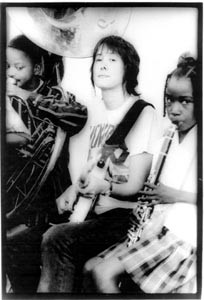
American story: Michelle Shocked, left, and friend.

Shocked Treatment

Folk-rocker Michelle Shocked makes fighting comeback

By Alan Sculley

MICHELLE SHOCKED may not be a star or a household name in the music business, especially after a lengthy hiatus from the recording studio, but she is one artist who has truly declared and gained her independence. Her biggest battle occurred about six years ago when she was forced to pay for recording a CD, Kind Hearted Woman, and finance a tour herself because she was locked in a bitter contract dispute with Mercury Records, the label that had released her three critically acclaimed previous studio records–1988’s Short, Sharp, Shocked; 1989’s Captain Swing; and 1992’s Arkansas Traveler.

The label had refused to fund studio time for two proposed albums–one with a working title of Prayers and a version of Kind Hearted Woman–saying both records were stylistically inconsistent. What Shocked later discovered was that Mercury’s decision was based less on artistic merit than on a desire to rework her record deal.

As rarely happens in the music business, Shocked, 38, had negotiated ownership of her master tapes, and at the conclusion of her contract would control the release rights and royalties for her records. Mercury wanted to regain ownership. Shocked wouldn’t surrender. When Mercury refused to let her record for another label, the two parties went to war.

“I at first internalized a lot of rejection,” Shocked says, explaining her initial reaction to Mercury’s decisions. “I thought there was something wrong with me. And then as it went on down the road, I felt like they were behaving with an imperiousness, a high-handedness.

“It brought out the anger that comes from–if you know a little bit about my background as a runaway–the abused-child syndrome,” says Shocked (born Michelle Johnston), who at 16 ran away from home and soon after was briefly committed to a mental institution by her mother.

SO SHOCKED decided to circumvent Mercury altogether, recording a solo guitar version of Kind Hearted Woman in a friend’s garage. Armed with her CD, she then recruited two members of the Irish band Hothouse Flowers–Fiachna O’Braonain and Peter O’Toole (and on some shows, drummer Cedric Anderson)–and went on tour, selling her homemade discs at her shows.

The tour and CD sales raised enough money to keep Shocked on the road for two years and enabled her to return to the studio to re-record Kind Hearted Woman, with O’Braonain, O’Toole, and Anderson fleshing out songs.

In the meantime, she settled her dispute with Mercury and gained her freedom from the label. As part of the settlement, Mercury released a Shocked anthology CD, Mercury Poise. The new version of Kind Hearted Woman, meanwhile, was released four years ago on the Private Music label.

The CD stands as a significant departure for the eclectic singer-songwriter. Her first three records, which Shocked views as a trilogy, showed three distinct sides to her music. Short, Sharp, Shocked was a singer-songwriter record full of bluesy, folk-rock tunes. Captain Swing was a swinging horn-filled record. Arkansas Traveler–which featured bluegrass legend Doc Watson and gospel great Pops Staples–explored Shocked’s musical roots, with a collection of folk and blues songs she had learned while growing up, as well as some original material.

By contrast, Kind Hearted Woman remains Shocked’s most stark and emotionally charged record. It presents a series of stories about struggle, despair, and ultimately redemption, told by characters battling personal and professional setbacks while living in rural America.

“What I’ve been experiencing is that on a superficial listen, the material does end up being perceived as very . . . someone used the word barebones,” she says. “If you listen to it all, it does take you down into the depths, but before the journey’s over, it’s lifted you into, I don’t know, this mood of acceptance or tolerance. I define it as redemption, myself, but most people have at least managed to capture a sense, a mood of something a little lighter than the despair.”

LOOKING BACK on her battle with Mercury, Shocked hopes she has helped trigger some improvements in how the record industry treats its artists. She has continued to follow a highly independent path over the past few years, hitting a creative high point and touring each year.

She finished out 1999 with a special five-night stand at New York’s Bottom Line, performing 30 songs she had written in 30 days with O’Braonain.

“Well, I’m looking at it from a generational point of view. It’s now the baby boomers who are running the labels,” Shocked says. “But when they were coming up, they really received a lot of indulgence and nurturing from the record men, the guys who understood they were in the business of culture. And in the ’80s corporate environment, as that generation came into power running the labels, they started giving the power to the bottom liners, the accountants, the lawyers; and as a result, even the good record men that remained were driven out.

“It became seen as a negative to indulge the creative, the talent. And they really went back to a feudal system, like in the ’50s, of one-hit wonders and producers writing the songs and double-dipping by producing the albums and getting the publishing and all that.

“So from my generation, I just cannot go down without a fight,” she adds. “You do not have to, if you’re in the system, take a bunch of drugs and numb out, just be a loser or a slacker. You can be positive. You can have your wits about you, you can actually improve things. . . . I would like to see much more of a united front of artists who are exploited primarily because they allow themselves to be divided and conquered.

“So if I can represent a generational shift and paradigm from ‘we work inside the system and therefore we’re already defeated’ to ‘we work inside the system and we’re making it better for everybody,’ I’ll make the sacrifice of four years of standing up to a label like Mercury.”

Michelle Shocked performs Monday, June 12, at 8 p.m., at the Inn of the Beginning, 8201 Old Redwood Hwy., Cotati. Tickets are $15 in advance (available at the Last Record Store, Santa Rosa, and Backdoor Disc & Tape, Cotati), $18 at the door, 664-1522.

From the June 8-14, 2000 issue of the Sonoma County Independent.

© Metro Publishing Inc.

Liza Dalby

Novel Idea

‘The Tale of Murasaki’ re-creates the life of the world’s first novelist

By Patrick Sullivan

“MANY PEOPLE have this experience when they’re a teenager,” says author Liza Dalby. “You read a great deal, and then you find something that just blows you away, and you truly realize the power of literature to put you in a completely ºdifferent world. For me that happened in reading the classic Arthur Waley translation of The Tale of Genji.”

What Dalby doesn’t add is that most of us eventually put our mind-blowing literary discovery aside, with only subtle consequences on the rest of our lives. For Dalby, it was different. Her father’s gift to her at age 16 of The Tale of Genji–possibly the world’s first novel–helped trigger a lifelong interest in all things Japanese.

Dalby went on to become a trained anthropologist specializing in Japanese culture. As research for her Ph.D., she went so far as to actually become a geisha–the only Westerner ever to do so. Dalby was a consultant on Arthur Golden’s Memoirs of a Geisha, and she’ll do the same job on Steven Spielberg’s upcoming film adaptation of the bestselling novel.

But the author, now 49, never forgot her experience with The Tale of Genji. Nor did she forget Lady Murasaki Shikibu, who wrote the epic novel in the 11th century, beating Cervantes’ Don Quixote by about 600 years.

“She was a prodigious talent,” says Dalby, speaking by phone from her home in Berkeley. “The initial impetus for me was just wondering how she could have done this, invented this genre single-handedly. . . . I think it’s something of a miracle.”

For 10 years, Dalby worked to craft a literary tribute to Murasaki, who is a revered household name in Japan but less well known in the United States. In a project Dalby calls “literary archaeology,” she used the existing fragments of Murasaki’s diary to create a novelistic reconstruction of the woman’s life. The result is the newly published The Tale of Murasaki (Doubleday; $24.95).

Moving at a measured pace, the book employs rich descriptions to bring Murasaki and her aristocratic society to life. The daughter of a well-educated government official, Murasaki led an unusual life for a Japanese woman of her time. Determined to retain her independence, she married late and quickly found herself a widow. A talented poet and dedicated journal writer, Murasaki invented Prince Genji as an antidote to loneliness.

Her hero was a complex figure: a sensitive lover whose exploits thrilled everyone who picked up Murasaki’s writing. The stories became wildly popular, eventually capturing the imagination of the regent of the Imperial Court, who appointed the author to tutor his daughter.

Of course, the sources Dalby draws on to create The Tale of Murasaki are fragmentary. The gaps are filled in by her knowledge of Japanese culture and her imagination.

“The diary that she left is like a bright spotlight shining on about three or four years of her life while she was at court,” Dalby says. “We don’t know a lot about the rest of her life, so my version of the end of her life is conjecture.”

Better supported by the facts, Dalby says, is her book’s portrayal of Murasaki’s intimate relationships with various women. Not only was the world’s first novelist a Japanese woman, but Dalby–joined by other scholars–contends that she was also bisexual, a conclusion based on Murasaki’s love poems to female friends. “It would be kind of weird, given those poems, to say that she didn’t have those kind of relationships,” Dalby says.

No one seems upset by such assertions, even the Japanese, to whom Murasaki is a kind of literary goddess. The book will soon be published there, and other foreign language rights are selling like hotcakes. Indeed, it’s not impossible that The Tale of Murasaki may ignite the kind of popular interest in Prince Genji and his creator that Arthur Golden’s novel did for the world of the geisha. And, to hear Dalby tell it, anyone who does pick up The Tale of Genji will not be disappointed.

“I think what’s so appealing about [the book] is that it’s set in a world ruled by aesthetics, where poetry matters,” Dalby says. “Sensitivity to beauty was the most important thing about a person.”

Liza Dalby speaks on Friday, June 9, at 7:30 p.m. at Readers’ Books, 130 E. Napa St., Sonoma. For details, call 939-1779.

From the June 8-14, 2000 issue of the Sonoma County Independent.

© Metro Publishing Inc.

Panty Raider CD-ROM

0

Racy new CD-ROM game draws the ire of feminist critics

By Lucy Maher

IF YOU THOUGHT panty raids struck only sorority row, think again. A new CD-ROM game called Panty Raider targeted at young men will let players strip models down to their underwear to satisfy aliens threatening Earth. But critics say the game sends a bad message and humiliates girls and women.

Parents’ and women’s groups have sent numerous e-mails to New York publisher Simon & Schuster to try [to] halt the release of the game later this month.

“These gender stereotypes are really corrosive and harming both our daughters and our sons,” says Joe Kelly, executive director of Daughters and Dads, an advocacy group that started the e-mail campaign.

“The notion that women are just there to be objectified is dangerously unhealthy.

“It’s the repeated message that how a girl looks is more important than what she is capable of doing.”

However, Simon & Schuster Interactive says the game is just entertainment.

” ‘Panty Raider: From Here to Immaturity’ is a humorous game, and like all comedy might offend some people while amusing others,” the company said in a statement. “The over-the-top nature of its humor is a clear indicator that it is not meant to be taken seriously. Its intention is to make light of the many pervasive stereotypes that permeate our culture.”

In addition to stripping models of their clothes, players can pop in breath mints, flash credit cards, and deliver “cheesy pick-up lines to lure models out of the woods.”

“No self-respecting supermodel can resist these items,” Simon and Schuster said in its press release.

While some may think the game is fun, others say it goes too far.

“It’s the bottom of the barrel in terms of imagination,” says Corless Smith, a San Francisco State University professor, who recently discussed the game in her “Women and the Media” class. “It’s supposed to be ironic and over-the-top, but why is it that women are always victims in over-the-topness?”

Simon & Schuster says the game is targeted at “age-appropriate groups”–and the Entertainment Software Rating Board, an independent organization that rates games, says the game is appropriate for players aged 18 and older.

Industry experts say teenagers will be drawn to the game, but don’t think it’s cause for concern.

“It’s pretty unusual,” says Amer Ajami, preview editor at www.gamespot.com.

“I don’t think there’s been another game where you get a teenager who gets to decide how to dress naked models. It’s something that needs to be taken lightly by grown-ups. It’s just a game, and it’s clearly comical.”

Still, parents like Kelly say they don’t get the joke.

“For them to say that it is [aimed at men] is a silly response,” he says. “If this was a game for adults, it wouldn’t be stripping the supermodels down only to their underwear.”

This article originally appeared on Chickclick’s news channel, Shewire.

From the June 8-14, 2000 issue of the Sonoma County Independent.

© Metro Publishing Inc.

Cop Watch

0

Activists protest police-involved deaths

By Greg Cahill

JUST DAYS after the official release of the long-overdue U.S. Commission on Civil Rights report criticizing local law enforcement agencies for a spate of police-involved deaths between 1996 and 1998, a group of local activists staged a mock funeral to call attention to what they say are the latest in an “epidemic” of similar incidents.

That federal report recommends the formation of independent civilian-police review boards. At press time, the Purple Berets and Santa Rosa Copwatch were scheduled to hold the funeral in downtown Santa Rosa before a planned march to the Press Democrat building to protest the paper’s coverage of the deaths.

The daily has repeatedly rejected the notion that civilian review boards are needed and has frequently mocked those who call for them.

During the past five months, five people have died, either in police- involved shootings or while in custody. On May 4, two Santa Rosa police officers and an unnamed SRJC officer shot Todd Dieterle after he pointed a toy gun at them. The police had responded to a 911 call in response to an armed robbery. The store owner had repeatedly told the 911 dispatcher that he believed the gun used in the holdup was a fake.

That same day, Robert Francisco Camacho was shot fatally five times by Rohnert Park police responding to reports of gunfire at a local mobile home park.

Last week, Santa Rosa Police Chief Michael Dunbaugh held a public meeting of the department’s controversial citizens’ advisory board to discuss the most recent shooting. After a small turnout, Dunbaugh concluded that the department has widespread public support, saying the Dieterle shooting was the latest in a series of “suicides by cop.”

He said the lack of protests was a clear sign that the public places no blame on the police for the incidents.

Activists disagree.

“That board is appointed by Dunbaugh, and people are aware of that,” says Ben Saari of Santa Rosa Copwatch. “It doesn’t have any [independent] authority–it’s a group of Mike Dunbaugh’s friends who will back him any way he wants.”

The meeting wasn’t announced until the same day, Saari says, and it was held at 5:30 p.m., when most people are still at work or commuting.

Three other police-involved deaths were the subject of the protest as well. On May 10, two Windsor police officers shot and killed Erin McDonald in her home after she made a 911 call summoning police. McDonald reportedly had a fake gun. The shooting was called “suicide by cop.”

On March 19, James Curran died while in custody after sheriff’s deputies handcuffed him. Two months earlier, Phillip Tony Medina died several hours after he was transferred to a local hospital after complaining of illness.

THE FEDERAL REPORT, approved last month by the U.S. Commission on Civil Rights and leaked April 21 to the local daily (weeks before its scheduled release), noted that panel members are “appalled” by the police-involved deaths of eight people over the 25-month period leading up to the commission’s February 1998 public hearing.

“The Advisory Committee agrees with community spokespersons who said that the number of events should be cause for alarm for all citizens of the county,” the report states.

The civil rights panel recommends that the Sonoma County Board of Supervisors and the Santa Rosa and Rohnert Park city councils create independent civilian-review boards with the power to, among other things, investigate police-involved shootings or alleged misconduct; promote improved procedures for filing a citizen complaint; encourage increased ethnic, gender, and language diversity in law enforcement ranks; and support better training in cultural diversity and the handling of domestic violence cases and of suspects experiencing psychiatric and drug- or alcohol-induced episodes.

“It is the right and responsibility of citizens to protest police practices they view as unwarranted, unnecessary, or a gross abuse of discretionary authority,” the report continues. “We provide police officers with the responsibility to enforce the laws and protect individuals and property.

“We do not grant them authority to be arrogant or to abuse this trust.

“For a law enforcement department to view citizen concerns about police practices as a threat makes a mockery of this trust, and the consequences are community fear, ineffective policing, and deteriorating police-community relations.”

Usual Suspects loves tips. Call our hotline at 527-1200 or e-mail us at In**@******re.com.

From the June 1-7, 2000 issue of the Sonoma County Independent.

© Metro Publishing Inc.

Spins

0

Four rock legends release new discs with mixed results

By Karl Byrn

One advantage of being a pop music icon is that even though your best work is behind you, the test of time demands that critics and fans give your current release a serious nod. In a pop music landscape that’s alive with hip-hop, Kid Rock, and Dixie Chicks, what do ’70s folk and punk icons like Neil Young, Patti Smith, Lou Reed, and Joni Mitchell have to offer? Where are they at, and what are they telling their middle-age audiences?

The current discs from these four legends offer the expected maturity–nostalgia for romance and revolution, a search for simplicity, admonitions to young idealists, music that isn’t risky, less confessional upheaval and more personal reflection (except for Smith, they all avoid topical issues). But it’s not as simple as autumnal artists making September-of-my-years statements; they’ve already examined death–Young as early as 1975’s Tonight’s the Night (about band member Danny Whitten) and as recently as 1994’s Sleeps With Angels (Kurt Cobain), Reed on 1992’s Magic and Loss (various friends), Smith on 1996’s Gone Again (brother Todd and husband Fred), Mitchellincidentally on 1979’s Mingus (a tribute to then-dying jazz great Charles Mingus).

Having already faced mortality, they’re now pursuing post-tragic normalcy.

Not surprisingly, they find this in their own well-known devices. After 1995’s grunge-rocking Mirror Ball, Young again flips his style coin and becomes Acoustic Neil on Silver & Gold (Reprise). Reed hates his lover and is thrilled by sex-and-drugs street life on Ecstasy (Reprise). Smith issues a mystical call to arms on Gung Ho (Arista), while Mitchell delivers a misty set of jazz standards on Both Sides Now (Warner).

Mitchell is the least relevant. Both Sides Now teams her with the London Symphony Orchestra for a soggy “exploration” of romantic love that unwisely includes two of her own classics paired with such standards as “At Last” and “Stormy Weather.” The rhythms of her own material are misplaced, but it’s not just the unbalanced arrangements or her grasp for credible vocal color that defeats the project; it’s the fact that the trend of pop-rockers covering war-era torch songs passed a half dozen years ago. This is a vile idea of what a middle-age audience needs, and given Mitchell’s contemptuous attacks on current pop, it’s further proof that she’s out of touch.

While Mitchell asks her audience to conceptually dumb themselves down, Smith isn’t afraid to seem silly while warning her audience “We got to get off/Our ass or get burned.” Gung Ho‘s expansive rock (delivered with sturdiness by her original band) doesn’t make clear what future she envisions or how she plans to get there, partly because her poetic visions aren’t nearly as provocative as they once were. But it’s telling that in the above lyric (from the not-so-unclear “New Party”) she refers to “our ass” as a singular thing. Her insistence on a universal spirit is the disc’s strength, from the opening Asian-flavored power-pop of “One Voice” to the closing title cut, a bizarre tribute to the late North Vietnamese leader Ho Chi Minh and the idea of revolution for it’s own sake.

Gung Ho needs clarity, but after the dark solemnity of Gone Again and 1997’s Peace and Noise, it’s inspiring that Smith feels her listeners need social change more than reflection.

Reed feels his audience just need good old ironically-distanced Lou. Ecstasy gives plenty, as the disc’s title is at odds with its theme of failed marraiges. Too many cuts don’t follow this theme, but such unedited indiscretion is vintage Reed as well. Despite the irony and excess, his acceptance of inadequacy is amusing. On “Baton Rouge”, Reed casts himself as a regular guy with a regular tale of divorce, while “Modern Dance” finds the regular guy fantasizing about bohemianism. But finally, his mature, straight-forward musings on couples are too much pressure, so he returns to the filthy streets for the 18-minute two-chord crawl of “Like A Possum”, where images of condoms, crack, and masochism make him feel alive. Swept over by the impulse to be wild again, Reed shakes out of his usual montone to whimper that he’s finally “Calm! Calm!”.

Young has a genuine calmness that, unlike Reed’s focus on failed couples, is based on faith in true love. While Mirror Ball was lengthy and thematically complex, the sentimental Silver & Gold, with its short, simple folk tunes, is Young’s easiest, least challenging work ever. But there’s always more to Young than meets the eye. Though the disc starts with the plain-spoken, happy-go-lucky comforts of middle-age–the warmth of homecoming, admiration for aging parents, fondness for youth’s pals–by the end he’s wrestling with incompleteness and finality, “trying to find something I can’t find yet.”

On Mirror Ball, Young remarked that “People my age/They don’t do the things I do.” He wasn’t just noting his work with hip acts like Pearl Jam, but was summoning the self-awareness that Smith, Reed, and Mitchell miss–a yin/yang tug of sadness and satisfaction that on Silver & Gold replaces the mere need to accept (or resist) growing old gracefully.

For middle-age music fans, that’s a comforting notion.

From the June 1-7, 2000 issue of the Sonoma County Independent.

© Metro Publishing Inc.

Old Vic

Clean and sober: Olive enjoys music and a nonalcoholic drink at the Old Vic. Straight Edge Nondrinkers hit the bar-and-club scene By Shelley Lawrence MS. OLIVE, 28, is six feet tall with six piercings in her lip. Actually, she's got six small holes, because she took the piercings...

Club Fab

Club Fab ignites Guerneville nightlife By Patrick Sullivan Roving spotlights prowl across a stormy sea of dancing bodies moving to the grinding beat of a booming sound system. Two muscular, scantily clad male dancers wiggle their bronze bodies atop two high platforms in front of a giant prop rocket. On a huge projection...

Mighty Mo Rodgers

Mo better blues: Mighty Mo Rodgers performs June 18 at the Russian River Blues Festival. Sound & Spirit Mighty Mo Rodgers reclaims power of blues By Greg Cahill "Blues, which once was on the cutting edge of American music, has become as comfortable as an old chair now."...

Daring Drinks

Daring Drinks Belly up to the bar and blow your mind By Marina Wolf By 1862 the first bartender's guides were circulating, and British correspondents already were complaining about American drink names; "an obvious defect in manners," said one. You've seen them before: the shot glasses glowing with...

Usual Suspects

GMO man: Jim Winston opposes the Healdsburg City Council measure. Photograph by Michael Amsler Growth Spurt Healdsburg gets dueling growth measures on November ballot By Greg Cahill A LOCAL ACTIVIST who once said he was willing to compromise is blasting a city-backed growth-control initiative approved on Monday by...

Michelle Shocked

American story: Michelle Shocked, left, and friend. Shocked Treatment Folk-rocker Michelle Shocked makes fighting comeback By Alan Sculley MICHELLE SHOCKED may not be a star or a household name in the music business, especially after a lengthy hiatus from the recording studio, but she is one artist who has truly declared...

Liza Dalby

Novel Idea 'The Tale of Murasaki' re-creates the life of the world's first novelist By Patrick Sullivan "MANY PEOPLE have this experience when they're a teenager," says author Liza Dalby. "You read a great deal, and then you find something that just blows you away, and you truly realize the power...

Panty Raider CD-ROM

Racy new CD-ROM game draws the ire of feminist critics By Lucy Maher IF YOU THOUGHT panty raids struck only sorority row, think again. A new CD-ROM game called Panty Raider targeted at young men will let players strip models down to their underwear to satisfy aliens threatening Earth. But critics say the...

Cop Watch

Activists protest police-involved deaths By Greg Cahill JUST DAYS after the official release of the long-overdue U.S. Commission on Civil Rights report criticizing local law enforcement agencies for a spate of police-involved deaths between 1996 and 1998, a group of local activists staged a mock funeral to call attention to what they say are the...

Spins

Four rock legends release new discs with mixed results By Karl Byrn One advantage of being a pop music icon is that even though your best work is behind you, the test of time demands that critics and fans give your current release a serious nod. In a pop music landscape that's alive with...
11,084FansLike
4,606FollowersFollow
6,928FollowersFollow