
Fashion Junkies

0

Fashion junkies abound in mainstream America

By Laura Compton

MY FRIEND Jeff used to be the most devoted thrifter I knew. An accountant by day and an artist the rest of the time, he visited Salvation Army stores sometimes twice a day, hit garage sales and flea markets every weekend, and created wallets and art out of construction signs and other unlikely elements. Recently, however, his personal style has evolved from vintage gabardine shirts, white T-shirts, and paint-splattered khakis to baggy designer jeans and flamboyant Nikes.

IN SHORT, he’s gone from a thrift scorer to a fashion junkie. Fashion junkies (or victims, if you prefer) used to be slaves to European couture dreams–the fancies of designers inspired by art, history, certain French actresses, and perhaps a period epic such as Amadeus. The media still propagate this version, with its coverage of the seasonal runway shows, designer and supermodel cults of personality, and, of course, the endless litany of what’s in, what’s out, and what’s back.

That’s high fashion. But these days, the true fashion Zeitgeist is firmly entrenched in the states. The unique styles of some of America’s most disenfranchised, marginalized groups are being systematically raided and appropriated. Add in the forces of pop culture, music, and good, old-fashioned capitalism and the result is a syncretic “low” fashion that increasingly blurs the lines of its origins. Smart designers tweak and steal street fashions, then send them back out as hip new products, all while charging outrageously high prices.

Look no further than Macy’s display windows, Foot Locker, or Pavilions boutiques, and you’ll see items that look eerily familiar–but are suddenly way out of your price range.

“It’s now about chase and flight–designers and retailers and the mass consumer giving chase to the elusive prey of street cool,” Malcolm Gladwell wrote in The New Yorker in 1997. The article, which introduced the term “coolhunt” into the popular lexicon, explained how athletic-shoe companies such as Reebok and Converse run prototypes of new products by urban youth in “happening” cities like New York, Detroit, Los Angeles, Chicago, and Philadelphia.

The reasoning goes like this: Cool kids want the real shit and often create their own trends. They instinctively know what’s hot, know what they and their friends will buy, and don’t take kindly to lame imitations. Models, rap and hip-hop musicians, and sports figures might popularize the styles to the masses via MTV and style magazines such as Details and Grand Royal, but it’s a symbiotic relationship that originates in the street.

Designers often revamp or scrap styles based on initial street reaction. Older trends, such as the Converse One-Star basketball shoes and Hush Puppies, are now back in force on retail shelves because they were selling so well in thrift and secondhand stores.

How big is this market?

Unbelievably, basketball shoes alone are a $7.5 billion market worldwide.

“It’s ironic that the same demographic group demonized by right-wing politicians, harassed by the police, and ignored by employers is the most sought-after by many of America’s richest entertainment and apparel companies, who seek the blessings of their authenticity, then sell it back to them for an inflated price,” comments an article in this month’s Spin explaining the phenomenon.

BUT IT GOES beyond irony. The same baggy clothes and athletic wear that can land ethnic teens on “gang wannabe” lists are now marketed to suburban teenagers who want the tough image without the reality. Hip-hop style has thoroughly permeated youth fashion and become so commercialized during the past several years that much of it has been rendered innocuous, but it’s a process of constant evolution. As creative modes of dressing continue to come up through the streets, they will inevitably continue to be redone with designer names and exorbitant prices.

Hip-hop culture is just one example. Culture vultures know no boundaries; other groups whose distinct elements have become fashion fodder include skateboarders and snowboarders (baggy pants, Vans), Latinos (baggy shorts, tank tops), punks (studded belts and jewelry, Converse, men’s pants), riot grrrls (Mary Janes, barrettes). The act of appropriation not only divests these symbols of their power; it also blurs their origins until they are no longer distinguishable.

One term you’ll never see mentioned in fashion ads or the media is class. Instead, its surrogate code words are campy, kitschy, hip, retro. Trailer parks, alleys, and bedraggled urban areas are the backdrops for both ads and editorial spreads. Take the short-lived, much-ballyhooed “heroin chic” fashion stance President Clinton and others were so up in arms about. Ads and fashion layouts from such designers as Diesel and Calvin Klein, with their malnourished, drugged-looking models in hooker getups, were glamorizing poverty, not heroin.

In today’s political climate, with its rapidly unraveling welfare system and safety net, low-income women are simultaneously blamed for society’s ills and held up as fashion plates.

Magazines such as Spin and Rolling Stone, with their double-page color ads and au courant fashion spreads, function as guidebooks of co-optation as designers desperately try to sell cool and rebellion.

Often the co-optation goes beyond the styles to the sources. Declassé styles of yesterday that we once held up as examples of bad taste or age–polyester, leisure suits, loud prints, etc.–have now been recycled and revived for a several-decades-removed generation. Thrift stores, a perennial font of older styles, have been pillaged. It’s bad enough that retailers are remaking old styles and charging an arm and a leg for them, but it’s truly galling to find Thrift Town picked over and polyester shirts selling for $20 (vs. $2 or $3) at Urban Outfitters.

A fashion spread in Spin once advised readers on how to trade in ’70s designer fashions for ’80s variations. “Feeling imprisoned by that suit and tie?” it asks. “Longing for the grunged-out Courtney?”

Ironically, in recalling the time when Courtney Love’s clothing choices expressed personal sentiments more than designer ones, Spin seemingly contradicts Harper’s Bazaar, which once put Love on the cover because her “severe good looks and sensational background (the drugs, the booze, the rawness) suddenly conform with fashion’s hard-edged glamour.”

However you choose to frame it, it’s still about selling a look, whether it’s kinder-whore or Klein.

ISN’T A FASHION-BLIND society, where our differences are obscured and thus become unimportant, a worthy goal? Maybe in theory. But fashion is first and foremost a form of personal expression. In our visually oriented age, it sends an immediate first impression. Throughout history, disenfranchised and minority groups such as beatniks, hippies, punks, gangs, and gays have been able to identify each other and bond based on certain clothing and accessory choices.

Fashion statements are often antifashion statements. Seattle rockers didn’t wear flannel shirts and ripped-up Levi’s because they were fashionable; they wore them because they were practical and cheap. Los Angeles street kids wear Hanes tank tops because they’re sexy and inexpensive.

Whenever a distinctive look, attitude, culture, or type of music becomes marketed on a mass level, it loses its impact. By its very nature, mass marketing mutes complexities and contradictions. When we appropriate the styles of classes or cultures other than our own, respect and understanding are rarely part of the exchange. We can dress up like part of a rebellious group without taking any of the risks or truly understanding its mindset. Short of ignoring the trends, there’s no easy way around this.

But being conscious of the ways in which the fashion industry sells marginalized cultures’ styles is a start.

Recognizing who’s profiting from a lifestyle or sweatshop labor is essential. Fashion is about individual decisions. You can vote for it or veto it–with your pocketbook. The choices are up to you.

From the September 21-27, 2000 issue of the Sonoma County Independent.
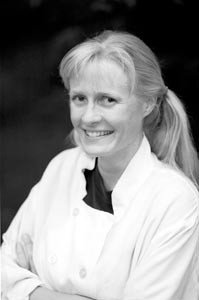
© Metro Publishing Inc.

Mistral

0

Mistral presents a local farm-food extravaganza

By Paula Harris

SET THE TABLE, set the stage. That’s the motto master showman Michael Hirschberg, energetic proprietor of Santa Rosa’s Mistral Restaurant and Wine Bar, and his equally star-struck staff seem to have taken on with unabashed theatrical glee.

“Dinner here is like a performance, it’s akin to theater,” says the boyish and bustling Hirschberg, who routinely plans ambitious themed dinner events for the popular restaurant as if he’s a Broadway artistic director. “The audience–uh, the customers–walk in and ready or not, the show is on the road. The players must remember their lines and hit their marks.”

Mistral puts on about 10 themed dinners each season. Sometimes the meal features a specific wine varietal, or is geared around a certain winery, or maybe transports patrons far away from the restaurant’s functional business-park location to immerse their senses in the exotic cuisine of some distant land.

And the culinary show seems to be playing to raves.

For example, a Sept. 17 “Sonoma County Farms Dinner,” a six-course extravaganza showcasing local farm products paired with five Sonoma County wines at $65 per person, appeared to be almost a sellout. I even overheard a woman at the next table tell her friend, “We should stand up and cheer, ‘Michael, Michael!’ ”

Indeed, this particular dinner, a generous meal with full glasses of topnotch vino, rendered at a pleasurable relaxed pace, was a standout. The seemingly never-ending feast featured Bodega Bay chili pepper rockfish with Asti olive oil and preserved lemons, with 1999 Geyser Peak sauvignon blanc; Imwalle white corn risotto with Hog Island kumamoto oysters, with 1998 Matanzas Creek viognier; heirloom tomatoes with house-made mozzarella; grilled CK lamb chop and cannellini beans and greens, with 1997 Hamel syrah; baked Redwood Hill crottin (aged goat cheese) with arugula and roast plums, with 1998 De Loach “Barbieri” zinfandel; and Timbercrest fig ice-cream “Newton,” with DeLorimier late-harvest semillon.

Some pairings have been truly inspired, such as corn and oyster rice with floral honey-scented viognier; perfectly balanced intensity of grilled lamb and syrah; roasted plums with jammy zinfandel; and fig and caramel flavors of dessert superbly amplified by late-harvest semillon.

Mistral chef Scott Snyder and Hirschberg obviously take great pains to continually come up with imaginative new pairings in order to keep the Wine Country’s jaded diners alert.

“Sometimes the dish comes first and we search for the best wine to pair with it, and sometimes the wine is first and we have to create a dish to go with that,” explains Hirschberg, who also teaches a class on food and wine pairing at Santa Rosa Junior College. “The pairing is our great passion.”

DINERS CAN TRACE the roots of Hirschberg’s food-and-wine pairing dinners to 1985 and his former restaurant, the upscale Matisse in downtown Santa Rosa. “In the old days it was more of a showpiece winetasting event–a six-course meal with wine. Matisse only had 12 tables and it got a bit highbrow, but it’s now evolved into more of a fun thing.”

At Mistral, where diners can have an eating experience that’s as elegant or as casual as they want, the dinner events are diverse. One set is a seasonal multicourse meal dedicated to a specific wine varietal; for example, a meal featuring chardonnays during the heat of August, another with cabernet sauvignon and comfort food when the night air grows more crisp.

Another theme features a specific winery. But forget about having to endure some stuffy winemaker giving a speech on how to toast barrels or harvest grapes when all you really want to do is gorge and guzzle. “People are out for a nice meal, and they want to relax, and [winemaker speeches and such] are an intrusion,” says Hirschberg. “We don’t want to be teachy-preachy and force information down people’s throats.”

Viticulture’s educational component is covered during the restaurant’s wine seminar series, when the dining room gets transformed into a classroom of sorts, a panel of experts discusses all things vine and wine, and customers participate in a blind tasting and optional buffet. “In these, the focus remains on wine education,” explains Hirschberg. “But in the dinners, the focus is on hedonism!”

WZHEN THE STYLISH, contemporary Mistral opened five years ago (as a new incarnation of Hirschberg’s Ristorante Siena, which operated in the same location), the Mediterranean-inspired menu spanned France, Italy, Spain, Greece, and Morocco, but was not entirely successful.

“Not everyone was as familiar with those cuisines as they could have been,” says Hirschberg. So now the regular menu focuses mostly on southern French cuisine. Not that that’s restricted Hirschberg and Snyder. They get their kicks trying out exotic, authentic recipes for the periodic and very festive ethnic-themed dinners.

A recent “Supper on the Sahara” dinner, for example, featured Algerian brik stuffed with spiced lamb; Moroccan seabass with charmoula; Tunisian salads; chicken tangine with lemon and olives served with couscous; and almond, hazelnut, and pistachio creams.

On Oct. 15 and 16, the restaurant will feature a six-course Harvest Fair gold-medal-winner dinner, spotlighting eight of the triumphant wines. “I have to get hold of these wines really soon for the dinner,” muses Hirschberg, who is one of the wine judges this year. Nice job that, being a wine judge. “It’s not so easy,” he remarks. “You have to spit out every drop as if you were sampling rat poison, otherwise you’ll get blasted.”

So why does Hirschberg stage these regular ambitious dining adventures? To keep customers on a flavor frenzy, tantalizing them with ever more exciting dinners, just like those crazy restaurateurs in the movie Big Night (another of Hirschberg’s special dinner themes, by the way)?

Nope, it’s because Hirschberg gets hellishly bored. Bored?

“Yes, I get bored easily,” he admits. “I have a very low attention span. I always want to do something new all the time. I just can’t imagine serving caesar salad and grilled fish every day of the week.”

But after five years at Mistral isn’t he fed up with it yet?

“Oh no,” the affable Hirschberg replies with a laugh. “Hey, that’s why I keep doing all these special dinners.”

Curtain up.

Mistral serves lunch weekdays, dinner daily, at 1229 N. Dutton Ave., Santa Rosa. To get information on upcoming events or to make reservations, call 578-4511.

From the September 21-27, 2000 issue of the Sonoma County Independent.

© Metro Publishing Inc.

Sparks at the Inn

0

Haute stuff: Alex Bury has sparks flying at Sparks in Cotati, a wellexecuted gourmet vegan eatery.

Photograph by Michael Amsler

Enlightened Eating

Sparks serves gourmet vegan fare

By Paula Harris

NOT TOO LONG AGO a restaurant in food-lovin’ San Francisco turned gourmet dining on its collective shell-like ear by introducing a menu that was entirely vegan, entirely healthful–and entirely sumptuous.

Millennium focused on intricately prepared gourmet vegan delicacies. Pricey and hip, the candlelit eatery swiftly became a favorite among vegetarians and vegans and, yes, even among committed carnivores, who simply appreciate a delicious and creative dish (whether it once had a face or not).

Now, like Millennium, Cotati’s newly opened Sparks at the Inn is striving to make vegan food exciting and wonderful, no small feat given the blandness of many vegan foods, which are fleshless, eggless, and dairyless. The dishes at Sparks are influenced by the flavors of international cuisines and are made with mostly organic, nongenetically modified foods. There are even plans for upcoming vegan cooking classes at the restaurant.

Owner/chef Alex Bury received her training at New York’s chichi Culinary Institute of America, but her politics are purely community-oriented. “We are striving to run a successful business that does the least amount of harm possible,” states her menu. The napkins are recycled, unbleached paper; the wines are organic; and even the restaurant’s name, Sparks, is derived from the name of critter-activist group SPAR (Sonoma People for Animal Rights).

Sparks is located at the back of Cotati’s minimalist music venue/neighborhood watering hole, the Inn of the Beginning. This is both a blessing and a curse for the restaurant. A blessing because of the built-in exposure. A curse because after dinner the staff must completely convert the restaurant into a nightclub.

In addition, there’s the potential noise problem. Live concerts begin at 9 p.m., but if musicians start sound checks beforehand, that could interfere with the restaurant’s comfortable, intimate ambiance. Sparks is offering “a sound-check special,” a 10 percent discount for diners who endure excess noise.

But don’t let these hiccups deter you from trying this new restaurant; a recent meal suggested that dining here could well save you a trek to San Francisco.

THE PLACE IS SMALL and cozy, partitioned off from the bar by a thick black curtain. There are about 10 tables inside and a handful outside on the leafy enclosed patio. The ancient, thick wood-plank floor is dinged and scarred and full of character. The sponge-painted walls are rose, decorated with colorful horticultural photos. The tables (each with a painted top) hold flowerpots of different herbs, and tea lights with dried beans or lentils decorating the white wax flicker warmly. Music on the sound system runs from world beat to classical.

Our waitress, a very friendly and gracious server, brings water with fresh mint and lemon slices, a pot of bright-orange carrot “butter” (not actually butter, but carrots and zucchini puréed with olive oil), and hefty whole-grain rolls to smear it on.

A complimentary amuse-bouche is a single warm, plump clove of garlic encased in fritter batter with a well-balanced plum sauce of black beans, ginger, maple syrup, and fruit from the plum tree out back. A tasty morsel.

Appetizers include “sausage and potatoes” ($5.95). No, not real sausage–bite your tongue!–but house-made seitan medallions (made with protein-rich wheat gluten), with a warmed roasted-potato salad dressed with fennel and maple-mustard vinaigrette. The faux meat has the texture of true sausage, with a rich, smoky Louisiana-link flavor.

There’s also sushi salad ($5.95), with three sushi pieces filled with avocado and mango that tend to fall apart a bit. On the side is a neon-green wasabi sauce, along with a huge pile of salad greens, flecked with sesame seeds and smidgens of fresh ginger that give little sharp nips. Unfortunately, the salad dressing is so vinegar-laden it painfully puckers the cheeks.

The curried vegetable stew entrée ($9.95) is an extremely satisfying creamy golden curry of onions, yams, carrot, and squashes piled high with coconut-ginger jasmine. Although the dish is very flavorful, you’re not assaulted by the spices. It’s very smooth, but with a sly after-zing.

The savory tempeh (fermented soybean) loaf ($11.95) is a fine choice for any meat lover. Moist and tasty, it is generously made up of savory brown shiitake mushrooms and other veggies with a red wine sauce and served with extra-chunky garlic mashed potatoes (an unusual blend of creamy mashed spuds plus whole unskinned pieces). Also on the plate is one perfectly steamed baby bok choy and a cornbread muffin with delicate flecks of dill.

You won’t miss the meat, especially with a glass of red wine.

There’s a selection of Mendocino County Bonterra organic wines by the glass or bottle. A bottle of 1997 Bonterra zinfandel ($27) is lovely, full and spicy. Sparks also offers microbrews and imported beers and natural juices.

There’s also an exciting vegan dessert selection. A tart lemon curdlike custard ($4.95) is lighter than cream, heavier than Jello-O, with fresh fig slices, blueberries, and orange zest. But a pair of peach-blueberry fritters ($4.95), with an intense clove flavor, are overly heavy.

One novel touch: instead of an after-dinner mint, you get a sugary piece of crystallized ginger to give you a fiery-sweet blast. After eating vegan all evening, it’s surprising how sated one feels by the end.

Sparks at the Inn 8201 Old Redwood Hwy., Cotati; 664 0944 Hours: Tuesday-Saturday, 5 to 9 p.m. Food: Gourmet vegan; mostly organic and nongenetically modified foods Service: Friendly; low-key but efficient and gracious Ambiance: Intimate and comfortable bistro in the back of a music club and bar, so it could get noisy later in the evening Price: Moderate Wine list: Small selection of organic wines Overall: 3 stars (out of 4)

From the September 14-20, 2000 issue of the Sonoma County Independent.
© Metro Publishing Inc.

Russian River Celebration

0

Current events: Environmental activist Kay McCabe has created a watershed event that highlights the issues facing the Russian River–a source of water for Sonoma and Marin counties–without getting bogged down in politics.

Liquid Assets

Celebrating the Russian River

By Bill Strubbe

“IN RETROSPECT, I am amazed that when I first began saying to people, ‘Let’s celebrate the spirit of the river,’ they didn’t laugh at me,” says Kay McCabe, the visionary behind the third annual, 10-day homage to the biological, economic, and spiritual lifeblood of the county. Indeed, the Pomo Indians knew the winding waterway as Shabakai, the Pomo word for snake. In 1812, homesick Russian fur traders named the river Slavanika–an endearing diminutive for a Slavic girl. Later, European settlers gave it the name we now know it by: the Russian River.

“No matter what your religious background, the spiritual experience of sitting beside water is a deep one,” says McCabe, a longtime Sonoma County resident living in the rural west county town of Occidental. “We all know that without water there would be no life on our planet. The relationship humans have with water is so primal that it goes beyond usual conversation and draws one to silence.”

Silence and action are the enduring ways of the Quakers. As a Quaker, McCabe was always active in her community–directing Headstart, organizing cooperative daycare, and being active in the League of Women Voters–but it wasn’t until a mystical experience in Ireland that a shift into bioregional consciousness, this notion of celebrating the spirit of the river, took hold of her.

“After my husband died several years ago, I decided to do something to invent a new life for myself. Both our fathers were Irish, so I visited Ireland to explore our heritage,” recalls McCabe, an octogenarian great-grandmother. “While there I had several what one might call mystical experiences, where I subliminally absorbed the Celtic notion of the web of life and nature, that we are a part of everything else.”

Shortly afterward, while reading an Irish headline about an upcoming celebration of the river Shannon, it dawned on McCabe: “Why didn’t we have a celebration of our own river, starting at the headwaters and ending up at Jenner–an event to express our gratitude for the river’s gifts and to honor the different peoples who live and have lived in the area?”

Back in Sonoma County she called around to friends and key environmentalists and asked if they’d help stage such an event. “Everyone said their plates were too full and asked, ‘Why don’t you do it?’ ” recalls McCabe. “But what did I know? And I figured that if I didn’t know, then there was probably an enormous number of people who didn’t know anything about the river either. I should say the watershed, because water is flowing everywhere, in streams and underground. But I didn’t even know what a watershed was.”

So McCabe, now 81, studied everything she could get her hands on, spoke to experts and activists, and quickly learned that “the whole area is tied up in water-related conflicts and issues: the increased demand on water for housing; wastewater disposal; mining the rich gravel beds; diverting water from the Eel River. I go to some of those meetings, and there’s so much anger in the room that it sometimes seems impossible for a meeting of the minds.”

But she realized that the one factor uniting all factions was their love of the Russian River. “You don’t have to be a specialist. Politics and positions on various issues don’t matter. Caring about and loving the river is the only requirement for participating in any of the events,” McCabe emphasizes.

“What I liked about Kay’s approach was that it was a very nonpolitical, positive, and educational way to raise awareness,” says Russian River Celebration chair Brace Parkman, a senior state Parks Department archeologist, who also works with Siberians to raise awareness of their own Angara River, which drains out of Lake Baikal. “We’re trying to unite communities that one wouldn’t normally think were connected, but which in fact are. Which in turn helps foster concern for what happens throughout the watershed.”

TO MANY environmental activists entrenched in years of conflict and litigation, McCabe’s nonconfrontational and “fun” approach appeared naive, and some admit it took them a while to warm up to her plans. But McCabe reasoned that people are going to care about the watershed by developing a sense of belonging through creating fun and ongoing ritual. As the eminent Joseph Campbell believed, rituals express a spiritual reality in accord with the way of nature. He wrote that rituals are enactments of myth, and myth is the “music we dance to when we cannot hear the tune.”

Over the last three years, in what is believed to be the only watershedwide river celebration in the nation, a cycle of river rituals has continued to evolve. The Celebration of the River commences at the headwaters in Mendocino, where a spring bubbles out of the ground–“the water is so clear,” says McCabe, “that it’s not difficult to imagine the small fish floating in air rather than swimming in water.”

The small gathering, with representatives of Native Americans from Round Valley, begins in silence, followed by an opportunity to speak of feelings about water and nature.

Glass-blowing artist Sonny Cresswell of Cazadero created a flask in which to scoop water from the headwaters and convey it the 120 miles to the ocean. “As a symbolic way to link ourselves with the process of the water flowing to the ocean,” McCabe says, “we have a relay of cyclists, kayakers, and canoers carrying the water to the river mouth.” Despite limited public access, Howard Moes, a retired psychologist in Santa Rosa, created a Russian River Relay Pathway, a series of routes for cyclists, hikers, and kayakers.

ON THE LAST DAY, at the river mouth, Violet Chappell, the elder of the Kashaya Reservation at Salt Point, will preside over a ceremony and give a blessing in the Pomo language. The headwaters from the flask will be transferred to a traditional water basket, then poured into the sea, accompanied by a flotilla of kayaks being paddled into the sunset.

While Kay McCabe is indubitably the moving spirit–crowned last year as “Queen of the River”–about 20 committees in cooperation with the Sonoma County Conservation Council coordinate the various events offered during the 10-day celebration: educational hikes, river walks, lectures, river cleanups, poetry and singing, festivals, ceremonies and rituals, and a picnic.

“The Russian River is a very private river in that there are only eight public county beaches,” McCabe explains. “To highlight how little access there is, we’ll be having a picnic at one of the lesser-known beaches. People generally don’t know where they are, and the county has just published a map.”

Oscar Gomez has participated the last two years on the cleanup days. “Memorial Beach, where we like to hang out, was a mess, so I got some friends together to help pick up the diapers, beer bottles, and bags,” the 19-year-old from Healdsburg says. “After that it made me think about why I am tossing this garbage and polluting the river, when someone else will have to pick it up.”

The number of participants each year has grown from dozens and hundreds to a few thousand. One of the ongoing challenges of organizing the slew of events is the tiny $5,000 budget, most of it donated in $25 to $100 checks. This year, a generous matching grant of $2,000 from Broadlink Communications and EcoStewards has been extended, meaning $2,000 must be donated by the community at large before the extra $2,000 kicks in.

From inner urgings, to studying biology and politics, to involving the broader community, to manifestation, the river celebration undertaking has been one of learning for McCabe herself. “In these past few years I’ve reached beyond my capacities and grown enormously. I feel more clear about myself and that I’ve done something that is of value.”

From the September 14-20, 2000 issue of the Sonoma County Independent.
© Metro Publishing Inc.

Kadosh

0

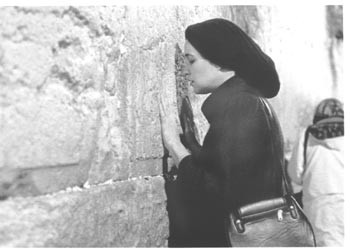
Woman on the verge: Yaël Abecassis approaches her breaking point in Kadosh.

Wailing Wall

Ultra-orthodoxy takes a toll in ‘Kadosh’

By Patrick Sullivan

TWO WOMEN conjure up very different responses to the crushing weight of religious extremism in Kadosh, a film from acclaimed Israeli director Amos Gital that opens the fifth year of the Sonoma County Jewish Film Series. Set in the ultra-orthodox community of Jerusalem’s Mea Shearim district, Kadosh (Hebrew for “sacred”) enters the world of two sisters just as their community’s harsh traditions bring their lives to the point of crisis.

The older sister, Rivka (played by Yaël Abecassis), has been happily married to her husband, Meir (Yoram Hattab), for 10 years. But there’s one small problem: no baby. The two are working at it pretty hard, as is demonstrated by a subtle but erotic love scene, and Meir loves Rivka deeply. But as his domineering rabbi tells him, in the ultra-orthodox community a barren woman is a deal breaker: “The only task of a daughter of Israel is to bring children into the world.”

The younger sister, Malka (played by the irrepressible Meital Barda), has a slightly different problem. Her parents and the community in general are pushing her to get married, but she doesn’t want to. It’s not just that her proposed husband, Yossef (Sami Hari), the rabbi’s faithful helper, is an insensitive clod, or that she’s in love with someone else. It’s that she’s not into the idea of spending the rest of her life pregnant and subservient, working to support her husband as he goes off to pray.

Indeed, one look at Barda’s crooked little smile and dancing eyes tells you that she’s not likely to hew to orthodoxy of any kind.

Still, Yossef gets his wish and marries Malka. It turns out to be as bad as she expected it to be, but she soon finds ways to make him bitterly regret the union.

But tradition has a stronger grip on her sister, who seems paralyzed as her husband comes under growing pressure to dump Rivka and pick a younger, fertile woman as a new wife. The irony is that when Rivka makes a visit to the doctor, she discovers that it’s probably her mate who is shooting blanks–not that such a scientific assessment of the problem will do her much good, given the male supremacist ideology that permeates her world.

“Blessed is our Eternal God who has not created me a woman,” Meir chants to himself as he goes through his elaborate dawn ritual of dressing and morning prayer. That sentiment eventually overpowers his richly rendered and entirely believable love for his wife, with devastating results.

It’s hardly surprising that this film was controversial in Israel, where it was first released last year. Gitai is known for his leftist documentaries, and the director’s searing take on women’s lives in the ultra-orthodox community burns like a hot iron.

But it’s unfair, as some have done, to label the film a didactic propaganda piece. In truth, the director brings a simple but evocative approach to his subject, and the actors do an excellent job of offering a nuanced portrait of the dramatic clash between tradition and modernity and the ugly human fallout that results.

Kadosh screens on Thursday, Sept. 21, at 4 and 7:15 p.m. at the Rialto Cinemas Lakeside, 551 Summerfield Road, Santa Rosa. The Sonoma County Jewish Film Series offers four more films and continues through Dec. 14. Tickets are $7.50, and season passes are available. For details, call 528-4222.

From the September 14-20, 2000 issue of the Sonoma County Independent.
© Metro Publishing Inc.

Rabid Possum Cellars

0

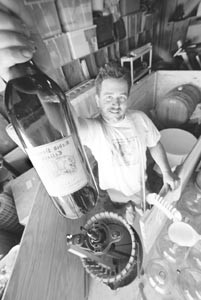
Straight outta the Rabid Possum Cellars: Healdsburg resident Jan Anderson is hooked on the DIY approach to winemaking.

Photograph by Michael Amsler

Comforts of Home

Home winemakers defy odds and drink hearty

By Marina Wolf

IN MARKETING parlance, Jan Anderson’s winemaking setup would be called “rustic.” In all blunt honesty, it’s downright primitive. The 35-year-old Healdsburg resident (whose first name is pronounced “yawn”) tastes and blends his wine in the garage of his rented house. The entire operations of Rabid Possum Cellar–one barrel, a few glass jugs, and right after the crush a few food-grade plastic garbage cans–fit into a hinged plywood box that encloses the wine and protects it from swings in temperature. In an uninsulated garage, those can be extreme; right now, for example, the garage is at least 85-90 degrees, estimates Anderson. “I used to keep a thermometer out here, but it was just giving me head games,” he says with a good-natured shrug. “If this is what I’ve got, I can’t stress about it. I just do the best I can.”

Home winemakers make jokes out of such situations–one group in Sonoma County is called the Garage Enologists of North County (GENCO for short). But the reality is not a laughing matter. Home winemaking, more than commercial winemaking, is an endless struggle with the elements, with the physical realities of temperature, space, and time.

Temperature is particularly key during the first fermentation. Too hot, and the yeasts that make wine from the grape juice die off. Too cold, and those same yeasts just can’t get going (one cold winter Anderson had to box up his wine in the “cellar” with a space heater so that fermentation would start). Later, wine is often chilled to stabilize it or to crystallize the tartaric acids for removal. Commercial wineries place their wine in stainless-steel tanks and run glycol through the double walls of the tank to bring the wine close to freezing.

But even though he’s got a pretty good home setup, GENCO president Bob Bennett has to chill his wine the old-fashioned way: “We put it outside at night for three or four nights in the coldest part of winter.”

Space is another troubling issue. Bennett has a three-car garage and a custom-built wine room on his Windsor ranchette. But many winemakers are in Anderson’s shoes, with a garage that has to hold both the wine and the washing machine. “A winery has space to leave stuff aging,” says Anderson, looking around at the crowded space. “Like at Jordan [where Anderson is a maintenance worker], they age things in the barrel two years and then age it in the bottle for another two years. I just don’t have the space for that.”

Hunting the Wild Grape

SEBASTOPOL resident James Knight has had much the same problem since he started making wine five years ago. “You have to be in the same spot to store your wine; otherwise you’re moving it around a couple times a year. You have to get your friends to store your wine or you’ve got to carry it around with you, and you have to store it at a reasonable temperature, which is just about impossible in rentals.”

Knight, 31, is one of the younger generation of home winemakers. Older enologists have had more time to get ahead, and their winemaking establishments show it. Otis Holt has been custom-building an estate home designed around his winemaking operations on 10 acres in Sebastopol. His space is heavily insulated and conditioned to maintain the temperature at an even 61 degrees. There’s space for six or seven 30-gallon French oak barrels and for rows of five-gallon glass carboys.

Holt’s methods are precise, down to using inert gas pressure to shift the fluid instead of pumps that bruise the wine and expose it to oxygen. He is a strong proponent of home winemaking, and even goes so far as to claim its potential superiority to commercial winemaking.

“You can be so meticulous about it,” he says. “The very best wines in the world are likely to be found in somebody’s winemaking setup.”

Holt’s real advantage lies with the grapes: he grows them himself.

“Having control over my own fruit is 90 percent of the battle,” he says. “I go out and pick fruit 100 pounds at a time. I don’t crush my fruit, I pay my helper to remove the berries by hand, so there are no stems, no leaves, no rotten fruit. That’s rare, having that degree of control of raw material.”

Most home winemakers, lacking the prosperity and the property, have to get their juice from someplace else, which often means buying grapes outright at prices that have skyrocketed in recent years or even making midnight raids on local vineyards.

Knight is so frustrated by this issue that he has begun to plant grapes this year in an unused corner of his parents’ property. “Other people’s grapes only cause me trouble,” he laments. “You can never tell until you’ve got them if they’re going to be good quality or not. You have to hunt for them, and they cost you.

“Even grapes that may not be good cost money.”

The alternative–picking free grapes out of other people’s vineyards–is not as free as it sounds. Gleaning after the first commercial harvest is possible, but second-crop grapes are a more common solution. These grapes are the product of inferior shoots on the vines and are lower in sugar and flavor than first-crop grapes.

But with every complaint comes a testimonial to the transformative power of garage-grown wine. Knight, even though he may be taking a hiatus from the hassle this year, still recommends it to others. “If you like wine, it’s a good idea to try to make it,” he says. “Getting your feet wet in grape juice with hornworms still crawling around it, it makes you appreciate what it really is. It’s this mucky, bubbling, bizarre process. “But you get this fine product from it.”

From the September 14-20, 2000 issue of the Sonoma County Independent.
© Metro Publishing Inc.

North Bay Authors

North Bay authors surface for a new season of books

By Greg Cahill, Paula Harris, Patrick Sullivan and David Templeton

IN A TIME when gigantic international conglomerates use multimillion-dollar marketing schemes to sell factories full of books that quickly turn into movies, video games, Web pages, and T-shirt vending opportunities, it’s easy to forget that some folks are still doing things the old-fashioned way. But sure enough, here comes another crop of offerings from North Bay authors. For the most part, these are folks who don’t have contracts with Bertelsmann/Simon & Schuster/ Amazon (or whatever the combination is this week). But what they miss in marketing they usually make up for in local color, unusual visions, and offbeat interests–not to mention enough raw talent to put us above our legal limits as a region.

Sarah Andrews An Eye for Gold (Minotaur; $24.95)

FEW WRITERS can evoke the beautiful but murderous environment of the rocky American desert as well as Sarah Andrews, who teaches geology at Sonoma State University. In An Eye for Gold, the sixth in a series of environmental whodunits featuring the conflicted “forensic geologist” Em Hansen, Andrews outdoes herself, delivering her juiciest rock-writing yet, as Em takes a case that leads across Utah and Nevada–and straight down into the bowels of the earth.

At the close of Andrews’ last book, Bonehunter, Em had fallen in love with a hunky Mormon cop–a creationist, of all people! At the start of the new novel, Andrews’ contemplative heroine is mulling over the cop’s marriage proposal when she allows herself to be lured into a case involving a bogus mining operation and a very dead body. As always, the frequent scientific descriptions are crisp and clear, but it’s the ever-intriguing Hansen who keeps those pages turning.–D.T.

Marsha Diane Arnold The Bravest of Us All (Dial Press; $15.99)

“WHEN MY SISTER Velma Jean was ten, there was nothin’ she was afraid of. Well, almost nothin’. Of us seven brothers and sisters, she was the bravest of us all.” So begins Marsha Diane Arnold’s emotionally complex new picture book, The Bravest of Us All, featuring the rich and evocative illustrations of Brad Sneed. Arnold–who lives in Sebastopol–has fashioned a reputation as the writer of children’s books that adults can’t wait to read aloud to their kids and grandkids, books like Heart of a Tiger, The Pumpkin Runner, and The Chicken Salad Club. While these earlier works explore the relationships that children have with their parents, grandparents, and great-grandparents, the new book shows the sometimes resentment-filled love that young sisters often share. Set in the Depression-era Midwest, the story gives us the wild-eyed Velma Jean, a sister who seems to be afraid of nothing–even “biting catfish”–and the other sister, whose loyalty and love, while a bit less flashy than Velma Jean’s derring-do, are as deeply rooted and ultimately every bit as heroic.–D.T.

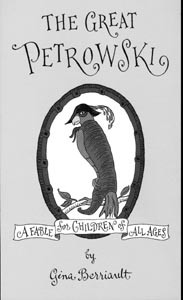
Gina Berriault The Great Petrowski (Thumbprint Press; $14.95)

DEATH deprived the world last year of a writer the New York Times once hailed for sentences that were “jewel-box perfect.” Gina Berriault, a Sausalito resident and PEN/Faulkner prize winner, left behind this beautifully written fable for children of all ages about a singing parrot that sets out to save his native rainforest through opera. It takes about an hour to read and leaves one with a lingering impression of the author’s quiet presence.–G.C.

Richard Blair, photographs; Kathleen Goodwin, text Point Reyes Visions (Color & Light Editions; $45)

FOG-SHROUDED HILLS. Fishing boats anchored in the cool blue waters of Tomales Bay. Rotting barn wood that seems to sprout miraculously from the dark, damp earth. These images evoke the untamed nature of the Point Reyes peninsula, captured in striking beauty by photographer Richard Blair and writer Kathleen Goodwin, the husband-and-wife team responsible for this museum-quality art book that showcases the place they have called home since 1988. The wildlife, the people, the landmarks, the rugged spirit of this place that attracts travelers from throughout the world and holds local residents under its spell, all are displayed here in the pages of this elegant collection of photographs and essays.–G.C.

Ellen Boneparth Death at the Olive Press (Self-published; $25)

ELLEN BONEPARTH is a former U.S. diplomat to Greece. Now a part-time resident of Santa Rosa, Boneparth spends her summers on a small Greek Island, where her home is . . . an olive press. An ancient edifice that has been fully restored, the olive press has now also become her inspiration. Death at the Olive Press is not the Agatha Christie knockoff the title suggests. With simple, uncluttered prose and authentic-sounding dialogue, the author weaves a tale of Alexis Davidoff, an expatriate American who attempts to restore an old olive press while enduring harassment from a handful of unfriendly locals. When she is framed for murder, Alexis fights to save her own life and keep her adopted home.–D.T.

William P. Brothers The Sabbatical (Vantage Press; $18.95)

SEX, LIES, and ruthless ambition mingle with surprisingly tedious results in The Sabbatical, Cloverdale author William Brothers’ acerbic take on life in the Ivory Tower. Set in the bizarre world of the Institute for Human Affairs, a Southern California think tank full of pugnacious and eccentric researchers, the book focuses on a young graduate student named Peter Parsons who hatches a brilliant plot to get grant money to take a leisurely sabbatical in Spain. Things don’t go according to plan, of course, but both Parson and the reader learn plenty about the underside of academic life along the way. The Sabbatical fools you: the story starts out in a lively and entertaining fashion, but the author heaps on long and complicated passages expounding his views on academic intrigue, and slowly the plot grinds to a crawl under this weight.–P.S.

David G. Dodd and Diana Spaulding, Editors The Grateful Dead Reader (Oxford University Press; $25)

SCRIBES HAVE spilled a lot of ink in praise of the Grateful Dead, the quintessential hippie band. Dodd and Spaulding, a husband-and-wife authorial team hailing from Petaluma, scoop up the best of the lot, for the most part (aside from a long-winded bit of hype from Dead publicist Dennis McNally), in a transcendent anthology that says as much about American popular culture as it does about this beloved band of psychedelicized troubadours and the legion of misfits that followed them. Authors include Tom Wolfe, Richard Brautigan, the late music critic Ralph Gleason, Grateful Dead lyricist Robert Hunter, and BAM editor Blair Jackson, who writes about the dark side of the Deadhead phenomenon.–G.C.

Gerald Haslam Straight White Male (University of Nevada Press; $17)

THE TITLE tells you much of what you need to know about this novel’s protagonist. Now a middle-aged college professor living comfortably amid the money-green hills of tony Mill Valley, Leroy Upton grew up a world away, in a working-class neighborhood in sun-blasted Bakersfield, where his father worked as an oil-field roughneck. But surprise: the boy can pull himself out of the oil fields, but the oil fields just don’t come out of the boy. As Upton’s comfortable life starts to crumble under a variety of pressures–his once invincible father is stricken with senility, and his mother wrestles with mental illness–he begins to come to grips with his own past, including his still deeply felt resentment over his wife’s youthful indiscretions. Haslam (who lives in Penngrove) paints a compellingly vivid contrast between the rough-and-tumble world of his protagonist’s childhood–which is described in a series of flashbacks–and the modern reality of the Bay Area, which in Upton’s eyes is sprouting a bumper crop of expensive cars and pretentious assholes who consume far too much mocha cappuccino. If this sounds a bit like a story that’s been told before, that’s because it has. But Haslam redeems the clichés with his usual eye for detail and compassionate understanding of human frailty.–P.S.

Leza Lowitz Yoga Poems: Lines to Unfold By (Stone Bridge Press; $14.95)

CALL IT A TWIST of fate. On a certain winter evening five years ago–shortly after moving to Northern California after a five-year residence in Japan–North Bay poet Leza Lowitz was patiently enduring Downward Facing Dog (a torturously demanding hatha yoga position) when a single line of poetry materialized in her mind: “Within my body, there’s a city.” The line reminded Lowitz of her beloved Tokyo and thus gave some comfort. By the end of the session, she’d found other lines, and a poem–appropriately titled “Downward Facing Dog”–was born. She didn’t know it yet, but that was the beginning of a book.

Yoga Poems, illustrated by Anja Borgstrom, is a unique series of poems inspired by various yoga positions and the insights of Lowitz’s own yoga practice. Marked by Lowitz’s serenely calm, confident craftmanship, the collection provides a rich, subtle, emotionally affecting experience that, while obviously appealing to yoga practitioners, also deserves the attention of a much wider audience.–D.T.

Carista Luminare-Rosen Parenting Begins before Conception (Healing Arts Press; $16.95)

IF THE FOLKS at Hallmark ever get hold of Parenting Begins before Conception, we’ll surely see a whole spate of pre-Mother’s Day cards for women who might not officially be mommies for years but are actively preparing their minds and spirits for eventual mommyhood. According to the sure-to-be controversial new book by Petaluma-based holistic prenatal counselor Carista Luminare-Rosen, the parenting process begins, as the title says, “before conception.” Way, way before. An important part of the author’s view is that we’ve all met before in past lives and are now swapping parenting positions (“You were the baby in our last lifetime, so I’ll be the baby this time”) to express each other’s divine natures in human form. Mixing spiritual philosophy with practical everyday advice (from the ins and outs of glands and hormones to the finer points of building financial security), Parenting is like no parenting book you’ve ever read.–D.T.

Ken Mansfield The Beatles, the Bible and Bodega Bay: My Long and Winding Road (Broadman & Holman; $24.99)

DURING the heyday of the Fab Four, Bodega Bay resident Ken Mansfield lived the dream of every Beatlemaniac–he worked for the band as U.S. manager of Apple Records. This book recounts some of his experiences. It also shares space (in alternating chapters) with meditations on God and the sea. In his intro, Mansfield–who now runs a small gift shop with his wife–posits that those who skip the biblical reflections will be eating the lettuce and tossing out the meat patty from this metaphorical sandwich. Beatles fans may see it differently. Overall, info-starved fans will find a few interesting tales–especially the tennis match between Mansfield and New York lawyer-turned- Beatles business manager Allen Klein, waged to decide the fate of Mansfield’s job–but little substantive news about the band members (Mansfield obviously was closest to Ringo, who carried little weight in the band’s body politic) or their tangled business dealings. And, oddly, for all his soul searching, Mansfield reveals little about his own demons.–G.C.

Megan McDonald Judy Moody (Candlewick Press; $15.99)

“JUDY MOODY was in a mood. Not a good mood. A bad mood.” The starting paragraph of Megan McDonald’s new mini-novel is so compelling and perfect that the publisher decided to start the story right on the front cover. Judy Moody, illustrated by Peter Reynolds, is the story of a third-grader with a creative mind and a cranky attitude. Watch out: she’s even snipped actual holes in the book’s paper jacket. McDonald–a Sebastopol author with over 15 kids’ books to her credit–has created a potential superhero in Judy, a girl so focused on becoming a doctor (because it’s gross!) that she’s already started collecting Band-Aids–and scabs. She performs operations on her dolls. She tries her darnedest to frighten poor Frank Pearl, who eats paste. The simple plot centers on Judy’s first major school assignment: assembling a collage of pictures that represent Judy Moody. “It’s a Me Collage,” she says. The simple project sends Judy on a complicated inner journey of personal discovery–sort of–that by the end of this charming, very funny book has gone a long way toward changing Judy Moody’s infamous mood.–D.T.

Jessel Miller Mustard: Lessons from Old Souls (Self-published; $24)

THIS LATEST children’s book in the Mustard series by Jessel Miller, a Napa art gallery owner, is a preachy-sweet tome about a contented, ecologically correct couple named Mustard and River who become new parents to twins named Meadow and Forest. Each oversized page teaches lessons about the power of nature and community values. The peaceful picture is completed with the author’s bright watercolor illustrations of smiling people, animals, and flowers, usually with a backdrop of Napa Valley mustard fields.–P.H.

Jeff Ott My World: Ramblings of an Aging Gutter Punk (Sub City; $15)

TELL YOUR KIDS to dare to stay sober (“Just Say No!”) or, better yet, give ’em a copy of Jeff Ott’s new book, a powerful dispatch from the underground by a committed activist and former drug user who has lost more than his share of friends to wasted lives and cheap heroin. Ott, a Santa Rosa resident, is a familiar face–this rock musician and Food Not Bombs activist once graced the cover of this publication. His brief autobiography is a blend of personal notes, interviews, wry observations, guest essays (including a chilling account of a 15-year-old OD victim), condemnations of the power elite, and resources for social justice and surviving on the streets. An often compelling read–suitable for backpacking through America’s urban jungles.–G.C.

Drew Sparks and Sally Kellman A Salon at Larkmead: A Charmed Life in the Napa Valley (Ten Speed Press; $19.95)

THIS BOOK by Napa Valley resident Drew Sparks and Sally Kellman chronicles the life of Lillie Hitchcock Coit, San Francisco’s legendary Firebelle, in 19th-century Napa Valley. Coit built a sprawling estate in Larkmead to be near her mother, Martha Hitchcock. The two women enjoyed a life of privilege and pleasure in the blossoming Napa Valley, a fresh haven of new wine estates and fashionable resorts. Excerpts from Martha’s diaries are included here with her recipes, archival photographs, and richly telling observations on a “life of confusion and excitement.”–P.H.

Maurice Taylor and Seana McGee The New Couple: Why the Old Rules Don’t Work and What Does (HarperSanFrancisco; $25)

ESCALATING divorce rates, serial monogamy, lonely folks who have been scared single: the old rules for relationships don’t seem to be working anymore. But buck up, because this Sausalito husband-and-wife team of therapists has discovered some new ones. In The New Couple, Taylor and McGee draw on both case studies from their practice and their personal experiences to offer the “Ten New Laws of Love,” which they say will help people move beyond the traditional views of relationships to healthy new ways of meeting the emotional needs of both partners.–P.S.

From the September 14-20, 2000 issue of the Sonoma County Independent.

© Metro Publishing Inc.

Usual Suspects

0

Progressive rally in Petaluma

By Greg Cahill

PROGRESSIVES don’t carry nearly as much clout in Sonoma County–or the rest of the North Bay, for that matter–as they once did. Even the hardcore draconian gang that once ruled Bolinas on the Marin County coast as if it were their private fiefdom have been caught asleep at the wheel with the recent revelation that yuppie queen Martha Stewart plans to relocate to that remote burg (and that other millionaires are buying up key chunks of real estate in the area).

But that hasn’t stopped local lefties from flocking to Walnut Park in Petaluma for an annual bash that draws a few hundred folks (though this year, the faithful mingled with patrons of Art in the Park, so it’s unclear who was on hand for political glad-handing and who was present to ogle the art). On Sept. 10, the Progressive Festival featured speeches by peace activist Daniel Ellsberg and a handful of other dignitaries. The global human rights group Amnesty International used the third annual event to bestow an award on Rep. Lynn Woolsey, D-Petaluma, for her work with the Santa Rosa chapter of the organization to free Zhang Jie, a Chinese prisoner of conscience who has been jailed since his arrest in connection with the 1989 uprising in Tiananmen Square in Beijing.

“Lynn Woolsey’s commitment to human rights is clear, and that’s why we’ve chosen to honor her,” noted Margo Miller, congressional liaison for Amnesty International.

I’m So Lonesome I Could Cry

SPEAKING of progressives, the Santa Rosa City Council–which is dominated by a conservative bunch, to put it mildly–has put City Councilwoman Noreen Evans in a twist by allegedly directing City Hall staff members to notify folks about public meetings “in such a way” as to exclude Evans from attending and participating in city business.

In a Sept. 7 letter to the City Council, Evans–a progressive politician who failed in her bid earlier this year to win a seat on the conservative county Board of Supervisors–claims that she was told by members of the Board of Public Utilities Liaison Committee that the City Council “had given direction” that Evans was not allowed to participate in the meeting, an apparent violation of the state’s open-meeting law.

In the wake of that fiasco, Evans says she has discovered that the city failed to notify her properly about at least three other key city meetings, including a general plan management team of which Evans is the chairperson.

Hmmm. What was it underground FM radio reporter Scoop Nisker used to say? No matter how paranoid you are, they’re always doing something worse than you imagined.

Cry Me a River

SPEAKING of underappreciated, the Russian River–long regarded as Santa Rosa’s unofficial cesspool–could use a few good friends. And that’s exactly what the eighth annual Russian River Appreciation Festival–Saturday, Sept. 16, from 3 to 6 p.m.–is all about. The event, co-sponsored by the Friends of the Russian River, the Russian River Environmental Forum, and the Sonoma County Conservation Council, will be held at the Hop Kiln Winery (owned by longtime vintner and environmentalist Marty Griffin), 6050 Westside Road, Healdsburg. State Assemblywoman Virginia Strom-Martin–who this week hosted an eco-economics hearing–Supervisor Mike Reilly, and Fred Euphrat will share the emcee duties.

The Petaluma City Council will be honored for taking a stand against county growth interests by refusing to sign an agreement increasing the diversion of water from the river. Both the county Board of Supervisors and the Santa Rosa City Council have threatened retaliation for that act of conscience.

And that’s enough to put those Sonoma County progressives into action once again.

See related article or call 578-0595 for details.

Usual Suspects loves tips. Call our hotline at 527-1200 or e-mail us at In**@******re.com.

From the September 14-20, 2000 issue of the Sonoma County Independent.

© Metro Publishing Inc.

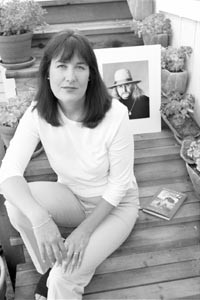
Santa Rosa Writer Ianthe Brautigan

Fishing expedition: Santa Rosa writer Ianthe Brautigan’s new book explores the life and death of her father, Richard Brautigan, author of Trout Fishing in America.

Photograph by Michael Amsler

Gone Fishing

Writer Ianthe Brautigan comes to terms with her famous father’s legacy

By Yosha Bourgea

IANTHE BRAUTIGAN Swensen was 24 in the fall of 1984 when she enrolled in a writing class at Santa Rosa Junior College. On Oct. 25 of that year, the body of her father, author Richard Brautigan, was found in a house in Bolinas beside a bottle of alcohol and a .44 Magnum. He was 49 years old.

It was in the class, taught by Sonoma County Poet Laureate Don Emblen, that Ianthe first began to write about her father’s suicide. “For whatever reason, experiences were happening in my life that were so large they couldn’t be contained in my body,” she remembers. “So I started writing.”

The journey she began that fall would find its way into print this past spring, 16 years later, with the publication of her first book. You Can’t Catch Death (St. Martin’s Press; $21.95) is a memoir of Richard Brautigan’s life and of the aftermath of his death, as seen through the eyes of his only child. It is a haunting, perceptive portrait of a man whose great talent as a writer was shadowed by alcoholism and the ghosts of his past.

“There was a point when I realized that [I could] write about my dad using techniques of fiction,” Ianthe says. “It felt almost easier to get to the material that way. When you write in your journal, or at least when I do, I’m complaining about things. But if you’re telling your story in a more amplified way, all that drops away.”

Ianthe now lives in Santa Rosa with her husband, producer/director Paul Swensen, and their 14-year-old daughter, Elizabeth. Ever since You Can’t Catch Death was released in May, she has been busy doing interviews and readings from the book.

“I didn’t anticipate the enormous freedom that I would feel,” she says. “The problem with suicide is that there’s so much shame associated with it. When all the words were finally out there, it was like, OK, this is a good thing. Shame has an enormous amount of power over you.”

Ianthe’s first reading was in Santa Rosa at Copperfield’s Books, where she is a part-time employee. The reception she received astounded her. “People have been giving me gifts,” she says. “I get people who are interested in the book because they have some relation to suicide. Then there’s a big constituency that’s my dad’s, and they’re all so welcoming and excited to see me. I’ve not had one nut.”

Richard Brautigan vaulted to fame in 1967 with the publication of his second novel, Trout Fishing in America. Written in a kaleidoscopic, deadpan-absurdist style that confounded critics and academics, the book caught on with the counterculture movement and became hugely successful, eventually selling several million copies around the world.

His other early books, A Confederate General from Big Sur, In Watermelon Sugar, and The Pill versus the Springhill Mine Disaster, also became popular, especially with college students. Early in his career he was labeled “the last of the Beats,” an association that stuck with him long after he left the Bay Area and moved to a ranch in Montana. By the time of his death, he had published 10 novels, nine volumes of poetry, and a collection of short stories.

But for all the popular acclaim, Brautigan was never accepted by the American literary establishment. It may have been his popularity, in fact, that prompted many critics to write him off as a temporary phenomenon.

“His style is very literary, but it’s also very accessible,” Ianthe says. “I think we have confused accessibility with being nonliterary. In France, he’s revered, and they write books of criticism about him. And he’s appreciated in Germany and places like that. But here, he’s still a secret, very word-of-mouth.”

After she finished You Can’t Catch Death, Ianthe discovered among her father’s papers a manuscript that had been completed before his death, but never published. It was released concurrently with the memoir, under the title An Unfortunate Woman (St. Martin’s Press; $17.95).

“There are parts of the book that are painful to me and will always be really painful, but when I look at them now, it’s so much easier,” Ianthe says.

The novel–which has been both praised and panned by critics–is written as an apparently haphazard pastiche of journal entries. Many of the events described in the book closely mirror events in Brautigan’s own life. One passage reads, in part: “One of the letters I got today was from my daughter. . . . She got married last year and I disapproved of the marriage and things have been strained ever since then between us . . . . She and I were very close until she got married. Now our communication is minimal and strained. Perhaps I should bend a little. I don’t know.”

The passage was written in 1982, a year after Ianthe, then 21, got married despite her father’s angry opposition. “It was the first time we had really disagreed on anything,” she remembers. “And it came at a bad time for him, emotionally. He was not equipped for a disagreement. [In the past] I had pretty much acclimated myself to whatever his thing was, whatever he wanted.

“Now that I’m older . . . ,” she pauses. “My husband and I lucked out, and we’ve been married 18 years, which is phenomenal. But I would not be thrilled if my daughter wanted to get married at 21.”

Ianthe remembers a father who was both protective and permissive.

“Even though he was quote-unquote a bohemian, even though he was not monogamous, there was a real moral dimension to him,” she says. “But it didn’t involve exterior rules; it had to do with common sense and respecting people.

“I went to Haight-Ashbury as a 7-year-old with him, and we’d meet up with the Diggers, and they would have these big free dinners,” she continues. “But as soon as the whole scene changed and got weird and violent, he stopped taking me there. He kept me very compartmentalized.”

In the wake of Brautigan’s death, newspapers and magazines from around the country had a go at his obituary. For the most part, Ianthe says, they got it wrong.

“I think that suicide terrifies people so much that they have to come up with really easy answers,” she says. “The thing about the press is, you’re kind of framed before you even start. People wrote things like: ‘Richard Brautigan, onetime ’60s icon, loses fame, loses fan base, kills himself.’ They were sending him up, and then they threw in Trout Fishing, and that was basically the story.”

Because there was so much more to the story than fame and death, Ianthe decided to add her own perspective. Both her father’s life and his writing, she felt, deserved more than a cursory glance.

“Whenever I read my dad’s stuff, there’s always the sense of somebody alone, walking down the street,” she says. “I see the shadow in everything, and the loneliness, and the hauntedness. But he always leaves you with something.

“My father was very funny,” she says. “He wasn’t gloomy all the time. That’s why, for me, I accept the body of his work as a whole. You have the shadow side, you have the lonely side, you have the hysterically funny side, you have the dignified side. He was a storyteller.”

From the September 14-20, 2000 issue of the Sonoma County Independent.

© Metro Publishing Inc.

The Barenaked Ladies

0

Nice nerds: The Barenaked Ladies are an antidote to butt-rock bands.

Nude Girls!

Barenaked Ladies: New CD for adults only

By Gina Arnold

THE BARENAKED Ladies are one of those extremely rare cases of nice guys coming in reasonably near to the head of the pack. And for that alone, their music should be praised to the skies. After all, they don’t play butt-rock (a term coined to describe the type of hate-filled dumb redneck music of acts like Limp Bizkit, Kid Rock, Eminem, and others). Instead, I think of the Barenaked Ladies as a Canadian version of the Young Fresh Fellows, a band I consider one of America’s finest.

Like the Fellows, who are neither young nor fresh, this band is neither nude nor female. What they are is a plain old guitar-based rock band with a love of plain old bands like the Beatles and the Beach Boys augmented by a seriously debilitating sense of humor.

On the face of it, the Barenaked Ladies are an unlikely success story, since their lyrics are not mean, violent, or sexy. Also, they play tuneful, midtempo, funny rock–kind of in the same camp as that of Ween, the Dead Milkmen, and They Might Be Giants. Like the Giants, they excel in the live arena, where they are known for goofy medleys of rap and pop songs, precision dancing, and audience participation. In person, it is darned hard not to like the Barenaked Ladies. Yet, although they are a truly wonderful live act, they are not particularly good-looking, videogenic, or pretentious–three things that tend to be essential to success in America.

Perhaps because of their lack of charisma, their career to date has had a peculiar trajectory. In 1992, their debut LP, Gordon, sold 950,000 copies in Canada, catapulting them into stardom. Of course, it’s a lot easier to succeed as a rock band if you’re Canadian, as the government insists that all radio stations play mostly Canadian music. Even so, something funny happened to the Barenaked ones, because their next three LPs sold fewer and fewer copies, bottoming out at 150,000 in 1997.

THEIR CAREER reignited in 1998 when Sarah McLachlan’s management, hot off the Lilith Fair phenom, took them on, leveraging that Lilith Fairy clout into airplay for the 1998 LP Stunt. With constant touring–the band crossed the Canadian tundra six times in one year–and a splendid live show, the Barenaked Ladies broke into America, going triple platinum on the strength of the single “One Week,” a goofy-white-boy rap about a weeklong fight between a boyfriend and a girlfriend with the chorus “It’ll still be two days till I say ‘I’m sorry.’ ”

“It’s All Been Done,” the follow-up single, is slightly more indicative of the Barenaked Ladies’ strengths: a harmony-laden, jangle-pop tune with thoughtful lyrics and a soaring chorus. Nevertheless, although in 1998 they were one of the few bearable bands on the radio, the Barenaked Ladies have not become a household name, probably because they haven’t been able to distinguish themselves from other all-guy, two-guitar rock bands that inhabit the earth in such great numbers.

The newly released Maroon (Reprise) is the Barenaked Ladies’ seventh LP, and although it continues to provide a steady stream of catchy rock songs about problem relationships, it is also weirdly staid. Gone are lyrics like “If I had a million dollars I’d buy you some art–a Picasso or a Garfunkel” and “Like Harrison Ford I’m getting frantic/ Like Sting I’m tantric.”

INDEED, adult is the word that comes to mind when listening to this record. This could be because one member of the Barenaked Ladies, Kevin Hearn, has just completed a two-year battle with leukemia, and the emotional impact seems to have had a truly profound effect on the band’s songwriting. They’ve always been articulate, but these songs have an unexpected extra layer of depth. There’s no simple pop tune on here, no “One Week” that rhymes wasabi and Lee Ann Rimes.

Instead, there are songs like “Pinch Me,” a slow-tempo philosophical reverie about a guy who can’t figure out what the meaning of life is, and various other songs about relationships that never slip into easy answers. Then there’s “Helicopters,” which equates certain aspects of rock touring with the fall of Saigon. It is a beautiful song, with a delicately felt subtext, a great deal richer than most songs with this kind of very lightweight tunefulness and instrumentation.

Even more poignant is “Tonight I Fell Asleep at the Wheel,” which confronts quite literally the idea of dying young–without, somehow, sinking into morbidity or even depression.

In short, Maroon is a mature record–and that’s kind of an odd thing for a rock ‘n’ roll band to be. After a decade of shooting all over the charts, this may be the moment when the Barenaked Ladies find their real level, and the unfortunate thing is, it’ll probably be back down the food chain a bit–where nice guys belong.

I mean that as a compliment, though: this stuff is just too good and too subtle for the masses.

From the September 14-20, 2000 issue of the Sonoma County Independent.

© Metro Publishing Inc.

Fashion Junkies

Fashion junkies abound in mainstream America By Laura Compton MY FRIEND Jeff used to be the most devoted thrifter I knew. An accountant by day and an artist the rest of the time, he visited Salvation Army stores sometimes twice a day, hit garage sales and flea markets every weekend, and created wallets and art...

Mistral

Mistral presents a local farm-food extravaganza By Paula Harris SET THE TABLE, set the stage. That's the motto master showman Michael Hirschberg, energetic proprietor of Santa Rosa's Mistral Restaurant and Wine Bar, and his equally star-struck staff seem to have taken on with unabashed theatrical glee. "Dinner here is like a performance,...

Sparks at the Inn

Haute stuff: Alex Bury has sparks flying at Sparks in Cotati, a wellexecuted gourmet vegan eatery. Photograph by Michael Amsler Enlightened Eating Sparks serves gourmet vegan fare By Paula Harris NOT TOO LONG AGO a restaurant in food-lovin' San Francisco turned gourmet dining on its collective shell-like ear...

Russian River Celebration

Current events: Environmental activist Kay McCabe has created a watershed event that highlights the issues facing the Russian River--a source of water for Sonoma and Marin counties--without getting bogged down in politics. Liquid Assets Celebrating the Russian River By Bill Strubbe "IN RETROSPECT, I am amazed that...

Kadosh

Woman on the verge: Yaël Abecassis approaches her breaking point in Kadosh. Wailing Wall Ultra-orthodoxy takes a toll in 'Kadosh' By Patrick Sullivan TWO WOMEN conjure up very different responses to the crushing weight of religious extremism in Kadosh, a film from acclaimed Israeli director Amos Gital that opens the...

Rabid Possum Cellars

Straight outta the Rabid Possum Cellars: Healdsburg resident Jan Anderson is hooked on the DIY approach to winemaking. Photograph by Michael Amsler Comforts of Home Home winemakers defy odds and drink hearty By Marina Wolf IN MARKETING parlance, Jan Anderson's winemaking setup would be called "rustic." In...

North Bay Authors

North Bay authors surface for a new season of books By Greg Cahill, Paula Harris, Patrick Sullivan and David Templeton IN A TIME when gigantic international conglomerates use multimillion-dollar marketing schemes to sell factories full of books that quickly turn into movies, video games, Web pages, and T-shirt vending opportunities, it's easy to forget that...

Usual Suspects

Progressive rally in Petaluma By Greg Cahill PROGRESSIVES don't carry nearly as much clout in Sonoma County--or the rest of the North Bay, for that matter--as they once did. Even the hardcore draconian gang that once ruled Bolinas on the Marin County coast as if it were their private fiefdom have been caught asleep at...

Santa Rosa Writer Ianthe Brautigan

Fishing expedition: Santa Rosa writer Ianthe Brautigan's new book explores the life and death of her father, Richard Brautigan, author of Trout Fishing in America. Photograph by Michael Amsler Gone Fishing Writer Ianthe Brautigan comes to terms with her famous father's legacy By Yosha Bourgea IANTHE BRAUTIGAN Swensen...

The Barenaked Ladies

Nice nerds: The Barenaked Ladies are an antidote to butt-rock bands. Nude Girls! Barenaked Ladies: New CD for adults only By Gina Arnold THE BARENAKED Ladies are one of those extremely rare cases of nice guys coming in reasonably near to the head of the pack. And...
11,084FansLike
4,606FollowersFollow
6,928FollowersFollow