restaurant name

Just Like Home

By Marina Wolf

Comfort food. Just reciting the list of usual suspects–macaroni and cheese, chicken noodle soup, meat loaf–is strangely relaxing, as though in speaking the dishes aloud we invoke their comforting powers. But here’s a tip, in case you didn’t already know: any food can be comfort food at the right place and time.

The season has something to do with it, for sure. Just the other day, after a hot morning hike in shoes that didn’t breathe and socks that collected burs like a stray dog’s coat, I sat down to a chunk of watermelon from the fridge. It was an inspired choice, seedless, succulent, and soothing in much the same way as a good chicken soup is on a bad winter’s day. They both equalize body temperature, which in extreme weather conditions is a very comforting thing.

But comfort food goes beyond physical needs, into issues of class and culture. Our choices for soothing suppers reveal everything about us. We take with us our culture’s choices–miso in Japan, in Germany maybe potato pancakes–and overlay them with family favorites. The qualities may be identifiable and similar from culture to culture–smooth, creamy, hot, savory–but the mix is unique. On an individual level, our choice of comfort food is as changeable as our moods.

True comfort food, whatever its form, meets all the desires and needs we bring to the table at any given moment. After a particularly challenging day at work, I might crave the relief and sheer adolescent self-indulgence implicit in, say, a big glass of tomato juice and a bowlful of cheddar•sour cream potato chips (a snack from my teenhood, associated with trashy books and a warm summer’s day). Another time, on a long-overdue date with my sweetie, I may be drawn to a melting filet mignon, a smooth velvety morsel that gives me an excuse to shyly offer a bite across the table. This is what psychologists and Oprah call emotional eating, and I don’t think there’s anything wrong with it. On the contrary, these comfort foods represent the body’s basic need to soothe itself.

Now, I’m not so messed up that I always need comfort food. But I am always on the lookout, and every once in a while I’ll stumble across a new food with real comfort potential. A few years ago, I started a new job 100 miles from home, which necessitated occasional overnight stays at an acquaintance’s house. My friend didn’t say anything about food, so when I stumbled back after the first day–tired, frustrated, and hungry–I anticipated only a strange bed and an empty stomach.

Instead, my hostess met me at the front door, ushered me into the kitchen, and sliced up a baguette, crusty with sesame and poppy seeds. I sat there on a barstool, blinking like an owl, while she rattled stacks of Tupperware out of the refrigerator and onto the counter. One container held some trout that her husband had caught and smoked himself. Did I want to try some? Another container contained a velvety rind of Cambozola; I’d never heard of it, but sure.

I timidly sliced off a piece of the fragrant cheese, spread it on the bread, and took a bite. All in a rush, my appetite for life came back and settled happily along the sides of my tongue. I wanted to faint, it was so good. The sesame seeds from the bread burst against my teeth. The cheese melted in a flood of saliva. The trout flaked delicately in my fingers. I had never eaten some of these foods before, but tasting them, I recognized them immediately as symbols of care and concern. They were as comforting as my mother’s own milk, too comforting for words, or even to say thank you. Until now.

From the October 5-11, 2000 issue of the Northern California Bohemian.

© Metro Publishing Inc.

‘Almost Famous’

0

Crazy Days

Ben Fong-Torres on the death of rock and roll

Writer David Templeton takes interesting people to interesting movies in his ongoing quest for the ultimate post-film conversation.

‘FIRST OF ALL, I’ve got to say it,” pronounces author Ben Fong-Torres, shortly after catching Almost Famous for the third time. “The movie does a great job of re-creating its particular time period. And I think it re-creates the feeling of falling in love with music–and of falling in love, in general–extremely well.

“It also,” he continues, “captures the rush of being a part of the rock music scene, of being allowed, even temporarily, into the inner circle of musical stardom.”

OK, stop. Wait. Hold it a minute.

Though Fong-Torres has a lot more to say about the movie–and I have a point or two of my own to share–maybe we should stop and let the rest of you catch up first.

First of all, the time period to which Fong-Torres refers is the year 1973, when he was serving as editor of the then 4-year-old Rolling Stone magazine. By that time, the Oakland native had already fallen in love with music himself, having had his own rock-and-roll cherry popped by Elvis Presley way back in the ’50s.

Almost Famous–a mostly entertaining and funny film that’s just a little dry around the edges–is director Cameron Crowe’s semi-autobiographical rock-and-roll fantasy based on his own early days as a starstruck 15-year-old writing for Rolling Stone.

It’s a classic coming-of-age story, as the innocent, embarrassingly uncool lad is sent out on the road (assigned by a then twentysomething Ben Fong-Torres) to cover the backstage shenanigans of an up-and-coming rock group named Stillwater (a fictional amalgamation of several ’70s bands that Crowe actually did write about).

The kid is played with wide-eyed wonder by young Patrick Fugit, the band’s intense lead-guitar player by Billy Crudup, and the band’s favorite groupie–excuse me, their favorite “Band Aide”–by the brittle but sweet Kate Hudson. Fong-Torres is portrayed, in a handful of goofy scenes, by Terry Chen.

Some of Fong-Torres’ own Rolling Stone memories are captured in Not Fade Away: A Backstage Pass to 20 Years of Rock & Roll, a collection of the author’s interviews, featuring a colorful foreword by Cameron Crowe.

“While Cameron’s movie shows what it’s like to be a writer on the road with a band,” he observes, “it also catches, very vividly, the frustration of being ultimately defined as being on the other side of the line. Because, by being a journalist, you are not an insider.

“Even though you’ve been pulled into the huddle,” he continues, “even though you’ve been allowed backstage, and even though the musicians have talked to you as if you were something more than a reporter, still finally, the line is there, and you are the enemy.

“I think the movie drew those portraits quite vividly, and it did a great job.”

“And as a depiction of the young Ben-Fong Torres?” I ask.

“Well. As a depiction of the young Ben Fong-Torres, it was an absolute disgrace!” he says. “In fact, I’m calling my attorneys immediately. Better yet, I’m calling Hunter Thompson. He’ll take care of Cameron. He’ll pull him up to Colorado, take him out to Woody Creek for a little target practice.”

“But didn’t you really throw the word crazy into every single sentence,” I ask, “like you do in the movie?”

“Actually, no, I didn’t,” Fong-Torres replies. “I mean, I did say ‘crazy,’ but it was in a different context usually. Let’s call it an affirmative, approving nod. If Cameron had said, ‘Hey, I finally scored that interview with Neil Young and we talked for an hour and a half,’ I would say, ‘Crazy.’

“Not ‘Ca-raaaaaaa-zy!’ “

For the record, Fong-Torres does a spot-on impression of Terry Chen doing a bad impression of Fong-Torres. But there are better things to talk about.

“So tell me about the whole rock-and-roll-being-dead thing,” I say, referring to the pessimistic rantings of Lester Bangs, the real-life rock critic and provocateur (played by Phillip Seymour Hoffman) who was something of a mentor to Crowe.

“When that conversation came up in the movie, I thought back to this interview I did with Jim Morrison in 1971,” Fong-Torres says, “where one of the subjects of discussion was the death of rock and roll. It seems that from the late ’60s on, the recent death of rock and roll has been a recurrent subject. Rock and roll is always dying.

“You have to listen to the Lester Bangs speech to get a sense of what he was talking about,” says Fong-Torres.

“It was the aggressiveness, the rebelliousness, the take-no-prisoners approach to rock-and-roll music that people thought had died. The other thing that had died was the belief that rock and roll would somehow change the world.”

FOR SURE. According to Bangs, the commercial aspects of the music industry had possessed rock and roll, destroying the purity of its once revolutionary soul. But since rock was essentially created by Little Richard and Chuck Berry and the like–people who weren’t really angling for a hippie revolution–it could be argued that the revolutionary element in the ’60s sort of co-opted rock and roll.

“I don’t know about being co-opted–that’s a strong word to use,” says Fong-Torres. “I think music, including rock and roll, is always being conjoined to causes, to societal changes, to political interests and all of that. That’s nothing new either.”

“Yet the rock-and-roll-is-dead people do seem to feel a sense of ownership of the music,” I say. “Lester Bangs was certainly expressing a sense of ownership the music, and he was pissed that someone had stolen it away from him.”

“And God bless Mr. Bangs and all people like him,” Fong-Torres says laughingly. “They may have the loudest, most articulate voices, but that doesn’t mean they’re the majority.

“For every fan today who bemoans the state of popular music, there are a hundred others going out and buying Britney Spears T-shirts.

“What’re you gonna do?” he concludes.

From the October 5-11, 2000 issue of the Northern California Bohemian.

© Metro Publishing Inc.

Open Mic

0

Workers struggled for generations to secure the eight-hour day. Now serfs in local high-tech industries compete to see who can log the most hours. Why? Because leaving at 5 o’clock is seen as a poor career move

By C. D. Payne

YOU BOUGHT the wrong oil filter for your car. You return it to your local Sprawl-Mart, and even though it’s the house brand and clearly unused, the clerk refuses to take it back because you don’t have your receipt. Slobodan Milosevic foments a bloody war in the Balkans that kills thousands and leaves the region in ruins.

What’s the connection between these two events?

Both are examples of that ugly plague on humankind called careerism: jobholders trying to get ahead, cover their ass, or climb the corporate ladder without regard to the common good.

The nuclear disaster at Chernobyl, the marketing of cigarettes to schoolkids, the quashing of controversial stories by the local paper that might offend advertisers–all can be traced backed to some desk-bound twit trying to look good to his or her superiors.

These days entire industries are structured to exploit careerism and enhance the bottom line. HMO docs who spend the least amount of time and money on their patients rack up the best career-boosting numbers. Ever wonder why liberal Northern California has so many conservative talk- radio shows? Hiring an intelligent progressive might please the listeners, but few station managers would view it as a smart career move. Station executives get promotions and we get the right-wing cant.

Workers struggled for generations to secure the eight-hour day. Now serfs in local high-tech industries compete to see who can log the most hours. Why? Because leaving at 5 o’clock is seen as a poor career move if you want to get ahead in global capitalism’s new “workaholic cult.” So employees sacrifice their personal lives, marriages, and families to “work” 60-, 70-, and 80-hour weeks.

They may be sitting in their cubicles, but are they really working?

Back when I was a corporate slave, I noticed my body was still on its high school schedule. At 3:15 p.m. my brain went south, and all thought ground to a halt. By 4, most co-workers were firing up the coffee machine, going out for cookies, or surfing the Net to stay awake. Quitting time was three hours away, but their productive day was over.

Oh, if you enjoyed this article, please show it to your friends. I’m hoping it will give a big boost to my career.

C. D. Payne now spends his days writing novels, among which is Youth in Revolt: The Journals of Nick Twisp.

From the October 5-11, 2000 issue of the Northern California Bohemian.

© Metro Publishing Inc.

Drinking in Japan

0

Tokyo Time

Fast livin’, hard drinkin’ on the Pacific Rim

By BOB JOHNSON

AS THE TOUR BUS parts a vast sea of automobiles, motor scooters, bicycles, and pedestrians in Tokyo’s frenetic Ginza district, a melancholy look darkens the previously sunny face of the tour guide, Kaori. “I should tell you about married life in Japan,” Kaori says. “The average Japanese husband spends only 17 minutes per day conversing with his wife.”

“No wonder the divorce rate is so low here,” I think to myself.

Kaori continues: “While more women are working than ever before, it is still acceptable for the man to have a job and the woman to stay at home and raise the children.

“The men work very hard, and after a long day at the office, it is common for them to have drinking parties at a nearby bar or restaurant.”

“Hmm . . . ,” I muse. “This place is sounding better all the time.”

“Ginza is known not only for its shopping, but also for its nightlife,” Kaori adds. “This is a popular area for drinking parties. By the time the party has ended and the men have spent an hour or more on a train, it can be 11 o’clock or later when they finally get home.”

There is a somewhat judgmental tone to Kaori’s commentary, and I can’t help but notice that there is neither a wedding band nor an engagement ring on her left hand. As an obviously well-educated woman, she seems torn between the pressures to embrace Japan’s traditional social practices and the desire to adopt the Western perspective of husbands and wives as equal partners.

Her words come to mind later that evening when I am invited to the very kind of drinking party to which she has alluded. Only the party I attend is held not in Ginza, but rather in the much more gaudy Kabuki-cho area of the neighborhood known as Shinjuku.

The restaurant where we gather is set against a backdrop of strip clubs, bars both funky and seedy, massage parlors, porn shops, and bathhouses. Color this district bright red. But once we’re inside the restaurant, an air of formality takes over as our party is escorted to a private room with a banquet table in the middle and a series of round cocktail tables hugging the walls.

I sit down next to one of my hosts, but am politely instructed to leave a seat vacant between us. A few minutes later, I find out why: This is a hostess bar, and we are joined at the table by young women known as maiko, who are training to be geisha.

IN JAPAN, social etiquette calls for the guest to follow the lead of the host. So, once the hostesses have joined us, we all adjourn to the cocktail tables and begin filling our plates with helpings of fugu, okonomiyaki (similar to pizza), yakitori (charbroiled and sweetly spiced chicken chunks on skewers), and assorted morsels of sushi and sashimi.

As an American, I am a klutz when it comes to using chopsticks, but the maiko seated to my left is quick to notice, and henceforth picks up bites of food from my plate and feeds me, much like a parent feeds a baby in a highchair.

The drinking and eating begin concurrently, with huge bottles of Asahi and Kirin beer placed up and down the table. It is customary to pour for the person seated next to you, so it’s rare that a beer glass ever is empty. Drinking in Japan does not carry the stigma with which it’s saddled in America. In fact, it is viewed as a trust-building endeavor that helps cement relationships. The Japanese even have a name for this form of communication through drinking: nominikeshon. It implies an opportunity to speak candidly and to let off steam, and even provides an acceptable excuse for what otherwise might be deemed inappropriate behavior.

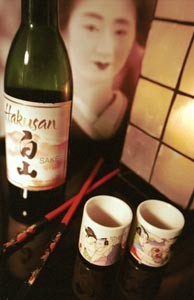
I am surprised that the sake is served not nearly as hot as I’ve experienced in the States. My hosts tell me that the proper serving temperature is the temperature of the human body. They say sake is heated to extreme temperatures to mask flavor flaws–the same reason our local winetasting rooms chill wines. Japan’s official sake tasters, just like North Coast vintners, perform their evaluations with the elixirs at room temperature.

MY HOSTS had heard of the old wine harvest ritual of humans stomping grapes with their feet and want me to know the history behind Japan’s first sake, which dates back to the third century. Kuchikami no sake–a.k.a. “chewing-in-the-mouth” sake–involved the entire populace of a village chewing rice, chestnuts, and millet, then spitting the saliva-infused mulch into tubs.

Thank God for the impurity-killing magic of the fermentation process. . . .

Sake is an acquired taste, and even after several encounters with the beverage over a few days, I remain in the “acquisition” stage. I also am feeling bloated from all that beer I consumed at the drinking party, so on my one free evening in Tokyo, I go hunting for a good glass of wine. After nearly a week without my daily dose of vino, a glass of Kendall-Jackson Vintner’s Reserve Chardonnay never tasted so good. * And as I savor each succeeding sip, that annoying tune I’d heard a few days earlier at Tokyo Disneyland finally escapes from my subconscious: “It’s a small world after all . . .”

From the October 5-11, 2000 issue of the Northern California Bohemian.

© Metro Publishing Inc.

Spins

0

Local Motion

North Bay recording artists strut their stuff

By Greg Cahill

Dan Hicks & His Hot Licks Beatin’ the Heart Surfdog

WHAT A GEM! This is the first major work since 1994’s Shootin’ Straight from singer/songwriter Dan Hicks, a Marinite who made his mark in the early ’70s with wryly turned phrases and a fondness for sentimentality, old-timey acoustic arrangements, and blues-inflected country swing. And it’s well worth the wait. Lots of big-name guests here: Elvis Costello, Tom Waits, Rickie Lee Jones, Brian Setzer, and Bette Midler. The Hicks/Waits duet on the hipster stomp “I’ll Tell You Why That Is” is the show-stopper, but this is pure Hicks all the way–an often cornball, sometimes tender, always hip tunesmith who remains unflinchingly true to his own quirky vision.

Barbara Morrison with Johnny Otis and His Band Ooh-Shoobie-Doo J&T Records

SEBASTOPOL R&B legend Johnny Otis is no slouch as a talent scout. And here Otis shows that he hasn’t lost his touch. In the past, Otis “discovered” Etta James, Esther Phillips, Marie Adams, and a slew of other great female vocalists. This widely ranging album, featuring Michigan native Barbara Morrison, is designed to showcase Morrison’s diverse talents. That’s good and bad. Morrison ably handles everything from gut-bucket blues to doo-wop, straight-ahead R&B to jazz. But you sort of wish for a little more even-handedness in the song selection. Still, Morrison is a real find and shouldn’t be overlooked.

Elvin Bishop & Little Smokey Smothers That’s My Partner Alligator

THE RECENT MURDERS of his ex-wife and daughter overshadowed the release of this terrific set of good-rockin’ blues by west Marin guitarist Elvin Bishop and his longtime mentor, Chicago bluesman Albert “Little Smokey” Smothers. Recorded live earlier this year at Biscuits & Blues in San Francisco, the CD delivers plenty of Bishop’s trademark self-deprecating tongue-in-cheek humor while he trades red-hot licks with the guitarslinger he first met 40 years ago while Bishop was helping to make the blues palatable for white audiences as a member of the legendary Paul Butterfield Blues Band. A feel-good album from a performer whose life has been mired in tragedy.

Maria Muldaur Music for Lovers Telarc

NEARLY 30 YEARS after blues diva Maria Muldaur steamed up the charts with the sultry pop hit “Midnight at the Oasis,” she is in peak form and fanning the flames of passion in this sizzling collection of unsentimental love songs. Culled from her last three Telarc releases, this album displays Muldaur’s strengths as a savvy song interpreter, turning up the heat on robust tunes by Greg Brown, John Hiatt, and others. And does she have friends? Background vocalists include Mavis Staples, Ann Peebles, Lady Bianca, Tracey Nelson, and Charles Neville. Let your hormones run wild.

From the October 5-11, 2000 issue of the Northern California Bohemian.

© Metro Publishing Inc.

Indy Awards

0

The Indies

The third annual North Bay arts awards

ART IS LIKE revolution–neither one happens by itself. Independent spirits have to be there, defying convention and leading the way. But the resemblance doesn’t stop there. In both cases, after the smoke clears, it’s easy to forget the people whose bold ideas lit the spark.

Not fair? Of course not. But it’s also darn unwise. If you ignore creativity long enough, it will go away–and with it the artistic innovation that keeps life here in the North Bay (or anywhere else) interesting.

With that rather selfish motive in mind, this publication tries every year to recognize the independent spirits at work in the arts through the Indy Awards, an annual award ceremony that shines a spotlight on individuals and institutions who make a unique contribution to the North Bay arts scene.

The recipients, selected by the newspaper’s editorial board, are always an eclectic group working in a variety of creative fields, from music to the visual arts to administration.

This year is no exception: whether they’re starting their own music magazine to highlight the accomplishments of local bands or mounting a world-class film festival that attracts the top names in independent film to the North Bay, these folks arc like lightning bolts across the local arts scene. Without them, our world would be a dimmer place.

For art’s sake: Gerry Simmel, Victor Conforti, and Jim Callahan realized their dream of creating a visual arts venue in Sonoma.

Visions in the Valley

Sonoma Valley Museum of Art

“It felt like we were responding to a need,” recalls Jim Callahan, one of a group of local art enthusiasts whose dream to establish a visual arts venue at a prominent site has recently borne fruit with the creation of the Sonoma Valley Museum of Art.

The group transformed an eyesore–a former furniture shop at the entrance to Sonoma’s historic plaza that had sat vacant for a decade–into a stylish new facility that offers precious wall space to local artists, traveling exhibits, and private collections. The museum displays works by local, national, and international artists, including painting, drawing, sculpture, photography, ceramics, architecture, design, printmaking, film, video, and crafts.

“One aspect of our mission is that art has a place in every life and everybody has some sort of relationship to it: artists, appreciators, and collectors,” says Callahan, himself a Sonoma artist for 21 years.

Another of SVMA’s goals is to provide a cultural bridge among the diverse communities in Sonoma Valley, he says. The museum has recently featured works by Latino and Japanese artists. “There are elements of universal beauty, and we want to provide a showplace for that,” explains Callahan. He adds that part of the excitement of working with the SVMA is being able to provide additional educational programming for local schools.

Future SVMA exhibitions include a series showcasing original artwork used for wine labels; a spotlight on West Coast photographers; and “Art That Sings”–handmade guitars as art–which will run concurrently with the Healdsburg Guitar Festival.

As a member-supported nonprofit, SVMA is flourishing, having signed up 850 members since its inception last spring. Organizers have even raised enough cash to buy the building (which it now leases) in February.

The museum’s location in Sonoma Valley plays a vital role in its success, according to Callahan. “Part of the identity of this community is contained within the idea of aesthetic appreciation,” he explains. “Food and wine are aesthetic pursuits, and likewise we’re providing a another level of enhancement in the community.” Paula Harris

A Hand to the Bands

Frank Hayhurst

Back when Janis Joplin roamed the earth and the Beatles were still together, Frank Hayhurst was already rocking Sonoma County. For more than three decades now Hayhurst has been a tall drink of white light on the local music scene.

In the late ’60s his legendary band, the Bronze Hog, helped launch the Inn of the Beginning and a budding county music scene. In 1983 he opened Zone Music in Cotati, which quickly gained a reputation as a musician-friendly venue with a knowledgeable staff.

But Frank’s desire to help musicians goes far beyond giving advice on what new guitar to select. In 1994 he founded Musicians Helping Musicians to aid uninsured local music makers and their families. The program also encourages people to practice preventive medicine and promote general wellness.

“A lot of musicians aren’t part of the system,” Hayhurst says. “Generally, they don’t have any medical insurance. When friends got seriously ill, I discovered that the medical community and the insurance companies are in turmoil. We need to take care of each other.”

Musicians Helping Musicians is funded through musical benefits and contributions and adheres to the strictest nonprofit guidelines.

“When money comes into MHM, it goes directly to the people who need it,” Hayhurst says. “I consider my time and any form of overhead I incur as my personal donation. Hopefully, we can grow MHM into something that can be duplicated across the county.”

To date, Musicians Helping Musicians has raised more than $200,000. On Dec. 3 Hayhurst will present an all-out rock-and-roll event at the Tradewinds, the Inn of the Beginning, Spanky’s, and the Redwood Cafe to raise money for local keyboard artist Stu Blank, who is currently battling melanoma. The show will feature over 20 local bands, each playing for 15 minutes.

“Musicians are into the most juicy and interesting parts of life,” Hayhurst says. “The real value in music comes from the heart. It’s not about becoming a star. It’s about the love of the art form itself. I consider Zone Music a community resource to help my fellow musicians.” Bill English

Music Seen

Section M

Section M–the name is almost ominous. The lone consonant recalls Hitchcock’s Dial M for Murder or the single-letter title of Fritz Lang’s child-killer flick M. It’s even the nom de guerre of 007’s exasperated boss. But for readers of the popular local publication, M stands for music.

“I really believe that the North Bay has some of the best bands in the world,” says Michael Houghton, 28, editor and co-founder of the 2-year-old bimonthly magazine.

“A bunch of us got together and just started throwing around the concept of a music magazine for the North Bay, and the idea just took on a life of its own,” he continues. “It grew faster than we ever expected, faster than we could keep up with sometimes.”

Overseen by a committee of staffers (including locals Sara Bir, Geoffrey Dawson, Michael Houghton, William “Wild Bill” Powell, Mike Schaus, and Felix Thursday), Section M has become the bulletin board, pulpit, and soapbox of Sonoma County’s music scene.

“This magazine has acted as sort of a magnet to draw in some of the most talented and amazing people I’ve ever met,” Houghton says of Section M’s contributors.

Among those people is photographer Wild Bill, 26, who wryly characterizes his involvement with Section M as “totally accidental from the beginning, but I figured that it would be a good way to get my photographs published.” Then he adds, “Section M would have never existed if it wasn’t for the hard work and dedication of all our volunteers.”

Indeed, the past 24 months have amounted to something of a crash course in publishing for the dedicated crew.

“We’re really proud of the creative end, but we’re still learning how to run Section M as a business,” says Houghton, who holds down a day job doing architectural drafting. “We’ve been doing this whole thing on a shoestring budget for two years, and sometimes that makes it hard to expand as fast as we would like.

“This is what we do in our free time,” he adds. “It’s been rough at times, a lot like being in a band. It’s hard work, we lose a lot of sleep, but this is our definition of following our dreams.” Daedalus Howell

Cinema Paradiso

The Film Institute of Northern California

When the historic Rafael Theater in downtown San Rafael was refurbished and reopened 18 months ago by the Film Institute of Northern California, expectations for the newly christened Rafael Film Center were optimistically high.

FINC director Mark Fishkin, together with longtime board member and Rafael project coordinator Ann Brebner, envisioned the new facility as being more than a mere annex site for the Mill Valley Film Festival, the stylish international movie event that till now has been FINC’s main claim to fame.

With first-rate projection and sound systems, and with three no-expense-spared theater spaces in a lovingly restored art decco building, the Rafael was expected to be hailed as the classiest place to catch small, independent films in the North Bay–if not the entire state. It was quite a dream.

Happily, the dream came true.

Since opening its doors, the Rafael has drawn steadily increasing numbers of cineastes from around the North Bay. The theater is also building a solid reputation–mirroring that of the highly influential MV Film Festival–as the place for struggling independent filmmakers to show their work.

Says Brebner, “I can’t count the number of times that visiting filmmakers have come up to me saying, ‘I can’t believe it! Not only am I actually showing my film to an audience that loves it, but just look at the theater it’s being shown in!’

“It’s easier to finance a film today than to find a place to show it,” she says. “You can’t imagine the number of remarkable films that have been made around the world that no one will ever see.

“It breaks my heart to think that these films will have to remain hidden simply because they cannot find a venue.”

There is hope for all such filmmakers as long as the Film Institute of Northern California continues to dream such magnificent dreams. David Templeton

Feeling like a million bucks: Telecom Valley tycoons–Keith Neuendorff, Paul Elliott, Chick Peterson, and David Scott–bailed out the Phoenix Theatre, a popular Petaluma punk emporium.

Musical Mercy

The Phoenix Theatre Four

December 1999 was about to deliver a holiday from hell to local music fans. The rumors had been circulating for months: the Phoenix Theatre was being sold to a developer who planned to turn the Petaluma all-ages music venue into an office building.

The rumors turned out to be true. The deal was in the works, and the North Bay was about to lose one of its most cherished concert halls, a youth hangout that had been a launching pad for hundreds of Bay Area bands, ranging from outfits that never played another live gig to the likes of Primus and Green Day. After 15 years of live music, the curtain was about to drop on the Phoenix for good.

But suddenly, at the last possible moment, everything changed. A group of mystery investors stepped in and purchased the Phoenix to preserve it as a music venue. Like a Texas kid waking up to a white Christmas, music fans of all ages were rubbing their eyes, wondering what the hell was going on.

The angels of musical mercy turned out to be a group of local telecom engineers who reaped a financial windfall from the stock market last year when their employer, Cerent Corp., was bought out by Cisco Systems. The four–Paul Elliott, Keith Neuendorff, Chick Peterson, and David Scott–pooled their newfound money to buy the Phoenix from the developer who had it in escrow.

“There’s no place like it in the Bay Area,” Peterson says, explaining the foursome’s decision to shell out $350,000 to save the venue. “Most clubs won’t even let a kid in to play music, and here’s a place where young musicians can not only play but can actually get encouragement to pick up an instrument in the first place or learn how to do sound or lighting. . . . I think that makes the Phoenix unique.”

Peterson and the other buyers are quick to say that the deal wouldn’t have happened without help from some local business people–including real estate agent Robert Ramirez and attorney Thom Knudson.

But the struggle isn’t over at the Phoenix, caution its new owners. The building, built in 1904 as an opera house, could use some serious renovation, and the law requires an expensive seismic retrofit that must be completed by 2002. None of this will be easy. But the Phoenix Four, who all are parents, are determined that the next generation will be able to enjoy the North Bay’s most unusual music venue.

Says Paul Elliott, “We’re trying to preserve the Phoenix so that when Dave and Keith’s kids are ready, it’ll be there for them.” Patrick Sullivan

Free Verse

The Petaluma Poetry Walk

Geri Digiorno loves poetry. She loves to read it, write it, and speak it aloud. And she knows a lot of other people who feel the same way. But about six years ago, Digiorno had to face the fact that in her home town of Petaluma there were not that many places (read: none) where poetry fans could gather to experience the electrifying magic of poetry being read by its author.

Beyond the random bookstore appearance by the rare visiting poet (and it’s usually only the most famous of them who ever receive such treatment), there were no venues for poets to present their work to an appreciative audience.

“It was very frustrating,” says Digiorno.

Out of that frustration was born the Petaluma Poetry Walk. The annual event–which recently celebrated its fifth anniversary–brings local poetry writers, known and unknown, together with a range of international poets.

The artists are assigned time slots at half a dozen live performance spaces set up throughout Petaluma’s downtown area. Beginning at noon, poetry fans, maps in hand, move from venue to venue, drinking up literally hundreds of poems.

Now co-sponsored by Poets & Writers, the quirky and appealing event draws scores of eager attendees every year. The Poetry Walk is now a fixture of the North Bay arts scene and has contributed to a kind of poetry renaissance.

“The North Bay,’ says Digiorno, “was starving for an event like this.”

Poet Ron Salsbury, a regular performer at the event, agrees.

“This is poetry heaven,” he says of the North Bay. “There’s so much good poetry being created around here, it’s just amazing. But where can you go to hear it? Where can a poet find an audience? Since Geri started organizing the Poetry Walk, local interest in live poetry has definitely increased.”

That’s what Digiorno likes to hear.

“Poetry is a vital part of being human,” she says. “The Poetry Walk isn’t just for the poets and the people who already love poetry. It’s for the people who never knew before how thrilling, how life-changing, a well-crafted poem can be.” David Templeton

Native Glory

Rene di Rosa di Rosa Preserve

Rene di Rosa sometimes describes himself as an artoholic, and visitors to the Rene and Veronica di Rosa Preserve–located in the hills of Napa County–will be unlikely to quibble with that description. In the preserve’s main gallery, art comes at visitors from every direction–walls, ceilings, and floors. In all, the collection houses more than 1,700 pieces of art.

But it’s not just any art that finds its way into di Rosa’s collection. The emphasis here is on California art–paintings, sculptures, and photographs by 600 artists, almost all from Northern California. “It’s a unique collection because it focuses on Bay Area art, especially Bay Area funk,” says Gay Shelton, director of the Sonoma Museum of Visual Art. “I don’t know anyone else who’s collecting like that.”

Indeed, this may be the best place in Northern California to find regional art. But that’s not the only thing that makes the di Rosa preserve unique.

The preserve may be the only world-class art collection whose owner frequently greets visitors at the door. The elderly di Rosa (born in Boston in 1919) brings that personal touch to many aspects of the gallery.

It’s a trick of the di Rosa gallery–which has only been open to visitors for three years now–not to name the artists with the customary plaques. Instead, small notebooks in every chamber of the preserve contain the names, titles, and dates. Di Rosa says he avoided title cards because it irked him to see visitors at a museum paying more attention to the text than to the image.

Perhaps nothing sums up the unique appeal of the di Rosa preserve and its art collection better than the big chiseled stone letters spelling out the museum’s mission: “divinely regional, superbly parochial, wondrously provincial . . . an absolutely native glory.” Patrick Sullivan and Richard von Busack

From the October 5-11, 2000 issue of the Northern California Bohemian.

© Metro Publishing Inc.

The Bohemian

0

With coverage now expanded to include Napa and Marin counties, readers will be able to stay abreast of a wider range of cultural and culinary options and issues transcending individual communities

THE POST-GOLD RUSH years unleashed a literary movement that figured prominently in Northern California’s cultural development. The journalists, poets and novelists loosely identified as bohemians preferred art, literature, and political discourse to the aggressive material culture of their day and had a strong connection to the geography and natural beauty of the land north of the Golden Gate.

Successor movements with a bohemian flavor–environmentalism, the Beat generation, the hippie movement, the sexual revolution, California cuisine, hip cyberculture–were similarly catalyzed by their synergy with this area. Is it an accident that utopian communities, from Sea Ranch to Zen Center and The Well, took root here?

Now, at the millenium’s rollover, modern Bohemia–independent thought and rejection of conformity through lifestyle choices–continues as a topic of contemporary debate. We hear about bourgeois bohemians (“bobos”) and “fauxhemians” as affluence fuses with ostensible anti-materialism. (Then again, socialist bohemian North Bay habitué Jack London didn’t exactly lead a pauper’s life.)

Concurrently, the freedom enabled by cheap electronic communication and the explosive weath it produced poses a new set of challenges for a region whose remove from the epicenters of finance and industry once kept it safely off the worn urban path.

We think the time couldn’t be better to introduce a new name, journalistic mission, and look. The publication you hold represents the convergence of two proud local traditions–a century-old literary and intellectual ethic of free thought and artistic expression and a newspaper founded in 1979 to champion community interests. For 10 years, it was published as The Paper or the West Sonoma County Paper. It was sold in 1989 to John Boland and Jim Carroll, who changed its name to the Sonoma County Independent and moved its offices from Bohemian Highway to Santa Rosa. In 1994, the Indy joined a Bay Area group of alternative weeklies, Metro Newspapers.

The reinvention of the Independent as the Northern California Bohemian continues an evolution begun 21 years ago when founding publisher Bob Lucas declared that his newspaper would be “dedicated to the truth and the right of individual expression,” and a voice “not controlled by out-of-the-area big money interests.”

The Bohemian will serve the North Bay’s communities, with particular interest in their culture and quality of life. It will question the agendas of government and large corporations whose interests tend to be overrepresented in the mass media. With coverage now expanded to include Napa and Marin counties, readers will be able to stay abreast of a wider range of cultural and culinary options and issues transcending individual communities. At this unique period of history, with unprecedented prosperity and powerful forces that transcend borders, thinking journalism is needed to preserve the region’s extraordinary natural beauty, gorgeous coastlines, redwood forests, and agricultural lifestyle.

Our commitment is to enrich our readers’ lives by presenting a lively, opinionated, and informative package of writing and graphics each week. We hope you enjoy the new format and editorial direction. Please drop us a note if you have any ideas or comments.

From the October 5-11, 2000 issue of the Northern California Bohemian.

© Metro Publishing Inc.

Newsgrinder

0

Important events as reported by daily newspapers and summarized by Daedalus Howell.

Wednesday 9.27.2000

Faux-federales might not need no stinkin’ badges but teachers will. Identification badges are appearing on Petaluma School District campuses, as a new regulation requiring all nonteaching staff to wear a photo and name tag takes hold. The district suggests that teachers wear them, too. District Superintendent Carl Wong said district officials believe they will make school campuses safer for both students and employees–perhaps in the same way badges make the inmates feel safer in the county jail. “All of our campuses are open campuses,” says Wong. “Nonstudents have full access to the campuses.” Not that nonstudents or the students themselves particularly want to go there. However, several incidents led to the badges–one involving two Petaluma police officers who recently scampered across a Petaluma high school campus in plain clothes, unquestioned by any school authorities. What they were doing there is anyone’s guess, but since the ’80s, the campus has maintained a reputation for its good weed and loose girls.

Sunday 10.1.2000

Rep. Lynn Woolsey, who is seeking her fifth term this November, missed a scheduled debate with political opponents scheduled for 9 a.m. Sunday. Cynthia Brantly, Woolsey’s campaign manager, took the heat, claiming she thought the debate was scheduled for 9 p.m. “It’s my fault,” said Brantly who apparently operates on Malta time. A taping of the debate–which is to be aired on Petaluma’s public access channel–was rescheduled for Tuesday at 9 a.m. Woolsey’s opponents agreed to the change but only after expressing their exasperation to the debate sponsors, the League of Women Voters. “What she is saying is she doesn’t care enough about this district to show up,” said Woolsey’s second-time Republican opponent, Ken McAuliffe, whom the district hasn’t cared enough about in the past to elect to office. . . .

In an unrelated item, increasing numbers of Marin teenagers are suffering from stress, eating disorders, self-mutilation, and suicide attempts, according to school district officials. “My parents have really high expectations of me. By the end of the week, I’m dead,” said a San Marin High School student.

Monday 10.2.2000

Stop the presses! Petaluma’s Argus-Courier actually found some news this week–a sheep, whose DNA must have been crossed with the late-actor Steve McQueen’s, attempted a great escape earlier in the month from a livestock yard on Corona Road. The sheep, which bleats to the name Hot Cheeks, pranced gingerly across Corona Road and most of the way down Industrial Avenue, nearly becoming mutton as several motorists careened out of its way. The intersection was blocked, and there was tell of a rear-ended semi-truck. Hot Cheeks sought cover in some nearby bushes but, alas, was discovered near KnowledgePoint, a software company, according to the Argus-Courier. The venerated paper, known for its riveting coverage of tide data, neglected to report whether or not the tech firm offered the sheep a full-benefits package with stock options.

Tuesday 10.3.2000

HMO woes have stricken Novato newborn Alexander Page Leroux from day 1. He was born unaided by doctors at 3:33 a.m. on Sept. 17 on a hallway floor at Kaiser Permanente in San Francisco. His parents, Linnea and Rick, with their 17-month-old son, Eric, were en route to the labor and delivery ward on the third floor when Linnea began birthing the tyke. A nurse eventually showed up, bearing merely a swath of cloth, which she used to help deliver the healthy 8-pound, 4-ounce boy. Within minutes of Alexander’s first breaths, an ER door guard showed up and ordered Dad to move his car.

No Joke: Animal Shelter Ball-buster

A City of Petaluma Animal Service (PAS) newsletter that featured a humor piece dubbed “Real Men Don’t Neuter” has raised the ire of Petaluma man’s man and gender crusader Joe Manthey. In a letter to the editor published in the Press-Democrat, Manthey accused PAS manager Nancee Tavares of “spreading derogatory stereotypes” in an article that suggests some men refuse to neuter their pets because they “need to project a macho image,” a notion that Manthey characterized as “sexist.”

Tavares goes on to write, “Studies prove that men have a better self-image when their dogs sport Neuticles–faux testicles.” No word as to whether Manthey’s self-image is intact, or his dog’s testicles, or if he even has a dog.

From the October 5-11, 2000 issue of the Northern California Bohemian.

© Metro Publishing Inc.
The New Morality

0

Beyond Faith & Family

Why I’m resisting the New Morality

By STEPHEN KESSLER

THE RHETORIC of this political season reveals some dubious assumptions that currently seem to prevail in American culture. The emphasis on “family and faith” (especially by the alpha Democrats) as the bedrock of all virtue and morality implies that secular and/or single persons are somehow morally inferior and socially suspect. Even married couples without children or religious affiliation–let alone unmarried couples–are likely, in the present climate, to be regarded as vaguely unsavory or at least far enough outside the imagined mainstream to deserve little or no acknowledgment as valued contributors to the commonwealth. And if you happen to be gay, forget it.

By declining to breed, you are obviously out of bounds; you may be tolerated in the big tent of happy-face cosmetic diversity that even the Republicans have fabricated, but when it comes to “family values,” yours are at best questionable.

Now, I don’t mind if Al Gore wants to ask himself what Jesus would do about the budget surplus or the strategic oil reserve, or whether he’d run for president. And if Joe Lieberman would like to declare every Saturday a national day of rest, I don’t consider that such a bad idea. And even if that big-league Bible-hugger George W. Bush believes he’s exercising Christ’s compassion as he signs off on one more Texas execution, that’s a moral riddle I leave to scholars of deeper Talmudic wisdom than mine.

But when these guys suggest that rational faithlessness and deliberate or circumstantial singleness are less than moral, or maybe un-American, that gets my goat.

How many scheming evangelists and pedophilic priests and adulterous rabbis have to be publicly busted before the virtue-mongers are forced to acknowledge that there’s no correlation between proclamations of righteousness and actual ethical or moral conduct? Didn’t Jesus himself expose the Pharisees as a bunch of pious hypocrites? And wasn’t Jesus single?

ONE LIKELY source of this new moralism is a backlash against the perceived excesses of the 1960s–the pot-smoking, draft-dodging, sexually promiscuous self-indulgers personified by our lame-duck scapegoat president. Never mind that the greatest obscenity of that era was an insane war that some people had the good sense to resist.

“The sixties” are still being bashed by those too old or young to have been tormented by that decade’s terrible contradictions and by those who used the turmoil of the times as a smokescreen for their own irresponsible experiments and who now, unable to govern their own children, are desperately reaching for some controlling moral authority.

Religious institutions, with their “thou shalt nots,” are an appealing refuge from the dizzying changes currently wracking the planet. Some folks who sought spirituality in drugs or exotic cults or Eastern religions or the Internet are returning with relief to their Judeo-Christian roots

But one philosophical movement that gained currency in the 1960s and remains, for me, a wellspring of ethical and moral inspiration–with or without God–is existentialism. Without reducing this various and complex body of thought to some simple formula for living, I would say that one of its core principles is that of personal choice and responsibility. If God’s existence is in question and, as Dostoyevsky noted with anguish, “everything is permitted,” the burden of moral conduct is on the individual rather than the rules of some higher authority.

It is up to each of us to live in accord with our conscience and in conscious consideration of those around us.

This assumption of the power to shape our lives without the benefit of institutional guidelines is, in my experience, both humbling and exhilarating. The freedom to become what we are and do as we will, without the comforting fiction of a Supreme Being, affords us, as humans, a certain modest dignity. It is this existential dignity that I invoke against those who claim that morals are impossible without religion. Any thinking adult should be able to respect the integrity of those who consciously choose to live without false faith.

Better to remain honestly apart from hollow ritual than mindlessly go through the motions.

AS FOR THE FAMILY and its apotheosis as the model of wholesome citizenship, sure, it’s hard to raise kids and to support, both materially and emotionally, such a volatile and complicated biosocial unit. But it’s also hard to live alone in a culture that promotes marriage and children as the natural goal of anyone who wants to be considered normal. If contemporary memoirs are to be believed, the average family is steeped in destructive psychodrama and hardly the paradigm for a harmonious social order.

The joys of family life, like the joys of independence, are mixed with its agonies. The Democratic presidential ticket appears to take for granted the support of a majority of single voters, so it’s strategically understandable for Gore and Lieberman to court the “family” vote.

But a lot of single people are struggling, too, and at a time when half of all marriages end badly, it seems a bit myopic to ignore the legions of the unmarried. Certainly being a husband or wife or parent, while imposing an array of serious obligations, has historically failed to force people into virtuousness.

And there are enough lousy parents out there to raise the troubling question of whether some couples are morally fit to procreate.

Maybe once the election is over we’ll be spared the bully-pulpiteering of the self-righteous. One redeeming aspect of Bill Clinton’s moral lapses has been to disqualify him from copping a holier-than-thou attitude. He’s a flawed person, like the rest of us, and everyone knows it, so instead of pretending to have a hotline to heaven he has proceeded, for better or worse, to attend to business in the earthly realm. His public humiliation in the Lewinsky fiasco–not to mention his continuing legal problems–has had the ironic effect of making him far more likable than the sanctimonious obsessives who tried in vain to evict him from the presidency.

One lesson, or “moral,” of the impeachment spectacle was that most of this country’s citizens don’t look to the nation’s chief executive as a role model. Even Martin Luther King Jr., that icon of righteousness, was famously unfaithful to his wife. Does this diminish him as a heroic figure, a man of honor, and a fighter for justice?

Not as far as history is concerned.

In the secular Jewish tradition that I come from, doubt is no obstacle to goodness. One’s deeds in working for a better world, one’s contribution to the community, one’s ethical conduct in dealing with other people, are infinitely more valuable than self-serving declarations of faith.

In matters of religion, as of politics, I choose to cultivate a scrupulous skepticism.

From the October 5-11, 2000 issue of the Northern California Bohemian.

© Metro Publishing Inc.
‘Nurse Betty’

0

Nurse Betty.

Soap Box

Author Paula Sharp on soap operas, romantic love, and ‘Nurse Betty’

Writer David Templeton takes interesting people to interesting movies in his ongoing quest for the ultimate post-film conversation. This is not a review; rather it’s a freewheeling, tangential discussion of life, ideas, and popular culture.

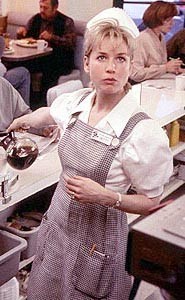
LESS THAN 15 minutes into the offbeat new comedy Nurse Betty, Renee Zellweger’s scumbag husband (Aaron Eckhart) is riotously scalped in his own living room by a pair of raving hit men (Chris Rock and Morgan Freeman). It’s not a pretty sight.

My guest this afternoon–New York novelist Paula Sharp (author of Crows Over a Wheatfield and the new I Loved You All)–responds to this cinematic mayhem as many sane persons would: she cowers in her seat, both hands over her eyes, praying for the bloodshed to end.

Renee Zellweger’s sweet, soap opera-loving Betty, however, reacts to her husband’s icky murder (she’s hiding in the bedroom at the time) in a much less predictable manner, suffering a shock-induced psychotic break. Suddenly delusional, she thinks her favorite soap opera, A Time to Love, is real and that she’s the former fiancée of the show’s fictional Dr. David, played by handsome actor George McCord (played by handsome actor Greg Kinnear).

In Betty’s mind, her husband isn’t dead; she’s just leaving him. With the hit men in pursuit, our heroine–the murder’s only witness–heads off to Los Angeles to “reunite” with her long-lost love. Further violence ensues (but, hey! No more scalpings!).

“I might have walked out if I’d been by myself,” says Sharp, laughing about it after the show, her warm blue eyes bright with excitement. “But I’m so glad I stuck it out, because Nurse Betty is brilliant! It’s film noir meets soap opera. It’s a seamless collision of these two highly stylized film genres that would normally seem to be polar opposites. The violence was necessary because, by comparison, it made the whole soap opera world seem so funny and absurd. It’s the best thematic collision I’ve seen in years.”

Paula Sharp likes it when things collide.

She’s made a few things collide on her own. Crows over a Wheatfield (Hyperion), set in the strange world of the family court system, became a bestseller in 1996, in part owing to its author’s knack for taking a serious, potentially morose subject (domestic violence) and cramming it with unexpected pockets of laugh-out-loud humor. Now, with I Loved You All (Hyperion; $23.95), Sharp pulls off an even trickier stunt, producing a riveting comedy about abortion.

Borrowing her novel’s title from a line in Gwendolyn Brooks’ controversial poem “The Mother,” Sharp–a former criminal defense lawyer–confronts us with the astonishing Isabel Flood, a rabid right-to-life activist who coolly insinuates herself into an eccentric but troubled family in upstate New York. The wildly unexpected results play out in a rich, semi-satirical tone that is not easy to describe. It’s no wonder, then, that Sharp enjoyed Nurse Betty.

Like her own work, it defies categorization.

“I’VE NEVER BEEN a big fan of soap operas,” Sharp insists, as we chew our way through a late after-movie lunch, “though I did live in Brazil once, and I let myself get hooked on Brazilian soap operas. But those are so wild and over-the-top, the whole country stops to watch them. They’re nothing like American soap operas.”

“Which leads to the question,” I insert, “of what their appeal really is. Why are soap operas so meaningful to so many people?”

“If your life is unbearable, then I suppose soap operas are a good way of losing yourself,” Sharp suggests. “I’m sure that’s why so many women have watched them over the decades. Soap opera is more interesting than a lot of women’s lives.”

“So soap operas are dangerous, right?” I assume.

“No, of course they’re not,” she retorts, with a shake of her head. I don’t think they’re dangerous at all. I mean, sure, if I had a daughter, I wouldn’t want her to have that soap-opera notion of romantic love and go out to the world with that, because that view of the world is not realistic. But women enjoy soap operas, and why shouldn’t they? People are entitled to their fantasies.

“But you obviously don’t agree,” Sharp says. She must have noticed the incredulous look on my face. I admit I never expected Paula Sharp to be a defender of Days of Our Lives.

“I think soap operas are dangerous,” I suggest. “You admit they project an unrealistic view of the world and that they are watched mainly by unhappy people. We already know the harm caused when unhappy teenagers spend hours in front of violent video games and movies. So can’t we assume that spending two to six hours a day in the world of soap operas is equally harmful?”

“I can’t believe you’re moralizing about soap operas,” Sharp teases, openly laughing at me. “Maybe the problem isn’t soap operas themselves. Maybe it’s sitting around the house watching TV for two to six hours a day that’s dangerous. Personally, I like Star Trek.

“But to get back to the movie,” she continues, “one of the reasons I liked it–and one of the reasons I like hyperbole so much–is that there is truth to be found in exaggeration. Fiction writers are taught that you can’t make a character all bad or all good. As the daughter of an anthropologist, I’ve always thought that the way people view character in our culture is merely cultural. We believe everyone has bad and good in them because that’s what we’re taught. We’re supposed to believe that everyone is half bad and half good.

“But I don’t believe that,” Sharp concludes. “I think some people, like Betty, are remarkably good. And some people, like the Chris Rock character, have so little good in them it’s impossible to see it.

“That might seem like hyperbole,” she concludes, “but it doesn’t mean it’s not the truth.”

From the September 28-October 4, 2000 issue of the Sonoma County Independent.

© Metro Publishing Inc.

restaurant name

Just Like Home By Marina Wolf Comfort food. Just reciting the list of usual suspects--macaroni and cheese, chicken noodle soup, meat loaf--is strangely relaxing, as though in speaking the dishes aloud we invoke their comforting powers. But here's a tip, in case you didn't already know: any food can be comfort food at the right...

‘Almost Famous’

Crazy Days Ben Fong-Torres on the death of rock and roll Writer David Templeton takes interesting people to interesting movies in his ongoing quest for the ultimate post-film conversation. 'FIRST OF ALL, I've got to say it," pronounces author Ben Fong-Torres, shortly...

Open Mic

Workers struggled for generations to secure the eight-hour day. Now serfs in local high-tech industries compete to see who can log the most hours. Why? Because leaving at 5 o'clock is seen as a poor career move By C. D. Payne YOU BOUGHT the wrong oil filter for your car. You...

Drinking in Japan

Tokyo Time Fast livin', hard drinkin' on the Pacific Rim By BOB JOHNSON AS THE TOUR BUS parts a vast sea of automobiles, motor scooters, bicycles, and pedestrians in Tokyo's frenetic Ginza district, a melancholy look darkens the previously sunny face of the tour guide, Kaori. "I should tell you...

Spins

Local Motion North Bay recording artists strut their stuff By Greg Cahill Dan Hicks & His Hot Licks Beatin' the Heart Surfdog WHAT A GEM! This is the first major work since 1994's Shootin' Straight from singer/songwriter Dan Hicks, a Marinite who made his mark...

Indy Awards

The Indies The third annual North Bay arts awards ART IS LIKE revolution--neither one happens by itself. Independent spirits have to be there, defying convention and leading the way. But the resemblance doesn't stop there. In both cases, after the smoke clears, it's easy to forget the people whose bold ideas lit the...

The Bohemian

With coverage now expanded to include Napa and Marin counties, readers will be able to stay abreast of a wider range of cultural and culinary options and issues transcending individual communities THE POST-GOLD RUSH years unleashed a literary movement that figured prominently in Northern California's cultural development. The journalists, poets and novelists loosely identified...

Newsgrinder

Important events as reported by daily newspapers and summarized by Daedalus Howell. Wednesday 9.27.2000 Faux-federales might not need no stinkin' badges but teachers will. Identification badges are appearing on Petaluma School District campuses, as a new regulation requiring all nonteaching staff to wear a photo and name tag takes hold. The district suggests...

The New Morality

Beyond Faith & Family Why I'm resisting the New Morality By STEPHEN KESSLER THE RHETORIC of this political season reveals some dubious assumptions that currently seem to prevail in American culture. The emphasis on "family and faith" (especially by the alpha Democrats) as the bedrock of all virtue and...

‘Nurse Betty’

Nurse Betty. Soap Box Author Paula Sharp on soap operas, romantic love, and 'Nurse Betty' Writer David Templeton takes interesting people to interesting movies in his ongoing quest for the ultimate post-film conversation. This is not a review; rather it's a freewheeling, tangential discussion of life, ideas, and popular...
11,084FansLike
4,606FollowersFollow
6,928FollowersFollow