Newsgrinder

0

Important events as reported by daily newspapers and summarized by Daedalus Howell.

Wednesday 01.03.01

Petaluma’s ArgusCourier.com reports that police took into custody a woman occupying a downtown doorway “with grass and twigs in her hair and clothing, talking about suicide.” No word why the fuzz targeted the outdoor production of A Midsummer’s’ Night Dream, but the production flagged without the actress who was portraying the mercurial woodland fairy Puck (“Pretty soul! She durst not lie near this lack-love, this kill-courtesy”). Several members of the awestruck audience were charged with loitering.

Thursday 01.04.01

An apparent group of student vandals qua asbestos-abatement vigilantes rained righteous terror upon Terra Linda High School by breaking into the main hall and turning on a faucet that soaked 14 classrooms, a computer lab, and the library, according to the Marin Independent Journal. “I don’t want to believe it was one of our kids,” said Principal Biff Barnes, in utter denial. “I just desperately want to find out who did this and punish them as completely as the law would allow.” Investigators believe the culprits entered the school through a window, thereby eluding an apparently useless security system. They then entered a second-floor utility closet, hooked a hose to the faucet in the sink, and cranked up the spigot, where the hose remained until neighbors reported flooding out of the school. The water has seeped under asbestos tiles in the library and hallway, spurring their removal (boo-hoo–we can’t have soggy cancer-causing agents on school grounds, now can we?).

Saturday 01.06.01

Santa Rosa officials shut down fast-food restaurant the China Inn after police witnessed dumping of grease, cooking oil, and food waste into the city’s storm-water system. The restaurant’s corporate president, Claude Alexandre, blamed the dumping on morally deficient “low-level, minimum-wage employees” (gotta love those corporate types). “I don’t know why it’s a big thing,” he told the Press Democrat. It’s a big thing, Claude, because the underground drain eventually flows to the Russian River and would fuck up the city’s wastewater-dumping. Environmental inspectors have not documented the damage to fish, but are certain the creatures are nonplussed by the Chinese food detritus.

Saturday 01.06.01

That two-headed hydra of investigative prowess cleaved from the San Rafael Police Department and the FBI say there’s a “strong possibility” that a man who recently robbed a downtown San Rafael bank, unaided by any order of disguise, might also have robbed another bank three blocks away last November, reported the Marin Independent Journal. The bureau’s Special Agent Andrew Black agreed: “There is a strong possibility that it’s the same guy.” In both cases, Black said, the robber waited in line and approached a teller without a mask or other disguise, quietly demanded money, and bailed. The suspects in both cases were described by witnesses as white, middle-aged, about 5-foot-9, 150 pounds, and wearing a denim jacket and a baseball cap embroidered across which was the tell-tale epitaph “I am a bank robber.” This is why agent Black is “special.”

Sunday 01.07.01

The big bad wolves at Philip Morris are trying to huff and puff and blow smoke in the eyes of Terra Linda High School students, reports the IJ. The manufacturer of Marlboro, Virginia Slims, and lung cancer delivered a raft of book covers to the Marin County school as part of its “youth smoking prevention effort.” Critics contend the book covers are riddled with subliminal images touting the pleasures of smoking. One design depicts a young man on a snowboard with clouds and mountains in the background. But the red-tipped snowboard looks suspiciously like a cigarette, and the clouds look like smoke. “Young people will recognize the fact that when you look at the picture, it looks like a cigarette,” said Jennie Cook, chairwoman of the state Tobacco Education Oversight Committee and a member of the Marin Tobacco Coalition. “It is putting a cigarette in front of them and making it look glamorous.” A 1998 law forbids the marketing of tobacco products to minors. But the use of “smoke and mirrors” in cigarette advertising apparently remains legal.

Sunday 01.07.01

In a tragic spin on their HeatWave Bag pizza delivery promotion (“crisper crust, bubbling cheese, and hotter toppings”), 40-year-old Napa Domino’s employee Martin Berg was arrested for arson and two counts of cruelty to animals after allegedly setting a kitten on fire. “It was shocking that somebody could do this to an animal and just walk away from it,” Napa Police Cpl. Kirk Premo said to the Napa Valley Register (vs. lighting it on fire and stomping it out?). The suspect allegedly “took the cat out of the truck, poured charcoal lighter fluid on it, and lit the cat on fire,” Premo said. The kitten was found alive and taken to a veterinarian, who was unable to save it. Bad Andy. Bad Martin, too.

From the January 11-17, 2001 issue of the Northern California Bohemian.

© Metro Publishing Inc.

‘Jazz’

0

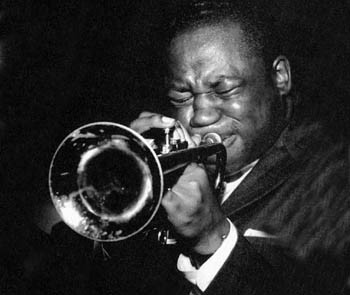
Trumpet master: Clifford Brown, who died in a 1956 car crash, remains a major influence on today’s young jazz lions.

Sour Note

When it comes to his ‘Jazz’ series, filmmaker Ken Burns could have done better

By Harvey Pekar

IN ORDER to understand Ken Burns’ objectives in his 10-segment, 19-hour PBS series Jazz, let me quote some of his comments: “All the jazz critics who are sort of sharpening their knives miss the whole point of this. . . . I see jazz as a particularly objective mirror of who we are as a people, far beyond the music, and telling the story of the music helps us understand ourselves in a much larger sense. . . . What we’re trying to do is enlarge the jazz audience. These people in their ‘academic purity,’ you know, are not being friends of the music they purport to love. . . .

“I’m not really concerned with the jazz community. . . I have to focus most of my attention on reaching that 99 percent for whom jazz is an esoteric, dense, and unapproachable music, made so not by the music but by the people who talk, write, argue, and fight about it. So there is a paradox.”

What Burns seems to be saying is that jazz would be far more popular if people quit arguing about it and united to praise his work. Unfortunately, as part of the crotchety 1 percent, I find that Burns’ series leaves a lot to be desired, and most of the people I’ve talked to about it have been disappointed to at least some extent, though some say, “Well, at least it’s better than nothing.”

Burns admits that he knew virtually nothing about jazz before beginning his project and that General Motors “gave us 35 percent of the $14 million budget for Jazz.” In fact, a publicist for the project asked me to be sure to mention GM’s sponsorship of the series in this article.

GM is putting up that kind of money for a reason. The company views it as an investment aimed at improving public relations and ultimately selling more products. To do that Burns is going to have to reach a mass audience. Therefore he can’t make his work too intellectually rigorous and has to incorporate discussions of nonmusical subjects that nonjazz fans will find interesting. This should not have been difficult for him to accomplish, since he already wants to use jazz history to attempt to mirror the American people “far beyond the music” and to “help us understand ourselves in a much larger sense.”

It is understandable then, that Jazz–which debuted Jan. 8 and airs on selected nights through Jan. 31–contains much political and social material in it about race relations, the Depression, World War II, and other topics that have a more general appeal to viewers than jazz.

It don’t mean a thing…: Duke Ellington savors Ella Fitzgerald’s show.

The series’ narrators and interviewees emphasize anecdotal material rather than technical music commentary. There is much information provided here about the substance abuse problems of jazz artists, from Buddy Bolden to Charlie Parker. Interviewees include not only musicians but also a number of authors, some of whom don’t specialize in writing about jazz, plus Negro League baseball great Buck O’Neil and actor Ossie Davis. They, like many of the commentators, offer the kind of not-particularly-enlightening impressions about jazz that one could get from just about any fan. One assumes they’re on Burn’s roster to provide celebrity appeal, in Davis’ case, and the recollections of a grand old man, in O’Neil’s.

The 10 programs are arranged chronologically. The acute viewer will notice that the first through ninth programs cover periods of from three to 10 years each; the 10th deals with 40 years–or 40 per cent–of jazz history.

At least that’s the way I see it.

Lynn Novick, who co-produced Jazz with Burns, has a different definition of history than mine. In interviewing her, I mentioned that to me history is everything that’d happened, even if it was one second ago. But Novick didn’t agree. To her, events aren’t history until a consensus about them has been reached and set in stone. Like Burns, she thought the jury was still out on many jazz musicians who had come to the fore since 1960, and consequently they are given short shrift or no shrift in Jazz, although some are middle-aged or old by now. Novick urged me, even if I thought experimental jazz artists of the past 40 years had been given too little attention during the last show, to consider seriously and hopefully praise the other nine episodes.

To her, I was most critical of only 10 per cent of the series.

However, Burns and Co. have virtually ignored almost 40 per cent of jazz’s history. Even in the last chapter, the work of innovative young jazz musicians and new developments in the idiom were dealt with less than the latter stages of the careers of Louis Armstrong and Duke Ellington, who are covered from birth to death, and even less than the work of reactionary younger musicians like Wynton Marsalis, Joshua Redman, and James Carter, all of whom employ styles that were created before they were born and are very imitative musicians with no interest in adding to jazz’s vocabulary, expanding boundaries, pushing envelopes, etc. Joshua Redman’s father, Dewey, in fact, is a more modern stylist than he is. The Dixieland revivalists of the 1940s–Lu Watters, Turk Murphy, Bob Scobey–are not mentioned in Jazz because their work was so derivative.

Similarly, Marsalis and the so-called young lions have no business being covered, despite the large amount of media attention they’ve gotten, because they are just as derivative.

The idea implicit in the statements of Burns and Novick that the work of experimental musicians cannot be evaluated until decades after they’ve come to the fore is nonsensical. Consider Ornette Coleman. Before Coleman emerged, improvisers were taking more and more liberties with chord progressions, adhering less and less strictly to them. Moreover, beginning with Django Reinhardt’s “Improvisation,” cut in 1937, and continuing into the 1950s, a few free jazz records already had been made, most notably Lennie Tristano’s Intuition and Digression. Even then, it seemed inevitable that a jazz musician would come along who would play free jazz on a regular rather than sporadic basis, and that whoever got national attention for doing this first would probably be recognized as a great artist. Coleman made this step, though he always credited Dallas/Fort Worth saxman Red Connor with doing it before him. He’d taken the necessary big step; he’d made the big breakthrough.

And, of course, he’s in the jazz pantheon now.

If you follow the evolution of an art form closely and are able to enjoy innovations in it over the years, you shouldn’t need a whole lot of time to evaluate the work of an avant-garde artist. Musicians, including free-jazz innovators Joe Maneri, John Zorn, Mark Dresser, Chris Speed, Joey Baron, and, going back to the 1960s, Albert Ayler, Anthony Braxton, Henry Threadgill and Paul Bley, have been keeping jazz or the jazz tradition alive, even if the Lincoln Center crowd doesn’t want to recognize their work with their innovations, while Marsalis merely mimics earlier jazz artists. So guess who Burns makes the most visible figure in Jazz.

Marsalis, of course.

Burns tapped Marsalis as lead commentator for his series because the trumpeter is well known, the darling of PBS–a box office draw. I will say, though, that when it comes to pre-1960s, Marsalis knows what he’s talking about. He has meticulously studied the styles of the men he copies and knows what makes them tick.

Livin’ on Monk time: Composer Thelonious Sphere Monk was dismissed by many as an eccentric with little talent. How wrong critics can be.

INDEED, Burns has been pretty shrewd about the way he’s put this show together, regardless of how little use I have for it. It’s mentioned in Jazz that “big-band swing accounted for 70 percent of the profits in the [American] music industry” at one time. Now Burns sees himself as an important chronicler of the American scene; he views his Civil War, baseball, and jazz series as an American trilogy. Beyond being a historian, he sees himself as a player, and wants to have a role in getting jazz back up toward that 70 percent share, as he’s stated above, as does Novick. To do this Burns doesn’t need to preach to the converted–that is, the small number of committed jazz fans. He’s got to go after the uninitiated, and he has a pretty good idea of what they want, because until recently he was one of them, and he still probably doesn’t know much about the music.

In any event, he’s developed a strategy to hook the general public.

It involves the use of a large group of commentators, including writers, musicians, record producers, promoters, club owners, and musicians’ wives and relatives.

Add O’Neil and Davis and you’ve got a varied and colorful group of people who chip in a bunch of anecdotes calculated to entertain a mass audience.

But Burns doesn’t want to bore viewers with a lot of talk about mere jazz music, so he dilutes it by dealing with other issues, some “far beyond the music . . . to help us understand ourselves in a larger sense.” In the process, we learn that Burns has some beliefs that all of us can agree with and rally behind. He is, for example, for democracy and racial equality and against lynching and fascism.

Moreover, Burns is always looking at jazz as a microcosm or a metaphor. He’s stated, “[J]azz. . . in addition to being a pretty objective witness to the 20th century, was also a vision of the redemptive future possibilities of our republic. Because embedded in the message of jazz is a finely tuned constitution at work: all people listening, incorporating, dealing with the question of the individual as well as the collective. And you have essentially in jazz a model of what we become when we live out, as Dr. King would say, the true meaning of our creed.”

Marsalis opens one show by saying that “jazz objectifies America.” We learn also from Marsalis that a jazz band works the same way a democracy does. And Burns plays the patriotism card. We are told that only in America could jazz have evolved.

Bleah!

I wonder if Burns has considered that only in Eastern Europe did klezmer evolve, only in Cuba did the son evolve, only in Brazil did the samba evolve, only in Italy did Italian opera evolve, only in France did French pastry evolve. Every nation has something unique about it, for crying out loud.

Regarding the similarities between jazz and democracy, jazz isn’t unique in being a form of collective activity that involves cooperation between individuals. Volleyball does as well. Can we, then, look forward to Burns doing a series on the history of volleyball?

I realize that the history of jazz may not seem as important in itself to Burns as other “larger” issues. On the other hand, I’m sick of writers and filmmakers who use music as a means to an end to discuss their favorite political and social issues. Frequently they do this because they don’t have anything important to say about the music. I wish more of them would deal more directly with the stuff that’s most important to them instead of trying to get at it in a roundabout way that is sometimes ludicrous.

Jazz is important enough to be dealt with as an end in itself. As it is, Burns deals with jazz and politics in a half-baked way.

As for the notion that Jazz is going to play a part in reviving the music, Burns can forget it, although there may be a slight upturn in record sales. A relatively small number of retro performers, including Marsalis and Redman, are doing well for themselves, but they’re not going to bring back the days when jazz and pop music were virtually synonymous. The vast majority of young people are involved with the music of today, not 50 years ago. Moreover, from the advent of bop to the present, ,jazz has been too difficult for most people to make sense of. The average listener cannot follow a 1948 Charlie Parker solo any more than figure out a 75-year-old Arnold Schoenberg composition or a Mark Rothko abstract painting.

Throughout the 19th century, the public was able to catch up with the work of experimental artists after a few decades had passed. However, 20th-century modernism confuses people now as much as it did in 1915 or 1930.

What Burns could’ve done without damaging the commercial appeal of his series was to give more attention to the efforts of today’s innovators, whose performances might have posed difficulties for most viewers, but no more so than the stuff he used by Parker, Coltrane, and Coleman. Guys like Maneri and Dresser are unlikely to get rich with their music, but more people out there would support them if they could at least hear it.

I wish Burns had shown more interest in supporting the living.

The Hot Five: Trumpeter and jazz innovator Louis Armstrong (seated) with Johnny St. Cyr, Johnny Dodds, Kid Ory, and Lil Hardin Armstrong, circa 1925.

IN ADDITION to the television show, a five-CD history of jazz, Ken Burns Jazz: The Story of America’s Music (Epic/Legacy/Verve) and a $65 coffee-table book, Jazz: A History of America’s Music (Knopf; 2000), have been on the market for weeks to take advantage of the holiday retail opportunities.

The five-CD set, issued jointly by Columbia and Verve, draws material from many labels and is fine up to a point. Keep in mind, though, that just about any reasonably intelligent person could’ve put together four of the first five volumes if they’d read several good histories of jazz. The material on them is not only great, but often mentioned. However, the fifth volume contains some pretty debatable choices, dictated to an extent by opportunism.

But what’s really a drag is that there is a track a piece on the final CD by Marsalis and by his Lincoln Center repertoire band. Columbia co-produced this set, and apparently was determined to have its star attraction, Marsalis, represented, as ludicrous as it is to have him in the same set as Armstrong, Ellington, and Parker.

As in the TV series, a bunch of important innovators from the 1960s to the present aren’t included on the Jazz CDs.

Burns and Geoffrey Ward are co-credited with having written the Jazz book, but Ward, who wrote the TV narratives for Jazz, Baseball, and The Civil War seems to have done most of the work. The basis for the Jazz book is his TV script, and, like it, the book is composed of 10 segments covering essentially the same material.

The book opens with Burn’s banal, cliché-ridden preface, during which it is claimed that “the genius of America is improvisation,” and that “the Constitution is the greatest improvisational document ever created.”

Pardon me, but the U.S. Constitution was not written in half an hour; its creation involved a great deal of preparation, debate, and discussion; it was not improvised, as ordinary school kids know. So what kind of crap are you handing us?

Burns then goes on to make the claim that Jazz offers “the explosive hypothesis that those who had the experience of being unfree in a free land might actually be at the center of our history. African-Americans in general, and black musicians in particular, carry a complicated message to the rest of us, a reminder of our great promise and our great failing, and the music they created and then generously shared with the rest of the world processes the contradictions many of us would rather ignore.”

This statement is a lot of melodramatic nonsense. Consider Burns’ contention that African-Americans “generously shared” their music with the rest of the world. Actually, non-African-Americans heard jazz, liked it, copied it, and/or shaped and modified it to suit their needs, just as African-Americans did with the music they heard that was created by whites in the States. It’s an aesthetically healthy exchange, but it’s mostly about hearing and taking without permission.

A love supreme: John Coltrane

Remarkable as jazz is, Burns’ statements about it are sometimes nebulous, hyperbolic, and absurd. He can make it a metaphor for anything he wants to, but jazz is a form of music, not a political movement. Moreover, he has ignored the musicians who are keeping it alive currently, that are adding to its vocabulary.

When I was a schoolkid, it always bothered me that history courses ended long before the present. I took a music appreciation course in 1951, and the most modern composer discussed was Tschaikowsky. The world history course ended with World War I. To me, history is useful primarily because of the light it sheds on contemporary events; the further it stops from the present, the less relevant it often is for me. By ignoring recent developments in jazz history, Burns makes it appear that its evolution is over.

By devoting so much time in his series to political issues and so little to music, he implicitly undermines jazz’s importance.

He does this explicitly when he constantly refers to jazz as part of a bigger picture, and as a metaphor. Burns’ work doesn’t harm jazz overall; it’ll probably help sell some recordings. It’s better than nothing. And because jazz is so difficult for Burns’ 99 percent of the public to understand, there’s not much he could’ve done for it.

But, man, he could’ve done better by it.

Jazz critic and comic-book artist Harvey Pekar lives in Texas. A longer version of this article appears this week in the ‘Austin Chronicle.’

From the January 11-17, 2001 issue of the Northern California Bohemian.

© Metro Publishing Inc.

1999/2000 Individual Visual Artists Grantee Showcase

0

Leepa Asleep with Grass in Her Mouth.

Visual Variations

Falkirk Cultural Center showcases artist award winners

By Paula Harris

RARENESS is something of an art form at the Falkirk Cultural Center. For instance, if you imagine the art gallery at the San Rafael-based arts facility to be the usual sterile expanse of pale wall space, you may be surprised to learn the center is housed within the private rooms of an 1888 Victorian building replete with bay windows and fireplaces.

And to add to the rareness, you may also be surprised to learn that the Marin Arts Council routinely awards unrestricted grants to local artists–an unusual move in a field where grants usually come with a spider’s web of strings attached. Starting Friday, Jan. 19, the Falkirk Center will feature the work of the 14 grant recipients for the 1999/2000 Individual Visual Artists Grantee Showcase.

“The goal is to show the public some of the most outstanding work currently being created by Marin artists and to support the awards for visual arts,” explains Beth Goldberg, curator for the center. “It’s rare these days to find unrestricted grants funding for the arts.”

The Individual Artist Grants Program was developed 10 years ago by the Marin Arts Council in partnership with the Marin Community Center, the full funder of the program, says Alison DeJung, grants proposal coordinator for the Marin Arts Council. Some $100,000 is awarded in grants to local artists annually.

DeJung adds that the 1999/2000 call for artists attracted a wide range of entries in the four visual arts categories–22 crafts entries, 103 paintings, 31 photographs, and 28 sculptures.

Grantees in each category were selected by a panel of three jurors residing outside Marin County who are professionals in the discipline. This year’s judges included Susan Martin, a sculptor and academic adviser at the San Francisco Art Institute; Nora Kabat, associate curator for the friends of Ansel Adams Center; and Philip Linhares, chief curator of art for the Oakland Museum of California.

Goldberg says the judges selected a variety of artists: “Some are established and have been working for some time and are known, not nationally but in Marin, though not all.”

San Rafael painter Jorge Gamboa, 38, says he is surprised to get the award. “This is the third time I’ve tried for one of these grants,” he adds.

Gamboa, who works out of a small home studio–which he says county officials recently ruled to be illegal–says he received some $2,000. He describes his oil paintings as figurative, with some narrative elements thrown in. “I get an image and then try to put in narrative,” he explains. “It’s the old thing of a picture being worth a thousand words.”

All artists are slated to be in attendance at the opening event. The exhibit will show 36 pieces with works from each visual arts medium. Once again, the range of work is extensive. The paintings alone range from landscapes, to abstracts, to darker pieces reminiscent of the post-Vietnam War era.

In addition, Fairfax-based sculptor and grant recipient Lorraine Weglarz will create an installation on-site to enhance the Falkirk gallery.

From the January 11-17, 2001 issue of the Northern California Bohemian.

© Metro Publishing Inc.
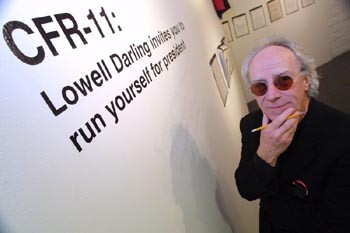
Lowell Darling

0

Oh My Darling

Renegade artist runs conceptual campaign

By Paula Harris

“IF YOU WANT to run for president, it’s as easy as this,” declares internationally known (and infamous) conceptual artist Lowell Darling, as he flamboyantly presses a small green button on a copy machine and grins his infectious smirk. The photocopier whirs into action, a light flashes, and a copied page from the Florida Election Code slides out on crisp white paper.

“This is the first step,” he says.

Darling, 58, clad entirely in black, except for the barely visible red, white, and blue edges on a blacked-out campaign button pinned to his lapel, explains his theory: “If everyone runs for president, every vote would count and be counted,” he states.

The Camp Meeker (rather than Camp David) resident runs a hand through his shock of receding gray hair, then takes a pencil and scrawls that statement across a white wall in the Sonoma Museum of Visual Art, the current site of his “Run Yourself for President” exhibit.

This ultra-sparse exhibition may be a bewildering mystery to some observers. A few may even call it a publicity stunt by someone with a taste for celebrity–or a mere scam masquerading as art.

“Run Yourself” consists merely of packets of paperwork attached along the walls; a table full of election paraphernalia like books and buttons; a video playing on a TV; a 40-year-old tattered black derby hat filled with concrete next to a miniature boxing ring (to signify throwing one’s hat into the ring–if you’re able to lift it); drapes of red, blue, and black bunting–and the photocopy machine.

Of course, those familiar with Darling’s work will surmise that this is a humorous and ironic exhibit designed to provoke thought and question the American electoral process. The paperwork on view is a collection of the red tape involved in running for president. There are documents and application packages Darling amassed from various states and the Federal Election Commission when Darling himself ran for president last year. He subsequently withdrew in dismay because of the seemingly impossible procedures involved.

At the time, Darling’s main motive for running was to point out to American elementary school teachers that they should stop telling schoolchildren that anyone can grow up to be president, because it’s no longer so. “Anyone can’t be president,” he says. “It’s not our vote that elects the president. It’s a handful of campaign finance lawyers who decide.”

He says that, under the guise of political campaign reform, the two main political parties have legislated away this basic right and enduring American dream in the form of CFR-11 (the Code of Federal Regulations for Presidential Elections), which Darling calls a legal land mine.

“Only the candidates with 50 million bucks under their belts that are wealthy enough to hire expensive campaign and finance lawyers can navigate the legally treacherous maze of the CFR-11,” he asserts.

OVER THE course of an artistic career that began after art school in the late ’60s, Darling has been awarded several grants from the National Endowment for the Arts. Among his best-known work is the first artists’ website/exhibit at the Whitney Museum of American Art.

Now the irreverent artist is inviting everyone to run himself/herself for 2004 president: to come into the exhibit at SMOVA, photocopy the necessary paperwork, begin the application process–and basically flood the system.

“How many people can the Supreme Court take on?” Darling asks, eyes twinkling behind amber-tinted glasses. “I’m interested to see where this goes from here.”

Ever the explorer of American culture, Darling has been a tongue-in-cheek politician since 1978, when he ran for governor of California against Jerry Brown and captured some 67,000 (or 2 percent) of the vote. During that time, he created memorable political agit-props in the form of a glove-on-a-stick for germ-free handshaking and lips-on-a-stick for kissing babies.

Darling is a performance artists who plays to the media, a hip jokester whose previous artistic capers over the years have included lacing up a small portion of the San Andreas fault with ropes in order to save California from a major earthquake (a stunt captured by Rolling Stone magazine), and recently campaigning for U.S. president in Europe–where he told people that the office of the president was “too important to be left in the hands of Americans.”

Indeed, This Is Your Life: Fuck You was to be the title of a book that Darling never wrote that summed up his investigation of 20th-century American culture.

Darling has recognized political campaigning as an art form, and he uses video, buttons, paperwork, and humor to make his points. He calls himself a pro bono artist because he often does not produce a salable end-product, but rather a concept-driven work that evolves with public events.

“It’s an organic work,” Darling explains. “Like biology, it keeps changing. Art is not made, it’s willed. You make it happen.”

SMOVA director Gay Shelton compares Darling in some ways to the installation artist Christo because his medium is the news media, and the art itself is what occurs in the media as the exhibit happens.

“Darling gets an idea and makes an art show, but the whole process unfolds as he get more intrigued by current events and it becomes a work in progress,” Shelton says. “That’s why it’s so current.”

In this case, life has seemed to imitate art as the latest election mess outdoes Darling’s satire.

“This campaign was choreographing that campaign,” he says, shaking his head in wonderment. “The real political situation keeps matching this one lunacy for lunacy.”

Darling says he’s actually very happy about the election fiasco. “The country is having a big conversation that it needs–and this is my sentence,” he says, gesturing to the exhibit. “But it’s not a life sentence. Being president is a life sentence.”

But can anyone really become president using his ballsy system?

“Yes,” says Darling, not missing a beat. “If everyone runs, you will be most likely to vote for yourself–unless you have absolutely no self-esteem. And so if you get two votes you could win.

“All you need is one good suit and one good quote.”

Lowell Darling conducts a public tour of his exhibit on Saturday, Jan. 6, at 11:30 a.m. The exhibit continues through Feb. 18 at the Sonoma Museum of Visual Art, LBC, 50 Mark West Springs Road, Santa Rosa. Admission is $2. For details, call 707/527-0297.

From the January 4-10, 2001 issue of the Northern California Bohemian.

© Metro Publishing Inc.

Wine-Related Resolutions

0

12 Monkeys

Wine-related resolutions for 2001

By Bob Johnson

IT’S THAT TIME of year when people resolve to get into better shape, eat healthier, quit smoking, and spend more time with family. Of course, by around Jan. 15, every one of those resolutions will have been broken. To avoid self-humiliation, I’m suggesting a few wine-related resolutions for others to embrace.

January

Resolve to think differently about wine. Too many people associate wine with special occasions. Then they go to Europe, immerse themselves in the culture, and come away thinking all Germans, Italians, and Parisians are candidates for the Betty Ford Clinic. Europeans know that a glass of wine a day does not a gutter-hugging drunk make. Study after study has shown that moderate consumption of alcohol–especially wine, and more specifically, red wine–contributes to a more healthful lifestyle for most people. The special occasion Europeans choose for drinking wine is known as “life.”

February

Resolve to share a bottle of red wine with your significant other. Yes, this is a not-so-veiled reference to Valentine’s Day. Let’s face it, women love romance, and what color do we most commonly associate with that pursuit? You got it: red. Toss in a few candles, some soft music, and a decent meal, and you have the makings of a memorable evening . . . that may well extend into the morning, if you play your cards right.

March

Resolve to hold your wine glass any damn way you please. All right, I admit it: Like every other chronicler of wine at one time or another, I have written about the importance of holding a wine glass by its stem. The reasoning behind this advice is that if you hold the bowl part of the glass, you’ll alter the temperature of the wine, making it warmer than is recommended. Two things: (1) There isn’t a restaurant in the world that serves every bottle of wine at exactly the “correct” temperature; (2) if your hand is throwing off enough heat to significantly alter the wine’s temp, you should be in the emergency room, not a dining room.

April

Resolve to host a wine summit. Have you been feuding with a formerly close friend or someone in your family? Someone has to bury the hatchet, so it may as well be you. Invite your antagonist to a public place, order a bottle of wine, and start talking. Wine brings people together, and it’s also the world’s most effective truth serum. By the time you’re draining your last glass, you’ll either be back on good terms or sharing a paddy wagon.

May

Resolve to adapt an ABC attitude. We’re referring not to the American Broadcasting Company, nor the American Bowling Congress, nor the Alcoholic Beverage Control spies . . . er, representatives. This ABC stands for “Anything But Chardonnay,” and it’s an attitude, should you choose to adapt it, that could open the door to some eye-opening and palate-pleasing wine experiences. Just as some beer drinkers always order a particular brand, many wine drinkers find it easy to get into a chardonnay rut. If variety truly is the spice of life, you can have some spicy times ahead if you occasionally think “ABC” when ordering wine. P.S.: The “C” can also stand for cabernet.

June

Resolve to break the food-and-wine pairing rules. Ever since Red Wine with Fish? hit the shelves at Barnes & Noble, food and wine writers have been questioning the “traditional” guidelines that urged red wine with (red) meat, and white wine with fish. While that’s still good basic advice, the problem is that it’s limiting; it precludes way too many sublime chow-and-vino possibilities. For instance: broiled salmon with pinot noir . . . a thick steak grilled in melted butter with a well-oaked chardonnay . . . spicy beef and broccoli with Gewürztraminer. Didn’t someone once say that rules were meant to be broken?

July

Resolve to refer to California sparkling wine as champagne. For generations, French winemakers have argued that only sparkling wine made in the Champagne region of France should be referred to as “champagne.” Some have even initiated legal proceedings to eliminate use of the word by “interlopers.” I’ve played along with this silliness for way too long, and this is the year I’m putting my foot down. If it looks like champagne . . . if it smells like champagne . . . if it bubbles like champagne . . . dammit, it’s champagne! (Do they still check passports in France?)

August

Resolve to embrace, rather than eschew, the wines of summer. The boys of summer were the old Brooklyn Dodgers. The wines of summer are chilled roses and lighter whites like chenin blanc, Riesling, pinot blanc, and Gewürztraminer. What do baseball and wine have to do with each other? Well, the Disney dynasty owns the Anaheim Angels as well as the soon-to-open California Adventure next door to Disneyland, and that new theme park will include a wine-themed attraction sponsored by Robert Mondavi. And if there’s anything better than a cold beer at a ball game, it’s . . . peanuts and pinot noir? . . . Cracker Jack and cabernet? . . . ice cream and ice wine? . . . OK, so there isn’t anything better than a cold beer and a hot dog. But you can’t spend all your time at the ballpark, so learn to love the aforementioned wines of summer and make some room in the refrigerator.

September

Resolve to trust your own palate. Don’t get suckered by the $100-and-up price tags on a (disturbingly) growing number of wines these days. Those prices have more to do with our proximity to the nouveaux riches in Silicon Valley, combined with somewhat limited supplies, than with quality. You name a hundred-buck bottle, and I’ll name five that are every bit as enjoyable for a third of the price. We all can indulge our champagne tastes on a Budweiser budget simply by learning what we, as individuals, like. Even if most of the wine you drink comes out of a box, that wine is good–to you. And when it comes to drinking wine, you’re the only person who counts.

October

Resolve to cook with wine . . . and even use some in your recipes. OK, it’s an old joke, but adding wine to certain sauces and stews can truly enhance and expand the flavor spectrum. Numerous books have been written on the subject, and many cookbooks include recipes that call for a splash or two of wine. It’s also a good way to kill off a bottle that has been open for a few days.

November

Resolve to mix it up on Turkey Day. Don’t pull your hair out trying to find the “perfect” wine match for your holiday turkey or ham. Perfection cannot be attained . . . unless you’re serving turkey or ham and nothing else. It’s all those other dishes on the Thanksgiving table that create the matching havoc, so the best way to handle the situation is to offer several different kinds of wine and put at least a couple wine glasses at each place setting. Your guests will figure out what they like on their own.

December

Resolve to learn the proper way to open a bottle of champagne (yes, including California sparkling wine that you’ve been calling champagne for eight months now). Uncorking a champagne bottle as they do in the movies is a good way to lose an eye–yours or someone else’s. To avoid possible catastrophe, slowly remove the “cage” surrounding the cork, then get a firm grip on the cork itself. Slowly–repeat: slowly–turn the cork until it emerges from the neck with a muted “pop” sound. The bubbles will be just as, well, bubbly with a muted pop, plus you won’t spill (i.e., waste) any of the wine via cascading spillage. If you simply must experience the sound of a loud pop, tune in a Lawrence Welk rerun on PBS.

From the January 4-10, 2001 issue of the Northern California Bohemian.

© Metro Publishing Inc.
Rant

The Actors and the Mole People

By Bonnie-Jean Kimball

HOW EXCITING! We now belong to the Mole People. What a great gift our government has given us! Some of us have been voting in every election, and now we’ve learned it’s not necessary. They let us vote; they just don’t count them! To our politicians we say, “Are you just happy to see us, or is that a judge you have in your pocket?” Ho, ho, ho.

With makeup, hair styling, costuming, and PR, these guys we thought wanted to be statesmen are great actors. What a comedy! It’s a big sitcom, like health care. Our government and those huge insurance companies see that we receive only minimum care because they want us to stay strong and pay the right people, who pay them. Ross Perot became a multibillionaire the American Way, didn’t he, with our Medicare money?

These important men sit on one another’s boards of trustees controlling prices. Is that why we see so many mergers? The international pharmaceutical companies priced us out of medications first so we could get well on our own or take unregulated herbal products. The media businesses don’t get much money from us yet, so they support outfits that buy big advertisements. “That’s just business.”

Don’t revolutionaries take over press, radio, and TV in a coup? Lucky us–we’re coup-less!

And with the merger of grocery companies, they’ve priced us out of products we don’t need, like milk. It’s too bad farmers can’t get more of that money, but they must not be paying our needy candidates and the one-party system enough. Governments don’t want us to have too much water either, because that would put drought-control boards and water-treatment people out of business. Have you noticed lately that they need to raise prices?

Since we can’t afford housing costs where we work, we travel too much, and that’s why the global (whoa–not just Texas!) oil and gasoline people need bigger profits. It puts independent truckers out of business, but their vehicles are the ones that tear up roads that seldom get repaired, so what do we care? We know the government needs our gasoline tax money for other purposes. What are those again?

Now at the start of winter the power companies, whose poor investors weren’t receiving high enough dividends, are helping us realize we can live without heat or light.

Boy! It’s better than a horror movie.

With help from the media, they’ve got everybody scared. Of course, old people get pneumonia or fall down, but without medicine, health care, food, water, rent money, gas, or light they can’t make it anyway. Haven’t politicians reported that Social Security’s going broke?

But, gee, I hope they don’t raise prices on matches and candles, because “if everyone lit just one little candle–” What’s the rest of that song?

Send your 500-word Rant item to: Northern California Bohemian, 50 Mark West Springs Road, Santa Rosa, CA 95403, attn: Opinion page editor.

From the January 4-10, 2001 issue of the Northern California Bohemian.

© Metro Publishing Inc.

Open Mic

0

Wingin’ It

By Becca Lawton

THE THANKSGIVING DAY vandalism of Luna, the 200-foot-tall redwood made home by Julia “Butterfly” Hill for over two years, followed by a week my own trip to Humboldt County. I’d gone to tour a station that measures sediment in Freshwater Creek near Eureka, hoping to learn techniques applicable to Sonoma County streams. While showing me around, the geologist who operates the station confessed, “I wasn’t an activist before I moved here and saw what was going on in the forests.”

What’s going on is continued clear-cutting that delivers sediment to streams at an alarming rate. The geologist and his colleagues sample on several creeks in Humboldt Bay watersheds, and they’ve watched little drainages go silty one by one as the forests above them become patchworked with naked slopes. During certain storms the Freshwater station has measured suspended sediment at concentrations more than twice what the stream’s dwindling population of endangered coho salmon can handle. Extended periods of high sediment in stream water act like sandpaper on the salmon’s gills. The fish suffocate.

Not everyone cares about fish, of course. A quote I read from someone who doesn’t: “I don’t give a good goddamn about salmon. . . . Saving salmon, it doesn’t make sense.” Words perhaps similar to those, albeit about trees, may have been running through the mind of Luna’s destroyer–on a day traditionally dedicated to feasting, communing, and giving thanks.

Creek monitoring included, we have no way to measure the true impacts of clear-cutting deep forests (whether for timber, agriculture, or building), chain-sawing our elder redwoods, and smothering coho. Which brings to mind the Ray Bradbury tale about the big-game hunters who time-travel from AD. 2055 back to the Cretaceous to bag T. rex. The hunters must confine their movements to an antigravity path hovering six inches aboveground so they in no way affect the ancient environment. Of course, one terrified wretch accidentally strays from the path, and after the’ve downed T. rex and returned to 2055, the wretch turns up with the crushed remains of a golden butterfly on one shoe.

The results are disastrous. The butterfly was meant to survive, and losing it from the fragile landscape of the evolving ecosystem transforms the world to a place not worth living in: chemically tainted, oily, and overridden with crude sensibility. A Las Vegas with gloves off.

In the wretch’s own words, Killing one butterfly couldn’t be that important. Could it?

Sonoma County writer-geologist Becca Lawton is the author of ‘Discover Nature in the Rocks.’

From the January 4-10, 2001 issue of the Northern California Bohemian.

© Metro Publishing Inc.

Newsgrinder

0

Important events as reported by daily newspapers and summarized by Daedalus Howell.

Thursday 12.28.00

“Steffi & Andre: Liebesnest für 50 Millionen Mark,” blared a headline from Bildzeitung, a German-based tabloid. What’s it all mean, oh great one, you ask? Andre Agassi, tennis star and Brooke Shields deflowerer, bought a pad in Tiburon for Steffi Graf, girlfriend and fellow Wimbledon champ, reports the Marin Independent Journal, which was besieged by German tabloids covering the “story.” German tabloids–can you just imagine? Remember that is the nation that invented the concept of “schadenfreude” (experiencing joy from another person’s misfortune), not to mention Nazi spin doctor Joseph Goebbels. “I think everybody and their brother is after this thing,” noted Brigitte Knauf of Der Spiegel, who said her publication wants to run a “small, human interest” piece on the dwelling–so small, apparently, that the German rag is willing to lay out some hard cold marks for airfare and accommodations.

Friday 12.29.00

Rick Ferguson, an employee of a San Anselmo concrete company, cemented his “Employee of the Week” title when he endeavored to retrieve a stolen company dump truck after spotting it being driven near his Richmond home. “I started following him, trying to get him to stop, and the guy pulled over to let me pass,” Ferguson recounted to the IJ. “I got out and told him that he was driving my boss’ truck. He got out and said he didn’t steal it and that he owned it. Then he took out a gun and put it to my head.” (Suggested soundtrack: “Billy, Don’t Be a Hero,” performed by Bo Donaldson & the Heywoods.) “I think Ferguson’s motives were good and that he was trying to do the right thing, but I would never advise anybody to do that,” said San Rafael Police Sgt. Jonathan Bean. “In that situation I would recommend you be a good witness, drop back and protect your safety, and call 911.” Or just walk the fuck away.

Sunday 12.31.00

The Napa Valley Register reports that U.S. retailers bought up to 20 percent more champagne and sparkling wine than usual in 1999. According to wine columnist Dan Berger, customers bought only 5 percent more, however, leaving millions of undrunk cases sitting in stockrooms. “We were all victims of the biggest marketing hoax in history,” said Phil Huettenhain, owner of Vintage 1870 Wine Cellar in Yountville (apparently unaware of the Village People). “It was built up so big I thought every person in the world would have a glass of champagne in hand.” There’s still time, Phil. Overstocked champagne can be sent to: Daedalus Howell, c/o Northern California Bohemian, 50 Mark West Springs Road, Santa Rosa, CA 95403. Bottoms up!

Sunday 12.31.00

When wetlands consultant John Zentner pleaded guilty to illegally moving eight red-legged frogs protected by the Endangered Species Act out of the path of a Concord housing development, he said he didn’t foresee the tidal wave of negative press that would follow. “I could never have predicted the newspaper coverage,” Zentner told the Press Democrat. Indeed, Zentner could never have predicted this: wiggy, wiggy, wom, wiggy, wom, wiggy wom. . . .

Monday 01.01.01

Thanks to bicyclists Tom Fallon and Dolores Mosqueda, motorists who drive “dangerously close” to bicyclists may get a poor grade on their “Road Rage Report Card” (drivers who run down cyclists still have to drive home really, really fast and get paint jobs, however). Concerned about the growing number of assaults on cyclists by aggravated motorists, the duo has printed 1,000 notebooks for cyclists to record license-plate numbers and physical descriptions of unsafe drivers (or their Last Will and Testament, depending on the extent of the assault). The report cards come on the heels of part-time balloon salesman Glenn Wilson’s alleged endangerment of the cyclists when he reportedly threw a soft drink at them, charged at them, and skidded by, whilst driving a car full of helium balloons. Fallon says that Ross Police Chief Lee Hinnenberg told him that Wilson was a member of a venerable Ross family (uh, yeah, sure, balloon guy) and encouraged him to drop the matter, which the chief denies. “From what we’ve been told, [Fallon’s] a radical–one of the bicyclists, the hard-core type,” he said to the IJ. Watch yourself, Chiefy, words like that tend to attract radical, hard-core cyclists in droves–they may swarm your wee little burg like a plague of locusts for a little civil disobedience. . . . Calling Critical Mass!

Monday 01.01.01

The PD reports that 5,400 babies were born in Sonoma County during 2000; however, only 4,000 county residents died before 2001. The result is a 1,400 countywide Soul Deficit, owing to the skewed reincarnation ratio. Parents who suspect their child was born without a soul are urged to register him or her with the Census Bureau to aid in the search for the antichrist. When the antichrist is located, he or she will be rewarded a $500 college scholarship and an embossed certificate of authentication. Happy New Year. . . .

From the January 4-10, 2001 issue of the Northern California Bohemian.

© Metro Publishing Inc.
Dave Foreman

Dave Foreman’s novel offers passion for vanishing wild places

By Steven Hawley

FOLLOWING Mark Twain’s adage “Write what you know about,” the world of fiction might be neatly divided into two camps. There are writers who research a subject extensively and manage to write intimate, detailed, vivid prose born of whatever spark might be ignited by hours spent in library stacks. Then there are writers whose work is purely imaginative. Such authors tend to create characters who are at least loosely autobiographical.

Whatever the finer points or drawbacks of either genre, Dave Foreman’s first crack at fiction, The Lobo Outback Funeral Home (University Press of Colorado; $24.95), falls plainly within the bounds of biographical fiction.

Foreman, a co-founder of the radical environmental group Earth First!, has attracted controversy from inside and outside environmental circles.

Over a 30-year career in the conservation movement, Foreman has been beaten by pro-logging thugs, investigated by the FBI, and reviled by fellow environmentalists for abandoning his radical roots.

The protagonist in this novel, 40-something Jack Hunter, is a lot like Foreman: a lifelong conservationist who has made the Southwest his home. Like Foreman, Hunter began his career as an environmental lobbyist in Washington, D.C., and became disillusioned with the bureaucracy there. And like Foreman, Hunter seems unable to avoid headlong collisions with controversy after departing Washington for greener pastures.

Unlike Foreman, Hunter wishes to retire from the activist life, relegating himself to a quiet existence as a farrier (a person who shoes horses) and explorer of a nearby beloved wilderness area.

Of course, things get complicated. Hunter falls in love with a fiercely intelligent and passionate wildlife biologist, Dr. MaryAnne McClellan, finds a breeding population of wolves in his wilderness area, and runs afoul of rednecks and monied interests that have an anti-environmental stranglehold on local politics.

All this leads to sex in the wilderness, brawls in bars, and duels with local hicks and bureaucrats, borrowing intelligently from a fiction formula perfected by Ed Abbey and Carl Hiaasen.

Foreman’s passion for American wilderness is transparent, an obsession that both helps and hinders this novel.

His love and intimate familiarity with Southwestern wild lands is finely woven into the scenery of the book in a visceral way that makes you want to hop onto I-15 south and drive until you find the landscape that matches the prose.

While the scenery is great, Foreman’s zeal to promote the wilderness cause presents some literary glitches. Anyone not fascinated by the procedures for designating, documenting, and protecting wilderness areas can skip substantial portions of the middle of the book, since that’s what the good guys in Lobo Outback are up to. The same goes for a long lecture from Hunter’s love interest McClellan, who often sounds like a Peterson’s field guide, providing accurate, detailed bird, plant, and animal factoids that nonetheless take some of the wind out of the sails in this plot.

But overall, Lobo Outback is an entertaining read, a contemporary Western that depicts some fantastic wild places and the increasingly divided culture charged with protecting them.

From the January 4-10, 2001 issue of the Northern California Bohemian.

© Metro Publishing Inc.

‘Hamlet’

0

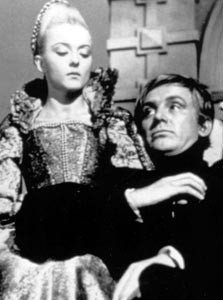
Hamlet.

Will Red

The plot’s the thing in compelling Soviet film version of ‘Hamlet’

THE VERY notion of a Russian-language version of Shakespeare’s Hamlet, filmed in the Soviet Union in 1964 during the terrible old Cold War days, will surely intimidate certain viewers. Others may be attracted to such an offering out of cultural curiosity, approaching the piece with an eye for cinematic clues about life in Russia during the reign of Khrushchev. And some, Shakespeare fans who’ve already seen every English version of the play, might be eager to score one more big-screen Hamlet notch on their cineaste belts.

Such fears and expectations are natural. But the true pleasure of Grigory Kozintsev’s magnificent Hamlet–screening during the Rafael Film Center’s Soviet Cinema series–lies in seeing the bones of the story laid bare. With Shakespeare, the glorious language often takes precedent over the story itself. But in this case–with English subtitles translated from a “modern language” version by Russian poet-writer Boris Pasternak (Dr. Zhivago)–Shakespeare’s language is dropped to a subordinate role, allowing the tale itself to rule the show. And rule it does.

Few filmed versions of Hamlet have so perfectly captured the relentless doom of Hamlet’s predicament. He’s too terrified to accuse his uncle of murdering the rightful king, yet he’s equally scared not to.

The film was made in a Cold War-era Russia steeped in fear. The dread of nuclear annihilation and the growing sense that each Russian’s every move was being watched reveal themselves in the way Hamlet’s every action is shadowed by spies: Claudius, the court adviser Polonius, Hamlet’s turncoat friends Rosencrantz and Guildenstern, and the faceless guards lurking in every corridor. The prince is a prisoner in his own country, deemed dangerous because he won’t play along.

Kozintsev’s Hamlet opens with a long series of eerie shots, in stark but vibrant black-and-white, that brilliantly set the tone and pace for all that follows. Waves rise and fall at sea. Then more waves, filmed a bit closer, till we finally see the shore: sharp, jagged rocks being pounded by surf, and a shadowy reflection–the imposing Castle of Elsinore–now appearing in the mist-shrouded water below.

The ominous quiet of these images is suddenly shattered by a wide shot of Hamlet (Innokenty Smoktunovsky) riding a horse at frantic full gallop across a barren landscape, then up and through the gates of Elsinore. Slowly the gate is lowered and, with a reverberating click, locks into place.

The prison theme shows up throughout the film. When Hamlet addresses his former love, Ophelia, delivering his self-hating “Get thee to nunnery” speech, he does so from one side of a stairway banister, talking through the wooden supports as if through the iron bars of a jail. Later, Ophelia is shown being locked into a stiff iron corset that looks more like a torture device than a piece of apparel.

Smoktunovsky plays Hamlet with a heartbreaking openness, his overwhelming grief and anger made profoundly clear in his haunted eyes. All the performances, in fact, are magnificent, somehow transcending the muddling effect of the subtitles. The orchestral score, too, by Dimitri Shostakovich, is exceptional, rising and falling from moments of quiet emotion to rousing cacophonies that, like this provocative Hamlet itself, are as moving as they are frightening.

‘Hamlet’ screens Saturday, Jan. 6, at 7 p.m. at the Rafael Film Center, 1118 Fourth St., San Rafael. Tickets are $7.50. For details, see Movie Times, page 31, or call 415/454-1222.

From the January 4-10, 2001 issue of the Northern California Bohemian.

© Metro Publishing Inc.

Newsgrinder

Important events as reported by daily newspapers and summarized by Daedalus Howell. Wednesday 01.03.01 Petaluma's ArgusCourier.com reports that police took into custody a woman occupying a downtown doorway "with grass and twigs in her hair and clothing, talking about suicide." No word why the fuzz targeted the outdoor production of A Midsummer's' Night Dream,...

‘Jazz’

Trumpet master: Clifford Brown, who died in a 1956 car crash, remains a major influence on today's young jazz lions. Sour Note When it comes to his 'Jazz' series, filmmaker Ken Burns could have done better By Harvey Pekar IN ORDER to understand Ken Burns' objectives in his...

1999/2000 Individual Visual Artists Grantee Showcase

Leepa Asleep with Grass in Her Mouth. Visual Variations Falkirk Cultural Center showcases artist award winners By Paula Harris RARENESS is something of an art form at the Falkirk Cultural Center. For instance, if you imagine the art gallery at the San Rafael-based arts facility to be the usual sterile...

Lowell Darling

Oh My Darling Renegade artist runs conceptual campaign By Paula Harris "IF YOU WANT to run for president, it's as easy as this," declares internationally known (and infamous) conceptual artist Lowell Darling, as he flamboyantly presses a small green button on a copy machine and grins his infectious smirk. The photocopier...

Wine-Related Resolutions

12 Monkeys Wine-related resolutions for 2001 By Bob Johnson IT'S THAT TIME of year when people resolve to get into better shape, eat healthier, quit smoking, and spend more time with family. Of course, by around Jan. 15, every one of those resolutions will have been broken. To avoid self-humiliation, I'm...

Rant

The Actors and the Mole People By Bonnie-Jean Kimball HOW EXCITING! We now belong to the Mole People. What a great gift our government has given us! Some of us have been voting in every election, and now we've learned it's not necessary. They let us vote; they just don't count them! To our politicians...

Open Mic

Wingin' It By Becca Lawton THE THANKSGIVING DAY vandalism of Luna, the 200-foot-tall redwood made home by Julia "Butterfly" Hill for over two years, followed by a week my own trip to Humboldt County. I'd gone to tour a station that measures sediment in Freshwater Creek near Eureka, hoping to learn techniques applicable to...

Newsgrinder

Important events as reported by daily newspapers and summarized by Daedalus Howell. Thursday 12.28.00 "Steffi & Andre: Liebesnest für 50 Millionen Mark," blared a headline from Bildzeitung, a German-based tabloid. What's it all mean, oh great one, you ask? Andre Agassi, tennis star and Brooke Shields deflowerer, bought a pad in Tiburon for Steffi...

Dave Foreman

Dave Foreman's novel offers passion for vanishing wild places By Steven Hawley FOLLOWING Mark Twain's adage "Write what you know about," the world of fiction might be neatly divided into two camps. There are writers who research a subject extensively and manage to write intimate, detailed, vivid prose born of whatever spark might...

‘Hamlet’

Hamlet. Will Red The plot's the thing in compelling Soviet film version of 'Hamlet' THE VERY notion of a Russian-language version of Shakespeare's Hamlet, filmed in the Soviet Union in 1964 during the terrible old Cold War days, will surely intimidate certain viewers. Others may be attracted...
11,084FansLike
4,606FollowersFollow
6,928FollowersFollow
