
‘Hannibal’

0

Hannibal.

Losing Lecter’s Lunch

Horrified brain expert dissects America’s favorite cannibal

Writer David Templeton takes interesting people to interesting movies in his ongoing quest for the ultimate post-film conversation. This is not a review; rather, it’s a freewheeling, tangential discussion of art, alternative ideas, and popular culture.

ATTENTION, class. Please take notes. Three things Dr. John J. Ratey and Dr. Hannibal Lecter have in common:

1. They are both brilliant doctors with a keen understanding of the human psyche.

2. They are both eloquent speakers, able to take complex scientific issues and restate them in elegant, understandable English.

3. They both have a thing for brains.

Unlike the fictional Dr. Lecter, however, Dr. Ratey’s interest in that spongy, three-pound organ is not the least bit culinary–a fact his patients will undoubtedly be relieved to hear.

Until he was invited by me to sit through Hannibal–the hit sequel to 1990’s Oscar-winning Silence of the Lambs–Ratey had never even considered using the human brain as a side dish, with or without onions.

“I loved Silence of the Lambs,” gasps the Massachussetts-based Ratey. “I loved it! But this one was . . . oh my god! It was horrible! It was just horrible! It ran from dull to grotesque and right back to dull. I mean . . . Oh . . . my . . . god!”

Exactly.

But everything is a matter of taste. With a box-office take of 100 million and counting, audiences are clearly eating Hannibal up, taking special delight in the much-discussed scene (one that gives new meaning to the word headwaiter) in which Lecter (Anthony Hopkins) dresses up in his Sunday best to serve up the frontal lobes of one unfortunate fellow’s brain, sliced off and sautéed with shallots and a dash of white wine, while the poor, anesthetized slob sits there babbling and slurring.

“The one good thing about that scene,” says Ratey, “is that people are leaving the theater asking serious questions about the human brain. Which part does what? How much of the brain do we need? Very good questions.”

An associate clinical professor of psychiatry at Harvard Medical School, Ratey is the author of several books on psychology and human behavior, the most recent of which is the appealingly titled A User’s Guide to the Brain .

The book is an exciting read that makes brain science seem like an action adventure, and Ratey is just as accessible and entertaining in person. He’s the kind of person who, discussing a film like Hannibal, will toss off such comfortably down-to-earth remarks as, “It’s kind of stupid to take someone’s brain apart like that” or “The brain is full of cross-fibers going all over the goddamn place.”

THREE FACTS the brain-eating scene got right, according to Dr. Ratey:

1. The brain has no nerve cells, so carving it up like turkey would technically not hurt.

“Assuming the person didn’t go into shock,” Ratey allows. “I suppose it’s possible to scoop out a few spoonfuls of brain while the guy makes wisecracks, and maybe he wouldn’t go into shock because you don’t lose that much blood when you do that sort of thing–but, oh my god!”

2. The removal of some prefrontal lobe tissue would cause some slurred speech, but the subject would maintain his basic language skills.

“Hannibal was going into the guy’s right frontal area,” the doctor explains. “And for men especially, that part of the brain does not contain much language function. They have language function in their left hemisphere only. For women, who tend to be more bilateral–having language function in both hemispheres of the brain–it would have been worse.”

3. While brain damage can cause changes in people’s personalities, since the guy in question was kind of a sleazebag, the procedure would probably make him no worse a person.

“What Lecter tells him is very true,” Ratey affirms. “He says, ‘You don’t really need this part of your brain,’ then something about ‘social graces’ and his being fairly rude to begin with. That’s accurate, because the part of the brain that Lecter was cutting has a major role in controlling our social interactions, our level of politeness, our empathy and sympathy to other people’s feelings. That guy was a sleazebag, so he wasn’t using much of that anyway.”

Just how much of our brains can we do without?

“Well, there are people who have hemispherectomies,” Ratey says, “in which one entire half of their brain–a whole hemisphere–is surgically removed. There are problems with motor skills on the opposite side, obviously–you’d be severely impaired–but most of their language function can be gradually picked up by the other half of the brain. So, can you live with half of your brain missing? Yes. Will you still function? Not very well.”

Not surprisingly, Ratey is much more interested in what went wrong with Hannibal Lecter’s brain than in how Lecter would go about making a meal of someone else’s. Especially interesting to Ratey is the common-sense method Hannibal uses to try and escape justice at the climax of the film.

“Hannibal would try that,” Ratey reveals, “because–and this is kind of interesting–people like Hannibal don’t feel very much. Their brains are such that normal levels of sensation can’t register a spark. They have to press for the bizarre, the weird, the extreme. There’s a whole list of things they often don’t feel any other way.”

Five things that people like Lecter don’t easily feel:

1. A sense of thrill. 2. Pleasure. 3. Fear. 4. A sense of threat. 5. Pain.

According to Ratey, it’s like this: Though fairly rare, such individuals are hard-wired, so to speak, to be impervious to normal levels of stimulus. In scary or life-threatening situations that would give the rest of us a coronary these medical marvels maintain completely normal levels of blood pressure and pulse.

“In psychobabble language,” he says, “these people are not connected to their own lives; they’re sort of ‘not into it’ as much as the normal people. This is how we get people like Jeffrey Dahmer, people devoid of human feelings of pain, sadness, and attachment.

“It so happens,” Ratey concludes, “that all the Lecter types are missing that.”

From the February 22-28, 2001 issue of the Northern California Bohemian.
© Metro Publishing Inc.

Odeon Pope

0

The Seeker

Saxman Odean Pope strives for the sacred

By Greg Cahill

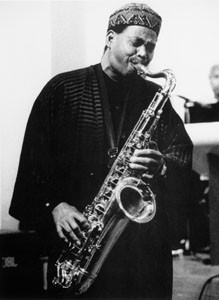
ODEAN POPE spends his time in the relentless pursuit of truth as codified in the fiery scales of a searing free-jazz sax solo. Indeed, 10 minutes into a phone interview with this obscure Philadelphia-based tenor sax player, it becomes clear that this is a man who is not a mere musician in the traditional sense of the word, but a committed spiritual seeker thirsting for sacred knowledge inside a swirl of polytonality. “To me, music is a universal thing,” says Pope.

This is a notion that permeates Pope’s conversation and one that has been a guiding light throughout his long, fruitful career as a performer, recording artist, and educator.

How deep is that vision? At age 8, as a member of a Baptist church in the unusually named town of Ninety Six, N.C., Pope would sit in the straight-backed, wooden pews, listening to the gospel choir and pondering what it would sound like to play that same sacred music on nine saxophones.

He got his chance. As the leader of the avant-garde Saxophone Choir, Pope has recorded several adventurous (and hard-to-find) albums, establishing himself as a cult figure. He has mastered the art of multiphonics, using a cluster of simultaneous overtones, an extremely difficult technique. And he’s performed for nearly 30 years as a sideman with legendary jazz drummer Max Roach and jammed with many of the giants of jazz, including John Coltrane and Dizzy Gillespie.

He returns to Sonoma State University on Saturday, Feb. 24, in a rare North Bay appearance.

“It’s important to channel information down to the young people in order to keep this music alive,” says Pope, 63, who teaches everyone from poor Philly kids to privileged suburban students. “My philosophy is that even if you successfully pass that information down to one out of 10 students, then that one will pass it down to others,” he adds. “You’ve got to keep that fire burning.”

FOR POPE, that fire has burned hotly since his youth. “When I first came to Philadelphia I was 10 years old,” he says. “There was a place called the Earl Theater, and they used to have Lionel Hampton, Count Basie, Illinois Jacquet, and Buddy Rich’s big bands–a whole lotta big bands used to come through town. I was exposed to a lot of different kinds of music.”

At 18, he joined the pit band at the rival Uptown Theater, playing behind such R&B and soul heavyweights as Stevie Wonder and Aretha Franklin. “About 10 days out of each month they’d feature a touring stage show–Smokey Robinson, the Supremes,” recalls Pope, who already had sat in with jazz greats Chet Baker and Elvin Jones. “I learned a lot from that.”

It was during one of his frequent visits to a local nightclub that an underage Pope met Roach. “I wasn’t old enough to go inside the clubs, but I used to stand right near the door and listen to all the music.” During the breaks, the musicians would come outside to catch a breath of fresh air.

One of them later arranged for Pope to sit with Roach. “Max kicked ‘Cherokee’ so fast that it was one of the most intense learning experiences I ever had,” Pope says of the drummer’s mastery of legendary saxman Charlie Parker’s complicated jazz piece. “It made me go back to the woodshed to get more and more involved with the music.”

Among his closest contacts in those early years were such jazz notables as Coltrane, Rahsaan Roland Kirk, Pharaoh Sanders, Benny Golson, and Jimmy Heath–all part of the bustling Philly music scene. He remembers Coltrane as a humble man who would sit in his living room with his tenor sax perched on his lap, surrounded by a half-dozen books on African and American literature and the arts, alternately reading and playing his horn.

“‘Trane gave me my first major job, with [jazz organist] Jimmy Smith,” Pope says. “When [Coltrane] went to work with Miles Davis [in 1958], he had two weeks left on a job at a club here in Philly. He’d been listening to me at some of the local jazz workshops, and, for whatever reason, he called and asked me take over that spot for him. Of course, I was scared to death, but he convinced me that I could do it.”

At 21, Pope landed a spot in Roach’s landmark band. It was a heady experience for the novice jazz player, who stayed on board for a year before returning to Philly. “It really showed me the kinds of things I needed to do and convinced me that music was going to be my livelihood,” he says. “I came back and enrolled in school and got deeply involved with it.”

He returned with a vengeance, performing with pianist Ray Bryant and Art Blakey and the Jazz Messengers before resuming his long, continuous association with Roach. In the ’70s, he led an experimental jazz-funk fusion band called Catalyst, a contemporary of Miles Davis’ early electric bands. “It was a period of adjustment during which all musicians were standing back and taking a very good look at themselves and saying, ‘Let’s dabble in this and see if there’s anything there.’ ”

He formed his own trio, a format that gave him the freedom to explore a more adventurous free-jazz sound, and joined the ranks of jazz players reaching out into unexplored musical terrain.

Over the years, he has embraced the spirit of musical discovery. “Right now, I’m working on the whole spectrum of how you can expand, like cross rhythms. It gives me a chance to extend from where some of these jazz giants left off,” he explains. “I’m taking it to another level. The way I look at it is, music is evolution. Every time I pick that horn up there’s always something that I discover I can do differently if I really seek. If you were on planet Earth for, like, 2 billion years, I feel as though there’s always something new that you can find to do. There’s no end.

“When you feel satisfied with what you’re doing and feel as though you’ve got everything, then you’re dead.”

Odean Pope performs on Saturday, Feb. 24, at 8 p.m., at Warren Auditorium, Sonoma State University, 1801 E. Cotati Ave., Rohnert Park. Tickets are $12 general, $6/students and seniors. 707/664-2353.

From the February 22-28, 2001 issue of the Northern California Bohemian.

© Metro Publishing Inc.

‘Rebels with a Cause’

0

Rebels with a Cause.

Rebel Hearts

Helen Garvy offers forgotten stories of the ’60s

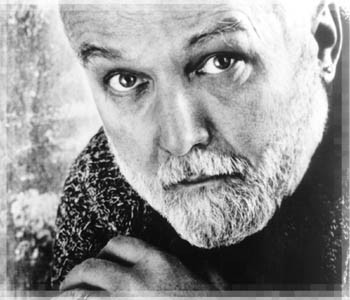
HELEN GARVY was a young rebel the last time she stood in this part of downtown Oakland. That was 31 years ago. She’s a bit older now, and perhaps a bit wiser, but Garvy is still a rebel. And sometimes–today, for instance, back in Oakland to revisit a painful, powerful memory–she still gets angry.

Dressed for warmth against the February wind, the filmmaker stands near the corner of Clay and 16th, attempting to summon a vision of these streets as they looked on Friday, Oct. 20, 1969.

That was the day a band of antiwar activists, Garvy among them, temporarily shut down the Oakland Army Induction Center with a loud protest against America’s seemingly unstoppable Vietnam War machine. Only a few days before, in the very same spot, a baton-wielding squad of sheriffs and police officers had attacked protesters during an antiwar peace march, beating demonstrators until they scattered.

“I was furious,” recalls Garvy, 58, her voice dropping to a whisper. “We were all so angry by what happened in Oakland. We’d seen police violence at protests in the South, but this was the first time we’d ever seen that kind of violence here.”

All these events are captured in Rebels with a Cause, Garvy’s documentary film about Students for a Democratic Society (screening Feb. 23 and 24 at the Sonoma Film Institute).

Back then, however, Garvy was working as a schoolteacher in San Francisco. She was also an activist and an early member of SDS, which organized the Oakland protest. That Friday, Garvy joined a second, even larger protest march, and this time the marchers were prepared, protected by motorcycle helmets and hard hats. The police attacked anyway, but anticipating the police tactics, the protesters used cars and flower planters to barricade the intersections. This time they succeeded, taking the streets of Oakland and shutting down the U.S. Army–for one day.

But what a day.

THIS MORNING, Garvy can find few signs that any of it happened. “Nothing is recognizable,” she murmurs, gazing up and down the street. “I don’t remember exactly where anything was. Of course, in a situation like that, you don’t really pay attention to landmarks.”

Now standing in the spot where Garvy guesses the Induction Center was–“The building was nothing much to look at, that’s all I remember,” she says–is the Elihu M. Harris State Building, an attractive, glass, stone, and steel structure that was opened about three years ago.

Ironically, just inside the building’s main lobby is a conspicuous sign directing police officers upstairs for “Use of Force Training.”

Back on the street, Garvy points to a nearby street light, allowing that it might be one she climbed up to get a better view of the area and to scout the scene for the presence of police. “There were so many people, you didn’t know what was happening even half a block ahead,” she recalls. “And if you were like me, you were terrified.”

Our history books offer few references to such significant events of the 1960s. In order to preserve those stories, Garvy, who lives in Santa Cruz, has spent the last five years making Rebels with a Cause, a remarkable oral-history documentary that chronicles the actions of SDS.

Among the most influential student groups of the 20th century, SDS at the height of its strength had more than 100,000 members on campuses from coast to coast, organizing to fight for civil rights, free speech, women’s rights, and the anti-apartheid movement, and to call for an end to the war in Vietnam.

The film features dozens of interviews with the group’s members, ranging from Tom Hayden to the late Carolyn Craven. Mingled with archival footage, newspaper clippings, and startling FBI documents that target SDS leaders, Rebels masterfully blends its individual storytellers, cutting from person to person–often in mid-sentence–in a way that suggests a group of people so closely connected they can finish one another’s thoughts.

“We would do that, back in the ’60s,” says Garvy, smiling. “We would finish each other’s sentences. In a lot of ways, the movement was one big long dialogue.”

In part, Garvy made the film to counter the widely held opinion that the ’60s were mainly about sex, drugs, and rock and roll, and that the idealistic social movements of the era were a failure. That’s a view, says Garvy, that breaks her heart–and can’t be supported by the facts.

“We did make a difference,” she says. “Yes, we had setback after setback, and frustration after frustration. It took years to end the war–and it was the Vietnamese who did that–and every little victory along the way took incredible effort.

“But look around,” she continues. “The world is a better place because of the people who put their lives on the line in the ’60s.”

Garvy’s film has already changed a few minds. After one screening, a young black woman approached Garvy and thanked her. “She thanked us for making things better for her,” Garvy says. “She said she’d always taken it for granted that people made sacrifices so she can be a little better off than she would have been.”

Garvy hopes the film also touches those who were a part of the movement.

“There are people who lost their hope back then,” she says, “people who’ve been hurt and disappointed and embarrassed to talk about what they did in the ’60s because everyone keeps saying we failed.

“I hope they see this film and finally get to say to themselves, ‘Oh my god. It wasn’t all for nothing,’ ” she says. “We really did make a difference. We really did help change the world.”

‘Rebels with a Cause’ screens at 7 p.m. Friday and Saturday, Feb. 23 and 24, at Sonoma State University’s Darwin Hall, 1801 E. Cotati Ave., Rohnert Park. Filmmaker Helen Garvy is tentatively scheduled to appear Friday night. Tickets are $4. 707/664-2606.

From the February 22-28, 2001 issue of the Northern California Bohemian.
© Metro Publishing Inc.

Russell Banks and Michael Ondaatje

Reel Deal

Novelists Russell Banks and Michael Ondaatje pair up to discuss fiction and film

By

FROM THE BURNING desert of The English Patient to the snow country in The Sweet Hereafter, the geographies in the books of Russell Banks and Michael Ondaatje are as diverse as their prose. Still, these two prolific literary lions are both most quickly identified by mentioning the movies that came from their words. Ondaatje is the author of The English Patient. Banks wrote the books that were the sources for the films Affliction and The Sweet Hereafter.

Such writers reading publicly always face the same questions–whether they were handled gently or roughly by Hollywood, what was included or left out, how it felt to see the omissions and additions. Yielding to these popular questions, the two authors have made the subject of novels transformed into movies the main part of their Feb. 28 appearance at the Marin Center Literary Arts Series.

If you ask me, Banks has had the better luck with his adapters. Paul Schrader’s solid film of Banks’ semi-autobiographical novel Affliction had a justly Oscar-winning turn by James Coburn as the lumbering, drunken father, and Nick Nolte was tragic and feral as the beaten, grievously damaged son. (Echoing other battered kids who were saved by art, Banks has said that if he hadn’t become a novelist, he probably would have become a murderer.)

Atom Egoyan’s film of Banks’ The Sweet Hereafter was maybe the best movie of the 1990s. In his novel, Banks spoke of the unspoken terror of North American families as they try to protect themselves against chance: the random act of violence, the bad influence, the loose piece of machinery that snaps and kills a child.

Meanwhile–and this is the bitterest irony in The Sweet Hereafter–these families are blind to the interior forces that scatter them. By never preaching Togetherness or Responsibility, Egoyan captured Banks’ great themes. How love and admiration is expressed in the worst possible way, as incest. How a father is placed, by a medical emergency, into the position of Abraham, with Isaac shivering in his arms.

Egoyan’s remoteness is as clean as the mountain snows and as eerie as the dirge “Courage” by the Tragically Hip, floating in the freezing air.

A DIFFERENT KIND of remoteness flickers through the work of Michael Ondaatje, whose prose style is elemental and mysterious, where Banks’ writing is clear and calm. Born in Sri Lanka, Ondaatje relocated to the antipodes of the world in Toronto. Still, the heat and spice remain into his novel writing, which seems an extension of his poetry.

The French title for The English Patient is L’Homme Flambé, “the burned man.” Ondaatje’s best-known book contains the epigram “the heart is an organ of fire.” He mentions “the antlered helmet of fire” the burning pilot wears when he is rescued. A burning heart also turns up as an image in a page of Ondaatje’s poetry in the collection Handwriting.

Rereading The English Patient, all alight with fire symbolism, is so much easier than rewatching the movie. The film seemed to lose its way, touching all the corners of a novel that’s simultaneously expansive and compact. It lost me with its emphasis on the romance of the stiff English–Kristin Scott Thomas and her double, Ralph Fiennes, thin already at his precooked weight.

Gorgeous as the movie could be, I had to cheer Seinfeld’s Elaine (Julie-Louise Dreyfus) when she broke up a screening of The English Patient by yelling “Wouldja hurry up and die, already?”

Statelessness is kind of a religion to Ondaatje, who writes about Hungarians in the Sahara and Sikhs prowling the Suffolk downs. When Ondaatje decided to write about America, he chose legendary figures of whom the historical facts are scant: the elusive jazz trumpeter Buddy Bolden (in his fictionalization of Bolden’s life, Coming through Slaughter) and Billy the Kid, in his 1970 The Collected Works of Billy the Kid. The book about William Bonney is woven out of scraps of poetry, news accounts, interviews: scraps gathered, as if they were pulled out of a fire.

Banks, by contrast, chose not a common outlaw for his American epic novel, but a titanic one. Banks’ novel Cloudsplitter is titled from the Iroquois name for an Adirondack mountain that overlooked John Brown’s farm in upstate New York. The honorific also applies to the towering figure of abolitionist John Brown, American history’s most celebrated terrorist, whose murder of pro-slavers and seizure of the federal arsenal at Harpers Ferry precipitated the Civil War.

There are at least two ways of looking at Brown. Thomas Hart Benton’s mad-heroic portrait of Brown in the Kansas statehouse illustrates the passionate view. In the mural, Brown stands twice the height of an ordinary man, holding an open Bible with Alpha and Omega written large on its pages. Maybe Banks was thinking of this painting when he described Brown’s visage as “the face of a man who had been gazing on fires, who had routed the attendants of fires . . . the man who dared to swing open the iron doors and peer inside.”

Contrast that strength with Edmund Wilson’s more cool summing up of Brown, in his brilliant book of essays on Civil War literature, Patriotic Gore. “This madman,” Wilson calls John Brown, reminding the reader of the insanity that ran in Brown’s family, root and branch. Wilson credits Brown’s cult to “the capacity of self-delusion of the Bible-drugged New England idealist.”

Either way, it’s hard to think of a more vivid contrast to the coolly remote personalities who inhabit The English Patient.

Something slithered away from Ondaatje’s pages when the novel was about to be captured for screening purposes. Or perhaps symbolism just looks screamingly literal in a movie. (Maybe Michael Powell, a British director who took English rectitude and ripened it into lush reveries, could have made The English Patient in his customary fiery stained-glass-window brightness–instead of the nostalgic cream and bone colors used by the admirable cinematographer John Seale.)

When Ondaatje writes about different levels of pain–burning alive, Nazi torture, the minor injuries a furious woman inflicts on her stubborn lover–he always describes the scars instead of the wounds. The pain is always elsewhere.

In Ondaatje’s most recent novel, Anil’s Ghost, his heroine Anil is a forensic examiner who re-creates injuries through the marks left on skeletons. Ondaatje seems to be in the same line of work as Anil. In Ondaatje, violence is abstract, touching down and moving on, impossible to perceive except through its aftermath.

Banks, who experienced plenty of violence growing up, writes of it with the sense of injustice that is still awake and pain that’s still vivid. It’s the American in Banks that thinks there is truth and justice somewhere.

From the February 22-28, 2001 issue of the Northern California Bohemian.
© Metro Publishing Inc.

‘Ratcatcher’

0

Ratcatcher.

No Kidding

Hell is for children in compelling ‘Ratcatcher’

By Nicole McEwan

“MY MUM says this place is a very-mental-health hazard,” says one child to another as he surveys the garbage-choked yard of the condemned housing project they call home. It’s ’70s-era Glasglow at the height of the famed garbage strike. In this sorry corner of the earth, the vermin outnumber the populace–and the rats probably eat better as well.

Ratcatcher, UK director Lynne Ramsay’s mesmerizing feature film debut, paints a devastating portrait of one boy’s impoverished life as it aimlessly drifts from bad to worse. Shot mainly in cool blues tones, the episodically structured film is saturated with a dank and bitter hopelessness that moves purposely toward a frank conclusion that would never see the light of day on a Hollywood film set.

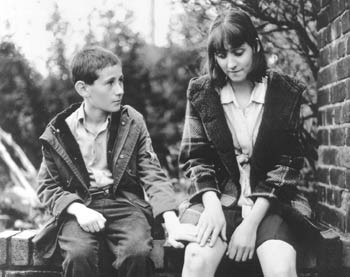
Unlike the young hero of the highly overpraised, paint-by-numbers tearjerker Billy Elliot, 12-year-old James Gillespie (William Eadie) is leading a life that’s unlikely to take him much farther down the lane, let alone over the rainbow.

He lives one step above squalor in a tiny apartment with his drunk-and-on-the-dole dad, his long-suffering mum, and his two sisters. It’s a hand-to-mouth existence, but somehow there’s always enough money for liquor and cigarettes, even if that means hiding from the landlord and letting the children suffer in outgrown shoes.

School’s out for the summer, so James spends his days playing in and around the polluted, trash-strewn canal near his home. In these bleak surroundings, the mountains of rubbish and the murky water serve as both playground and swimming pool to a group of lice-ridden, grubby imps, and sadistic toughs so downtrodden that they might have sprung from Dickens’ inkwell.

One morning, some horseplay between James and his best friend, Ryan, ends in disaster, with the younger boy drowning. Terrified, James flees the scene. The secret weighs on him terribly, but his remote, erratic behavior goes unnoticed by a family consumed with simply surviving.

Distraction comes in the form of a masochistic and pitifully myopic neighborhood girl (Leanne Mullen), whose chief form of entertainment is to allow a group of neighborhood bullies to use her as sperm depository. Presumably it’s the only attention Margaret gets, as her parents are rarely at home. It’s a disturbing but utterly believable scenario made more poignant by the fact that the girl is quite pretty–only she doesn’t know it yet. In the same way that dogs smell fear, her tormentors sense her insecurity and recognize her loneliness and use those weaknesses against her.

James, a sexual innocent, finds solace and an almost maternal fascination in her naked form. Goaded by the others into laying atop her semi-clad body, he finds comfort, not arousal, in her Madonna-like embrace. Ramsey breaks up the desolation with several small magic moments like this.

Particularly memorable is one in which a pet mouse is carried skyward by a balloon. As James watches the slow ascent, his envy of the animal’s escape is palpable, despite his knowledge that the mouse will likely perish.

Eades’ angular face, alert eyes, and milk-pitcher ears serve him well in an often silent performance. Considering the dour tone of Ramsey’s film, it’s a good bet that the director cast him for his low cuteness quotient.

Ratcatcher is not without flaws. In her quest to avoid sentimentality, Ramsey has left a few too many questions unanswered. Of course, poverty is too complex a social ill to explain in 90 minutes, though Brit social realist filmmaker Ken Loach has made a career out of trying, with mostly strong results.

“What doesn’t kill you makes you stronger,” wrote Nietzsche. It’s a homily tailor-made for children like James–if only they all lived long enough to appreciate it.

‘Ratcatcher’ opens Friday, Feb. 16, at the Rafael Film Center, 1118 Fourth St., San Rafael. For details, see or call 415/454-1222.

From the February 15-21, 2001 issue of the Northern California Bohemian.
© Metro Publishing Inc.

The Bush Administration and the Environment

0

Bushwhacked!

Horsemen of the environmental apocalypse

By David Helvarg

PRESIDENT George Bush’s naming of former Colorado Attorney General Gale Norton as Interior Secretary and recently defeated Michigan Sen. Spencer Abraham as Energy Secretary suggests that Republicans haven’t learned from the 104th Congress of 1995, when attempts to gut environmental protections helped undermine the short-lived Gingrich revolution. The beliefs Norton and Abraham share about natural-resource exploitation are as close as subsurface oil and gas but completely out of whack with their departments’ stated missions.

As Colorado’s attorney general from 1991 to 1998, Norton pushed programs of voluntary compliance for industrial polluters and opposed government (and voter) initiatives to counter sprawl. She has been an active advocate for “property rights,” the idea that government should compensate developers when environmental laws and regulations limit their profits, while also fighting hard to protect agribusiness access to cheap federal water. Since 1999, she’s worked for Brownstein, Hyatt, Farber & Strickland, a law firm that has lobbied for a range of sprawl-promoting clients, including Denver International Airport and the city’s new taxpayer-financed stadium for its pro football team, the Denver Broncos.

A four-year veteran of James Watt’s Mountain States Legal Foundation, Norton continued to work for Watt after he became President Reagan’s controversial (“We will mine more, drill more, cut more timber”) Interior Secretary.

In 1998 Norton, along with right-wing activist and BP oil lobbyist Grover Norquist, became co-chair of the Coalition of Republican Environmental Advocates. Dedicated to “free-market environmentalism,” the CREA included “wise users,” property-rights advocates, and auto, coal, mining and developer lobbyists. Traditional GOP environmentalists like the late Senator John Chafee refused to join the group.

In 1999 Norton joined the team advising the Bush campaign on developing a conservative environmental agenda. Among those working with her was David Koch of Koch industries, which last year paid a $35 million fine for oil pollution in six states; also Lynn Scarlett, a senior fellow at the antiregulatory Foundation for Research on Economics and the Environment, which according to the Washington Post lived up to its acronym by holding a series of all-expenses-paid “seminars” for federal judges at a Montana dude ranch.

NORTON’S commitment to begin oil drilling in the Arctic National Wildlife Refuge could make her the most controversial interior secretary since her mentor. On the other hand, the media’s focus on her being a pro-choice Republican suggests she’ll also support a caribou’s right to abort before losing its habitat.

Working closely with Norton as energy secretary will be longtime Republican operative and former Dan Quayle staff aide Spencer Abraham, who only last year called for the abolition of the Energy Department (as a cost-saving measure). During his one term as senator from Michigan Abraham fought to limit fuel-efficiency requirements for SUVs, limit renewable energy research, abolish the federal gasoline tax, and open up ANWR to oil drilling. While this won him a zero rating from the League of Conservation Voters, it also scored him close to $450,000 in contributions from energy and natural resource industries in his failed re-election bid. Ironically, he has now become a personal example of recycling.

Aligning with Abraham and Norton will be Don Evans, a FOG (Friend of George) oil executive and $100 million Bush fundraiser. As the next commerce secretary (another department Abraham wanted to abolish), Evans will oversee the National Oceanic and Atmospheric Administration, the lead agency for America’s oceans (which are the source of 25 percent of our domestic oil and 26 percent of our natural gas).

If, following the lead of the oilmen in the White House, Cabinet members Norton, Abraham, and Evans should choose drilling, particularly in the ANWR, as their first environmental battle (something national green groups believe they will), they could quickly find themselves sinking in a political quagmire of their own creation.

This article was first published in ‘The Nation.’

From the February 15-21, 2001 issue of the Northern California Bohemian.
© Metro Publishing Inc.

The Wide-Eyed Gourmet

The simple pleasures of the occasional baking session

By Marina Wolf

I LIKE BRINGING baked goods to people’s houses. Invariably they act as if someone brought a pile of holy wafers fresh from the oven. I suspect the recipe for holy wafers is more complicated than what I do, which is scones, usually, or banana bread. But it’s not what goes into the mixing bowl that matters as much as what comes out of the oven at the end, after that ineffable transubstantiation that kicks in at around 400 degrees.

The spiritual nature of baked goods has been addressed before, most notably by Peter Reinhart, a longtime North Bay resident, master baker, and applied theologian who specializes in bread as metaphor, and also bread as just bread, especially rustic loaves and Celtic harvest breads. His books all deal with baked things in various ways–Crust and Crumb and Brother Juniper’s Bread Book are mostly recipes; Sacramental Magic in a Small-Town Cafe offers great stories; and Bread upon the Waters just gets deep–but they all are written in reverence. I mean, Reinhart has a whole web of theories about the transcendent spirit of the baking process. Bread is his guiding light, a perfect metaphor on his path toward spiritual understanding. Somehow he manages to tie this in to the lives of assorted saints and some of the lesser-known apocrypha, plus tips about bread mixers and steaming the oven.

I appreciate Reinhart’s approach, but when sometimes you’re talking with lay people about baking, you have to go for a more secular approach, something tempered with objective, scientific fact, because baking recipes definitely involve more chemistry than most cooking recipes. There is less room for error, and less opportunity to correct it. A tablespoon of tomato paste missing from a soup will most likely be overlooked. But even a half-teaspoon of, say, baking soda can make the difference between a fluffy scone that you’d want to eat on a Sunday morning and a scone that you could use as a doorstop.

Oddly, the qualities that make baking so scary–structure, discipline, and the laws of chemistry and nature turned loose in the oven–are the same qualities that can make it so easy and enjoyable. All you have to do is follow the recipe, and then blame the cookbook writer if it doesn’t turn out.

But people are still intimidated. They think they don’t have the time, and they opt instead for convenience methods, muffin mixes, ready-bake tubes of cookie dough, and vacuum-sealed pizza crusts. These products are fine for their purpose, and are pretty much the culinary equivalent of the washing machine, as far as women’s liberation goes. I mean, that whole “daily bread” thing is not meant to be taken literally. I don’t care to whip up a little something every day, or even every week, the way housewives did a hundred years ago.

But now that we are so far removed from baking as a daily practice, the occasional baking session can bring on even more intense epiphanies, for the baker and the eater alike. The ingredients are raw: just plain bland flour and fat, salt, baking powder, and sugar in seemingly inedible proportions. You sift and mix them with your hands, dump the whole thing on a baking sheet, and then take a leap of faith.

Yes, faith. Because you never know how the oven is going to act today, or whether the house was just warm enough to get a good rise. Until the glorious moment when you open the oven and see for yourself, you don’t know what you’re going to get. Sometimes it’s a crisis of burnt crust, or an overflow.

But sometimes, that little loaf or scone is the perfect golden thing, and that is a beautiful moment indeed.

From the February 15-21, 2001 issue of the Northern California Bohemian.

© Metro Publishing Inc.

Pine Cone Diner

0

Pining Away

Pine Cone Diner offers upscale fare

By Paula Harris

YES, IT LOOKS just like an all-American down-home diner–the type of funky greasy spoon, complete with well-worn counter, red vinyl stools, and plastic booths, reminiscent of the movie Alice Doesn’t Live Here Anymore.

But though the motif is cozy-kitsch–little cafe curtains, linoleum on the floor, and a collection of mismatched plates (all featuring pine cones) on the wall painted Hollywood swimming pool blue–the food is gourmetdom.

The breakfast includes pan-fried trout fresh from Idaho with two eggs ($8.50) and honey-baked ham and cheese omelet ($8.25). Lunch features sandwiches, burgers, soups, and salads. But dinner boasts such ambitious dishes as cherry-wood-smoked pork loin with lavender gastrique–lavender-infused sherry, vinegar, and honey ($15.95), and steak au poivre ($22) with peppercorn brandy sauce.

We first visited the Pine Cone last summer and enjoyed a mug of freshly brewed aromatic coffee and a scrumptious slice of homemade apple-mango cobbler at the old counter, and we’re eager to return for an evening meal.

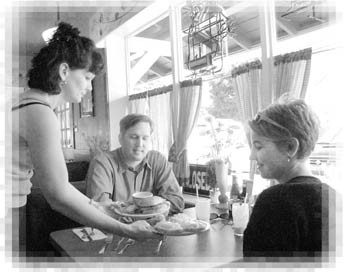
By night, the place still resembles an unpretentious diner, but there are tea lights glimmering on each of the seven tables. It’s only 6 p.m. but the place is already jammed. The diner doesn’t accept reservations, so we are stuck at the little yellow half-moon table attached to the far wall. Not the best spot–it’s cramped and my chair is constantly bumped by an open door directly behind it. A request to change to a booth, once it becomes free, is denied by our server. Indeed, a closer look at the menu reveals the rule: “Please, where you sit is where you eat.”

Waiting diners are sent with a glass of wine to browse at the bookstore next door. However, service at the Pine Cone tends to err on the abrasive side for such a homey, big-hearted environment. Where’s Alice when you need her?

Our set-faced server recommends crispy Panko prawns ($9.95) to start. Three lightly breaded butterflied prawns are jumbo, but strong-smelling amid a pile of daikon and carrot and a lake of creamy green wasabi sauce. This sinus-clearing sauce is way too strong and obliterates any other flavor, and the menu promises coconut, leeche (do they mean lichee?), and sweet red chili–none of which are detectable–on the plate.

Another starter, billed as “fresh mushroom lasagne,” with smoked tomato coulis, layered portobello mushrooms, organic seasonal vegetables, and highly popular local Cowgirl Creamery cheese ($10.25) is both pleasant and disappointing. Yes, there are layers of grilled veggies interspersed with very mild cheese, but no pasta! We feel cheated since lasagne is an internationally known description for a dish of baked flat noodles. Why no explanation?

The vegetarian in the group fears he’ll get more of the same in his “seasonal organic vegetable platter” ($12.95), so he hurriedly switches his entrée order to the penne pasta ($12.50). Good move. This is the most satisfying dish of the evening. The brown butter sauce clings to the ribbed penne pasta, which is perfectly al dente, and there are soft chunks of roasted butternut squash, coarsely chopped hazelnuts, caramelized red onion, and braised seasonal greens in the dish. The menu also promises dates, but we cannot detect them. The effect is sweet yet savory and texturally very pleasing.

The tried-and-true garlic chicken ($13.50) is another dish we find to be well executed but lacking. A couple of chicken pieces are roasted golden and cooked to juicy (but not at all pink) perfection. Yet we cannot taste any garlic flavor, and wish for it. Likewise the mashed potato (it has more like a whipped consistency) again has us wondering–where’s the garlic? The dish is served with snapping fresh green string beans and a light pan gravy.

There’s a very small wine list with some good-value selections. A bottle of 1998 Yalumba cabernet sauvignon from Australia ($27) is juicy and soft with a fruity rum raisin flavor that accompanies our entrées with ease.

The desserts are a monster hit. A down-home apple pie ($5.25) with juicy brownish apples and a soft crust is served with Clover brand vanilla ice cream and sprinkled with powdered cinnamon. A childhood dream. The flourless chocolate cake ($5.95) is even better, with the most mouth-friendly texture you can imagine. It’s soft and moist, yet toothsome and chewy, and manages to be light yet sinfully fudgy. The cake is served to even more advantage with thick caramel sauce and whipped cream. Yum.

It’s worth a trip to the tiny whistlestop town of Pt. Reyes Station to experience the whimsical Pine Cone, even for just a slice of pie. But be warned, the diner accepts no credit cards.

Pine Cone Diner Address: 60 Fourth St., Pt. Reyes Station; 415/663-1536 Hours: Tuesdays-Thursdays and Sundays, 8 a.m. to 8:30 p.m.; Fridays-Saturdays, 8 a.m. to 9 p.m. Food: Gourmet diner fare Service: Abrupt Ambiance: Funky greasy spoon meets upscale bistro Price: Moderate to expensive Wine list: Small selection Overall: 2 stars (out of 4)

From the February 15-21, 2001 issue of the Northern California Bohemian.

© Metro Publishing Inc.

‘The House of Mirth’

0

House Warming

Why a 19th-century hooker could kick Gillian Anderson’s ass

Writer David Templeton takes interesting people to interesting movies in his ongoing quest for the ultimate post-film conversation.

“DEATH,” purrs author Sheri Holman, dropping a silver spoon into her bowl of Irish stew and reaching for a glass of water. “Death is not as ugly as people think. Death can be a very beautiful thing.”

It’s early evening, and the tiny pub is packed. Our table is within immediate earshot of at least a dozen people, all of whom now turn their heads to see who’s making such unconventional dinner conversation.

If Holman (author of A Stolen Tongue) notices the attention she’s getting, she gives no sign of it. Next, she launches into a highly visual anecdote about holding an old woman’s lungs in her hands–“It was lighter than air, as light as a napkin,” she says–while witnessing an autopsy as research for her latest novel, The Dress Lodger.

Holman displays a real knack for making heads turn. On the page and off.

Set in England during the 1899 cholera epidemic, The Dress Lodger follows Gustine, an unstoppable 15-year-old prostitute, and her fateful alliance with a grave-digging doctor. It has become a book club sensation since its hardcover publication last year. Holman, 34, has a way with death–be it death by cholera or by less natural causes–and her atmospheric resurrection of Industrial Age England has won the New Yorker a quiet cult of fans on both sides of the Atlantic.

We’ve met to discuss another story set in 1899: The House of Mirth.

A critically acclaimed film version of Edith Wharton’s masterpiece about class warfare in 19th-century New York City, the movie stars Gillian Anderson (of X-Files fame) as Lily Bart, a woman with serious debts, unappealing suitors, and a Hamlet-like aversion to making up her mind.

Whereas Anderson’s Agent Scully is tough as nails–and would not hesitate to grasp a woman’s lungs in her own hands, by the way–Lily Bart can’t seem to get a grip on anything.

Holman agreed to see The House of Mirth in part because she has a somewhat unique connection to the book. She read it a few years ago when she was in Syria, on vacation with her then-boyfriend, now-husband.

“We were in a town called Hama, near Damascus, and I had horrible dysentery,” Holman explains. “I was so, so sick, and the bathroom was way down the hall where I was staying in this awful, cockroach-infested hotel. So in between trips to the bathroom, I read The House of Mirth.

“I have to admit,” she confesses, with a big smile, “that when you invited me to see The House of Mirth–when I heard those words House . . . of . . . Mirth–my first response was that I felt my stomach clench. I got this intense sense of memory of retching my guts out in that awful hotel in Hama.”

More heads turn; multiple sets of eyes narrow and peer before they all snap nervously away. Holman laughs, shaking her blond-maned head in gleeful mock embarrassment. “But the movie was great,” she adds.

Our talk turns temporarily to less queasy matters, as I suggest similarities between The House of Mirth and The Dress Lodger–mainly that each tale shows the cruelty of class distinction, the rift between the haves and have-nots. But I also argue that poor Gustine’s situation is much more dire than Lily Bart’s. Holman disagrees.

“At least Gustine has a skill,” she says. “She’s willing to do anything because she doesn’t think anything is beneath her. Gustine is fearless because she has nowhere to go but up, but Lily Bart has nowhere to go but down, and it’s that downward mobility that is so terrifying to her. I can identify with that fear.”

On cue, Holman demonstrates her Lily Bart identification by adopting an uncannily accurate expression of wide-eyed astonishment, with an overlay of tight-muscled panic and a smidgen of open-mouthed disbelief.

It’s a good picture, Holman confesses, of how she’s been feeling of late. As The Dress Lodger finds a wider and wider audience, raking up an impressively expanding pile of dollars, the author has been broadsided by an unexpected truckload of anxiety.

“For the first time in my life, I feel I have something to lose,” Holman says. “I think [Lily Bart’s] fear, the precariousness of her position, is a really American thing. In America, it doesn’t matter who you are or what you once accomplished. If you have no money, you lose your standing.

“If Lily Bart had been a different kind of person,” Holman muses, “maybe she could have made the money back, but she’d never been trained for work. She goes to the milliners to try and learn a skill, but she can’t do it. She’s literally fit for nothing.”

Holman pauses, sliding the stew bowl back over for another few spoonfuls.

“It’s weird. As much as we do hate poverty in this country,” she says, “it’s kind of a love-hate relationship. Poverty also has a certain attraction.

“When I first moved to New York from the Midwest, it was partly under the allure of poverty,” she continues. “I had $800 in my pocket. I lived in every bad neighborhood I could live in. I purposefully set myself in harm’s way because I thought that’s what artists did. I really did have a romantic view of being without money. I thought it would ennoble me to cast my lot with lost and drifting people. Instead, it ground me down to almost nothing.”

Fortunately, Holman has more Gustine than Lily Bart in her. She’s fought her way back up, and the odds are good that she’ll be staying up. But speaking of fighting, Holman has one last thing to say about Gustine and Lily.

“If the two of them ever got into a street fight,” she suggests wickedly, “Gustine would kick Lily Bart’s ass.”

From the February 15-21, 2001 issue of the Northern California Bohemian.

© Metro Publishing Inc.

Lou Reed

0

‘Metal Machine Music’ clatters back

By Greg Cahill

PITY THE POOR neighbors. It’s the hot summer of 1975 and Lou Reed–an unlikely superstar with five solo albums, including the 1972 classic Transformer and 1973’s conceptual masterwork Berlin, and the underground cache of having been a member of the Andy Warhol-created art-rock band Velvet Underground–is squirreled away in his New York apartment experimenting with feedback. Lots and lots of feedback.

“Just for fun,” as he recalls, Reed would explore unusual tunings, stand a pair of guitars in front of one of these amplifiers–one of these really big amplifiers–crank up the volume, and just let ’em rip! The guitars would go through a series of tortured transmogrifactions, making all kinds of weird and eerie sounds and blending an electric brew of harmonics previously unheard by the human ear.

It was as if the damn things were alive.

Reed decided to document the effect. Armed with a trusty four-track recorder, he laid down a series of tracks, mixing the album himself in his apartment (the neighbors! The poor fucking neighbors!), manipulating the speed and tone of the basic tracks and separating them into distinct stereo channels–one blaring into the right ear, the other blaring into the left ear, with no middle channel–to give a most disturbing and almost schizophrenic effect, like listening to two pieces of music at the same time.

Then Reed–who was pissed off at his record company for demanding too much product and wanting another “Walk on the Wild Side”-type radio hit–unleashed the finished product, on a major label no less, on an unsuspecting public (bear in mind that Peter Frampton was the biggest thing around at that time). The recording was split into four 16-minute segments (which fit neatly onto four vinyl sides), with a lock groove at the end of side 4 so the damn thing would play for an eternity unless you pulled your stunned self off the sofa to lift the tone arm.

TWENTY-FIVE years ago, Metal Machine Music: An Electronic Instrumental Composition (RCA) hit the record-store racks. It caused an immediate sensation, which is to say no one listened to it at the time and folks are still arguing today if it is high art or a bad joke. Now, the limited-edition 25th anniversary CD version has been released on the Buddha label. It’s still unlistenable, but we have a chance to argue about the meaning of Metal Machine Music all over again.

Of course, gonzo music journalist Lester Bangs of Creem immediately hailed the recording as “the greatest album ever made in the history of the human eardrum.” The more staid Rolling Stone dismissed Metal Machine Music as “a gigantic ‘fuck you’ disguised as a groundbreaking experiment.” In fact, in his 1975 Rolling Stone review, critic James Wolcott likened the recording to “the tubular groaning of a galactic refrigerator” and “spending the night in a bus terminal.” The Trouser Press Record Guide has since noted that “if [Reed] was simply looking to goad people and puncture perceptions, [the album] was a rousing success.”

Reed himself has called the album “the perfect soundtrack for the Texas Chainsaw Massacre.”

LOVE IT or hate it, there is no question that, in those still innocent pre-punk days–the Sex Pistols and their offspring wouldn’t rattle the rafters for another two years–Reed delivered a powerful Dadaist avant-rock statement that has since drawn comparisons to the experimental works of jazz-great Cecil Taylor and such contemporary classical composers as Stockhausen and Elliott Carter. Indeed, Metal Machine Music, for all its atonal ambiance, was a revelation to a handful of young and influential industrial and indie-rock musicians, including Sonic Youth and even Neil Young (who released an entire CD of feedback on 1991’s Arc/Weld), who helped set the tone for modern rock, pop, and techno music in the ’80s, ’90s, and 2000.

“I wasn’t just squealing and making noises,” Reed insisted on the fake spec notes on the back of the original 1975 release, “But if you just like loud feedbacking guitars–well, there it is.”

Judge for yourself. But, dear god, pity on the poor neighbors.

From the February 15-21, 2001 issue of the Northern California Bohemian.

© Metro Publishing Inc.

‘Hannibal’

Hannibal. Losing Lecter's Lunch Horrified brain expert dissects America's favorite cannibal Writer David Templeton takes interesting people to interesting movies in his ongoing quest for the ultimate post-film conversation. This is not a review; rather, it's a freewheeling, tangential discussion of art, alternative ideas, and popular culture. ...

Odeon Pope

The Seeker Saxman Odean Pope strives for the sacred By Greg Cahill ODEAN POPE spends his time in the relentless pursuit of truth as codified in the fiery scales of a searing free-jazz sax solo. Indeed, 10 minutes into a phone interview with this obscure Philadelphia-based tenor sax player, it becomes clear...

‘Rebels with a Cause’

Rebels with a Cause. Rebel Hearts Helen Garvy offers forgotten stories of the '60s HELEN GARVY was a young rebel the last time she stood in this part of downtown Oakland. That was 31 years ago. She's a bit older now, and perhaps a bit wiser, but Garvy is...

Russell Banks and Michael Ondaatje

Reel Deal Novelists Russell Banks and Michael Ondaatje pair up to discuss fiction and film By FROM THE BURNING desert of The English Patient to the snow country in The Sweet Hereafter, the geographies in the books of Russell Banks and Michael Ondaatje are as diverse as their prose. Still, these...

‘Ratcatcher’

Ratcatcher. No Kidding Hell is for children in compelling 'Ratcatcher' By Nicole McEwan "MY MUM says this place is a very-mental-health hazard," says one child to another as he surveys the garbage-choked yard of the condemned housing project they call home. It's '70s-era Glasglow at the height of the...

The Bush Administration and the Environment

Bushwhacked! Horsemen of the environmental apocalypse By David Helvarg PRESIDENT George Bush's naming of former Colorado Attorney General Gale Norton as Interior Secretary and recently defeated Michigan Sen. Spencer Abraham as Energy Secretary suggests that Republicans haven't learned from the 104th Congress of 1995, when attempts to gut environmental protections helped undermine...

The Wide-Eyed Gourmet

The simple pleasures of the occasional baking session By Marina Wolf I LIKE BRINGING baked goods to people's houses. Invariably they act as if someone brought a pile of holy wafers fresh from the oven. I suspect the recipe for holy wafers is more complicated than what I do, which is scones, usually, or banana...

Pine Cone Diner

Pining Away Pine Cone Diner offers upscale fare By Paula Harris YES, IT LOOKS just like an all-American down-home diner--the type of funky greasy spoon, complete with well-worn counter, red vinyl stools, and plastic booths, reminiscent of the movie Alice Doesn't Live Here Anymore. But though the motif...

‘The House of Mirth’

House Warming Why a 19th-century hooker could kick Gillian Anderson's ass Writer David Templeton takes interesting people to interesting movies in his ongoing quest for the ultimate post-film conversation. "DEATH," purrs author Sheri Holman, dropping a silver spoon into her bowl of Irish stew and reaching for...

Lou Reed

'Metal Machine Music' clatters back By Greg Cahill PITY THE POOR neighbors. It's the hot summer of 1975 and Lou Reed--an unlikely superstar with five solo albums, including the 1972 classic Transformer and 1973's conceptual masterwork Berlin, and the underground cache of having been a member of the Andy Warhol-created art-rock band Velvet Underground--is squirreled...
11,084FansLike
4,606FollowersFollow
6,928FollowersFollow