
‘Blow’

0

Movie-talk authors look for the hidden moral lesson in ‘Blow’

Writer David Templeton takes interesting people to interesting movies in his ongoing quest for the ultimate post-film conversation. This is not a review; rather, it’s a freewheeling, tangential discussion of art, alternative ideas, and popular culture.

Talk about the ultimate subjects for the ultimate post-film conversation. Ronald Madison is the Movie Shrink. An innovative New Jersey-based psychologist, Madison, 50, has built a unique reputation for his use of popular movies–from Lassie and Mary Poppins to Dead Man Walking and Do the Right Thing–as conversation starters, as ice-breakers, as psychological touch-stones, in his successful therapeutic work with emotionally troubled adolescents.

Corey Schmidt, 28, is a freelance writer and New York P.R. executive. The daughter of sports filmmaker Louis Schmidt, she grew up in a household where the routine watching of classic films was strictly required, where films were used as deliberate discussion topics to bridge the tricky generational gaps between parent and child.

It seems that Hollywood movies aren’t merely a mind-numbing, mass-produced entertainment product designed to numb the masses and promote consumerism; according to Madison and Schmidt, movies heal.

Or can, if used properly.

To explain how, the two long-time film fans have joined forces and written Talking Pictures: A Parents’ Guide to Using Movies to Discuss Ethics, Values, and Everyday Problems with Children ( Running Press, 2001, $14.95). The one-of-a-kind guide book is broken into age-appropriate sections, focusing on provocative themes such as “Fantasies and Fears” (suggested films for discussion include Peter Pan, Escape to Witch Mountain and Bambi), “Gender and Self Identity” (October Sky, Wizard of Oz, Yentl), and “Sex and Romance” (Reality Bites, Summer of 42, Kids). Reading through the book, one quickly understands what has been demonstrated for years in University town coffeehouses: even lousy movies can be good for getting people to talk.

Which brings us to Blow.

Starring Johnny Depp, the much-hyped Ted Demme film is the true story of George Jung, a Boston slacker who briefly achieved enormous wealth–if we are to believe his claims–by teaming up with Colombian drug-king Pablo Escobar to become the first person to smuggle massive quantities of cocaine into America. The real George Jung is now in prison, and the strenuously sympathetic movie–which plays more like an earnest parole request than an honest biography of a serial drug dealer–is definitely inspiring comment.

“Jesus, if I’d known drugs were that easy to score,” said a young man I overheard in the movie theater, “I wouldn’t have waited till college to start using.”

Perhaps this film won’t be appearing in future editions of Madison and Schmidt’s book, which does suggest The Doors, Clean and Sober, and Basketball Diaries as movies that might jump-start useful conversations about drugs and alcohol.

“I deal a lot with kids who have drug issues,” says Madison, “and as I was watching Blow, I was thinking, ‘Well, this is not a movie you’d ever want a kid to see without planning to have a discussion afterwards. Blow is Basic Drugs 101. It’s How to Start an Entrepreneurial Drug Selling Business 101.”

“As an author of a book geared to helping parents tackle difficult issues with kids, this is probably not a film we would have selected to use,” agrees Schmidt. “Not that it couldn’t be used with kids, but you’d have to be very careful.”

Indeed. As an anti-drug movie, Blow is about as effective an effort as Reefer Madness, and may, in fact, inspire as much new drug use as that film did in its day. But the comparison isn’t really a fair one. Rising to Blow’s defense, Schmidt points out that the movie obviously wasn’t meant to be a cautionary tale about the dangers of drugs, so it shouldn’t be criticized for not being that.

“It’s a good movie. It’s just not a movie about drug abuse,” she insists. “It’s more of a movie about addiction to material needs. It’s a movie about greed.”

Madison agrees that Blow is not a film about drug addiction. He pegs it as a film about stupidity. “Especially among the population of kids I work with, this film could be used to have discussions about decision making,” he surmises. “You could say, ‘Look at the decisions this guy is making. Look at how he doesn’t see the big picture.’

“You could ask whether or not they think the guy’s use of drugs had any effect on how well he made those decisions, and you could look at how his decisions affected all the people around him–his parents, his wife, his daughter. You could use blow to ask a lot of open-ended questions.”

Such as?

“How about, ‘What the hell was this guy thinking?'” Madison offers with a laugh. “I mean, didn’t he think ahead? What do you expect when you’re dealing with someone like Pablo Escobar? Didn’t he realize that, in the end, it would probably all turn out in some disastrous way?”

“There are a lot of interesting things in this movie that you could talk top kids about,” adds Schmidt. “You could just ask, ‘Did you like this guy?’ He’s a pretty likable guy, I thought. So you could ask, ‘Can someone be a likable person and still do something horrible?'”

“I didn’t like him a bit,” remarks Madison. “I thought he was a bumbling schmuck who made everyone miserable. What’s likable about that?

“On the other hand, George Jung is useful to illustrate what happens when a person doesn’t step back and take a look at their own behavior. Blow shows how a person, if they don’t look at the consequences of their actions, can end up playing out the same kinds of mistakes made by their family or by the people they hang out with.”

But is that a message kids will hear, whether inspired by a cool Johnny Depp movie or otherwise?

“Sure,” says Schmidt. “They’ll at least be willing to think about it.”

“Kids will hear you,” says Madison, “if you don’t make it sound like you just came down from Mount Sinai. Kids will be more than willing think about things if you just make little observations and avoid preaching.”

To illustrate this, Madison names another movie: Ordinary People.

“There are some great pieces in there,” he says, “where the therapist talks to the kid, and makes these very short, to-the-point comments. ‘Life is good.’ ‘Feeling pain is good. It says that you’re alive.’ And he leaves it at that.

“The good therapists do that, and the good movies do that.”

From the May 3-9, 2001 issue of the Northern California Bohemian.

© Metro Publishing Inc.

Sven Nykvist

0

Tragic Magic

Sven Nykvist film both sad and enlightening

HE SAID, “Let there be light,” and there was light–and movies were never the same again. Sven Nykvist had set a high new benchmark of artistry and beauty.

While Nykvist’s name may be most familiar to trivia nuts, hardcore cineastes, and the actors and directors who actually make movies, one could hardly say that his work is obscure.

Considered one of the greatest cinematographers of all time, the Swedish-born Nykvist enjoyed a behind-the-camera career that spanned five decades, chalking up 123 films to his credit, including Crimes and Misdemeanors, The Unbearable Lightness of Being, The Postman Always Rings Twice, Agnes of God, King of the Gypsies, and Sleepless in Seattle. He won Oscars in 1972 and 1983 for his work on the Ingmar Bergman films Cries and Whispers and Fanny and Alexander, respectively. It was in his early films with Bergman–The Virgin Spring, The Winter Light –that Nykvist first began to forge his reputation as a master of lighting, photographing his scenes with an expressive simplicity that ran counter to the technically slick lighting schemes that is often the norm.

In the opening seconds of the luminous new documentary Light Keeps Me Company–a labor of love by Carl-Gustaf Nykvist, Sven’s movie director son–we are treated to a vast scrolling list of the cinematographer’s films. At nearly the same moment, we are ushered into a tragic revelation.

Nykvist has progressive aphasia–a rare brain illness that causes words to become mixed up and eventually leads to complete loss of speech–diagnosed in 1997 during the filming of Woody Allen’s Celebrity. With his condition rapidly worsening and communication becoming increasingly hard, Nykvist was forced to retire. Celebrity was his last film.

That Nykvist, a reigning master of the visual image, should be taken out of his career owing to a deterioration of his use of words is a sadly ironic plot twist worthy of a Bergman masterpiece. Though Light Keeps Me Company goes to great lengths to avoid become mired in such sadness, a sense of melancholy can’t help but pervade the film, turning it into something deeper, more emotional than a mere congratulatory tribute.

There are the expected clips of Nykvist’s greatest works, interspersed with interviews from a who’s-who roster of stars that includes Bergman and Allen, along with Susan Sarandon, Roman Polanski, Richard Attenborough, Melanie Griffith, and Gena Rowlands. We hear the words of Nykvist, recited by an unnamed actor, reflecting upon his life–he was the son of strict Christian missionaries who forbade the watching of movies–and telling a few colorful stories along the way. And we see Nykvist (beautifully filmed, wrapped in a cocoon of warm light) rooting through a trunk of old videotapes and knickknacks, demonstrating the setup of a camera, receiving a medal from a Swedish film society.

But the Light’s best trick is its inclusion of the text, spread in bits throughout the film, of Hermann Hesse’s novel Siddhartha, Nykvist’s favorite book. The tale of a life lived in search of perfection, Hesse’s masterpiece lends a splendid harmony to the story of Nykvist, a remarkable man who spent his life trying to capture light in a bottle. What this movie wonderfully proves is that, more often than not, Sven Nykvist succeeded.

‘Light Keeps Me Company’ makes its Bay Area premiere Friday May 4 and runs through Thursday, May 10, at the Rafael Film Center, 1118 Fourth St., San Rafael. All shows are at 6:45 p.m. 415/454-1222.

From the May 3-9, 2001 issue of the Northern California Bohemian.

© Metro Publishing Inc.

Wine Myths

0

Myth Busters

The truth about wine

By Bob Johnson

MYTHS abound in virtually all aspects of our business and personal lives. You have to have money to make money. An apple a day keeps the doctor away. A good defense will beat a good offense every time. Most myths possess at least a shred of truth, and often are closer to being correct than incorrect; they’re just hardly ever entirely accurate. And, generally speaking, these assumptions and assertions are harmless. So it is in the world of wine, where Champagne labeled “extra dry” actually is quite sweet, and where consumers put more faith in highly subjective numeric ratings than in their own taste buds.

Allow me a few inches of newsprint to bust a few of the more common vinous myths. Also, with that thread-of-truth caveat in mind, allow me to recommend an equal number of myth perpetuators.

Myth No. 1: Vineyard-designated wines are superior to other wines. A vineyard designation, in and of itself, is no guarantee of quality, let alone superiority. I’ll grab a bottle of “California” cabernet from one of the giant wine “factories” over a “Gila Monster Hill Vineyard” offering from Bakersfield any day of the week.

A vineyard-designated wine simply offers the aromas and flavors of the grapes grown in a particular vineyard–the good, the bad, and the smelly.

Candid vintners will tell you that most vineyard-designated wines could have been improved by at least some blending, and that once the nuances imparted by oak barrels become a part of the wine, most of the distinctive vineyard characteristics are neutralized.

There is one commonality that almost all vineyard-designated wines share, however: a premium price.

Myth Perpetuator No. 1–Chateau St. Jean 1998 Robert Young Vineyard Chardonnay, Alexander Valley ($25). When the chardonnay grapes grown in the Robert Young Vineyard are subjected to malolactic fermentation, they produce a liquid that tastes more like imitation butter-drenched popcorn than wine.

So winemaker Steve Reeder transforms this delicate fruit into a non-malolactic wine, big on fruit and spices, that earns critical praise even in challenging vintages. Rating: 3.5 corks (out of 4).

Myth No. 2: “Old Vine” zinfandel is superior to zin grown in less venerable vineyards. While it’s true that older vines tend to produce smaller yields and grapes with more concentrated flavors, there is no guarantee that these flavors will be “better.”

Furthermore, there is no agreed-upon definition of “Old Vine.” Much like human age, “old” depends on the image one holds. To an 18-year-old, 40 years sounds ancient. To a 40-year-old, 65 years may represent the beginning of one’s second carefree youth.

Myth Perpetuation No. 2–Pedroncelli 1997 Pedroni-Bushnell Vineyard Zinfandel, Dry Creek Valley ($15). While this wine is not promoted as an “Old Vine” zin, the vineyard that produced it dates back more than half a century.

The wine is rich and intense, with lots of berry (black, rasp, and boysen) and black pepper flavor. Ideal alongside a pepperoni pizza or barbecued fare. Rating: 4 corks.

Myth No. 3: “Reserve” wines are superior to “regular” bottlings. As is the case with the term “Old Vine,” there is no mandated or generally accepted definition of “Reserve” or its many permutations, including “Private Reserve,” “Cellar Reserve,” “Winemaker’s Reserve,” and so on. Often, but not always, “Reserve” wines spend more time in oak barrels than “regular” wines do. Because barrels are expensive, prolonged oak aging can significantly inflate the wine’s price. (It also can overwhelm the fruit flavors, but that’s another story.)

Myth Perpetuation No. 3–Windsor Vineyards 1997 Private Reserve Cabernet Sauvignon, Russian River Valley ($20.50). An excellent wine from an exceptional vintage, with subtle vanillin oak framing a solid core of luscious cherry/berry fruit. Given the quality, a relative bargain (especially for a “Reserve” wine). Rating: 4 corks.

AS I ENTER the home stretch of this exercise in myth busting and perpetuating, allow me to recommend a twin-myther: Dry Creek Vineyard’s 1999 Reserve Fumé Blanc ($18). Not only does the “Reserve” designation carry no meaning, but neither does the “Fumé Blanc” name. Fumé Blanc is a phrase concocted by Robert Mondavi, a vintner who has been around longer than most “Old Vine” zinfandel vines. It’s simply another name for sauvignon blanc, although some (but not all) wineries invoke it to imply sauvignon blanc aged in oak. This twin-myther was, indeed, aged in oak barrels–both French and American–for eight months. But there’s still plenty of fruit flavor, along with an alluring floral aroma provided by the addition of a dollop of viognier to the blend. Rating: 3.5 corks.

Here’s one final myth for the road; it is perhaps the most common, and least accurate, wine myth of all: Price equates with quality.

From the May 3-9, 2001 issue of the Northern California Bohemian.

© Metro Publishing Inc.

Britney Spears and Pepsi

0

Sex & Spears

Taking the Britney and Bob challenge

By Lara Riscol

ONCE UPON a time, a little blond Baptist girl from Louisiana busts into international stardom, snagging the biggest ever, multiyear sponsorship pact with a ruling cola conglomerate. The teen queen named Britney Spears hits Forbes’ Top 10 list of most powerful celebrities, pushing Bruce Willis, Michael Jordan, and Oprah Winfrey down the fame-and-money ladder.

“I have strong morals. I believe in God. I’m saving myself for marriage,” chants the self-proclaimed virgin as she strips, struts, gyrates, and thrusts in a belly- and boob-baring getup, while singing “I’m not so innocent.” The mass marketing of Britney inspires fashion trends for pre-pubescent girls and teen slut websites for, well, everyone, everywhere. Shortly after the rising Lolita graduates from the Mickey Mouse Club, a geriatric senator named Bob Dole runs for U.S. president.

Coached by the religious right, the Republican candidate preaches abstinence-only as America’s answer to teen pregnancy, abortion, and STDs. During elections Congress passes the Welfare Reform Act, laying out nearly a half billion dollars to scare American youth to keep their legs shut and pants zipped. The federal and state funding feeds a bulging born-again virgin movement and spawns Christian-run programs that decree sex within marriage as the “standard for human sexuality.”

Conservative Bob loses the presidential race, but soon scores a lucrative Viagra advertising deal. The former chastity champion now peddles the little blue pill that permits him to once again get it up and ride strong after prostate surgery and nearly 80 years on the planet.

Bob meets Britney when the abstinence stud and virginal slut team to peddle his latest little blue friend, the Pepsi can. For those of you who missed the trio’s commercial debut, the spot is hot. Britney strips; then, with her dance troupe of workers, romps through a warehouse in faded hip-hugger jeans and white bustier, with flashes of her pierced belly and pushed-up bosom. Cut to a fast-food cook standing before the TV staring, jaw dropped, while food sizzles on the grill behind and Britney sizzles on the screen before him. The ad climaxes with Bob, too, overheating as he grins and shakes his head, then says, “Easy boy” to his barking dog or, maybe, his Viagra-triggered member.

We’re all titillated. The ad is so fun, fast, and sexy that I’m a Pepsi convert, and I don’t even drink cola except now and then with rum. I’m a Britney fan, and I loathe her music. I’ve also warmed to Bob and his dry sense of humor.

BUT, ALAS, this story is not about me but about the next Pepsi generation growing up hostage to America’s schizophrenic approach to sex. Teens are the casualties in a culture war that reduces our basest, most transcendent drive to extremes. Youth are left to flounder under the intensified hypocrisy and mixed messages of a nation that can’t move beyond sexuality’s marital ideal or commodified reality.

Federal policy says teens shouldn’t have sex, but commerce bombards us with half-naked nymphets hawking the latest magazine, music, movie, video game, gadget, fashion. Amid the sexual gluttony of our media and marketplace, church and government brazenly pull information from youth and push chastity until marriage, calling it balance. I call it paradoxical. Neither excess nor repression develops into sexual intimacy or connection, let alone responsibility.

Bob’s right-wing cohorts undercut sex education and family planning to protect kids’ innocence. Abstinence-only programs are up 3,000 percent since 1996. President George W. has proposed increased abstinence funding, fulfilling his campaign pledge to make nonmarital chastity a priority, at least for others. His brother, Florida Governor Jeb, is reallocating $1 million of family planning funds into the pregnant pot of abstinence-only programs, about half now headed by Christian groups.

Meanwhile, Britney and team milk her god-given attributes to mobilize armies of budding wannabes by sanitizing her sexuality, and legions of horny men by fetishizing her purity. Pimping its teen gold mine, PepsiWorld.com spotlights her gyrating torso, cropped just under the crotch, just over the breasts, not unlike her bastard-sister porn sites. Coke has recruited fellow Mouseketeer alum Christina Aguilera to go tit to tit with Britney in the cola wars starting in May, and the media are already manufacturing the rivalry between the “soda pop princesses.”

The moral of this story is muddy except that I should have purchased Pepsi stock before the Britney deal. Maybe teens can’t have sex, but adults can package teen sex to sell goods and keep our economy strong. Or if you’re single, and especially under 20, you can peddle sexuality, but you can’t piddle your paddle.

Possibly the moral is that we should either admit teenagers are sexual beings–who shouldn’t be denied information and access needed to make healthy decisions–or stop leering at them while sipping our Pepsi. But that’s just a fantasy.

Lara Riscol is writing ‘Ten Sex Myths That Screw America,’ a book she began while completing a master’s degree in contemporary issues and public policy at the University of Denver. This is the second in a two-part series on soda pop and society.

From the May 3-9, 2001 issue of the Northern California Bohemian.
© Metro Publishing Inc.

Nortec Collective

0

Break Beats

Techno meets mariachi on new CD

By Karl Byrn

ELECTRONIC dance music failed to conquer the pop charts in the late ’90s, but may yet have the last laugh as the preferred medium for global pop-music innovation. Techno now takes the place of rock and hip-hop as the universal link, offering a template for hybrid sounds of modern culture that can be heard worldwide on TV commercials, at underground raves, and throughout current rock and R&B hits.

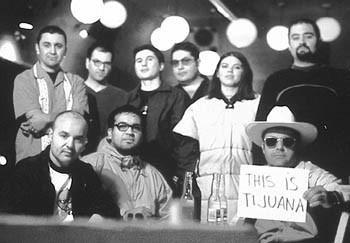
Latin music has also recently entranced the world-pop ear. In California, a Rock en Español movement has generated moderate heat in recent years. So it’s no surprise to hear a dance disc like The Tijuana Sessions, Vol. 1 (Palm Pictures), by Nortec Collective, a batch of tracks that stews feisty regional border sounds with hip club-culture groove, all by young artists from a city most Americans only associate with cheap tourism and tequila hangovers.

The disc’s jacket boasts the accurate claim that “Nortec Collective is not a genre or a group . . . but an entire electronic aesthetic. Nortec stands for norteno-techno; Tech-Mex cut and paste; the convergence of high-tech, low-tech, and traditional northern Mexican music.” Simply put, this is techno-meets-mariachi/salsa. In recent world-pop terms, the nearest precedent is the 1997 British compilation Anokha, a disc featuring artists like Talvin Singh and State of Bengal, who spiced current dance tracks with traditional sounds from India.

If you’re imagining Moby remixing Herb Alpert and the Tijuana Brass, you’re close. The Tijuana Sessions, Vol. 1 swings from straight house-disco hardness to semi-acoustic trance ambiance to electro-soul, hitting a smooth blend between cheap, earthy localism and sophisticated electronica. The peppy rhythms of salsa, reggae, rhumba, and bossa nova dominate the collection, with dusty samples of instruments like the cowbell, accordion, timbal, and tuba fleshing out the break beats in the same way sitar and tabla completed Anokha.

For the Nortec Collective artists, blending natural sounds with modern tracks is all about fills–the space between beats where a trumpet lick kicks in some fire, where scratchy percussion maintains the pulse, where accordion chords mimic Euro-pop. Techno’s favored drum-‘n’-bass model is echoed with rumbling congas and timbal loops playing a consistent high to the dublike low of blaring tubas and seemingly broken, rather jazzy synth riffs.

Hip culture aside, the Nortec Collective is accessible as hell. Fussible (the performing name of disc producers Pepe Mogt and Jorge Ruiz) offer the spacey influence of Kraftwerk, plus a jamming synth-funk solo on “Casino Soul.” Bostich and Terrestre could be Stereolab as they navigate through their busy, soundtrack-ready, Brazilian- flavored lounge-funk. Plankton Man plays Reggae Floyd with a smooth jazz guitar solo on “No Liazi Jaz.”

While Terrestre’s tellingly titled “Norteno de Janeiro” showcases the disc’s melding of electro-pop with Latin/Caribbean roots, it’s Hiperboreal’s “Tijuana for Dummies” that makes the most sense. Sparse and thumping, it projects an earthiness that’s easier and deeper than the jazz sax fills, Euro-beats, and the disc’s single diva vocal sample.

On The Tijuana Sessions, Vol. 1, those elements are all understated examples of the familiar, specific roots that Nortec Collective shares with a growing, global electronic style.

From the May 3-9, 2001 issue of the Northern California Bohemian.

© Metro Publishing Inc.

Open Mic

0

Open Mic

Ride Anxiety

By C. D. Payne

SPRING IS THE TIME when a young (or not so young) person’s fancy turns to . . . motorcycles. What a pleasure to zip along our rural roads in the warm sunshine. Only one thing spoils the fun. Cars.

Get on a motorcycle and now even a passing Pinto seems like a menacing beast of prey. Will that Volvo pull out in front of you? Will that SUV change lanes right on top of you? Will that truck smack you from behind when you’re stopped at a light?

Cruising at 50 on a motorcycle you have no seat belt, air bags, crumple zones, or side impact reinforcements. It’s your body vs. large, multi-ton vehicles. A minor fender-bender in a car can be a major bone breaker on a bike.

One solution is to spend several thousand dollars on a helmet, boots, gloves, and an abrasion-resistant riding suit loaded with space-age armored pads. In theory you could take a spill at freeway speeds and walk away with only a few bruises. But for every fun jaunt across town you must suit up like a medieval knight.

None of that for your usual Harley rider, often seen in T-shirt, jeans, and barely legal minimalist helmet. Macho, to be sure, but I’m still traumatized by the story I read about the biker who took a curve too fast and ricocheted through some roadside shrubbery. His riding buddies spent the next half hour looking for his ears which had been neatly excised by the straps of his “beanie” helmet.

For years my approach was to tool around lonely roads at modest speeds on embarrassingly low displacement scooters and mopeds. I rode bikes that even wheels-desperate 14-year-olds would sneer at. No satisfying throb of a big vee twin for me. I preferred the whine of a 50 c.c. single straining to hit 25 mph.

It didn’t help.

Cars, I discovered, are even scarier when you can’t keep up with them. Impatient drivers were all too ready to pull around you on a blind curve, or blow right on by with their side mirrors whizzing past your ears like bullets.

So I sold my flame red Honda Spree. I unloaded my cherry 1978 Vespa moped. I even ditched my Zap electric bike.

Still, it’s spring and I’ll be out on the roads. I’m the guy in the big green F-250 blowing diesel exhaust in the faces of passing bikers.


Licensed driver C.D. Payne is the author of ‘Youth In Revolt.’


From the May 3-9, 2001 issue of the Northern California Bohemian.

© Maintained by .


Sheila Metzner

0

Immortal Images

Sheila Metzner exhibits her early photos in Petaluma

By Maja Wood

LIKE MOST parents, Sheila Metzner took many pictures of her seven children. One day she was snapping photos of the kids, the next day Warren Beatty was calling her at home, asking to have his picture taken.

Then the editors of Vanity Fair and Vogue, as well as companies such as Chanel, Victoria’s Secret, and Ralph Lauren started throwing photo assignments and contracts at her. And let’s not forget all those museums, such as the Museum of Modern Art and the Metropolitan Museum of Art, which began adding her prints to their collections.

“Life can be surprising and amazing,” Metzner muses, speaking on her cell phone from Utah, where she’s on assignment for Condé Nast Traveler.

Metzner launched her career 23 years ago with a New York gallery show that, not surprisingly, included many pictures of her favorite models–her children. Since then, she’s become an internationally known photographer, a contemporary master of the art form with a unique style and a dazzling diversity of subjects.

Now, after nearly a quarter of a century, those early photos will be exhibited for the first time since that premiere showing. Many of the prints are the only ones available outside of Metzner’s personal collection, but they’ll soon be on exhibit in downtown Petaluma.

The exhibit opens with a talk by Metzner on Saturday, May 5, at the Barry Singer Gallery, a gallery known among photography aficionados for its collection of work by the likes of George Rodger and Lloyd Ullberg. The gallery has now moved to larger quarters in a street-level location just around the corner from the former site.

“I wanted to inaugurate the new space with a blockbuster exhibit,” owner Barry Singer says. “I wanted a strong show, something that would make a big impact. And this is it.”

Metzner, 62, is also excited about the new exhibit, explaining that the photographs hold many memories for her.

“Back then, when I was taking those shots, I was hoping that someday I could work as a photographer, but I never dreamed all this would happen,” she explains.

Building a career, plus raising five children of her own, plus helping with two children from her husband’s previous marriage, left Metzner with barely any time to sleep.

“I learned that I could shoot even if I wasn’t fully awake and even if the kids were pulling my hair,” Metzner says. “So, during the day, I’d take photographs with the kids. And then around 9:30 at night, when they were asleep, I’d take a shower and get dressed up in high heels and lipstick so that I wouldn’t feel like it was the end of the day. And then I would go in the darkroom and make the prints until about 3 or 4 in the morning.”

Many of the shoots included outings to nearby areas of upstate New York. “The kids were young, and I wasn’t able to travel,” she recalls. “So I would take them somewhere close to home to do a shoot, somewhere that was somehow symbolic of an exotic place, such as Egypt, and we’d pretend to be there.”

Metzner was very particular about her photographs, and at the end of nine years she had 22 prints that she felt were worthy of being shown. She went to a gallery and spread her 22 photos on the floor, and the owner agreed to do a show on the spot.

During that show, a picture of Metzner’s stepdaughter, titled Evyan, Kinderhook Creek, caught the eye of John Szarkowski of the Museum of Modern Art. Szarkowski included it in his famous and controversial exhibit “Mirrors and Windows: American Photography since 1960.” There, it was noticed by powerful New York Times art critic Hilton Kramer, who devoted an entire page to Metzner’s picture. (This print is included in the upcoming exhibit at the Barry Singer Gallery.)

On the heels of that success, Metzner was given a solo show, which garnered a half-page review in the Sunday New York Times Magazine section. All those raves caught the attention of a Vanity Fair editor, who called Metzner and hired her to do a photo shoot of French actress Jeanne Moreau. The editors of Vogue noticed that photograph and signed Metzner on to an exclusive contract for the next eight years.

“The whole progression was just shocking,” Metzner says. “Things just started coming together.”

For example, early in her success she was interviewed by the New York Daily News and was asked her future plans. “I said I wanted to photograph the Chrysler Building and some vases and Warren Beatty,” she says. “A few weeks later, I was at home and my daughter answered the phone and yelled out, ‘Mom, Warren Beatty wants to talk with you.’

“I got on the phone and, sure enough, it was him, and he said, ‘So, I hear you want to take my picture.’ ” Metzner recalls. “Just like that. Things just became simple.”

In addition to her celebrity shots, fashion photography, and other commercial work, Metzner has always maintained a parallel career in fine art photography. Several of her more recent works, as well as the early prints, will be on exhibit at the Barry Singer Gallery. Among these are landscapes, photos of New York buildings, and some Fresson color photographs of flowers.

Invented in 1895, the Fresson method uses a carbon printing process utilizing pigments instead of dyes, which not only renders the color photos archival, but also leaves the colors looking very rich and textured. The process is a family secret that was passed down from the inventor, and now his grandson and great-grandson are the only ones who know how to do it. Metzner is one of only about 11 photographers worldwide with whom the Fresson family has chosen to work.

Many of Metzner’s fine art and commercial photos can be seen in her fourth book, Form and Fashion (Arena; $60), which was released last month. Her landscape photographs can be found in Inherit the Earth (Bulfinch; $75), which came out in October.

Metzner says that one of the main perks of her job is that she is given assignments around the globe, and that’s when she takes the landscape photos for herself.

Two of her photographs in Inherit the Earth are of the pyramids in Egypt. But this time, it’s the real Egypt.

Sheila Metzner gives a talk on her work on Saturday, May 5, at 5 p.m. A reception follows from 6 to 8 p.m. The exhibit of her photographs continues through June 23 at the Barry Singer Gallery, 7 Western Ave., Petaluma. For details, call 707/781-3200.

From the May 3-9, 2001 issue of the Northern California Bohemian.

© Metro Publishing Inc.

Food Studies Movement

0

Food for Thought

Food-studies scholars pursue truth at the table

By Marina Wolf

THE ACRONYM FSM once meant the Free Speech Movement, the wave of student demonstrations that covered universities in the mid-’60s. These days FSM may be developing a second meaning, one that’s taking campuses from the inside out: Food Studies Movement. “I hear it all the time, the Food Studies Movement with a capital M, and we’re right on the vanguard of it in classic revolutionary terms,” says Marion Nestle, chair of New York University’s department of nutrition and food studies. “We’re trying to establish food studies as a completely legitimate academic field of study, with very high standards, that people will take seriously.”

Gaining academic credibility has been the primary task of food studies, which, like other cross-disciplinary studies such as women’s studies or black studies, suffered from being diffused throughout disparate departments. Food studies bore the added onus of being about, well, food, a subject that has been disdained in academia with more than a hint of sexism. “It’s quotidian, too trivial, too housewifey,” says Nestle. “We constantly heard that advisers don’t want to see studies on food.”

But Nestle and other food-studies professionals are excited by recent signs that the Food Studies Movement is on the rise. Respected academic presses such as Oxford and Cambridge releasing highly acclaimed food history tomes, and the University of California Press has come out with Gastronomica: A Journal of Food and Culture. The inaugural issue includes poetry on a peach and an essay in favor of convenience foods, as well as an art historian’s research on letter cookies in 17th-century Dutch still lifes and a seriously convoluted deconstruction of a postmodern menu.

This bewildering mix is a suitable representation of the state of the Food Studies Movement. Indeed, diversity may be the new discipline’s draw, as scholars studying food seek a haven from their own department’s indifference. As students become aware of the possibilities in food studies, individual courses, scattered throughout the course catalog in literature or anthropology or agriculture, fill up as quickly as they appear.

Outside the ivory tower, consumer magazines such as Saveur are cultivating a certain socioculinary tone, bringing elements of food studies to the masses that don’t always know what they’re eating, says Gastronomica editor Darra Goldstein. “Take Thai food. People have a lot of familiarity with it. We can order pad thai and things we like. We’re knowledgeable about it on some level, but how much do we really know about how foods are served in Thailand?” asks Goldstein.

“Do they have any ritual importance? What is their historical importance? How have they changed over the centuries? We know something and that is good, but it isn’t necessarily a deep knowledge.”

Barbara Haber, curator of books at the Schlesinger Library at the Radcliffe Institute for Advanced Study at Harvard University, knows from her reshelving carts that food studies are alive and well. The library is actually dedicated to women’s history and women’s studies, but it’s the culinary collection, containing over 16,000 volumes, that is the real magnet for the public. Even Martha Stewart showed up recently to film a segment at the library, which has been a repository for cookbooks since its beginnings in 1943. “Whoever the director was then, [he or she] understood that books on household management had a place in women’s history,” says Haber.

“They give you a sense of what the expectations are.”

THAT FOOD studies and women’s studies are a natural match has not always been a popular opinion. “It was a forbidden subject in the earlier years of women’s history,” says Haber. “Anything to do with cooking and food was seen as retrograde and bad for business.” Haber credits scholars in multicultural studies for showing that food is a fast track to the heart of a culture, and women’s studies scholars soon began returning to cookbooks for insight into women’s culture.

These days the materials in the Schlesinger Library are used for a wide range of projects. Haber herself is working on a paper on cookbooks as texts for understanding radical feminism, and she has assisted, or reviewed works by, dozens of scholars, whose subjects range from the transmittal of recipes in colonial America to cookbooks as historical documents of the Cold War.

Generalists at an undergraduate level have also found food to be a naturally compelling tool for examining culture. “It’s something that people deal with daily, and at the same time they don’t always think about it,” says Warren Belasco, professor in American studies at University of Maryland Baltimore County. “It’s very much undervalued, particularly in rich countries like ours. People don’t realize what an amazing miracle the food system is.”

Predictably, scholars are finding some hidden weaknesses in the food-studies boom. Since the field is so new, it is still very open to writers. But usually these writers go on to other subjects after one book, rather than developing their expertise in the field of food. “Food is used as a case study in a particular dynamic, and then they move on,” says Belasco. “I think that indicates a certain weakness in the field.”

Other people are late for the train and have too much baggage, according to Haber. “I remember the early days of women’s history, when historians who had been traditionally trained jumped in and claimed to be involved in women’s history. Yet they talked as if women were just one monolithic whole,” says Haber. “I must now make that same assessment of academics who come traditionally from cultural criticism, deciding they are going to work on food. They approach food with a theoretical framework tightly in place, but they don’t recognize that food in itself is a subject, that it has a history, that it has a set of meanings.”

Not only that, she says, but some food-studies people don’t even know how to cook. “I’m concerned that some academics will corrupt food studies, because some of them are just too arrogant to realize that they need to know something about cooking. How else would you know what’s involved really in the creation of a dish, how long it takes? How do you pick up clues?”

From the May 3-9, 2001 issue of the Northern California Bohemian.

© Metro Publishing Inc.

Christian Religious Art

0

Wrap Act

Reflections on a religious icon and the art of dying

I ROSE EARLY on Easter Sunday, shortly after daybreak. With a thermos full of coffee and a few well-chosen medical supplies, I left the house and headed for the cemetery. I had a date with Jesus. Our rendezvous had been planned since last fall, ever since I bumped into Mary’s favorite son while strolling through the graveyard’s peaceful mausoleum. He was a statue, almost life-size, carved in wood, propped up at the end of the corridor. The arms were outstretched, hands upturned to display the famous gaping nail wounds, painted Day-Glo red for maximum shock value. Though the artist obviously meant for Jesus to appear transcendent, God-like, reaching out to beckon us all lovingly to his side, to me he looked like some poor guy saying, “Hey, man, can I borrow a Band-Aid?”

I’m serious. And I truly mean no disrespect.

My first impulse when I saw the thing was to jog home for some gauze and surgical tape.

I’m 40 years old. At various times I’ve been an Episcopalian, a Methodist, a Baptist, and a “nondenominational Born-Again.” In short, I’ve seen my fill of bleeding Jesuses. The only thing they have ever inspired in me–beyond a certain revulsion–is sympathy. So gazing upon this one, all I wanted to do–and I really wanted to do this–was to bandage those hands.

But I resisted the urge. Still, I couldn’t get the notion out of my mind. I kept thinking of those mangled wooden hands, imagining them all wrapped and bandaged, safe and sound. Yet the very idea of a bandaged Jesus, a healed Jesus, runs counter to our expectations. It’s abnormal. It’s spooky. “A triaged Jesus! What the hell is this? Hey, where’re the damn nail holes?” It’s obvious that, with or without the whole sacrifice-and-salvation view of the crucifixion, a lot of people just plain like to see Jesus bleeding.

The history of Christian religious art is, in many ways, one long odd tribute to our fascination with the bloodstained corpse of the poor carpenter from Galilee. The crucifixion, clearly, ranks among the most powerful and oft-repeated images in Western art. From Hieronymus Bosch and Michelangelo to El Greco and Rembrandt, from Paul Gauguin and Pablo Picasso to Andres Serrano and Salvador Dali, few major artists seem able to resist doing Jesus on that cross.

Whenever artists dare to tinker with the sanctified symbol of the gleefully murdered Christ, a hailstorm of controversy inevitably rains down on them. But these are often the most daring and, one could argue, spiritually transforming images of Jesus that we have. In Man of Sorrows: Christ with AIDS, painter W. Maxwell Lawton transposes Jesus’ suffering into modern terms by taking him off the cross and showing him shirtless and silent, his nail wounds replaced by telltale body sores. Arthur Boyd’s Crucifixion, Shoalhaven gives us a cross erected in the midst of a flowing river, and its naked, crucified Savior breaks tradition by daring to be a woman, thus insisting that Jesus truly represented all humans. These works are controversial, to say the least. Serrano’s Piss Christ is perhaps the best, and least understood, example of what happens when an artist throws the cross into a different light. So incensed were Christians by the infamous photograph of a crucifix floating in urine that they never bothered to ponder the deeper meaning of the work–or recognize its visual beauty–calling vehemently for an end to the National Endowment of the Arts funds that helped pay for the exhibition.

Perhaps a crucifix floating in a vat of blood would be more to their tastes.

Even back in the days that I believed Jesus died as a sacrifice for the sins of the world, I was uncomfortable about our obsession with the gory exhibitionism of so many Christ images. I preferred the laughing Jesuses, the meditating Jesuses, the living Jesuses, to the battered, blood-drenched ones. Even resurrected, Jesus always seemed to be leading with his wounds. Whenever I found a crucified Jesus that did not repel me, it was usually one that minimized the wounds and maximized the humanity. My favorites include Gauguin’s Yellow Christ–a jaundiced Jesus draped on the cross, breath-stopping despite its lack of oozing wounds–and Dali’s Corpus Hypercubus, showing Jesus floating before the cross in a crucified pose, not a sign of nail prints–or even nails–to cast the ghastly shadow of sadism onto the otherwise heightened beauty of Jesus.

Yes, I understand that the idea of salvation, as symbolized by those ever- clotless, public execution-made lacerations, is itself a meaningful and powerful and beautiful thing to many. So what? If we love Jesus, why would we want to keep the guy crucified?

AS I THOUGHT of the statue in the mausoleum, I couldn’t avoid thinking that the crucified Jesus, as art, is a symbol of more than salvation and sacrifice. It’s a symbol of psychological damage on the human species.

A friend of mine who’s done a lot of traveling once remarked that while passing through some of the world’s most impoverished, disease-ridden, politically oppressed countries, she began to notice that the local religious artworks, in and around the churches and chapels, tend to be stunningly gory. The images of Jesus–whether they show him in mid-crucifixion, being laid to rest in the tomb, or right after the Resurrection–are positively dripping in blood. As she continued through the tiny villages of central Mexico, it became clearer and clearer: The worse off the people have it, the worse off their Jesus is.

The reason is fairly obvious. According to Christian tradition, Jesus came to offer comfort. Even the thought of Jesus’ death–an event the early church spinmeisters turned into a metaphysical blood-for-sin exchange, bringing salvation to the world–offers comfort to those worried about what happens after death. If certain cultures are subconsciously moved to put their paint-and-plaster saviors through the artistic Cuisinart, it’s clearly because doing so makes them feel better. So they erect crucifixes bearing corpses so pummeled that they barely look human. In the face of a Jesus so unimaginably brutalized, their own suffering diminishes in comparison.

But what’s our excuse?

Are things so tough in America that we need to make our statues bleed just to feel more whole? Is the stock market so bad, are the crime rates so high and the high school test scores so low that we need to find comfort by running into a sculpture with its hands and feet punched full of holes? Is this a tradition we really need? I don’t.

So this year, I initiated a new tradition. While others were sleeping, or scattering Easter eggs on their lawn, or gathering on mountaintops for sunrise services, I found Jesus, I touched those twin faux nail-prints painted on those hand-carved hands–and I wrapped the hands carefully in clean white bandages.

Standing back to look upon my handiwork, I experienced what can only be called a religious experience. A mix of emotions moved through me as I looked at Jesus, his arms outstretched, his scars invisible beneath the soft, soothing gauze. And that’s how I left him.

While I have only the wispiest illusions that my little act of philosophical performance art could ever become a national movement on a par with tying yellow ribbons on trees during times of international strife, I like to imagine that my act may be repeated in years to come by those who, like myself, were moved by the unexpected sight of a bandaged Messiah, and are inspired, on future Easters, to make their own offer of comfort to a champion comforter. The way I see it, Jesus has been bleeding for 2,000 years.

It’s time to let the man heal.

From the May 3-9, 2001 issue of the Northern California Bohemian.

© Metro Publishing Inc.

Kenneth Cleaver

Consumer Correspondent

Mr. Brian Fox Virgin Megastore 1540 Broadway, Level 2 New York, NY 10036

Dear Mr. Fox,

Forgive my departure from the Queen’s English. Those who know me are sure to affirm a tenet of my character that forbids me from doing things half-assed. Seeing Star Wars was not enough. No, I proceeded to view The Empire Strikes Back, Return of the Jedi, and that overhyped catastrophe The Phantom Menace. Ditto for The Godfather, Karate Kid, and Porky’s trilogies.

I was dismayed to spend $4.25 for a 12-oz. bottle of Stewart’s Root Beer at your Virgin Mega Store Cafe in Times Square. I am not disputing the price of the beverage, but that it leaves me only marginally exploited. If I am going to be ripped off, I want to go all out, push the limits, and attain new heights of suckerdom. Enclosed please find my receipt and $2 cash. That brings the total of my soft drink purchase to $4.50. Now that’s highway robbery!

I would be obliged if you could recalibrate my receipt to reflect the cost increase.

Sincerely, Kenneth Cleaver

Kenneth Cleaver P.O. Box 810 Bedford, NY 10506

Dear Mr. Cleaver,

I am sorry that you didn’t enjoy your experience here in our cafe. However, I cannot accept your payment, and I am going to return it to you with a coupon for two dollars off towards the purchase of a non-sale priced CD, DVD, video, or book.

Sincerely,

Clinton Green, Shift manager

From the May 3-9, 2001 issue of the Northern California Bohemian.

© Metro Publishing Inc.

‘Blow’

Movie-talk authors look for the hidden moral lesson in 'Blow' Writer David Templeton takes interesting people to interesting movies in his ongoing quest for the ultimate post-film conversation. This is not a review; rather, it's a freewheeling, tangential discussion of art, alternative ideas, and popular culture. Talk about the ultimate subjects...

Sven Nykvist

Tragic Magic Sven Nykvist film both sad and enlightening HE SAID, "Let there be light," and there was light--and movies were never the same again. Sven Nykvist had set a high new benchmark of artistry and beauty. While Nykvist's name may be most familiar to trivia nuts,...

Wine Myths

Myth Busters The truth about wine By Bob Johnson MYTHS abound in virtually all aspects of our business and personal lives. You have to have money to make money. An apple a day keeps the doctor away. A good defense will beat a good offense every time. Most myths possess at...

Britney Spears and Pepsi

Sex & Spears Taking the Britney and Bob challenge By Lara Riscol ONCE UPON a time, a little blond Baptist girl from Louisiana busts into international stardom, snagging the biggest ever, multiyear sponsorship pact with a ruling cola conglomerate. The teen queen named Britney Spears hits Forbes' Top 10 list of...

Nortec Collective

Break Beats Techno meets mariachi on new CD By Karl Byrn ELECTRONIC dance music failed to conquer the pop charts in the late '90s, but may yet have the last laugh as the preferred medium for global pop-music innovation. Techno now takes the place of rock and hip-hop as the universal...

Open Mic

Open MicRide AnxietyBy C. D. PayneSPRING IS THE TIME when a young (or not so young) person's fancy turns to . . . motorcycles. What a pleasure to zip along our rural roads in the warm sunshine. Only one thing spoils the fun. Cars.Get on a motorcycle and now even a passing Pinto seems like a menacing beast...

Sheila Metzner

Immortal Images Sheila Metzner exhibits her early photos in Petaluma By Maja Wood LIKE MOST parents, Sheila Metzner took many pictures of her seven children. One day she was snapping photos of the kids, the next day Warren Beatty was calling her at home, asking to have his picture...

Food Studies Movement

Food for Thought Food-studies scholars pursue truth at the table By Marina Wolf THE ACRONYM FSM once meant the Free Speech Movement, the wave of student demonstrations that covered universities in the mid-'60s. These days FSM may be developing a second meaning, one that's taking campuses from the inside out: Food...

Christian Religious Art

Wrap Act Reflections on a religious icon and the art of dying I ROSE EARLY on Easter Sunday, shortly after daybreak. With a thermos full of coffee and a few well-chosen medical supplies, I left the house and headed for the cemetery. I had a date with Jesus. Our rendezvous...

Kenneth Cleaver

Consumer Correspondent Mr. Brian Fox Virgin Megastore 1540 Broadway, Level 2 New York, NY 10036 Dear Mr. Fox, Forgive my departure from the Queen's English. Those who know me are sure to affirm a tenet of my character that forbids me from doing things...
11,084FansLike
4,606FollowersFollow
6,928FollowersFollow