‘Wait Until Dark’

0

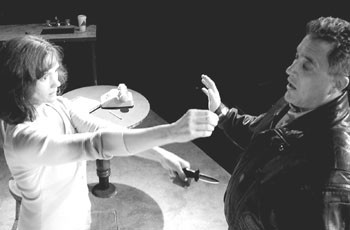
Hysterical Blindness: Rebecca Allington and Roy Jimenez battle it out in ‘Wait Until Dark.’

Dark Days

A blind woman fights for her life in ‘Wait Until Dark’

By Patrick Sullivan

Everyone’s frightened of something,” croons a villain to his intended victim in Wait Until Dark, now on stage at Sonoma County Repertory Theatre. This 1960s thriller from playwright and screenwriter Frederick Knott taps into what has become one of Middle America’s greatest fears: what newscasters in these troubled times call a home invasion, the sudden collision of domestic tranquility and shocking violence.

In Wait Until Dark, hearth and home are represented by what seems to be an especially vulnerable specimen: Susy, a blind woman painfully ill at ease with her disability, especially with her husband out of town.

In the other corner is a trio of con men desperate to get their mitts on a mislaid stash of contraband that has come into the blind woman’s unwitting possession. Unfortunately, as Susy eventually discovers, one member of this scheming threesome turns out to be something much worse than a two-bit grifter in search of an easy score.

Of course, any classic movie buff worth his or her salt has seen the movie version of Knott’s play. The luminous Audrey Hepburn played the beleaguered blind woman opposite Alan Arkin’s scheming psychopath in that 1967 film, which climaxes in a truly terrifying battle of wits.

It’s no small matter to step into shoes once filled by Hepburn, but Rebecca Allington makes a good go of it in the role of Susy in this SCR production, which is directed by Jim dePriest.

On opening weekend, the actress got off to a rough start with a few fumbled lines. But after that warm-up period, Allington offered an effective performance. She’s physically convincing as a blind person feeling her way through an uncertain world, and she also nicely captures her character’s psychological transition from near helplessness to determined resourcefulness as she realizes she’s fighting for her life.

As the murderous Roat, Roy Jimenez is reasonably intimidating without quite reaching the level of chillingly scary. Rich Deike is smoothly convincing–apart from a few fumbled lines–as a charming con man who lays out a web of lies in an attempt to separate Susy from the stash. Gerald Haston plays the third bad guy, the burly Carlino, who seems frighteningly comfortable with his brass knuckles.

Fair warning: despite the generally competent acting, this play features a few dead spots that will test an audience’s patience. That problem arises because Knott forces his characters to recite acres of exposition to illuminate the story’s torturous set-up. Even the movie, which sports a heavyweight cast and good cinematography, is painfully slow for the first hour. But patient audience members can expect a payoff in the second act. As the action builds towards climax, Allington and Jimenez both get better and better, and there are scenes here that will raise some goose bumps.

Other scenes may raise yelps of indignation from an audience surprised by the play’s old-school take on the hot-button issues of gender and disability. For instance, in the brief time we see Susy’s husband (played here by Bob Thomas) on stage, he’s a condescending jerk.

Apparently the two met when he rescued the poor woman from disaster in a busy intersection, but now he contents himself with giving Susy elaborate instructions on how to defrost the icebox while he’s off photographing fashion models. Frankly, it makes one long for a sequel. The first title to come to mind? Wait Until You Have to Write My Alimony Check.

‘Wait Until Dark’ continues through Nov. 9 at Sonoma County Repertory Theatre, 104 N. Main St., Sebastopol. 707.823.0177.

From the October 24-30, 2002 issue of the North Bay Bohemian.

© Metro Publishing Inc.

Twisted Vines

0

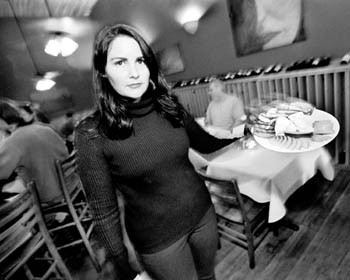
A Vine Design: Owner Phaedra DiBono displays Twisted Vines’ cheese plate.

Twisted, Sister

Swanky yet comfy, Twisted Vines is a great place to go and a good place to eat

By Sara Bir

Twisted Vines is a challenging restaurant, and not in the “pushing the envelope” sense. If you are oblivious to locations the way I am, it’s challenging to find, but it’s worth it. It’s down a lane inside the Landmark Building in downtown Petaluma on Kentucky Street.

Amie du Jour, luckily, was waiting outside to meet me. Inside, a couple sat at the bar, talking and sipping wine contentedly, and about a third of the tables boasted diners–not bad for Petaluma on a low-key Tuesday night.

Twisted Vines is more or less the same Twisted Vines that diners and drinkers have come to know since the venue first opened in 1996, but new owners Joeseph and Phaedra DiBono have implemented a few strategic changes. First: the decor, now with rust-and-clay-toned paintings and walls that cast a warm, red hue, evokes a well-kept wine cellar–which is what Twisted Vines is, in a sense.

All along the long side of the galleylike dining area (key word: “intimate”) stand racks of bottles. You can buy a bottle for home drinking or with dinner there (the corkage is now included in the sticker price, another change). The DiBonos have also added international wines to their list, which before consisted entirely of California wines.

The Beblenheim Pinot Gris from Alsace ($5.75 glass; $2.75 taste) was steely and bone-dry, with an up-front barrage of green apple quickly giving way to a soft mineral quality. It’s a great sipping wine for an aperitif. The versatile 100 percent syrah Côtes du Rhône ($5.25 glass; $2 taste) was smooth and mellow, with muted red fruit and a playful level of tannins.

There’s a gussied-up bistro Americano flair to chef Gary King’s menu: lamb T-bones, 40-cloves-of-garlic chicken, cheese plates, the California cuisine entry of seared Hawaiian fish–that sort of thing. We started off with fig tapanade ($8.50), which came with grilled bread, goat cheese, and walnuts. Adding figs to the traditional olive-caper-anchovy-garlic equation is a novel idea that tempers the salty concoction. The sweetness of the figs brightened the spread, and the meatiness of the olives took a back seat, making for a much less tapanadey experience.

A presentation of goat-cheese buttons rolled in herbs or ground black pepper would have been more elegant than a rough scoop of goat cheese, though that wouldn’t be in keeping with the casual, munchy spirit of the presentation. I wound up dipping the walnuts in the goat cheese and then drizzling them with the wonderful hazelnutty olive oil from the cruets on the table. Perhaps it is not the classiest thing in the world to create your own stoner food when eating out, but it speaks to Twisted Vines’ comfort factor that you can feel liberated enough to mess around with your starters in such an enjoyably tactless way.

The house salad was perfect; it was a salad with integrity, which most house salads are not. Twisted Vines’ house salad, nothing more than a lovely bed of mesclun greens tossed with thinly sliced red onion, cucumber, and a barely sweet balsamic dressing, is a minimalist medley. I could have eaten just a great big huge house salad and bread (from San Francisco’s Pan-O-Rama, and it’s excellent) with that wonderful olive oil and been very, very happy.

A half order of poor man’s lobster (that’s fancy food-industry talk for monkfish) and rock shrimp ravioli brought five generous ravioli burrowed in a rrrich pool of strikingly yellow spicy lobster cream sauce. Scattered across the top was a small handful of shaved parmesan, which was just too much. Gilding the lily!

After a meltingly intense first bite that rang of lobster the way a good bisque does, the sauce became cloyingly rich and parchingly salty. Monkfish, whose flesh is stringier and less meaty than lobster, couldn’t hold its own in the filling under the sauce and noticeably undercooked sheets of pasta. Maybe this was just not ravioli’s night. Minus the parm and the surplus salt in the sauce, and plus a minute and a half more pasta cooking time, this dish would have sung.

One of Twisted Vines’ biggest plusses is the flexible nature of its menu. There are enough small plates to facilitate socializing over wine and snacks at the bar; the salads and half orders of risotto and the ravioli are perfect for a lighter dinner; and the full-blown entrées like rib eye with demi-glace and mashed potatoes and the Liberty duck breast with green peppercorn sauce, basmati rice, and vegetables ($18) are suited to a special-event dinner.

Plated without a grain of rice out of place, the duck breast–Twisted Vines’ signature dish–looked grand. But the green peppercorn sauce was just kind of there, adding moisture but no flavor. The pretty little vegetable medley–carrots, zucchini, green beans, and red cabbage–flirted with the raw side of doneness just one degree too much (though Amie du Jour likes it that way).

As for the duck breast itself, it had the pinkish hue of a perfect medium rare but lacked that gamey duck taste. I suspect that the flavors of the whole plate were lurking in there somewhere, waiting to be released by a more attentive application of salt.

Decorated with random elementary school photos circa 1983, the dessert menus are more playful on the outside than the inside, which is fine. You can get unfussy treats like fruit crisp, rum raisin bread pudding, and apple spice cake with caramel sauce, which Pheadra herself makes.

Amie du Jour and I had our eyes on the eponymous Phaedra au chocolat (chocolate mousse layered with lady fingers), which was not available the night we went. Our unprofessional, contrarian natures led us to allow no substitutions, so no dessert reviews for you, dear reader! (Please address angry letters to le*****@******an.com.)

Twisted Vines has a good thing going. It’s stylish, casual, and comfortable. For easygoing wine lovers, it’s a great place to just hang out and relax. All it needs is a kitchen that keeps better tabs on its salt.

Twisted Vines, 16 Kentucky St., Petaluma. 707.766.8162. Dinner Monday-Saturday, from 5:30pm (wine bar opens at 4:30pm).

From the October 24-30, 2002 issue of the North Bay Bohemian.

© Metro Publishing Inc.

Billy Collins and Robert Hass

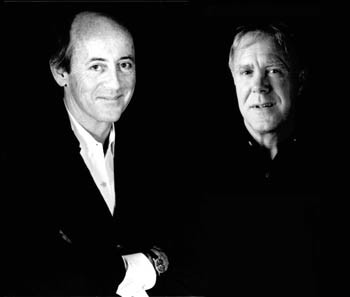
Way With Words: Billy Collins (left) and Robert Hass are tireless supporters of the public’s right to read (and write) lines of verse.

Poetic License

Being Poet Laureate is not all cheese cubes and wine in plastic cups

By Sara Bir

It’s even harder to gain national stardom as a poet than it is as a novelist, and that’s saying something. Consider for a moment how many poets there are in the North Bay. Now consider how many of them will ever perform to sold-out crowds at $15 a ticket or more. That’s the reality of modern poetry.

Still, some time in the past few years, Americans began to embrace poetry with a newfound enthusiasm, eagerness, and even need. There’s no one reason. You could chalk it up to soul-searching spurred by 9-11 (though the interest in poetry started before the tragedy); a proliferation of increasingly accessible poets; or the cresting of some kind of populist-poetry culture cycle.

Two of the many reasons, however, are easy to pinpoint: Billy Collins and Robert Hass, current Poet Laureate of the United States and former Poet Laureate of the United States respectively. Both appear at the Luther Burbank Center on Nov. 1, as part of the Copperfield’s Books Reader’s Series. The poets will also be announcing the winning poet from the submissions to Copperfield’s literary magazine, The Dickens.

Their appearance in Santa Rosa is being touted as the first time two Poets Laureate have appeared on one stage together–which, it turns out, is not entirely accurate, as Collins, Hass, and fellow former laureates Robert Pinsky and Rita Dove were all together recently at the Dodge Poetry Festival in New Jersey.

In any case, Collins and Hass sharing the same stage is a momentous thing, akin to seeing U2 and R.E.M. on the same bill. Hass served as Poet Laureate from 1995-1997, and during his tenure he reconceived the potential and meaning of the position, advocating literacy programs and promoting environmental awareness.

And the demand for Collins–whose 2001 collection of poems, Sailing Alone around the Room, has already gone through five printings, and whose recent collection, Nine Horses, is receiving good reviews–is nothing short of a phenomenon. His oftentimes unexpectedly humorous yet deceptively serious poems have won over many a once casual reader afflicted with the dreaded fear of poetry.

Since when did poets start making appearances to standing-room-only crowds and getting write-ups in such media outlets as USA Today? “It sure feels like poetry has a larger place in public consciousness than it did a decade ago,” Hass conjectures. “I think if it’s not one of the causes, it’s one of the symptoms–I’m not sure which.”

Before Hass (he’s a Bob, not a Rob) became laureate, there had hardly been much to the position at all. The job–until 1986, clunkily titled Consultant in Poetry to the Library of Congress–had called for little more than arranging poetry readings at the Library of Congress.

“I had expectations, I guess–they were not very grand expectations,” says Hass. “When I was rather a young poet, I had been invited to read [at the Library of Congress]. And the building is beautiful, but the audience for poetry at Capitol Hill was not enormous. When I thought about the job, the image was of a reception given by a not-very-rich governmental institution–that is to say cubes of cheddar cheese on toothpicks.

“It turned out that the name Poet Laureate had changed the position. There was more glare of publicity than I had realized, so it created more work and more opportunity than I had realized. It was a bit Kafkaesque; you’re handed this card that says ‘Do something.’

“Suddenly I was the spokesperson for American letters, and you have to figure out what that means and what you should do about it. There’s something about the title that connects it to the old English idea of a Poet Laureate that seems . . . grand, official, I guess, because it feels like there’s a person somehow appointed to speak for the country.”

Technically, all a Poet Laureate has to do is give one poetry reading and introduce a literary series at the Library of Congress. “It’s not a lot, and it doesn’t pay very much [$35,000 a year], so you don’t quit your day job for it.” Hass, a professor of English at UC Berkeley, commuted weekly to Washington when he was laureate.

Likewise, Collins still teaches English at Lehman College of the City University of New York. Since his appointment as Poet Laureate in 2001, Collins has compiled “Poetry 180,” a “poetry jukebox” for high schools that features one poem for every day of the school year, available on the Library of Congress’ website. It’s been getting about a million hits a week–no small feat, considering most high school English students’ attitude toward studying poetry.

To add to the general commotion of being Poet Laureate, Collins came out with Nine Horses last month. When we talked, he’d just gotten off the phone with U.S. News & World Report and was gearing up for a lecture at the Metropolitan Museum of Art in New York.

“It’s pretty nonstop,” he says, and it does have some creative repercussions, as far as time for writing is concerned. “It’s all gone. I miss it tremendously. I don’t have a life anymore; I’m on this merry-go-round.”

Even given his current popularity, Collins feels his life resembles a rock star’s “only in the sense of the desperate loneliness of the hotel room at the end of the day. When you go touring, you’re in this tunnel, and the tunnel is composed of a series of airport waiting rooms and tubular airplanes, and then you’re shuttled off to an auditorium, and then you’re put into a dinner with people you’ll never see again, and then you’re off to the next hotel and airplane. I travel all over the country, but I don’t get to see much.

“I was down in Orlando last week. I wasn’t dressed for the reading, the plane was late, and the reading was at noon. So I changed my shirt in the airport parking lot. You could have seen the Poet Laureate half-naked in the Orlando airport parking lot last Thursday.”

Ah, the duality of success. “I think other Poets Laureate will tell you, it’s kind of like Miss America, because you never really get rid of the tag,” Collins says of his plans for the postlaureate future. “You become former Poet Laureate–it doesn’t just stop. There’s a lot of afterglow attached to it. I don’t see my schedule tapering off too much, unless I stop accepting invitations. I’ve got a new book out now, and I’d be promoting that even if I didn’t have the Poet Laureate position.”

Does Collins’ frantic schedule concern him that he might not ever be able to return to writing poetry the way he used to? “Um, not really,” he assures. “I just wrote a poem. Having finished a poem yesterday, I feel great. If I don’t write for a couple weeks, I start feeling that this job was in fact taking the poet out of Poet Laureate, and just leaving . . . laureate.”

Both Hass and Collins have agreed to choose the winning poet for Copperfield’s sixth edition The Dickens. Submissions are being vetted by eminent local poets, and Hass and Collins will choose one from the top 10. The winner will be announced at the Nov. 1 reading, with the magazine–featuring the top honoree as well as others–being published in December.

It’s a very generous gesture, given the poets’ hectic schedules, though neither seems to look at it that way. “Well, they just asked me if I would,” Hass says matter-of-factly.

“I find judging contests fairly easy,” says Collins. “It’s not to say I don’t take them seriously; I find that the good poems just leap out at you. I’m pretty speedy about it because I just think that a poem that I like is going to talk to me right away.”

The Nov. 1 reading may have a few surprises in store, even for Hass and Collins, though that’s probably the way they want it. The two colleagues, both experienced and ultraengaging readers, have not yet plotted an approach to the evening.

“I’ll talk to Billy and see,” Hass says. “The idea of appearing with him is fun to me, but I feel like around here, I’m around so much, everybody’s heard me. We’ll probably get on the phone and figure out a structure in which people get a sense of him, as well as his poems, and we’ll play off each other–a little bit of reading, a little bit of talk, some kind of ping-pong, maybe.”

Copperfield’s Books Reader’s Series presents Billy Collins and Robert Hass at the Luther Burbank Center at 8pm on Friday, Nov. 1. 50 Mark West Springs Road, Santa Rosa. $10-$25. 707.546.3600.

From the October 24-30, 2002 issue of the North Bay Bohemian.

© Metro Publishing Inc.

Frenzy Trio Quintet

0

Free of Skronk: L-R: Aaron Lehr (filling in for Sean Moore), Jesse Wickman, Zack Matz, Ari Piotrkowski, and Damian Cohn.

Jazz It Up

The Frenzy Trio Quintet plays games with free jazz

By Karl Byrn

In the North Bay music scene, it’s a given that downtown Petaluma is a hard-to-beat hotspot. Two of the most enduring music venues in the area, the rootsy Mystic Theatre and the punk-rock Phoenix Theatre, were joined this summer by the intimate and stylish Zebulon’s Lounge, which since July 6 has been offering live jazz nightly.

Zebulon’s is pulling from a large store of serious jazz talent in the area, much of it coming from Sonoma State University students and teachers. The Frenzy Trio Quintet (or just Frenzy), who play at Zebulon’s every other Thursday, have another surprise for live music fans: free jazz that’s melodic and focused.

“If people are hearing something familiar, then they’ll be more accepting of the crazier stuff,” says drummer Jesse Wickman, describing the group’s ability to move on cue from long stretches of bebop listenability and groove to quick spells of chaos.

Wickman points out that the heart of free jazz is improvisation, not the stereotype of unlistenable “skronk” that many jazz fans associate with late-period John Coltrane. Frenzy play a challenging type of improv that, even for well-trained ears, isn’t too far from the standards-based bebop of other acts at the nightclub.

But where standards-based jazz applies improv skills to written charts, the Frenzy Trio Quintet improvises to what free jazzers call “improv games” or “game pieces.” Some games may be simple– following a certain rhythm or doing a piece with no rhythm. A favorite game of the Frenzy players is having a leader who nods instruments one at a time into a crescendo before nodding each one back out.

For now, Frenzy has more of a spur-of-the-moment approach. “We look at each other and say, ‘What do you guys want to do?'” Wickman says. If no one names a game, “someone starts doing something, and everyone else starts paying attention. It’s all about listening to each other.” So the Frenzy players move fluidly through music that has no compositional anchors, following each other’s moods and tones through patterns that thrust, stop, rebuild, and repeat.

When it’s time to shift from more conventional bebop grooves into frenetic, ambient spasms with Wickman rattling shakers and horn players moaning whole notes, then “everyone just moves in that direction.” He adds fondly, “Everyone starts to get that look in their eyes; you just know by the look. You get that look that says ‘Metal!’ and it means, ‘Here we go!'”

Starting as a trio, Wickman and guitarist Sean Moore (leader of his own Sean Moore Quartet) heeded the call of trombonist Achilles Polynis to seize the opportunity Zebulon’s offered to perform free jazz. Polynis has since left, but with consistent sit-ins from bassist Zack Matz and tenor sax player Damien Cohn (of the electronic-sample improv group Scattershot Theory), and with the newest addition of alto sax player Ari Piotrkowski, the expanded trio now has a core group of performers.

Frenzy’s style reflects the creative energy at Zebulon’s. The club, a lushly remodeled space around the corner from the Mystic, also operates as a gallery, features a specialty sake cocktail menu and wine, and hosts a writers’ salon every other Tuesday that draws standing-room-only crowds. Co-owner Trevor Cole (who books the musicians while co-owner Karen Ford books the artists) notes that he’s “happy to provide a forum for new music.”

The group shares the appreciation. “We feel like saying thank you for letting us play free jazz,” Wickman notes, adding that the special thing about the jazz at Zebulon’s is that “it’s not a scene, but a scene that’s about listening to music.”

Frenzy perform regularly at Zebulon’s Lounge, 21 Fourth St., Petaluma. 707.769.7948. Their next date is Thursday, Oct. 31, at 8:30pm.

From the October 24-30, 2002 issue of the North Bay Bohemian.

© Metro Publishing Inc.

Jazz Albums

0

Trumpeting what’s new: Dave Douglas tackles the infinite (and Mary J. Blige) on his new album.

New Standards

Jazz artists are keeping it fresh

By Greg Cahill

What do Radiohead, Afrika Bambaataa, and the Monkees have in common? All are providing inspiration for today’s new crop of twenty- and thirty-something jazz artists.

Amid a flurry of jazz reissues–from the recent four-CD Charlie Christian box set The Genius of the Electric Guitar (Sony/Legacy) to Blue Note’s Rudy Van Gelder multiartist series–it’s easy to overlook the fact that contemporary players are revamping the genre by redefining the standards that serve as the core of their repertoire.

Jazz artists used to draw on the pop tunes and films of the ’40s, ’50s, and ’60s for those melodies: “My Funny Valentine” (Chet Baker), “Someday My Prince Will Come” (Miles Davis), “My Favorite Things” (John Coltrane). Now they’re roaming further afield for material to stretch out on, and they’re doing it without pandering to pop audiences.

Back in 1996, Herbie Hancock set the pace with the appropriately named CD The New Standard (Verve), which included jazz covers of pop and rock songs by Kurt Cobain (“All Apologies”), Prince (“Thieves in the Temple”), Peter Gabriel (“Mercy Street”), and–gulp–Don Henley (“New York Minute”).

But jazz vocalist Cassandra Wilson had gotten there first. Her breakthrough 1995 album New Moon Daughter (Blue Note) featured such reinvented pop, rock, country, and blues fare as “Last Train to Clarksdale” (the Monkees ), “I’m So Lonesome I Could Cry” (Hank Williams), “Death Letter” (Son House), and “Love Is Blindness” (U2). While her new CD, Belly of the Sun (Blue Note), was recorded in her native Mississippi and has been hailed for its Delta sound, it draws from such folk, pop, and country songwriters as Bob Dylan (“Shelter from the Storm”), James Taylor (“Only a Dream in Rio”), and Jimmy Webb (“Wichita Lineman”), all filtered through the musical influences that have helped shape the Southern landscape.

Meanwhile, jazz trumpet player Dave Douglas, whose avant-garde style resonates with such disparate influences as Igor Stravinsky and Lester Bowie, has lent his improvisational talents to tracks by Rufus Wainwright (“Poses”), Mary J. Blige (“Crazy Games”), and Björk (“Unison”) on his newly released CD The Infinite (BMG), illustrating the infinite possibilities in melodies as far flung as urban soul, Icelandic pop, and folk-rock.

Pianist Brad Mehldau–who Newsday has hailed as “the most compelling, eccentric, and daring young pianist in years”–bolstered his reputation by including the Lennon/McCartney composition “Dear Prudence” and giving Radiohead’s “Paranoid Android” a gamelan-funk fusion treatment on his most recent disc Largo (Warner Bros.).

But most impressive of all is jazz pianist Jason Moran’s spectacular Modernistic (Blue Note). This new CD is steeped in the early 20th century-stride piano style of the legendary James P. Johnson (whose vintage composition “You’ve Got to Be Modernistic” opens this stunning CD) and reaches out to such nonjazz material as classical composer Robert Schumann (“Auf einer Burg”) and the seminal hip-hop of Afrika Bambaataa’s “Planet Rock,” which Moran has transformed into a solo-piano neoclassical funk meditation.

“All of my recordings are progress reports,” says Moran, whose past recordings have included covers of Public Enemy, Björk, and even “Yojimbo” from the Kurosawa movie of the same name.”I’m a modern piano player. I’m not a pioneer, I’m not cutting-edge and avant-garde. I bring new ideas to old things.” Indeed, this former student of jazz great Jaki Byard identifies the impressionistic aural and visual art of Maurice Ravel and Jean-Michel Basquiat as his biggest influences.

Modernistic is a text-book lesson in how a jazz artist can pay homage to the traditional roots of his forefathers–especially one, like Johnson, whose own adventurous music served as a bridge between the old and the new–while exploring the complex rhythmic and harmonic structures of modern music. Highly recommended.

From the October 24-30, 2002 issue of the North Bay Bohemian.

© Metro Publishing Inc.

Hemp Campaign

0

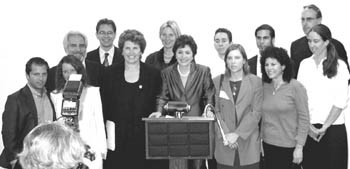
Boxing for Hemp: HIA members take their case to Barbara Boxer. L-R: Eric Rothenberg, Lenda Hand, Steve Levine, Chris Conrad, Candi Penn, Kimberly Kelly, Senator Barbara Boxer, Michael Norbury, Mari Kane, Gustavo Alcantar, Mikki Norris, David Bronner, and Rebecca Burgess.

Hempsters Go to Washington

Promoting the industrial weed to a war-addled Congress

By Mari Kane

I am standing at the gate in SFO waiting to board an 8am flight to Washington, D.C., when I spy a mousy-looking brunette in a black suit making her way through the crowd. “Why, it’s our own Senator Feinstein,” I say as I pull out my video camera and zoom in while calling out, “Senator Feinstein!”

She whips around, and the crowd comes alive with well-wishers who say, “We’ll see you there!” Seeing the senator in Washington is my hope too, since my mission on this trip is to lobby my representatives on behalf of industrial hemp and to educate them about what hemp is. What it isn’t is a drug.

Low-THC industrial hemp is grown in 31 countries. The United States remains the only developed nation to prohibit its cultivation. While both marijuana and hemp come from the same plant species–Cannabis sativa–hemp is to pot as a terrier is to a pit bull. Both are dogs, albeit with very different bites, but they are nonetheless seen by the same veterinarian.

Hemp remains under the control of the Drug Enforcement Agency, which refuses to acknowledge the difference between the plants. Thus hemp is viewed as a law-enforcement problem rather than the farming issue it is.

Washington’s weather on Oct. 2 is sunny, hot, and running about 100 percent humidity. Even hemp clothes don’t breathe enough to wick the sweat away. I am with members of the Hemp Industries Association, which is holding its ninth annual convention here. Armed with talking points and positive attitudes, hempsters representing 25 companies from 13 states and Canada fan out over three congressional office buildings to do battle.

The California contingent’s first appointment is with my fellow flyer Dianne Feinstein, but since the senator is preoccupied with the Iraq resolution, we are given to her agricultural aid instead. While waiting, I request that my opinion on Iraq be noted and when the secretary asks how I vote, I sardonically reply, “Er, that would be a no. My zip is 95436.”

A warm sense of political entitlement envelopes me. It is the job of these people to listen to their constituents, even if our opinions fall on deaf ears: Feinstein, within a week, will vote in favor of the president’s drastic Iraq resolution.

Feinstein’s aide Michael Buchwald ushers us into a small conference room. Buchwald is polite and attentive while 12 hempsters lay the issue out for him. The issue at hand is getting hemp out from under the thumb of the DEA. To accomplish that, we now have something previously unheard of: a Senate bill.

Senator Kent Conrad, D-N.D. has drafted a bill that would put control of hemp squarely in the hands of the U.S. Department of Agriculture. Transferring jurisdiction over hemp is the HIA’s new push, and they are quietly gathering support in advance of the bill’s introduction next year. Buchwald promises to discuss the matter with the senator.

The next stop is Congresswoman Lynn Woolsey. She too is out, but her ag aide, Kristin Mastromarino, meets with us. This meeting is attended by myself, HIA executive director Candi Penn of Occidental, San Rafael-based Rebecca Burgess of Loom-in-Essence, and Gustavo Alcantar from Swirlspace in San Francisco.

We know Woolsey knows about hemp–she represents one of the most hemp-intensive counties in California–but we are slightly taken aback when Mastromarino innocently asks, “What exactly is the difference between the plants?” It’s time for Hemp 101. She listens intently and suggests we find a representative on the House Agriculture Committee to present a co-resolution. As it happens, Sonoma County Congressman Mike Thompson sits on the committee, and he will become the HIA’s next best friend.

Next I accompany Corrine Turner to the office of Democratic Senator Debbie Stabenow of Michigan, my family’s home state. Turner speaks eloquently on hemp’s agricultural uses with legislative assistant Kim Love, who seems genuinely interested in Michigan’s hemp history.

We tell her how the state became a vast hemp laboratory for Henry Ford and Thomas Edison, who experimented with the raw material for use in car bodies and as an energy source, respectively. There is no Love lost during this meeting; Stabenow’s aide appears to get it.

At 3 o’clock we’re off to tea. Literally. Senator Barbara Boxer holds “tea” at 3pm every Wednesday, when she greets visitors and takes pictures with them. Boxer lays out her position on the Iraq issue: pro-inspection, prodiplomacy, and violence as a last means.

We line up for a picture with the senator, and as the 12 of us gather, I go for one side of her while Penn takes the other, and we each begin probing the senatorial mind.

Cocktail hour finds the HIA members sipping beers at a sidewalk bar when someone says, “Isn’t that Ralph Nader?” Sure enough, the tall guy is standing on the opposite corner in front of the Postal Museum, and I gamely say, “I’ll go get him.”

I hoof it across the street as he is waving down a cab and yell, “Hey, Ralph! I’m from the Hemp Industries Association, and we’re having our convention here!” Nader replies that he knew the hemp people were in town, but, no, he doesn’t have time for a drink.

I respond, “We have a bill now by Senator Conrad to transfer hemp from the DEA to the Ag Department and we need your help.” Nader listens to my through-the-window pitch. “Will you help us, Ralph?” I plead. “Yeah,” he replies, “send me something on it.”

Overall, HIA members are pleased with their efforts and promise a repeat performance. “Realizing that there were ears and eyes to hear and see our issue was exhilarating,” enthuses Penn. “I’ll definitely go back!”

I’ll go back too, since nothing makes me feel more politically potent than showing up at my representative’s office door and insisting on having my grievances heard. Lobbying is a cultural cross between reality TV, horse racing, and a town-hall meeting. Far above protesting, letter writing, and voting, I find congressional lobbying to be the highest level of political activism a citizen can perform, short of seeing the president, and nothing makes me feel more like an American.

It sure beats waving a flag.

Mari Kane is an HIA advisory board member and the former publisher of HempWorld and Hemp Pages. She can be reached at ma**@******ne.com.

From the October 24-30, 2002 issue of the North Bay Bohemian.

© Metro Publishing Inc.

Bars and Clubs

0

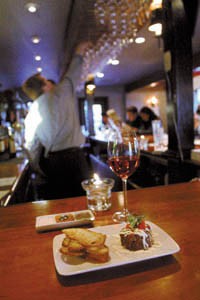
Photograph by Michael Amsler

Wines Raise the Bar

Once just a haven of tasting rooms, the North Bay embraces wine bars in their many forms

By Sara Bir

Enotecas, bodegas, bistros a vin . . . every country has its own version of a wine bar, a casual hangout where the locals gather and sip regional vintages, and wash down simple foods.

America, meaning not European, never did see its own specific take on a wine bar evolve. Maybe it’s because we were settled by Puritans. Even here, in this Disneyland of food and drink called wine country, the closest equivalent to wine bars became the winery tasting room, where you don’t hang out so much as . . . taste.

Bar by bar, that’s been changing. The past decade’s nationwide proliferation of hip and swanky joints dedicated to the clinking of glasses before and after the sun has set has leaked northward across the San Francisco Bay into our own fertile soil. And while there is a difference between a wine bar and a bar with wine, wine bars are a new enough phenomenon that there’s plenty of room for custom-tailoring the definition of a wine bar to the need and personality of the outlet.

From fancy to funky, spots that offer more than just wine with dinner are drawing in the regular Joe Public who’s increasingly exploring wine, despite (or perhaps because of?) a soft economy. “I think more and more people are getting into wine. The younger generation is coming into it, which is fun to see,” says Josh Silvers, chef and owner of Syrah restaurant in Santa Rosa. Syrah’s wine list features California and French offerings that spotlight unusual varietals. Next month, Syrah will be expanding into a retail space with a wine shop that will feature a tasting bar.

Factoring a tasting bar that sells wines by the glass into a retail shop can make the difference between selling a bottle and not selling a bottle, and it also creates another source of revenue. Of course, the benefits extend to the consumer, too. “For an eighty-five dollar bottle of wine, you don’t have to spend eighty-five dollars to check it out,” Silver says. “With wines that are unique and hard-to-find, they can try it, and if they like it they can buy it, and if not, they didn’t invest a lot of money into it.”

While many wineries in the area have impressive tasting rooms, it can become an out-of-the-way event to visit them. “One of the great things about our wineries in Sonoma is that it’s a discovery to find them–you’ve got to kind of travel around,” says Silvers. A wine bar can bring together wines from a variety of lesser-known local producers under one roof, making it easier to think and taste out of the Chardonnay-Cabernet box.

“For a guest coming to wine country, I think they’re just more open [to different wines] because they’re coming to wine country,” offers Silvers. “And then for the locals, they’re brought up on wine, and they get tired of the same old thing and they want to try something new and experiment, and I think they don’t want to be their parents, in a way. They get their friends into it, and it’s one of those things that starts growing and growing.”

Another way wine bars help make drinking wine an event is by introducing food into the equation. This can be anything from a simple cheese plate or dish of almonds to a small plate, such as a lamb chop with fava beans and celeriac puree, but overall, the message is that wine and good company can still involve food without escalating into a gigantic meal.

“Most people’s interaction with wine does involve food,” says Jessica Gorin, who’s been the chef at J Vineyards and Winery in Healdsburg for four months. Gorin has already cornered the personality of J’s food-friendly wines and created a tasting menu of tiny pâté triangles and itty-bitty stuffed vegetables. When paired with flights of wines in J’s tasting room, the combinations pull out notes in both the food and wine that would otherwise be untapped. J has been doing this in their tasting room since 1999 to emphasize that wine was made to enjoy with food. While not a wine bar per se, it’s all done in the spirit of such a place, and to encourage patrons to play around with combinations.

“There’s definitely been more openness about getting away from the old paradigms of what wines go with what foods,” Gorin says. “If you know that you like Pinot Noir but you know that you want to have fish for dinner, you can try it–Pinot Noir might go really well with the fish, it’s going to depend on how the fish is prepared.”

Wine bars–whether in a wine shop or a freestanding establishment like Willi’s–go beyond just savory bites and virtual day-tripping. They’re fun places to hang out, classy but casual alternatives to another night at the microbrewery.

“A lot of nights, the bar’s pretty full,” says Phaedra DiBono of Twisted Vines in Petaluma. “People even come in by themselves and they’ll just sit at the bar and have some wine. They’ll talk about different wines by the glass, and instead of just getting a glass they’ll get a flight. It’s fun for people, because it’s educational, too.”

In that case, let’s get educated!

Cantinetta Tra Vigne The cantinetta is a gift shop and wine bar addition to Tra Vigne, the Napa Valley tourist’s fave. Though the ambiance is Italian, the focus of the wine offerings is Californian. There’s also a selection of plated cured meats, cheeses, and specialty items. 1050 Charter Oak Ave, St. Helena. Open daily, 11am-6pm. 707.963.8888.

J Wine Company Okay, so it’s not a bar bar, but J’s food-and-wine-pairing philosophy puts a new twist on the whole tasting room thing. Test- drive J’s wines as they were meant to be drunk: with clever food pairings, like Picholine olive and onion tart with 2002 Pinot Noir, and sesame seeded and honeyed mascarpone atop a zucchini-bread crouton with the 1997 Chardonnay. 11447 Old Redwood Hwy, Healdsburg. $5/taste; $10/flight. Open daily, 11am-5pm. 888.JWINECO.

Twisted Vines (See review) 16 Kentucky St, Petaluma. Dinner Mon-Sat, 5:30 (wine bar opens at 4:30). 707.766.8162.

Wine Spectator Tasting Table at COPIA More museums should have wine bars; what better to cap off a day of culture? While few people are going to go to COPIA specifically for the wine, it’s not a bad idea. Boasting 49 wines by the glass and 250 by the bottle, the Wine Spectator Tasting Table is refreshingly global in scope, with many unique varietals and obscure producers. 500 First St, Napa. Thurs-Mon, 10am-5pm. 707.265.5820.

Willi’s Wine Bar A very Europe-by-way-of-California place (the name, though, has nothing to do with the famous Willi’s Wine Bar in Paris), with Belle Epoque-inspired art and a lovely courtyard, Willi’s has taken the old Orchard Inn and made it its own. You can have a glass and a nibble in the afternoon, or several glasses and a few plates for a full meal in the evening. Both old world and young and hip, Willi’s is one of the North Bay’s few freestanding wine bars novel enough for tourists but genuine enough for locals. 4404 Old Redwood Hwy, Santa Rosa. Wed-Thurs, 11:30am-10pm; Fri-Sat, 11:30am-10:30pm; Sun, 11:30am-9pm. 707.526.3096.

Wine Exchange of Sonoma Largest selection of California wine in Sonoma (plus a terrific selection of international beers). Before you buy wine there to drink in the now chickenless plaza, why not try a test swirl in the glass first? Proprietor Dan Noreen’s impressive in-store gallery of vintage French absinthe posters really whets the whistle. 452 First St, Sonoma, Open daily, 10am-6pm. 707.938.1794.

Zebulon’s Lounge This jazzy (literally) newcomer brings swanky city ambiance to downtown Petaluma with a plush wine-red interior and a beatnik hipster sensibility. Featuring an impressive roster of jazz talent nightly and an equally impressive roster of international wines by the glass and fancy sake cocktails, Zebulon’s has a half-price happy hour until 7pm that’s great for after-work unwinding. 21 Fourth St, Petaluma. Open daily at 4:30. 707.769.7948.

From the October 24-30, 2002 issue of the North Bay Bohemian.

© Metro Publishing Inc.

Bars and Clubs 2002

0

Sonoma County

Clo’s Parkside Grill Oct. 26, Bone Daddy (’70s funk). 9pm to midnight. $7 at the door. 557 Summerfield Road, Santa Rosa. 707.539.6100.

Club FAB Oct. 25-26, Russian River Massacre. Oct. 25, see Fife’s Guest Ranch listing. Oct. 26, Peaches Christ and Club FAB present spooky films, live performance art onstage, and costume contest with cash prize. Nov. 1, Gianni’s Halloween Costume Party. Nov. 2, Day of the Dead with Lost at Last. 9pm to 2am. $15. 16135 Main St., Guerneville. 707.869.5706.

Connolly’s Oct. 26, Halloween party #1 with the Jake Richmond Band. Oct. 31, Halloween party #2 with Jake Mackey. Both start at 9:30pm. 129 Main St., Guerneville. 707.869.1916.

Fife’s Guest Ranch Oct. 25, Peaches Christ and Club FAB present Midnight Mass cult films at Fife’s resort, full bar and bonfire. 9pm to 2am. $7. Oct. 26, Puta’s Poolside Pumpkin Slaughter. 2pm to 4pm. Free. Queer-bar costume crawl and parade. 8:30pm. 16467 River Road, Guerneville. 707.869.0656.

Flamingo Resort Hotel Oct. 26, Halloween bash and costume contest with M.O. Blues Band. 9pm to 1am. $10. Oct. 31, karaoke party costume contest. No cover. 2777 Fourth St., Santa Rosa. 707.545.8530, ext. 704.

Healdsburg Bar and Grill Oct. 31, DJ, costume contest, and raffle. 9pm. 245 Healdsburg Ave., Healdsburg. 707.433.3333.

Jasper O’Farrell’s Oct. 31, costume party with prizes. 9pm. 6957 Sebastopol Ave., Sebastopol. 707.823.1389.

Kodiak Jack’s Oct. 31, Halloween bash #1 with the Ghost Riders. Nov. 1, Q-105 Halloween bash #2 with Ghostbusters II. 256 Petaluma Blvd. N., Petaluma. 707.765.5760.

Last Day Saloon Oct. 31, Halloween party and costume contest with Tainted Love (’80s hits). $12. Fifth and Davis streets, Santa Rosa. 707.545.2343.

Lucy’s Oct. 31, Halloween-themed menu; Dgiin performs at 9pm. 6948 Sebastopol Ave., Sebastopol. 707.829.9713.

Michele’s Restaurant and Bar Oct. 31, costume party with cash prizes. Seventh and Adams streets, Santa Rosa. 707.546.1736.

Monroe Dance Hall Oct. 27, country-western Halloween dance lessons from 5pm; dancing from 7pm to 9pm. $8. 1400 W. College Ave., Santa Rosa. 707.836.1806.

Murphy’s Irish Pub Oct. 31, Halloween Scarey-Oke. 8pm. 64 First St. E., Sonoma. 707.935.0660.

Mystic Theatre Oct. 31, Shagadelic Halloween Bash with Casino Royale. 9pm. $15. 21 Petaluma Blvd. N., Petaluma. 707.765.6665.

Old Vic Oct. 29, Dolly Ranchers.Oct. 31, Ding Mao and special guests. 9pm. 731 Fourth St., Santa Rosa. 707.571.7555.

Powerhouse Brewing Co. Nov. 2, Halloween party with Zigaboo Modeliste. 268 Petaluma Ave. (Hwy. 116), Sebastopol. 707.829.9171.

Quincy’s Pub and Cafe Nov. 1, Halloween costume-party contest with cash prizes. 8:30pm. 6590 Commerce Blvd., Rohnert Park. 707.585.1079

Rose Pub Nov. 2, Celtic New Year party. 8:30pm. 2074 Armory Drive, Santa Rosa. 707.546.ROSE.

Russian River Eagle Nov. 9, midnight costume party. 16225 Main St., Guerneville. 707.869.3400.

Spancky’s Oct. 26, costume party with cash prizes, food, music, and dancing. 8201 Old Redwood Hwy., Cotati. 707.664.0169.

Tradewinds Oct. 31, Wicked Willy’s Halloween Bash with music by A Case of the Willy’s, costume contest, and prizes. $5. Nov. 1, Day of the Dead celebration with the Pulsators. $5. Nov. 2, Day of the Dead Celebration with the Cohorts. No cover. 8210 Old Redwood Hwy., Cotati. 707.795.7878.

Willowbrook Ale House Oct. 26, costume dance party. 8pm.

3600 Petaluma Blvd. N., Petaluma. 707.775.4232.

Zebulon’s Lounge Oct. 31, Halloween party, costume required. 8:30pm. Nov. 1, tacky costume Halloween party. 21 Fourth St., Petaluma. 707.769.7948.

Napa County

1351 Lounge Oct. 31, Hell-themed costume contest with DJ spinning disco inferno. 9pm, cash prizes at midnight. $10. 1351 Main St., St. Helena. 707.963.1969

O’Sullivan’s Oasis Oct. 26, costume contest with the band RTN. 9:30pm. 359 First St. N., Napa. 707.224.7427.

Silverado Brewing Co. Oct. 31, Fright-Fest 2002, costume party with DJs Johnny and Magnetic. 9:30pm. 3020 N. St. Helena Hwy., St. Helena. 707.967.9876.

Marin County

Mancuso’s Bar and Grill Oct. 26, huge party, costume contest and prizes, and music by the Cheeseballs (’70s and ’80s). 9pm. 1535 S. Novato Blvd., Novato. 415.892.5051.

Old Western Saloon Nov. 1, costume party with prizes. 11201 Hwy. 1, Pt. Reyes. 415.663.1661.

Peri’s Silver Dollar Bar Nov. 1, costume party and contest with the music of 35R. 9:30pm. 29 Broadway, Fairfax. 415.459.9910.

Pete’s 881 Oct. 31, huge party with DJ and live music, dancing, and costume contest. 8pm. 721 Lincoln, San Rafael. 415.453.5888.

Rancho Nicasio Oct. 25, Rusty Evans and Ring of Fire. 8:30pm. Town Square, Nicasio. 415.662.2219.

Sweetwater Oct. 31, Dean Del Ray opens for the Mother Hips. 9:30pm. Advance tickets advised. 153 Throckmorton Ave., Mill Valley. 415.388.2820.

Water Street Grille Oct. 31, costumes, pumpkin carving, and drink specials. 660 Bridgeway Ave., Sausalito. 415.332.8512.

From the October 24-30, 2002 issue of the North Bay Bohemian.

© Metro Publishing Inc.

Mill Valley Scrabble Club

0

Scrabble’s just as close as a Mill Valley pizza joint

If you go out for pizza in Mill Valley and see more people playing Scrabble than eating pizza, don’t do a double take. Especially if it’s a Thursday night at Round Table, because that is when and where the Mill Valley Scrabble Club meets weekly. They take over an entire section of the dining room and play Scrabble from 5pm until the restaurant more or less closes. Which may sound very intense, but–come on–this is a pizza restaurant. Cheesy Top 40 rock music blares at Round Table volume–stuff like Cher and the Offspring–and while the club members are passionate about Scrabble, there is a loose and open atmosphere.

“We just come here and talk, we’re all friends, and I love them dearly,” says Cynthia Pughsley, an upbeat and chatty woman from Oakland who happens to be one of the best Scrabble players in the country. “We do a lot of potlucks–just get together at people’s houses and play Scrabble. It’s our common bond. There’s such a wide range of people from all walks of life. And I love that. All ages, colors, everything.”

Though the very upper echelon of competitive Scrabble is known for its assortment of obsessive, high-strung personalities, the everyday Scrabble lovers who compose the bulk of the National Scrabble Association’s membership are regular, well-adjusted people who convene not to kick each other’s asses but just for the joy of playing Scrabble.

“We have a few Scrabble war stories,” Pughsley admits, “but mostly everybody plays for the love of the game. We’re not into going crazy.”

There’s a strong presence of Scrabble clubs in the Bay Area–there are clubs in Oakland, San Francisco, San Jose, Los Gatos, and other cities across the Silicon Valley–and Northern California’s “Scrabble Zen” attitude seems to color most of them. Everyone at the Mill Valley club is friendly and welcoming.

Pughsley, who once ranked 75th in the nation, sits down to play with two demure ladies from the nearby senior center who are mainly there for the social kicks. The intent is on having fun and playing well. In between shuffling tiles on their racks, people sneak bites of personal pizzas and wave hello to the club members who continue to trickle in.

Lester Schonbrun, a soft-spoken man in his mid 60s who played his first game of Scrabble in 1954, is the Mill Valley club’s resident Scrabble superstar. One of the originators of the New York tournament scene in the 1960s, Schonbrun merited an entire chapter in Word Freak. Considerate and modest, Schonbrun is a model of Scrabble’s more grounded side and a testament to the fact that you don’t have to be wacko to win tournaments.

“Recently,” says Schonbrun, “most of the clubs have picked up membership quite a lot. For many years, there’d be two types. One type gets beaten very badly, and they say, ‘I’m never coming back here!’ The other type also gets beaten very badly, but they say, ‘I love this game. I’m going to learn how to play it.’ And they’re the ones who become good players. Unfortunately, until Word Freak appeared, that seemed to be about 5 percent of the new players.”

The other 95 percent can’t be too far behind.

The Mill Valley Scrabble Club meets on Thursdays from 5-10pm at Round Table Pizza, 50 Belvedere Drive, Mill Valley. Call 415.388.3549 for more information.

From the October 24-30, 2002 issue of the North Bay Bohemian.

© Metro Publishing Inc.

Scrabble

0

The competitive Scrabble underground of word freaks, geeks, and just plain regular people is growing . . . tile by tile

By Sara Bir

Between Aug. 17 and 22, 700 people from all over the country and beyond gathered in San Diego to play a board game for hours and hours and hours. They played all day long with an afternoon break for lunch. Then, after official play ceased, they congregated in a hotel meeting room to play far into the night, just for fun.

The game is Scrabble, and to these hundreds of people, it’s not just a thing to play every now and then at parties or family reunions. It’s not even a hobby. Scrabble is a way of life, and for one week at the 2002 National Scrabble Championship, they are free to give themselves entirely over to their communal obsession.

“SCRABBLE: IT’S YOUR WORD AGAINST MINE” reads a larger-than-life Scrabble board positioned to meet those coming into the San Diego Concourse. It’s a Sunday, the first day of official play at the tournament, and the afternoon block of rounds is about to begin. Players, all kinds of people–middle-aged, overweight, dorky men; professional-looking older women; handsome, young hipster guys; and a good representation of African Americans, Hispanics, and Asian Americans–scurry around toting cymbal cases, which present the illusion that some weird kind of drummer’s convention is going on, but that’s how avid players transport their custom-made boards.

All around, people shake hands or hug pals from the tournament circuit whom they haven’t seen in a while. Others size up the postings of ratings–who’s playing whom in what division. Eventually, the players all filter into the auditorium and find their assigned tables.

An official-sounding voice announces the start of play, the buzz of anticipation in the air gives over to anxiousness, and for the next few hours, the prevailing sound is the unoiled squeak of hundreds of lazy Susans revolving and the clink of thousands of tiles. It’s a ghostly, oddly thrilling sound, the mounting call of hundreds of unseen crickets and rattlesnakes.

The biannual National Scrabble Championship is the biggest of about 175 tournaments in the United States and Canada sanctioned by the National Scrabble Association, a group that helms about 10,000 members who make an effort to set aside a fair chunk of their lives for Scrabble. During the nationals, the NSA website is updated play by play. People around the world are following the action.

“At the World Championship in December, we had 3 million hits in five days,” says John D. Williams, sounding like a proud father. Williams is executive director of the NSA. He used to play competitively himself but hasn’t for several years, mainly because running the NSA doesn’t leave him time to study. For his efforts, he’s been called the Johnny Appleseed of Scrabble.

“I guess it’s a compliment,” he chuckles, admitting that his efforts to promote the game have not only gotten people involved, they’ve gotten people hooked, turning them into Scrabble junkies. “We’ve grown every year for the last 15 or 20 years. There are more books on strategy now, and the book Word Freak helped a lot too. It’s a really good time for Scrabble.”

Round Tables, Square Tiles: Scrabble’s just as close as a Mill Valley pizza joint

Freak Out

The book Williams is talking about is Stephan Fatsis’ bestselling Word Freak: Heartbreak, Triumph, Genius, and Obsession in the World of Competitive Scrabble Players, which was recently released in paperback. In the process of writing the book, Fatsis not only hung out with Scrabble players for three years, he became a competitive player of note himself. Fatsis was at the Nationals this year, playing in division two.

“When I met these people that I describe in the book, I got sucked in really quickly, and I started studying and playing in tournaments,” Fatsis recalls. “I was way more interested in playing than I was in journalism; I honestly wanted to be a player.”

Word Freak is packed with Scrabble stories; everyone has a Scrabble story. Hasbro sells 2 million sets of Scrabble a year with minimal promotion, and someone is buying them. My family’s story is that we played every year during our beach vacations when I was growing up. There were battles of epic proportions about the legality of words. To this day, my brother insists that “MOONPILOT” counts (“It’s a guy who flies on the moon–an astronaut!”); it doesn’t.

The differences between leisurely and competitive Scrabble play are few though vital enough to make the two almost totally separate games. Competitive players play one-on-one, with a 25-minute limit per player per game. They keep track of turns with a chess clock. Players are penalized 10 points for every minute they go over.

This is a great contrast to living-room games of Scrabble, where one turn can take 25 minutes. Also, competitive Scrabble players don’t use the familiar blonde wood tiles, which can be “brailed” (feeling the surface of a tile while it’s still in the bag in order to draw a specific letter). Instead, they use colored plastic ProTiles, whose letters are silk-screened on. Idle chitchat–“coffeehousing”–is frowned on as a way of distracting an opponent.

Competitive Scrabble’s defining factor, though, is the vast pool of words its players draw from. Unlike leisurely play, where memorizing the Scrabble Player’s Dictionary might be seen as sneaky and underhanded, in competitive Scrabble, players study lists and lists of Q-without-U words, two- and three-letter words, anagrams, and vowel dumps, words packed with vowels and few consonants. The brain becomes a word bank, and the board a cross between a battlefield and a canvass.

Phony words (like “MOONPILOT”) are totally acceptable, as long as they go unchallenged. This is called “bluffing,” and while every Scrabble player has done it, in competitive Scrabble, it’s not unethical, just risky.

Very, very top players have usually digested 85 percent or 90 percent of the words on the Official Tournament and Club Word List, or OWL. Words in the OWL really exist and really mean something, but at the same time, most are so obscure and unfamiliar that, when spoken or read, they seem like gibberish: “OORIE,” “QWERTY,” “GOX.”

Given that probably no one but a Scrabble player knows these words, they might as well be in Scrabblese, not English. Most players don’t even bother with the meaning of the words, though, because memorizing some 2 1/2 million words is daunting enough.

“It’s very determinist,” explains Fatsis. “If the word is in the book, you can play it in Scrabble. If it’s not in the book, you can’t play it. But you don’t know when all of those words you’ve learned will ever be useful. So there is this constant anxiety about being able to retrieve the right word at the right moment. The beautiful challenge is that you’re handed these seven letters and your clock is ticking, and your job is to solve the puzzle.”

Knowing words will only get you so far, though; you also have to play them right, fully exploiting each tile’s potential. “When we play, there is strategy,” Fatsis says. “We know the two-letter words, the three-letter words. You don’t use a blank unless you’re going to use all seven of your tiles. When two great players play each other, you know that their resources are really being maximized. It’s more fun.”

Heck yeah, winning is fun. That’s why many casual living-room players can still recall their greatest Scrabble coup, or the one time they played all seven of their tiles (a “bingo”). Little do we, the Scrabble day-trippers of America, realize that our games are only scratching the surface.

“Very often,” says Fatsis, “the great frustration at home is that [players will] find the correct word, but they might not be able to play it because they don’t know that you can put an A next to an A to make the word ‘AA,’ which is a type of lava. So knowing these very fundamental things, there’s a greater chance for that magical word that you’ve discovered [to] actually get played for, say, 82 points.”

Fatsis calls this the “eureka moment.” “That’s what’s great about it,” he says, “that it allows you to experience those spasms of excitement frequently. That’s something that everybody, whether they’re a Scrabble player or not, loves to experience.”

For the Love of the Game

Kevin Koch, a 29-year-old self-proclaimed board-game lover from Cotati, still remembers how his initial eureka moment drew him into the game. “I did that first bingo, and the high I got–I couldn’t believe I did it! And I wanted to do more. It was like a drug addiction,” he says.

“Other games are very dry, very esoteric,” he continues. “They’re not colorful. Every time I play Scrabble, I learn new words. And every word is different. This game makes learning the English language fun. Most people think definitions are unimportant and just want to score points in the game. But to me, what makes Scrabble so great is that I’m getting more education and developing my language while I’m playing.”

Koch got into Scrabble four years ago, and he very quickly decided to pour his energies into becoming an expert. “I studied really hard, and I don’t mean to sound conceited–I’m smarter than I look–and I progressed at a very fast rate. I did enough studying and training to probably put that amount of time into getting an MD or Ph.D.”

Eventually, Koch says, he got so good it took the fun out if it. “I had less incentive to try to study.” He no longer plays in tournaments but still goes to the Mill Valley Scrabble Club every now and then (see sidebar).

Such cycles of burnout are not uncommon, but, as with most competitive sports, a fervid Scrabble player’s greatest lament is that a realistic lifestyle–job, family, sleep–is not conducive to being a top-level player. Basically, studying Scrabble has to consume your entire existence, and even with a $25,000 first-place prize at the nationals, studying Scrabble is not an easy way to make a living.

Joel Sherman, the 2002 winner (otherwise known as GI Joel, as in “gastrointestinal” because of his many stomach problems), lives off of a dwindling inheritance and has made playing Scrabble the No. 1 priority in his life. Sherman’s unusual lifestyle is all the proof you need that being one of the world’s best Scrabble players is hardly a fast lane to fame and fortune.

“Every Scrabble player hopes that it will get bigger, particularly the players at the top, who would like nothing more than to be able to make a living at it,” says Fatsis, who should know because he hangs out with these people regularly. “But will it ever get to the point that ESPN is televising the world championships? I’d say no. It’s hard for lay people to get.”

That’s much easier to do when the games are unfolding right in front of you. At the nationals, observing hundreds of simultaneous games in progress from the balcony is eerily arresting: the charged silence, the whispers mounting to a perceptible buzz until a judge gets up on the mic, librarian-like, with a “Shhhh . . .”

The players’ tension is palpable, but it’s a feeling of excitement rather than dread. Sometimes a hand shoots up in the air, accompanied by a muted call of “Challenge!”, and one of the dozen or so word judges, who otherwise circulate around the room in random trajectories, scurries over with the OWL to settle whether a word is a phony or legit.

You can taste the concentration and sense brains reaching lightning-quick into their word banks. You can feel the joy of chaos as it is tamed into letters and then words. Hundreds of thousands of words. It’s mind-boggling.

“The amazing thing about Scrabble that most people don’t realize,” reveals Koch with a stunned reverence, “is that there are more different ways for a Scrabble game to turn out than there are atoms in the entire universe. The number of ways a game of Scrabble can turn out is virtually infinite.”

One Big Scrabbled Family

Outside of words, Scrabble, unlike other gaming subcultures, does not have a unifying aesthetic. There’s no D&D land of goblins, wizardry, and fringed suede pirate boots. Obsessive Scrabble players dwell not within the fuzzy parameters of fantasy but in a world whose boundaries are calculable and definite, if insanely complex.

Those boundaries do, though, attract a certain type. “Scrabble players are–no offense–often old ladies, often anal-retentive,” confides Koch. “English itself is an anal-retentive thing.”

Additionally, the overlooked math-oriented nature of the game–letters are, after all, symbols–draws a lot of accountants, programmers, and the like. Most top players are men in their 40s, while middle-aged women dominate the lower divisions.

That’s changing a bit. Chris Ofstead, a player from Antioch, is himself a model of Scrabble normality. Ofstead’s been playing competitively for two years and was introduced to the game in third grade through his school’s Scrabble club. He’s now 13 and in division six at the nationals, his first.

And he’s kicking some butt too, though he’s pretty offhand about it, saying he’s not sure what it is about Scrabble that initially snagged him. “I won my first tournament I played at school. My friend brought me to one of the clubs, and I tried it out and I liked it.” He studies a lot–“different lists and words,” he says. “It helps my math and spelling, and a little bit of the vocabulary.”

He didn’t do so well at his first few tournaments but still had fun, so he just kept at it. “Most of it is determination . . . don’t give up,” he says when asked what it takes to make a good player. Ofstead comes out of the nationals with a rank of 34 out of the 88 division-six players, which is not bad at all, considering that most of the people he played against were more than twice his age.

“Scrabble has somewhat of an intellectual cachet–word freak, nerd–we’re always trying to fight that,” NSA executive director Williams says. “It’s more approachable than chess. It also can be more fun, because there’s a little bit of a luck element. You can beat a better player if everything goes your way, which you can’t do in chess. We actually get some refugees from the chess world here. It tends to be more social . . . well, there’s more women, first of all. It’s more female than male. There’s a lot of Scrabble romances and Scrabble weddings, Scrabble affairs.

“It’s a very interesting community,” Williams adds with fondness. “It’s a subculture, and we have our love affairs, our feuds, our heroes, our bad boys, the whole deal. For many of these people, this is a significant part of their identity–playing Scrabble. It’s their social life; it’s their passion.”

Waiting as my oil got changed, I sat reading Word Freak. The man next to me, an older guy in a leather aviator’s jacket, peered over my shoulder and after a moment said, “I used to play Scrabble every day for five years while I was in prison in Iran.”

“Whoa,” I said. What do you say to that? I wanted to ask him what he was doing there and how they got hold of a Scrabble set to begin with and if it helped him keep his sanity and if he got really good at it or just played for something to do. But I didn’t, because it was all too heavy. So I just smiled at him and looked sympathetic yet impressed.

He got up and walked outside to smoke a cigarette. “It’s a great game,” he said, before stepping out the door.

“It sure is.” Everyone knows that– some more than others.

From the October 24-30, 2002 issue of the North Bay Bohemian.

© Metro Publishing Inc.

‘Wait Until Dark’

Hysterical Blindness: Rebecca Allington and Roy Jimenez battle it out in 'Wait Until Dark.' Dark Days A blind woman fights for her life in 'Wait Until Dark' By Patrick Sullivan Everyone's frightened of something," croons a villain to his intended victim in Wait Until...

Twisted Vines

A Vine Design: Owner Phaedra DiBono displays Twisted Vines' cheese plate. Twisted, Sister Swanky yet comfy, Twisted Vines is a great place to go and a good place to eat By Sara Bir Twisted Vines is a challenging restaurant, and not in the...

Billy Collins and Robert Hass

Way With Words: Billy Collins (left) and Robert Hass are tireless supporters of the public's right to read (and write) lines of verse. Poetic License Being Poet Laureate is not all cheese cubes and wine in plastic cups By Sara Bir ...

Frenzy Trio Quintet

Free of Skronk: L-R: Aaron Lehr (filling in for Sean Moore), Jesse Wickman, Zack Matz, Ari Piotrkowski, and Damian Cohn. Jazz It Up The Frenzy Trio Quintet plays games with free jazz By Karl Byrn In the North Bay music scene, it's...

Jazz Albums

Trumpeting what's new: Dave Douglas tackles the infinite (and Mary J. Blige) on his new album. New Standards Jazz artists are keeping it fresh By Greg Cahill What do Radiohead, Afrika Bambaataa, and the Monkees have in common? All are providing inspiration for...

Hemp Campaign

Boxing for Hemp: HIA members take their case to Barbara Boxer. L-R: Eric Rothenberg, Lenda Hand, Steve Levine, Chris Conrad, Candi Penn, Kimberly Kelly, Senator Barbara Boxer, Michael Norbury, Mari Kane, Gustavo Alcantar, Mikki Norris, David Bronner, and Rebecca Burgess. Hempsters Go to Washington Promoting the industrial weed to...

Bars and Clubs

Photograph by Michael Amsler Wines Raise the Bar Once just a haven of tasting rooms, the North Bay embraces wine bars in their many forms By Sara Bir Enotecas, bodegas, bistros a vin . . . every country has its own version of...

Bars and Clubs 2002

Sonoma County Clo's Parkside Grill Oct. 26, Bone Daddy ('70s funk). 9pm to midnight. $7 at the door. 557 Summerfield Road, Santa Rosa. 707.539.6100. Club FAB Oct. 25-26, Russian River Massacre. Oct. 25, see Fife's Guest Ranch listing. Oct. 26, Peaches Christ and...

Mill Valley Scrabble Club

Scrabble's just as close as a Mill Valley pizza joint If you go out for pizza in Mill Valley and see more people playing Scrabble than eating pizza, don't do a double take. Especially if it's a Thursday night at Round Table, because that is when and where the Mill Valley Scrabble Club meets weekly. They...

Scrabble

The competitive Scrabble underground of word freaks, geeks, and just plain regular people is growing . . . tile by tile By Sara Bir Between Aug. 17 and 22, 700 people from all over the country and beyond gathered in San Diego to play a board game for hours and hours and hours....
11,084FansLike
4,606FollowersFollow
6,928FollowersFollow