2003 Food and Wine Issue

0

Who’s Cooking Now?

With the help of cooking schools, it could be you

By Sara Bir

On a Wednesday evening, 15 people from the East Bay, Napa, and even as far down as the Peninsula have gathered at Ramekins, relinquishing prime evening relaxation-at-home time to learn about . . . knife skills?

The youngest person in our class is a very gung-ho lad of 13; the oldest is in his 60s. Only half of us brought our own knives, and some of them are very dull. No worry, though–that’s why we’re all here, to master (or at least better comprehend) basic knife skills. Most hands-on classes at Ramekins involve cooking an actual meal that the students will sit down and eat at the end of the class, but tonight our rewards will be expertly minced shallots and finely julienned zucchini.

There are many ways to learn about cooking, but when you boil it all down, there’s only one way to learn how to cook–and that’s by cooking. You can watch the Food Network until your eyeballs fall out, pore over cookbooks as if they were the latest Harry Potter installment, and spend hours in Internet chat rooms, yapping away at the best way to zest a lemon or how long to marinate a steak.

But that’s all just prep work. It takes firsthand experience burning a few crêpes, curdling a hollandaise or two, and baking a génoise with all the lightness of a lead brick. People used to learn to cook from other family members (well, many still do), but if your mom and pop’s cooking made your family groan, there’s still hope–and it comes in many forms. Making mistakes in the presence of a helpful chef-instructor might be embarrassing, but he or she can tell you what went wrong and how to fix it. At home, you’re on your own.

2003 Food and Wine Issue
What Chefs Really Eat: Do chefs hoard deep, disturbing food vices? It depends on whom you ask.
Wine Alive: Biodynamic wines, where flaws are welcomed and individuality is coveted.
Life’s Too Short: Michele Anna Jordan’s philosophy involves eating well and living well.

There are culinary schools, both for professionals and for home cooks, peppering the entire Bay Area. We in the North Bay are lucky to have some of the best ones. And no matter what type of experience you’re looking for–intensive, hands-on instruction, celebrity chefs, or low-impact demonstrations with lots of breaks for sipping wine–there’s something for everyone.

We’re at Ramekins in Sonoma, a school for home cooks that opened in 1998. The school was nominated for an IACP Best Cooking School of the Year 2002 award–a pretty impressive feat for an establishment that’s only been around for five years. Ramekins, which is also a bed and breakfast, has two instruction kitchens for both hands-on classes and demonstrations (demos, if you want to sound like an insider). Chef-instructors include both local luminaries like John Ash and Joanne Weir, as well as culinary superstars such as Martin Yan, Mark Miller, and Paula Wolfert.

After a lecture from chef-instructor Charles Vollmar, we proceed to our stations, set up with cutting boards and a potpourri of raw fruits and vegetables. We hack our way through onions, garlic, celery, carrots, cantaloupe, and herbs. Some students dice their vegetables into tidy, uniform little piles of perfection. The guy next to me can’t seem to get past the onion, and there’s a confetti of misshapen chunks all around his station. When we peel potatoes with paring knives, though, he shines. “I was in the Navy,” he says, smiling, “and I had to do this for six months straight.”

Even if he doesn’t have a knack for handling a knife right off, he’s consistently upbeat and enjoying himself–which is the point. A good attitude is the key to coming out of a class enriched. In the end, there are good schools and bad schools, but the important thing to remember is that a bad student at a good school will still wind up being a crummy chef.

Here are some of the many resources to lead eager students on the road to slicing and dicing like a pro.

Beringer Master Series on Food and Wine
More of a fantasy camp than a cooking school, but if you have the bucks and the burning desire, then this one’s for you. For the next session on Aug. 1, you can cavort with Jan Birnbaum of Catahoula Restaurant, be a winemaker for a day, and share a glass with Bill and Dawnine Dyer of Dyer Vineyards. 2000 Main St., St. Helena. 707.963.7115. www.beringer.com.

La Buona Forchetta
At the Applewood Inn, indulge fantasies of celebrity chefdom. August offerings include “Pasta, Pasta, Pasta” and “Summer Luncheon Party.” 13555 Highway 116, Guerneville. 707.869.9093. www.applewoodinn.com.

COPIA
Not a cooking school per se, but plenty of demos on a daily basis–many free with admission. 500 First St., Napa. 888.51.COPIA. www.copia.org.

The Culinary Institute of America at Greystone
Unlike the school’s East Coast sister campus, Greystone offers just professional development classes and no degree programs, but they do have a baking and pastry certificate course. 2555 Main St., St. Helena. 707.967.1100. www.ciachef.edu/greystone.

The Institute for Educational Therapy
The Natural Chef program trains students to cook healthful cuisine for both home and professional applications. 7981 Old Redwood Hwy., Ste. F, Cotati. 800.987.7530. www.iet.org.

Meadowood Wine Center at Meadowood Resort
More for wine education than cooking, but they do have cooking classes, as well as wine and food seminars for home cooks. 900 Meadowood Lane, St. Helena. 707.963.3636. www.meadowood.com.

Napa Valley Cooking School
An intensive, hands-on professional program led by executive chef Barbara Alexander. The maximum number of students per class is 16, and all students participate in an externship. 1088 College Ave., St. Helena. 707.967.2930. www.napacommunityed.org/cookingschool.

Ramekins Sonoma Valley Culinary School
Corporate classes, winemaker dinners, and culinary tours add great flexibility to Ramekins’ programs, plus out-of-towners can stay at the B&B. 450 W. Spain St., Sonoma. 707.933.0450. www.ramekins.com.

Santa Rosa Junior College
Good things have been happening for SRJC’s culinary program, who this year moved to a fancy new standalone Culinary Arts Center at 458 B St. in Santa Rosa’s Brickyard center. 707.527.4011. www.santarosa.edu.

Sparks Professional Chef Training School
Sparks periodically offers one-day cooking classes and two- to three-day cooking intensives for home cooks, as well as a six-month, three-days-per-week program for people who want to pursue a career in vegan cooking. 16248 Main St., Guerneville. 707.869.8206. www.sparksrestaurant.com.

Tavola Festiva
Mark and Susie Lindsay head this school, which is devoted to Mediterranean cuisine. All classes are held in well-equipped, professional kitchens and are limited to eight students. P.O. Box 732, Corte Madera. 415.924.2551. www.tavolafestiva.com.

From the July 31-August 6, 2003 issue of the North Bay Bohemian.

© Metro Publishing Inc.

David Rees

0

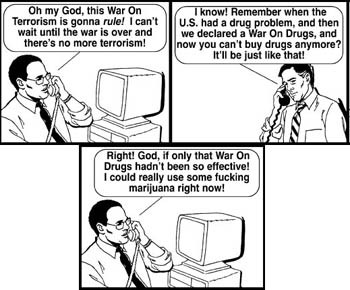
Irony: Not Dead Yet: David Rees’ ‘Get Your War On’ strip, started after 9-11, kept (and continues to keep) a singular perspective on the week’s events.

The Third Dimension

With their sharp comments on the world we inhabit, David Rees’ clip-art characters come alive

By Anthony York

In the days after Sept. 11, amid the flood of absurd e-mails about Nostradamus predicting the terrorist attacks and anti-Semitic conspiracies about Israel’s role in the disaster, many of us received a URL from a friend or a co-worker imploring us to click. The web address was complicated and unfamiliar, and brought us to a page of comics starring mechanical-looking office workers discussing the war in Afghanistan.

From the opening panel, proclaiming “Oh yeah! Operation: Enduring Freedom is in the house!” it was clear we had stumbled upon something important. In those days, when magazine editors were proclaiming irony dead and TV funnymen were asking whether it would ever be OK to laugh again, these clip-art antiheroes articulated our collective angst and confusion.

The URL circulated quickly, and it wasn’t long before life was imitating clip art. People around my office began to greet each other in the language of the strip: “Hey buddy, how are you enduring your freedom?” It became shorthand for the barrage of bad news screaming in the morning’s headlines, and the never-ending rattle of cable news.

David Rees’ “Get Your War On” appeared when we needed it most, filling a vacuum left by others who get paid to make us laugh and think. Rees pulled off the magic of a true humorist, allowing us to do both at the same time. The style of the strip mimics the message. The mundane clip art juxtaposed with the shocking, over-the-top language captures the absurdity most of us felt going on in our everyday lives. It speaks simultaneously to the quiet rage and anxiety many felt over Sept. 11, the helplessness to stop the escalation to a destructive war and the catharsis that comes with having a laugh in the throes of calamity.

As the strip continued, Rees managed to maintain perspective. The diffidence of the anonymous office workers allows them a certain clarity that is so easily lost in the chest-pumping rhetoric that surrounds tragedy and war. “Oh my God,” one proclaims, “this war on terrorism is gonna rule. I can’t wait until the war is over and there’s no more terrorism.” And they give us this on the new Bush Doctrine: “If you’re not with us you’re against us, huh? I like it–so nice and simple. When do we start bombing Western Europe?”

The strip felt less urgent as the war in Afghanistan faded. As life returned to normal, Rees’ work reverted to some of the absurdist roots of his previous strip, “My New Fighting Technique Is Unstoppable.” But as President Bush prepared the nation for war in Iraq in the name of freedom, our foul-mouthed doppelgangers were there to provide the commentary. “Once this is over, the Iraqi people better be the freest fucking people on the face of the Earth. . . . They better be so free they can fly.”

The humor is dark, but the compassion unmistakable. Rees’ strip illustrates slacker-style indifference, while understanding our need for hope. His characters, if they can be called that, are like cubicle-bound Holden Caulfields, armed with a never-ending arsenal of four-letter words and mock indifference used to protect their vulnerable, human hearts.

I spoke with Rees, 30, by phone at his Brooklyn home, about his love of hip-hop, his days at Maxim magazine, and why he will never draw another comic again.

All of your comics use clip art. Is that because you don’t know how to draw?

No, I draw. I used to draw little comics, and I still do a lot of doodling. I used to make little watercolors that were kind of comicy. I just started using clip art out of necessity, I guess. I would put these comics together at work. I was working temp jobs and would just find this clip art online, and it allowed me to make these little comics quickly. Well, once I realized how quick and easy it was, I just decided I would never actually draw a comic again. Too inefficient.

And the first one was “My New Fighting Technique Is Unstoppable”?

Yeah. I had temp jobs where there wasn’t much to do. So I was just messing around online, and I found some clip art about karate fighters. Even Karate Snoopy was clip art. I guess some kid had drawn it, and I found it online. That’s the other good thing about clip art. I would never think to draw something like that on my own. So it was fun to troll around and find images and try to narrate them. Like, I found some clip art of two guys loading a stretcher in the back of an ambulance, so I decided to use that. The story was definitely influenced by the clip art.

It seems for “Get Your War On” that the clip art adds to the feel and the message of the strip. A lot of people were reading that strip online, at work, in the same situations as the characters in the strip. Do you think that helped people identify with the strip?

Yeah, a lot of people who were reading it online were probably reading it in the same type of environment that those characters are in–a professional environment.

Office culture seems to be stifling to a lot of people, but you seem to have found some kind of inspiration there. Were these temp jobs a creative environment for you?

I think it was, initially. When I used to make these comics, it was always kind of exciting to try to dash them off, print them out on the laser printer, and it forced me to think really quickly and not overthink, not go back and try to perfect everything. I was just driving myself into hysteria by making all these little comics that I thought were just so fun and goofy. I was very excitable while I was doing temp work.

I always got my work done. There just wasn’t that much to do, so I was just sitting there bored out of my mind, and I couldn’t just take out a magazine or a book and start reading at my desk. So I would just continue typing, and [others in the office] would still hear the reassuring sound of fingers on the keyboard, but I’d just be making these little stories. I’d print them out, stake out the laser printer so nobody else would see I was printing them out. I would just put them away in my backpack, then take them home at night and read them with my friend and we’d just start laughing and laughing.

How did “Get Your War On” come about?

It was kind of a reaction to that whole sentiment that irony was dead. I just found it really offensive and undemocratic in a way. I guess I was just kind of reacting against a lack of skepticism about not only the morality of bombing Afghanistan in order to help end terrorism, but also a lack of skepticism about the rhetoric that was being used. For me, the reason those comics are formatted the way they are–in the classic three-panel strip style–is that I was just imagining, what if I opened the newspaper comics page and in between “Garfield” and “Rex Morgan, M.D.,” was this comic? And the schtick about this comic is it’s actually about how I’m feeling about the war on terrorism or life in America in the fall of 2001.

So I guess it was almost like a little experiment. Plus, I was working at Maxim magazine at the time. And Maxim magazine was so pro-war. There were lots of jokes around the office about fighting a war against people who have sex with camels–stuff that I thought was funny when I was 11.

But a lot of the strip, in a strange way, seems apolitical–not necessarily coming from a particular political perspective.

Right, well, because the point was not to try to convince anybody that the most logical thing was to try to find Osama bin Laden and bring him before an international tribunal. I wasn’t trying to change anybody’s mind. In a way, the goal was just to state some of these truths that just weren’t being discussed–that Operation: Enduring Freedom, at least initially, was going to mean dropping massive amounts of ordnance on one of the poorest countries on the planet.

From the opening panel of the strip, it’s clear that one of the targets is that kind of disconnect between the political rhetoric and the reality of what it meant. Is that something you’ve always been interested in, the impact of language?

Yeah, definitely. When I was a kid, I used to make up words. Later on, I got really into rap music, and a lot of rap is about language and technique with words. Then I studied philosophy in college and got into Wittgenstein. He was one of the philosophers who really made language one of the focuses of his philosophy.

So I’ve always been interested in language. And if you’re interested in language, the government is one of the places where language has an impact on people’s lives. And because the stakes are so high, I think the language that the government uses is so interesting. You feel it a little deeper. So when the United States government is using this almost metaphysical or religious language to discuss this international terror threat and how we’re going to react to it, it stirs up a lot.

I don’t know if the rhetoric or the language would have bothered me so much, it just seemed like they were getting a free pass on it. It was just fascinating to me. It almost seemed like it was just a couple of inches away from the language of wizardry and sorcery. A lot of the strip is about toying with language, using that political rhetoric and turning it on its head a little.

I guess it’s sort of similar to gays using the word “queer” or blacks using the word “nigger,” which I have mixed feelings about. But the point, if there is a point, is that one of the reasons they do it is to say, “See, it’s just a word.”

And yet the reaction to your dissecting that language in the strip is not intellectual at all; it’s visceral.

Exactly. For instance, that first strip that begins, “Oh yeah! Operation: Enduring Freedom is in the house!” That strip is just a conversation my friend and I had over the phone while we were at work after the bombing of Afghanistan started. I was at Maxim at the time. I don’t know why we chose to talk about it that way, in that sort of urban, street slang. Maybe because it was such an inappropriate way to talk about it. That was the whole reason that I chose the name “Get Your War On.” Because at the time, Missy Elliot had that song “Get Your Freak On” based on this hip-hop construction of “get your party on” or “get your drink on.”

So I called it “Get Your War On” because I felt, in a lot of ways, that’s how people were viewing this war–“I can’t wait to get my war on.” And I thought maybe using this very tacky, light-hearted phrase construction might jolt some people and make them think, “Oh, right–it is a war. People are going to die.”

In “Get Your War On,” in your mind do the individual characters have personalities?

No, no, no. When I was making it, I needed a forum. So I just set them up in panels kind of arbitrarily. I never even thought about any kind of character or story at all until I got the book back. When I got the book back and read them all together, sometimes, over the course of a couple of panels, there will be some consistency from panel to panel, character to character. But I never think, “Well, the guy with the notebook is a little more left-leaning, so maybe he shouldn’t say that.” It’s all just kind of like a hodgepodge.

Is the strip a regular thing now, or do you still publish when you’re inspired?

The only obligation I have is with Rolling Stone. Our agreement is that they get one strip per issue that won’t appear on the website.

Will “Get Your War On” continue as long as the war on terrorism?

That’s always the question. My standard answer is, I’ll do it as long as it’s still rewarding to me. But it was not a career goal of mine to be either a professional cartoonist or a professional satirist. The whole cartooning thing has been fun and interesting, but it started as a lark. It just happened to be the thing I did that got the most attention. And then, after “Get Your War On,” it was that much more high-profile. But my dream career would be to write songs, record records in my living room, release them, and then once a year travel around the country with my wife and play gigs. Not to have to read the newspaper everyday, figure out what’s going on in the world, and how to fit that into a comic.

I really like doing it when I’m really angry or upset about something, and then I can make a little comic strip about it. Because usually I feel like those are the most powerful strips and the most useful for me psychologically. I feel now, because I’m doing it professionally, I feel more obligated to keep up with current events, but that’s certainly not my natural strength. Usually, my comics are more absurdist and more divorced from reality. And I’d be perfectly happy just spending much of my life in my living room wrapped up in my own mind. But events have conspired to put me in this position, and if it means I have to read the newspaper every so often and open my atlas to figure out where the hell Syria is, that’s not the end of the world. If it takes this little strip with all this profanity and all this clip art to make me a better informed citizen, I guess worse things have happened.

It’s been a great experience, but honestly it peaked the first night with me. When I made those first strips and looked at them all on the computer screen and just read through them, I genuinely felt catharsis, which is something that is rare for me. I feel like it really did help me cope with how I was feeling in the fall of 2001, and, judging from the response I’ve received, it helped a lot of other people cope. So for me, the bar was set pretty high. And I’ve tried to continue with this on my own terms, with those feelings from that first night in mind. It’s not the kind of thing I want to do indefinitely. If I was still doing it in five years, I would feel like there were some opportunities I had missed.

Proceeds from the “Get Your War On” book go to the Adopt-a-Minefield campaign. Is that something you got involved in learning about the land-mine situation in Afghanistan after Sept. 11?

After Sept. 11, there was so much spontaneous generosity and activity in [New York]. I always felt like I had fallen short. The terrorist attacks were so horrific and destructive, but in the wake of that destruction, there was this tremendous sense of possibility. You saw that with people literally rushing down to the World Trade Center to help remove debris by hand. Or you saw people lining up to hand out sandwiches they had made in their kitchen to aid workers. Or you saw people sending 4,000 tons of chocolate chip cookies to all the firehouses.

I gave a little money, but I didn’t have much money and I was working at the time, so I always told myself if I wasn’t working, I would go help out and do something. Then I got laid off and began to feel guilty that I personally hadn’t lived up to that promise. Then I began to feel, on a national level, that this notion of really noble self-sacrifice, this opportunity, was really being squandered. So in doing “Get Your War On,” I had learned a little bit about the land-mine situation in Afghanistan. And one of the first strips is that one about how we’re dropping food aid packages into a country that’s one big minefield. That was always my favorite strip. People ask me, “For you, what sums up this whole project?” and it’s always that strip.

So when it came time to publish a book, I couldn’t find a publisher who would do it the way I wanted to do it. And I had self-published enough books to know what a pain in the butt it is. I thought, well, I don’t really have room in my living room to have 5,000 copies of this book lying around, I’ll just do a limited edition of 1,000 copies. If I do a limited edition, I might as well sign and number each one and have it be a real limited edition. That way, I can charge more money per book. But if I’m going to charge $20 per book, I feel kind of weird keeping the money, and people frankly probably wouldn’t pay it, so I’ll give the money away. And then for me, it was like, oh great, here’s a way to actually help out.

So I thought it would be cool to find out if there was a group that worked removing land mines in Afghanistan, because that was one of the things that really bothered me. I didn’t even know if there was such a group. So I just went on Google and typed in “removing land mines” plus “Afghanistan” plus “helping,” and I found Adopt-a-Minefield and called them up. I had a funny conversation with them where I reluctantly told them what the book was about, and it turned out they already knew about “Get Your War On” and there were some fans over there.

In Afghanistan?

No, Adopt-a-Minefield is based here in New York. They work in seven or eight countries like Cambodia, the former Yugoslavia, and also Afghanistan. They have an Afghanistan program, which was halted on Sept. 12 because they didn’t want their people on the ground if there were going to be American bombs falling. Of course, immediately the casualty rate spiked up because there was nobody there to tell people where not to walk to avoid the minefields. And then we were dropping cluster bombs, which was sort of like dropping a fresh dusting of land mines on the country. So they were in a real crisis situation.

So for me, it was great. I figured if this strip was popular, I might as well use that popularity to try to help out in that country since, at least initially, that was the whole point of the strip. It wouldn’t satisfy me to rage and complain about the situation and then not try to do something to ameliorate it.

This interview first appeared in ‘The Believer.’ David Rees’ strips and information on land-mine relief projects are online at www.mnftiu.cc. The anthology of ‘Get Your War On’ strips is published by Soft Skull Press, and is available at local bookstores.

From the July 24-30, 2003 issue of the North Bay Bohemian.

© Metro Publishing Inc.

Bohemian Grove

0

Behind Closed Doors

The Bohemian Grove protests get wacky, remain focused

By Joy Lanzendorfer

The 23rd annual Bohemian Grove protest, called the “Fat Cat’s Festival and Parade,” was held July 19 in the Monte Rio Amphitheater. About 150 people attended the protest against the summer encampment of wealthy men, including many government and corporate officials, which has been held for approximately the last 125 years in the 2,700-acre redwood grove.

The crowd of protesters, though smaller than in previous years, was colorful, with activists wearing costumes and handing out fliers. Police on foot and motorcycles were noticeable on the outside of the amphitheater, some videotaping the crowd.

“We’re surrounded on the parameter by law-enforcement officials,” said Miguel Molina of KPFA radio to the crowd. ‘”That tells you there are some very important people in the grove.”

The event lasted four hours and finished with the march down to the gates of the Bohemian Grove. This year’s festival-like atmosphere focused less on issues than it has in the past and more on entertainment. Musicians ranging from hip-hop to folk took the stage and several skits criticized the Bush administration.

One skit, called “Dubya the Dubious,” featured a man in a Bush mask and his assistant performing the “magic tricks” of the Bush administration, such as the Disappearing Ballots Trick, Mass Hypnosis, and the Ever-Changing Excuse for Invading Iraq. The skit ended with a “fat cat” effigy–a large cat mask smoking a cigar–leading the Bush character around the stage like a puppet on a string, symbolizing corporate control over the current administration.

What few political speeches there were touched less on specific issues and more on general complaints and encouragement.

“Is it worth it to do this event?” asked labor activist Alicia Sanchez in an emotional speech. “Do we have any impact? Remember, brothers and sisters, this society makes you doubt that you can have any effect. Well, I’m here to tell you that yes, you do have an effect. You are the thorn in the fat cat’s ass!”

The lighter atmosphere of the event was a matter of controversy among organizers. Mary Moore, who founded the protest back in 1980 but has since stepped aside from a leadership position, criticized the upbeat mood.

“I felt the folks who organized the event should have included more information in the protest,” she said. “I know that the idea of a parade and the festival is sort of mocking the Grove, but I felt that it somewhat trivializes the issues.”

However, organizer Susan Lamont from Not in Our Name, which hosted the event, said the lighter atmosphere was a deliberate attempt to avoid inundating people with heavy-handed political rhetoric.

“Two years ago, I went to the protest when International Answer was hosting the event,” she said. “They have a way of being very strident with one speaker after another shouting at you. I wasn’t even disagreeing with the message, but I didn’t like it. I thought there would be a way to do it that was more positive.”

The Bohemian Grove promotes an atmosphere of secrecy that has inspired much interest. Theories about what goes on in the Grove range from the likely to the bizarre. Rumors of well-known politicians sacrificing children stink of urban legend. Though some protesters hold such beliefs, most of the activists at the protests focused their aim against the idea that policies are secretly made in the Grove–deals closed and inked, forgoing the customary democratic process.

The Grove’s motto is “Weaving Spiders Come Not Here,” a line from Shakespeare that warns guests to leave business at the door. In the past, schedules of events that have been smuggled out included lectures with titles like “Do We Need a Foreign Policy?” and “Status of Missile Defense.” Some high-profile guests are said to have included George Bush Sr., George Bush Jr., Richard Nixon, Ronald Reagan, Alan Greenspan, Dick Cheney, and Donald Rumsfeld.

“Whether policy is made behind closed doors or in redwood trees, it has reached a point that corporations and the government are almost the same,” said Lamont. “Everybody is cozy with one another. It’s an incestuous relationship.”

Matt Oggero, general manager of the Bohemian Grove, said that while he respects the protesters’ right to protest, they are mistaken in their beliefs about the Grove.

“What they are claiming takes place here does not take place here,” he said very carefully.

From the July 24-30, 2003 issue of the North Bay Bohemian.

© Metro Publishing Inc.

Patrick Ball

0

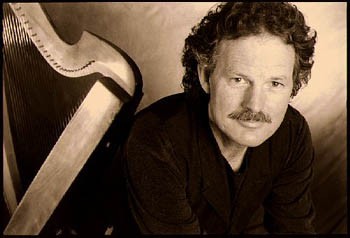
Ball Tales: Patrick Ball’s ‘Fine Beauty of the Island’ speaks of homeland and longing.

Vanishing Act

Storyteller and Celtic musician Patrick Ball breathes life into the Blasket Islands

By Greg Cahill

In a nation known for sad and lonely places, the Blasket Islands in County Kerry, Ireland, are perhaps the saddest and the loneliest. No one knows who named the string of small rugged isles off the coast of the Dingle Peninsula, but it has been suggested that the name is derived from the Norse word brasker, meaning “a dangerous place.” Whatever the origin, after several hundred years of occupation, the last of the Blasket islanders had finally had enough of the hard-scrabble farming and scant fishing. In 1953, the entire community moved to America.

Their tale is fertile soil for local storyteller, playwright, and Celtic musician Patrick Ball. His one-man play The Fine Beauty of the Island, concluding this weekend at Spreckels Performing Arts Center, marks the 50th anniversary of the day the islanders packed whatever they could carry and left together for the States, a day the islanders refer to simply as the Vanishing.

In his play, Ball brings their tale to life through music, pub chatter, and historical details. His interest in the islands began 20 years ago when Ball encountered a haunting Irish tune said to have first been heard on the winds of the Blasket Islands and then passed down through generations of local musicians.

“A very unique community of poets, musicians, and storytellers lived there,” says Ball, “and an entire way of life ceased. It was, quite truly, the end of an era in Ireland.”

The Fine Beauty of the Island is just the latest highlight in a career that has earned Ball widespread acclaim as one of America’s best storytellers.

Ball’s own spiritual voyage to the Blasket Islands began nearly 30 years ago in Johnsborough, Tenn., site of the largest storytelling festival in the United States. There he sat on a crisp autumn night listening intently as local folklorists spun Appalachian tales at a benefit for a colleague injured in a car accident.

“It was the first time I ever heard anybody tell a story to a lot of people gathered together,” says Ball, 53, a Sebastopol resident. “It didn’t really seem much like a theatrical experience. It was more like a warm, intimate sort of exchange.”

It was enough to convince Ball after his graduation from Dominican College in San Rafael (with a master’s degree in Irish history) that being cooped up in a stuffy classroom was not for him. “It’s the nicest job I’ve ever had,” Ball says of the lucrative career he has created as an actor, playwright, storyteller, and Celtic harpist.

Ball uses the Celtic harp “to create an atmosphere where people are receptive to hearing the older stories,” he explains. His own introduction to the instrument came a year after he began his career as a professional folklorist. He first heard the distinctively bright, chiming tone of the instrument in 1980, while visiting the Renaissance Pleasure Faire. There, Ball met Jay Witcher, a former aerospace engineer turned master craftsman of folk harps.

The 32-string, four-and-a-half-octave instrument, which dates back more than a thousand years, is gracefully carved from wood, strung with brass wire, and plucked with the fingernails–characteristics that lend it a considerably different tone than that of its concert cousin.

Over the years, Ball has recorded several albums of Celtic harp music. His 1983 debut, Celtic Harp I: Music of Turlough O’Carolan, showcased the works of the Irish musician who has become his muse. Indeed, much of Ball’s concert and recorded material has drawn heavily from the poignant songs of O’Carolan, the blind Irish bard who roamed the rugged countryside on horseback.

“O’Carolan was influenced by the Italian and Baroque musical influx that swept Ireland at the turn of the 18th century,” says Ball, who used O’Carolan’s songs for the 1987 score of The Ugly Duckling, a Windham Hill/Rabbit Ears children’s recording narrated by Cher. “One of the reasons I learned to play the harp was so I could play his music.”

Five years ago, Ball paid homage to O’Carolan again in the one-man play O’Carolan’s Farewell to Music, which Ball co-wrote with Peter Glazer, the writer and director of Woody Guthrie’s American Song. Variety magazine hailed the play as “a small gem.”

Ball’s new compilation CD, Music on the Wind: Selected Pieces, 1983-2003, gathers many gems of Irish wit and charm from throughout his career. “It’s an art form, in a way,” he says. “But it’s also just simple human exchange. What I’ve always liked about it is that there’s an intimacy and a directness, which is good theater if nothing else.

“I don’t feel as though I have any particular message. It’s simply the charm of what used to be a common occurrence.”

‘The Fine Beauty of the Island’ runs through July 27 at the Spreckels Performing Arts Center, 5409 Snyder Lane, Rohnert Park. Showtimes are Thursday at 7:30pm; Friday and Saturday at 8pm; Sunday at 2:30pm. $13 for all seats, Thursdays; $18 general and $15 youth and senior for all other performances. 707.588.3400.

From the July 24-30, 2003 issue of the North Bay Bohemian.

© Metro Publishing Inc.

Logan Whitehurst

0

Photograph by Sara Sanger

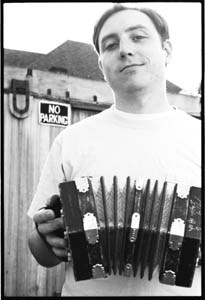
Army of One: Logan Whitehurst takes the Junior Science Club on the road with the release of ‘Goodbye, My 4-Track.’

Join the Club

Logan Whitehurst’s not-so-secret life in the Junior Science Club

By Sara Bir

As if playing drums in a nationally touring band and making a living as a freelance graphic designer isn’t enough talent for one person, the one-man musical force of nature that is Logan Whitehurst pulls off a career hat trick with his solo project of eight years, the Junior Science Club. He’s a bit of an mp3.com superstar, having recently hit over 100,000 downloads with nary a sliver of marketing, save having his “Monkeys Are Bad People” played on the Dr. Demento show. And it’s all done through the army of Logan, a plastic lawn snowman as a sidekick, and a Yamaha MT4X four-track.

After attending Sonoma State University and playing for a few years in geek-rock band Litte Tin Frog, Logan settled in Sonoma County, recording more music in his bedroom than there are songs in an army of jukeboxes. While Logan in the real world is as personable and down to earth as can be, the Junior Science Club world is full of hot coffee, science textbooks that rhyme, and old monster movies.

Here’s a crib sheet for Logan’s shiny new album, Goodbye, My 4-Track, whose 19 songs feature 17 guest musicians: songs mentioning brains, either removable or removed: two; songs mentioning heads falling off: one; songs name-checking Pee-Wee’s Big Adventure: one. Released on Petaluma’s Pandacide Records, it’s Logan’s first album for an actual label.

Most of the recording for Goodbye, My 4-Track was done at Logan’s house, though he did tote his four-track along to the homes of some of the musician friends he’d met while touring with the band he plays drums in, Sonoma County’s art-pop stars the Velvet Teen. The songs are a mix of rerecorded versions of old favorites and a host of brand-new songs, ranging from “Me and the Snowman,” which could just as well be from a Broadway musical, to the ’80s-style rap “The Robot Cat,” a song that rivals anything from DJ Jazzy Jeff and the Fresh Prince’s He’s The DJ, I’m The Rapper.

For a guy who, until now, has self-released all of his music, Logan’s output has been fairly prodigious–a few cassettes, mini-albums, and two full-length albums. His first album, from way back in 1997, was never even intended to be released. Logan just made copies for his friends, but the word got out, and their friends were soon asking for copies.

“I didn’t know how to use a four-track, and I didn’t know how to play any instruments,” Logan says. “I couldn’t work out my ideas very well, and I just wanted to play with sounds. I’d sit down and try to harmonize with myself or start a drum machine . . . and that lack of skill translated to great appeal. It sounded like I was either trying really hard to make it sound bad, or I was just having fun. People really responded to it. I still have people who remember my very first tape–which I really can’t listen to, by the way–but everyone loved, it because I was just goofing around.”

“My first two albums I put out on tape,” he says. “The next ones were right when mp3.com started, and I thought, ‘That’s a great program, because I can just put my songs online and have people make CDs of them.'” Thanks to mp3.com, Logan has pockets of fans from Michigan to Seattle to Florida.

The most shorthand, direct way to describe Logan’s music is to drag out the very handy They Might Be Giants comparison: silly subjects and scientific songs whose didactic slant takes a back seat to catchy melody. “I guess people would see a lot of parallels,” Logan says. “If what I have in common with They Might Be Giants is that my songs don’t sound similar to one another and my subjects range from love and loss to someone’s head falling off, then that’s fine. They’re the best example of what I aspire to be.”

A Junior Science Club show is straight-up fun, an event where even the hippest of hipsters can delight in singing along with gusto in an atmosphere that’s saturated with enthusiasm and openness. Logan just gets up there with his keyboard and does his thing, like a hurdy-gurdy man gone digital. Volunteers from the audience go onstage to gurgle the fish’s lines in “Lizard and Fish,” and the crowd quickly picks up on the shout-along chorus to “Happy Noodle vs. Sad Noodle.”

“That’s something that I got from my other bands,” he says, “the ability to not be afraid onstage. I’m not a great live keyboardist, and I’m not a great rapper. But what I think the shows have is energy. I’m not afraid to make mistakes, and if I do, it’s funny–it should be funny to the audience if I’m having a good time, no matter how crappy I am playing.

“The audience responds a lot to that sense that it’s a very personal show, for them or for me,” Logan continues. “I try and make it as intimate as I can. When you tell an audience to participate, a lot of them feel put on the spot, like everyone’s going to be listening to them and they probably shouldn’t say anything. I’ll write songs that make it really easy for you to get the clue that I want you to do this, and that’s about as far as I’ll go. If people want to dance, they can dance, and if they don’t, I don’t care.”

Logan’s inanimate sidekick, Vanilla the Plastic Lawn Snowman, has been a part of every Junior Science Club show from the get-go, when Logan opened for Frank Black and the Catholics at the Phoenix. Logan had just received Vanilla as a birthday gift, and it gave him an idea. “Instead of going up with just a keyboard and a CD player, I thought, ‘I’ll just have this glowing lawn snowman onstage with me.’ I introduced him as my sidekick because I thought it would be funny, and he got a giant round of applause.”

So call the Junior Science Club wacky and fun and witty–but don’t think of it as comedy. Logan is not Weird Al. “The second anyone sees the word comedy, they think, ‘Oh, it’s parodies, it’s satire, it’s songs about sporks and pirates and ninjas,'” Logan says. “I don’t want this to be classified as comedy–more like Jonathan Richman. The music is intelligent, the lyrics are intelligent. It’s more fun for me to write something that makes me laugh.

“My hope is to get to where I can write songs that are goofy and still have people appreciate them for the music, because I really do spend a lot of time on the music and try to do something interesting with everything.”

Logan grew up singing and messing around with taping skits and character voices on a cassette recorder, but he didn’t really start playing music until he was 17 and his stepbrother started a garage band. “I went out in the garage, and I’d kind of bang on stuff to keep time for them. My stepmother heard this and went and paid $75 and bought a drum kit. It’s the same one I have now, but it’s done great–it’s on all my recordings.”

Creative blood runs in the Whitehurst family. Logan’s sister sings in the punk-Zeitgeist band known as Tsunami Bomb, who are currently headlining the Warped tour. “My sister and I started with the same sort of base in music,” Logan says, “and then I got into movie soundtracks and ’80s new wave pop, and my sister got into punk. Now she’s at least met or been talked to by all of these bands that she had posters of up on her wall. I’m really impressed with what she’s doing. They’re like a rocket. I’ve got nothing but respect for that band.”

With his own project, Logan’s highest aspiration is to get other people out there tinkering away on their own four-tracks. “I like compliments like ‘You rock!’ or ‘That was a great show,’ but every once in a while I get somebody saying they heard some music that I did, and it made them want to play music. That’s the best thing. I don’t care if they liked my music or they didn’t like it, but I’d love to inspire somebody to do something like this–because I’m not a practiced and skilled artisan, I’m not lovingly crafting these songs. I just like music. I just wanted to do it.”

And then some. Hello, four-track.

Logan Whitehurst and the Junior Science Club’s CD release show is on Saturday, July 25, at 8pm at the Phoenix Theatre, 201 E. Washington St., Petaluma. The Librarians and the Huxtables headline, with Logan Whitehurst, Minus Vince, and Inanimate Objects opening. $8. 707.762.3565. Learn more about Vanilla at www.loganwhitehurst.com.

From the July 24-30, 2003 issue of the North Bay Bohemian.

© Metro Publishing Inc.

Chai BaBa Chai/Govinda’s

0

Photograph by Michael Amsler

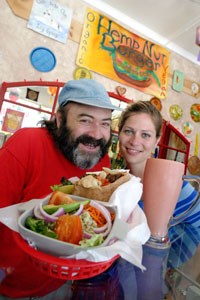
Beat the Meat: Chai Baba Chai owner Rich Love and general manager Trava Faust show off their falafel plate and fruit shake.

Where’s the Beef?

Who cares? At Chai BaBa Chai and Govinda’s, we’re dining out vegetarian!

By Sara Bir

One of my constant gripes about dining out is that there are never enough vegetables, and ironically enough, this seems to be particularly the case with vegetarian entrées, whose persuasions run deeply in the carbs-with-cheese realm–risotto, macaroni and cheese, burritos bursting with about 12 pounds of rice. It’s very dismal, which is one of the reasons I save my part-time vegetarianism for home, where I can make an entire meal of green beans.

Two places have opened in the past few months to offer gatherers-not-hunters more dining options than pasta or veggie burgers. Now vegetarians and day-tripping carnivores alike can scoot over to Chai BaBa Chai’s, which sits at the tail end of Sebastopol Road, right where Highway 101 and the mall cut off easy access to the South A Street neighborhood. Because of that relative isolation, it’s a very charming corner of town–the neighborhood that time forgot. There’s a funky consignment shop, a salon, a stylish furniture store, a great gallery, and hardly any traffic at all.

Chai BaBa Chai’s fits very snugly into the neighborhood’s spirit. It’s an eclectically decorated, colorful space, small enough to call a hole in the wall. There are some tables outside, a few tables inside, and two seats at a counter cramped with flyers for all sorts of New Agey services.

The menu is posted up on the right as you walk in, listing a fairly Mediterranean selection of what Chai BaBa Chai’s has dubbed “vegan fast food.” It’s definitely vegan, though I dunno about fast. Chai BaBa Chai isn’t slow, in any case, and besides, what’s the hurry? The staff is friendly, and it’s a great place to hang out, especially on a summer afternoon outside with an iced chai and a good book.

The food, made mostly from organic ingredients, is rather hit-and-miss but overall tasty enough to warrant multiple–and perhaps regular–visits. I stopped in for a Love Burger ($5.50) of lentils, brown rice, shiitake mushrooms, hempnut, and a million other wholesome ingredients that make a patty so moist it’s prone to falling apart.

The burger comes with avocado, lettuce, pickles, tomatoes, and a very tasty spicy-sweet-tart secret sauce (which isn’t so secret, since Chai BaBa Chai’s has the ingredients to everything posted up on the wall). As you eat a Love Burger, the sauce drips all over your hands, making a total mess, like a good burger should. I was so into it that I wound up getting another one on my second visit and never was able to check out the pesto pizza or hummus wrap.

You can get a Love Burger with a side salad or oven-roasted potatoes that approximate fries ($6.50, in that case). The potatoes are a great concept–thick wedges tossed with herbs, and roasted until they turn brown and crisp on the edges–but the ones I received were barely warm, and the insides were still slightly raw. Perhaps I just got a bad batch.

The potatoes come with three dipping sauces, so you get to set up your own little sauce smorgasbord, which is very fun. The spicy ketchup was more like cocktail sauce; the sweet mustard was pungent; and the lemon aioli (at least that’s what the menu said it was) had a curry taste going on.

I also tried a falafel pita ($5.50). Depending on whom you talk to, falafel is either classic Middle Eastern street food or classic vegetarian hippy food; this was more the latter. The fried chickpea patties were tasty and crunchy, though the accompanying chunks of cucumber lining the pita were less sandwich-friendly than slices. I’d have preferred more sesame tahini dressing and less hummus (falafel is already made from chickpeas–why garnish chickpeas with more chickpeas?).

And about that hummus . . . Each time I went in, I was presented with a small cup of silky red-pepper hummus that was good enough to lick from a spoon–or a finger, like I did–after the celery and carrot sticks ran out (the carrots were unpeeled, but somehow I didn’t mind). Likewise, the side salad of tabouli that came with my pita was welcomingly delicate, the bulgur wheat fine-grained and the dressing understated.

The beverage offerings are at least as extensive as the food menu, if you take into consideration that you have a choice of soy, almond, or rice milk, and black, green, or decaf teas, as well as yerba maté. That’s not even counting the juice drinks. I wound up playing around with all of the chai options and hardly made a dent in the menu.

Since it’s pushing into the mid 90s in the afternoons these days, I’d recommend having a nice iced drink–plus the ice dilutes the chai, and that stuff is ridiculously sweet. Chai BaBa Chai simply has the best chai around, hands down. Drinking this stuff makes me ashamed of the concoctions I’ve brewed at home and tried to pass off as chai. Some things are worth going straight to the source.

Govinda’s Restaurant, in the Bennett Valley Shopping Center in Bistro Allure’s former digs, is vegetarian, like Chai BaBa Chai. But the two places are otherwise very different in tone, mostly because Govinda’s is a buffet. I live very close to a Sizzler, and on Sundays, you see huge people lumbering out of their cars to fill up their plates with the endless sizzlin’ bounty.

Sizzler and Govinda’s may have a buffet and the euphemistic “all you care to eat” line in common, but Govinda’s is so much more than a Sizzler minus the meat. It’s a spacious, calm place whose walls are lined with framed pictures of Krishna. Add the softly playing world music in the background, and it’s a very soothing, if minimal, spot.

Here’s the drill: You go in, pay a flat $6.75 fee for lunch and $8 for dinner (soup and salad or bread and salad-only prices are available, too). Then you stock up your cafeteria tray and make tracks to the steam tables.

There’s not a crazy-huge amount of food at Govinda’s like at other buffets, which is nice, because when you see hotel pans laden with every side dish under the sun, stretching out endlessly into the horizon, it gets overwhelming. Chef and owner Alvin Marsden changes up the fare a bit daily, but there are two soups, a few breads, some hot entrées, steamed vegetables, and a pretty standard salad bar.

Left to my own devices, I have pretty strange eating habits. Everyone does, I suppose, and the freedom of a buffet allows you to indulge those. So I made up a green salad with shredded carrots and beets and topped it with a very good tofu-dill dressing. Then I slopped Alfredo sauce on top of my bread, in addition to the plain tricolored fusilli pasta. The Alfredo sauce was all right–it reminded me of what you’d find jarred in the grocery store. I liked it better on the slightly sweet, soft whole-grain bread.

The buffet had two types of rice–basmati and brown–to go with a very mild vegetable curry of spinach, potatoes, and tomatoes dotted with cumin and brown mustard seeds. What with the pasta, the bread, the rice, and the potatoes from the curry, you can enjoy four different forms of carbohydrates in one sitting–another unique feature of buffets.

The red lentil dal soup was disappointingly thin, as if it had been watered down, but its residue in the bowl leant a pleasing kick when I refilled it with creamy broccoli soup (yes, I know, the law states you need to get a new bowl each time you return). My favorite part of the meal was halvah, a sweet East Indian pudding of steamed cream of wheat that’s totally different from the sesame candy of the same name. Dense but fluffy at the same time and packing a gingery punch, the halvah added a fifth carb to the meal but was worth it.

I left a little too full, but feeling properly nourished and not in wont of vegetables. That’s the way I like it.

Chai BaBa Chai’s. 463 Sebastopol Ave., Santa Rosa. Open Monday-Friday, 10am-9pm. 707.544.2222.

Govinda’s Restaurant. 2765 Yulupa Ave., Santa Rosa. Open Tuesday-Saturday. Lunch, 11:30am-2:30pm; dinner, 5-8pm. 707.544.2491.

From the July 24-30, 2003 issue of the North Bay Bohemian.

© Metro Publishing Inc.

Queen Ida

0


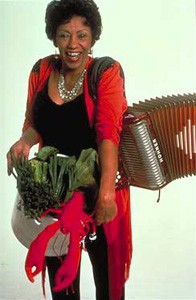
Out of the Frying Pan: Ida Guillory, also known as Queen Ida, makes it spicy.

Hey, La Bas!

Queen Ida cooks up a spicy gumbo of zydeco hits

By Greg Cahill

Call it the spice of life. It’s been more than a decade since Ida Guillory released her popular Creole and Cajun cookbook, Cookin’ with Queen Ida, a mouth-watering collection filled with traditional Louisiana staples like gumbo, jambalaya, boudin pork sausage, shrimp Creole, and crayfish étouffée.

But the 74-year-old Daly City author and award-winning bandleader, best known for her highly rhythmic variation on Cajun music, is still cookin’ up a storm, onstage instead of in the kitchen, with one of the hottest zydeco combos around.

Her patented musical gumbo is flavored with such far-flung ingredients as New Orleans R&B, Latin salsa, country and western, West Coast jump blues, Tex-Mex, and sensual Caribbean rhythms. “For the most part, we do hang with the standard zydeco songs,” she says, “but once in a while you say to the audience, ‘Here’s a treat, here’s something a little bit different.’ Since zydeco is a blend of music from all walks of life, you sort of mix them all in and hold on to your roots.

“And like they say, if it ain’t broke, don’t fix it.”

Clearly, Guillory has hit upon a winning recipe. A closet accordionist who went public nearly 30 years ago, she has become one of the world’s leading exponents of zydeco music. The first female to lead a zydeco band, she has recorded a dozen albums under the moniker Queen Ida and Her Bon Temps Zydeco Band. Four of those were nominated for Grammy awards; one album won.

As a child in Lake Charles, La., and later in nearby Beaumont, Texas (part of the so-called Cajun triangle), Guillory was surrounded by accordion music (her mother taught Ida to play) and French-speaking Creole and Cajun culture. In those days, she also specialized in cooking for 30 to 40 farmers before the ebullient sound of accordions and fiddles and rub boards and harmonicas came out at night and filled the humid air.

“During the annual Mardi Gras festivities, the kids would holler, ‘Hey, la bas!’–the traditional call and response for ‘Hey, you over there!'” she remembers.

After World War II, Ida left Beaumont, where she had worked driving a tractor on her father’s rice farm, and moved to San Francisco. In 1947 she married Ray Guillory, an old friend and an airman at Travis Air Force Base in Fairfield.

The couple soon began hosting basement parties for other Louisiana-born Creoles they’d met at a local church. Those weekend events featured a rub-board player named John Simien, then the only zydeco accordionist in the Bay Area. Eventually, Guillory’s brother, Al Lewis (known professionally as zydeco musician Al Rapone), began joining in on guitar.

For 14 years, Guillory raised three children and worked as a school bus driver. She soon began sneaking the accordion on to the bus whenever she took the kids on field trips. “I’d park the bus way far away, get the accordion out of the luggage compartment, and play,” she recalls with a laugh. “No kidding, that’s how I really learned to play: practice, practice, practice. I had plenty of time and no distractions.”

In 1975 Ida’s brother invited her to sit in with his band before a packed house at the All Hallows Church in San Francisco. “That’s how I started,” she adds, “with all those butterflies in my tummy.”

The crowd loved her. A writer for the now defunct California Living magazine who was in the crowd that night dubbed her Queen Ida.

Two years later, she quit her bus driving job and never looked back.

“The most rewarding part of it is just seeing how the people enjoy the music, the smiles on their faces,” she says. “We give and they return the energy. And, believe me, there’s a lot of energy that goes into this music.”

Queen Ida and Her Bon Temps Zydeco Band perform on Thursday, July 24, at 8pm at the Sonoma County Fair, 1350 Bennett Valley Road, Santa Rosa. The concert is included with the admission cost of the fair. 707.545.4200.

From the July 17-23, 2003 issue of the North Bay Bohemian.

© Metro Publishing Inc.

Housing Break

0


Housing Break

San Rafael turns a blind eye to illegal dwellings

By Joy Lanzendorfer

Imagine you’ve got a big problem that involves many people with different agendas. You come up with a solution that, while not completely solving the problem, manages to alleviate it somewhat while still being efficient, using existing resources, and appealing to all the different groups. With your solution, everyone wins.

Well, almost everyone. Maybe your solution isn’t 100 percent fair to everybody involved. In fact, some might say that your solution is actually unfair–ignoring people who did the right thing and rewarding people who did the wrong thing. Given that the benefits of your solution outweigh this sticky little moral issue, would you still go through with it?

For the city of San Rafael, the answer to that question seems to be yes. The city voted earlier this month for a year-long amnesty for owners of illegal second units (additional dwellings that were built without the proper permits). For the next year, people who want to make their illegal units legal will not have to pay the $500 fine for not getting a permit in the first place. After the amnesty period passes, the fine will double to $1,000.

The program helps the affordable-housing problem while benefiting most groups involved. People with illegal dwellings can set things right for a nominal cost (they still have to pay a permit fee of $500). Low-income single people will have cheaper and safer options when looking for a place to live. The neighborhoods will benefit from more affordable housing without the traffic and congestion that new construction brings. And the city will get to count the now-legal units toward affordable housing. The state is requiring San Rafael to come up with 2,060 affordable-housing units, about 700 of which have to be built by 2006.

But while many will benefit, the amnesty program still rewards people who did the wrong thing, believes Cyr Miller, the only San Rafael City Council member to vote against the program.

“The measure isn’t fair to people who got permits for their second units in the first place,” he says. “The people who build without a permit go against the community norms, and all of a sudden they get to legalize their property with no recompense? We’re just supposed to give them a break?”

People who build units without a permit put their tenants in jeopardy by not meeting safety codes. In addition, they are cheating on their taxes because they are improving their property value and not reporting the improvements to the state, believes Miller.

But others say the program allows people to do the right thing.

“It isn’t unfair to those people who got permits in the first place,” says Dave Fahrner, a real estate agent with Frank Howard Allen Realtors and president of the Marin Association of Realtors. “Those people did what they were supposed to do and were not penalized. This program just allows people who didn’t do the right thing to correct a wrong.”

Some people who have illegal second units may be unaware that there’s something wrong. The illegal unit may have been there when the owners bought the property, or they might have built the second unit and not realized they were supposed to get a permit, explains Fahrner. He admits, though, that that group must only be a small percentage of those who own illegal units.

The amnesty program is on top of another law change saying that second units no longer have to get a use permit, a process that cost an average of $2,000 and included a public hearing.

“With the use permits, the city was only seeing four or five people a year report illegal units,” says Councilmember Paul Cohen. “With the two things coming together–the waiving of the use permit and the fines–we expect to see significant changes.”

It’s impossible to know how many new units the program will bring in, though some estimate around 35 or so. Other cities like Novato have had success with amnesty programs in the past. In addition to San Rafael, 10 cities in Marin County are considering similar amnesty programs.

Even if only a few units are legalized, this program can only help the affordable-housing program. San Rafael is looking into other ways of adding affordable housing, from rezoning for mixed use to scaling back new commercial development.

“The fees were real barriers to the second units, so this is part of the solution to the problem, but only part,” says Betty Pagett of the Marin Housing Council, an affordable-housing advocacy group. “San Rafael is far behind in affordable housing. To start with, we’ve been pushing our workforce into Sonoma County for years now. There are lots of little pieces that need to come together for affordable housing.”

From the July 17-23, 2003 issue of the North Bay Bohemian.

© Metro Publishing Inc.

Going Green

0

Going Green

Untangling the ridiculously obvious yet alarmingly complex ideas behind sustainability

By Davina Baum and Sara Bir

It’s mind boggling, like taking apart a Rubik’s Cube–the pieces just don’t mean anything by themselves. Breaking down the idea of sustainability is just not possible, because the very nature of sustainability is interwoven, each piece inextricably linked to the other in so many ways. Food issues lead to water issues lead to land-use issues lead to shelter issues, and every combination thereof. So breaking down the sections below is both an academic exercise and an attempt to present the issue simply and clearly.

Green living is all the rage. Even San Francisco magazine, that bastion of Bay Area commercialism, tackled it in a recent issue. Although every week the Bohemian highlights people and groups doing good things for our communities, take this as a primer of sorts, and consider these pages–this week and the following weeks–an ongoing conversation about living mindfully.

The information in these pages may be new and interesting to you; it may be (yawn) another commercially minded publication trying to ring the green-trend bell. The issues laid forth below are a dramatic simplification of everything that sustainability encompasses. We encourage you to read more, talk more, and learn more; the answers will only be found collectively.

There are so many people in our communities that can serve as amazing role models. See the Voices sidebars for a few of them (thank you to Starhawk, Brock Dolman, trathen heckman, Wendy Krupnick, Ann Hancock, and Joseph Kennedy for offering their wise words), and check out the resources listings for even more.

If you take one thing from this issue, let it be this: This is the way we need to live, in order to continue living. We think about what we consume. We are mindful of others. We tread lightly and respect the earth. There is so much more to learn, and this is a step in the right direction.

Food

Where did your dinner come from? Can its pedigree be traced? If it came from a box, what store did the box come from, and its contents before that, and what went into the growing of those ingredients? What chemicals were used in their manufacture and growth? How far were the ingredients shipped to get to the production plant, and then how far were they shipped to get to the store?

Food doesn’t just grow on trees–well, it does, but the methods employed to get it to us are not nearly so simple and have caused increasing damage to our water, soil, and air. But we’re the ones hurting, too. Changes in eating habits have made us a fat society with little sense of liability about what we choose to nourish ourselves with. What’s more, families don’t eat together as often, and an important tradition of equating food with companionship, relaxation, socializing, and personal history is fading into a background of prepackaged salads, yogurt in squeezable tubes, and energy bars in place of actual meals.

Once there is value for eating food, there can be value for its origins. We’re fortunate. The Bay Area has for decades been a hotbed of culinary luminaries, inspired farmers, and just concerned folks singing the hymn of “fresh and local,” a return to basics and an appreciation and concern for how our foods are grown. As restaurants like Manka’s Inverness Lodge prove, it is possible to only serve foods grown, caught, or raised within a “15-minute radius.”

But not everyone has foragers out combing the hills for them. How can those principles be modeled for the general population? It’s never been more important to stop and think of the previous life of whatever you’re putting into your mouth, before it was your dinner.

Growing the food we eat accounts for over 70 percent of consumer water use. Eating less meat can make a big difference, as meat production is harder on the environment than any other food (chew on that, all you Atkins dieters). Try to think of meat as a special treat rather than a dietary staple. Have a filet mignon once a month instead of ground beef five times a month. And when you do buy meat, make an effort to find out where it came from and how it was raised (and how it was treated). What that chicken ate is now what you eat.

And while it is true that small efforts can add up to a big difference, there’s a lot more to conscious eating than just buying organic Fritos. Supporting local farms means that you are buying a product that’s fresher, and your money is going right back into the local economy. It also takes fewer resources to transport the food, and it keeps our strong North Bay agricultural heritage alive.

Food grown with concern and care tastes better and is more vivid and alive. A summer tomato pulls its flavor from the characteristics of the soil, and its juicy texture hasn’t succumbed to a mealy mush through poking and prodding. That’s why we enjoy eating in the first place, isn’t it? We eat not just to stay fed, but because it is pleasurable. Why fight nature when you can embrace it?

–S.B.

Transportation

It’s 5pm, and Highway 101 traffic is jammed again. The sun pounds down on the windshield, the car’s interior is an oven, and all around, exhaust vomits into the air.

Until we can learn how to teleport at will, our society’s embrace of the automobile won’t be relaxing. A recently released survey claims that while Californians agree that pollution is a problem, they don’t count their cars as part of the equation. As it is now, our daily driving accounts for over 40 percent of the air pollution attributable to consumers. But it’s true that some cars are worse than others; although developments in technology can’t guarantee that traffic jams will go away, they can curtail the pollution.

Constructing modes of mass transit–like a North Bay BART–may sound like dream scenarios, but they are mightily cost-prohibitive, not to mention time-intensive. We can’t be holding our breath for the state to step in and hook us up. The sad fact is that Sonoma, Napa, and Marin are all counties full of commuters. Unless radical changes are made to where and how we live and work, simply not driving, as obvious as it may sound, is not a viable option for most people.

Changes in fuel consumption, for the time being, don’t look like changes that will happen automatically. So it’s up to us to take matters into our own hands. We are all guilty. Rather than throwing hateful glances from economy cars toward Humvee drivers, one of the most immediate ways to make progress is to focus on ways you can decrease your own personal fuel use. Take the shuttle to the airport, enjoy the opportunity to walk to the video store, lighten up on the gas pedal and drive under 55 mph. It’s all stuff we’ve heard before, and quite possibly not listened to. Now is the time.

Go beyond conserving petroleum-based fuels to choosing alternative fuels. The Bay Area has an active network of groups and co-ops whose American-made biodiesel and straight vegetable oil burn cleaner and are surprisingly easy to convert engines to run on. Naft Gas in Fairfax recently became the first gas station in the North Bay to offer biodiesel at the pump, taking one step toward making this fuel much more convenient for the consumer.

Still, choosing to drive less, driving fuel-efficient cars, and reducing the number of cars per household–while contributing to lessening the amount of emissions in the air–are not solutions, but remedies. They don’t significantly reduce the number of cars out on the road, and they don’t keep the bottlenecking of 101 from exploding into a six-lane bonanza that cuts into the landscape that drew people to the North Bay in the first place. It’s important not to overlook the value of encouraging the use of existing transit options like buses, carpooling, and bicycles. Or, even more basic, feet. As long as there’s progress being made, we’re all moving toward a less smoggy and congested future.

–S.B.

Land Use

Look down, look at your feet. Look under your feet. That’s land. It may be concrete or carpet or linoleum or dirt, but somewhere down there, there’s land. It’s what we live on, and there’s precious little of it.

California was once the last frontier and mythic land of plenty. Long after the state joined the Union, it was marked by wide open spaces and small towns. Things have changed radically in the past half century, and there is little that is wild and free anymore in California. The land we walk upon, if it’s not privately owned, has been bought up by local, state, or federal agencies–the same agencies that allow logging, hunting, and those beastly all-terrain vehicles to dominate.

But the issue is not whether land is owned or not; it’s how it’s treated. In Sonoma, Napa, and Marin counties, much of our land is agricultural, for better or for worse. Industrial farms have swallowed and destroyed parts of that land, polluting the watershed with pesticides and animal waste while removing the natural habitats of native animals. The land trust programs in Sonoma, Napa, and Marin have been integral to the effort to keep land in the hands of family farms, but monocropping has allowed the possibility of widespread economic and agricultural devastation.

Although the wide open spaces of the North Bay inspire and sustain us, they also make the land that is inhabitable ever more expensive. Planning and zoning have given us the sprawl of Santa Rosa and the 101 corridor, as well as the prohibitively expensive agricultural land of the Napa Valley.

Proponents of “smart growth” advocate for urban density within defined boundaries. The idea is that we should live in areas where we can walk to the local market or park, send our kids to school nearby, and hop on a train, bus, or a bicycle to get to work. It’s community, basically–something that by and large has escaped many who live in walled-off minimansions and drive to work for hours a day in their SUVs.

Those communities can be created anywhere, even in the far reaches of West Marin or West Sonoma. If zoning were to allow for multiple families to share land, grow food, and recycle waste on a plot of land, community would spring up everywhere. It’s not a hippie vision; it’s just common sense.

Within urban growth boundaries, there should be little need for cars (and if there were, carpooling or hitchhiking should be eminently accessible). If I live in downtown Santa Rosa, I should be able to walk to a store and buy organic fruit and vegetables, or stock up once or twice a week at a year-round farmer’s market, where the kids can sample fresh fruit and play, where neighbors can catch up. I could even have a local farm deliver a box of produce (Laguna Farms delivers theirs by biodiesel trucks) once a week, and share it with neighbors if it’s too much food.

The answers are simple, but the process is not, and as always, it depends heavily on politics. Land use and its related issues–affordable housing, sustainable agriculture, urban growth, to name a few–are some of the most pressing issues facing our growing population.

–D.B.

Shelter

Many would say that the way we live today has a lot to do with the societal problems that keep cropping up in all the wrong places. Not just the way we live, but the way we live; that is, the roofs we live under, the fences we live behind, the floors we tread upon.

Our homes are our refuge, and as much as they shelter us, they can also be poisonous to us and to the environment. Modern building materials are, for the most part, toxic in one way or another. Thanks to the wonders of the industrial revolution and the dramatic globalization that has made our world a very small, very McDonald’s-heavy place, we have the ability to expend precious energy in the endless quest for the bigger and the better.

Synthetic materials that produce toxic offgassing are trucked, shipped, and flown thousands of miles to line the floors of a dream house, when nontoxic, environmentally sustainable, and beautiful materials like rammed earth, adobe, or bamboo are available, nearby and inexpensive. A solar self-reliant house is a beautiful thing, aesthetically and morally–and eminently attainable.

There are sustainable alternatives to almost anything, it just takes a little research and a lot of determination, because, after all, our world is set up at the moment so that the unsustainable choice is most likely the more obvious and easier to obtain.

In addition to building homes that are less damaging to the environment and to our bodies, sustainability requires that we build homes that are less damaging to society as a whole. Certainly not least of our societal wounds is the fact that only the top percentage of our population can afford to buy a house in the North Bay. Shelter is a basic human right, and making housing affordable and available to everyone–by changing the way we build, zone, and conceptualize communities–should be happening. It’s not.

Architects are looking to vernacular styles to create more livable environments, and the alternatives are endless. Small houses, shared housing, housing that fits in with its environment are wonderful, affordable, and sustainable ways to live but are mostly anathema to modern standards, in which the dream house is a single-family, 2,000-square-foot behemoth set on its fenced-in plot of land.

Cohousing, a movement that began in Europe and spread to the States in the 1980s, is experiencing greater and greater acceptance and is an example of a progressive solution to the twin dilemmas of land use and housing. The concept is that intentional communities are, in effect, a microcosm of the ideas behind smart growth in cities.

Cohousing communities, which are in various stages of completion all over the Bay Area, are basically cooperative eighborhoods–private dwellings built on a plot of land with an ample common area, which may include dining facilities, a kitchen, meeting rooms, and children’s play spaces. Cohousing communities are designed and managed by the residents cooperatively.

–D.B.

Energy

Remember what it’s like when the electricity goes out–how you feel helpless yet empowered all at once? You light candles, and it’s almost like camping indoors–until the milk sours and it’s too dark to read and you miss your favorite show. Yeah, it’s a great reminder for most of us that energy isn’t so much a resource as it is a dependence, a teat we suck from and cry over once it runs dry.

We’re running out of decomposed prehistoric plants and dinosaurs to burn up–and it’s about time, too. Instead of continuing to rape the earth and get mired in all sorts of political quagmires in order to extract our remaining fossil fuels, all of that work could be going into further developing renewable energy sources. Because if we continue going on the way we have been, it’ll be our carrion compressing over eons into the fossil fuels of a very distant and unpopulated future.

The logic behind renewable energy is pretty brainless: The sun shines, the wind blows, the water flows, and the earth moves, all on their own accord. So heck, why not get in on the action? Wind was possibly the first renewable resource harnessed by humans to convert into usable energy. It’s clean and breezy, and wind farms–which currently furnish 1 percent of the state’s electricity–look cool.

Solar energy, a very viable option for private homeowners who’d like to ease off the grid, is seducing more and more people. But it’s an expensive initial investment, and you have to first own a home on which to put all of those panels. Geothermal energy, producing 5 percent of the state’s electricity, is a little larger scale in scale and doesn’t require damming up rivers as hydroelectricity does. All it takes is the heat of the earth and a big ol’ power plant, and the only thing it releases into the air is steam.

Fuel cells have generated a great deal of talk. It’s estimated that they’ll provide electricity for smaller businesses and homes in the near future. The battery-like devices convert hydrogen and oxygen into water vapor and obtain direct current electricity from the reaction. Any fuel with hydrogen and oxygen–natural gas, methane, butane, propane, or water–can supply the fuel cell.

Methane and ethanol are emitted as waste gasses from landfills and agricultural operations, and harvesting these gasses for fuel cells prevents them from being burned off or released into the atmosphere. Biomass– energy drawn from combusting or decomposing organic waste–also harnesses these gasses. How renewable is that? As long as humans walk the earth, there will always be an ample supply of organic waste.

Our methods for harnessing these resources are hardly perfect. Stinky and hazardous hog manure from factory farms is slurried and piped into covered lagoons for biomass generation, while the production of methanol and ethanol is not always earth-friendly. Even the methods for isolating hydrogen at this point use fossil fuels. But these are still important steps.

In the meantime, what better way to flip PG&E the bird than to do everything you can to reduce your bill? And the California Energy Commission offers tax rebates for installing eligible electric generating systems. So until the majority of corporate America catches on, every private step we take with renewable energy weans us away from the fossil-fuels teat.

–S.B.

Water

We drink it, lawns drink it, wine grapes drink it. The right to abundant and clean water seems so basic and simple that the very concrete facts of its misuse, and our society’s acceptance of it, seems preposterous. In any case, if we don’t watch it, that goofy movie The Ice Pirates–set in the distant, outer-space future when water is so precious that it’s smuggled across the universe like drugs–won’t seem so far-fetched. In fact, it’s been happening very slowly right under our noses.

Water’s all over the place, so it’s easy to take it for granted. Turn on the faucet, and–whoosh!–there it is. Go to the beach, there’s a bunch more of it. The summer sun’s bearing down, and the lawn is turning yellow? Never fear, the sprinkler is here.

The problem is having water in the right form in the right place at the right time. Growing cities clamor for water. Southern California has been scrambling for it, and other places who have water to sell don’t want to give it up. And it’s not just car washes and laundromats and dishwashers and decorative fountains that need the water; it’s also all of those crops in the Central Valley, the lettuce and almonds and oranges and tomatoes that feed an entire nation. There’s only so much drinkable water to go around. So who gets it?

Apparently, water is a very popular item, because walking down the sidewalk or going to yoga class, half of the people around will have bottles of it (and even though staying hydrated is a healthful choice, bottled water is often just fancy tap water, anyway–and less than half of those bottles get recycled). So why don’t we treat it with respect?

Then there are people who look at our water and see a glittering sea of gold, like the water in the Gualala River, which was looking pretty sexy to a corporation who wanted to export North Coast water in giant water bags to sell to San Diego.

It’s not always an issue of one area tapping into another area’s water, either. Sometimes people will come along and not take water, just mess it up. The community of Jenner has had to fight to keep their watershed protected from the commercial interests of companies who own nearby logging land.

The primary cause of water pollution is runoff, and that doesn’t just mean from the farmers out in the Central Valley. Every time you do laundry with tons of bleach or wash your car outside as the soapy bubbles go into the drain that goes into the creek, you’re altering the quality of the water. Even the medications we take can wind up in our water, which is a very scary thought. A number of wells in south Sebastopol had such unsafe levels of the cancer-causing chemicals PCE and TCE that they are now unsafe to drink from.

As Brock Dolman says, “We must learn to think like a watershed and understand how human development impacts the water cycle.” We have to use it wisely and keep it flowing clean and clear–before we all turn into ice pirates.

–S.B.

Education

If you think about it, education is the ultimate renewable resource–that whole “give a man a fish/teach a man to fish” thing. All those good deeds done to get bonus points from the sustainability gods, like composting or recycling or using cloth bags at the store, don’t instigate changes for the better on their own. Individual actions mean a lot, but as wee insignificant ants in the grand scheme of things, one person’s actions don’t amount to a hill of shade-grown beans. It’s the sharing of knowledge on scales small and large, formal and informal that really makes an impact.

Education assumes many guises in a sustainable world. It can be as casual as picking up a magazine and as elaborate as a graduate-school seminar. But one of the best ways to get some learning is to get friendly with someone who’s into something you’d like to learn more about, if it’s driving on veggie oil or cultivating herbs or building with straw bales. Practitioners of sustainability are like born-again Christians in that they simply can’t seem to get enough of witnessing and spreading the word.

For those wishing to become more sustainability-savvy, you can’t live in a better place. You can hardly swing a cat in the North Bay without swatting an opportunity to saturate the mind. The granddaddy of them all, the Occidental Arts and Ecology Center, has been offering long- and short-term classes and retreats on everything from carpentry to permaculture design. There’s also Point Reyes’ Permaculture Institute of Northern California, the leading permaculture school in the country, and New College, whose innovative and eclectic programs are breeding evangelists spreading the sustainability gospel.

Becoming active in a group you believe in is a great launching pad. There’s strength in numbers, and it’s amazing how one super-knowledgeable person will be able to tell you about five other people you should talk to.

You can even sit on your butt watching videos, being entertained while getting educated. The Sustainable Petaluma Network has been enlightening minds with its film series of indie documentaries. Or you can flit around all weekend long in raver getup at the Health and Harmony Festival, and soak in all the EcoVillage has to offer.

Making changes isn’t so daunting when they are presented as small adjustments rather than major undertakings in our everyday routines. Think of the mind as a funnel rather than a sieve, and glean from all the good and bad stuff out there. And somehow, the people teaching you come out learning things too. Education works both ways like that.

–S.B.

Resources and Media

There are endless local and national resources for action, education, and community. Here are a few:

Sonoma County Climate Protection: www.skymetrics.us

Cohousing Association of the United States: www.cohousing.org/usdetails.html

Land Trust of Napa County: www.napanet.net/~nclt

Sonoma Land Trust: www.sonomalandtrust.org

Marin Agricultural Land Trust: www.malt.org

Green building: www.nativesystems.com; www.hammondfinehomes.com; www.greenbuildersofmarin.com

U.S. Green Building Council: www.usgbc.org

California Institute of Earth Art and Architecture: www.calearth.org

Town Hall Coalition: www.townhallcoalition.org

Sustainable Sonoma County: www.sustainablesonoma.org

Sustainable Petaluma Network: www.sustainablepetaluma.net

Sustainable Mill Valley: www.sustainablemillvalley.org/index.html

Sonoma County Conservation Action: www.conservationaction.org

Friends of the Russian River: www.envirocentersoco.org/forr

Greenbelt Alliance: www.greenbelt.org

Permaculture Institute of Northern California: www.permacultureinstitute.com

Agriculture/natural resources classes at SRJC: www.santarosa.edu. Click link to “Schedule of Classes” under the “Academics” heading, then choose “Agriculture” in the scrolling Departments menu, or call program director Laura Mendes at 707.527.4649 or the garden at 707.887.0740.

Occidental Arts and Ecology Center: www.oaec.org

New College of California: www.newcollege.edu

Environmental Center of Sonoma County: www.envirocentersoco.org

Sonoma State’s Environmental Technology Center: www.sonoma.edu/ensp/etc

Real Goods: www.realgoods.com

Sonoma County Herb Association: www.altrue.net/site/scha

California School of Herbal Studies: www.cshs.com

Health and Harmony Festival: www.harmonyfestival.com

Bioneers: www.bioneers.org

Reading and learning as much as you can–and sharing what you learn–is key to the continuing conversation. There are countless things to read to keep the brain noshing.

Ripples: Available at local bookstores, Whole Foods, and Oliver’s.

Mother Jones: Available at newstands. www.motherjones.com.

Yes!: Available at newstands. www.futurenet.org.

Utne Reader: Available at newstands. www.utne.com.

Mother Earth News: Available at newstands. www.motherearthnews.com.

E magazine: Available at newstands. www.emagazine.com.

Grist Magazine: Online only: www.gristmagazine.com.

Fatal Harvest: A seminal book busting the bubble of industrial agriculture. Available at local bookstores. www.fatalharvest.org.

Voices

To create a sustainable culture and society, we need to change our understanding of how the world works. The mechanistic model of the world that underlies many of our most unsustainable practices sees the world as a fixed, static thing made up of isolated parts that interact in simple, cause-and-effect relationships. To create not just sustainability but ongoing abundance, we need to understand that the world is a web of dynamic relationships, that everything exists in communities, and nothing stands alone.

We can’t benefit one part of a community at the expense of another and expect that community to last. We can’t orient our economy, our agriculture, our forestry, and our science to produce profits for the few, and expect our system to survive. But if we consider how to create beneficial relationships among all aspects of a community, the health and abundance of the entire system will increase.

A forest is not just a factory for producing Douglas firs–it’s a community of plants, animals, birds, insects, soil microorganisms, mycorrhizal fungi, and human beings. A business is a community that includes the whole biological community that creates the resources used, those who do the work and make decisions and ultimately use what is created.

In my home and gardens, I practice permaculture, the art of designing beneficial relationships to produce systems modeled on natural systems, and find it a useful lens for looking at any system. I also practice magic, “the art of changing consciousness at will.” One tool I find useful for thinking about sustainability is the magic circle of the four elements–air, fire, water, and earth–with spirit in the center. When making a decision, we can ask, how will this affect the air, the climate? The birds and insects? Will it bring inspiration and refreshment?

How much energy will this use, and where will it come from? Will it use more energy than we take in? How much human energy will it require? Will it energize or drain us?

How will this affect the water? The fish, sea life, and water creatures? Will it use more water than we have? How do we feel about it?

How will this affect the earth? The health of the soil? The microorganisms and soil bacteria? The plants and animals? The forests?

How does this affect our human community? Will it benefit the poorest and least advantaged among us? Does this reflect and further our deepest values? Will it feed our spirit?

Sustainable abundance is a goal we can move toward. No one in this society can lead a totally sustainable life today, but if we ask the right questions, we will begin to move in the right direction.

–Starhawk

Starhawk, committed Global Justice activist and organizer, is the author or coauthor of nine books, including The Spiral Dance, The Fifth Sacred Thing, and Webs of Power: Notes from the Global Uprising. She is a veteran of progressive movements, from antiwar to antinukes, is a highly influential voice in the revival of Goddess religion, and has brought many innovative techniques of spirituality and magic to her political work. She teaches at Earth Activist Training, which combines permaculture design, activism skills, and earth-based spirituality, and also works with the RANT collective, providing training and organizing support for the global justice movements. www.starhawk.org.

For me the question of sustainability is about supporting the systems that sustain all life. As a biologist–by definition, one who studies life–my interest in sustainability is a lifelong quest toward becoming an ecologically literate agent of social change in the service of sustaining life.

So what of this idea, this mantra, this expanding marketing ploy called sustainability? Sustain what, for whom, and why? I find it helpful to cut the word sustainability exactly in half, reverse the order of the two resulting words, then pose the question, “What are you trying to have the ability to sustain?” Fundamentally, the answer must be “cycles.”

Human behavior patterns that demonstrate the ability to ensure the integrity, resiliency, and continuity of the cycles that sustain all life are what I start with as a benchmark to judge sustainability. What cycles, you say? I mean here basic elemental hydrological, chemical, and biological cycles. The water cycle, carbon cycle, nitrogen cycle, phosphorus cycle, fire cycle, human life cycle, and salmon cycle.

Cycles are intrinsic to a spherical rotating earth orbiting the sun. All life forms that have demonstrated the ability to sustain continuity of tenure on this planet have done so by living within the confines and carrying capacity of such cycles. The evolution of life has not had a choice to do otherwise, and nor do we, although finite fossil carbon has fueled a pathology that believes otherwise.

Sustainability is a vision of a reciprocal relationship where humans are regenerative earth healers, soil builders, and water purifiers. True sustainability is a question of will. Do we collectively have the probiotic will, and will we behave accordingly? Or will we bequeath our inheritors an antibiotic, thrown-away planet? On a finite planet there is no “away”; you can’t just throw plastic and plutonium away.

Cycles-based sustainability must become the defining platform of participatory democracy, such as the Iroquois philosophy of seven generations. We must vote for ourselves as leaders who affirm a positive life-cycle analysis with a regenerative vision that sees human communities as a solution, not a problem. To get there from here, sustainability must start at home–in our watersheds, in the humble heart of deeply held ethical interdependence. We each must become bountiful headwaters nourishing this watershed event called sustainability.

–Brock Dolman

Brock Dolman is a biologist and cofounder of the Occidental Arts and Ecology Center and the Sowing Circle Intentional Community. He is the director of OAEC’s Basins of Relations, Permaculture and Ecological Design, and Wildlands Restoration programs. Brock is a Sonoma County Fish and Wildlife commissioner, and an active member of the Dutch Bill Creek Watershed Group, the West County Watershed Network, and the Russian River Watershed Council.

When it comes to sustainable, eco-groovy, and green, healthy relations form the foundation. Yep, it’s you, me, and the collective “we” that shape the fruitfully potent potential in our common daily actions. Of course, don’t forget nature.

To ask why, I look to the wisdom in how rivers meander in the same way as the wrinkles in our guts and brain. With wiggle-waggling pathways, more fits into a small space, whether it’s your belly, head, or a watershed. Increasing the meander increases surface area, decreases flow, and aids in absorption. Ahhhh, the intelligent design of natural systems.

Unfortunately, this is far from how our lives are lived, bringing us to the problem of choosing the shortest distance between point A and B–there is no why. Zooooom, there we go, all jacked on caffeine and electro-gadgetry things, somehow forgetting that a newer this and shinier that won’t get us there.

It’s true, we’ve lost our why. But don’t cringe or fear, just look to realationships. By reclaiming what we do, buy, and take for granted, we increase the quality and quantity of relations in our lives, the way meanders increase surface area and all sorts else in rivers. When rushing straight from A to B, we experience and absorb less, lacking flow and connection.

Is Highway 101 your model for life, or is the fecund, riparian habitat of an ambling stream? I mean, we already eat, drink, and breathe, why not reap more from it? Our food, clothing, and common details speak volumes about our relationships with the living world, each other, and the future generations we impact thru each act.

Reclaim and steward the interdependent-luvfully-abundant pile of relations that is your life. Buy local, organic, and Fair Trade. Grow food. Tend your friends. Compost apathy. Become the media. Write, record, and seek to share. Shake yer booty with yer hands in the air. Start a good-living file with images, quotes, and articles that help you live better while bettering life.

Now tumble into the streets with mindful masses, inoculating indifference with inspired acts, connection, and cups of tea, for these are the bits of bliss in how we live.

All right, let’s close with a collective incantation, all together now: “Owning this awareness is my confession that I’m ready for the life connection needed to heal this systemic infection. I’m ready to acknowledge, relish, and bathe in the fine print holding us together.”

–trathen heckman

trathen heckman is the founder of Daily Acts and publisher of Ripples, a seasonal sustainability journal. To co-conspire or say hi, drop him a line at da*******@****sp.com. This fall, he will be teaching a class on empowering our daily actions through permaculture, tai chi, and more. Contact New College of California in Santa Rosa for details.

Living green will not save the world. To prove this for yourself, take five minutes, go online to www.myfootprint.org, answer 15 multiple-choice questions, and calculate your personal ecological footprint. Then imagine without any illusions what it’s really going to take to save the world.

Don’t get me wrong. It’s imperative that we each lighten our individual impact on earth–eat less meat, use a clothesline, drive less, have fewer children. Such actions are essential, but they are not sufficient.

What most people discover by calculating their footprint is that they exceed nature’s limits, and not just by a little. In my case, it would take three and a half planets if everyone lived like I do, based on the size of my footprint. I am dedicated to living lightly on the earth, dedicated to leaving a legacy for future generations, and still I’m a flagrant consumer compared with what’s required to live sustainably. Even if I rode my bicycle everywhere, canned my own tomatoes, and never used a dryer, it wouldn’t be enough by a long shot.

Conclusion: We’ve got to radically change the system in which we live.

What does this mean? First, it means rethinking environmentalism. Most environmentalists embrace the directive “think globally, act locally.” But focusing exclusively on local creeks, wetlands, tiger salamanders, and open space misses the big picture.

The big picture shows us that global economic forces trump the most valiant and brilliant local efforts. Look at the unrelenting political press for economic growth. Observe the cause-and-effect connection between the faltering economy, lowered interest rates, rising housing prices, rising equity, widespread refinancing, and sustained high consumption levels.

We export most of the impacts of our consumption to other parts of the nation and the world. And we pass one of the most dangerous impacts–global climate change from greenhouse gas emissions–on to future generations.

According to Bill Moyers, if you really care about the environment, “Don’t hug a tree–hug an economist.” Clinton’s strategists reached the same conclusion when they said, “It’s the economy, stupid.”

If we want to save the earth, we’ve got to use the price system, the most potent and underutilized tool available to us. For example, the price of fossil fuel currently is low relative to its real cost because of huge government subsidies. If fossil fuel’s price reflected its true cost–including all the costs of global climate change–it would skyrocket. Consumers would respond by seeking cheaper alternatives. Renewable energy would become much more economically attractive, and the system would shift dramatically in a sustainable direction.

Using the price system entails being politically adept. Let’s take a cue from the corporations wielding influence in Sacramento and Washington. They understand that real power lies in designing the economic rules.

When we make saving money and saving the planet synonymous, living green will be second nature.

–Ann Hancock

Ann Hancock is a Graton resident and coordinator of the Climate Protection Campaign (www.skymetrics.us).

When I was very young, I took to heart the quotation, “All things to all things connected are, so one cannot touch a leaf without the trembling of a star.” And credit to my childhood–growing up with the folk songs of the ’50s and activism of the ’60s, in a true community where we practiced cooperation and cared for each other and the land. With this background, I’ve always believed that the gifts of nature were to be honored, and that how we choose to live makes a difference in the quality of life, for ourselves and for all the other creatures in our ecosystem, now and in the future.

So “living lightly”–reducing, reusing, and recycling, in that order–and valuing friendship, arts, and values over “stuff,” came naturally to me. Choosing to live in small spaces–to grow my own food organically, to not go shopping, and to drive as little as possible–were never conscious decisions or deprivations. It just made sense and was more comfortable and easier.

Sustainability has to do with what is necessary for life to not just continue, but to thrive. It has to do with a net increase in energy rather than depletion. This can be seen in an agriculture that produces more in food value and soil-enhancing biomass than it takes in resources to produce. I’ve spent much of my life’s work and focus on organic agriculture because it is such a tangible–and delicious–way to do good work in the world. Nurturing the health of the soil and our bodies simultaneously, and sharing the abundance with others, is a pleasure and a profound miracle to experience.

Sustainability can be seen in human systems when people come together to collectively problem-solve. There is a synergistic effect–more energy, strength, and security in community than in a collection of individuals–that I find exciting. Having grown up with community, I have always sought community by joining organizations where people who have similar passions and concerns have the desire to work together for change.

And sustainability has to do with finding balance in our lives–restoring and resting our bodies and spirits at least as much as we are giving to others and the world. Like many who are concerned that the world is on an unsustainable path, creating sustainability in my daily life can be a challenge. My daily yoga and exercise, eating nourishing food that I have helped grow, spending time in nature, and making space for quiet time, help recharge my desire and ability to do more.

–Wendy Krupnick

Wendy Krupnick is the garden coordinator at Santa Rosa Junior College’s Shone Farm, a four-acre production and educational garden that uses organic techniques.

I have been musing lately on our local landscape, and have found myself imagining what Sonoma County might be like in a hundred years. Sometimes this is a dark vision, influenced by the current era of political madness, climate change, and unremitting growth. But more often it is a positive imagining based on decisions, large and small, that I hope we have the wisdom and foresight to make.

As an architect, I find myself dreaming about how our built landscape might change for the better, but I also know that shifts in the invisible landscapes of lifestyle and politics are necessary as well. When I imagine the future, I see many of us embracing a lifestyle of elegant simplicity, having exhausted the dubious benefits of rampant consumerism. We will reengage with our communities, with our land, and with ourselves in such a way that our common wisdom may shine forth, so that we can restructure our communities for ecological health, societal fairness, community vitality, and individual joy.

I envision our towns made denser, yet more humane, by transforming our relationship with the automobile and through designing buildings for human conviviality and connection with the sun. Our older, historic neighborhoods will serve as a template for new development, serviced by convenient, comfortable, and fun transit options like streetcars and light rail.

I can envision a pedestrian district spanning from Railroad Square to Courthouse Square. The Santa Rosa Mall will have been radically reconfigured. Fourth Street would once again join the east and west sides, and perhaps the 101 freeway could go underground (it is hard to imagine it going away) to help join these currently divorced parts of the city.

We would live bioregionally. As a political entity, I could see Sonoma County itself replaced by watershed-based political districts. At a smaller scale, decision-making would be radically democratized, and centered in the neighborhood, with political decisions made in service to the whole community, not to corporate interests. We will joyfully engage in civic life. We will, for example, happily go to a building and planning department transformed into a place where homeowners get the best information on how to live in harmony with the planet and ourselves.

I see neighborhoods with small plazas and gardens built by residents, where we take down our fences to create green havens that can be shared by all. As for suburban developments, the most egregious may be carefully deconstructed, and the land placed back into more suitable agricultural uses, or returned to nature.

Construction of modest and elegant self-sufficient homes tucked into currently underutilized pockets of our towns and cities would be of local materials such as straw, sustainably harvested wood, earth, and stone, as well as recycled building materials (using those deconstructed suburban McMansions for good purpose!). We will recycle our wastes and grow a good part of our own food on the fertile soil that currently underlies our lawns. We will be happy.

This is all now a dream. I work toward the time when it may come true.

–Joseph F. Kennedy

Joseph F. Kennedy is the co-editor of The Art of Natural Building, cofounder of Builders without Borders, and a teacher in the ecodwelling program at New College, North Bay. Contact him at jk******@********ge.edu.

From the July 17-23, 2003 issue of the North Bay Bohemian.

© Metro Publishing Inc.

Fruta Gratis

0

Photograph by Michael Amsler

Juice Machines: Cindy Cleary (left) and Pam Bolton elevate sharing free fruit to an art form.

Give and Take

Fruta Gratis and the transient art of fruit

By Sara Bir

Anyone who has a fruit tree in his or her yard knows its double-edged gift: refreshment and sustenance blossoming just beyond the door vs. the gooey flotsam of smashed, rotten flesh staining the driveway.

The zone of contrast between fruit as a luxury item and as a bothersome surplus is the creative habitat of artists Pam Bolton and Cindy Cleary, who months ago sent an anonymous letter to a handful of North Bay newspapers.

“Do you have fruit trees in your backyard or orchard that produce fruit you don’t have time to pick or eat? Do you ever wish there was someone to pick the fruit and a way to get it to people who could use it?”

The letter concluded with contact information for Free Fruit/Fruta Gratis, described as a “political art-intervention group,” inviting the public to offer fruit for the taking, which Free Fruit would use for one of its installations. Initially, Bolton and Cleary had intended to remain anonymous, but a few of the papers publishing their letter printed their names, so the gig was up.

Cleary, who lives in Guerneville, and Bolton, who lives in Geyserville, have been collaborating for three years. They met while in graduate school at Orinda’s John F. Kennedy University in the department of arts and consciousness.

“We were asked in separate classes to find someone in the class to collaborate with,” Bolton says. “So Cindy and I got together, and because we both lived in Sonoma County, we brainstormed . . . and we realized we both felt this angst about the fruit orchards that had been pulled out everywhere in the county. And [then] the glut of vineyards.”

Something Bolton heard over the radio was one of the initial sparks for Free Fruit. “I was coming back from Berkeley listening to KPFA, and there was an interview with a young man who said, ‘My folks never had enough money to buy fruit. We never had fresh fruit.’ And to think of not having fresh fruit–it’s so astounding. Why are we not feeding ourselves? Why are there any people hungry when there’s abundance?”

The duo’s first action was to save fruit seeds and send them out to a random mailing of 33 people, “mostly by virtue of them having their address be Forestville or Orchard Lane or something to do with growth,” Bolton says. “Thirty-three is a very powerful number–because of all our actions, we’ve kind of engaged the mystery, the elements, the planets.”

Their first actual installation was to put bare-root fruit trees out on the side of the road, along with a sign reading “Fruta Gratis” and handouts with information about how to plant the trees. “We put them in places where migrant workers hang out, we put one near New College,” Bolton says. They revisited those sites for following installations, next giving away fruit recycled from the Cloverdale Citrus Fair.

Free Fruit installations are minimal but attention-grabbing. The artists pile donated fruit–some misshapen and gimpy, but all naturally Crayola-bright–in wooden fruit boxes marked with a “Free Fruit/Fruta Gratis” sign, and set out a stack of paper bags so passers-by can take up the offer.

And then there are the handouts: orange, green, and yellow slips of paper with typewritten musings on local agricultural heritage or writings by Pablo Neruda. But otherwise, it’s just the viewer and the fruit. “We usually put a poem out where we leave our fruit–it’s kind of simple and straightforward, and not a lot of language attached to it,” Cleary says.

All of the fruit is marked with the Free Fruit stamp, a red “Sunkist”-like emblem that winks at our numbness to branding and marketing. The bags are stamped too, so if a person got the fruit secondhand and didn’t know where it came from, perhaps he or she would think Free Fruit was a new produce company.

When Bolton and Cleary did their first installation with the fruit trees, they stayed and watched, something they have mixed feelings about. “We stood back, but we took field notes and photographs,” says Bolton. “We also felt like it took something away from it, because we ended up being the ones in the know. We were being like the scientists. And it’s kind of nice to have the unknown be part of it. Those people who are coming are part of the art and the collaboration.”

And–outside of giving away fruit–the mystery is the fun part. The fruit goes fast once it’s out; people love free things. It stirs their curiosity, but it also stirs the artists’ curiosity: What happens to the fruit once it leaves, and who is it going home with? Do those taking fruit come from big families? Will they sell the fruit? Will they make marmalade? Do they share with their neighbors?

Cleary cites the artists’ detachment from the installations once they are erected as a vital element to the art itself. “At each place, eventually somebody either took the whole crate or dumped the crate into the back of a truck or car. And having that be fine–that person was going to do something with the fruit.”

Even though Free Fruit’s actions and intentions are noble and helpful, they are not a full-scale organization to fight hunger or promote sustainability. The simplicity inherent in the approach is the whole point–that we, too, can make this happen. We all give away; we all, at some point, take; and we can facilitate other people’s giving and taking.

“We haven’t done it with the intention of solving some problem, but with identifying something that’s disturbing to us and then having people wonder,” says Bolton. “That’s exactly what we wanted. And also, we’ve had a lot of possibilities. Communities could come up with maps where there’s free fruit and . . . figure out how to get that backyard fruit that somebody can’t get anymore to people who could eat it.”

“One of the things we’re hoping is that we can be a conduit between the people who want the fruit or need the fruit and the people who have the fruit,” Cleary says. “We’ve gotten so many phone calls from people who say, ‘I have one tree, [or] I have a hundred trees,’ and organizations who are doing similar kind of work with food or hunger, wanting to know if there’s a way that we could connect. I really didn’t think we’d have much response. I don’t know why I didn’t trust that other people were feeling the same way we were.”

Both Cleary and Bolton do individual projects using natural materials. Cleary’s been working with fruit and fruit juices on large-scale pieces of mulberry paper, “to see what the fruit has and what it can feel like, what it wants to be,” she says. “I really got to know the character of each fruit–how it goes on the paper, what’s really inside of it.”

Bolton, who’s also a spiritual counselor, looks to her home for inspiration. “I’ve really felt called to use natural materials from the land where I’ve lived for 25 years. And I really feel we need to have a reverence again for nature and connect with art, have the artist remembering for us that reverence we need.”

The next step Cleary and Bolton want to take the project in is still unclear, but that’s because there are so many possibilities. “We’ve talked about the project like throwing a stone into a pond and watching the ripples move out, seeing how it touches other people, and what that brings,” says Cleary. The idea of collecting oral histories of farmers on tape has come up, as has the concept of setting up Free Fruit/Fruta Gratis as a model for other communities.

“Free Fruit across America,” laughs Bolton. “We’re definitely going to continue to be playful in that sense with it. And to make public installations.”

“I think the playfulness and the magic are the two key words that enliven a really serious subject,” Cleary adds.

“And maybe excite . . . or interest [people] in coming up with creative thoughts, just stimulate that creative thinking,” Bolton continues. “There is abundance; there is enough for all of us. It’s just a matter of understanding that.”

If you would like your fruit to become part of the project, call Free Fruit at 707.823.2492.

From the July 17-23, 2003 issue of the North Bay Bohemian.

© Metro Publishing Inc.

2003 Food and Wine Issue

Who's Cooking Now?With the help of cooking schools, it could be you By Sara BirOn a Wednesday evening, 15 people from the East Bay, Napa, and even as far down as the Peninsula have gathered at Ramekins, relinquishing prime evening relaxation-at-home time to learn about . . . knife skills?The youngest person in our class is a very gung-ho...

David Rees

Irony: Not Dead Yet: David Rees' 'Get Your War On' strip, started after 9-11, kept (and continues to keep) a singular perspective on the week's events.The Third Dimension With their sharp comments on the world we inhabit, David Rees' clip-art characters come aliveBy Anthony YorkIn the days after Sept. 11, amid the flood of absurd e-mails about Nostradamus predicting...

Bohemian Grove

Behind Closed DoorsThe Bohemian Grove protests get wacky, remain focusedBy Joy LanzendorferThe 23rd annual Bohemian Grove protest, called the "Fat Cat's Festival and Parade," was held July 19 in the Monte Rio Amphitheater. About 150 people attended the protest against the summer encampment of wealthy men, including many government and corporate officials, which has been held for approximately the...

Patrick Ball

Ball Tales: Patrick Ball's 'Fine Beauty of the Island' speaks of homeland and longing.Vanishing ActStoryteller and Celtic musician Patrick Ball breathes life into the Blasket IslandsBy Greg CahillIn a nation known for sad and lonely places, the Blasket Islands in County Kerry, Ireland, are perhaps the saddest and the loneliest. No one knows who named the string of small...

Logan Whitehurst

Photograph by Sara SangerArmy of One: Logan Whitehurst takes the Junior Science Club on the road with the release of 'Goodbye, My 4-Track.'Join the ClubLogan Whitehurst's not-so-secret life in the Junior Science ClubBy Sara BirAs if playing drums in a nationally touring band and making a living as a freelance graphic designer isn't enough talent for one person, the...

Chai BaBa Chai/Govinda’s

Photograph by Michael AmslerBeat the Meat: Chai Baba Chai owner Rich Love and general manager Trava Faust show off their falafel plate and fruit shake.Where's the Beef?Who cares? At Chai BaBa Chai and Govinda's, we're dining out vegetarian!By Sara BirOne of my constant gripes about dining out is that there are never enough vegetables, and ironically enough, this seems...

Queen Ida

Out of the Frying Pan: Ida Guillory, also known as Queen Ida, makes it spicy.Hey, La Bas!Queen Ida cooks up a spicy gumbo of zydeco hitsBy Greg CahillCall it the spice of life. It's been more than a decade since Ida Guillory released her popular Creole and Cajun cookbook, Cookin' with Queen Ida, a mouth-watering collection filled with traditional...

Housing Break

Housing BreakSan Rafael turns a blind eye to illegal dwellings By Joy LanzendorferImagine you've got a big problem that involves many people with different agendas. You come up with a solution that, while not completely solving the problem, manages to alleviate it somewhat while still being efficient, using existing resources, and appealing to all the different groups. With your...

Going Green

Going GreenUntangling the ridiculously obvious yet alarmingly complex ideas behind sustainabilityBy Davina Baum and Sara BirIt's mind boggling, like taking apart a Rubik's Cube--the pieces just don't mean anything by themselves. Breaking down the idea of sustainability is just not possible, because the very nature of sustainability is interwoven, each piece inextricably linked to the other in so many...

Fruta Gratis

Photograph by Michael AmslerJuice Machines: Cindy Cleary (left) and Pam Bolton elevate sharing free fruit to an art form.Give and TakeFruta Gratis and the transient art of fruitBy Sara BirAnyone who has a fruit tree in his or her yard knows its double-edged gift: refreshment and sustenance blossoming just beyond the door vs. the gooey flotsam of smashed, rotten...
11,084FansLike
4,606FollowersFollow
6,928FollowersFollow