‘Monumental’

0

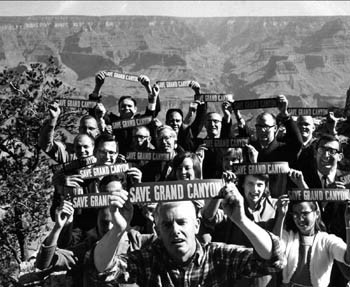
Imagine It Gone!: David Brower, foreground, saved the Grand Canyon from rampant damming.

No Compromise

Environmentalist David Brower and the fight to save the earth

By Gretchen Giles

Imagine the entire swath of the Pt. Reyes National Seashore as little more than a rich folks’ resort of luxury seafront homes and shudder. Picture water-skiing right down the ruined alleyways of the Grand Canyon with thousands of others. See the Yosemite Valley criss-crossed with cement and streaming with smoking ribbons of cars in all directions. Wonder what Glen Canyon must have looked like.

Dammed by the Army Corps of engineers in 1956 to better hold Colorado River water for the thirsty state of Arizona, the Glen had ancient native hieroglyphs etched into its walls, deep green fens flourishing in its tall shade and was, the late environmental activist David Brower once declared, the most beautiful place he’d ever seen.

Generations have multiplied since the Glen met a watery grave; generations have lost something elemental to the earth. David Brower vowed that this wouldn’t happen again.

The leader who catalyzed the Sierra Club in 1952, becoming its executive director and changing its nature from that of a hiking enthusiast’s gathering to a major political force, ushering in what we now call the environomental movement, the Berkeley-born Brower–who died in 2000 at the age of 88–is brought back to the ferocity of life in a new documentary, Monumental: David Brower’s Fight for Wild America, screening as part of the Wine Country Film Festival.

Cannily using footage Brower himself took of trips through Yosemite and other of his most beloved places, Monumental most passionately describes the fights Brower lead to save the Grand Canyon from additional damming; the quest to make Pt. Reyes into the protected spot it is today (Ladybird Johnson in pill box hat and heels standing near the surf, breathing in deep admiration); and the creation of the Redwood National Park on the high North Coast, protecting the oldest living things on earth.

Brower, the father of four, was perhaps not the easiest man to get along with, and his crusty side is ably shown in Monumental. But he brooked no cowardice and bore no compromises. His split with the Sierra Club in 1969 over their willingness to compromise over the Central Coast’s Nipomo Dunes, some of the most pristine sand hills in North America.

While Monumental never explores those aspects of Brower that earned him the “Arch Druid” nickname, what this documentary does do splendidly is to underscore how just one man, a handful of people and a pokey little organization for hikers and bird watchers can indeed change the entire face of a nation by simply not allowing it to change.

‘Monumental: David Brower’s Fight for Wild America’ screens on Sunday, Aug. 8, as part of the Wine Country Film Festival. Filmmaker Kelly Duane and Brower’s son Ken, an activist in his own right, will discuss the film and Brower’s legacy following the screening. Sebastiani Theater, on the Plaza, Sonoma. 3pm. $8. 707.935.FILM.

From the July 28-August 3, 2004 issue of the North Bay Bohemian.

© Metro Publishing Inc.

Mama Collective

0

Photograph by D.W. Lech

Women and Children First!: Mama Collective and kids, from left to right: Adler Blaze, Lila Cugini, Xenia Burlison-Craft, Dani Burlison-Craft, Ava Burlison, Terrie Samundra-Girdner, Ceili Samundra-Carr.

Crisis and Opportunity

Santa Rosa’s Mama Collective rises to the challenge of the GOP

By Michael Houghton

The three women sitting across the table from me don’t exactly look like wild-eyed radicals. But according to the mainstream media, that’s what they are. Dani Burlison-Craft, Lila Cugini and Terrie Samundra-Girdner are three of the estimated 1 million liberal “fringe element” that are planning to “invade” New York City in early September to protest the Republican National Convention.

Sure, they look young and hip, with stylish hair and Portland-chic secondhand clothes. And sure, Burlison-Craft has a frenetic swirl of tattoo creeping kudzulike down her arm. But there’s one thing that messes up the image. The only time they look particularly “wild-eyed” is when they’re laughing about how Xenia, the oldest of Burlison-Craft’s two daughters, is in the other room shouting at a broom that she’s been trying to levitate with her mind, thanks to Harry Potter.

Burlison-Craft, Cugini and Samundra-Girdner are single mothers and the backbone of Santa Rosa’s Mama Collective, a group they founded last year, they say, “to support single and partnered mothers who are involved in artistic expression and activism.” Their first official activity has been to produce a zine by the young single mothers of the North Bay, the first issue of which will be out soon. But another, less tangible result is that, with each other’s support, the Mama Collective’s members are feeling more confident about taking risks–personally, artistically and politically.

“[In art and protest,] there’s a lot of fear that you’re going to get ridiculed and that you don’t have support. You feel really alone,” says Samundra-Girdner. “It can be really lonely parenting. You can feel really isolated, and it’s good to have a support system.”

“Part of a collective,” says Cugini, “is that people individually are shy about making art or making political statements. But collectively if there’s even one other person, or two other people, then there’s strength in numbers; people aren’t as shy.”

Now that the Mama Collective has set its sights on protesting the Republican National Convention, there’s just one problem. “We’re single mothers,” Samundra-Girdner says, stating the obvious. “We’re not exactly rich.”

“We need to raise money,” continues Burlison-Craft, “at least for our air fare, which is going to be around $1,000.”

To do so, the Mamas have planned a fundraiser for Sunday, Aug. 1. On sale will be baked goods and art, as well as a rummage sale. Tables will also offer voter registration, and of course, more information. “My main focus of going to the RNC,” says Burlison-Craft, “is obviously to support the cause–to feel that sense of global community and to know that there are thousands of people out there fighting for justice right alongside me–but we’re also going to document everything. The plan is to come back and report on what happened. I’ll write articles, Terrie will be working on a film and we’re going to have an anti-Bush art show before the November elections.”

“We’re also planning on connecting with other mothers’ groups from different areas,” says Samundra-Girdner.

The women also plan to highlight what they see as the GOP’s manipulative choice of the location and timing of the event.

“This is the first time they’ve held [the RNC] in New York in the last 150 years,” points out Burlison-Craft with obvious frustration. “And on top of that, they’re holding it two months later than usual, just a week before the anniversary of 9-11. The GOP is using it as propaganda. They’re playing on people’s emotions and their fears; it’s ridiculous how blatantly obvious what they’re doing is: exploiting the grief and tragedy of 9-11–again.”

But most importantly, the Mamas are going to New York because the policies of George Bush are affecting their children, now and in the future.

“There are these wars being waged on impersonal slogans like ‘war on terrorism,'” says Samundra-Girdner. “I don’t want to live with that fear. I’m going there as a mother because this is a burden that our children are going to carry, they’re the ones who are going to have to live with it.”

“The Bush administration has been a complete nightmare,” adds Cugini. “A nightmare for civil rights, a nightmare for national security, a nightmare for the environment . . .”

“When Bush was the governor of Texas,” adds Samundra-Girdner, “there were times when children couldn’t even go out to play during recess because the air was so bad. That’s why I’m going–because I want to stand up for the kind of life I want for my child.”

Even closer to home, George Bush’s tax cuts are directly affecting some of the Mamas’ livelihoods and those social programs that help single parents.

“I was working for a nonprofit social services agency that deals directly with subsidized child’s care,” says Burlison-Craft. “The funding got cut so badly that they were thinking about closing the agency. I got my hours cut in half and ended up leaving. The first program to get cut was the respite program for kids that are at risk.”

Burlison-Craft can literally rattle off a long list of Bush policies that are directly affecting her ability to raise her child. “The subsidized housing assistance I count on to help me to afford my house is being threatened. Medi-Cal services are getting cut way back. Public schools are constantly doing fundraising because their art programs and pretty much everything is getting cut.”

But in the end, these women are going because they hope to make a difference.

“It may seem minor to some people,” says Samundra-Girdner, “but it’s a really big deal to us. This is what we can do on a small scale, on a local level.”

“I talk to my mom a lot about what’s going on,” says Burlison-Craft, “and she’s really freaked out about me going out to protest in New York because of what she sees all over the news about how dangerous it’s going to be. I try to explain to her, it’s like this Chinese proverb I have next to my desk: ‘Crisis and Opportunity.’ Every crisis carries two elements–danger and opportunity. No matter how bad things are, no matter what huge crisis you’re in the middle of, there’s always some opportunity for something good to come out of it. So for me, the fact that things are just so insane right now in our country–I think there’s a huge opportunity for people to build a stronger community network and to actually do something to make a change.”

The Mama Collective fundraiser is planned for Sunday, Aug. 1, 9am-3pm. Sonoma County Peace and Justice Center, 467 Sebastopol Ave., Santa Rosa. For more information, contact the Mama Collective at ma************@***oo.com.

From the July 28-August 3, 2004 issue of the North Bay Bohemian.

© Metro Publishing Inc.

Dining Guide

0

Mouth Wandering

Our giddy guide to getting out

By Heather Irwin

You love to eat and drink. In fact, you probably do it at least three or four times a day. More, if you’re lucky. And by some stroke of fate, you’ve ended up doing it here in the North Bay–home to many of the world’s best chefs, restaurants, farms and wineries. So why are you in the drive-through line again? We love a $6 burger as much as anyone else, but life’s too short for another sesame seed bun.

Here are more than 50 reasons to sharpen that fork and hit the road hungry.

Meet the Makers

Choosing a favorite chef in the North Bay is like, well, picking a favorite child. They’re all so special in their own way, the darlin’s. But what’s impressed me most since arriving here just nine short months ago are the amazing women at the helm of so many restaurants. Duske Estes of Zazu (3535 Guerneville Rd., Santa Rosa; 707.523.4814) has straight-up indie sensibilities, youthful joie de vivre and a passion that she tempers with solid skills. Sondra Bernstein of The Girl and the Fig (110 W. Spain St., Sonoma; 707.938.3634) sticks to a formula that works and makes it solid every single time. Mary Dumont of Sonoma Saveur (487 First St., Sonoma; 707.996.7007) has weathered a storm of controversy over the restaurant and its owners’ production of foie gras, and consistently turns out some of the most interesting new dishes in the county–including a tasty new duck burger.

In St. Helena, Cindy Pawlcyn of Cindy’s Backstreet Kitchen (1327 Railroad Ave., St. Helena; 707.963.1200) continues to impress rarified Napa Valley diners who still fondly remember her Mustard’s days. And the buzz-garnering Pilar Sanchez of Pilar (807 Main St., Napa; 707.252.4474) finds a new way to do it every single day.

But just because we’re shouting out to the ladies, don’t think we haven’t noticed the amazing talents of (relative) newcomers Randy Lewis of Popina (1612 Terrace Way, Santa Rosa; 707.523.0317) and David Sypnicki of One-Fifty-Four (154 Petaluma Blvd. N., Petaluma; 707.763.0628).

Live Nude Food

We’re not exactly talking about 9 1/2 Weeks, but lately we’ve been noticing a glut of food porn out there. You know, the gratuitously soft-focused and beautifully lit shots of food in, well, compromising positions on the covers of cookbooks everywhere. Locally, Thomas Keller was one of the first to do it in his French Laundry Cookbook. You’ll never look at raw salmon the same. Recently, John Ash‘s Cooking One on One fell prey, as well, to the salacious lure of tantalizing minced carrot close-ups and views of cilantro that, frankly, shouldn’t be shown to children. Paula Wolfert‘s Slow Mediterranean Kitchen seems to have escaped the need for censors, though fall’s upcoming release of Keller’s Bouchon and Bruce Aidell‘s Complete Book of Pork, both due out in November, may need to be hidden behind The Joy of Cooking from young ones.

Meanwhile, the whole food-wank orgy continues on with the cult of Slow Food quietly invading nearly every professional kitchen and food pedigrees being trotted out on menus from Petaluma to Mill Valley. And if you just want to watch, head out bright and early to Krispy Kreme (2688 Santa Rosa Ave., Santa Rosa; 707.541.3700) to see the fresh, yeasty doughnuts take a ride through a milky frosting bath. Just cover your eyes when they start forcefully inserting the jelly center–unless you’re into that kind of thing.

DIY Füd

Where there’s food porn, there’s a whole category of amateurs doing it for themselves. The recently opened Sur la Table (2323 Magowan Dr., Santa Rosa; 707.566.9820) offers a number of weekly cooking classes in the shop, but those with a little kitchen know-how who volunteer for prep-work and clean-up can attend the classes free and get credit toward free cookware. Ramekins (450 W. Spain St., Sonoma; 707.933.0450) brings in local celebrity chefs like Joanne Weir and the charming Paula Wolfert, but one of the best courses is a tour of the new San Francisco Ferry Building that includes lunch at the impossible-to-book Slanted Door with Sally Bernstein.

And with the grilling season smokily upon us, we found the perfect mate for your sad little kettle barbecue. A charcoal chimney, available at Barbeques Galore (2510 Santa Rosa Ave., Santa Rosa; 707.578.5248), filled with wood briquettes rather than that nasty old black charcoal, makes for a less lighter-fluid-tasting burger. Your secret is safe with us.

Noontime Noshing

Desk-eaters and brown-baggers, take heart! Though your cubicle may be remote and your lunch hour painfully less than 43 minutes, there are better options than a Whopper, even with time, multitasking and budgetary considerations often outweighing lunchtime gastronomy. So while you’re picking up your dry cleaning or buying shampoo, take a second glance around the mini-mall.

At Coddingtown, the ultra-pink Sakura (300 Coddingtown Center, Santa Rosa; 707.523.1916) serves up super-fresh sushi rolls and lunch teriyaki specials amidst Sailor Moon-covered walls and flat screen TVs. Skip any fancy hoopla and head to Sunshine Foods (1115 Main St., St. Helena; 707.963.5940), where there’s a great deli as well as some reasonable prepacked sushi.

Stay strong as you pass the nachos, but the 7-11 (2648 Santa Rosa Ave., Santa Rosa; 707.544.1591), incredibly enough, now has a tasty spinach salad and ramen noodles, plus spinach and cheese taquitos. Taqueria los Altos de Jalisco, (2700 Yulupa Ave., Santa Rosa; 707.575.1265) kicks out killer burritos, while the very nearby Yao Kiku (also 2700 Yulupa Ave., Santa Rosa; 707.578.8180) has a more upscale sushi vibe.

Around lunchtime, Whole Foods (1181 Yulupa Ave., Santa Rosa; 707.575.7915) seems to be conducive to scoring free samples, but be wary of the deli case. The food at this outlet rarely tastes as good as it looks. In Healdsburg, the Cousteaux Bakery (417 Healdsburg Ave.; 707.433.1913) makes a mean bowl of onion soup. And in Sonoma, The Breakaway Cafe (19101 Sonoma Hwy.; 707.556.5949) is a warm, ranch-ish respite from the cares of the day, hoss.

Eat Out More Often

There are no excuses for not trying something new in these climes. Newly opened digs include Monti’s (714 Village Court, Santa Rosa; 707.568.4404), Pamposh(52 Mission Circle, Ste.10, Santa Rosa; 707.538.3367) and Stomp (1475 Lincoln Ave., Calistoga; 707.942.8272). Then again, sometimes everything old is new again. Restaurants like John Ash and Co.
(4330 Barnes Rd., Santa Rosa; 707.527.7687), Auberge du Soleil (180 Rutherford Hill Road, Rutherford; 707. 963.1211) hold continued appeal, along with the newly reopened French Laundry (6640 Washington St., Yountville; 707.944.2380–bonne chance getting reservations).

For those of us with real-world salaries, pairing a box of Panda Express (235 Santa Rosa Ave., Santa Rosa; 707.545.7228) orange chicken with a midnight movie at the Rialto Cinemas Lakeside is about as close to heaven as you can get for under $20.

Early and Often

Getting a good buzz on before 11am simply hasn’t been the same since the Trophy Room closed in May. Though rumor has it the TR will rise from the ashes in August, we’re not holding out much hope. In the meantime, the late-night spot in Yountville remains Bouchon (6534 Washington St., Yountville; 707.944.8037), where off-duty chefs and locals sip until nearly 1am. The Underwood Bar and Bistro (9113 Graton Rd., Graton; 707.823.7023) remains our favorite watering hole for entertaining slick out-of-towners, along with Napa’s Bounty Hunter (975 First St., Napa; 800.943.WINE), where they can sit tall in the saddle.

Boathouse Sushi (6278 Redwood Dr., Rohnert Park; 707.588.9440) is Rohnert Park’s happy-hour hotspot, while Healdsburg’s new lounge rustico Barndiva (231 Center St., Healdsburg; 707.431.0100) will likely hold cosmopolitan visitors’ interest with its nouveau-nouveau California cuisine and Manhattan prices. On weekends through October, Ravenswood Vineyard (18701 Gehricke Road, Sonoma, 707.933.2332) offers ribs and barbecue from 11:30am to 2:30pm; live music accompanies da beef on Sundays.

In Napa, COPIA (500 First St., Napa, 707.259.1600) is reinventing itself to appeal more to the masses who keep asking, “So where are all the free wine samples?” Programs like the Edible Gardens Festival ($25 for members, Aug. 21-22) include food, wine and such luminaries as Alice Waters. Too heady? Each Friday, they offer a prix fixe dinner at Julia’s Kitchen, including a glass of wine and a movie ticket for under $30. Now that’s a great local deal.

Seven-Second Secrets

Psst. Wanna know a secret? Guess what well-known Sonoma restaurant was recently handing out samples by a rep who assured all comers that the foodstuff had “No preservatives!” so therefore “Won’t give you diarrhea!”? Whoops, we guess someone read the cue card wrong. . . . And a rivalry for best place to be seen (in Prada) is bubbling between two wine country farmers markets. We’ll let you guess which ones. . . . A funky new Chinese restaurant is rumored to be in the works in Rohnert Park and an equally hip bargain-priced wine is, we hear, being released this summer by one of Sonoma’s oldest wine families. Keep those corkscrews poised. . . .

From the July 28-August 3, 2004 issue of the North Bay Bohemian.

© Metro Publishing Inc.

Confessions of a Foodie

0

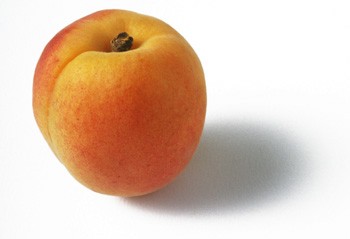
Eat a Peach: Edible perfection is all the fair foodie requires.

Fessin’ Up to the ‘F’ Word

Proud confessions of a foodie

By Heather Irwin

Let’s get one thing incredibly straight here: anyone who talks about food for a paycheck is a foodie. I’m a foodie. Yep, I just admitted that. And while it seems that food writers from Calvin Trillin to the North Bay’s own Michele Anna Jordan (whom I love, but must disagree with on this point) have distanced themselves from the f-word in a very public way, I’m here to expose the exodus as a whole lot of shit.

See, the term “foodie” has fallen out of favor, like gourmet clubs and aspic gelatin. Coined during the mid-1980s in The Official Foodie Handbook, the term was a cousin to such popular labels of the day as yuppie, buppie and dinky. The authors’ definition was: “A person who is very, very, very interested in food. . . . They don’t think they are being trivial–foodies consider food to be an art on a level with painting or drama. It’s actually their favorite art form.”

OK, not exactly complimentary, but a fairly accurate description of many of us. Over the years “foodie” has morphed into a less pointed reference to someone who really loves food, and has been reclaimed by many young epicures, gourmands and gastronomes who found other labels a little, well, pretentious. I mean, really, what’s more annoying, calling oneself a gastronome or gently terming oneself a foodie?

Here’s a definition from Foodie.com that I’ve come to associate with the true neo-foodie: “The foodie lives to eat, and eating to live is definitive boredom. A true foodie clings to all things culinary. . . . To find the perfect cheese or the best macaroon recipe is life’s work.”

Life’s work. Seriously. So, while a lot of people seeking world peace or a cure to cancer might find my eternal quest for the perfect buffalo mozzarella (Fratelli Ravioli in Park Slope, N.Y.) a bit pointless, it’s my quest as a food fanatic. Hey, food fanatic. Maybe I should call myself a “foofan”? A “foofie”?

I’ve always found the term “foodie” to be an accessible descriptor for someone who loves to eat. It’s approachable and fun and doesn’t require a French dictionary. Sure, a few bad apples ruin the barrel by self-identifying at dinner parties and droning about artisan cheddar while the rest of us nod politely and consider chewing our arms off to escape. But annoying people exist everywhere; it just seems like there are a lot more of them talking about food lately. Blame it on the Food Network and the Slow Food movement. But believe me when I tell you that these are the same people who eight years ago were blathering endlessly on about their dotcom start-ups or their new BMWs. They’ll move on.

Foodies of the true calling, dear friends, are forever. They are not groupies. They are true eaters who have a passion for food. Identified by their clean plates and round bellies, they tend to carry around mental lists of the best places to find not just foie gras, but pork skins, Spanish cheese and tikka masala. They know where to find fish roe at 8am. They tend to congregate and talk a lot about food–yes, maybe sometimes to a fault.

Yet the foodie clearly appreciates the wonders of a fresh peach just as much as a dinner at the Farmhouse Inn. The catch: they’ll probably want to tell you at which food stand they got it (if you promise not to tell anyone else!) and why it’s better than the stand they used to frequent. So indulge them a little.

Being a foodie is about a passion for wonderful food in any sort of package and for those who care passionately about their craft. Making a pilgrimage to the French Laundry is maybe for some a vanity, but for the initiated, it is about being in the presence of food that is prepared with such perfection and grace that it may as well be Mecca. That same mysticism is just as present when one is presented with a perfect piece of sushi or pan of polenta. Sure, it’s also about trying it at home yourself with a mound of cookbooks, but like the Trillins of the world, not all of us have the talent for cooking. Sometimes food fanaticism extends merely to appreciation.

So with all this talk about labels, maybe the point is that the true foodies need not label themselves at all. Maybe they should just sit quietly and appreciate food.

Yeah, right. Obviously you’ve never met me. Can I tell you about these amazing raspberries I found last week?

From the July 28-August 3, 2004 issue of the North Bay Bohemian.

© Metro Publishing Inc.
Swirl ‘n’ Spit

0

Swirl ‘n’ Spit
Tasting Room of the Week

Gloria Ferrer Winery

By Heather Irwin

Lowdown: With nearly 400 acres of grapes surrounding it, Gloria Ferrer is a bit of Catalonia in Sonoma. The first sparkling winery in the Carneros, Ferrer’s red tile roof and hacienda architecture harks back to Jose Ferrer’s native Spain, where he and his family, owners of the vast multinational Freixenet wine empire, have continued wine traditions dating from the 13th century.

Mouth value: Decisions, decisions. Unlike most wineries, Ferrer serves up six-ounce glasses for between $4 and $10, rather than two-ounce (or less) samples. Why? The staff say it was just too hard to pair the flights, wash all the glasses, serve them up . . . or something. In any case, why ask why? The good news is that you can taste at the bar or get a hearty flute or two delivered tableside while marveling at the view below. To throw all caution to the wind, shell out the $10 for a glass of the 1995 Carneros Cuvée (or better yet, just buy the whole damn bottle for $50).

Toasty and creamy, there are hints of almond and anise that make this a favorite. The blend of Pinot Noir and Chardonnay gives the wine a balance of crisp acidity and mellowness. The Sonoma Brut ($18 per bottle) and Blanc de Noirs ($18), which were almost indistinguishable from one another, are primarily made from Pinot Noir grapes and have a lighter, crisper flavor. The 2001 Blanc de Blancs ($24) is 100 percent Chardonnay, giving it a heavier, richer flavor with toasty, yeasty vanilla. How to choose? The staff say that it’s kind of like beer–if you like a pale or amber, you’ll like the lighter Pinot blends; stout lovers will probably like the more beefy Chardonnay blends. The winery also serves up a number of table wines made from the grapes, including a 2000 Pinot Noir, Jose S. Ferrer Selection ($35), that is spicy and smoky with flavors that are an interesting contrast to those made further north along the Russian River.

Don’t miss: Worth the trip are the champagne caves, which can be toured three times a day. No appointments are necessary, but it’s a good idea to call ahead that morning to make sure the staff can accommodate you.

Five-second snob: This one will amaze friends: how many bubbles are there in a glass of Gloria Ferrer sparkling wine? Hey, stop counting. There are, in fact, about 7.3 million, and approximately 40 million in each bottle, depending on the amount of time the wine spent on the yeast. That’s a lot of gas, baby. Ask for the winery’s trivia sheet, which answers the age-old question, how many turns of the wire safety cage does it take to get to the chewy center, er, cork of the champagne bottle?

Spot: Gloria Ferrer, 23555 Carneros Hwy., Sonoma. Open daily, 10am to 5pm. Cave tours at noon, 2pm and 4pm. $4-$10 tasting fee. 707.996.7256.

From the July 28-August 3, 2004 issue of the North Bay Bohemian.

© Metro Publishing Inc.

Thelonious Monk

0

Feeling Monkish

1956 was very good year for jazz buffs

By Greg Cahill

A lot of jazz buffs, fans and critics alike, were flummoxed by Thelonious Monk’s angular rhythms and sideways chord progressions when the hard-bop pianist started recording for the Blue Note label in 1948. For a while, he seemed destined to become a cult figure revered by only a small cadre of jazz cognoscenti. But 1956’s Brilliant Corners (Riverside), newly remastered as a hybrid stereo SACD that bristles with startling clarity, provided the breakthrough that would win over even his staunchest critics.

Brilliant Corners was Monk’s third album on the Riverside label and the first with all original music. It’s genesis was a painful one.

For the recording session, Monk enlisted alto saxophonist Ernie Henry (considered Coltrane’s equal at the time), tenor saxophonist Sonny Rollins, bassist Oscar Pettiford, and drummer Max Roach (trumpet player Clark Terry sits in on one track and Miles Davis’ bassist Paul Chambers replaces Pettiford on another). But despite the talent-laden lineup, the musicians struggled to master Monk’s complicated compositions. Producer Orrin Keepnews recalled that it took 25 takes and four hours in the studio to lay down an acceptable version of the title track, which required the players to double their tempo every second chorus. “I had no way of foreseeing how incredibly more difficult this would be for me [than the first two albums],” Keepnews once wrote. “Basically dealing with Monk in full-scale action meant that it was my job to supervise and control the creative flow of recording sessions that involved a perfectionist leader driving a group of sensitive and talented artists beyond their limits.”

Those bruised egos were worth the effort.

Clocking in at just over 48 minutes, the five-track Brilliant Corners featured one unaccompanied piano piece (“I Surrender, Dear”) and two blues numbers (including “Ba-Lue Bolivar Ba-Lues-Are,” a tune dedicated to the Hotel Bolivar, where, according to Straight, No Chaser author Leslie Gourse, management had objected to Monk wandering the halls in a bright red shirt that accentuated the pianist’s eccentric demeanor and even scared guests).

In retrospect, the blues tunes, along with the ballad “Pannonica,” contribute to the album’s relatively laid-back feel and belie the on-the-edge innovation of the composer’s work. But Brilliant Corners is still notable for its remarkable freshness–just as it served as a calling card to a broader audience in the conservative Eisenhower Era, this new SACD release reminds us just how creative Monk was in his day and what a driving force he became on the bop and post-bop scene.

Meanwhile, despite a fairly aggressive SACD release schedule, Fantasy Records (God bless ’em) is continuing to issue its stellar audiophile-quality 20-bit K2 Super Coding jazz series, with several recent reissues that include Thelonious Himself (Riverside), a 1957 session equally split between originals and standards in a mostly solo-piano setting (John Coltrane and bassist Wilbur Ware pop up to accompany Monk on one fine track, “Monk’s Mood”).

Other recent K2 releases include 1957’s Traneing In, featuring John Coltrane with the Red Garland Trio; Sonny Rollins’ 1956 album Worktime, the saxophonist’s first album since kicking the heroin habit that almost wrecked his career; the Wes Montgomery Trio’s eponymous debut release-the guitarist’s first session as a bandleader; and Eric Dolphy at the Five Spot, Vol 1, the 1961 recording that captured the legendary saxophonist and one of the era’s greatest jazz bands (with trumpet player Booker Little, pianist Mal Waldron, bassist Richard Davis, and drummer Ed Blackewell) on the final night of their only extended concert engagement.

And you can never own too many Eric Dolphy CDs.

Web extra to the July 28-August 3, 2004 issue of the North Bay Bohemian.

© Metro Publishing Inc.

Brian Wilson

0

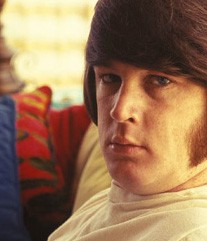
Forever Young: Brian Wilson in the ‘Pet Sounds’ days.

Wouldn’t It Be Nice

Brian Wilson’s newest misses the hit again

By Bruce Robinson

In the post-Elvis, pre-Beatles doldrums of the early 1960s, the early Beach Boys singles were a brine-tinged breath of fresh air on the Top 40 airwaves. With Brian Wilson co-writing the songs and orchestrating the tight, multi-part, sometimes contrapuntal (and disarmingly nasal) harmonies of his brothers and their band mates, the Beach Boys exported a romanticized Southern California of surf, cars, girls–and yes, even school–to the world.

When the Fab Four asserted their unprecedented chart dominance in early 1964 (limiting the otherwise irrepressible “Fun, Fun, Fun” to a number five peak on the charts), the Boys of Hawthorne responded with a determination to match the Beatles’ energy and innovation. And for a time, they did.

“I Get Around,” an infectious slice of suburban restlessness, was inarguably more complex than “Love Me Do” or “P.S. I Love You,” which preceded it up the charts by a few weeks. And the teen angst of the hot-rod ballad, “Don’t Worry Baby,” on the flip side was certainly more emotionally sophisticated than the sunny pop of “A Hard Day’s Night” a month later.

But Lennon and McCartney were just hitting their compositional stride, and the trans-Atlantic rivalry spiraled upward into 1966, when Rubber Soul was challenged by Pet Sounds, which even now is widely seen as the high point among Beach Boys’ records. Revolver later that year upped the ante yet again, but Brian Wilson answered with quite possibly the greatest pop single ever released, the incomparable “Good Vibrations.”

He then embarked on his most ambitious project, an album to be called Smile. But just as it was nearing completion, the Beatles raised the bar yet again. While Sgt. Pepper’s Lonely Hearts Club Band defined the Summer of Love for many, its brilliance sent Brian into a vortex of despair. He scrapped Smile, destroying many of the tapes (the album later titled Smiley Smile was an attempt to patch together what survived), and fell into a creative tailspin for the next two decades.

The band soldiered on (Brian had retired from touring before Pet Sounds), and continued to score such occasional hits as “Darlin'” and “Do It Again,” but never again reached the artistic or commercial peaks of their earlier work. Surf’s Up (1971) was a tantalizing taste of a return to form, but subsequent albums of new material went from inconsistent to weak to pathetic. The emergence of the “oldies” radio format boosted demand for their live shows, however, and the group, in some form, has never really gone away.

Brian, however, was far gone–lost in a fog of mental illness and sequestered for years by a would-be Svengali psychologist who even asserted co-author credits on a few of the substandard songs Brian somehow ground out during that time. Finally, in the late ’80s, he began to emerge from his extended funk, issuing a generally uninspired, self-titled solo album in 1988. Through the next decade, he began to perform occasionally and another solo album, Imagination, was released in 1998. Alas, it was even less distinguished than the first.

Undeterred by Imagination’s flop, Brian assembled a band capable of recreating any of his records on stage and began to tour more enthusiastically. Pet Sounds Live is just what its title suggests, drawn from a series of London concerts in 2001, and he topped that this past summer with a return to London in which he resurrected Smile in concert.

After all this tortured history, I would like to report that Brian’s new disc, Gettin’ In Over My Head (Rhino), is a triumphant comeback. But I can’t.

Sure, it’s the best of the three–faint praise indeed–and it does have some agreeable moments: the opening duet with Elton John, “How Could We Still Be Dancin’,” evokes both men’s stellar past; “Desert Drive” echoes the classic Beach Boys driving songs; and Eric Clapton injects some badly needed rock verve into “City Blues.” Brian’s skills as an arranger are fully displayed throughout, and may be the best thing about the record overall. But in the absence of a worthy lyricist, too many of the songs are trite fluff, including the saccharine pairing (“A Friend Like You”) with Paul McCartney.

Still, there’s just enough here to keep the faint hope alive that somehow, someday, Brian Wilson might just deliver one last masterwork. But this, unfortunately, isn’t it.

From the July 28-August 3, 2004 issue of the North Bay Bohemian.

© Metro Publishing Inc.
Sue Grafton

Photograph by Steven Humphrey

18 Rounds: Novelist Sue Grafton has just eight left to go.

‘G’ Is for Grafton

Mystery novelist Sue Grafton soups the alphabet

By Joy Lanzendorfer

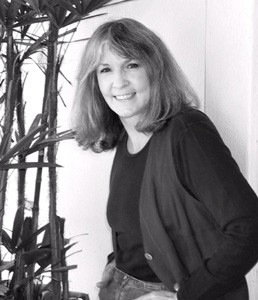
Sue Grafton, author of the alphabet mysteries starting with A Is for Alibi, has sold millions of books. Her newest endeavor, R Is for Ricochet (Putnam; $26.95), is no exception. Released just two weeks ago, it is already No. 10 on the Amazon.com top sellers list as of this writing. Fans eagerly await each installment of the series about hard-boiled female private investigator, Kinsey Millhone.

Leaving the solitude of her Santa Barbara writing desk for a book tour can be taxing for Grafton, an introvert by nature, who appears at Copperfield’s on July 29. But she still loves her readers.

“They are the dearest people on the planet,” she says by phone from her home office. “I feel like I’m walking in a room full of friends every time I do a signing.”

Even though she writes about crime, Grafton says she never sees the kind of obsessed fans that other popular authors have complained about.

“The sort of people who are attracted to my books tend to be good souls,” she says. “I don’t write butchery books about animals and children being dismembered. I think the people who are ultimately attracted to my books are involved in Kinsey’s life and want to see what happens next. Readers who are attracted to the more gruesome and grisly naturally gravitate to other writers.”

In R Is for Ricochet, Kinsey is hired by a wealthy man to pick up his daughter, Reba Lafferty, from a 22-month jail sentence so she won’t violate her parole. It seems like easy money for Kinsey until Reba reconnects with her former lover, Alan Beckwith, and things get complicated.

This being the R book, there are lots of R words: Reba, Reno and romance, to name a few. But though there are guns, there is very little ricocheting. “‘Ricochet’ is used in a metaphorical sense,” Grafton assures. “The book is really about the consequences of people’s behavior.”

A native of Louisville, Ky., and daughter of a lawyer and mystery writer, Grafton moved to California in the ’70s to try her hand at television writing. But she didn’t like Hollywood, and proceeded to write seven novels on the side–only two of which were published. Her eighth novel, A Is for Alibi, was published in 1982.

Though only a few years have passed in Kinsey’s world since the first book, 22 years have passed in the real world. Grafton has slowed down a bit. The average time-span between books is now two years instead of one.

There are two reason for the longer turnaround time: Grafton is getting older and her job is getting harder. With 18 books down and eight more to go, she’s in constant danger of repeating herself.

“Sometimes I feel like I’m using every smidgen of imagination I have,” she says. “Each book is hand-crafted. Certainly, there are elements that run from book to book–Henry, Santa Theresa, jogging, peanut butter and pickle sandwiches–but I don’t want the basic bones of the books to repeat.”

Making sure she doesn’t repeat herself also keeps her from getting bored.

“If I’m bored, the reader is going to be bored, so I’m constantly casting about for new ways to write the book,” she says. “For instance, in K Is for Killer, I thought, wouldn’t it be interesting to do a novel set entirely at night? N Is for Noose was my Western–there was just something about it that felt like a Western; M Is for Malice was my ghost story; and P Is for Peril was my film noir.”

After all these years, Grafton has a set writing routine. She gets up every day at 6am, exercises and spends the morning in her office, alternately writing her daily two pages, doing research and writing in a long, single-spaced document she calls her “journal.” She breaks for lunch, works for another hour or two and then often works out again at the end of the day. Exercise, she says, is great with dealing with the stress of her job.

In her journal, Grafton explores the ideas she gets from her subconscious, citing the Jungian term “shadow.” Often when sleeping, her subconscious gives her thoughts and intuitions that end up opening the book for her.

“I’m always saying, ‘Thank you, shadow, thank you, shadow,'” she says. “I kiss shadow’s hand every day of my life. Shadow is our intuition and shadow is everything wicked about us at the same time. And when you’re writing detective fiction, you have to be in touch with your dark side.”

Sue Grafton reads from and discusses ‘R Is for Ricochet’ on Thursday, July 29, at Copperfield’s Books, Montgomery Village. 2316 Montgomery Drive, Santa Rosa. 7pm. Free. 707.578.8938.

From the July 28-August 3, 2004 issue of the North Bay Bohemian.

© Metro Publishing Inc.
GMOs

0

Grass Is Greener: Should GMOs be banned in Marin and Sonoma counties?

Growing Concern

Sonoma and Marin County initiatives challenge genetically manipulated crops

By Joy Lanzendorfer

Splice rice with a daffodil gene to reduce blindness. Cross potatoes with mice and jellyfish genes so that they’ll glow fluorescently, allowing satellites to see when they need watering. Gift a goat with the gene of a spider to produce a half-web, half-milk substance that scientists hope will be stronger than steel.

These are just a few of the weirder examples of genetically modified organisms (GMOs) currently under development, and illustrate the nearly unlimited potential of the process. Already, some 60 percent to 70 percent of processed foods in the United States contain GMOs. Most of us, whether we know it or not, eat some sort of genetically modified food every day.

But critics say the enormous potential of genetic manipulation also comes with risks–risks that so far have not been presented to the public, particularly in the United States. While many nations, including most of Europe, Japan and Mexico, have banned GM foods, few areas of the United States had said no to GMOs until last spring, when Mendocino County passed an ordinance banning the cultivation of GM crops within its boundaries.

Now Marin and Sonoma counties are considering following Mendocino’s lead. In November, Marin will vote on whether to ban GM crops. On July 27, the Sonoma County Board of Supervisors will decide whether area residents will also have a chance to vote on the issue in November.

Currently, no GM crops are grown in either county, but organizers say that’s why it’s important to move ahead now.

“We have a unique opportunity right now to keep Sonoma County uncontaminated,” says Dave Henson, director of the Occidental Arts and Ecology Center. “We won’t have that in a few years–once GMOs get into our ecosystem, it will be impossible to get them out.”

In late April, people from nine counties attended a workshop led by Els Cooperrider, leader of the anti-GMO measure in Mendocino County. There, attendants learned how to start an initiative to ban GMOs in their own area.

Organizers from Marin County found support for the ban immediately. With only 100 volunteers, they gathered 15,000 signatures in five weeks, well over the 9,000 needed to get the initiative on the November ballot.

Sonoma County took longer to craft its ordinance, and only gathered signatures a week before they were due. Still, volunteers managed to get 1,700 people to sign the petition. The Sonoma County Board of Supervisors will decide whether to put the initiative on the November ballot, hold a special March election or wait.

In Marin, organizers are bracing for retaliation by trade associations like CropLife International. CropLife poured an estimated $750,000 into a public-relations campaign against the Mendocino measure.

“There were these outrageous radio spots that said something like the garden police are coming to rip up your garden in the middle of the night, the garden gestapo,” says Frank Eggers, mayor of Fairfax, an anti-GMO organizer who was in Ukiah before the county voted on the measure. “But it didn’t work. The people saw through it.”

Marin is raising $100,000 to put out a campaign to circumvent any similar attempts by CropLife in its county.

“We’re going to fight fire with fire,” says Eggers.

Genetically engineered means that genes are removed from one organism and inserted into another organism. It differs from traditional plant breeding, because the exchange crosses species barriers, something that could never occur in nature.

Both the Marin and Sonoma initiatives would make it illegal to plant and cultivate GMOs, though it would not stop the sale of genetically modified foods coming into either county. Exemptions would be made for medical research–new drugs and treatments are being developed through genetic engineering–as long as the research was contained in specially designed buildings.

Sonoma’s initiative is more tech-friendly than Marin’s. It allows for other scientific research, could be overturned by the Board of Supervisors if a new technology’s benefits outweighed its problems, and would come up for review in 10 years.

Critics of genetic engineering say that one of the problems is that the technology is unregulated. The FDA does little testing and the state does no testing of GMOs. There are no independent studies on their safety, and no testing, period, on their health effects. The only people who provide information on the technology are the same companies that sell it, and they are not required to publish their results.

“We’re not hearing about this technology from the scientists who develop it, but from the best PR firms out there,” says Mark Spears, a co-owner of Good Earth Natural Foods who helped organize the Marin initiative. “The scientists don’t even know what to look for, and yet they are ramming it into the food chain.”

Organizers say there are good reasons to be concerned about the health effects of GMOs. For one thing, to combine genes from different species, scientists have to also put bacteria and viruses into the genes to trick them into combining. The long-term effect of eating bacteria or viruses–not to mention the pesticides and other toxic materials inserted into some plants–are unknown.

Environmental issues are also a concern. In Mexico, pollen drifts of Bt corn–corn with a chemical that wrenches the guts of moths and butterflies that feed on it–bred with native corn plants. The results have left environmentalists concerned about the butterfly population.

“Never mind what a chemical like Bt would do to my guts after I eat it for 30 years,” says Henson. “How would it affect something like the monarch butterfly that migrates [north from Mexico] every year, munching Bt corn on the way? How do monarchs affect the ecosystem?”

GMOs also threaten organic farms, because if the technology breeds with organic crops, farmers could lose their licenses.

But proponents of genetic engineering say that banning the technology could hurt nonorganic farmers. The promises of the technology–reducing pesticide spraying, yielding bigger crops and feeding the world–are impressive.

“These initiatives would cover something like grapevines modified to be resistant to Pierce’s disease, which is under development,” says Lex McCorvey of the Sonoma County Farm Bureau, referring to a virus spread by the glassy-winged sharpshooter, a dire vineyard pest. “In that case, pollen drift wouldn’t be an issue, so cross-contamination wouldn’t happen. These bans shouldn’t put all the technology under one big umbrella.”

With so many countries banning GM foods, planting them could also affect sales. California is the second biggest producer of rice in the United States. The rice industry’s biggest customer–Japan–has said it will not buy from California if GM rice is planted here.

But economic advantages or disadvantages aside, for some, the potential dangers of GMOs outweigh any benefits.

“I come from a county with the highest breast cancer rate in the country and one of the highest prostrate cancers. I am abiding by cautionary principles,” Eggers says.

“Until it is proven safe, I don’t want it.”

From the July 21-27, 2004 issue of the North Bay Bohemian.

© Metro Publishing Inc.
‘Trinitas’

0

Summer House: Frances McCormack’s ‘Babur Padshahs Abode’ is among those on exhibit in ‘Trinitas.’

By the Beautiful See

Just at the golden sweet spot of high summer, several visual art exhibitions beckon us back indoors

By Gretchen Giles

There’s one bench already placed in front of a Frances McCormack painting at the Museum of Contemporary Art in Santa Rosa. On this day, the exhibition’s installation is still unfinished, and a utility stool has been hastily left in front of another of her works. Having two places to sit down and contemplate McCormack’s oversized canvases proves to be a boon, even were it not so hot and the reporter’s notebook so heavy.

An instructor at the San Francisco Art Institute, McCormack, whose paintings are part of the “Trinitas” exhibit showing at MOCA through Oct. 10, paints large works mostly abstract in composition and certainly handsome in execution. But a nice long squat on a splattered utility stool provides a deeper look at what “handsome” might mean.

The art vs. design struggle–how to free the canvas and the process up, let it be loose while making marks that transcend the merely pretty, working more deeply into the stomach-knotting realm of beauty–is evident in McCormack’s works. The eight paintings exhibited at MOCA all share a palette of a rather stylish green/brown complement that both evokes the garden settings McCormack works from as well as the latest color scheme for an upscale hotel room. Rich, juicy colors appear in small patches, as though irresistible. There initially appears to be a pleasing formality to the paintings, one that would reward a quick glance on a dining room wall but needs little more.

However, McCormack’s canvases ripen past just-plain-pretty in several ways, the most marked being that kinetic clusters of composition make small works unto themselves, offering energy and grace to the rest of the plane. Using a fairly severe structure to each canvas–several of her works feature houselike lines marking out their centers–McCormack gives a crazy freedom to these clusters that offers that thrilling stomach-knot of beauty when really parsed.

A long squat also reveals that McCormack’s paintings defy gravity, with paint dribbles flowing off the canvas in ways they couldn’t possibly do were the piece merely affixed to an easel. Instead, hers are vigorous works that have been turned and considered and painted from different directions, offering disparate escapes from the world created. There is always a way out, even from the civilized wilds of the backyard.

And indeed, moving out of McCormack’s garden one enters Thekla Hammond’s forest. Titled “Impermanence,” this installation features some 40 acrylic panels hanging freely from the ceiling upon which Hammond has drawn, scratched and squidged paint to form leaves and birch trunks. Any suggestion of breeze sends the panels moving, creating shadows on the walls adorned with huge arboreal panels, intended to catch her ephemeral darkenings, as well as on the floor, which, barring the availability of a utility stool, is an excellent vantage point from which to take in the work.

Visitors are encouraged to walk through the hanging panels, which is both somewhat frightening–one never wishes to be that cursed soul who trips, flails and wrecks the art–and intensely calming, both at the same time.

The final segment of “Trinitas” is the cheerfully nihilistic, little boys’ bedroom-like installation of Maria Park. Titled “Paradise Camouflage,” Park’s site-specific work uses wood-grain contact paper as the image area, with strongly drawn jet fighters adorned by palm fronds upon it, detailed cities and structures seen from above–the easier to bomb them with, my dear–and bright pleasant stripes painted on miniature ovoid droplets of paradise, the whole damned lot about to be exploded. Were the installation better achieved–contact paper is a monster to work with and rebels in art evidently just as it does on kitchen shelving–it would be perhaps a stronger cautionary work, but is so nicely odd that it twinges and pulls anyway.

“Trinitas” shows through Oct. 10 at the MOCA, 50 Mark West Springs Road, Santa Rosa. A reception for the artists is slated for Saturday, July 24, from 5pm to 7pm; free. The artists speak on their work on Thursday, Aug. 5, at 5:30. $8-$10. 707.527.0297.

Art Notes

Bay Area art star Squeak Carnwath moves to the fiber arts, showing in tapestry medium–should that be a phrase–at the Edith Caldwell Gallery in Sausalito. Carnwath is applauded for the art of her artless drawing and the random words that help to inform the viewer of perhaps nothing at all. She joins such legion as funk daddy William T. Wiley in exploring this different form of presentation, as Wiley has recently also seen his wordy work woven through. Carnwath exhibits with Era and Donald Farnsworth and Alan Magee. Through Sept. 15. 819 Bridgeway, Sausalito. 415.331.5003. . . .

Meanwhile, at the Headlands Center for the Arts, German-born sculptor Olav Westphalen labors in the Project Space through July 26. This studio is open to the public from noon to 5pm during the week, and all and sundry are welcome to come watch the artist prepare for his second New York solo show. Westphalen, a participant in the Whitney’s 2004 Biennial, uses humor, caricature and comics to criticize and remind us humans of our very humble role in the universe. He speaks on his work on Thursday, July 22, at 8pm. Free. 944 Fort Barry, Eastwing Building 944, Sausalito. 415.331.2787. . . .

Perhaps cursed by Duchamp’s freeing dictum that “everything is art,” emerging artist Zack Davis aims to push the limit of everything with grid-patterned monkey heads, da Vinci remakes using graph paper and ballpoint pen and other exuberant displays of young, free and so-what. Which is just fine by us. His exhibit “Navel Your Contemplate” shows through Aug. 30. Roshambo, 3000 Westside Road, Healdsburg. Free. 707.431.2051. . . .

Quicksilver Mine Co. in Forestville welcomes back several former Sonoma County artists by hosting exhibits for sculptors Kurt Steeger and Libby Hayes, who left for Grass Valley some years ago, in September; and painter Sam Woolcott and sculptor Poe Dismuke, who left for Arizona shortly thereafter, in November. 707.887.0799. . . .

And finally, painter Paul Wonner’s work again deserves mention. While there are those who take small offense at this seminal artist’s current designation as “Bay Area Elder Artist of the Year”–as if he had to get old to get good–such petty coats should be thrown off in favor of getting over to the di Rosa Preserve’s Gatehouse Gallery to see Wonner’s one-man show, exhibiting through Aug. 28 as part of the regular, reservations-only Preserve tour. 5200 Carneros Hwy., Napa. 707.226.5991.

From the July 21-27, 2004 issue of the North Bay Bohemian.

© Metro Publishing Inc.
‘Monumental’

Imagine It Gone!: David Brower, foreground, saved the Grand Canyon from rampant damming.No CompromiseEnvironmentalist David Brower and the fight to save the earthBy Gretchen GilesImagine the entire swath of the Pt. Reyes National Seashore as little more than a rich folks' resort of luxury seafront homes and shudder. Picture water-skiing right down the ruined alleyways of the Grand Canyon...

Mama Collective

Photograph by D.W. LechWomen and Children First!: Mama Collective and kids, from left to right: Adler Blaze, Lila Cugini, Xenia Burlison-Craft, Dani Burlison-Craft, Ava Burlison, Terrie Samundra-Girdner, Ceili Samundra-Carr.Crisis and OpportunitySanta Rosa's Mama Collective rises to the challenge of the GOPBy Michael HoughtonThe three women sitting across the table from me don't exactly look like wild-eyed radicals. But according...

Dining Guide

Mouth WanderingOur giddy guide to getting outBy Heather IrwinYou love to eat and drink. In fact, you probably do it at least three or four times a day. More, if you're lucky. And by some stroke of fate, you've ended up doing it here in the North Bay--home to many of the world's best chefs, restaurants, farms and wineries....

Confessions of a Foodie

Eat a Peach: Edible perfection is all the fair foodie requires.Fessin' Up to the 'F' WordProud confessions of a foodieBy Heather IrwinLet's get one thing incredibly straight here: anyone who talks about food for a paycheck is a foodie. I'm a foodie. Yep, I just admitted that. And while it seems that food writers from Calvin Trillin to the...

Swirl ‘n’ Spit

Swirl 'n' SpitTasting Room of the WeekGloria Ferrer WineryBy Heather Irwin Lowdown: With nearly 400 acres of grapes surrounding it, Gloria Ferrer is a bit of Catalonia in Sonoma. The first sparkling winery in the Carneros, Ferrer's red tile roof and hacienda architecture harks back to Jose Ferrer's native Spain, where he and his family, owners of the vast...

Thelonious Monk

Feeling Monkish1956 was very good year for jazz buffsBy Greg CahillA lot of jazz buffs, fans and critics alike, were flummoxed by Thelonious Monk's angular rhythms and sideways chord progressions when the hard-bop pianist started recording for the Blue Note label in 1948. For a while, he seemed destined to become a cult figure revered by only a small...

Brian Wilson

Forever Young: Brian Wilson in the 'Pet Sounds' days.Wouldn't It Be NiceBrian Wilson's newest misses the hit againBy Bruce RobinsonIn the post-Elvis, pre-Beatles doldrums of the early 1960s, the early Beach Boys singles were a brine-tinged breath of fresh air on the Top 40 airwaves. With Brian Wilson co-writing the songs and orchestrating the tight, multi-part, sometimes contrapuntal (and...

Sue Grafton

Photograph by Steven Humphrey18 Rounds: Novelist Sue Grafton has just eight left to go.'G' Is for GraftonMystery novelist Sue Grafton soups the alphabetBy Joy LanzendorferSue Grafton, author of the alphabet mysteries starting with A Is for Alibi, has sold millions of books. Her newest endeavor, R Is for Ricochet (Putnam; $26.95), is no exception. Released just two weeks ago,...

GMOs

Grass Is Greener: Should GMOs be banned in Marin and Sonoma counties?Growing ConcernSonoma and Marin County initiatives challenge genetically manipulated crops By Joy LanzendorferSplice rice with a daffodil gene to reduce blindness. Cross potatoes with mice and jellyfish genes so that they'll glow fluorescently, allowing satellites to see when they need watering. Gift a goat with the gene of...

‘Trinitas’

Summer House: Frances McCormack's 'Babur Padshahs Abode' is among those on exhibit in 'Trinitas.'By the Beautiful SeeJust at the golden sweet spot of high summer, several visual art exhibitions beckon us back indoorsBy Gretchen GilesThere's one bench already placed in front of a Frances McCormack painting at the Museum of Contemporary Art in Santa Rosa. On this day, the...
11,084FansLike
4,606FollowersFollow
6,928FollowersFollow