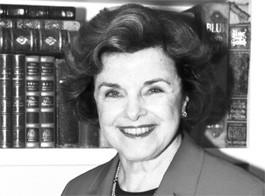
Serious business: Our investigation shows that Democratic senator Dianne Feinstein consistently breached ethical boundaries.
By Peter Byrne
In the November 2006 election, the voters demanded congressional ethics reform. And so, the newly appointed chairman of the Senate Rules Committee, Dianne Feinstein, D-Calif., is now duly in charge of regulating the ethical behavior of her colleagues. But for many years, Feinstein has been beset by her own ethical conflict of interest, say congressional ethics experts.
As chairperson and ranking member of the Military Construction Appropriations subcommittee (MILCON) from 2001 through the end of 2005, Feinstein supervised the appropriation of billions of dollars a year for specific military construction projects. Two defense contractors whose interests were largely controlled by her husband, financier Richard C. Blum, benefited from decisions made by Feinstein as leader of this powerful subcommittee.
Each year, MILCON’s members decide which military construction projects will be funded from a roster proposed by the Department of Defense. Contracts to build these specific projects are subsequently awarded to such major defense contractors as Halliburton, Fluor, Parsons, Louis Berger, URS Corporation and Perini Corporation. From 1997 through the end of 2005, with Feinstein’s knowledge, Blum was a majority owner of both URS Corp. and Perini Corp.
While setting MILCON agendas for many years, Feinstein, 73, supervised her own staff of military construction experts as they carefully examined the details of each proposal. She lobbied Pentagon officials in public hearings to support defense projects that she favored, some of which already were or subsequently became URS or Perini contracts. From 2001 to 2005, URS earned $792 million from military construction and environmental cleanup projects approved by MILCON; Perini earned $759 million from such MILCON projects.
In her annual Public Financial Disclosure Reports, Feinstein records a sizeable family income from large investments in Perini, which is based in Framingham, Mass., and in URS, headquartered in San Francisco. But she has not publicly acknowledged the conflict of interest between her job as a congressional appropriator and her husband’s longtime control of Perini and URS–and that omission has called her ethical standards into question, say the experts.
Insider Information
The tale thickens with the appearance of Michael R. Klein, a top legal adviser to Feinstein and a long-time business partner of Blum’s. The vice-chairman of Perini’s board of directors, Klein was a partner in Wilmer, Cutler & Pickering, a powerful law firm with close ties to the Democratic Party, for nearly 30 years. Klein and Blum co-own ASTAR Air Cargo, which has military contracts in Iraq and at Guantanamo Bay, Cuba. Klein also sits on the board of SRA International, a large defense contractor.
In an interview with this reporter in September, Klein stated that, beginning in 1997, he routinely informed Feinstein about specific federal projects coming before her in which Perini had a stake. The insider information, Klein said, was intended to help the senator avoid conflicts of interest. Although Klein’s startling admission was intended to defuse the issue of Feinstein’s conflict of interest, it had the effect of exacerbating it.
Klein said that he regularly gave Feinstein’s chief of staff, Mark Kadesh, lists of Perini’s current and upcoming contractual interests in federal legislation, so that the senator would not discuss, debate, vote on or participate in matters that could affect projects in which Perini was concerned. “Earmarks, you know, set asides, you name it, there was a system in place which on a regular basis I got notified, I notified her office and her office notified her,” Klein said.
“We basically identified any bid that Perini was going for and checked to see whether it was the subject of already appropriated funds or funds yet to be appropriated, and if it was anything that the senator could not act on, her office was alerted and she did not act on it.”
This is an extraordinary thing for Klein and the senator to do, since the detailed project proposals that the Pentagon sent to Feinstein’s subcommittee for review do not usually name the firms already contracted to perform specific projects. Nor do defense officials typically identify, in MILCON hearings, which military construction contractors are eligible to bid on upcoming work.
In theory, Feinstein would not know the identity of any of the companies that stood to contractually benefit from her approval of specific items in the military construction budget–until Klein told her.
Klein explained, “They would get from me a notice that Perini was bidding on a contract that would be affected as we understood it by potential legislation that would come before either the full congress or any committee that she was a member of. And she would as a result of that not act, abstain from dealing with those pieces of legislation.”
However, the public record shows that contrary to Klein’s belief, Feinstein did act on legislation that affected Perini and URS.
According to Klein, the Senate Select Committee on Ethics ruled, in secret, that Feinstein did not have a conflict of interest with Perini because, due to the existence of the bid and project lists provided by Klein, she knew when to recuse herself. Klein says that after URS declined to participate in his conflict-of-interest prevention plan, the ethics committee ruled that Feinstein could act on matters that affected URS because she did not have a list of URS’ needs. That these confidential rulings are contradictory is obvious and calls for explanation.
Klein declined to produce copies of the Perini project lists that he transmitted to Feinstein. And neither he nor Feinstein would furnish copies of the ethics committee rulings, nor examples of the senator recusing herself from acting on legislation that affected Perini or URS. But the Congressional Record shows that as chairperson and ranking member of MILCON, Feinstein was often involved in supervising the legislative details of military construction projects that directly affected Blum’s defense-contracting firms.
After reviewing the results of this investigation, Wendell Rawls, executive director of the Center for Public Integrity in Washington, D.C., observes that by giving Feinstein notice of Perini’s business objectives, Klein achieved the opposite of preventing a conflict of interest.
Rawls comments, “Sen. Feinstein has had a serious conflict of interest, a serious insensitivity to ethical considerations. The very least she should have done is to recuse herself from having conversations, debates, voting or any other kind of legislative activity that involved either Perini Corporation or URS Corporation or any other business activity where her husband’s financial interests were involved.
“I cannot understand how someone who complains so vigorously as she has about conflicts of interest in the government and Congress can have turned such a deaf ear and a blind eye to her own. Because of her level of influence, the conflict of interest is just as serious as the Halliburton-Cheney connection.”
Called into Question
Here are a few examples from the Congressional Record of questionable intersections between Feinstein’s legislative duties and her financial interests:
At a MILCON hearing in 2001, Feinstein interrogated defense officials about the details of constructing specific missile defense systems, which included upgrading the early warning radar system at Cobra Dane radar on Shemya Island, Alaska. In 2003, Perini reported that it had completed a contract to upgrade the Cobra Dane radar system. It has done similar work at Beale Air Force Base in California and in the United Kingdom. URS also bids on missile defense work.
In the 2002 MILCON hearings, Feinstein questioned an official about details of the U.S. Army’s chemical demilitarization program. URS is extensively involved in performing chemical demilitarization work at key disposal sites in the United States.
At that same hearing, Feinstein asked about the possibility of increasing funding for anti-terrorism-force protection at Army bases. The following year, on March 4, 2003, Feinstein asked why the antiterrorism-force protection funds she had advocated for the year before had not yet been spent. On April 21, 2003, URS announced the award of a $600 million contract to provide, among other services, anti-terrorism-force protection for U.S. Army installations.
Beginning in 2003, both Perini and URS were awarded a series of open-ended contracts for military construction work around the world, including in Iraq and Afghanistan. Under Feinstein’s leadership, MILCON regularly approved specific project “task orders” that were issued to Perini and URS under these contracts.
At a March 30, 2004, MILCON hearing, Feinstein grilled Maj. Gen. Dean Fox about whether or not the Pentagon intended to prioritize funding the construction of “beddown” maintenance facilities for its new airlifter, the C-17 Globemaster. After being reassured by Fox that these funds would soon be flowing, Feinstein said, “Good, that’s what I really wanted to hear. Thank you very much. Appreciate it very much, General.” Two years later, URS announced a $42 million award to build a beddown maintenance facility for the C-17 at Hickam Air Base in Hawaii as part of a multibillion dollar contract with the Air Force. Under Feinstein’s leadership, MILCON approved the Hickam project.
In mid-2005, MILCON approved a Pentagon proposal to fund “overhead coverage force protection” in Iraq that would reinforce the roofs of U.S. Army barracks to better withstand mortar rounds. On Oct. 13, 2005, Perini announced the award of a $185 million contract to provide overhead coverage force protection to the Army in Iraq.
In the 2005 MILCON hearings, Feinstein earmarked MILCON legislation with $25 million to increase environmental remediation at closed military bases. Year after year, Feinstein has closely overseen the environmental cleanup and redevelopment ofMcClellan Air Force Base near Sacramento, frequently requesting that officials add tens of millions of dollars to that project. URS and its joint ventures have earned tens of millions of dollars cleaning up McClellan. And CB Richard Ellis, a real estate company headed by Feinstein’s husband Richard Blum, is involved in redeveloping McClellan for the private sector.
This investigation examined thousands of pages of documents, including transcripts of congressional hearings, U.S. Security and Exchange Commission filings, government audits and reports, federal procurement data and corporate press releases. The findings were shared with contracting and ethics experts at several nonpartisan, Washington, D.C.-based government oversight groups. Danielle Brian, executive director of the Project on Government Oversight, a nonprofit organization that analyzes defense contracts and who examined our evidence says, “The paper trail showing Sen. Feinstein’s conflict of interest is irrefutable.”
On the face of it, there is nothing objectionable about a senator closely examining proposed appropriations or advocating for missile defense or advancing the cleanup of a toxic military base. Blum profitably divested himself of ownership of both URS and Perini in 2005, ameliorating the conflict of interest. But Feinstein’s ethical dilemma arose from the fact that, for five years, the interests of Perini and URS and CB Richard Ellis were inextricably entwined with her leadership of MILCON, which last year approved $16.2 billion for military construction projects.
Melanie Sloan, executive director of Citizens for Responsible Ethics in Washington, remarks, “There are a number of members of Congress with conflicts of interest. [California Republican Congressman John T.] Doolittle, for example, hired his wife as a fundraiser, and she skimmed 15 percent off of all campaign contributions. Others, like [former] Speaker [Dennis] Hastert and Cong. [Ken] Calvert were earmarking federal money for roads to enhance the value of property held by their families.
“But because of the amount of money involved,” Sloan continues, “Feinstein’s conflict of interest is an order of magnitude greater than those conflicts.”
Family Matters
Californians elected San Francisco’s former mayor Dianne Feinstein to the Senate in 1992. She was overwhelmingly reelected in November 2006. She is well-liked by both liberals and conservatives. She supports abortion rights and gun control laws. She politicked this year for renewal of the Patriot Act and sponsored a constitutional amendment to ban American flag burning. She is currently calling for President Bush to set a timetable for withdrawing troops from Iraq, but she strongly supported the invasions, occupations and “reconstructions” of both Iraq and Afghanistan. She sits on the Defense Appropriations subcommittee and the Senate Intelligence Committee, and she is a consistent hawk on matters military.
And she is wealthy. In 2005, Roll Call calculated Feinstein’s wealth, including Blum’s assets, at $40 million, up 25 percent from the year before. That made her the ninth wealthiest member of Congress. Feinstein’s latest Public Financial Disclosure Report shows that in 2005 her family earned income of between $500,000 and $5 million from capital gains on URS and Perini stock combined. From CB Richard Ellis, Blum earned between $1.3 million to $4 million. (The report allows for disclosure of dollar amounts within ranges, which accounts for the wide variance.)
A talented financier and deal-broker, Blum, 70, presides over a global investment empire through a labyrinth of private equity partnerships. His flagship entity is a merchant banking firm, Blum Capital Partners, L.P., of which he is the chairman and general partner. Through this bank, Blum bought a controlling share of Perini in 1997, when it was nearly broke. He named his close associate, the attorney Michael R. Klein, to represent his interest on the board of directors. Blum declined to comment for this story. Perini CEO, Robert Band, deferred to Klein for comment.
In 2000, according to public records, Perini–which partly specializes in erecting casinos–earned a mere $7 million from federal contracts. Post-9-11, Perini transformed into a major defense contractor. In 2004, the company earned $444 million for military construction work in Iraq and Afghanistan, as well as for improving airfields for the U.S. Air Force in Europe and building base infrastructures for the U.S. Navy around the globe. In a remarkable financial recovery, Perini shot from near penury in 1997 to logging gross revenues of $1.7 billion in 2005.
In December 2005, Perini publicly identified one of its main business competitors as Halliburton. The company attributed its growing profitability, in large part, to its Halliburton-like military construction contracts in Iraq and Afghanistan. But the company warned investors that if Congress slammed the brakes on war and occupation in the Middle East, Perini’s stock could plummet.
According to Klein and to public records, Blum’s firm originally paid $4 a share for a controlling interest in Perini’s common stock. After a series of complicated stock transactions, Blum ended up owning 13 percent of the company, a majority interest. In mid and late 2005, Blum and his firm took their profits by selling about 3 million Perini shares for $23.75 per share, according to Klein and reports filed with the SEC. Klein says Blum personally owned 100,000 of the vastly appreciated shares when they were sold. Shortly thereafter, Feinstein began calling for winding down the Iraq war while urging that the “global war on terror” continue indefinitely.
Perini
It is estimated that Perini now holds at least $2.5 billion worth of contracts tied to the worldwide expansion of American militarism. Its largest Department of Defense contracts are “indefinite delivery-indefinite quantity” or “bundled” contracts carrying guaranteed profit margins. As is all too common, competitive bidding was minimal or nonexistent for many of these contracts.
In June, Cong. Henry Waxman, D-Los Angeles, released a report by the House Committee on Government Reform criticizing the Pentagon’s growing use of bundled contracts. Waxman complained that these contracts give companies an incentive to increase costs. One of the “problem contracts” identified by Waxman was a no-bid, $500 million contract held by Perini to reconstruct southern Iraq’s electrical grid.
In fact, bundled military construction contracts fueled Perini’s transformation from casino builder to major war contractor. As of May 2006, Perini held a series of bundled contracts awarded by the Army Corps of Engineers for work in the Middle East worth $1.725 billion. Perini has also been awarded an open-ended contract by the U.S. Air Force for military construction and cleaning the environment at closed military bases. Perini shares that $15 billion award with several other firms, including URS.
Perini regularly performs military construction jobs from Afghanistan to Alaska. It built a biological warfare laboratory for the Navy in Virginia. It built fuel tanks and pipelines for the Navy in North Africa. Details of these projects are typically examined and approved or disapproved by MILCON.
At a 2001 MILCON hearing, Feinstein, attending to a small item, told Maj. Gen. Earnest O. Robbins that she would appreciate receiving an engineering assessment on plans to build a missile transport bridge at Vandenberg Air Force Base. He said he would give it to her. She also asked for and received a list of unfunded construction projects, which prioritize military construction wish lists down to the level of thousand-dollar light fixtures. While there is no evidence to point to nefarious intent behind Feinstein’s request for these details, it is worth noting that Perini and URS have open-ended contracts to perform military construction for the Air Force. The senator could have chosen to serve on a subcommittee where she had no potential conflict of interests at all.
In 2003 hearings, MILCON approved various construction projects at sites where Perini and/or URS are contracted to perform engineering and military construction work. The sites included: Camp Lejeune; the Underwater Systems Lab in Newport, R.I.; Hill Air Force Base, Utah; the Naval facilities at Dahlgren, Va.; projects at the Naval Surface Warfare Center in Crane, Ind., and Roosevelt Roads, Puerto Rico, and military bases in Guam, Diego Garcia and Crete.
There are some serious problems with Perini’s work in Iraq. In June 2004, the Government Accountability Office reported that Perini’s electrical reconstruction contract in southern Iraq suffered from mismanagement and lack of competition. In 2006, the Office of the Special Inspector General for Iraq Reconstruction found that Perini was paid to construct multimillion dollar electrical substations in the desert that could not be connected to the electrical grid. And the company was billing the government for purchasing and subcontracting costs that were not justified, according to the Defense Contract Audit Agency. An October 2005 audit by the Defense Department’s Inspector General criticized the execution of Perini’s cost-plus military construction work in Afghanistan, saying, “The contractor had an incentive to increase costs, because higher costs resulted in higher profit.”
URS & McClellan
URS dwarfs Perini. With more than 100 subsidiaries, it employs nearly 30,000 engineers and workers worldwide. The firm’s largest customer is the U.S. Army, from which it booked $791 million in work in 2005 out of a total revenue of $3.9 billion.
URS is not just a construction company; it also develops and maintains advanced weapons systems. In 2002, URS purchased weaponry firm EG&G Technical Services from the Carlyle Group, in which former President George H. W. Bush was a principal. But as profitable as its arms dealing division is, URS reports that its growth sectors are military construction, homeland security and environmental services for military sites under existing defense department contracts.
According to a database of federal procurement records made available for this investigation by Eagle Eye Publishers of Fairfax, Va., URS’s military construction work in 2000 earned it a mere $24 million. The next year, when Feinstein took over as MILCON chair, military construction earned URS $185 million. On top of that, the company’s architectural and engineering revenue from military construction projects grew from $108,726 in 2000 to $142 million in 2001, more than a thousand-fold increase in a single year.
As Congress gave the Bush administration the green light on military spending after 9-11, the value of Blum’s investment in URS skyrocketed. Between 2003 and 2005, URS’ share price doubled. In late 2005, Blum resigned from the URS board of directors, after 30 years as a member. Simultaneously, he sold 5.5 million URS shares, worth about $220 million at market price.
The Congressional Record shows that in year after year of MILCON hearings, Feinstein successfully lobbied defense officials to increase the budget for military base cleanup and redevelopment, especially at the decommissioned McClellan Air Force Base. The detoxification of McClellan is a plum job: it is estimated to cost $1.3 billion and take many years to complete. There is, of course, nothing unusual about a senator advocating for projects that improve environmental health, particularly when the project is in her home state; and the Pentagon is notoriously lax about cleaning up its Superfund sites.
It turns out, though, that URS specializes in environmental consulting and engineering work at military installations. It holds a $69 million contract to manage the cleanup of Hill Air Force Base in Utah, which was awarded in 2004. It has a $320 million contract to remediate pollution at U.S. Army bases in the United States and the Caribbean, which was awarded in 2005. And from 2000 to 2005, URS and its partners were paid $204 million for work at McClellan Air Force Base, according to Eagle Eye.
At a MILCON hearing in 2001, Feinstein cited the environmental work at McClellan as needing more money. “That is a base that I am very familiar with, and I am glad that we were able to provide that funding so that work at McClellan can proceed,” she said. Feinstein then asked for and received detailed information concerning the Pentagon’s projected schedule to finish the McClellan cleanup and the effect of delaying cleanup upon its potential for commercial reuse.
At a MILCON hearing in March 2002, Chairman Feinstein interrogated Assistant Secretary of Defense Nelson F. Gibbs:
Sen. Feinstein. Is the Air Force capable of executing greater [cleanup] funding in 2003 at McClellan?
Mr. Gibbs. Yes, ma’am.
Feinstein. And how much would that be? How about $22 million?
Gibbs. That would be very close. That would be almost exact as a matter of fact. . . . If you would like, I can provide for you a list of those individual projects.
Feinstein. I would. If you would not mind. Thank you very much.
The next week, Gibbs sent Feinstein a memo showing the addition of $23 million to the McClellan environmental budget, mostly for groundwater remediation, URS’ specialty.
In the 2003 MILCON hearings, Feinstein told Dov S. Zakheim, then the Defense Department comptroller, that she “was really struck by the hit that environmental remediation [at McClellan Air Force Base] took. . . . However, I have just [received] a list from the Air Force of what they could use to clean up . . . McClellan, and one other base, and it is 64 million additional dollars this year.”
Dr. Zakheim replied, “Well, let me first say that I remember your concern last year, and I am glad that we took care of [McClellan]. That is important.” Feinstein remarked that the Pentagon had already spent $7 billion on environmental cleanup of closed bases, and that another $3.5 billion should be immediately allocated so that the clean bases can be transferred to the private sector. Demonstrating her grasp of technical details, she remarked, “I am particularly concerned with the dilapidated condition of the sewer line at McClellan that continues to impede significant economic redevelopment of the base.”
That is where CB Richard Ellis comes in.
The real estate firm is politically well-connected. Sen. Feinstein’s husband chairs the board of directors. Bill Clinton’s secretary of commerce, Michael Kantor, joined in 2004. Former Senate Majority Leader Thomas A. Daschle signed on in 2005. The firm specializes in consulting with local governments and developers from California to Puerto Rico on how best to redevelop cleaned-up military bases. It also brokers the sale and lease of redeveloped base lands to the private sector. Since Blum took over CB Richard Ellis, for example, the company has closed deals leasing tens of thousands of square feet of commercial space on cleaned-up portions of McClellan to private developers.
In a 2003 MILCON hearing, Sacramento County redevelopment official Robert B. Leonard told Feinstein, “We wanted to express our appreciation for your efforts over the last year in supporting our needs at McClellan.” During the five years that Feinstein led the subcommittee, support for the McClellan cleanup and the redevelopment deals were particular focuses of her attention.
URS declined to comment for this story. The sole comment that Feinstein’s office made in response to a series of written questions about significant facts reported in this story is that “Sen. Feinstein has never had any knowledge nor has she exercised any influence on the award of environmental cleanup contracts under the jurisdiction of the Military Construction Appropriations Subcommittee.”
Let the Sunlight In
Last week, the Senate voted to close some significant loopholes in its ethics rules. But it stopped short of creating an office of public integrity, which would independently monitor lobbyists and members of congress for ethical compliance. Setting her own limits on the extent of reform she will countenance, Feinstein says she is opposed to the creation of an independent congressional ethics watchdog. “If the law is clear and precise, members will follow it,” she assured the New York Times on Nov. 18, 2006.
The problem with the existing rules governing congressional ethics is that they are neither clear nor precise, and neither are they effective. Senate rules governing conflicts of interest are so vaguely worded, say government watchdogs, that short of stashing cash bribes in the refrigerator, the line between serving constituents and serving oneself is often blurred. The public record shows that Feinstein has a history of crossing that blurry line.
Charles Tiefer is a professor of law specializing in legislation and government contracting at the University of Baltimore in Maryland. He served as solicitor and deputy counsel to the House of Representatives for 11 years. He has taught at Yale Law School and written books on congressional procedures and separation of powers. Tiefer observes that, unlike the executive and judiciary branches of government, Congress does not have enforceable conflict of interest rules. It is up to Sen. Feinstein’s constituents, Tiefer says, to decide if she has a conflict of interest and to take whatever action they want. To make that possible, Feinstein should have publicly disclosed the details of her family investments in Perini, URS and CB Richard Ellis as they related to her actions on MILCON. Tiefer avers that when Klein gave Feinstein lists of Perini’s interests, he worsened her conflict of interest.
“The senator should, at a minimum, have posted Klein’s lists on her Senate website, so that the press and the public would be warned of her potential conflicts,” Tiefer says, noting that she should also make public her correspondence with the Senate Ethics Committee.
As the arbiter of Senate rules on ethics, it is incumbent on Feinstein to provide the public with an explanation of why she did not recuse herself from acting on MILCON details that served her financial interests, and why she failed to resign from the subcommittee after she recognized the potential for conflicts of interest, which, unfortunately, materialized in an obvious way and over a long period of time.
Research assistance for this story was provided by the Investigative Fund of the Nation Institute.