News Briefs

February 21-28, 2007

Making a sign

One cross at a time, one lawn at a time. That’s the goal of Crosses4Peace.org. “We’re a very small group trying to take a very big idea and spread it to a larger geographic audience,” explains Joanne Gifford, president of the project’s parent organization, United Napans Concerned Over Iraq Lunacy (UNCOIL). Inspired by memorials such as Arlington West in Santa Monica and contractor Jeffrey Heaton’s hillside effort in Lafayette, Crosses4Peace urges people to place a single white cross in their front yard as a universal symbol of war and death, to honor everyone killed in Iraq; U.S. military deaths now number over 3,100. “We felt the public had become desensitized to the reality of the war,” Gifford explains. “We thought this would be a great way for people to individually place a visual reminder of the fact that people are still dying.” Instead of more than 3,000 crosses in one place, the aim is to put one cross in at least 3,000 places, if not many, many more. “They are visually stunning in their singularity, when you see them against the backdrop of the homes,” Gifford says. Individuals can decorate their cross as they choose. Some have added a Star of David, others a peace sign or the word “Peace,” and still others use all three. Volunteers have already crafted 200 white wooden crosses, each 36 inches high and 18 inches wide, and do-it-yourself instructions are on the project’s website. About 170 crosses have been distributed. While most are in Napa County, at least some have been installed in Sonoma and Lake counties, and a few are on their way to the South Bay. When a cross is placed in someone’s front yard, Gifford says, it generates questions from neighbors and usually requests for more crosses. Crosses4Peace organizers hope the project will continue to grow, neighborhood by neighborhood and friend to friend in a truly grassroots movement. “We’re hoping people will pick up the idea and make and distribute crosses in their own area,” Gifford notes. “One of our goals is to spread this nationwide if not worldwide.

Cold woes

Gov. Arnold Schwarzenegger is asking the federal government to add Marin and Sonoma to the list of 18 California counties declared official disaster areas because of freezing temperatures that hit the state Jan. 11 to Feb. 7. In recent letters to the U.S. Secretary of Agriculture, Schwarzenegger asked for disaster status and cited the damage done to hay crops and pasture worth more than $1.4 million in Sonoma and more than $1.5 million in Marin County.


Letters to the Editor

February 21-27, 2007

Not just the evil Republicans

(“Senator Warbucks,” Jan. 24) was truly eye-opening! Now I see that Machiavelli’s political writings have been incorporated into business-as-usual by representatives of both parties, not just the “evil Republicans.” Thank you, Peter, for helping me to get wise about how the game is played today in Washington! Your story was extremely valuable.

Carla Normand, Petaluma

Misappropriating appropriations

Peter Byrne’s recent story on Sen. Dianne Feinstein and her husband Richard Blum raises serious ethical questions. If she had any notion that her participation on the Military Construction Appropriations subcommittee (MILCON) might in any way have a positive impact on Mr. Blum’s financial interests, it would have been most appropriate for her to resign from the committee to avoid the slightest appearance of a conflict of interest. Despite this potential conflict of interest, she chose to continue as a MILCON committee member.

One wonders if Sen. Feinstein would have been re-elected if the facts cited in Byrne’s story were made public prior to the 2006 election. It is likely that questions would have been raised about her ethics and the decisions she made as chairperson of the MILCON committee.

Sen. Dianne Feinstein needs to respect the fact that there are many, in addition to this writer, who question her ethics and values.

John Pizzuti, Soquel

Outshining in our field

Thanks for your important article about Dianne Feinstein. I did not vote for her in the primary because she was not opposing the Iraq War or denouncing Bush’s assault on the Constitution. Your research explains why.

I regularly read several national newspapers and magazines, but I open the Bohemian confident that Peter Byrne’s column will outshine the big-city publications and contain the substantial, critical journalism we desperately need. Courage.

Lois Atchison, Glen Ellen

For more shocking truths about the tangled riches of Dianne Feinstein’s husband, Richard C. Blum, see . This time, Mr. Blum goes to college!

Someone’s seat is a little narrow

Hooray for our heroes, the drugged, garishly clad rolling corporate billboards! And hooray for their sponsor, Amgen, manufacturer of EPO, the widely used illegal drug for which the riders are not tested! Yay!

Brian Boldt, Santa Rosa

Piss artist

I paused as I read the opening paragraphs of your article ( Jan. 31) as writer Alastair Bland described how Lagunitas owner Tony Magee left town so he could avoid chipping in to clean up the environmental impact of his brewery.

I was perplexed as I finished the article that no mention was made about the waste handling in his new home, Petaluma, a situation that could only have more of an impact today as he, Bland writes, rolls out “the Lagunitas–bottle by bottle, case by case and flush by flush.”

Lesley Bruecks, Santa Rosa

One crazy mofo

Read your article on Feinstein. Maybe you should ask her how she voted on the Telecommunications Act of 1996 and why this government gave the media $70 billion worth of public airwaves. Ask her about the true origin of HIV/AIDS and how U.S. servicemen were used as carriers of this disease in 1971 and where this disease started. Ask her about the $2.3 trillion in missing funds from the Department of Defense that Donald Rumsfeld spoke of on Sept. 10, 2001. Ask her about the covert/shadow government that actually controls this nation and was headquartered in the WTC. That’s why it had to be destroyed. Ask her, who are the NSA and other agencies actually spying on? If you want to contact me, GOOD LUCK! I don’t think that the government, AT&T and Yahoo will let you.

Steven R. Gillespie, Stockton


Wine Tasting Room of the Week

0


Two years ago, a previous Swirl ‘n’ Spit writer devoted this column to a rant against indifferent and rude staff she had encountered at some tasting rooms. “I found myself wanting to flee in horror,” she wrote. What better place, I thought, to reacquaint myself with Napa Valley than at Chateau Montelena, one of the listed offenders. A Sonoma partisan, I weave warily through the idling limousines, the crowds jostling to suckle at the teat of the Napa experience. Wine clichés refuse to die amidst a storm of their own realities.

In the 1880s, a San Francisco entrepreneur with a branding sense ahead of his time built a chateau named for Mount St. Helena, and imported a French winemaker. This Gallic obsession foreshadowed the winery’s triumph at the 1976 “Judgment of Paris” tasting where French judges, quelle horreur, found that they had awarded top honors to a California contender, 1973 Chateau Montelena Chardonnay. Surely such a grande dame, casting a long shadow from the top of Napa Valley, might hold her place on the previously penned list of shame.

Totally wrong on that count. At Chateau Montelena, we had a great time with our affable host, who was alternately deeply informative and corny (“California Burgundy,” he quipped to another group, “is an oxymoron. No oxen were involved, but more than a few morons.”) The real irregularities, he confided, are more likely to be the fault of boorish weekenders glued to their mobile phones.

The generous pours were worth the $15 fee, which was waived anyway after we purchased Montelena’s unusual first offering, the 2005 Potter Valley Riesling ($20). Labeled off-dry, only sweet enough to bring its delicate pear flavor into focus, it’s a minerally, well-structured German-style Riesling. The 2003 Montelena Estate Zinfandel ($28) isn’t much of a Zinfandel, but you could wow someone in a brown-bag tasting with the finest Merlot he’d ever sipped. Soft, rich and plummy, this is an ultimate cheese-plate wine. The current Montelena Estate Cabernet Sauvignon release has been in the making since 2000, and rewards the patient tongue with softened tannins, yet prickles the pocketbook ($105). Hopefully, it is free and clear of the Band-Aid aroma that compromises the 1998–but, hey, what do I know. Breaking the rules, our host led us back to the flagship 2001 Napa Valley Chardonnay, which indeed held its apple flavor and pie-crust aroma after the reds. It’s only available in a pricey $93 magnum, but it’s not bad for kids from the sticks.

Chateau Montelena Winery, 1429 Tubbs Lane, Calistoga. Tasting room open daily, 9:30am to 4pm. 707.942.5105.


View All

First Bite

I am grateful. Well, not always, but at Cafe Gratitude that’s about the only way to get fed. With three established locations in S.F. and Berkeley, this gimmicky restaurant is the Bay Area’s dining mecca for vegans and raw foodists, and on Feb. 12 opened its fourth location in San Rafael. But more than gratitude, I would recommend patience for those who sit down to eat here. The food is worth it.

Scanning the brief wine list on the day of the grand opening, I saw under the list of reds a 2004 Barbera ($6.25 per glass) from Argentina. I read that it was vegan. That’s how I prefer my wine–without butter, cheese, lard or gristle–so I went with it. It arrived a quarter of an hour later with a young waitress who smiled and shined like an angel.

Hmm. Now, how do I say this? “I Was Satisfied.” Or maybe, “I ordered the ‘I Am Satisfied.'” Anyhow, I Am Satisfied ($7), a salad, is the appetizer I requested. My brother Andrew ordered I Am Insightful ($8), four spinach-wrapped samosas stuffed with veggies and nuts. We drank the wine together, and from the walls, peace-mongering propaganda spoke at us in big lettering. Slogans like “I Am Alive” could not be argued with.

At last our starters arrived, but I Am Satisfied was missing its signature ingredient: macadamia nut Parmesan. We ate quickly and ordered entrees ($12 each). I chose to be Fabulous, Cafe Gratitude’s bid at lasagna. Andrew decided he would pose as Abundant.

To kill time, we shared a couple of smoothies ($7 for 16 ounces): I Am Luscious, a creamy potion of hazelnut milk, cacao, figs and dates; and I Am Delicious, a blend of hemp milk, almond butter, dates, maca and vanilla. We sipped slowly while outside the day matured. Rain showers and cold weather fronts came and went, and it seemed that spring would arrive before our food. In the open kitchen, I saw the staff looking buoyant and happy together. Amidst shelves of organic bananas, coconut oil and nut butters, they hugged each other and laughed, all sharing the gaiety of this wonderful thing called life.

“I Am Starving,” my brother announced 10 minutes later, but before he perished, a glowing female apparition arrived with our platters. Abundant was a fantastic variety spread of curry soup, live hummus, hempseed pesto, flaxseed crackers, almond toast and seaweed salad. My pesto-marinara “lasagna” was composed of zucchini slices in place of the pasta and sumptuous cashew cream as ricotta.

Andrew and I were too full to try the desserts like vegan cheesecake, tiramisu, cobbler and ice cream sundae (all $7), but I have little doubt that each option was wonderful. Really, there is no complaining about the food at Cafe Gratitude. Every bite is jam-packed with flavor and thriving nations of microscopic organisms, a major selling point for raw cuisine. Eaten for what it is (not for pizza, burgers or lasagna), Cafe Gratitude’s clean, light and refreshing food gets a thumbs up, though on its first day in business, the service could have used some heavy-duty grease. I Am Not Worried that this will soon change.

2200 Fourth St., San Rafael. Open daily, 10am to 10pm. 415.824.4652.


View All

Quick-and-dirty dashes through North Bay restaurants. These aren’t your standard “bring five friends and order everything on the menu” dining reviews.

Eternal Discussion

0

February 21-27, 2007


The Arcade Fire have a terrible weight of expectation on their shoulders. No band in the world would envy the precipice on which the artistic success of Neon Bible, Arcade Fire’s second album, due out March 6, teeters. In the current desolate atmosphere of sophomore implosions from indie rock’s former brightest stars—the Yeah Yeah Yeahs, Joanna Newsom, Clap Your Hands Say Yeah—all eyes are on the one band with the potential for longevity, the promise to continually deliver, the ability to keep our hearts intact. A comparison to finding a proper husband isn’t totally off the mark, except that the Arcade Fire are presently expected to love and honor not just one, but hundreds of thousands of fans.

More than any other indie rock band, the large-scale Montreal collective have connected to a widespread base of people looking for innovation, emotion, hope and creativity in their musical choices, and the band’s flawless, masterful debut, Funeral, delivered all of these in spades. Upon its 2004 release, the critics went crazy coming up with new adjectives to shower upon the band; sold-out tours commenced and scalped ticket prices skyrocketed; David Bowie and Bono became high-profile admirers. Most importantly, for the next two years, defying all rules of building up and knocking down, no one appeared to get sick of the band’s music; if anything, it actually sunk in deeper over time.

Listening to Neon Bible in one fell swoop is like standing dangerously close to a passing train, a miracle of machinery and engineering too incredible to comprehend until it fades out of sight, and even then, too untouchable to recreate. A distant rumble starts the album’s opener, “Black Mirror,” before pulling into a suffragette city of bombs, security cameras and lost languages. The floating strings, the punchy piano, the loose backup vocals—all the hallmarks of the Arcade Fire’s sound are present, but the mood both musically and lyrically is resolutely portentous, and the track fades out among the crashing sounds of dramatically distant explosions.

Though the next track, “Keep the Car Running,” sounds much more upbeat (a faux-rockabilly beat percolates beneath what sounds like the Cure played at 45 rpm), most of the album is weighted with sociopolitical despair. The Arcade Fire’s lead vocalist and songwriter, Win Butler, spent most of Funeral singing as if he were crawling his way out of a muddy well, with the quavering desperation of one slowly grasping at an eventual return to the world. Throughout Neon Bible, his voice is calm, almost fearful, as if he’s contemplating that going back into the well might not be such a bad idea.

Butler, raised a Mormon in Texas, has started to reckon his upbringing against modern times, and nowhere more pointedly so than in “Intervention,” an indictment of a devout father pursuing God over the well-being of his family in a time of war. “Working for the church while your life falls apart,” he clamors, “Singin’ hallelujah with the fear in your heart.” Driven by an overpowering church organ, the song smacks of a purpose greater than any of Funeral‘s dance-floor ditties about power outages in the neighborhood; at the band’s five-night stand last week at Judson Memorial Church in New York City, it must have sounded especially indecorous.

This reaches a head on “Windowsill,” which extrapolates the repeated phrase “Don’t wanna live in my father’s house no more” into three separate meanings: running away from a literal father; renouncing a heavenly father; and seceding from a national father. Over a basic folk-guitar form, splashes of effects and climbing violins rise to a strangely brief climax. “MTV, what have you done for me?” Butler demands. “World War III, when are you coming for me?”

Fans of the band’s previous bombast will notice the abridged endings, the scaled-down musical themes, the clipped outros. “(Antichrist Television Blues),” stamped with spot-on Springsteen emulsion about the light of day and the minimum wage, avoids the problem completely by chopping itself off practically midsentence. At first listen, it presents a cheeky comment on the blue-collar rambling of the song’s narrator, but given the pattern of the album, the notion occurs that perhaps the Arcade Fire simply didn’t feel like figuring out how to end the song.

Yet the fact that the band are taking stylistic chances—and succeeding—is good fodder for fan discussions and an even better design for listening. Early modern-rock hitchhikes its way along Neon Bible‘s highway: there’s those big, Steve Lillywhite drums; a Siouxsie and the Banshees evocation in “Black Wave”; a handful of droll asides that capture Morrissey at his driest. A re-recording of “No Cars Go” from the bands first EP is a welcome addition near the end of the record with a spellbinding snare drum pattern, à la the Smith’s “The Queen Is Dead.”

There are moments on Neon Bible, culled more distantly from the worldwide songbook, that are near holy—perhaps not that surprising given that the band wrote and recorded the album during a yearlong residency in a Montreal church. A standout is “Ocean of Noise,” with its cocktail-lounge drums, its brooding low piano, its Spanish-flavored horns. Strip all of these sublime adornments away (along with the accelerated one-note, super-reverb guitar-picking embellishment so popular in current indie rock), and there still stands a beautiful song of bitter reckoning, like an outtake from Blood on the Tracks. Butler sings, “No way of knowing what any man will do / An ocean of violence between me and you / You’ve got your reasons and me, I’ve got mine / But all of the reasons I gave were just lies to buy myself some time.”

Closing the album is “My Body Is a Cage,” a chilling song of fear and yearning that Nina Simone could have nailed. Grappling the spiritual and the political together in a gospel incantation, Butler calls for redemption in “an age that calls darkness light” while the return of the booming pipe organ contributes its Carnival of Souls—like uncertainty. The album then ends, hanging on an unresolved chord, its only coda the pounding of the listener’s heart.

Upon repeated plays, Neon Bible elicits ardor rather than the ennui of recognition, precisely because the Arcade Fire have done the right thing with their anticipated follow-up album: instead of tunneling further into an idiosyncratic style, they’ve utilized that style to fuel a meaningful content of longstanding truths. This is the modern Americana, where old bearings are reinterpreted into something new and relevant, where a strong, distinctive voice chimes in on an eternal discussion. With its charismatic statements and confident manner, Neon Bible shakes the weight from the Arcade Fire’s shoulders, and poises them at the forefront of where we pin our hopes.

The Arcade Fire appear on ‘Saturday Night Live’ Feb. 24 and plan a two-day gig at Berkeley’s Greek Theater June 1-2.


Little Big Town

0

February 21-27, 2007

Editor’s note: This is the second part of our look at Napa’s ongoing transformation.

The city of Napa has always been destined for gawkers. Pioneer Nathan Coombs laid the town in out 1847 as a resort, intending to cater to patrons of a racetrack he envisioned erecting nearby. But the track never went commercial and the tourists didn’t come. They didn’t, that is, until much later.

Lying just miles south of two touristy hamlets, St. Helena and Yountville, the city of Napa has long stood apart from those upvalley towns and their wine money cachet. It’s as if an invisible line separates the city of Napa from its upvalley neighbors. Above the line, the upper-crust revel in rural bliss. Below the line, blue-collar and service workers deal with urban annoyances. Upvalley: milk and honey. Downvalley: bread and water.

Class tension? Repressed. Jealousy? Maybe. Oversimplification? You bet.

Clamoring for its share of tourist dollars, Napa city is actively trying to coax that invisible line to inch a bit further south. Some even say that it now lies well within the city’s urban limit. But as the invisible divide moves, the socioeconomic, class and historical tensions that rift the Napa Valley as a whole become exaggerated in the city of Napa itself. Straining to build a luxury tourist infrastructure onto its down-home core, the city sways under the awkward graft.

Longtime residents identify the key battlegrounds between preserving town flavor and cashing out. On the brink of the city’s decisive moment, Napans question the ramifications of a dramatic, but muddled, redevelopment.

Not Our Town

Wearing a finely checked blazer and pale yellow tie, real estate agent Luis Perez de Leon sits behind his large desk at Coldwell Banker. Leather upholstery and a ficus plant neatly accent his office décor. But while paintings of vineyards and lakes adorn the walls, the window offers a different view: one of Napa city’s most congested and nondescript intersections, the corner of California and Jefferson streets.

Among those working to change the face of the city, Perez de Leon is keenly aware that housing prices here have roughly doubled in the last five years, so that now even the most modest homes go for upwards of $480,000. Rising home prices mean a change in the city’s diverse makeup.

Napans handle the bulky price tags in different ways. “Historically, the Latino community tried to stay close within the family,” Perez de Leon explains. “So we’re seeing the parents who do have homes here helping their children purchase another property in Napa proper. I [am working with] a family right now–the parents are buying a home–and they have older children, 19 and 20, who are helping them make the mortgage.”

On the other hand, many other families end up moving out. “Parents used to think that their children would be able to afford property here,” says Perez de Leon, who has lived here for 18 years, “and then they would be able to raise their grandchildren.” Instead, grandparents are leaving town to join their grown children who have sought more affordable digs in American Canyon, Vallejo, Fairfield or Suisun City. Rather than a growing, committed citizen pool, second homeowners now comprise about 20 percent of the city’s population, and Perez de Leon–who sits on a number of local boards–says it can be hard to engage them in civic and nonprofit activities.

Outsiders’ disinterest in the local community also happens in the economic arena. San Francisco- and New York-led investments in the city often backfire because project leaders don’t necessarily employ Napa’s workforce. “With plumbers or construction folks or the heating and air conditioning folks,” says Perez de Leon, “it used to be, ‘Hey we live here and work here. Let’s help each other.'” Now, he says, contracts are often awarded to outside bidders instead of to local businesses.

“The people who have the purse strings are not in Napa,” he says. “The power base is leaving, and the decision-making process is now outside of the county of Napa. You kind of see where the future of Napa is going, and it’s beyond one’s control.”

Besides the economic transfer of power, Perez de Leon also recognizes what redevelopment might mean for the city’s aesthetic feel. “The whole new revitalization of the Napa River might translate into an artificial feel for the city,” he predicts. Deliberately making a town “quaint” can jeopardize the aesthetic charm it had in the first place.

Add Water & Mix

Napa’s burgeoning faux-quaint aesthetic especially peeves artist Gordon Huether. The sculptor’s expansive studio, which was a tannery during Napa’s industrial heyday, now twinkles with neon, glass and fresh-faced assistants. Huether just started his second term as the chairman of the City of Napa Planning Commission, and if he has anything to say about Napa’s changing aesthetic, the city may yet attain a modernist gestalt. Sick of seeing disingenuous architecture that he describes as “Walnut Creek meets Little Italy,” Huether has lately been sending developers back to the drawing board.

Describing a design for a new hotel downtown, he remembers thinking, “Gee, that looks like a giant Taco Bell.”

“Oh, no, no, Gordon–that’s Mission-style,” he says the developers assured.

“I said, ‘Well, that’s the next county. We didn’t have any missions here, so that’s totally inappropriate,” Huether remembers with a chuckle. “[I] jumped in the car with them and drove around town and pointed to some things that one could say might embody Napa.”

Huether blames some of the city’s problematic design on a misguided redevelopment effort that leveled some 40 historical buildings during the 1970s to make room for parking garages and “nostalgic” touches. That redevelopment also missed out on a crucial opportunity to create a town square. Without such a center, Huether believes, the city doesn’t really have a heart. “Basically, [this] tore the wheels off the car,” he says, “and we’ve been trying to get them on ever since.”

Compounding these design problems, big-box stores proliferate; the city already has not one, but two, Targets. Mushrooming at the city’s north and south entrances, the sprawl is partly a result of the rural urban limit, which the county defined over 30 years ago. The limit has been a mixed blessing, protecting a swathe of vineyards upvalley, but forcing the downvalley area of Napa city to absorb the brunt of residential and commercial construction.

Huether worries that Napa is on its way to being just another Anytown, U.S.A. He says, “There are these communities, and it’s just like, add water and mix. They’ve got condos on one side, they’ve got three-bedroom, two-story houses on the other side. Across the street, they’ve got a Home Depot on one corner and a Bed Bath & Beyond on the other.

“Napa will never be the same–but the jury’s still out,” Huether adds, giving the city a fifty-fifty chance of changing successfully. “It still has the potential of being a vibrant, viable community. We are our own worst enemy–not looking beyond our nose. You’ll know in the next 10 years, with 600,000 square feet of new building downtown.”

Bubbas Like Me

Last year, the San Francisco Chronicle published an article about a host of spendy new winetasting programs in Napa. “Welcome to the Napa Valley. Not you, Bubba,” the article began.

Trouble is, Napa is full of Bubbas.

While the city of Napa metastasizes, these Bubbas mourn for their old town. Instead of the Napa Valley Electric Railway, which used to transport residents from Calistoga to the ferry in Vallejo, the Napa Valley Wine Train now transports tourists on “varietal voyage luncheons” and “Vista Dome appellation dinners.” Bubbas acknowledge that tourism provides important economic developments, but they wish the city’s growth were more well-rounded.

“There’s no culture besides grapes here,” complains building contractor Will DeLong. “It’s a monoculture. All there is in Napa is fine dining and Mexican food.”

Lauren Coodley, author of Napa: The Transformation of an American Town and a history teacher at Napa Valley College, moved to the county during the 1970s. Speaking by phone from her Napa home, she explains a shift in psyche that longtime residents have undergone. “When I moved here,” she remembers, “we had a Napa which was unpretentious, full of bowling alleys and diners; a place where tourists drove by on their way to wineries.” In the last dozen or so years, that’s changed.

“Many people in Napa are very confused about what’s going on in Napa,” Coodley says. “[It’s] much different from when they were young. I think a lot of young people are sad about the loss of empty, public space. Turning Napa into a tourist industry has consequences, but people don’t know how to articulate it.

“[Wine snobbery] didn’t used extend down here like it does now,” she continues. “There were no wine bars, just regular old bars where people drank beer. Old-timers mourn the loss of those watering holes. New people like wandering around from wine bar to wine bar. And I totally understand why that’s fun for them. Every time you come to a new town, you’re sitting on somebody else’s massacre, and you don’t want to think about it. When I came, the Chinese, the Indians and the Mexicans had [already] been displaced.

“In general, gentrification only benefits people at the way high end of the economic scale. People [are] concerned with public space, citizen participation, affordable housing–none of the teachers who get hired now at the college can afford to live here in the community. That’s a huge loss. Gentrification has doubled the housing prices in five years. I don’t see how anyone can see how that’s a good thing. It would be much better to me if all that chichi glamour stuff would stay upvalley, but they decided to take Napa as well.”

Co-founder of NapaNet, a local internet service provider, Mick Winter currently maintains a website about the city’s goings-on (www.napanow.com), an endeavour that’s hardly a full-time job in an arts-starved community.

“They’ve raised the rents so much in downtown Napa, despite the fact that it’s a ghost town,” he says, adding that he can’t quite put his finger on when downtown’s struggles began. “Maybe when they started on the flood-control project,” he guesses. “All of a sudden, all the stores looked empty and boarded up.” The small area surrounding Main Street, he notes, is an exception.

“There are very few restaurants where you can get a decent meal for a decent price,” Winter says. “I think tourism is an awful industry, particularly for a small rural area, because it just can’t handle the numbers of people. In an urban area, you can have tourists come and be willing to be fleeced, [but you can] still have other neighborhoods. Here, there’s nothing left when that happens.”

Wistfully, Winter considers resisting Napa’s development. “Lots of people are unhappy about what’s happening,” he says, “but how do you stop it? You can slow it down, but that just stalls it.

“A lot of people lament the loss of flavor of the city,” he continues, “and I guess that can be written off to a bunch of neo-Luddites. But just because people think things were better in the past doesn’t mean they’re against progress.”

Robust Napa

However, many Napans would like to see Napa city growing with less encumbrance. Jeff Schechtman, general manager and program director for radio station KVON 1440-AM, jokes that if it were up to him, the boutique town of St. Helena would have its own Banana Republic.

In his glassed-in office at the Napa station, Schechtman questions why old-timers don’t want to get with the program. “You get people in Sonoma who are very resistant to change,” he says, “and part of the reason is because they feel that it’s kind of nice the way it is. But Napa, on the other hand, should change. Napa has every reason to change. By and large for a lot of years, it was a mess: it was economically depressed; it was depressed in terms of its looks. The situation in Napa was very different; it was really about trying to keep out the forces of reality.”

COPIA’s recent downsizing indicates that the city’s efforts to draw new business and more tourism have met only mixed success. But on the whole, Schechtman feels that the city’s plans are finally starting budbreak, citing the Napa Valley Opera House’s handsome renovation as a positive change. “[Napa] is becoming more consistent with the image and reputation of the Napa Valley,” he says. “Former mayor [Ed] Henderson used to say that the goal was to turn it into a world-class city. It certainly has the potential to do that. It hasn’t lived up to that potential yet, but hopefully it will.”

Until recently, retail entrepreneur Rene Champaign owned two upmarket upvalley boutiques–Belle Amie in St. Helena and Sole Provider in Calistoga. In October, she opened a third shop, the first retail outlet in downtown Napa to feature $3,000 jackets and $100 tank tops. Now, with several new hotels, a convention center and mixed-use buildings all on slate, will Napa one day be as upscale as St. Helena? Probably.

Would that be a good thing?

That depends on whom you ask. Part-time Napa resident and contributing editor to the U.S. News & World Report, Marty Nemko sees the changes in a positive light. “I think that Napa has all of the elements necessary to go from a good to a great city,” he says. “It’s got money. It’s got growing cachet because of the wine thing. It’s got weather. It’s got natural beauty. And I think that with thoughtful planning, it can turn into much more than just another look-alike, yuppified monument to material excess.”

So what does Nemko have in mind? More substance. For example, he wonders, what if COPIA had an annex for discussion forums? It could hold forth on such hard questions as how do you have a wine-centric economy that nonetheless does not encourage alcoholism?

“[Napa] can be differentiated from other destinations whose primary attraction is a series of upscale gift-shops,” says Nemko. “And then instead of calling it a tourist trap, it could be good for Napans, as well, to see what’s going on in the cafes, the bookstores, the annex of COPIA. I think that should be the vision for Napa.

“That’s a much more interesting place to go than a wind-chime store.”


Big Bad ‘Woolf’

0

the arts | stage |

Get the Guests: Martha (Andrea Van Dyke) toys with young Nick (Mark Schwetz) in Pegasus Theater’s ‘Woolf.’

By David Templeton

Who’s Afraid of Virginia Woolf?

Those five words have a way of eliciting strong responses, even from those who’ve never seen Edward Albee’s groundbreaking play. Due partly to the semisuccessful movie version featuring Elizabeth Taylor and Richard Burton, many have picked up the idea that the play is nothing but a humorless slog, as a quartet of angry, foul-mouthed, drunken people say and do despicable things to one another for three very long hours, making numerous references to literature and popular culture along the way.

This is only partly true.

As written by Albee, the play actually contains a great deal of humor, along with some astonishingly insightful writing. George and Martha, the married couple whose living room is the setting of the play, do indeed say terrible things to one another; they are cruel and relentless and coarse to a wallpaper-peeling degree. But what Albee has created is not a hate story, but the opposite. George and Martha are an educated, intelligent couple whose love, based largely on mutual respect and a deep delight in one another’s intelligence and wit, has become frayed after too many years fighting to live up to society’s neat and tidy nuclear-family standards.

“I believe this play is one of the greatest plays of the 20th century, if not the greatest,” says Michael Tabib, cofounder of Pegasus Theater Company in Monte Rio, who is returning after a three-year hiatus to direct Pegasus’ upcoming production of Woolf, opening Feb. 17, with an appropriately alcohol-fueled fundraising gala. “This play is very much a love story,” he says. “These are very intelligent people, the folks in this play, and they know the weapons to use in any marital battle. But one thing that a lot of people forget–and it’s clear in any good production of the play–is that they also enjoy each other’s prowess a lot, and are quite often amused by the terrible things they say to one another. A good production never loses sight of the fact that, when Martha comes up with something really nasty to say to George, George is impressed. And that goes for Martha.”

Albee’s play takes place over the course of one evening as history professor George and his wife Martha “entertain” a young couple they meet at a party, employing a series of games with titles like Humiliate the Hosts, Get the Guests and Bringing Up Baby. The infamous language was so raw for censorship-plagued 1962 that when the play was selected for the Pulitzer Prize for drama, the Pulitzer board refused to grant the award, electing instead to give no prize to a play that year. Today, Woolf is recognized as having been a major event in the history of theater, art and literature. Despite the “shocking and unacceptable” language, the show ran for over two years on Broadway, won five Tony Awards including Best Play, and ushered in an era of bolder, more honest playwriting.

“The writing in Who’s Afraid of Virginia Woolf is poetic,” says Tabib, “it’s real, it’s beautiful, it’s challenging–and it’s funny. People forget how funny this play is. It’s really hilarious.”

Pegasus Theater’s ‘Who’s Afraid of Virginia Woolf’ runs Thursday-Sunday, Feb. 17-March 10. Thursday-Saturday at 7:30pm; Sunday at 2pm. Pegasus Hall, Monte Rio, 20347 Hwy. 116. $12-$15; Feb. 17 opening-night Champagne gala, $35; pay what you will, Feb. 22. 707.522.9043.


View All


Museums and gallery notes.


Reviews of new book releases.


Reviews and previews of new plays, operas and symphony performances.


Reviews and previews of new dance performances and events.

Fears and Dreams

0

Photograph by Nina Zhito
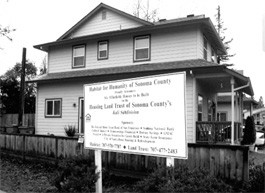
Creation theory: The Kali subdivision on West Avenue in Santa Rosa’s Roseland district is the latest Sonoma County Habitat for Humanity project.

By Patricia Lynn Henley

Ed Sotelo doesn’t like the way the media’s been describing opponents of a prospective Habitat for Humanity project in Marin. The group is proposing to build four three-bedroom homes in his Tiburon neighborhood. “They think we’re all a bunch of rich people who don’t want this in our backyard,” Sotelo complains. “Hell, I’m a working stiff myself.” Referring to the changes in Marin County real estate fortunes over the last half-century, he snorts, “I moved here 50 years ago.”

In fact, it is working folks who put in 500 hours of sweat equity, then buy and live in Habitat’s affordable and attractive houses, says Phillip Killbridge, executive director of San Francisco Habitat for Humanity overseeing the proposed project. “They’re teachers, they work as security officers, they work in your kids’ schools. This is workforce housing; this is housing for people who [want to] live and work in their community.”

For his part, Sotelo says he knows 17 widows in his neighborhood alone. None is wealthy and all are worried that the Habitat homes will harm their main asset: their property values.

Killbridge says that every single study done statewide shows that building affordable ownership housing does not hurt property prices. He adds that the four Habitat homes proposed for the .85 acre at the bottom of a 16.5-acre hilltop are being designed by the same award-winning architect who’s laying out the multimillion-dollar homes planned for the top.

Sotelo’s still worried, but Killbridge is patient. He’s been through this before. It’s a clash of perspectives, a friction between fears and dreams, as Habitat officials and other affordable-housing supporters throughout the North Bay work to find space for ordinary people who’ve been locked out of local home ownership by real estate prices that, despite a recent slow-down, are still way beyond the reach of average folks.

Potential buyers must earn 40 percent to 60 percent of the local median income, which in Marin translates to a maximum of $55,000 for a family of four. Buyers provide sweat equity, usually 500 hours or more. In exchange they get a no-interest mortgage on a house with resale restrictions that ensure it will be their home and not a get-rich-quick scheme.

Habitat’s had so much trouble gaining a foothold in Marin that the local chapter closed its doors in the 1990s. The San Francisco-based group led by Killbridge has taken up the effort to create affordable ownership housing in Marin, using a steering committee of Marin residents. If the four houses in Sotelo’s neighborhood are built, they will be the first-ever Habitat homes in Marin County.

“This is a real chance for us to make a difference in the community,” Killbridge says. “Once this first project is completed in Marin, it will be a huge learning opportunity and help things move forward.

“The first project is always the most difficult,” Killbridge adds. “Once folks see how great this development is and how great these Habitat for Humanity families are, I think it will be an opportunity to build even more homes [in Marin County].”

Sandwiched in an unincorporated area of Marin County between Tiburon and Mill Valley, Ed Sotelo’s stretch of North Knoll Road just off Tiburon Boulevard holds two houses–Sotelo’s and one other–plus a gas station, a medical office building and a veterinary clinic. At the north end of the short street North Knoll Road, Eagle Rock Road and Bay Vista Drive swoop downhill on blind curves to an intersection devoid of stop signs, sidewalks or other traffic accoutrements. Sotelo calls it the killer corner; in the past 10 years, there were 209 collisions in the general vicinity, with 112 injuries and two deaths.

“We have nothing against Habitat. We support it,” Sotelo says. “But the area that they’re putting it in, it’s unbelievable. The roads cross here and it’s one of the most dangerous in Marin County.”

Marin County supervisor Charles McGlashen agrees.

“One of the most valuable parts of this process so far is that our public works department has identified that intersection as worthy of investments to make it better,” McGlashen explains. “A wide variety of interventions are being explored. The good news is that intersection will get some much-needed attention one way or another, whether or not the Habitat for Humanity project happens.”

Residents worried about additional traffic should focus more on the three proposed market-rate homes, McGlashen says. The average expensive home on a hill generates up to 11 trips a day by residents as well as gardeners, household help and other workers, McGlashen says, while there’s empirical evidence that affordable housing generates a lot less traffic.

That’s the sort of thing that can be discussed in the coming months.

“One thing to note is that this project has a long way to go,” McGlashen says. “The design review board, the planning commission and the board of supervisors will all take a look at this project pretty carefully.”

It’s important to carefully shape a project that works well in the area.

“Marin County has a chronic lack of affordable housing, so finding suitable locations all over the county is critical,” McGlashen says. “It must be done.”

A similar process is unfolding in Napa County. After a four-year search, Solano Napa Habitat for Humanity has an option to buy a potential home site on E Street in downtown Napa, if the property can be subdivided. Although the group has built 11 homes in 10 years in nearby Solano County, this will be its first in high-priced Napa County. There’ll be a community meeting in March to discuss the possibilities.

Solano Napa Habitat for Humanity president Steve Brothers says potential volunteers tend to show up with hammers in their hands, ready to pound nails. “Most people don’t understand how long it can take to acquire property and get it approved for development.”

A registered architect and certified planner who only recently retired his California real estate license, Brothers has spent 35 years getting building projects approved. There’s always initial opposition to new housing, he says, whether it’s “affordable” or not.

“One of the common characteristics is that neighbors always object,” Brothers explains. “I believe that’s because it’s a change. It doesn’t mean the project is bad; it just means it’s a change.”

That’s why it’s critical to explain who the Habitat for Humanity homeowners will be and how the process works, says Amy Lemmer, outreach and development manager for Habitat Sonoma County, which has constructed eight new homes and remodeled 18 others since 1984.

“People’s fears are valid and they need to be addressed, but we’re not going to stop building affordable housing in our community just because people are uncomfortable. People need housing. Our mission is that everyone has a decent and affordable place to live.”

If people who work in the North Bay can’t afford to buy here, they’ll purchase a home elsewhere and commute, adding to traffic congestion and pollution, and leaving them little time to become productive members of their communities, because so much of their lives are spent on the road. Creating affordable homes they can buy in the areas where they already work is the best alternative, Lemmer says. And they make great neighbors, she adds.

“[Habitat homeowners] are much more screened than any other neighbor you have next to you,” Lemmer explains. “They go through a rigorous screening process so you usually get a much better neighbor than if you get some random person moving in next to you.”

Often, Lemmer adds, nearby residents who originally oppose a project end up supporting it, even helping with the volunteer labor. “[But] sometimes they just get dug in and then they just want to be right.

“I think it takes courage to rethink your position.”


The Byrne Report

February 14-20, 2007

I seldom feel pity for a politician when the public relations machine turns against him overnight. But in the case of San Francisco mayor Gavin Newsom, I find a morsel of compassion on my reportorial plate. He is clearly having a nervous breakdown, and the schadenfreudian twittering from his friends and foes alike demonstrates little or no comprehension of what is going on inside this man.

As a reporter for the SF Weekly for many years, I wrote about Newsom on a regular basis. He is, to twist a phrase, a Manchurian mayor, a guy who was programmed from birth to serve the political interests of a family fortune presided over by San Francisco billionaire Gordon Getty.

Getty’s childhood friend, retired Superior Court judge William Newsom, Gavin’s dad, has been the Fixer for the Getty family since the 1960s. He has escorted generations of Gettys in and out of drug rehabs; watched over Gordon’s “other” family, a collection of daughters born to a woman other than his wife; administered the Getty’s multibillion dollar business and charitable trusts; and, as Abraham did for Jehovah in the Old Testament, delivered unto Getty his first-born son.

No wonder Newsom has cracked up: he has never had a real life. Given his intellectual potential, he could have been a happy bartender, maybe a midlevel IT exec or, left to his more decent instincts, an acceptable mayor of San Francisco. Instead, his personality and political being has been shaped, molded, handled, tweaked and perverted by the imperatives of the super-rich socialite stratum that rules San Francisco and beyond. From the moment that Mayor Willie Brown appointed him to the board of supervisors in 1997, Newsom has been falsely portrayed by his handlers and the media as a “successful entrepreneur” (even though his PlumpJack restaurant and wine businesses are controlled by Gordon Getty); as “fiscally conservative” (a nonsense phrase); and as “socially liberal” (savior of the poor). When starstruck reporters such as the San Francisco Chronicle‘s team of Matier and Ross regularly labelled him as “Kennedyesque,” Newsom began to believe the hype that he is political heir to the martyred brothers.

In an SF Weekly article in 2002, I humorously compared Gavin’s minor accomplishments as a city supervisor to President Kennedy’s record as a war hero and Congressman at the same age, 34. Early the next morning, Newsom, who was running for mayor, called me. He was pissed and defensive and wanted to talk. So I visited him in his office, a space replete with busts and photographs of the Kennedys. Badly dyslectic, Newsom is not much of a reader, but he was nonetheless informed and enthusiastic about certain municipal issues. I would not trust him with the nuclear trigger–but a traffic light siting in the Marina District? Sure.

Intrigued, I investigated Newsom’s financial assets and wrote a story showing how they are completely intertwined with the Getty fortune and his father’s holdings. By that time (late 2003), candidate Newsom had stopped talking to me upon instructions from his political consultant, Eric Jaye. But Judge Newsom talked to me intimately and at length (probably because Jaye had ordered him not to). The judge said he worried that politics might ruin his son’s personal life. His own marriage to Gavin’s late mother had collapsed after the judge ran for the state senate in 1968. I received the distinct impression that Abraham was having second thoughts about sacrificing his beloved boy to the Getty gods.

As mayor, Newsom’s only claim to lasting accomplishment is his courageous stand on gay marriage. Otherwise, municipal corruption and ineptitude is flourishing as usual in San Francisco. In 2005, I interviewed the mayor in his City Hall office. He was riding high on sudden popularity, and appeared to be, well, Kennedyesque, with his rolled-up white shirt sleeves and big hair. The books behind his desk lay on their backs (so that a reporter could read the spines?). I took the bait, and we chatted about George Lakoff’s hot new book on liberal politics. Newsom showed me his highlighted copy of Don’t Think of an Elephant. Then his press secretary, Peter Ragone, left the room and returned momentarily with another book.

“Here is the new bio of Robert Kennedy,” Ragone said.

“Oh, I’ve been dying to read it,” Newsom responded, grasping it like a precious treasure.

As we walked out of City Hall together, a crowd of homeless protesters surrounded Newsom’s limo. The mayor gave me an embarrassed look, as if to say, “I really do care.” And he may care, but in my opinion, he does not possess the self-knowledge necessary to confidently govern a city, or his own life. Now, as his false image spins away like a kite caught in a hurricane, the real Gavin Newsom stumbles after it, lost and wondering what happened.

Let it go, Gavin.

or


Morsels

0

February 14-20, 2007

Enjoy life while you can–that’s the philosophy underlying Mardi Gras. Translated from the French, it’s “Fat Tuesday,” the night before Ash Wednesday, signaling the end of the traditional denial of pleasures great and small during the religious observation of Lent.

Mardi Gras is the culmination of carnival celebrations that began on Three Kings Day on Jan. 6. In Sweden, Fat Tuesday is called Fettisdagen; in Slovenia it’s called Kurentovanje (and it’s customary to eat doughnuts). The cities most famous for their Mardi Gras celebrations include New Orleans, Rio de Janeiro, Venice, Bahia and Mazatlán. Nowadays, it seems like more people celebrate carnival and Mardi Gras than observe Lent–but, hey, any excuse for a party. In the North Bay, Fat Tuesday takes on many guises, many of which have nothing to do with Tuesday at all.

  • For those who savor a good stogie–and even those who don’t–there’s the Mardi Gras Cigar Tasting complete with music and prizes for best costume and mask in downtown Napa on Friday, Feb. 16. Baker Street between First and Main streets. 6pm to 9pm. Free. 707.255.4434.
  • Dance to swing and jazz, enjoy casino-style gambling, bid on auction items and nibble gumbo, desserts and more at the annual Napa Mardi Gras Celebration at the Boys and Girls Club of Napa Valley on Saturday, Feb. 17. 1515 Pueblo Ave., Napa. 5:30pm to 10pm. $40-$50. 707.255.6499, ext. 9.
  • For animal lovers, there’s the Humane Society of Sonoma County’s Bacchus for Barkkus, replete with canine dress-up, music by the Baby Seal Club, a puppy cake walk, costume contest, food, wine and more on Saturday, Feb. 17, at the Starlight Wine Bar. In the Gravenstein Station, 6761 Sebastopol Ave., Sebastopol. All day long, from 1pm to 4pm; and again from 5pm to 11pm. 707.823.1943.
  • Get further into the swing of things with Brazilian Mardi Gras festival fun sparked by the French gypsy funk sounds of Dgiin at the Raven Theater on Sunday, Feb. 18. 115 North St., Healdsburg. 8:30pm. $10-$12. 707.443.6335.
  • What’s Mardi Gras without Cajun-style food? Cookbook author Terri Pischoff Wuerthner presents “In a Cajun Kitchen: Authentic Cajun Recipes and Stories from a Family on the Bayou” on Tuesday, Feb. 20, at Copperfield’s Books. 140 Kentucky St., Petaluma. 7pm. Free. 707.762.0563. That same night, Cindy Rice leads the Rajin’ Cajun hands-on cooking class on Mardi Gras foods at the Ramekins Culinary School. 50 W. Spain St., Sonoma. 7:30pm. $80. 707.933.0450.
  • Quick dining snapshots by Bohemian staffers.

    Winery news and reviews.

    Food-related comings and goings, openings and closings, and other essays for those who love the kitchen and what it produces.

    Recipes for food that you can actually make.

    News Briefs

    February 21-28, 2007 Making a sign One cross at a time, one lawn at a time. That's the goal of Crosses4Peace.org. "We're a very small group trying to take a very big idea and spread it to a larger geographic audience," explains Joanne Gifford, president of the project's parent organization, United Napans Concerned Over Iraq Lunacy (UNCOIL). Inspired by memorials...

    Letters to the Editor

    February 21-27, 2007Not just the evil Republicans ("Senator Warbucks," Jan. 24) was truly eye-opening! Now I see that Machiavelli's political writings have been incorporated into business-as-usual by representatives of both parties, not just the "evil Republicans." Thank you, Peter, for helping me to get wise about how the game is played today in Washington! Your story was extremely valuable.Carla...

    First Bite

    Eternal Discussion

    February 21-27, 2007The Arcade Fire have a terrible weight of expectation on their shoulders. No band in the world would envy the precipice on which the artistic success of Neon Bible, Arcade Fire's second album, due out March 6, teeters. In the current desolate atmosphere of sophomore implosions from indie rock's former brightest stars—the Yeah Yeah Yeahs, Joanna Newsom,...

    Little Big Town

    February 21-27, 2007Editor's note: This is the second part of our look at Napa's ongoing transformation.The city of Napa has always been destined for gawkers. Pioneer Nathan Coombs laid the town in out 1847 as a resort, intending to cater to patrons of a racetrack he envisioned erecting nearby. But the track never went commercial and the tourists didn't...

    Big Bad ‘Woolf’

    the arts | stage | Get the Guests: Martha...

    Fears and Dreams

    Photograph by Nina Zhito Creation theory: The Kali subdivision on...

    The Byrne Report

    February 14-20, 2007I seldom feel pity for a politician when the public relations machine turns against him overnight. But in the case of San Francisco mayor Gavin Newsom, I find a morsel of compassion on my reportorial plate. He is clearly having a nervous breakdown, and the schadenfreudian twittering from his friends and foes alike demonstrates little or no...

    Morsels

    February 14-20, 2007 Enjoy life while you can--that's the philosophy underlying Mardi Gras. Translated from the French, it's "Fat Tuesday," the night before Ash Wednesday, signaling the end of the traditional denial of pleasures great and small during the religious observation of Lent. Mardi Gras is the culmination of carnival celebrations that began on Three Kings Day on Jan. 6....
    11,084FansLike
    4,446FollowersFollow
    6,928FollowersFollow