Land of the Fee

0

Photograph by Felipe Buitrago
Paper/work: Adel Olivera, left, director of the Center for Employment Training’s Immigration and Citizenship Program, talks with Rosalba Marquez.

By Matt Stroud

Abdu Christopher Marquez is a soldier. At 21, he’s a private first class with five years to go in a six-year Army National Guard reserve contract. He has a one-year-old son named Isaiah. In a few weeks, Abdu will leave Sacramento for Iraq to join the 143rd Infantry Brigade as a military cop.

Despite the many considerations you’d imagine he’d have right now, he’s got his mom on his mind. He says he’s proud of her. That’s because this year, his mother, Rosabla, is finally taking major steps toward her Application for Naturalization, the N400 classification by the United States Citizenship and Immigration Services (USCIS).

Rosabla Marquez has lived in the United States for more than two decades. She’s put herself through a marriage, a divorce, the birth of four children, five professional changes, the rise and fall of a successful entrepreneurial career and, just last year, the birth of her first grandchild. She did it all without United States citizenship. But Abdu has playfully hassled her to get official papers since he left for boot camp last year.

“I was just pushing her–‘C’mon mom, you can’t just stay like this, you gotta be something, you gotta be somebody,'” he says. “I want her to have the same opportunities I have. Being a citizen is something to be proud of, you know?”

It has other advantages, too. Though some immigrants prefer to remain as noncitizen “permanent residents,” that categorization (aka Green Card status) is akin to having one foot in the country and one foot out. Under Green Card status, immigrants can’t vote as permanent residents and, if taken into custody, don’t have rights to a lawyer, except at their own expense; they also can’t leave the country for more than six months without risk of deportation or detainment. Citizenship is preferable for some, and Abdu believes his mother is ready to take that step.

But what if his mom had to pay almost twice as much for the privilege? She’s waited 20 years, after all, and it’s not required; her Green Card status is 100 percent legal. The fee right now is $330. But what if she had to pay $595? Would he still hassle her to get her citizenship papers then?

“Oh, damn,” he says. “If money wasn’t a problem I would, but probably not.” Rosabla has struggled financially, he says, and it was a big deal for her to be able to afford to apply for citizenship this year. “I’d probably leave her alone about it if it were that much,” he says.

Take a Hike

The increased price of citizenship may come sooner rather than later. Last month, the USCIS (not the INS, which ceased to exist on March 1, 2003) proposed a price hike that would raise the cost of some 40 disparate immigration services by an average of $223.

The proposal, according to a Homeland Security fun pack released Feb. 1, is a funding issue. According to the USCIS, an application to adjust status from temporary to permanent resident is way undervalued. It currently costs $180; if the proposal goes through, it’ll cost $1,370. (Application for temporary nonimmigrant status, however, is apparently just right. It currently costs $270. Post-proposal, that fee will remain the same.)

In theory, the proposal has an upside for applicants because it seeks to eliminate some red tape. They would not have to reapply as often, and residents applying to change from, say, temporary status to permanent residency, would no longer have to waste time and money on additional applications for work status and permission to travel. The USCIS is a government-supported but self-sustaining organization. That means all released immigration documents are legally binding and required by federal law, but costs are funded only by service fees. Because of this, the USCIS is putting the price hike to a vote. The comment period began Feb. 1 and lasts until April 2. The “adjusted” fees, if approved, will not become effective until June, at the earliest.

Bureaucracy Run Amok

Ali Noorani, executive director of the Massachusetts Immigrant and Refugee Advocacy Coalition, says the real problem is with the USCIS, which he calls a “bureaucracy run amok.” The way he sees it, throwing more money at the problem won’t help. “The spending seems arbitrary to me,” he says. “It seems immigrants will be paying a whole lot for nothing.”

Noorani says more people are waiting much longer to become citizens, even after typically required waiting periods (five years for permanent residents over 18 and three years if the applicant is a legal permanent resident married to and living with a citizen), because the Bush administration has made no investment in the naturalization process.

“The feds are increasing naturalization fees, but making no concrete commitment to improving services,” Noorani says. “If anything, this is just another brick in the wall. Who decides where the money goes?”

USCIS spokesperson Sharon Rummery responds that no one can decide better than the agency itself. “We know where our needs are, so we know what money needs to go where,” she says. The reasoning behind the fee-increase proposal is simple, Rummery says. Since USCIS is funded solely by user fees, “if we want to keep up, we need to raise costs.”

But Angelo Paparelli, an active immigration blogger, California certified specialist in immigration law and former chairman of the Immigration and Nationality Committee, doesn’t believe the USCIS has measured its costs accurately. He says that before the proposal is approved, the USCIS needs to be held accountable at a congressional oversight hearing where it shows proof of cost analyses and funding needs. “Otherwise, it sounds either like an elusory campaign for technological improvement, or a tax on wanting to become a citizen,” Paparelli says. “And isn’t citizenship something we encourage?”

Not necessarily, says Norm Matloff. A computer science professor at UC Davis, Matloff is an outspoken anti-immigration activist who’s particularly concerned with computer companies seeking to hire foreign guest workers. “Most people view illegal immigration as bad simply because it’s illegal,” he says. “I don’t look at it that way.”

Instead, Matloff asserts that immigration has the more or less the same effect, whether it’s legal or not.

“As to the immigrants themselves,” he says, “I would sympathize with them if the increased fees were to force them to stay illegal. However, I do not believe that that would happen; they’ll pay the cost, even if they have to borrow the money.”

Rosabla Marquez has avoided the price hike. But even if the price were a thousand dollars, she says she would find a way to do it, however she could. Her entire family is here, her children were born here and it’s in her best interest to become a citizen, she says. “I want to do it. I really do.”

To express your opinion on USCIS’ proposed price increases, e-mail comments to OS********@*hs.gov or mail them to Director, Regulatory Management Division, U.S. Citizenship and Immigration Services, Department of Homeland Security, 111 Massachusetts Ave., NW, 3rd Floor, Washington, DC 20529.


UnReal Estate

0

March 7-13, 2007

The Money Issue:

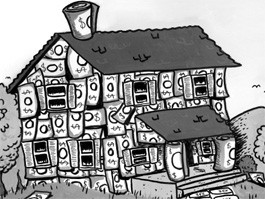
A house appraised at $500,000 two years ago now sells for $400,000. “We’ve lost $100,000” wail the neighboring homeowners, who bought cheaply and expect their property values to soar each and every year. But that “lost” $100,000 is fantasy money, say real estate experts. How can you lose something you never really had?

Home sweet equity. Is the family dwelling a place of shelter and warmth, or a canny investment, destined to pay off big? Barraged by advertisements for easy financing and enticed by television shows portraying trading up or “flipping” a house as the smart thing to do, an increasing number of homeowners are viewing their primary residence less as a place to hang their hat and more like an endless money machine.

“Your home is your biggest, most valuable investment. You shouldn’t abuse it,” advises Erica Sandberg, spokeswoman for Consumer Credit Counseling Service of San Francisco.

Second mortgages. Refinancing. Home-equity loans. Reverse mortgages. Buying a place with no money down and interest-only loan payments. It’s all so easy to do. Just sign on the dotted line, get what you want now and it will all work out later, right?

“It’s not acceptable to be overly optimistic,” Sandberg cautions. “You need to look into the future and say, ‘What happens if I lose my job, what happens if my partner loses their job, what happens if the interest rate goes up?’ Get rid of the idea that you’ll be able to make it somehow. That philosophy gets people into trouble really fast.”

Home-equity loans are easy to get and offer lower interest rates than credit cards. Pull a little cash out of the old homestead and put in a fabulous kitchen, send a kid to college, buy that dream car or boat. What’s the harm? Your house is worth it, and why not have the money now rather than later?

“You can really overuse your equity,” Sandberg warns. “You can take out too much to where you tap yourself out.”

And if you take money out of your house now, don’t expect to get that same amount again later when you sell. The buy-buy-buy and borrow-borrow-borrow mentality is harmful to many people, Sandberg says. Some folks purchase a pricier place than they can afford, using fancy financing and scrambling to make the payments each month on the gamble that the property will be worth a lot more in the long run. Others use home-equity loans or second mortgages to pay for I-want-it-now luxuries or to cover daily expenses, blithely assuming they’ll be able to handle the extra payments. Homes have taken over the role of savings accounts.

“You still need cash to cover yourself in an emergency,” Sandberg explains. “That’s not the purpose of a credit card, and that’s not the purpose of your home.”

Welcome to the complex world of personal real estate, where homeownership is an important investment, but not in the same sense as income property, stocks or bonds. A home is a long-term asset, existing in a market based on supply and demand. Even when prices drop, owners still have a place to live. You can’t live in a stock or a bond.

Older people still tend to pay off their mortgages and own their homes outright before retirement, says real estate agent Golly McGinty. It’s younger generations who sometimes view their houses as the equivalent of giant ATM machines.

“It’s like putting candy in front of a baby; you’ve got it, why not use it?” she says.

When the real estate market was hot and homes were appreciating 10 to 20 percent or more annually, people gambled that home values would quickly build back the equity they had sucked out through loans. But then the market leveled off, and some folks ended up owing more than their house is currently worth.

“Real estate is not a crap game. Real estate shouldn’t be thought of as gambling,” McGinty emphasizes. “If you want to gamble, go to Reno and put your money on the table. If you want to own a home or invest in real estate, that’s different. And those are two different scenarios, owning a home and investing in real estate.”

It helps to have a long-term perspective, advises agent Beth Egan.

“Real estate is very psychologically driven,” Egan says. “If there’s only one item and four people want it, the value goes up. And I think the media plays into it very, very heavily.”

When the market was hot, the media urged people to buy immediately or get locked out of homeownership.

“What happened was that people had this false sense of value,” Egan says. “They took that false sense of value and went and got home-equity lines of credit and took that money and bought boats and cars. We became a society of haves and have-mores.”

In an average market, homes appreciate about 3 percent to 5 percent a year, not spectacular, but a steady improvement over time. Historically, Egan adds, homes double in value about every 10 years.

Asked about media hype over the real estate “bubble,” Egan rolls her eyes. In her opinion, a bubble is a trend or a fad that’s going to become outdated and replaced.

“People are always going to need houses and there is always going to be a certain demand for houses,” she points out. “The market will shake itself out, people will come back to a more realistic sense, and the market will correct itself. That’s a better word for what’s happening now: it’s a correction of the market. It’s not a bubble, it’s a correction.”

Mortgage broker Brooks Rumph agrees. “Real estate is cyclical. Everything goes up, everything comes down, everything goes up, everything comes down.”

The key is in understanding the details of any type of financing, whether it’s a no-money-down, interest-only loan or a home-equity line of credit.

“You have to be very clear what the terms are and what you’re doing,” Rumph explains.

Be skeptical of flashy advertisements for 1 percent interest rates. They’re what’s known as negative amortization, where the actual interest rate is 8 percent or more, but payments only cover 1 percent, which means after several years a homeowner actually owes a lot more money than at the start of the mortgage.

“Those ads are so incredibly deceptive,” Rumph says. “I get them [mailed to me at home] all the time that look like they come from the mortgage company I work for.” They don’t. He ends up assisting people who fall for the sales pitch and wind up angry, frustrated and desperate when things don’t work out.

Like Sandberg, McGinty and Egan, Rumph believes perspectives on home ownership have shifted.

“Somewhere down the road, people have gone from this concept of shelter and a warm place to live to an investment vehicle,” he says. “People have gone from thinking the house that they live in is their home, to thinking, ‘Ooh, I’m going to make a lot of money on this structure.'”

Investment property, Rumph says, is just that: an investment. It’s not a home. “You’re not attached to it. It’s not close to your heart–or it shouldn’t be.”

Although he agrees with Sandberg and other credit counselors that homeowners should be careful about tapping into their home’s value, Rumph says home-equity loans can be good if used judiciously.

“In a perfect world, you wouldn’t use an equity line except for home improvement. In the real world, people don’t save. An equity line can help people get through six months of trouble.”

However, applying for a line of credit while times are good, Rumph says, is a safety net.

“Life gets in our way and you never know what’s going to happen. It’s harder to get an equity line of credit when you get laid off than if you’re employed and taking it out just in case. Better to eat a little bit of equity than to lose your home in times when you lose your income.”

Sandberg, McGinty, Egan and Rumph may disagree on exactly what property owners should do, but they agree on the fundamentals. “Get as much information as possible and understand your loan programs. That’s a big key,” Rumph concludes. “Don’t get into something you don’t understand completely.”


News Briefs

March 7-13, 2007

North Bay views?

Is global warming a potential threat to our local economy and quality of life? According to a recent annual survey by the Bay Area Council, 42 percent of North Bay residents think it’s “very serious” and 36 percent view it as “somewhat serious,” with only 12 percent saying it’s “not too serious,” 4 percent calling it “not at all serious” and 5 percent replying “don’t know.” Similar results were found throughout the nine Bay Area counties, with 48 percent at “very serious” and 30 percent at “somewhat serious.” That’s based on interviews by the Field Research Corporation in both English and Spanish with 600 Bay Area residents–100 of them in the North Bay counties of Marin, Napa, Solano and Sonoma–between Jan. 8 and Jan. 14. (The survey is said to be accurate by plus or minus 4 percent.)

The Bay Area Council, which represents hundreds of major employers, also asked if the state should regulate greenhouse gas emissions “across the board” by making all companies cut back 25 percent, or use a “more flexible trading system” in which firms that can’t cut back easily can pay other companies to reduce their emissions even more. The Council’s poll found that 33 percent of all respondents (40 percent of those in the North Bay) favored the make-everybody-do-it approach while 49 percent (47 percent in the North Bay) thought the flexible trading system was best.

As is done each year, the survey also asked about the biggest problems facing the Bay Area. Traffic and transportation were listed as the main challenge by 41 percent of the North Bay residents and 33 percent of everyone surveyed. In 1995, only 16 percent thought traffic and transportation were the main difficulty, while 32 percent named crime as the primary concern.

Asked if they’re better off financially than they were a year ago, 48 percent said yes in 1996. That dipped to 31 percent in 2001 and 27 percent in 2002, but rose to 42 percent this year. In 1996, 72 percent thought the Bay Area economy was in good shape, compared to 18 percent in 2002, 14 percent in 2003 and 53 percent this year.

Asked how well Gov. Schwarzenegger is doing his job, 60 percent of North Bay residents approved, 19 percent disapproved and 21 percent didn’t know; of everyone surveyed, 54 percent approved, 30 percent disapproved and 16 percent didn’t know.

Since this is a business-sponsored survey, we wonder how accurately it reflects local views. Do you think global warming is a serious threat to the North Bay? Do you favor regulating emissions by making every company cut 25 percent or letting them “trade” emission reduction requirements so the net is still 25 percent from all firms?

E-mail your opinions to ed****@******an.com with “Global Warming” in the subject line.


News of the Food

0

March 7-13, 2007

I‘m pretty skeptical of diets, and I’ve never been on one. The fact that there’s always a new fad diet making even greater promises than the last one only reinforces how specious their claims of health benefits and weight loss are. But as I was reading an article in the New York Times recently about a reported Viagra boom in Spain, I came across a diet that could have real benefits.

The Feb. 11 article (“Spain Says Adios Siesta and Hola Viagra”) describes how cultural changes in Spain are fueling surging demand for the little blue pills. Pfizer, the drug’s manufacturer, says it sold nearly 1 million boxes of Viagra last year, the equivalent of one box for every 17 men ages 18 and older. The drug is in such demand that there are reports of drugstore thefts, and Spanish women are increasingly requiring their partners to get prescriptions for the drug.

Spain is moving from a sleepy-but-sexy Mediterranean culture into a Anglo-Saxon-style, work-obsessed nation, and it’s having a negative impact on men’s libidos, the article says.

“We used to have a siesta, to sleep all afternoon, to eat well,” says Belén Alguacil Arconada, a Pfizer spokeswoman. “But now we have become a fast-food nation where everyone is stressed out, and this is not good for male sexual performance.”

Implicit in this statement is some exciting information: that eating well, taking midday naps and not working too hard is good for your sex life. If ever you needed an excuse to eat well and take it easy, this is it. A recent study in Greece, another wise Mediterranean country, found that regular naps help lower your chance for heart disease. So there’s further evidence that a long lunch followed by a nap is good for you.

What good is the so-called Anglo-Saxon lifestyle anyway? Work too much and you’re likely to die young and need to pop a pill to get it up.

Quick dining snapshots by Bohemian staffers.

Winery news and reviews.

Food-related comings and goings, openings and closings, and other essays for those who love the kitchen and what it produces.

Recipes for food that you can actually make.

Soulsville, USA

0

March 7-13, 2007

America is doing some serious soul-searching. After six years of treachery in the White House, opinion polls show that an overwhelming percentage of American voters would seriously consider electing a black president–and that’s good news for the charismatic senator Barack Obama of Chi-town.

How ready are we for a black president?

The pundits are already arguing if Obama is black enough.

In recent months, the country has been cozying up to soul music in a big way. The Dixie Chicks’ “Not Ready to Make Nice” might have snagged the 2007 Grammy Awards Song of the Year honors, but the snarling neo-soul single “Crazy,” from Gnarls Barkley’s funky St. Elsewhere album was the bigger radio hit. And neo-soul connoisseurs grooved last summer to British blue-eyed soulman James Hunter’s party-pleaser People Gonna Talk, which bristles with Sam Cook and Jackie Wilson sensibilities. And, of course, there’s that ongoing love affair with Dreamgirls.

Of late, Sony/BMG has launched an ambitious new reissue program that includes a Beautiful Ballads series, featuring the softer sides of Earth, Wind & Fire, the Isley Brothers, the O’Jays and Gladys Knight & the Pips, among others. In late March, the label will reissue seven digitally remastered titles by Sly & the Family Stone–the premier crossover soul band of the ’60s and ’70s, and the originators of the ubiquitous slap-bass sound–with a slew of bonus tracks.

Meanwhile, on March 13 the Concord Music Group is initiating a major reissue of Stax Records material, starting with a two-CD box set featuring 50 hit singles by Otis Redding, Sam and Dave, Booker T & the MGs, Isaac Hayes, Johnny Taylor, Albert King, the Staples Singers, Rufus and Carla Thomas, and others. The Stax 50 compilation commemorates the 50th anniversary of the founding of the seminal Satellite Records as a country music imprint in a north Memphis garage before it edged into rhythm and blues.

CMG, which acquired the Satellite, Stax and Volt catalogues as part of its 2004 purchase of Fantasy records, also plans to release definitive collections, rare performances, unreleased tracks and remixes on another 20 Stax titles throughout the year.

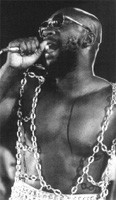
The beauty of the Stax/Volt label (known as Soulsville USA) was that for the most part it served as a gritty, blue-collar adjunct to the squeaky-clean sounds of Detroit’s Motown label, which billed itself as Hitsville USA. While Motown artists like Marin Gaye–with his dapper demeanor, smooth choreography and tailored Italian suits–were coolly churning out pop hits without so much as breaking a sweat, such Stax/Volt artists as the soul duo Sam and Dave were tearing up stages with a far more visceral brand of soul music.

It’s a sound that continues to resonate: the Stax/Volt roster is a staple of the classic radio format; Portishead sampled the Isaac Hayes single “Walk on By” for their song “All Mine” (used last year on a Victoria’s Secret TV ad); and Prince snared Stax/Volt artist Frederick Knight’s singing style, lock, stock and barrel.

Music industry wags report that Justin Timberlake is planning to revive the Stax label to produce contemporary R&B acts. And while that may not be black enough for you, the classic sounds on Stax 50 should serve as a scintillating soundtrack for this extended presidential campaign.

At least it’s one party that won’t let you down.


The Ag Report

0

March 7-13, 2007


The face of agriculture, as Northern Californians have known it for decades, has changed forever. Old faces have vanished and new faces have arrived. The days defined by barbed-wire fences, locked gates, crop-dusting, “No Trespassing” signs and a near-medieval state of mind have disappeared. All across Sonoma, Marin, Napa and Mendocino counties, a new generation of artisan farmers and creative ranchers have opened their fields and barns to the public and set out the welcome mat.

Pesticides and herbicides that caused cancer have been banned, and the compost pile thrives as never before. Unlike the agriculturalists of old, who prided themselves on producing the biggest crops in the fastest manner, today’s quiet agrarians believe that small can be beautiful, that slow and steady makes for good business, and that farmers, environmentalists and consumers share common ground: the planet earth itself.

Land prices are daunting, and so can be the advent of agribusiness into the lucrative organic-food economy, but small, local farmers are reinventing the ancient art of tilling the soil, carving out niches in a complex market. College-educated, worldly wise and possessing high-tech savvy, these agricultural revolutionaries have introduced new varieties into the region, and they have resurrected old ones. Even the once regal apple has made a dramatic resurgence.

Sally Graves and her husband, Mike-the president of the Marin County Farm bureau-grow a half-dozen different varieties of such heirloom apples as Pinova, Mutsu, Senshu, William’s Pride, Molly’s Delicious and Orin on their sprawling 600-acre ranch in the heart of rural Marin County. “It’s sad to see orchards pulled out, but while others are pulling out, we’re putting in,” Sally says. “We sell every single apple we pick, and we’ve derived immense pleasure from our orchard. There’s nothing as beautiful as an apple tree in blossom.”

Sally inherited Chileno Valley Ranch, a family-run enterprise since 1862, from her mother. She and Mike do the picking and pruning themselves. “We must be crazy,” she says. “We’re grandparents. In addition to apples, we grow pears; we’re doubling the size of the orchard, and next summer we’re putting in tomatoes.” Sally calls the ranch “a hybrid,” because the apples are certified organic and so are their pastures, while the cattle they raise are merely “grass-fed.” They inoculate the herd against diseases, which means that the county does not allow them to sell beef under the organic label. But they treat their cows as humanely as cows raised for beef can be treated.

“We enjoy a connection to our animals,” Sally says. “The calves live here their whole lives and they’re harvested here. A butcher slaughters and quarters three animals at a time. The meat hangs for two weeks and customers pick it up at the butcher shop.”

Today, growers not only raise the food we eat, but also, increasingly, provide a sense of place, a feeling of attachment to the earth, feeding the imagination as well as the stomach. Men and women with a hoe and seeds, hope and salesmanship serve as guardians of moral values in a world in which nothing feels deep-down rooted anymore.

In the agricultural fields of the North Bay, I hear two constant refrains: “To own a farm in Northern California, you either have to inherit it or marry into it” and “Your farm will reflect your personality.” Both seem true. Stan Denner, who is nearly 90, and who met the legendary Luther Burbank as a boy, is a fourth-generation Sonoma County rancher; in boots, jeans and cowboy hat, he’s the iconic California cowboy.

Bearded, bespectacled Lou Preston from Preston Vineyard also comes from a traditional farming family. He grew up on a local dairy, went away to college and came home to grow grapes.

“I was seriously bitten by the grape bug and had grape blinders,” Preston said at a recent panel at the Sonoma County Museum. Preston now grows prunes, apples, walnuts and olive trees. He shared the panel with Denner and with Rick Kaye, a self-described “wannabe farmer” who works as an education specialist for the Sotoyome Resource Conservation District, a local agency that lobbies on behalf of the environment and for sustainability. Kaye reminded the audience that two acres of farmland are lost every two minutes in the United States. Still, acres of farmland are also found and restored, and even outsiders like Kevin McEnnis occasionally acquire land on their own.

After graduating from UC Santa Cruz and working in Guatemala for human rights, McEnnis settled in Sonoma County in the late 1990s. He leased land from the city of Santa Rosa and began to grow vegetables on 10 acres at Quetzal Farms. At first, he did all the growing and selling himself. Then he burned out and joined with Keith Abeles, who took over much of the marketing. They sell to Green Leaf, a major San Francisco distributor, and to Oliver’s, Whole Foods and Fiesta markets. The bulk of their produce is sold in Berkeley, some of it grown to meet the exacting specifications of gourmet chefs looking for new, different tastes.

“This is a weird profession to be in,” McEnnis says as he stands in the middle of a field with a winter cover crop, a baseball hat protecting his eyes from the bright sun. “People have stereotypes. They expect ‘Farmer John’ in overalls.”

McEnnis and Abeles, who look more like Butch Cassidy and the Sundance Kid, pay $600 a year in fees to be certified organic. “We’re found that the further away from the farm, the closer the relationships we have with customers,” McEnnis says. “In Sebastopol, we’re taken for granted. In Berkeley, where we have a cult following, they love us. They see our peppers and tomatoes, and say, ‘They’re beautiful.’ In a way, we’re fulfilling aesthetic needs.”

McEnnis and Abeles say that their farm is profitable, but they must borrow money every year. Like most, if not all farmers, they experience cash-flow problems. McEnnis adds to his income by teaching at New College. “I want the students to be able to grow their own food in keeping with ecological principles,” he says. “I bring them to Quetzal and show them what we’re doing here.” He and Abeles have also taken their message abroad; as invited guests, they attended Terra Madre, a gathering of artisan food producers held last year in Turino, Italy, sponsored by the Slow Food movement.

Nobody in local farming has the cash-flow problem solved as well as Scott Mathieson at Laguna Farms, which, surprisingly, is not organic. Mathieson has more than 400 supporters who belong to his community-shared agriculture program. For years, they have been the saviors of Laguna Farm, and they’re proud of their role. Such subscribers will play a part in saving small, locally owned farms in northern California-if the locally owned farm, that endangered species, is to be saved at all.

“We’re blown away by these carrots,” says Martha, a Laguna Farms subscriber who stopped by the place on a recent Wednesday to pick up her food. She was raised on a farm in the Midwest. “These carrots taste the way carrots taste in your wildest imagination.” Barbara, who comes from Chicago and lives a mile from the farm, says, “We need to have farms close to home. This is the way we need to go in the future.”

Imgard Kern, who was born and raised in Germany, sums up the way a great many shoppers feel. “It’s a political statement to buy from a local farm,” she says. “I like to think it’s spreading.” Michael Traugot, a Ph.D. student in agriculture at UC Davis adds, “I like the fact that the produce here is not flown in or trucked from far away. I also buy here to help prevent urban sprawl.”

One shopper had a gripe about her bill. Maitreyi Siruguri, who grew up in South India and who supervises the pickups and payments, came to the rescue. She settled the account amiably and went on keeping the books.

Mathieson used to run his CSA on the honor system, but that proved unworkable; cabbages, carrots and kale disappeared and receipts didn’t add up. The only way to prevent produce from vanishing was to keep a sharp eye on it and, more recently, to hire Siruguri to mind the store.

Laguna Farms has had problems since it started in 1986, but Mathieson maintains his utopian dreams. “Local is more important than organic,” he says, standing in the sun, wearing clogs, baggy sweatpants and a fleece jacket with a button that proclaims, “Inner Peace Is World Peace.”

Mathieson doesn’t hide the fact that his parents gave him the land and that he doesn’t have a mortgage to pay. He doesn’t hide his politics either. Some of what he says he’s borrowed from the agrarian philosopher Wendell Berry. He quotes Berry’s remark about putting culture back in agriculture, and over the years, he’s done just that. In the summer of 2007, he’ll operate the Earth Roots Field School to teach “sustainable living” and “nature awareness.”

“If you are what you eat, then what you put into your mouth is what you turn into,” he says. “What you feed the soil is what you feed yourself.” He’s certainly driven, if not preoccupied, with his farm, but he’s harvested wisdom, too. “I’m addicted to this lifestyle,” he says. “But I don’t want the farm to run me; I want to run the farm.”

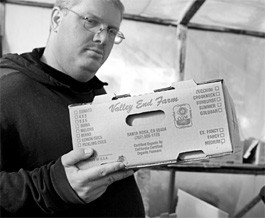
Halfway across Sonoma County, directly east of Laguna Farms, a far different story unfolds at Valley End Farms on Petaluma Hill Road, near the foot of Sonoma Mountain. Valley End looks like the quintessential local farm; the rich, dark soil smells lovely after it’s newly plowed, and men and women, not machines, do the harvesting. Sharon Grossi, who owns and operates the business with her son Clint, named the farm “Valley End” because it sits, literally, at the tiptop of a long, fertile valley.

She didn’t mean the name to be prophetic, didn’t think she would live to see the end of farming in her valley, but it might turn out that way. A developer wants to build 1,600 houses across the road, Sonoma State University is expanding in her direction and the county is calling for more wetlands adjacent to Grossi’s 65-acre farm.

“They’ve got me squeezed, and I’m freaked,” she says as she sits on the sofa in the living room of her sprawling, modern farmhouse, dressed in sweatpants and a sweatshirt. “Everyone loves the farmer, and everyone loves agriculture, but everyone, it seems, wants to live in Sonoma County, and that means more houses, more traffic, more people, more cars, more malls, diminishing water and fewer farms. I want to go on living and farming here, but I’m not sure how I’m going to do that.”

Farming has been Grossi’s life. Raised by her parents on a ranch, she mended fences, milked cows and pulled heifers out of ditches. “Dad worked me like a man,” she says. “I did boy stuff all through my teen years.” She attended Cal Poly, studied agriculture and received a certificate to teach home economics, which comes in handy, she says, when deciding what crops to plant. As a young woman, she married a dairyman, reared kids, raised hay and ran the business end of the ranch before she divorced and moved away to start her own operation.

No one seems to have the latest figures, but Valley End Farm is apparently the largest certified organic farm in Sonoma County. It is certainly the largest local organic farm owned and operated by a woman, and working in the largely male-dominated world of agriculture has not been easy. “Some San Francisco distributors seem to think that women are dumb and that they can cheat me,” she says. “I have to stay on my toes.”

Grossi, who is known in the trade as the “Bean Queen,” grows four different kinds of beans, plus garlic, spinach and tons of tomatoes. She makes a decent living, but she works hard-360 days a year-and paperwork on her desk and a computer constantly beckon. Now that big farms in the great Central Valley have converted from conventional to organic because it’s more profitable, not for moral or political reasons, she finds herself squeezed at the marketplace.

“Organic is mainstream now,” she says. “It’s not a niche product anymore. The change is driving the price way down. If the trend continues, it might put small and medium size growers like me out of business. Or else I’ll have to reinvent the wheel.” Last summer she started a roadside stand on Petaluma Hill Road and sold enough vegetables to make her want to expand. She’d like to have subscribers, and open a year-round store. If Rohnert Park or Sonoma State University would adopt her farm, she’d breathe a big sigh of relief.

The farmworkers who work for Grossi seem happy enough, but organic farmers are not known to pay top dollar to laborers, and the law of supply and demand demands that they cut costs. Not paying minimum wage is one solution.

If farming in northern California is to survive, it may depend on Mexicans like Leno, the foreman at Valley End. Born and raised in Oaxaca, he worked on a farm called La Pelita before he came to the United States and obtained a green card.

“My whole family is here now,” he says. “The opportunities are bigger here, and my own dream is to own a rancho. I have a heart for farming and I plan on growing organic. Not using chemical sprays is better for all of us. There’s less of a chance of cancer.”

Growers who find a niche and work it efficiently also seem likely to survive the revolution in agriculture. Perhaps no local grower has carved out a niche more successfully than Joseph Minocchi, the quintessential hermitlike herbalist at White Crane Springs Farm, deep in the forest not all that far from the border between Sonoma and Mendocino. On a postage-stamp-size farm, fed by the freshest water around, he grows flowers, herbs and rare greens for “the elite,” to borrow his own phrase. Minocchi uses no machines and no chemicals. He works seven days a week year-round and earns the bulk of his income from his 20 ingredient “Wild and Herbal” salad mix, featuring burnet, chickweed, mache, sorrel, purslane and mallow that he sells for $30 a pound. He ships the mix in special containers that preserve its freshness to gourmet restaurants in Las Vegas, and he delivers it by hand to the Saturday farmers market at San Francisco’s Ferry Building.

“I’m beyond organic,” Minocchi says on a cold winter day when the ground is covered with frost and the sun doesn’t shine on his land. “I’m biodynamic. When I started, I didn’t want to grow the same things that everyone else was growing. I didn’t want to grow lettuce. It’s too common. So I raise tulips and watercress, which I sell for $30 a pound, and that Alice Waters loves. Once anybody tries my Wild and Herbal mix, they’re hooked, and it’s good for you, too. It tastes wonderful and it’s medicinal, too.”

He holds out his hand, his palm filled with fresh herbs, and smiles. “What more could anyone want?”

Quick dining snapshots by Bohemian staffers.

Winery news and reviews.

Food-related comings and goings, openings and closings, and other essays for those who love the kitchen and what it produces.

Recipes for food that you can actually make.

Mightier than the Chord

0

March 7-13, 2007

The ides of March is around the corner, and the mere anticipation of ambition has dogged every sophomore release this year so far. Even Bloc Party aren’t immune, especially with their PR flak’s lofty suggestion that their new disc, A Weekend in the City, is another OK Computer. (It isn’t.) But unlike the Killers’ musical murder of last year, Bloc Party’s concept album receives only a misdemeanor noise complaint.

“Song for Clay” kicks City off uncharacteristically, with Kele Okereke’s Morrissey-like crooning over gentle organs. “I am trying to be heroic in an age of modernity,” he wails, the first in his many personifications of London disillusionment. But just as you settle into the self-destructive murk, on comes the familiar guitar throbbing and spastic drumming.

Much of the album follows suit, with arbitrary tempo shifts and regal vocal walls that show the band trading Gang of Four for Queen. The needless synthesizer blips, symphonic swells and U2 choruses appear to exist only for the sake of bombast. But Bloc Party’s strengths–indelible melodies, taut chord crunch, shimmering arpeggios and more-soulful-than-Bowie vocals–persevere, providing enough audio Viagra to satisfy fans of their downright danceable first disc, Silent Alarm.

Sacrificed in the shuffle, though, is the proper context for Okereke’s lyrics, which run the gamut from post-9-11 paranoia (“Hunting for Witches”) to sexual promiscuity (“Kreuzberg”). While rapid axe-shredding distracts from the refreshing racism study in “Where Is Home?” everything coalesces on “I Remember,” a sugary, Echo and the Bunnymen-like gem recalling an unfulfilled young gay romance that’ll surely cause a fury of blogospheric speculation.

Any strong thematic cohesion is laid to rest by the second half, with its uniformly subdued reminiscences of youthful glory days, but Bloc Party still warrants our attention. Unlike Clap Your Hands Say Yeah, the quartet’s second record has, at the very least, staked a claim in the here and now, showing that their transcendence of buzz-band status is underway. Now, if they could just stick to one speed per song . . .


Splitting the Jar

0

March 7-13, 2007

The Money Issue:

‘So, how are we going to split up this money?”

Someone was bound to ask it sooner or later. It’s hard enough to count all the crumpled-up and folded bills from the pickle jar when there’s only enough room to form separate piles on my knees in a back seat crowded with 12-packs and sleeping bags, and now we have to figure out what to do with it. What’s more, the van is rocking with celebration, while 10 feet away inside this garage in Arcata, a hundred people sweat and sway to the sounds of the sixth and final band of the night.

What at first seemed like a recipe for the cops showing up has turned, miraculously, into a successful show; perched delicately on my knees, the random collection of bills grows and grows. Not bad, considering that after the first two bands the promoter simply stopped working the door to hang out with her friends, the job and the pickle jar falling into the hands of a semisloshed guitarist from an opening band. After amassing a collection of batted eyelashes and various beers, he turned into a fully sloshed guitarist, passing the door duty off to, oh, someone standing nearby.

Thus, the show became a beautiful cohesion of individual disarray. Out here, the waves of the intoxicating night reign supreme, and responsibilities are anybody’s guess. No one knows exactly who moved all the landscaping equipment to the back of the garage; no one knows exactly who set up the PA in the corner; no one knows exactly who paid and didn’t pay to get into the show, but somehow, at the end of it all, I am delicately balancing exactly $300 in my lap.

“Do you think we should get all the bands together and talk about it?”

The logic of distributing door money is fairly complex, further complicated tonight by the presence of six bands on the bill, all of them from out of town and in need of gas money. It’s not my job to split up the pickle jar, but old habits die hard and my brain starts in on the customary considerations of the task. Which band headlined? Which band has the longest drive tomorrow? Which band didn’t play for two hours or break the microphone stand?

“What about $100 each to the Midwest bands, if they’re cool with that, and $25 each to the West Coast bands?”

Inside, where there’s barely room to move as a gelatinous mass of bodies swirls and reverberates, the crowd responds with screams after each gut-filled song. It’s a diverse spectrum of punks, hippies, students, hipsters and models, but tonight they cohere as one under the garage roof, and from atop a stump next to a wheelbarrow filled with mulch, I can watch friends square-dancing, couples making out with teenage abandon, fans literally hanging from the rafter beams.

“All the bands playing tonight are on tour!” the bassist shouts between songs, “so please go see what they have to sell at the table in the back!” A collection of silk-screened records, dubbed cassettes, hand-printed thrift-store shirts and photocopied zines occupy precious table space with their respective, humble price lists. The headliner, a band from Indiana called Defiance, Ohio, displays a sign, scrawled on corrugated cardboard, that asks just $6 for CDs and $8 for T-shirts.

The band who’ve just finished, called This Bike Is a Pipe Bomb, sell their own dirt-cheap merchandise alongside that of other bands from their hometown of Pensacola, Fla., and after their set I overhear the singer offering a rare guarantee to a curious onlooker. “If you don’t like it,” he says, “write to me, and I’ll give you double your money back.”

At the end of the night, as the crowd slowly disperses–many of them on bikes, still others stumbling into the main house for a midnight dance party–I go out to the van to grab the pickle jar. But to my surprise, it’s nowhere to be found, because the headliners themselves have already grabbed, and decided what to do with, the cash.

Most people would be worried, but the night has been so strangely amazing that it seems natural what happens in the end. Hell, it’s such a tiny amount of money anyway, the headliners say. After all of the hemming and hawing, they simply give every band $50 each–an equal six-way split–and everyone raises a toast to each other.


Six Reasons

0

March 7-13, 2007

The Money Issue:

Please forgive us for quoting Karl Marx, whose writing is just a bit on the dense side, but he says it best: “This physical object, gold or silver in its crude state, becomes, immediately on its emergence from the bowels of the earth, the direct incarnation of all human labour. Hence the magic of money.”

Little did he know then that money is magical for other reasons, too.

Special powers coming to a bill near you As printing technology becomes more accurate and accessible, counterfeiting will also become easier. Taking a turn from Hogwarts, anticounterfeiting nanotechnology of the near future may make the face on your $100 bill look like it has a mind of its own. “Squeeze Ben Franklin’s face and he might smile or wink or turn purple,” predicted a recent NPR broadcast. In the next decade, other molecular powers attesting to the purity of our bucks may include the ability for a bill to feel like paper while withstanding scissor blades or to become rigid when snapped and floppy when pulled. Apparently, some industries, like (big surprise) medicine and defense, are already using nanotechnologies, but they’re too expensive at the moment to apply to money.

Making money literally makes money Apparently, only 8 percent of Americans realize that the United States Mint produces coins. That worries us. Where do the other 92 percent think coins come from? Super Mario Bros. machines? Contrary to popular belief, the U.S. Mint does indeed make coins (bills come from the U.S. Bureau of Engraving and Printing) and has for, oh, the past 215 years. The Mint also holds custody of the American gold and silver supply–roughly $102 million worth–at a bullion storage facility in Fort Knox, Ky., and operates four plants nationwide, one of which is in San Francisco, overlooking the Castro.

The S.F. branch produces proofs, which are specially made collectible coins. One of these is a $5 gold coin, and technically it could buy an egg salad sandwich. But the Mint sells the coin for more than $200, directing the profits toward converting the city’s historic old building, aka the Granite Lady, into a museum. One of the U.S. Mint’s big moneymakers is the quarter, which in 2003 cost only about eight cents to make. That means that for every quarter the U.S. Mint produced that year it made roughly 17 cents. In 2005, the U.S. Mint posted a $1.77 billion revenue but, because it’s a government agency and therefore not allowed to make a profit, contributed $775 million to the U.S. Treasury.

Money can disappear (but you already knew that) Benevolent as it may seem, the U.S. Mint nonetheless has an enemy: Coinstar. Coinstar is embodied by those green kiosks at grocery stores into which people dump the contents of their piggy banks in return for the equivalent–less roughly 9 percent–in cash or gift certificates. Coinstar’s website even has a calculator estimating how much your jar of change is worth based on how many ounces the jar measures. According to the website, a 32-ounce Mason supposedly yields some $57.08.

Why does the U.S. Mint hate Coinstar so much? Because it recirculates the wealth. What the Mint and its employees count on is that about half of all change manufactured is eventually lost–under sofa cushions, in wishing wells, stashed in jelly jars, etc. In fact, about one-half of the entire U.S. Mint production is dedicated to turning out pennies, which suggests that with all the loose change out there, we especially can’t be bothered to pay for goods in pennies. Better to drop them in the tulips’ water or use one to rejoin the contacts of a broken coffeemaker. Sure, each penny costs more than one cent to make (estimates range from 1.1 to 1.4 cents), but more of the Mint staff stays employed as long as there are lost pennies, nickels, dimes and quarters to replace.

Animal, vegetable and mineral–like a sorcerer, money assumes different forms The Kyrgyz once used horses as money, making small change in the form of lamb skins. Like a demon, money has traveled through the ages, possessing various hosts: tobacco, cowrie shells, rum, indigo, salt, barley (in Babylon, the term shekel referred to a certain unit of barley), and even people, as during the slave trade.

But barter and commodity money (when the physical form of money is inherently useful–barley could be eaten and metal could be turned into tools) was inefficient. In ancient Egypt, receipts verifying that the bearer had a certain amount of grain at a warehouse could be used as “representative” money. This system was an early precursor to banking. Instead of grain, 17th-century England saw goldsmiths as bankers, issuing receipts that attested to how much gold the bearer had deposited for safekeeping at the smith’s warehouse. Eventually, the goldsmiths’ system led to the formation of banks, which each issued bank notes according to how much gold and silver filled their vaults. Betting that not everyone would come to collect at once, banks often issued notes above the amount of metal they had in stock. Most of the time, they figured right. But sometimes, they figured wrong, and eventually, the U.S. Federal Reserve Bank took over the duty of issuing bank notes.

Money doesn’t really exist Even before the United States dropped the gold standard in 1971, a very small percentage of bullion backed our currency. For example, in 1880, only 16 percent of currency was backed by gold. We primarily held on to the ingots to compare ourselves to other national currencies. The Federal Reserve Notes we use now are, in themselves, valueless–fiat money. Nevertheless, we use them because the feds say they’re legal tender. Each and every one of us agrees to this mythic construct. Essentially, bills represent a moderated rate of inflation, based on supply and demand of goods and services.

Money is everything (at least according to Karl Marx) But the German philosopher and political economist was far from flush. His buddy and colleague, Friedrich Engels, modestly supported Marx and his family for years, mailing him £1 and £5 notes cut in half for security. In 1843, just a year before Engels began collaborating with him, the impoverished Marx wrote, “Money is the alienated essence of man’s labor and life, and this alien essence dominates him as he worships it.” So money isn’t that great. But for those who’ve been offered thousands of dollars in credit lines, it gets even worse! On credit, Marx has this to say: “Instead of money and paper, my very personal existence, my flesh and blood, my social virtue and reputation is the matter and the substance of the monetary spirit. Credit no longer reduces monetary value to money, but to human flesh and the human heart.” Ouch.


Money Talks

March 7-13, 2007

The Money Issue:

Money’s not something we ordinarily talk about here at the Bohemian, at least not without plenty of tissues nearby. Bob Woodward, Norman Mailer and Phil Bronstein notwithstanding, journalists don’t tend much to the growing of dosh. Not only do we basically not understand money and, having never seen much of it, deeply distrust the stuff, we’re generally also fantasists who prefer to live as though it will just eventually come to us in such big huge swadges as we deserve. And we deserve a lot.

So when it came time to conceptualize this first annual money issue, we decided to look at money as an abstract construct. But even within the abstract, the stock market is a different animal, one comprising packs and herds. Driven by panic as much as by research, the stock market would make terrible ship’s passengers, with traders and investors rushing from port to starboard depending on rumor, speculation and what everyone else is doing.

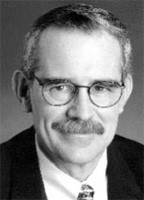
But lo, out of the pack, separate from the herd and as foreign to our minds as a zebra in a jumpsuit, there is a journalist who understands money, makes actual money through investing and, most particularly, breathes clearly (without panicky hiccups) within the stockyards of the stock market. Santa Rosa-based writer Brad Zigler, in fact, can even talk about the stock market without trailing off into a stupor. And talk he does, each Friday evening on KRCB 91.1-FM, detailing the triumphs and woes of a very local segment of the national trade, those publicly held companies found solely in Sonoma, Marin and Napa counties.

Speaking by phone from his office, Zigler says that he formed his own North Bay Stock Index (NBSI) to give area investors a sense of how local stocks stack up against the big boys found on the Dow Jones and S&P 500 reports.

As with so many other checkbook-involved things, location can be a key to making a profit in the stock market. And co-habitating with an area business often gives investors an advantage. “Research done at the University of Illinois showed that the average household invests nearly one-third of its portfolio in local stocks,” Zigler says. “The suggestion was that somehow these investors were able to exploit local knowledge to outdo conventional benchmarks, like the S&P 500. What that boils down to is that the locals knew something that the rest of the world didn’t. That’s not hard to see. A lot of local stocks are ‘orphans.’ Nobody’s paying attention to them, no one’s writing about them, no one’s analyzing their data.”

Zigler, who used to write regularly for the North Bay Business Journal and who now freelances full-time (often under the byline “the Curmudgeon”), is kind to orphans, singling them out for attention on his weekly radio broadcast. Stock in the ZAP electric car company, for example, grew over 205 percent last year alone. To this writer, that sounds like a sure thing. To that writer, however, emotions run more calmly.

“It’s what ZAP did in 2006,” he stresses politely. “But if you decided to buy stocks solely on the basis of how well they did previously, you’re making an assumption of a trend that may be overstretching it. There’s not a guarantee, nor necessarily even a strong probability, that ZAP is going to go up past 205 this year. When you’re looking at 205 percent, you’re looking at a stock that’s priced at about $1 now, and you had to have started at a very low level to get that gain.” Actually, ZAP stock ended its boffo year at 79 cents a share. Zigler may have a point.

Some nine companies from Sonoma County are publicly traded; five of them are banks. In Marin, the Bank of Marin is a huge player, as is the video tech firm Sonic Solutions, a few other banks and Restoration Hardware, the gadget store that revalued the sex appeal of antique veneer on door handles in the ’90s. Napa is also lousy with banks and curiously only has one wine company in the market, Andretti Wine Group, co-owned by retired race car driver Mario Andretti and his partner Joseph E. Antonini, the former CEO of Kmart.

There is little left of what Zigler terms the “tech wreck,” that giddy period of time when it looked like the North Bay would be a Silicon sister to those information-friendly folks in the South Bay. Does Zigler see the North Bay resurging in the tech industry?

“Well,” he says cheerfully, “it’s awful damn expensive to live here and work here. The decision for a business to come here is often more a lifestyle issue than an economic issue.

“But if you’re going to be broke,” he shrugs, “what better place is there?”

Our sentiments exactly.

‘Brad Zigler’s North Bay Stock Index’ is heard every Friday at 6:04pm on KRCB 91.1-FM.


Land of the Fee

Photograph by Felipe Buitrago Paper/work: Adel Olivera, left, director of...

UnReal Estate

March 7-13, 2007The Money Issue: A house appraised at $500,000 two years ago now sells for $400,000. "We've lost $100,000" wail the neighboring homeowners, who bought cheaply and expect their property values to soar each and every year. But that "lost" $100,000 is fantasy money, say real estate experts. How can you lose something you never really had?Home...

News Briefs

March 7-13, 2007 North Bay views?Is global warming a potential threat to our local economy and quality of life? According to a recent annual survey by the Bay Area Council, 42 percent of North Bay residents think it's "very serious" and 36 percent view it as "somewhat serious," with only 12 percent saying it's "not too serious," 4 percent calling...

News of the Food

March 7-13, 2007 I'm pretty skeptical of diets, and I've never been on one. The fact that there's always a new fad diet making even greater promises than the last one only reinforces how specious their claims of health benefits and weight loss are. But as I was reading an article in the New York Times recently about a reported...

Soulsville, USA

March 7-13, 2007America is doing some serious soul-searching. After six years of treachery in the White House, opinion polls show that an overwhelming percentage of American voters would seriously consider electing a black president--and that's good news for the charismatic senator Barack Obama of Chi-town.How ready are we for a black president?The pundits are already arguing if Obama is...

The Ag Report

March 7-13, 2007The face of agriculture, as Northern Californians have known it for decades, has changed forever. Old faces have vanished and new faces have arrived. The days defined by barbed-wire fences, locked gates, crop-dusting, "No Trespassing" signs and a near-medieval state of mind have disappeared. All across Sonoma, Marin, Napa and Mendocino counties, a new generation of artisan...

Mightier than the Chord

March 7-13, 2007The ides of March is around the corner, and the mere anticipation of ambition has dogged every sophomore release this year so far. Even Bloc Party aren't immune, especially with their PR flak's lofty suggestion that their new disc, A Weekend in the City, is another OK Computer. (It isn't.) But unlike the Killers' musical murder of...

Splitting the Jar

March 7-13, 2007The Money Issue: 'So, how are we going to split up this money?"Someone was bound to ask it sooner or later. It's hard enough to count all the crumpled-up and folded bills from the pickle jar when there's only enough room to form separate piles on my knees in a back seat crowded with 12-packs and...

Six Reasons

March 7-13, 2007The Money Issue: Please forgive us for quoting Karl Marx, whose writing is just a bit on the dense side, but he says it best: "This physical object, gold or silver in its crude state, becomes, immediately on its emergence from the bowels of the earth, the direct incarnation of all human labour. Hence the magic...

Money Talks

March 7-13, 2007The Money Issue: Money's not something we ordinarily talk about here at the Bohemian, at least not without plenty of tissues nearby. Bob Woodward, Norman Mailer and Phil Bronstein notwithstanding, journalists don't tend much to the growing of dosh. Not only do we basically not understand money and, having never seen much of it, deeply distrust...
11,084FansLike
4,446FollowersFollow
6,928FollowersFollow