Online Without a Spine

0

Light Reading: Brewster Kahle, director of the Internet Archive, and ‘the Scribe,’ the scanner used to get public-domain works online.

By Richard Koman

Say you’re in school and you have to write a research report on the anti-slavery movement in the United States in the mid-19th century. Where do you go?

Hmmm. How about taking a look at the James Birney Collection of Anti-Slavery Pamphlets–a collection of over a thousand abolitionist books, pamphlets and newspapers housed at the Johns Hopkins University Libraries. Fancy a trip to Baltimore? Right now, that’s the only way you’ll get to look at them.

But soon enough, the entire collection will be online as high-quality scans. So will the complete personal library of John Adams (housed at the Boston Public Library), the Getty Research Institute’s collections on art and architecture, the full archive of publications of the Metropolitan Museum of Art and UC Berkeley’s extensive collection of texts from the Gold Rush.

“Many people are turning to the Net as the public library,” says Brewster Kahle, director of the Internet Archive in San Francisco. “Unless the works are available on the Internet, they will be unavailable to the next generation. Our role is to make great materials available to our children.”

In January, the Sloan Foundation awarded a $1 million grant to the Internet Archive and the Open Content Alliance to scan and put online those classic materials from America’s past. The award is a stake in the ground, a flag that says information should not only be online but truly free, truly accessible, no matter what search engine brings you to the content.

“The capability to digitize all recorded human knowledge now exists for the first time, and it is important that we seize this moment and ensure that public works and the public domain at large remain in the hands of the public,” says Doron Weber, the program director of Public Understanding of Science and Technology at the New York-based Sloan Foundation.

The Sloan project is fundamentally different from Google Books, an initiative the search giant launched in cooperation with Stanford, Harvard, the University of Michigan and several other major university libraries.

For one thing, Sloan’s paltry million bucks is a drop in the bucket compared to the upward of $100 million that Google is spending. Google’s footing the bill for all of the scanning, and the universities are giving Google access to millions of books. That’s money schools like Stanford are happy not to be spending themselves.

Google is really putting only one condition on the partner libraries: that the books are only indexed by Google. That means if you use another search engine, you won’t have access to these works. Use Google, you get access.

That’s a deal breaker for people like Kahle. His first company was based on the open source search system, WAIS, that he developed in the late 1980s. He later sold WAIS Inc. to America Online and a second company, Alexa, to Amazon.com.

Kahle has worked to make information available online for two decades, but the open-content movement goes back even further. It began some 30 years ago when Michael Hart, a professor at the University of Illinois, launched Project Gutenberg, an online collection of public domain books available in text, HTML and XML formats. Hart started by typing in texts like Alice in Wonderland and War and Peace. Today there are 20,000 texts online at Project Gutenberg (www.gutenberg.org), which are also hosted at the Internet Archive (www.archive.org).

The Archive serves as a kind of portal to a number of open content efforts, including Gutenberg. The other projects are not just text renditions of books but full-color scans that can be downloaded as PDFs or in a highly compressed format called DjVu. Among the efforts: the Million Book Project, Microsoft’s book search, the scanning of American and Canadian libraries and the Archives’ own scanning efforts. There are a total of 100,000 public domain books freely available for download and printing on the Archive site.

“People are deciding to go open,” says Kahle. “People are interested in having the public domain stay public domain–and to do high-quality scanning that would be of value to the public and to researchers.”

The books that make up our heritage should be available online, but freely available, says Kahle. “We want the books available through Google, Yahoo, Microsoft, libraries. The idea of locking things down doesn’t make sense in this Internet age.”

When Google Books launched, the company said they would scan books in copyright, as well as public domain books. That made publishers mad. Really mad. In 2005, publishers and authors sued Google and the company made some changes to accommodate those concerns.

The Archive project will have no such issues; it’s focused totally on works that are in the public domain.

“The first step is public domain works, then orphan works, then out-of-print works, then in-print works,” says Kahle. “For in-print works, I think we’ll see publishers take a role in distributing their works.”But the orphans will be locked up for a while longer.

“Orphan works” are those that would have entered the public domain if it weren’t for a 1976 rewrite of the Copyright Act that made copyright registration optional. In 2004, Kahle and ephemeral film collector Rick Prelinger sued the government to try to “free the orphans.” But a panel of the Ninth Circuit Court of Appeals ruled last month that the orphan works will stay where they are.

“What is at stake is if libraries of the future can provide access to out-of-print materials after the publishers and authors are gone,” says Kahle. “This case had only one purpose: to get the judge to say that the structure of copyright had changed so we can get the law examined, and he did not seem to even answer the question. Very sad. Another opportunity missed by our government. Sometimes, I think some of the more senior judges haven’t bothered to understand what is happening to our civic institutions in our digital age.”

Perhaps a little copyright history is in order. For almost 200 years–from the adoption of the Constitution in 1789 until the bicentennial in 1976–you had to register a copyright, which lasted for a certain number of years, and then renew it. If your work no longer had commercial value, you wouldn’t renew it and it would enter the public domain.

The rules changed in 1976 with a rewrite of the Copyright Act. The intent was to bring the United States into compliance with the Berne Convention, the 1971 international accord on copyright issues, and the new law did away with the registration and renewal requirement. Now work is copyrighted upon creation–you don’t even have to publish or print the “©” symbol.

But there are a number of works that hadn’t been renewed and would have entered the public domain if not for the new law. These so-called orphan works have no commercial value and yet are locked up under copyright. They can’t be scanned or published online or used in derivative works until their copyright expires. And copyright now lasts a very long time: a 1998 law named after Sonny Bono extended copyright to the lifetime of the author plus 70 years.

So Kahle and Prelinger filed suit, hoping that the courts would order the Copyright Office to remove copyright protection from these works. In rejecting the Archive’s request, the Ninth Circuit judges said that Kahle and Prelinger were essentially complaining that copyright was too long–the same argument that had earlier been made and rejected in the U.S. Supreme Court.

Chris Sprigman, the lead lawyer in the Kahle case, wrote on his blog that he was “maddened” by the Appeals Court’s refusal to take on a key aspect of the Supreme Court’s Eldred decision–that unless changes to the copyright laws “alter the traditional contours” of copyright protection, they don’t offend the First Amendment.

Sprigman, Kahle and Prelinger are appealing the decision for review by the full Ninth Circuit Court of Appeals.

Kahle wants the court to clarify that groups like the Internet Archive can make out-of-print works available on the Internet.

“Otherwise we live in a world of just very old works in the public domain and commercially available works. Everything in between effectively will be denied the next generation,” he says.

“We could lose the 20th century.”


Ask Sydney

0

March 14-20, 2007

Dear Sydney, my mother and I are trying to reestablish a relationship following estrangement. She’s an alcoholic, and one of the last times we were together, she drank a great deal and was pretty abusive. I’ve asked her to visit in the Bay Area and don’t want to repeat this scene. On the other hand, my mother is an old and frail woman and I do not want to patronize her by saying “no drinking.” Nor do I want to antagonize her just as we’re trying to find some common, if admittedly superficial, ground again.–Maternal Worries

Dear Mat: Even if you tell your mother that you don’t want her to drink, if she’s a practicing alcoholic, chances are she will anyway. She won’t be able to help herself. This does not mean that you are not justified in having clear boundaries in regards to what you are willing to subject yourself to, but you are not in control of your mother’s drinking. It’s neither your fault nor your responsibility. In fact, you can count on the fact that she will quite probably drink, no matter what you do. If this seems like something you don’t want to take on, then don’t invite to her visit.

The best thing you can do if you want to proceed with this reunion (and it seems as if you genuinely do) is go into the situation prepared to protect yourself. If things begin to go in a direction that feels abusive to you, make sure you can leave. Take your own car. Don’t share a room in the hotel. Have an escape route. Another good trick is to bring someone with you whom you trust for emotional support and to help negotiate your leave-taking, should that be necessary. And above all, try not to beat yourself up about this. Your emotional reaction to your mother’s drinking and subsequent behavior is to be expected. If you are interested in finding out more about alcohol related co-dependencies, Al-Anon is a great resource, and there are meetings all over the place. They’re in the phone book.

Dear Sydney, I’m hoping you can offer some advice on a very delicate situation. My friend just told me that she is pregnant from a brief relationship that she recently broke off. Her boyfriend moved to another state to go to college, and they decided to end their relationship because it wasn’t really going anywhere. Now she says she’s not going to tell him, that she doesn’t want any money from him (she has a pretty decent job), that she doesn’t even like him that much and that this is her baby. Is this OK? I’m thinking not.–Worried

Dear Worried: Maybe he doesn’t even want to know. If he’s just left town for college, chances are this is the last thing he’s going to want to hear about. Well, too bad for him. The fact that she is the one carrying the baby does not change the fact that this young man has paternity rights and responsibilities. Though the father may not want anything to do with the baby (his loss), it is still imperative that he be able to decide for himself. If she doesn’t tell him, the odds are that at some point he will find out anyway, and when he does, he will have every right to feel hurt and outraged that he was not given a chance to participate in the life of his own child. The exception to this would be if the guy is super-sketchy or abusive in some way. Every mother has the right to protect herself and her child. But based on what you say here, it seems like your friend needs to face the fact that she is going to have to be more involved with this guy than she wants to. Big bummer, there’s no denying it. But if she wants to have a baby without a father attached to the other end, then she should consider artificial insemination next time. It’s not that expensive and there are no strings attached.

Dear Sydney, I’m a person with a lot of ideas. My problem is, I can’t decide which one to do, or if I do, I only really stick with it for a little while. I have this feeling that I want to do something great, but I’m interested in so many things, it’s hard to stick with one for long. I dabble in different thing but inevitably feel like the new project just isn’t quite cool enough or I’m just not that great at it. I guess sometimes so much freedom is overwhelming. Any suggestions?–Flighty

Dear Flighty: Never take good ideas for granted. This is a skill to be proud of and one to foster. Take a moment to consider how wonderful it is that you are so excited by the world around you, that you have a flow of vibrant concepts moving through your head. It’s hard to know when to begin, however, and when to give up, how to tell failure from your own rising disinterest and how to have faith in yourself, when no one else seems to be paying any attention. In order to help you keep the faith and the focus, it could be useful for you to develop some sort of support system. See if you can pull together a group of friends who are also busy following through with their own great ideas, people you can talk to on a regular basis. It’s not that your support group will have all the answers; in fact, if you are an independent thinker, you will probably think most of their advice sucks. But what they can do for you is keep you from beating yourself up for no reason, and from losing hope. When all you have is an audience of one, it’s easy to get discouraged and doubtful. Collaboration will help you stay focused and help keep your energy up.

No question too big, too small or too off-the-wall.


Wine Tasting

0

More about this barrel tasting: Is it about conversing with the winemaker in the hush of the cool cellar over a cask of the nascent vintage? Well, you and a few thousand others. At the end of the hugely popular first weekend, a few who were manning the barrels confided about Saturday like they were talking about bad weather. Me, I have somewhat less enthusiasm for crowds than for good wine–but the wine wins. Now, my vegetarian soul wags, if there were only something decent to eat besides chipped beef . . .

The Heart of Sonoma Valley Wineries are always stepping it up with a theme-party atmosphere for barrel tasting. This year, 19 Kenwood and Glen Ellen wineries are hosting a foodie extravaganza. Finding nosh for the sip-sodden can be hit or miss, but Savor Sonoma Valley promises that wines will be “perfectly paired with culinary creations.” Arrive with an appetite for appetizers, and you will certainly be sated. Top chefs and caterers from the local roster, like the General’s Daughter, the Girl and the Fig, and Feast, will be on hand, as well as both cheese makers and cheese mongers. Meanwhile, the deceptively staid Chateau St. Jean is going off the hook–something about pirates, treasure and secret maps. Aaargh! Nice to see that the valley doesn’t take itself all too seriously. This event sells out, so snagging tickets in advance is not a bad idea.

Across the street from the historic mill in Glen Ellen, the winemaker himself at Eric Ross Winery will be grilling up savory mini cheeseburgers. I first heard of Eric Ross when it won top awards at the Harvest Fair a few years back, and I wondered if it was a guy I knew whose local band did a cookin’ cover of “Lowrider” at the end of the ’80s. Nope, nor is it the name of the rooster that struts across the label. Two wine enthusiasts, Eric Luse and John Ross Storey, got the winery going in the mid-’90s.

Eric Ross is something of an anomaly. The wine is made in Novato and plunked down in a tasting room in Glen Ellen. It’s become very popular on weekends, but on a cool winter’s Monday, we were the only visitors to enjoy the fire and hang out at the bar. The place is furnished with giant metal roosters, a plus.

The 2005 Saralee’s Vineyard Chardonnay ($25) has a full mouthfeel, honey and melon, and a hint of fresh vegetal aroma–a walk in the June garden. The 2005 Old Vine Carignane ($18) is surprisingly soft, not too acidic, and scented of vanilla and raspberry. The 2002 Feeney Ranch Old Vine Zinfandel ($30) has sweet raspberry jam flavor, with a whiff of spice–garam masala?

The knockout is the winery’s first Syrah, and I hope they don’t learn the wrong lesson from it. The 2005 Catie’s Corner Syrah ($28) stews menacingly in the glass with dark fruit, a brooding floral aroma and deep tobacco and plum. I’ll wade through the crowds to get a taste of the 2006.

Savor Sonoma Valley runs at 19 wineries Saturday-Sunday, March 17-18. www.heartofsonomavalley.com. Eric Ross Winery, 14300 Arnold Drive, Glen Ellen. Tasting room open Thursday-Monday 11am to 5pm. 707.939.8525.

View All

Into the Woods

0

the arts | stage |

By David Templeton

“Everything on Earth comes to an end.”

So states the lovable, bear-like non-philosopher Boris Simyonov-Pischik, at the conclusion of Anton Chekhov’s The Cherry Orchard, the best of the four new plays that open the annual Oregon Shakespeare Festival, in Ashland. Boris’ simple sentiment about the end of things is especially apt this year in Ashland. As OSF prepares to say goodbye to Libby Appel as Artistic Director (the top-dog for 12 years, she’ll be back next year as the director of one play), and sweeps off the welcome mat for incoming AD Bill Rauch (who’ll be helming Shakespeare’s Romeo & Juliet later this season and has already instigated a number of fresh changes), it seems that every new show this Spring carries themes of greeting the new, adjusting to the lost, or in the case of The Cherry Orchard, a little of both.

Directed and newly adapted by Appel (working with translator Allison Horsley), The Cherry Orchard is hits the stage of the Angus Bowmer Theatre hauling more than 100 years of musty baggage. The play ranks among Chekhov’s most daunting works, and bears the weight of being the playwright/poet’s final work (and some argue his finest), while also carrying the scars of generations of poorly-paced, overly-reverential productions. In Appel’s hands, the notion of The Cherry Orchard as a past-it’s-prime museum piece starts melting away from the show’s opening moments, which Appel interjects with a surprising bit of casual fun, and a clever, unexpectedly funny entrance for one of the play’s major characters. In everything from the lovely, intelligent acting to the beautiful set (Rachel Hauck), this one is a triumph, both heartbreaking and emotionally thrilling, easily the best work that Appel, as a director, has done in years, a point made clearer in reading the program notes, where the director describes The Cherry Orchard as her first great theatrical love.

Lyubov Andreyevna Ranevskaya (Judith-Marie Bergan), after several years spent abroad in Europe, has returned home to her family’s ancestral mansion at the edge of once glorious cherry orchard. Deeply in debt, the family has been ordered to put up the orchard and the house for public auction; the best Lyubov and her billiards-entranced brother Leonid Andreyevich Gayev (Richard Howard) can hope for is that a rich relative will buy the property and allow them, with their children and remaining servants, to continue living there. As Lyubov foolishly throws one last party, she wrestles with the suggestion of her long-time neighbor Yermolai Alekseyevich Lopakhin (Armando Duran)—the now-wealthy son of an impoverished former orchard-worker—that she and Leonid avoid the auction-block by agreeing to cut down the orchard themselves, and sell the property in pieces to developers. No mater which course of action the siblings choose, their days among the cherry trees have apparently come to a close. They are the only ones around who have not accepted this, except perhaps for the chronically cash-strapped, reality-avoiding next-door neighbor, Boris (a marvelous Anthony Heald, who some will recognize as one of Hannibal Lecter’s most satisfying dinner companions in Silence of the Lambs). Chekhov peoples the play with a large cast of characters: daughters and sons, friends, servants, the children of servants, and in this production, all of them leap to life with performances that avoid cliché and melodrama, remaining interesting by imbuing every action and line-reading with vitality, hope, fear, despair and bushels of proud, beautifully bruised humanity.

While some productions attempt to juice things up by playing the various characters against one another, exploiting the various betrayals and deceptions to turn Chekhov’s comedy-drama into some sort of Russian ‘Dallas’ or ‘Dynasty.’ Appel is too smart, and too respectful of Chekhov, to allow such easy tactics. In this production, one is a villain, even those whose choices rob others of their greatest hopes. The tone of the play, right up its playful final line (made more-so in this translation) and a devastating auditory grace note (I’ll say no more), blends gentle doses of humor and sadness. Appel, in her reworking of the text and her sure-handed direction of the action, underscores everything with a sweet, gradually escalating sense of impending, inescapable doom. But do not think this is not a downer of a play; as heart-rending as Chekhov’s swan-song is at times, neither he nor Appel let us forget that for every ending, for every cherry tree chopped down, something new will come along to take its place, that overwhelming grief and loss are usually followed, given enough time, by love and friendship, kindness and hope.

This is a variation of the same theme explored in David Lindsay-Abaire’s Tony-nominated Rabbit Hole, directed in Ashland by James Edmondson in OSF’s smallish New Theatre. Becca (Robin Goodrin Nordli) and Howie (Bill Geisslinger) are upper-middle-class suburbians, each fighting in their own way to keep their head above water in the wake of their young son’s recent death in a car accident. Becca, after 8 months, is systematically clearing the house of reminders of Danny, removing photos from the refrigerator, giving away his toys, his clothes, his dog. Howie, working through his pain through group therapy sessions (which he attends alone), takes a more extraverted approach to his grief, telling total strangers about his son’s death, indulging in late-night viewings of Danny’s baby videos. Becca’s self-absorbed, happy-go-lucky sister, Izzie (Tyler Layton), reacts to her sibling’s sorrow mainly by ignoring it, filling the silent spaces in their conversations with casual chatter, wry observations and quick quips about things like the potential stalker status of the Runaway Bunny’s mother. Nat (Dee Maaske), the sisters’ widowed mom, has her own view of how Becca should be dealing with the loss of her son, having grieved the death of her own son, under very different circumstances. Becca, simultaneously fragile and distant, does not take her mother’s suggestions graciously, nor is she happy when Izzie casually announces that she is pregnant. This is a family that is ready to fly apart at the seams, stuck in place and unable to take first step toward healing, with everyone but Izzie either magnifying the relevance of trivial things or minimizing and avoiding the issues that desperately need addressing. When young, guilt-ridden Jason (Jeris Schaefer) appears on the scene—he’s the teenage boy who was driving the car that took Danny’s life—it is clear that the young man’s presence will either be the “first step” the family needs to move ahead, or instead—switching metaphors the way Becca changes subjects—might be the trigger that finally blows everything apart. The cast is excellent, particularly Nordli and Layton, though the comparatively inexperienced Schaefer can’t quite match the others in emotional depth and intensity; it’s not a fatal flaw, since this is a kid who isn’t on the same level as the others, realizing that he’s done something bad, but not quite understanding the depth of this family’s pain.

There is an exquisite moment late in the play where Becca sits at the table with her mother, and finally allows Nat—who is usually hiding behind a wall of gallows humor—to describe her own grief as having been like a giant brick that gradually grew smaller, until she could finally crawl out from under it, and then carry around.

“Like a brick in your pocket,” she says. And you forget it every once in a while, but then you reach in for whatever reason and there is is: ‘Oh, right.’ Which can be awful. But not all the time. Sometimes . . . it’s not that you like it exactly, but it’s what you have instead of your son, so you don’t wanna let go of it either.”

There is nothing original or groundbreaking in these people’s grief, and that is part of the point of the wise and open-hearted script; this mother and father are not exceptional. On the contrary, they are the perfectly normal, they are exactly like millions of others who’ve walked that same road before them, a point that Edmondson makes clear in the way the family’s house is replicated in identical house images painted on the back of the set. The most devastating moments in the play are nothing extraordinary, as when Howie discovers that Becca has accidentally taped over the cassette of Danny taking his first steps; it’s a small thing that carries enormous emotional weight, and the scene is beautifully played, with agonizing believability, by Nordli and Geisslinger.

On the subject of the set, designer Richard L. Hay has created a remarkably detailed home for Becca and Howie to live and fall apart in, from the working refrigerator and kitchen sink to the split-level living room, nicely crammed with books, knickknacks, and the little bits and pieces of normal people’s lives.

Normal people are nowhere in site in ‘On the Razzle,’ Tom Stoppard’s giddy, confectionary reworking of Johann Nestroy’s ‘Einen Jux Will er Sich Machen,’ already adapted by Thornton Wilder (twice) as ‘The Merchant of Yonkers’ and ‘The Matchmaker,’ which eventually evolved into ‘Hello Dolly.’ Stoppard’s verbally supercharged adaptation is like none other, a crazy, silly, crude, impossibly high-spirited farce, nicely staged in the Bowmer Theatre, directed by Laird Williamson with an eye toward dazzling color and visual flash. The set, by Michael Ganio, is worth the price of admission alone, bright, bubbly music-box of a set, with gizmos and whirligigs, screens, scrims and furniture, all spinning and whirring about like a top gone mad.

The story is a classic, a sentiment that’s affirmed by the resourceful manservant Melchior (G. Valmont Thomas), whose oft-repeated exclamation of choice is, in fact, “Classic!” Within the bustling Austrian grocery emporium of the self-important Herr Zangler (Tony DeBruno), two secret plots are about to be launched; with Zangler preparing to spend the day in Vienna proposing to his fiancé and appearing in a grocers’ parade, Zangler’s nice and ward, the virginal Marie (Teri Watts), plan to take advantage of her uncles’ absence by eloping with the besotted Sonders (Shad Willingham), whom Zangler opposes as a marital choice due mainly to Sonders’ lack of money—and his knack for saying innocent things that sound sexual. Simultaneously, Zangler’s Chief Sales Assistant Weinberl (Rex Young) is conspiring with the shop apprentice Christopher (Tasso Feldman) to close up the shop and escape to Vienna for a few hours of tantalizing life experience. That Weinberl and Christopher will accidentally end up on a date with Zangler’s fiancé Mmme. Knorr (Suzanne Irving) and her friend Frau Fischer (Teri McMahon), and that all of them will end up at the same restaurant as Zangler, Marie and Sonders, will come as no surprise. The wonderful thing about ‘On the Razzle’ is not what happens, but how much fun Stoppard has with all of the details, and especially the tangled, witty, pun-filled dialogue.

Early on, when Sonders falls on his face in front of Zangler (who is clad in his underwear in anticipation of the arrival of his new uniform), Sonders ends up clutching at the ankles of the affronted Zangler, who exclaims, “Unhand my foot, sir!”

“But I love your Niece!” replies Sonders.

“My knees?” gasps Zangler. “Oh! My Niece!”

It’s that kind of play.

The climax is predictably satisfying, with everything wrapping up neatly—and just in the nick of time. The cast is marvelous at working the jokes, milking the audience for every groan or roar of approval. It’s not classy, but it is great fun, and you might find yourself purchasing the script in the lobby, just so you can take a another trip through all of that marvelously silly word-play.

The one-and-only Shakespeare play in Ashland at the moment is ‘As You Like It,’ with ‘The Tempest,’ ‘Taming of the Shrew,’ and the aforementioned ‘Romeo and Juliet’ all opening on the outdoor Elizabethan stage in June. Unfortunately, As You Like It is the one disappointment in the first batch of shows. Directed by J.R. Sullivan, staged in the Bowmer Theatre, the central idea of this production seems promising at first. Shakespeare’s tale of banished noblemen gathering in the Forest of Arden to form a new society based on nature, poetry and love, has been transplanted to 1930’s America. The cast is dressed in weathered overcoats and work shirts, and Shakespeare’s numerous songs are performed by a series of jug bands and country-tinged singers. Clearly, the producers were aiming for an ‘O Brother Where Art Thou’ kind of vibe, but they’ve ended up closer to just, ‘O brother!’

‘As You Like It’ contains some of Shakespeare’s most beautiful and famous language, including the beloved, “All the world’s a stage” speech. Until this production, I’ve never noticed how talky this play is, as if Shakespeare strung together a bunch of clever speeches he’s written in the privy, tossing in some plot points here and there to hold it together. Blame the pacing, which inches along when it should trot, bounce and scamper, and blame the director, who’s allowed half-a-dozen misguided characterizations. The worst is Rosalind, played by the typically solid Miriam A. Laube. As written, Rosalind—the daughter of a banished lord, who follows her beloved Orlando (Danforth Comins) into the woods—is full of wisdom and beauty, the most grounded person in Arden. But Laube plays her as a perky, shallow schoolgirl, all giggly and intoxicated with love. It doesn’t work. Jaques, the melancholy nobleman who delivers the aforementioned “All the World” speech. As played by Robert Sicular, is not melancholy so much as he is irritable and bored and kind of grouchy, which takes the fun and pathos out of character. We are supposed to like Jaques and wish for him to cheer up, but in this production, his moments off stage come as a relief. Similar bad choice render much of the cast of characters unlikable, and if there is no one to like, all we are left with is a pretty set full of crabby rich people.

The set by William Bloodgood is otherworldly in an It’s a Small World or The Many Adventures of Winnie the Pooh mode, with the forest suggested by gliding panels of two-dimensional painted-wood leaf groupings that are added to as the play progresses. There are pleasures to be had in this production, and some surprises. The Act I wrestling match between Oliver and the hit-man/wrestler Charles (Todd Bjurstrom) is extremely well-staged, and the climactic reunion between all the various lost relatives is effectively moving. Still, compared to the vibrant energy and depth of the other three shows, the overall vibe of this ‘As You Like It’ is as flat and unconvincing as those wooden cut-out leaves hanging from the rafters.


View All


Museums and gallery notes.


Reviews of new book releases.


Reviews and previews of new plays, operas and symphony performances.


Reviews and previews of new dance performances and events.

Letting Loose

0

music & nightlife |

Multiculti bliss: Lila Downs avoids the traps of authenticity.

By Gabe Meline

Man, I hate authenticity these days.

All this media bullshit about Barack Obama not being “black enough” has put me in a fluster over our cultural worship of the authentic background. Every celebrity’s biography, it seems, is geared to prove that dues were paid and obstacles overcome in some vague, holy quest to “stay true.” We’re bombarded with these backstories and we eat them up.

We demand authenticity in music, don’t we? Music that comes from a true source, whether way down in the swamps or high up in the hills, is our cultural grail. We hunger for a living representation of purity, someone upon whom we can bestow the ultimate honor: being the “real deal.”

But this phenomenon’s all-too-common opposite–writing off anything that blurs particular prejudices of geography, economic status or race–is a dangerous practice at large, and extremely limiting for music in particular. What if a milk-faced kid from Tupelo had never discovered rhythm and blues? What if four straight-edge guys from D.C. had enrolled in grad school instead of starting a hardcore band? What if three girls from Texas had never broken through country music’s blind support of the president?

Where would we be then? I’ll tell you: we’d be listening to the same 29 Robert Johnson songs over and over again, stagnating in a pool of self-imagined authenticity. In fact, I know some of these people, and take my word for it, they are not an exceptionally happy bunch.

I don’t mean to be purely reactionary here. I’m simply explaining my own shortsighted judgment when I first discovered that Lila Downs, the sensational Oaxacan-born singer of Mexican rancheros and spirited carrier of the Mesoamerican tradition, had actually been raised in America by a Scottish-American father, graduated from the University of Minnesota, sung jazz in Philadelphia and for a few years–sin of all sins!–followed the Grateful Dead around the country.

My mind reeled. My knee jerked. How could this be? Inside, I felt the distressed pang of being duped.

But I decided to immediately listen again to Downs’ latest album, La Cantina, in an experiment to determine if her music had, in fact, been tarnished by this new revelation. It hadn’t. Moreover, the very elements in her music that betrayed a traditional Mexican heritage–angular big-band arrangements, drum and vocal loops, a cappella choirs–were the same distinctive elements that drew my attention to Downs in the first place and opened me to the powerful emotional range of her rich, throaty interpretations of native Zapotec, Maya, Nahuatl and Mixtec Indian songs. She appears at Yountville’s Lincoln Theater on March 23.

Over the phone from a Hollywood hotel last week, Downs admits that she’s taken knocks from hard-line traditionalists for not being “authentic” enough, but she has the sage detachment to laugh about it. “I’m sure that I do get criticized,” she says. “I’ve heard of some in Veracruz. But of course, nobody tells me to my face.”

Why would they, when every musical tributary that Downs has explored has only enriched her palette? Through singing jazz standards like “God Bless the Child” or “Tenderly” at smoky clubs in Philadelphia, she picked up a deceptively uninflected phrasing that she employs to fragile degree throughout La Cantina. “I think it’s always a point to come back to, the standards,” she explains, “and to somehow always envision that life.”

Through singing tango music in the highly acclaimed movie Frida, Downs was able to reach a wide audience–and to help liven up the Academy Awards show in 2003. “It was kind of a somber time,” she recalls of the broadcast. “I remember that the war had just begun, I think, the day before. So we were all kind of just a little quiet. I remember that Michael Moore was there, and that,” she laughs, “was kind of a relief.”

A move to New York City allowed Downs to assemble an outstanding multicultural band, incorporating electric instruments and modern production. “I really dig the electric guitar,” she says. “It just kind of opens your soul, you know, and it opens lots of different things, the way that you feel about life, and you can let loose.”

There’s one musical avenue that didn’t stick, however. Despite seeing the Grateful Dead night after night, Downs shows an uncanny lapse in memory when it comes to the band’s music. If you can remember it, as the saying goes, you weren’t there, and when asked what her favorite Dead song is, Downs clarifies that she was, in fact, there.

“Yeah, I think I have, uh, several that I kinda, that I like,” she stumbles. “I like, uh, uh, let’s see . . . There’s a song that goes, ‘Friend of the devil is a friend of mine.’ I like that song, it’s pretty cool. It’s renegade, it’s that kind of thing. And that was really one of the reasons that I was attracted to that whole scene, was kind of like droppin’ out, you know, that whole thing that we have to go through in life.”

Has she ever regretted following the Dead instead of pursuing her own music? “I don’t think you can ever turn back once you go in that direction,” she insists. “I mean, for me, it wasn’t ever just a phase. It really made an imprint on my life, and it made me believe in certain things and I try to stick to those things.”

Now, on the eve of an acoustic West Coast jaunt, sandwiched between tours of New Zealand and Spain, Downs is looking forward to spending time, she says, in California, where the Mexican population “has so much to do with who I am as an individual, these issues that have to do with migration and the Mexican-American community.” Downs’ 2001 album Border explored the immigrant experience.

Of course, despite the vineyard-worker population, Napa Valley is for the most part a very upscale area, and I ask if, when she performs in regions like this, she’s still able to connect to the people of the community that gave birth to her music. “I hope so; I mean, that’s one of our challenges–always trying to bring audiences together,” she offers, having earlier in the day filmed a television special for Univision and about to conduct an on-air interview for NPR. “We’re very lucky, our audiences vary quite amazingly.

“The question is finding a way that the music can bridge those gaps between people who are in different walks of life,” she stresses. “I think that’s very important, so that people aren’t so afraid of one another.”

Lila Downs performs on Friday, March 23, at the Lincoln Theater, 100 California Drive, Yountville. 8pm. $25-$50. 707.944.1300.


FIND A MUSIC REVIEW

Modern Irish Bounty

0

Photograph by Robbi Pengelly
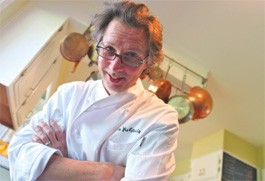
Craickin’ on: Fred Astaire’s grandson Kevin McKenzie has a love of fresh Irish cuisine.

By Patricia Lynn Henley

To truly celebrate St. Patrick’s Day, savor mussels cooked in Guinness, leg of lamb baked in lavender and hay, or have some tasty smoked salmon. That’s the real taste of Ireland, explains chef Kevin McKenzie.

“It’s a very pristine, pure, gorgeous country with amazing food,” McKenzie asserts, standing in the sunlight-drenched kitchen of his Santa Rosa home. “I think people just don’t get what Ireland is. Americans equate Ireland with pubs and fried food.”

McKenzie will be exploring what the media has dubbed the “new Irish cuisine” at a March 17 cooking class in Healdsburg and through a tour of Ireland in July, both sponsored by Relish Culinary School.

And while it’s true that Ireland is filled with pubs and their standard grub, McKenzie says, it’s also filled with culinary riches–a coastline brimming with lobsters, mussels, shrimp and fish, and acres of rich farmland, where the concepts of sustainable eating and Slow Food are entrenched, centuries-old traditions.

“The best smoked salmon in the world comes from Ireland,” he proclaims. “There’s a lot more depth to Irish cuisine than people understand. There’s an incredible amount of bounty there.”

The problem, he adds, stretches back about 150 years ago to the Irish potato famine, when they lost their base crop. “I think they lost faith, literally, in their land,” he muses. In a country of some 8 million people, more than 4 million emigrated, many to the United States.

But Ireland’s recent economic revival as a major player in the high-tech world has led for the first time in more than a century to reverse immigration, with Irish people moving back home, embracing new opportunities and old traditions.

“There’s a resurgence and a new faith in their land,” McKenzie says.

There’s also more money. “People with money tend to eat good food.” McKenzie adds that people flushed with financial success will travel and try other cuisines, bringing more sophisticated palates back to their home tables.

“There’s almost like a world menu right now,” he says, adding that there’s always been great food in Ireland. It’s just that people, especially in the United States, are only now starting to realize that.

“It’s like when California cuisine became a buzz word. I think Irish cuisine is finding it’s own focus.”

McKenzie should know. He launched his career at the beginning of the California-cuisine movement, training under such world-renowned chefs as Jeremiah Tower and Jonathan Waxman. McKenzie, now 50, owned the acclaimed Rover’s restaurant in Seattle, and spent several years in Los Angeles as a successful caterer and private chef. His culinary feats included organizing the Academy of Arts and Motion Pictures’ Governors Ball three years in a row.

After suffering through a number of personal losses, McKenzie wanted a simpler life and a chance to renew his passion for food. In 2000, he and his wife relocated to Sonoma County from LA.

“Being a chef and a writer, this area is just heaven for me,” he enthuses, “all the artisans and all the farms.”

In some ways it’s similar to the bounty in County Cork, Ireland, where his parents, Ava Astaire McKenzie (she’s the daughter of Fred Astaire) and Richard McKenzie, bought a farmhouse 30 years ago. The property includes an 12th-century tower.

“The view from there hasn’t changed,” McKenzie says. “It’s been the same for eight centuries.”

The family enjoys the deep Irish connection to the land and the sea. Ava is the author of My Home in Ireland: Cooking and Entertaining with Ava Astaire McKenzie, and Richard wrote Turn Left at the Black Cow: One Family’s Journey from Beverly Hills to Ireland.

Kevin McKenzie visits as frequently as he can, cooking with his mother in her kitchen and savoring all the local culinary riches. After a trip to Ireland last year, he returned with boundless enthusiasm for all that County Cork has to offer, says Relish Culinary School owner Donna del Rey.

“He came back and said we have to take people there, it’s really an amazing place.”

So Relish, which sponsors a number of local culinary tours, is organizing its first overseas adventure, From Farm to Fork: Ireland Culinary Tour this July.

It will be an insider’s look at County Cork and its modern-day, Slow Food cuisine. A few of the planned activities include visits to Ballymaloe Cookery School on its 400-care sustainable farm and a rare public visit to the family-run Gubbeen Farm which cheeses, smoked meats and organic vegetables and herbs.

“As with our Sonoma County tours, we really will let the artisans speak for themselves,” del Rey says.

The schedule also includes a cooking class taught by Ava and Kevin McKenzie, using mussels harvested from the cove on the McKenzie property, produce fresh from Ava’s garden and other local goodies.

As a foretaste, Kevin McKenzie is teaching a class March 17 in Healdsburg on the contemporary Irish supper. The menu ranges from smoked wild Irish salmon on traditional brown soda bread to that leg of lamb baked in lavender and hay.

Except for a few items such as smoked mackerel, almost all the ingredients used in modern Irish cuisine are easily available in Sonoma County, McKenzie says, from mussels and salmon to artisan cheeses. It’s part of the growing Slow Food movement, where people are more aware of how and where their food is produced.

“It’s becoming a way that we’re reconnecting again, because we’re such a splintered society. Food is becoming a way we’re jelling again.”

And it’s a way to reach out to past traditions–real traditions of Irish bounty and abundance, not the stereotypical ones. The corned beef and cabbage dish that many Americans eat on St. Patrick’s Day isn’t even Irish.

“Corned beef and cabbage was actually invented in New York,” McKenzie explains. Irish immigrants wanted to recreate a traditional Irish bacon and cabbage dish, and corned beef by Jewish butchers was as close as they could come.

For a more accurate taste of Irish cuisine both traditional and modern, apparently County Cork is the place to go.

“Cork bills itself as the cultural center of the world, literally–they have signs proclaiming that,” McKenzie laughs.

From Farm to Fork: Contemporary Irish Supper, Saturday, March 17, 5:30pm, Alexander Valley Hall, Healdsburg. $75. 877.759.1004 or 707.431.9999. www.relishculinary.com.


SEARCH AVAILABLE RESERVATIONS & BOOK A TABLE

View All


Quick dining snapshots by Bohemian staffers.


Winery news and reviews.


Food-related comings and goings, openings and closings, and other essays for those who love the kitchen and what it produces.


Recipes for food that you can actually make.

Letters to the Editor

March 14-20, 2007

Old-fashioned questions

Congratulations on dealing with tough topics in the March 7 “Money Issue,” especially (“UnReal Estate”). Paul Krugman’s March 2 column in the New York Times acknowledges the impact of inflation in the housing sector as well as burgeoning personal debt as significant hazards for American financial stability.

Now we are seeing the next wave of economic tribulation as the housing market shrinks and the attendant crisis in proliferating equity lines of credit and the sub-prime mortgages taken out by people who really cannot afford the houses they are living in.

Where is an alternative? What happened to the instruction so many of us received in economics classes in high school and college that a sound budget was one where consumers chose a house priced at four times their family’s annual income?

What justifies the abandonment of this rule? Who benefits when home buyers take on overpriced, over-large houses? Are parents spending a good share of their time with their children or are they working a second job?

When foreclosures begin over home equity loans or at the level of sub-prime mortgages, what happens to those consumers? What happens at banks or mortgage lending institutions? What happens to our community?

Am I missing something here in that I still believe in living within one’s means? Am I old-fashioned for paying my bills?

Cecile Lusby, Santa Rosa

Aw, shucks

The Bohemian‘s “Money Issue” should win you some kind of publishing award. An excellent read, front page to back–the features, critics’ choices, cartoons, Brezsny–even the ads. I was moved to send a copy to Our Meg [artist Meg Hitchcock, recently relocated to Brooklyn] to remind her that intelligence, creativity and humor are still thriving here in the North Bay. Thanks, guys.

Claude Smith, Graton

Call me paranoid, but. . .

While I agree with Peter Byrne that (The Byrne Report, “Impeach Now!” March 7), I think one thing he failed to address is that the left fears the right, and rightfully so. The right controls most of the money in this country, all of the arms produced in it and has demonstrated with the Oklahoma City bombing that they are quite prepared to kill innocent Americans to achieve their aims. And rather than atone for it, right wing commentators now cite it as one of former president Clinton’s “security failures.”

Call me paranoid, but I can’t help but feel that Bush and Cheney have, during one of their bull sessions, at the very least riffed on a hypothetical scenario in which another terrorist attack is allowed to succeed that could serve as a pretense for use of the president’s war powers for a declaration of national emergency, the cancellation of November ’08 elections, and the indefinite suspension of the U.S. Constitution. But it’ll never happen, right?

Rich Jones, Monte Rio

Two-word cause

Peter Byrne seems bewildered by the dearth of “soldier age” attendees at the talks on impeachment of Bush-Cheney given locally by Elizabeth de la Vega and Cynthia McKinney. I suggest a two-word cause for that effect: no draft. It’s not that young people applaud the behavior of Bush & Ilk; it’s that they don’t take such shenanigans personally, as did their generational peers of the ’60s and ’70s. It could also be that they’re following the example of their parents (who by and large missed Vietnam) and who aren’t showing all that much urgency about changing things either, beyond perhaps some tut-tutting to pollsters for maybe five minutes–and the pollsters come to them!

Constant reader Don McQueen, Santa Rosa

Blue Teeth Brigade

Thanks for (“P.S. I Love You,” March 7). He’s right about this varietal turning teeth blue, which is why we had Blue Tooth Tours for a couple of years. We took to the highways and byways to extol the virtues of this dark and delicious varietal grape, Petite Sirah–hence, the morphing into Dark & Delicious.

With the wine industry being a billion-dollar business in California, and California being the fifth largest economy in the world, I say, “Make wine, not war!” and we’ll all be happier.

Jo Diaz, Windsor


Lucky Man

0

the arts | stage |

Photograph by Jenny Graham
Comedy tonight: Shad Willingham (right) and G. Valmont Thomas mug it up in ‘On the Razzle.’

By David Templeton

‘Welcome to our little winter wonderland. Please take the snow with you when you leave,” jokes actor Shad Willingham as he warmly greets a visitor to the very cold Ashland home of the Oregon Shakespeare Festival (OSF).

The phrase “winter wonderland” has been grotesquely overused, but on this day, the last Sunday in February during the opening weekend of OSF–and Oscar night to boot–the tiny burg of Ashland does indeed qualify for the right to be called a winter wonderland. Three days ago, the town received its heaviest snowfall in 50 years, and now the stuff is everywhere. On this morning, three months before the festival opens its large outdoor theater, the crowds are pleasantly small as the OSF launches its 10-month-long-season with four plays, a number that will eventually grow to 11. The four openers are Shakespeare’s As You Like It, Chekhov’s Cherry Orchard, David Lindsay-Abaire’s Rabbit Hole and Tom Stoppard’s On the Razzle.

The latter, a delirious comedy built out of outrageous puns, pratfalls and diabolical twists of plot and language, features Willingham in the role of Sonders, a would-be suitor to the virginal Marie, whose uncle, Zangler, opposes the marriage for financial reasons. Willingham, working with a cast of first-rate comic actors, gets some of the show’s biggest laughs, largely through a blend of extreme physicality and pitch-perfect timing.

“I’ll tell you this about Razzle,” Willingham says, taking a seat at a coffee shop around the corner from the theaters. “Comedy is really hard, and this is even harder. Our timing has to change from night to night. We start the show thinking, ‘OK audience, where are you at tonight? Oh, OK, you like the sophomoric material.’ Or, ‘I see, this crowd is going to be into the headier stuff, the linguistic gymnastics and the puns.’ It takes a while to gauge the audience and figure out how to play the show, how to anticipate which jokes they’ll be laughing at and which they won’t be.”

In June, Willingham will add another comedy, The Taming of the Shrew, to his duties, playing the part of Hortensio. This is the fifth season at OSF for Willingham, a graduate of Santa Rosa High School and a cofounder of the Sonoma County Repertory Theatre. Now a regular on the Ashland stage, Willingham says that performing here was a goal from the first time he visited while still in high school in 1981.

“I used to dream about getting a job here as an actor,” he says. “From the moment I saw my first Ashland show to the first time I actually, finally set food on that stage, I never stopped dreaming about this place. For an actor growing up in Northern California, this is Broadway. This whole town is a theater, this town is devoted to theater. There’s nowhere like it, except maybe New York City.”

While the drive from the Bay Area to Ashland takes most Ashland fans about seven to 10 hours, Willingham’s journey took a little longer: he achieved it in just over 20 years.

While in high school, where he admits he began hanging around with a “bad crowd,” Willingham got hooked on theater after taking Elizabeth Craven’s drama class at Santa Rosa High, then doing after-school plays with her husband, John Craven. It was an exciting time to be an actor at SRHS, with the Cravens staging controversial shows like Tobacco Road and Cabaret, the latter of which was notoriously shut down by the school board for its fishnets-and-swastikas realism. Over the next several years, Willingham performed with every North Bay theater company that would give him a part, spending several seasons with the nationally acclaimed Summer Repertory Theater program at Santa Rosa Junior College.

He earned his BFA at the North Carolina School of the Arts, then returned to Sonoma County with the intention of starting his own theater company. That company, formed with his friend Eric Cook, was the Illusion Theater Alliance, which staged two or three shows before Willingham was approached by director Jim dePriest. DePriest had recently acquired a small theater space in Sebastopol and invited Willingham to join him in starting a new theater company, Main Street Theater, the earliest evolution of what would eventually become the mighty Sonoma County Repertory Theatre. In its first few years, Willingham directed and performed in several shows, then–on what amounts to a whim–suddenly decided to see if he could make it in New York.

“My girlfriend at the time was a dancer,” he explains, “and one day she looked at me and said, ‘We’re young, we’re not tied down with a child’–except for me, of course–‘so let’s move to New York.’ Three months later, we were there.” He stayed for six years, during which time he learned everything there was to know about the high pressures of auditioning in the Big Apple and the New York restaurant industry. “I was like a lot of actors in New York,” he laughs. “I didn’t really know how to start my career. I just showed up.”

By the time he left, Willingham had done exactly two shows in New York, both of them off-off-Broadway, one as an actor and one as a director. On the other hand, he’d been doing quite a bit of regional theater over those six years, performing outside of NYC. Eventually, he decided to do the next logical thing for an actor: he went back to school to earn his masters degree, this time landing at the University of Washington in Seattle.

And that’s when the Oregon Shakespeare Festival finally took notice.

Over the years, he’d auditioned for OSF twice and been passed over both times. So when he was asked to come to Ashland and audition, he tried to remain realistic.

“But then,” he says, “they offered me a season, man! I did Demetrius in Midsummer and a couple of parts in Richard II. It was like a fairy tale. It was like, ‘Why do you go to graduate school?’ The answer is not, ‘To get a degree.’ The answer is, ‘So you can work at the Oregon Shakespeare Festival.’ If I’d known that, I’d have gone to grad school a whole lot earlier.”

On this snowy day in Oregon, however, Willingham is once again at a crossroads.

“I haven’t decided if I’m going to audition for next year’s season or not,” he reveals. “That dream of working here in Ashland, that dream I cultivated for 20 years, that’s not my only dream. I also kind of–and I’m serious, so don’t smirk–I want to win an Oscar.” He laughs happily.

“Hey, Ben Affleck has an Oscar,” he adds. “Why can’t I have an Oscar?” Next year could see Willingham in either Los Angeles or London.

This being the day of the Academy Awards ceremony (Willingham is hosting an Oscar party for some friends), the subject of acceptance speeches comes up.

“As someone who actually works on his Oscar speech from time to time,” he states, “I have actually given some thought to this, and to whom I will thank, someday, in my speech. Here’s the deal: I am a very, very lucky actor. When I first got into theater, I can confidently state that I was very definitely going down the wrong road. I was, maybe, a year-and-a-half away from doing some very bad things.

“So, first of all–and pardon me for being corny–I will thank my mom,” he says. “Even when I was going down the wrong road, my mother saw that I was searching for something to fulfill my . . . whatever–my emptiness. When I came to see theater as my calling, she didn’t discourage that. She didn’t suggest I come up with something to fall back on. She just said go for it. The drama class I took from Beth and John Craven at Santa Rosa High School–it literally changed my life. And I’d definitely thank Jim dePriest, who taught me that energy alone can get stuff done, that you don’t always have to have a plan, but you do have to have the energy to implement whatever it is you do come up with. These are the people who helped me become who I am. They are the people who helped get me here, and will be a part of wherever I end up next.”


View All


Museums and gallery notes.


Reviews of new book releases.


Reviews and previews of new plays, operas and symphony performances.


Reviews and previews of new dance performances and events.

First Bite

In our foodie version of The Merchant of Venice, Bassanio has won an all-expenses paid time-warp vacation package to the New World for himself and several of his acquaintances. He decides to smooth things over with his old nemesis, Shylock, by inviting him along. Forgive the bastardized iambic pentameter; it’s the best we could do on deadline.

The Merchant of Venice, Act II, Scene 3 (alt-version)

Early Saturday evening, St. Helena. Bassanio has formulated a plan to save his friend Antonio from Shylock, the villain. On a trip to the New World from Venice, the timeless characters Bassanio, Shylock and Portia find themselves in the 21st century, homesick for the food of the motherland. They enter Cook, a small restaurant serving Northern Italian cuisine, and take seats around a marble bar. From high on the wall, a paper lamp, shaped like the mounted head of a horned beast, glows prettily over them; a Waitress serves them a split-bottle of Felsina ($30), a red Italian wine.

Shylock: Methinks this wine smells strangely of rubber.

Waitress: Gee, you tourists certainly talk funny. But never mind. We’ll open another. If it’s alike, then it must be the wine.

Shylock: Indeed, the nose is the same. Vulcanized!

Bassanio: Yet, it stings the palate with fine acidity. Worry not, fair wench. We’ll drink it. Here, here!

Waitress rolls her eyes and rustles a small pad and pen from her apron.

Portia: Fetch us beets and ricotta ($9), and the arugula caprese with mozzarella and roasted tomatoes ($10).

The appetizers arrive, greens tousled rakishly on the plates.

Bassanio: Verily, it’s succulent and tasty! Good waitress, make haste and bring us the mains.

The Waitress returns, bearing gnocchi with Gorgonzola cream ($16), risotto with hedgehog mushrooms, teleme and braised pork ($20) and penne carbonara with pancetta and peas ($16).

Shylock: In sooth, this tastes genuine with a twist. Chubby and chewy are these dear gnocchi. Eating such, I shall gain what I covet: a pound of flesh.

Bassanio: Why, man, Antonio will be relieved! (aside to Portia) Zounds, our plan did worketh. As for my dish, this penne hath power. Upon such savory, I rarely munch.

Portia: Like ambrosia to Zeus this risotto doth please me, though the pork is right salty.

Shylock: True, these vittles shine in flavor, but their color lacks as alabaster.

Portia: Good sir, you are quick to find fault. Let me remind you, we ordered rice and pasta.

Bassanio: I propose an antidote to the white. Waitress, bring the flourless, chocolate cake ($7)!

The three friends indulge in a most delicious dessert–squishy, sweet and rich, accompanied by crème anglaise.Exeunt.

Cook, 1310 Main St., St. Helena. Open daily for lunch and dinner. 707.963.7088.


View All

Quick-and-dirty dashes through North Bay restaurants. These aren’t your standard “bring five friends and order everything on the menu” dining reviews.

News Briefs

March 14-20, 2007

Y’ice’ men cometh

Sweeps by Immigration and Custom Enforcement (ICE) teams in San Rafael and Novato March 6 and 7 sparked vigils in Marin County and fearful rumors throughout the North Bay. These are not raids, says ICE spokeswoman Lori Haley, but “targeted enforcement actions” executed under the lightly named Operation Return to Sender. Federal agents are searching for people who have ignored final deportation orders–ICE calls them “immigration fugitives”–but others are also picked up. “If we go to a house looking for one of our targets and identify others who are in this country illegally, they’re also subject to arrest,” Haley explains. Immigration and Custom Enforcement currently has two teams in the Bay Area with 52 teams nationwide, and expects to have 75 by the end of the year.

Opponents of these targeted enforcement actions call them raids and say they create a climate of fear prompting this nation’s estimated 12 million undocumented residents to keep their children home from school and to avoid contact with government officials of any type. The Marin Interfaith Council and the Canal Alliance hold weekday morning vigils to witness additional ICE activities in San Rafael’s Canal district. The goal, says the Rev. Carol Hovis of Marin Interfaith Council, is “to continue to stand watch with the neighborhood to decrease the level of fear and to be a public witness to the immigrant community.”

Fears and rumors about ICE activities caused a number of Petaluma residents to skip work and keep their children home from school, although ICE had no recent activity in Petaluma. The repercussions of these raids are felt throughout the North Bay, says Ellen LaBruce, executive director of La Luz Center in Sonoma. “People are afraid to leave their homes,” she explains. “You have kids who are going to school who may have heard from other folks or witnessed parents being separated from their kids. A six-year-old is not going to understand that they’re OK because their parents have legal papers. What they see is families being broken up.” The raids drive undocumented residents underground. “They’re afraid to be seen,” LaBruce adds. “People will only go out and do what they have to do to keep body and soul together, which means decisions are made that keep them more hidden. Someone who may be a victim or a witness of a crime is less likely to come forward. Someone who has a chronic medical condition is less likely to seek treatment until it gets so out of control they have to go to the emergency room.”

Changes need to be made, LaBruce asserts. “What we are pressing for is humane reform of U.S. immigration laws by showing the human impact our schizophrenic immigration laws create.”


Online Without a Spine

Light Reading: Brewster Kahle, director of the Internet Archive,...

Ask Sydney

March 14-20, 2007 Dear Sydney, my mother and I are trying to reestablish a relationship following estrangement. She's an alcoholic, and one of the last times we were together, she drank a great deal and was pretty abusive. I've asked her to visit in the Bay Area and don't want to repeat this scene. On the other hand, my mother...

Wine Tasting

More about this barrel tasting: Is it about conversing with the winemaker in the hush of the cool cellar over a cask of the nascent vintage? Well, you and a few thousand others. At the end of the hugely popular first weekend, a few who were...

Into the Woods

the arts | stage | By David Templeton ...

Letting Loose

music & nightlife | Multiculti bliss: Lila Downs avoids...

Modern Irish Bounty

Photograph by Robbi Pengelly Craickin' on: Fred Astaire's grandson Kevin McKenzie has a love...

Letters to the Editor

March 14-20, 2007Old-fashioned questionsCongratulations on dealing with tough topics in the March 7 "Money Issue," especially ("UnReal Estate"). Paul Krugman's March 2 column in the New York Times acknowledges the impact of inflation in the housing sector as well as burgeoning personal debt as significant hazards for American financial stability.Now we are seeing the next wave of economic...

Lucky Man

the arts | stage | Photograph by Jenny Graham Comedy...

First Bite

News Briefs

March 14-20, 2007 Y'ice' men cometh Sweeps by Immigration and Custom Enforcement (ICE) teams in San Rafael and Novato March 6 and 7 sparked vigils in Marin County and fearful rumors throughout the North Bay. These are not raids, says ICE spokeswoman Lori Haley, but "targeted enforcement actions" executed under the lightly named Operation Return to Sender. Federal agents are...
11,084FansLike
4,446FollowersFollow
6,928FollowersFollow